The Silent Farmhouse Beyond The Cornfields And The Vanished Keeper
CHAPTER 3: COLD COFFEE ON THE COUNTER
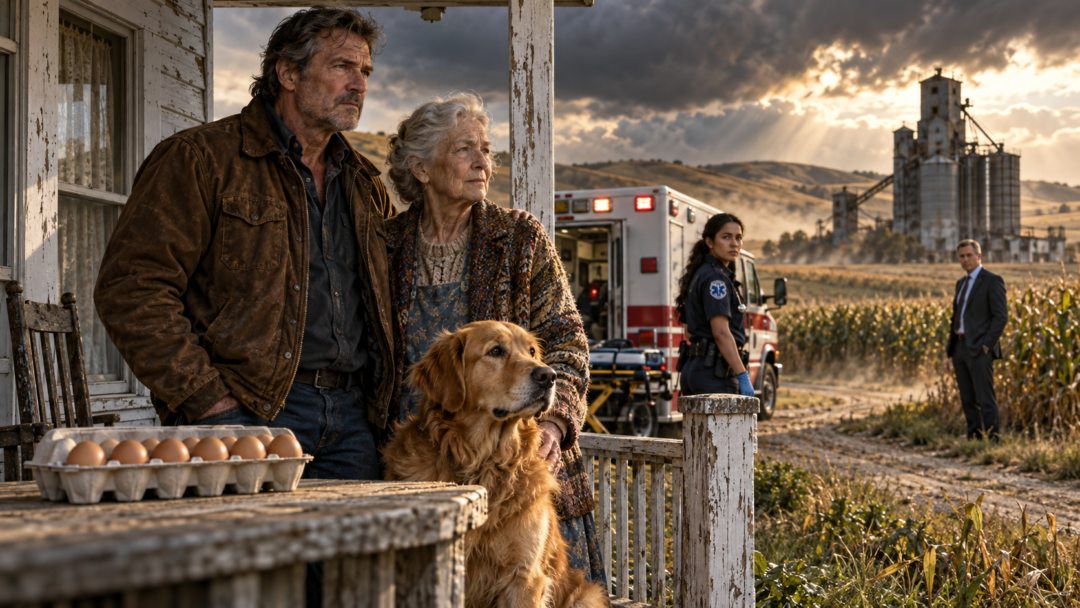
Jack did not look directly into the camera lens. He kept his head lowered, the brim of his leather jacket shading his eyes, and walked smoothly around the wrap-around porch toward the rear of the farmhouse, with Rusty staying tightly glued to his right heel.
The rear kitchen door had a nine-light glass window framed in painted pine. Two panes above the deadbolt had been punched inward; shards of heavy antique glass lay scattered across the linoleum inside, catching the amber sunlight. The wooden door stood half an inch ajar, held only by a secondary friction latch.
Jack drew his pocketknife, slipped the flat blade between the jamb and the strike plate, and eased the door open without a sound.
The air inside the kitchen was suffocatingly warm, smelling of stale chicory coffee, old linoleum wax, and dried grease. On the small Formica table in the center of the room sat a half-filled white ceramic mug of black coffee, a thick layer of grayish mold floating on its surface. Beside the mug lay an overturned plastic pill bottle—Hank’s sublingual nitroglycerin tablets, prescribed for acute angina. Dozens of tiny white pills lay scattered across the blue tabletop, completely untouched.
“They didn’t let him take his medicine,” Jack murmured, his hand tightening into an iron fist.
He stepped into the hallway, moving with the silent, balanced weight transfer he had perfected over thousands of hours clearing accident scenes and searching abandoned vehicles on dark interstates. The living room was in disarray. The drawers of Hank’s roll-top oak desk had been pulled out and dumped onto the braided rug. File folders containing tractor maintenance logs, seed hybridization charts, and old tax returns were strewn across the floorboards. But the steel fire-safe in the corner remained locked, its heavy chrome dial untouched.
Apex hadn’t been looking for money or titles; they had been hunting for the cassette tape and the 1888 patent.
Outside, the heavy crunch of gravel tore through the quiet prairie afternoon.
Rusty let out a low, menacing growl deep in his throat, the fur along his spine rising like a brush. Jack moved instantly to the front window, keeping his body pressed against the floral wallpaper, parting the lace curtains by half an inch.
A heavy, late-model black Ford F-250 Super Duty pickup had pulled into the driveway, parking bumper-to-bumper behind Jack’s cruiser, effectively blocking his exit. The truck had dark-tinted windows, a heavy steel brush guard, and small, magnetic commercial placards on the doors reading: STERLING ASSET MANAGEMENT & RECOVERY.
The driver’s door swung open. A tall, broad-shouldered man in a charcoal-gray tactical softshell jacket, dark sunglasses, and khaki cargo trousers stepped out into the dust. On his right hip, held in an open-top Kydex holster, was a black semi-automatic pistol. From the passenger side emerged a second man, similarly dressed, carrying a heavy carbon-fiber tablet computer and a black nylon restraint kit.
“Clear the porch!” the driver called out, his voice sharp, practiced, and arrogant. “Jack Cross! We know you’re in the residence! Step out onto the porch with your hands visible! You are trespassing on a court-ordered conservatorship parcel under active private receivership!”
Jack looked at Rusty. “Stay, boy. Down.”
The golden retriever dropped obediently to the floorboards, trembling with disciplined restraint.
Jack turned, slipped out through the rear kitchen door, and vaulted over the low railing into the waist-high weeds between the house and the machine shed. He moved through the dense green cornstalks that crowded the edge of the yard, circling silently behind the tractor barn until he was thirty feet from the black pickup’s rear bumper.
The two security contractors had ascended the front porch steps, their boots clattering on the cedar planks. The driver had unholstered his pistol, holding it down at his side as he kicked the screen door open.
“Cross! Last warning!”
Jack stepped out from the cornfield behind them. In his right hand, he carried a heavy, four-foot steel tractor drawbar he had retrieved from the dirt beside the barn. He moved with explosive, silent speed.
Before the passenger on the porch could turn his head, Jack closed the distance and slammed the heavy steel drawbar across the driver’s forearm. The impact broke the man’s grip instantly; the semi-automatic pistol flew through the air and landed in the overgrown rhubarb patch beside the foundation.
“What the—!” the passenger yelled, dropping his tablet and reaching for his belt.
Jack didn’t give him the chance. He stepped inside the man’s reach, his left elbow driving hard into the guard’s sternum with the concussive force of a sledgehammer. The man gasped, the breath exploding from his lungs as he tumbled backward over the porch bench, crashing into the bags of rotten groceries.
The driver lunged forward, clutching his bruised wrist, but Jack brought the steel bar up level with the man’s throat, stopping two inches from his windpipe. The gray eyes behind Jack’s brow were colder than a Nebraska December.
“You took an eighty-two-year-old heart patient without his nitroglycerin,” Jack said, his voice terrifyingly quiet. “Where is Hank Thorne?”
The driver swallowed hard, his eyes darting frantically toward the road. “He’s at Prairie Rest… out by Missouri Valley. It’s legal, man! We’ve got an emergency court order signed by the magistrate!”
“Who paid the magistrate?” Jack demanded, pressing the cold steel bar against the man’s collarbone until his knees buckled.
“Arthur Sterling,” the guard choked out. “Apex Agri-Energy. The deed transfer hearing is at nine o’clock tonight in the private annex. If Hank signs the conservatorship transfer before ten, the pipeline permit clears.”
Jack pulled the man’s tactical zip-ties from his cargo pocket, kicked the second guard flat on his stomach, and bound both men to the heavy oak porch pillars in under thirty seconds. He took their truck keys, hurled them two hundred yards into the dense cornfield, and walked down to his cruiser.
“Come on, Rusty,” Jack called.
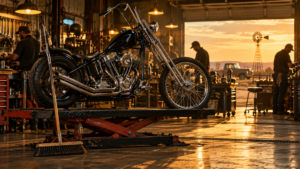
The dog leaped gracefully from the porch, bounded across the gravel, and jumped into the leather sidecar rig attached to Jack’s black cruiser—a custom rig Jack had built specifically for the old dog years ago.
Jack hit the starter. The V-twin engine roared to life with a ferocious, window-rattling bark. He spun the cruiser around in the gravel, tearing down County Road L-34 toward Missouri Valley as the sun began to drown in a sea of bruised purple thunderheads.