The Silent Farmhouse Beyond The Cornfields And The Vanished Keeper
CHAPTER 2: THE LOAM AND THE TIN
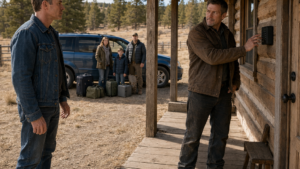
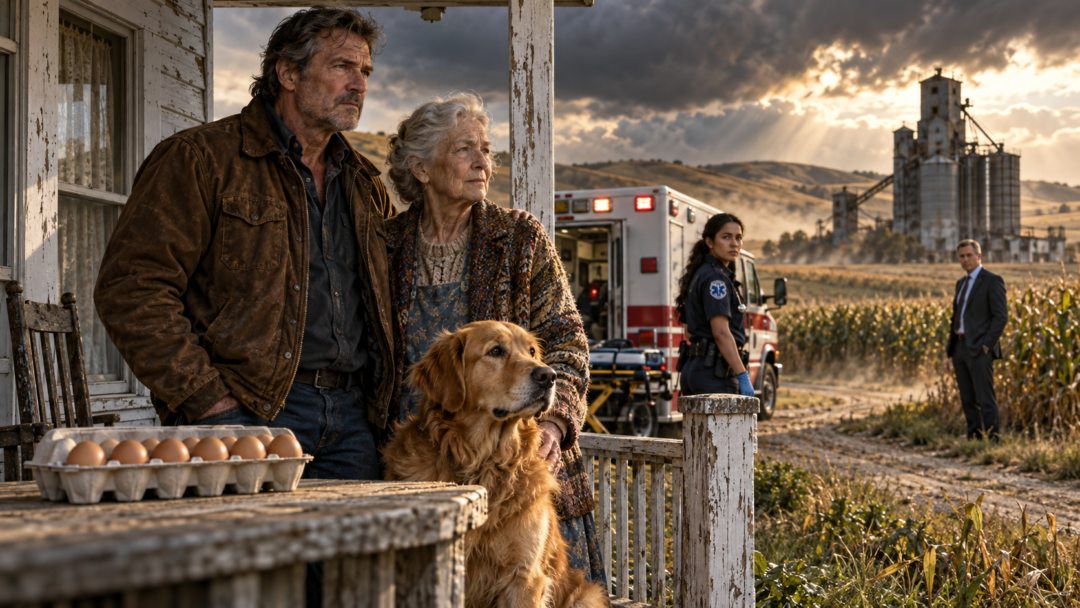
Jack stood on the sun-bleached porch, the smartphone still pressed to his ear, his jaw tightening until the muscle below his graying goatee twitched with restrained fury. The dry wind whistled through the rusty tin eaves of the porch roof, carrying the faint, sweet scent of drying corn husks and the coppery tang of ozone from the distant storm front gathering over the western horizon.
“Dispatcher,” Jack said, his voice dropping an octave, carrying the icy weight of twenty years on the interstate patrol. “Who signed that transport manifest? Hank Thorne’s heart requires digitalis and sublingual nitrates every twelve hours without fail. He doesn’t have living family in this state, his late daughter Martha made me his sole medical representative, and I am listed as his designated emergency healthcare proxy on file with the district court in Council Bluffs.”
“Sir, the record is sealed under a judicial protective seal issued by the chancery,” the dispatcher replied, her voice tightening with bureaucratic defensiveness and nervous friction. “Apex Agri-Energy filed the conservatorship petition as an interested commercial party under the revised rural utilities easement act. The order was signed by Judge Harlan Vance late Friday afternoon. The premises are currently under private legal surveillance. If you remain on the parcel after this notice, you will be cited for criminal trespass by the county authorities.”
The line disconnected with a sharp, electronic tone that buzzed like an angry hornet in Jack’s ear.
Jack slowly lowered the phone, his eyes narrowing into cold slits. “Apex,” he whispered aloud to the empty porch.
Apex Agri-Energy was a multibillion-dollar corporate agribusiness syndicate that had spent eighteen months attempting to purchase a four-mile corridor through Pottawattamie County for a high-pressure liquid carbon dioxide pipeline and industrial ethanol terminal. Every family farm along the drainage basin had buckled under pressure, eminent domain threats, or seven-figure buyout checks. Only Hank Thorne had held out. Hank’s six hundred and forty acres of virgin river bottomland held the last unhybridized, non-patented heirloom white flint maize seeds in the Missouri River valley—a genetic legacy his family had bred since the homestead act of 1862.
Jack turned his back to the door and looked down at the gravel driveway. His investigator’s eye immediately went to the soft, red-clay ditch bank where the dirt apron met the county road.
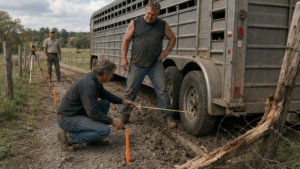
In the damp loam beneath the overhanging willow branches, two deep, fresh tire impressions had cut through the sod. Jack stepped off the porch and walked swiftly to the edge of the drive, kneeling in the dirt. He pulled a six-inch steel machinist’s scale from his jacket pocket and laid it across the tread pattern, noting the dual-wheel siping.
The tracks were eight inches wide, with an aggressive, asymmetrical siping pattern and dual-rear-wheel spacing. They were commercial Michelin Agilis light-truck tires—the exact specification used by heavy private transport ambulances and armored passenger vans. The vehicle had pulled in, backed up to the porch steps, and accelerated away hard enough to throw damp loam twelve feet into the ditch. The clay was still dark and tacky beneath the surface, confirming the vehicle had departed less than forty-eight hours prior.
Rusty trotted up beside him, nudged Jack’s elbow with his cold nose, and then bounded back up the porch steps. The golden retriever stopped directly beneath the wooden porch swing, dropped his belly to the cedar planks, and began scratching frantically at an uneven seam in the floorboards with both front paws, whining with intense, agitated purpose.
Jack bounded back up the steps, his boots thudding softly on the cedar. “Easy, Rusty. What do you have there, boy?”
The dog backed away two feet, panting, his tail giving a single, hopeful thump against the wood.
Beneath the porch swing, the third cedar plank had been pulled loose from its rusted iron cut-nails. The wood was worn smooth at the edge, where rough, calloused fingers had lifted it repeatedly over decades. Jack slipped the flat tip of his pocketknife into the gap, pried upward, and lifted the twelve-inch floorboard section clear of the structural joists.
Resting on the dusty stone foundation beneath the porch lay an antique red-and-yellow Prince Albert tobacco tin, wrapped tightly in two heavy industrial rubber bands to keep the damp prairie earth from penetrating the seam.
Jack picked up the tin. It was surprisingly heavy in his hand. He rolled the rubber bands off and eased the hinged metal lid open, releasing the faint, sweet aroma of cured Virginia pipe tobacco and aged paper.
Inside lay three items: a handwritten pocket notebook bound with black electrical tape, a standard magnetic micro-cassette tape, and a notarized legal document on heavy parchment paper stamped with the official seal of the United States General Land Office, dated May 14, 1888.
Jack opened the pocket notebook. Hank’s cramped, precise engineer’s handwriting filled every page with meticulous entries:
August 28: Arthur Sterling, chief counsel for Apex, returned with two private security men. Offered $4.2 million. Told them to get off my dirt. Sterling said if I wouldn’t sell the ground, they’d prove in probate court that an eighty-two-year-old living alone with a dog is legally incompetent to hold real estate.
August 30: Sheriff’s cruiser sat at the end of my lane for three hours. Deputy refused to look me in the eye when I walked down with the shotgun.
September 1: If you are reading this, Jack, they used the backdoor. Check the medicine cabinet. They won’t let me take the pills. The tape has Sterling’s voice making the threat. The Cleveland patent is non-transferable without direct blood heir consent. Don’t let them bulldoze the seed crib.
A high-pitched, electric whining sound suddenly sliced through the afternoon wind.
Jack snapped the tobacco tin shut and slipped it inside the inner breast pocket of his leather jacket, pressing it flat against his ribs. He stepped to the edge of the porch roof, looking up through the golden light.
Hovering fifty feet above the rusty windmill, its four carbon-fiber rotors shimmering like glass in the sun, sat a heavy commercial quadcopter drone. Its high-resolution optical gimbal was pointed directly down at Jack, a blinking red LED beneath the housing confirming that live high-definition footage was being transmitted across the county grid.