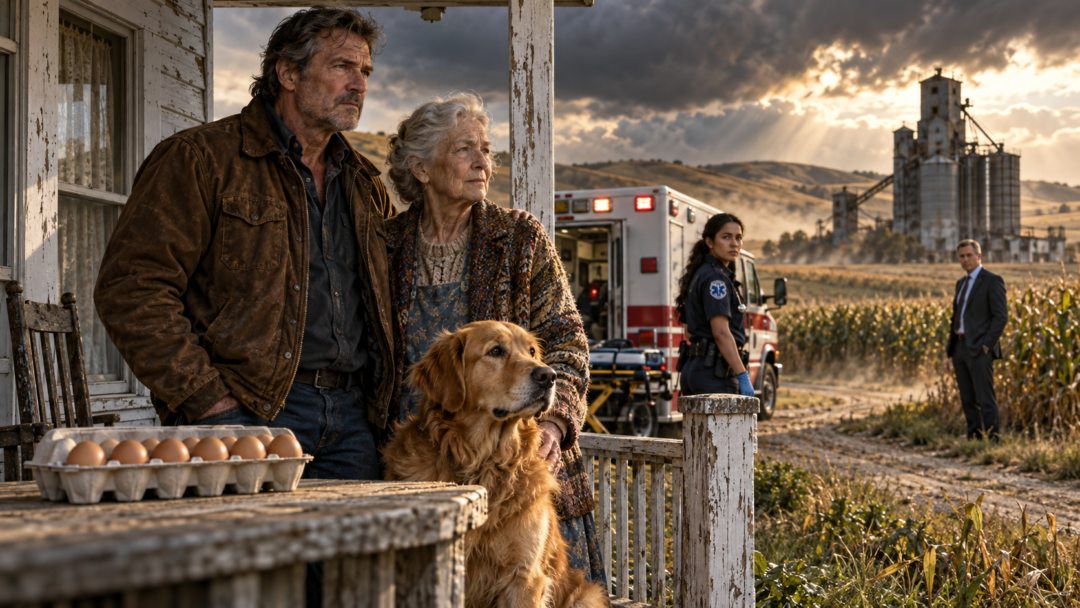
The Silent Farmhouse Beyond The Cornfields And The Vanished Keeper
CHAPTER 7: THE SOIL OF THE FATHERS
Dawn broke over the Missouri River valley in brilliant, pristine clarity. The storm had washed the dust from the air, leaving the vast Iowa sky painted in translucent shades of pale blue and rose gold, the wet cornfields glistening like an emerald sea beneath the rising sun.
At 8:30 AM, the marble corridors of the United States District Courthouse in Des Moines were quiet, save for the rhythmic clicking of wingtip shoes and the clatter of heavy motorcycle boots.
Outside Courtroom 3B, Arthur Sterling sat in a polished mahogany chair, his right arm bound in a heavy white surgical sling, flanked by three high-priced corporate defense attorneys in silk ties and Judge Harlan Vance, who looked pale and visibly sweating in his dark woolen suit. Sterling held an emergency expedited petition, his eyes cold with desperate venom as he watched the elevator doors slide open.
Stepping out into the sunlight of the atrium came Jack Cross, flanked by Tom Cole and six uniformed officers of the Iowa State Highway Patrol. Between them walked Henry “Hank” Thorne.
The old man was dressed in a clean, pressed denim work shirt, dark bib overalls, and his scuffed leather field boots. The chemical fog had completely cleared from his eyes, replaced by the fierce, unyielding dignity of a man who had worked his ground for six decades. He walked without a cane, his chin held high, holding an antique Prince Albert tobacco tin firmly beneath his arm.
Arthur Sterling leaped to his feet. “Your Honor! This is an outrage! Henry Thorne is an adjudicated ward under an emergency state conservatorship! These men abducted him from a licensed medical facility!”
The heavy oak doors of the courtroom swung open. Federal District Judge Evelyn Morris stepped out, accompanied by the United States Attorney for the Southern District of Iowa and two armed federal marshals.
“Sit down, Mr. Sterling,” Judge Morris said, her voice cutting through the marble hallway like a frost. “This court convened an emergency session thirty minutes ago pursuant to a federal civil rights and racketeering complaint filed by the United States Attorney.”
Jack stepped forward, removed the antique tin from his coat, and placed its contents onto the clerk’s mahogany table: the tape recorder, Hank’s handwritten journal, and the yellowed 1888 land grant bearing Grover Cleveland’s seal.
“Your Honor,” Jack said, his voice clear and resonant. “This is the original non-transferable federal territorial patent for the Thorne homestead. It carries a permanent covenant reserving the parcel as an inviolable public seed trust. Under Article Six of the United States Constitution, this federal covenant supersedes any municipal or state probate decree.”
Judge Morris picked up the parchment, examining the faded iron-gall ink and the embossed federal eagle seal. She looked up at Judge Harlan Vance, whose face had turned the color of chalk.
“Judge Vance,” Judge Morris said coldly. “Federal agents executed a search warrant on your personal banking records two hours ago. They found an offshore wire transfer of two hundred and fifty thousand dollars originating from an Apex Agri-Energy subsidiary account in the Cayman Islands, timestamped Thursday afternoon.”
Vance’s knees buckled. A federal marshal stepped behind him, pinning his arms and clicking a pair of stainless-steel handcuffs onto his wrists.
Arthur Sterling backed toward the elevator, but two state troopers blocked his path, their campaign hats low, their hands resting on their sidearms.
“Arthur Sterling,” the US Attorney announced, stepping forward with a warrant. “You are under arrest for conspiracy to commit kidnapping, federal bank fraud, and violation of the Racketeer Influenced and Corrupt Organizations Act.”
As the handcuffs snapped shut around Sterling’s uninjured wrist, Hank Thorne stepped forward. The old farmer looked the corporate lawyer dead in the eye, his weathered face etched with the enduring strength of the prairie soil.
“You can buy steel, Sterling,” Hank said softly, his voice carrying the deep resonance of sixty harvests. “And you can buy weak men. But you can’t buy the dirt that feeds a nation. That ground belongs to God and the people who sweat on it.”
Four hours later, the black cruiser and its leather sidecar pulled back up the gravel driveway of the Thorne homestead.
The midday sun bathed the white clapboard farmhouse in warm, peaceful golden light. The rotten groceries had been cleared from the porch; the broken glass had been swept away; and the ancient red windmill turned lazily in the sweet prairie breeze, pumping fresh, icy groundwater into the wooden cattle trough.
Hank sat in his favorite high-backed wooden rocker on the front porch, a cup of fresh, hot black coffee resting on the wide armrest. Rusty lay curled at his feet, his golden head resting comfortably across the old man’s boot, his tail thumping contentedly against the floorboards.
Jack leaned against the porch railing, his helmet resting on the bench, looking out across the six hundred and forty acres of tall, green corn that stretched all the way to the blue horizon.
Hank looked over at the younger man, his eyes shining with profound, unspoken gratitude.
“Martha knew what she was doing when she made you give that promise, Jack,” Hank said softly, his voice trembling slightly.
Jack smiled—a warm, gentle expression that softened the rugged scars along his jaw. He reached out and touched the old man’s shoulder, a solid, unbreakable bond between two men who understood the true meaning of honor.
“Martha knew you’d never give up the ground, Hank,” Jack replied, turning his gaze back to the rustling corn. “And neither will we.”