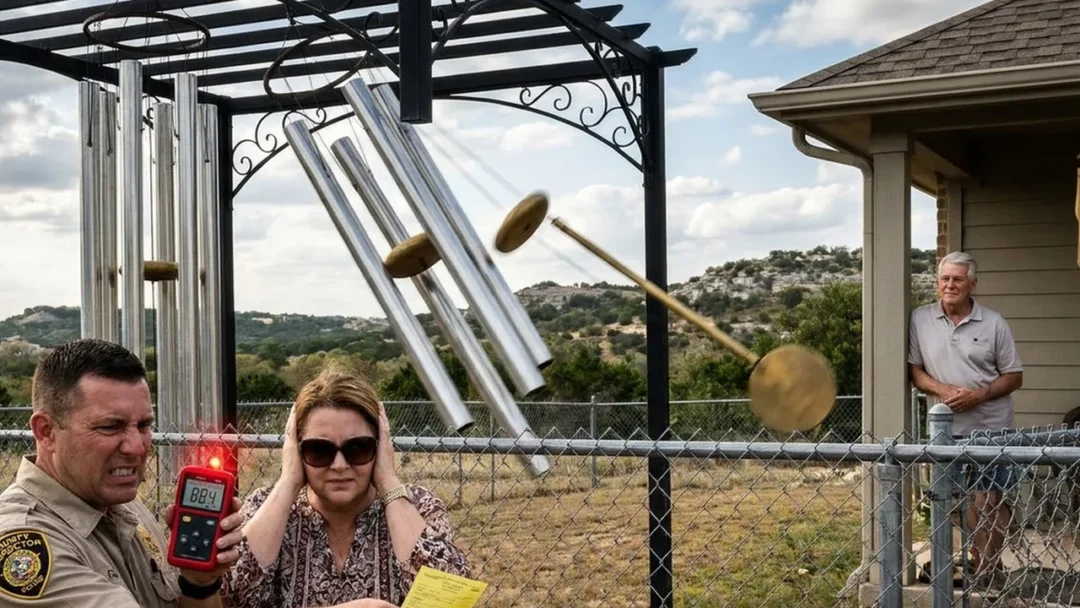
The Six Foot Steel Chimes And The Decibel Meter On The Pergola
CHAPTER 5: THE COUNTY DISMANTLING ORDER
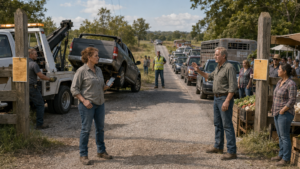
The massive fifty-ton crane truck stabilized itself on the asphalt shoulder of Whispering Pines Bluff, extending four heavy hydraulic outriggers onto steel ground plates with a deep mechanical groan.
Austin Energy Crew Chief Dave Patterson, wearing full arc-flash protective gear, fiberglass hot-sticks, and insulated rubber gloves, stood on the limestone terrace beside Inspector Marcus Sterling, surveying the dangerous clearance between the six-foot steel chimes and the overhead primary electrical line.
‘Inspector Sterling, Detective Hayes,’ Patterson announced through his two-way radio, ‘we are executing an emergency high-voltage lockout on transformer feed number forty-eight. That metal pergola has zero legal clearance. The structural vibration from those heavy pipes in high winds is actively galling the insulation on the seven-thousand-volt primary conductor. If this wind kicks up another ten knots, that line will fault to ground, energizing this entire stone patio with twenty thousand volts.’
From the back door of her luxury residence, Karen Sterling-Price came sprinting across the flagstone patio, her designer clothes disheveled, her face contorted in hysterical, unhinged fury.
‘Stop this right now! You cannot touch that sculpture!’ Karen screamed, thrashing wildly as two sheriff deputies stepped forward to block her path. ‘That is private art on private property! My husband will sue this county into oblivion! You are destroying a fifty-thousand-dollar installation!’
‘Mrs. Sterling-Price, step back onto your porch immediately!’ Detective Hayes ordered, his voice carrying the immovable authority of the law. ‘This structure is condemned under Travis County Emergency Public Safety Order 2026-88. It is an unpermitted electrical hazard, an unpermitted structural encroachment, and a public noise nuisance.’
Crew Chief Patterson signaled the crane operator. The massive sixty-foot telescoping hydraulic boom swung smoothly across the yard, centering the heavy steel rigging hook directly above the iron pergola.
Two utility riggers attached heavy, four-ton nylon lifting slings around the upper framework of the six-foot steel chimes. A rigger drew a high-speed pneumatic cut-off saw, slicing cleanly through the frayed steel suspension cables.
With a high-pressure hiss of hydraulic fluid, the crane hoisted the massive, two-hundred-pound steel chime array into the air. The colossal cylinders swung gently above the limestone canyon, silent at last, before being lowered smoothly onto the flatbed of the county transport truck.
As the crane moved to dismantle the unpermitted iron pergola, an excavation crew began checking the concrete footings set into the turf.
Worker Carlos Mendez suddenly shouted, waving his arms frantically toward the emergency shut-off valve. ‘Hold the excavation! Gas leak! Shut off the main!’
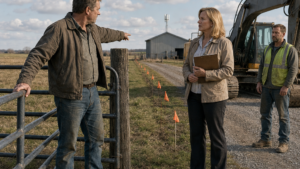
Inspector Sterling and Rick Vance rushed to the footing. The concrete pier supporting the western corner of the unpermitted pergola had been poured directly on top of the neighborhood’s two-inch municipal natural gas distribution line. Under the immense weight and constant vibration of the heavy steel structure, the concrete footing had cracked the plastic gas pipe, venting pressurized natural gas directly into the subsoil.
Carlos immediately crimped the emergency plastic shut-off clamp, cutting off the gas flow as the fire department hazmat crew moved in with atmospheric gas monitors.
Carlos Mendez carefully deployed an electronic combustible gas sniffer along the cracked natural gas main, watching the digital meter stabilize as the emergency clamp held firm. ‘The static ground pressure from that uninspected concrete pier was over three thousand pounds per square foot, bearing directly on a two-inch medium-density polyethylene gas pipe,’ Mendez explained to Inspector Sterling. ‘Under Texas Railroad Commission pipeline safety standards, structural foundations must maintain a minimum five-foot radial clearance from any buried gas transmission utility. Pouring concrete directly around an unshielded gas main is an act of gross mechanical negligence that could have leveled two residential homes.’
Crew Chief Patterson signaled the crane operator to secure the final structural beam of the dismantled pergola onto the transport flatbed. ‘Every piece of this unpermitted structure will be held in county impound as physical evidence for the upcoming criminal proceedings,’ Patterson informed Detective Hayes. ‘The municipal utility lockout will remain in place until the property owner hires licensed master electricians to completely remove the illegal three-phase service drop and restore the residential electrical feed to code.’
Inspector Marcus Sterling carefully packed his calibrated decibel meter into its Pelican field case, securing the precision condenser microphone. ‘In environmental acoustic litigation, documented spectral data is the gold standard of physical evidence,’ Marcus explained to Elena. ‘These calibrated audio logs, Fourier frequency transforms, and continuous decibel recordings will be submitted directly to the county attorney’s office. When confronted with irrefutable acoustic physics, no amount of bluster or false victimhood can obscure the reality of an eighty-eight-decibel industrial sound hazard.’
Inspector Sterling looked at Karen, his face pale with cold fury. ‘Not only was your structure an unpermitted noise nuisance and an electrical hazard; your uninspected footing cracked the main natural gas line. If a spark from that electrical wire had dropped into this trench, this entire bluff would have exploded.’
Karen sank onto her stone patio steps, her hands trembling uncontrollably, her arrogant bluster completely destroyed as the handcuffs clicked around her wrists.