The Splashed Wine On The Gallery Canvas And The Maestro’s Signature
CHAPTER 2: THE DISSOLVED PIGMENT
The silence that clamped down on the Cabot-Vance Pavilion was so absolute and suffocating that the distant rumble of a delivery truck on Commonwealth Avenue sounded like an earthquake beneath the marble floor. In the rear of the rotunda, two elderly Boston Brahmin patrons stood paralyzed with champagne flutes suspended halfway to their lips, staring in utter disbelief at the scene unfolding beneath the centerpiece easel.
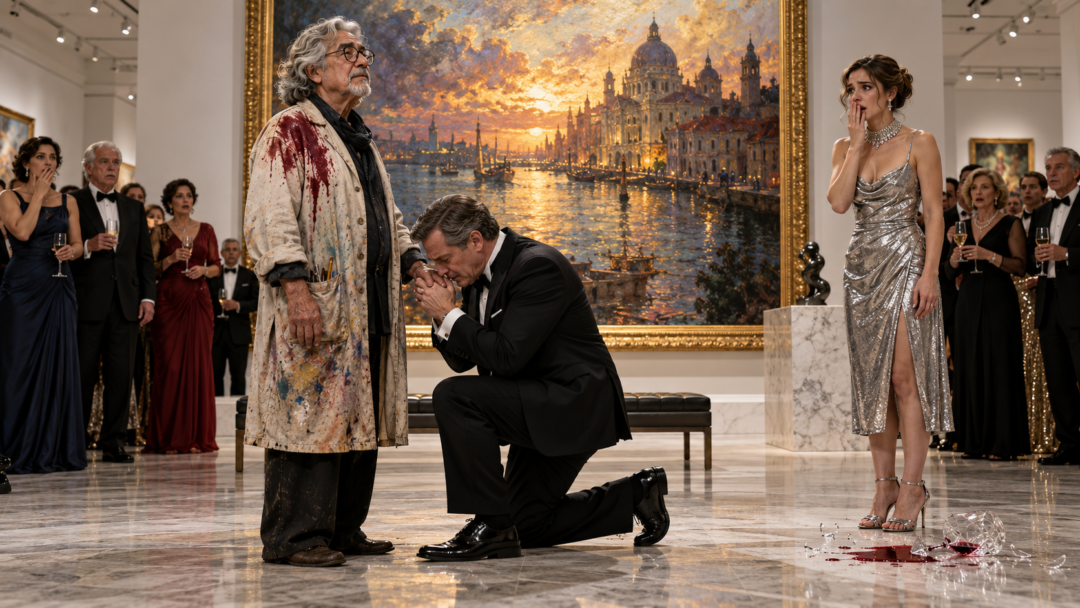
Bianca Sterling’s crystal wine glass slipped from her paralyzed, manicured fingers. It plummeted two feet and detonated against the polished Italian marble with an explosive crash that sent crystal shards and remaining drops of crimson wine skittering across the floor. Her jaw sagged open, her tongue sticking to the roof of her mouth as the color drained from her cheeks until she looked like a marble statue in her metallic silver gown.
“A… a maestro?” Bianca whispered, her voice cracking into a dry, pathetic squeak. “Julian… who is this man? You’re kneeling in spilled wine! He was wearing a filthy apron…”
Julian Cabot did not rise from his knee. He looked up at Bianca with eyes blazing with the cold, absolute fury of a scholar whose temple had just been desecrated by a barbarian.
“This man, Miss Sterling,” Julian said, his voice vibrating through the vaulted gallery with devastating clarity, “is Maestro Mateo Romero. He is the living titan of contemporary American landscape art. His works hang in the Louvre, the Prado, and the Metropolitan Museum of Art. He has lived in complete monastic seclusion in Maine for twenty years, refusing all public honors. And you just assaulted him with a glass of cabernet on the floor of the gallery that bears his name.”
Mateo Romero gently patted the curator’s trembling shoulder, urging him to his feet with quiet, fatherly grace. “Stand up, Julian. A man only kneels before God and the canvas. Never on marble.”
Mateo turned back toward the seven-foot masterpiece resting on the easel. He took the linen cloth he had used to wipe his spectacles, dabbed a corner of it into the puddle of red wine on his smock, and reached out toward the bottom right corner of the painting—directly where Bianca’s splash had landed on the lower crest of a painted Atlantic wave.
He pressed the wet linen cloth against the painted sea foam and made a single, gentle horizontal wipe.
The white pigment did not resist. It did not smear like cured, aged linseed oil paint. It dissolved instantly into a milky, rubbery smear, stripping away to reveal a cold, synthetic grey undercoating that had never seen the shores of Massachusetts.
Mateo pulled the cloth back, inspecting the dissolved smear with cold, diagnostic precision. A faint, sad smile touched his lips.
“Cadmium white synthesized with an acrylic polymer emulsion,” Mateo murmured softly, his voice cutting through the silent room like a razor blade. “Water-soluble resin. Manufactured no more than three years ago by Liquitex in Cincinnati.”
Julian Cabot stepped closer, his face turning an unnatural, sickly grey as he looked at the ruined corner of the multi-million-dollar masterpiece. “Maestro… what are you saying?”
Mateo looked around the rotunda, his eyes sweeping over the elite collectors, museum directors, and high-society patrons who had gathered to bid on his legacy.
“I am saying, Julian,” Mateo said with quiet, unshakeable finality, “that The Solitude of Cape Ann was painted in 1988 using hand-ground lead white and cold-pressed Baltic linseed oil that I aged myself for twelve years in cedar barrels. Lead oil does not dissolve in cabernet. This painting is a counterfeit.”
A chorus of shocked gasps erupted across the rotunda. Behind Bianca, two prominent Manhattan art dealers stepped back in horror, clutching their auction bidding paddles to their chests.
Bianca took a frantic step backward, her high heels grinding into the shattered crystal on the floor. “He’s lying! He’s an old senile man trying to ruin my family! My father purchased that painting from an authorized estate in Geneva! We have certified provenance documents signed by the International Art Loss Register!”
“Your father purchased nothing, Miss Sterling,” a sharp, youthful voice echoed from the shadowed archway of the conservation wing.
Stepping into the rotunda was Clara Romero-Vance. She was twenty-eight years old, Mateo’s granddaughter, wearing a crisp dark blazer and holding a heavy leather portfolio of forensic spectroscopic documents. She had worked for eighteen months as an undercover assistant conservator at the gallery, tracing the stolen art pipeline that had destroyed her family’s name.
“My grandfather’s original master canvas was stolen from his Gloucester studio in 2009 during an arson attack that nearly took his life,” Clara said, holding up a certified fire marshal’s report. “And the corporate shell company that registered the insurance payout on that fire was Sterling Maritime Holdings—managed by your father, Arthur Sterling.”
Julian Cabot stood beside the easel, his hands clasped tightly behind his back as he stared at the synthetic grey undercoating exposed by Mateo’s linen cloth. In his twenty-five years as a museum curator and appraiser, he had examined tens of thousands of canvases across Europe and the Americas, but never had he witnessed such brazen, clinical forgery executed at this financial scale. The brushwork had looked convincing from a distance under the carefully calibrated amber spotlights of the rotunda, but up close, stripped of its synthetic varnish, the absence of natural craquelure and pigment depth was staggering.
“This was commissioned through an uncertified restoration atelier in Hamburg,” Julian whispered, his voice trembling with scholarly indignation. “Arthur Sterling submitted forged thermoluminescence certificates and radiometric carbon reports that fooled our independent appraisal committee. They were planning to take the five million dollars from tonight’s auction, deposit it into a shell foundation in Liechtenstein, and use the tax deduction to wipe out eighty million in capital gains. It is the most sophisticated art fraud enterprise in modern New England history.”