The Splashed Wine On The Gallery Canvas And The Maestro’s Signature
CHAPTER 3: THE GLOUCESTER GHOST
The gallery was rapidly descending into chaos as private cell phones began buzzing across the room. Wealthy collectors were hurriedly whispering to their art advisors, demanding immediate authentication audits on every lot listed in the evening’s forty-million-dollar catalog. The white-coated waiters had ceased circulating, standing frozen by the marble columns as security guards secured the exits to prevent anyone from tampering with the exhibits.
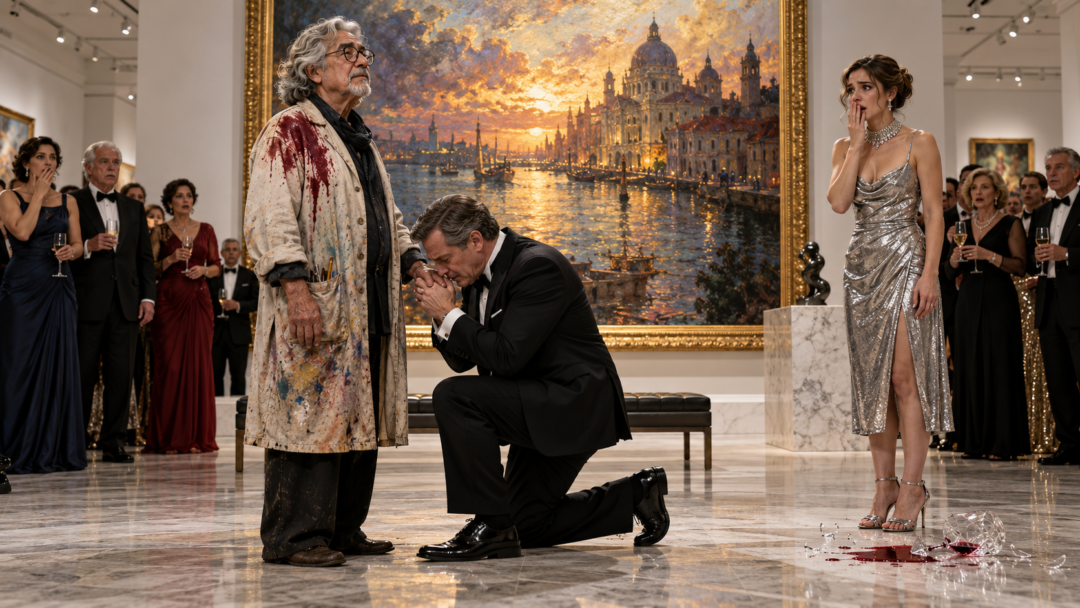
Mateo Romero stood beside his granddaughter Clara, his hand resting gently over hers as she displayed the archival spectroscopic printouts on an easel beside the centerpiece. Despite the wine soaking through his smock, Mateo radiated an aura of calm, indestructible authority that commanded the entire room.
“Look at the infrared reflectography, Julian,” Clara explained, pointing to high-resolution cross-sectional scans of the canvas. “When my grandfather painted The Solitude of Cape Ann, he applied a charcoal underdrawing directly onto Belgian linen coated with rabbit-skin glue. On the original painting, underneath the storm clouds in the upper left quadrant, he inscribed a dedication in Spanish to my grandmother Elena: Para mi luz eterna, hasta que el mar se seque.“
Julian Cabot adjusted his tortoiseshell glasses, his face gleaming with nervous sweat as he brought a portable ultraviolet torch to the surface of the canvas on the easel. The purple light washed across the stormy sky.
The surface glowed with a flat, uniform violet luminescence characteristic of modern synthetic varnishes. Beneath the paint layer, where the charcoal inscription should have appeared like dark veins in marble, there was only empty, machine-woven polyester canvas.
“There is no underdrawing,” Julian whispered, his hands trembling violently. “The weave count is machine-calibrated sixty threads per inch. This canvas was manufactured in 2021.”
Bianca Sterling backed away toward the mahogany exit doors, clutching her diamond choker as if the jewels were choking her. Her eyes darted toward the four private security guards who had been hired by her father’s firm, but the guards were looking at Maestro Romero with profound, reverent awe, refusing to meet her gaze.
“Julian, this is a coordinated smear campaign!” Bianca hissed frantically. “My father donated three million dollars to this pavilion’s endowment fund! We have legal title to this artwork! I demand that you clear this gallery of unauthorized persons and proceed with the auction!”
“The auction is canceled, Miss Sterling,” Julian said with icy, uncompromising finality. “And under the bylaws of the Cabot-Vance Arts Foundation, I am freezing all twelve lots consigned by Sterling Maritime Holdings pending an immediate forensic audit by the Federal Bureau of Investigation’s Art Crime Team.”
“You can’t freeze my father’s assets!” Bianca screamed, her voice losing every shred of high-society polish and degenerating into raw, gutter hysteria. “He will destroy this pavilion! He will buy the mortgage on this brownstone and tear it down brick by brick!”
“Your father won’t be tearing down anything, Miss Sterling,” Mateo said softly, stepping toward her with deliberate, unhurried strides. His heavy boots made a solid, echoing thud on the marble. He stopped three feet from her, looking down into her wild, terrified eyes.
“Art is not real estate, madame,” Mateo continued, his voice resonating through the hushed rotunda like church bells in a valley. “You cannot steal the soul of a master with a forged bill of sale. You cannot buy honor with stolen offshore millions. You thought you could throw wine upon an old man because you saw only his smock. But the smock bears the paint of fifty years of honest labor. Your dress bears only the vanity of an empty heart.”
Bianca opened her mouth to curse him, but the words withered in her throat. She looked around the rotunda and saw only cold, disgusted stares from Boston’s most powerful families—the very people whose approval she had spent her entire adult life desperately trying to buy.
“Guards,” Julian Cabot commanded, gesturing toward the double doors. “Escort Miss Sterling off the premises. And ensure she does not return.”
The two gallery security officers stepped forward, flanking Bianca firmly by both elbows. As they marched her toward the mahogany exit into the pouring rain, her metallic silver dress trailed through the puddle of red wine on the floor, leaving a dark, smeared trail across the pristine white marble.
Mateo watched the heavy doors swing shut behind her. Then he turned to Clara, his eyes narrowing with diagnostic focus. “Clara, where is the real canvas?”
Clara leaned close, her voice dropping into a tense whisper. “Grandfather… Arthur Sterling didn’t leave it in Geneva. He shipped it into Boston harbor yesterday on a private container barge. They are preparing to load it onto a cargo freighter bound for Singapore at midnight.”
The whispers among the gathered Boston Brahmin patrons had grown into an agitated, collective murmur that swept through the marble corridors like rising wind. Many of the families present—descendants of maritime merchants, textile magnates, and railroad founders—had collected Mateo Romero’s early works for two generations, hanging his seascapes in their historic Beacon Hill townhouses and summer cottages in Martha’s Vineyard. To learn that the evening’s premier offering was nothing more than synthetic plastic on industrial polyester sent shockwaves through the city’s cultural hierarchy.
Several prominent collectors pulled out their smartphones, instructing their family trust attorneys to freeze all active escrow deposits and initiate immediate forensic audits on every acquisition brokered by Sterling Maritime Holdings over the preceding decade. The reputation of the Cabot-Vance Pavilion hung in the balance, but Julian Cabot’s swift and unhesitating defense of Maestro Romero had preserved the institution’s soul. Truth was reclaiming its rightful throne, and the high-society syndicate that had traded on forged prestige was watching its social capital dissolve into dust.