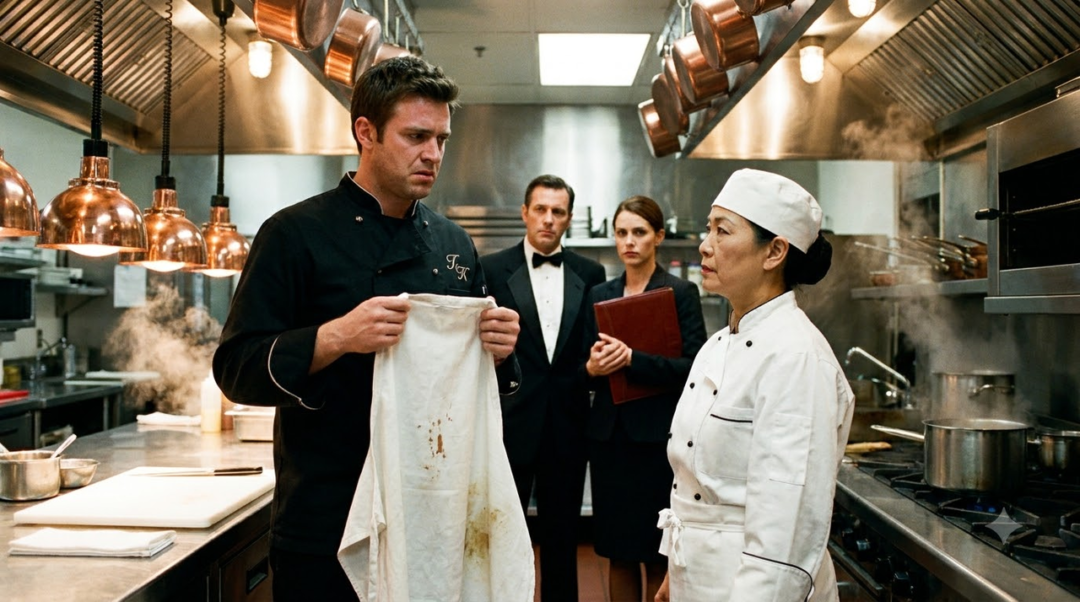
The Stained Linen Apron In The Three Star Michelin Kitchen
CHAPTER 2: THE COUNTERFEIT ESSENCE
The silence that gripped the kitchen was heavier than the cast-iron skillets hanging above the French top. The hum of the exhaust hoods seemed to drop an octave, transforming into a low, droning hum that rattled the copper lids on the prep line.
Julian “Jax” Sterling stood frozen in the center of the bay, holding the stained linen apron against his chest like an explosive device. His face, which had been bronzed for high-definition cameras, looked greasy and pale under the harsh kitchen lighting. Behind him, the two cameramen had slowly lowered their gimbals, their red recording tally lights winking out one by one as they realized the magnitude of the disaster unfolding.
“Madame… Madame Chen?” Jax’s voice cracked into an uncoordinated, defensive stutter. He looked frantically toward Henri Laurent, hoping to catch a flicker of corporate hesitation in the manager’s aristocratic eyes. “Wait… this is Eleanor Chen? The founder? But the board told me she was in semi-retirement in Kyoto! They told me the culinary operations were being managed by the executive committee!”
“The culinary operations are managed by those who understand the craft, Mr. Sterling,” Madame Chen replied. Her voice remained entirely calm, free of theatrical rage, carrying the quiet, crushing finality of an ancient oak falling across a narrow road. “The board owns financial shares in the parent holding trust. I own the operational charter of this restaurant, every recipe in this house, and fifty-one percent of the super-voting equity. No plate leaves this kitchen without my authorization.”
Madame Chen stepped past Jax, completely ignoring his presence, and walked over to his dedicated mise en place cart—a sleek rolling steel trolley equipped with his monogrammed carbon-steel knives, squeeze bottles, and custom ceramic plating dishes.
She reached out with a clean, calloused hand, lifting a small, amber glass bottle wrapped in gold foil from the side rack. The label was written in ornate faux-Italian script: ESSENZA BIANCA DI TARTUFO – RISERVA SPECIALE.
Madame Chen unscrewed the dropper cap, holding the bottle two inches beneath her nose. Her eyes narrowed into cold, dangerous slits.
“You brought this into my kitchen,” she said softly.
“That’s my signature finishing drizzle,” Jax protested, stepping forward with his hands clenched into fists, his defensive arrogance attempting to rally. “It’s an artisanal white truffle reduction! It intensifies the aroma for television and gives the guests an unforgettable sensory blast! Every major culinary influencer uses it!”
“This is not white truffle, Mr. Sterling,” Madame Chen said, her voice dropping into a tone of quiet, devastating disgust. She turned the bottle upside down, letting three drops fall onto a clean white ceramic saucer. “This is bis-methylthiomethane. A synthetic chemical compound derived from petroleum distillate, combined with cheap olive pomace oil and artificial vanillin. It costs four dollars a gallon to manufacture in a chemical plant in New Jersey, and you sell it online for ninety dollars a vial.”
Inspector Jean-Luc Mercier stepped forward, opening his red leather notebook and producing a small glass vial containing a chemical test strip. He dipped the strip into the oil on the saucer. Within five seconds, the absorbent paper turned an unmistakable, violent shade of dark purple: the universal indicator for synthetic petroleum aromatics.
Mercier looked up, his French accent thick with disdain. “Synthetic 2,4-dithiapentane. Strictly prohibited in three-star Michelin establishments under Article Twelve of our international inspection protocol. The use of chemical fragrance to simulate natural ingredients is classified as fraudulent culinary presentation.”
Mercier made a sharp, definitive stroke with his fountain pen across the page of his red book.
Jax’s throat clicked as he tried to swallow. He looked wildly around the kitchen, but none of the line cooks met his gaze. The thirty young men and women—many of whom had spent years sweating through sixty-hour weeks just to master the art of peeling shallots under Madame Chen’s exacting eye—stared at him with cold, unified contempt.
“You don’t understand the business!” Jax shouted, his hands waving wildly in the air as he turned toward the dining room doors. “Fine dining is dying! Nobody cares about hours of boiling bones and scrubbing dirt off roots! People want theater! They want viral moments! They want food that pops on a phone screen! I was going to bring five million new eyes to this restaurant tonight!”
“Food is not theater, Mr. Sterling,” Madame Chen said, stepping directly in front of him, her small frame radiating an immovable, majestic authority that towered over his six-foot height. “Food is an act of communion between the earth, the cook, and the human soul. When you lie about what is on the plate, you poison that communion. You poison the trust of every guest who sits at our tables.”
Madame Chen turned her gaze toward Henri Laurent.
“Henri, call building security. Have Mr. Sterling’s luggage and media equipment removed to the service alley. And notify our legal department to prepare a formal claim against his agency for breach of contract, property destruction, and intentional food adulteration.”
“At once, Madame Chen,” Henri said, bowing his head.
Jax stumbled backward, the reality of his ruined reputation closing around him like an iron trap. “You can’t just cancel this service! There are eighty VIP guests out there! Food critics from the Tribune, the Times, and Eater! If you don’t send out food, you’ll lose your third star before midnight!”
Madame Chen reached over to the prep table, picked up her favorite eight-inch Japanese chef’s knife, and turned toward the line cooks.
“The service will not be cancelled, Mr. Sterling,” Madame Chen announced, her voice ringing out like a bronze bell across the gleaming kitchen. “Tonight, our guests are going to taste what real food tastes like.”