The House She Was Given
Part I — The Blue Pitcher
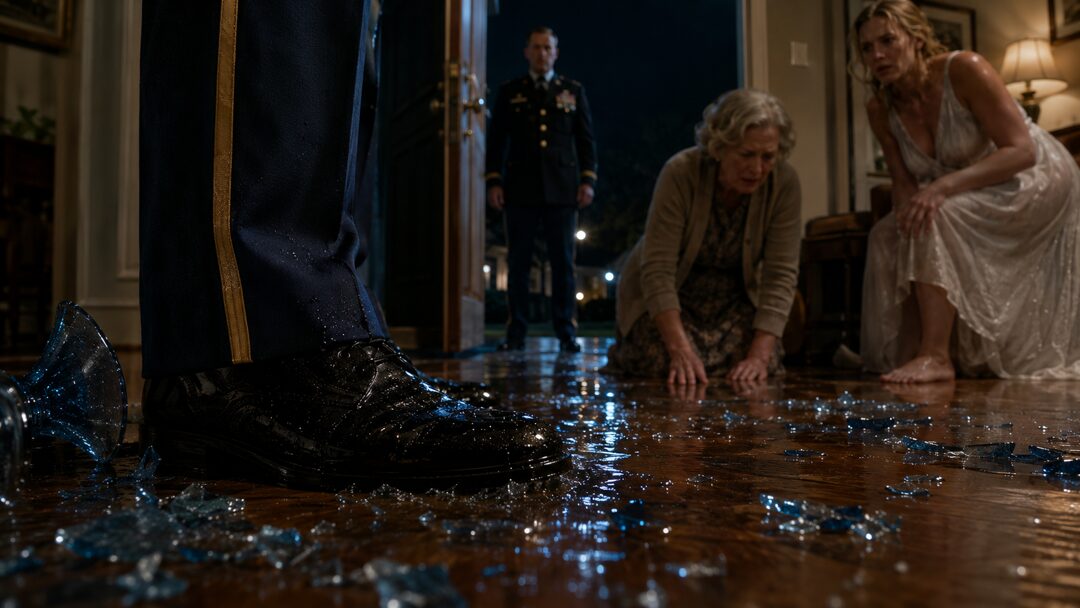
The blue glass pitcher flew past Daniel Brady’s chest before he had fully stepped into the house, turning once in the hallway light like something beautiful changing its mind, then burst open against the hardwood floor.
Water slapped across his polished black shoes.
Glass scattered under the entry table.
For one second, Daniel stood there with his key still between his fingers, his dress jacket stiff over his shoulders, the medals on his chest catching the light from the living room. He had come home to silence. Instead, he had opened the door into a mess already waiting for him.
His mother was on her knees beyond the puddle.
Margaret Brady, sixty-eight years old, pearls at her ears, gray hair pinned into its usual careful wave, was pressing both hands into the spreading water as if she could hold it still. Her beige cardigan was soaked at the cuffs. Her face had folded into an expression Daniel had not seen since the night his father died.
“Mom,” he said.
She did not look up.
“Wash it properly, my son,” she whispered.
His wife was sitting on the floor beside her.
Emily’s white dress was wet at the hem, clinging to her knees. One bare foot rested in the water. Her blonde hair, pinned neatly when Daniel left for the veterans’ banquet, had slipped loose on one side. She looked up at him, and her face was calm in a way that made him more afraid than tears would have.
“Don’t touch her yet,” Emily said.
Daniel looked from his wife to his mother.
“What happened?”
Margaret bent lower, scooping water with her palms. It ran between her fingers.
“It was just a joke,” she said, and began crying harder.
Emily gave one short laugh.
“The joke has lasted three years.”
Outside, through the open front door, Daniel could see the porch light spilling over the driveway. Two cars remained at the curb. His mother’s birthday dinner guests had not all gone home. They were close enough to hear if anyone raised their voice.
Daniel stepped inside and shut the door slowly behind him.
The click sounded too small.
“Emily,” he said, using the tone he used when a room needed order. “Move away from the glass.”
She did not move.
Margaret looked up then. Her mascara had made two gray tracks down her cheeks.
“Daniel, please,” she said. “Don’t let her make this ugly.”
Emily’s eyes stayed on him.
“Ugly came in before you did.”
Daniel knelt between them, careful of the shards. The water soaked through the knee of his trousers immediately. The cold traveled fast.
He reached toward his mother.
“Stand up, Mom.”
Margaret recoiled as if his hand embarrassed her.
“No,” she said. “No, I’ll clean it. I should clean it.”
“It’s water,” Daniel said.
Emily’s mouth tightened.
“That’s what she said at dinner too.”
Daniel looked at her.
Emily leaned back on one hand, the other pressed against the floor near a bright shard of blue glass. Her wedding ring was not on her finger. Daniel noticed that before he knew why he had noticed it.
He looked at her bare hand.
She saw him see it.
“Don’t worry,” she said. “It’s still in the house.”
Margaret made a sound like a warning.
Daniel turned to his wife. “Where?”
Emily nodded toward the water between them.
“In the only place it belongs tonight.”
Daniel did not reach for it yet.
He could feel the house listening. The framed photographs in the hallway. The folded napkins on the dining table. The half-melted candles from Margaret’s birthday cake. His father’s portrait above the sideboard, watching everything with the same formal approval he had given nothing and demanded from everyone.
“Tell me what happened,” Daniel said.
Emily stared at his chest. Not his face. His medals.
“You came home dressed like that,” she said softly, “and still asked the wrong question.”
Part II — Guests at the Door
The dinner had begun with white roses and careful laughter.
Daniel had missed most of it. The banquet downtown had run late, then later, then unbearably long. Men who had known his father shook his hand too hard. Women he barely remembered said Margaret must be proud. Someone bought him a drink he carried more than sipped.
By the time he texted Emily that he was on his way, she had already read the check.
She had found it folded inside a birthday card on Margaret’s desk upstairs, half-tucked beneath an old photograph. The check was made out to Emily’s younger brother’s clinic. The amount was not enormous by Brady standards, but it was enough to explain three months of unexpected mercy.
Enough to explain why the clinic had stopped calling.
Enough to explain why Margaret had smiled across dinner and said, “It’s good when families can help each other. Some people know how to receive help graciously.”
Emily had not understood the full shape of it then.
Not until Margaret asked her to bring water.
“The blue pitcher, dear,” Margaret had said, in front of eight guests. “The nice one. Daniel’s father gave it to me.”
Emily had risen because that was what she had learned to do in that house. Rise. Smile. Carry. Absorb.
The pitcher had been cold and heavy in her hands.
She was halfway around the table when Margaret said, lightly, “Careful now. Some women can hold a house together. Some only know how to spill what they’re given.”
The guests had laughed because Margaret’s tone gave them permission.
Not loudly. That would have been easier.
It was the small kind of laughter. The polite kind. The kind that entered the skin and stayed there.
Emily had kept walking. She filled every glass. Daniel’s cousin looked away. An old colonel’s wife watched Emily’s hands to see if they shook.
They did not.
Margaret smiled.
“No one is asking you to be ungrateful,” she added.
That was when Emily understood that the check was not charity. It was a leash with good stationery.
Now, in the hallway, Daniel listened while Emily told it in clipped pieces.
He listened badly.
“You should have called me,” he said.
Emily blinked.
“From your mother’s table?”
“I would have come home.”
“You were already late to the part where I was being measured.”
Margaret lifted her head. “That is not fair.”
Emily turned to her with a calmness that felt sharpened. “Neither was the table.”
Margaret’s wet hands trembled over the floor. “It was a joke. People joke in families. You have never understood that.”
“Because in my family,” Emily said, “when someone wants to insult you, they don’t call it tradition.”
Daniel drew a slow breath. He could smell the water on the wood now, clean and cold, mixed with birthday cake, perfume, and something metallic from the broken glass.
“Emily,” he said. “You’re upset. I understand that.”
“No,” she said. “You understand upset. You don’t understand tired.”
He looked toward the living room window. Beyond the curtains, shadows shifted on the porch. Someone was still outside. Maybe two people.
“We can talk upstairs.”
Emily smiled without warmth.
“There it is.”
“What?”
“The Brady solution. Take it upstairs. Shut the door. Dry the floor. Smile tomorrow.”
Margaret pressed one hand to her chest. “Do you hear how she speaks to me?”
Daniel’s jaw tightened. “Mom, please.”
“No, Daniel, you please. I have given this girl everything. This house. This name. Security most women would thank God for.”
Emily laughed again, but this time it broke before it ended.
“This girl,” she repeated.
Margaret looked wounded by her own words.
Daniel turned to Emily. “She didn’t mean—”
“She always means it,” Emily said. “She just trusts you to translate it into something softer.”
That landed.
Daniel looked away first.
Emily saw it, and something in her face changed. Not surprise. Confirmation.
“You do know,” she said.
Daniel said nothing.
Margaret suddenly bent forward again, trying to gather larger pieces of glass with her bare hands.
“Stop,” Daniel said sharply.
A bead of red appeared on Margaret’s finger.
She stared at it as if it were another accusation.
Emily did not move.
“Stand up, Mom,” Daniel said again.
Margaret looked at him then, childlike and furious. “I was trying to fix it.”
Emily’s voice lowered. “That’s what you call it?”
Margaret’s face hardened for the first time that night.
“I call it protecting my son.”
The room went still.
Even the water seemed to stop moving.
Daniel heard footsteps shift outside the front door.
Emily slowly turned her head toward him.
“From me?” she asked.
Margaret’s silence answered too quickly.
Daniel closed his eyes for half a second.
When he opened them, Emily was watching his hand move toward the puddle.
Toward the ring.
Part III — The Ring in the Water
The ring lay under a thin layer of water near Daniel’s left knee.
Gold. Small diamond. Simple setting.
Emily had loved its simplicity when he gave it to her. She had said it looked like something meant to be worn every day, not hidden in a box. Daniel had slid it onto her finger in his kitchen one rainy Sunday morning, without an audience, without candles, without asking his mother first.
At least, that was the version Emily had lived inside.
Daniel picked it up.
The water ran from the diamond and down his fingers.
He looked at it too long.
Emily noticed.
Of course she noticed. Emily noticed everything Daniel tried not to feel.
“Why are you looking at it like that?” she asked.
Daniel closed his fingers around it.
Margaret made a low sound. “Daniel.”
Emily looked from Margaret to Daniel.
“No,” she said softly. “Say it.”
Daniel’s face had gone pale beneath the hallway light.
“Emily, not like this.”
“That means there’s a this.”
Margaret straightened on her knees. Her soaked cardigan hung from her wrists. “It was his grandmother’s ring.”
Emily did not look away from Daniel.
“Was it?”
Daniel opened his hand.
The ring sat in his palm, wet and ordinary.
“It was meant for Sarah,” he said.
For a moment, Emily did not understand the sentence.
Then she did.
Sarah Miller. The photograph on the upstairs landing. Dark hair, navy dress, Daniel in a gray suit beside her, both of them younger and brighter in a way that made Emily feel like she had entered the house after the real story ended.
Margaret had never removed the photograph. She had only moved it higher on the wall.
“Your fiancée,” Emily said.
“Former fiancée,” Daniel said.
Emily almost smiled. “That fixes it.”
Daniel flinched.
Margaret grabbed the edge of the coffee table and pulled herself up slightly, then sank back down. “Sarah was part of this family for years. The ring was already here. It seemed wasteful to—”
“To what?” Emily asked. “Let me have something that began with me?”
Margaret’s mouth trembled.
Daniel said, “I should have told you.”
Emily looked at him then.
There it was. The first honest sentence of the night, and it was too small to hold what it had broken.
“You should have told me before I wore another woman’s place on my hand,” she said.
Daniel’s fingers curled around the ring again. “It wasn’t like that.”
“Then tell me what it was like.”
He did not answer.
Margaret did.
“Sarah left him,” she said. “After everything. After his deployment. After he came home and couldn’t sleep and wouldn’t talk and drank enough to scare me. She left because she was raised to know when a man was becoming a burden.”
Daniel turned sharply. “Mom.”
Margaret ignored him. Her voice had the desperate speed of someone who had held a story too long. “You were kind, Emily. You were gentle with him. You looked at him as if he wasn’t ruined.”
Emily absorbed the words one by one.
Kind.
Gentle.
Useful.
Margaret reached toward her, palm open, water dripping from her sleeve. “I saw that. I knew you could help him.”
Emily stared at the hand as if it were offering a collar.
“You chose me for him,” she said.
“I introduced you.”
“You selected me.”
Margaret’s eyes flashed. “I saved him.”
Daniel said her name again, but weaker this time.
Margaret turned on him. “I did. You would not have survived that year alone. You know it.”
The words struck Daniel in a place Emily had seen before, late at night when he woke drenched and shaking and furious that she had noticed.
She remembered him on the bathroom floor, forehead against her stomach, whispering that he could not go back to sleep because sleep had doors in it.
She remembered pouring bottles down the sink while he stood behind her, silent.
She remembered the first time he laughed after six dry months, surprised by the sound of himself.
Those things had been real.
That was the cruelty.
Real did not mean clean.
“You let me think love found me,” Emily said.
Daniel’s voice broke. “It did.”
“No. Need found me first. Love came after and pretended it had been there all along.”
He had no defense against that. Not one that would not make it worse.
The porch outside creaked.
Someone whispered, “Should we go?”
No one inside moved.
Emily held out her hand.
“Give me the ring.”
Daniel placed it in her palm.
She looked down at it for a long time. Then she dropped it back into the water.
The sound was tiny.
Margaret covered her mouth.
Daniel stared at the ring beneath the ripples.
Emily said, “That’s the first honest place it’s been all night.”
Part IV — The Check
Margaret stopped crying after that.
Some women became more dangerous when they raised their voices. Margaret became more dangerous when she became polite.
She rose from the floor slowly, one hand on the armchair, the other pressed around her cut finger. Water dripped from the hem of her dress. Her pearls were still perfectly in place.
“You are being very cruel,” she said.
Emily looked up at her from the floor.
“No,” she said. “I’m being accurate. You just prefer me grateful.”
Daniel shifted. “Emily.”
She turned on him. “Don’t say my name like it’s a door you can close.”
He swallowed whatever came next.
Margaret looked toward the front of the house. “There are people outside.”
“I know,” Emily said.
“They came to celebrate my birthday.”
“They stayed to listen.”
Margaret’s face pinched. “Because you made a scene.”
Emily stood then.
She did it carefully, one hand braced on the wall, because the floor was slick and her legs were shaking. The wet fabric of her dress clung to her calves. She looked smaller standing barefoot in the mess, but only for a second.
Then she reached into the pocket of the cardigan she had left on the hall bench and pulled out the folded check.
Daniel saw it.
His expression changed before he could stop it.
Emily saw that too.
Of course she did.
“Oh,” she said.
Daniel’s mouth opened.
Emily held up the check. “You knew.”
Margaret’s eyes closed.
Daniel stepped toward her. “I knew she helped with the bills.”
“Helped,” Emily repeated.
“Your brother needed—”
“My brother needed treatment. My family needed time. I needed not to be turned into a story your mother could tell at dinner.”
Daniel’s face tightened with pain. “I didn’t tell her to say anything.”
“You didn’t have to.”
The hallway seemed narrower now. The guests outside might as well have been standing inside the room.
Emily unfolded the check with wet fingers. The paper had softened at the edge.
“She paid the clinic,” Emily said. “Then she told people I married you for security.”
Margaret lifted her chin. “I never used those words.”
“No. You used better ones. ‘Some girls are lucky when a good family opens its door.’ ‘Emily knows what stability means.’ ‘Not everyone comes from a place where pride is affordable.’”
Daniel looked at his mother.
For once, Margaret looked back without apology.
“I paid because you would not ask,” she said to Emily. “And because Daniel was worried sick about you.”
Emily’s eyes moved to Daniel.
He did not deny it.
That was worse than denial.
“Were you?” she asked.
“Yes.”
“So you let her pay.”
“I thought it helped.”
“You thought it made me stay.”
“No.”
But the word came too fast.
Emily nodded once, as if something inside her had finished falling.
Daniel stepped closer, his shoes pushing water toward the baseboard.
“I was afraid,” he said. “You were exhausted. Your brother was calling every week. You were working double shifts. I had the money, Mom had access to the account, and I thought if one thing got easier—”
“For me?” Emily asked. “Or for you?”
He stopped.
She gave him the answer he would not say.
“If my brother’s bills were paid, I had less reason to leave.”
Daniel’s eyes shone, but he did not look away.
“I didn’t want you trapped.”
Emily’s voice softened, and that softness hurt more than anger. “Then why did every kind thing come with a wall behind it?”
Margaret snapped, “Because walls keep houses standing.”
Emily turned to her.
“No. Walls keep people in.”
Margaret looked as if Emily had slapped her.
Daniel reached for Emily’s arm. Not hard. Not even fully. Just the beginning of a plea.
She stepped back before his fingers touched her.
He let his hand fall.
That was the first thing he did right all night.
Too late, but right.
Margaret saw it and panicked.
“Daniel,” she said. “Do not let her twist this. You know what you were like before her. You know what she did for you. A wife is supposed to help her husband stand.”
Emily looked at Daniel.
There it was again. The whole marriage, made into a duty and handed to her.
She thought of all the nights she had sat awake beside him, listening to him breathe. All the mornings Margaret called and asked brightly whether Daniel had slept, as if Emily were a nurse giving a report. All the family brunches where people praised Daniel for looking better and praised Emily only with their eyes, as if she were furniture someone had finally placed correctly.
She had mistaken usefulness for belonging.
That was the part that almost broke her.
“I loved you,” Daniel said.
Emily’s eyes filled then, not because she doubted him, but because she did not.
“I know,” she said. “That’s why this is so ugly.”
Part V — The Open Door
Margaret moved toward the entryway before Emily did.
For one wild moment, Daniel thought his mother was going to open the door herself, gather the guests, explain everything in some polished Brady way that made cruelty sound like concern.
Instead, she placed herself between Emily and the door.
Her cardigan was wet. Her hand was wrapped in a white dinner napkin. Her face had rearranged itself into dignity.
“Enough,” Margaret said.
Emily stood a few feet away, holding the ruined check.
Daniel remained near the puddle, the ring still visible beneath the water behind him.
Margaret spoke carefully. “You are angry tonight. I understand that. You have reason to be hurt. But there are ways to handle hurt without punishing everyone.”
Emily said nothing.
Margaret mistook the silence for weakness.
“This is still your home,” she said. “Keep it. Keep the ring. Keep the name. No one is throwing you away.”
Daniel’s face changed.
He heard it then.
Maybe for the first time.
Emily did not move. “No one?”
Margaret’s voice softened, almost tender. “You are Daniel’s wife.”
“And what was I before that?”
Margaret’s eyes flickered.
Emily waited.
The silence stretched until the porch outside went quiet too.
Daniel took one step forward. “Mom.”
Emily looked at him.
She waited for him to finish.
To say the thing plainly.
To tell his mother that Emily had been more than useful. More than selected. More than the woman who made his life manageable.
But Daniel had spent too many years surviving by making rooms smaller. He was trying to find a sentence that would not destroy anyone.
That was the sentence that destroyed her.
Emily turned toward the door.
“Don’t,” Margaret said.
Daniel moved faster. “Emily, let me handle it privately.”
She looked back at him then.
The pain in her face was not loud. It was almost tired.
“Private is where you kept me.”
Then she opened the front door.
Cold night air entered the house.
On the porch stood Colonel Harris and his wife, both pretending they had been discussing the weather. Daniel’s cousin Mark stood near the steps, car keys in hand. Two neighbors were halfway down the walk and turned back when the door opened.
Everyone saw the water.
Everyone saw Margaret soaked and standing.
Everyone saw Daniel in his formal jacket, kneeling no longer but not quite upright either, as if caught between command and confession.
Everyone saw Emily barefoot in the wet white dress.
No one spoke.
Emily looked at them all.
She did not raise her voice.
“Dinner is over,” she said. “The Bradys are tired of pretending I was welcomed here.”
Margaret inhaled sharply.
Daniel closed his eyes.
The colonel’s wife looked at the floor.
Mark whispered, “Emily…”
She did not look at him.
Daniel stepped toward her. “Please.”
That word was dangerous from him. It carried every night he had needed her. Every morning he had not thanked her. Every moment he had asked with his silence and called it love.
Emily turned.
His face was open now in a way she had once begged to see.
It would have undone her a year ago.
Maybe even a month ago.
“Drink,” she said, “then get out of my house.”
The words hit him harder than shouting would have.
He flinched because she did not mean only the glass he had carried downtown. She meant every truth he had swallowed. Every responsibility he had poured into someone else and expected her to clean.
Margaret whispered, “How dare you?”
Emily did not answer her.
Daniel looked at the floor.
Then he did something no one expected.
He knelt again.
Not to his mother.
Not to gather glass.
He reached into the puddle and picked up the ring.
Water slipped down his wrist. He wiped the ring once against his sleeve, leaving a dark mark on the formal fabric. He stood and held it out to Emily, palm open.
No speech. No demand. No promise wrapped around it.
For the first time, he offered it without trying to make it mean what he wanted.
Emily looked at the ring.
Then at him.
Her face changed just enough for him to know she loved him.
That was the worst mercy.
“No,” she said.
Daniel’s hand shook once.
He nodded.
Then he lowered himself and placed the ring back into the water.
Not dropped.
Placed.
As if something unclean could at least be returned honestly.
Margaret sank into the nearest chair. She looked suddenly older, not because she was weak, but because the story she had built had stopped obeying her.
The guests began to leave quietly. No one said goodbye properly. Cars started one by one, headlights moving across the wet floor through the open door.
Emily stepped aside and let them go.
Daniel remained inside the house.
For once, he did not follow her.
Part VI — What Stayed
Three weeks later, Emily’s apartment had uneven floors, thin curtains, and a kitchen sink that hummed when the upstairs neighbor ran water.
It was not beautiful.
It was hers in a way the Brady house had never been.
There were still legal papers in a folder on the counter. Some signed. Some not. Daniel had not rushed her. He had not begged in person. He had called twice and hung up before voicemail. The third time, he left six seconds of silence before saying, “I’m trying to learn what not to ask from you.”
She had listened once.
Then she deleted it.
Not because she hated him.
Because she did not.
That was the harder discipline.
On a Thursday afternoon, an envelope arrived with no return address. Inside was a check made out to the clinic that treated her brother.
No note.
No family name pressed into the paper.
Just Margaret Brady’s careful signature at the bottom.
Emily stood in her small kitchen for a long time. Rain tapped the window over the sink. A bus hissed at the curb below. Her brother had called the night before, embarrassed and cheerful, promising he would pay her back one day.
She tore the check in half.
Then again.
Then she sat at the table, opened her laptop, and paid one small installment herself.
It was not enough.
It was hers.
Two evenings later, Daniel came to the building.
Emily saw him from the second-floor window before he rang. He stood on the sidewalk in a plain dark coat, no formal jacket, no medals, no polished shine for other people to admire. His hair had grown just enough to soften the severe line of his head.
He did not look up until she opened the front door downstairs.
They stood with three steps between them.
That felt right.
“I moved out,” he said.
Emily nodded.
“I started treatment.”
She nodded again.
“I’m not saying that so you’ll come back.”
“I know.”
His mouth tightened. He looked thinner. Or maybe just less arranged.
“My mother asked if she could write to you.”
Emily looked past him at the street. “She can write.”
“Will you read it?”
“I don’t know.”
He accepted that too.
The old Daniel would have tried to make uncertainty smaller. This one let it stand there between them, uncomfortable and deserved.
“I found Sarah’s photograph,” he said.
Emily’s breath caught despite herself.
“I took it down,” he added. “Not because of you. Because it should have been down before you ever came into that house.”
Emily looked at him then.
There were a hundred things she could have said.
Too late.
Thank you.
That helps and doesn’t.
I miss you.
You made missing you unsafe.
Instead she said, “I hope you get better, Daniel.”
He nodded, and she saw the sentence land exactly where it needed to: not as an invitation, not as forgiveness, not as a door left open for him to walk through.
Just hope.
Costly. Distant. Real.
“I hope you do too,” he said.
She almost smiled.
Then she went upstairs alone.
In the apartment, the kitchen light flickered once before settling. Emily took a clear glass from the cabinet, filled it from the tap, and poured water into a chipped blue mug she had bought for two dollars at a thrift store.
The sound was ordinary.
No guests.
No pearls.
No one watching to see whether her hand shook.
She lifted the mug and saw her bare ring finger wrapped around it.
For a moment, grief moved through her so cleanly it almost felt like peace.
Then she drank.
Outside, traffic passed on the wet street. Somewhere below, the front door opened and closed, but she did not go to the window.
The water was plain.
The room was quiet.
And nothing in her hands belonged to anyone else.