The Room Where Her Silence Finally Changed What He Remembered
Part I — The Jacket
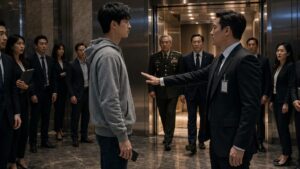
Emily Carter had been ordered to keep her jacket on, which was exactly why everyone in the room watched when she let it slide lower.
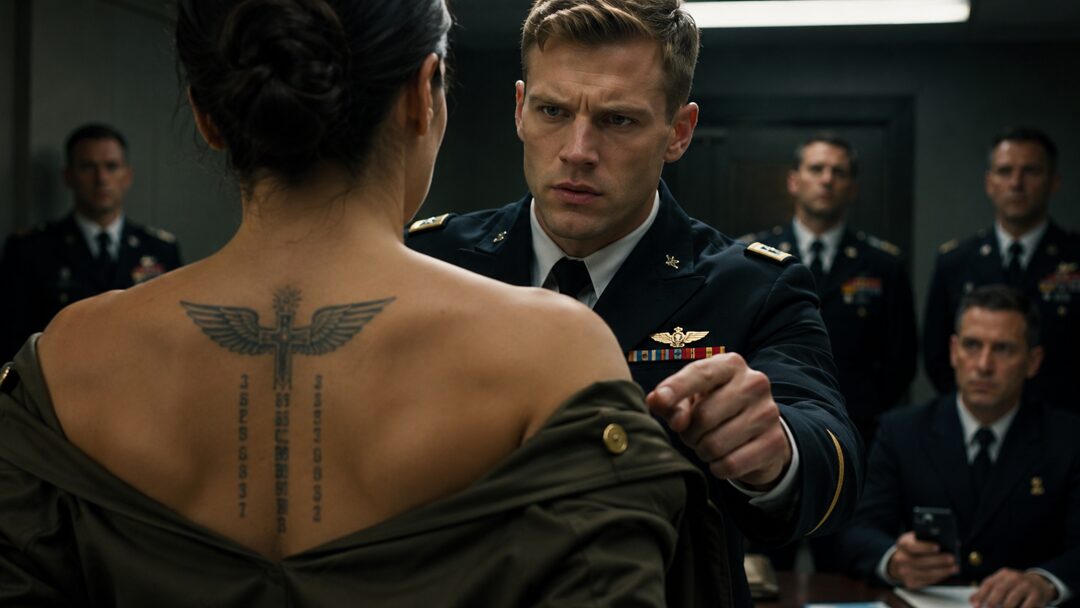
The olive fabric caught for a second on the points of her shoulders. Her dark hair was pinned so tightly at the back of her head that not a strand moved. She stood with her back to the door, facing the long table where five officers sat beneath fluorescent lights that made every face look tired and unfinished.
First Lieutenant Ryan Miller stood across from her.
He was twenty-nine, blond, clean-shaven, and rigid enough to look carved into his uniform. He had been chosen to conduct the hearing because he was precise, calm, and unlikely to embarrass the command.
Now his jaw tightened.
“Captain Carter,” he said, “put your jacket back on.”
Emily did not turn around.
At the far end of the room, a junior aide shifted in his chair. His phone came up half an inch, not enough to be obvious unless someone was looking for guilt. Emily saw the reflection in the dark glass of a framed commendation on the wall.
She had expected someone to record it.
She lowered the jacket another inch.
A silence moved through the room, thin and electric.
Across her upper back, just visible above the white edge of her undershirt, was the top of a tattoo: dark wings spread wide from a field cross. The ink was not fresh. It had settled into her skin like something that had been there longer than the person wearing it.
Colonel Michael Hayes closed the folder in front of him.
Not loudly.
That made it worse.
“Captain,” Hayes said, “this is still a formal proceeding.”
“Yes, sir,” Emily said.
Her voice was even.
That bothered Ryan more than if she had sounded afraid.
He had seen fear in hearings before. He had seen anger, trembling, pleading, the brittle confidence of officers who thought their decorations could speak for them. Emily Carter had none of it. She stood in the center of the room with her jacket slipping down her arms, and she looked like a woman who had already decided what the room was allowed to take from her.
Ryan glanced at the file.
CARTER, EMILY R.
CAPTAIN.
FORMER MEDICAL ATTACHMENT.
OPERATION ASHLINE.
The paper was clean. The facts were aligned. She had received a direct extraction order and deviated from it. She had delayed her convoy eleven minutes. Two vehicles were lost during the return. The official recommendation used the phrase operational recklessness.
Ryan preferred clean words. Clean words kept men from saying what they really meant.
“Captain Carter,” he said, “you requested this review.”
“I did.”
“You were advised that evidence must be submitted through proper channels.”
“It was.”
Hayes’s eyes lifted.
Ryan felt the room tighten.
Emily’s hands stayed low at her sides. Her jacket hung from the bend of her elbows now, exposing more of the tattoo. Beneath the wings, thin columns of numbers descended along the line of her spine.
They were not decorative.
Ryan knew that before he knew why.
Numbers did not fall like that by accident. They had the cold order of coordinates, fragments, counts. The kind of numbers men copied down before they stopped having names.
“Your written appeal,” Ryan said, “states the official report is incomplete.”
“It is.”
“And you claim to possess proof.”
“I do.”
“Then present it.”
Emily turned.
Not all the way. Just enough for the room to see the tattoo more clearly.
The wings spread from shoulder blade to shoulder blade. The field cross sat between them, narrow and stark. Below it, three vertical lines of ink ran down her back: letters, numbers, short breaks, then more numbers.
Ryan’s eyes caught on one sequence and stopped.
D-M-7.
His breath did not change. His posture did not move.
But something inside him stepped backward.
Emily saw it.
She had not looked at him until then, not really. Now she did, over her shoulder, and the look was not challenge. It was recognition.
Ryan felt heat rise under his collar.
“Put the jacket back on,” he said.
“No.”
The aide’s phone rose another inch.
Hayes noticed this time. “Private Thomas.”
The aide froze.
“Phone down.”
“Yes, sir.”
The phone disappeared into the aide’s lap, but the damage had already been done. The room knew the moment had escaped. Even if the recording never left the building, it had changed the air.
Ryan’s voice hardened.
“Captain Carter, you are not here to stage a scene.”
“No,” Emily said. “I’m here because the scene already happened.”
Part II — The File
Ryan opened the folder because paper gave his hands somewhere to go.
“On May 14, during Operation Ashline, you were assigned as medical lead to Convoy Three, tasked with extracting a detained intelligence analyst from Relay Station Nine. At 1840 hours, headquarters issued a route change due to aerial risk in the east corridor.”
Emily faced forward again. Her back remained exposed to the room.
“At 1847,” Ryan continued, “you disobeyed the revised order and led two vehicles off designated route. At 1858, you rejoined the convoy. At 1906, the convoy came under fire. Two vehicles were destroyed. Three personnel were lost. You accept these facts?”
“I accept the times,” Emily said.
Hayes’s mouth barely moved. “Answer the question as asked.”
“I accept the times,” she repeated.
Ryan looked up.
It should have annoyed him. It did. But beneath the annoyance was something else, something with a pulse.
D-M-7.
Daniel Miller had been DM-7 in the last version of the story Ryan had been allowed to read.
His older brother had always hated being reduced to letters and digits. “If I vanish,” Daniel had joked once, “don’t let them make me sound like a parking spot.”
Then he had vanished, and the institution had done exactly that.
Ryan had been twenty-five then. Old enough to understand official language. Young enough to believe it had to be true because otherwise no one would be able to keep standing.
“Captain,” Ryan said, “why did you leave the route?”
Emily’s fingers flexed once against the inside of her jacket sleeve.
“I heard a transmission.”
“From whom?”
“A patrol west of the relay road.”
“The patrol listed as unrecoverable?”
“Yes.”
Hayes leaned back. “That patrol had no confirmed live signal after 1812.”
Emily turned her head slightly toward him.
“That is what the report says.”
“That is what the record shows.”
“No, sir,” she said. “That is what survived editing.”
The words landed too cleanly.
No one moved.
Ryan shut the folder.
“Careful, Captain.”
Emily looked at him again. “I have been careful for three years.”
Ryan did not want that line to reach him. It did anyway.
He stepped closer, not enough to be inappropriate, just enough to reclaim control of the hearing. The tattoo sharpened in his vision. D-M-7 sat in the left column, four lines beneath what looked like a grid fragment.
“You expect this board to accept ink on your body as evidence?” he asked.
“No.”
“Then what is it?”
“The part they couldn’t lock in a cabinet.”
Hayes’s expression did not change, which was how Ryan knew the answer had struck him.
Ryan let his eyes move down the columns again. There were route fragments. Counts. Times. Initials. Not full coordinates, not complete call signs. Enough to mean everything to the right person. Not enough to matter to anyone determined not to see.
He hated that he understood the design.
He hated her more for making him understand it in front of everyone.
“You were ordered to extract Sarah Brooks,” Ryan said. “A living analyst with active intelligence value.”
“I did extract her.”
“After delaying the convoy.”
“Yes.”
“After diverting toward a patrol already assessed as lost.”
Emily’s jaw tightened for the first time.
“Not lost.”
Ryan heard the edge in her voice and stepped into it.
“You are suggesting command knowingly abandoned living personnel?”
“I am saying command stopped listening.”
“Because you didn’t like the answer?”
Emily’s shoulders were still. Too still.
“Because the last living voice on the radio was asking for a medic.”
Ryan stared at her.
He knew he should stop. A presiding officer did not get personal. A presiding officer did not let old grief sit up inside him and speak.
But Daniel’s call sign was on her back.
And she had chosen to reveal it like a weapon.
“You don’t get to use dead men to make your disobedience look noble,” Ryan said.
The room went colder.
Emily turned fully enough for him to see her face in profile.
There was no fury there.
That made it harder.
“No,” she said. “I don’t.”
Part III — The Last Voice
The first time Sarah Brooks entered the story, she was still only a name in the file.
Captured analyst. Relay Station Nine. Priority extraction.
The report said Emily’s convoy had reached the station under degraded visibility. It said Brooks had been found alive in the server room, dehydrated and injured. It said the return route was compromised because Captain Carter deviated from command instructions.
It did not say what Emily had heard before she turned the wheel.
Ryan read from the file. Emily corrected nothing until he said, “No live transmission from the western patrol was recorded.”
“Recorded where?” she asked.
“In the official channel log.”
“That wasn’t the only channel open.”
Hayes spoke before Ryan could. “Captain Carter, you were not authorized to monitor unsecured emergency bands during that phase.”
Emily looked at him. “Men who are dying don’t always use approved channels, sir.”
The aide’s pen stopped moving.
Ryan felt the sentence pass through the room. It was too simple to attack.
“State what you heard,” he said.
Emily did not answer right away.
For the first time, her control seemed less like discipline and more like a hand pressed hard against a door.
“A broken signal,” she said. “Static first. Then a voice giving partial position. I thought it was old traffic bouncing. Then he said they had two breathing, one fading, one pinned.”
Ryan’s throat tightened.
Emily continued, each word measured.
“He asked for medical. Then he corrected himself and asked for evacuation. Then he said he had eyes on the ridge road and could guide us through the dead zone if we came west instead of south.”
Hayes’s eyes narrowed. “That information is absent from all validated records.”
“Yes, sir.”
“And you wrote none of it down at the time?”
“I wrote it where I knew no one could remove the page.”
Ryan looked at the tattoo again.
The first column, Emily said, was the route they had been ordered to take.
The second column was the route they actually drove.
The third was not a route.
It was a count.
“How many breathing when we reached them,” she said.
The aide looked up before he could stop himself.
Ryan hated him for it, then understood him.
“How many?” Ryan asked.
Emily’s eyes met his.
“Four.”
The file said the western patrol had been unrecoverable before Emily arrived. The file said no confirmed live contact. The file said Daniel Miller had died before the convoy changed direction.
Ryan’s hand rested on the folder.
He did not open it.
“What time?” he asked.
Hayes turned his head slightly. “Lieutenant.”
Ryan ignored him.
“What time did you reach them?”
Emily’s gaze moved to some point over his shoulder, as if the wall behind him had become a road in fading light.
“1853.”
Ryan already knew what the file said.
He said it anyway.
“My brother was listed unrecoverable at 1812.”
No one breathed normally after that.
Emily’s face changed, not by much. Her mouth softened at the corners, not into sorrow exactly, but into the memory of having held sorrow too long.
“Yes,” she said.
Ryan waited for more.
She did not give it.
The absence cut deeper than detail.
“Was he alive when you reached him?” Ryan asked.
Hayes’s palm came down flat on the folder.
“This line of questioning is outside the stated scope.”
Ryan did not look away from Emily.
“Was he alive?”
Emily’s answer was barely above a breath.
“Yes.”
Ryan felt the word enter him and rearrange three years.
His brother had not been gone when command said he was gone. He had existed for forty-one more minutes inside a report that had already closed over him.
Ryan’s face remained still because his training held.
But Emily saw the damage.
That was the terrible thing about people who had carried the same event from different sides. They could recognize the exact second another person began to break.
Part IV — The Witness
Sarah Brooks arrived with a limp she tried to hide and a blazer too formal for the weather.
She paused at the doorway when she saw Emily standing without her jacket.
Her eyes went first to the officers, then to the tattoo, then to Emily’s face.
Shame moved through her so visibly that even Hayes looked away.
Ryan had read her name for years without imagining a person around it. Sarah Brooks had been the rescued analyst, the reason for the mission, the proof that something had gone right. In the doorway, she looked less like proof than someone who had been living under a ceiling that kept lowering.
“Ms. Brooks,” Hayes said, “you understand this is a closed review.”
“Yes.”
“You understand your prior statement remains part of the record.”
“I do.”
Emily did not turn toward her.
That mercy was worse than accusation.
Ryan gestured to the chair beside the table. Sarah sat carefully, one hand resting near her knee.
“During Operation Ashline,” Ryan said, “Captain Carter’s convoy extracted you from Relay Station Nine.”
“Yes.”
“You were conscious?”
“Partially.”
“Did Captain Carter delay extraction to search for the western patrol?”
Sarah’s eyes flicked to Hayes.
That was answer enough.
Ryan leaned forward. “Ms. Brooks.”
“She heard them,” Sarah said.
Hayes’s voice cut in. “Speak only to what you personally observed.”
Sarah swallowed.
“I personally observed Captain Carter pause at the station exit with a radio handset in her hand. I heard a male voice through static. He was giving directions.”
Ryan’s fingers tightened around his pen.
“What directions?”
Sarah closed her eyes briefly. “Ridge road. Drainage cut. Avoid the south turn.”
Emily’s shoulders lowered by a fraction.
Not relief. Recognition.
“Did you include that in your original statement?” Ryan asked.
“No.”
“Why not?”
Sarah looked at the table.
“Because I was told the channel was unverified.”
“By whom?”
Hayes closed his folder again.
The sound was soft. Final.
“This is unnecessary.”
Sarah looked up. “No, sir. It was necessary three years ago.”
The room changed.
Emily did not move, but Ryan felt the shift in her. Not forgiveness. Not triumph. Something smaller and more painful: she was no longer the only person holding the door shut.
Sarah’s voice steadied.
“I was told that if I mentioned the transmission, the entire extraction could be questioned. My clearance. My recovery. The report. Captain Carter’s actions. Everything.”
Ryan said, “So you signed a statement that omitted it.”
“Yes.”
“Knowing Captain Carter would bear responsibility for the deviation.”
Sarah looked at Emily’s back.
“Yes.”
The single word did not defend itself.
For the first time since the hearing began, Emily turned toward Sarah.
“Sarah,” she said quietly.
Sarah flinched.
Not because Emily’s tone was hard.
Because it wasn’t.
“I was alive because of you,” Sarah said.
Emily answered, “You were alive because Daniel gave us the road.”
Ryan’s pen slipped from his fingers.
It struck the table and rolled once.
No one reached for it.
Hayes sat very still.
Ryan looked at the tattoo again. The letters. The route. The counts.
Near the lower edge, partly hidden by the back of Emily’s undershirt, was another number.
Not D-M-7.
A time.
Ryan knew before asking.
But knowing and hearing were not the same punishment.
“What is that number?” he said.
Emily did not answer.
“Captain.”
She closed her eyes for one second.
“The time your brother died.”
Ryan’s world became horribly clear.
Daniel had not died alone in a line of official text. He had lived long enough to guide the convoy. Long enough to choose the living. Long enough for Emily Carter to reach him, hear him, and carry the minute of his leaving on her body because the file would not carry it on paper.
Ryan heard his own voice from far away.
“Did he ask you to save him?”
Emily’s face did not move.
“No.”
“What did he ask?”
Emily looked at him then, fully.
“He asked me not to turn back for him.”
Part V — The Record
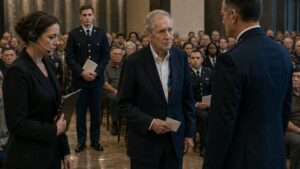
Hayes stood.
That was enough to remind everyone of rank.
“This proceeding is suspended,” he said. “Captain Carter’s statements will be reviewed for emotional reliability. Ms. Brooks’s testimony will be sealed pending classification assessment. Lieutenant Miller, you will prepare a disciplinary recommendation based on the original scope.”
The words were clean.
Clean words could bury anything.
Ryan looked at the folder in front of him. Then at Emily. Then at Sarah, whose hands were clenched so tightly around each other that her knuckles had gone pale.
Private Thomas’s phone was face down on his knee.
Hayes saw Ryan notice.
“Private,” Hayes said, “you will surrender that device before leaving this room.”
Thomas went white. “Yes, sir.”
Ryan understood then why Emily had let the jacket fall before anyone had sworn testimony. Not to create scandal. To create witnesses. To make the room complicit in seeing.
She had learned what happened to truth when it arrived politely.
Hayes turned to Ryan. “Lieutenant.”
Ryan stood.
The room expected obedience from him. He could feel the shape of it waiting. It would be easy. One signature. One recommendation. One more file that said difficult things in clean language.
He had built his life around clean language after Daniel disappeared into it.
His brother, unrecoverable.
The patrol, assessed lost.
The transmission, unverified.
The omission, necessary.
Emily Carter, reckless.
Ryan looked at Emily’s back.
For three years, he had imagined Daniel’s final moment as absence. Empty terrain. No witness. No choice. Just a line ending.
Now there was another version, and it was worse and better at the same time.
Daniel had been alive.
Daniel had given the road.
Daniel had spent the last strength he had pointing strangers toward home.
Ryan bent, picked up his pen, and opened the transcript log.
Hayes’s voice was low. “Lieutenant, do not misunderstand your position.”
Ryan looked at him.
“I don’t think I do, sir.”
Then he turned to Emily.
“Captain Carter,” he said, and his voice was rougher than before, “turn around.”
The room held its breath.
Emily did not obey immediately. That hesitation mattered. It gave the command its full weight. This time, it was not humiliation.
It was record.
She turned.
Ryan looked at the tattoo without flinching.
“Left column,” he said. “Fourth line.”
Emily read it.
“Route revision. South corridor. 1840.”
“Second column. Fourth line.”
“West ridge deviation. 1847.”
“Third column. Fourth line.”
“Four breathing on arrival. 1853.”
Ryan’s mouth tightened.
“Call sign below.”
Emily’s voice changed.
“DM-7.”
Ryan forced the next question out.
“Full name.”
Emily’s eyes shone, but nothing fell.
“Staff Sergeant Daniel Miller.”
The room was completely silent.
Ryan could hear the fluorescent lights. He could hear Sarah’s breath catch. He could hear the small shift of Hayes’s polished shoe against the floor.
“Time notation near lower right,” Ryan said.
Emily’s voice was almost gone.
“1859.”
“Meaning?”
Hayes said, “Lieutenant.”
Ryan did not look at him.
“Meaning?” he repeated.
Emily looked straight ahead.
“Time of death.”
The pen felt too small in Ryan’s hand.
Sarah spoke before he could ask her.
“I confirm the transmission,” she said.
Hayes turned on her. “Ms. Brooks.”
“I confirm that Captain Carter was instructed to omit it from her preliminary account.”
“That is not the question before this board.”
“It should have been.”
Hayes’s face went flat.
Ryan wrote.
Not everything. Not the whole truth. No official record ever held a whole truth. But enough. A route. A time. A call sign. A correction. A recommendation.
He signed the page.
His signature looked strange to him, like it belonged to someone who had stepped out of line and become more himself by doing it.
“My recommendation,” Ryan said, “is removal of the cowardice notation from Captain Carter’s disciplinary file and formal reopening of the Ashline review.”
Hayes stared at him.
“You understand the consequences of that sentence.”
Ryan met his eyes.
“Yes, sir.”
Emily’s jacket still hung from her arms.
Ryan looked at her then, not as a case, not as an accused officer, not as the woman who had brought his brother back into the room without warning.
As the last person who had heard him.
Emily spoke to Ryan for the first time without the board between them.
“Your brother asked me not to waste his death,” she said. “I have been trying not to.”
No one wrote that line down.
Everyone heard it anyway.
Part VI — What Changed Shape
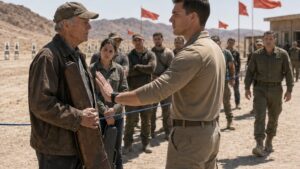
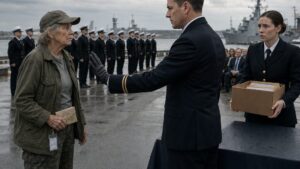
Three weeks later, Emily Carter left the base through the side gate with one cardboard box and no ceremony.
The official notice had been delivered at 0730. Partial correction. Reopened file. Cowardice notation removed. Command separation pending final administrative review.
It was not justice.
It was not nothing.
Emily carried the box against her hip. Inside were two folded uniforms, three paperbacks, a chipped coffee mug, and a sealed envelope she had not opened yet because she already knew it would use the word service more than once and never once use the word sorry.
The morning was bright in a way that made everything look too ordinary.
No officers lined the walkway. No one saluted. A mechanic glanced over from a bay door, recognized her, and looked away with the awkward respect people showed when they did not know whether a person had won or lost.
Emily did not blame him.
She did not know either.
At the gate, Ryan Miller waited beside the guard booth.
He was not wearing his cover. His blond hair moved slightly in the wind. He looked younger without the hearing room around him, but not lighter.
Emily stopped.
“Lieutenant.”
“Captain.”
“Not for much longer.”
He accepted that without correction. That was kind of him.
For a moment, neither spoke.
There were things language would ruin if it entered too quickly.
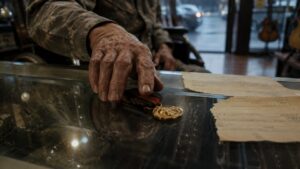
Ryan reached into his coat pocket and took out a small brass compass.
Emily recognized it before he offered it.
Her chest tightened so sharply she almost stepped back.
“No,” she said.
Ryan held it anyway.
“It was in recovered personal effects. The file reopening released it to next of kin.”
“Then it belongs to you.”
“It did.”
She stared at the compass as if it were heavier than the box in her arms.
The casing was scratched along one edge. There was a dent near the hinge. She remembered Daniel Miller’s hand closing around it, remembered him pressing it toward her with fingers already losing strength.
Ridge road, he had said.
Take the living.
She had hated him for making it sound simple.
Ryan’s voice was quiet.
“He used it to point you toward them.”
Emily did not touch it.
“He used it to send me away.”
Ryan looked at her for a long moment.
“Maybe that was the same thing.”
The words opened something she had spent three years holding shut.
Not all the way.
Enough to hurt differently.
Emily shifted the box to one arm. With her free hand, she accepted the compass.
The brass was warm from Ryan’s pocket.
For a second, neither of them let go.
“I used to think,” Ryan said, “that if I ever found out someone had been with him, I’d know what to say.”
Emily looked at their joined hands around the compass.
“Do you?”
“No.”
That made her almost smile.
Almost.
Ryan released the compass.
Emily closed her fingers around it and felt the old shape press into her palm. The tattoo beneath her shirt did not vanish. The numbers were still there. They would be there that night, and the next morning, and every day her body remained the place where the missing record lived.
But the compass was outside her now.
Held.
Seen.
Shared.
Ryan stepped back from the gate.
“Captain Carter.”
She looked at him.
He swallowed once.
“Thank you for not leaving him alone.”
Emily’s grip tightened around the compass.
There were answers she could have given. That she had not saved him. That she had left when he told her to. That she had spent years hearing his voice whenever a room went too quiet. That gratitude was too clean for what had happened.
Instead, she gave him the only truth that did not ask either of them to pretend.
“He wasn’t alone.”
Ryan nodded.
It was not forgiveness.
It was not closure.
It was a place to set one part of the weight down.
Emily walked through the gate with the box under one arm and Daniel Miller’s compass in her hand. Behind her, Ryan stayed where he was until she reached the road.
The morning kept moving.
So did she.