What She Kept Until Morning
Part I — The Dance No One Heard
Emily Carter knew the general had not crossed the ballroom to be kind.
Everyone else saw kindness.
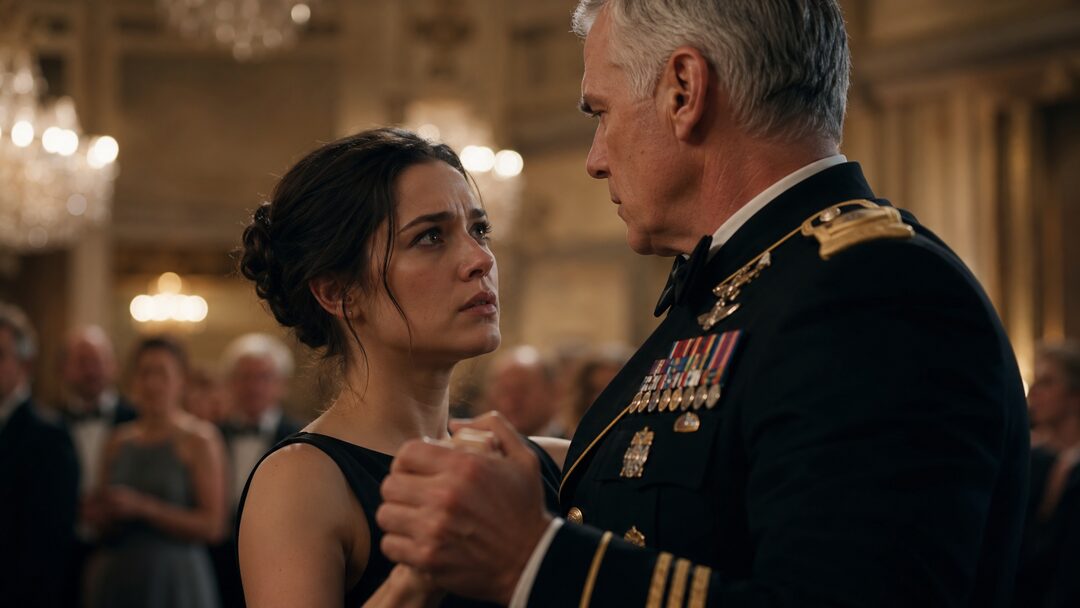
They saw the chandeliers, the white tablecloths, the flowers arranged in silver bowls, the old men in dress jackets lifting glasses to one another as if history could be toasted into something clean. They saw General Robert Hayes, tall and silver-haired, his formal jacket heavy with medals, extending a hand to the young nurse in the black dress.
“A dance, Ms. Carter?”
The room softened around them.
A donor’s wife smiled. Someone near the stage whispered, “That’s Daniel’s nurse.” A photographer lifted his camera, already hungry for the picture: the grieving father, the young caregiver, one gracious moment beneath the lights.
Emily looked at his hand.
She had washed that hand’s son from beneath her fingernails six months ago.
“I’m not much of a dancer,” she said.
“Neither was Daniel.”
He said the name gently enough for the room to miss the blade in it.
Emily took his hand because refusing would have made a scene, and because Robert Hayes knew she would know that. His fingers closed around hers with the firmness of a man who had spent forty years giving orders and being obeyed.
The band moved into something slow.
They stepped onto the polished floor.
For three turns, he said nothing. His right hand rested between her shoulder blades. His eyes stayed above her head, his face composed for the room.
Then he leaned closer.
“You were with my son when he died.”
Emily’s breath caught so quickly she almost missed the next step.
Around them, couples turned in soft circles. A woman in pearls laughed at something near the bar. Glasses chimed. The hospital director watched from a table near the stage, pleased by the elegance of grief when it behaved.
Emily kept her eyes on the general’s collar.
“I was on shift that night,” she said.
“That isn’t what I asked.”
He guided her through another turn, smooth and exact. Anyone watching would have thought he was leading with old-world courtesy.
Emily felt trapped by his hand, by the music, by every face that admired him.
“The report says Daniel was unconscious after surgery,” Hayes said. “It says he never spoke again.”
Her mouth went dry.
“Reports are written from charts,” she said. “Not every minute becomes a line.”
His gaze dropped to her face.
“But some minutes do.”
She missed a step.
He caught her before anyone noticed.
The humiliation of that steadied her more than comfort would have. Emily straightened. She had spent years learning not to shake in front of families, not to cry in supply closets until her hands stopped working, not to carry one patient’s voice into another patient’s room.
She had learned silence like a second uniform.
General Hayes lowered his voice.
“A night orderly told me Daniel woke up at 2:13. He said my son asked for a nurse.”
Emily looked past him and found the exit doors at the far end of the ballroom.
Too far.
“He was confused,” she said.
“That orderly said he knew your name.”
The music rose.
Emily heard another sound beneath it: the squeal of wheels on hospital tile, the overhead page calling trauma team, the soft, terrible beep of a monitor that had not yet given up.
Hayes watched her as if he could read the memory moving behind her eyes.
“What did he say?”
Emily did not answer.
For the first time, the general’s perfect public face hardened.
“What did my son say to you?”
Across the room, Dr. Michael Grant stopped with a glass halfway to his mouth.
Emily saw him see them.
And that was when she knew the night was not finished with any of them.
Part II — The Time That Stopped
General Hayes turned her slowly, so the room kept thinking they were dancing.
“I received Daniel’s personal effects in a sealed bag,” he said. “Boots. Ring. Dog tags. Wallet.”
Emily kept her face still.
“And a watch.”
Her hand tightened before she could stop it.
There it was. The smallest betrayal of muscle. A flinch no one else could have noticed, but Hayes had spent his life noticing what men tried to hide under pressure.
His eyes sharpened.
“You know the watch.”
Emily said nothing.
“It was mine first,” he said. “Field issue. Ugly thing. Kept terrible time unless you wound it every morning. Daniel wore it anyway.”
The ballroom blurred at the edges.
Emily remembered the watch cold in her palm. Heavy for its size. The strap cracked dark from years of sweat and dust. The glass face scratched across the two and the four.
Stopped at 2:17.
Hayes’s voice stayed level.
“They told me it stopped during transport.”
Emily swallowed.
“Maybe it did.”
“No.”
One word. Flat and certain.
He led her past a cluster of officers who nodded respectfully as they passed. Hayes nodded back. Emily wondered how many people in that room had practiced grief until it looked like discipline.
“My son was not wearing the watch when they returned him to me,” Hayes said. “It was separate. Bagged. Logged by hand. Someone removed it before the body was transferred.”
Emily’s heart struck once, hard.
“You think I did.”
“I think you know who did.”
She almost laughed, not because it was funny, but because accusation was easier to bear than the truth.
Daniel had removed it himself.
With fingers that trembled from blood loss and pain and whatever pain medication had not yet softened the edges. He had struggled with the buckle until Emily reached for it, and he had snapped, “No. Let me.”
Still giving orders with his body failing around him.
Still trying to make one last thing happen by himself.
General Hayes leaned closer.
“Did he give it to you?”
Emily looked at him then.
For half a second, he was not a general. He was an old man holding his breath inside a decorated shell.
Then the shell returned.
“Ms. Carter.”
“Please don’t do this here,” she said.
His jaw tightened.
“I asked quietly for six months. I filed requests. I made calls. I read reports with whole hours missing. I was told my son died peacefully in service of his country.”
His voice did not rise.
That made it worse.
“Then a janitor who owed no one anything told me Daniel woke up and asked for Emily.”
Her name sounded different in his mouth. Not intimate. Not kind.
Evidence.
Emily felt Dr. Grant moving at the edge of the dance floor before she saw him. He kept his distance, but his face had lost color.
The general noticed her glance.
“So he knows too.”
Emily’s silence answered.
Hayes gave the smallest nod, as if another piece had clicked into place.
“What did Daniel ask you to hide?”
Her stomach turned.
“Nothing.”
“That was too fast.”
“He didn’t ask me to hide anything.”
“Then what did he ask?”
Emily could not speak.
Because the answer was not one thing.
Daniel had asked for water he could not have. He had asked whether Miller made it. He had asked if his father was coming. He had asked whether the interpreter had been counted among the rescued. He had asked for the watch. He had asked Emily to leave him.
And then, at the end, he had asked her to carry a sentence she had not been strong enough to deliver.
The song shifted into its final movement.
Hayes’s hand pressed once at her back, not cruelly, but with command.
“Tonight,” he said, “they are presenting Daniel’s commendation.”
Emily’s eyes snapped to his.
“What?”
“You didn’t know?”
The room tilted.
On the stage, a framed photograph of Captain Daniel Hayes stood beside a folded flag and a polished plaque. Emily had avoided looking at it all evening. Now the image came into focus: Daniel in uniform, younger than she remembered him, smiling like he had not yet learned what orders could cost.
“The hospital team will be called up,” Hayes said. “You included.”
“No.”
“Yes.”
“I can’t.”
“You can.”
His voice softened in a way that did not feel merciful.
“And if you let them pin another clean lie to his name, I will know.”
The music ended.
Applause rose around them.
General Hayes stepped back and bowed his head, every inch the gentleman.
Emily stood on the dance floor with one hand empty and the other clenched so hard her nails bit her palm.
From across the room, Dr. Grant started toward her.
Part III — The Corridor at 2:17
Six months earlier, Emily had been twelve hours into a shift that should have ended at midnight when the first call came in.
Four incoming. Classified transfer. Multiple injuries. No media. No families yet.
The emergency wing changed shape when that kind of call came through. Voices got lower. Doors opened faster. Names became initials. Men with badges stood near elevators pretending they were not listening.
Emily tied her hair tighter and told herself what she always told herself.
One room at a time.
Captain Daniel Hayes arrived first.
She did not recognize him as the general’s son then. He was just a man on a stretcher, pale beneath grime, one hand gripping the rail as if refusing to be delivered anywhere lying down.
“Name?” she asked, leaning over him.
“Daniel Hayes.”
His eyes found hers, too sharp for the damage his body had taken.
“Where’s Miller?”
“We’re taking care of you right now.”
“That’s not what I asked.”
Even then, Emily almost smiled. He sounded less like a patient than a man furious to be interrupted.
Dr. Grant appeared at the foot of the bed, sleeves already pushed up, expression stripped to function.
“Captain Hayes,” he said, “you need to save your air.”
Daniel ignored him.
“There’s another stretcher behind me. Kevin Miller. Twenty-four. Left arm bad. Breathing worse.”
Grant glanced once toward the corridor.
“We’ll triage as they arrive.”
“He has a better chance than I do.”
Emily’s hands kept moving because hands had saved her more than hope ever had. Cut fabric. Check lines. Call pressure. Watch pupils. Keep the body from becoming only the injury.
Daniel caught her wrist.
Not hard. Just enough.
“Listen to me.”
“Captain, I need you to let go.”
“You’re Emily?”
She blinked.
“My badge says that.”
“Good. Emily. When Miller comes in, you go with him.”
The bed beside them beeped faster.
Grant’s eyes flashed.
“No one is going anywhere yet.”
Daniel’s gaze stayed on Emily.
“That’s an order.”
“You don’t outrank me in here,” she said.
A corner of his mouth moved. It might have become a smile in another life.
“Then take it as a request.”
The second stretcher hit the corridor like a crash.
“Room three!” someone shouted. “We need hands!”
Emily looked at Grant.
For one second, the whole night narrowed into a choice no one should be young enough to make.
Daniel’s fingers slipped from her wrist.
“Go.”
His voice was rougher now.
“Please.”
Emily went.
That was the part she had replayed until it had worn grooves in her mind.
Not that Daniel died.
People died in her rooms. People died despite good hands and better equipment and prayers muttered by people who claimed they did not pray.
It was that she left because he asked her to.
It was that Miller lived.
It was that when she returned, Daniel was still conscious enough to know she had obeyed.
He looked smaller then. Not weak. Never weak. But stripped of command. Reduced to breath and pain and the awful human work of staying.
“Miller?” he asked.
“Alive,” Emily said.
Daniel closed his eyes.
For a moment, peace passed over his face.
Then he opened them again.
“The interpreter?”
Emily looked at Grant.
Grant looked away.
Daniel understood.
His face changed, and Emily would remember that change longer than the blood, longer than the alarms. It was not surprise. It was confirmation of something he had been trying not to know.
“Did we get him out?” he asked.
No one answered.
That was the first lie.
Not spoken. Worse. Shared.
Daniel moved his left hand toward his wrist. He fumbled at the watch.
Emily reached to help.
“No,” he said. “Let me.”
The buckle resisted him. His fingers shook. He cursed once, softly, almost politely. Finally the strap came free.
He pressed the watch into Emily’s palm.
“Give it to my father.”
“You can give it to him.”
“No.”
“Daniel—”
His eyes sharpened.
“Emily.”
She hated that he knew her name now. Hated that it made the room intimate. Hated that the dying had a way of making strangers into witnesses.
“Tell him,” Daniel said, “I didn’t leave him because I was afraid.”
The monitor stuttered.
Emily leaned closer.
“Who?”
Daniel’s throat worked.
“The man we couldn’t carry.”
Grant stepped in.
“That’s enough.”
Daniel did not look at him.
“I stayed until the last second. Miller wouldn’t move. None of them would. I chose my people, and I left a man calling my name.”
His eyes filled, but no tear fell.
“Tell my father I was afraid anyway.”
Emily’s fingers closed around the watch.
Daniel breathed in like it hurt to be honest.
“Tell him I was still his son.”
Then everything moved too fast.
Grant called for medication. Someone shouted numbers. Emily was pushed back, then pulled in, then given gauze, then told to hold pressure, then told to move. Daniel’s eyes found hers once more over the chaos.
At 2:17, the watch stopped.
At 2:23, the room did.
Afterward, in the corridor, Emily stood with the watch inside her scrub pocket and Daniel’s words under her tongue.
Dr. Grant found her near the linen cart.
“You heard what he said,” she whispered.
Grant’s face looked ten years older.
“I heard a man in shock.”
“He knew what he was saying.”
“He implicated an operation no one here is cleared to discuss.”
“He asked me to tell his father.”
“His father is General Hayes.”
“He’s still his father.”
Grant took a long breath and looked toward the closed room where Daniel’s body lay under a clean sheet.
“Emily, listen to me. There are survivors still being stabilized. One of them is Miller, whose recovery may depend on not becoming the reason a decorated captain’s family tears itself open. There are rescued people whose names cannot enter a public report. There are careers, inquiries, funding, diplomatic channels—”
“He asked me.”
“And if you repeat it wrong, they will turn his last words into a hearing.”
That stopped her.
Grant lowered his voice.
“Sometimes the kindest thing is to let the official story be enough.”
Emily looked at the watch in her hand.
“It isn’t enough.”
“No,” Grant said. “But it may be all anyone can survive.”
For six months, she carried the watch wrapped in gauze inside a small box in her apartment.
She told herself she was waiting for the right moment.
She told herself there was no right moment.
Then General Hayes asked her to dance.
Part IV — The Room Built Around a Version
Dr. Grant caught Emily near the side hallway just as the applause from the dance floor faded.
“You need to breathe,” he said.
She almost laughed.
“That’s your medical advice?”
“That’s my human advice.”
He reached for her elbow. She pulled back before he touched her.
Grant’s hand dropped.
“What did he say to you?”
“He knows Daniel woke up.”
Grant closed his eyes briefly.
“Who told him?”
“Does it matter?”
“It matters if he’s building a case out of half-truths.”
“He asked about the watch.”
That did it.
Grant looked toward the ballroom, where Hayes was now speaking to two donors with impossible calm.
“You didn’t bring it here.”
Emily said nothing.
“Emily.”
“I didn’t know about the commendation.”
His face shifted, and that was answer enough.
“You knew,” she said.
“I knew they were honoring the hospital team.”
“You knew they would call me up there.”
“I was going to warn you.”
“When? While they handed me a plaque?”
Grant rubbed a hand over his face. Beneath the gala lighting, he looked wrong in a suit. Without the white coat, he seemed less powerful and more tired.
“This is exactly why I told you not to carry it alone.”
“You told me not to speak.”
“I told you not to turn a dying man’s trauma into public ammunition.”
Her voice came out colder than she expected.
“Is that what you call his last words?”
Grant flinched.
For a second, she saw the man from that night. The surgeon who had fought for Daniel until there was nothing left to fight. The man who had sat down afterward in the staff room with blood on his cuff and not noticed until morning.
He was not heartless.
That made him harder to hate.
“Truth does not become harmless because it is true,” Grant said. “You know that.”
Inside the ballroom, someone tested the microphone. A soft squeal pierced the air.
Emily looked through the open doors.
Kevin Miller sat near the back with his injured arm held close against his body. He had lost weight since the first time she saw him awake. His tuxedo jacket hung strangely on his frame. When a donor leaned down to speak to him, Kevin smiled with the politeness of a man who had learned to let people feel generous.
He saw Emily.
Then he saw Grant.
His smile vanished.
Grant followed her gaze.
“He shouldn’t have come,” he said.
“He’s not a patient anymore.”
“He’s a symbol tonight. That’s worse.”
Emily watched Kevin turn his water glass between two fingers, his eyes fixed on the stage.
“Does he know?” she asked.
Grant’s silence answered.
“He remembers enough,” he said.
“Enough?”
“He knows Daniel told you to go to him. He knows he lived. People like him fill in the rest with whatever hurts most.”
Emily pressed a hand to her stomach.
The box with the watch rested inside the small black clutch she had left under her chair. She had brought it because she did not know how not to. Because going into a room with Hayes and Daniel’s photograph without the watch had felt like another lie.
Grant looked at her carefully.
“If you have it, give it to me.”
“No.”
“I can secure it.”
“No.”
“Emily, if this becomes public—”
“I’m not trying to destroy anyone.”
Grant’s answer was immediate.
“Truth does that on its own if you hand it a microphone.”
Inside the ballroom, applause began.
The hospital director stepped onto the stage, smiling too widely.
“Ladies and gentlemen, if we could ask everyone to take their seats.”
Emily felt the room gather itself into ceremony.
Grant lowered his voice.
“There is still a way through this. Say nothing. Let Hayes receive the honor. Let Miller get through the night. Tomorrow, if you must, arrange a private meeting.”
“Tomorrow is what cowards call mercy.”
The words were sharper than she intended.
Grant absorbed them.
Then he said quietly, “And tonight is what guilt calls courage.”
That landed.
Emily looked away.
Because part of her had wanted the public room to decide for her. She had wanted the pressure to become so unbearable that whatever she did next could be blamed on the moment.
Grant knew that. It was why his warning hurt.
The director was speaking now, his voice warm and practiced.
“Tonight we honor not only service, but the hands that receive service members when they come home to us…”
Emily saw General Hayes near the stage. He stood beside Daniel’s photograph with his shoulders squared and his face unreadable.
Then Hayes looked across the room and found her.
Not a command this time.
A question.
Emily turned away from Grant.
She walked back into the ballroom.
Part V — What the Watch Remembered
Emily took her seat with the watch in her clutch and Daniel’s words in her mouth.
The ceremony began the way ceremonies always did. With polished sentences arranged around pain so no one had to touch it directly.
Captain Daniel Hayes was called brave.
Dedicated.
Selfless.
An example.
A son of the nation.
Each word made Emily’s throat tighter.
Not because they were false.
Because they were too smooth.
Bravery had not looked smooth at 2:17. It had looked like a man trying to unbuckle a watch with shaking fingers. It had sounded like, Tell him I was afraid anyway.
Kevin Miller sat three rows behind her. She heard his uneven breath before she dared to glance back.
He was staring at Daniel’s photograph.
Not crying. Not moving.
Punishing himself by staying present.
The hospital director called Dr. Grant first. Grant walked onstage to polite applause and accepted a framed certificate. He did not look proud. He looked like a man standing too close to an open flame.
Then the director said, “And Nurse Emily Carter, whose dedication that night represents the best of this institution.”
Emily could not move.
The applause grew uncertain.
A woman at her table touched her wrist.
“Dear?”
Emily stood.
Her legs felt separate from her body. She carried the clutch in both hands as she walked toward the stage.
General Hayes waited beside the podium.
Up close, she saw what the ballroom had hidden. The skin beneath his eyes was bruised with sleeplessness. His medals were immaculate, but his hands were not still.
The director smiled at her.
“Ms. Carter, thank you for your service to our returning heroes.”
Emily accepted the certificate. It felt absurdly light.
A photographer raised his camera.
General Hayes stepped toward the microphone.
“My son,” he began.
The room quieted.
Emily heard the sentence forming in the room before he said it. The story everyone had gathered to receive. The clean one. The one in which Daniel did his duty, came home silent, and left nothing behind that would trouble the living.
Hayes glanced at Emily.
She knew then that he would not stop her.
He would not save her either.
The choice was hers.
Emily stepped closer under the pretense of adjusting the certificate in her hands.
“General,” she whispered.
His jaw moved once.
She opened the clutch.
The watch lay wrapped in white gauze.
For one breath, Hayes did not understand.
Then he did.
The room did not see the way his face changed. It was too small for them. Too private. A crack running under stone.
Emily placed the watch in his palm.
His fingers closed around it as if the metal had weight enough to pull him from the stage.
“He took it off himself,” she whispered. “He wanted you to have it.”
Hayes stared at the scratched glass.
“Why was it stopped?”
“At 2:17, he asked me to go to Miller.”
Hayes looked up.
Emily held his gaze now.
“He knew Miller had a chance. He knew he might not. He ordered me to leave him.”
The general’s face tightened with a pain so sudden Emily almost stopped.
But Daniel had given her more than pain.
“He asked about the interpreter,” she said.
Hayes closed his eyes.
“He knew?”
“He knew enough.”
The microphone stood inches away. The room waited, unaware that the real ceremony was happening just outside its hearing.
Emily’s voice shook once, then steadied.
“He said, ‘Tell my father I didn’t leave him because I was afraid.’”
Hayes opened his eyes.
“He said he stayed until the last possible second. He said Miller and the others would not move without him. He said he chose his people.”
Her own eyes burned now.
“And then he said, ‘Tell him I was afraid anyway. Tell him I was still his son.’”
Hayes’s hand curled around the watch.
For one terrible second, Emily thought he might fall.
Instead, he turned back to the microphone.
The paper with his prepared remarks waited on the podium. He looked down at it. Read nothing. Folded it once. Then again.
The small sound of paper creasing carried farther than it should have.
“My son Daniel,” Hayes said, “has been called many things tonight.”
His voice was controlled, but lower now.
“Brave. Decorated. Exemplary. Those words are not wrong.”
He paused.
“They are simply not enough.”
The ballroom went still.
Emily stood behind him, half in shadow, the certificate against her chest.
“Daniel was brave,” Hayes said. “He was also stubborn. He was impatient. He hated ceremonial shoes. He called me sir when he wanted to annoy me.”
A soft ripple moved through the room. A few people smiled.
Hayes looked at Daniel’s photograph.
“And he was afraid when fear was the honest thing to be.”
No one moved.
“There are stories we tell because they are easier to carry. There are honors we give because we do not know what else to do with what remains. But no medal, no plaque, no speech can hold the whole measure of a person.”
His thumb moved over the watch in his palm.
“My son was not made less brave by being human. None of them are.”
Emily saw Kevin Miller lower his head.
Hayes breathed once, carefully.
“So tonight, I accept this honor not for a perfect hero, but for a man who kept choosing others even when the choice cost him peace. And I ask that when we speak of service, we make room for the people our clean stories leave behind.”
The silence held.
Then applause began, not loud at first. Uneasy. Human.
It spread slowly through the room.
Dr. Grant stood near the back of the stage, his eyes fixed on Emily. He did not smile. He did not nod. But he did not look away either.
Emily stepped back while the applause rose around Hayes.
For the first time in six months, she could breathe without feeling the watch against her ribs.
Part VI — Until Someone Is Ready
Emily changed before the gala ended.
She could not bear the black dress anymore. In the staff locker room, she folded it into her bag and pulled on blue scrubs, then the dark hoodie she wore on overnight shifts when the corridors turned cold after midnight.
Her face in the mirror looked younger without the dress.
Or maybe only more honest.
She washed her hands once, then again, though there was nothing on them.
When she stepped into the corridor, the hospital had already returned to itself. Away from the ballroom wing, the music became a distant suggestion. The lights were bright and unforgiving. A housekeeping cart squeaked near the elevators. Somewhere, a monitor chimed.
This was the world she understood.
Not easier.
Just plainer.
Emily stopped beside the long window overlooking the courtyard and let her shoulders drop.
She did not cry.
Not yet.
She heard footsteps behind her and knew, before turning, who it was.
General Hayes stood at the corridor entrance with his jacket still buttoned, the watch in his hand.
Without the crowd around him, he seemed older.
“I won’t keep you,” he said.
Emily nodded.
For a while, neither of them spoke.
There were no chandeliers here. No photographers. No applause to tell them what shape their faces should make.
Finally Hayes said, “You were there when he asked about me?”
“Yes.”
“Did he think I would be ashamed of him?”
Emily looked down.
“He was afraid you would need him to be simpler than he was.”
Hayes absorbed that.
It struck harder than blame would have.
He looked at the watch.
“I did,” he said.
Emily’s throat tightened.
He took one step closer, not enough to crowd her.
“I spent his whole life teaching him to be steady. Then when I lost him, I let other people make him into stone.”
His hand closed around the watch.
“He deserved better than that.”
“So did you,” Emily said.
The words surprised them both.
Hayes looked at her then, fully.
For the first time all night, his authority left the room.
“What happened after he gave it to you?”
Emily could have told him everything. The alarms. The sheet. The way Grant stood in the corridor. The six months of waking at 2:17 for no reason her body could explain.
Instead she gave him the truth that mattered.
“I stayed until they made me leave.”
Hayes’s face moved.
Not much.
Enough.
“Thank you,” he said, “for staying with him.”
That was when she cried.
Quietly at first, with one hand over her mouth like she could still make it smaller. Then not smaller. Not dramatic. Not pretty. Just the body finally surrendering a weight it had mistaken for duty.
Hayes did not touch her.
He stood beside her and let the corridor hold what the ballroom could not.
After a while, Emily wiped her face with her sleeve and laughed once, brokenly.
“I’m sorry.”
“Don’t be.”
She looked at the watch in his hand.
“It belongs to you.”
Hayes looked toward the far end of the corridor, where Kevin Miller stood near the vending machines, half-hidden by shadow. He must have followed them from the ballroom, or maybe he had been standing there long enough to hear nothing and understand everything.
Kevin’s injured arm rested against his side.
He did not come closer.
Hayes saw him too.
“No,” the general said quietly. “Not yet.”
Emily frowned.
Hayes held the watch out to her.
“I want you to keep it a little longer.”
“I can’t.”
“You can.”
She shook her head.
“I carried it too long.”
“Then carry it until he’s ready.”
Emily looked again at Kevin.
He stood like a man waiting for permission to still be alive.
Hayes’s voice roughened.
“Daniel chose him. I think Daniel would want him to know that someday. Not as a debt. As a charge.”
Emily took the watch.
This time, it did not feel like evidence.
It felt like something unfinished, but not hidden.
Across the corridor, Kevin raised his eyes. He saw the watch. He saw Emily holding it. He saw Hayes standing beside her, not accusing, not absolving, simply there.
No one moved toward anyone.
Not yet.
That was all right.
Some truths needed a room.
Some needed a corridor.
Some needed to wait until the living could bear them.
Emily slipped the watch into the pocket of her hoodie. Its weight settled against her hip, familiar and changed.
A call bell sounded from the nurses’ station.
She wiped her face again, breathed in, and turned toward the work still waiting.
Behind her, General Hayes remained by the window.
Ahead of her, the corridor stretched bright and cold and open.
For the first time since 2:17, Emily walked through it without feeling alone.