The Name He Carried Across the Desert Without Asking for Thanks
Part I — The Man at the Gate
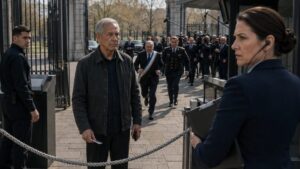
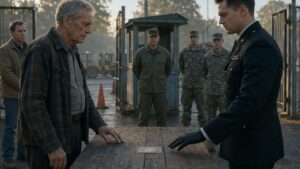
The old man crossed the desert range like he had been expected, even though every young soldier watching him knew he did not belong there.
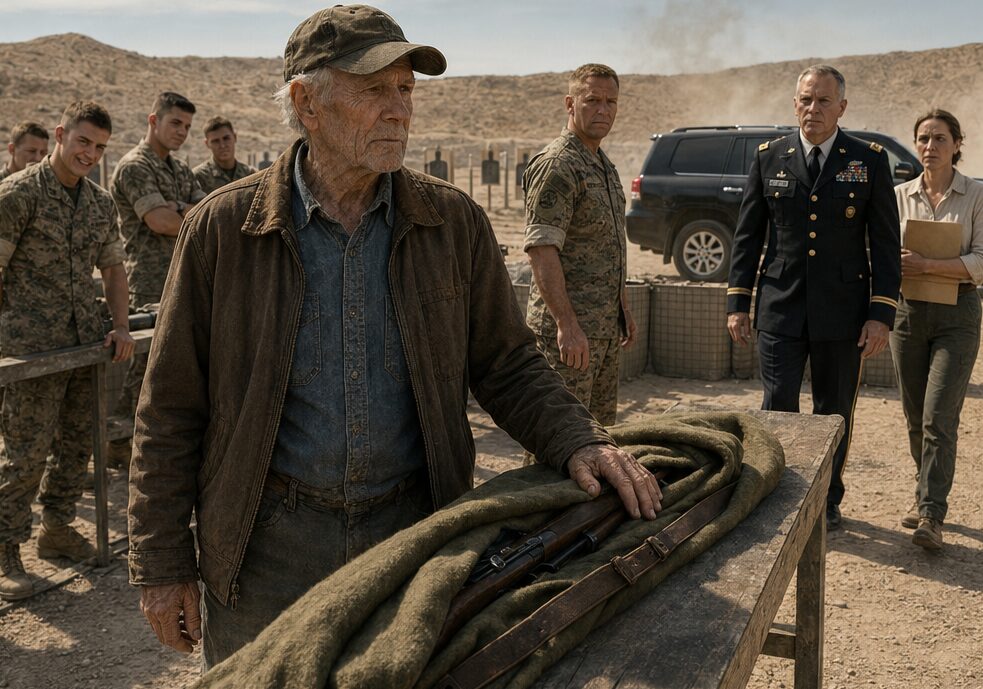
He wore a faded cap, a brown work jacket, a denim shirt buttoned wrong at the throat, and boots dusted pale from the walk between the gate and the firing line. In both hands, he carried something long and narrow wrapped in an olive field blanket, the cloth tied with a dark strap so worn it looked more like a memory than equipment.
The soldiers had been laughing before he arrived.
They had been complaining about the heat, the glare, the dry wind coming off the low hills. Then the old man came through the gate without escort, without uniform, without hurry, and the laughter changed shape.
It became pointed.
It became young.
Tyler was the first to say something.
He stood near the ammunition table with his sleeves rolled tight and a grin that had not yet learned shame. He watched the old man pass the white-painted safety line and called out, “Sir, the museum tour is on the other side of the gate.”
A few soldiers laughed.
Not loudly. Not cruelly enough to get corrected.
Just enough.
The old man did not turn his head.
He kept walking.
That made it worse. Silence made people braver when they were already wrong.
Tyler looked at the others and lifted both hands, as if the old man had proven his point. “Guess he didn’t hear me.”
The old man heard him.
His name was Richard, though no one on that line knew it yet. His right hand tightened once around the wrapped object, not with anger, but with the pressure of someone stopping an old door from opening inside him.
The range stretched ahead in hard sunlight. Targets stood in staggered rows. Heat shimmered over the sand. Beyond the last visible marker, the land sloped toward brown rock and scrub, where older parts of the training ground lay unused.
Richard walked toward the firing bench at the far end.
The range officer noticed him then.
“Sir,” the officer called. “This is a restricted line.”
Richard stopped only when he reached the bench.
He set the wrapped bundle down with more care than anyone expected. The cloth did not fall open. He took a breath first, slow and practiced, as if even unwrapping it required permission from someone not present.
The soldiers had gone quieter.
Old men usually fumbled with things. Richard did not.
His fingers were slow, but exact. He loosened one knot. Then another. The blanket peeled back from dark wood, aged metal, a long barrel, a sling that had been repaired in two places. It was not like the rifles laid out on the racks behind the soldiers. It belonged to another time.
Not a display piece.
Not forgotten.
Maintained.
Tyler’s smile thinned, but he held onto it.
“Well,” he muttered, loud enough for the nearest men to hear, “that looks safe.”
The range officer moved closer. “Sir, civilians can’t handle firearms on this line.”
Richard reached into his jacket and unfolded a letter.
He placed it on the bench without looking up.
The officer took it, already annoyed. Then his face changed.
Not dramatically. Just enough.
He read the signature twice.
“Where did you get this?”
Richard’s eyes remained on the old rifle. “From the man who signed it.”
The officer glanced toward the administration road, where no vehicle had yet appeared.
The letter trembled slightly in his hand, though the wind was not strong.
Tyler leaned toward another soldier. “What, he got a permission slip?”
Richard slid the old sling through his fingers. On the underside, near the place where leather had cracked and been resewn, a small cloth tag was tied flat against it. Something had been written there long ago in ink that had faded to a ghost of blue.
He touched the tag with his thumb.
Only once.
Then he began checking the rifle.
The laughter died in pieces.
Not because anyone understood.
Because nobody checks a relic like that unless it has never stopped mattering.
Part II — The Letter With a Signature
The range officer cleared his throat.
“Sir, I’m going to need you to step back until I verify this.”
Richard did not move.
He lifted the bolt, checked the chamber, closed it again, and rested one palm over the stock as if calming an animal.
“Sir,” the officer said more sharply.
Richard looked at him then.
His eyes were pale, steady, and tired in a way that did not ask for sympathy.
“I’m not here for your line,” Richard said. “I’m here for the old marker.”
The range officer frowned. “There is no old marker in use.”
“No,” Richard said. “There isn’t.”
Tyler let out a short laugh. “Does he even know what year it is?”
The words moved through the heat and reached Richard cleanly.
This time his hand did not tighten around the rifle.
It tightened around the sling.
The difference was small.
But one soldier near Tyler noticed. His laugh stopped before it started.
Richard bent over the bench, opened a small tin from his jacket pocket, and took out a folded cloth. He wiped dust from the rifle’s stock, not because it was dirty, but because that was what his hands knew to do while other people spoke carelessly.
Tyler was not finished.
“Can he even see the target from here?”
A few soldiers shifted. The joke had less air under it now.
Richard pulled a pair of old shooting glasses from his pocket. He unfolded them. One temple had been repaired with wrapped thread. He put them on and looked downrange.
Not at the targets.
Past them.
Far past them.
“Sir,” the range officer said again, now unsure whether to be angry or careful, “you cannot discharge that weapon until command confirms authorization.”
Richard’s jaw moved once.
He did not answer.
From the administration road came the sound of tires on gravel.
Everyone turned except Richard.
A black SUV rolled toward the range through a low cloud of dust. It stopped hard beside the safety barrier. The front passenger door opened first.
A woman stepped out with a folder pressed against her chest and her hair pinned back badly against the heat. She wore practical boots, a pale blouse with sleeves rolled to the elbow, and the anxious focus of someone who had read too many old records and trusted none of them completely.
Then the driver’s side opened.
Colonel James Walker stepped into the sun.
The entire line changed posture.
Boots adjusted. Shoulders squared. Voices disappeared.
Tyler’s grin vanished as if it had been called away.
Colonel James Walker was not tall enough to intimidate by size, but he had the kind of stillness that made people measure themselves. His uniform was clean, his gray hair clipped close, his face composed until he looked at Richard.
Then something tightened around his mouth.
Not surprise.
Recognition.
Richard kept his back to him.
James walked slowly to the firing bench. The woman followed, clutching her folder. The range officer handed him the letter at once.
James did not read it.
He had written it.
“You came early,” James said.
Richard was still looking downrange. “You moved the ceremony up.”
“That was not my decision.”
“But it is your wall.”
The woman looked between them. “Mr.—”
Richard looked at her before she could finish the wrong name.
She corrected herself by not saying one.
James lowered his voice. “You don’t have to do this today.”
For the first time since entering the range, Richard turned fully.
He looked older facing them. The sun found every line around his eyes, every place time had pulled at his face. But there was nothing weak in him.
“I’m not doing it for you,” he said.
No one on the line moved.
Tyler stared at the ground.
James took off his cap, held it at his side for one second, then put it back on because command had habits even guilt could not break.
“This is Laura,” he said. “She’s verifying the archive.”
Laura stepped forward, careful but urgent. “I’ve been reviewing the memorial list.”
Richard’s face did not change.
Laura swallowed. “The updated wall goes public at sixteen hundred.”
“I know.”
“There’s a disputed name.”
The old man’s fingers moved against the sling.
James closed his eyes for half a breath.
Laura opened the folder.
“The file says Matthew left his position during the extraction.”
Richard looked at her then, and something in the heat seemed to sharpen.
She did not say the last name. She did not need to.
Richard’s voice came out low.
“The file lies.”
Part III — The Name That Was Missing
The young soldiers had stopped pretending not to listen.
The base was built on rules, ranks, posted signs, and boundaries painted in white. But the moment Laura said the missing name, none of those things seemed strong enough to hold the silence.
James took the folder from Laura. “The official record says what it says.”
Richard looked at him. “Records don’t breathe.”
“No,” James said. “But they’re what we have.”
Richard touched the rifle stock. “Not all we have.”
Laura stepped closer to the bench. “Mr. Richard, I need to understand what you’re saying. If there’s physical evidence—”
“Don’t call me that like we’re in an office.”
She stopped.
He looked back to the range. “And don’t touch the rifle.”
Laura’s hand had not moved, but she drew it back anyway.
James saw it. “Richard.”
“The last man who touched it before me was Matthew.”
That ended whatever James had meant to say.
The soldiers heard the name now. Not as a line in a file. As a person who had touched wood and metal and leather before disappearing into whatever place made old men go quiet for forty years.
Laura opened the folder again, gentler this time. “The archive references a route marker, but the map is incomplete. There’s a coordinate string in the sealed index, but half the page is redacted.”
Richard lifted the old sling and turned it over.
The cloth tag lay flat against the underside. Faded numbers. Two letters. A dash. More numbers that looked almost gone.
Laura leaned in, then stopped herself.
Richard saw that. He nodded once.
She read without touching.
Her face changed.
“These match the partial index.”
James turned sharply. “You can’t know that from looking.”
“I can know enough,” Laura said. “The pattern is the same. The missing digits are here.”
James stared at the tag like it had insulted him.
Richard said, “He wrote them in the dark.”
No one asked who.
They all knew.
A wind moved across the range. Fine dust lifted and settled on the old blanket.
Laura’s voice softened. “Why didn’t you bring this forward before?”
Richard’s thumb pressed once against the cloth tag.
Behind his eyes, the present thinned.
Not enough for anyone else to see the past clearly. Only fragments came through.
A hand shoving the rifle into his chest.
A voice close to his ear saying, “Carry it out.”
A strip of cloth tied with shaking fingers.
A radio popping with static.
A sky without stars.
Then the present returned, hot and white.
Richard said, “Because living men get tired. Dead men don’t.”
Laura looked down.
Tyler looked at Richard’s boots.
James turned away first. He took three steps toward the open range, then stopped where the painted safety line cut across the sand.
“You know what you’re asking,” James said.
“I know what he asked.”
“You’re asking me to alter a public memorial hours before dedication based on a field tag, an old weapon, and your memory.”
Richard’s face did not move. “I’m asking you not to carve a lie into stone.”
The line struck harder than a shout.
James absorbed it without flinching, but his neck reddened above the collar.
Laura pressed the folder against her ribs. “Colonel, there are supporting fragments. The convoy report references a guiding mark at the pass. The old range expansion covered that terrain later. If the marker still exists—”
“It may not,” James said.
“It does,” Richard said.
James looked at him.
Richard pointed downrange, past the targets, beyond the visible steel plates, to where a rust-colored slope rose under the heat.
“There.”
The soldiers followed his finger.
They saw nothing.
Tyler wanted to say something. His face showed the habit forming.
But he did not.
That was the first useful thing he had done all day.
Part IV — The Marker Beyond the Targets
James refused twice before he allowed it.
First, he said the range was not cleared for anything past the standard line.
Richard said nothing.
Then James said the ceremony schedule could not be interrupted.
Richard still said nothing.
Silence was difficult to argue with when it was not empty.
Finally, James ordered the line cold, moved the soldiers back, and told the range officer to clear the far sector. No one said why. No one had to. Every person there understood they were no longer training.
They were witnessing something they had not been invited to understand.
Richard lowered himself behind the rifle.
The movement cost him. His knee did not bend cleanly. One hand pressed briefly against the bench before he settled. Age entered the moment without apology.
Tyler watched him and looked ashamed before anyone had accused him.
Richard adjusted the sling around his forearm. His fingers found the old repairs by feel. The rifle looked wrong beside the modern gear on the range, but in his hands it seemed to belong to the only clock that mattered.
Laura stood behind James with the folder open.
James kept his arms crossed.
“You miss,” he said quietly, “and this ends here.”
Richard did not look up. “No.”
James’s jaw tightened. “No?”
“I miss,” Richard said, “and you still know why I came.”
The wind moved.
The range waited.
Richard looked through the sights.
The world narrowed.
For everyone else, there was only distance and heat and uncertainty.
For Richard, there was a night folded inside daylight.
A slope. A pass. A convoy stalled where it should not have stopped. Matthew’s hand on his shoulder, hard enough to hurt.
“Carry it out.”
“I’m not leaving you.”
“You’re not staying for me. You’re leaving for them.”
Then the rifle shoved into Richard’s hands.
The sling wrapped around his wrist.
A tag pressed into his palm.
“Make them remember where we were.”
Richard’s finger rested.
He exhaled.
The shot cracked across the desert.
It was not loud for long. The sound hit the hills, broke, and came back smaller.
Far beyond the standard targets, something rang.
A thin steel note.
Clear.
Unmistakable.
Every head turned toward the slope.
The range officer lifted binoculars. “Old marker,” he said, and his voice had lost all official tone. “Left side of the wash. Rusted, but it’s there.”
Laura was already moving.
She spread the archive map across the hood of the black SUV, pinning one corner with her elbow. James followed her, though he moved like a man approaching a verdict.
Richard stayed seated behind the rifle.
No one told him to stand.
Laura traced the tag coordinates with one finger, then the partial index, then the old survey lines.
Her face changed before she spoke.
“It’s the route,” she said.
James said nothing.
Laura looked up at him. “Colonel, it’s the extraction route. The marker lines up with the pass reference. The missing digits on the archive page are on that sling.”
James stared at the map.
Tyler stepped forward before he seemed to realize he had moved.
“I saw it,” he said.
James turned.
Tyler swallowed. “Sir, I saw where he aimed. It wasn’t luck.”
No one thanked him.
That was not what the moment needed.
Richard stood slowly. He gathered the old blanket, but not the sling. The sling remained fixed to the rifle, dark against the stock.
James walked back to him.
His voice was low enough that only those nearest heard. “Even if this is what you say it is, the official record says Matthew abandoned position.”
Richard looked down at the rifle.
“He stayed so others could leave.”
“Richard—”
“He knew the route would die with him if I stayed too.”
James looked at the old man for a long time.
Then Richard said the thing he had carried longer than the rifle.
“He ordered me to live, and you called him a coward.”
James flinched.
Not visibly enough for the soldiers.
Enough for Richard.
Laura closed the folder.
“That name cannot be left off the wall,” she said.
James did not answer.
The ceremony was less than two hours away.
The sun had not softened.
Neither had the choice.
Part V — Before the Names Were Read
The memorial stood on the eastern side of the base, where the afternoon light struck the stone cleanly.
Rows of folding chairs had been arranged in front of it. Officers gathered near the front. Families stood in small clusters. Soldiers lined the back in pressed uniforms and polished boots, their faces arranged into ceremony.
The wall itself was covered with a dark cloth.
A new wall for old names.
Richard stood at the edge of the crowd in the same work jacket, the wrapped rifle resting upright beside him. No one asked him to move. No one offered him a seat twice after he refused the first time.
Tyler stood with his squad at the rear.
He had not spoken since the range.
He kept looking toward Richard and then away, as if eye contact required permission he no longer deserved.
Laura stood near the podium with the folder clutched in both hands. She had added pages. Copies. Marked references. Enough to support the correction. Maybe not enough to satisfy every office that would later ask questions.
Enough for the truth to have weight.
James stood behind the podium.
He held the prepared speech in a folder embossed with the base seal. It was a clean speech. Responsible. Honorable. Safe.
Richard could see that from where he stood.
Safe words had a smell after a while.
James began.
He spoke about service. Continuity. Sacrifice. The obligation to remember.
The words were not false.
That was the trouble.
False words were easier to hate. Clean words that stepped around a wound were harder. They sounded like respect while making room for absence.
Richard looked at the covered wall.
He knew where the blank space would be. Laura had shown him the proof sheet that morning. A gap too small for anyone else to notice. Large enough to hold forty years.
James turned a page.
Richard’s hand moved to the sling beneath the blanket.
Laura watched him.
So did Tyler.
James reached the part where he was supposed to unveil the names.
He stopped.
The silence was small at first. A pause in cadence. A breath too long.
Then it spread.
James looked down at the prepared speech.
He closed the folder.
Several officers shifted.
Richard did not.
James lifted his eyes to the crowd. “Before this wall is unveiled, a correction must be made.”
The words landed hard.
Not loud.
Hard.
“This memorial was prepared from the official record,” James continued. “Today, credible evidence was brought forward showing that the official record failed one of the men it claimed to remember.”
No one moved.
James looked toward Richard, then away, as if direct apology would make the moment too personal to survive.
“A name was removed from this wall because the record stated he left his position during an extraction. That record was incomplete.”
Richard felt his chest tighten.
Not with relief.
Relief was too simple.
James’s voice remained controlled, but now it cost him something.
“He did not abandon his position. He held it long enough for others to come home.”
Laura bowed her head.
Tyler’s face went pale.
James turned to the covered wall. “His name will be restored before this ceremony continues.”
The base carpenter had been waiting behind the first row, called quietly by Laura after the range. He stepped forward with a small brass nameplate and a drill box, hands shaking as if he had been handed something sacred and dangerous.
No music played.
No one clapped.
That made it better.
The cloth came down from the wall. Rows of names flashed in the sun. Near the lower right, one space had been left open.
The carpenter fixed the plate there.
Matthew.
Only one name to most of them.
A whole life to Richard.
The drill buzzed briefly, then stopped.
The silence after it was larger than before.
James stepped away from the podium.
Richard picked up the rifle.
The soldiers watched him walk forward.
No one laughed now.
His steps were slow. The distance to the wall seemed longer than the walk across the range. When he reached it, he stood before the newly fixed name and did nothing for several seconds.
Then he unwrapped the rifle one last time.
He did not lay the rifle down.
Only the sling.
He loosened it carefully, his fingers stiff but certain. The dark leather slid free from the old stock. The cloth tag still hung beneath it, faded numbers turned toward the stone.
Richard folded the sling once.
Then he placed it at the base of Matthew’s name.
Not as evidence anymore.
As something returned.
James stood behind him.
“Richard,” he said.
The old man turned.
James raised his hand in salute.
For a moment, Richard did not move.
The delay was not disrespect.
It was judgment.
It was memory deciding whether the living had done enough to stand beside the dead.
Then Richard lifted his hand.
His salute was not sharp. His elbow did not rise like a young man’s. His fingers trembled slightly near the brim of his faded cap.
But every person there understood that he was not saluting James.
He was saluting the name on the wall.
And the man who had waited forty years to be brought back into the room.
Part VI — What He Left Behind
After the ceremony, people spoke quietly, as if volume might undo what had happened.
Some approached Richard.
Most stopped before they reached him.
There are kinds of respect that do not know what to do with their hands.
James remained near the wall, speaking to two officers whose faces had gone rigid with future paperwork. Laura stood beside the new name, writing nothing down. For once, she seemed to understand that not every important thing needed to be captured immediately.
Richard wrapped the rifle in the old blanket again.
It looked smaller without the sling.
Or maybe he did.
Tyler came to him when the crowd had thinned.
He removed his cap, though no one had told him to. Up close, he looked younger than he had at the range. The confidence had drained out of him and left something unfinished.
“Sir,” Tyler said.
Richard tied the blanket closed.
Tyler tried again. “I’m sorry.”
Richard pulled the knot tight.
The old anger would have been easy. So would forgiveness. Both would have made the young man feel the moment belonged partly to him.
Richard gave him neither.
“Remember his name before you remember mine,” he said.
Tyler looked toward the wall.
“Yes, sir.”
Richard lifted the wrapped rifle.
Tyler stepped forward as if to help, then stopped himself.
Good, Richard thought.
Some burdens should not be grabbed from a man’s hands just because someone finally feels bad.
Laura approached next, slower than Tyler had.
“I’ll make sure the archive reflects what happened today,” she said.
Richard looked at her. “Reflects.”
She accepted the correction in his tone. “Records,” she said. “Fully. Clearly.”
He nodded once.
She hesitated. “There may be questions.”
“There should be.”
“And from higher up.”
“There always is.”
Laura looked at the sling beneath the name. “Do you want it returned after it’s documented?”
Richard’s gaze followed hers.
For forty years, that sling had lived in drawers, closets, motel rooms, beside hospital beds, in the trunk of a car he drove across three states because he could not stay in one place too long after his wife died. He had touched it on birthdays. On sleepless nights. On mornings when his own name felt like the wrong one to have survived.
Now it lay under Matthew’s name, where other people would have to bend down to read the tag.
“No,” he said.
Laura did not argue.
James walked over last.
Without the podium, without the prepared speech, he seemed older. Not as old as Richard. But old enough to know that time did not forgive rank.
“I should have questioned it,” James said.
Richard looked past him at the hills.
“Yes.”
James took the answer like he deserved it.
“I was young.”
“So was he.”
James nodded slowly.
There was no defense left in him. Only the shape of one.
“I’ll take responsibility for the correction.”
Richard’s mouth moved, almost a smile but not close enough to become one. “That’s not the same as taking responsibility for the mistake.”
James looked down.
“No,” he said. “It isn’t.”
For a moment they stood together in the sun, two men tied to the same absence from opposite ends.
Then James gestured toward the black SUV. “Let me drive you back.”
Richard looked at the vehicle, polished and waiting.
He had arrived on foot from the gate because he wanted every step to count. He would leave the same way.
“No.”
“It’s a long walk.”
Richard adjusted the wrapped rifle under his arm.
“Not as long as the last one.”
James had no answer for that.
Richard turned away from the wall.
He did not look back immediately.
He walked past the chairs, past the soldiers, past Tyler, past the range road where dust still held the tracks from the black SUV. His boots moved slowly, but each step belonged to him.
Near the gate, he stopped once.
Not for James. Not for Laura. Not for the soldiers watching him.
He turned toward the memorial wall.
From that distance, the names were unreadable.
But he knew where one of them was now.
He lifted two fingers to the brim of his cap.
Then he lowered his hand and kept walking.
Behind him, the black SUV stayed where it was.
The old man left the base the way he had entered it: plainly dressed, carrying less than people understood, and asking no one to thank him.