The Man With the Broom Who Remembered One Name Too Clearly
Part I — The Advice No One Asked For
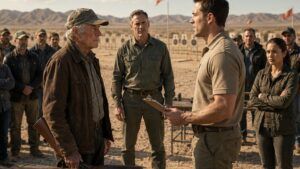
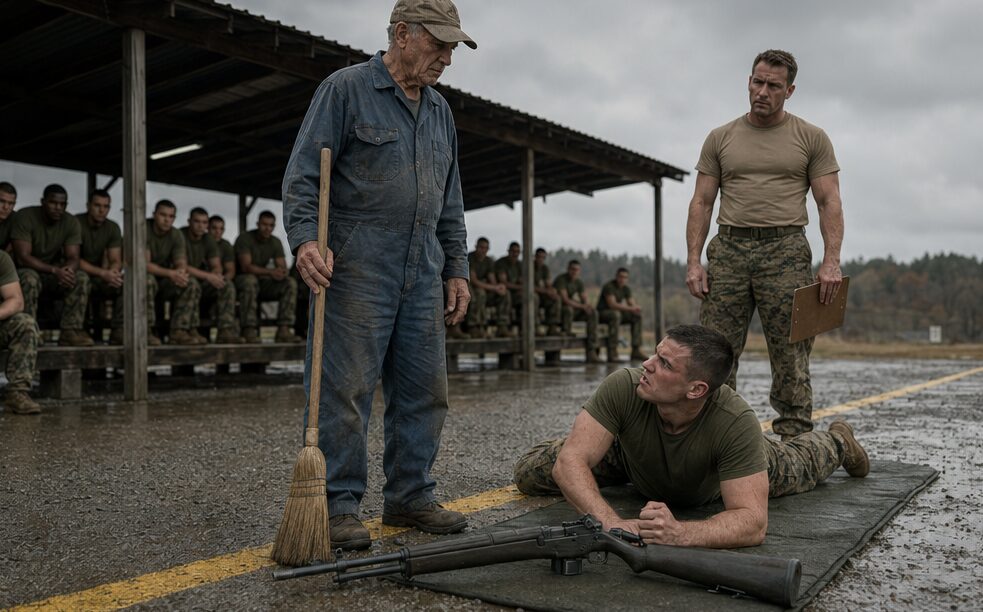
Edward Walker was sweeping brass behind lane six when the young man missed for the third time and blamed the rifle.
The morning had gone gray over the range, the kind of low, heavy gray that made every sound feel closer. Boots scraped gravel. Empty casings clicked into piles. Far downrange, paper targets fluttered on wooden frames, each one waiting to tell a man the truth about his hands.
Edward kept his broom moving.
That was what people expected from him.
Sweep the brass. Empty the trash barrels. Replace the torn target backers. Keep his faded blue coveralls zipped, his beige cap low, and his opinions to himself.
The young recruit on lane six did not have the same gift for silence.
“Come on,” he muttered, jerking back from the scope. “That’s impossible.”
His name tape read MATTHEW. He was twenty-something, close-cropped, built tight with ambition, wearing a green training shirt and camouflage pants. A small patch was tucked into the elastic band around his notebook, old and worn at the edges, like something handled too often.
Edward noticed that first.
Then he noticed the way Matthew’s right shoulder crept up before every trigger press.
Then the way his left hand moved to the adjustment knob after every bad round.
Then the breath.
Always the breath.
Edward leaned on the broom and looked down at the rifle without touching it.
“You’re chasing the miss,” he said.
Matthew looked up slowly, as if the broom had spoken.
“What?”
Edward nodded toward the rifle. “You’re chasing the miss. Let the group tell you something before you start answering it.”
For half a second, the range went quiet enough for Edward to hear the wind rubbing through the trees behind the berm.
Then Matthew gave a short laugh.
“I don’t need janitorial advice.”
A few recruits nearby heard it. One coughed into a grin. Another looked away too late.
Edward’s face did not change.
He had learned, a long time ago, that a man did not have to answer every insult just because it found him.
His fingers tightened around the broom handle anyway.
Matthew turned back to the rifle. “Maybe stay behind the yellow line, sir.”
The last word was not respect. It was decoration on a slap.
Sergeant Scott Harris came over from the firing table with a clipboard under one arm and a look that told everyone he had heard enough.
“Matthew,” he said.
The recruit stiffened. “Sergeant.”
“Problem?”
“No problem.”
Scott looked at Edward, then at the rifle, then back at Matthew. He was a broad man in a tan range shirt, with tired eyes and the controlled patience of someone responsible for twenty young men holding too much pride.
“Then why are you running your mouth?”
Matthew swallowed. “He was distracting me.”
Edward lowered his eyes and swept three casings into a neat crescent.
Scott hesitated.
That hesitation said more than the reprimand did. He did not like disrespect. He also did not like a maintenance worker interrupting a qualification line.
The institution had its lanes. Its painted borders. Its roles.
Edward’s role had a broom.
Scott turned to him carefully. “Mr. Walker, did you see something?”
Edward hated the sound of his last name on the line.
Not because it was wrong.
Because it was his.
He glanced once at Matthew’s target downrange. The pattern was loose but not hopeless. It leaned the way fear leaned when it dressed itself as frustration.
“He’s adjusting after every bad round,” Edward said. “Not reading the pattern. Breaking his breath before he settles.”
Matthew let out a sharp breath. “You can see all that from back there?”
Edward swept another casing.
“Same way a man knows when rain’s coming,” he said. “You stand outside long enough.”
This time, more recruits laughed.
One of them said, not softly enough, “Range Grandpa’s got theories.”
Edward kept sweeping.
But Scott’s eyes did not leave him.
And Matthew, red now with embarrassment, dropped back behind the rifle like the old man had challenged him to a fight.
He fired again.
The round went wide in the same direction.
No one laughed at that.
Part II — The Name on the Patch
By noon, Matthew had failed twice and was one attempt away from losing the slot he had spent a year trying to earn.
The specialized pipeline only took a handful from their unit. It was not glamorous in the way young men imagined glory. It meant longer days, harsher standards, colder nights, less applause. But it had belonged to his father once, and that made it sacred in Matthew’s mind.
Edward knew that kind of sacred.
It could steady a man.
It could also crush him flat.
Matthew sat alone on an ammo crate near the covered shed, elbows on his knees, staring at the old patch in his hand. The stitching had faded. One corner had been repaired with darker thread.
Edward came out of the maintenance shed carrying a trash liner and stopped when he saw the patch.
Not because of the shape.
Because of the name printed in permanent marker on the back.
Carter.
Edward felt the range tilt slightly under his boots.
Matthew noticed him staring and closed his fist around it.
“What?” he said.
Edward’s throat worked once before the words came. “That your father’s?”
Matthew’s expression changed. Not softer. Sharper.
“Yeah.”
Edward nodded.
He should have walked away then.
He had walked away from less dangerous things.
Instead he stood there with the trash liner in one hand and the broom tucked under his arm, watching Matthew fold the patch into his notebook as if he were putting away a piece of bone.
“He served?” Edward asked.
Matthew’s jaw tightened. “He did more than serve.”
The words came with pride, but there was a crack under them.
Edward knew that too.
People spoke loudest around the places they were afraid to touch.
Matthew looked him up and down. “Why do you care?”
Edward almost said, I don’t.
It would have been easier.
Instead he said, “No reason.”
Matthew stood. “You know, if you actually know something, you could help instead of standing around being mysterious.”
Edward let the trash liner sag at his side.
“I gave you what I saw.”
“No,” Matthew said. “You gave me a fortune cookie and let everybody laugh.”
Edward looked toward the range. Scott was speaking to two recruits near lane three. The wind had picked up enough to rattle the paper targets. The gray sky was lowering.
Matthew stepped closer.
“If you can help me pass, help me pass. If not, stay out of it.”
Edward looked at the young man’s hands. Strong hands. Nervous hands. Hands that wanted to be someone else’s.
“You think passing will make him less gone?” Edward asked.
Matthew’s face went still.
For a moment, neither of them moved.
Then Matthew said quietly, “Don’t talk about my father.”
Edward accepted that. He deserved it.
He had not earned the right.
Before he could turn away, Scott appeared at the shed entrance.
“Matthew. Inside. Weather’s shifting. We’re pausing live fire.”
Matthew brushed past Edward hard enough to bump his shoulder.
Scott watched him go, then looked at Edward.
“You knew his father?”
Edward picked up the broom.
“No.”
The answer was too quick.
Scott heard it.
“Mr. Walker.”
Edward hated it again.
Scott lowered his voice. “I pulled old qualification records last month for the hallway display. Your name was in a file. Recon attachment. Border deployment. Same era as Carter.”
Edward stared at the gravel.
It was always strange, how the past waited in paper.
A man could bury it in his body for forty years, and then someone opened a drawer.
Scott said, “I don’t know the whole story.”
“Good.”
“Two men didn’t come home from that operation.”
Edward lifted his eyes.
Scott stopped.
The wind tapped a loose strip of metal against the shed roof. A dry, nervous sound.
Edward said, “Some names don’t belong in a training file.”
Then he walked away before Scott could ask the question that had followed him for four decades.
Why did you?
Part III — The Picture in the Hallway
The storm did not arrive all at once.
It came in pieces.
A harder wind. A darker sky. The smell of wet dust. Orders shifting from the range to the administration building. Recruits filing inside with their gear and their frustration, all of them pretending not to watch Matthew pretend not to unravel.
Edward stayed behind to secure the target frames.
He worked slowly because his knees required it and because the longer he stayed outside, the longer he could avoid the hallway.
But the rain began, cold and slanting.
By the time he entered through the side door, his coveralls were damp at the shoulders and the broom bristles were dark with water.
He heard Matthew before he saw him.
“You knew him.”
Edward stopped.
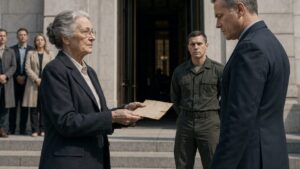
The hallway display was lit by two fluorescent bulbs, one flickering faintly. Framed photographs lined the wall: old training classes, commanders, unit patches, newspaper clippings from open houses and retirements.
Matthew stood in front of one black-and-white photograph near the end.
His finger was pressed against the glass.
Edward did not need to look.
He knew the picture.
He had avoided it for seven years.
Scott stood a few steps behind Matthew, silent and unhappy, holding the edge of the display case key in one hand.
Matthew turned.
His face had changed. The arrogance was still there, but now it had grief behind it, and grief made it more dangerous.
“You knew him,” Matthew said again.
Edward said nothing.
Matthew hit the glass lightly with the side of his fist. Not hard enough to break it. Hard enough to make the photograph tremble.
“That’s my father.”
Edward looked then.
The photograph showed twelve men standing in uneven sun, younger than they had any right to be. Dusty uniforms. Bad haircuts. Hard smiles.
There, near the left, was Edward at thirty-two.
Straight-backed. Watchful. A face not yet weathered down to restraint.
Beside him stood Thomas Carter, one arm slung loose over another man’s shoulder, smiling like the world still planned to return what it borrowed.
Matthew pointed at Edward’s younger face.
“And that’s you.”
The hallway seemed too narrow.
Edward could feel Scott watching him, could feel the recruits pretending not to listen from the doorway at the far end.
“I served with him,” Edward said.
The words came out rough.
Matthew laughed once, but there was no humor in it. “You served with him.”
Edward nodded.
“My whole life,” Matthew said, “people told me they didn’t know much. Records sealed. Details classified. Mom got two folded letters and a box. And you’ve been here sweeping brass, watching me fail, knowing my name?”
Edward’s grip tightened around the broom.
“I didn’t know you were his boy until today.”
“But you knew him.”
“Yes.”
“And you said nothing.”
Edward had no answer that would not sound small.
Matthew stepped closer. “What happened?”
Scott said, “Matthew.”
“No.” Matthew’s voice rose. “He knows. He’s standing right here.”
Edward looked at the photograph, not the son.
Thomas Carter’s grin had survived better than the men had.
“What happened?” Matthew demanded.
Edward’s mouth went dry.
The answer lived behind a door he had held shut so long that his whole body had grown around it.
“Your father was a good man,” Edward said.
Matthew’s eyes hardened.
“That’s what people say when they don’t want to tell the truth.”
Edward flinched, barely.
Matthew saw it.
And because he was young, wounded, and afraid, he used it.
“Did you freeze?” he asked. “Is that it? Did you wash out after? Did you leave him there and come home to sweep floors?”
The hallway went silent.
Even the recruits at the far end stopped pretending.
Scott moved. “That’s enough.”
Edward raised one hand, not to stop Scott, but to spare him the trouble.
Matthew’s breath shook.
“I’m asking him.”
Edward looked at the young man then.
Really looked.
The same anger. The same chin. None of Thomas’s easy warmth, but the eyes were close enough to hurt.
“You don’t want what you’re asking for,” Edward said.
Matthew’s voice broke around the reply.
“I’ve wanted it my whole life.”
Edward lowered the broom until the bristles touched the tile.
He could have told him then.
He almost did.
Instead he said, “Final qualification is at sixteen hundred if the weather clears.”
Matthew stared at him.
“That’s all?”
Edward turned away.
Behind him, Matthew said, “Coward.”
The word struck clean because some part of Edward had called himself that first.
Part IV — The Edge of the Line
Mary found him behind the maintenance shed an hour later, sitting on an overturned bucket with his cap in his hands.
She had come straight from the clinic, still in her nurse’s shoes, her jacket zipped to her chin against the wet wind. She was forty-six and tired in the way practical people became tired: not dramatically, just thoroughly.
“You didn’t answer your phone,” she said.
Edward looked at the gravel between his boots.
“I was working.”
“You always say that when you’re hiding.”
He gave a small breath that might have been a laugh if either of them believed it.
Mary stood beside him without sitting. She knew better than to crowd him when he had that look, the one that made him seem less like her father and more like a man listening to a radio no one else could hear.
“Sergeant Harris called me,” she said.
Edward closed his eyes.
“He was worried.”
“He shouldn’t have done that.”
“He said a recruit found the old photo.”
Edward folded his cap once in his hands, then smoothed it again.
Mary’s voice softened, but only a little. “Was it him?”
Edward did not ask who.
“Yes.”
Mary looked toward the range. Rain clung to the metal roof in bright drops. Beyond it, the firing lanes waited under a sky that had begun, reluctantly, to clear.
“You knew this could happen,” she said.
Edward nodded.
“Then why stay here all these years?”
He looked at the broom leaning against the shed.
Because the range needed sweeping.
Because the dead did not ask questions when a man kept his head down.
Because the work was honest and small and did not require anyone to say thank you.
Because sometimes punishment looked exactly like routine.
Instead he said, “It was steady.”
Mary’s mouth tightened. “Steady isn’t the same as alive.”
That one landed.
Edward put his cap back on.
From the range, Scott’s voice carried over the loudspeaker. The final qualification group was being called.
Mary followed his gaze.
“You’re going out there?”
“No.”
The answer came too fast.
Mary heard that too. She had inherited his talent for noticing what people tried to bury in plain sight.
“He asked you about his father?”
Edward stood, slower than he wanted to.
“He accused me of leaving him.”
Mary’s face changed. “Did you?”
Edward looked at her.
She regretted the question as soon as it left her, but she did not take it back. That was one of the things he loved about her and one of the things that made her dangerous.
“No,” he said.
The word was quiet, but it held.
Mary nodded once. “Then maybe stop living like you did.”
Edward looked away.
On the range, Matthew was already at lane six again. Even from the shed, Edward could see the tension in him. Too fast with the sling. Too hard on the stock. Too much pride in every movement.
Scott stood behind him, arms crossed, not interfering.
The other recruits watched from under the cover.
Some watched Matthew.
Some watched Edward.
One of them said something Edward could not hear.
Another laughed.
Edward picked up the broom.
Mary saw his hand shake before he hid it.
“Dad,” she said.
He had not heard that word on the range in years.
He looked back at her.
Mary’s eyes were wet, but her voice stayed steady.
“You don’t have to tell everybody everything.”
“I know.”
“But you have to stop disappearing from your own life.”
The loudspeaker crackled.
“Lane six. Final attempt.”
Matthew lay down behind the rifle.
He adjusted the scope.
Edward saw it from thirty yards away and felt something old and automatic rise in him.
Not memory.
Training was too clean a word.
It was recognition.
A body in fear will confess itself.
Matthew shifted again. Wrong.
Edward took one step.
Then another.
The broom was still in his hand.
Scott saw him coming and did not stop him.
One recruit muttered, “Here comes Range Grandpa again.”
Scott turned his head.
“His name,” he said, “is Mr. Walker.”
That was the first thing on the range that day that made Edward almost stop.
Not because it fixed anything.
Because it did not.
And still, it mattered.
Part V — Don’t Outrun Your Heartbeat
Edward stepped across the yellow line.
Matthew lifted his head. “Are you kidding me?”
His voice had anger in it, but less than before. The rest was panic.
Edward crouched beside him with a stiffness he could not hide. His knees complained. His back complained. The past complained loudest of all.
“Stop touching the adjustments,” Edward said.
Matthew’s eyes flicked to Scott.
Scott said nothing.
That silence gave the moment away.
Matthew looked back at Edward. “I don’t need—”
“You do.”
The two words were plain enough to cut through him.
Matthew shut his mouth.
Edward pointed, not touching the rifle. “You’re asking the glass to forgive what your body keeps doing.”
Matthew swallowed.
“You don’t know what my body’s doing.”
“I know you’re trying to shoot before you’re still.”
The wind moved across the lane. Paper snapped downrange.
Edward nodded toward Matthew’s shoulder. “Settle that first.”
Matthew did, barely.
“Again.”
He did it better.
Edward watched his breathing.
There it was. The hitch. The tiny betrayal before the trigger. Fear trying to get ahead of the man.
Edward heard Thomas Carter’s voice as clearly as if he were lying two feet away in dust and heat, grinning even then, even with the world narrowing.
Don’t outrun your heartbeat.
Edward closed his eyes once.
When he opened them, Matthew was looking at him.
“Breathe,” Edward said.
Matthew breathed.
“Don’t outrun your heartbeat.”
The young man froze.
The range froze with him.
Matthew turned his head slowly. “What did you say?”
Edward kept his eyes on the target.
“Your father used to say that when men got too fast.”
Matthew’s face went pale beneath the flush.
“You don’t get to do that,” he whispered.
“I know.”
“You don’t get to use his voice on me.”
Edward nodded. “I know.”
Matthew’s hands loosened on the rifle.
For a second, Edward thought he had broken the boy completely.
Then Matthew said, so quietly only Edward and Scott could hear, “Tell me.”
Edward looked past him, beyond the target frames, beyond the berm, beyond the wet trees.
He did not give the whole story.
There were parts that belonged to closed rooms, to men who had signed papers, to families who had learned to live with blanks where details should have been.
But he gave the part that mattered.
“Your father didn’t fail his unit,” Edward said. “He didn’t get reckless. He didn’t panic.”
Matthew’s jaw trembled.
“The extraction went bad. We had one man who couldn’t move. I was carrying him. Your father stayed to hold the line long enough for us to get out.”
The wind passed between them.
“He knew?” Matthew asked.
Edward nodded.
Matthew blinked hard. “He knew he wasn’t coming back?”
Edward’s throat tightened. “He knew enough.”
Matthew looked down at the ground, then at the patch tucked in his notebook near his elbow.
Edward continued, because stopping now would be another kind of cowardice.
“I should have been the one to stay.”
Scott looked at him sharply.
Matthew did too.
Edward’s voice did not rise. It did not need to.
“I was senior. I was the one who gave the route. I was the one who said we could make the ridge before dark. Your father stayed because I had the wounded man on my back and he wouldn’t let me put him down.”
Matthew’s eyes filled, though no tears fell.
“Why didn’t you tell us?”
Edward almost said because the report was sealed.
That was true.
It was not the whole truth.
“Because shame can sound like duty if you listen to it long enough,” Edward said.
No one on the line moved.
Matthew stared at him as if he hated him, needed him, and believed him all at once.
Edward pointed gently toward the target.
“You still have to fire.”
Matthew let out a broken laugh. “Now?”
“Especially now.”
“I can’t.”
“Yes,” Edward said. “You can. Not for him. Not for me. For the man lying here today.”
Matthew looked at him.
Edward tapped two fingers against his own chest. “You.”
That did what all the instruction had not.
Matthew lowered himself behind the rifle again.
His first breath shook.
His second one settled.
Edward watched his shoulder drop.
Watched his hand stop searching for something to correct.
Watched the boy stop fighting the rifle, the target, his father, the old man beside him, and himself.
“Slow,” Edward said.
Matthew breathed.
“Still.”
The paper target moved in the wind.
Matthew waited.
This time, he did not chase anything.
He fired.
The sound cracked across the range and rolled into the trees.
Nobody spoke until Scott lowered the spotting scope.
He looked once at the target.
Then at Matthew.
Then at Edward.
“Qualified,” he said.
The word was not loud.
It did not need to be.
Matthew stayed behind the rifle, face turned away from everyone, shoulders shaking once before he forced them still.
Edward rose carefully.
His knees hurt.
His back hurt.
The past had not loosened.
But something inside him had stopped holding its breath.
He picked up the broom and stepped back behind the line.
Part VI — What the Broom Meant Afterward
By the time the range cleared, the sky had opened into a thin, pale evening.
Recruits packed gear in embarrassed silence. No one knew what to say to Edward, which was better than saying the wrong thing.
Scott stopped near him once.
“Mr. Walker.”
Edward looked up.
Scott seemed ready to offer something official. An apology. A report correction. A call to someone whose job involved plaques and framed certificates.
Edward could see all of it forming behind his eyes.
So he spared him.
“Sergeant,” Edward said, “trash barrels are full by the west shed.”
Scott held his gaze for a moment.
Then he nodded. “I’ll have two men handle it.”
That was enough.
A little later, Edward was sweeping lane six again, moving brass into a clean pile, when Matthew came back alone.
He had changed out of his training shirt. His hair was still damp from the rain. The old patch was in his hand.
For a while, neither of them spoke.
Then Matthew said, “Mr. Walker.”
Edward stopped sweeping.
That was all.
Just his name, said correctly.
Matthew looked out toward the targets. “Was he afraid?”
Edward rested both hands on top of the broom handle.
“Yes.”
Matthew closed his fist around the patch.
The answer hurt him. Edward saw that.
But lies had already taken enough from the boy.
Matthew nodded slowly. “Good.”
Edward looked at him.
Matthew wiped his face with the heel of his hand, angry at the moisture there. “I mean… not good. I just…” He swallowed. “I thought if he was afraid, it made him less than what people said.”
Edward shook his head.
“Fear doesn’t make a man smaller,” he said. “Handing fear the wheel does.”
Matthew held that line like it had weight.
Then he stepped forward and placed the patch on the edge of Edward’s workbench.
Edward looked at it.
“You should keep that,” he said.
Matthew’s voice was rough. “I did.”
Edward did not understand at first.
Then Matthew touched his chest, above his heart.
“I kept what I needed,” he said. “Maybe you should keep what you’ve been carrying wrong.”
Edward could not answer.
Matthew did not force him to.
He only nodded once and walked away, leaving the patch between the dented coffee tin and the box of replacement staples.
Edward stood there until the evening cooled around him.
When Mary arrived, she found him in the shed doorway, looking at the patch like it might speak if he waited long enough.
She came beside him quietly.
“He gave you that?”
Edward nodded.
Mary did not touch it.
She knew better.
After a while she said, “Are you all right?”
Edward almost gave the old answer.
Fine.
Working.
Tired.
Instead he said, “No.”
Mary turned toward him.
He kept looking at the patch.
“But I might be closer than I was this morning.”
Her eyes filled.
She did not hug him. Not there. Not with his hands still trembling and the range still listening.
She only stood beside him until he picked up the patch and placed it carefully in the top drawer of his workbench.
The next morning, Edward arrived before anyone else.
The range was quiet. The gravel still held dark spots from yesterday’s rain. A few missed casings glinted near lane six.
He took the broom from the shed.
Then, for the first time in seven years, he walked into the administration building by the front door.
The hallway lights hummed.
The old photograph waited in its frame.
Edward stopped in front of it.
There he was, young and straight-backed, standing beside Thomas Carter, who smiled as if he had not yet been asked to give away the rest of his life.
Edward reached up and adjusted the frame. It had hung crooked for years.
His fingers lingered on the glass, not over his own face, but over Thomas’s.
“I told him enough,” Edward said softly.
The hallway gave nothing back.
That was all right.
Some answers did not come from the dead.
Some had to be lived among the living.
Edward stepped away, broom over his shoulder.
Outside, the first recruits were arriving. Their voices carried over the gravel, young and loud and certain in the way young men could afford to be.
Edward walked toward the firing line.
He was still the man who swept brass.
Still the man in faded blue coveralls.
Still old.
Still carrying more than anyone could see.
But when he passed lane six, he did not lower his head.
And when one of the new recruits looked at the broom in his hand and then at his weathered face, Edward looked back until the young man nodded first.