His Children Donated His Old Brown Coat Before Learning Why He Still Carried Grocery Money
Chapter 1: The Boxes Were Labeled Before He Came Home
Thomas Bennett knew something was wrong before Lisa turned the key in his front door.
It was not the pain in his hip, though that still barked at him every time he shifted his weight. It was not the smell of the antiseptic wipe the urgent care nurse had used on his elbow, or the paper bracelet still loose around his wrist, or the way his daughter’s hand hovered near his back without touching him. Those things belonged to the day he had already survived.
What was wrong was the sound inside his house.
Cardboard sliding on hardwood.
Tape stretching and snapping.
A drawer shutting too hard.
His house had never sounded like that. For thirty-nine years, it had spoken in smaller noises: the old refrigerator humming, Betty’s spoon tapping the side of her coffee mug, rain ticking against the kitchen vent, the floorboard by the hall closet giving its one familiar complaint. But this was a different language. Busy. Efficient. Certain of itself.
Lisa opened the door wider and called, “We’re back.”
Thomas paused on the threshold. The porch light showed the gray in his hair and the tightness around his mouth. He held the metal railing with one hand. His other hand went automatically to the inside of his jacket, feeling for the envelope of discharge papers Lisa had tucked there.
“You don’t have to stand there, Dad,” she said. “Come in before you get cold.”
He stepped into the hall.
The first thing he saw was the row of boxes under the front window. Each one had a white paper taped to the side, written in Lisa’s careful block letters.
KEEP.
DONATE.
TRASH.
Some labels were doubled, as if one word had not been enough to make the decision permanent.
His eyes moved over them without haste. A stack of Betty’s gardening magazines leaned crookedly in DONATE. The brass umbrella stand he had bought at a yard sale in 1988 sat beside TRASH with a rolled-up rug inside it. On the entry table, the little ceramic bowl where he dropped his keys had been emptied and wiped clean. His keys were gone.
Lisa followed his look.
“I put them in the kitchen drawer so you don’t have to reach over the table,” she said quickly. “Just for now.”
Thomas nodded once, not because he agreed, but because his body was tired and he had learned that tiredness made every answer sound like surrender.
Nicholas came out of the living room carrying a banker’s box against his chest. His shirt sleeves were rolled to the elbows. There was dust across one shoulder.
“Hey, Dad,” he said. “How’s the hip?”
“Still attached.”
Nicholas gave a short laugh, relieved to be offered something ordinary. “Good. That’s good.”
Behind him, a woman Thomas did not recognize stood near Betty’s bookcase with a clipboard. She wore soft-soled shoes and a cardigan too neat for the dust she was disturbing. At her feet were three open boxes.
Lisa saw Thomas notice her.
“This is the organizer I told you about.”
“No,” Thomas said quietly. “You told me you were calling someone for estimates.”
Lisa’s face tightened, then smoothed. “It is an estimate. She’s just helping us see what we’re dealing with.”
The woman smiled in a careful way. “Mr. Bennett, I’m just here to make things safer and easier.”
Thomas looked past her at Betty’s chair.
It was not an expensive chair. The fabric had faded from blue to a tired gray along the arms. Betty had kept her knitting basket on the floor to the left and her library books on the right, sorted by due date with grocery receipts for bookmarks. After she died, Thomas had not sat in it. He had not moved it either. Some things needed to remain where grief could find them without searching.
The chair was empty.
No folded throw. No knitting basket. No small pillow Betty had used for her lower back.
Thomas took two steps into the living room. Lisa moved as if to guide him toward the sofa, but he lifted one finger, and she stopped.
“Where’s the basket?”
Nicholas looked at Lisa.
Lisa said, “In one of the boxes. We didn’t throw it away.”
“One of which boxes?”
“The keep pile, I think.”
“You think.”
“Dad, we’ve been at this for three hours. I can’t remember every single thing.”
Thomas stood in the room where his wife had spent her last winter and looked at the open boxes as if they were holes cut into the floor. Betty had died in March, with rain on the windows and a grocery list still stuck to the refrigerator. Nine months was long enough, people said, for a house to begin returning to normal. He had never known what they meant. Normal had been the person who was gone.
Nicholas set down the banker’s box. “We’re not trying to upset you.”
“Then you’re missing by accident.”
Lisa breathed out through her nose. “Dad.”
He turned toward the hallway closet.
His old brown coat hung there, or should have. He wore it for errands, for the grocery store, for walking to the mailbox when the wind came off the river. It was ugly in a way useful things became ugly after years of service: dark at the cuffs, shiny at the elbows, one pocket sewn twice with thread that did not match. Betty used to say it made him look like a man who knew where the good bread was marked down after six.
The coat was still on its hook.
Thomas did not touch it at first. He only looked at it, making sure the weight of it was right, that both sleeves hung the same, that nobody had taken it down and put it back differently. The left inside pocket sagged slightly. Good.
Lisa watched him.
“You can’t wear that anymore,” she said.
He turned his head.
“It’s not warm enough,” she added. “And it’s filthy. I was going to ask you about it.”
“You already made the label.”
She hesitated. “What?”
Thomas reached out and turned the hanger with two fingers.
A small white DONATE sticker had been pressed onto the wood.
Lisa’s cheeks colored. “That was just so we could remember to talk about it.”
Nicholas came closer. “Dad, nobody’s taking anything today that matters.”
Thomas’s hand remained on the hanger. “Who decides that?”
The organizer shifted near the bookcase, pretending to study a shelf.
Lisa lowered her voice. “You fell in the kitchen because there were newspapers stacked by the pantry. You were alone for forty minutes before the neighbor heard you. We can’t ignore that.”
“I fell because I reached for the wrong shelf.”
“You fell because this house is too full.”
He looked around the living room. The house was not too full. It had a widow’s chair, a retired man’s books, a table with scratches from children who had grown and moved away, a cabinet of dishes nobody wanted because they could not go in the dishwasher. It had years in it. Years took up space.
Nicholas said, “We’re trying to get ahead of it.”
“Get ahead of what?”
The question hung there.
Lisa picked up the discharge papers from the entry table and held them like evidence. “You need rails in the bathroom. You need the hall cleared. You need someone checking in every day. Maybe more than that. And if the house has to be sold eventually—”
Thomas looked at her sharply.
She stopped.
There it was. Not hidden well, but hidden enough that she had hoped to reach it later.
Nicholas rubbed his forehead. “Nobody’s saying tomorrow.”
“No,” Thomas said. “You’re saying it with boxes.”
Lisa’s mouth moved, but for a moment nothing came out. She looked tired. That was the trouble with her. Her worry was real. The dark circles under her eyes were real. The way she had driven too fast to urgent care after the neighbor called was real. But real worry could still pick up another person’s life and start sorting it by category.
Thomas took the coat down from the hook.
Lisa stepped forward. “Dad, don’t. You just got home.”
He put one arm into it, then the other. The fabric settled over his shoulders with familiar weight. His fingers slipped inside the left pocket, touching the folded grocery list there, the small envelope, the bills pressed flat from being counted and recounted.
He buttoned only the middle button. His hands were not steady enough for the rest.
“I’m going to sit in the kitchen,” he said.
“I’ll help you.”
“No.”
He did not raise his voice. The word had no anger in it. That made Lisa flinch more than anger might have.
Thomas walked slowly past the boxes. KEEP. DONATE. TRASH. His hip hurt. His elbow burned. His house smelled of dust and someone else’s hand lotion. At the kitchen doorway he paused and looked back once.
Nicholas had picked up the DONATE sticker from the floor where it had fallen after Thomas took the coat. Lisa stood beside him, arms folded tightly, watching her father as if he had become a door she could not open.
Thomas went into the kitchen alone.
The keys were in the drawer, just as Lisa had said. Not gone. Moved.
He sat at the table where Betty used to write grocery lists in pencil because ink felt too final. He took the folded list from his coat pocket and laid it flat beneath his palm.
Milk. Bread. Apples if cheap. Soup for the girl.
Betty’s handwriting had faded at the creases.
In the living room, tape snapped again.
Thomas closed his eyes and kept his hand on the list.
Chapter 2: His Daughter Called It Help, He Called It Gone
By ten the next morning, the driveway looked like a house had been turned inside out.
Trash bags leaned against the garage door in black, swollen rows. Cardboard boxes sat open on the concrete, their paper labels flapping whenever the wind came down the street. The donation truck had backed in crookedly, its rear doors spread wide. A young driver in a knit cap stood near the ramp, checking something on his phone while Nicholas carried out a lamp Betty had hated and Thomas had kept because hating it together had become part of their marriage.
Thomas watched from the front porch.
Lisa had told him to stay inside. She had said the air was too cold, the steps were slick, and the work would go faster if he did not try to supervise every little thing. She used that phrase gently, as though softness could make it less insulting.
Every little thing.
His life had become little things the moment his children touched them without asking.
A box marked KITCHEN sat near the walkway. From where Thomas stood, he could see Betty’s yellow mixing bowl inside it, nested with measuring cups and a chipped blue saucer. The saucer had held lemon drops beside her bed when the medicine made her mouth bitter. Nobody would know that by looking. It would be easy to call it chipped. Easy to call it extra.
Nicholas came out carrying a stack of newspapers tied with twine.
“Dad, you shouldn’t be out here.”
“I live here.”
“I know, but—”
“Then speak like you know.”
Nicholas stopped on the walkway. He had his mother’s eyes, though he rarely used them the way she had. Betty’s eyes invited people to finish what they were afraid to say. Nicholas’s eyes tried to finish for them.
Lisa came from the garage with the organizer behind her. The organizer held a clipboard and a roll of stickers. The sight of those stickers made Thomas’s jaw tighten.
“Dad,” Lisa said, “please go inside. We’re not touching anything important without asking.”
Thomas looked at the trash bags.
“How many questions fit in those?”
Lisa pressed her lips together. “Most of that is actual trash. Old newspapers. Broken things. Empty jars.”
“The jars are for soup.”
“You don’t make soup anymore.”
Thomas looked at her. “I did Tuesday.”
The organizer glanced down at her clipboard.
Lisa’s face softened with embarrassment, then hardened in self-defense. “Fine. We’ll keep some jars. But not thirty.”
“Did I ask for thirty?”
“You don’t ask for anything. That’s part of the problem.”
The donation driver coughed and looked away.
Nicholas put the newspapers near the truck. “Can we not do this in the driveway?”
Thomas stepped down one stair, gripping the rail. “That’s where you put it.”
Lisa moved quickly toward him. “Dad, stop. The nurse said—”
“The nurse said no ladders and no loose rugs. She didn’t say my children could empty my hall closet.”
That made Lisa turn.
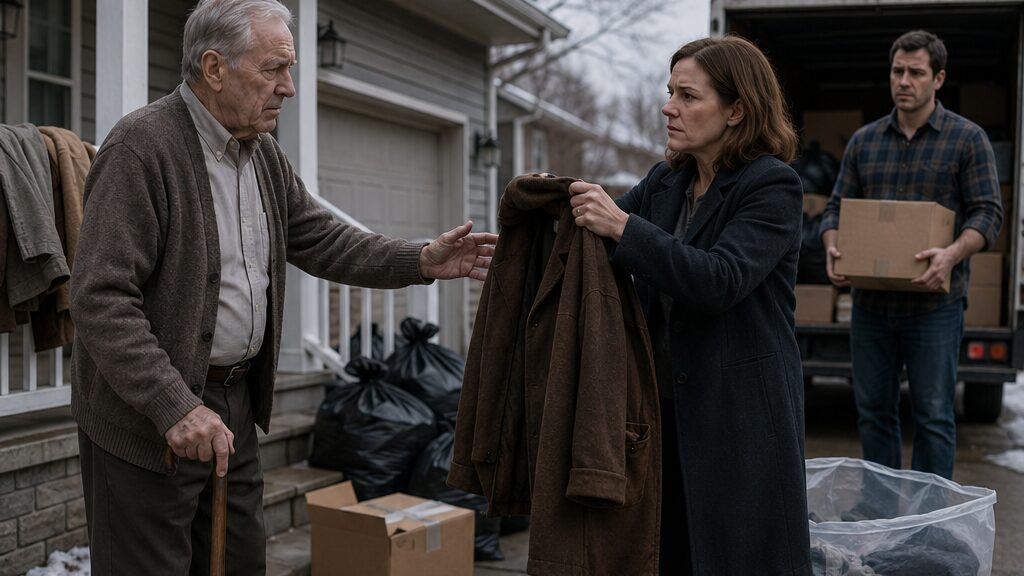
The hall closet had been opened wide. Coats were draped over the porch railing: Betty’s raincoat, Thomas’s winter jacket, two old scarves, a canvas grocery bag, and the brown coat.
The brown coat was not hanging. It was folded badly over the back of a chair Nicholas had dragged from the garage. One sleeve trailed near the ground.
Thomas went still.
Lisa followed his gaze. “We talked about that coat.”
“You talked.”
“It’s dirty. It smells like damp wool. The lining is torn. You have better coats.”
“No.”
“Dad—”
“No better coat.”
Nicholas picked it up with two fingers, not cruelly, but with the careless distance people gave something they had already decided was beyond saving. “This thing is falling apart.”
Thomas came down the final step.
His hip complained so sharply that he had to stop halfway along the walk. Lisa reached for him. He moved his arm away.
“Put it back.”
Nicholas looked at Lisa.
Lisa said, “We can wash it if that helps.”
“It doesn’t.”
“Then tell me what does.”
“Put it back.”
The organizer spoke in the tone of someone trained to enter family pain and pretend it was a storage issue. “Sometimes it helps to take a picture of sentimental items before letting them go.”
Thomas turned to her. “Do you take pictures of your hands before someone cuts them off?”
Silence landed hard.
The organizer’s mouth opened, then closed.
Lisa flushed. “That’s unfair.”
“So is the truck.”
Nicholas let out a breath. “Dad, nobody is cutting off your hands. It’s a coat. You are making this impossible.”
Thomas looked at the coat in his son’s hand. The left inside pocket hung slightly open. He could see the corner of the folded list, pale as old bone.
“I’m making it slow,” he said. “You wanted impossible because impossible lets you stop listening.”
Lisa’s eyes filled, but she did not let the tears fall. “Do you know what it was like getting that phone call? The neighbor said you were on the floor. I drove here thinking you might be dead. Then I walk in and there are newspapers stacked by the pantry, jars by the back door, tools on the basement steps, a chair in the hallway for no reason—”
“The chair is there because I sit down before I carry laundry.”
“You shouldn’t be carrying laundry down basement stairs!”
“Then say that.”
“I have been saying that.”
“No,” Thomas said. “You’ve been labeling.”
Nicholas looked toward the donation driver again, aware of the audience. “We’re trying to help you stay safe.”
Thomas’s voice dropped. “Safe for what?”
Lisa stared at him.
He took one more step toward the coat. “Safe enough to sit in a house where everything that reminds me I lived here has been hauled away?”
“That is not what this is.”
“Then why is my wife’s raincoat on the porch?”
Lisa turned toward the railing. Betty’s raincoat hung limp in the wind, the hood inside out. Her name was still written on the tag because she had volunteered at the church pantry and coats got mixed up on rainy days.
Lisa said, “I was going to ask you about that.”
“When?”
“Before it left.”
“The truck is here.”
Nicholas shifted the brown coat under his arm. “We can’t stop every five seconds. The driver has a schedule.”
Thomas looked at his son for a long moment. “So did your mother.”
Nicholas’s face changed. Something old and boyish passed through it, then was gone.
Lisa took the coat from Nicholas. “Dad, please. This isn’t about Mom. This is about you being able to live here without getting hurt.”
Thomas reached for the coat. Lisa held it back, not far, but enough.
That small movement did more than raised voices could have.
Thomas looked at her hand gripping the shoulder seam.
“Did either of you check the pockets,” he asked, “before you decided my life was trash?”
Lisa went quiet.
Nicholas said, “Nobody said trash.”
Thomas pointed to the black bags by the garage. His finger trembled, but he did not lower it.
Lisa looked down at the coat. With stiff movements, she opened one outside pocket. A receipt fell out. She opened the other. A peppermint wrapper. Her face said what she did not: See?
Then the wind lifted the lining.
The inside pocket gaped open. The folded grocery list slipped free first, landing on the concrete. The small envelope followed. It hit the ground and spilled three folded bills, worn soft from being handled.
The donation driver looked over.
Lisa stared at the money.
Nicholas bent to pick it up. Thomas spoke before he touched it.
“Leave it.”
Nicholas froze.
Thomas lowered himself slowly, one hand braced on his knee. Pain moved across his face, but he reached the grocery list before Lisa could stop him. He picked it up carefully, protecting the creases between his fingers.
Lisa’s voice had lost its certainty. “Dad, why are you carrying cash in that old coat?”
Thomas put the list back into the envelope. “Because some people don’t take cards.”
“What people?”
He slid the bills into the envelope after the list. His hands shook once, then steadied.
“People who need soup,” he said.
Nicholas frowned. “What does that mean?”
Thomas took the coat from Lisa. This time she let go.
For a moment, standing in the cold driveway with the donation truck open behind them, it seemed the matter might pause there. The coat was in his hands. The money had been seen. Something had shifted.
Then the organizer, trying to be helpful, said, “We can make a memory box for that.”
Thomas closed his fingers around the coat.
Lisa wiped at one eye with the heel of her hand. “Dad, I’m asking you to work with us.”
“No,” he said. “You’re asking me to agree after the decision.”
Nicholas’s phone rang. He looked at it, silenced it, then glanced at the truck. “The driver can’t wait all morning.”
Lisa looked from her father to the boxes, to the porch, to the open hall door. Her face was pale and tight with too many duties fighting each other.
“We’ll keep the envelope,” she said. “And the list. But the coat—”
Thomas stepped back as if she had struck the air between them.
“You still don’t hear it.”
“I hear that you are attaching meaning to something unsafe.”
“I’m attached to deciding.”
The donation driver finally came forward. “Ma’am, I need to load whatever’s ready.”
Nicholas reached for the stack of coats on the railing, avoiding the brown one. The organizer began moving boxes. Lisa stood frozen for a breath too long.
Then she took the brown coat from Thomas’s weakened grip.
It was not dramatic. He was tired, one hand on the cane he hated using, his fingers stiff from cold. Lisa pulled gently, almost apologetically, but she pulled.
“Just for cleaning,” she said. “We’ll sort it out later.”
Thomas did not fight her.
That was what she would remember later: not that he shouted, not that he grabbed, not that he cursed his children in the driveway. He simply let his hand fall open, and his face went quiet in a way she had not seen since the funeral home director asked which urn they wanted.
Lisa put the coat into a clear donation bag.
Nicholas stared. “Lis—”
“We’ll get it back if we need to,” she said, sealing the bag.
The driver loaded it with the others.
Thomas stood beside the porch steps, the envelope in his hand, and watched the truck doors close.
When the engine started, the wind pushed Betty’s raincoat against the railing. It lifted once, like someone trying to wave.
The truck pulled away.
Lisa turned back toward her father, already forming the words she would use to make this reasonable.
Thomas was no longer looking at her.
He was looking down the street, where the truck had gone, as if something more than a coat had just been taken around the corner.
Chapter 3: The Grocery Money Was Never For Him
Thomas left the house at four thirty, when the winter light had thinned to the color of dishwater.
He did not tell Lisa.
She was in the dining room with Nicholas, arguing in low voices about whether the realtor should come before or after the bathroom rail was installed. The organizer had gone. The truck was gone. Betty’s raincoat was back in the hall closet, but the brown coat was not. Its empty hook seemed larger than the coat had ever been.
Thomas wore his better coat, the navy one Lisa had bought him two Christmases ago. It was warm and clean and wrong. The zipper caught under his chin. The pockets were too shallow. Nothing in it remembered the shape of his hands.
He took the envelope from the kitchen table and put it inside his shirt pocket.
The bills were still there. The grocery list was still there. Lisa had not touched them after the truck left. She had stood in the kitchen doorway once and asked, “Do you want to tell me who the money is for?” He had looked at the empty hook behind her and said, “Not while you’re holding a broom.”
She had set the broom down.
He had not answered anyway.
Outside, the air bit through the navy coat as if it knew he did not trust it. Thomas walked slowly. His hip had stiffened since morning, and every uneven piece of sidewalk asked a question of his balance. At the corner, a neighbor lifted a hand from behind a windshield. Thomas nodded but did not stop.
The grocery store was eight blocks away. Before the fall, he could walk it in fifteen minutes if he caught the lights. Now it took nearly twice that, with one rest against the brick wall of the dry cleaner and another at the bus stop where the bench was cold enough to make his bones complain.
He could have called for a ride. Lisa would have driven him, probably with her jaw tight and her questions tighter. Nicholas would have said it proved the point. Thomas had no strength for being evidence.
The grocery store windows glowed at the end of the block.
He had first come there when Betty was alive and the old market closed. She had hated the bright aisles, the self-checkout voices, the way tomatoes were made to shine as if they had never touched dirt. But she liked the discount shelf by the bakery. “A person can forgive a store a lot,” she used to say, “if they mark down bread before it turns hard.”
After she got sick, the store became his errand and then his route and then, without anyone naming it, his reason to leave the house.
The first child he helped had been standing near the soup display with a can in each hand, counting coins on the edge of the shelf. Betty had seen him before Thomas did. She had been thin by then, wrapped in the brown coat because the chemo made her cold no matter the season.
“Tom,” she whispered.
He followed her eyes.
The boy had put one can back.
Betty took five dollars from her coat pocket and handed it to Thomas. “Don’t make him feel small.”
That was all.
Don’t make him feel small.
After Betty died, Thomas kept five-dollar bills in the coat. Then tens when prices rose. He did not ask names unless they offered. He did not lecture. He did not make a performance of kindness. He bought soup, bread, apples if cheap. Sometimes he gave the money directly if the child was old enough to choose. Sometimes he left a store gift card with the clerk and said, “For the next kid who counts twice.”
He never told Lisa. Lisa would have wanted a system.
That evening, the girl was by the entrance, near the carts.
Carolyn Parker was small for her age, with a gray hoodie zipped to her chin and one sneaker lace dragging. Her hair had been pulled back quickly, leaving wisps stuck to her cheeks. She held a basket with a loaf of bread, a carton of milk, and two cans of chicken noodle soup. Her other hand was open. Coins lay in her palm.
Thomas stopped just outside the automatic doors.
The doors breathed open, then closed. Warm air brushed his face and vanished.
Carolyn saw him and tried to smile. “Hi, Mr. Bennett.”
“Evening.”
“You’re not wearing your coat.”
“No.”
She looked at the navy coat with the frank suspicion children gave adult substitutions. “This one’s fancy.”
“That’s one word.”
She smiled a little, then looked down at her coins again.
Thomas stepped beside her, careful not to crowd. “Prices misbehaving?”
“I thought the soup was on sale.”
“It was.”
“It’s not now.”
The automatic doors opened again as a woman with paper bags came out. She glanced at Thomas, then at Carolyn, then away.
Thomas felt the glance land. Old man. Little girl. Money. Public places made strangers into judges faster than they made them into neighbors.
Carolyn shifted her basket. “It’s okay. I can put one back.”
“Which one?”
She looked offended by the practical difficulty. “I don’t know.”
“That’s the trouble with soup. Always wants choosing.”
Her mouth trembled, and she bit the inside of her cheek. “Mom said just get enough until Friday.”
Thomas nodded.
He took the envelope from inside his shirt pocket. Without the old coat, the movement felt exposed. He had to unbutton the navy coat, reach across his chest, pull the paper free where anyone could see. His fingers were colder than he expected. One of the bills stuck to the grocery list.
Carolyn watched with growing alarm. “Mr. Bennett, no.”
“Did I ask a question?”
“You need your money.”
“So do you.”
“My mom will pay you back.”
“No, she won’t.”
Carolyn’s eyes widened.
“Not because she wouldn’t,” he said. “Because I’m not lending.”
He held out the folded bill. Not high, not like charity dropped from above. Low, between them, where she could take it without lifting her face to the whole parking lot.
She stared at it.
The doors opened again. Two teenagers came out laughing, then quieted when they saw the old man holding money toward the girl. One nudged the other. Thomas kept his hand steady.
Carolyn whispered, “People are looking.”
“People do that when they don’t know what else to do.”
“I don’t want them to think—”
“Then don’t let their thinking carry your groceries.”
Her eyes filled fast. Children tried so hard not to cry in public that the effort often looked like pain. Thomas remembered Lisa at nine, refusing to cry after falling off her bike because Nicholas was watching. He remembered Betty kneeling on the sidewalk, not fussing, just opening her arms.
Carolyn took the bill.
“Thank you,” she said, barely audible.
Thomas nodded toward the store. “Get apples if they’re cheap.”
She gave a small, wet laugh. “They’re never cheap.”
“Then get one rude apple. The bruised ones have character.”
This time she laughed for real.
She went inside. Thomas remained near the carts, one hand on the metal rail, waiting until he saw her reach the checkout line. The clerk at register three noticed him and gave a small nod. The clerk knew. Not everything, but enough to make no announcement of it.
A black SUV pulled into the fire lane.
Its headlights swept across Thomas and pinned his shadow against the glass doors. He turned his face away from the glare. The driver’s door opened. A woman stepped out in a dark dress under a long coat, one heel clicking sharply on the pavement before she stopped.
“Carolyn?” she called.
The girl turned from inside the store, startled.
The woman moved fast toward the entrance, then slowed when she saw Thomas. Her eyes went to his face, then to the envelope in his hand, then back to the store where Carolyn stood clutching the money and the basket.
For one second, Thomas saw the suspicion form. He had expected it. He almost welcomed it. Suspicion was easier than pity.
The woman came closer.
“Sir,” she said, controlled and cold. “Why does my daughter have your money?”
Thomas folded the envelope shut. “Because the soup was lying about its price.”
Carolyn pushed through the automatic doors. “Mom, he was helping.”
The woman did not take her eyes off Thomas. “Carolyn, get in the car.”
“He didn’t do anything wrong.”
“Get in the car.”
Thomas stepped back from the entrance. His hip struck the cart rail, and pain flashed white through his side. He steadied himself.
The woman saw that. Her expression shifted, not softened, exactly, but interrupted.
“Are you all right?”
“Yes.”
“You don’t look all right.”
“That’s not new.”
Carolyn stood between them, miserable. “Mom, this is Mr. Bennett. I told you. He’s the one who—”
The woman’s face changed.
She looked at him again, harder this time. Not at the navy coat or the old shoes or the tremor in his hand. At his eyes. At his mouth. At the name Carolyn had just said.
“Bennett?” she asked.
Thomas said nothing.
Her voice lowered. “Thomas Bennett?”
He looked toward the street. There were too many headlights. Too much glass. Too many people coming and going with bags of things they had chosen for themselves.
The woman took one step closer. “Did your wife’s name used to be Betty?”
Thomas’s hand closed around the envelope.
Carolyn looked from her mother to him. “Mom?”
The woman’s face had gone pale in the store lights. She crouched suddenly, not to Carolyn but near Thomas, as if standing above him had become impossible.
“My name is Deborah Parker,” she said. “You don’t know me. But your wife did.”
Thomas swallowed.
Behind Deborah, the black SUV idled with its headlights on. Inside the store, the clerk at register three held Carolyn’s basket and waited.
Deborah looked at Thomas’s thin navy coat, then at the envelope in his hand.
“Mr. Bennett,” she said, her voice breaking around the formality, “why are you out here without your brown coat?”
Chapter 4: The Woman In The Black SUV Knew Betty’s Name
Thomas did not answer Deborah Parker’s question.
The cold came up through the soles of his shoes while the black SUV’s headlights cut across the grocery-store glass. Carolyn stood by the automatic doors with the basket clutched to her coat. The clerk at register three watched from inside, trying not to watch too openly.
Deborah had crouched beside Thomas, but now she rose slowly, as if sudden movement might break whatever thin thread had been stretched between them.
“Mr. Bennett,” she said again, softer. “Where is your coat?”
Thomas folded the envelope once, though it was already folded. “Somewhere useful, I hope.”
Carolyn’s eyes flicked to her mother. “Mom?”
Deborah looked at her daughter and seemed to remember where they were. “Go pay for the groceries.”
“But—”
“Please, sweetheart.”
Carolyn hesitated, then went back inside. She looked over her shoulder twice before reaching the checkout.
Deborah turned back to Thomas. The suspicion had drained from her face, leaving something more difficult for him to bear. Recognition, maybe. Not of him exactly, but of the shape of what had happened.
“You’re Betty’s husband,” she said.
“Was.”
“That doesn’t stop being true.”
He looked at the pavement.
Deborah’s breath showed in the air. “She helped me once. Years ago. I don’t know if she ever told you.”
“She helped a lot of people.”
“This was at the old church pantry. Before Carolyn was born.” Deborah glanced toward the store, then back at him. “I had a coat with a broken zipper and a baby bag with nothing in it but two diapers. I remember your wife because she didn’t ask me what went wrong. She just put a grocery card in my hand and said, ‘No mother should have to explain hunger to strangers.’”
Thomas closed his eyes for a moment.
That sounded like Betty. Not the words exactly—he could not be sure of the exact words after so many years—but the weight of them. Betty had known how to help without making a person stand in the light too long.
Deborah lowered her voice. “Carolyn told me there was an older man who helped sometimes. I thought she meant the clerk. Or someone from a charity. She never said it was you.”
“I told her not to make a story of it.”
“She didn’t. She protected you.”
Thomas looked through the window. Carolyn had placed the bill on the belt with the bread and soup. The clerk said something that made her smile, then added a bruised apple from a small basket beside the register without ringing it up.
Thomas felt that in his chest.
Deborah noticed. “You do this often?”
“Not as often as prices require.”
A small, pained laugh escaped her before she could stop it. “That’s not an answer.”
“It’s the one I have.”
The SUV engine hummed behind them. Heat from the grocery store leaked out each time the doors opened. Thomas should have gone home. Lisa would notice soon. Nicholas would say exactly what this proved: that Thomas could not be trusted to stay put, that he wandered, that the house was not the problem because the problem was him.
Deborah seemed to read some of it on his face.
“Is there someone I should call?”
“No.”
“Mr. Bennett.”
“I said no.”
The sharpness surprised both of them. Thomas took a breath and looked away.
Deborah did not retreat. “You’re standing outside a grocery store in the cold after giving my daughter money. You’re not wearing the coat she described. You look like walking here hurt you. If I drive away, I become one more person who saw and decided it wasn’t my business.”
“It isn’t.”
“That’s what people said to me before Betty.”
Thomas’s fingers tightened around the envelope.
Carolyn came out then, carrying two grocery bags. The basket was gone. The apple sat on top of one bag, imperfect and bright.
“Register three gave me this,” she said to Thomas.
“He has sense.”
Carolyn smiled, then looked at the envelope. “You should take the change.”
“No.”
“Please.”
Thomas’s expression softened. “Keep it in case the soup lies again.”
Deborah watched the exchange with her mouth pressed shut. Then she looked toward the street as if making a decision.
“I’m calling your daughter,” she said.
Thomas turned. “You know Lisa?”
“No. Carolyn knows your last name. The clerk knows your first. People aren’t as hard to find as they used to be.”
“Don’t.”
Deborah already had her phone in her hand, but she paused. “Why?”
Because Lisa would come with fear in her throat and control in her hands. Because Nicholas would see him under these lights and add the image to his list of reasons. Because Thomas was tired of being caught doing ordinary things and having them turned into symptoms.
He said none of that.
“My children are busy.”
Deborah’s eyes moved over his face. “Are they the reason you don’t have your coat?”
Thomas gave a small shrug that hurt his hip. “They called it help.”
Carolyn looked down.
Deborah’s hand closed around the phone. “Did they take it?”
“They donated it.”
The word came out flat. The cold made it easier. If he gave the word no shape, perhaps it would not cut.
Carolyn whispered, “The brown one?”
Thomas nodded.
“The one with the deep pocket?”
He looked at her. “You noticed that?”
“That’s where you kept the soup money.”
Deborah inhaled slowly.
There was no accusation in Carolyn’s voice. Only the simple devastation of a child discovering that adults could remove something important because they had failed to understand it.
Deborah unlocked her phone.
“Please,” Thomas said.
She stopped again.
He hated the plea in that one word. He hated that it had left him before he could fold it away.
Deborah lowered the phone. “All right. I won’t call yet.”
Thomas looked at her.
“But I’m not letting you walk home in the dark.”
“I can manage.”
“I believe you’ve managed a lot. That isn’t the same as letting you hurt yourself to prove it.”
Carolyn stepped closer. “We can drive slow.”
Thomas almost smiled. “That’s not usually how your mother drives.”
For the first time, Deborah’s face loosened. “Fair.”
He looked at the SUV. Its leather seats, its clean dashboard, the heat fogging the edges of the windshield. He looked at Carolyn holding groceries bought with his money and an apple the clerk had slipped in. He looked at the road home.
In the end, his hip decided before his pride could vote.
Deborah helped him only after he nodded. She did not take his arm until he offered it. That mattered. Not enough to fix anything, but enough that he noticed.
Inside the SUV, the heat wrapped around him too quickly. Carolyn climbed into the back with the groceries on her lap. Deborah turned down the radio until only a low murmur remained.
Thomas gave his address.
Deborah repeated the street name, then stopped with her hand on the gearshift. “The Bennett house with the green porch?”
“It used to be green.”
“My mother used to point it out when we drove by,” Deborah said. “She said the woman there knew how to feed people without making them feel fed by charity.”
Thomas looked out the window.
The store lights blurred against the glass. For a moment, he saw Betty reflected there, not as she had been at the end, but wrapped in that brown coat outside the old pantry, pressing money into his palm and trusting him to understand the part she did not say aloud.
Don’t make him feel small.
Deborah pulled away from the curb.
No one spoke for several blocks.
When the house came into view, every downstairs light was on. Lisa stood on the porch with her phone in one hand, Nicholas behind her, both of them rigid with the panic Thomas had wanted to avoid.
Deborah parked at the curb, but did not shut off the engine.
Lisa came down the steps before Thomas could open the door.
“Dad,” she said, breathless and angry and afraid. “Where have you been?”
Thomas reached for the handle.
Deborah got out first. Carolyn followed with the grocery bags. Lisa’s eyes moved from the woman to the child to her father in the passenger seat.
Deborah closed the door gently and faced her.
“Are you Lisa Bennett?”
Lisa blinked. “Yes. Who are you?”
“My name is Deborah Parker.” She glanced once at Thomas through the window. “Your father was outside the grocery store without his coat.”
The words struck harder than Thomas expected.
Lisa’s face changed. For one second, all the arguments she had prepared fell away, and she looked toward the empty hall behind her, toward the hook that could not be seen from the street.
Thomas opened the SUV door.
Cold air rushed in. Deborah reached to help him, then stopped, waiting.
This time, Thomas took her hand.
Chapter 5: The Coat Had Already Been Priced For Strangers
Lisa found the donation receipt in her coat pocket at six the next morning.
She had slept badly, if what she had done counted as sleep. Mostly she had lain on the sofa under a throw blanket, listening for her father to move in the kitchen or fall in the hallway or open the front door again. Nicholas had gone home after midnight, leaving with the stiff silence of a man who believed he had helped and been punished for it. Deborah Parker had not stayed long. She had carried Carolyn’s groceries back to the SUV, but before she left she wrote her number on the back of a store receipt and handed it to Lisa.
“If the coat went where I think it went,” Deborah said, “call me when they open.”
Lisa had nearly answered that she could handle it. Then she had looked at Thomas sitting at the kitchen table, the navy coat still zipped to his throat, his hands folded over the small envelope as though warming a bird.
She took the number.
Now, in the blue-gray kitchen light, she unfolded the donation receipt and read the name of the center twice. Nicholas had arranged the truck because it was the one that could come fastest. That had seemed good yesterday. Efficient. Responsible.
The center opened at eight.
Lisa called at seven fifty-eight.
By eight twenty, she was in Deborah’s SUV because Deborah had arrived before Lisa finished putting on shoes.
“You didn’t have to come,” Lisa said, fastening her seat belt.
“No,” Deborah said. “I didn’t.”
They drove in silence for three minutes.
Lisa looked out at the winter lawns, the bare trees, the trash cans lined up at curbs. The neighborhood looked ordinary in a way that felt almost insulting. Yesterday, her father’s coat had gone into a truck. Today, people still walked dogs and warmed cars and complained about frost.
“He wouldn’t tell me,” Lisa said.
Deborah kept her eyes on the road. “About the money?”
“About any of it.”
“Did you ask before or after you donated the coat?”
Lisa turned toward her.
Deborah’s expression remained calm, which made the question worse. It did not arrive as an attack. It arrived as a fact waiting to be sorted.
Lisa looked down at the receipt. “You don’t know what it’s been like.”
“No,” Deborah said. “I don’t.”
“He fell. He was on the floor. The house is crowded, and he won’t admit what he can’t do anymore. He keeps old newspapers and jars and broken things. He forgets where he puts bills. He acts like every suggestion is an insult.”
“Maybe some are.”
Lisa’s throat tightened. “I am trying to keep him alive.”
Deborah slowed at a red light. “Betty kept me alive once. She didn’t take my choices to do it.”
Lisa had no answer for that.
The donation center sat behind a strip mall, its windows filled with lamps, framed prints, winter coats, and mismatched dishes arranged to look charming instead of abandoned. A cardboard sign announced half-price outerwear. Lisa stared at it until Deborah parked.
Inside, the store smelled of old fabric, dust, and lemon cleaner. A clerk behind the counter listened while Lisa explained. The clerk was kind but not hopeful.
“Outerwear moves fast this week,” the clerk said. “Cold snap.”
“It came yesterday,” Lisa said. “Brown men’s coat. Worn. Torn lining.”
The clerk gave her a look she could not read. “A lot of them are worn.”
“It might have had money in it,” Lisa said, and heard how ugly that sounded. As if the money mattered more than the coat.
Deborah added, “And grocery lists. Folded papers.”
The clerk softened. “Check the men’s rack. If it isn’t there, I’ll look in the back.”
Lisa walked too quickly. Her eyes skimmed sleeves, collars, zippers. Black pea coat. Gray parka. Tan work jacket. Brown corduroy. Not his. Not his. Not his.
Then she saw it.
The old brown coat hung between a red ski jacket and a wool overcoat with one missing button. A white tag had been pinned through the left lapel.
$6.00.
Lisa stopped so abruptly Deborah nearly bumped into her.
There was the dark cuff where Thomas rubbed his thumb when he was thinking. There was the small patch on the pocket where Betty had sewn with the wrong thread because she refused to buy a whole spool for one tear. There was the collar, crushed from years of being held close against wind.
Six dollars.
Lisa reached out, then pulled her hand back before touching it.
She remembered holding it away from him. Not far. Just far enough.
Deborah stood beside her. She said nothing.
Lisa removed the coat from the rack. It was heavier than she expected, or maybe her arms were weaker than yesterday. The price tag swung from the lapel, bright and obscene.
At the counter, the clerk said, “If it’s yours, you don’t have to buy it back.”
Lisa almost said thank you. The words would not come.
Deborah asked for scissors and cut the tag off carefully, as if removing a bandage.
In the SUV, Lisa held the coat on her lap. She opened the left inside pocket. Empty.
Panic rose so fast she nearly dropped it. “The papers are gone.”
Deborah pulled into a parking space and turned off the engine. “Check the lining.”
Lisa did. Nothing.
She checked the outside pockets. A peppermint wrapper. A receipt from weeks ago. One small grocery list tucked deep into the torn seam.
Not the list from yesterday. Older.
Lisa unfolded it.
Bread. Milk. Soup. Apples if cheap.
For D. and baby if they come.
The handwriting was Betty’s.
Lisa knew it instantly. The gentle slant, the practical spacing, the way the capital B leaned into the next letter. Her mother’s handwriting had labeled school lunches, birthday envelopes, casserole instructions, insurance forms, Christmas tags. Lisa had not seen it fresh in years, only on old cards she could not throw away and did not look at.
For D. and baby if they come.
Lisa looked at Deborah.
Deborah’s eyes had filled.
“That was me,” she said.
Lisa pressed the paper flat against the coat. “Why didn’t he tell us?”
“Maybe he thought you already knew who he was.”
The sentence landed quietly and stayed.
When Lisa brought the coat home, Thomas was in the kitchen. He had not moved from the table except, perhaps, to make coffee. A mug sat untouched near his right hand. Nicholas stood by the sink, arms folded, looking both guilty and defensive.
Lisa placed the coat on the table.
Thomas looked at it. Not at her. At it.
“I found it,” she said.
He reached out but did not take it. His fingers stopped just above the sleeve.
Nicholas cleared his throat. “Dad, we didn’t know.”
Thomas’s eyes remained on the coat. “That part was clear.”
Lisa sat down across from him. She had planned an apology on the drive home. Several versions. All of them sounded too large now, too clean.
She set Betty’s old grocery list beside the coat.
“I found this in the lining.”
Thomas looked at the paper.
For the first time since the truck drove away, something in his face moved without permission. His mouth tightened, and his hand went to the edge of the table.
Lisa said, “Deborah said Mom helped her.”
He nodded once.
“Is that why you kept doing it?”
Thomas touched the list with one finger. “Your mother saw things before other people finished hiding them.”
Nicholas came closer. “Why keep it secret?”
Thomas looked up then. “It wasn’t secret. It was quiet.”
Lisa flinched.
Deborah’s words returned. Maybe he thought you already knew who he was.
Lisa pushed the coat toward him. “I’m sorry.”
Thomas did not take it.
The words hung there, small and insufficient.
“I should not have let the truck take it,” she said.
“No.”
“I should have checked the pockets.”
“No.”
“I should have asked.”
Thomas looked at her for a long moment. “Yes.”
Nicholas shifted near the sink. “We were scared.”
“I know.”
“We still are.”
“I know that too.”
Lisa waited, but he said nothing more. No forgiveness offered to rescue her from the discomfort. No lecture to let her become defensive. Only the coat between them, returned and not restored.
Finally Thomas picked it up.
He held it in both hands. His thumb found the mismatched stitching on the pocket. For a moment Lisa thought he would put it on, and some part of her wanted that too badly. If he wore it, the damage might become smaller. A mistake corrected. A story with a fixed object and a lesson learned.
Instead, Thomas folded the coat carefully and placed it on the empty chair beside him.
Lisa stared at it.
Nicholas said, “Dad?”
Thomas gathered Betty’s list and the newer envelope together.
“Returning a thing,” he said, “is not the same as giving back the right to keep it.”
No one moved.
Then Thomas rose slowly, one hand on the table, and left the coat folded on the chair.
Chapter 6: One Room At A Time, With His Hand On Every Door
By Saturday morning, the boxes were still in the living room, but the labels had begun to curl at the corners.
Thomas noticed that before anyone spoke. KEEP. DONATE. TRASH. Lisa had not removed them. Nicholas had not either. The words sat there waiting for authority, as if paper could outlast shame.
The brown coat lay over the back of Betty’s chair.
Thomas had put it there the night before. Not on the hook, not in the closet, not on his shoulders. The chair had been empty too long. The coat did not belong to Betty, but the promise did, and for now that was close enough.
Lisa arrived first with a bag of groceries and eyes that looked as if she had read the same sentence all night without understanding it. Nicholas came twenty minutes later carrying a small toolbox. He held it up when Thomas opened the door.
“For the bathroom rail,” he said. “Only the rail.”
Thomas stepped aside.
They gathered in the kitchen because the living room still felt occupied by boxes. Lisa put milk in the refrigerator, then noticed three jars drying beside the sink.
“You made soup?” she asked.
“Vegetable.”
“You were supposed to rest.”
“I sat while it cooked.”
Nicholas looked at the jars. “Dad.”
Thomas turned. “There are six. Not thirty.”
Nicholas closed his mouth.
It was not peace. It was a beginning too small to name.
Lisa sat at the table. “We need to talk about the house.”
Thomas poured coffee into three mugs. His hand shook slightly on the second one. Lisa saw it and did not reach for the pot. He noticed that too.
Nicholas remained standing. “We don’t have to do everything today.”
“No,” Thomas said. “You don’t.”
Lisa folded her hands. “Dad, the fall still happened.”
“Yes.”
“The hallway still needs clearing.”
“Yes.”
“The basement stairs are still dangerous.”
“Yes.”
Nicholas frowned, thrown off by agreement.
Thomas sat across from them. The coat was visible through the doorway, dark against Betty’s faded chair.
“I am not arguing with rails,” Thomas said. “Or better lights. Or moving the laundry upstairs if we can figure out where the machine goes.”
Lisa blinked. “You’d consider that?”
“I considered it before you labeled my marriage.”
She looked down.
Nicholas set the toolbox on the floor. “Nobody meant—”
Thomas raised one hand.
Nicholas stopped.
For a moment, the kitchen held only the refrigerator hum and the faint tick of the wall clock. Betty had bought that clock because it was shaped like a sunflower. Thomas had always thought it foolish. Now he would have argued with anyone who tried to take it down.
“I need help,” Thomas said.
Lisa’s face changed. She had been waiting months to hear those words, but they did not sound like victory. They sounded like cost.
Thomas looked at his coffee. “I don’t like needing it. I don’t like that my hip tells me the weather. I don’t like that jars multiply because carrying them to the garage is harder than washing them. I don’t like forgetting whether I paid the gas bill until I find the receipt in the bread drawer.”
Nicholas looked toward Lisa, then away.
“But needing help,” Thomas continued, “doesn’t make me furniture.”
Lisa’s eyes filled. “I know.”
“No,” he said, not unkindly. “You’re learning.”
That hurt her. He could see it. He let it. Some truths had to ache or they would be mistaken for opinions.
Nicholas pulled out a chair and sat. “What do you want us to do?”
Thomas took the old grocery list from his shirt pocket. He had moved it there after the coat came back, not because the coat had lost trustworthiness, but because he had. He laid the paper on the table.
“This started with your mother,” he said.
Lisa leaned forward. Nicholas did too, despite himself.
Thomas smoothed the creases. “Winter before Carolyn was born, your mother saw Deborah Parker at the pantry with no food and a baby coming. She asked me for cash because she knew if she handed it over herself, Deborah might feel watched. Betty had rules about kindness. Do it low. Do it quick. Don’t make a person perform being grateful.”
Lisa wiped her cheek with one finger.
“She kept a list after that,” Thomas said. “Names when she knew them. Things people needed. Bread. Milk. Soup. Apples if cheap. Sometimes diapers. Sometimes bus fare. After she got sick, she put the money in my coat because I was the one still driving.”
Nicholas stared at the paper. “Why didn’t Mom tell us?”
“She tried.”
“When?”
“Every time she sent you home with leftovers you didn’t need.”
Nicholas looked down.
Lisa gave a small, broken laugh that did not become a laugh at all. “She did that constantly.”
“She was practicing on you,” Thomas said.
The three of them sat with that.
Then Nicholas said, quieter, “And you kept doing it after.”
Thomas nodded.
“Even when money got tight?”
“It was never a lot.”
“That’s not what I asked.”
Thomas looked at his son. “Yes.”
Lisa drew a breath. “Dad, if we had known—”
“You would have made a spreadsheet.”
She flinched, then gave a reluctant smile through tears. “Probably.”
“And your brother would have found a tax angle.”
Nicholas’s mouth twitched. “Probably.”
Thomas allowed himself one small smile, then let it go. “That’s why.”
Lisa reached toward the grocery list, then stopped before touching it. “May I?”
Thomas looked at her hand. “Yes.”
She picked it up carefully. Nicholas leaned close enough to read over her shoulder. Their faces changed as they saw Betty’s handwriting not as evidence of clutter but as motion, as a woman still reaching through old paper to correct them.
After a while, Lisa set it down.
“I thought the coat was keeping you stuck,” she said.
Thomas looked through the doorway. “Sometimes it does.”
That startled her.
He continued before she could speak. “Some days I put it on because I’m going to the store. Some days I put it on because I don’t know what else to do with my hands. I know the difference less often than I used to.”
Nicholas’s expression softened. “Dad.”
“But that difference is mine to face,” Thomas said. “Not yours to solve by taking it away.”
Lisa nodded slowly.
Thomas pushed back from the table and stood. “Come with me.”
They followed him to the living room. He walked past the boxes, past the bookcase with gaps where the organizer had pulled things forward, past Betty’s chair with the coat over it. At the hallway, he stopped.
The door to Betty’s room was closed.
It had been called the guest room before she got sick, though no guest had slept there after she moved the narrow bed under the window. Her pill organizer had sat on the dresser. Her scarves had hung from the closet door. After she died, Thomas had shut the door and opened it only to dust badly and water the plant that finally gave up in June.
Lisa stood very still.
Nicholas’s voice was cautious. “We don’t have to do this now.”
“Yes,” Thomas said. “We do. But not the way you did.”
He put his hand on the doorknob.
His fingers rested there longer than turning required.
“When this door opens,” he said, “no one touches anything unless I hand it to you or say the word. No boxes labeled before I decide. No truck in the driveway. No strangers with clipboards.”
Lisa nodded. “Okay.”
“Nicholas.”
His son straightened. “Okay.”
“If I say I need a minute, you give me one.”
“Yes.”
“If I say I need a week, you give me that too.”
Lisa swallowed. “What if something is unsafe?”
“Then you say, ‘Dad, this is unsafe.’ Not, ‘Dad, this is trash.’”
Nicholas closed his eyes briefly.
Thomas turned the knob.
The room smelled faintly of lavender sachets and closed air. Morning light lay across the narrow bed. Betty’s robe hung from a hook on the closet door. A stack of books sat on the nightstand, the top one still marked with a grocery receipt. The dresser held a hairbrush, an empty water glass, and a framed photograph of Betty in the backyard wearing Thomas’s brown coat over a church dress, laughing at something outside the frame.
Lisa made a sound and covered her mouth.
Thomas walked to the dresser. For a moment, he seemed smaller in that room, reduced not by age but by the size of what memory could do when given walls. He picked up the hairbrush, looked at it, then set it back down.
He opened the top drawer.
Inside were scarves, folded with Betty’s old precision. Blue. Green. Yellow with small white flowers. Under them, envelopes, appointment cards, a pair of gloves, a packet of seeds she had never planted.
Lisa stood at the doorway. Nicholas behind her.
Thomas lifted the yellow scarf.
“She hated this one,” he said.
Lisa laughed softly, surprised. “She wore it every Easter.”
“She said it made her look like a tablecloth.”
“She never said that.”
“She didn’t want to hurt your feelings. You gave it to her.”
Lisa stared at the scarf, then laughed again, crying this time. “I bought that from a gas station gift rack.”
“She knew.”
Nicholas leaned against the doorframe, one hand over his mouth.
Thomas folded the scarf once, then held it out to Lisa. “This one you can keep if you want it. Or donate it if you don’t. She had no loyalty to it.”
Lisa took it with both hands.
Then Thomas lifted the green scarf and pressed it once against his palm.
“This one stays.”
No one argued.
They worked for nearly an hour and filled only one box. Not even full. A few books for the library sale. The yellow scarf in Lisa’s purse because she could not yet decide. Appointment papers for shredding. The dead plant’s cracked saucer, after Thomas admitted Betty would have thrown it out herself and scolded him for making a shrine of bad ceramic.
At noon, Nicholas installed the bathroom rail.
He asked before drilling.
Thomas sat in the hallway and listened to the tool bite into the wall. It was a hard sound, but a clean one. Not removal. Support.
When Nicholas finished, he called Thomas in to test it. Thomas gripped the rail. It held.
“Good,” Thomas said.
Nicholas looked relieved in a way that was almost young. “Good.”
Back in the living room, Lisa crouched by the boxes. One by one, she peeled off the labels. KEEP. DONATE. TRASH. The paper tore on the last one, leaving a white scar of adhesive on the cardboard.
Thomas watched from Betty’s chair, the brown coat across his knees.
Lisa gathered the torn labels in her hand. “What do we call them instead?”
Thomas rubbed his thumb over the mismatched stitching on the coat pocket.
After a while, he said, “Ask me.”
Lisa looked at the blank boxes.
Nicholas sat on the arm of the sofa, tired and quiet.
Thomas reached into the coat and took out the envelope. He counted the remaining bills, then slid Betty’s grocery list behind them. Tomorrow, perhaps, he would go to the store. Perhaps Lisa would drive. Perhaps Carolyn would not be there. Perhaps some other child would be.
He looked toward Betty’s open room.
“One room at a time,” he said. “With my hand on every door.”
Chapter 7: He Kept The Coat, But Not The Silence
Two weeks later, the hook by the front door held the brown coat again.
It did not hang the way it used to. Thomas noticed that first. Before, he had dropped it there without ceremony after errands, one shoulder higher than the other, the sleeves twisted from the way he shrugged out of it while reaching for the mail. Now he hung it carefully. Not because it had become precious in the delicate way of things no one could touch, but because he had learned how quickly ordinary could be mistaken for disposable.
The house had changed.
A rail ran along the bathroom wall. The hallway table had been moved six inches closer to the wall after Thomas agreed the narrow passage was foolish pride disguised as furniture placement. The newspapers by the pantry were gone, except for the current week stacked in a basket Lisa brought from her own house. The jars had been reduced to eight, lined on a shelf where Thomas could reach them without bending.
Not thirty.
Not none.
Eight.
It was a number nobody would have chosen if they were trying to win.
That morning, Nicholas arrived with coffee and an envelope of blank labels. He stood in the kitchen doorway holding them like a peace offering he was not sure was allowed.
Thomas looked up from slicing an apple. “You labeling my breakfast?”
Nicholas glanced at the apple, then at the labels. “No.”
“Good. It knows what it is.”
Nicholas smiled, then set the labels on the counter. They were plain white. No words.
“I thought,” he said, then stopped.
Thomas waited.
“I thought we could use these only if you want them. For boxes you already decide on. You write them. Or tell me what to write.”
Thomas put down the knife.
It was a small thing. A pack of labels from an office store. The old Thomas, the one before the fall and before the truck, might have made a joke and left it there. The new Thomas, who was not new at all but had been forced to speak where silence once served him, looked at his son until Nicholas met his eyes.
“That would be all right,” Thomas said.
Nicholas’s shoulders lowered.
Lisa came at ten with laundry baskets, not boxes. She had learned the difference. Baskets could carry things from room to room without declaring judgment. She knocked before coming in, though she still had a key.
Thomas opened the door wearing the brown coat.
She noticed. Of course she did. Her eyes went first to the coat, then to his face, then to the inside pocket where the envelope made its soft rectangle.
“You’re going to the store?” she asked.
“After lunch.”
“I can drive.”
“I know.”
She accepted that without rushing into the next question. It had taken practice. Sometimes he could see the words crowding behind her teeth: Are you sure? Should you? What if? She swallowed many of them now. Not all. He did not need all. He needed enough.
In the living room, three baskets waited by Betty’s chair. One held library books. One held scarves. One was empty.
Betty’s room had not been cleared. It had been entered.
That was different too.
The bed was still under the window. The robe still hung on the closet door. The dresser top was no longer a shrine to interrupted care. The empty water glass was gone. The old pill organizer had been thrown away after Thomas held it for a full minute and said, “She would hate that I kept this.” Lisa had cried in the hallway where she thought he could not see her. Nicholas had taken the organizer out to the trash without a word.
The yellow scarf had gone home with Lisa, folded in her purse. She had not decided whether to keep it, but she had stopped calling that indecision clutter.
The green scarf stayed.
The cracked plant saucer went.
The sunflower clock remained in the kitchen, still foolish, still ticking.
They worked until noon. Thomas sat in the chair by Betty’s window while Lisa opened drawers only after he nodded. Nicholas carried one box to the car after Thomas wrote LIBRARY SALE in his own hand across a white label.
His handwriting had changed. He noticed that. The letters were thinner, less certain. But they were his.
At lunch, Lisa warmed the vegetable soup Thomas had made and Nicholas cut bread thick enough for Betty to have teased him. They ate at the kitchen table. No one spoke for a while. The silence was not empty. It had bowls in it, spoons, winter light, three people learning how not to fill every space with defense.
After the dishes were cleared, Lisa took an envelope from her purse.
“I called Deborah,” she said.
Thomas looked at her.
“I asked first,” she added quickly. “I told her I wouldn’t invite anyone into your business unless you said it was okay.”
“And yet here comes the envelope.”
Lisa pushed it across the table. “She wanted you to have this. I said I would ask.”
Thomas did not pick it up. “What is it?”
“A grocery card. From her and Carolyn.”
Nicholas leaned back, watching carefully.
Thomas stared at the envelope. “No.”
Lisa nodded once, as if she had prepared herself for that. “That’s what I told her you might say.”
“Might?”
“I hoped you’d say yes.”
He looked at her.
She did not flinch, but she did not push the envelope closer either.
“Why?” he asked.
“Because Carolyn wanted to give without being made to feel small.”
The words entered the room and changed the air.
Thomas looked down at his hands. There were age spots across the backs of them, a small healing scrape near his knuckle from where he had caught himself on the pantry shelf weeks earlier. Hands that had carried freight, held babies, opened jars for Betty, folded bills into an envelope, failed to hold onto a coat.
Lisa said, “I’m not asking you to stop doing what you do. I’m asking if someone else can put something in the pocket too.”
Thomas sat still for a long time.
Then he took the envelope and opened it. Inside was a grocery gift card and a folded piece of notebook paper. The handwriting was Carolyn’s, rounded and careful.
Mr. Bennett,
Mom says helping is not supposed to go only one way. I think your coat pocket should have backup.
Thomas read it twice.
Nicholas looked toward the window. Lisa kept her eyes on her mug.
Thomas slid the gift card into the envelope with Betty’s list and the remaining bills. It made the paper bulge slightly.
“Backup,” he said.
Lisa let out a breath.
At two, Thomas went to the grocery store.
Lisa drove, but Thomas sat in the front seat wearing the brown coat. She did not ask if he was warm enough. She did not tell him to zip it higher. When they arrived, she parked in a regular space instead of the fire lane and waited while he opened his own door. It took longer. He hated that. She waited anyway.
Inside, the clerk at register three raised his hand. “Good to see the coat back.”
Thomas nodded. “It wandered.”
“Coats do that.”
Lisa heard the exchange and said nothing, which was its own apology.
Carolyn was not by the carts. Deborah was not there either. For a moment Thomas felt foolishly disappointed. Then he saw a boy near the bakery discount shelf, counting change beside a loaf of day-old bread and a small jar of peanut butter. His shoes were too big. His ears were red from the cold.
Lisa saw him too.
Thomas did not move at first.
He waited, partly because the boy deserved the privacy of trying, and partly because he needed to know what Lisa would do.
She looked at the boy, then at Thomas.
“Do you want me to go get apples?” she asked.
Thomas turned to her.
There was no performance in her face. No grand discovery, no shining apology offered where strangers could admire it. Just his daughter standing beside a cart, asking how to help without taking the act from him.
“Yes,” he said. “Bruised ones if they have character.”
Her mouth trembled into a smile. “Mom said that?”
“More than once.”
Lisa went toward produce.
Thomas walked to the bakery shelf. The boy stiffened when he noticed him. Thomas stopped far enough away.
“Peanut butter’s rude,” Thomas said.
The boy frowned. “What?”
“Costs more when bread costs less. They plan it that way.”
The boy looked unsure whether to laugh.
Thomas took the envelope from the inside pocket of the brown coat. The motion felt familiar again, but not the same. Nothing was the same after being taken and returned. Sometimes that made a thing weaker. Sometimes it made the hand holding it more honest.
He pulled out the grocery card Carolyn had given him.
The boy looked at it, then at Thomas. “I’m not supposed to take stuff from strangers.”
“Smart rule.”
The boy glanced toward the checkout. “Then why are you giving it to me?”
Thomas pointed to the clerk at register three. “I’m not. He’s going to hold it. You tell him what you need. He’ll ring it up. That makes him the stranger.”
The boy considered this with grave seriousness.
The clerk, overhearing, called out, “I’ve been called worse.”
The boy laughed then, surprised by himself.
Lisa returned with a small bag of apples. Some were bruised. One had a scar along the skin shaped almost like a crescent moon.
She handed them to Thomas.
He gave the bag to the boy. “These are troublemakers. Best eaten quickly.”
The boy took them. “Thank you.”
Thomas nodded once. “Go on.”
He did not watch too closely as the boy went to register three. He had learned that kindness could become a spotlight if you held it wrong.
Lisa stood beside him.
After a moment she said, “Does it hurt every time?”
Thomas knew what she meant. Not the hip. Not the walk. The giving. The remembering. The pocket opening like a door Betty had left behind.
“Yes,” he said.
Lisa nodded.
They bought milk, bread, onions, and coffee. Thomas paid for his own groceries. Lisa carried the heavier bag after asking. On the way out, the automatic doors breathed cold air over them.
Deborah’s black SUV pulled up as they reached the sidewalk. Carolyn jumped out before the vehicle fully settled.
“Mr. Bennett!”
“Careful,” Deborah called from behind the wheel.
Carolyn ran over, then stopped short as if remembering he was old and should not be collided with. She looked at the coat and grinned.
“You got it back.”
“Seems so.”
“Did you get my note?”
“I did.”
“Did you use the backup?”
Thomas looked toward the store. The boy was leaving through the other doors with the clerk’s hand resting briefly on his shoulder.
“Yes,” Thomas said. “It behaved well.”
Carolyn beamed.
Deborah came around the SUV. She smiled at Lisa, not warmly exactly, but without the coldness from that first night.
“How’s the house?” Deborah asked.
Lisa looked at Thomas.
He answered. “Still mine.”
Deborah nodded as if that was the only answer that mattered.
At home, Nicholas was waiting on the porch with the old brass umbrella stand beside him. It had been rescued from the trash row before the truck returned for anything else. One side was dented. Thomas had not even remembered caring about it.
Nicholas stood when they got out of the car. “I cleaned it.”
Thomas looked inside. No rolled rug. No hidden pile of things. Just the stand, empty and polished enough to show the weak afternoon light.
“Why?” Thomas asked.
Nicholas shrugged, embarrassed. “You and Mom bought it in ’88, right?”
“At a yard sale.”
“You said she argued the man down from ten dollars to four.”
“She did.”
Nicholas put his hands in his pockets. “I thought maybe it could stay by the door. Unless you don’t want it.”
Thomas studied his son. Nicholas looked tired. Older than he had two weeks ago. Younger too.
“By the door is fine,” Thomas said.
Nicholas carried it inside.
The hook waited in the hall.
Thomas took off the brown coat slowly. The inside pocket held Betty’s list, Carolyn’s note, the thinned envelope, and the receipt from that day’s groceries. Not proof. Not relic. Not clutter. Just pieces of a life still moving.
Lisa stood near the kitchen with the grocery bags. Nicholas adjusted the umbrella stand by the wall. The house smelled faintly of soup and furniture polish. The boxes in the living room were no longer labeled. One waited open beside Betty’s chair, not demanding, just available.
Thomas hung the coat on its hook.
It sagged to the left, as it always had.
Lisa looked at it, then at him. “Dad?”
“Yes.”
“Next weekend, if you want, we could do the top shelf in the hall closet.”
Thomas considered the closet. Betty’s raincoat. Old scarves. Canvas bags. Winter gloves without partners. Things that mattered, things that did not, and things that would need his hand before anyone knew the difference.
“One shelf,” he said.
“One shelf,” Lisa agreed.
“And lunch after.”
“I’ll bring soup.”
Thomas touched the coat sleeve once, not to check that it was there, but because it was.
“I’ll make it,” he said. “You can bring bread.”
Outside, the afternoon lowered itself over the porch. Inside, the sunflower clock ticked in the kitchen, foolish and steady. Thomas listened to it while his children moved carefully through the rooms of his life, no longer as owners, not even as rescuers, but as guests learning where to place their hands.
The story has ended.