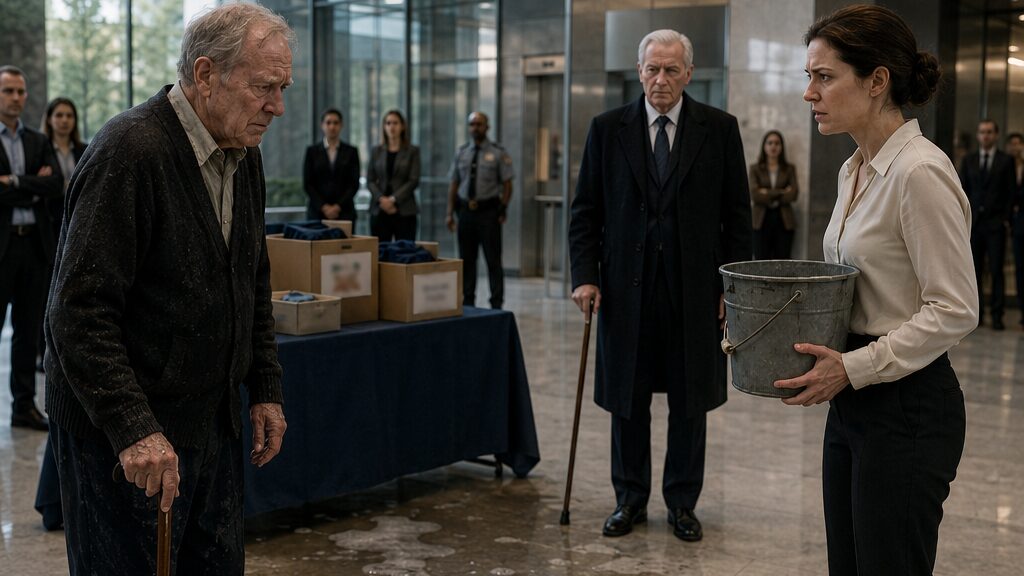
His Daughter Called The Gray Bucket Trash Before She Learned What Her Mother Had Kept Inside
Chapter 1: The Labels Appeared Before Breakfast
Daniel Bennett found the first label before the coffee finished dripping.
It was bright orange, stuck to the cardboard box that sat open on the kitchen table, the one where Patricia used to keep extra dish towels folded in thirds. DONATE had been written across it in Rebecca’s clean block letters. Under that, smaller but just as firm, was a date.
Today.
Daniel stood in the doorway with one hand on his cane and the other resting against the doorframe. The kitchen smelled wrong. Not bad, exactly. Just wrong. It smelled of cardboard, black marker, floor cleaner, and the lemon candle Rebecca always brought when she said the house needed “freshening up.” Patricia’s kitchen had once smelled like toast left a shade too long, coffee, onions softening in butter, and the faint starch of ironed cotton. Since her death, Daniel had done what he could to keep the place ordinary. He washed his cup. He wiped the counters. He put the mail in a pile instead of letting it scatter.
But this morning there were boxes on the table, boxes against the pantry door, boxes in the hallway.
KEEP.
DONATE.
TRASH.
The words faced him like instructions.
Rebecca came in from the back room carrying a stack of old magazines pressed to her chest. She was already dressed for work even though it was Saturday, dark slacks, cream blouse, hair pulled back as if she had a meeting waiting in the driveway. She stopped when she saw him.
“Dad,” she said carefully. “You’re up.”
“I live here.”
Her mouth tightened, not with anger yet, but with the effort of not starting there. “I know that.”
Daniel looked past her into the back room. He could hear Timothy moving something heavy, the scrape of furniture feet against the floorboards. Another voice, a woman’s voice, murmured, “I’d make a separate pile for sentimental and household.”
Daniel had never heard that voice in his house before.
“Who’s here?”
Rebecca set the magazines into the DONATE box as if doing it gently made it less final. “Donna Miller. She’s an organizer. I told you about her.”
“No,” Daniel said. “You told me you were thinking about calling someone.”
“That was three weeks ago.”
“That isn’t the same as telling me she’d be here before breakfast.”
Rebecca took a breath through her nose. Daniel knew the gesture well. Patricia had called it Rebecca’s office face, the one she wore when a person in front of her had become a problem to solve.
“We talked about this, Dad. The house is getting hard for you to manage. Timothy and I are worried.”
“Worrying doesn’t give you a key to every room.”
“We have keys because you gave them to us.”
“For emergencies.”
Rebecca glanced toward the hallway, where Timothy appeared carrying a cardboard box of old Christmas tins. He was broad in the shoulders now, gray at the temples, a man who wore sneakers with expensive soles and looked uncomfortable in any house older than his own. He saw Daniel and stopped.
“Morning, Dad.”
Daniel looked at the tins. “Those are your mother’s.”
Timothy looked down as if surprised by what he held. “They’re empty.”
“She kept buttons in the red one.”
Timothy opened the lid, peered inside, and gave a small helpless shrug. “It’s empty now.”
“That doesn’t mean it’s nothing.”
No one spoke for a moment. The coffeemaker clicked off behind Daniel with a small, final sound.
Donna Miller stepped into view from the back room. She was about Rebecca’s age, maybe a few years older, with soft gray-blond hair and a tablet tucked under her arm. She smiled the kind of smile people used when they wanted to enter a grief-struck room without making eye contact with the grief.
“Mr. Bennett,” she said. “I’m Donna. I know this feels like a lot at once.”
Daniel looked at her tablet, then the boxes, then the labels.
“Does it?”
Rebecca’s cheeks colored. “Dad.”
Donna did not take offense. She looked around with professional calm. “My job is to help families make decisions before things become overwhelming.”
“My things are not overwhelming me.”
Timothy set the Christmas tins on the table. They landed beside DONATE.
“Dad,” he said, “you tripped on the back step last month.”
Daniel’s hand tightened around the cane. “The step was loose.”
“You were carrying a box you shouldn’t have been carrying.”
“It had light bulbs in it.”
“You were alone.”
“I’ve been alone before.”
Rebecca’s face changed at that, just a little. Daniel wished he could take the sentence back, not because it was untrue, but because Patricia would have heard the bitterness in it and given him that look over the rim of her coffee cup.
Donna cleared her throat softly. “Maybe we can begin with low-emotion categories. Duplicates. Expired items. Broken household objects.”
Daniel gave a short laugh without meaning to. “Low emotion.”
Rebecca turned away too quickly and picked up another label. “We’re not touching anything important without asking.”
Daniel looked at the orange word on the dish-towel box.
“You already touched the towels.”
“They’re old towels.”
“They were hers.”
Rebecca’s hand paused over the marker. “Dad, Mom has been gone two years.”
Daniel looked at the window over the sink. Patricia had kept a small blue glass bird there, one of the cheap ones from a craft fair, because she liked the way morning light went through its belly. The bird was still there, but someone had moved it to wipe beneath it. It stood an inch from its old place.
“Two years is not a permission slip,” he said.
Timothy rubbed both hands over his face. “Nobody is trying to erase Mom.”
Daniel looked at the boxes again.
“No?”
Rebecca put the marker down with deliberate care. “We are trying to make sure you don’t fall, or get trapped in a room full of boxes, or leave us to figure this out during some emergency. That’s all.”
Daniel heard the word us. He heard what it carried: long drives, phone calls, missed meetings, guilt, resentment no one wanted to admit to because it sounded ugly when said plainly. He knew his children loved him. That was part of what made the morning so hard. Cruelty was easier to refuse when it came without love attached.
Donna moved toward the laundry room. “Maybe I’ll just assess the utility shelves for now.”
Daniel’s head lifted.
“Leave those.”
Donna stopped. “Of course. I won’t remove anything. Just looking.”
Rebecca said, “Dad, the laundry room is exactly what we need to sort. There are old bottles, rags, cleaning supplies from years ago—”
“Leave those,” Daniel repeated.
Rebecca stared at him, frustration gathering around her eyes. “This is what I mean. Every corner has something we’re not allowed to touch.”
Daniel stepped into the kitchen. His right knee complained. He ignored it. “Then maybe every corner belongs to someone who lived here.”
Timothy softened his voice. “Dad, we’re not packing up your life. We’re clearing space.”
“Same hands,” Daniel said. “Different words.”
Donna, perhaps sensing the wrongness deepening, retreated half a step from the laundry room door. But Rebecca moved past her.
“I’m just going to show you,” Rebecca said. “That’s all. No one is throwing anything away this second.”
She opened the laundry room door wider.
The little room was narrow and dim, with shelves Daniel had installed when Rebecca was ten and Patricia had complained that the mop had nowhere proper to stand. On the bottom shelf, behind a stack of folded rags and a cracked plastic basin, sat the old gray bucket.
Daniel saw it before anyone reached for it.
It was dented on one side. The handle had been wrapped in silver tape so many times that the tape had gone dull and soft at the edges. Near the rim, half hidden by years of wear, Patricia had written BENNETT in black marker, the letters faded to ghosts.
Donna bent, practical and quick. “This sort of thing is usually easy. If it leaks or has rust, we can—”
“No.”
The word left Daniel sharper than he intended. Donna’s hand froze an inch from the handle.
Rebecca looked from the bucket to him. “Dad. It’s a bucket.”
Daniel’s throat tightened. He hated that. He hated how small and foolish grief could make a person look from the outside.
“It stays.”
Rebecca crouched and pulled it forward anyway, not harshly, but with the confidence of someone who believed reason was on her side. The bucket scraped across the shelf.
Daniel took one step.
“Rebecca.”
She stood with the bucket in her hand. “It’s cracked.”
“It doesn’t leak.”
“Dad, it’s covered in old tape.”
“I know what it looks like.”
“Then help me understand why this is the hill.”
Daniel looked at the bucket and saw Patricia’s hand around the handle. Not young Patricia. Not the wedding picture Patricia with her shy smile and short veil. The tired Patricia from the years when the house payment had swallowed half his check and Rebecca needed new shoes and Timothy had asthma medicine that cost more than Daniel wanted to remember. Patricia in a blue cardigan at ten-thirty at night, carrying that bucket out to the car because the office building downtown paid cash for cleaning after hours.
He did not say any of that.
He only said, “Put it back.”
Timothy sighed. “This is exactly why we needed Donna.”
Daniel turned to him. “Needed her for what?”
“To help us make decisions when you can’t.”
The room went still.
Even Rebecca looked at Timothy, a warning in her eyes. He looked sorry the moment the words were out, but sorry did not gather them back.
Daniel felt something inside him close. Not break. Close. Like a drawer pushed shut quietly.
Donna lowered her gaze. Rebecca still held the bucket.
After a moment, Daniel said, “I can decide about a bucket.”
Rebecca’s voice softened. “Dad, we’ll set it aside for now.”
“That means you’ll move it when I’m not looking.”
“No, it doesn’t.”
Daniel looked at the labels again. KEEP. DONATE. TRASH. Three words, three judgments, all written before his coffee.
Rebecca set the bucket on the counter, not back on the shelf. “We’re going to take this one step at a time.”
Daniel watched her hand leave the handle.
In the back room, sunlight came through the curtains Patricia had sewn too long and hemmed twice. Dust moved in the beam where Timothy had dragged a box across the floor. Somewhere beneath the smell of marker and cardboard, Daniel caught the old mineral scent of the bucket, damp metal and soap and years.
He stepped toward it.
Rebecca picked up another label.
“Anything from that shelf can go,” she told Donna.
Chapter 2: His Daughter Called It A Safety Problem
By noon, the driveway looked as if the house had been turned inside out.
Trash bags leaned against the garage door in black, swollen rows. Cardboard boxes sat open behind Rebecca’s SUV, each one marked in orange or green or white. Donna had brought folding tables from somewhere, and on them she had made neat categories from Daniel’s life: kitchen extras, linens, seasonal, tools, documents, sentimental.
Sentimental had its own box, as if feeling could be stacked separately and handled later.
Daniel stood beneath the shade of the carport, coat buttoned though the sun had warmed the concrete. His cane rested against his hip. The back step, the one Timothy kept mentioning, had been fixed three days after the fall, but nobody mentioned that part. They mentioned the fall as if it had become a permanent description of him.
Timothy came out of the garage carrying two old wooden crates.
“Those stay,” Daniel said.
Timothy stopped walking. “Dad, they’re empty.”
“They fit under the workbench.”
“For what?”
“For when I need them.”
“You haven’t needed them in years.”
Daniel looked at his son’s hands on the crates. Timothy had once been small enough to sit inside one of them while Patricia folded laundry, pretending it was a boat. He had shouted for storms, pirates, rescue. Patricia had tied a dish towel around his shoulders like a cape and told him captains did not abandon ship.
Daniel did not say that either.
“They stay,” he repeated.
Timothy set the crates down harder than necessary. “This is not sustainable.”
Rebecca came from the side door with the gray bucket in one hand and a bundle of rags in the other.
Daniel straightened.
She did not look at him at first. She moved with the briskness she used at work, making decisions faster than people could object to them. Donna followed behind, writing something on her tablet.
“Rebecca,” Daniel said.
“It’s going in the garage pile.”
“There is no garage pile.”
“The donation truck will take household goods Monday at my office. We’re collecting for the shelter drive.”
“It’s not going to a shelter.”
She turned then, bucket swinging slightly from her hand. “Dad, a shelter does not need a cracked old bucket. Nobody needs this. That’s the point.”
“I need it.”
“No, you want it.”
Daniel felt the difference land between them like a slap.
Timothy came closer. “Maybe let’s take a break.”
“No,” Rebecca said, still looking at Daniel. “We keep taking breaks. That’s how this house got like this.”
“This house,” Daniel said slowly, “got like this because your mother died.”
Rebecca’s face tightened.
Donna stepped back toward the tables, suddenly interested in the tablet. Timothy looked at the street.
Rebecca lowered her voice. “That is not fair.”
“No,” Daniel said. “It isn’t.”
“I miss her too.”
“I didn’t say you didn’t.”
“You act like we don’t care because we can’t keep every bottle cap and rag and broken thing she touched.”
Daniel looked at the bucket. “I asked for one thing.”
“You asked for everything by asking for one thing every five minutes.”
A neighbor slowed on the sidewalk, pushing a stroller. Rebecca saw the glance and flushed. Daniel saw her embarrassment before she hid it, and some weary part of him understood. She was the daughter with the old father and the messy house. The daughter who had to explain why there were boxes in the driveway and why her father stood guard over a bucket as if it were a child.
Rebecca shifted the bucket to her other hand.
“You fell, Dad. You were alone on the ground for twenty minutes.”
“Fifteen.”
“That is not better.”
“I got up.”
“You shouldn’t have had to.”
“The step was loose.”
“And why were you carrying a box down that step in the first place?”
Daniel glanced toward the garage. “Because the porch light burned out.”
“And instead of calling me or Timothy—”
“For a light bulb?”
“You climbed over things in the laundry room, found a box, carried it outside, and fell.”
“I did not climb over things.”
Timothy said, “Dad.”
Daniel turned. “What?”
His son’s voice was quieter now. “You scared us.”
The words should have softened him. They nearly did. Daniel looked at Timothy and saw the boy with the inhaler, chest rattling in the middle of the night while Patricia counted seconds between breaths. He saw Rebecca at fourteen pretending not to cry when Daniel came home late and Patricia had left again to clean offices. Children did not stop being children in a parent’s mind. They only became taller and found new ways to be afraid.
“I know,” Daniel said.
Rebecca’s eyes shone, but she blinked it away quickly. “Then let us help.”
“This isn’t help.”
“It is if you stop fighting every single thing.”
Daniel pointed with his cane toward the tables. “Help is asking. Help is fixing the step. Help is putting heavier things where I can reach them. Help is not bringing a stranger into your mother’s laundry room and giving my house three labels.”
Donna’s shoulders stiffened at stranger but she did not interrupt.
Rebecca held up the bucket. “And what is this, Dad? Tell me. Is this dignity? Is this memory? Is this Mom? Because from here it looks like rusted junk you’re using to stop us from doing anything.”
Daniel looked at the old tape on the handle. The sun caught the worn edges. Patricia’s writing near the rim was barely visible outside.
“That bucket paid for more than you know.”
Rebecca gave a sad, frustrated laugh. “What does that even mean?”
He could have told her. He could have said that when the factory cut hours, Patricia took evening cleaning work in the Hayes Building, carrying that bucket through offices where people left half-drunk coffee in porcelain mugs and dropped paper clips like they grew from carpet. He could have said that Rebecca’s senior-year application fees, Timothy’s medicine, the winter furnace repair, all had gone through Patricia’s hands and that handle.
But the words would have sounded like accusation in the driveway.
He did not want to use Patricia like that.
“It means,” he said, “you don’t know enough to throw it away.”
Rebecca’s jaw trembled once before she locked it. “I know you are not safe living like this.”
“Living like what?”
“With pathways measured by what Mom used to touch.”
Daniel looked toward the open garage. Boxes had been shifted from shelves. A row of Patricia’s canning jars sat in a crate marked DONATE. Her garden gloves lay on top of an old towel. There were things he could let go. He knew that. Some nights he had stood in the back room and admitted it silently to the lamp, to the dust, to the place where Patricia’s chair used to sit.
But not like this. Not with strangers’ systems. Not with his children watching him as if every no proved he was failing.
Rebecca walked to her SUV and opened the back hatch.
Daniel moved after her too fast. Pain shot from his knee to his hip. His cane slipped on a pebble, then caught. Timothy reached for his arm.
Daniel pulled away.
“Don’t put it in there.”
Rebecca placed the rags into a box. Then she set the bucket beside them.
“It’s for Monday,” she said. “I’m not throwing it in the trash. I’m taking it to a donation drive.”
“You’re taking it from me.”
“I am taking one broken bucket out of a house that is becoming dangerous.”
Daniel stepped close enough to touch the bumper. “You didn’t ask.”
Rebecca shut the hatch halfway, then stopped. “If I ask, you say no.”
“Then you have your answer.”
She stared at him across the open hatch. For a second he saw her at eight years old, standing in the kitchen with a cracked mug behind her back, trying to decide whether truth or fear would win.
Now fear won in a different shape.
“I have a meeting Monday morning,” she said. “The office is collecting donations before nine. I’ll take the boxes, I’ll take the bucket, and after work we’ll talk about what comes next.”
“What comes next,” Daniel said, “is you bring it back.”
Timothy came beside her. “Dad, don’t make this harder.”
Daniel looked at his son. “For whom?”
Timothy looked away.
Rebecca closed the hatch.
The sound was not loud, but Daniel felt it through the concrete.
He stood in the driveway after they went back inside. Behind the glass of the SUV, the gray bucket sat tipped against a box of Patricia’s rags, its taped handle turned toward him like a question.
Chapter 3: The Bucket In The Glass-Walled Office
Daniel had not planned to go into Rebecca’s office wet.
He had planned to arrive early, before the lobby filled, ask the receptionist for his daughter, and retrieve the bucket quietly. He had dressed carefully in his dark cardigan and the pressed shirt Rebecca had given him last Christmas. He had taken his cane, not the walker Timothy kept mentioning as if saying the word enough times would make Daniel accept it. He had called a cab because Rebecca would have checked the driveway if he asked the neighbor for a ride.
The Hayes Building had changed since Daniel last stood beneath its glass entrance.
The old brass doors were gone. The lobby ceiling was brighter, higher somehow, with hanging lights shaped like rings. The security desk had been moved to the left. Where there had once been green marble, there was pale stone polished enough to reflect his shoes. People crossed the lobby holding phones and paper cups and conversations that did not pause for old men.
For a moment, Daniel stood just inside the revolving door and smelled lemon cleaner.
Not Patricia’s brand. Something sharper, bought in bulk.
A long table had been set near the elevators. A white banner above it read COMMUNITY DONATION WEEK. Boxes lined the wall beneath the sign. Some were full of coats, some of toys, some of kitchen things wrapped in newspaper. At the end of the table, beside a stack of folded towels, sat the gray bucket.
Daniel saw it before he saw Rebecca.
His chest eased, then tightened again.
It looked smaller here. In his laundry room, it belonged to the shadows and shelves and old work. Here, under white office light, it looked shabby and exposed. Someone had tied a paper tag to its handle.
HOUSEHOLD / CLEANING.
Daniel crossed the lobby slowly.
A receptionist looked up. “Sir? Can I help you?”
“I’m here for that bucket.”
She blinked. “The donations?”
“That one.”
Before she could answer, Rebecca came through the glass doors beyond the lobby, walking with two coworkers. She stopped when she saw him. Her face emptied first, then filled with alarm.
“Dad?”
Daniel rested his hand on the table. “I came for it.”
The coworkers glanced at each other. One pretended to check a phone.
Rebecca walked quickly toward him, lowering her voice before she reached him. “What are you doing here?”
“I said I came for the bucket.”
“You took a cab?”
“Yes.”
“Dad, you can’t just show up at my office.”
“It wasn’t at your office until you brought it here.”
Her eyes flicked toward the receptionist, then the donation table, then the two coworkers still lingering too close. “This is not the place.”
“That’s what I said about my laundry room.”
A faint color climbed her neck.
“Please,” she said. “Let’s step outside.”
Daniel untied the paper tag from the handle. His fingers were slower than he wanted. The knot had been pulled tight.
Rebecca reached across the table. “Don’t.”
Daniel lifted his eyes. “Don’t what?”
“Make a scene.”
“I’m taking what is mine.”
“It is a donation item now.”
“No.”
“Dad.”
He pulled the knot loose. The paper tag fell to the table.
Rebecca snatched the bucket handle before he could lift it. Not violently, but fast enough that the bucket knocked against a box of towels. The sound rang thinly through the lobby.
People looked.
Daniel kept one hand on his cane and one on the rim. “Let go.”
Rebecca leaned closer, voice tight. “You need to stop.”
“You first.”
“This is exactly what I’m talking about,” she whispered. “You came all the way downtown over a bucket.”
Daniel looked past her shoulder. Employees had slowed near the elevators. The receptionist was half-standing now. A man holding a laptop bag watched openly.
Rebecca saw them too. Her grip hardened.
“You’re embarrassing yourself,” she said.
“No,” Daniel said. “You’re embarrassed by me.”
That landed. He saw it. Her face tightened with hurt, then anger arrived to cover it.
A janitorial cart stood near the wall behind the donation table. Someone had left a gray plastic pail of mop water on the lower rack, its surface cloudy and still. Rebecca shifted backward with the bucket in one hand. Daniel reached again, not for her, only for the handle.
“Dad, stop grabbing.”
“I’m not grabbing.”
“You are. You’re shaking.”
“I am old. That isn’t the same as confused.”
A coworker murmured, “Should we call someone?”
Rebecca turned her head sharply. “No. It’s fine.”
But it was not fine. The bucket slipped between their hands, knocked against the janitorial cart, and struck the pail below. Water surged over the rim. The pail tipped sideways in a slow, impossible motion.
Daniel saw it coming and could not step back fast enough.
Cold water splashed across his shoes, his trouser legs, the front of his cardigan. The shock stole his breath. The pail clattered on the stone floor. Dirty water spread outward in a gray sheet, carrying the sharp smell of cleaner.
For one second, nobody moved.
Daniel stood in the middle of the lobby, soaked from the knees down, one sleeve dripping because he had reached out to steady himself against the table. His cane had skidded away and lay on the wet floor near a donation box.
Rebecca held the old bucket against her side, eyes wide.
The receptionist whispered, “Oh my God.”
Daniel bent slightly, trying to reach for his cane. His knee buckled with the movement. Rebecca stepped toward him, but he put up one wet hand.
“No.”
“Dad, I didn’t—”
“No.”
The word came quietly, but it stopped her.
People were watching from the elevators now, from behind glass walls, from the hallway that led to Rebecca’s office. A security guard approached, then slowed as if uncertain whether this was a spill or a family matter or something worse.
Rebecca’s face flushed dark. “Can everyone please give us a minute?”
No one did.
Daniel straightened with effort. Water dripped from the hem of his cardigan onto the polished floor. He looked at the bucket in her arms.
“Did you look under the handle before you called it trash?”
Rebecca’s mouth opened, then closed.
“What?”
“Under the handle,” Daniel said.
The words seemed too small for the lobby. Too private for all that glass.
Rebecca looked down at the taped handle. “Dad, this is not—”
“Did you?”
Her eyes flashed with humiliation. “No. I did not inspect the broken bucket before donating it.”
Daniel nodded once, as if she had answered a larger question.
Behind them, the revolving door turned. A man entered slowly, leaning on a polished cane. He wore a dark suit and a wool coat despite the spring weather, his white hair combed back, his posture careful but upright. He stopped when he saw the water on the floor, the employees gathered, Daniel standing wet in the center of it, and Rebecca holding the gray bucket as if it had become evidence.
The lobby changed around him. Not dramatically. No one gasped. But people made room. A few employees straightened.
Rebecca turned and went still.
“Mr. Hayes,” she said.
Scott Hayes looked at her first, then at Daniel.
His face shifted from confusion to recognition so slowly that Daniel almost wished it would stop before it finished.
Scott stepped closer, his cane tapping once on the stone.
“I know that bucket,” he said.
Chapter 4: The Man Who Remembered The Night Shift
For a moment, Daniel heard only the water dripping from his cardigan.
The lobby held its breath around him. People stood behind glass walls, beside elevators, at the edges of hallways, all of them pretending they were not staring while doing nothing else. Rebecca’s hands stayed locked around the gray bucket. Her face had gone pale under the flush of embarrassment.
Scott Hayes took another step forward. The rubber tip of his cane clicked once, then pressed into the wet stone.
“Daniel Bennett,” he said.
Daniel closed his eyes briefly.
He had not heard his whole name in Scott Hayes’s voice in more than twenty years. The last time, the building still had brass elevators that groaned between floors, and Scott had still worn his shirtsleeves rolled up after hours, pretending he was not the sort of owner who noticed who emptied his trash.
“Mr. Hayes,” Daniel said.
Scott looked down at the spill, then at Rebecca, then back to Daniel. His eyes did not ask for the story. They had already gathered enough of it to know there had been a wrongness here, even if not the whole shape.
“Let’s get you somewhere dry,” Scott said.
“I’m all right.”
“No,” Scott said softly. “You’re standing in mop water.”
The receptionist moved then, hurrying behind the desk for towels. The security guard retrieved Daniel’s cane and offered it with both hands, careful now, as if the cane had become something important once Scott had recognized its owner.
Daniel took it without looking at him.
Rebecca found her voice. “Mr. Hayes, I’m so sorry. This was a family matter. It got out of hand.”
Scott’s gaze shifted to the bucket in her arms.
“Family matters usually do,” he said. “That doesn’t mean they belong on the floor.”
The words were not loud. That made them worse. Rebecca looked down at the water as if seeing it for the first time.
A manager appeared from the hallway and began directing employees away with quiet urgency. Someone placed yellow caution signs near the spill. Someone else brought more towels. The lobby began moving again in stiff, embarrassed fragments.
Scott turned to Daniel. “My office is still upstairs, if you’ll allow it.”
Daniel wanted to say no. He wanted to take the bucket and leave before any more of himself was shown under this white office light. But his trousers clung coldly to his legs, his knee was beginning to tremble, and Rebecca was still holding what he had come for.
He nodded once.
Scott glanced at Rebecca. “Bring it.”
Rebecca swallowed. “Of course.”
They rode up in an elevator with mirrored walls. Daniel could see himself from too many angles: wet cardigan, flattened gray hair, jaw set hard enough to ache. Rebecca stood in the opposite corner with the bucket resting against her hip, no longer like trash, not yet like something she understood. Scott stood between them, one hand folded over the top of his cane.
No one spoke.
On the eleventh floor, the office had been changed into conference rooms with glass fronts and pale wood tables, but Scott still had a small private room at the end of the hall. The nameplate read HAYES in letters discreet enough to belong to someone who no longer needed to announce himself.
Inside, Scott pointed to a chair near the window. “Sit, Daniel.”
“I can stand.”
“I know. Sit anyway.”
Daniel sat.
Rebecca placed the bucket on the conference table. It left a wet ring on the polished wood. She noticed and reached for a tissue from the sideboard.
“Leave it,” Scott said.
She stopped.
Scott opened a cabinet and took out a folded towel. He handed it to Daniel, not to Rebecca. Daniel accepted it and dried his hands first, then the front of his cardigan, though there was no real use in trying.
The room overlooked the street. Far below, tiny cars moved through morning traffic. Daniel remembered those streets at night, emptier, darker, Patricia’s breath making clouds in winter as she unlocked the service entrance with the key Scott’s old superintendent had given her.
Scott stood beside the table, looking at the bucket.
“I haven’t seen that in years,” he said.
Rebecca wrapped her arms around herself. “You recognize the bucket?”
Scott smiled, but there was no pleasure in it. “I recognize the woman who carried it.”
Daniel’s hand tightened around the towel.
“Patricia,” Scott said.
Rebecca looked at Daniel quickly.
Scott did not seem to notice. Or maybe he noticed and chose not to save her from the silence. He touched the rim of the bucket with two fingers, not lifting it, not claiming it.
“She came after closing,” he said. “Most nights. Your father too, sometimes. But Patricia had that bucket like it was part of her arm.”
Daniel stared at the table.
Rebecca’s voice was small. “Mom cleaned here?”
Daniel said nothing.
Scott looked at him, then understood enough to be careful. “Years ago. The old Hayes Building. Before the renovation. Before half the people downstairs were born.”
Rebecca’s eyes moved from Scott to Daniel again. “Dad?”
Daniel heard the question inside her voice. Not just Did Mom clean here? but Why didn’t I know? And beneath that, worse: What else did I not know because you two decided I didn’t need to?
Scott took his hand from the bucket. “Your mother was one of the reasons this building opened clean every morning. People like to think businesses run on signatures and meetings. They don’t. They run because somebody comes in after everyone else leaves and makes the place usable again.”
Rebecca looked as if each word had found a place to bruise.
Daniel leaned forward. “That’s enough.”
Scott turned to him. “Daniel—”
“I said that’s enough.”
The room quieted.
Daniel could feel Rebecca staring. He did not look at her. He had not come to have Patricia made into a lesson for an office full of people. He had not come to let Scott polish old guilt by speaking kindly now. Patricia would have hated that, the way some people made respect arrive only after embarrassment had already done its work.
Scott studied him for a moment, then nodded. “All right.”
Rebecca took a step toward the table. “Dad, I didn’t know.”
“No,” Daniel said. “You didn’t.”
“I mean, I knew Mom worked. I knew she did cleaning sometimes, but I didn’t know it was here. I didn’t know—”
“That bucket was in the house for thirty years,” Daniel said. “You knew enough not to take it without asking.”
Her mouth closed.
Scott moved to the sideboard and poured water into a glass. He set it beside Daniel. “Drink.”
Daniel almost refused, then took it. His hand shook slightly. He let it. There were too many witnesses in his life today already to pretend his body was not old.
Rebecca watched the tremor and looked away too late.
Daniel drank half the glass.
“I was trying to help,” she said.
“I know.”
The answer seemed to hurt her more than anger would have.
Scott lowered himself into the chair across from Daniel. “May I ask why you brought it here, Rebecca?”
She glanced at Daniel, then at Scott, then down at her hands. “My office is running a donation drive. Dad’s house needs clearing. It seemed practical.”
“Practical,” Scott repeated.
Rebecca’s shoulders tightened. “He fell last month.”
Daniel closed his eyes.
“He was alone,” she said, as if the words had been waiting too long. “He doesn’t tell us when things are broken. He won’t let us move anything. There are boxes everywhere. He says every object means something, and maybe it does, but I don’t know how to keep him safe if every shelf is sacred.”
Daniel opened his eyes.
There it was, at last. Not the office voice. Not the daughter scolding him with a bucket in her arms. The fear underneath.
Scott did not answer for him.
Daniel set the glass down. “Then you ask me what can move.”
Rebecca’s eyes filled, though she did not let tears fall. “And if you say nothing?”
“Then you ask me why.”
“I did ask.”
“No,” Daniel said. “You asked me to explain fast enough to keep up with your labels.”
Rebecca looked down.
The old bucket sat between them, dented and ugly and carrying more history than any of them could hold cleanly.
Scott leaned back. “There is something under the handle, isn’t there?”
Daniel’s gaze snapped to him.
Scott lifted one hand. “Patricia showed me once how she wrapped it. Said the handle bit into her palm if she didn’t pad it. I remember there being more tape than a bucket needed.”
Daniel looked at the dull silver wrapping. For years he had not touched the underside unless he had to. Not because he had forgotten what was there, but because some memories survived better when not handled too often.
Rebecca whispered, “What’s under it?”
Daniel rose slowly. His wet trouser legs dragged against his skin. He took the bucket from the table before anyone could stop him.
“Not here.”
“Dad—”
“Not in this office. Not for him. Not for them.” He nodded toward the glass wall, beyond which employees moved with false busyness. “And not because you’re ashamed now.”
Rebecca flinched.
Daniel did not apologize for it.
Scott stood too, slower. “Can I have my driver take you home?”
“I’ll call a cab.”
“Daniel.”
“I said I’ll call a cab.”
Scott nodded again, accepting the boundary faster than Daniel’s own children had. “Then at least take a dry coat.”
Daniel looked at him.
Scott added, “Not charity. Courtesy.”
Daniel almost smiled. Almost.
Rebecca reached for the bucket, then stopped herself. “Can I drive you?”
“No.”
“Dad, please.”
Daniel turned to her then. Water still dripped from his cuff. His cane was steady under his hand. “You still haven’t asked me what I was trying to keep.”
Her face crumpled just enough for him to see the child inside the woman.
He tucked the bucket against his side and walked out before either of them could turn grief into another argument.
Chapter 5: What Patricia Hid Under The Handle
Daniel left the bucket on the kitchen table until evening.
He did not put it back in the laundry room. He did not hide it. He set it where the DONATE box had been that morning, directly in the center of the table, and went upstairs to change. His trousers left damp marks on the steps. He moved slowly, one hand on the rail, letting the house make its usual noises around him: radiator tick, floorboard sigh, the small rattle in the bathroom fan Patricia had once insisted was not worth replacing until it “actually quit complaining.”
By the time Rebecca and Timothy arrived, the kitchen was quiet except for the clock above the stove.
Timothy came in first, using the key but knocking after the door had opened, a habit that told Daniel his son already knew something had gone wrong beyond what Rebecca had explained. Rebecca followed with her coat still buttoned. Her eyes were swollen at the edges, but she had repaired her face enough to drive.
Neither of them looked at the bucket right away.
Daniel sat at the table with his cane resting against his chair. He had placed three mugs out because old habits were harder to discard than chipped dishes. He had not made coffee.
Timothy stopped near the sink. “Dad.”
Daniel nodded.
Rebecca stood by the door, her hands clasped in front of her like she was waiting to be called into an office.
“Sit down,” Daniel said.
They sat.
The bucket remained between them.
For a while, no one spoke. Outside, a car passed slowly. Somewhere down the block, a dog barked twice and stopped.
Rebecca finally said, “I’m sorry about what happened at the office.”
Daniel looked at her. “About the water or the bucket?”
Her lips parted.
Timothy looked down at the table.
Rebecca swallowed. “Both.”
“That’s a start.”
She nodded once, accepting the smallness of it.
Timothy leaned forward. “Rebecca told me Mr. Hayes recognized it.”
“Scott,” Daniel said.
“What?”
“He goes by Scott now. When you’re both old enough, last names feel like putting on a tie to sit in your own kitchen.”
Timothy’s mouth moved as if he might smile, but he didn’t quite.
Rebecca’s eyes shifted to the bucket. “Mom cleaned that building?”
“Yes.”
“For how long?”
Daniel rubbed his thumb along a scratch in the table. Patricia had made that scratch with a roasting pan on a Thanksgiving when Timothy had brought home a girlfriend whose name Daniel had forgotten. Patricia had cursed under her breath, then covered the mark with a bowl of mashed potatoes.
“Long enough,” he said.
Rebecca closed her eyes briefly. “Dad.”
Daniel knew that tone. It asked for facts, then blamed him for the pain facts caused.
He reached for the bucket and turned it so the handle faced him. “After the factory cut my hours, your mother found evening work. The Hayes Building paid better than the motel and didn’t ask too many questions if she brought her own supplies.”
“She worked after already working all day?” Timothy asked.
“She worked when work was there.”
Rebecca stared at the table. “I don’t remember her leaving every night.”
“You weren’t supposed to. That was the point.”
The words settled with the weight of old protection.
Daniel lifted the handle. The tape around it was layered thickly, silver over gray over almost black. At one end, the edge had loosened. He had not peeled it back in years, but his fingers remembered the place. He worried the tape up with his thumbnail.
Rebecca leaned forward despite herself.
“Don’t touch,” Daniel said.
She pulled her hands back.
The first strip came away with a dry whisper. Beneath it was another layer, and beneath that, a narrow slit Patricia had made in the padding she wrapped around the metal handle. Daniel worked slowly. His fingers were stiff. Timothy almost offered to help, then stopped before speaking.
Good, Daniel thought. He can still learn.
At last, the hidden fold opened.
Inside the taped padding were papers, flattened and thin from years of pressure. Daniel eased them out one by one and laid them on the table.
Rebecca’s face changed as she saw Patricia’s handwriting.
Not many things remained that carried it. A few recipe cards. Birthday notes. The labels on jars in the basement, though most of those had faded. Here, the writing was cramped and practical, made by someone who had balanced paper against a bucket in a service hallway.
Daniel unfolded the first note.
Hayes Building. 4th and 7th floors. Extra restrooms after meeting. $32 cash. Rebecca application fee.
Rebecca made a sound but did not speak.
Daniel unfolded another.
Snow night. Daniel drove. Timothy inhaler refill. Do not forget milk.
Another.
Overtime at factory cut again. Keep going. Kids don’t need to know everything.
Timothy’s hand covered his mouth.
Daniel did not read them all aloud. He did not need to. He laid out enough for the shape to appear: nights worked, money counted, small needs covered, repairs postponed, school trips paid for, medicine bought, shoes replaced, furnace parts, SAT fee, band uniform deposit, graduation dress, gas bill.
Rebecca reached toward one note, then stopped and looked at Daniel.
“May I?”
He nodded.
She picked it up as if it might tear from breath alone.
The kitchen light caught the paper’s creases. Rebecca read silently. Her face folded inward.
“I thought,” she said, then stopped.
Daniel waited.
“I thought you and Mom just didn’t want us to worry.”
“We didn’t.”
“But this is different.”
“Is it?”
She looked at him then, angry through tears. “Yes. You let me think things were easier than they were.”
Daniel gave a tired nod. “Your mother insisted.”
“And you agreed.”
“I agreed to many things with your mother.”
Timothy lowered his hand. “The bucket was where she kept these?”
“Not all at first. Some were in her apron pocket. Some in the glove box. She started tucking them under the handle because she said the bucket was the only thing nobody in this family wanted to borrow.”
A broken laugh escaped Timothy. It surprised him enough that his eyes filled.
Daniel touched one of the notes but did not pick it up. “After she died, I found them. I meant to move them somewhere safer.”
“Why didn’t you?” Rebecca asked.
He looked at the bucket. “Because every time I thought about taking them out, it felt like telling her she was done carrying us.”
Rebecca covered her eyes.
Daniel regretted the sentence as soon as he said it. It was true, but truth could still be cruel if handed over without warning.
He softened his voice. “I know it’s a bucket. I know what it looks like.”
Rebecca shook her head behind her hand.
“I know there are things in this house that can go,” he continued. “There are boxes I have not opened since before your mother got sick. There are cans of paint dried solid. There are clothes no one will wear. I know.”
Timothy looked up.
“But when you come in here with labels already written,” Daniel said, “you make everything defend itself at once. And I am too old to stand in front of every object and give testimony.”
Rebecca lowered her hand. Tears had tracked down but she did not wipe them. “I didn’t know how scared I was until today.”
Daniel said nothing.
“I saw the house, and the step, and the boxes,” she said. “I kept thinking if I could just get it organized, I could stop something from happening.”
“You can’t stop me from being old.”
“I know.”
“No,” Daniel said gently. “You don’t. Not yet.”
Timothy looked toward the doorway. “I’m sorry for saying you couldn’t make decisions.”
Daniel looked at him. His son’s face was open in a way it had not been that morning.
“You said what you feared.”
“That doesn’t make it right.”
“No.”
Rebecca set Patricia’s note down. “What do you want us to do?”
The question came softly. It should have been the beginning.
Daniel let the silence hold it.
Then Timothy’s phone buzzed on the table. He glanced at it, frowned, and picked it up. “It’s Donna.”
Rebecca wiped her face quickly. “Don’t answer.”
But Timothy had already read the message. His expression changed.
“What?” Daniel asked.
Timothy looked at Rebecca first.
“What?” she repeated.
He held the phone loosely, like bad news could leak from it.
“Donna says the donation center picked up the rest of the boxes from the office after lunch. She thought we approved everything on the table.”
Daniel’s eyes went to the bucket, then to the empty spaces around it where other boxes should have been.
Timothy’s voice dropped.
“Some of Mom’s things are already gone.”
Chapter 6: The Truck Had Already Left
The donation center opened at eight, but Daniel was awake by five.
He sat at the kitchen table with Patricia’s notes stacked inside a shallow dish, weighted by a mug so the old folds would not lift. The gray bucket rested on the chair beside him. He had not been able to put it on the floor. Not yet.
He could hear Rebecca moving around upstairs in the guest room. She had stayed the night without asking exactly, and he had not told her to leave. Timothy had slept on the couch, too tall for it, one arm hanging over the side like he had when he was seventeen and came home from football practice too tired to climb stairs.
At six-thirty, they stood in the kitchen with him, all three of them dressed as if for bad weather though the morning was clear.
Rebecca had called the donation center three times before anyone answered. Yes, a truck had collected office donations. Yes, household goods had been unloaded. No, they could not guarantee specific items had not already been sorted. If they came in person, someone could check.
Daniel put Patricia’s notes back under the handle before they left.
Rebecca watched him do it and said nothing.
The donation center sat behind a strip mall, in a low building with a loading bay and a blue sign that had sun-faded at the edges. Behind it, workers moved carts of bags and boxes through a wide open door. The air smelled of cardboard, damp cloth, and diesel.
Daniel stayed in the passenger seat for a moment after Timothy parked.
Rebecca turned around from the front. “Do you want us to go in first?”
Daniel looked at the loading bay. A worker tossed a black bag into a wheeled bin. Another slit tape on a box with a practiced motion.
“No.”
Timothy came around to help him out. Daniel accepted a hand this time, not because he could not manage, but because refusal had begun to feel like another kind of prison.
Inside, the donation center was louder than he expected. Carts rattled. Tape tore. People called to one another over piles of things that had once belonged somewhere: lamps without shades, bags of children’s clothes, mismatched dishes, framed pictures turned face down.
Rebecca spoke to the clerk at the front. Her voice stayed controlled, but Daniel could hear strain beneath it.
“My office donation was picked up yesterday. Some boxes were taken by mistake. Bennett. Or maybe Hayes Building collection.”
The clerk looked at a clipboard. “A lot came in from Hayes yesterday.”
“There were boxes of linens, old household items, cleaning supplies,” Timothy said.
The clerk glanced toward Daniel, then back to Rebecca. “If they’ve been priced or sent to textile sorting, I can’t promise—”
“We understand,” Rebecca said too quickly.
Daniel looked at her.
She corrected herself. “We’re asking you to check.”
The clerk called to someone in the back. They waited near a row of donated chairs. Daniel ran his thumb over the cane handle until the skin felt warm.
After ten minutes, a worker brought out two boxes.
Rebecca stepped forward.
One was marked KITCHEN EXTRAS in Donna’s neat hand. The other said SEASONAL / MISC. Daniel recognized neither as the ones he feared most. Timothy opened them anyway.
Inside were canning jars, folded tablecloths, three chipped serving bowls, a bundle of curtain rods, and a Christmas tin with no buttons.
Rebecca lifted the tin and looked at Daniel.
He nodded. “That one can go.”
She held it a second longer, then set it back, gently.
The worker returned with another box. This one had Patricia’s garden gloves on top.
Daniel’s breath caught.
Timothy saw and moved slowly, lifting the gloves without asking whether they mattered. Beneath them were aprons, old cleaning rags, a cracked plastic basin, clothespins, and a small bundle of dust masks still in their package.
Rebecca whispered, “This is one.”
Daniel reached for the aprons. There were three. Blue, green, and one with yellow flowers faded almost white. Patricia had worn the blue one most often at home, the green one for gardening. The yellow had been for baking until a bottle of floor polish leaked in the trunk of the car and stained the pocket.
He held the yellow apron and closed his eyes.
“We can take it back,” Rebecca said.
He opened his eyes. She looked ready to take back the whole building if he asked.
“That one,” he said. “The gloves. The clothespins.”
Timothy found an empty box and began moving the items Daniel named. Not quickly. Not efficiently. He waited after each object.
A second worker came over, wiping his hands on his jeans. “There was another box like this, I think. Went to textile sorting this morning.”
Rebecca turned. “Can we get it?”
The worker grimaced. “Truck left about an hour ago.”
Timothy stepped forward. “Where?”
“Regional processing. Once it’s there, it’s bulk. Rags, fabric recycling, overseas bales. I’m sorry.”
Rebecca’s face went blank.
Daniel looked down at the apron in his hands.
“What was in it?” Timothy asked quietly.
Daniel tried to remember the driveway. Donna’s tables. Rebecca’s SUV. Boxes lined in the office lobby. He had been so fixed on the bucket that the other losses had blurred around it.
“Cleaning cloths,” he said. “Maybe her old work sweater. Labels. I don’t know.”
Rebecca pressed both hands against her mouth. The gesture made her look young and frightened.
“I did that,” she said.
No one corrected her.
The worker shifted, uncomfortable. “I can take your number in case anything turns up.”
Timothy gave it to him. Rebecca did not move.
Daniel placed the yellow apron in the return box. His anger was there, but it had changed. Yesterday it had been a wall. Now it was a room he was tired of standing in.
“Rebecca.”
She looked at him.
“You can’t bring back what’s gone by punishing yourself in public.”
Her eyes filled again. “I don’t want it to be gone.”
“I know.”
“I thought if I called it clutter, it would be easier.”
Daniel nodded once. “For you.”
She flinched but stayed with him.
Timothy carried the return box to the car. Rebecca carried the garden gloves and clothespins, though they would have fit in the box. Daniel walked between them with his cane, the bucket hooked over his left arm, lighter now and heavier than ever.
At the car, Timothy loaded the recovered things into the trunk.
Rebecca stood beside Daniel. “What do we do now?”
Daniel looked at the open trunk, at the returned box, at the things not returned. Across the lot, another family unloaded bags from a minivan. A little girl held a stuffed rabbit by one ear and watched it disappear into a bin.
“We go home,” Daniel said.
“And then?”
He took his time answering.
At home, the driveway still carried evidence of the cleanup. A strip of packing tape had stuck to the concrete. One orange label had blown against the hedge. The folding tables were gone, but the garage door remained open, shelves exposed.
Daniel walked to the doorway and looked in.
Things had been moved. Not all badly. Some shelves were clearer. Some hazards had truly been hazards. A box of old paint cans sat near the wall, waiting for disposal. A stack of newspapers leaned dangerously by the water heater.
He could see what his children had seen.
That did not excuse how they had taken.
Rebecca and Timothy waited behind him.
Daniel turned. “The cleanup stops.”
Rebecca nodded quickly. “Yes.”
“I don’t mean for today.”
Timothy frowned. “Dad—”
Daniel lifted a hand, and his son closed his mouth.
“It stops until I call you back.”
Rebecca looked toward the garage. “You want us to leave everything like this?”
“I want you to leave.”
The words hurt them. He saw that. They hurt him too.
Timothy said, “For how long?”
“Until I know what I’m ready to touch.”
Rebecca’s voice cracked. “Dad, we can’t just disappear.”
“I’m not asking you to disappear. I’m asking you to stop entering my house like a committee.”
She looked down.
Daniel shifted the bucket on his arm. “When I call you back, there will be rules. You will ask before you label. You will listen before you lift. Donna can come if she agrees this is my house, not a project.”
Timothy nodded slowly.
Rebecca wiped her cheek with the heel of her hand. “And if we’re worried?”
“Then you say you’re worried. You don’t disguise fear as trash bags.”
For the first time all morning, no one argued.
Daniel stepped into the house and set the recovered box just inside the kitchen. Rebecca and Timothy remained on the porch, as if an invisible line had been drawn across the threshold.
Daniel looked at them through the screen door.
“I’ll call,” he said.
Then he closed the inner door, not hard, but fully.
Chapter 7: The Corner He Chose To Keep
Daniel waited seven days before he called them back.
During that week, he moved through the house as if it had become unfamiliar territory. He did not repair everything. He did not sort every shelf. Some mornings he only stood in the doorway of the back room and looked at what remained. The folding tables were gone from the driveway, but the marks of the cleanup were everywhere: gaps on shelves, boxes turned sideways, labels half-peeled, a clean rectangle of dustless wood where something had been carried away.
On the first day, he was angry enough to do nothing.
On the second, he took the old paint cans from beside the water heater and lined them by the garage door. They had dried so solid that shaking them made no sound.
On the third, he opened a box he had not touched since before Patricia’s diagnosis. Inside were appliance manuals for machines they no longer owned, three extension cords with cracked casing, and a bag of curtain hooks Patricia had kept because curtain hooks disappeared when needed and multiplied when not. He kept six hooks and threw the rest away himself.
On the fourth day, he put the yellow apron in the wash and watched it turn slowly behind the glass door.
On the fifth, he sat at the kitchen table and read Patricia’s notes one at a time. Not all of them. Enough to know he had been treating them like relics when they had been something more practical to her. She had not written them to be worshiped. She had written them because she counted, remembered, planned, endured. Patricia had never liked waste. Not money. Not effort. Not grief.
On the sixth day, Daniel took three orange labels, turned them over, and wrote new words in his own handwriting.
ASK.
DECIDE.
THEN MOVE.
He stuck one to the kitchen table, one to the laundry room door, and one to the gray bucket.
On the seventh day, he called Rebecca.
She arrived with Timothy and Donna at ten o’clock on a clear morning. Rebecca came to the door carrying nothing. No tote bag, no marker, no stack of labels. Timothy carried a toolbox, but he held it low at his side and looked almost guilty about it. Donna had her tablet, but she kept it turned off beneath her arm.
Daniel opened the door before they knocked.
“Morning,” he said.
Rebecca looked at him carefully, as if checking for injury without wanting him to notice. “Morning, Dad.”
Timothy lifted the toolbox slightly. “Loose hinge on the garage cabinet. Thought I’d fix it if you want.”
“If I want,” Daniel repeated.
Timothy nodded. “If.”
Daniel stepped back. “Come in.”
They entered with the cautious quiet of people visiting a room where someone was sleeping. Daniel let them take off their coats. He let them notice the kitchen table, cleared except for the gray bucket, a stack of notes tied with string, and three mugs. He did not offer coffee yet.
Donna saw the label on the bucket first.
ASK.
Her face changed, not dramatically, but enough. “That’s a good system.”
Daniel looked at her. “It’s not a system.”
“No,” she said. “You’re right.”
Rebecca sat at the table only after Daniel did. Timothy remained standing until Daniel nodded toward a chair.
“I’m going to say this once,” Daniel began.
Rebecca folded her hands in her lap.
“I know this house needs work. I know some things have to go. I know the back room is crowded, the garage shelves are bad, and the laundry room is not easy to move through. I know you are scared I’ll fall again.”
Timothy’s eyes dropped.
Daniel touched the bucket handle. “Knowing that does not give anyone permission to decide what my life means faster than I can speak.”
Rebecca’s throat moved. “I understand.”
“Not yet,” Daniel said, not unkindly. “But you can.”
Donna set her tablet on the chair beside her instead of the table. “How would you like to begin?”
Daniel appreciated the question enough that he did not answer too quickly.
“The back room,” he said. “One shelf.”
Rebecca nodded. “One shelf.”
“No boxes leave the house today.”
Timothy nodded too.
“No label goes on anything until I say what it is.”
Donna said, “Understood.”
“If I say I don’t know yet, it goes in the don’t-know-yet place.”
Rebecca looked up. “Where is that?”
Daniel pointed toward the corner beneath the kitchen window. Patricia’s blue glass bird still sat on the sill, moved back to its proper place. Below it, he had cleared a small wooden shelf. On it rested the washed yellow apron, folded once; Patricia’s garden gloves; the six curtain hooks in a jar; and the gray bucket.
“That corner,” he said.
Rebecca stared at it.
Timothy looked from the shelf to Daniel. “You cleared that?”
“I did.”
The surprise in his voice pinched, but Daniel let it pass.
Rebecca rose slowly and went to the shelf. She stopped short of touching anything. “It looks nice.”
Daniel snorted. “It looks like a shelf.”
“No,” she said. “It looks like Mom.”
He had not expected that. His chest tightened, but he said only, “Some of it does.”
They began in the back room.
Daniel sat in the old wooden chair near the door, the one Patricia had used when folding sheets warm from the dryer. Timothy worked on the top shelf because he was tallest. Rebecca sat cross-legged on the floor in trousers too nice for dust and asked before opening each box. Donna kept a notebook by hand, not her tablet, writing only when Daniel answered.
The first box held empty jars. Daniel kept twelve, donated ten, and threw away three with chipped rims.
The second held tangled extension cords. Timothy tested them in the wall outlet by the lamp. Two worked. Four did not. Daniel told him to cut the bad ones before throwing them out so no one else tried to use them.
The third box held newspapers from the months after Patricia’s funeral.
Rebecca lifted the lid and went still.
Daniel saw the headlines before she could close it. Ordinary world news. Store ads. Obituaries. Weather reports. Paper from days when he had woken up and not known what a house was for if Patricia was not in it.
“We can leave this one,” Rebecca said softly.
Daniel looked at the box for a long moment.
“No,” he said.
She looked up.
He pointed with his cane. “Recycle them.”
“All of them?”
“All of them.”
Timothy reached for the box, then paused. “You’re sure?”
Daniel looked at the newspapers. He had kept them because the world had continued on those mornings and he had not. That did not mean he needed a box of proof.
“Yes.”
Rebecca carried the box out herself. Daniel heard the lid of the recycling bin open, then close.
When she returned, her eyes were wet but steady.
They worked for two hours. Not quickly. Sometimes Daniel told them the story of an object and then let it go. Sometimes he kept a thing without explaining. Once, Rebecca opened her mouth to ask why, caught herself, and shut it again. Daniel saw. He did not praise her for basic respect. But he noticed.
Near noon, Timothy fixed the cabinet hinge in the garage. He asked first. Daniel stood beside him, handing him screws from the old coffee can Patricia had used for hardware. Timothy tightened the hinge and tested the door.
“That better?”
Daniel opened and closed it. “Better.”
Timothy smiled faintly. “Good.”
They returned to the kitchen with dust on their hands and the awkward peace of people who had not forgiven everything but had stopped making it worse.
Rebecca stood by the shelf under the window. Patricia’s note bundle lay beside the bucket.
“Dad,” she said, “may I read one?”
Daniel looked at her.
She did not reach. She waited.
The house seemed to settle around the question. Sunlight passed through the blue glass bird and laid a small patch of color on the shelf.
Daniel rose, slower than he wanted but without help. He crossed to the corner he had chosen. His hand hovered over the tied notes.
“Not any one,” he said.
Rebecca nodded. “You choose.”
Daniel untied the string.
Chapter 8: Not Everything Lost Was Thrown Away
Daniel chose the smallest note.
It had been folded so many times that the creases were nearly white. Patricia had written on the back of a grocery receipt, her handwriting squeezed between printed lines for eggs, flour, coffee, and soap. Daniel remembered the receipt once he saw it. A winter receipt. The kind from a week when every dollar had already been promised before it came into the house.
Rebecca stood beside him, hands loose at her sides, waiting.
Daniel held the note for a moment longer, then gave it to her.
“Read it out loud,” he said.
Her fingers closed around the paper carefully. Timothy stayed at the table, elbows on his knees. Donna stood near the doorway, not pretending to be part of the family, not pretending she was not moved either.
Rebecca looked at the page.
Her voice caught on the first word. She tried again.
“Whoever forgets why we kept going,” she read.
Daniel looked toward the sink.
Rebecca paused, then continued.
“Remember it was not for the bills, though the bills screamed loudest. Not for the house, though the house needed us. Not even for the children, though I would clean every floor in the city twice for them. We kept going because stopping would have made fear the boss of us.”
Timothy bowed his head.
Rebecca’s voice thinned but held.
“If this note is still hiding in the bucket, then I never found a better place for all the little proofs. Maybe that is fine. A bucket is not a treasure chest, but it carried what needed carrying. If the kids ever find these, tell them not to feel guilty. We did what parents do. Then tell them not to throw everything away just because they are sad to look at it.”
She stopped there.
Daniel closed his eyes.
He had not known that line was in the note. Or maybe he had read it once and put it away so deeply that it had become part of the ache rather than the memory.
Rebecca covered her mouth with the back of her hand. Timothy stood and turned toward the window, one hand pressed to his hip.
Donna quietly looked down.
Daniel took the note back when Rebecca offered it. Their fingers touched. His daughter did not cling, did not collapse into him, did not ask him to make her feel better. That, more than the apology she had tried to give, felt like the beginning of one.
“I’m sorry,” she said.
Daniel folded the note along its old lines.
“I know.”
“I’m not asking you to say it’s okay.”
“It isn’t okay.”
She nodded, tears slipping down her face.
Daniel set the note beside the bucket. “But it doesn’t have to stay the only thing that happened.”
Timothy turned back then. “What do we do with the missing box?”
Daniel looked at the shelf. The yellow apron. The gloves. The clothespins. The bucket with its worn handle. The absence beside them, where other things might have been if the truck had not left.
“We remember that it’s missing,” he said. “We don’t pretend we found everything.”
Rebecca wiped her cheek. “I’ll keep calling the donation center.”
“You can call,” Daniel said. “But if it’s gone, it’s gone.”
Her face tightened.
“That is part of this too,” he said. “You can be sorry and still not get to undo it.”
“I know.”
He believed that she was beginning to.
They spent the afternoon finishing the one shelf. Daniel chose more than they expected to donate. A stack of old towels went into a box after he kept two. The cracked plastic basin went to trash. The extra curtain rods went into the garage for Timothy to carry out later. Patricia’s garden gloves stayed. So did the yellow apron. So did the six curtain hooks in the jar, though Daniel admitted he did not know why yet, and no one asked him to defend them.
Donna wrote labels only after Daniel named them.
KEEP.
DONATE.
TRASH.
DON’T KNOW YET.
By late afternoon, the back room had one clean shelf and one messy shelf and several still untouched. It did not look transformed. It looked possible.
Daniel made coffee at four. Rebecca tried to get up to help, but he shook his head.
“I can pour coffee.”
She sat back down.
He poured four mugs. Donna accepted hers with both hands and said thank you as if the words mattered. Daniel appreciated that too.
After coffee, he carried the gray bucket to the shelf beneath the kitchen window. He placed Patricia’s notes inside it now, not hidden under the handle but gathered in a small cloth pouch Rebecca had found in the back room and asked before washing. The old handle stayed wrapped, its secret no longer secret, its wear no less sacred for being known.
Rebecca stood beside him.
“Can I ask something?”
“You just did.”
A small, startled laugh came from her, and for the first time in days, it sounded like herself.
“Can I come next Saturday?” she asked. “No boxes in the car. No Donna unless you want. Just me.”
Daniel looked at the bucket. Then at his daughter.
“For coffee?”
“For coffee,” she said. “And maybe one shelf, if you say so.”
He nodded. “One shelf, if I say so.”
Timothy came in from the garage carrying a small cardboard box. “These are the paint cans for disposal. I wrote the pickup date on the lid. Didn’t move them to the curb.”
Daniel took a sip of coffee. “Good.”
Timothy set the box by the back door. “And the hinge is fixed.”
“You said that already.”
“I wanted credit twice.”
Daniel looked at him over the mug. Timothy smiled uncertainly. Daniel let his own mouth soften.
“Half credit.”
Timothy accepted it like a gift.
As evening lowered itself around the house, Donna left first. At the door she told Daniel she would only return if invited. He said that would be best. She did not look offended. Rebecca and Timothy lingered afterward, reluctant to be the ones who chose to go.
Finally Daniel stood.
“I’m tired.”
Rebecca picked up her coat. “Of course.”
At the door, she turned back. “Dad?”
He waited.
“That day at the office,” she said. “I was embarrassed by the wrong thing.”
Daniel leaned on his cane.
Rebecca looked toward the kitchen shelf. “I should have been embarrassed that I made you stand there like that. Not that people saw.”
He said nothing for a moment.
Then he nodded once.
It was not absolution. It was acknowledgment. For now, that was cleaner than either of them pretending to be healed.
After they left, Daniel walked through the quiet house. The back room smelled of dust and cardboard, but less sharply than before. In the kitchen, the blue glass bird caught the last weak light from the window. The gray bucket sat below it on the shelf Daniel had cleared himself. Its dented side faced outward. Patricia’s handwriting, faded near the rim, could still be read if a person knew to look closely.
BENNETT.
Daniel stood before it with one hand resting on his cane.
On the table behind him sat the boxes they had finished. One marked DONATE. One marked TRASH. One marked KEEP. One marked DON’T KNOW YET.
He picked up the DONATE label last.
For a long while, he held it between his fingers. Then he placed it on the box of old towels with his own hand, smoothing the corner so it would stick.
The house did not protest. Patricia did not vanish. The shelf remained.
Daniel turned off the kitchen light.
In the dimness, he touched the bucket once, not to guard it this time, but to say goodnight.
The story has ended.