The Old Sailor Stood Alone in the Aisle While Security Ran Toward His Worn Green Jacket
Chapter 1: The Man in the Worn Green Jacket
Jack Bennett arrived before the ceremony began, though his knees had argued with him from the parking lot to the hangar doors.
The morning was bright enough to turn the metal siding white. Heat lifted off the pavement in faint waves, and every step made the old leather of his shoes crease around his toes. He had polished them the night before until the cracks shone darker than the rest, but no amount of polish could make them look new. Nothing on him looked new. Not the olive jacket with the frayed cuffs. Not the shirt buttoned too carefully beneath it. Not the folded paper he kept inside the left breast pocket, flattened and softened from being touched too many times.
He stopped at the edge of the entrance walkway and looked up at the banner hanging over the open hangar door.
The letters were clean. The fabric was smooth. The wind moved it only slightly.
He read the words once, then again, as if the second reading might give him more time.
Inside, chairs had been arranged in careful rows. White-uniformed sailors moved with quick, practiced steps, their covers tucked under their arms or set squarely on their heads. The floor had been swept until the overhead lights reflected in long, pale stripes. At the far end, beneath a line of flags, a podium waited.
Jack’s hand rose without permission.
His fingers settled over the old patch on his sleeve.
The patch had once been blue, or near enough to blue that a young man could have called it that without lying. Now it was a tired gray-green shape stitched into cloth that had faded around it. Its edges had lifted in two places. His wife had tried to repair it years ago and had complained that the thread would not take. Jack had told her to leave it. He had said the patch was supposed to look its age.
He had not worn the jacket in public for a long time.
A young sailor near the entrance glanced at him, then looked again. The second look was longer and more careful.
“Sir?” the sailor said.
Jack turned his head.
The sailor came forward, polite but uncertain. He could not have been more than twenty. His white uniform fit him sharply, as if he had been measured twice and warned not to wrinkle. A small tablet rested in his hand.
“Are you here for the ceremony?”
Jack nodded.
The sailor waited for more. Jack reached into his pocket slowly, because speed had left him years ago and because folded paper tore when handled roughly. He brought out the invitation.
The sailor took it with both hands at first, then with one when he saw how old it was.
The paper had been white once. Now the crease lines had darkened, and one corner had softened almost to cloth. The typed date was clear. The room name was clear. The name Stephen Walker was clear because Jack had traced it with his eyes so many times that his mind filled it in before the letters arrived.
The sailor frowned slightly. Not rudely. Not yet.
“This is for today,” he said, as if surprised the paper had managed that much.
“Yes,” Jack said.
“Do you have a badge, sir? Or a current guest pass?”
Jack moved his thumb over the invitation’s edge. “This is what they sent.”
The sailor glanced past him, toward the parking lot, toward the line of arriving guests in suits and dark dresses. Some wore small ribbons. Some wore pins. A few older men wore caps with ship names embroidered across the front. They stood together, speaking softly, letting younger relatives guide them toward the side entrance.
Jack had not gone that way. The sign for honored guests had been blocked by a delivery cart when he came up the walk, and the main hangar door had stood open like a mouth.
The sailor looked back at the invitation. “This says family seating.”
Jack said nothing.
“Are you family of Mr. Walker?”
Jack’s hand closed once, lightly, against the air. “No.”
The sailor’s face shifted. It was not contempt. It was the quick practical calculation of someone given a problem five minutes before a ceremony.
“Were you supposed to check in at the guest table?”
“I don’t know.”
“Okay.” The sailor looked behind him again. “Okay, sir. The guest table is around the side, but they may have already closed seating. We’re about to begin.”
Jack heard the floor hum beneath a rolling cart. He heard a microphone click at the far end of the hall. He heard men and women in uniform taking their places with the soft rhythm of shoes and breath.
“I was told to stand when his name was called,” Jack said.
The sailor looked down at the paper again.
“Who told you that?”
Jack did not answer quickly enough.
The young man’s expression tightened, not with anger but with training. People waited behind Jack now. A woman in a navy dress leaned slightly to see what was holding the line. A man with a phone in his hand checked the time.
“Sir, I’m going to need you to wait over there for a second,” the sailor said. “Just near the wall. Someone can help you.”
Jack looked where he pointed. It was not a bad place. It was only away from the door, away from the aisle, away from the place where the name would travel when spoken into the microphone.
“I can stand,” Jack said.
“I understand, sir, but we need to keep the entrance clear.”
The sailor handed the invitation back. Jack accepted it and folded it along the old lines, even though one fold had begun to split. His fingers were not steady. They had not been steady since before Deborah Sullivan’s last letter found him in his mailbox, and they were worse today.
He stepped to the side as asked.
A group of sailors moved past him in two lines. Their sleeves were clean. Their shoulders were straight. One of them glanced at his jacket and then away, as if embarrassed to have looked. Jack kept his eyes on the floor until the group passed.
The sailor at the entrance was called by someone inside. He turned, listened, then made a small frustrated gesture toward the side of the hall.
“Sir,” he said to Jack, “if you go straight ahead and then left, someone at the front can direct you.”
Jack followed the direction he had been given.
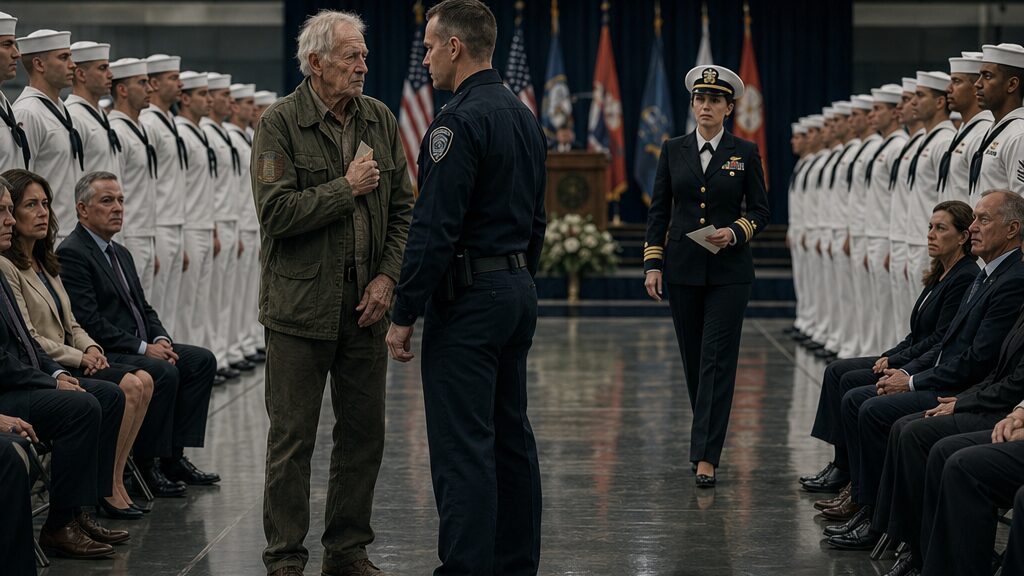
Straight ahead did not take him to the guest table. It took him into the central aisle.
At first, he did not understand. The light changed as he entered the hangar fully, becoming cooler and whiter. The sound became bigger. Every small motion carried. Every cough seemed to belong to the whole room. Rows of sailors stood to his left and right, facing inward with the stillness of people waiting for command.
Jack walked three steps before he realized the aisle was empty because it was supposed to remain empty.
He stopped.
A hundred white uniforms seemed to hold their breath.
At the far end, the officer at the podium adjusted the microphone. She wore a dark formal uniform and a white cover, her posture composed, her face set in the careful neutrality of ceremony. The program lay in front of her. Behind her, the flags stood bright and still.
Jack could have turned back then.
He should have turned back.
But his body had learned long ago that some moments did not allow retreat. He stood with the folded invitation inside his jacket, his hand over the sleeve patch, and waited.
The officer at the podium looked up.
Her eyes moved from the back rows to the center aisle and stopped on him.
Jack felt the attention ripple before he saw it. Heads did not turn all at once. That would have been easier. Instead, small glances passed through the room. A sailor’s eyes flicked toward him and snapped forward. An older guest whispered and then went quiet. Somewhere to the side, a chair leg scraped.
Jack’s face warmed.
He lowered his hand from the patch, then raised it again because he did not know where else to put it.
The officer at the podium paused with one page lifted between her fingers.
The microphone waited.
Jack stood alone in the aisle, wearing the oldest thing in the room.
Chapter 2: Security Moved Before Anyone Asked His Name
Rebecca Carter had planned the ceremony down to the length of each silence.
There would be no wandering between readings. No uncertain pauses while names were checked. No awkward corrections from the podium. Families had waited long enough for the restored memorial list, and the Navy had already failed some of them once. Rebecca had told every junior sailor on the event team that dignity was not decoration. Dignity was precision.
Then the old man stepped into the aisle.
For half a second she thought he was part of the program she had not been told about, some late addition from command, some elder representative placed there for effect. But no escort stood beside him. No aide moved toward him. No one at the side tables gave her a signal.
He was simply there.
Thin shoulders. Worn olive jacket. One hand pressed near his left sleeve. His hair was white and uneven at the back, as if he had combed it himself without a mirror. He faced her with an expression she could not read at that distance, but his stillness disturbed her more than movement would have.
Rebecca kept her hand on the program page and glanced toward the side.
Thomas Reed saw her look.
He stood near the wall with two security personnel in dark uniforms, his shoulders square, his earpiece wire visible against his collar. He did not wait for her to make the decision. That was one reason he was good at his job and one reason he sometimes worried her.
Rebecca gave the smallest shake of her head, intending it to mean wait.
Thomas read it as move carefully.
He moved.
The two with him followed.
The sound of their steps ran down the aisle before they did. Controlled at first, then quicker, because a ceremony hall was too open for uncertainty. White-uniformed sailors remained at attention, but their eyes shifted. Guests in the side rows leaned back as the dark uniforms passed them.
Jack Bennett heard the steps and knew they were for him.
He did not turn immediately. He looked once at the podium, at the officer holding her page, and saw that the moment had gone wrong in a way that could not be folded back into shape.
His hand found the patch again.
He had crossed decks in smoke. He had carried hot metal with wet towels wrapped around his palms. He had heard men call for help in voices that made them boys again. But nothing made an old man feel smaller than a clean room full of younger people watching him become an inconvenience.
Thomas Reed slowed when he came within six feet.
“Sir,” he said, low but clear. “I need you to step with me.”
Jack turned his head.
Thomas was not young enough to be careless, but not old enough to have lost faith in procedure. His jaw was set. His eyes moved quickly over Jack’s jacket, shoes, empty hands, then face.
“I’m here for the ceremony,” Jack said.
“I understand. We just need to verify your seating.”
“I was told to stand.”
A murmur went through the nearest row. It was small, almost nothing, but Jack heard it.
Thomas’s expression did not change. “Sir, this aisle needs to stay clear.”
Jack looked at the aisle beneath his feet. It was wide enough for a casket, wide enough for a color guard, wide enough for absence to pass through with ceremony. He wondered if Stephen would have laughed at that thought. Stephen had laughed at wrong moments.
“I’ll move when the name is called,” Jack said.
Thomas took a breath through his nose. “I can’t have you standing here.”
The words were not cruel. That was almost worse. Cruelty could be dismissed. Politeness had the weight of a locked door.
Rebecca left the podium.
The microphone caught the soft scrape of her movement, then a hollow bump as she stepped away. She came down the stage steps without hurry, but her face had tightened. Behind her, the flags seemed too bright.
“Chief Reed,” she said.
Thomas did not look away from Jack. “Ma’am, we have an unidentified guest in the center aisle.”
“I can see that.”
Jack watched her approach. She was younger than he expected from her voice, maybe late thirties, with the composed face of someone used to being watched. Her eyes paused on his jacket. Not on the patch. On the wear around the collar.
“Sir,” she said, “I’m Lieutenant Commander Carter. May I ask your name?”
Jack’s mouth dried.
The whole room waited for him to give a name that meant something. It would not. Not here. Not on the program. Not in any file they had opened this morning.
“Jack Bennett.”
Rebecca held his gaze for a beat. There was no recognition.
“Mr. Bennett, were you checked in with the guest table?”
“I showed the paper.”
“The paper?”
He reached into his jacket.
Thomas’s hand lifted slightly, not to a weapon, not even close, but enough. Jack saw it. Thomas saw him see it. Both men froze inside that small gesture.
The silence grew sharp.
Slowly, Jack withdrew the folded invitation.
He did not offer it right away. The paper had been in his pocket so long that bringing it out felt like taking off a bandage in public. He opened one fold, then another. His fingers trembled. Not fear, he wanted to tell them. Not the way you think.
But he said nothing.
Rebecca stepped closer and accepted the paper.
The invitation looked smaller in her hand than it had in his. She read the heading, the date, the ceremony title. Her eyes moved down. When they reached Stephen Walker’s name, something in her expression changed, not enough for the room to see, but enough for Jack.
“You were invited by the Walker family?” she asked.
Jack nodded once.
“Are you a relative?”
“No.”
Thomas shifted. “Ma’am, if he’s not on the family list—”
“He has an invitation,” Rebecca said.
“It’s not a pass.”
“No,” she said. “It isn’t.”
The distinction sat between them.
Jack reached for the paper, but Rebecca did not return it yet. She was still reading the bottom line. He knew the line without looking. Deborah Sullivan had written it by hand under the printed text because the official invitation had not known how to ask.
If you can come, please stand when they say my father’s name.
Rebecca looked up from the ink.
“Who is Stephen Walker to you, Mr. Bennett?”
The question should have been simple. The answer had once been simple. Shipmate. Friend. The man who went back when Jack could not. The man whose name had been spoken too softly for too many years.
Jack looked at the rows of sailors.
Some stared straight ahead with disciplined blankness. Some watched him openly now. A young sailor near the front swallowed. An older guest touched a tissue to her mouth. Everyone seemed to be waiting for a story, or a mistake, or a reason to decide what kind of old man he was.
Jack would not give them Stephen like that.
“He asked me once not to let him be forgotten,” Jack said.
Rebecca’s fingers tightened on the invitation.
Thomas looked at him differently then, but only for a second. Training returned.
“Sir,” Thomas said, softer, “we still need to move out of the aisle.”
Jack nodded.
It should have ended there. He should have followed them quietly to the side, allowed the ceremony to continue, waited for Stephen’s name from a chair near the wall.
But as he took his first step, someone in the guest seating whispered, not softly enough.
“Poor man must be confused.”
Jack stopped.
Thomas closed his eyes briefly, as if wishing the words had not found air.
Rebecca heard them too. Her face changed, not with anger exactly, but with the pain of a ceremony slipping from dignity into something else.
Jack did not turn toward the whisper. He did not ask who had said it. He did not defend himself.
He simply folded the invitation back along its old lines, pressed it against the patch on his sleeve, and lowered his hand.
“I’m not confused,” he said.
The words were quiet.
The microphone at the podium, still live in the waiting room of sound, caught just enough of them to carry.
No one moved.
Rebecca looked toward the stage, toward the program, toward the rows of names that had been checked and rechecked by people who had never once imagined an old man might arrive with the missing part in his pocket.
She turned to the sound technician and drew one finger across her throat.
The speakers went dead.
Then Rebecca faced Thomas.
“Pause the ceremony,” she said.
Thomas stared at her. “Ma’am?”
“Pause it.”
The order traveled quickly. A sailor near the side door moved. Another picked up a radio. At the rear of the room, someone closed one of the hangar doors halfway, and the sunlight narrowed across the floor.
Rebecca held the invitation out to Jack with both hands.
This time, she did not make him reach far.
“Mr. Bennett,” she said, “will you come with me for a moment?”
Jack looked at the aisle ahead of him, then at the sailors lined on either side, then at the paper that had become too heavy for its weight.
“Is his name still going to be read?” he asked.
Rebecca did not answer quickly enough.
That was answer enough.
Jack took the invitation.
Rebecca turned toward the side corridor. Thomas stepped back to let Jack pass, and for the first time since the running began, his eyes lowered.
Jack walked out of the aisle slowly.
Behind him, the hall remained still, filled with people who had seen him stopped but had not yet been told why he had come.
Chapter 3: The Name That Was Missing From the Program
The side corridor behind the ceremony hall smelled of floor wax, printer toner, and coffee left too long on a warmer.
Rebecca had walked through it twenty times that morning, checking cables, seating charts, access points, family escorts, program copies, and the emergency medical station. It had seemed narrow but orderly then. Now, with Jack Bennett beside her and Thomas Reed a few steps behind, it felt like the space where every mistake came to wait.
Jack moved slower once they were out of the hall. Away from the eyes, the stiffness in his shoulders loosened into something more fragile. He did not limp exactly, but his right leg hesitated before accepting weight. Rebecca shortened her stride without making a show of it.
He noticed anyway.
“You don’t have to do that,” he said.
“I know.”
She kept doing it.
Thomas opened the door to a small preparation room. Inside were two folding tables, boxes of extra programs, a garment rack with ceremonial covers, a stack of bottled water, and a chair placed too close to the wall. Rebecca gestured toward it.
Jack remained standing.
Of course, she thought. After what just happened, he would not want to be placed anywhere.
She set the program on the table. “Mr. Bennett, I need to understand how you received this invitation.”
Jack took the folded paper from his pocket again but did not hand it over. “In the mail.”
“From Deborah Sullivan?”
His eyes moved to her face.
“That’s the name written on the return address?”
“Yes.”
Rebecca turned to the ceremony clerk standing near the boxes. “Find the Walker family packet.”
The clerk, pale with nerves, began searching through folders.
Thomas remained by the door, arms at his sides. He looked larger in the small room than he had in the hall. Jack did not look at him.
Rebecca softened her voice. “Stephen Walker is on today’s restored memorial roll. That part is correct.”
Jack’s chin lifted slightly.
“But your name wasn’t on the seating list,” she said. “And we didn’t have you marked as a speaker, escort, or family representative.”
“I’m not any of those.”
“You said you were told to stand.”
Jack looked down at the invitation.
“I was asked.”
Rebecca waited.
The clerk found a blue folder and brought it over. Rebecca opened it. Inside were printed emails, a seating chart, two family contact forms, and a copy of the ceremony program. She scanned the list.
Stephen Walker. Correct.
Deborah Sullivan. Family representative. Correct.
Reserved front row, seat four. Correct.
Additional guest request. Blank.
Rebecca frowned. “There’s no mention of you here.”
Jack gave a small nod, as if that was no surprise.
Thomas cleared his throat. “Ma’am, there may have been a late guest addition that didn’t clear security.”
Rebecca shot him a look, not harsh, but enough to stop him. Then she looked back at Jack. “Did Mrs. Sullivan tell you where to check in?”
“She told me to come if I could.”
“When?”
Jack rubbed the edge of the invitation with his thumb. “First letter came years ago.”
The room quieted around that.
Rebecca thought she had misheard. “Years?”
“She wrote after they found the old report.”
The clerk looked up, then down again quickly.
Rebecca knew the report. Everyone on the ceremony team knew some version of it, though most knew only the administrative shape. A shipboard accident from decades before. Maintenance crew. Fire contained before it reached stored fuel. Records incomplete. One sailor’s actions omitted from the commendation language because the surviving witnesses had been separated before statements were collected properly. Today’s ceremony was part correction, part memorial, part apology written in official language.
“Did you respond to the earlier letters?” Rebecca asked.
“No.”
The answer was flat, almost rough.
Thomas shifted his weight by the door. Rebecca could feel the security clock running in his head. A paused ceremony was a problem. Unverified guest. Public disruption. Senior officers waiting. Families growing uneasy. But she also felt something else now, something that had begun in the aisle when Jack had said, I’m not confused.
“Why today?” she asked.
Jack folded the invitation once, though it was already folded. “Because this one had a time.”
“That was the only reason?”
“No.”
He did not add to it.
Rebecca looked at the program on the table. Stephen Walker’s name was in the third section, after the chaplain’s remarks and before the wreath presentation. She had practiced that portion twice. She had known to pause after the name because Deborah Sullivan had requested it. One measured pause. Three seconds.
Three seconds for a life missing from paper for decades.
Rebecca suddenly hated the neatness of it.
The door opened behind Thomas, and a woman’s voice said, “Commander Carter?”
The clerk stepped aside.
A woman in her sixties stood in the doorway, one hand at her throat. She wore a dark blue dress and a silver pin shaped like an anchor. Her hair was carefully styled, but one side had come loose, as if she had been touching it repeatedly. Her eyes moved from Rebecca to Thomas, then to Jack.
She did not breathe for a moment.
“Mrs. Sullivan,” Rebecca said. “I’m sorry for the delay.”
Deborah Sullivan took one step into the room.
Jack turned toward her with the slow care of a man preparing to accept something deserved.
Deborah’s lips parted. Her gaze dropped to the jacket, the sleeve patch, the folded paper in his hand. Something like recognition passed over her face, but it was tangled with shock and anger and an older hurt.
“You came,” she said.
Jack held the invitation lower, almost at his side.
“Yes, ma’am.”
Deborah flinched at the formality.
Rebecca looked between them. “You know Mr. Bennett?”
Deborah gave a small, incredulous laugh that had no humor in it. “Know him? I wrote to him for eight years.”
The clerk became very still.
Thomas looked away.
Jack did not defend himself.
Deborah stepped farther into the room. “I wrote after the first records request. I wrote when the Navy said they couldn’t amend the language. I wrote when the historian found my father’s maintenance log. I wrote when they finally agreed to read his name.” Her voice stayed controlled, but the effort showed at the edges. “I thought you threw every letter away.”
Jack looked at the floor.
Rebecca closed the folder slowly.
“Mrs. Sullivan,” she said, “Mr. Bennett’s name was not on the official list. That appears to be our error, at least in part.”
Deborah did not look at her. “Did you get them?”
Jack’s hand moved toward the patch, then stopped halfway. He let it fall.
“Yes.”
The single word seemed to hurt Deborah more than denial would have.
“All of them?”
He nodded.
The small room held the paused ceremony inside it like pressure in a sealed pipe.
Deborah’s eyes shone, but she did not cry. “My father talked about you in every story he ever told. Jack Bennett this. Jack Bennett that. Jack could fix anything. Jack kept the pumps running. Jack would know.” She swallowed. “And when I needed you to tell them he mattered, you vanished.”
Jack closed his eyes.
Rebecca saw then that his silence was not emptiness. It was a door held shut with both hands.
Deborah noticed the invitation in his grip. “But that one you kept.”
Jack opened his eyes.
“This one asked less,” he said.
Deborah stared at him.
“It only asked me to stand.”
No one spoke after that.
From the hall came a muffled sound: chairs shifting, a cough, the low rise of people waiting for someone to explain what had gone wrong. Rebecca looked at the program again, then at Stephen Walker’s name.
She had spent the morning trying to prevent disorder.
Now she understood that order had nearly erased the only witness in the building who knew how much the name had cost.
She turned to Jack.
“Mr. Bennett,” she said carefully, “before I resume that ceremony, I need to know what you want done.”
Jack looked toward the wall, though the hall was beyond it.
His answer came slowly.
“I want his name read.”
Deborah’s face trembled once.
Rebecca waited, sensing there was more.
Jack touched the folded invitation to the worn patch on his sleeve, then lowered it.
“And I want to be standing when it is.”
Chapter 4: The Daughter Who Thought He Never Came
Deborah Sullivan did not sit.
There were three chairs in the preparation room. One had a stack of unused programs on it, one had a folded dress jacket across the back, and one stood empty beside the wall where Rebecca had offered it to Jack. Deborah stood near the door as if sitting would make the room too permanent.
Jack understood that. Some rooms became traps once a person sat down.
Rebecca had stepped into the corridor to speak with the clerk and give instructions in a low voice. Thomas remained outside the door now, close enough to be called but not close enough to press his presence into the room. The ceremony waited beyond the walls, hundreds of people caught inside a pause they had not chosen.
Deborah kept looking at Jack’s jacket.
Not his face. Not at first.
The patch drew her eyes the way old damage drew weather. She had seen it before, or something like it. Jack could tell. Maybe in a photograph. Maybe in one of the boxes families kept when they did not know what else to do with proof of a life.
“My father had one,” she said.
Jack nodded.
“He kept it in a drawer,” she said. “My mother tried to throw out the shirt once. He wouldn’t let her.”
Jack looked at the folded invitation in his hand. “Stephen didn’t like throwing things away.”
Deborah’s mouth trembled, then tightened. “You knew him well enough to know that.”
“Yes.”
“But not well enough to answer.”
The words struck cleanly. Jack did not turn away from them.
Deborah took one step deeper into the room. The anchor pin on her dress caught the overhead light. “Do you know what it was like, writing to a man my father trusted more than almost anyone and getting nothing back?”
Jack did know something about letters that went unanswered. He knew the weight of them on a kitchen table, the way envelopes could look harmless until evening, when the house was quiet and there was no one left to pretend for. He knew how a mailbox could become something a man avoided until the sun went down.
But that was not her question.
“No,” he said.
Deborah’s eyes sharpened. “No?”
“No, ma’am. I don’t know what it was like for you.”
For a moment, the anger in her face faltered. She had expected defense. Maybe denial. Maybe an old man’s pride dressing itself as injury.
Jack gave her neither.
She turned toward the table and touched the top program with two fingers. “The first letter I sent you had a copy of my father’s notebook page. I thought that would matter to you.”
“It did.”
“You didn’t say so.”
“No.”
“The second had the investigator’s summary. The third had the old maintenance log.” Her voice thinned, but she kept it steady. “The fourth was after my mother died. I wrote that she’d always believed someone else knew what Dad did that night. I wrote that maybe you were the last one.”
Jack closed his hand around the invitation. The paper bent under his palm.
Deborah saw it. “And still nothing.”
He had opened that letter at the sink.
He remembered that because he had been rinsing a coffee cup when the envelope slid from between two grocery circulars. The stamp had been crooked. Deborah’s handwriting had looked more tired than the earlier ones. He had read the first paragraph standing up, then sat before the second.
My mother passed in March. She never stopped saying Dad did not die because he was careless.
Jack had put the letter under the fruit bowl after reading it, as if an orange and two bananas could hold down the past. He had not slept that night. In the morning, he had taken the old jacket from the closet and hung it over a chair. By afternoon, he had put it back.
“I read it,” he said.
Deborah’s lips parted slightly. “That’s all?”
“No.”
Jack looked toward the closed door. Through it came the muffled voice of Rebecca, firm and controlled. The ceremony had not resumed. Not yet.
“I read them more than once,” he said.
Deborah’s hands folded together. “Then why?”
There it was. Not the anger. Not the accusation. The question beneath all of it. The one she had carried into this room dressed as anger because anger stood straighter.
Jack could have told her a smaller truth.
I was sick. I was alone. I didn’t know what to say. I thought someone else would answer better.
All of those were true enough to be useful and false enough to be shameful.
Instead he looked at the program on the table and found Stephen Walker’s name printed in black ink, official and tidy.
“Because your father did not need me to make him matter,” Jack said.
Deborah stared at him. “That sounds noble. It isn’t.”
“No.”
“You let them write him wrong.”
Jack’s face tightened.
She saw that one land. Her own expression shifted, and for a second she seemed almost sorry. Not enough to take it back.
Jack rubbed his thumb over the invitation’s crease. “They wrote a lot of men wrong.”
“I’m talking about my father.”
“I know.”
“No, I don’t think you do.” Her voice rose, then she forced it down, remembering the room, the ceremony, the wall between them and waiting families. “I grew up hearing half-stories. Dad would start one and stop when Mom came in. He joked about everything until he didn’t. Then after he died, there was this file. This clean official file that made him sound like he was just there. Like he happened to be in the wrong place during an accident.”
Jack swallowed.
Deborah stepped closer. “But he wasn’t just there, was he?”
Jack looked at her then.
In her face he saw a girl who had waited beside a hospital bed for a father’s hand to move. He saw a woman who had read reports written by people who had not smelled smoke in their hair for days afterward. He saw someone who had inherited a question and mistaken it for a duty because no one else would carry it.
“He was never just there,” Jack said.
The answer struck her harder than she expected. Her eyes filled quickly, and she turned away before the tears could fall. She pressed two fingers under one eye, careful not to disturb her makeup.
“Then why did I have to fight alone?”
The room became very still.
Jack let the invitation drop to his side. His hand, freed from the paper, moved to his sleeve patch and rested there. He had done it all morning without thinking. Now Deborah watched the motion and understood it was not a habit without meaning.
“I was there when he went back,” Jack said.
Deborah did not move.
“He told me not to follow.”
The words came out quietly, almost too quietly for a room that had waited years to hear them.
Deborah turned.
Jack’s eyes had gone somewhere else. Not far. Just behind the clean wall, behind the folding tables, behind the hanging covers and bottled water and printed programs. Somewhere metal groaned under heat. Somewhere a voice laughed where it should not have laughed. Somewhere Stephen Walker said, Stay where you are, Jack, and for once Jack had.
“I thought,” Jack said, “if I wrote you, I’d have to tell you why I came home and he didn’t.”
Deborah’s anger did not vanish. It changed shape. That was worse in some ways, because now it had to share space with pity, and she did not seem ready to pity him.
“My father wouldn’t have wanted you punished for surviving,” she said.
“No.”
“Then why did you punish us?”
Jack closed his eyes.
Rebecca opened the door, then stopped as she saw their faces.
Deborah did not look away from Jack. “Answer me.”
Jack opened his eyes again.
“I didn’t think of it that way,” he said.
It was not enough. It was perhaps the only honest thing left.
Deborah exhaled, broken and angry. “Eight years.”
“Yes.”
“My mother died waiting for someone to say Dad was brave.”
Jack’s hand tightened on his sleeve.
“He was,” Jack said.
“She needed to hear it from someone who knew.”
Jack bowed his head.
There were apologies too large for the word sorry. He had learned that late. Sorry could not rebuild a burned compartment. Sorry could not give Deborah back eight years of unanswered envelopes. Sorry could not sit beside her mother’s bed and speak the name properly before she died.
“I should have answered,” he said.
Deborah’s face changed again. She looked almost disappointed by the simplicity of it, as if she had prepared herself for excuses and received a stone instead.
“Yes,” she said. “You should have.”
Rebecca stepped fully into the room. “Mrs. Sullivan, Mr. Bennett, they’re asking for an update. We can continue the ceremony with a revised order, or we can postpone the memorial reading until after—”
“No,” Deborah said.
Jack looked up.
She wiped under her eye once more and steadied herself. “No postponing. Not again.”
Rebecca nodded. “Then I need to know how you want Mr. Bennett included.”
Deborah looked at Jack. The question sat between them, heavy with all the letters he had not answered.
“He said he came to stand,” she said.
Jack’s gaze dropped.
Deborah’s voice softened by one degree, not forgiveness, not yet. “Then let him stand.”
Rebecca looked to Jack. “Is that what you want?”
Jack looked at the folded invitation, then at Stephen’s name on the program. He thought of the first letter, the fourth, the last. He thought of an old woman dying with a question still open in the room. He thought of how silence could look like dignity from one side and abandonment from the other.
“Yes,” he said.
Then, after a pause, he added, “But not in front of her.”
Deborah frowned. “What does that mean?”
Jack’s voice was rough. “Don’t put me where people look at me instead of hearing his name.”
Rebecca studied him, and something in her expression gentled.
Deborah looked down at the program. When she spoke again, the anger was still there, but it had lowered its voice.
“You always did that in his stories,” she said.
Jack waited.
“Moved out of photographs. Stood behind people. Let him tell the funny parts.”
Jack almost smiled. Almost.
“Stephen told the funny parts better.”
For the first time, Deborah’s face opened around a memory that did not hurt only one way.
Then the hallway speaker clicked faintly, and a voice called for the ceremony team.
Rebecca straightened. The officer returned, but not the same one who had left the podium. “We need to decide now.”
Deborah picked up the program and held it toward Jack.
He did not take it.
“I already know where his name is,” he said.
Chapter 5: What the Patch Remembered
The memory display wall stood at the rear of the hall, just outside the main ceremony space, where guests passed it on their way to coffee and restrooms without being forced to stop.
Rebecca had chosen the location because it was respectful and unobtrusive. Photographs in black frames. A short history of the ship. A timeline of the accident investigation and later review. Names printed beneath small portraits where portraits could be found, and beneath empty gray squares where time had taken too much.
Stephen Walker’s photograph was near the end of the second row.
He was younger than Deborah now by decades. Younger than Jack had been for most of his life. He wore a work shirt and a grin that seemed to have arrived half a second before the camera captured him. Someone had written on the back of the original, according to the display caption, Walker after shift, still talking.
Jack stood before the photograph with his hands at his sides.
Deborah stood a few steps away, not beside him yet. Rebecca remained near the corner, giving them as much privacy as a public hallway allowed. Thomas was farther down, speaking into his radio in a low voice, his back deliberately turned.
Through the wall came the muffled weight of the ceremony waiting. A cough. A chair. The faint test of the microphone.
Jack looked at Stephen’s grin and felt the old irritation rise before the grief did.
“He always talked when he was tired,” Jack said.
Deborah looked at the photograph. “Mom used to say that.”
“He said silence made him sleepy.”
A breath escaped her that might have become a laugh if it had been given more room.
Jack lifted his hand to the patch on his sleeve. This time he knew he was doing it. His fingers rested over the frayed edge, and the touch brought back the scrape of canvas, the smell of oil, the heat of a compartment where air turned mean in the lungs.
“This wasn’t a dress patch,” he said. “Nothing official anyone would care about.”
Deborah stepped closer.
“Maintenance crew had them made near the pier,” he said. “Bad stitching. Wrong color. Stephen said that made them honest.”
He could see the shop in his mind now, though he had not thought of it in years. A narrow place with sun-faded caps in the window. The man behind the counter had misread the order and made the border crooked. Stephen had bought two anyway. Said perfection was for inspection and lies.
Jack had laughed then. He remembered laughing. That part always startled him, that he had laughed so much before.
“Dad kept his in a cigar box,” Deborah said.
Jack nodded. “He kept everything.”
“The display team asked for more objects. I almost brought it.”
“Why didn’t you?”
She folded her arms lightly, as if holding herself in place. “I was afraid they’d lose it.”
Jack understood that so well he could not answer.
Rebecca came closer, careful. “Mr. Bennett, Mrs. Sullivan told me the investigation records were amended last year. The ceremony today recognizes that correction.”
Jack looked at the timeline on the wall.
Correction. Review. Amendment. Restored language.
Words that made grief stand in line.
“They fixed the sentence,” he said.
Rebecca did not pretend to misunderstand. “Yes.”
“The sentence wasn’t the man.”
“No,” she said. “It wasn’t.”
That answer surprised him. He glanced at her, and for the first time since the aisle, he saw not only an officer but a woman carrying her own embarrassment carefully.
Deborah touched the edge of Stephen’s frame. “What happened that night?”
Rebecca remained still.
Jack heard the question as he had heard it for years, in envelopes, in dreams, in the sound of rain against the house after his wife died. He had built walls around it. Good walls. Useful walls. He had told himself that Deborah wanted a report, and reports already existed. He had told himself that Stephen’s family needed official language, not an old man’s version full of heat and fear.
But Deborah had not asked what the report said.
She had asked what happened.
Jack looked at the photograph. “A valve locked open after the first alarm. Not the one the report talked about. A smaller one behind the pump housing. If it stayed open, the fire suppression line lost pressure.”
Deborah listened without blinking.
“I was closest,” he said. “I tried to reach it. Burned my hand through the glove before I got halfway. Stephen pulled me back by the belt hard enough to put me on the deck.”
He flexed his right hand. The scars were old and pale now, thin lines that disappeared unless the light found them.
“He was stronger than he looked,” Jack said.
Deborah’s mouth moved faintly. “He was always showing off with pickle jars.”
Jack nodded, and that nearly undid him.
“He told me to stay where I was. I told him he was an idiot.” Jack’s voice roughened. “He said, ‘Then you fix it when I’m done being one.’”
Deborah covered her mouth.
“He went under the pipe rack. He was smaller. Faster. He got to the valve.” Jack stopped. His eyes remained on Stephen’s photograph. “Pressure came back. That’s why the next line held.”
Rebecca lowered her eyes.
“The report said he assisted containment,” Deborah whispered.
Jack’s jaw tightened. “He saved it.”
The words landed in the hallway without ceremony.
Not shouted. Not delivered. Simply put where they had always belonged.
Deborah closed her eyes.
Jack looked down at his sleeve patch. “Afterward, there was smoke and noise and people counting heads wrong. I was taken off before I gave a full statement. By the time anyone asked, the first report had words already. Careless words. Soft words. Words that made it easier for everyone still alive.”
“Including you?” Deborah asked.
Jack accepted that. “Including me.”
She turned toward him. “You were hurt.”
“I was alive.”
“That isn’t the same as guilty.”
Jack stared at the old patch. “It can feel close.”
Rebecca made a small sound, not quite a breath. “Mr. Bennett, your statement could still be included in the historical record.”
Jack gave a tired smile without humor. “That what you need from me?”
Rebecca did not answer too quickly this time. “It may be what the record needs. But no. That is not what I meant.”
“What did you mean?”
She looked toward the hall. “People in there saw us move you out of the aisle. Some may think you interrupted. Some may think we handled it properly. Some may think nothing at all except that the ceremony was delayed.” Her voice softened. “If we resume without acknowledging enough, we protect the schedule and leave the wrong picture in their minds.”
Jack looked at her carefully. “You want to explain me.”
“I want to correct myself.”
Thomas, down the hall, had stopped speaking into his radio. He did not turn around.
Jack saw that too.
Deborah looked from Rebecca to Jack. “Dad wouldn’t want you hidden.”
Jack almost answered that Stephen had hidden plenty, especially extra dessert and bad hands in poker. But the humor would have been cowardice then, and he had used enough cowardice for one life.
“I didn’t come for that,” he said.
“I know,” Deborah said.
The gentleness in her voice hurt more than anger.
Jack looked back at Stephen’s photograph. The grin was still there, careless and impossible. For a moment, the hallway disappeared, and there were two young men on a pier with cheap patches in a paper bag, one of them insisting that crooked stitching gave a thing character.
“He made me promise something once,” Jack said.
Deborah waited.
“Not that night. Before. We were talking nonsense, the way men do when they think they have too much time. He said if he went first, I wasn’t allowed to let him turn into a line on a wall.”
Deborah looked at the display.
Jack’s hand slipped from the patch to the folded invitation in his pocket. “I told him he talked too much.”
“Did you promise?”
Jack did not look away from Stephen’s face. “Yes.”
The hall speaker clicked again. This time Rebecca’s name came through faintly, asking for status.
Rebecca stepped away, answered, then returned. “They can hold five more minutes.”
Jack almost laughed at the idea that five minutes could be granted after decades.
Deborah reached into her small purse and took out a folded tissue. She did not use it. She just held it.
“Why answer the last invitation?” she asked.
Jack removed the paper from his pocket. “Because you didn’t ask me to write anything. You didn’t ask me to fix the record. You didn’t ask me to remember cleanly.”
He opened the invitation and looked at the handwritten line.
“You asked me to stand.”
Deborah read her own words upside down. If you can come, please stand when they say my father’s name.
“I was angry when I wrote that,” she said.
“I could tell.”
“I thought if you had any decency left, that would hurt.”
“It did.”
She looked ashamed then, but Jack shook his head once.
“It should have,” he said.
Silence settled, not empty now, but bearable.
Rebecca stepped beside them and looked at the photograph of Stephen Walker. “Mr. Bennett, I won’t ask you to speak from the podium. I won’t ask you to display anything you don’t want displayed. But I am asking whether you will allow me to say that you were invited by the Walker family and that you served with Stephen Walker.”
Jack’s fingers closed around the invitation.
“No stories?”
“No stories unless you choose them.”
“No calling me up like I’m something.”
“No.”
“No blaming him.” Jack glanced toward Thomas.
Rebecca followed his look. Thomas stood still.
“No,” she said. “No blaming him.”
Deborah frowned. “Jack—”
“He did his job,” Jack said. “Too fast, maybe. But he did what he thought was keeping your father’s ceremony safe.”
Thomas turned then.
His face had changed. The hard professional mask was still there, but something behind it had lowered.
“I should have asked your name before I moved,” he said.
Jack looked at him. “You did ask.”
“After.”
Jack did not spare him, but neither did he strike. “Yes.”
Thomas nodded once, accepting the difference.
Rebecca looked toward the hall. “Then we resume.”
Jack folded the invitation carefully. Deborah watched his hands. When the paper was tucked away, he started to return to the side corridor, but Deborah stopped him.
“Jack.”
He turned.
She stepped close enough to touch the sleeve patch, then stopped before her fingers reached it. “May I?”
The question seemed to surprise him.
After a moment, Jack held his arm still.
Deborah touched the edge of the patch with two fingers, barely enough to move the frayed thread. Her face tightened with recognition, as if the crooked stitching had connected the man in front of her to the father in the photograph in a way the official program never could.
“He really did have one,” she whispered.
“Yes,” Jack said. “He did.”
Deborah lowered her hand.
Rebecca opened the door toward the hall. Sound entered at once: chairs, quiet voices, the living pressure of a room waiting to continue.
Jack looked at Stephen’s photograph one last time.
Then he walked toward the aisle he had been removed from.
Chapter 6: He Would Not Let Shame Become the Ceremony
When Rebecca returned to the podium, the hall quieted before she asked it to.
That was the first difference.
Before the interruption, the room had been orderly because procedure required it. Now the silence had weight. People had watched an old man escorted from the aisle. They had watched the officer leave the stage. They had sat with guesses long enough for those guesses to become uncomfortable.
Rebecca set the revised program on the podium and placed both hands beside it.
Jack stood just inside the side entrance with Deborah near him. Not beside the front row, not yet. Thomas stood a few paces behind, his posture formal but no longer sharpened into readiness. The two security personnel had returned to their stations near the wall.
Across the hall, rows of sailors faced forward.
Jack felt their attention without meeting it. He had once been able to tell the mood of a compartment by the way men breathed. This room breathed cautiously.
Rebecca adjusted the microphone. This time, she checked the sound light before speaking.
“Ladies and gentlemen,” she said, “thank you for your patience.”
Her voice carried cleanly.
Jack’s hand moved toward the sleeve patch, then stopped. He let it rest at his side.
Rebecca looked down at the page, then up again. “Before we continue, I need to correct the way this ceremony was paused.”
A small shift passed through the room.
Jack’s shoulders tightened.
He had asked for no blame. He had meant it. Shame could spread faster than fire if given air.
Rebecca did not look toward Thomas. She looked across the whole hall.
“A guest invited by the Walker family entered through the wrong point of access and was not identified properly by our team. In our effort to protect the order of the ceremony, we failed to first protect the dignity of the person standing before us.”
The room remained still.
Jack looked at the floor.
She had not made him large. She had made the mistake visible. There was a difference.
“This ceremony exists because names and actions can be mishandled by records, by systems, and by people trying to move too quickly,” Rebecca continued. “We cannot honor corrected memory while repeating careless judgment in the present.”
Thomas’s face did not move, but Jack saw his throat work once.
Rebecca turned one page. “Mr. Jack Bennett was invited by the Walker family. He served with Stephen Walker. He has asked for no speaking role and no recognition beyond the right to stand when his shipmate’s name is read. We will honor that request.”
A woman in the guest rows lowered her head. Jack wondered if it was the one who had whispered that he was confused. He hoped no one would look at her.
Rebecca resumed the ceremony from the section before the memorial roll. The chaplain offered a prayer that did not try to explain suffering. Jack was grateful for that. Some prayers filled silence with too many answers.
Deborah stood beside him, holding her program in both hands. Her knuckles were pale against the paper.
“You can sit until his name,” she whispered.
Jack shook his head once.
She did not argue.
The names began.
Each one was spoken slowly. Rebecca gave each the same care, the same measured pause. Rank, name, role. A bell sounded after every third name, soft and clear, struck by a sailor near the stage. The sound moved through the hangar and faded into the rafters.
Jack kept his eyes forward.
He listened to names he did not know and felt ashamed that he did not know them. Then he let the shame pass. A man could not carry every name. He could only refuse to drop the ones placed in his hands.
Stephen Walker’s name waited in the program like a step in the dark.
Deborah shifted beside him before it came. She knew the order. So did he.
Rebecca looked down.
There was a pause longer than the others, but not dramatic. Not enough for spectacle. Enough to breathe.
“Stephen Walker,” she said. “Damage-control maintenance crew.”
Jack stood straighter.
Not much. Not like a young man. Not like a photograph. His spine resisted, his knee trembled, and the old jacket pulled across his shoulders. But he stood with everything in him facing forward.
Rebecca continued, her voice steady. “Recognized today for actions essential to the containment of the shipboard fire and the protection of his crew.”
Deborah made a sound too small for anyone but Jack to hear.
The bell rang.
Jack closed his eyes.
For a second, the hall was gone.
He was twenty-two and sweating through his shirt. Stephen was beside him on the pier, holding up the crooked patch and saying the border looked like it had survived a storm. Jack told him it looked like the shop owner had sewn it with his feet. Stephen said that was why it belonged to them.
Then Jack opened his eyes again.
The hall returned.
Stephen’s name had been spoken.
The world had not broken open. No one had shouted. No thunder rolled through the roof. A name was just sound until people chose what to do with it.
Jack reached into his jacket and drew out the folded invitation.
Deborah turned toward him.
He had not told her this part because he had not known he would do it until the name entered the room. He unfolded the paper once, then stopped. Not all the way. Enough for the handwritten line to show.
If you can come, please stand when they say my father’s name.
He held it in both hands.
Rebecca had begun to move toward the next name when she saw him step forward.
Not into the center aisle as an accident this time.
By choice.
A tremor went through the room, not sound exactly, but attention gathering itself again. Thomas shifted as if instinct still wanted to manage movement, then held himself still.
Jack walked slowly along the side of the front row.
Deborah followed one step behind, then stopped, understanding before anyone else did.
There was an empty chair beside her reserved seat. It had been left for Stephen symbolically, though no one had announced it as such. A folded white program rested on the cushion. A small ribbon lay across it.
Jack stood before the chair.
His breath had grown short. The walk was not far. It felt far.
He looked back once at Deborah.
She nodded.
Jack placed the folded invitation on the chair, beside the ribbon and program. He did not smooth it flat. The creases were part of it. So was the softened corner. So was the line written in anger and hope.
Then he rested his hand over the sleeve patch.
Not guarding it now. Letting it be seen.
He leaned slightly toward the empty chair.
“I stood,” he said.
The microphone did not catch it. The hall did not need to hear.
Deborah did.
She covered her mouth, and this time she did not turn away from her tears.
Jack stepped back.
For a moment, no one knew what to do. That was the dangerous part of public feeling. It wanted to become noise. It wanted to become applause, or command, or some large gesture that would make everyone feel released.
Rebecca seemed to sense it.
She lowered her eyes to the program and continued before the room could turn Jack’s private act into a performance.
“Thomas Miller,” she read, voice quiet and firm. “Engineering division.”
The ceremony moved on.
Jack returned to Deborah’s side. He did not look at the rows of sailors, though he felt many of them watching him differently now. Not all. Some would forget by supper. Some would remember only that the ceremony ran long. That was fine. A man did not need a whole room to understand him.
Deborah slipped her hand around his arm.
He stiffened at first, then allowed it.
Her fingers rested just below the old patch.
“I’m still angry,” she whispered.
“I know.”
“But I’m glad you came.”
Jack watched Rebecca read the next name. “So am I.”
At the podium, Rebecca did not look toward him again until the memorial roll ended. When she did, it was brief. Not a salute. Not a display. Just a look that said she knew the aisle was no longer the same.
Thomas stood by the wall with his hands clasped in front of him.
For the rest of the ceremony, he did not once take his eyes off the guest entrance.
Chapter 7: The Chair He Left the Letter On
After the ceremony ended, people did not rise all at once.
They moved carefully, as if standing too fast might disturb whatever had settled in the hangar. Chairs folded against legs. Programs rustled. Low voices returned in pieces. At the front, a sailor collected the bell with both hands and carried it away as though it were still sounding.
Jack stayed where he was until the rows began to loosen.
Deborah had let go of his arm during the final prayer, but she remained close enough that he could feel her deciding whether to take it again. He was grateful she did not. He was also grateful she had before.
The empty chair at the front still held the folded invitation.
No one had touched it.
The ribbon lay beside it, pale against the seat. The official program rested underneath, straight and clean, while Deborah’s paper sat at an angle, softened by pockets and years and an old man’s thumb. It looked out of place. That was why it belonged there.
Rebecca came down from the podium after speaking with the chaplain. She stopped near the chair first, not near Jack.
For a moment she simply looked at the folded invitation.
Then she turned to Deborah. “Mrs. Sullivan, we can have that placed with the memorial materials if you’d like.”
Deborah looked at Jack.
Jack shook his head slightly. “It’s hers.”
Deborah did not answer at once. She stepped to the chair, picked up the folded paper, and held it as if it might come apart in her hands.
“I wrote it angry,” she said.
Jack stood beside her. “Anger got it mailed.”
“That doesn’t make it kind.”
“No.”
Her thumb moved over the line she had written, though the paper was folded and she could not see it. “Do you want it back?”
Jack looked at the chair. Without the invitation, it was only an empty chair again.
“No,” he said. “It did what it came to do.”
Deborah’s eyes filled, but she had cried enough in front of uniforms. She folded the paper once more along the lines Jack had made familiar and slipped it into her purse.
Around them, sailors and guests moved in slow currents. Some glanced at Jack and looked away respectfully. A few seemed to want to approach and then decided not to. He appreciated those most. Respect had room in it. Curiosity often did not.
The young sailor from the entrance stood near the side door, holding a stack of collected programs. He looked at Jack twice before gathering the courage to come forward.
“Sir,” he said.
Jack turned.
The sailor’s face had gone red at the ears. “I’m sorry about earlier. I should have taken you to the guest table myself.”
Jack studied him. The boy looked ready for punishment, which made him look younger than before.
“You were given a job,” Jack said.
“I still should have done it better.”
Jack considered that, then nodded. “Yes.”
The sailor swallowed.
“Do it better next time,” Jack said.
“Yes, sir.”
The sailor stepped back, not relieved exactly, but steadier. Jack watched him return to the door and move an elderly guest’s walker away from a cord before anyone tripped. A small thing. Maybe enough for one morning.
Thomas Reed waited until the room had thinned before approaching.
He had removed his cover and held it in one hand. Without it, the sharpness of his role softened. He looked tired now, and embarrassed, and older than he had when running down the aisle.
“Mr. Bennett,” he said.
Jack faced him.
Thomas glanced toward Deborah, then Rebecca, then back at Jack. “I owe you an apology.”
Jack said nothing.
“I moved before I asked enough questions,” Thomas said. “I made a judgment from what I saw. The jacket. The aisle. No visible pass. That’s not an excuse.”
“No,” Jack said.
Thomas accepted it with a small nod. “No, it isn’t.”
The two men stood with the space of the earlier mistake between them.
“I’ve had people try to interrupt ceremonies,” Thomas said. “Protests. Confused guests. A man once came in shouting about a benefits claim. I thought I knew what the beginning of a problem looked like.”
Jack’s eyes rested on him.
Thomas looked down at his cover. “Today I learned I don’t always.”
Jack did not make it easy by forgiving him quickly. He had lived long enough to know forgiveness given too fast could be another kind of dismissal. It let the other man leave before feeling the weight of the thing.
But he had also lived long enough to know when shame had already done its work.
“You were trying to protect the room,” Jack said.
“I forgot you were part of the room.”
That answer was better than Jack expected.
He nodded once. “Remember that.”
“I will.”
Thomas put his cover back under his arm, then stood straighter. Not at attention. Not performing. “We’re changing the entry procedure for memorial guests. No one with an old invitation gets turned aside without an escort. No one gets moved from the aisle until someone asks why they’re there.”
Rebecca, standing nearby, added, “I’ll make sure that becomes written procedure, not just today’s regret.”
Jack looked at her.
She met his gaze without flinching. “I am sorry, Mr. Bennett.”
He had heard many official apologies in his life. Most were built to survive being filed. This one was not. It was too plain for that.
“I know,” he said.
Rebecca seemed to understand that he was not saying it was fine.
Deborah touched the purse where she had placed the invitation. “Jack, I’d like to send you copies of the corrected materials. And Dad’s patch, if you want to see it. Not to keep. Just to see.”
Jack’s first instinct was to say no.
No had kept his days manageable. No had kept envelopes closed. No had kept Stephen safely young in memory and Deborah safely distant in handwriting. No had allowed him to be a man with a quiet house and an old jacket instead of a witness with unfinished work.
He looked at Stephen’s photograph on the display wall across the room.
The grin had not changed.
“That would be all right,” Jack said.
Deborah exhaled. “And maybe you could write down what you told me.”
His hand went to the sleeve patch. This time, he did not clutch it. He only touched the rough edge.
“Maybe,” he said.
Deborah accepted the maybe as the large answer it was.
The hall had almost emptied. The flags still stood behind the podium. The aisle stretched between the rows of chairs, no longer guarded by ceremony. It looked ordinary now, just polished concrete and light.
Jack took one step toward the exit, then stopped.
His body was tired in a way that went beyond knees and breath. The day had taken something from him, but not cruelly. More like a hand opening after holding too long. He could feel where the invitation had been in his pocket, a flat absence against his chest.
Deborah came beside him. “Do you need help to your car?”
He almost said no.
Then he thought of all the times he had mistaken refusal for dignity.
“To the door,” he said.
She smiled a little. “To the door, then.”
They walked slowly across the hangar. Not down the center aisle this time, not exactly. They crossed through the space between chairs where people had passed before them. Rebecca remained near the front, speaking softly to the clerk, pointing once toward the guest entrance and once toward the seating chart. Thomas had gone to the side door, where he opened it for an elderly couple without making them ask.
At the threshold, sunlight struck Jack’s shoes.
Outside, the day was still bright. Cars moved beyond the lot. Somewhere, a gull cried over the base roofs. The world had continued rudely while Stephen Walker’s name was spoken, as worlds always did.
Deborah stopped beside him.
“I don’t forgive you yet,” she said.
Jack looked at the parking lot. “I didn’t ask.”
“I know.”
He nodded.
“But I don’t want to be angry alone anymore,” she said.
That made him turn.
For a moment, he saw her mother in a house he had never visited, waiting for a sentence no official record could give her. He saw Deborah at a table with envelopes, writing his name again and again. He saw himself placing each letter somewhere he would not have to answer it until not answering became its own answer.
“No,” he said quietly. “You shouldn’t have had to be.”
Deborah held out her hand.
Jack looked at it. Then he took it.
Her grip was warm, firm, and careful. Not a daughter’s grip. Not yet a friend’s. Something between accusation and beginning.
After a moment, she let go.
Jack stepped outside.
At the edge of the walkway, he paused and touched the old sleeve patch once more. For years, the gesture had been a guard at a locked door. Today his fingers rested there lightly, feeling the crooked stitching, the lifted edge, the stubborn thread his wife had once failed to mend.
Then his hand fell to his side.
Behind him, inside the hangar, someone laughed softly at something ordinary. A chair folded. A door opened. The ceremony became memory.
Jack walked toward his car without hurrying, the worn green jacket moving gently in the sun.
The story has ended.