The Young Instructor Told the Old Veteran to Step Away from the Rifle, Until He Noticed the Mark Nobody Else Saw
Chapter 1: The Old Man at Bench Seven
The range opened under a pale morning sky, the kind that made every sound carry farther than it should.
James Bennett heard the first metal clack before he reached the firing line. A bolt drawn back. A magazine checked. A range flag snapping once in a light crosswind. Gravel shifted under his shoes as he walked past the folding table where volunteers had set out coffee, bottled water, and paper name tags printed too large for old eyes and not large enough for pride.
“Sir, do you need help with that?”
The young volunteer had already reached for his rifle case before James answered.
James moved the case half an inch away, not sharply, only enough to make the answer clear. “I’ve got it.”
The volunteer smiled the way people smiled when they had already decided patience was kindness. “Of course.”
James nodded and kept walking.
The case was not heavy, not compared with what he had carried when he was twenty or forty or even sixty. It was only awkward now. His right hand did not close around the handle as quickly as it once had, and his left knee gave him a private warning each time the gravel sloped. He could manage both. What bothered him was not the weight. It was being watched for signs that he could not.
The veterans’ charity range day had grown since the last time he attended. There were more tents, more laminated safety signs, more people in clean shirts with radios clipped to their belts. A local reporter stood near the registration table with a camera, turning slow circles to catch the flags, the uniforms, the old men in ball caps, the wives holding coffee cups, the younger soldiers trying to look relaxed while still standing straight.
James had almost stayed home.
Pamela had stood in his kitchen that morning with her car keys in one hand and his medication list in the other. “Dad, you don’t have to prove anything.”
“I know.”
“You say that like you agree with me, then you do the opposite.”
He had folded the paper range card and slid it into his shirt pocket. “I’m not proving anything.”
“What are you doing, then?”
James had looked toward the window above the sink. The glass reflected him in pieces: white hair combed flat, beige short-sleeve shirt buttoned to the collar, old jeans pressed because habit still mattered. Behind his reflection, the morning had been quiet.
“Showing up,” he said.
Now he stood at the edge of the firing area while Carol Miller hurried toward him from beneath a blue canopy. She wore a charity badge on a lanyard, and her clipboard was already crowded with papers, sticky notes, and a pen attached by string.
“James Bennett,” she said, breathless but pleased. “I was hoping you’d come.”
“I signed up.”
“A lot of people sign up.” Her eyes dropped to his case, then to his shoes, then back to his face with practiced warmth. “Bench Seven is yours. We put you closer to the center so you wouldn’t have to walk all the way down.”
James looked toward the line. Bench Seven sat halfway down the row of wooden firing benches, its surface darkened by years of oil, sun, and weather. Beyond it, paper targets waited on frames downrange, pale rectangles against the berm.
Closer to the center also meant closer to everyone.
“That’ll do,” he said.
Carol lowered her voice. “If you need anything, wave me over. No shame in taking it slow.”
James gave her the smallest smile he could manage honestly. “Slow is not the same thing as unsafe.”
Her smile faltered for half a second, then returned. “Of course not.”
He walked to Bench Seven.
The bench had been swept clean but not well. A crescent of brass glittered near the front leg. Someone had left a soft black shooting rest near the centerline and a clipboard at the far corner. James set his rifle case down and placed both palms flat on the wood for a moment. The surface was cool beneath his fingers.
A range was never silent, even before firing began. Men coughed. Boots scraped. A radio clicked. A younger soldier laughed too loudly and stopped as soon as a senior range officer turned his head. Somewhere behind James, a woman told someone to stand in the shade before they got dizzy.
James opened the case.
The rifle inside was not his. He had known that from the registration form. The charity was using armory rifles so participants would not have to transport their own. Standardized equipment, the email had said. Efficient. Safe. Fair.
He lifted the rifle with both hands and set it on the bench, muzzle downrange. His left thumb came to rest along the stock instead of around it. He noticed that before he noticed anything else. Old habit. Don’t strangle the tool. Don’t make your hands louder than your eyes.
He checked the chamber, the magazine well, the safety, the sling swivel, the sight drum. Not because he distrusted anyone in particular. Because rifles deserved to be checked by the hands that would use them.
The printed range card on the clipboard listed his bench number, firing order, ammunition count, and distance. Bench Seven. Demonstration lane rotation after qualification. One hundred yards. Three-round grouping. Five minutes.
James read it twice.
Then he looked back at the rear sight.
A faint unease moved through him, not fear, not yet certainty. Just a small interruption in the pattern. The kind of thing a younger man might ignore because nothing had gone wrong yet.
He took the folded card from his shirt pocket. His own copy had been mailed a week earlier, and he had marked it at the kitchen table in pencil. Not much. A small note beside the distance. A correction from memory, because the range had changed its lane markings years ago after they rebuilt the berm. He had helped measure it once, long before the charity took over the event.
He laid his card beside the official clipboard card.
The numbers were close enough to pass for the same thing if a person was in a hurry.
James was not in a hurry.
The loudspeaker cracked. “Shooters for first relay, move to your benches. Instructors will confirm clear weapons and range cards.”
James looked downrange. The target at his lane fluttered once in the breeze. The distance marker near the berm leaned slightly left, sun-faded and familiar in a way that made his chest tighten.
He touched the pencil mark on his card.
Not now, he told himself. Check once more.
The rifle’s sight setting did not match the distance on the card.
It was not wildly wrong. Not enough for a dramatic mistake at a glance. It was the kind of wrong that hid inside confidence. The kind that waited for someone to say, close enough.
James shifted the official card nearer, turned it square with the bench grain, and read it again.
A young instructor in camouflage moved briskly along the line, checking benches with a clipped rhythm. He was broad-shouldered, clean-shaven, and too controlled to look comfortable. He stopped at Bench Five, spoke to the shooter, tapped the card, moved to Bench Six, checked the chamber, moved again.
James picked up the pencil attached to the clipboard by a frayed string.
His hand paused above the paper.
He could leave it. He could complete his three rounds, compensate quietly, and go home. No fuss, no attention, no one leaning in with that soft concerned tone. He had done enough correcting in his life. He had no rank here, no assigned lane authority, no reason to make a young man’s morning harder.
The instructor reached Bench Seven.
James made one small mark beside the printed distance.
The pencil line looked thin and old-fashioned on the official white card.
The instructor’s boots stopped in the gravel beside him.
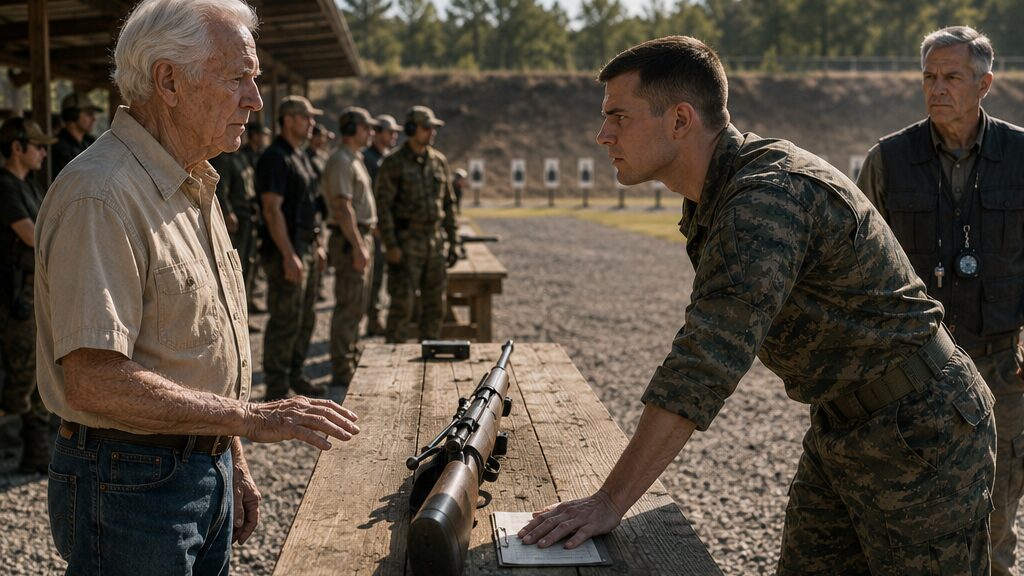
“Sir,” the young man said, “hands off the rifle for inspection.”
James set the pencil down.
The target downrange flickered again, and the sight drum caught a small flash of sun.
James kept his left thumb resting along the stock, light as a memory.
Chapter 2: Patrick Carter Keeps the Line Moving
Patrick Carter had been awake since four-thirty and behind schedule since six.
The first delay came from the armory clerk, who could not find the sign-out sheet for the borrowed rifles because someone had filed it under the charity’s name instead of the range’s. The second came from a volunteer who put the wrong color wristbands on the first relay. The third came when the local reporter asked if she could get “just a quick shot” of the safety briefing and then made everyone repeat the part about honoring service because her microphone had not been on.
By the time Patrick reached the firing line, his jaw had settled into the locked position Mark Sullivan called his “parade face.”
“Relax your shoulders,” Mark had told him earlier, standing under the shade canopy with a paper cup of coffee. “You look like you’re about to invade the parking lot.”
Patrick had rolled his shoulders once. “We’ve got civilians handling rifles, half the benches are charity guests, and the reporter keeps drifting behind the line.”
“That’s why we have instructors.”
“That’s why we need people listening the first time.”
Mark had studied him over the rim of the coffee cup. “Listening goes both directions.”
Patrick had not answered. It was the kind of thing senior men said when they already trusted themselves to be calm. Patrick trusted checklists. Checklists did not forget. Checklists did not get sentimental. Checklists did not let a seventy-something man with shaky hands drift through a safety procedure because everyone was afraid of hurting his feelings.
He respected veterans. That was part of why he hated events like this.
Respect, to Patrick, meant keeping the line safe. It meant not letting an old infantryman, a retired mechanic, a former clerk, or a man who had not fired in thirty years embarrass himself in front of people filming on phones. It meant stepping in early, clearly, and if necessary, sharply.
At Bench Four, a man in a Korean War Veteran cap tried to joke with the bolt open and his finger too near the trigger guard. Patrick corrected him. At Bench Five, a woman asked which way to place the magazine. Patrick showed her twice, then watched until she did it properly. At Bench Six, everything was clean.
Then he reached Bench Seven.
The old man there was not joking, not chatting, not looking around for help. That should have reassured Patrick. Instead, something about his stillness made Patrick slow down.
The man had white hair, a deeply lined face, and a beige shirt tucked neatly into jeans. His rifle case lay open beside him with the careful order of someone who did not like clutter. The rifle rested correctly downrange. The chamber flag was visible. His hands were not shaking.
But he had a pencil in reach, and the official range card had been moved.
Patrick saw the small mark before he saw what it meant.
“Sir, hands off the rifle for inspection.”
The old man removed his right hand at once. His left thumb stayed along the stock, not gripping, barely touching.
“Both hands, sir.”
The thumb lifted.
Patrick checked the chamber, the magazine well, the safety. Everything was fine. He glanced at the card. Bench Seven. One hundred yards. Three-round grouping. He noticed the handwritten pencil mark beside the printed distance.
“Did you write on the range card?”
“Yes.”
Patrick looked at him. “These cards are assigned by lane.”
“I know.”
“If there’s an issue, you call an instructor.”
The old man’s eyes were pale gray, steady but tired. “That’s what I’m doing.”
Patrick felt the line moving behind him without moving at all. The pressure had a sound: boots shifting, low voices waiting, the loudspeaker humming, the reporter’s camera clicking somewhere behind his left shoulder.
“What’s the issue?” Patrick asked.
The old man turned the card slightly with two fingers. “Sight setting doesn’t match this distance.”
Patrick looked at the rifle, then the card. The rear sight setting was not unusual for the lane setup they were using. The armory rifles had been checked that morning. He had checked them. Mark had signed off.
“It’s set for today’s course,” Patrick said.
“No,” the old man said, not loudly. “It’s set for the printed course. Not for this bench.”
Patrick stared at him for half a beat.
There it was. Confusion. Not wild confusion. Not the kind people spotted from across a room. The more dangerous kind, because it wore confidence and made people argue.
“This is Bench Seven,” Patrick said, tapping the card. “Your target is the seventh frame. One hundred yards.”
The old man looked downrange. “The marker says that.”
“The marker is correct.”
“It used to be.”
Patrick took a breath through his nose. He could feel himself losing time.
“Sir, I need you to step back from the bench.”
The old man did not move.
He did not become angry. That would have been easier. He only looked at Patrick as if weighing whether the next words were worth the cost of saying them.
“Son,” he said, “if you move this rifle to the demonstration lane later with that same card, somebody is going to trust the wrong number.”
Patrick’s face warmed.
He heard the word son more than the warning. He heard the waiting line. He heard the reporter laughing softly at something behind him. He heard Mark’s voice from the morning: Listening goes both directions.
But Mark was not the one standing in front of an old man who had marked up an official card and now seemed determined to rewrite the range procedure from memory.
“Do not call me son on the line,” Patrick said.
A few heads turned.
The old man’s expression did not change, but something closed behind his eyes. “All right.”
Patrick lowered his voice. “I’m responsible for this relay. If you have a concern, I’ll take it to the safety officer after qualification. Right now, you need to follow instructions.”
“I am following the one that matters.”
“Step back.”
Carol Miller appeared at the edge of Patrick’s vision, clipboard pressed to her chest. “Everything okay here?”
Patrick did not look away from the old man. “We’re fine.”
Carol gave the old man a worried smile. “James, do you need a minute?”
So his name was James.
James Bennett, according to the card.
James looked at Carol, then at the rifle, then at Patrick. “A minute won’t change the sight.”
Patrick felt the words land along the line. Not loud, but clear enough. Bench Eight’s shooter leaned back to look. A soldier at Bench Nine stopped adjusting his sling.
Patrick leaned closer, keeping his hands visible and his voice controlled. “Mr. Bennett, you are holding up a live-fire relay because you think a standard sight setting is wrong. You have not fired this course yet. You have not completed instructor inspection. You altered the range card without authorization. I am asking you one more time to step away from the rifle.”
James looked at the pencil mark.
For a second Patrick thought the old man might refuse outright. Instead, James placed both hands flat on the bench and pushed himself upright. It was not easy for him. Patrick saw the stiffness in one knee, the pause before his back straightened, the way he gathered balance without reaching for help.
That should have softened the moment.
Instead it confirmed Patrick’s decision.
James stepped back.
Carol touched his elbow. He allowed it for only a moment, then moved free.
Patrick took the range card and clipped it back to the board, leaving the pencil mark where it was. He considered replacing it, then decided against making a bigger scene.
“Bench Seven clear for inspection,” he called.
Mark Sullivan looked over from the center of the line. “Problem?”
“Handled,” Patrick said.
James heard that. Patrick knew he heard it.
The old man stood behind the bench now, hands at his sides, eyes still on the rifle. Not on Patrick. Not on Carol. On the rifle and the card, as if they were the only two honest things on the line.
The loudspeaker clicked again. “First relay, prepare to load on command.”
Patrick moved to Bench Eight, but he carried Bench Seven with him. The pencil mark stayed in his mind, irritating because it was small, because it was unauthorized, because it had interrupted the rhythm he had worked all morning to protect.
At Bench Ten, he looked back once.
James Bennett had not picked up the rifle.
He was looking downrange at the leaning distance marker, and his lips moved once, counting something Patrick could not hear.
Chapter 3: The Mark Nobody Wanted to Read
James had been corrected by men louder than Patrick Carter.
He had been corrected by sergeants with tobacco in their cheeks, by captains with maps folded wrong, by young lieutenants trying to keep fear out of their voices, by old colonels who knew exactly what they were doing and did it anyway. Correction did not trouble him. A man who could not be corrected had no business near a weapon.
Being dismissed was different.
Dismissal had a quiet shape. It did not always shout. Sometimes it wore a clean uniform and said sir while taking the decision out of your hands.
James stood behind Bench Seven and watched Patrick move down the line. The young instructor worked efficiently, no wasted steps, no lazy checks. He was not careless. That was what made the trouble harder. Careless men were simple. Patrick cared. He cared about order, timing, the line, the watching crowd, the rules printed on laminated sheets. He cared so much about the structure of safety that he had mistaken the structure for safety itself.
Carol remained beside James, close enough to help if he swayed, far enough to pretend she was not waiting for him to need it.
“James,” she said softly, “maybe we should let them sort it out.”
He looked at her.
She touched the clipboard with her thumb. “I don’t want this to become uncomfortable.”
“It already is.”
“I mean for you.”
He almost smiled. “That’s not the part I’m worried about.”
Downrange, the seventh target shifted in the wind. The frame sat where the old hundred-yard line had once been, or near enough to fool a printed card. But the bench angle had changed after the berm work. The demonstration lane, two stations down and slightly offset, used the new measurement. Most shooters would never notice. At close grouping with supervised fire, a sight mismatch might only mean embarrassment, a bad pattern, a joke about old eyes or rusty hands.
But later, with the demonstration rifle moved, with people standing proud and distracted, with everyone trusting the copied card, the wrong number could matter.
James could feel the old memory waiting behind the morning like heat behind a door.
He kept it closed.
The first relay loaded on command. Metal clicked in a broken rhythm. Patrick’s voice carried from the far end, clear and firm. Mark Sullivan stood near the center with a stopwatch and a whistle, scanning the line.
James did not load.
Patrick returned before the fire command, saw the empty magazine well, and stopped hard.
“Mr. Bennett.”
James rested his right hand on the edge of the bench. “I’m not firing it with that card.”
A silence opened around Bench Seven.
Patrick stepped closer, his shadow falling across the rifle. “You were instructed to prepare.”
“I heard you.”
“Then load.”
“No.”
The word was not loud. It did not need to be.
Patrick’s mouth tightened. “This is not optional.”
“It is for the man holding the rifle.”
Someone behind them drew in a breath. Carol whispered James’s name, not as a warning exactly, but as a plea.
Patrick leaned in, just as he had at the beginning, close enough that James could see the faint line where his helmet strap had pressed into his skin earlier. His voice dropped.
“You are creating a safety issue.”
James looked at the rifle, then at the paper card clipped beside it. “No. I’m refusing to ignore one.”
Patrick straightened and signaled with two fingers. Mark Sullivan came over from the centerline, boots grinding in the gravel. He was older than Patrick, broad through the chest, silver at the temples, with the settled face of a man used to being obeyed because he usually deserved it.
“What’s going on?”
Patrick kept his eyes forward. “Mr. Bennett refuses to load. He believes the sight setting is incorrect for the lane.”
Mark looked at James. “You believe that, or you know it?”
It was the first useful question anyone had asked.
“I know the card and the sight don’t agree,” James said. “I believe the bench marker is the reason.”
Mark held out his hand. Patrick unclipped the card and gave it to him. The pencil mark looked even smaller in Mark’s hand.
Mark read the printed line, then the handwritten note. His expression did not change.
“You familiar with this range, Mr. Bennett?”
“Yes.”
“Recently?”
“No.”
Patrick’s shoulders shifted, almost imperceptibly.
Mark heard it too. “How recently?”
James looked past them toward the berm. “Before the backstop was rebuilt. I came once after. Not to shoot.”
Mark glanced downrange. “The survey was redone.”
“The cards were,” James said. “The habit wasn’t.”
Patrick made a frustrated sound under his breath. “Sir, with respect, the armory signed off on these rifles this morning.”
James turned to him. “Armory signed off on the rifles. Not your card.”
Patrick’s eyes hardened again. The words had cut too close to pride, though James had not meant them to. Or perhaps he had meant them a little. He was old, not holy.
Mark studied the rear sight. He adjusted nothing. Then he looked at the target marker, the neighboring benches, and the demonstration lane beyond them. His gaze slowed for a fraction.
James saw the moment Mark noticed the angle.
Then Mark let it pass.
“We’re not changing the line during first relay,” Mark said. “Mr. Bennett, you may sit this relay out. We’ll inspect the setup during the break.”
Patrick accepted that as victory. Carol accepted it as peace. The watchers along the line accepted it as the strange old man being gently managed.
James accepted none of those things.
“What happens to the rifle after qualification?” he asked.
Mark looked back. “Demonstration rotation.”
“Same card?”
Patrick said, “That’s enough.”
James reached toward the clipboard.
Patrick moved fast, catching the edge of the board before James could lift it. “Do not touch the equipment after being told to step back.”
The line went very still.
That was the moment people would remember if they remembered it wrong. The young instructor leaning over the bench. The old man with one hand half-raised. The rifle between them. The paper card pinned under Patrick’s fingers. The implication that James’s hand, slow and weathered, was the danger.
James lowered his hand.
He felt heat rise in his face, not from embarrassment but from the effort of keeping his voice even. Anger came easier with age in some ways, because there was less time to waste pretending foolishness was wisdom. But anger near a firing line was a luxury.
So he did what he had taught hundreds of young soldiers to do when breath shortened and pride crowded the eye.
He looked at the nearest true thing.
The pencil.
It lay on the bench, attached by its string, the point dulled from his single mark.
James picked it up with two fingers.
Patrick’s hand twitched, but Mark raised his palm slightly, stopping him.
James did not reach for the rifle or the card. He drew on the bare edge of the bench, where dust from the morning had settled: one short line for the printed distance, one angled line for the actual lane, one small cross where the demonstration bench sat offset.
“This is not about whether I can shoot,” James said.
His voice carried farther than he intended. The range had gone quiet enough to give it room.
He tapped the first line. “That’s what the paper says.”
He tapped the second. “That’s where the bench points after the rebuild.”
He tapped the cross. “That’s where you’re going to move the rifle when the reporter asks for a clean demonstration.”
The reporter, hearing her role appear in the dust drawing, lowered her camera slightly.
Patrick stared at the marks. He wanted not to. James could see that. The young man wanted the situation to remain a discipline problem because discipline problems had procedures. Look at the marks, and it became something else.
Mark bent closer.
“Where did you learn to read a lane like that?” he asked.
James let the pencil hang from its string. “Same place I learned not to rush one.”
It was not a full answer. It was not meant to be.
Carol’s eyes moved from James to the drawing and back again. Her worry had changed shape. It was no longer only concern that an old man might be embarrassed. Now she looked as if she had found a closed door in someone she thought she knew.
Mark straightened. “First relay will proceed on the remaining benches. Bench Seven stands down.”
Patrick turned toward him. “Sir—”
“Bench Seven stands down,” Mark repeated.
James heard the compromise for what it was. Not belief. Not dismissal. A pause wrapped in authority.
The loudspeaker crackled again. Mark walked back toward the centerline. Patrick stayed a moment longer.
“You should have brought this up before the line went hot,” Patrick said.
James looked at the card still under the clip. “I did.”
Patrick’s face changed. Only slightly. Not apology. Not recognition. A hairline crack in certainty.
Then he took the rifle from Bench Seven, cleared it again though it was already clear, and placed it on the rack behind the line.
James watched the rifle leave the bench.
His hand felt suddenly empty.
Carol said, “James, come sit in the shade.”
He looked at the dust drawing on the bench. The two lines and the cross were already softening in the breeze.
Downrange, the whistle blew for the first relay.
The shots began without him.
Chapter 4: The Accident James Still Hears
The shade behind the range shed smelled of dust, gun oil, and the sweet chemical lemon of a cooler wiped down too recently.
James sat on a folding chair that sagged slightly under him. Carol had brought it without asking, and he had taken it because refusing a chair after standing too long was pride, not dignity. There was a difference. He had spent most of his life learning differences other men preferred to blur.
Beyond the shed, the first relay continued. Shots cracked in uneven groups, some steady, some rushed, some arriving after long pauses that told James more about the shooter than any target would. A nervous shooter held breath too long. A careless one fired quickly after the command as if the rifle might vanish. A trained one let the shot happen between heartbeats and did not chase it.
He listened despite himself.
Pamela found him after the second string.
She came around the corner with her arms folded tight, sunglasses pushed on top of her head, mouth already pressed into the line she had inherited from her mother. Behind her, the charity tents shone white in the sun, and people moved through patches of shade with paper cups and polite voices.
“I knew this was a bad idea,” she said.
James looked up. “Good morning to you too.”
“It was a good morning when you were in the kitchen.”
“I recall you disagreeing with me there as well.”
Pamela did not smile. She looked toward the firing line, where smoke drifted faintly above the benches. “Carol called me over.”
“Carol worries for a living.”
“Somebody has to.” Her eyes moved across his face, his hands, his knee. “Are you all right?”
“Yes.”
“That young man was in your face.”
“He was doing his job.”
“He was talking to you like you were a problem to manage.”
James looked down at his hands. A faint line of graphite dust darkened the side of his right index finger. He rubbed it with his thumb, but it only spread.
“I became one,” he said.
“No, Dad. You noticed something. That’s not the same thing.”
He looked at her then.
Pamela had not wanted him here, but she had heard him. That made the next words harder.
“You don’t know that.”
“I know you.”
“You know me at the house. With the pillbox and the squeaky porch step and the coffee pot I forget to turn off.”
Her face changed. “That was once.”
“Twice.”
“Fine. Twice.” She sat in the chair beside him, though she looked too angry to sit. “That doesn’t mean you’re wrong about everything else.”
A whistle blew from the line. The sound cut through the shade, clean and bright.
James’s fingers closed around the paper range card in his shirt pocket before he knew he had moved.
Pamela saw it.
“Dad?”
He let go of the card.
The shed wall in front of him wavered for a moment, not visibly, not enough for anyone else to see. The present held. Gravel, folding chair, Pamela’s worried face, distant voices. But beneath it another range waited, hotter and younger and full of men trying not to show how tired they were.
He had not been old then. Not even close. Old had been men with silver hair and slow steps. Men he had secretly thought of as finished.
The training range had been running late that day too.
James had been an instructor then, younger than Mark Sullivan was now, old enough to have authority and young enough to resent having it questioned. A new group had come through for qualification after weather delays. The light was failing. Everyone wanted the day done. A lieutenant had pressed them to move faster. An armorer had swapped two rifles between lanes after a feed issue. A card had followed the shooter instead of the weapon, or the weapon had followed the wrong card; later, in the statements, nobody agreed which.
James had seen the mismatch before the last drill.
He had said, “Hold the line.”
The lieutenant had said, “We’re within tolerance.”
A young private, trying to be quick, trying to be good, had trusted the command more than the quiet doubt in the instructor’s face.
The shot had not killed anyone. That was what the official report emphasized. No fatality. No permanent blindness. No negligence finding against James Bennett.
Reports were clean because they were written after blood was wiped away.
For years afterward James remembered smaller things: the way the private’s hands shook after; the white crease around the lieutenant’s mouth; the smell of burned powder trapped beneath summer humidity; the sight of a range card curled at one corner in the dirt, pencil marks smeared by a boot heel.
The whistle blew again in the present.
Pamela leaned closer. “You went somewhere.”
“No.”
“Dad.”
He looked toward the corner of the shed where sunlight cut a hard line across the gravel. “A long time ago, I let a man outrank a warning.”
Pamela said nothing.
James had never told her the whole of it. He had given the family version when she was young: a training accident, a bad day, nobody lost. Later, after her mother died, Pamela had asked once whether he still dreamed about the Army. He had told her old men dreamed about everything, which was true enough to pass for an answer.
“I thought you said it wasn’t your fault,” she said carefully.
“It wasn’t mine to carry officially.”
“That is not the same answer.”
“No.”
Another volley sounded. This one uneven. One shot too fast, two measured, one late.
James closed his eyes briefly. “When something is wrong on a line, you say so. If they wave you off, you say it again. If they get angry, you keep saying it until the rifle is safe or the line stops.”
“Then why are you sitting back here?”
The question landed harder because she did not sharpen it.
James looked down at his knee. “Because I’m tired.”
Pamela’s expression softened, and that was worse than anger. “Then come home.”
He shook his head once.
“Dad, listen to me. You already said something. They made their decision. You don’t have to stand there and be treated like—”
“Like what?”
Her mouth closed.
“Like an old man?” he asked.
“I didn’t say that.”
“No. You work around it better than they do.”
She looked away.
James regretted it as soon as the words left him. Pamela had carried more than he had asked and worried more than he had thanked her for. She called too often because he had once not answered. She checked the stove because he had once left coffee burning until the kitchen smelled bitter for hours. She watched his steps because the world did not soften just because he refused to.
But protection could become a smaller room.
He took the range card from his pocket and unfolded it. The pencil mark he had made at home was darker than the one on the official card, pressed by a hand that had taken its time. Pamela looked at it.
“What is that?”
“The part they don’t want to read.”
“Can you prove it?”
James almost said yes. Then he looked toward the firing line and corrected himself.
“I can explain it.”
“That may not be enough for them.”
“It doesn’t need to be enough for them. It needs to be enough before someone fires from the wrong setup.”
Pamela rubbed her forehead. “You hear how that sounds?”
“Old and stubborn?”
“Scared.”
He folded the card again.
That was the word he had not expected from her, and because it was true, he disliked it.
“I am,” he said.
Pamela’s face changed again. Not alarm. Recognition, maybe. She had seen him irritated, tired, proud, distracted, quiet. She had rarely seen him admit fear without putting a fence around it.
The firing stopped. Voices drifted up. The relay was changing.
James pushed himself forward in the chair.
Pamela reached out. “Wait.”
He paused, not because he needed her help, but because he understood that not taking her hand every time did not mean he should never take it.
She held his elbow while he stood. Only his elbow. Lightly.
When he was steady, she let go.
They walked together to the edge of the shed. From there James could see the range staff moving rifles from the first relay benches to the demonstration area. The local reporter had repositioned near the rope line, camera lifted. Carol stood beside Mark Sullivan, pointing at her clipboard, probably trying to keep the schedule alive.
Patrick Carter was at Bench Seven.
He lifted the same rifle James had refused to fire, checked it, and carried it down the line toward the demonstration bench.
James stopped walking.
Pamela followed his gaze. “Is that it?”
“Yes.”
“Maybe they’re checking it now.”
James watched Patrick set the rifle into a rack near the demonstration lane. The official card went with it, clipped neatly to the board.
The pencil mark was still there.
No one was looking at it.
James took one step forward, then another.
Pamela whispered, “Dad.”
He did not stop.
Chapter 5: The Rifle Changes Hands
Patrick hated that he kept looking at the mark.
He had moved the rifle from Bench Seven because Mark told him to keep the demonstration rotation ready and because moving equipment gave his hands something useful to do. The event had already lost time. The first relay had finished with no incidents except one shooter flinching hard enough to miss paper, which was unfortunate but not dangerous. People were smiling again. Carol Miller had convinced the reporter to film a short segment about veterans helping younger service members understand history. Mark had told Patrick to reset, drink water, and stop wearing every delay like a personal insult.
Patrick had drunk half a bottle and tasted nothing.
Now the rifle from Bench Seven rested in the demonstration rack, its muzzle downrange, chamber open, bright flag inserted. The card hung from the side clip.
Bench Seven. One hundred yards. Three-round grouping.
And one pencil mark.
Patrick stood over it with his arms folded.
The mark was not dramatic. That irritated him too. If an old man was going to stop a relay, draw in the dust, and make everyone stare, the evidence should at least look like evidence. It should be a bold correction, a number, an arrow, something official enough to respect.
Instead it was a small angled line beside the printed distance.
Mark Sullivan came up beside him. “Still thinking about it?”
“No.”
Mark made a low sound that could have been a laugh if he had been less tired. “That was almost convincing.”
Patrick looked toward the range shed. James Bennett was not in the chair anymore. His daughter stood near him, one hand hovering like she wanted to hold him back and knew better.
“He should have raised it at registration,” Patrick said.
“Maybe.”
“He shouldn’t have altered the card.”
“Probably not.”
“He definitely shouldn’t have refused instruction on the line.”
Mark looked at him. “You want me to keep agreeing until you feel better?”
Patrick exhaled sharply. “I want to know why you’re not more concerned that a participant challenged the procedure during live fire.”
“I am concerned.”
“You don’t sound concerned.”
“I’m concerned about the procedure too.”
Patrick looked at him.
Mark took the card from the clip and held it up, squinting against the light. “The old survey maps are in the office. I haven’t looked at them in years. After the rebuild, we adjusted target frames, not benches. Most lanes stayed close.”
“Close enough?”
Mark did not answer immediately.
A volunteer called from the canopy, asking where to put the sponsor banner. Carol waved her toward the fence. The reporter spoke into her microphone, smiling with the range behind her, careful to frame the flags and not the trash cans. The whole day kept trying to become a clean story.
Patrick looked at the demonstration bench. “We can swap rifles.”
“We can.”
“Then do it.”
Mark turned the card over, then back again. “That solves the wrong problem.”
“It removes the disputed rifle.”
“No. It hides the dispute.”
Patrick frowned. “Sir, with respect, we’ve got guests waiting, and if that rifle makes everyone nervous now—”
“Does it make everyone nervous, or does it make you nervous?”
Patrick’s jaw worked.
Mark clipped the card back. “I signed off on the setup. If there’s an issue, that’s on me. Not you.”
Patrick should have felt relieved. Instead he felt cornered. “I checked the rifles.”
“And did a good job. That doesn’t mean a card can’t be wrong.”
The word wrong sat between them.
Patrick looked again toward James. The old man had moved closer now, slow but steady, his daughter beside him. He was not grandstanding. He was not calling attention to himself. That made Patrick feel worse, though he could not have said why.
Carol approached with her clipboard tucked under one arm. “We’re ready for the demonstration in five minutes. The reporter wants a shot of the instructor explaining the lane first.”
Mark nodded. “We may need a minute.”
Carol’s smile tightened. “Mark.”
“I said may.”
Her eyes moved to the rifle card. “Is this still about Bench Seven?”
Patrick said, “It’s handled.”
At the same time, Mark said, “Not yet.”
Carol looked between them. The noise of the crowd filled the pause.
“Can we not do this in front of everyone?” she asked quietly. “The whole purpose of today is to honor these men and women. I don’t want one misunderstanding to become the thing people remember.”
Patrick felt a sting of agreement. That was what he had been trying to prevent all morning. One old man confused, one instructor forced to correct him, one clip online stripped of context. People loved the shape of disrespect more than the burden of responsibility.
Then James Bennett’s voice came from behind them.
“Misunderstandings become dangerous when everyone is afraid to look at them.”
Patrick turned.
James had stopped just outside the rope line. Pamela stood a half step behind him. She looked angry now, but not at James. At all of them.
Carol lowered her voice. “James, please. We’re checking.”
James looked at Mark. “Are you?”
Mark did not bristle. That was one reason people trusted him. “I’m about to.”
“Before or after you put a shooter behind it?”
Patrick stepped forward. “Mr. Bennett, you need to stay behind the rope.”
“I am behind it.”
“You need to let range staff work.”
James looked at him for a long moment. “That is what I’m trying to do.”
Patrick felt the heat rise again. He hated being spoken to as if he were missing something obvious. He hated more that maybe he was.
Mark raised a hand before either of them could continue. “Mr. Bennett, explain it once. Briefly.”
Carol’s eyes widened. “Mark, the schedule—”
“The schedule can survive two minutes.”
James came no farther. He pointed, not at the rifle, but at the card.
“That printed distance belongs to Bench Seven’s old line. The sight setting is close for a straight hundred from the original post. This demonstration bench sits offset after the berm rebuild. If you use that card and trust the same hold, you won’t send the group where your instructor says it will go.”
Patrick glanced at the target frames. “It’s a paper demonstration, not a tactical drill.”
James nodded once. “Then it will embarrass you.”
Patrick almost answered.
James continued, softer. “Unless someone compensates without saying so. Then the next person trusts the wrong lesson.”
That stopped Patrick more effectively than accusation would have.
Mark looked at him. “Get the tape.”
Patrick hesitated.
“The survey tape,” Mark said.
Patrick went.
The tape was in the range shed, hanging from a nail beside spare flags and a box of ear protection still in plastic. He took it down too quickly, banging the metal reel against the wall. On his way back, he passed two young soldiers whispering near the water cooler. They stopped when they saw him.
Good, he thought, then immediately disliked himself for it.
When he returned, Mark had unclipped the card and laid it on the demonstration bench. James remained behind the rope. He had not moved closer, though no one was physically stopping him.
Mark handed one end of the tape to Patrick. “From the bench line.”
Patrick pulled the tape down the side marker while Mark sighted the angle. It was awkward with people watching. The reporter lowered her camera but did not stop recording. Carol looked as if she wanted to stand in front of the lens.
“Distance is still inside range tolerance,” Patrick said when the tape settled.
James did not answer.
Mark crouched, checked the angle toward the target frame, then looked back at the old card. His face gave away nothing, but his silence changed.
Patrick saw it.
“What?” he asked.
Mark stood. “The distance isn’t the only issue.”
He took the rifle from the rack, verified it clear, and set it on the demonstration bench. Then he looked through the sight line without shouldering fully.
Patrick knew that look. It was the look of a man trying not to become certain too quickly.
Mark stepped back. “The offset changes the sight picture more than the card accounts for.”
Carol whispered, “Is it unsafe?”
“Not if we correct it.”
Patrick heard the word if.
James looked tired now. Not triumphant. Not even relieved. Only tired.
Patrick picked up the card again. “Why didn’t you just say offset?”
James’s mouth moved slightly, almost a smile but not quite. “I drew it.”
In dust, Patrick thought. On the bench I took away from him.
The loudspeaker popped. A volunteer’s voice announced that the demonstration would begin shortly. People started drifting toward the rope line. The reporter lifted her camera again.
Carol leaned toward Mark. “We need a decision.”
Mark looked at Patrick. “We stop and re-brief.”
Patrick’s first instinct was to think of the schedule, the guests, the camera, the way authority looked when it corrected itself in public. Then he looked at James Bennett’s left hand. The thumb rested along the seam of his jeans, straight and controlled, not gripping anything.
A man holding himself still because everyone else was rushing.
Patrick swallowed.
“I’ll do it,” he said.
Mark watched him. “You sure?”
“No.” Patrick took the card and the pencil from the bench. “But I’ll do it.”
He walked toward the loudspeaker before he could change his mind.
James’s voice stopped him.
“Don’t make it about me.”
Patrick turned.
James stood with the sun on his white hair and the rope line between them. “Make it about the card.”
Patrick looked at the small pencil mark again.
For the first time all morning, he understood that the old man was offering him a way out that did not require pretending.
He nodded once and lifted the microphone.
“Attention on the line,” he said, his voice carrying across the gravel. “We’re pausing the demonstration for a range-card correction.”
The crowd quieted.
Patrick looked down at the card in his hand, and the little mark no longer seemed small.
Chapter 6: Before the Whistle Blows
The pause changed the range more than a shout would have.
People did not move much. They only turned their heads, shifted their weight, looked from Patrick to Mark, from Mark to the demonstration rifle, from the rifle to James Bennett standing behind the rope. A few faces held curiosity. A few held irritation. Most held the uneasy patience of people who had just been told that a thing they trusted needed checking.
Patrick kept the microphone in his hand and wished it were anything else.
Mark stood beside the demonstration bench with the rifle open and clear. Carol had stopped trying to smile. The reporter kept her camera trained on the scene, but she had lowered it enough that the red recording light no longer felt like an eye pressed to Patrick’s throat.
Patrick looked at James.
The old man did not nod encouragement. He did not rescue him. He only waited.
That waiting did something Patrick had not expected. It gave him room to choose.
“We have a correction to make before the demonstration,” Patrick said into the microphone. “The rifle is clear. The line remains cold. No one approaches the benches until instructed.”
The old phrases steadied him. Clear. Cold. Instructed. Words built for order. He lowered the microphone.
Mark spoke quietly. “Bring him in.”
Patrick knew who he meant.
He turned toward the rope. “Mr. Bennett.”
James looked at the rope as if it were a rule he had no intention of violating without being invited.
Patrick lifted the clip. “Please step through.”
The word please did not erase the morning, but it changed the air around it.
Pamela touched James’s arm. He gave her a brief look, then stepped through the opening. His movement was slow enough for people to notice and controlled enough to make pity feel inappropriate. He crossed the gravel to the demonstration bench and stopped with both hands visible.
Patrick held out the card.
James did not take it at first. “You want me to explain it to you or to them?”
The question carried no insult. That made it worse.
“To me,” Patrick said. “Then I’ll explain it to them.”
James accepted the card.
Up close, Patrick could see the tremor in the old man’s fingers. Not large. Not constant. It came when James held the card unsupported, a small vibration under the paper. Patrick saw it and felt the last of his certainty try to rebuild itself around that tremor.
Then James set the card flat on the bench, placed two fingers on the corner to hold it still, and the tremor disappeared.
“Don’t read hands from the air,” James said without looking up. “Read what they do when they touch the work.”
Patrick said nothing.
James pointed to the printed distance. “This number is not foolish. It is just incomplete.”
Mark leaned in from the other side. Carol stood a few steps back, clipboard held against her chest. Pamela remained near the rope, arms folded, eyes fixed on her father.
James took the pencil. On the card, beside his first small angled mark, he drew a second line. Cleaner. Slower. It showed the bench offset in relation to the target frame. Then he marked the corrected sight reference beneath it.
“You don’t need drama here,” he said. “You need a note that travels with the rifle. If this card stays with Bench Seven, it says one thing. If it moves with the rifle to the demonstration bench, it needs this.”
Patrick watched the pencil move.
It was not speed. It was economy. James made no unnecessary line. The graphite darkened only where it needed to.
Mark checked the sight drum against the corrected note. “That’s not the setting we had listed.”
“No.”
“Armory wouldn’t catch that.”
“No.”
Patrick heard the shape of his own earlier argument and felt it turn in his stomach.
James looked at him then. “Armory checked the rifle. You checked the rifle. The card is the traveler. That’s where the mistake learned to walk.”
The words were quiet enough that only the nearest people heard them, but Patrick knew he would remember them longer than anything said through the microphone.
Mark took the card, studied it, then handed it to Patrick. “Make the correction.”
Patrick adjusted the sight under Mark’s supervision. He had done the motion hundreds of times, but this time he felt each click as if everyone could hear his pride moving with it. One click. Pause. Another. Confirm. Do not rush. Do not cover embarrassment with speed.
James watched without touching the rifle.
When Patrick finished, Mark looked through the sight line again. He took his time. Then he straightened.
“That’s the correction.”
The crowd could not hear him, but they saw his face. A murmur traveled along the rope.
Carol exhaled softly. “All right. We can tell them it was a routine adjustment.”
James looked at her.
She flushed. “I mean—so it doesn’t become a bigger thing.”
“It is a routine adjustment,” James said. “After someone reads the routine.”
Carol lowered her clipboard.
Patrick took the microphone again. His palm had begun to sweat around it. He could say almost anything now. He could smooth it over. He could protect the event, Mark, himself. He could say the range staff had identified a minor card issue. No lie exactly. No old man in the center. No young instructor corrected in front of the people he had been trying to command.
James had given him that path.
Don’t make it about me. Make it about the card.
Patrick looked at the card. Two pencil marks now. One ignored. One accepted.
He lifted the microphone.
“Attention on the line. The demonstration will resume after a correction to the range card and sight setting. The rifle was safe and remains safe. The issue was not the weapon itself. It was a mismatch between the card assigned to the firing point and the sight reference being carried into the demonstration lane.”
A few people shifted, listening harder.
Patrick looked at James once, then away.
“Mr. Bennett noticed the mismatch before the first relay and brought it to my attention. I did not slow down enough to verify it at the time. That was my error.”
The range went very quiet.
James’s face did not change, but Pamela’s did. Her folded arms loosened.
Patrick continued before his courage thinned. “The correction is now marked on the card. Going forward, instructors will verify card, bench, and sight reference before moving any rifle between lanes.”
He lowered the microphone.
No applause came. Patrick was grateful for that. Applause would have made it smaller somehow, turned the moment into a performance. Instead there was the sound of wind moving along the target frames and someone under the tent quietly setting down a paper cup.
Mark nodded once. “Good.”
Carol looked at James. “Thank you.”
James shook his head. “Thank him if he uses it next time.”
Patrick set the microphone down.
The demonstration shooter, a younger soldier who had been waiting near the bench, stepped forward only after Mark signaled. Patrick walked him through the corrected card, repeating the steps James had shown him. He heard his own voice steadying as he spoke. Not because he was pretending nothing had happened, but because the right procedure had finally caught up with the right reason.
“Card first,” Patrick said. “Bench second. Sight third. If one moves, check all three.”
The soldier nodded.
Patrick glanced at James. “Is that right?”
Everyone close enough heard the question.
James looked at the card, then at the sight, then downrange. He took a breath, not deep, just enough.
“That’ll hold,” he said.
Mark stepped back. “Line remains cold until command.”
The demonstration proceeded without hurry.
When the shooter finally fired, the shot cracked clean across the range. The target frame jumped faintly. Through the spotting scope, Mark checked the paper and gave a small nod.
Patrick did not ask whether it was a perfect shot. He found he did not care.
James had not been trying to win a marksmanship contest. He had been trying to stop a bad habit from becoming an accident.
After the demonstration, as people began talking again and the event tried to return to itself, Patrick found James standing beside the bench, looking at the corrected card still clipped to the board.
“I owe you an apology,” Patrick said.
James did not look at him immediately. “Probably.”
Patrick accepted that. “I thought you were confused.”
“I know.”
“I thought your hesitation was the problem.”
James touched the edge of the card with one finger. “Sometimes it is.”
Patrick looked at him.
James’s eyes stayed on the mark. “I’m slower than I was. That’s true. Some mornings, my hands don’t tell me the whole truth until I give them a minute. Some days, my daughter sees more clearly than I do.” He paused. “That doesn’t mean I’m wrong every time I pause.”
Patrick felt the words settle in places defensiveness had occupied all morning.
“No, sir,” he said. “It doesn’t.”
Mark called Patrick’s name from the centerline, needing him for the next reset.
Patrick turned to go, then stopped. “Mr. Bennett?”
James looked over.
“Would you be willing to review the card procedure with me before the last relay?”
It was not a grand offer. Not enough to repair everything. But it was the first question Patrick had asked him all day without already deciding the answer.
James studied him for a long moment.
Then he handed him the pencil.
“Start by sharpening this,” he said.
Chapter 7: Bench Seven Stays Open
By late afternoon the range had lost its sharp edges.
The morning glare had softened into a low gold that caught on brass casings in the gravel and made them look less like debris than small things left behind on purpose. The tents sagged a little. The coffee was gone. A volunteer folded chairs near the registration table while another gathered empty water bottles into a clear trash bag that clicked and crackled with each step.
The last relay had finished without incident.
That was how Mark Sullivan said it when he closed the logbook: without incident. James heard the phrase from where he stood near Bench Seven and thought there were days when the best ending was a plain one. No ambulance. No report. No young man pretending a mistake had never almost happened. No old man carrying home another silence because speaking had cost too much.
The rifle had been cleared, checked, and returned to its case. Not James’s case. The armory case. He watched Patrick do it, slow and exact. Chamber open. Flag visible. Magazine removed. Sight returned only after the corrected card had been copied. Patrick did not rush the process even after Mark told him the truck was waiting.
James appreciated that more than an apology.
Pamela stood at the end of the bench, holding his old canvas bag with both hands. She had offered to carry the rifle case too. He had said no. She had not argued, but she had not walked away either.
Carol came over first.
Her clipboard was tucked under her arm now, the papers curled at the corners from sun and handling. Without the busy motion of the event around her, she looked older than she had that morning. Not old like James, but old enough to know that good intentions could still bruise.
“James,” she said. “I’m glad you stayed.”
He looked at the empty firing line. “So am I.”
“I owe you more than a thank-you.”
“You gave me a chair.”
Her mouth tightened into something like a smile. “That was before I understood.”
He did not ask what she understood. People often explained themselves when a simple change in conduct would have done better. Carol seemed to know that, because she looked down at the card clipped to Bench Seven and touched the edge of it.
Patrick had made a clean copy after the correction. The original still bore James’s two pencil marks: the first faint and nearly ignored, the second darker, drawn when someone had finally asked him to explain. Mark had told the armory clerk to attach the copy to the range book. Patrick had left the original on the bench for James.
“I thought protecting you meant keeping the scene small,” Carol said.
James ran his thumb along the bench edge, feeling old splinters worn smooth by years of shooters leaning into their work. “Sometimes small is just where people hide a thing they don’t want to see.”
She nodded slowly. “I’ll remember that.”
He looked at her then. “Put it in the procedure instead.”
Carol gave one soft laugh, surprised and humbled by it. “Yes. I can do that.”
Mark Sullivan approached as Carol stepped away. He carried the range log under one arm and the authority of a man who had already decided not to defend himself.
“Mr. Bennett.”
“Mark.”
Mark glanced at the corrected card. “I pulled the old survey sheet.”
James waited.
“You were right about the offset.”
“I know.”
Mark accepted that without flinching. “I should have checked when you first raised it.”
“Yes.”
The honesty in that single word made Mark’s face shift. Not anger. Not shame exactly. Something more useful than either.
“I’ve run this range for nine years,” Mark said. “Most days that helps. Today it got in the way.”
James looked toward the berm. The leaning marker had gone quiet in the falling light. “Habit is a good servant.”
“And a poor safety officer?”
James almost smiled. “Something like that.”
Mark placed the old survey copy, folded, beside the corrected card. “I’m keeping Bench Seven open next month. We’re going to review the lane cards before the event. If you’re willing to look them over, I’d value it.”
Pamela’s hand tightened around the canvas bag.
James heard the offer under the words. Not charity. Not ceremony. Work.
“I don’t drive much after noon,” James said.
“We can schedule morning.”
“My knee doesn’t like standing long.”
“We have chairs.”
James gave him a dry look.
Mark’s face warmed. “Not like that.”
James let him sit in the discomfort a moment, not cruelly, only long enough for the difference to matter.
“I’ll look,” James said. “I won’t run your range for you.”
“I’m not asking you to.”
“Good.”
Mark nodded once. “Thank you.”
After he left, Pamela came closer.
“You’re really going to come back?”
“If they send the cards.”
“That’s not what I asked.”
James picked up the corrected card. The graphite had smudged slightly where his hand had passed over it. He thought about folding it into his pocket, keeping it as proof of something. Then he thought better of it and set it back under the clip.
“Yes,” he said. “I’m going to come back.”
Pamela looked at the bench, then the empty rifle rest, then him. “I was scared this morning.”
“I know.”
“I still am, a little.”
“I know that too.”
Her eyes shone, though she would have disliked anyone pointing it out. “When I worry about you, I’m not trying to make you smaller.”
James looked at his daughter, really looked at her, past the folded arms and tight mouth and practiced readiness to catch what might fall. Pamela had been a child when he came home from service with habits she did not understand. She had learned him by edges: the way he sat facing doors, the way a dropped pan could stop him mid-sentence, the way he never wasted light in a hallway. Later, she had learned the new edges age gave him: the missed call, the stiff step, the morning he could not remember where he had put the car keys and pretended he had not been frightened.
She had been guarding him from the world.
Sometimes, he had let her because he was tired.
“I know,” he said again. “But sometimes you have to ask before you carry what’s mine.”
Pamela swallowed. “Fair.”
“Not everything. Some things.” He nodded toward the canvas bag. “That, for instance.”
She looked down, then laughed once through her nose. “You want the bag?”
“I want you to hand it to me before I ask twice.”
She gave it over.
The bag was not heavy, but when he took it, the weight pulled at his shoulder. Pamela noticed. She noticed everything. This time she did not reach for it.
Patrick came last.
He had removed his cap, and his close-cropped hair was flattened with sweat. Without the cap and microphone and constant motion, he looked younger. Still controlled, but less certain that control was the same thing as strength.
He stopped on the other side of Bench Seven. For a few seconds he said nothing.
James waited. He had done enough helping men avoid their own apologies for one day.
“Mr. Bennett,” Patrick said, “I’m sorry.”
James looked at the corrected card, then back at him. “For what?”
Patrick’s brow tightened slightly, not with irritation but effort. “For assuming you were confused. For putting my hand on that card like you were the risk. For hearing your warning as a challenge to my authority instead of a concern for the line.”
James gave no sign of approval. “Anything else?”
Patrick looked toward the demonstration bench. “For making you step back before I understood what you were looking at.”
“That one matters.”
“I know.”
“No,” James said quietly. “You know it now. Remember it later.”
Patrick absorbed that.
The range had grown almost quiet around them. A few people remained near the tents. The reporter was packing her camera. Mark stood by the office, speaking with the armory clerk. Carol labeled a folder with a black marker.
Patrick reached into his pocket and took out the pencil from Bench Seven. It had been sharpened. Not to a perfect point. To a useful one.
“I replaced the string,” he said. “The old one was frayed.”
James took the pencil. The new string was tied with a square knot. A little clumsy. Secure enough.
“My first knot was worse,” James said.
Patrick let out a breath that was almost a laugh.
Then he grew serious again. “I joined range staff because I didn’t want to be the guy who missed something.”
“Nobody wants to be.”
“I thought if I stayed strict enough, nobody could.”
James rolled the pencil between his fingers. “Strict catches some mistakes. It hides others.”
Patrick nodded.
James placed the pencil back beside the card. “Next month, when a shooter pauses, what will you ask?”
Patrick looked at the bench as if the answer had been written there. “What are you seeing?”
James nodded once. “Start there.”
It was not forgiveness exactly. Forgiveness was too large a word for one afternoon, too easy to offer where habit had not yet changed. But it was a door left open.
Patrick seemed to understand. “Would you come early next month?” he asked. “Before the line opens. Not for the charity program. For us. I’d like you to walk me through the old markers.”
Pamela looked at James.
James felt the day in his knee, his back, his hands. He felt the old accident quieter than it had been that morning, not gone, never gone, but no longer pushing against his ribs with the same force. He looked down the row of benches, each one holding marks from men and women who had leaned there, learned there, missed there, corrected there.
“I’ll come,” he said. “But I’m not doing your thinking for you.”
Patrick’s mouth curved, small and real. “No, sir.”
“And don’t call me sir every time you feel guilty.”
“Yes—” Patrick stopped himself.
James raised an eyebrow.
Patrick looked away, embarrassed. “Mr. Bennett.”
“That’ll do.”
The sun had dropped low enough that Bench Seven lay half in shadow. James reached for the rifle case. Pamela shifted, then stilled. Patrick noticed and moved as if to help, then stopped too.
James lifted the case.
It was heavier than it had been in the morning.
He did not pretend otherwise. He adjusted his grip, gave his knee a moment, and started toward the parking area. After three steps, Pamela came alongside him.
“Can I take the bag?” she asked.
He looked at her.
She lifted one hand. “Asking.”
He handed it to her.
They walked slowly across the gravel. Behind them, Patrick remained at Bench Seven. James heard the faint scrape of the clipboard clip being lifted, the paper adjusted, the pencil set straight so it would not roll.
At the edge of the lot, James stopped and looked back.
Patrick was reading the card again. Not glancing. Reading. Mark stood beside him now, and Carol too. The three of them bent over the small pencil marks as the last light touched the bench.
Pamela followed his gaze. “You okay?”
James thought about the question. His knee hurt. His hands were tired. He had been angry, embarrassed, afraid, useful, and understood all in the same day, which was too much weather for one old body.
“No,” he said.
Pamela turned to him.
He gave her the rifle case handle for a moment while he changed hands. Then he took it back.
“But I’m all right.”
She smiled a little. “That sounds like one of your Army answers.”
“It was a good answer before the Army borrowed it.”
They reached the car. Pamela opened the trunk, and James laid the case inside himself. He took his time fitting it flat. No hurry. No performance. When he closed the trunk, the sound was solid and final.
From the range, a whistle blew once as Mark locked the line down for the day.
James did not flinch.
He stood beside the car and listened until the echo faded into evening. Then he looked once more toward Bench Seven, where the corrected card remained clipped for whoever came next.
“Next time,” he said, not loudly, not to Pamela exactly, “ask what the old man is looking at before you decide he can’t see.”
Pamela did not answer.
She only opened the passenger door and waited, one hand resting on the roof, giving him room to get in by himself and staying close enough to be there if he asked.
James Bennett took the time he needed.
Then he sat down, closed the door, and carried the quiet home.
The story has ended.