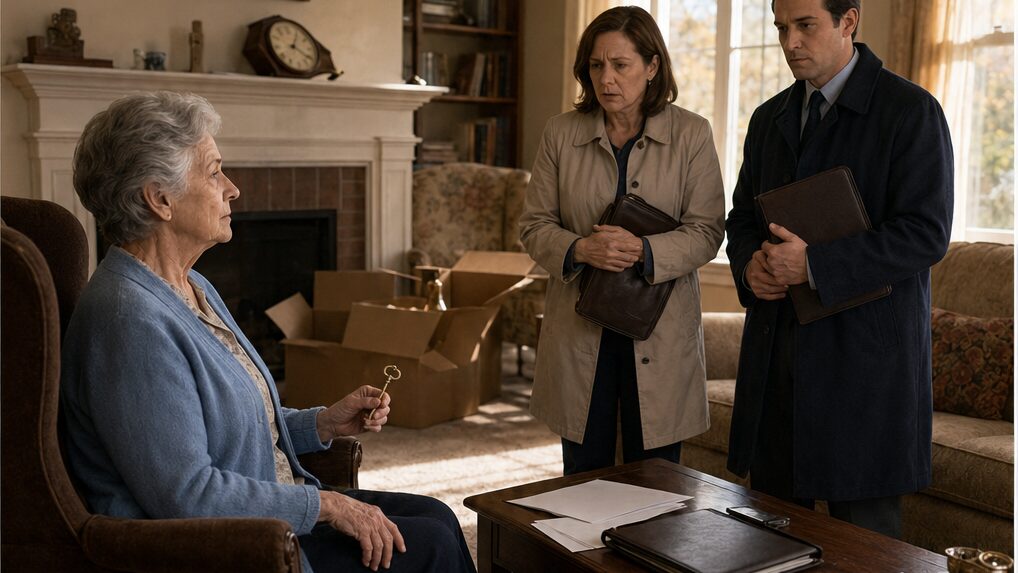
When Nancy’s Key No Longer Opened Her Own Front Door, Her Children Called It Care
Chapter 1: The Key That Would Not Turn
Nancy Bennett always slowed down before turning into her driveway.
It was not because the curve was sharp or because the maple roots had lifted the edge of the pavement, though both were true. She slowed because the house looked different at that hour, just after sunset, when the windows warmed before the sky went fully dark. The porch light came on by timer at six. The hall light glowed beyond the narrow glass beside the door. From the street, it looked as if someone inside had remembered her.
For forty-six years, that had been the point.
She parked in the driveway instead of the garage because the garage door had been sticking again, and she did not feel like wrestling with it in the cold. The November air had a damp edge. Leaves were pasted along the walkway, and the handrail felt slick beneath her palm as she climbed the two porch steps.
Her left knee complained. She ignored it.
The brass key was already in her hand. Not the newer copy with the square head her daughter had given her, but the old one, the original one with the worn notch at the top and a dull shine where her thumb had rested for decades. Her husband had once joked that she could find that key by feel in a coal mine.
“Because it knows me,” she had told him.
Now she stood in front of the blue front door, breathing out a little cloud, and guided the key toward the lock.
It stopped halfway.
Nancy frowned. She pulled it back and tried again, slower this time. The key slid in a fraction farther, then caught against something hard and unfamiliar. She jiggled it gently. Nothing.
For a moment she simply stared at her own hand.
The lock had always had a little give. In winter, it stuck if the door swelled. In summer, it needed a lift from the knob. She knew every mood of that door. She knew how much shoulder to give it when the frame shifted and how to turn the key just before the click. This was not that.
This was a different lock.
Nancy leaned closer. The porch light showed a clean silver circle where the old brass deadbolt had been. New screws. New plate. No scratches around the edge. Whoever had installed it had wiped the dust away afterward.
Her first thought was that she had come to the wrong house.
It was foolish, but it came anyway. She stepped back and looked at the porch chair with the faded green cushion, the clay pot where she had let the geraniums go too long after the first frost, the crack in the bottom step shaped like a crooked river. Her house. Her door. Her porch.
Her key did not fit.
A car went by slowly, its headlights cutting over the yard and across the front windows. Nancy held herself still until it passed. She did not want whoever was driving to see an old woman standing confused at her own door.
She tried the key again.
This time she used both hands, one steadying the knob, one turning the brass head with care. The key would not enter fully. It would not even pretend.
A tightness gathered beneath her ribs. She looked over her shoulder toward the neighbor’s house. Michelle Carter’s kitchen light was on, curtains drawn. Across the street, a television flickered blue through blinds. Ordinary houses. Ordinary evening. Somewhere a dog barked once and stopped.
Nancy pressed the bell.
Inside the house, faint and distant, the chime sounded.
She waited.
The hallway light stayed on. No footsteps came. No shadow moved behind the glass. She rang again, longer. The bell made its bright little song, the same one her husband had installed because the old buzzer sounded, he said, like a sick goat.
No one answered.
Nancy’s fingers had gone cold around the key. She slipped it into the pocket of her gray coat, then took it out again, as if the key might have changed while hidden. Her breathing sounded too loud under the porch roof.
Kimberly had been at the house that morning. Nancy remembered that much. Her daughter had called at nine and said she was coming by “to check a few things.” Nancy had been on her way to the pharmacy and then to the church basement to help fold donated sweaters. Kimberly had sounded clipped, busy, the way she did when she was driving.
“Don’t start on the gutters,” Nancy had told her. “I already called someone.”
“I’m not starting anything, Mom. I just want to look.”
James had sent a text two days earlier asking about the water heater. Not hello, not how are you, just, Did you ever get that water heater estimate?
Nancy had not answered right away. She disliked answering questions that were not really questions.
Now she looked at the new silver lock and felt the day rearrange itself behind her.
Her children had keys.
They had keys because she had given them keys, not because she was helpless, not because the house had somehow become common property by virtue of her age. Kimberly had one with a purple rubber cover. James had one on a ring with his truck key and a bottle opener from a brewery. They had used them to bring soup, to leave tax papers, to check the basement after a storm.
They had not been given permission to change the lock.
Nancy stepped away from the door. The porch boards creaked beneath her. She walked to the front window and cupped a hand around her eyes. The living room was dim, lit only by the lamp near the sofa. At first she saw nothing unusual. Then she noticed the corner by the fireplace.
The small table was gone.
Her husband’s reading chair had been turned at an angle, facing the room instead of the window. A stack of flattened cardboard leaned against the wall where the table had stood.
Nancy let her hand fall from the glass.
A strange embarrassment rose in her, hot and childish. Not fear. Not yet. Embarrassment, because the house had seen something she had not. Strangers or family had moved through her rooms while she was out folding sweaters. Hands had lifted things. Shoes had stepped over thresholds. Someone had decided the front door needed a lock she could not open.
Her phone was in the outside pocket of her purse. She pulled it out, nearly dropping it because her fingers were stiff.
There were three missed calls from Kimberly.
One voicemail from James.
A text from Kimberly at 5:18 p.m.
Mom, don’t panic when you get home. We had to make a safety decision. Call me before you go inside.
Nancy read it twice.
The words blurred, then sharpened again. Don’t panic. Safety decision. Before you go inside.
She stood on the porch with her key in one hand and her phone in the other. The hall light glowed through the glass as if the house were awake and refusing to speak.
She tapped Kimberly’s name.
The call rang four times and went to voicemail.
Nancy did not leave a message.
She called James.
He answered on the second ring. “Mom?”
His voice carried noise behind it—traffic, maybe, or a television.
“James,” Nancy said, and was proud of how level her voice sounded. “Why doesn’t my key open my door?”
Silence. Not long, but enough.
“Where are you?” he asked.
“On my porch.”
“You shouldn’t be standing out there. Did Kim not talk to you?”
“I’m asking you a question.”
“Mom, we had the locksmith come. It’s temporary.”
“Temporary locks still open with keys.”
He sighed, and in that sigh Nancy heard the boy who used to deny eating cookies with chocolate on his chin and the man who now thought sighing could make her unreasonable.
“We were going to bring you a new key tonight.”
“You changed the lock on my house while I was gone.”
“We had to. The old one was loose. Anybody could’ve pushed that door in.”
“No one has pushed that door in for forty-six years.”
“That’s not the point.”
“It is the point if I’m standing outside it.”
A pause. Then James lowered his voice. “Mom, please don’t make this harder than it needs to be.”
There it was. The sentence that had been hiding inside all the others for months.
Nancy looked again through the window at the cardboard by the fireplace.
“What else did you do today?” she asked.
“We’ll talk when I get there.”
“What else did you do?”
“Kim took care of some organizing. Christopher needed a few pictures, just preliminary ones.”
Nancy did not move.
“Christopher who?”
“The realtor, Mom. We told you he might come by and give an opinion.”
“You told me you wanted an estimate on repairs.”
“It’s all connected.”
The porch seemed to tilt slightly beneath her. Nancy lowered herself carefully into the green-cushioned chair. The old cane rocker gave a soft complaint. Her thumb rested against the brass key until its edge pressed a mark into her skin.
“My house is not connected to anything I have not agreed to,” she said.
“Mom—”
“No.”
“Listen, it’s getting cold. Sit in your car. Kimberly’s on her way.”
Nancy ended the call.
For a while she sat very still, looking at the door. She could see, now, the faint outline where the old deadbolt had been. A ghost circle around the new metal.
Her husband used to leave the hallway light on when she worked late at the school office. Even after he retired, even after the children moved out, even after the neighborhood changed and people installed cameras and motion sensors, he kept that light burning.
“Not because you need it,” he had said once when she teased him. “Because you should never have to come home to a dark house.”
After he died, Nancy put the lamp on a timer and told no one why.
The hallway light still burned.
But the key did not turn.
Her phone buzzed in her lap. Not a call this time. An email notification, sent to the address she barely used except for coupons and church schedules.
Subject line: Your Home Preview Link from Christopher Reed.
Nancy opened it because her hands already knew what her mind did not want.
The first picture loaded slowly, line by line. Her living room appeared on the screen, brighter than it looked through the window, the colors sharpened, the old rug cropped out of frame. The fireplace mantel had been cleared. The afghan she kept on the sofa was gone. Her husband’s reading chair had been angled like furniture in a showroom.
Below the image were words in clean black type.
Potential listing preview. Three-bedroom family home in established neighborhood.
Nancy looked from the glowing phone to the front door.
Inside the house, the hallway light burned as if nothing had happened.
Chapter 2: The Listing Photo in Her Hand
Nancy sat in her car with the engine off and the phone bright in her lap.
She had not gone there for warmth. She had gone because James had told her to, and she had needed the small satisfaction of deciding for herself whether to follow the instruction. The car smelled faintly of peppermint from the tin in the cup holder and of the wool coat she had worn through last winter. The windshield reflected the porch light back at her, turning the house into a layered image: blue door, silver lock, her own face pale in the glass.
She enlarged the listing preview with two fingers.
The photograph showed her living room from the corner near the bookcase. Whoever took it had stood where the Christmas tree used to go, before she stopped putting up the big one. The room looked wider than it was. The lamp glow had been corrected into a honey color. The fireplace bricks appeared cleaner than they were. The flattened boxes were not visible.
Nancy swiped.
Kitchen.
Her kitchen table had been cleared except for the blue bowl in the center. The blue bowl had held cough drops, stamps, rubber bands, and one button from a coat nobody owned anymore. In the photo it looked intentional, decorative, almost expensive.
She swiped again.
Hallway.
Her breath caught.
The photographer had taken the picture from the front door, looking down the hall toward the closed bedroom at the end. The hallway light was on. The runner rug had been straightened. The small brass hook where her key usually hung was empty.
Nancy closed the email.
For a moment she could hear her own pulse in her ears. The car was cold, but a line of sweat gathered under the collar of her blouse.
She did not cry. Crying would have made it feel like the thing had already happened.
Instead she opened her messages and scrolled past Kimberly’s text. Don’t panic when you get home. She found Michelle Carter’s name.
Are you home? Nancy typed.
The answer came quickly. Yes. I saw lights over there earlier. Are you all right?
Nancy stared at the words. She did not know how to answer without making it real.
I’m in my driveway. My key won’t work.
Three dots appeared at once.
What do you mean it won’t work?
The lock was changed.
Nancy watched the porch while she waited. A curtain shifted in Michelle’s kitchen window next door. A moment later Michelle’s front door opened, and her neighbor stepped out with a cardigan thrown over her shoulders and a flashlight in one hand, though there was enough light between the houses.
Nancy got out of the car before Michelle reached the hedge.
“Nancy?” Michelle called softly, as if a louder voice might embarrass them both.
“I’m fine.”
Michelle did not pretend to believe her. She came through the gap in the hedge where the grass had never grown properly and stopped at the bottom of the porch steps. “Your daughter was here most of the afternoon.”
“I know.”
“There was a man with a camera.”
“I know that now too.”
Michelle’s face changed. She looked toward the door, then back at Nancy. “I thought maybe you knew. He had a folder. Kimberly said they were getting ahead of things.”
Nancy folded her phone in both hands though it did not fold. “Ahead of what?”
Michelle looked uncomfortable. “She said you were considering options.”
“Options,” Nancy repeated.
“I’m sorry.”
“You didn’t do anything.”
“I saw boxes.”
Nancy nodded once. “So did I.”
Michelle climbed one step, then stopped. She had been Nancy’s neighbor for eighteen years, long enough to bring casseroles without asking and short enough to still hesitate at family thresholds. “Do you want to come sit at my place until they get here?”
“No.”
“It’s cold.”
“I know.”
“You shouldn’t have to stand outside your own house.”
There was kindness in it, and that almost undid her.
Nancy turned away toward the front window. The living room lamp shone on the floorboards. She remembered James lying there at six years old, drawing roads for toy cars with painter’s tape because rain had ruined his birthday picnic. She remembered Kimberly sitting cross-legged by the fireplace, wrapping gifts badly but with fierce concentration. She remembered her husband on a ladder, saying the mantel was not crooked, the whole world was.
Now the room looked ready for strangers to judge its square footage.
Nancy’s phone buzzed again. Kimberly.
This time Nancy answered.
“Mom, where are you?”
“Outside the house.”
“I told James I was coming. I’m ten minutes away.”
“Did you change my lock?”
A breath. “The locksmith changed it.”
“Kimberly.”
“Yes. We had it changed.”
“Did you ask me?”
“We tried to talk to you.”
“You talked around me. That is different.”
“Mom, the old lock was unsafe.”
“Then you could have handed me a new key before I came home.”
“I was going to. The day got away from me.”
“The day did not get away from you. My house did.”
Michelle lowered her eyes and stepped back, giving Nancy the dignity of not being watched too closely.
On the phone, Kimberly’s voice tightened. “Please don’t do this in front of the neighbors.”
Nancy almost laughed, but it would have sounded wrong.
“You changed my lock, photographed my rooms, and left me outside,” she said. “But the problem is the neighbor.”
“That is not fair.”
“No. It isn’t.”
Another car turned onto the street. Not Kimberly’s. It passed slowly, then continued.
“Mom,” Kimberly said, quieter now, “we’re worried about you.”
Nancy closed her eyes.
There it was, the soft cloth wrapped around the stone.
“We found the burner on last week,” Kimberly said.
“It was off.”
“It smelled like gas.”
“It smelled like the pan I scorched.”
“And the basement steps—”
“I called about the railing.”
“You said that last month.”
“I called yesterday.”
“You can’t keep doing everything alone.”
“I am not trying to do everything alone. I am trying to keep people from doing everything over me.”
Kimberly went silent. Nancy could hear a turn signal clicking faintly through the phone.
Then her daughter said, “Christopher only came to give us an idea of value. Nothing is signed.”
“Why did I receive a listing preview?”
“It’s not public.”
“That is not the question.”
“It’s standard.”
“To photograph a house without the owner’s permission?”
“We are your children.”
Nancy looked at the new lock. “That is also not the same thing.”
From somewhere down the block came the low sound of an approaching engine, then tires against the curb. A police cruiser eased into the street and stopped two houses down before rolling toward Nancy’s driveway. Its lights were not screaming, not urgent, just turning red and blue across the damp pavement.
Michelle glanced at Nancy. “Did you call?”
“No.”
But then Nancy remembered her phone in her shaking hand after James hung up, her thumb opening the city non-emergency number she had saved years ago after a rash of garage break-ins. She had not thought of it as calling the police. She had thought, simply, I need someone to say this happened.
Kimberly’s voice sharpened. “Mom? What’s that sound?”
“A car.”
“Did you call the police?”
“I called to document that I cannot enter my own house.”
“Oh my God.”
“No,” Nancy said quietly. “Do not use God for this.”
The cruiser stopped near the mailbox. The responding officer stepped out, calm and heavy-coated, one hand resting near a notepad, not a weapon. Nancy felt no triumph. Only a strange, steady sadness.
Kimberly said, “You’re making us look like criminals.”
Nancy watched the red light slide across the blue front door, across the silver lock, across the window where her living room had become a preview.
“I didn’t change the lock,” Nancy said, and ended the call.
The officer approached the driveway. “Mrs. Bennett?”
Nancy lifted her chin.
“Yes.”
“You called about being locked out of a residence?”
“My residence,” she said.
He glanced at the house, then at Michelle, then at the key in Nancy’s hand. “Do you have identification with this address?”
“In my purse.”
Nancy opened the car door and reached inside. Her fingers found her wallet, then paused over the phone still glowing on the seat. The listing photo of her hallway had returned to the screen.
The hallway light was captured there, bright and obedient, leading to the closed bedroom no one had the right to open.
She handed the officer her license.
Then she picked up the phone and looked once more at the photograph of her own living room, polished for strangers while she stood outside with a useless key.
At the corner, Kimberly’s car turned onto the street.
Chapter 3: They Said It Was For Safety
Kimberly parked crookedly behind the police cruiser.
She was out of the car before the engine had fully stopped, coat unbuttoned, hair tucked behind one ear in the hurried way she had when she wanted everyone to understand she had been interrupted from something important. James arrived two minutes later in his truck, jaw tight, shoulders hunched against the cold. He did not look at Nancy first. He looked at the officer.
That hurt more than she expected.
“Is this really necessary?” James asked.
The officer, who had introduced himself only by title, kept his voice even. “I’m just here to make a report and make sure Mrs. Bennett can access her residence if she’s legally entitled to.”
“If?” Nancy said.
The officer gave her a brief apologetic glance. “Procedure, ma’am.”
Kimberly came up the walkway. “Mom, we were bringing the key.”
Nancy looked at her daughter’s hands. No key was visible.
“It’s in my purse,” Kimberly said, noticing. “I came straight from work.”
“You had time to hire a locksmith.”
Kimberly flinched. “We didn’t hire him like that. James knew someone.”
James exhaled sharply. “The old lock was a joke, Mom. I could move the whole thing with my thumb.”
“You never mentioned that before today.”
“I mentioned the door.”
“You mentioned many things.”
“Because many things are wrong with this house.”
The words landed on the porch and stayed there.
Michelle had retreated to the edge of the yard, unwilling to leave but careful not to intrude. The officer stood near the steps, notebook open. Red and blue light moved silently over the windows, making the house look as though it were underwater.
Nancy turned to Kimberly. “Open the door.”
Kimberly hesitated.
“Now,” Nancy said.
Her daughter took a key ring from her purse. It had too many keys on it, bright tags and little plastic labels. She found a new silver one and inserted it into the lock. It turned smoothly, obscenely easily. The door opened into the hallway.
Warm air came out carrying the smell of dust, cardboard, and the lemon cleaner Nancy kept under the sink.
Nancy walked in first.
No one stopped her.
Inside, the house looked both familiar and injured. The hall rug had been moved six inches to the left. Her umbrella stand was gone. The framed print above the entry table leaned against the wall, not broken, just displaced. In the living room, three boxes sat near the fireplace. One was labeled DONATE in Kimberly’s handwriting. Another said STORAGE. The third had no label, only a strip of tape waiting to be sealed.
On the coffee table lay a glossy folder.
Christopher Reed Real Estate.
Nancy removed her coat slowly and hung it on the hook beside the door. The old brass key usually hung there too, but tonight it was in her hand. She carried it into the living room and placed it in the center of the coffee table.
The small sound it made was enough to quiet everyone.
Kimberly shut the front door. James remained standing near the archway, arms crossed. The officer stayed in the hall, present but not presiding. Michelle hovered just inside the doorway after Nancy nodded once to let her in.
Nancy pointed to the folder. “Whose is that?”
Kimberly rubbed her forehead. “Christopher left it.”
“Why?”
“To give us information.”
“Us.”
“Mom.”
Nancy sat in her husband’s reading chair. It had been turned away from the window. She noticed the change again and did not move it back. Not yet.
“Say what you came here to say,” she told them.
James looked at Kimberly. Kimberly looked at the officer, then at Michelle, then at Nancy. “Can we do this privately?”
“You changed my locks publicly enough.”
“That’s not fair,” Kimberly said.
Nancy lifted her eyes to her daughter’s face.
Kimberly’s mouth trembled once before she tightened it. “Fine. We are worried. The house is too much. The railing to the basement is loose. The gutters are full. The back step is rotting. You leave things on the stairs. You drive at night when you shouldn’t. Last week there was a smell in the kitchen.”
“I scorched a pan.”
“You could have forgotten the burner.”
“But I didn’t.”
“You don’t know that.”
The room changed.
Nancy felt it in Michelle’s stillness, in James looking down, in the officer’s pen pausing over the page. You don’t know that. Not You might not remember. Not We were scared. A declaration. A door closing.
Nancy rested her hands on the arms of the chair. “I know when I turn off a burner.”
Kimberly’s eyes shone. “Most of the time, maybe.”
James stepped in. “Mom, nobody’s saying you’re incompetent.”
“You just changed my lock so I couldn’t enter my house.”
“That was for safety.”
“You photographed my rooms.”
“That was for planning.”
“You invited a realtor.”
“That was for information.”
“You packed boxes.”
Kimberly’s voice rose. “Because you won’t let us help!”
Nancy looked at the box labeled DONATE. The top was open. Inside, she saw the corner of a quilted pillow, three old magazines, and the blue cardigan she wore in spring when the mornings were cool. Kimberly must have found it on the back of the kitchen chair.
“You packed my sweater,” Nancy said.
Kimberly glanced at the box as if seeing it for the first time. “Mom, that’s not—”
“You packed my sweater while explaining safety to a police officer.”
James muttered, “This is exactly why we can’t talk to you.”
“Because I notice things?”
“Because you turn everything into an attack.”
Nancy leaned back. Her heartbeat had steadied now, but her body felt far away, like she was listening from the hall. “Then speak plainly, James.”
He looked at her.
“Say what you want.”
Kimberly whispered, “Mom.”
“No,” Nancy said. “Let him say it.”
James swallowed. He was still broad in the shoulders, still the child who had once believed he could lift anything if he was angry enough. “We want you to consider selling.”
“Consider.”
“Seriously consider.”
“And the changed lock helps me consider?”
“You weren’t hearing us.”
“So you made the house stop hearing me too.”
The officer looked down at his notebook. Michelle turned her face toward the window.
Kimberly sat on the edge of the sofa. “Mom, no one is trying to take anything from you. We’re trying to prevent a crisis.”
“What crisis?”
“You falling. A break-in. A fire. A pipe bursting. You lying here for two days because no one knows.”
Nancy absorbed each image. They were not impossible. That was the cruel part. The house had stairs. Pipes did burst. Older women did fall. Fear did not need to invent much to sound reasonable.
But fear was not a deed.
“Then ask me about a plan,” Nancy said. “Ask me about repairs. Ask me about a medical alert button. Ask me about having someone come twice a week. Ask me about anything that begins with asking.”
Kimberly wiped beneath one eye. “We have asked.”
“You asked until you disliked my answers.”
James picked up the realtor folder and dropped it back down. “The market is good right now. If we wait, we could lose tens of thousands on repairs alone. This place needs work whether you admit it or not.”
There it was again, not safety but value.
Nancy’s gaze moved from James to the folder, then to the key lying between them. “Who is ‘we’?”
“What?”
“You said we could lose tens of thousands.”
James’s face colored. “The family.”
“I am not dead.”
“No one said you were.”
“You are discussing my house as if I am late to my own estate meeting.”
Kimberly covered her mouth.
James looked away.
The sentence seemed to surprise even Nancy. It had come from somewhere below manners, below fear, below the old habit of softening things for her children. Once spoken, it hung in the room with more truth than she had intended to give it.
Kimberly stood. “That is unfair.”
“Then tell me why Christopher Reed has photographs of my hallway.”
“He was trying to help us understand options.”
Nancy pointed toward the hall. “Did he photograph the back bedroom?”
Kimberly stiffened.
James said, “No. You keep that door locked.”
Nancy looked at the brass key on the table. “Not with that key.”
No one answered.
The officer cleared his throat gently. “Mrs. Bennett, do you want to make any changes tonight regarding access? I can note that you’ve been given a new key.”
Kimberly quickly reached into her purse and removed a silver key with a paper tag. She held it out.
Nancy did not take it.
The little tag read MOM in Kimberly’s neat printing.
For some reason, that nearly broke her. Not the lock. Not the photographs. Not the boxes. That tag, as if the problem could be labeled kindly enough to become care.
Nancy picked up her old brass key from the table. She held it in her palm, closing her fingers over its familiar shape.
“How much of my house,” she asked, looking at Kimberly first and then James, “did you sell before telling me?”
Kimberly began to cry soundlessly.
James said nothing.
Christopher Reed’s folder lay between them, glossy and patient.
Nancy stood, and the reading chair scraped softly against the floor. She walked to the hallway and turned on the light, though it was already on.
At the end of the hall, the closed bedroom door remained in shadow around its edges.
Behind her, James said, “Christopher is coming back tomorrow with the paperwork. Just look at it, Mom.”
Nancy kept her hand on the light switch.
Tomorrow, then. They had already given tomorrow a job.
Chapter 4: The Room They Would Not Photograph
Nancy slept in her chair that night.
She did not mean to. After the officer left and Michelle walked home with her cardigan pulled tight at the throat, after Kimberly and James stopped arguing in lowered voices and finally drove away, Nancy told herself she would wash her face, lock the new deadbolt, and go properly to bed. Instead she sat in her husband’s reading chair with the old brass key in her lap and woke at three in the morning with one hand closed around it.
The house was quiet in the way houses become quiet only after they have been disturbed. The boxes near the fireplace looked different in the dark, not threatening exactly, but patient. The realtor folder had been removed by Kimberly before she left. Nancy had watched her daughter slide it into her purse without asking.
“Christopher will still come tomorrow,” Kimberly had said, her voice small and stubborn at once. “Just to talk.”
Nancy had not answered.
Now morning spread slowly through the curtains. The sky was pale and low. The living room smelled faintly of cardboard. Nancy stood carefully, her back stiff from the chair, and went through the house touching what had been moved.
The entry table had been cleared except for a dish of coins. The old church directory was gone. The umbrella stand had been placed in the hall closet, where it leaned awkwardly across the vacuum. In the kitchen, the blue bowl had been emptied and rinsed. Its contents sat in a plastic bag by the toaster, as if cough drops and rubber bands needed quarantine before strangers came through.
She made tea and did not drink it.
At nine, Michelle knocked on the back door, using the old habit of neighbors before doorbell cameras and text messages.
“I brought muffins,” Michelle said, holding up a paper bag.
“That is not breakfast.”
“It is if you are upset enough.”
Nancy let her in.
Michelle did not mention the boxes. She set the bag on the counter, took two plates from the cabinet without asking, and turned on the kettle again though Nancy’s tea sat untouched beside the sink.
“Did they call?” Michelle asked.
“Kimberly texted.”
“What did she say?”
“That Christopher will be here at ten-thirty and I should keep an open mind.”
Michelle’s mouth tightened. “Are you going to?”
“I have an open mind. That is how all the wrong things keep getting inside.”
Michelle looked at her, then laughed once despite herself. Nancy almost smiled. Almost.
The doorbell rang at ten twenty-two.
Nancy did not move at first. The sound was too bright. Michelle touched her sleeve lightly, then stepped back. “I can stay in the kitchen.”
“You don’t have to.”
“I know.”
Nancy walked to the front door. The new lock gleamed in daylight, smug and clean. She opened the door to Christopher Reed standing on the porch in a navy overcoat, holding a tablet and a slim leather folder. Kimberly stood beside him with a strained smile. James waited near the driveway, speaking into his phone.
Christopher was younger than Nancy expected, perhaps early forties, polished in a way that made him look recently unpacked. His smile faltered when he saw her face.
“Mrs. Bennett,” he said. “I’m Christopher Reed. I hope this isn’t a bad time.”
“It is a bad time,” Nancy said. “But you’re already here.”
Kimberly flushed. “Mom.”
Christopher cleared his throat. “I apologize if there was any misunderstanding yesterday. I was under the impression the family wanted a preliminary valuation.”
“The family,” Nancy said, stepping aside. “Come in, then. Let us see who that includes.”
He entered carefully, eyes moving the way professional eyes move, measuring without appearing to. Nancy saw him notice the baseboards, the fireplace, the old oak floor worn pale in the path from hall to kitchen. She saw him not notice what mattered.
James came in through the front door last and immediately bent to remove his shoes, an old rule he had not forgotten. That small obedience made Nancy more tired than defiance would have.
Christopher opened his tablet in the living room. “This is only exploratory. No listing can proceed without the property owner’s authorization.”
“Good,” Nancy said.
Kimberly folded her arms. “Nobody said otherwise.”
Nancy looked at her.
Kimberly looked away.
Christopher began with numbers. Comparable houses. Market timing. Repair concessions. Buyer expectations. He spoke gently, with no obvious pressure, which made the pressure harder to object to. James nodded too often. Kimberly watched Nancy’s face as if waiting for a symptom.
“We would also need complete photos,” Christopher said. “Yesterday we skipped a few spaces.”
“You skipped the back bedroom,” James said.
Nancy stood.
The room quieted.
Christopher glanced down the hall. “Only if Mrs. Bennett is comfortable.”
“She isn’t,” Nancy said.
Kimberly’s voice softened in the dangerous way. “Mom, no one is going to hurt anything in there.”
“It is not about hurting things.”
“Then what is it about?”
Nancy did not answer. She walked to the hallway, aware of all of them behind her. The runner rug had been straightened for the photo, its pattern aligned with the floorboards. At the end of the hall, the bedroom door was closed. On the wall beside it, the hallway light switch rested beneath the brass hook where the old key used to hang.
Nancy lifted her hand and touched the hook.
“Dad’s room,” James said quietly, and she hated him a little for making it sound like an explanation.
“It is my room too,” Nancy said.
Kimberly came closer. “Mom, it’s been four years.”
“Yes.”
“You can’t keep it like a shrine.”
Nancy turned then. “Do not call a closed door a shrine because it makes you uncomfortable.”
Kimberly’s eyes filled again, faster this time. “We’re uncomfortable because you’re alone in a house full of things you won’t touch.”
“I touch what I choose to touch.”
James rubbed the back of his neck. “Buyers will want to see it eventually.”
“I am not selling to buyers.”
“No one said today.”
“You brought a realtor to my hallway.”
Christopher shifted. “Mrs. Bennett, we can leave that room out of any discussion for now.”
Nancy looked at him. “No. You can leave my house out of any discussion for now.”
Kimberly made a small sound. “Mom, please.”
Nancy took the old brass key from her cardigan pocket. She had put it there after waking, unable to leave it on a table. Its teeth no longer matched the front door, but they still fit the small lock on the back bedroom. Her husband had installed that lock when the grandchildren were little and liked to hide in closets.
She slid the key in but did not turn it.
Everyone watched.
The hallway light hummed faintly overhead.
Nancy remembered her husband in that room during his last winter, sitting on the edge of the bed while she changed the sheets, embarrassed that his hands shook too much to help. She remembered him saying, “Promise me they won’t make this place a project before you’re ready.” She had told him not to be dramatic. He had smiled because they both knew he was right to ask.
She took the key out again.
Not yet.
Kimberly whispered, “What are you keeping in there?”
Nancy closed her fist around the key. “Something that is mine to open.”
She walked past them into the kitchen. Michelle looked up from the table, where she had been pretending not to listen.
Nancy’s mail lay near the fruit bowl, brought in by Kimberly sometime the previous day. A white envelope sat open on top. Beside it was a glossy brochure with a silver-haired couple smiling beside a garden path.
Kimberly entered behind her and saw Nancy pick it up.
“I didn’t know you were looking at places,” Kimberly said.
Nancy turned the brochure over in her hand.
“I wasn’t looking at places,” she said. “I was asking questions.”
Kimberly’s expression changed, hope and panic arriving together.
James stepped into the kitchen doorway. “What place?”
Nancy looked at the cheerful couple on the brochure. They appeared to be laughing at something just outside the frame.
Kimberly reached for it. “Mom, this is exactly what we’ve been trying to talk about.”
Nancy did not let go.
For the first time that morning, she wished she had thrown the mail away before anyone saw it.
Chapter 5: The Brochure They Treated Like Consent
By noon, the brochure had become evidence.
It lay on the kitchen table between the muffin crumbs and Nancy’s cold tea while Kimberly and James behaved as if it had spoken in Nancy’s voice. Christopher had left after Nancy asked him to, polite enough to look embarrassed and professional enough to leave his card. Michelle had gone home when Nancy squeezed her hand under the table and said she would call later.
Now there were only the three of them.
Family, Nancy thought, had a way of making a room feel smaller than strangers did.
Kimberly sat with the brochure open to a page showing bright apartments with wide doorways and emergency pull cords. “You requested information.”
“I requested a brochure.”
“That means you were thinking about it.”
“I think about many things. I thought about buying a yellow raincoat last week. You do not see me dressed like a canary.”
James did not smile. Kimberly almost did, then seemed to remember she was upset.
“Mom, this place has independent living,” Kimberly said. “Not a nursing home. Nobody is saying you can’t have your own space.”
“My house is my own space.”
“It’s too much space.”
“For whom?”
James leaned against the counter. He had taken off his jacket and rolled up his sleeves as if labor were about to begin. “For you. For us. For everybody trying to keep up with what’s breaking.”
Nancy turned the brochure so the smiling couple faced him. “The gutter man is coming Tuesday. The railing man called this morning. The back step can be repaired.”
“And the roof?”
“It is not leaking.”
“It will.”
“All roofs will eventually.”
“That’s not an answer.”
“No, James. It is a fact you dislike because it refuses to panic.”
He looked toward the sink. His jaw worked once, then settled.
Kimberly pressed her palms flat on the table. “We’re not trying to panic. We’re trying to plan.”
“Planning includes the person whose life is being planned.”
“Then tell us your plan.”
Nancy looked at the old brass key lying beside the sugar bowl. She had placed it there without meaning to, the way she once set down reading glasses and recipes. It did not open the front door anymore. Yet her eyes kept returning to it as if it could remind her how to begin.
“My plan,” she said slowly, “was to gather information. About repairs. About help in the house. About places like this, if I choose someday to need one.”
Kimberly’s face softened too quickly. “That’s good. That’s all we’re saying.”
“No. You are saying someday has arrived because you are tired of waiting.”
Kimberly looked wounded. “That isn’t fair.”
Nancy was beginning to hate that phrase. It had become a curtain they pulled whenever she saw too much.
James crossed his arms. “Mom, there are real numbers here. Christopher said the house could sell well if we don’t let it deteriorate.”
“There is no ‘we’ selling my house.”
“You keep saying that like we’re strangers.”
“You keep acting like being my children makes you owners.”
The words struck him. For a moment he looked less angry than cornered.
Kimberly reached across the table. “Can we not do this like a fight?”
Nancy looked at her daughter’s hand. She wanted to take it. That was the trouble. Kimberly’s hands had been tiny once, always sticky, always reaching. Nancy remembered teaching her how to crack eggs into a bowl, how to thread a needle, how to hold a pencil without breaking the point. Now that same hand lay between them, asking for peace without offering back the ground it had taken.
“I don’t want a fight,” Nancy said.
“Then let us help.”
“What does help mean today?”
Kimberly hesitated.
Nancy nodded once. “That is the question, isn’t it?”
James pushed away from the counter. “Help means you stop pretending nothing has changed.”
The kitchen fell still.
Nancy turned her cup by its handle. “I know things have changed.”
“Do you?” His voice cracked with frustration. “Because Dad is gone, and you’re still living like he’s coming back from the hardware store.”
Kimberly said, “James.”
He kept going. “The hall light is on every night. His jacket is still in the closet. That back room is locked like there’s treasure in it. You won’t let anyone fix anything because fixing means admitting time passed.”
Nancy’s hand moved to the key.
Not dramatically. Not quickly. Just enough that Kimberly saw it and went pale.
James saw it too. His anger dimmed, replaced by something uncertain.
Nancy stood and carried her cup to the sink. The tea had gone brown and bitter. She poured it out slowly, watching the stream disappear.
“When your father was dying,” she said, without turning, “he worried about this house more than his own body. Not because of its value. Because he knew houses become arguments when one person leaves.”
No one spoke.
“He asked me to promise that I would not let grief make me foolish. I promised.” She rinsed the cup. “He also asked me not to let the two of you settle the house around me before I was ready. I promised that too.”
Kimberly’s voice was small. “Why didn’t you tell us?”
Nancy set the cup in the rack. “Because it was between a husband and a wife. And because I hoped you would not make it necessary.”
The words landed harder than she intended. Kimberly looked down. James’s face closed.
For a few minutes, there was only the refrigerator hum and the distant sound of a leaf blower somewhere down the block.
Then Kimberly gathered herself. “Mom, I understand that this is emotional.”
Nancy turned.
Kimberly flinched slightly but continued. “I do. But a promise to Dad doesn’t change the fact that you’re getting older. It doesn’t change the house. It doesn’t change what could happen.”
“I know.”
“Do you? Because every time we bring up help, you treat it like betrayal.”
“Yesterday was betrayal.”
Kimberly looked toward the door. “Yesterday was handled badly.”
Nancy laughed once, quietly. “Badly.”
James dragged a hand over his face. “We’re sorry about the lock.”
It was the first apology offered, and it came out like a receipt.
Nancy looked at him. “Are you sorry you did it or sorry I called someone?”
His eyes hardened again. “I’m sorry you felt you had to.”
There it was. Not enough. Not nothing.
Kimberly pulled the brochure closer. “Would you at least visit the place? Just visit. No commitment.”
Nancy sat again. Her knee hurt. Her back hurt. Pride, she was learning, did not make the body younger.
“I will visit,” she said.
Kimberly’s whole posture loosened with relief.
Nancy lifted one finger. “After the railing is repaired, after the gutters are cleared, and after every key to my house is returned to me so that I decide who has access.”
James shook his head. “Mom—”
“That is my condition for discussing anything.”
Kimberly’s relief faltered. “But if there were an emergency—”
“You may have an emergency key when I choose to give it.”
“We already have keys.”
Nancy looked toward the new silver lock. “No. You have access I did not grant.”
James stepped away from the counter. “This is getting ridiculous.”
“No,” Nancy said. “It became ridiculous when my key stopped working.”
Kimberly closed the brochure carefully, as though gentleness with paper might repair everything else. “Christopher can still come back later. Just to keep options open.”
Nancy held her gaze.
Kimberly looked away first.
That evening, after they left, Nancy sat at the kitchen table with the brochure on one side and a notepad on the other. She wrote three headings in careful block letters.
Repairs.
Help.
Future.
Under repairs, she listed railing, gutters, back step, garage door.
Under help, she wrote groceries when icy, ride after dark, someone to check smoke detectors.
Under future, her pen hovered for a long time.
At last she wrote: Mine to choose.
She tore the page from the pad and folded it once.
As she reached to move the brochure, her phone lit up with a text from Kimberly.
Mom is almost there. Christopher can still come this weekend.
Nancy stared at it.
The message had not been sent to her.
A second later, Kimberly deleted it.
Chapter 6: Boxes Before Permission
On Saturday morning, Nancy woke to the sound of tape being pulled from a roll.
For a few seconds, still between sleep and waking, she thought it was rain. Then came the hollow thump of cardboard opening, the scrape of something dragged across the living room floor, and Kimberly’s voice saying, “Put those by the fireplace, not the window.”
Nancy sat up.
The house was gray with early light. She had gone to bed after midnight, not because she was busy, but because she kept rereading Kimberly’s mistaken text until the words became less shocking and more useful. Mom is almost there. Christopher can still come this weekend.
Almost where, Nancy wondered now, reaching for her robe.
Not home. Not safe. Not heard.
She walked down the hallway barefoot, passing the closed bedroom door. The old brass key hung from a ribbon around her neck because she had woken twice in the night afraid she had misplaced it. She had felt foolish tying it there. Now, hearing boxes open in her living room, she did not.
Kimberly stood near the sofa with her hair clipped up and a marker in her hand. James was kneeling by the fireplace, assembling a cardboard box. Two more flattened stacks leaned against the wall. The DONATE box had multiplied.
James looked up first. “Morning.”
Nancy stopped in the archway. “You let yourselves in.”
Kimberly turned, startled, then too bright. “I knocked. You didn’t answer.”
“So you opened the door.”
“We still have the key from Thursday. We were going to talk about that.”
“While packing?”
Kimberly’s brightness faded. “Mom, please don’t start.”
Nancy looked around the room. Her blue cardigan had been removed from the old box and folded on the sofa, perhaps to prove they listened. In its place were framed photos, old magazines, a basket of yarn, the stack of crossword books she kept beside the chair. James had wrapped the mantel clock in newspaper, leaving only its brass feet visible.
The clock had belonged to her husband’s mother. It had not worked since 2009. Nancy kept it because silence from a clock was better than absence from a shelf.
“Unwrap that,” she said.
James looked down. “It doesn’t even run.”
“Unwrap it.”
He set his jaw but pulled the newspaper away.
Kimberly came toward her, lowering her voice. “We’re not throwing anything important away. We’re just sorting.”
“Sorting is what people do with socks.”
“Mom.”
“You are triaging my life before breakfast.”
James stood. “We came early because Christopher is coming at eleven.”
Nancy felt the key against her chest.
“I did not invite him.”
“We know,” Kimberly said. “I did.”
The sentence was quiet. It was not apologetic.
Nancy looked at her daughter as if seeing a door inside her close.
“You did not learn anything this week,” Nancy said.
Kimberly’s face tightened. “I learned that if we wait for you to feel ready, nothing will happen until there’s a crisis.”
“You keep needing a crisis.”
“No, Mom, we’re trying to prevent one.”
“By creating one?”
James tossed the flattened newspaper onto the coffee table. “This isn’t a crisis. This is a few boxes.”
Nancy walked to the nearest one. It had been labeled OLD JUNK in thick black marker. She looked inside.
A jar of buttons. A stack of recipe cards held with a rubber band. Her husband’s cracked leather work gloves. Two chipped mugs from a vacation in Maine. A small dish of keys.
Nancy reached into the box.
The keys were mostly useless. One for a bicycle lock long gone. One for the old shed before James replaced the latch. One tiny key to a suitcase that had not traveled in years. Beneath them, half-hidden under a grocery receipt, lay her old brass key.
Not the one around her neck.
Its twin.
For a moment Nancy could not breathe.
She had forgotten there were two. Her husband had kept this one in the kitchen drawer for years, “in case the real one runs off with your lipstick,” he used to say. After he died, she must have moved it without thinking. Or he had. The thought opened a small, sharp room in her chest.
Kimberly came closer. “What is it?”
Nancy lifted the key from the box.
James frowned. “That doesn’t work anymore.”
“No,” Nancy said. “You made sure of that.”
Kimberly looked at the label on the box and winced. “I didn’t mean old junk like—”
“You wrote it.”
“I meant things we needed to go through.”
“Then write what you mean.”
Kimberly took the marker from the table, peeled the tape from the box, and struck a line through OLD JUNK so hard the cardboard bent. “Fine. I’m sorry.”
Nancy held the second brass key beside the first. They were not perfectly identical. The one from the box was duller, less worn by her thumb. It had waited somewhere dark while the other went on living in her pocket.
James checked his phone. “Christopher just texted. He’s on his way.”
Nancy turned to him. “Tell him not to come.”
“We can at least hear what he has.”
“I have heard enough.”
“No, you’ve rejected enough.”
Kimberly said, “James, stop.”
But James did not stop. He took two steps toward Nancy, not threatening, just too close. “Do you know what the insurance is going to cost if the roof gets flagged? Do you know what the property tax does next year? Do you know what happens if you need care fast and everything is tied up in this house?”
Nancy studied his face. Beneath the anger was fear, yes, but fear with numbers behind it.
“What is tied up, James?”
He looked away.
Kimberly froze.
Nancy slipped both brass keys into her robe pocket. “What is tied up?”
James gave a short laugh. “Everything is always an interrogation with you.”
“No. This is a question.”
His phone buzzed. He ignored it.
Nancy waited.
Finally he said, “We could all use clarity.”
“That is not an answer.”
“I have bills, Mom.”
Kimberly closed her eyes.
Nancy did not move.
James’s face reddened. “The shop cut my hours in July. We’ve been catching up. The kids need things. I didn’t want to dump that on you.”
“But you would sell my house into it.”
His eyes snapped back to hers. “That’s not fair.”
“There is that sentence again.”
“I am not stealing from you.”
“I did not say stealing.”
“You’re looking at me like I am.”
Nancy’s voice softened despite herself. “I am looking at you like my son, who should have told me he was afraid before he made me afraid to come home.”
That stopped him.
For a moment, all the noise in the room seemed to withdraw: the tape, the boxes, Kimberly’s breathing, the distant street. James looked young and ashamed, and Nancy nearly reached for him. Nearly.
Then the doorbell rang.
Kimberly wiped her face quickly. James stepped back.
Nancy walked to the door herself. She could feel both old keys in her robe pocket, small and useless and heavy.
Christopher Reed stood on the porch with the same leather folder, his professional smile already uncertain.
Behind Nancy, the living room waited with open boxes.
“Mrs. Bennett,” he said. “I hope I’m not intruding.”
Nancy looked past him at the street, at the bare maple, at the driveway where no one had asked permission to park that morning.
“You are,” she said. “But come in. I want everyone to hear the same thing.”
Chapter 7: No One Signs Away A Life By Surprise
Christopher stepped into the living room and stopped at the sight of the boxes.
He was too polished to show much, but Nancy saw the brief calculation in his eyes: open cartons, family members stiff with anger, elderly homeowner in a robe with two brass keys in her pocket and one new lock on the door. Whatever Kimberly had told him, this was not the clean appointment he had expected.
“Mrs. Bennett,” he said carefully, “we can reschedule.”
“No,” Nancy said. “You came for paperwork. Put it on the table.”
Kimberly turned toward her. “Mom, you don’t have to do this like a scene.”
Nancy looked around the room. The mantel clock sat unwrapped but not returned. The box labeled OLD JUNK had been crossed out, the black line still fresh and angry. James stood near the fireplace with his hands at his sides as if he did not know whether to hide them.
“I am not making a scene,” Nancy said. “I am stopping one.”
Christopher glanced at Kimberly. Kimberly gave a small, helpless shake of her head, then looked away.
He removed several papers from his folder and laid them on the coffee table. “These are not sale documents,” he said. “They’re preliminary authorization forms. They would allow me to prepare a formal market analysis and begin a listing file if Mrs. Bennett chooses to proceed.”
Nancy sat in her husband’s reading chair. “Do they require my signature?”
“Yes.”
“Then they are not preliminary to me.”
James made a restless sound. “Mom, you don’t have to sign today.”
“That is not what you said on the phone.”
“I said look at them.”
“You said Christopher was coming with paperwork.”
“Because he is.”
Nancy looked at the papers. There were neat lines, legal phrases, cheerful explanations in smaller print. Her name appeared where someone had typed it ahead of time: Nancy Bennett. Owner.
Owner looked strange on paper. Not because it was false, but because everyone in the room had spent the week treating it as a technicality.
Kimberly sat on the sofa, too close to the DONATE box. “Nobody can force you to sign.”
Nancy folded her hands. “But you can change my locks, photograph my rooms, pack my things, invite a realtor, and tell each other I’m almost there.”
Kimberly’s mouth opened, then closed.
James looked at her. “What does that mean?”
Nancy reached to the side table and picked up her phone. She opened the mistaken text and placed the screen face-up beside the papers.
Mom is almost there. Christopher can still come this weekend.
Kimberly covered her face with one hand. “That was not meant like that.”
“No,” Nancy said. “It was meant for your brother.”
James read it. Something in his expression shifted, not toward Nancy, but toward Kimberly. “You told me she agreed to keep talking.”
“She did agree to visit the place.”
“After conditions,” Nancy said.
Kimberly dropped her hand. “I was trying to keep everyone moving.”
“Toward what?”
“Toward a decision.”
“Whose decision?”
Kimberly looked exhausted then. Not cruel. Not triumphant. Exhausted enough that Nancy could see the fear under the efficiency. “I can’t keep waiting for a fall, Mom. I can’t keep getting calls from neighbors, or wondering if you answered the phone because you’re busy or because something happened. I can’t keep pretending this house isn’t getting away from you.”
Michelle had not called because of an emergency. The neighbors had not been reporting Nancy like weather. But Nancy heard what Kimberly meant. Heard the nights her daughter must have imagined, the stairs, the stove, the silence. Fear could become controlling without ever admitting it had stopped being love.
James took a slow breath. “And I should’ve told you about the bills.”
Kimberly looked at him sharply.
He did not look back. “Not because it gives me a right to anything. It doesn’t. But it’s in my head every time we talk about the house. I see repairs and taxes and value and I think if we wait too long, everyone loses.”
“Everyone?” Nancy asked.
He rubbed his face. “I lose. Maybe. Some. I don’t know.”
It was not a full confession. It was not clean. But it was the first honest thing he had said without hiding it inside the word safety.
Christopher shifted by the archway. “Mrs. Bennett, I don’t want to be part of any pressure. If there’s disagreement about consent, I should step out.”
“You should stay long enough to hear me say no.”
Kimberly flinched.
Nancy removed the old brass key from her pocket and placed it on the table, above the signature line. Then she took out the second brass key from the box and set it beside the first. Last, she reached into the pocket of her robe and removed the new silver key Kimberly had left on the entry table the night before.
Three keys lay between the papers and Nancy’s hands.
One had opened the front door for decades.
One had waited in a drawer, forgotten but not meaningless.
One opened a lock she had not chosen.
Nancy touched the silver key. “This one works.”
No one answered.
She touched the first brass key. “This one used to work.”
Her fingers moved to the second. “This one reminded me that sometimes a thing can stop being useful to everyone else and still belong to a life.”
James looked down at the crossed-out box.
Nancy did not let the room soften too much. If she softened too quickly, they would think the worst was over.
“I am not signing,” she said.
Kimberly began to cry again, but quietly this time, as if she no longer trusted tears to help her.
Nancy picked up the papers and handed them back to Christopher. “You will not prepare a listing. You will not photograph another room. You will not speak to my children about this property unless I call you myself.”
Christopher took the papers. His face had gone serious. “Understood.”
James crossed his arms, then uncrossed them. “So that’s it?”
“No,” Nancy said. “That is the end of your plan. It is not the end of mine.”
She reached into the pocket of her robe again and removed the folded page she had written at the kitchen table. The creases were soft from being opened and closed. She smoothed it against her knee and read only the headings aloud.
“Repairs. Help. Future.”
Kimberly wiped her face with both hands and looked at the paper.
“The gutter man comes Tuesday,” Nancy said. “The railing man comes Thursday morning. I want the back step repaired before the first ice. James, if you know someone who can fix the garage door without turning it into a lecture, give me the number.”
He blinked. “I do.”
“I will get a medical alert button if it makes everyone sleep better.”
Kimberly gave a small, broken laugh. “It would.”
“I will not drive after dark unless necessary.”
“Mom—”
Nancy lifted her hand. “Do not spend your gratitude before I finish.”
Kimberly pressed her lips together.
“I will visit one independent living place. One. Not because you pushed me. Because I had already begun gathering information, and I am not ashamed of planning for a future I choose.”
James nodded slowly.
“But no one packs my belongings without my permission. No one brings a realtor into my house without my invitation. No one changes a lock unless I am standing here with the locksmith. And no one speaks of this house as something the family is losing money on while I am still making tea in the kitchen.”
The room held the words.
Christopher closed his folder. “Mrs. Bennett, I’m sorry for my part in this.”
“You assumed they had my consent.”
“I did.”
“Do better next time with someone else’s mother.”
He accepted that with a small nod. “I will.”
Nancy turned to Kimberly. “I want every key.”
Kimberly looked toward her purse.
“Now.”
Her daughter opened her purse and removed the silver key, then another copy with a green plastic tag. James took one from his truck ring with difficulty; the split ring resisted his thumbnail, and the small struggle seemed to embarrass him more than the conversation had. He placed the key on the table.
Nancy counted them.
“Are there more?”
Kimberly shook her head, then said, “The locksmith has the code.”
“Then I will call him.”
James said, “Mom, if there’s an emergency—”
“I know what emergencies are.”
His face tightened, but he stayed quiet.
Nancy gathered the silver keys and placed them beside the unsigned paperwork in Christopher’s folder. “Those belong to a decision I did not make.”
Christopher hesitated. “Do you want me to take them?”
“No.” Nancy picked them up again and set them in the blue bowl on the entry table. “I want them where I can see them until the locks are changed properly.”
Kimberly stood. “You’re changing the locks again?”
“Yes.”
“So none of us can get in?”
“So I know who can.”
Her daughter folded inward slightly, arms around herself. “Do you hate us?”
The question was so young that Nancy’s anger lost its edge.
“No,” she said. “That is why this hurts.”
James looked toward the hallway. “What’s in the back room, Mom?”
Nancy followed his gaze.
For a moment she considered opening it. She imagined turning the old key, letting them see the bed, the sweater folded over the chair, the shoe box of cards, the small stack of repair receipts her husband had kept in envelopes by year. She imagined their faces changing. She imagined the relief of making the house explain her.
But she was tired of offering proof before being believed.
“Not today,” she said.
Kimberly’s face crumpled with disappointment and perhaps shame.
Nancy stood. “Today you can put back what you moved.”
No one argued.
Christopher left first, stepping around the boxes with care. At the door he turned once, as if to say something, then thought better of it. James began returning books to the shelf. Kimberly unpacked the DONATE box slowly, pausing over each item as though it had become fragile under her hands.
Nancy took the mantel clock from the coffee table and carried it to the fireplace herself.
It still did not work.
She set it back in its place anyway.
Chapter 8: The Copy She Chose To Give
The locksmith came on Monday morning at nine.
Nancy stood beside him while he worked, wearing her blue cardigan and good shoes, though she had no plans to leave the house. The old silver lock came out with a few turns of his screwdriver. It lay in his toolbox like an extracted tooth.
“Want to keep it?” he asked.
“No.”
He nodded and dropped it into a compartment with other discarded hardware.
Kimberly sat in her car at the curb for twenty minutes before coming inside. Nancy saw her through the front window but did not wave. She let her daughter decide whether to approach a door she could no longer open.
At last the bell rang.
Nancy waited a breath, then answered.
Kimberly held a paper grocery bag against her coat. “I brought soup.”
“Did I ask for soup?”
“No.”
Nancy stepped aside. “Come in.”
The new lock clicked softly behind them when Nancy closed the door. It was brass, not because brass was better, but because Nancy had chosen it. The locksmith had given her three copies. Two were in the blue bowl. One was in her pocket.
Kimberly set the soup on the kitchen counter and stood there with her hands empty.
“The railing man confirmed Thursday,” she said.
“I know. He called me.”
Kimberly nodded. “Good.”
It was the kind of small, awkward word people used when large words were too dangerous.
Nancy took bowls from the cabinet. “Are you hungry?”
“A little.”
They ate at the kitchen table without discussing the house for almost six minutes. Nancy knew because the clock above the stove worked, unlike the mantel clock, and she watched the second hand make its thin, dutiful rounds.
Finally Kimberly put down her spoon. “I was scared.”
Nancy did not answer right away.
“I know that doesn’t excuse it,” Kimberly said quickly. “I’m not saying that. I keep trying to explain because I want there to be a reason that makes it less awful. There isn’t.”
Nancy folded her napkin. “There are reasons. Reasons are not permission.”
Kimberly looked at her bowl. “I know.”
“Do you?”
Her daughter’s eyes filled, but no tears fell. “I’m starting to.”
Nancy accepted that because it sounded unfinished, and unfinished was honest.
The gutter man came Tuesday. James came with him, not to direct, but to hold the ladder after Nancy told him he could. He brought coffee and did not mention market value. When the gutter man found a sagging bracket, James opened his mouth, then closed it and looked at Nancy.
“Fix it,” she told the man.
James nodded once, as if learning a new language.
On Thursday, the railing man replaced the loose basement rail. Nancy watched him test it with both hands. After he left, she made James test it too.
“Solid,” he said.
“I know. I paid for solid.”
He smiled faintly, and the expression made him look tired rather than defensive. “I can look at the garage door Saturday if you want.”
“If I want,” Nancy repeated.
“If you want,” he said.
She did.
Michelle came by that evening with a pie she claimed had “lost structural confidence” and therefore needed sharing. Nancy made coffee. They sat at the kitchen table while the hallway light glowed beyond them.
“Feels different,” Michelle said.
“The house?”
“You.”
Nancy stirred her coffee though she took it black. “I don’t feel different.”
“That’s usually when it’s true.”
Nancy looked toward the blue bowl on the entry table. The two new brass keys lay inside, bright and unused.
“I keep thinking I should have handled it better,” she said.
Michelle raised an eyebrow. “Being locked out of your own home? I’d have handled it with more volume.”
Nancy smiled.
“I don’t mean the anger,” she said. “I mean before. I let them worry in the dark. I was so afraid that if I admitted the stairs were harder, or that the driving bothered me at night, they would take the whole house from me. So I said nothing. Then they filled in the silence with their own plans.”
Michelle’s face softened. “That doesn’t make what they did right.”
“No. But it gives me my part, and I would rather have my part than pretend I was only a victim.”
On Saturday, Nancy unlocked the back bedroom.
She did it alone.
The old brass key slid into the small lock as if no time had passed. The room smelled faintly of cedar and closed curtains. It was not a shrine, not exactly. Dust lay on the dresser. Her husband’s jacket hung over the chair because she had put it there after the funeral and never found a reason to move it. On the bed sat a shoe box of cards, a stack of envelopes, and a flashlight that no longer worked.
Nancy opened the curtains.
Light entered without ceremony.
She spent an hour sorting one drawer. Not emptying the room. Not staging it. Sorting. She kept some things, threw away others, and set aside a sweater for James because it was too large for anyone else and too warm to waste.
In the shoe box, she found the note her husband had written two months before he died. She had forgotten the exact words, though not the shape of them.
Don’t let them turn worry into orders. But don’t make loneliness look like strength, either.
Nancy sat on the bed until the room blurred.
The next afternoon, Kimberly and James came together. Nancy had invited them, which made all the difference. Kimberly brought no boxes. James brought a toolbox and left it in the truck until asked.
They sat in the living room. The mantel clock was back in place. The realtor folder was gone. The blue bowl sat on the entry table with one new key inside.
Nancy had made a list and copied it twice.
Kimberly took hers with both hands. James leaned forward, elbows on knees.
“These are the conditions,” Nancy said. “Not suggestions.”
James read silently. Kimberly’s lips moved a little over the words.
Emergency key with Kimberly, not for routine entry. No unannounced visits unless urgent. Repairs discussed with Nancy before scheduling. No realtor, no photographs, no listing discussion for six months. Grocery help during ice or illness. Medical alert button to be ordered by Nancy. Future housing visits only if Nancy chooses the date.
Kimberly touched the line about the key. “Only me?”
“For now.”
James looked up. Nancy could see the sting, but he did not protest.
“I earned that,” he said quietly.
Nancy did not soften the truth for him. “Yes.”
He nodded.
Kimberly pressed the paper flat on her knee. “Six months?”
“Six months without the word sell unless I say it first.”
James took a breath, then let it out. “Okay.”
Kimberly’s fingers trembled. “And after six months?”
Nancy looked toward the hallway. The back bedroom door was open now. Not wide, but open enough for light to cross the floor.
“After six months,” she said, “we talk. Not decide. Talk.”
Kimberly nodded, crying silently.
Nancy stood and went to the entry table. She picked up the new brass key from the blue bowl. For a moment she held it beside the old one on her ring. The old key was darker, worn down by years of coming home. The new key was sharp-edged and bright.
She returned to the living room and placed the new copy in Kimberly’s palm.
Kimberly closed her fingers around it as if it were breakable. “Thank you.”
“It is not a reward,” Nancy said.
“I know.”
“It is not ownership.”
“I know.”
“It is for fire, flood, broken bones, or if I call and ask you to come.”
Kimberly gave a wet laugh. “Understood.”
James stood and walked to the mantel. He touched the clock lightly. “Do you want me to see if I can get this running?”
Nancy looked at the clock, then at her son.
“No,” she said after a moment. “I think I like it quiet.”
He nodded, accepting the answer without turning it into a diagnosis.
Before they left, Kimberly paused by the hallway and looked toward the open bedroom door. “Mom?”
Nancy followed her gaze.
“Maybe someday,” Kimberly said, “you could tell us what you kept in there.”
Nancy touched the old brass key on her ring. “Someday I might.”
This time, Kimberly did not ask when.
After they drove away, Nancy stood on the porch until their taillights disappeared around the corner. The air smelled of damp leaves and chimney smoke. Across the hedge, Michelle lifted a hand from her kitchen window. Nancy lifted one back.
She went inside and locked the door.
The new brass lock turned smoothly. On her key ring, the old key rested against the new one with a soft metallic click.
At six, the hallway light came on.
Nancy stood beneath it for a while, listening to the house settle around her. It was not the same house it had been when her husband was alive. It was not the same house it had been before the lock changed. It needed repairs. It needed decisions. Someday, perhaps, it would need goodbye.
But not by surprise.
Not by pressure.
Not before she opened the door herself.
Nancy walked down the hall and turned off the bedroom light she had left burning in the afternoon. Then she returned to the front door, checked the lock once, and slipped the key ring into her own pocket.
The story has ended.