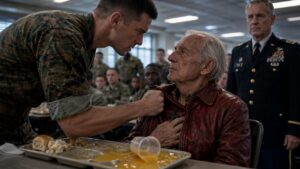
The Prosecutor Called Him Dangerous Until One Courthouse File Revealed What He Had Carried Home
Chapter 1: The File Landed Before He Spoke
The file folder landed hard enough to make the water in Ronald Bennett’s paper cup tremble.
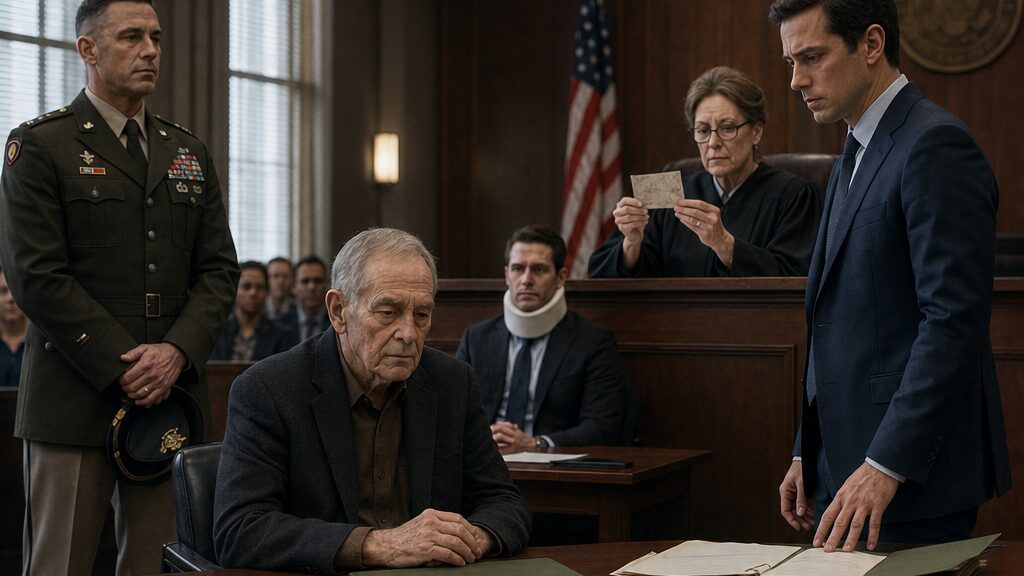
It was not a thick folder. That was the first thing Ronald noticed. Not a life’s worth of paper, not even a month’s worth. A green county folder with a white label, one corner bent from being handled too quickly, the metal fasteners inside already pulling loose from the cardboard. It sat on the defense table between his folded hands and the assistant prosecutor’s polished belt buckle, as if the whole matter could be reduced to three clipped pages and a photograph.
Benjamin Reed kept his palm on top of it a second longer than necessary.
“Mr. Bennett,” he said.
Ronald looked at the hand first. Young hand. Clean nails. A small pale line where a ring had been removed or recently shifted. The kind of hand that touched paper more than skin.
“Mr. Bennett,” Benjamin repeated, louder, as though age had turned Ronald’s ears into wood. “I asked whether you understand why you’re here.”
The courtroom was small enough that everyone could hear the air conditioner click and struggle in the ceiling. A clerk sat below the bench with a pen raised over a form. A bailiff stood near the side door, his shoes planted wide. Judge Carolyn Hayes watched from above them with her reading glasses low on her nose. Behind the prosecutor’s table, Nicholas Miller sat stiffly in a dark suit that did not quite fit across his shoulders. A foam neck brace held his chin at an unnatural angle.
Ronald did not look long at the brace.
He had already looked once.
“Yes,” Ronald said.
His voice came out steady but low. The microphone in front of him caught only part of it, and the word moved through the speaker with a faint dry crackle.
Benjamin lifted his hand from the folder and opened it. “You understand you’re charged with assault after shoving Mr. Miller into a security barrier inside this courthouse last Thursday?”
Ronald’s fingers rested together on the table. The skin over his knuckles had thinned with age, and the veins rose like blue cords under paper. His daughter had wanted him to put lotion on them before court, as if dry hands could make a judge believe the wrong thing.
“I understand the charge,” Ronald said.
“But you deny striking him.”
“I did not strike him.”
A slight movement passed through the spectators’ benches. Not quite a laugh. Not quite a sigh. A little release of disbelief. Ronald kept his eyes forward.
Benjamin pulled a sheet from the file. “Mr. Miller’s statement says you pushed him with both hands.”
“He wrote what he remembers.”
“Did you push him?”
Ronald did not answer at once.
There were three narrow windows high on the courtroom wall, too high to show the street. Morning light came through them in pale rectangles and lay across the flag, the seal, and the judge’s bench. The room smelled of coffee, printer ink, damp wool, and the faint disinfectant used by cleaning crews before anyone important arrived.
“Mr. Bennett,” Judge Hayes said, not unkindly, “you need to answer the question.”
Ronald looked down at the folder. The white label had his name in block letters, last name first. BENNETT, RONALD. Under it, someone had typed: MUNICIPAL DISTURBANCE / ASSAULT / COURTHOUSE SECURITY.
He wondered who had chosen the word disturbance.
“No,” he said.
Benjamin’s eyebrows tightened. “No, you didn’t push him?”
“No, I won’t answer it like that.”
The prosecutor leaned back a fraction, then gave the judge a small look, the kind of look men gave one another when a machine failed to work. Only this look went to a woman in a black robe, and she did not return it.
“Your Honor,” Benjamin said, “the state is trying to establish whether the defendant acknowledges basic facts.”
“The defendant can answer in his own words,” Judge Hayes said. “For now.”
Benjamin nodded, but the nod had no patience in it. He turned back to Ronald. “Then in your own words, explain why Mr. Miller needed medical treatment after you interacted with him.”
Ronald heard the word interacted and almost looked at Nicholas again.
Almost.
A guard had shouted last Thursday. A man had gone down near the metal detector. Someone had said he was drunk. Someone else had told everyone to stand back. Nicholas had moved fast, irritated by the jam in the entry line, one hand reaching under the fallen man’s shoulders as if moving a sack away from a doorway.
Ronald’s own body had moved before his age remembered itself.
He felt again the weight of another man’s shoulder under his palm. Felt a pulse fluttering wrong beneath two fingers. Felt a voice from fifty years ago telling him not to move the neck unless he had to, not unless fire or rounds or water made stillness worse than motion.
In the courtroom, he folded his hands more tightly.
“That paper does not tell what happened,” he said.
Benjamin’s mouth thinned. “The paper tells that you put your hands on a courthouse employee, and that employee suffered an injury.”
“He is not a courthouse employee,” Ronald said.
The answer came too quickly, and everyone heard the correction.
Benjamin glanced down. “Contracted security personnel. The distinction doesn’t help you.”
Ronald said nothing.
Judge Hayes looked at him over her glasses. “Mr. Bennett, do you have counsel?”
The public defender beside Ronald shifted in his chair. He was overworked, kind-eyed, and already damp at the collar. “Your Honor, I’ve met with Mr. Bennett briefly. We discussed asking for a continuance.”
“I don’t want one,” Ronald said.
The public defender lowered his voice. “Sir—”
“I’m not coming back here three times for them to say the same wrong thing.”
Benjamin tapped the folder with two fingers. “Then perhaps we can proceed with arraignment conditions. Given the defendant’s refusal to provide a coherent account and the age-related concerns noted by responding officers—”
“Age-related,” Ronald said softly.
Benjamin stopped.
The courtroom became still around the phrase. Ronald had not raised his voice. He had not even looked offended. He had only repeated the words with the carefulness of a man picking up a sharp object.
Benjamin looked down at his page. “That is the language used in the incident report.”
“Of course,” Ronald said.
“Mr. Bennett,” Judge Hayes warned.
Ronald bowed his head once, not in apology exactly. More in acknowledgment that he had used one more word than he intended.
The prosecutor continued. “The state requests that Mr. Bennett be ordered to avoid contact with Mr. Miller, refrain from entering the courthouse except for court dates, and submit to a cognitive evaluation if the court deems appropriate.”
The public defender rose halfway. “Your Honor, there’s been no showing that—”
“My father knows where he is.”
The voice came from behind Ronald.
He closed his eyes for a moment.
Amy Bennett stood near the back row, one hand gripping her purse strap so hard the leather bent under her fingers. She had told him she would sit quietly. She had promised. But Amy had never been good at watching someone cut into a person she loved with polite words.
Judge Hayes looked toward her. “Ma’am, you’ll need to remain seated unless called.”
Amy sat, flushed and angry, but Ronald could feel her stare on the back of his neck.
He wished she had stayed at work. He wished she had not seen the folder land. He wished she had not heard “cognitive evaluation” spoken in the same tone as “weather delay” or “parking violation.”
Benjamin lifted a photograph from the file and turned it toward the bench. Ronald did not need to see it clearly. The image showed Nicholas on the courthouse floor, one hand at his neck, the security barrier tipped sideways beside him. The fallen man was not in the frame. Neither was Ronald, except for the edge of his sleeve near the bottom.
A sleeve could be enough, apparently.
Ronald looked at Nicholas then.
The younger man’s jaw worked inside the brace. He did not meet Ronald’s eyes.
For the first time that morning, Ronald moved his right hand away from the other. He placed two fingers against the inside of his left wrist. It was an old habit, one he did not always notice until someone else noticed for him. Count, breathe, wait. Count again. Do not trust the first panic of the room.
His pulse was steady.
Not calm. Steady.
Benjamin saw the movement and paused. “Are you all right, Mr. Bennett?”
There was something almost decent in the question, but Ronald could hear what sat under it. Are you confused? Are you failing? Are you about to prove my point?
Ronald lowered his hand.
“I’m here,” he said.
Judge Hayes wrote something on the pad before her. The clerk’s pen moved. The public defender whispered something Ronald did not catch.
Benjamin slid the photograph back into the folder and squared the pages with a brisk tap against the table. “The state believes the defendant’s own responses demonstrate why some restrictions are necessary.”
Ronald looked at the folder again. At his name. At the bent corner. At the thinness of it.
A man could cross an ocean and come home with less paper than that. A man could carry names he never wrote down. A man could do one thing in a crowded lobby because his hands remembered what his mouth would not explain, and the world would staple together the easiest version by noon.
Judge Hayes leaned forward. “Mr. Bennett, before I rule on temporary conditions, I’m going to ask you plainly. Is there anything you want this court to know about what happened last Thursday?”
Amy shifted behind him.
The public defender turned toward him with hope and warning mixed together.
Nicholas’s brace creaked faintly as he swallowed.
Ronald touched the straightened edge of the folder with one finger and pushed it back an inch, not toward Benjamin, not away from himself, but into alignment with the grain of the table.
“Yes, Your Honor,” he said.
Benjamin looked ready.
Ronald looked at the judge.
“That file is missing a man.”
Chapter 2: The Captain Noticed the Wrong Paper
The words did not move the court the way a shout might have. They settled instead, quietly and inconveniently, into the places where everyone had already decided what the morning was about.
Judge Hayes stopped writing. “A man?”
Ronald nodded once.
Benjamin opened the folder again with less patience than before. “Your Honor, the state has provided the incident report, Mr. Miller’s statement, a medical intake summary, and the responding officer’s notes. If Mr. Bennett is referring to an unnamed bystander, we have no record—”
“That is what I said,” Ronald interrupted.
The public defender touched Ronald’s sleeve under the table. A caution. Ronald did not pull away. He knew the man was trying to help. He also knew help could sometimes become another hand over your mouth.
Benjamin drew a breath through his nose. “Then perhaps Mr. Bennett can provide this alleged missing person’s name.”
Ronald did not answer.
The prosecutor looked almost relieved. Silence gave him something firm to stand on again.
“That’s exactly the issue, Your Honor,” Benjamin said. “The defendant continues to make vague claims without facts. Meanwhile, Mr. Miller is sitting here with an injury sustained while performing his job.”
Nicholas sat straighter, then winced. His right hand rose toward the edge of the brace but stopped before touching it.
Ronald’s eyes followed that movement. A man who had neck pain guarded himself differently when the pain was deep than when the brace had become part of the argument. Nicholas was hurt. Ronald did not doubt that. Pain did not make the story true.
The courtroom door opened at the back with a careful click.
No one turned at first except the bailiff. Courtrooms had their own weather: doors opening, people entering late, paper traveling from one hand to another. But then the bailiff straightened, and the subtle shift in his posture pulled attention behind him.
A man in Army service uniform stepped inside and removed his cap.
He was tall, broad through the shoulders, but he did not enter like a man trying to own the room. He paused just past the door, spoke quietly to the bailiff, and waited until the bailiff nodded. The ribbons on his chest caught the high window light without glittering. His face was young enough to make Ronald feel old and old enough to know not to mistake volume for authority.
Judge Hayes noticed him next. “Captain Carter?”
“Yes, Your Honor.” The officer stepped forward. “Samuel Carter, county veterans’ liaison. I was scheduled for the diversion docket at ten.”
“You’re early.”
“Yes, ma’am. The clerk told me this case may have a veterans’ screening question.”
Benjamin looked toward the clerk, irritated. The clerk looked at her paper as if paper had done it.
Judge Hayes looked back at Ronald. “Mr. Bennett, are you a veteran?”
The question was not harsh. It was not reverent either. It was procedural, a box opening somewhere.
Ronald looked at Samuel Carter for the first time.
The captain stood beside the aisle, not behind him yet, not claiming anything. His eyes had gone to Ronald’s hands. Not to the gray hair, not to the old blazer, not to the alleged victim’s brace. To the hands.
Ronald folded them.
“Once,” Ronald said.
Amy made a small sound behind him. He did not turn.
Benjamin glanced at the folder, then at Samuel. “Your Honor, I’m not sure that changes the immediate safety concerns.”
“No one said it did,” Judge Hayes replied.
Samuel remained still. “May I approach the clerk’s copy, Your Honor?”
“For what purpose?”
“To verify service eligibility if the court is considering any veterans’ docket referral.”
Benjamin almost objected; Ronald saw the shape of it gather in his shoulders. But objecting to a veterans’ liaison checking a veterans’ docket form would sound like what it was, so Benjamin only shifted his stance.
Judge Hayes nodded. “You may.”
Samuel walked to the clerk first, not to Ronald. That mattered. He asked for the copy. He did not take it until the clerk handed it over. He read with the quick attention of someone used to finding what other offices buried.
Ronald looked down at the table.
He had spent years keeping the past where it belonged. In a drawer. In a box. In the pauses between sleep and waking. In the way he sat with his back to walls in restaurants without ever saying why. Service was not a secret exactly. It was simply not a tool. Not a credential to be waved when the groceries cost too much or when a clerk spoke sharply. Not a shield against being wrong.
Samuel turned a page.
Then he stopped.
It was not dramatic. His face did not break open. He did not look shocked. He looked, suddenly, careful.
“Your Honor,” he said, “there’s a document in this copy that does not belong in a standard assault file.”
Benjamin stepped closer. “What document?”
Samuel did not hand it to him first. He looked to the judge.
Judge Hayes extended her hand. “Bring it here.”
Samuel walked to the bench and placed the page before her with both hands. Ronald did not need to see it. He knew the shape of that paper even after all these years: the boxed lines, the faded duplication, the old service number partially blacked out, the medical notation that had followed him from one records office to another by accident or stubbornness.
Judge Hayes read in silence.
Benjamin’s patience gave way. “Your Honor?”
She looked over her glasses at Ronald. The room had changed, though no one had moved much. The air had grown thinner.
“Sergeant Bennett,” she said, then stopped as if hearing herself.
Ronald looked up.
It had been a long time since a judge called him that.
Samuel turned slightly toward him. His posture shifted—not into parade-ground stiffness, not a salute, but into recognition. Shoulders squared. Voice lowered.
“Sergeant Bennett,” Samuel said, “with the court’s permission, may I ask whether this field medical card is yours?”
Ronald stared at the page on the bench.
The first thing he remembered was not blood. People always thought it would be blood. It was dust. Dust on teeth, dust in the folds of gauze, dust turning sweat into mud under a helmet strap. Dust on the corner of a card while a young man tried to joke through shock because joking was easier than asking whether he would keep his leg.
The courtroom waited.
Ronald could feel Amy waiting harder than anyone.
“Yes,” he said.
Benjamin looked from the judge to Samuel. “A field medical card from military service doesn’t tell us what happened last Thursday.”
“No,” Ronald said. “It doesn’t.”
Samuel glanced toward him, and Ronald caught the flicker there: respect, curiosity, and the beginning of a mistake. The captain wanted to help. Men who wanted to help could still turn you into a symbol before you had time to become a person in the room.
Judge Hayes held the paper carefully now. That was the first changed behavior. She had handled every other page as a page. This one she held by the edges.
“Mr. Reed,” she said, “why is this in the state’s file?”
Benjamin moved to the bench, accepted the page when she handed it down, and read it. A flush rose from his collar. “I don’t know, Your Honor. It may have been included with identity records or prior municipal forms.”
“It appears to be a service medical document,” Judge Hayes said.
Samuel spoke quietly. “Vietnam-era, ma’am. Army medic notation. Some of these turn up in VA referral packets, but they should not be loose in a municipal assault file.”
Ronald pressed his thumb against the side of his index finger. He could feel the room turning toward him, and he disliked it almost as much as he had disliked being dismissed. There were different ways to be flattened.
Benjamin recovered himself. “The state has no objection to verifying Mr. Bennett’s service for eligibility. But I want the record clear: veteran status does not excuse assault.”
Ronald looked at him then. Fully.
“No,” he said. “It does not.”
The answer took some of the force from Benjamin’s argument because Ronald had not argued back. He had agreed with the part that was true.
Samuel stepped closer to the defense table, then stopped. “May I, Your Honor?”
Judge Hayes nodded.
Samuel came to stand a few feet behind Ronald’s chair. Not close enough to loom. Not close enough to claim him. Close enough that the room could see he had chosen a place.
“Sergeant Bennett,” Samuel said, “would you like the court to pause while we verify the veterans’ docket options?”
Ronald looked at the folder. The green cardboard had been opened and closed so many times that the bent corner now pointed up like a lifted fingernail. Inside it sat their version, his name, Nicholas’s brace, the missing man, and now a piece of a war that did not belong to any of them.
Amy’s breathing had changed behind him. He could hear it because he had spent years listening for her breathing when she was a child with fever, then as a teenager crying into a pillow after her mother died, then as a woman trying not to cry when she thought he was getting too old to notice.
“I do not want a docket option,” Ronald said.
The public defender leaned in. “Mr. Bennett, it may help—”
Ronald turned his head just enough to stop him.
Samuel did not interrupt. That was the second changed behavior. He waited.
Judge Hayes studied Ronald. “Then what do you want?”
Ronald’s mouth felt dry. He reached for the paper cup, then left it untouched.
“I want the file to say there was another man on the floor,” he said. “I want it to say Mr. Miller tried to move him before anyone checked him. I want it to say I told him not to.”
Nicholas’s face changed. It was small, a tightening around the eyes, but Ronald saw it.
Benjamin saw Ronald seeing it.
“You’re alleging Mr. Miller caused the incident,” Benjamin said.
“I am saying your file begins too late.”
Silence followed that. Not respect yet. Not truth. But something had slowed.
Judge Hayes closed the folder herself this time instead of letting Benjamin do it. “We’ll take a fifteen-minute recess. Mr. Reed, find out why the initial incident report omits the collapsed individual. Captain Carter, remain available. Mr. Bennett, I suggest you speak with counsel.”
The gavel did not strike hard. It did not need to.
People stood. Chairs scraped. The courtroom loosened into murmurs.
Samuel waited until Ronald had placed both hands on the table and pushed himself carefully to standing. Then the captain took one step nearer—not to grab his elbow, not to help without asking.
“Sergeant,” he said softly, “permission to stand by?”
Ronald looked at him. At the uniform. At the carefulness. At the young man’s effort not to make respect into theater.
After a moment, Ronald nodded.
“Stand,” he said. “Don’t speak for me.”
Samuel’s expression sobered.
“Yes, Sergeant.”
Ronald reached for the folder, but Benjamin had already taken it. For the first time all morning, the prosecutor did not slap it closed. He gathered the pages slowly, as though one of them might cut him.
As the courtroom emptied, Amy remained frozen behind the rail.
Ronald turned at last.
His daughter’s eyes were wet, not with pride exactly. Pride would have been simpler. This was confusion, hurt, anger at being left outside a room inside her own father.
“Dad,” she said. “Sergeant?”
Ronald looked away first.
The field card lay on the judge’s bench now, far from his hands, and still he could feel its old folded edge in his pocket like a thing that had never stopped weighing anything.
“Do not make that card say more than I have said,” he told her.
Chapter 3: Amy Wanted the Quiet Way Out
The hallway outside Courtroom Two had been painted the color of old oatmeal. Ronald had always disliked public buildings that tried to calm people with beige walls while making them sit under fluorescent lights until their names were called.
Amy stood beside a vending machine that hummed louder than it needed to. She had one arm folded across her stomach and the other hand pressed over her mouth, as if she were keeping words physically inside. The public defender had gone to find coffee and a working copier. Samuel Carter waited near the far window, close enough to be available and far enough to keep his promise.
Ronald sat on the wooden bench beneath a bulletin board of outdated notices. Jury duty instructions. Domestic violence resources. Traffic payment plans. A faded flyer about veterans’ benefits with a phone number someone had torn off at the bottom.
Amy stared at that flyer for a long moment.
“You never told me,” she said.
Ronald rested his hands on his knees. “You knew I was in the Army.”
“I knew you were in the Army the way I know Grandma liked roses. A fact. A sentence. Not—” She stopped and looked toward Samuel, then lowered her voice. “Not whatever just happened in there.”
“Nothing happened.”
Her laugh came out once, sharp and unbelieving. “A captain walked into court and called you Sergeant Bennett.”
“He read a paper.”
“You had a field medical card in a prosecutor’s file.”
“I didn’t put it there.”
“That is not the point.”
Ronald looked down at the polished floor. A black scuff mark curved near his shoe, probably from someone turning too quickly. “It became the point when everyone stared at it.”
Amy sat beside him, but not close. There was a careful distance between them, a space for all the questions he had trained her not to ask.
She had dressed for court as if dressing well could protect him: navy jacket, cream blouse, hair pinned back, small earrings her mother used to wear. Ronald had noticed. He noticed most things, even when people thought age had made him vague. The older he became, the more people mistook silence for absence.
“The public defender said there may be a diversion option,” Amy said.
Ronald closed his eyes.
“He said because you’re a veteran, they might move this out of regular court. No conviction if you comply with conditions. Maybe counseling, maybe check-ins, maybe—”
“No.”
“You haven’t heard it.”
“I heard enough.”
“Dad.”
He opened his eyes. “No.”
A clerk passed them carrying a stack of files. Her shoes made soft rubber sounds on the tile. Somewhere nearby, a child cried and was hushed. A man argued quietly into a phone about a parking ticket as if the person on the other end had personally painted the curb red.
Amy leaned toward Ronald. “This is not about pride.”
He almost smiled. Pride. At his age, pride was what people called your last boundary when they wanted it moved.
“What is it about?” he asked.
“It’s about staying out of jail. It’s about not dragging yourself through hearings. It’s about not letting some prosecutor decide you’re dangerous because you won’t answer questions like a normal person.”
Ronald turned his head.
Amy’s face tightened as soon as she heard herself.
“I didn’t mean—”
“Yes,” Ronald said. “You did.”
Pain crossed her eyes. “I meant you won’t help yourself.”
“I am helping myself.”
“No, you’re sitting there letting them write things about you.”
“That is why I’m still here.”
She took a breath and lowered her voice again. “The diversion paper says they can evaluate you and recommend services. That might be the easiest way to make this go away.”
“Read the line under eligibility.”
Amy looked away.
“Read it,” Ronald said.
She reached into her purse and removed a folded paper. She had already gotten a copy. Of course she had. Amy had always prepared for disasters by collecting documents. Hospital discharge papers, insurance forms, appliance warranties, prescription lists. When her mother was dying, Amy had kept three folders on the kitchen table, each labeled in neat handwriting, as if death might respect organization.
She unfolded the paper slowly.
Ronald did not need her to read the whole thing. He had seen the phrase when the public defender slid it toward him in the courtroom.
Amy swallowed. “It says referral may be appropriate when the defendant’s conduct appears connected to service-related trauma, substance abuse, homelessness, or cognitive instability.”
“And which one did they circle?”
She did not answer.
“Amy.”
“Cognitive instability,” she said.
The vending machine hummed. Samuel shifted slightly near the window but did not turn around.
Ronald nodded. “That is the quiet way out?”
“It is one phrase on one form.”
“It is the phrase they keep.”
“It could keep you safe.”
“It would keep them comfortable.”
Her eyes filled again, and this time anger came with it. “Why do you make everything harder than it has to be?”
Ronald looked at his hands. There was a small nick near his thumbnail from fixing the loose hinge on his kitchen cabinet. Amy had wanted to hire someone. He had told her a hinge was not a crisis. She had told him nothing was a crisis until he was lying on the floor and refused to call her.
Maybe she had not been entirely wrong.
“I don’t want you hurt,” she said.
“I know.”
“I don’t want to get a call saying you fell in a courthouse hallway, or got locked up overnight, or signed something you didn’t understand.”
“I understand the paper.”
“You understand papers better than people sometimes.”
That one found him.
He sat back against the bench. Across the hall, Benjamin Reed came out of the courtroom with the green folder tucked under his arm. He spoke to Nicholas Miller near the elevator. Nicholas still held himself stiffly inside the brace, but his eyes kept moving toward Ronald.
Amy followed Ronald’s gaze. “What really happened?”
Ronald’s pulse moved under the skin of his wrist. He did not touch it this time.
“A man fell,” he said.
“You said that.”
“He needed time.”
“What does that mean?”
“It means people rush when they are embarrassed by someone else’s body.”
Amy waited.
Ronald could have said more. He could have told her about the sound a body made when it hit tile without catching itself. About the way the man’s eyes had fluttered under lids too pale. About Nicholas saying, “Get him up, get him out of the way,” with a lobby full of irritated citizens watching the security line freeze.
He could have told her about another young man on a dirt road long ago who had begged to be moved because lying still felt like dying, and how Ronald had held him down with both hands and lied into his ear until the helicopter came.
He said none of it.
Amy folded the diversion paper along its existing crease. Her voice softened, which worried him more than anger did. “Dad, if the court thinks this is connected to your service, maybe that is not an insult. Maybe it is help.”
“Help asks what happened before naming it.”
She looked down.
Ronald let the words sit between them. They were sharper than he intended, but not untrue.
Samuel approached only after Ronald lifted his eyes toward him. The captain stopped a respectful distance away.
“Sergeant Bennett,” he said, “the judge is reconvening in five minutes. The prosecutor found a supplemental note from the responding officer. There was a second individual transported by ambulance.”
Amy rose. “Who?”
Samuel looked to Ronald before answering, and Ronald saw that he had remembered the instruction.
Ronald gave a small nod.
“Unidentified at the scene,” Samuel said. “Male, older, possibly unhoused. Taken to county hospital.”
Amy turned to her father. “You knew him?”
Ronald stood. The bench creaked with relief as his weight left it. His knees hurt, though he did not let the pain reach his face.
“I knew what not to do to him,” he said.
“That’s not what I asked.”
“No.”
He buttoned his blazer with slow fingers.
Amy stepped closer and touched the folded diversion paper to his sleeve. “Please. Just think about it.”
Ronald looked at the paper. At the circled phrase he could not see but felt as plainly as if it had been stamped across his forehead.
Then he took it from her.
For one second, hope loosened her face.
Ronald folded the paper once more, carefully, along the crease. Then he handed it back.
“I won’t sign a lie because it is quiet,” he said.
The courtroom door opened. The bailiff called for parties to return.
Amy held the paper against her chest, and Ronald walked ahead of her, slower than the others, not because he wanted to be seen but because he would not hurry for a room that had already mistaken motion once.
Behind him, Samuel Carter walked without speaking.
And under Benjamin Reed’s arm, the green file had grown thicker.
Chapter 4: The Neck Brace Told the Easy Story
When court resumed, Benjamin Reed did not slap the file down.
He carried it with both hands, which Ronald noticed before anything else. The folder had changed in the hallway. A yellow slip now protruded from the top edge, and a photocopy with a crooked black stripe sat behind the original report. It looked heavier, though paper did not weigh much unless a man had to answer for what it did not say.
Nicholas Miller took the stand with care. The bailiff adjusted the microphone. Nicholas raised his right hand and swore to tell the truth, his neck brace lifting his chin as if truth were something up near the ceiling.
Benjamin stood at the lectern. “Mr. Miller, where were you assigned last Thursday morning?”
“Main entrance security,” Nicholas said.
“Were you on duty when you encountered Mr. Bennett?”
“Yes.”
“Can you describe what happened?”
Nicholas looked once toward Ronald, then away. “There was a disturbance near the metal detector. A man went down. People started crowding. I moved in to clear the area.”
“Was that part of your job?”
“Yes. Keep the entrance clear. Make sure nobody blocks the screening lane.”
“And what did Mr. Bennett do?”
Nicholas’s jaw shifted inside the foam brace. “He came at me from the side. Told me not to touch the guy. I told him to step back. Then he shoved me.”
Benjamin turned slightly, enough to let the spectators absorb it. “How hard?”
“Hard enough that I lost my balance. Hit the barrier. My neck snapped back.”
Ronald watched his hands instead of Nicholas’s face. Nicholas kept the left one flat on his knee. The right hand flexed whenever he reached the part of the story where control left him. Embarrassment had its own pulse.
“Did you strike Mr. Bennett?”
“No.”
“Threaten him?”
“No. I told him to step back.”
“Had you ever met him before?”
“No.”
Benjamin walked to the table and lifted the photograph. “Is this a fair depiction of your condition immediately after the incident?”
Nicholas looked at it. “Yes.”
The judge accepted the photo. Carolyn Hayes studied it longer than she had earlier. Her eyes moved over what was there, then over what was not.
Ronald kept still.
The public defender stood for cross-examination with two pages of notes and the weary caution of a man entering a room after someone else had already broken the glass.
“Mr. Miller,” he said, “you testified that a man went down near the metal detector.”
“Yes.”
“Do you know his name?”
“No.”
“Did you check his pulse?”
Nicholas blinked. “That’s not my job.”
Ronald’s fingers tightened once under the table.
The public defender glanced at him, then continued. “Did anyone check his pulse before you tried to move him?”
“I wasn’t trying to move him. I was clearing the area.”
“By lifting him?”
Nicholas’s eyes shifted to Benjamin. “By helping him up.”
“Was he conscious?”
“I don’t know. There was a lot happening.”
“Was he speaking?”
“No.”
“Were his eyes open?”
“I don’t remember.”
The public defender waited just long enough for the answer to show its shape. “But you remember Mr. Bennett shoving you.”
“Yes.”
“Do you remember Mr. Bennett saying anything before he touched you?”
Nicholas swallowed. The brace made it impossible to hide. “He said don’t move him.”
“Did he say why?”
“He said just don’t move him.”
Ronald looked at the flag.
The public defender turned a page. “Did he put both hands on you?”
“Yes.”
“Where?”
“My shoulder and chest, I think.”
“Did he push you toward the barrier, or did he block you from bending down?”
Benjamin rose. “Objection. Calls for speculation.”
“I’m asking what Mr. Miller physically experienced.”
Carolyn considered it. “He may answer if he knows.”
Nicholas’s right hand flexed again. “It happened fast.”
“That wasn’t the question.”
“I don’t know. He pushed me back.”
The public defender nodded. “Back from the man on the floor?”
Nicholas’s face reddened. “Back from doing my job.”
Ronald heard Amy breathe in behind him. He did not turn. In his mind, he saw the lobby again: the line stopping, bins half-filled with belts and phones, a woman clutching court papers to her chest, someone muttering about being late. The fallen man had worn two coats though the building was warm. One shoe had no lace. His hand had opened and closed once against the tile, fingers searching for something that was not there.
Nicholas had crouched fast, annoyed but not cruel. Ronald held on to that. Not cruel. Just hurried. Just certain that a body in the wrong place needed to be moved before it needed to be understood.
Benjamin rose for redirect. His voice sharpened with the relief of familiar ground. “Mr. Miller, did Mr. Bennett identify himself as a medic?”
“No.”
“Did he show you any medical credentials?”
“No.”
“Did he tell you he had training?”
“No.”
“Did he explain anything at all?”
Nicholas looked at Ronald again, and this time Ronald met his eyes.
“No,” Nicholas said. “He just grabbed me.”
There it was. The easy story. It fit the photograph. It fit the brace. It fit the form, the charge, the request for restrictions. It fit because it began after the moment that mattered.
Benjamin turned to the judge. “Your Honor, the state is sympathetic to Mr. Bennett’s background. But even if he believed he was helping, he cannot use force on courthouse personnel based on some unspoken instinct.”
Ronald did not flinch at instinct, though he disliked the word.
Samuel Carter sat in the first row behind the rail. He was not in uniformed motion now, not entering, not reframing. He was simply present, cap on his lap, listening. Ronald respected him more for that than for the ribbons.
Carolyn folded her hands. “Mr. Reed, during recess you located a supplemental note?”
Benjamin’s face changed by a degree. “Yes, Your Honor.”
“Read the relevant portion.”
He looked down at the yellow slip. “Responding officer notes: unidentified male subject transported by county ambulance following reported collapse near screening area. Subject removed prior to completion of statements. No apparent relation to altercation. End note.”
“No apparent relation,” Carolyn repeated.
Benjamin said nothing.
The public defender rose. “Your Honor, I’d ask that the state produce ambulance records and any security footage before the court imposes conditions based on a partial record.”
Benjamin closed the folder. “Security footage from the lobby is overwritten on a short cycle unless preserved immediately.”
“Was it preserved?”
A pause.
Benjamin looked toward Nicholas, then back to the judge. “Not that I have been able to confirm.”
Amy made a small disbelieving sound behind Ronald.
Carolyn’s gaze moved to the prosecutor. “Why not?”
“Because the responding officer categorized the medical transport as unrelated to the assault complaint.”
“And the only person who said it was unrelated was whom?”
Benjamin’s mouth tightened. “The initial report reflects Mr. Miller’s statement and the officer’s observations.”
Nicholas sat very still.
Ronald felt no triumph. Lost footage did not make a man right. A missing record did not restore a missing moment. It only widened the space where people could choose the version most convenient to them.
The judge turned to Ronald. “Mr. Bennett, do you know the transported man’s name?”
Ronald’s tongue touched the back of his teeth. He had heard a name in the lobby, but not from the man himself. Someone in line had said, “That’s the guy from the VA stop,” and someone else had called him “old soldier” with the careless affection strangers used when they did not know what else to say.
“No, Your Honor.”
“Do you know where he was taken?”
“County hospital, if the ambulance did what they said.”
Benjamin seized the opening gently. “So you don’t know the man, you don’t know his condition, and you don’t have medical authority now.”
Ronald looked at the prosecutor.
“No,” he said. “I don’t.”
The simplicity of the answer unsettled Benjamin more than argument would have.
Carolyn leaned back. “Captain Carter, does your office have any way to assist in identifying whether the transported man was connected to the VA clinic or county veterans’ outreach?”
Samuel stood only when addressed. “We can ask, Your Honor. We cannot access medical records without authorization, but if he is in outreach contact, there may be a nonmedical identification trail.”
“Do that.”
Benjamin began, “Your Honor, I would object to turning this hearing into an investigation of—”
“Into an investigation of whether the charging file omitted the event that caused the alleged assault?” Carolyn asked.
The prosecutor stopped.
The judge’s tone remained level, but the room heard the correction.
Ronald looked down at the green folder on the state’s table. For the first time, it did not look like something thrown at him. It looked like something that might fall open under its own weight.
Carolyn continued. “Temporary no-contact order between Mr. Bennett and Mr. Miller remains in place. No cognitive evaluation at this time. We will reconvene tomorrow morning. Mr. Reed, I expect the state to determine whether records exist for the transported individual. If they do, I expect to know why they were left out.”
The gavel sounded.
Nicholas stepped down carefully. As he passed the defense table, he did not look at Ronald, but he slowed. For half a breath, Ronald thought the younger man might say something.
Instead, Nicholas touched the edge of his brace and walked on.
Samuel came to the rail but did not cross it. “Sergeant Bennett.”
Ronald looked up.
“There may be a veterans’ records clerk who knows the outreach side,” Samuel said. “I can check without using your name if you prefer.”
Ronald nodded. “Use his first, if you find it. Not mine.”
Samuel understood. “Yes, Sergeant.”
Amy came forward, but her eyes were on the file under Benjamin’s hand. “They lost the video?”
“Maybe,” Ronald said.
“Maybe means yes.”
Ronald stood slowly. His back ached from the courtroom chair. “Maybe means maybe.”
Amy turned to him, anger and fear still fighting in her face. “You keep giving them more fairness than they give you.”
Ronald watched Benjamin slide the yellow note into the green folder. “That is not for them,” he said.
Across the aisle, the prosecutor looked down at the file as though, for the first time, he did not trust it.
Chapter 5: The Missing Name in the Record
By the next morning, the green folder had a rubber band around it.
Ronald saw it as soon as Benjamin Reed entered Courtroom Two. The folder no longer lay flat under the prosecutor’s hand. Papers pressed against its edges. Corners stuck out. A white envelope had been tucked beneath the band, and someone had written HOSPITAL INTAKE? across the front in blue ink.
Ronald sat at the defense table before anyone asked him to. He had slept poorly, though he had not told Amy when she called before sunrise. He had stood in his kitchen at four-thirty with a cup of coffee cooling beside the sink and listened to the refrigerator hum. On the table lay the copy of the diversion paper Amy had forgotten to take back. Cognitive instability circled in black ink.
He had turned it facedown.
Now Amy sat behind him again, quieter than yesterday. She had brought no purse full of solutions this time, only a small notebook. She had asked him in the parking lot whether he wanted her to sit close or farther back. The question had nearly stopped him.
“Where you can hear,” he had said.
That was all.
Judge Carolyn Hayes entered at nine sharp. No one spoke while she arranged her papers. When she looked up, her eyes went first to Ronald, then to Nicholas Miller, then to Benjamin and the folder.
“Mr. Reed,” she said, “what did the state find?”
Benjamin rose. His suit looked as neat as yesterday, but something in him had lost its polish. Not authority. Certainty.
“Your Honor, the state contacted county ambulance dispatch, county hospital intake, and courthouse security administration. There was a medical transport from this courthouse at 8:42 a.m. last Thursday. The transported individual was initially unidentified but later entered under the name Timothy Brooks.”
Ronald’s hand moved before he stopped it. Two fingers against his wrist, brief as a blink.
Amy saw.
So did Samuel Carter from the first row.
Carolyn looked toward Ronald but did not ask yet. “Condition?”
Benjamin glanced down. “Hospital intake notes are limited due to privacy restrictions, but the nonprotected incident summary states the patient arrived after a collapse with altered consciousness. He was transferred to observation.”
“Was there any indication he was connected to the altercation?”
“The ambulance departure occurred before officers completed the assault statement.”
“That is not an answer.”
Benjamin’s jaw tightened. “Yes, Your Honor. The collapse occurred immediately before Mr. Miller’s injury.”
The courtroom remained quiet. It was a different quiet from yesterday. Less entertained. Less waiting for the old man to trip over himself.
Carolyn turned a page. “Captain Carter?”
Samuel stood. “Your Honor, county veterans’ outreach confirmed Timothy Brooks has been a walk-in client at the VA clinic and courthouse outreach table. They could not provide medical details, but he is a veteran.”
Ronald closed his eyes once.
Timothy Brooks. He did not know the name. Not really. But he knew the face. He had seen the man twice before at the bus stop near the VA clinic, coat over coat, beard uneven, boots taped at the side. Once Ronald had watched him give half a sandwich to another man and keep the smaller half for himself.
A person did not have to be known deeply to matter.
Carolyn leaned forward. “Mr. Bennett, did you recognize Mr. Brooks?”
Ronald opened his eyes. “Not by name.”
“How did you recognize him?”
“The VA bus stop. Maybe the clinic.”
Benjamin stood. “Your Honor, I have to object to medical speculation from the defendant.”
“I haven’t asked for speculation,” Carolyn said. “I’ve asked whether he recognized a person missing from your file.”
Benjamin sat.
The judge looked back at Ronald. “What did you see last Thursday?”
Ronald heard the courthouse lobby before he saw it: bins sliding, belts clinking, the metal detector giving its flat electronic complaint. A woman saying, “I have court in five minutes.” A guard saying, “Keep moving.” Timothy Brooks standing in line with both hands in his coat pockets, swaying once as though the floor had shifted under him.
Ronald kept his eyes on the judge.
“He fell wrong,” he said.
Carolyn did not rush him.
Ronald’s right hand closed over his left thumb. “Most people try to catch themselves. He didn’t. He went down heavy. His head turned. His arm tucked under him.”
Nicholas stared at the table.
Ronald continued. “I went to him. He was breathing, but not right. I told them to call an ambulance. Mr. Miller came in fast.”
Nicholas looked up then, stung by his own name in Ronald’s mouth.
“He said to clear the lane,” Ronald said. “He reached under Mr. Brooks’s shoulders.”
“And you stopped him?” Carolyn asked.
“Yes.”
“How?”
Ronald looked at Nicholas. “I put one hand here.” He touched his own shoulder. “One here.” He touched the center of his chest. “I moved him back.”
Nicholas’s face hardened. “You shoved me.”
Ronald nodded. “I moved you too hard.”
The admission entered the room plainly. Benjamin’s pen stopped moving.
The public defender looked startled, then worried.
Ronald did not look away from Nicholas. “I did not mean for you to hit the barrier.”
Nicholas blinked. It was not forgiveness. It was not even softening. It was the first time the sentence had not sounded like denial.
Benjamin rose slowly. “Your Honor, the defendant has now admitted physical contact resulting in injury.”
Carolyn’s eyes flicked to him. “And the court has now heard the context your initial file omitted.”
“Context doesn’t negate force.”
“No. But it may change how the court understands necessity, intent, and credibility.”
The word credibility landed harder than the file had.
Benjamin looked at Ronald, and Ronald saw him struggling with two duties that no longer pointed in the same direction. Protect the complaint. Protect the truth. They had probably felt like one duty yesterday.
Samuel stepped forward when Carolyn nodded to him.
“Your Honor, may I clarify one point for the record?”
“Proceed.”
Samuel turned slightly, addressing the court, not performing for it. “A field medic’s training, especially from Sergeant Bennett’s era, would emphasize preventing unnecessary movement after collapse if spinal injury, head trauma, or compromised consciousness is possible. I’m not offering medical testimony about Mr. Brooks. I’m saying Sergeant Bennett’s response, as described, is consistent with old but serious emergency training.”
Ronald looked down.
Sergeant Bennett’s response.
He wanted to reject the phrase. He wanted to say his hands had moved before his mind did, that training was not nobility, that sometimes the body simply obeyed an old command because failing once had carved it too deep. But Samuel had been careful. He had not said hero. He had not said saved. He had only said consistent.
Carolyn wrote something. “Mr. Reed, why was Mr. Brooks categorized as unrelated?”
Benjamin looked toward Nicholas.
Nicholas’s shoulders rose and fell once inside the suit. “I told the officer the old man attacked me after the guy fell. I didn’t think the guy had anything to do with it.”
Ronald believed him. That was the hardest part. Nicholas had not needed malice. A wrong story told early could become a record before truth found its shoes.
Carolyn addressed Nicholas directly. “Did you know Mr. Brooks was transported?”
“I knew the ambulance came.”
“Did you tell the officer Mr. Bennett had warned you not to move him?”
Nicholas’s mouth opened. Closed. “I said he yelled at me.”
“What exact words?”
Nicholas looked at Ronald. This time, he held the look longer. “He said, ‘Don’t move him. Check him first.’”
Amy lowered her head behind Ronald.
The judge turned to the clerk. “Read that back.”
The clerk did, voice steady: “He said, ‘Don’t move him. Check him first.’”
The sentence sounded different in the official air. Smaller than it had been in the lobby, but alive.
Benjamin looked at his file. The rubber band pressed a groove into the cardboard. “Your Honor, given this new information, the state would be open to resolving this through veterans’ diversion without further litigation.”
Ronald knew it was coming before Benjamin finished. The quiet way out returning in a nicer coat.
The public defender leaned toward Ronald. “This is good,” he whispered. “This could end it.”
Amy did not speak. Ronald felt her restraint like a hand she had chosen not to place on his shoulder.
Carolyn looked at him. “Mr. Bennett, that option may spare everyone additional proceedings.”
Everyone.
The word was not cruel. It was just broad enough to erase the part that still mattered.
Ronald touched the edge of the defense table. “What would the file say?”
Benjamin hesitated.
Ronald turned to him. “After diversion. What would the file say?”
The prosecutor looked down. “The charge could be dismissed upon completion.”
“That is not what I asked.”
Carolyn watched Benjamin answer.
“It would reflect referral to veterans’ diversion based on service-related concerns,” Benjamin said.
“And cognitive instability?”
The courtroom went still.
Benjamin did not look at Amy, but Ronald knew he remembered the circled form. “That language can be amended.”
“Can be,” Ronald said.
The public defender whispered, “Mr. Bennett, we can negotiate that.”
Ronald shook his head once. “No.”
Amy’s notebook closed softly behind him.
Carolyn’s voice gentled but did not weaken. “Mr. Bennett, tell me what you are asking the court to do.”
Ronald looked at the green file. Yesterday it had accused him. Today it had expanded to include a man nobody had planned to remember. Tomorrow, if he let them, it would shrink again into a dismissal that made the courthouse feel merciful without becoming accurate.
“I am asking,” he said, “whether this court can correct a file without making a man beg for it.”
No one answered immediately.
Benjamin looked at the folder under his hand. Then, slowly, he removed the rubber band.
Chapter 6: Sergeant Bennett Finally Answered
The final hearing began with the file already open.
That was the first difference.
It lay on Benjamin Reed’s table with its metal prongs spread and the pages arranged in order: initial complaint, Nicholas Miller’s statement, photograph, supplemental officer note, ambulance confirmation, veterans’ outreach identification, and a blank correction form placed on top like a clean bandage not yet pressed down.
Ronald saw the blank form and felt no relief.
Paper could wound or heal, depending on who held the pen and what they were willing to name.
Judge Carolyn Hayes entered without delay. Amy sat behind Ronald, close enough that if she leaned forward her knee might touch the back of his chair. She had asked before choosing the seat. He had nodded. Samuel Carter sat across the aisle in uniform, cap in his lap, eyes lowered until court was called.
Nicholas Miller was there too, no longer at the prosecutor’s table but in the first row. The neck brace remained, though it sat looser today. He had shaved poorly, missing a strip along his jaw.
Benjamin stood when the case was called. “Your Honor, before the court hears from Mr. Bennett, the state wishes to make a record.”
Carolyn nodded. “Proceed.”
Benjamin placed both hands on the lectern. For once, he did not touch the file.
“The state acknowledges that the initial charging review did not include the full sequence of events at the courthouse entrance. Specifically, it omitted the collapse and ambulance transport of Timothy Brooks immediately before the physical contact between Mr. Bennett and Mr. Miller. The state further acknowledges that Mr. Bennett gave a verbal warning before contact occurred.”
Ronald listened without moving.
Benjamin continued. “The state does not withdraw concern regarding Mr. Miller’s injury. But based on the additional facts, the state is willing to amend its recommendation and pursue dismissal conditioned only on a written statement of events and no further contact.”
The public defender’s shoulders loosened beside Ronald. Amy exhaled quietly. It was a good offer. A reasonable offer. A door opened by someone embarrassed but trying.
Carolyn looked at Ronald. “Mr. Bennett?”
The public defender leaned close. “We can take this. You don’t have to testify.”
Ronald knew that.
He had known quiet exits in his life. He had taken some. He had walked past questions he could have answered because answering would make someone look at him with the soft, hungry pity people confused with honor. He had let Amy believe silence meant there was nothing to know because he did not want his old war living at her dinner table.
But Timothy Brooks had been “unrelated” for almost a week.
Ronald stood.
The public defender’s hand hovered, then fell away.
“Your Honor,” Ronald said, “may I answer from here?”
Carolyn studied him. “You may.”
Benjamin turned slightly from the lectern, careful now, attentive in a way that did not ask to be praised.
Ronald placed one hand on the back of his chair. He did not grip it hard, though his knees wanted him to.
“I don’t want Mr. Miller punished for being wrong,” he said.
Nicholas looked up.
Ronald kept his eyes on the judge. “He was doing what he thought his job was. The lobby was crowded. People were angry. The man on the floor was in the way. That is how people saw him.”
He heard the air conditioner shudder overhead.
“I saw a man who fell without protecting himself. I saw his breathing. I saw his head turned wrong and his shoulder under him. I told people to call an ambulance. Mr. Miller reached to pull him up. I told him not to move him. I said check him first.”
He stopped there because the room had begun to tilt slightly toward another place. Not fully. Not the jungle. Not the road. Just dust at the edge of the courtroom tile.
Carolyn’s voice came softly. “Take your time, Mr. Bennett.”
Ronald almost told her not to call him that. Not because it was wrong. Because Samuel’s “Sergeant” and Benjamin’s “Mr.” and Amy’s “Dad” had all begun to gather around him, and none of them alone was enough.
He breathed once.
“When I was young,” he said, “I learned that moving a hurt man too soon can finish what hurt him started.”
No one interrupted.
“I learned it the hard way. Most learning like that is hard. I carried men who wanted to stand. I held down men who begged me to let them stand. Sometimes I was right. Sometimes it did not matter. Sometimes I still do not know.”
Amy’s breath caught behind him. Ronald did not turn, though his own throat tightened at the sound.
He looked at Nicholas. “Last Thursday, I put my hands on you because I thought you were about to move him wrong. I used too much force. I am sorry for the injury. I am not sorry I stopped you.”
Nicholas’s face twisted, anger first because anger was easier to stand in. Then something less certain.
Benjamin looked down.
Ronald turned back to the judge. “I will sign a statement that says that. I will not sign anything that says I was confused. I will not sign anything that makes my service the excuse. I will not sign anything that leaves Timothy Brooks as an unrelated note.”
Carolyn’s pen rested between her fingers. “What do you want the corrected record to say?”
Ronald looked at the blank form.
The clerk waited.
“Say the incident began with a medical collapse,” Ronald said. “Say I warned security not to move the collapsed man before assessment. Say physical contact happened when I blocked that movement. Say Mr. Miller was injured. Say the court found the original file incomplete.”
Benjamin swallowed. “The state can agree to that language with minor legal edits.”
Ronald looked at him until Benjamin added, “Without changing its meaning.”
Carolyn nodded once. “Good.”
Nicholas stood abruptly. His chair legs scraped loud enough that the bailiff straightened.
“Your Honor,” Nicholas said.
Benjamin turned. “Mr. Miller—”
“No.” Nicholas touched the brace, then lowered his hand as if he had grown tired of using it to speak for him. “I want to say something.”
Carolyn considered him. “Briefly.”
Nicholas stepped into the aisle. He did not come near Ronald. “I didn’t say he warned me because I thought it made me sound stupid.”
The words came out rough and too fast. Once said, they made him smaller and more human at the same time.
“I was told to keep that entrance moving. People complain if the line stops. They complain if you touch them. They complain if you don’t. That man went down, and everybody looked at me like I had to fix it in five seconds. I was going to drag him clear. Mr. Bennett stopped me.”
Ronald watched him carefully.
Nicholas’s eyes moved to him. “I still think you shoved me.”
“I did,” Ronald said.
Nicholas nodded once, accepting the word because it came without dodge. “But I didn’t tell the whole thing.”
The courtroom held still around that admission.
Benjamin walked to his table and took the blank correction form from the file. He brought it to the clerk, not with flourish, not as surrender, but as work that should have been done sooner.
Carolyn dictated the correction in measured language. The clerk typed. Keys clicked in small bursts. Ronald remained standing until the judge noticed.
“You may sit, Mr. Bennett.”
He sat.
Samuel Carter had not moved, but his eyes had lifted. There was respect there, yes, but also restraint. He did not salute. Ronald was grateful.
Carolyn signed the corrected order first. Benjamin signed where the state needed to acknowledge amendment. The public defender signed next. Then the clerk brought the page to Ronald.
The pen was ordinary blue plastic.
Ronald took it.
His hand shook once before he steadied it. He wrote Ronald Bennett in the blank space, not Sergeant, not defendant, not veteran. Just the name he had carried before and after everything else.
When he finished, Carolyn spoke to the room.
“The charge will be dismissed upon acceptance of the corrected factual record and Mr. Bennett’s written statement. No cognitive evaluation is ordered. No veterans’ diversion label will attach. The no-contact order is lifted, unless either party requests otherwise.”
Nicholas looked at Ronald.
Ronald did not request otherwise.
Neither did Nicholas.
Benjamin gathered the pages into the file. He paused before closing it. Then he removed the old top sheet—the one that began with MUNICIPAL DISTURBANCE / ASSAULT / COURTHOUSE SECURITY—and placed the corrected order above it.
The sound of the prongs closing was small, metallic, final.
Court moved on around them. Another case was called. Another folder opened. But for Ronald, the room had narrowed to the green file on Benjamin’s table and Amy’s hand resting on the rail behind him, close but not touching.
Samuel approached after the judge stepped down.
“Sergeant Bennett,” he said.
Ronald looked up.
Samuel’s shoulders squared, then eased. He seemed to decide against whatever instinct came first. Instead, he held Ronald’s gaze and asked, “May I thank you?”
Ronald studied him.
A salute would have been easier to reject. Thanks were harder.
“For what?” Ronald asked.
“For insisting the record include the man on the floor.”
Ronald looked toward the aisle where Nicholas stood alone, brace loose, eyes lowered.
“That wasn’t service,” Ronald said.
Samuel’s voice stayed quiet. “Maybe not only service.”
Ronald had no answer for that.
Amy came around the rail. She stood beside him, her notebook held against her chest.
“Dad,” she said.
He prepared himself for questions. For tears. For the old ache of being asked to open a door he had kept shut so long the hinges had grown into the frame.
But Amy only looked at the file in Benjamin’s hand and then back at him.
“Do you want me to wait,” she asked, “or walk with you now?”
Ronald felt the question move through him more deeply than the judge’s order had.
He placed one hand on the table and stood.
“Walk,” he said.
As they moved toward the courtroom doors, Nicholas stepped into the aisle.
Ronald stopped.
Nicholas looked as though he had prepared something larger and lost most of it on the way to his mouth. At last, he said, “I should’ve checked him.”
Ronald nodded.
“Yes.”
Nicholas winced, not from his neck. “That’s all?”
“That is enough to start with.”
Benjamin stood by the prosecutor’s table, the corrected file held against his side. When Ronald passed, the younger man lowered his voice.
“Mr. Bennett,” he said. Then, after a pause, “Sergeant Bennett.”
Ronald stopped but did not turn fully.
Benjamin’s face held discomfort, regret, and something still unfinished. “I should have asked why the file started where it did.”
Ronald looked at the green folder.
“Yes,” he said.
Benjamin accepted it without defense.
Outside the courtroom, the hallway light was still too bright, the walls still the color of oatmeal. Nothing had become grand. No crowd waited. No one applauded. The courthouse swallowed the morning and prepared for the next mistake.
Amy walked beside Ronald without taking his arm.
Halfway to the elevator, she said, “Who taught you to check the pulse like that?”
Ronald kept walking.
For a few steps, he said nothing.
Then he lifted two fingers, looked at them as though they belonged to someone younger, and lowered them again.
“A man who died before he finished teaching me,” he said.
Amy did not ask another question.
Not yet.
The elevator doors opened, and Ronald stepped inside carrying no file at all.
Chapter 7: The File Closed Differently
The courthouse steps were wet from a rain that had stopped while they were inside.
Ronald noticed the darker patches first, the way water gathered in the shallow worn places where hundreds of shoes had crossed without thinking. The sky had cleared only halfway. Clouds still hung over the municipal buildings, dull and low, but there was a pale strip of light beyond the parking lot where traffic moved slowly past the courthouse lawn.
Amy walked beside him without touching his arm.
That was new.
For years, she had reached automatically whenever they came to stairs, curbs, slick sidewalks, crowded rooms. Not because he always needed it. Because she needed to feel ready. He had resented it more than he admitted, then resented himself for resenting a daughter’s fear.
At the top step, she slowed.
Ronald looked at the wet stone, judged the distance, and took the first step down. His knee caught halfway, an old little betrayal, but he kept his balance. Amy’s hand twitched at her side. She did not lift it.
When he reached the bottom, she let out a breath through her nose.
He glanced at her. “You passed.”
She looked startled, then almost smiled. “I was being graded?”
“Everyone is.”
The smile faded into something softer. Not hurt. Not quite. She looked back at the courthouse doors where people continued to enter and leave, carrying their own folders, their own unfinished versions of themselves.
Samuel Carter came through the doors behind them but did not follow immediately. He stopped near the top of the steps, cap in hand, speaking quietly with the veterans’ records clerk who had arrived too late to matter and still looked determined to matter somehow. Benjamin Reed emerged next, the green folder under his arm. He paused when he saw Ronald, then gave a small nod.
Ronald returned it.
Not absolution. Not friendship. Acknowledgment.
Nicholas Miller came out last, the foam brace loose around his neck, one hand holding the strap instead of wearing it tight. He stood alone beneath the stone columns and looked toward the street where county buses stopped two blocks away. For a moment Ronald thought Nicholas might come down and speak again, but the younger man only watched the traffic and rubbed the side of his jaw.
Amy followed Ronald’s gaze. “Do you think he meant it?”
Ronald considered that. “Today, yes.”
“That’s not much.”
“Some days it is.”
They crossed to the parking lot. Amy’s car sat under a sycamore tree shedding wet leaves onto the windshield. She unlocked it, then hesitated with the driver’s door open.
“Do you want to come to my place?” she asked.
“No.”
The answer came too quickly. He saw her brace against it.
He softened his voice. “Not today.”
“All right.”
“I have coffee at home.”
“You always have coffee at home.”
“That is why I go there.”
This time she did smile, though it did not last long. “Can I come in for a little while?”
Ronald looked at the passenger window, where the courthouse reflected in a broken shape across the glass. He could say no. She would accept it badly but she would accept it. He could go home, put the corrected papers in the drawer beneath the dish towels, and let the quiet settle back where it had been before Thursday morning.
Except it would not settle the same way.
The file had been corrected, but paper was not the only record.
“Yes,” he said.
Amy got in before he could change his mind.
The drive to Ronald’s house took twelve minutes. Amy made it in silence except for the turn signal and the soft slap of the wipers clearing leftover rain. They passed the county hospital, its emergency entrance crowded with idling cars. Ronald looked straight ahead as they went by. He did not know whether Timothy Brooks was still inside or already gone back to the bus stop, to the shelter, to wherever men went when systems had names for them but no place.
At a red light, Amy said, “Will anyone tell him?”
“Tell who?”
“Timothy Brooks. That he was in the record.”
Ronald watched the light. “Maybe Captain Carter.”
“Do you want to know how he is?”
The question was careful. Everything from Amy had become careful in the last hour, and Ronald did not know yet whether carefulness would last or whether it would become another form of fear.
“Yes,” he said.
Amy nodded. “Okay.”
Just that. No plan spoken aloud. No immediate phone call. No promise to fix it by dinner.
At Ronald’s house, the front walk was scattered with leaves. The porch light was still on from when he had left before sunrise. He disliked wasting electricity, but he had forgotten to turn it off. Amy noticed and said nothing.
Inside, the house smelled faintly of coffee, old wood, and the lemon soap Amy bought in bulk because she thought his usual brand smelled like a hospital. Ronald took off his blazer and hung it on the back of a kitchen chair. Amy stood near the table, waiting as if she had never been in the room before.
The diversion paper still lay facedown beside the sugar bowl.
Ronald picked it up, folded it once, and put it in the trash.
Amy watched but did not comment.
He took two mugs from the cabinet. One had a chip near the handle. He gave that one to himself. Amy sat only after he gestured to the chair across from him. The small courtesy seemed to steady them both.
The kettle clicked. He poured coffee. His hand shook lightly, and this time he did not hide it by turning away. Amy noticed. Her fingers tightened around her mug, but she did not ask if he was all right.
On the table between them lay the corrected copy the public defender had given him before they left. White paper, black text, county seal at the top. It did not glow. It did not heal. But it said Timothy Brooks. It said medical collapse. It said warning given before contact. It said original report incomplete.
Ronald placed one finger on the page and slid it toward the center of the table.
Amy looked at it for a long time.
“May I?” she asked.
He nodded.
She touched the corner first, then drew the paper closer. Her eyes moved slowly over the lines. Ronald drank his coffee and let her read. The house made its small afternoon sounds around them: the refrigerator, the settling pipes, a car passing outside through wet pavement.
When Amy finished, she did not say, “I’m proud of you.”
He had feared that. Pride could be another way of closing a file too soon.
Instead, she said, “I didn’t know how to stand beside you without taking over.”
Ronald set his mug down.
Amy kept her eyes on the paper. “After Mom got sick, everything was lists. Medicine, appointments, bills, foods she could swallow. Then after she died, I kept making lists because if I stopped, I had to feel how quiet everything was. And then you got older.”
“People do.”
“I know.” Her mouth tightened. “But I looked at you and saw the next emergency.”
Ronald looked toward the sink, where morning light used to catch in his wife’s wedding ring when she washed dishes. She had been gone eight years, and still some rooms kept her in angles of light.
“I let you,” he said.
Amy looked up.
“I let you make lists because it was easier than telling you I did not need all of them.”
“You did need some.”
“Yes.”
They sat with that honest middle.
Amy looked back at the corrected record. “Why didn’t you tell me about being a medic?”
“I told you I was in the Army.”
“You know that’s not the same.”
Ronald smiled faintly. “Yes.”
She waited. This time, waiting seemed to cost her something, and because it cost her something, he trusted it more.
He rubbed his thumb along the chip in his mug. “When your mother was alive, she knew enough.”
“Enough?”
“Enough not to ask at the wrong times.”
Amy absorbed that. “And after she died?”
“After she died, there was no one left who knew when not to ask.”
The words surprised him by coming out whole.
Amy’s face changed, but she did not fill the space with apology. She held her mug and looked down into it, giving him the privacy of not being watched while he had said too much.
Ronald reached across the table and turned the corrected paper slightly, aligning it with the table edge. He had done the same with the folder in court. Straightening a thing did not fix it. But sometimes it told the hand what the heart was trying to do.
“There was a man,” he said.
Amy did not move.
“Not Timothy Brooks. Before. In the service.” He looked at the window over the sink. Outside, water dropped from the porch roof in slow, irregular taps. “He taught me to check twice before moving anyone. First pulse tells you what fear says. Second tells you what the body says.”
“What was his name?”
Ronald’s fingers stilled around the mug.
There it was. The door.
He could close it. He could say not today. Amy would accept that now. Maybe that was why he did not.
“Timothy,” he said.
Amy’s eyes lifted.
Ronald gave a small shrug that failed to make the coincidence smaller. “Different Timothy. Young. Mouthy. Thought he knew everything because he had once wrapped a sprained ankle before I arrived.”
Amy’s smile trembled and vanished.
“He died?” she asked.
“Yes.”
Ronald looked at his two fingers, the ones that had checked his own pulse in court. “I had to choose who to move first. I chose wrong, or I chose right too late. Depends on the night.”
Amy put her hand flat on the table, palm down, not reaching for him. Available.
Ronald looked at that hand. She had her mother’s fingers. Long, capable, always doing something.
“I have spent a long time not letting people thank me for things they do not understand,” he said. “And not letting them blame me for things they understand even less.”
Amy whispered, “Is that why you wouldn’t sign?”
“That paper wanted to make my mind the problem. My mind was not the problem last Thursday.”
“No.”
“But it has been a problem other days.”
The admission entered the kitchen quietly.
Amy’s eyes filled, but she held herself still. “What do you want me to do with that?”
Ronald appreciated the question more than she could know.
“Ask,” he said. “Do not decide first.”
She nodded.
“And sometimes I will say no.”
“I know.”
“You will not like it.”
“I know that too.”
He looked at the corrected record. “And sometimes I may answer.”
Amy’s hand remained palm-down on the table. Ronald reached over and placed two fingers lightly on the inside of her wrist.
She went very still.
He felt her pulse jump, then settle. First fear. Then body.
“Your heart is fast,” he said.
She laughed once through tears. “It has been a long week.”
“It has been three days.”
“Same thing.”
He removed his fingers, but she turned her hand and caught them before he could pull away completely. Not gripping. Not rescuing. Holding.
On the porch, a car slowed, then moved on. Somewhere in the neighborhood, a dog barked at nothing urgent. The corrected paper lay between them, no longer an accusation, not quite an answer.
Later, Ronald would put it in a folder of his own. Not with medals. Not with photographs. With the house deed, Amy’s birth certificate, his wife’s death certificate, and the VA papers he kept because bureaucracy forgot unless paper reminded it.
For now, he left it on the kitchen table.
Amy glanced toward it. “Do you want me to make a copy?”
Ronald thought about the courthouse, the green folder, Benjamin’s lowered voice, Samuel asking permission, Nicholas admitting what he had left out. He thought about Timothy Brooks, whose name had almost disappeared between forms.
“Yes,” he said. “One copy.”
Amy nodded. “Where should I put the original?”
Ronald looked at the paper, then at his daughter.
“Ask me tomorrow,” he said.
She understood the gift inside that small delay.
They drank their coffee while the afternoon light moved slowly across the table. No salute, no speech, no sudden mending of all that had gone unsaid. Only a corrected record, a daughter learning to wait, and an old man allowing one door inside him to remain unlocked for another day.
The story has ended.