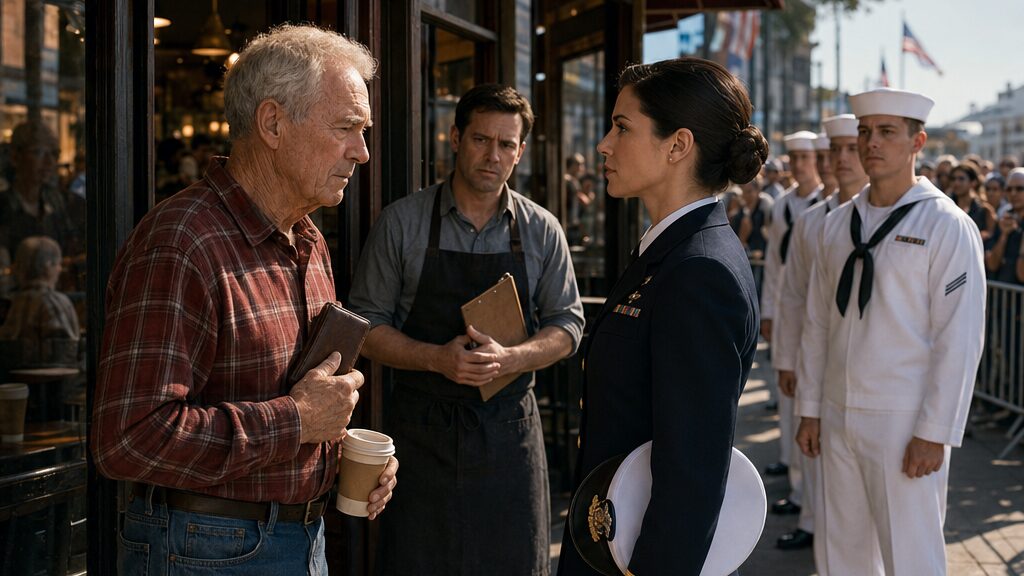
The Old Man in the Red Plaid Shirt Wasn’t Waiting for a Salute
Chapter 1: The Table by the Window Was Already Taken
Frank Bennett wore the red plaid shirt because it was Tuesday.
He did not call it lucky. He did not believe in lucky things anymore, not in the way people meant when they slapped a coin on a counter or touched a dashboard before a long drive. But the shirt was clean, soft at the elbows, and familiar in the shoulders. On Tuesdays, when the weather held and his knees allowed it, he put it on, buttoned it slowly, and walked six blocks to Brenda Cooper’s bistro for coffee at the table by the front window.
The walk was not long. It only felt longer when the town had decided to become important.
By the time Frank turned onto Harbor Street, blue barricades were already leaned against parking meters, and the sidewalks had been marked with little strips of tape. A delivery truck idled near the curb. Two city workers in orange vests were arguing over where to place a temporary sign. Farther down, an American flag moved in a hard morning breeze above the old brick post office, snapping bright and restless against the pale sky.
Frank stopped at the corner and looked at it longer than he meant to.
The flag made a clean sound in the wind. Cloth, rope, metal ring against pole. People usually heard only the pretty part of it. Frank heard knots, pulleys, deck lines, weather turning faster than a man expected.
A young sailor in white passed near him carrying a folded stand. The sailor glanced at Frank, gave the polite half-smile people gave old men who might need directions, and kept moving.
Frank stepped aside to let him pass.
Brenda’s bistro sat midway down the block, its green awning lowered over the sidewalk and its front door propped open with the brass foot of a heavy planter. The chalkboard outside usually read soup, pie, coffee, sometimes a joke if the waitress had been bored. Today the chalkboard had been wiped clean and replaced with a printed sign.
WELCOME NAVY HERITAGE WALK PARTICIPANTS
Frank read it once, then again, though the words did not change.
Inside, the bistro had been rearranged. His table by the window, the small square one with the nick in the left corner, was gone. In its place stood three taller tables pushed together and covered with a white cloth. A tray of pastries sat where Frank usually rested his right hand. Small paper flags had been tucked into a vase.
He remained in the doorway a moment too long.
“Sir?” someone said behind him.
Frank shifted his weight and turned. A woman with a stroller was trying to get past. He stepped out of the way, murmuring an apology, though he had not been fully in her path.
The bell above the door gave a nervous little ring when he entered.
The bistro smelled of coffee and warm butter, but underneath it was the sharp smell of floor cleaner. People moved differently when they expected important guests. Chairs scraped harder. Voices became brighter. The waitress hurried by with a stack of plates and did not see him until she almost clipped his elbow.
“Oh—Frank. Sorry.” She tucked the plates against her hip. “It’s a mess today.”
“I can see that.”
“You want the usual?”
He looked at the window. “If there’s room.”
Her face changed before she spoke, which was kind of her and worse because of it. “They took that table out for the reception setup. Just for today.”
Frank nodded once.
“We have counter seats,” she said. “Maybe. Let me check.”
“No need to fuss.”
“It’s no fuss.”
But she had already looked past him toward the back, where Brian Miller, the manager, was standing with a clipboard and the intense expression of a man who believed a clipboard made his worry official. Brian was younger than he thought he was and older than he wanted to admit, with his sleeves rolled neatly to the forearms and his jaw set tight.
He saw Frank, then the crowded room, then the doorway behind Frank.
“Morning, Mr. Bennett,” Brian said, coming over. “Little busy today.”
“So I gathered.”
“We’re hosting part of the Heritage Walk. Navy group coming through. City folks too.” Brian tapped the clipboard with his pen. “It’s not really a normal seating day.”
Frank could have said he had been coming there before Brian knew the difference between dark roast and dishwater. He could have said that a normal seating day was not a law of nature. He said nothing.
The waitress hovered beside them, holding the plates.
Brian softened his tone, which meant he thought he was doing Frank a favor. “We can get you a coffee to go.”
Frank looked again at the missing table. The white cloth hung too low on one side. Someone had placed the vase too close to the edge.
“To go is fine,” Frank said.
“You sure?” the waitress asked.
“Yes, ma’am.”
She gave him a small frown for the ma’am, the way she always did, and went to fill the cup.
Frank stood near the pastry case, careful to keep his hands at his sides. Behind the counter, cups clicked and machines hissed. On the wall by the register, Brenda had hung framed photographs of the town: fishing boats, the old shipyard gate, a Fourth of July parade from years ago. One photograph showed sailors in white marching down Harbor Street. Their faces were too small to make out. Frank looked away.
Outside, the sidewalk was filling. More sailors gathered near the curb, their dress whites almost painful in the sun. A dark-uniformed officer stood among them, speaking with a city clerk. She had her cap tucked under one arm. Even through the window, Frank could see the way she held herself: straight without stiffness, alert without showing hurry. People either learned that posture or spent their lives pretending to have it.
Her eyes moved across the storefronts, the barricades, the uneven sidewalk, the open bistro door. For a brief moment, they landed on Frank through the glass.
He lowered his gaze first.
“Here you go.” The waitress set a lidded paper cup on the counter. “No charge today.”
Frank reached for his billfold. “Coffee costs money.”
“Frank—”
“Coffee costs money,” he repeated, not sharply.
Brian, passing behind her, sighed just enough to be heard. “Let him pay if he wants to pay.”
Frank placed two bills on the counter and waited for change. The waitress gave him coins and a look that said she wished he would let small kindnesses stay small. He put the coins away one at a time.
The paper cup felt wrong in his hand. Too light. Too temporary.
At his old table, the vase of flags trembled when someone brushed the cloth. One of the little flags leaned toward the window, as if trying to escape.
Frank turned toward the door.
A group of customers entered at the same time, laughing too loudly. Frank stepped back, then sideways. His shoulder caught the edge of a chair. The chair scraped. A man at the counter glanced at him with irritation, then saw his age and changed the expression into something worse: patient tolerance.
“Sorry,” Frank said.
He made it through the doorway and onto the sidewalk.
The morning had grown brighter. Sun flashed off brass buttons and polished shoes. A few people had gathered behind the blue barricades, holding phones before anything had happened. A little boy pointed at the sailors. His mother bent to say something in his ear.
Frank stood just outside the bistro, holding his coffee, not yet sure where to go.
He had planned to sit for twenty minutes. He had planned to watch the street from inside the window, where he could be present without being part of anything. He had planned to go home before the speeches began.
Plans were small promises a man made to himself. It was foolish to resent the world for breaking them.
Down the sidewalk, the officer in the dark uniform finished speaking to the city clerk and looked toward the bistro again. This time there was no glass between them.
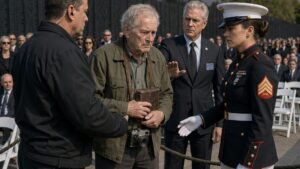
Frank felt an old instinct move through him, almost embarrassing in its strength. Shoulders back. Chin level. Hands still.
Then he caught himself and turned slightly away.
He was only an old man with coffee in a paper cup and nowhere to drink it.
The officer began walking in his direction.
Frank considered crossing the street, but the barricades had narrowed the corner, and a delivery driver was rolling a dolly up the curb. He could not move quickly without looking like he was trying to escape, which annoyed him because that was exactly what he was considering.
The officer stopped near the bistro door, close enough now that Frank could read her nameplate if he allowed himself to look.
“Sir,” she said, professional and even, “we’ll need to keep this section clear in a few minutes.”
Frank nodded. “I’ll be out of your way.”
Her voice was not unkind. That was the trouble. Unkindness was easier to push against. Procedure had no face to blame.
Behind her, sailors in white were forming a line along the sidewalk.
Frank looked down at his red plaid shirt, at the paper cup cooling in his hand, at the place inside the window where his table used to be.
For a moment he wished he had stayed home.
Chapter 2: A Billfold Falls on the Sidewalk
The officer’s name was Lisa Carter.
Frank had read it despite himself when she turned slightly to answer a question from one of the sailors. The letters on her dark uniform were small, bright, and clean. CARTER. He had known a Carter once, though that had been half a life ago and nowhere near this street.
“This stretch has to stay open,” Lisa said to the sailor. “No one blocks the doorway. No one crowds the curb. Keep the line clean when the mayor arrives.”
“Yes, ma’am.”
Frank took a careful sip from the paper cup. The coffee was too hot and tasted faintly of cardboard. He looked toward the corner, measuring his path home. If he walked now, he could be out of the ceremony area before the crowd thickened.
A folding sign blocked the easiest route.
Brian came out of the bistro carrying a roll of blue tape and a worried look. “Frank, you still here?”
“Leaving.”
“Right, good. I mean—not good like that.” Brian glanced at Lieutenant Carter, then at the sailors. “We just can’t have anyone hanging by the entrance. The city wants a clean photo line.”
Frank looked at him.
Brian flushed a little. “You know what I mean.”
“I usually don’t.”
The words came out drier than Frank intended. Brian’s mouth tightened.
“I’m trying to keep this from turning into a mess,” he said. “Brenda’s got press coming. The Navy folks are doing their thing. The mayor’s office changed the schedule twice. I’ve got deliveries stuck two blocks over, and the pastry tray is already short.”
Frank said nothing. He had learned that silence made some men hear themselves. Other men only filled it.
Brian pointed gently with the tape roll. “If you could just move down past the barricade.”
“I said I was leaving.”
“Great. Thank you.”
The officer watched the exchange without interrupting. Her expression remained controlled, but Frank felt the weight of her attention. Not suspicion. Assessment.
He shifted the coffee into his left hand and reached into his back pocket for his billfold, intending to tuck the receipt away before walking. The old leather had molded itself around years of use. It did not slide out cleanly. His fingers, stiff from the morning chill, pulled too hard.
The billfold slipped.
It hit the sidewalk with a flat slap and opened.
Coins scattered. A receipt fluttered under the bistro planter. A small faded card, folded inside the leather for decades, slid out and landed faceup near the toe of a young sailor’s polished white shoe.
Frank’s hand moved toward it faster than the rest of him could follow.
The sailor bent first.
“Got it, sir,” he said.
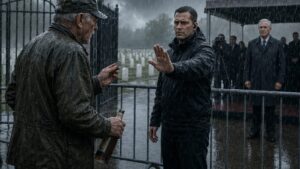
Frank’s voice sharpened. “Leave it.”
The sailor froze.
Everything around them seemed to pause for half a second. Brian stopped unwinding tape. The waitress inside the doorway looked out. Lieutenant Carter turned fully toward Frank.
Frank felt heat rise under his collar. He had not meant to bark. The sailor was only trying to help. He was young enough to still believe help was always welcome.
Frank bent carefully, his right knee protesting, but the sailor was already crouched. The card lay between them.
It was not much to look at. Cream-colored once, now the shade of old bone. The corners had softened. The ink had faded to a tired blue. A stamped date sat crooked in one corner, and beneath it, the name of a shipyard receiving station and a liberty authorization from another era.
The sailor glanced at it before he could stop himself.
Frank saw the glance.
The boy’s face changed with the first flicker of curiosity, then embarrassment. “I’m sorry, sir.”
Frank picked up the card with two fingers and covered it in his palm.
“No harm done.”
His breath had shortened. He kept his face still, but his body had betrayed him. His hand trembled once as he gathered the coins. One rolled toward the curb. Lieutenant Carter stepped forward and placed her boot beside it before it could drop into the gutter.
She bent, picked up the coin, and held it out.
Frank took it. “Thank you.”
Her eyes moved to his closed hand.
Brian tried a laugh that did not find anyone willing to join it. “Old stuff always falls out at the worst time, right?”
Frank put the coin in his billfold.
The young sailor stood. His name tape read REED. He kept his hands at his sides now, uncertain what to do with them.
Lisa looked at him briefly. “Seaman Reed, return to position.”
“Yes, ma’am.”
David Reed moved back into line, but his eyes remained lowered, as if he had stepped on something fragile.
Frank folded the card back inside the billfold, behind the bills, behind the photograph he never showed anyone, behind the grocery list he kept forgetting to replace. He did this with the deliberation of a man locking a door.
Lisa’s voice was quieter when she spoke again.
“Sir, may I ask—was that from the old receiving station?”
Frank did not look at her. “Lot of old receiving stations.”
“Yes, sir.”
Brian glanced between them. “Is everything okay?”
Frank closed the billfold and returned it to his pocket. “Everything’s fine.”
But Lisa had gone very still. Her attention had sharpened into something different from procedure. She was no longer seeing a man in the way of a route. She was fitting a piece into a shape she had not expected to find on a sidewalk.
“The date,” she said.
Frank looked at her then.
She did not finish the question. That was to her credit.
“It was a long time ago,” he said.
Behind Lisa, the sailors in white stood in a line along the curb. Some looked straight ahead. Others, unable to help themselves, watched from the corners of their eyes. The sidewalk crowd had grown, drawn by uniforms and the promise of something official. A woman lifted her phone, saw only an old man, and lowered it again.
Brian checked his watch. “Lieutenant, the mayor’s assistant said they’re five minutes out.”
Lisa did not answer him immediately.
“Mr.—” She stopped. “Sir, your name?”
Frank hated the sudden gap before it. The shift from category to person.
“Frank Bennett.”
Lisa’s face did not change much, but the little it changed mattered. Her jaw eased. Her shoulders, already straight, settled into a different kind of attention.
“Frank Bennett,” she repeated, not loudly.
The name moved through the air between them.
David Reed looked up.
Frank felt the old card in his pocket as if it had weight enough to pull his coat crooked, though he was not wearing a coat. He could still turn away. He could walk past the barricade, down Harbor Street, around the corner, home. He could put the card in the drawer with the unpaid water bill and the spare keys and leave the town to its ceremony.
Lisa spoke again. “Were you assigned to the harbor detail attached to the Sullivan receiving station?”
The bistro noise seemed to fold inward. Cups still clicked. Someone still laughed inside. A gull cried from the roofline, ragged and ordinary.
Frank’s hand closed around the coffee cup.
“Lieutenant,” he said, “I’m just trying to get out of your way.”
Her eyes lowered once, not in defeat, but as if she had heard more in that sentence than he had offered.
Then she held out the coin she had picked up, though he had already taken it. Realizing her hand was empty, she let it fall.
“I understand,” she said.
Brian exhaled, relieved by the word understand because he misunderstood it. “Great. So if we can just clear—”
Lisa turned her head toward him.
“Mr. Miller,” she said.
Brian stopped.
Her tone had not grown louder. It had become exact.
“Give us a moment.”
Brian’s pen hovered above the clipboard. “Sure. Of course.”
Frank looked at the officer’s nameplate again. CARTER.
The flag down the street snapped hard in the wind.
Lisa waited until Brian stepped back. She did not ask the sailors to move. She did not make a show of anything. She simply faced Frank with her cap held against her side, and for the first time that morning, no one treated him like clutter.
“Mr. Bennett,” she said, “may I ask you one question before you go?”
Frank wanted to say no. He had earned the right to say no to questions that came wrapped in old dates.
But the young sailor who had touched the card was watching him with a remorse he did not deserve to carry, and the officer had asked permission.
Frank gave one small nod.
Lisa’s voice lowered.
“Were you there the night of the harbor fire?”
Frank closed his eyes for less than a second.
When he opened them, the white uniforms on the sidewalk were too bright.
Chapter 3: The Officer Asked His Name Differently
Lisa Carter had read the harbor fire record three nights earlier in a room that smelled of dust, toner, and old civic pride.
The Navy Heritage Walk had seemed simple then. A public route, a few stops, a short speech near the old shipyard gate, a tribute to sailors who had served through the town’s busiest years. Her commanding officer had told her the town cared about ceremony. The city clerk had told her the donors cared about photographs. Lisa had told herself those were not reasons to be cynical.
Then she had found the binder.
It sat in the back of the historical room beside a box of water-damaged parade programs. The label on its spine read HARBOR INCIDENTS, 1960–1980. Most of the pages were copies of copies. Some were nearly unreadable. But one report had held her attention: a fuel line fire, a half-loaded utility craft, three injured men trapped below, civilian panic along the quay, young sailors moving before official orders arrived.
Two names had been circled in pencil, probably years later.
One of them was Frank Bennett.
The report had not called him a hero. Reports rarely knew what to do with courage. It said he assisted evacuation. It said he returned to the smoke-filled lower compartment. It said one sailor survived because of actions taken before fire crews reached the pier.
It also said another sailor died before dawn.
Lisa had read the page twice. Then a third time.
Now the man whose name had sat in that brittle report stood in front of her in a red plaid shirt, holding a paper cup, trying to leave without being noticed.
“Were you there the night of the harbor fire?” she asked.
Frank did not answer at first.
Brian shifted near the doorway. “Lieutenant, I don’t think—”
Lisa raised one hand slightly. Not enough to silence him sharply. Enough.
Frank looked at the line of sailors, then at the people beginning to slow on the sidewalk. He saw the phones. Lisa saw him see them.
“I don’t talk about that out here,” he said.
The answer moved through her like an instruction.
Lisa stepped half a pace closer and lowered her voice. “Then we won’t.”
Something in Frank’s face eased, but only slightly.
“I shouldn’t have asked like that,” she said.
“You asked better than most.”
Behind her, Seaman Reed stood so rigid he looked carved. Lisa glanced back at him.
“Reed,” she said, “eyes front.”
“Yes, ma’am.”
His chin lifted.
Brian was trying to read the moment and failing. His discomfort made him busy. He bent to move the folding sign two inches, then moved it back.
Frank tucked the coffee cup against his chest with both hands, warming his fingers around it. The lid had loosened when he dropped his billfold. A thin line of coffee had run down one side and cooled near his thumb.
Lisa looked at his hand. Noticed the tremor. Looked away before noticing became staring.
“Mr. Bennett,” she said, “may I return something to you properly?”
He frowned.
“The card,” she said. “If you allow it.”
Frank’s mouth tightened. “It’s already put away.”
“I understand.”
She waited.
The sidewalk noise pushed around them. A car horn sounded at the next block. A gull dropped onto the roof of a parked sedan and strutted as if it owned the day. Inside the bistro, the waitress stood still with a towel in her hand.
Frank drew in a breath through his nose.
“It’s just an old liberty card.”
“No, sir,” Lisa said softly. “It is not just anything if it made you reach for it that fast.”
The words could have been too much. She knew it as soon as she said them.
Frank’s eyes sharpened, and for a second she thought he would walk away. He had every right. A stranger had no claim on the contents of his pocket or the weight of his memories.
Instead, he pulled out the billfold.
His fingers opened the leather slowly. He removed the card and held it flat in his palm.
Lisa did not take it.
She asked, “May I?”
The question changed the air more than the card had.
Frank looked at her for a long moment. Then he extended his hand.
Lisa took the card with both hands.
It was lighter than she expected. Thin, worn, nearly soft. The stamped date matched the one in the report. The shipyard name had faded, but the authorization number was still visible. So was the signature of an officer long dead.
She felt, absurdly, as though she should not breathe too hard near it.
Brian’s face had gone uncertain. “Is that… military?”
Frank gave him a dry look. “No, Brian. It’s a lunch coupon.”
A few people nearby chuckled before they caught themselves. Frank did not smile.
Lisa read the name, though she already knew it.
“Bennett, Frank,” she said.
This time she did not say it like a formality. She said it like a correction to the morning.
Frank’s eyes lowered.
Lisa straightened.
She did not salute. Not yet. Not on a crowded sidewalk, not while holding a private object, not before she understood what the man wanted. Instead, she shifted her cap under her arm, brought the card closer to her chest, and spoke with a care that made the people nearest them quiet.
“Mr. Bennett, I owe you an apology. I treated this as a route problem.”
“You were doing your job.”
“That may explain it,” she said. “It does not excuse the part I got wrong.”
Brian looked down at his clipboard.
Frank’s expression did not soften into forgiveness. It did something harder to watch. It held.
Lisa turned slightly so Brian could hear without being publicly dressed down. “Mr. Miller, please make sure no one asks Mr. Bennett to move again unless he chooses to.”
Brian swallowed. “Of course.”
“And no one photographs that card.”
The woman with the phone lowered it quickly.
Frank noticed. Lisa wished he had not needed to.
He reached for the card, and Lisa placed it back into his hand as carefully as if returning a folded flag, though she made no ceremony of it. Her fingers did not brush his.
Frank slid it into the billfold.
For a moment, all the movement around them seemed to belong to other people.
Then David Reed stepped out of line.
Lisa turned. “Seaman Reed.”
His face reddened. “Ma’am, permission to apologize.”
Lisa considered him. “Briefly.”
Reed faced Frank. He was young, too young to know that apology did not always lighten what it touched.
“I shouldn’t have looked at your card, sir,” he said. “I was trying to help, but I shouldn’t have looked.”
Frank studied him.
“No,” he said. “You shouldn’t have.”
The sailor’s face fell.
Frank took another breath. “But you stopped it from blowing under a car.”
Reed blinked.
“So thank you.”
“Yes, sir.”
The young man returned to line changed by a small mercy.
Lisa looked at Frank again. “The Heritage Walk today includes the harbor fire.”
Frank’s jaw moved once.
“They have your name in the record,” she continued, “but no one told us you were living here.”
“No one asked me.”
The sentence struck harder because it was plain.
Lisa had no answer good enough.
From inside the bistro, Brenda Cooper appeared at the doorway. She was wiping her hands on an apron though her hands were already clean. Her eyes moved from Lisa to Frank to Brian’s lowered clipboard.
“Frank?” she said. “What’s going on?”
Frank did not turn around. “Nothing that needs a crowd.”
Lisa heard the warning in it.
She nodded once. “Then we move this inside.”
Brian looked startled. “Inside? We’re packed.”
Brenda touched his arm before he could say more. “We’ll make room.”
Frank shook his head. “I don’t need room.”
“No,” Brenda said quietly. “But maybe we should have made it anyway.”
That landed badly because it landed true.
The crowd outside pretended not to listen. The sailors held formation. The American flag down the street cracked in the wind like a sudden command.
Lisa stepped aside, leaving the path open rather than directing him.
“Mr. Bennett,” she said, “you can leave if you want. Or you can come inside where it’s quieter. No speeches. No photographs. No questions unless you allow them.”
Frank stared at the open bistro door. Beyond it, the white cloth still covered his missing table. The little paper flags still leaned in the vase.
His face had gone pale beneath the weathering.
At last he said, “That record never told the part that mattered.”
Lisa did not ask what part.
Not there.
Not with the sidewalk watching.
She only said, “Then we won’t pretend it did.”
Frank looked at her for a long time, the old billfold closed in his hand, his red plaid shirt bright and ordinary beneath the noon sun.
Then he stepped toward the doorway.
Chapter 4: The Part the Record Left Out
The back room of Brenda Cooper’s bistro had never been meant for privacy.
It was a narrow rectangle between the kitchen and the alley door, with metal shelves on one side and a desk on the other. Boxes of napkins were stacked under a framed health certificate. A calendar from the seafood supplier hung crooked above the desk, still turned to the wrong month. Every few seconds, the kitchen door swung open and let in the clatter of plates, the hiss of steam, or a burst of voices that stopped when whoever entered remembered Frank Bennett was sitting there.
Brenda had brought in a wooden chair from the dining room and wiped it twice before offering it to him. Frank sat because his knee had begun to throb, not because he wanted to be treated like a guest of honor in a storage closet.
Lisa Carter stood near the desk, cap in both hands. She had removed herself from the front sidewalk with visible reluctance, leaving one of the sailors in charge of the line. Brian lingered near the door until Brenda looked at him long enough for him to find something urgent to do elsewhere.
Frank held his coffee, though it had cooled beyond saving.
“Would you like a fresh cup?” Brenda asked.
“No.”
“Water?”
“No, thank you.”
She folded her hands at her waist. Frank knew that look. It was the face people wore when apology was forming but pride was still deciding what shape to allow.
“I should’ve had a place for you,” Brenda said.
Frank looked at the boxes of napkins. “You had a place for the pastry tray.”
Her face tightened, then accepted the hit. “Yes. I did.”
Lisa lowered her gaze to the card in Frank’s hand. He had not put it away since they came inside. He held it against his billfold with his thumb, as if any draft might steal it.
“I won’t ask to see it again,” Lisa said.
Frank glanced at her. “You already did.”
“I did.”
“And you were careful.”
“I should have been careful sooner.”
He did not answer.
The kitchen door swung open. The waitress stepped in with a small plate she had no business carrying: two slices of pound cake, untouched, the edges too clean. She saw the room and hesitated.
“I thought maybe—”
Brenda took it gently. “Thank you.”
The waitress left. No one reached for the cake.
Outside, faint through the walls, a voice tested a microphone. It gave a low squeal, then a hollow thump. Someone laughed nervously.
Frank closed his eyes.
Lisa heard it too. “They’re starting the first stop.”
“Then you should be out there.”
“I have a few minutes.”
“You people always have a few minutes right before you don’t.”
She almost smiled. Almost. Then the seriousness returned. “Mr. Bennett, I don’t want to turn you into part of the program.”
“That’s good.”
“But I need to know whether the record is accurate before anyone repeats it today.”
Frank looked up sharply.
Lisa continued before he could object. “Not because I want your story. Because if they already have your name in the material, and it’s wrong, they may say it wrong in public.”
That reached him.
Brenda shifted. “Your name is in the program?”
“Not the printed public program,” Lisa said. “In the historical notes prepared for the speakers. I saw the binder at the city archive. The Heritage Walk includes the old harbor fire.”
Frank turned the liberty card over, though there was nothing on the back but age.
“Figures,” he said.
Brenda’s voice softened. “Frank, I didn’t know.”
He gave a short breath that was not quite a laugh. “Most people don’t know what they don’t ask.”
The words left the room still.
Brenda looked down.
Lisa waited.
Frank disliked waiting when it was done well. Bad waiting applied pressure. Good waiting made a man responsible for his own silence.
“The report says a fuel line caught,” he said at last. “That part’s true.”
Lisa did not move.
“Utility craft tied up off Pier Three. Late watch. Rain coming sideways. Everyone thought the weather was the trouble until it wasn’t. Fire got under the deck fast.” He rubbed his thumb along the card’s edge. “There were three men below.”
“The report says you assisted evacuation.”
“The report says a lot with small words.”
Brenda had gone very still.
Frank looked at the closed alley door. He did not see it. The room changed around him, shelves becoming bulkheads, the floor becoming slick steel, the air thick with heat and smoke and shouted orders cut short by coughing.
“I was nineteen,” he said. “Old enough to think fear was something you beat by pretending not to have it.”
Lisa’s face did not change, but her hands tightened around her cap.
“There was another sailor,” Frank said. “Richard Hayes.”
Brenda glanced at Lisa, perhaps because the name came too suddenly, too plainly, like a person entering the room.
Frank held up one finger slightly, not for drama, but to keep the memory in order. “Richard was the one who saw the hatch was blocked. He was the one who heard them below. He went first. I followed because he went first.”
The microphone outside squealed again, then steadied into a voice welcoming visitors to Harbor Street.
Frank swallowed.
“The record says I returned to the lower compartment. It doesn’t say Richard shoved me back through the smoke when the frame buckled. Doesn’t say he was laughing when he did it, like I’d made some stupid mistake in a card game. Doesn’t say he told me to move, Bennett, before I could turn around.”
The card bent slightly under his thumb. He loosened his grip.
Lisa spoke carefully. “He didn’t make it out.”
“No.”
The word had no decoration. It did not need any.
Brenda touched the edge of the desk as if steadying herself.
Frank looked at Lisa. “So if some city man stands out there today and says I saved three men, he’ll be wrong. Richard saved four, if you count me.”
Lisa drew in a slow breath.
“Is his name in the material?” Frank asked.
“I remember seeing Hayes,” she said. “But not in the speech draft. I think he was in the casualty note.”
Frank nodded once, as if he had expected no better.
Brenda’s eyes shone, but she did not cry. Frank appreciated that more than she knew.
“I kept the card because Richard signed me out that afternoon,” he said. “We had liberty. Supposed to go into town, get burgers, maybe act richer than we were. Fire happened before we made it past the gate.” He looked down at the faded paper. “His handwriting’s on the back fold. Most of it wore off.”
Lisa’s attention sharpened. “May I ask one thing?”
Frank waited.
“Not to take it. Just to understand.”
He turned the card over and tilted it toward her. In the crease, nearly lost beneath grime and years, a few dark strokes remained. Not a full name. Not even enough for someone else to recognize. But Frank knew the hand. He had known it for fifty-five years.
Lisa did not reach out. She only looked.
“Thank you,” she said.
The kitchen door opened a crack. Brian appeared, then stopped when he saw the room.
“Sorry,” he said. “The mayor’s assistant is asking whether Lieutenant Carter is needed outside.”
Lisa did not look away from Frank. “Tell them I’ll be there shortly.”
Brian nodded, but his eyes had moved to the card. For the first time that day, he did not look impatient. He looked young and out of place.
Frank slid the card back into the billfold and closed it.
“That’s all,” he said.
Lisa nodded. “That’s enough.”
“No,” Frank said. “It isn’t. But it’s all I’m giving you.”
Brenda turned away for a moment and busied herself with the untouched plate of cake. When she faced him again, her voice was steadier.
“What do you want us to do?”
Frank almost said nothing. It was the answer he trusted most. Nothing made no promises. Nothing did not grow into speeches.
Then he thought of Richard Hayes reduced to a casualty note while Frank’s name sat circled in pencil.
“If they say the story,” Frank said, “they say his name right.”
Lisa straightened, not formally this time, but personally. “They will.”
“And don’t make me stand up there.”
“I won’t.”
Brenda nodded. “No one will.”
Frank looked at each of them, measuring whether they understood the difference between agreement and obedience. He was not sure yet.
Outside, applause rose for something small and official.
Lisa put her cap back under her arm.
“The main stop at the old shipyard gate is in less than an hour,” she said. “The harbor fire is supposed to be mentioned there.”
“Then you’d better get them to mention it right.”
“I will.”
Brian, still at the doorway, cleared his throat. “Frank?”
Frank turned.
Brian’s grip on the clipboard had loosened. “I’m sorry about earlier. The doorway. The clean photo line.”
Frank studied him. Brian looked as if he wanted punishment because punishment would tell him when the moment was over.
“Don’t apologize to get comfortable,” Frank said.
Brian flinched slightly.
Frank stood slowly, using the chair back without asking permission from his knee or anyone else.
“Just do better next time you see somebody standing where you didn’t plan for them.”
Brian lowered his eyes. “Yes, sir.”
Frank did not correct the sir. He did not accept it either.
Lisa opened the back-room door for him. Not because he could not open it. Because this time someone had noticed he was carrying more than a paper cup.
Frank stepped toward the dining room, the billfold back in his pocket, the old card against his hip, Richard Hayes’s nearly vanished handwriting following him like a hand at his back.
Chapter 5: No One Clears the Doorway Again
Brenda Cooper had owned the bistro for twelve years, which was long enough to know that a dining room could lie.
From the counter, everything looked warm and generous. Sunlight in the window. Coffee in white cups. People leaning over small tables as if the world outside had agreed to wait. The framed photographs on the walls told a story of community: fishing boats, parades, old shipyard workers in caps, children waving flags from curbs.
But that afternoon, after Frank Bennett walked out of the back room and returned to the public part of the bistro, Brenda saw the room differently.
She saw his missing table.
She saw the white cloth she had thought looked festive. She saw the pastry tray sitting on the spot where Frank usually rested his folded hands. She saw the little paper flags in the vase and remembered how proud she had been of them that morning.
Frank paused near the dining room entrance as if he had forgotten why he was there.
“Your coffee’s cold,” Brenda said.
He gave her a look. “It had ambitions once.”
The waitress made a small sound, half laugh and half relief.
“I’ll get you a fresh one,” Brenda said.
“I said I didn’t need—”
“I heard you.” She moved behind the counter. “This one isn’t because you need it.”
Frank let that stand.
Brian was near the front, speaking quietly with the city clerk. The clerk’s expression had the brittle panic of someone whose schedule had encountered a human being. Through the window, Lieutenant Carter stood under the awning with her phone to one ear, her posture controlled but her face intent. The sailors remained in position along the sidewalk, their line adjusted so the bistro doorway was no longer blocked.
No one had told them to stand differently in a way Brenda could hear. Somehow, they had.
Brian finished with the clerk and came back to the counter. His clipboard was still in his hand, but now he held it against his thigh instead of in front of his chest.
“The mayor’s assistant wants to know if Frank is willing to be acknowledged at the shipyard gate,” he said.
“No,” Frank said.
Brian nodded too quickly. “Right. I told them probably not.”
“No probably.”
“Right.”
Brenda set a fresh cup in front of Frank. Not paper. A white ceramic cup on a saucer. She saw his eyes move to it, then away.
The waitress cleared her throat. “I can move the pastry table.”
Frank looked toward the window.
“No,” he said. “Don’t rearrange the whole day because I’m touchy.”
Brenda leaned both hands on the counter. “You are not touchy.”
That made him almost smile, but not enough to call it one. “Brenda, I have spent seventy-four years becoming touchy.”
“You know what I mean.”
“I do.”
The honesty of that quieted them.
Outside, Lisa ended her call and stepped in. A few customers turned to look at her. Uniforms did that to rooms. Brenda had watched it all morning: the instinctive straightening, the curious glances, the little hush that followed authority. Frank had walked through the same room for years in his red plaid shirt and had produced no hush at all.
Lisa stopped just inside the door. She did not look for a stage. She looked for Frank.
“They’re changing the remarks,” she said.
Frank held the cup but did not drink. “Changing how?”
“Richard Hayes will be named in the harbor fire section. You will not be asked to come forward. Your name will not be added to the public remarks unless you give permission.”
He nodded once.
“The city clerk also asked whether you would be willing to stand with the sailors for a photograph.”
“No.”
“I already told her no.”
That answer settled something in the room.
Brian shifted. “There is a concern,” he said carefully, “that if people find out afterward that you were here, they’ll say we ignored you.”
Frank looked at him. “You did.”
The words were not loud. They did not need to be.
Brian looked down.
Brenda felt the sting of it too, because it belonged to all of them. “Then we don’t fix it by using you to prove we didn’t.”
Lisa’s eyes moved to Brenda with quiet approval.
Brian rubbed the back of his neck. “I’m not trying to use him.”
“I know,” Brenda said. “That’s why I’m saying it before you accidentally do.”
The waitress came from behind the counter and began removing the extra napkins from the tall table by the window. Frank watched her.
“I said don’t move it.”
She froze.
Brenda waited.
Frank put the cup down. “People are coming for your event. Let them have their pastry table.”
“It’s not the table,” the waitress said. “It’s the chair.”
Frank frowned.
She pulled one chair from the back hallway and set it near the window, not at the table, not in display, just angled where a person could sit without being in the way.
“In case someone needs it,” she said.
Frank looked at the chair for a long moment.
Then he said, “Someone might.”
No one smiled too broadly. Brenda was grateful.
Lisa stepped closer to Frank. “There is something else.”
“I was afraid of that.”
“The sailors outside know only that the route changed and that they are to maintain respect around this doorway. They do not know your story.”
“Good.”
“I intend to keep it that way unless you say otherwise.”
Frank studied her. “But?”
“But Seaman Reed knows he saw the card. He asked if he should be removed from the formation.”
Frank’s eyebrows drew together. “For helping pick up what I dropped?”
“For mishandling a private item.”
“He apologized.”
“Yes.”
“Then he learned something. Leave him be.”
Lisa nodded slowly. “I will.”
That, Brenda thought, was the first time Frank had directed the day rather than merely endured it.
The city clerk appeared at the doorway, half in and half out. “Lieutenant Carter? We really do need to start moving toward the gate.”
“In a moment,” Lisa said.
The clerk’s smile strained. “Of course, but the mayor—”
Lisa turned fully. “The remarks will include Richard Hayes?”
“Yes, we’re adjusting—”
“Not adjusting. Including.”
The clerk blinked. “Including. Yes.”
“And Mr. Bennett will not be approached by press, staff, or guests.”
The clerk glanced into the bistro, found Frank, and looked quickly away. “Understood.”
Frank’s jaw tightened at being seen and avoided in the same motion.
Brenda walked to the doorway before she had decided to. She kept her voice low enough for the clerk but clear enough for Brian and the nearest customers.
“And no one will refer to him as a local color piece,” she said.
The clerk flushed. “I didn’t—”
“I’ve hosted enough town events to know the phrases.”
Brian looked at Brenda then, not wounded, but startled. As if he had not realized she could sound like that.
The clerk nodded, chastened, and left.
For a few seconds, only the bistro sounds remained.
Frank lifted his cup. “You’re going to get yourself taken off the holiday committee.”
“I’ve been trying for years.”
This time he did smile, briefly.
Lisa checked the sidewalk, then returned her attention to him. “Mr. Bennett, I need to join the formation.”
“Then go.”
“If anything changes, Brenda knows how to reach me.”
“Nothing’s changing.”
Lisa seemed to consider that, then said, “Sometimes things already have.”
Frank looked away first.
She did not force a response. She put on her cap, stepped outside, and resumed command with no raised voice. Through the glass, Brenda watched the sailors respond immediately. One order, quiet and clean, passed down the line. The formation adjusted again, leaving the bistro doorway open as if it had always deserved space.
Brian stood beside Brenda at the window.
“I messed that up,” he said.
“Yes.”
He winced. “You could soften it a little.”
“I could.”
Frank sat in the chair near the window, not his old table, not the ceremonial one. He held the cup with both hands. The red plaid of his shirt stood out against the white tablecloth beside him, stubbornly ordinary.
“What do I do now?” Brian asked.
Brenda watched Frank watch the sailors.
“You stop trying to turn sorry into a speech,” she said. “You pay attention.”
Outside, the formation began moving down Harbor Street toward the old shipyard gate. The crowd followed. Phones lifted. Flags fluttered. The town poured itself toward the official place where it believed history would happen.
Frank stayed by the window.
After a while, he reached into his pocket and touched the billfold, as if checking that the past had not slipped out again.
Then Lisa Carter, halfway down the block, stopped and looked back toward the bistro.
She did not wave.
Frank did not wave either.
But Brenda saw him sit a little straighter, and she understood that something had been left unfinished on purpose.
Chapter 6: The Sidewalk Went Quiet Before He Stepped Out
By late afternoon, the bistro had grown quiet in the way a room grows quiet after holding too many voices.
The pastry tray was half empty. Coffee rings marked the white cloth. A paper flag had fallen from the vase and lay flat beside a crumb of pound cake. Outside, the crowd had thinned, though people still drifted along Harbor Street in clusters, carrying pamphlets from the Heritage Walk and speaking in lowered, satisfied tones.
Frank had not gone home.
He had told himself he stayed because his knee was stiff. Then because the sidewalk was crowded. Then because leaving by the back alley would seem foolish when the front door was right there. He had used up three excuses and was working on a fourth when Brenda set a small glass of water beside his coffee cup.
“You missed the remarks,” she said.
“I intended to.”
“They said Richard Hayes.”
Frank looked at the window.
“They said it right,” Brenda added.
He nodded once, and if his hand tightened on the arm of the chair, she did not mention it.
A few minutes later, Lisa Carter returned.
She came in alone at first, cap under her arm, the edge of the day showing in her face. Her uniform remained precise, but the person inside it looked as if she had been carrying more than schedule and ceremony. She paused near the door until Frank looked up.
“Mr. Bennett.”
“Lieutenant.”
“I wanted to tell you before you heard it from someone else. The city clerk removed your name from the remarks entirely. Richard Hayes was named as one of the sailors whose actions saved lives during the harbor fire.”
Frank’s eyes stayed on her. “One of?”
Lisa nodded. “One of.”
He sat back slowly. “Good.”
“There was no speech about you.”
“Better.”
“There were people who asked questions.”
“I imagine.”
“I did not answer them.”
He looked down at the cup. “Best answer there is sometimes.”
Lisa’s hand moved to her pocket, then stopped. “I have something of yours.”
Frank’s expression sharpened.
“Not the card,” she said quickly. “You have that.”
From her pocket she took a small folded photocopy, creased once. She placed it on the table near him but did not push it closer.
“The archive had a clearer scan of part of the record. I asked for a copy of the page with Richard Hayes’s name. I thought you might want it. If not, I’ll take it back.”
Frank did not touch it.
Brenda, from behind the counter, lowered her eyes and pretended to wipe a spotless surface.
The paper sat between Frank and Lisa like something warm enough to burn.
“I didn’t ask for that,” he said.
“No.”
“People bring old men papers like they’re bringing bones to a dog.”
Lisa absorbed that without flinching. “I’m sorry.”
He hated that she sounded as if she meant it.
“Why bring it then?”
“Because the copy at the archive had his name spelled correctly. And because the public record here may not be something you trust, but it still belongs partly to you.”
He stared at the folded page.
“And,” she said, “because I wanted to ask permission before the sailors leave.”
Frank looked up. “Permission for what?”
Lisa glanced toward the sidewalk.
Frank turned his head.
Through the bistro window, he saw them.
The sailors in white stood along the sidewalk, not in the formal marching line from earlier, but in two quiet rows that left the doorway open. David Reed was near the front. Behind them, the American flag down the street moved in the weakening light. No microphone stood nearby. No mayor. No clerk. No photographer arranged them. A few passersby had slowed, sensing something, but no one seemed to know what.
Frank’s hand went to the arm of the chair.
“No,” he said softly.
Lisa did not move. “They don’t know the story.”
“Then why are they standing there?”
“Because I told them this doorway deserved respect before we left.”
“That sounds like a story.”
“It is an instruction.”
Frank looked at her sharply.
She held his gaze. “I also told them an older gentleman inside had shown more patience today than we had earned. That is all.”
He breathed once, shallowly.
“They are not here to claim you,” Lisa said. “They are not here to put you on display. If you want us to leave, we leave.”
Brenda came from behind the counter but stopped several feet away.
Brian stood near the kitchen door, quiet for once.
Frank looked from face to face. He disliked being watched. He disliked even more that none of them were pushing him. Pressure he knew what to do with. Respect left room, and room required a man to choose.
“What happens if I walk out?” he asked.
Lisa’s voice softened. “Nothing you don’t allow.”
“Dangerous promise.”
“Yes, sir.”
He looked back through the window. David Reed’s face was forward, but Frank could see the boy trying not to hope for anything. The line of white uniforms seemed almost unreal against the everyday sidewalk: parking meters, taped signs, a trash can, the bistro awning with one corner faded by sun.
Frank reached into his pocket and touched the billfold.
The card was there.
So was the folded grocery list. So was the old photograph. So was the part of his life no record had held correctly until a young officer bothered to ask.
He picked up the photocopy and unfolded it.
The page was not dramatic. It was a report, typed unevenly, with official language that made fear sound tidy. But near the lower middle was the name.
HAYES, RICHARD.
Frank read it once. Then again. The letters held. They did not fade under his eye.
He folded the paper carefully and placed it inside his billfold beside the liberty card.
Then he stood.
Brenda stepped forward, then stopped herself. Frank appreciated that. He put one hand on the table, waited for his knee to agree to the plan, and walked toward the door.
Brian moved to open it.
Frank paused.
Brian froze with his hand near the handle.
“May I?” Brian asked.
The question was clumsy and late and exactly right.
Frank nodded.
Brian opened the door and stepped back, not into the path, not into the moment, just back.
The street air came in cool from the harbor.
Frank crossed the threshold.
The sidewalk went quiet before he had both feet outside.
No one barked an order. No heels cracked hard against pavement. The sailors were already standing straight, and yet somehow they straightened more. Lisa stepped out behind him and moved to the side, leaving Frank facing the line rather than her authority.
David Reed stared ahead, jaw tight.
Frank looked at the young faces. Some barely old enough to shave cleanly. Some trying to look older by holding still. He remembered being nineteen and stupid with fear, following Richard Hayes into smoke because Richard had moved first.
His throat tightened.
Lisa stood before him now, not too close.
“Mr. Bennett,” she said, and her voice carried only because the sidewalk had chosen to listen, “we are leaving Harbor Street. Before we do, I wanted to ask whether we may acknowledge the respect owed to this doorway, this town, and the men who served before us.”
Frank looked at her for a long moment.
“You always talk that careful?”
“When it matters.”
He almost smiled.
Then he looked past her at the sailors. “You said they don’t know.”
“They don’t.”
“Keep it that way.”
“Yes, sir.”
He took one step forward.
Lisa did not salute. She waited.
Frank lifted his right hand, but not to return anything formal. He extended it toward her, palm angled, fingers worn and slightly bent.
For a heartbeat Lisa looked at the hand as if she understood what it cost.
Then she stepped forward and took it.
No applause came. That was why Frank could bear it.
Her grip was firm, brief, human.
“Thank you,” she said, low enough that it belonged to him.
Frank held her gaze. “Say his name when it matters.”
“I will.”
Behind her, David Reed’s eyes shone, but he kept his face steady.
Frank released Lisa’s hand and turned slightly toward the line.
He did not make a speech. The words he had carried for Richard were not sidewalk words, not crowd words. Instead he nodded once to the sailors, a small motion from an old man in a red plaid shirt.
Every sailor held still.
Then Frank looked at David Reed.
“You,” he said.
The young sailor’s eyes flicked to Lisa.
She nodded.
“Yes, sir?” Reed said.
Frank gestured toward the chair just inside the doorway. “Come sit a minute before you march off and pretend your feet don’t hurt.”
A faint ripple moved through the line, not laughter exactly, but release.
Reed looked stunned. “Ma’am?”
Lisa’s mouth softened. “Go ahead.”
Frank turned back toward the bistro.
He did not take the microphone because there was none. He did not stand before the flag. He did not let anyone turn him into a story with clean edges.
He simply walked inside, leaving the door open behind him, and waited for the youngest sailor to follow.
Chapter 7: Respect Stayed After the Uniforms Left
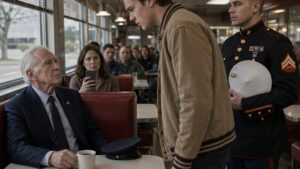
David Reed sat in Frank’s chair by the window as if it might break beneath him if he trusted it too quickly.
He kept his cap on his knee and his back straight. His white uniform looked too bright for the bistro now that the sunlight had thinned. Across from him, Frank lowered himself into the chair Brenda had pulled from the corner and set his billfold on the table between them, not open, not offered, simply present.
The sailors outside had begun to move again. Their formation loosened by degrees as orders carried them toward the end of the Heritage Walk. Boots struck pavement, then softened with distance. A few people on the sidewalk lingered, trying to understand whether they had missed something important.
They had.
That was all right with Frank.
David looked at the billfold, then at Frank. “Thank you for letting me sit, sir.”
“Your feet hurt?”
“No, sir.”
Frank gave him a look.
David lasted three seconds. “Yes, sir.”
“Then start there next time.”
The young sailor smiled despite himself, then dropped it quickly, unsure whether he had permission.
Frank lifted his coffee cup. “A man can stand straight and still tell the truth.”
David considered that as if it had been written into orders.
Brenda set a fresh plate on the table. Two pieces of pound cake this time, each with a fork. Frank raised an eyebrow.
“It was going stale,” she said.
“It was baked this morning.”
“Fast morning.”
David looked between them and wisely said nothing.
Near the counter, Brian spoke quietly with Lisa. Frank could not hear every word, but he saw Brian nod more than once. Not the quick nod of a man trying to escape discomfort. A slower one. Listening took longer than agreeing.
Lisa removed something from her pocket and gave it to Brian. A folded copy of the corrected remarks, maybe. He held it with both hands.
Frank looked away before he could be caught watching.
David cleared his throat. “Mr. Bennett?”
“Frank.”
The sailor hesitated. “Frank.”
It sounded strange in his mouth, like he was handling a tool he had never been trained to use.
“I didn’t know there were people like you still around town,” David said, then flushed. “I mean—veterans from then. People connected to the old shipyard.”
“There are people like everybody still around. Mostly trying to buy coffee.”
“Yes, sir.”
“Frank.”
“Yes, Frank.”
The correction landed gently, but it landed.
Frank broke off a small piece of pound cake with his fork. He had not meant to eat any. The sweetness surprised him.
David looked toward the window. “Lieutenant Carter said we weren’t to ask questions.”
“She’s smart.”
“So I won’t.”
Frank chewed, swallowed, and let the silence sit. The boy’s effort not to ask was almost painful.
“Richard Hayes,” Frank said at last.
David’s eyes returned to him.
“That’s the name you remember if anybody asks why this doorway mattered today.”
David nodded. “Richard Hayes.”
“Not loud. Just right.”
“Yes, Frank.”
The old billfold rested between them. Frank touched it once, then left it closed.
A week later, Tuesday arrived without ceremony.
Frank wore the red plaid shirt because it was Tuesday, because it had been washed and dried and hung over the back of a kitchen chair, because his hands had reached for it before he had decided whether he wanted to go out.
The town had returned to itself. The barricades were gone. No sailors lined Harbor Street. No city clerk hurried along the sidewalk with a folder pressed to her chest. The American flag still moved above the post office, but today it made only the sound of cloth in wind.
Frank stopped at the corner and looked at Brenda’s bistro.
The chalkboard was back.
Soup. Pie. Coffee.
Underneath, in smaller handwriting, someone had written: Hold the door when you can.
Frank stared at that for a while.
Inside, the bell rang when he entered. The waitress looked up and smiled without surprise.
“Morning, Frank.”
“Morning.”
The room had its usual shape again. The tall tables were gone. The white cloth was gone. The vase of paper flags had disappeared. His table by the window was back in its place, the nick in the corner visible, the chair angled slightly outward the way he liked it because his knee did not bend well in tight spaces.
There was no sign on it.
No reserved card. No ribbon. No little flag.
Just a cup turned upside down on the saucer, waiting.
Brian stood behind the counter.
For a moment neither man spoke.
Then Brian picked up the coffee pot. “Usual?”
Frank removed his cap. “If you’ve got it.”
“I’ve got it.”
Brian came around the counter himself. He poured the coffee at the table, not too full, leaving the small space at the top Frank preferred but had never told him about. Then he set down a small plate with one plain biscuit.
Frank looked at it. “I didn’t order that.”
“No.”
“Brenda making you give away the store?”
“She said if I called it an apology biscuit, you wouldn’t eat it.”
“She’s right.”
“So it’s a biscuit that needed somewhere to go.”
Frank considered this. “Well. Waste is a sin.”
Brian’s shoulders eased.
Frank sat slowly. Brian did not reach to help. He only waited until Frank was settled, then stepped back.
“Mr. Bennett,” he said, then stopped. “Frank.”
Frank looked up.
Brian’s face carried the awkwardness of a man trying not to make his decency too visible. “I cleared the doorway this morning before we opened. There was a delivery sign blocking half the walk.”
“Good.”
“And I moved the extra chair back near the window. Not for you. Just in case someone needs it.”
Frank lifted his cup. “Someone might.”
Brian nodded once and returned to the counter.
Frank drank his coffee.
For a while, nothing happened. That was the best part. People came in and ordered. A delivery driver dropped off bread. The waitress laughed at something near the register. A child pressed both hands to the pastry case and was gently corrected by a tired mother. The old bistro breathed around him.
Frank opened his billfold under the table.
The liberty card was there, soft at the fold. Beside it was the photocopied line from the report, trimmed now to fit: HAYES, RICHARD. The ink was not old. The paper was not precious. Still, he kept it carefully.
He closed the billfold before memory could pull too hard.
Near noon, the bell over the door rang again.
A young sailor stepped inside. Not David Reed, but another one, in working uniform this time, holding the door for an elderly woman with a cane who had been reaching for it behind him.
“After you, ma’am,” the sailor said.
The woman smiled, surprised by the space he gave her.
Frank watched from the window table.
The sailor did not know anyone was watching. That mattered. He held the door until the woman was safely inside, then stepped aside again so she could choose where to go.
Brian came from behind the counter. “Take your time,” he told her. “No hurry.”
Frank lowered his eyes to his coffee.
The red plaid sleeve rested against the table, ordinary as ever. Sunlight touched the worn cuff. Outside, Harbor Street moved on with its errands, its weather, its small impatiences and smaller mercies.
Brenda emerged from the kitchen and saw him looking at the doorway.
“Everything all right?” she asked.
Frank looked at the coffee, the window, the chair no one had labeled, the young sailor who had already forgotten his good deed because he had simply done it.
“Yes,” he said.
And for once, it was close enough to true.
The story has ended.