The Old Veteran Touched One Helicopter Panel, And The Young Soldier Nearly Ordered Him Away
Chapter 1: The Old Man Beside The Helicopter
Richard Bennett had not meant to touch the helicopter.
He had promised himself at the gate that he would keep his hands folded, take the visitor badge Donna Harris gave him, stand where the chairs were arranged, nod when people spoke too loudly to him, and leave before the sun made the concrete shimmer white. He had even chosen his cleanest blue coveralls because they still looked plain enough for a man who did not want attention.
But the moment he saw the aircraft parked beyond the hangar doors, every promise became thin.
The helicopter sat on the flight line with its nose pointed toward the runway and its rotors still as church rafters. Its green skin had been washed for the open-house ceremony, but no amount of polish could hide what it was. A workhorse. A box of noise and vibration and oil. A machine that asked men to trust bolts, weather, training, and one another.
Richard stopped at the edge of the painted line.
Around him, families moved in small clusters. Children pointed at the rotor blades. A woman in a veterans outreach vest checked names on a clipboard near a row of folding chairs. Somewhere behind the hangar, a generator coughed and settled into a steady growl.
Richard hardly heard any of it.
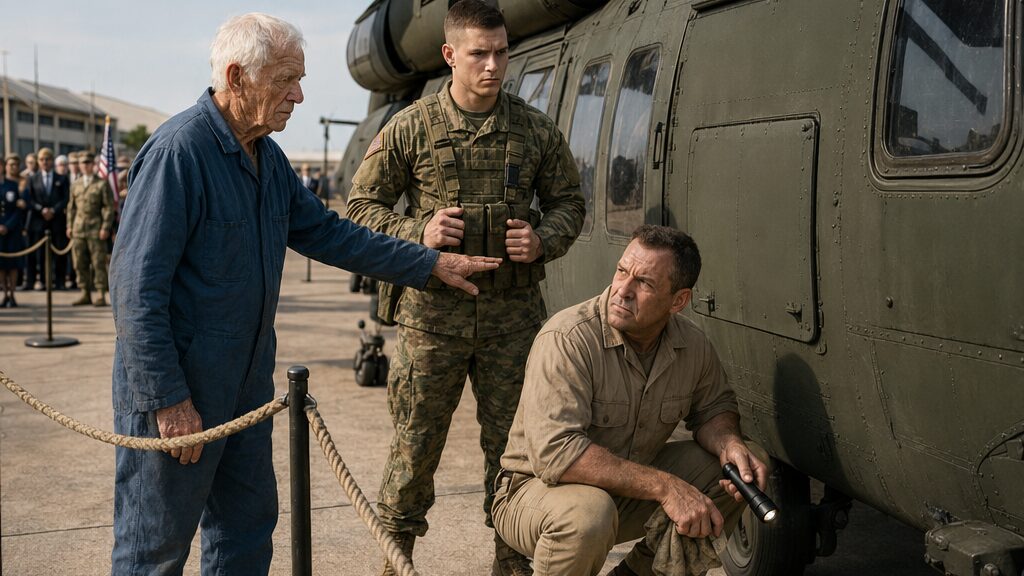
His eyes went to the left side of the helicopter, just behind the crew door, where an inspection panel sat flush with the aircraft skin. Not perfectly flush. Almost. There was a difference.
Most people would not have seen it. Most mechanics might not have cared until the scheduled check. A shadow caught under the lower edge, no wider than a thumbnail, and the smallest unevenness where the fastener heads should have lined up like quiet punctuation.
Richard took one step closer.
Then another.
His knees disliked the distance. The concrete had a way of sending pain up old bones before a man was ready for it, but he ignored the complaint and walked with the slow care people mistook for uncertainty. The helicopter grew larger until its side filled his view. For one brief second, he was no longer seventy-eight years old on a ceremonial morning. He was thirty-two, rain soaking his collar, a wrench between his fingers, waiting for a pilot to shut down so he could chase a sound no one else had heard.
The aircraft smelled faintly of fuel, sun-warmed paint, and hydraulic fluid.
Richard lifted his right hand.
He stopped just short of the panel.
“Not yours anymore,” he murmured.
But his fingers kept rising.
The metal was warm when he touched it. He laid his palm flat against the aircraft skin, not pressing, not claiming, only listening through the bones of his hand. Machines spoke through vibration even when they sat quiet. They held tension in their seams. They remembered careless hands.
He moved two fingers to the edge of the inspection panel and tapped once.
A clean note should have answered.
He tapped twice.
The second sound was lower.
He tapped a third time, lighter, near the lower fastener.
The panel answered hollow.
Richard’s chest tightened.
“Sir.”
The voice behind him was young, controlled, and close enough to be official.
Richard did not turn at once. He kept his fingertips on the panel, feeling nothing now but his own pulse.
“Sir,” the young man repeated. “I need you to step away from the aircraft.”
Richard lowered his hand.
The soldier standing a few paces behind him wore camouflage, a tactical vest, polished boots, and the expression of a man who had been given responsibility before he had been given patience. His name tape read Carter. His eyes flicked from Richard’s badge to the helicopter and back again.
Richard could see the calculation happen. Old man. Visitor badge. Restricted equipment. Possible problem.
“I’m stepping back,” Richard said.
He took one deliberate step away from the aircraft. His left knee caught, but he did not let his face show it.
The soldier’s hand hovered near his radio. “This area is restricted to authorized personnel.”
“I know.”
“You crossed the painted line.”
“I did.”
“That aircraft is part of today’s demonstration. No one touches it unless they’re cleared maintenance or flight crew.”
Richard looked again at the side panel. The shadow had not moved. Of course it had not.
The soldier shifted slightly, putting himself between Richard and the helicopter. “Are you with one of the veterans groups?”
“With the invited guests.”
“Then you need to remain in the guest area, sir.”
Richard heard the sir. It was the kind issued by training, not respect. Clean. Empty. Useful.
Behind the soldier, Donna Harris noticed the exchange and started toward them, clipboard held to her chest. Richard almost welcomed the rescue, then disliked himself for it. He had not come to be rescued from a young man doing his job.
“I’m not trying to bother your aircraft,” Richard said.
The soldier’s expression softened only by a fraction. “I understand, but you can’t be over here.”
Richard nodded. He had spent half his life moving people back from things that could hurt them. He knew the tone. He had used it himself. The difference was that he had never liked it when someone looked at a man and saw only inconvenience.
Donna reached them slightly out of breath. “Specialist Carter, Mr. Bennett is one of our invited veteran guests. I’m sorry, I should have walked him over myself.”
Carter looked at her, then back to Richard. “Ma’am, he was touching the aircraft.”
“I understand. Richard, are you all right?”
Richard almost said yes. It was the answer people wanted from old men. Yes, I am all right. Yes, I know where I am. Yes, I will go sit down.
Instead he looked past them to the panel.
“That lower corner isn’t seated right.”
The words came out quieter than he intended.
Carter followed his gaze. “Maintenance cleared this bird this morning.”
“Maybe they did.”
“Then it’s cleared.”
Richard turned fully toward him. The soldier was broad-shouldered, serious, probably kind to his mother, probably tired of guests wandering near expensive machines. Richard tried to hold all of that in mind.
“I didn’t say it wasn’t,” Richard said. “I said that panel isn’t seated right.”
Donna glanced toward the helicopter, then back at Richard. Her face carried polite concern, the kind people wore when an elder spoke too specifically about something no one had asked him to explain.
Carter did not laugh. Richard gave him that. He did not smile, either.
“Sir, with respect, you can’t determine that by touching it.”
Richard looked down at his own hand.
The fingers were bent more than they used to be. The knuckles had thickened. A pale scar ran from his thumb toward his wrist, old as weather. He curled his hand into a loose fist and let it drop to his side.
“No,” he said. “Not by touching it.”
Carter seemed relieved.
Richard looked back at the panel. “By listening.”
The young soldier waited, as if expecting more. Richard gave him nothing else. Not yet. He had learned long ago that too many words could make the truth sound like begging.
Donna touched Richard’s elbow gently. “Let’s get you back with the group. The ceremony starts soon.”
Richard allowed himself to be guided away.
He walked slowly, feeling Carter’s attention on his back. He did not look over his shoulder. The sun was warming the back of his neck. A child laughed near the hangar. Someone tested a microphone, and the speakers popped.
The aircraft sat behind him, polished and silent.
But Richard had heard it.
That panel was singing wrong.
Chapter 2: The Soldier Who Thought He Was Protecting The Mission
Joshua Carter watched the old man walk away and told himself he had handled it correctly.
That was what mattered. Not whether the man looked embarrassed. Not whether the veterans coordinator gave Joshua a tight little nod as if he had stepped on something delicate. Not whether the old man’s words had landed strangely in his head and stayed there.
That panel is singing wrong.
Joshua glanced at the helicopter.
The aircraft looked fine. More than fine. It looked ready for photographs, speeches, children with wide eyes, and the short flyover scheduled after the base commander finished thanking everyone for coming. Maintenance had washed it at dawn. The crew chief had signed off. The pilot had done his walkaround. The day had a schedule, and Joshua’s part in that schedule was simple.
Keep civilians where civilians belonged.
He had been assigned to the open-house detail because he was reliable. That was what his squad leader had said. Reliable meant he checked badges. Reliable meant he did not improvise. Reliable meant that if an elderly guest wandered past a painted line and put his hand on an aircraft, Joshua moved him back without turning it into a scene.
He wrote the incident down in his small notepad because that was what reliable people did.
Elderly male guest crossed line. Touched left-side panel. Removed without incident.
He hesitated, then added: Claimed panel “sounded wrong.”
The phrase looked ridiculous in ink.
Joshua closed the notebook.
Across the flight line, the old man sat with the other invited veterans under a shade canopy. He did not talk much. He had taken a chair at the end of the row, his hands resting on his knees, blue coveralls loose around his thin frame. From that distance, he looked less like a threat than someone’s grandfather who had taken the wrong turn looking for coffee.
Joshua looked away.
“Carter.”
He straightened as Mark Reed came out from beside the maintenance tent, wiping his hands on a rag. Reed was not technically Joshua’s supervisor, but everyone on the flight line treated him like a man whose irritation had rank. He had close-cut hair, a square jaw, and the permanent squint of someone who inspected things for a living.
“Any issues?” Reed asked.
“One guest crossed the line and touched the aircraft. I moved him back.”
Reed’s eyes sharpened. “Touched where?”
“Left side. Inspection panel behind the crew door.”
Reed looked toward the helicopter, then back at Joshua. “Did he damage anything?”
“No, Sergeant. Just touched it. Tapped it maybe.”
“Tapped it.”
“Yes.”
Reed exhaled through his nose. “Veterans day brings out all kinds.”
Joshua did not answer. The phrase sat wrong with him, though he could not have said why.
Reed looked toward the guest canopy. “Which one?”
Joshua indicated Richard with a small movement of his chin.
“The one in blue coveralls?”
“Yes.”
Reed’s mouth tightened. “I saw him at check-in. Outreach guest. Probably used to turn wrenches somewhere and thinks every bird on the line is waiting for his blessing.”
“He said the panel sounded wrong.”
Reed stared at him.
Joshua regretted repeating it.
“Carter,” Reed said, “that aircraft passed inspection at 0600. I signed the readiness packet myself. The pilot signed his walkaround. The commander wants wheels up at 1400 for the flyover. You see where this is going?”
“Yes, Sergeant.”
“Good. Keep guests off the aircraft.”
Reed walked away before Joshua could say anything else.
For the next twenty minutes, Joshua did his job. He checked badges. He redirected a boy who wanted to see if the tires were taller than he was. He answered a father’s question about where the restrooms were. He told a woman with a camera that photographs were fine from behind the barrier.
Still, every few minutes, his eyes went back to the old man.
Richard Bennett had not tried to approach the aircraft again. That should have been the end of it. Instead, he sat under the canopy as if listening to something no one else could hear. When the wind shifted and the helicopter’s tiedown straps trembled, the old man’s head turned slightly. When a mechanic opened a toolbox near the aircraft, his fingers pressed once against his knee.
Joshua had guarded enough places to know the difference between confusion and focus. Confused people wandered. Richard Bennett waited.
A group of junior mechanics gathered near the helicopter’s left side, laughing at something one of them said. One leaned a shoulder against the fuselage, too close to the same panel. Richard’s posture changed. Not dramatically. He did not rise. He only leaned forward, eyes fixed.
Joshua saw it.
He should have ignored it.
Instead, he crossed toward the canopy.
Donna Harris met him halfway, as if she had expected him. “Is there a problem?”
“No, ma’am.”
“Then why do you look like there is?”
Joshua removed his sunglasses. It made him feel less official and more exposed. “I need to ask Mr. Bennett one question.”
Donna studied him, then stepped aside.
Richard looked up when Joshua approached. The old man’s face gave away nothing. Up close, Joshua noticed the deep lines around his eyes and the way his right hand rested half-closed, as if still feeling the aircraft skin.
“Mr. Bennett,” Joshua said.
“Specialist Carter.”
The fact that Richard remembered his name made Joshua oddly uncomfortable.
“You said the panel sounded wrong.”
Richard waited.
“What did you mean?”
Donna stood a little behind Joshua. A few of the seated veterans had gone quiet, listening without turning their heads.
Richard looked past him to the helicopter. “That lower fastener is not carrying the sound the way the others are.”
Joshua frowned. “The sound.”
“When a panel sits right, the tap comes back tight. Same skin, same frame, same tension. That one gave back a hollow note.”
“You got that from three taps?”
Richard’s mouth moved in something too tired to be a smile. “Two and a half.”
Joshua felt heat rise in his neck. “Sir, I’m asking seriously.”
“I answered seriously.”
A man two chairs down gave a soft chuckle. Donna shot him a look, and he quieted.
Joshua took a breath. “Maintenance says it’s cleared.”
“Then it’s probably cleared.”
“But you still think something’s wrong.”
Richard looked at him then. His eyes were pale blue, not cloudy, not lost.
“I think,” Richard said, “that if a panel sounds different from the panel next to it, a man ought to know why before he puts people in the air.”
Joshua had no good answer for that.
From the maintenance tent, Reed called, “Carter!”
Joshua turned. Reed stood with one hand on his hip, irritation visible even from a distance.
“Back on the line,” Reed said.
Joshua faced Richard again. “Please don’t approach the aircraft unless you’re escorted.”
Richard nodded once. “I won’t.”
Joshua started to leave, then stopped. “What did you work on?”
For the first time, something shifted in Richard’s expression. Not pride. Not eagerness. Something guarded.
“Helicopters,” he said.
“What kind?”
“The kind that came back louder than they left.”
Joshua did not know what to do with that, so he put his sunglasses back on and returned to his post.
Reed was waiting near the barrier.
“You interviewing guests now?” Reed asked.
“No, Sergeant.”
“Then let’s not make a ceremony out of an old man tapping aircraft like a melon.”
Joshua heard the words and wished he had not.
He looked toward Richard one more time.
The old man sat still, hands on his knees, looking at the helicopter with the patience of someone who had already said the only thing he intended to say.
Joshua touched the small notebook in his pocket.
That panel is singing wrong.
He did not cross it out.
Chapter 3: Cleared On Paper
Richard had always trusted paperwork when paperwork was honest about what it could not hear.
A logbook could tell a man when a part had been replaced, who signed for it, what inspection followed, and whether the right boxes had been marked. It could not tell him whether the mechanic signing the page had been rushed. It could not tell him whether a fastener had been seated by a hand thinking about lunch, or a crew chief thinking about a commander’s schedule, or a young man afraid to ask why the thread felt wrong.
Paper remembered facts.
Machines remembered touch.
Richard sat beneath the shade canopy and watched the maintenance supervisor walk toward him with Specialist Carter half a step behind. Donna Harris followed, her clipboard now held like a shield.
The ceremony had not started, but the airfield had changed. More guests had arrived. The base band tested a short burst of brass near the hangar. Children pressed against the rope line. A row of folding chairs filled with veterans wearing caps from wars and ships and units that had long since changed names.
Richard wished he had gone home after the first warning.
There was dignity in leaving before people decided you needed managing.
Mark Reed stopped in front of him. “Mr. Bennett?”
Richard stood carefully. His knees made the process slower than he wanted. Joshua moved as if he might help, then caught himself. Richard noticed and pretended not to.
“That’s me,” Richard said.
Reed’s expression was professional, but not warm. “I’m told you have concerns about one of my aircraft.”
“One panel.”
“My aircraft,” Reed repeated.
Richard accepted the correction with a nod. “Your aircraft.”
Donna stepped in gently. “Mark, Richard is one of our honored guests today. He served in Army aviation.”
“I respect that,” Reed said, in the tone of a man setting a boundary around the word respect. “But we can’t have guests making maintenance calls on the flight line.”
“I didn’t make one,” Richard said.
“You told my security soldier a panel was wrong.”
“I told him it sounded wrong.”
Reed’s jaw tightened. “Mr. Bennett, this helicopter passed its daily inspection. It has been checked by qualified personnel. It is scheduled for a ceremonial flyover in less than three hours. If every retired mechanic who came through here wanted to second-guess a panel gap, we’d never get a bird off the ground.”
A few guests nearby had turned their attention fully now. Richard felt their eyes land on his coveralls, his white hair, his hands. He hated that part more than Reed’s words. Public correction had a way of shrinking a man if he let it.
Richard kept his voice level. “You have the log?”
Reed blinked. “What?”
“The aircraft log. If the panel was opened recently, there’ll be an entry.”
Reed gave a short laugh without humor. “I don’t need to show you maintenance logs.”
“No,” Richard said. “You don’t.”
The answer seemed to disarm Reed more than an argument would have. Joshua looked between them.
Donna said softly, “Would it hurt to check?”
Reed turned to her. “Yes, actually. It encourages this.”
“This?”
“Unofficial interference.”
Richard looked back toward the helicopter. The panel sat where it had before, indifferent to all of them.
He should have let it go. A younger version of himself would have pushed harder, maybe too hard. An older version knew that pride dressed itself as safety on both sides of an argument. Reed had a job. Carter had a job. Donna had a ceremony to hold together. Richard had a memory and an old hand that had heard a hollow note.
Memory was not authority.
Still, the sound remained.
Joshua cleared his throat. “Sergeant, maybe we could just check whether that panel had a recent entry.”
Reed turned slowly toward him.
Joshua’s face reddened, but he did not step back. “Not open it. Just check the log. If there’s nothing, there’s nothing.”
The silence after that was small but sharp.
Richard looked down at Joshua’s boots. Polished. Dust beginning to gather near the soles. Good boots, he thought absurdly. A man who took care with small things.
Reed seemed to weigh whether correcting Joshua in front of guests would create more trouble than the log itself. Finally he turned toward the maintenance tent.
“Fine,” he said. “We’ll check the paper.”
He walked away, expecting them to follow.
Richard did not move.
Donna touched his arm. “You don’t have to.”
“I started it,” Richard said.
He followed slowly, Joshua beside him but not too close. The maintenance tent smelled of canvas, coffee, and metal tools warmed by the day. A folding table held binders, clipboards, and a laptop. A junior mechanic looked up, surprised to see a civilian guest brought into the edge of the workspace.
Reed pulled a binder from the table with more force than necessary. He flipped through the pages, found the aircraft number, and ran a finger down the latest entries.
“Daily inspection complete,” he said. “No faults noted.”
Richard waited.
Reed turned a page. “Pre-event exterior wash. Blade tie-down check. Static display prep.”
He stopped.
Richard saw the pause before anyone else did.
Reed’s finger moved back one line.
“What is it?” Donna asked.
“Nothing,” Reed said too quickly.
Richard did not lean in. His eyes were not what they used to be, and he refused to squint over another man’s shoulder like a beggar after scraps.
Joshua stepped closer. “Sergeant?”
Reed exhaled. “Panel L-three was removed yesterday for access during a comms harness inspection. Reinstalled and secured. No faults.”
“L-three,” Richard said.
Reed looked at him.
“That’s the panel behind the crew door.”
“Yes,” Reed said. “And it was reinstalled and secured.”
“Who signed it?”
The junior mechanic at the table lowered his gaze.
Reed’s tone cooled. “A qualified mechanic.”
“I didn’t ask if he was qualified.”
“You’re not entitled to ask anything.”
“No,” Richard said again. “I’m not.”
That answer irritated Reed more than resistance. He closed the binder. “There. Mystery solved. The panel was opened, reinstalled, inspected, and cleared. Whatever you heard is an old memory, not a maintenance fault.”
The words should not have hurt. Richard had heard worse in louder places from better men under harder pressure. But old memory found its target.
He looked at the binder, then at the helicopter beyond the tent opening.
An old memory.
Yes. That was exactly what it was.
A rain-dark flight line. A pilot tapping his watch. A captain asking how long it would take. A younger Richard saying, Give me five more minutes, then not taking them because the mission was already late. A hollow sound under his hand. A small doubt swallowed because everyone else seemed certain.
He felt Donna watching him.
Richard backed away from the table. “Thank you for checking.”
Reed’s shoulders loosened, victory arriving before wisdom. “Good. Then we’re done.”
Richard nodded once.
He turned and walked out of the tent.
The sunlight struck hard after the shade. The ceremony chairs blurred for a second before his eyes adjusted. He heard Joshua behind him but did not stop.
“Mr. Bennett.”
Richard kept walking until he reached the rope line. There, he stopped because his knee required it, not because he wished to speak.
Joshua came beside him. “I’m sorry about that.”
“You did your job.”
“I didn’t mean—”
“You asked a question. That’s more than most do.”
Joshua looked toward the helicopter. “The log said it was secured.”
“Yes.”
“Does that change what you think?”
Richard studied the aircraft. A gust crossed the field. The tiedown strap near the tail fluttered once. Near the crew door, sunlight slid along the panel seam and caught again at the lower edge.
“No,” Richard said.
Joshua’s face tightened. “Why?”
Richard lifted his hand halfway, then let it fall before pointing.
“Because paper says someone closed it,” he said. “It doesn’t tell me why it answered hollow.”
Donna joined them, quieter now. “Richard, what did you hear?”
He looked at her clipboard, at the printed schedule clipped neatly beneath her thumb, at the line that likely said flyover in clean black type.
He wanted to say nothing. He wanted to go sit beneath the canopy and let younger men have their cleared aircraft and their bright ceremony. He wanted, more than anything, not to be the old man everyone had to handle.
But the panel waited.
“Not enough to accuse anyone,” he said. “Enough to check twice.”
From the hangar speakers came the cheerful crackle of a microphone.
“Ladies and gentlemen, our veterans recognition program will begin shortly.”
Donna turned toward the sound. Joshua looked back at Reed, who was already speaking to the junior mechanic as if the matter had been settled.
Richard looked only at the helicopter.
For a moment, the airfield fell away. He heard the hollow note again, clean and wrong under his fingers.
Then Donna’s voice came softly beside him.
“What did you hear that they didn’t?”
Chapter 4: The Sound He Never Forgot
Donna did not press him at first.
She guided Richard back toward the veterans seating area as the microphone crackled again and the first announcement rolled out across the flight line. The voice over the speakers welcomed families, service members, retirees, and guests. It thanked sponsors. It mentioned the ceremony schedule. It made everything sound ordered, bright, and safe.
Richard sat at the end of the row beneath the canopy.
Donna pulled a folding chair close but did not sit immediately. She looked across the airfield, where Mark Reed had returned to the maintenance tent and Joshua Carter stood near the rope line, rigid again, though his attention kept slipping toward the helicopter.
“What did you hear?” Donna asked.
Richard rubbed his thumb over the first two fingers of his right hand. The skin there had gone thin with age, but the old calluses still lived underneath, buried like stones under grass.
“A loose answer,” he said.
Donna waited.
He looked at her then. She was not young, but she had the energy of someone who had spent years keeping events from falling apart. Her hair was pinned back. Her vest had two pens clipped to the front pocket. She had the careful face of a person who had learned that veterans did not always say what they meant the first time.
“A panel can be tight and still wrong,” Richard said. “A fastener can catch enough to pass a glance. A bracket behind it can carry stress you won’t see until the aircraft starts working. The sound changes first.”
“You heard that from tapping it?”
“I heard enough to ask.”
Donna folded her hands over the clipboard. “Have you asked before?”
He almost said yes. It would have been true and not true enough.
Instead, he looked at the helicopter.
The ceremony had begun near the hangar doors. The base commander stood at a podium, sunlight on his shoulders. People clapped at the appropriate places. A row of children sat cross-legged near the front, restless and dazzled. Beyond them, the aircraft waited like a patient animal.
Richard could feel Donna still beside him.
“I was younger than Specialist Carter when I learned not every warning comes loud,” he said.
She sat down then.
He did not look at her. It was easier to speak toward the field.
“We had a bird come in wet one afternoon. Bad weather over the trees. Crew tired. Everybody tired. There was a mission waiting, and a captain who wanted it turned fast. I heard something in a panel after a repair. Not much. Just enough.”
His right hand closed slowly on his knee.
“I told myself I’d check it after the next run.”
Donna said nothing.
“The next run never came back the way it left.”
The words were smaller than the memory. There was no way to make a sentence carry the smell of rain, the slap of rotor wash, the sudden silence after too much noise. No way to put into words the look on a pilot’s face when he realized a man on the ground had doubted and not stopped the launch.
“Was it because of the panel?” Donna asked softly.
Richard shook his head. “Not only. Things stack up. Weather. Pressure. Wear. A small mistake looks harmless until it joins hands with three others.”
“But you blamed yourself.”
He glanced at her then.
She did not apologize for seeing it.
“I was the one who heard it,” he said.
A burst of applause rose from the crowd. The commander had just introduced the visiting veterans. Several men under the canopy straightened; one lifted his cap in acknowledgment. Richard kept his hands on his knees.
Donna looked down at the printed schedule on her clipboard. “The flyover is after the recognition remarks.”
“Yes.”
“You think they should delay it.”
“I think they should open the panel.”
“That’s not the same answer.”
“No,” Richard said. “It’s the only answer I’m entitled to.”
She studied him. “You know they may not listen.”
“I know.”
“And if they don’t?”
He looked toward the aircraft again. “Then I’ll have to decide whether I can live with leaving.”
The sentence surprised him. He had not planned to say it. The truth had come loose before pride could stop it.
Donna’s face changed. Not pity. That would have made him stand and walk away. It was closer to recognition, as if the ceremony she had organized had shifted shape in front of her.
“I invited you today because your name was on the list from the veterans center,” she said. “It said Army aviation. Retired maintenance. No family attending.”
Richard gave a faint shrug. “That part was accurate.”
“I thought a good seat and a handshake would be respectful.”
“It is.”
“But maybe not enough.”
He looked at her, and for the first time that morning he saw uncertainty in someone who was trying to help, not manage.
Before he could answer, the helicopter gave a slight metallic tremor.
It was not dramatic. A mechanic near the nose had powered a ground unit, and the aircraft skin carried the faint vibration through its frame. Nearby guests did not notice. The commander kept speaking. The band members shifted in their chairs.
Richard heard it.
His head turned before he meant it to.
Donna noticed. “What?”
“Listen.”
The sound threaded under the ceremony noise, thin and uneven. A healthy panel would have carried the vibration cleanly. This one gave a faint flutter, a dull broken tremor under the lower corner.
Donna leaned forward, trying to hear what he heard.
“I don’t—”
“It’s there.”
Across the line, Joshua had turned too.
Richard saw it. The young soldier’s face changed just enough. Not understanding. Not yet. But recognition of Richard’s reaction.
The ground unit coughed and steadied. The vibration faded.
Richard slowly rose from his chair.
Donna stood with him. “Richard.”
“I’m not crossing the line.”
“What are you doing?”
“Waiting for him to look this way.”
Joshua was already walking over, though he tried to make it look like patrol.
He stopped on the other side of the rope. “Mr. Bennett.”
Richard did not waste words. “Did you hear that during the power-up?”
Joshua glanced back at the helicopter. “I heard the unit start.”
“No. Under it.”
Joshua’s jaw worked once. “The panel?”
Richard nodded.
Donna held her clipboard tighter. “Specialist Carter, can you request one more check?”
Joshua looked toward the maintenance tent. Mark Reed stood there with the junior mechanic, both watching the ceremony, not the aircraft.
“I can request,” Joshua said. “Doesn’t mean they’ll do it.”
Richard looked at the young soldier and saw the first crack in the wall of procedure. A man did not have to believe everything to begin doubting the right thing.
“Don’t tell him I know,” Richard said.
Joshua frowned. “What?”
“Tell him you heard something.”
“I didn’t.”
“You heard me hear it.”
Joshua almost smiled, but it died quickly.
Richard’s voice softened. “That’s a start.”
For a moment, the noise of the ceremony seemed to move around them instead of through them. Donna watched both men. Joshua looked caught between the rope line and the aircraft, between his orders and the old man’s steady eyes.
Then the speakers announced that the flyover crew would prepare shortly after the next recognition segment.
Joshua turned toward the maintenance tent.
Richard stayed where he was, hand resting on the back of the folding chair.
The sound was gone now.
But so was the comfort of pretending it had never been there.
Chapter 5: When The Old Method Met The New Checklist
Joshua had never liked uncertain ground.
He liked painted lines, posted orders, locked gates, radio calls, signatures, and the clean finality of a clearance stamp. He liked knowing who had authority and who did not. It made the world narrower, which meant it was easier to protect.
Richard Bennett had made the world wider in less than an hour.
Joshua walked toward the maintenance tent with the old man’s sentence moving through his head.
You heard me hear it.
That sounded useless. It also sounded uncomfortably true.
Mark Reed was bent over the folding table with a junior mechanic, one finger tapping the readiness packet. His body language said the matter had been settled and was now an irritation filed away. Joshua stopped just outside the tent shade.
“Sergeant Reed.”
Reed looked up. “What now?”
Joshua kept his voice low. “Requesting one more check on panel L-three.”
The junior mechanic went still.
Reed stared at Joshua as if he had spoken in another language. “On what basis?”
Joshua felt the answer he wanted and the answer he had.
“During the ground unit power-up, there may have been an irregular vibration near that panel.”
“May have been.”
“Yes, Sergeant.”
Reed looked past him toward the canopy. “Did Mr. Bennett tell you that?”
Joshua did not answer quickly enough.
Reed straightened. “Carter, I don’t know what kind of story that old man sold you, but I’m not delaying a scheduled flyover because a guest with coveralls and memories thinks he can hear through aluminum.”
“He didn’t ask to delay the flyover. He asked for the panel to be opened.”
“That is a delay.”
“Yes, Sergeant.”
The junior mechanic looked down at the table. Joshua noticed his hand move toward a rag, twisting it once before letting go.
Reed saw Joshua notice.
“What?” Reed snapped at the mechanic.
The mechanic swallowed. “Nothing.”
Reed’s expression hardened. “If you have something, say it.”
“It’s just…” The mechanic glanced toward the helicopter. “Yesterday, when we closed L-three after the comms harness check, I thought the bottom fastener felt gritty. I backed it out and reseated it. It torqued fine.”
Reed’s eyes narrowed. “And you logged it?”
“No fault. It seated.”
Joshua felt the air shift.
Reed’s voice dropped. “You’re telling me this now?”
“It wasn’t a fault, Sergeant. It torqued. I checked the edge. It looked flush.”
“Then why bring it up?”
The mechanic’s face reddened. “Because the old guy pointed right at that corner.”
For a moment, the tent held only the generator hum and the ceremony voice from the speakers.
Reed closed the binder with care. Too much care.
“Visual check,” he said. “No panel removal. We look at it, confirm it’s seated, and move on.”
Joshua should have felt relieved. Instead, he thought of Richard’s face when Reed had said old memory.
“Sergeant, if the concern is behind the panel—”
“The concern,” Reed cut in, “is that I now have security personnel debating maintenance procedure because a retired guest tapped on aircraft skin.”
Joshua held his ground. “Yes, Sergeant.”
Reed blinked.
Joshua had not meant it as defiance. It had simply come out too honest.
The junior mechanic looked away quickly.
Reed took a breath through his nose. “Fine. You want to learn something? Come watch a visual check.”
They walked out together.
The crowd near the ceremony had thickened. The commander had moved into a section honoring past service members, and the audience was quieter now. The helicopter sat beyond the rope line, sun glancing off its rivets and seams.
Richard remained by the veterans canopy. He did not approach. He did not wave. He only watched with his hands folded in front of him.
Joshua found that more persuasive than if the old man had hurried over.
Reed crouched beside the panel. The junior mechanic handed him a flashlight. Joshua stayed back, aware that he was security, not maintenance, and that every step closer made him look more involved than he had any right to be.
Reed ran the flashlight beam along the seam.
“Flush,” he said.
The junior mechanic leaned in. “Looks flush.”
Reed touched each fastener head with his thumb. “Seated.”
Joshua looked at the lower corner. It looked fine to him. That bothered him. He wanted proof one way or the other, something obvious enough to end the uncertainty.
Reed stood. “There. Done.”
From behind the rope, Richard’s voice came calmly. “Tap above the lower fastener.”
Reed turned.
Richard had not crossed the line. Donna stood beside him, tense. Several guests had begun watching again.
Reed’s face flushed. “Mr. Bennett, this is not a demonstration.”
“No,” Richard said. “It’s a check.”
Joshua saw Reed’s pride flare. He expected him to walk away.
Instead, maybe because people were watching, maybe because the fastest way to dismiss Richard was to prove him wrong in public, Reed rapped the panel twice with his knuckle.
The sound came back sharp enough.
“Happy?” Reed asked.
Richard did not answer.
“Above the lower fastener,” he repeated.
Reed’s mouth flattened. He crouched again and tapped where Richard had indicated.
Once.
The note shifted.
Not much. Joshua barely heard it, but he saw the junior mechanic’s head lift.
Reed tapped the panel beside it, then the lower corner again.
There it was.
A faint hollow difference, like tapping a full can and then an empty one.
The mechanic whispered, “That’s weird.”
Reed stood too quickly. “Could be normal skin variance.”
Richard nodded once. “Could be.”
The answer robbed Reed of an argument.
Joshua stepped closer. “What would cause that?”
Richard looked at the panel, not at Joshua. “A poor seat. A stressed bracket. Something behind it not carrying load the same way. Or nothing worth naming.”
Reed seized on that. “Exactly.”
Richard’s eyes moved to him. “But you do not know which until you open it.”
The ceremony speaker announced a brief intermission before the flyover crew prepared for the aircraft demonstration. Families began standing, stretching, moving toward water coolers and photo spots.
The pilot approached from the hangar, helmet bag in one hand, sunglasses on. He looked at the cluster near the helicopter and slowed.
“Why are we gathered around my aircraft?” he asked.
Reed turned, professionalism snapping back into place. “Minor panel question. Visual check complete.”
Joshua looked at Richard.
Richard said nothing.
The pilot looked at Reed, then Joshua, then the old man behind the rope. His gaze lingered on the blue coveralls and white hair.
“Is there a fault?” he asked.
“No confirmed fault,” Reed said.
The answer was technically true.
Joshua heard the shape of it.
The pilot’s expression sharpened. “That’s not what I asked.”
The junior mechanic shifted his feet.
Reed looked toward the ceremony crowd, then at his watch. “We’re on a schedule.”
Richard’s hand rose to the rope line but did not touch it.
Joshua watched that hand. Bent knuckles. Old scar. Fingers that had heard something before anyone else cared to name it.
He found himself speaking before he had decided to.
“Sir,” Joshua said to the pilot, “Mr. Bennett noticed an irregular sound at panel L-three. The mechanic confirmed a slight difference when tapped near the lower fastener.”
Reed stared at him.
The pilot looked at Richard. “Mr. Bennett, is it?”
Richard gave a small nod.
“You crewed helicopters?”
“For a while.”
“How worried are you?”
Richard did not dramatize it. He did not claim danger. He did not reach for authority he did not have.
“Worried enough that I wouldn’t ride until I knew why it sounded that way.”
That settled over them harder than any accusation.
The pilot turned to Reed. “Open it.”
Reed’s jaw clenched. “Sir, that will delay—”
“Then we delay.”
For the first time all day, Richard looked away from the aircraft.
He looked at Joshua.
Not with triumph. Not with gratitude exactly.
With the quiet recognition of a man who had seen someone choose the harder side of a small line.
Joshua let out a breath he had not known he was holding.
Then Reed’s radio crackled, and the base commander’s aide asked whether the aircraft would be ready on time.
No one answered right away.
Chapter 6: The Flight That Had To Wait
The delay began as a ripple no one wanted to name.
First the pilot set his helmet bag down instead of carrying it to the aircraft. Then Mark Reed sent the junior mechanic for tools. Then Donna Harris crossed the grass toward the ceremony area with her clipboard pressed flat to her side, already preparing a version of the truth gentle enough for families and firm enough for command.
Richard remained behind the rope line.
He had asked for the panel to be opened. He had not been invited to stand beside it. That distinction mattered. A man who overstepped after being heard could lose the very ground he had gained.
The crowd shifted under the sun. Children asked whether the helicopter was going to fly. Parents gave answers that sounded certain and meant nothing. The band members set their instruments down. The commander’s aide walked briskly from the podium toward the maintenance area, face tight with schedule pressure.
Reed opened his tool roll on a clean cloth and did not look at Richard.
“Keep the guest clear,” he said to Joshua.
Joshua glanced at Richard. “Yes, Sergeant.”
Richard almost smiled. The young soldier had not moved to block him this time. He stood beside the rope, not in front of him.
The pilot crouched near the panel with Reed and the junior mechanic. “Talk me through it.”
Reed picked up a driver. “Panel L-three was removed yesterday for comms harness access, reinstalled, torqued, visually checked, no fault logged. Guest reported irregular sound. Visual recheck shows no obvious misalignment.”
The word guest landed with a hard edge.
Richard let it pass.
The pilot looked back. “Mr. Bennett, where exactly?”
Joshua lifted the rope slightly, then stopped, unsure whether he had authority.
Richard shook his head. “I can point from here.”
He raised his right hand, careful not to cross the line. “Lower aft corner. Just above the fastener. Tap the panel next to it first. Then there.”
The junior mechanic did as instructed, knuckle against metal.
Sharp.
Then hollow.
The difference was clearer now, perhaps because everyone had stopped pretending not to hear.
The pilot’s expression did not change, but his shoulders did. They settled lower, ready for bad news.
Reed began removing fasteners.
Each turn of the driver seemed louder than it should have. Around them, the ceremony continued in a softened, improvised form. Donna had arranged for the commander to speak with a group of visiting veterans near the display tables. Laughter rose once, then faded. The planned flyover time crept closer.
The commander’s aide arrived. “Sergeant Reed, status?”
“Checking a panel concern.”
“Is the aircraft down?”
“No confirmed fault.”
The aide looked at the pilot. “Sir?”
The pilot did not look up. “Aircraft is not flying until I’m satisfied.”
The aide’s mouth tightened, but he nodded and stepped back to make a radio call.
Richard watched Reed remove the final fastener and lift the panel away. For a moment, all they could see was shadowed interior space, wiring, brackets, ribs, the plain hidden truth behind polished skin.
The junior mechanic held the panel.
Reed leaned in with the flashlight.
“Well?” the pilot asked.
“Stand by.”
Richard’s right hand twitched at his side. He wanted to step closer. The wanting embarrassed him with its force. His body remembered crouching under aircraft, shoulder pressed to metal, eyes searching where light did not want to reach. His knees would punish him if he tried it now. His back too. Maybe his pride most of all.
Joshua noticed the movement.
“You all right?” he asked quietly.
“No.”
Joshua straightened.
Richard added, “But not in the way you mean.”
The young soldier did not answer. Good, Richard thought. He was learning when silence helped.
Reed shifted his flashlight. “I don’t see cracking.”
The junior mechanic let out a breath.
Richard closed his eyes for one second and listened past the words. Reed was searching for a large answer because large answers justified interruption. But small answers caused accidents too.
“Check the lower bracket seat,” Richard said.
Reed went still.
The aide looked irritated. “Can the guest please stop directing maintenance?”
Richard lowered his hand.
The old familiar heat rose in his chest, part shame, part anger, part fear. He had been careful. He had stayed behind the rope. He had not claimed authority. He had asked for one check and then one more specific place, because machines did not care about ceremony programs.
Donna had returned and heard the aide’s remark. She looked at Richard as if she might speak for him.
He did not let her.
“My name is Richard Bennett,” he said, voice calm enough that those nearby quieted to hear it. “I retired from Army aviation maintenance after thirty-one years. I am not on your crew. I do not outrank anyone here. I cannot certify that aircraft, and I am not trying to. But that panel changed pitch at the lower aft corner, and if you do not check the bracket seat behind that corner, you have not checked the thing that made the sound.”
No one moved.
Richard felt the cost of the words immediately. Not because they were dramatic, but because they were plain. He had put his name and his years into the open. He had not wanted to.
The aide’s expression shifted, but only slightly.
Reed’s face was unreadable. For one hard second, Richard thought pride would win.
Then Joshua spoke.
“Sergeant Reed,” he said, “he called the exact panel before he saw the log.”
The junior mechanic added, barely above a whisper, “And the exact fastener.”
Reed looked at the young mechanic.
The pilot said, “Check the bracket.”
Reed leaned back into the opening.
The flashlight beam lowered.
Silence gathered around them in layers. Even the nearby families seemed to sense that something had changed. The flyover was no longer the point. The point was the small dark space behind an inspection panel and whether men could set pride down long enough to look where they had been told to look.
Reed reached in with two fingers, then stopped.
“Hand me the mirror.”
The junior mechanic moved quickly.
Reed angled the inspection mirror into the lower corner. The pilot leaned closer.
“What do you have?” the pilot asked.
Reed did not answer immediately.
That was answer enough.
Richard looked at the helicopter’s skin. Without the panel, it seemed vulnerable, a machine stripped of its clean public face.
Reed adjusted the mirror again. “Possible fretting around the bracket seat.”
The junior mechanic swallowed. “From the harness work?”
“Maybe older.” Reed’s voice had lost its hard polish. “Maybe we disturbed it when we opened the panel.”
“Crack?” the pilot asked.
“Not calling it until we clean and inspect.”
The aide stepped closer. “Can it fly?”
The pilot turned his head slowly. “No.”
One word. No drama. No speech. Just the line that should have been drawn the moment doubt became specific.
The aide looked toward the crowd, then at his radio. “The commander needs to know.”
“Tell him maintenance delay,” the pilot said.
The aide left quickly.
Reed remained crouched by the open panel. He did not look at Richard. The junior mechanic stared at the hidden bracket as if it had personally betrayed him.
Richard felt no satisfaction.
Instead, he felt tired in a way that came from old rooms inside him opening at the same time. He had been right. That did not make him happy. Being right about a machine that might hurt someone was not a victory. It was a responsibility arriving late.
Joshua stood beside him, his face pale under the brim of his patrol cap.
“You knew,” Joshua said.
Richard shook his head. “No. I suspected.”
“That was enough?”
“It should be.”
Across the field, Donna moved among the guests, speaking gently, redirecting disappointment before it hardened into complaint. The commander walked toward the maintenance area now, slower than his aide had, reading the situation before entering it.
Reed finally rose.
He carried the inspection mirror in one hand. For a moment, he seemed older than he had that morning.
“Mr. Bennett,” he said.
Richard waited.
Reed looked toward the open panel, then back at him. “We’re going to pull the aircraft from the demonstration pending inspection.”
Richard nodded. “Good.”
No gloating. No relief shown too broadly. Just the answer the aircraft deserved.
The commander arrived beside the pilot. Voices lowered. Radios murmured. The flyover, the schedule, the polished ceremony all bent around a small hollow sound an old man had refused to dismiss.
Joshua reached for the rope line and lifted it.
Richard looked at him.
“Sergeant Reed may need you closer,” Joshua said.
Richard looked at the opening in the helicopter skin, then at his own knees.
He wanted to step forward. He also knew what it would cost.
After a moment, he shook his head.
“If he needs me,” Richard said, “he can ask.”
Joshua lowered the rope.
Reed heard. His shoulders stiffened, then slowly eased.
He turned fully toward Richard.
“Mr. Bennett,” Reed said, the words difficult but clean, “would you take a look from here and tell me if this is the corner you meant?”
Richard did not move at once.
The invitation hung in the air, not large enough to heal everything, but large enough to cross.
Then Richard stepped under the lifted rope.
Chapter 7: What The Panel Was Hiding
Joshua had seen people proven wrong before.
Usually they got loud first. They defended the old answer until the new one became too heavy to push back. Then they found someone below them to blame, or something above them to hide behind. He had expected some version of that from Mark Reed.
Instead, Reed went very quiet.
The helicopter’s side panel rested on a folded maintenance cloth near the skid, green paint facing up, inner surface exposed to the sun. It looked smaller off the aircraft, almost harmless. Joshua stared at it and thought of Richard Bennett’s hand pressed against it less than two hours earlier, before anyone had cared what it sounded like.
The open space behind the panel drew everyone’s eyes.
Reed worked slowly now. Not lazily. Carefully. The difference was sharp enough that Joshua could feel it. The junior mechanic held a flashlight while Reed used a mirror to inspect the lower bracket seat. The pilot crouched beside them, helmet bag forgotten behind his boots. The commander stood a few steps back with Donna Harris and the aide, both of them silent.
Richard had been allowed inside the rope line, but he had not pushed close. He stood where he could see without blocking the working crew, his old shoulders slightly bent, his hands loose at his sides. His face held no triumph. If anything, he seemed more tired now that people were listening.
Reed adjusted the inspection mirror again. “There.”
The junior mechanic lowered his head. “Is that scoring?”
“Fretting,” Reed said. “Light, but it’s there.”
The pilot leaned closer. “Show me.”
Reed angled the mirror so the pilot could see the lower bracket. “Seat’s been working. See the rub pattern? And here—” He shifted the light. “This fastener wasn’t carrying clean. It torqued, but the load wasn’t right.”
The junior mechanic swallowed. “I torqued it.”
Reed did not look up. “I know.”
“I checked the edge.”
“I know.”
The young mechanic’s mouth tightened. Joshua could see him bracing for the blow.
Reed surprised him.
“You checked what the checklist told you to check,” Reed said. “Now you’re seeing why we don’t stop thinking when the box is marked.”
The mechanic blinked quickly and looked back into the panel opening.
Richard watched that exchange with a stillness Joshua could not read.
The pilot turned to him. “Mr. Bennett, would that have failed in flight?”
Richard did not answer right away. Joshua appreciated that. Some men would have taken the question as an invitation to make the danger larger, to earn the fear in everyone’s eyes.
Richard stepped closer, slow enough that Joshua almost moved to help him, then stopped himself. Reed shifted aside without being asked. The open panel was low, but not low enough for Richard’s knees to tolerate a crouch easily. He bent at the waist instead, one hand braced on his thigh, eyes narrowed toward the shadowed bracket.
“I can’t certify what it would have done,” Richard said.
The pilot nodded once. “Understood.”
“It was talking before it was failing.”
Reed looked at him then. The irritation was gone. What remained was harder to name.
Richard pointed, but did not touch. “That corner was carrying different than the rest. Might have flown today. Might have flown ten more times. Might have joined the wrong vibration at the wrong moment and made liars out of all of us.”
The junior mechanic looked pale.
Richard straightened slowly. This time Joshua did step closer, but only enough to be there if needed. Richard noticed and did not object.
“I’m not saying that to scare you,” Richard told the mechanic.
The young man nodded, but his eyes stayed on the bracket.
Richard’s voice softened. “A machine gives you chances before it gives you consequences. The trick is not being too proud to take the chance.”
Reed looked down at the tool in his hand.
The commander asked, “What is the status of the aircraft?”
Reed wiped his fingers on the rag, then faced him. “Recommend grounding for full inspection and bracket evaluation. No flyover.”
The aide’s shoulders dropped as if the words had weight.
The commander did not argue. He looked at the pilot. The pilot nodded.
“Ground it,” the commander said.
The sentence moved outward quietly, through radios and staff and the ceremony area. There was disappointment, but not panic. Donna went to speak with the families. The commander returned to the podium and explained that the aircraft demonstration would be postponed out of caution and respect for safety. He did not mention Richard. Richard seemed grateful for that.
Joshua remained by the helicopter as the crowd noise changed. Some guests groaned softly. A child asked why the helicopter was broken. Someone answered that it was better to find out on the ground. That answer traveled from one small group to another until it became the day’s accepted truth.
Better on the ground.
Reed directed the junior mechanic through documenting the finding. His voice stayed even. No blame, but no softness either. When they finished the first notes, Reed closed the tool roll and stood facing Richard.
“Mr. Bennett.”
Richard turned.
Reed held the removed panel in both hands. Not offering it, not displaying it. Holding it like evidence that had become heavier than metal.
“You were right about the corner.”
“I was right to ask,” Richard said.
The correction landed gently, but it landed.
Reed nodded. “You were right to ask.”
The junior mechanic looked at Richard. “How did you hear that?”
Richard’s gaze moved from the young man to the panel, then to the open aircraft skin. Joshua expected a story. Maybe everyone did. A clean explanation that would make the whole thing easier to file away as experience.
Richard only raised his right hand and tapped two fingers lightly against his own palm.
“Same way you will someday,” he said. “After you’ve heard enough good sounds to know when one is wrong.”
The mechanic looked down at his hands.
Reed exhaled. “Would you show him?”
Richard’s eyes shifted to Reed.
“Not now,” Reed added. “When we’ve got it safe and documented. If you’re willing.”
The question changed the air between them more than an apology would have. It did not erase the way Reed had dismissed him. It did not make the morning graceful. But it gave Richard something better than being proven right. It gave him a way to pass the weight forward.
Richard looked toward Donna, who stood near the families with her clipboard tucked under one arm. She was watching him, not the commander, not the crowd.
Then he looked at Joshua.
The young soldier felt suddenly aware of the notebook in his pocket, the first line he had written that morning.
Elderly male guest crossed line.
Joshua wished he could tear the page out. He also knew that would be too easy.
Richard turned back to Reed. “I’ll show him what I know. Not more than that.”
Reed gave a short nod. “That’s enough.”
“No,” Richard said, looking at the open panel. “But it’s a start.”
For the first time all day, the helicopter did not look like part of a ceremony. It looked like work waiting to be respected.
Joshua stepped closer to the panel lying on the cloth. The inner side showed scuffs and old grime, unpolished and honest. He crouched near it, careful not to touch.
Behind him, Richard’s voice came quietly.
“Specialist Carter.”
Joshua stood.
Richard held his gaze. “You asked the second question.”
Joshua did not know what that meant at first.
Then he remembered.
The first question had been whether the old man belonged there. The second had been what he heard.
Joshua’s throat tightened. “I almost didn’t.”
“Most don’t.”
The words were not bitter. That made them harder to hear.
Reed called for a maintenance camera, and the junior mechanic moved to fetch it. The pilot picked up his helmet bag at last, not to fly but to leave the aircraft grounded. The commander’s voice rose over the speakers, steady and reassuring.
Joshua looked once more at the open panel.
That morning, it had been a spot an old man should not touch.
Now it was the reason everyone had stopped.
Chapter 8: A Hand On The Ladder
By evening, the flight line had emptied into quiet.
The families were gone. The band chairs had been stacked. The podium had been rolled back into the hangar, and the bright banners that had looked so cheerful in the morning now shifted softly in the cooling air. The helicopter remained where it had been all day, but the ropes were down, the demonstration placards removed, and a red maintenance tag hung near the open panel.
Grounded.
Richard stood a few feet from the aircraft and looked at the tag without sadness.
There were worse words.
Donna Harris had offered to drive him to the veterans center shuttle twice. Both times, he had said he would go soon. She had not argued. Instead, she brought him a bottle of water and left him alone with enough distance to keep his dignity.
The hangar lights clicked on one row at a time.
Mark Reed was inside completing paperwork with the junior mechanic. The pilot had come by before leaving, thanked Richard simply, and said he hoped to fly the aircraft another day after the maintenance team was satisfied. Richard had liked the phrasing. Not fixed. Not cleared. Satisfied.
A man who waited for satisfaction before flight had learned the right kind of caution.
Richard heard footsteps behind him and knew they belonged to Joshua before the young soldier spoke. The rhythm had changed since morning. Less marching. More approaching.
“Mr. Bennett?”
Richard turned.
Joshua held a small step ladder under one arm. In his other hand was the notebook.
“Sergeant Reed said he’ll be a while with the forms,” Joshua said. “He asked if tomorrow morning would be better for showing the mechanic.”
Richard looked at the ladder. “Did he ask that, or did you?”
Joshua’s mouth twitched. “He said tomorrow. I brought the ladder.”
The answer was honest enough to earn the faintest smile.
Richard looked back at the helicopter. The open panel was a little above where he could comfortably reach from the ground. Earlier, in front of everyone, he had pretended that did not matter. Evening made pretending feel unnecessary.
“I don’t climb fast,” he said.
“I’m not in a hurry.”
Joshua set the ladder in place near the aircraft, then hesitated. “May I?”
Richard understood. He gave one nod.
Joshua held the ladder steady.
It was a small thing. So small that a younger Richard might have resented it. A hand on the ladder meant someone had seen his age. Someone had calculated risk. Someone had made accommodation.
But the hand did not pull him. It did not hurry him. It did not make a show of helping.
It simply stayed.
Richard climbed two steps, enough to bring the open panel level with his eyes. His knees complained. His right hand found the ladder rail. Joshua’s grip tightened below, steady but silent.
Inside the aircraft skin, the bracket sat exposed in the glow from the hangar lights. The area had been cleaned now, and the fretting marks showed more clearly, small dull scars where vibration had worked metal against metal.
Richard looked at them for a long moment.
He had spent many years believing memory was a punishment. Today it had been a tool. He was not sure what to do with that yet.
Joshua opened the notebook. “I wrote it wrong this morning.”
Richard glanced down. “Wrote what?”
“The incident.” Joshua looked embarrassed, but he did not hide from it. “I wrote, ‘elderly male guest crossed line.’”
“That happened.”
“I know. But it wasn’t the important part.”
Richard stepped down one rung, then stopped so they were closer to eye level. “What is?”
Joshua turned the notebook so Richard could see the new line beneath the old one.
Mr. Bennett identified abnormal panel resonance before inspection confirmed fault.
Richard read it once. Then again.
The words were too formal. Too clean. They did not carry the heat of the sun, the sting of being dismissed, the hollow note under his fingers, or the old weight in his chest. But they were a record. Records mattered when they were honest.
“That’s better,” Richard said.
Joshua closed the notebook. “I’m sorry I almost had you removed.”
“You were protecting the aircraft.”
“I was protecting the line.”
Richard looked toward the faded painted boundary on the concrete. “Lines help.”
“Not always.”
“No,” Richard said. “Not always.”
For a while, neither of them spoke.
Then Richard lifted his hand toward the helicopter skin beside the open space. “Here.”
Joshua stepped closer.
Richard tapped the panel area next to the opening. Once. Twice. Then he tapped the exposed frame lightly.
“Do you hear the difference?”
Joshua listened hard. Too hard.
Richard shook his head. “Don’t chase it. Let it come back to you.”
Joshua closed his eyes, looking faintly foolish and too earnest to care. Richard tapped again.
Sharp.
Sharp.
Then, near the lower bracket, duller.
Joshua opened his eyes. “There.”
“Maybe.”
“Maybe?”
“You don’t marry the first answer. You hear it, then you make it prove itself.”
Joshua nodded, writing nothing down this time.
Richard rested his hand flat on the aircraft skin. The metal had cooled with evening. It no longer carried the day’s heat. Under his palm, the machine was quiet.
He thought of the aircraft years ago that had not come back right. He thought of the young man he had been, swallowing doubt because other men sounded certain. He thought of how long he had let one missed warning become the whole measure of his service.
A voice came from the hangar entrance.
“Mr. Bennett?”
Mark Reed stood there with his cap in one hand. He looked less like the man from the morning now. Or perhaps the morning had only shown one part of him.
“I spoke with the commander,” Reed said. “We’re setting up a safety review after the full inspection. If you’re willing, I’d like you to sit in. Not as a guest speaker. As someone who heard what we didn’t.”
Richard looked at Joshua’s hand still holding the ladder.
Then at Donna, who had appeared near the hangar door and was pretending not to listen too closely.
He could have said no. Part of him wanted to. Praise could be another kind of handling if a man was not careful.
“What do you want me to tell them?” Richard asked.
Reed looked toward the open panel. “That a checklist is where attention starts. Not where it ends.”
Richard considered that.
“I can tell them that.”
Reed nodded once. “Thank you.”
He went back inside.
Donna approached after a moment. “Your shuttle can wait a little longer.”
Richard stepped down from the ladder. His knees trembled when his boots reached the concrete, and Joshua saw it. The young soldier did not grab him. He only stayed close enough.
Richard appreciated that more than he could say.
Donna looked at the helicopter. “Not the ceremony I planned.”
“No,” Richard said.
“Maybe the one we needed.”
He did not answer. The evening air smelled of dust, oil, and cooling metal. In the distance, a flag rope tapped softly against a pole.
Joshua picked up the removed panel from the cloth after checking with a glance that it was all right. He held it carefully, inner side facing up.
“Will it fly again?” he asked.
Richard looked at the aircraft, then at the panel, then at the young soldier holding it like something worth understanding.
“When it’s ready,” he said.
Joshua nodded.
Donna smiled slightly. “And you?”
Richard knew what she meant.
The question was not whether he would fly. It was whether he would return. Whether he would let this day become more than an accident of being invited. Whether he would allow himself to be useful without letting usefulness become the price of dignity.
He looked at his right hand. The fingers were bent. The scar was pale. The hand had shaken that morning when he first lifted it to the aircraft, though he had hoped no one noticed.
Now it was steady enough.
“I’ll come tomorrow,” he said. “For the review.”
Joshua’s face brightened, then he controlled it.
Richard pointed at the notebook. “Bring that.”
“Yes, sir.”
This time, the sir did not sound empty.
Richard walked with them toward the hangar doors. He moved slowly. Neither Donna nor Joshua rushed him. Behind them, the helicopter rested with its side open to the evening, no longer polished for display, no longer pretending to be ready before it was.
At the threshold, Richard paused and looked back.
For one moment, he saw the morning version of himself: an old man in blue coveralls with one hand on a forbidden panel, a young soldier behind him ready to order him away, a whole airfield prepared to miss the smallest sound.
Then the image changed.
He saw Joshua holding the ladder. Reed asking instead of dismissing. Donna learning that recognition was not always a microphone and a chair. A young mechanic who would never again trust a clean edge without wondering what sound lived underneath it.
Richard touched two fingers to his palm.
Once.
Twice.
A third time, lighter.
Not a warning now.
A remembrance.
Then he turned away from the aircraft and walked inside with the others, carrying less of the old sound than he had brought with him.
The story has ended.