When the Sergeant Pointed at the Old Woman in the Archive, the Binder Remembered Her Name
Chapter 1: The Old Woman Who Asked for the Restricted Binder
The base archive opened at nine, but Janet Bennett had been sitting on the bench outside the glass doors since eight-thirty, her purse held neatly in both hands and her back as straight as the old bones would allow.
The building did not look the way she remembered.
The brick was the same, red-brown and sun-faded, with the post flag moving beyond it in the morning wind. The metal handrail still gave off a faint smell of rain and dust when the air warmed. But the old wooden sign had been replaced by a polished one with clean black letters: Military Records Reading Room and Archive Annex. The word archive sat there with a formality Janet did not trust. Once, this place had been called Records. Nothing more. Nothing decorative. Just a room full of paper that could make a mother sit down, a commander go quiet, or a young wife understand why the mailman had stopped outside her house.
A civilian receptionist unlocked the door from inside and glanced at Janet through the glass.
“You waiting for someone, ma’am?”
Janet rose slowly. Her left knee took its time, as it always did when the weather was damp. She adjusted the dark cardigan over her shoulders, touched the folded paper in her purse, and gave the woman a small smile.
“No. I’m here for the archive.”
The receptionist held the door. The lobby smelled of floor wax and copier heat. On the wall, framed photographs showed young soldiers standing in lines by decade: pressed uniforms, serious eyes, rifles held at angles that made their shoulders seem braver than they probably felt. Janet did not pause in front of them. Photographs asked too much if you looked too long.
The receptionist pointed her toward a short hallway.
“Reading room is down there. Sign in at the desk.”
“Thank you.”
Janet walked slowly, counting without meaning to. Twelve steps to the hallway. Seven to the second door. The old records section had once been down two more corridors, past a metal cabinet that squealed when opened. Now the public room stood bright and organized, with new shelves, sealed boxes, laminated rules, and a window with white blinds drawn halfway against the sun.
Inside, the archive was quiet enough to hear paper breathe.
Bookshelves lined both walls of a narrow room. Tall gray cabinets stood in the back. A service desk sat on the right with a computer, a scanner, and a bell no one had the courage to ring. At one table, two reserve soldiers bent over photocopies, whispering as if the dead could complain about noise. Behind the counter, a young enlisted clerk was sorting folders into stacks.
He looked up when Janet approached.
“Good morning, ma’am. Can I help you?”
His name tape read Miller. His face was young in the soft way faces looked young before they had spent enough time disappointing people.
“I hope so,” Janet said.
She took the folded paper from her purse and smoothed it carefully on the counter. Her handwriting had grown thinner with age, but she had printed the number twice to make sure it could not be mistaken.
The clerk looked down. “Accession binder 44-C-117.”
“Yes.”
His fingers moved to the keyboard. “Do you have a research appointment?”
“No.”
“Are you family of the service member?”
Janet’s eyes stayed on the folded paper. “No.”
He hesitated. “Are you with a unit office?”
“Not anymore.”
He smiled in the polite way people smiled when they thought old people were answering a different question. “Some of these accession binders are restricted. Depending on contents, we may need authorization or a supervisor’s approval.”
“I understand.”
His smile softened, but he did not move. “Can I ask what you need from it?”
Janet looked past him for a moment, toward the shelves. They were too clean now. Too evenly labeled. In the old days, some of the boxes had been taped at the corners, and every clerk knew which drawers stuck in August. She could still remember the sound of carbon paper sliding across a desk, the smell of coffee gone bitter in a metal pot, the slap of forms placed in a tray marked Immediate.
“I need to see whether a page is still where it was left,” she said.
The clerk waited for more. When she gave him none, he glanced again at the number.
“It might take me a few minutes.”
“I can wait.”
He disappeared between the shelves. Janet remained standing at the counter. There were chairs against the wall, but she did not sit. Sitting made people think she was tired. She was tired, but that was not the same as needing to be treated like a package someone had set down.
A woman in a navy blazer emerged from a small office behind the desk. She carried a mug and a folder pressed beneath one arm. Her badge read Linda Reed, Archive Supervisor.
“Morning,” she said. “Are you being helped?”
“Yes, thank you.”
Linda glanced at the counter, saw the accession number, and paused.
“That one’s in the transfer group.”
Janet kept her face still. “Transfer?”
“To the regional digitization center. We’re preparing selected binders for pickup tomorrow.”
“Tomorrow,” Janet repeated.
Linda set her mug down. “Is there a concern?”
“I need to see it today.”
Linda studied her more carefully now, taking in the gray hair pulled back at the nape of her neck, the glasses, the cardigan buttoned despite the warm room, the purse held close. Her expression was not unkind. It was the guarded look of someone whose job had taught her that every personal urgency wanted to become an exception.
“We can’t release or alter anything in a transfer group without proper procedure.”
“I’m not asking to alter it.”
“What are you asking?”
Janet placed one fingertip on the folded paper. The nail was trimmed short. A small tremor passed through her hand before she stilled it.
“To see whether the page is alone.”
Linda’s brow tightened. “I’m sorry?”
Before Janet could answer, Andrew Miller returned from the stacks carrying a large black binder with both hands. It was the old kind, heavy and square-backed, its corners worn soft beneath newer archive labels. Janet felt the room contract around it.
Her mouth went dry.
She had expected age to change the binder into something harmless. It had not. The black cover looked exactly like the ones that used to sit under her lamp on nights when the phones would not stop ringing.
Andrew placed it on the counter.
“Found it,” he said. “It was already pulled for transfer review.”
Janet’s hand rose before she could stop it. She did not touch the binder. Her fingers hovered over the cover, close enough to feel the air above the old vinyl.
Linda noticed.
“Ma’am, please wait.”
Janet lowered her hand at once. “Of course.”
From the hallway came the firm sound of polished shoes moving quickly. The reserve soldiers at the table looked up before the man even entered, as if their bodies recognized rank before their eyes confirmed it.
Command Sergeant Major Ronald Carter stepped into the reading room with a clipboard tucked under one arm and impatience already set in his jaw. His green service uniform was exact enough to seem carved: ribbons aligned, creases sharp, shoes reflecting the overhead lights. He took in the open counter, the binder, the supervisor, Andrew, and Janet in a single sweep.
“What is that binder doing out?”
Linda straightened. “Sergeant Major, Mrs.—”
“Bennett,” Janet said quietly.
Ronald did not look at her long. His eyes went back to Andrew. “That accession group is locked for inspection and transfer.”
Andrew’s shoulders squared. “Yes, Sergeant Major. She requested—”
“She?” Ronald turned fully toward Janet now.
His gaze moved over her cardigan, purse, glasses, and careful stance. It was not cruel. That almost made it worse. Cruelty knew what it was doing. This was faster. Administrative. Efficient.
“Ma’am,” he said, “restricted records are not brought out because someone walks in with a number.”
Janet looked at the binder. Then at him.
“I know.”
Something in her answer irritated him. Perhaps the calm. Perhaps the absence of apology.
“We have procedures here.”
“Yes,” Janet said. “You do.”
Linda touched the edge of the counter. “Sergeant Major, I can verify her request before—”
“No.” Ronald’s voice lowered, not softer but more controlled. “Not today. We have an inspection officer reviewing chain-of-custody tomorrow. Nothing leaves secured status because a visitor believes she remembers something.”
The word visitor landed in the room with more force than it deserved.
Janet felt Andrew look at her, then look away.
“I’m not asking for it to leave,” she said.
Ronald stepped closer to the counter. “Then you can file a written request like everyone else.”
The reserve soldiers had stopped whispering. Linda’s office clock clicked once, too loud.
Janet folded her paper along its old crease and placed it back in her purse. For a moment, she could have let the matter end there. She could have gone home, made tea, sat in the chair by the window, and told herself she had tried. At seventy-eight, people accepted surrender from you and called it wisdom.
But tomorrow the binder would leave.
And once it entered the digitization center, the page would become whatever the machine saw. If a wrong record was scanned cleanly enough, it could live forever with authority.
Janet lifted her chin. “Sergeant Major Carter.”
His eyes narrowed slightly at her use of his name, though it was stitched plainly on his uniform.
“I came early because I did not want to interrupt your work. I gave the number because I did not want your clerk searching blindly. I stood here because I know better than to sit with a restricted binder before permission is granted.”
Ronald said nothing.
Janet placed her hand flat on the counter, beside the binder but not touching it.
“But if that book goes out tomorrow with the page still standing by itself, your procedure will preserve an error.”
The room grew still.
Ronald looked from her hand to her face. “What error?”
Janet’s fingers curled once against the counter.
“The kind that outlives the person who made it.”
Andrew swallowed. Linda’s expression changed, not into belief yet, but into attention.
Ronald did not move aside.
“Open it,” he said to Andrew at last, “but do not let her touch a page.”
Andrew obeyed. The binder rings clicked open with an old metallic snap that made Janet’s breath catch.
Chapter 2: A Finger Pointed in the Aisle of Names
Andrew carried the binder away from the counter because Ronald told him to.
“Reading table,” Ronald said. “Middle of the room. Where everyone can see it.”
The words were meant for procedure, but Janet heard the warning inside them. No corners. No privacy. No chance for an old woman to slip something into a record and later claim confusion.
Andrew laid the binder on the long table between the two reserve soldiers. They gathered their photocopies at once and moved aside. Linda came from behind the counter but stopped near the service desk, arms folded, watching Ronald as much as Janet.
The archive seemed narrower now. Shelves rose on both sides with their careful labels and sealed boxes. The window blinds held the daylight in stripes. Dust moved in one bright line near the table, visible only because no one was moving enough to disturb it.
Janet walked to the binder.
Her knee hurt. She hated that Ronald could see it. She hated the small adjustment she had to make with every step, the way age announced itself before she could speak. When she reached the table, she stood with her purse against her hip and both hands visible.
Ronald positioned himself across from her.
“All right,” he said. “Tell us exactly what you think you know.”
Janet looked down at the first page Andrew had opened. Transfer index. New label, old paper. Names, dates, unit codes, cross-references. She recognized the format though the typeface had changed. Records people always thought their systems were new. Most were only old anxieties in cleaner boxes.
“Section four,” she said.
Andrew glanced at Ronald, received a nod, and turned the pages carefully.
“Casualty communications attachments,” Janet said.
Andrew’s hand paused.
Ronald’s eyes sharpened. “You read that from the index?”
“No.”
“Then where?”
Janet did not answer.
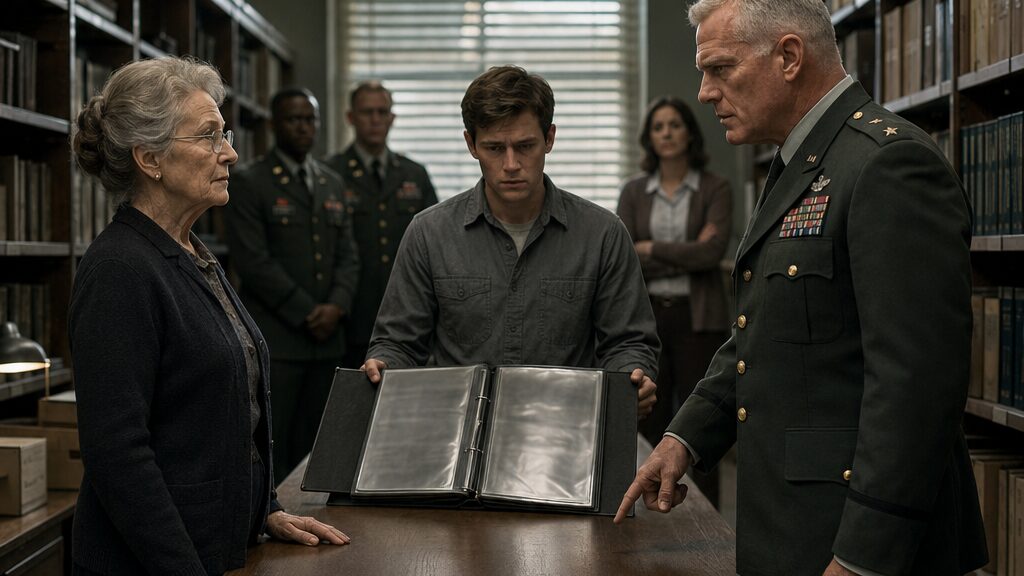
Andrew turned to section four. The papers there were sleeved in clear protectors, some typed, some photocopied, some carrying small handwritten notes from processing clerks whose names were not important enough to survive anywhere but the corners of pages. Janet stood very still as the past opened under fluorescent light.
She saw date stamps. Routing lines. Redacted blocks. The gray shadow of carbon copies. In one sleeve, a memo had been placed alone behind a divider. Her body recognized it before her mind permitted the memory.
“There,” she said.
Andrew stopped.
The page held a short typed log entry with a name near the top, a unit designation, and a brief notation of final communication received through field channels. It was not dramatic. Most true documents were not. They ruined lives in plain language.
Janet raised one hand. She pointed, but did not touch.
“That page.”
Ronald leaned forward. “What about it?”
“It was never supposed to stand alone.”
He exhaled through his nose. “Ma’am, with respect, you cannot walk into a federal records room and tell us how a fifty-year-old file was supposed to be arranged because you have a feeling.”
A little warmth moved into Janet’s cheeks. Not anger. Shame had its own temperature.
“It isn’t a feeling.”
“Then what is it?”
She looked up at him. “Memory.”
Ronald’s hand came down on the table, not hard enough to strike it, but hard enough to make the reserve soldiers look over again.
“That is not evidence.”
“No,” Janet said. “It is not.”
The answer seemed to catch him wrong. He had expected argument, maybe tears, maybe the wandering insistence of someone whose past had begun to replace the present. Janet gave him neither.
“Then this is over,” Ronald said. “Andrew, close the binder.”
Andrew put his fingers beneath the edge of the sleeve.
Janet’s hand moved.
She did not grab him. She did not touch the page. She only placed two fingers on the table near the lower corner of the binder, close to the place where the sleeve would turn. Her nails made no sound. The gesture was so small that only Andrew noticed at first.
Then Ronald saw it.
“Do not,” he said.
Janet lifted her fingers away.
“I didn’t.”
“You were about to.”
“No.”
His face tightened. In the tight aisle, with the shelves at his back and the table between them, his rank filled the room. When he stepped around the corner of the table, Janet had to tilt her head to keep his face in view.
“Listen to me,” Ronald said, and now his voice carried.
Linda shifted. “Sergeant Major—”
“No, Ms. Reed. This is exactly why chain-of-custody exists.” Ronald pointed toward the binder, then toward Janet, his index finger cutting the air between them. “Someone comes in with a number, refuses to explain herself, claims memory over documentation, and reaches toward a restricted page. That is how records get compromised.”
The room held its breath.
Janet’s eyes went to his finger. It hovered too close to her face, close enough that she could see a pale scar along the knuckle. In another year, another room, another young sergeant had pointed at a radio log and demanded she send a message faster, cleaner, without crying. She had not cried then either.
Ronald lowered his finger an inch, but not enough.
“You may have known someone in that file,” he said. “You may have a personal reason. I am not without sympathy. But you do not understand how official records work anymore.”
Andrew’s head lifted.
Linda’s mouth tightened.
The words moved through the room slower than they had been spoken.
Anymore.
Janet stood in front of the binder, her cardigan dark against the pale table, her gray hair pinned neatly, her glasses catching the light. She knew what they saw. Old hands. A visitor’s badge. Shoes chosen for balance instead of appearance. A woman who could be moved along if spoken to firmly enough.
She folded her hands in front of her.
For one moment, she wanted to tell him everything.
She wanted to tell him about the night shift with the generator failing and three incoming casualty notices waiting for confirmation. She wanted to tell him about the boys whose voices had come through broken channels, and the mothers who never knew which words were official and which had been mercy. She wanted to tell him that records were not paper. They were the last shape of a life when the body was gone.
Instead she looked at the open binder.
“That page was never supposed to stand alone,” she said.
Ronald’s jaw flexed.
“You already said that.”
“Yes.”
“And yet you still have not explained why.”
Janet turned her gaze to Andrew. Not pleading. Not asking him to rescue her. Only looking.
Andrew stared down at the page. His finger moved slightly under the edge of the plastic sleeve, then stopped. He bent closer.
“What?” Ronald said.
Andrew did not answer at first. His eyes had fixed on the bottom margin of the log entry, where a small processing notation had faded to the color of weak tea. It was nearly hidden beneath the sleeve’s glare.
“Sergeant Major,” Andrew said quietly.
Ronald looked annoyed. “What is it?”
Andrew adjusted the binder, careful not to shift the page. “There’s a pencil note here.”
“Processing notes are common.”
“Yes, Sergeant Major, but…” Andrew swallowed. “It says attachment separated pending verification.”
Linda came closer. “Let me see.”
Ronald did not step back, but he turned enough for her to lean in.
Andrew read the faded line aloud, slowly. “Attachment separated pending verification. J.B.”
Janet’s face did not change.
Ronald glanced at her. “Those initials could be anyone.”
“They could,” Janet said.
Andrew was still looking at the page. “There’s another mark below it. Not initials. Maybe a routing symbol.”
Linda went to the counter and returned with a magnifying sheet. She placed it over the sleeve. The room watched the old notation enlarge beneath the plastic.
Andrew read again, this time less certain. “Bennett?”
Ronald’s head turned toward Janet.
The reserve soldiers had gone completely silent.
Janet looked at the magnified handwriting. It was thinner than she remembered, but unmistakable in its pressure, its clipped final stroke, the small downward bend at the end of the double t. She had written it standing under a flickering lamp at two in the morning, with a cup of coffee untouched beside her and a field message waiting to be matched to a page that had never found its way home.
Linda’s voice softened. “Mrs. Bennett?”
Janet corrected her quietly. “Specialist Bennett, then.”
Ronald’s face changed only a little. His brows drew together, his certainty not gone but interrupted.
Andrew looked as if he had just realized the old woman in front of him had not entered the archive from outside the story. She had been inside it all along.
Ronald lowered his hand.
But he did not apologize.
Not yet.
“Close the binder,” he said, quieter now. “We need to verify this.”
Janet nodded once.
Andrew closed the cover with care. The sound was soft, but it seemed to travel through every shelf in the room.
As Ronald turned away, Janet’s fingers returned briefly to the table’s edge, touching the place where the lower corner of the page had been.
Chapter 3: The Initials No One Expected to Find
Andrew Miller had been trained to treat old paper like evidence and old people like visitors.
He had never thought about the difference until Janet Bennett stood on the other side of the reading table with her hands folded and Command Sergeant Major Carter’s words still hanging in the air.
You do not understand how official records work anymore.
Andrew carried the binder back to the counter after Ronald ordered it closed. He kept both palms flat against the cover as if it might lift itself and accuse him. The black vinyl was warm from the room and heavier than it had been when he first pulled it from the transfer shelf.
“Lock it in the review cabinet,” Ronald said.
“Yes, Sergeant Major.”
“And log the access.”
“Yes, Sergeant Major.”
Ronald turned to Linda. “I want the chain-of-custody sheet, the transfer manifest, and any personnel cross-reference connected to that accession number.”
Linda’s expression remained professional, but Andrew saw the line that had formed between her brows.
“I’ll pull what we have,” she said. “But if her name is in the processing notes, we need to treat her as a potential source, not a disruption.”
Ronald looked toward Janet, who had not moved from the reading table.
“We need to treat this as unverified.”
“Of course,” Linda said. “But unverified is not the same as irrelevant.”
For a moment, Andrew thought Ronald might snap back. Instead the sergeant major looked at the reserve soldiers, the open worktables, the public room that had heard too much already.
“Office,” he said.
Linda followed him into the glass-walled office behind the counter. The door did not shut all the way. Their voices dropped, but their shapes remained visible through the blinds inside the glass: Ronald upright and angular, Linda with one hand on the file cabinet, refusing to be rushed.
Andrew stood at the counter with the binder.
Janet came toward him slowly.
He straightened. “Ma’am—”
She stopped a few feet away, as if leaving room for his uncertainty.
“I’m not asking you to open it again,” she said.
“I know.”
He did not know what else to say. The apology pressing against his teeth felt too small because he was not the one who had pointed at her. It also felt necessary because he had stood there holding the binder and said nothing.
“I should log your name,” he managed. “For the access record.”
“Janet Bennett.”
He wrote it carefully. The pen seemed louder than usual.
“Are you retired Army, ma’am?”
She watched his hand form the letters.
“Yes.”
“What was your rank?”
The question came out before he could soften it. He regretted it at once. It sounded like he was searching for a reason to respect her, as if respect needed a pay grade.
Janet’s mouth moved into something almost like a smile.
“Not high enough to impress Sergeant Major Carter.”
Andrew’s face warmed.
“I didn’t mean—”
“I know what you meant.”
He looked down at the log. “I’m sorry.”
“For asking?”
“For standing there.”
That time, Janet did not rescue him from his discomfort. She let the words sit between them. Andrew found that worse than any lecture.
At last she said, “Standing still can become a habit if a person practices it too long.”
He looked up. Her gaze was not accusing him. It was measuring whether he understood the warning.
The office door opened. Linda stepped out with a set of keys and a controlled expression.
“Andrew, pull the old personnel roster index for records processing units. Years 1968 through 1972. Start with communications and casualty liaison sections.”
Andrew glanced at Ronald.
The sergeant major stood in the office doorway. “Do it.”
“Yes, Sergeant Major.”
Andrew went to the back cabinets. He had spent six months in this assignment, long enough to know the public catalog, the transfer shelves, the boxes that were requested most often by family researchers. The older indexes were different. They were housed in a lower drawer that resisted opening unless you lifted slightly as you pulled. Linda had shown him once and said every archive kept at least one drawer that remembered being mistreated.
The drawer groaned. Inside were flat ledgers, personnel indexes, retired finding aids, and photocopied rosters with typewritten headings. Andrew carried three to the processing table behind the counter.
Janet had been given a chair now, though she sat on the edge as if she might be called to stand again. Her purse rested in her lap. Ronald remained near Linda’s office, reading the chain-of-custody sheet with more attention than paper normally received.
Andrew opened the first roster.
Names ran in columns. Some were crisp. Some had been copied too many times and looked like they were dissolving. He found Bennett in the second ledger, but it was a James Bennett in supply. He kept going. The room returned to a careful quiet, though not the quiet from before. This one had listening in it.
Linda worked beside him.
“Try alternate unit labels,” she murmured. “Records sections changed names between commands.”
Andrew nodded.
After ten minutes, he found a page headed Communications Records Processing Detachment, Transitional Attachment Group.
His finger moved down the list.
There were Millers, Morgans, a Carter that made him pause though it had no relation to the man watching them, two Reeds, three names crossed out with transfer notes. Near the bottom, beneath a smudge from an old copier drum, he found it.
Bennett, Janet L. SP5.
A service number followed, partly redacted by a later privacy mark. Beside the name, in a narrow column labeled Duty Notes, someone had typed: casualty comms, attachments verification.
Andrew did not speak at first.
Linda saw his stillness. “You have something?”
He turned the ledger slightly.
Linda leaned in. Her eyes moved across the line, then back again.
“Sergeant Major,” she said.
Ronald came over.
Andrew watched him read the line. It took only seconds, but those seconds seemed to cost him something. His hand tightened on the chain-of-custody sheet. He looked once toward Janet.
She did not look back. Her eyes were on the window blinds, where afternoon light had turned thin and white.
Ronald set the sheet on the counter. “That confirms she served in a related unit. It does not confirm the record error.”
“No,” Linda said. “But it confirms she had reason to know the system.”
Andrew turned back to the binder log without being told. He copied Janet’s full name beside the access entry, then paused at the notes field. He wrote: possible historical processor identified. Then he stopped, crossed out nothing, and added: requires supervisor review.
It felt inadequate. It was procedure. Procedure was the only language the archive officially knew.
Janet rose from the chair.
“Mrs. Bennett,” Linda said, “I’d like to ask you some questions in my office, if you’re willing.”
Janet nodded.
Ronald stepped aside to let her pass. The movement was small, almost nothing. But Andrew noticed it because earlier Ronald had made himself the wall.
As Janet crossed into the office, Andrew saw her glance once at the locked review cabinet where the binder now rested. Her hand lifted slightly toward her purse, then settled again.
Linda closed the office door gently.
Ronald remained outside.
For several moments, he said nothing. Then he looked at Andrew.
“You speak when you find relevant information,” Ronald said.
Andrew stiffened. “Yes, Sergeant Major.”
“Not after. When.”
Andrew did not know if he was being corrected for hesitating or forgiven for noticing. Ronald’s face gave him no help.
“Yes, Sergeant Major.”
Ronald turned away, but before he did, Andrew saw his eyes move to the office glass where Janet Bennett sat under the half-closed blinds, small and straight-backed in the chair.
On Andrew’s desk, the roster ledger remained open.
Bennett, Janet L.
The name looked official now. But Andrew had the uneasy feeling that the official line was only the edge of something much older, and much heavier, than the archive had been prepared to hold.
Chapter 4: The Page That Was Never Supposed to Stand Alone
Linda Reed’s office was too small for three people and too full of paper to pretend otherwise.
A metal filing cabinet stood behind the door, its top crowded with catalog cards waiting to be boxed. A framed certificate leaned against the wall instead of hanging from it. On the windowsill, a plant with tired leaves bent toward the blinds. Janet sat in the visitor chair nearest the desk, her purse on her lap, her knees together, her hands folded over the clasp.
Linda shut the door gently.
Through the glass, Ronald Carter’s shape remained visible beyond the blinds. He was speaking to Andrew near the counter. Even blurred, he looked like a man determined to hold his line.
Linda sat behind the desk but did not pick up a pen.
“Specialist Bennett,” she said.
Janet looked at her.
“I’m sorry,” Linda said. “I should have asked before.”
“It has been a long time since anyone called me that.”
“Does it bother you?”
Janet considered the question. On the wall behind Linda, an old photograph showed the archive building before the annex was added. The windows were different then. Smaller. The door had been painted a darker green.
“No,” Janet said. “It just wakes up a room I don’t visit much.”
Linda nodded, as if that was enough of an answer. “I need to understand what you believe is wrong with the binder. Not because I doubt you personally, but because any correction has to be documented.”
“I know.”
“You said the page was never supposed to stand alone.”
“Yes.”
“Meaning there was an attachment?”
Janet’s thumb moved across the clasp of her purse. Once. Twice. Then stopped.
“There was a field message attached to that log entry. A retransmitted final communication.”
Linda leaned forward slightly. “From the service member listed on the page?”
Janet closed her eyes long enough to see the typing again. Not today’s page beneath clear plastic, but the original paper, thin from the field, the ink faint in one corner where rain or sweat had touched it.
“Yes.”
“Do you remember the name?”
Janet opened her eyes. “I remember too much of it.”
Linda waited.
The kindness in waiting was almost unbearable. Janet had prepared for resistance. She had not prepared for someone to give her room.
“It was during a transitional period,” Janet said. “Records moved between field channels and stateside processing. Some messages came through clean. Some arrived in pieces. Casualty communication attachments were supposed to be matched before final filing.”
“You worked that section?”
“For a time.”
“As a records specialist?”
“Communications first. Then casualty attachments when they needed hands that could type fast and not ask too many questions.”
Linda’s face changed, just slightly.
Janet looked down at her hands. They looked old now. The skin loose, veins raised, knuckles no longer straight. But she could still feel the hard edge of the old desk against her wrist. Could still hear the bell on the communications terminal, the short urgent ring that meant another message had landed after midnight.
“That page in the binder is a log entry,” Janet said. “It confirms that a final communication existed. But without the attachment, the record reads like the message was received and unresolved. That matters.”
“To family researchers,” Linda said.
“To anyone who thinks a last word deserves to arrive.”
The plant leaf brushed softly against the blind as the air conditioner came on. Janet looked toward the sound.
Linda lowered her voice. “Was the attachment lost?”
“Separated.”
“By whom?”
Janet smiled once, without humor. “That is what I have spent fifty years not answering.”
Linda did pick up a pen then, but she did not write. “Were you responsible for the separation?”
“I handled the page.”
“That isn’t what I asked.”
“No.” Janet’s thumb found the purse clasp again. “It is what I know.”
The office door opened before Linda could respond. Ronald stepped in without entering fully, one hand on the doorframe.
“Ms. Reed.”
Linda turned. “Yes?”
“I need to be present for any statement regarding restricted records.”
Janet saw the tightness in Linda’s jaw before Linda smoothed it away.
“This is a preliminary conversation,” Linda said.
“And now I’m here.”
He came in and stood near the cabinet because there was no second chair. His presence made the room smaller. Janet did not move.
Linda set the pen down. “Specialist Bennett was explaining that the page may have had an attachment.”
Ronald looked at Janet. Not with the same blunt dismissal as before, but not with trust either.
“May have,” he said.
Janet met his eyes. “Did.”
“Can you prove that?”
“Not yet.”
“Then we are still dealing with memory.”
“Yes.”
Ronald shifted his weight. “Memory does not authorize record correction.”
“No,” Janet said. “It tells you where to look when the index does not.”
Linda watched them both. “Do you know where the attachment might be?”
Janet turned slightly toward her. “If the transfer boxes still follow the old accession cross-code, the attachment would have been routed to temporary verification storage under the phonetic code of the field station, not the service member’s name.”
Ronald frowned. “Why would it be stored separately?”
“Because the original was incomplete when it arrived. A retransmission followed. The log page was filed first to preserve the date. The attachment should have been married to it after verification.”
“Should have,” Ronald said.
Janet nodded. “Should have.”
Linda wrote something down now. “Do you remember the field station code?”
Janet’s mouth tightened. The code was there. It had been there for years, buried beneath grocery lists, doctor appointments, bills, birthdays, the ordinary clutter that life piled over grief. She had not spoken it aloud since she was young.
“Whiskey-Two-Harris,” she said.
Ronald’s brow lifted. “Harris?”
“A relay designation. Not a surname.”
Linda wrote it down. “And the service member?”
Janet looked toward the blinds. Through them, she could see Andrew moving at the counter. Young shoulders. Careful hands. The same way they had all once looked, before records taught them how many endings could fit in a drawer.
“I would rather verify the page before saying his name in a room that has already mishandled him once.”
Ronald’s face hardened, but not as much as before. “That sounds like an accusation.”
“It is a fact,” Janet said. Then, after a moment, “And a confession.”
Linda stilled.
Ronald did not speak.
Janet opened her purse and took out a second folded paper, older than the first. Its creases had gone soft from being unfolded and refolded in private places. She did not hand it over. She only rested it on her lap.
“I copied the accession number many years ago,” she said. “I told myself I would come back when I was less angry. Then when I was less ashamed. Then when I had a reason that would sound proper at a desk.”
Linda’s voice was careful. “What changed?”
Janet looked down at the old paper.
“My doctor told me to stop postponing things that require stairs, signatures, or courage.”
The words might have been almost funny from someone else. In Janet’s mouth, they settled like dust.
Ronald looked away first.
Linda folded her hands on the desk. “Specialist Bennett, if we look for this attachment and find nothing, the binder transfers tomorrow as scheduled.”
“I understand.”
“If we find something, it still has to be verified.”
“Yes.”
“And if correcting the record shows a processing error from your unit, your name may become part of that file.”
Janet’s fingers pressed the paper flat against her purse.
“It already is.”
The office fell silent.
Outside the glass, Andrew had stopped pretending not to listen. He stood by the counter with a ledger open, one hand resting near the bottom corner of a page.
Ronald noticed and looked back at Janet.
“You came here knowing your own notation was in that binder?”
“I hoped it had faded.”
“Then why come?”
Janet’s eyes lifted to his.
“Because fading is not the same as being forgiven.”
For the first time since he had entered the office, Ronald had no immediate answer.
Linda closed her notebook. “I’ll pull the secondary storage index.”
Ronald straightened. “Tonight?”
“Before the transfer.”
“The inspection begins in the morning.”
“Then we should be accurate before we are inspected.”
Janet remained seated, the old paper under her hand.
Through the blinds, the archive shelves stood in their disciplined rows, each box holding its share of names. She had spent half a century believing one name waited among them in a silence she had helped create.
Now the room knew enough to look.
Not enough to understand.
Not yet.
Chapter 5: The Sergeant Major’s Rule Was Not the Whole Truth
Ronald Carter did not like rooms where civilians kept keys.
It was an unreasonable dislike, and he knew it. The archive had to be run by specialists. Civilians understood preservation, cataloging, humidity control, paper acidity, all the quiet sciences that kept history from turning brittle in its own boxes. Still, he disliked watching Linda Reed unlock cabinets he could not open, pull indexes he had not approved, and move through the records room with an authority that did not come from a uniform.
He had spent thirty-one years learning that authority had to be visible or it would be challenged.
His first platoon sergeant had taught him that. His first failed inspection had taught him harder. A misplaced form, an unsecured log, a commander’s stare across a table while young Ronald stood at attention and understood that no one cared how tired his team had been. Paper did not forgive effort. Paper only showed what had been done wrong.
Now he stood at the temporary desk beside the archive counter, reading the chain-of-custody sheet for the third time while Andrew Miller searched the old indexes and Linda moved in and out of the back room with a ring of keys at her waist.
Across the reading room, Janet Bennett sat alone at the table.
She had declined coffee. Declined water. Declined Linda’s offer to call someone for her. She sat with her purse in her lap and her back straight, looking not at the people but at the shelves.
Ronald tried not to look at her.
It was easier to look at the paperwork. The binder had been signed into transfer review two days ago. Locked status. Inspection group. Regional digitization pickup scheduled for 0800 tomorrow. Any exception would require notation, supervisor approval, and a justification that would not sound absurd to an inspection officer.
Possible old woman remembers page.
He rubbed one hand over his mouth.
No. Not old woman.
Specialist Bennett.
The correction came uninvited, and it annoyed him because it felt like weakness.
Andrew approached with a roster ledger. “Sergeant Major.”
Ronald looked up.
“Ms. Reed asked me to copy this for the review file.”
“Show me.”
Andrew turned the ledger toward him. The line was the same one Ronald had already seen, but the longer he looked, the less harmless it became.
Bennett, Janet L. SP5. Casualty comms, attachments verification.
SP5. Specialist Five. A rank from another Army, another structure, another era. Not high. Not low. The kind of rank held by people who did work that had to be right but rarely got remembered.
Ronald tapped the page. “This establishes prior duty assignment. Nothing more.”
“Yes, Sergeant Major.”
Andrew did not leave.
Ronald glanced up. “Something else?”
The young clerk’s throat moved. “When she said the page should not stand alone, she knew where in the binder it was before I turned to it.”
“She could have seen the divider label.”
“She told me section four before I reached it.”
Ronald held his gaze.
Andrew’s ears reddened, but he did not look away. “You told me to speak when I found relevant information.”
The words returned to Ronald with an uncomfortable precision. He had said them. He had meant them. He had not expected the first use to be against him.
“That is relevant,” Ronald said.
Andrew nodded once and stepped back.
Ronald looked toward Janet again.
She was older than his mother would have been, had his mother lived past seventy. That was an unhelpful thought, and he pushed it aside. His mother had kept grocery receipts in envelopes by month. She had believed every document mattered because she had never trusted anyone in an office to remember a poor woman’s word. When she died, Ronald had found a drawer full of paid bills, clipped warranties, insurance notices, and his father’s discharge papers wrapped in plastic.
He had thrown out everything but the discharge papers.
For a week after, he had felt efficient.
Then the guilt arrived and stayed.
Linda came from the back room carrying a narrow file box. “Sergeant Major, I found the secondary storage index, but the box reference is not in the main transfer manifest.”
“That means it is not part of tomorrow’s pickup.”
“Not necessarily. Some legacy boxes were consolidated last month. I need to check the loading list.”
“Tonight?”
Linda set the box on the counter. “Yes.”
Ronald lowered the chain-of-custody sheet. “Ms. Reed, I understand the emotional weight here. But I have an inspection officer arriving in the morning to review whether this archive can maintain control of restricted material. If we start pulling boxes based on memory and a marginal note, we risk exactly the kind of discrepancy they are coming to find.”
Linda’s expression did not change. “If a page is missing from a restricted binder, the discrepancy already exists.”
He disliked that answer because it was clean.
“And if we cannot verify it?”
“Then we document that we attempted.”
“Attempted because a former specialist walked in after fifty years?”
Linda’s voice cooled. “Because a former specialist with direct assignment history identified a possible separation in a binder scheduled for permanent digitization.”
Ronald glanced toward the reading table. Janet had heard. She gave no sign.
He lowered his voice. “You heard what she said in there. She is carrying guilt. That can shape memory.”
“Yes,” Linda said. “So can fear of embarrassment.”
For a moment, the archive became so quiet that the scanner’s hum seemed loud.
Andrew busied himself with the copier.
Ronald looked at Linda. “Be careful.”
“I am.”
“I mean with accusations.”
“I have made none.”
“You implied—”
“I implied that institutions sometimes prefer clean procedure over accurate memory.”
Ronald felt his temper rise and held it where it belonged, behind his teeth.
Before he could respond, the base receptionist appeared in the doorway.
“Sergeant Major Carter?”
He turned. “Yes?”
“The inspection officer’s aide called. They may move the initial walkthrough to 0730.”
Ronald closed his eyes briefly. Of course they would.
“Understood.”
The receptionist left.
Linda picked up the index box. “Then we have less time.”
Ronald looked at the archive: the shelves, the transfer carts, the locked cabinet, the public tables, the old woman who had come in with a folded paper and a sentence that had unsettled half his day.
He had built his career on not letting rooms become disorderly. Disorder got people hurt. Disorder lost weapons, missed warnings, buried reports. But there was another kind of disorder, he thought, looking at the binder locked behind the cabinet door. The kind that sat neatly labeled because no one wanted to reopen it.
Andrew returned with a photocopy of the roster. “For the review file.”
Ronald took it. The copy was slightly crooked, the bottom edge cutting close to Janet Bennett’s line. He almost told Andrew to redo it. Instead he stared at the name.
“Pull her service verification summary,” he said.
Andrew blinked. “Sergeant Major?”
“If she is connected to the binder, I want it documented properly.”
“Yes, Sergeant Major.”
Linda’s eyes rested on him, not grateful, not triumphant. Simply noting the shift.
Ronald did not look at Janet when he walked to the locked review cabinet. He removed the key from his pocket and opened it. The binder sat alone on the middle shelf, its black cover dull beneath the fluorescent lights.
He placed one hand on it.
For the first time that day, he did not feel like he was protecting the archive from Janet Bennett.
He felt, uncomfortably, as if he might be protecting himself from what she remembered.
Chapter 6: The Missing Name at the Bottom of the Log
By evening, the public lights in the reading room had been turned off, leaving only the workroom fluorescents burning behind the counter. The archive changed after hours. Without visitors, without the small shuffle of forms and chairs and whispered requests, the shelves seemed less like storage and more like witnesses.
Janet sat at the long worktable with the binder open before her.
Ronald stood near the door. Linda sat across from Janet with a yellow legal pad. Andrew had pulled a chair to the side, close enough to read but not close enough to crowd her. No one had asked the reserve soldiers to leave; they had gone on their own when the public room closed, glancing once at Janet as they passed.
The binder rested in a foam cradle Linda had brought from the preservation cabinet. Its pages lay under clean weights. The log entry was visible now without glare.
Janet had not touched it.
Linda placed a photocopy beside the original. “We can work from this.”
Janet nodded.
The copy made the page look flatter, less dangerous. But the name still sat near the top, typed in all capital letters. The service number had been partially redacted in a later hand. The unit code remained. The date remained.
Janet looked at the date for a long time.
“Specialist Bennett,” Linda said softly, “whenever you’re ready.”
Janet almost smiled. Ready was a word people used when they wanted pain to become polite.
She leaned forward.
“The message came through during a weather break,” she said. “We had been waiting on retransmissions from that relay station because several field copies were damaged. The log page was created first to show that a final communication had been received.”
Her voice was steady. That surprised her less than it surprised the others. She had learned long ago that the body could tremble after, but the voice had to hold during.
Andrew took notes. Ronald did not move.
“The attachment was not a letter,” Janet continued. “Not exactly. It was a relayed statement. Short. Field-confirmed. It needed verification before being attached to the casualty communication record.”
Linda asked, “And you were assigned to verify it?”
“I was assigned to match it.”
“With this log entry?”
“Yes.”
“Do you remember why it was not attached?”
Janet’s eyes dropped to the lower corner of the copied page. Her fingers moved toward it, then stopped above the table.
“There were three incoming packets that night. One confirmed. One illegible. One delayed. The delayed one belonged with this log. But the file had already been moved to outgoing review by the time the retransmission cleared.”
Ronald spoke from the doorway. “Moved by whom?”
Janet did not look at him. “By the system.”
“That is not an answer.”
“It is the only answer that does not turn a crowded room into one person’s crime.”
Ronald fell silent.
Linda’s pen paused. “Did you try to retrieve it?”
Janet’s breath left her slowly.
“Yes.”
The word carried them all into the part of the story that had never been written down.
She was twenty-one again, though not in the pleasant way memory sometimes returned youth. She remembered the heat first. The communications room had been too warm because someone believed machinery worked better in cold air and people could simply endure what remained. Her blouse had stuck beneath her arms. Her eyes had burned from carbon paper and no sleep.
There had been a young corporal waiting by the door for another file, shifting from foot to foot because he did not want to be there when casualty pages were sorted. Nobody wanted to be present when the last facts of a person became paperwork.
Janet had seen the mismatch before anyone else. A log page without its attachment. A name waiting without the words that belonged to it.
“I marked the page,” she said. “Attachment separated pending verification. My initials. My surname because there were two J.B.s that month.”
Andrew looked at the faded notation as if it had just become a hand reaching out of the page.
“I went to retrieve the attachment from temporary storage,” Janet said. “But the shift changed. A supervisor told me outgoing review had priority. Then another batch came in.”
Linda did not interrupt.
“I kept the code on a slip,” Janet said. “Whiskey-Two-Harris. I meant to fix it the next morning.”
“And?” Ronald asked.
Janet looked at him then.
“And the next morning had its own dead.”
No one wrote for several seconds.
Janet’s face remained composed, but her hand had closed around the edge of her cardigan. She made herself release it.
“The log stayed. The attachment stayed elsewhere. I checked once before I transferred out. It was still pending. I told myself someone would finish it because the note was there.” She swallowed. “Then I told myself many things.”
Linda’s eyes were bright, but her voice stayed even. “What was in the final communication?”
Janet pressed her lips together.
“You do not have to recite it,” Linda said. “Only what is needed to identify the attachment.”
“I know.”
Janet looked down at the copied page.
“There was a phrase at the bottom. That is how I’ll know it.” Her eyes moved over the typed name. “He asked that his mother be told he remembered the blue porch light.”
Andrew’s pen stopped.
Ronald looked away.
“It sounds small,” Janet said.
“No,” Linda said.
Janet folded her hands. “Small things are what people send when there is no room left for large ones.”
Linda wrote: blue porch light.
Andrew’s voice came carefully. “Was that in the log?”
“No.”
“Then if we find a page with that phrase—”
“It belongs here.”
Ronald came closer to the table. Not much. Enough.
“What was the soldier’s name?” he asked.
Janet stared at the copy. She had protected the name all afternoon as if speaking it too soon might damage it again. But a record could not be corrected around an absence.
“Private First Class Stephen Harris,” she said.
Linda looked up. “Harris? Same as the relay code?”
“No relation. That was part of the confusion. His surname matched the relay designation. The temporary index placed the retransmission under the station code, not the personal name. I remember because I thought, even then, that it would be easy to lose.”
“And it was,” Ronald said.
Janet heard judgment in his voice, but not the same kind as before. This one had less blade in it.
“Yes,” she said. “It was.”
Andrew turned pages in the secondary index Linda had pulled. “Whiskey-Two-Harris,” he murmured, scanning the lines. “Temporary verification. Field relay. Attachments pending.”
Linda shifted closer.
Andrew’s finger stopped. “There’s a storage box number.”
Ronald came to stand behind him. “Read it.”
“Legacy temporary verification, W-2-H. Box 19B. Consolidated to transfer pallet group seven.”
Linda’s face tightened. “Pallet group seven is on tomorrow’s loading list.”
“Where is it now?” Ronald asked.
“In the rear staging room,” Linda said. “If it hasn’t already been moved to the loading area.”
Janet’s hand flattened on the table near the copied page. For the first time all day, she looked frightened.
Ronald saw it.
The fear was not of him. That, somehow, made him feel smaller.
Linda stood. “We can pull it tonight.”
Ronald checked his watch. “The rear staging room is locked after hours.”
“You have access authorization.”
“For inspection preparation, not unscheduled historical searches.”
Linda held his gaze. “Then authorize it as inspection preparation. If a transfer pallet contains a misfiled restricted attachment, that is exactly what the inspection is supposed to catch.”
Andrew looked between them.
Ronald’s jaw worked once. The old reflex rose in him: no exceptions, no loose movement, no undocumented searches the night before review. But on the table lay the copied page with Janet Bennett’s old notation at the bottom, and beside it Linda’s new words in blue ink: blue porch light.
A mother’s porch light. A phrase small enough to be dismissed and large enough to last fifty years.
Ronald reached into his pocket and took out his key ring.
“We document every step,” he said.
Linda nodded.
Andrew stood so quickly his chair scraped the floor.
Janet remained seated. She looked suddenly older than she had in the public room, as if the telling had spent what little reserve had carried her through the day.
Ronald paused beside her.
“Specialist Bennett,” he said.
She looked up.
He seemed about to say something else. Something that belonged not to procedure but to the space after harm. Then he stopped.
“We’ll need the code again when we reach the staging room.”
Janet nodded once.
“Whiskey-Two-Harris,” she said.
Ronald repeated it under his breath, committing it to memory.
For once, he did not sound like a man giving an order.
Chapter 7: Before the Boxes Left the Building
Andrew arrived before the archive lights were fully on.
The base was still in the gray hour between night duty and morning inspection, when hallways smelled faintly of floor cleaner and coffee made too early. He had not slept much. The phrase blue porch light had followed him home, sat beside him at dinner, and waited for him when he woke before his alarm.
He found Linda already at the rear staging room door with a clipboard under one arm. Ronald Carter stood beside her, uniform sharp enough for the inspection he seemed determined not to think about. Janet Bennett sat on a bench against the wall, her purse in her lap, a folded coat beside her. She looked smaller in the loading corridor than she had in the archive, but when Andrew met her eyes, she gave him a nod as if he had arrived exactly on time.
“Morning, ma’am,” he said.
“Good morning, Andrew.”
The use of his first name surprised him. He did not correct her.
Linda checked her watch. “We have less than an hour before the transfer crew arrives.”
Ronald unlocked the staging room. “We touch only pallet group seven. Nothing leaves this room without being logged.”
No one argued. His voice had returned to its command shape, but something in it had changed. The words were still rules. They no longer sounded like a wall.
The staging room was colder than the hallway. Metal racks lined the walls, and transfer pallets sat wrapped in clear plastic, each one tagged with barcodes and destination labels. The smell of cardboard, dust, and machine oil made Janet stop just inside the door.
Ronald noticed. “Do you need a chair?”
“No.”
He seemed to want to insist, then did not. “Pallet seven is this way.”
Andrew cut the plastic wrap carefully while Linda recorded the time. Ronald read out every box number before allowing it to be moved. The process was slow, and each minute pressed against the room. Outside the loading bay, a truck backed somewhere in the distance with three short warning beeps.
Andrew lifted the first box marked Legacy Temporary Verification. “This one?”
Janet looked at the label, then shook her head. “Not yet.”
The second box carried a W-2 series mark, but the suffix was wrong. The third had water staining along one side and a replacement label. Janet leaned closer, her hand hovering above the cardboard but not touching.
“May I?” she asked.
Linda nodded. “Gloves first.”
Andrew handed her a pair. Janet pulled them on slowly, the thin white material catching at her knuckles. She touched the label’s lower corner. Andrew remembered the gesture from the binder—the careful approach, the refusal to claim more than she had been given.
“This one was relabeled,” Janet said.
Ronald looked at Linda. “Is that on the consolidation sheet?”
Linda checked. “Box 19B was consolidated into 19B-R after sleeve replacement.”
Andrew read the side label. “Temporary Verification, W-2-H, 19B-R.”
Janet closed her eyes for one breath.
“That’s it.”
Ronald moved beside the box. “Open it.”
Andrew cut the tape.
Inside were long folders, bundled sleeves, and stiff separators with handwritten codes. The papers looked ordinary in the way important things often did. No glow rose from them. No music announced the right place. Only old tabs and gray edges and the faint smell of paper that had waited longer than most people lived.
Linda took the first bundle out and placed it on the clean cart. “We search by relay code first.”
Andrew read labels while Ronald checked them against the index. Janet stood at the cart, hands clasped. Twice Linda asked her to sit. Twice Janet said no.
The first folder contained duplicate routing slips. The second held damaged retransmission logs. The third was empty except for a note saying contents moved for preservation. Andrew felt hope rise and fall with each folder, embarrassed by how badly he wanted the page to appear, as if finding it could undo yesterday.
A knock came at the staging room door.
The base receptionist leaned in. “Sergeant Major, the inspection officer just arrived at the front gate. Early.”
Ronald’s face did not change. “Understood.”
“He’ll be here in about fifteen minutes.”
“Thank you.”
The door closed.
Linda looked at him. “We can pause and secure this.”
“No,” Ronald said.
Andrew glanced at him.
Ronald kept his eyes on the box. “Continue.”
They worked faster but not carelessly. Janet’s breathing had grown shallow. Andrew could hear it when the room went quiet between folder shifts.
Then she said, “Stop.”
Her voice was barely above a whisper.
Andrew froze with a sleeve halfway out of a folder.
Janet pointed, not at the folder’s label, but at a small penciled mark on the inner flap: W2H / Harris cross.
Ronald stepped closer. “Harris cross?”
“The confusion,” Janet said. “The relay and the surname.”
Linda held the folder open.
Inside were three sleeves. The first held a routing correction. The second held a damaged field transmission, most of it unreadable. The third was thinner, yellowed at the edges, with a typed strip clipped to the top.
Andrew read the header.
“Retransmitted personal statement. Field-confirmed.”
Janet’s hand went to the cart to steady herself.
Linda did not remove the page immediately. She looked at Janet first.
“Is this the attachment?”
Janet stared at the sleeve. “Turn it enough for the bottom line.”
Andrew lifted the sleeve carefully so she could see without touching. The final typed line sat near the lower margin, faint but readable.
Tell my mother I remembered the blue porch light.
No one spoke.
The truck outside beeped again, farther away this time.
Janet’s lips moved once, but no sound came. She put one gloved finger on the cart beside the sleeve, close to the bottom corner, and bowed her head.
Andrew looked away because he suddenly understood that witnessing something did not mean owning it.
Ronald removed his cap slowly. Not as ceremony. Not as performance. The room was too small for that. He held it at his side and looked at the page.
Linda’s voice was low. “We have the matching unit code, the retransmission header, the relay designation, and the phrase.”
“And the log entry,” Andrew said.
“And Specialist Bennett’s notation,” Linda added.
Ronald replaced his cap. “Then it gets documented.”
Janet lifted her head. “The inspection—”
“Will see a discrepancy properly identified before transfer,” Ronald said.
She studied him, as if trying to decide whether he meant the record or himself.
Footsteps sounded in the corridor.
Linda slid the sleeve into a preservation folder. Andrew placed the original binder, brought from the review cabinet, onto the cart beside it. For the first time, the log page and the missing attachment lay within reach of each other.
Ronald opened the staging room door.
The visiting inspection officer stood outside with a tablet in one hand and an aide behind him.
“Sergeant Major Carter,” the officer said. “I understand we may be early.”
Ronald stepped aside, revealing the open box, the cart, Linda with her clipboard, Andrew beside the binder, and Janet standing with gloved hands near the page.
“Yes, sir,” Ronald said. “And we have something you need to see before that pallet leaves this building.”
Chapter 8: The Binder Remembered Her Name Quietly
The inspection officer did not raise his voice.
That helped.
He listened while Linda explained the transfer group, the restricted binder, the legacy temporary verification box, and the attachment located under the relay code. He asked precise questions. Linda answered them with dates, box numbers, and process steps. Andrew handed over copies. Ronald stood beside the cart, not interrupting, not softening the facts to spare himself.
Janet remained at the end of the worktable, the white gloves still on her hands.
When the inspection officer asked who had identified the possible separation, Linda looked at Janet.
“Specialist Janet Bennett,” she said. “Formerly assigned to communications records processing and casualty attachment verification.”
The title moved through the room without fanfare. No one saluted. No one applauded. No one made the moment larger than it could bear.
The inspection officer turned to Janet. “Specialist Bennett, are you willing to provide a verifying statement?”
Janet looked at the binder.
The black cover had been opened again, this time on the worktable beneath proper light. The log entry lay on the left. The recovered attachment, sleeved and supported, lay on the right. Between them, Linda had placed a correction form.
All day yesterday, Janet had feared the page might be gone. For fifty years, she had feared it might still exist.
Those were not opposites, she realized. They had been two doors into the same room.
“Yes,” she said.
Linda brought her a pen.
Janet removed the glove from her right hand. Her fingers were stiff, and for a moment she feared the signature would shake so badly it would look unlike itself. Then she placed the pen on the line.
Janet L. Bennett.
The letters came slowly. Not young. Not crisp like the faded notation in the binder. But complete.
The inspection officer reviewed the form. “This will delay the transfer of this accession group.”
Ronald said, “Yes, sir.”
“And require a corrective action note.”
“Yes, sir.”
The officer looked at him. “You are the reviewing authority?”
Ronald did not glance at Janet. “I am.”
“Then sign acknowledging the delay and review requirement.”
Ronald took the pen.
Andrew watched his hand as he signed beneath Janet’s name. Yesterday that same hand had pointed at her in the aisle. Now it held the page in place while the ink dried.
The correction did not erase what had happened. Andrew knew that. He suspected everyone in the room knew it. But the difference between pointing and holding was not small.
The officer finished his notes, thanked Linda, and told Ronald the walkthrough would begin in the public reading room after the transfer pallets were resealed. He did not ask Janet for a story. For that, Andrew felt grateful.
When the officer left, the staging room seemed to release a breath.
Linda began preparing the corrected record packet. Andrew returned the loose folders to their box under her direction. Ronald remained by the table, eyes on the binder.
Janet pulled off the second glove and laid it flat beside the first.
“Specialist Bennett,” Ronald said.
She looked up.
His posture was formal, but his voice was not the one he used for inspection officers.
“I owe you an apology.”
Linda’s hands paused briefly over the correction packet. Andrew kept his eyes on the box but stopped moving.
Ronald continued, “I spoke to you in a way I had no right to speak. I made an assumption from what I saw. I treated your memory like interference before I understood it was part of the record.”
Janet folded the gloves together.
“You were protecting the archive,” she said.
“I was protecting my control of it.”
The answer surprised her. She looked at him more closely.
Ronald’s face held the strain of a man who did not apologize often and did not intend to waste the occasion by making it easy.
“I can document the correction,” he said. “I can document the delay. I cannot document the disrespect in a way that repairs it.”
“No,” Janet said. “You cannot.”
Andrew looked down.
Ronald accepted it with a small nod. “Then I’ll remember it.”
Janet’s fingers rested on the folded gloves. “Remember the next person first.”
The words were not sharp. That made them heavier.
Ronald looked toward the open door, beyond which the archive hallway waited with its polished floors and morning light. “Yes, ma’am.”
Linda sealed the recovered attachment into the corrected packet and placed it behind the log page. The binder rings opened with a metallic click. Janet flinched, not visibly enough for most people to notice, but Andrew did. Ronald did too. He shifted his hand to steady the binder so Linda could work without jarring the pages.
The attachment slid into place.
For a few seconds, everyone simply looked at it.
The log page no longer stood alone.
Janet had imagined this moment many times, but never accurately. In her imagination, she had felt relief like a door opening, or grief breaking, or forgiveness arriving clean and whole. Instead she felt tired. Deeply, plainly tired. Beneath it, something loosened by a fraction, not enough to free her from the past, but enough to let her breathe around it.
Linda closed the binder.
“Would you like a copy of the correction notice when it’s finalized?” she asked.
Janet nodded. “Yes. And if there is a family request on file—”
“I’ll check,” Linda said. “Properly.”
Janet looked at the closed binder. “Thank you.”
Andrew carried the binder back toward the archive reading room. This time, Ronald took the recovered record packet himself and walked beside him. Janet followed with Linda at her pace.
When they reached the narrow aisle, the public lights were on. The room looked almost the same as it had the day before: shelves, blinds, service desk, reading table. Yet Janet felt the difference in the space where Ronald had stood pointing.
Memory did not change a room for everyone. Sometimes it changed only where a person could bear to stand.
Ronald placed the binder on the table, not pushed toward Janet, not held away. Set down evenly, with both hands.
“Here,” he said.
Janet touched the cover once.
Not to claim it. Not to forgive it. Only to acknowledge that it had carried what people had failed to carry.
Then she turned to leave.
At the doorway, she paused. A woman with silver hair had entered the reading room, holding a folder against her chest. The base receptionist was explaining the sign-in sheet too quickly, pointing from one box to another while the woman blinked in confusion.
Ronald saw it too.
He crossed the room before the receptionist could finish.
“Let her finish,” he said.
The receptionist stopped.
Ronald’s voice was calm. “One question at a time.”
The woman looked relieved, then embarrassed by her relief. Ronald pulled a chair out for her, but did not touch her arm, did not guide her as if she were a child, did not rush the folder from her hands.
Janet watched from the doorway.
Andrew came to stand near the counter, the binder now logged and secured behind him. Linda remained beside the worktable with the correction packet. No one said anything about what had changed. That was good. Some changes were stronger before they were named.
Ronald glanced back once.
Janet gave him a small nod.
Then she stepped into the hallway.
Outside, the morning had brightened over the base. The flag moved in the wind beyond the glass doors. Janet walked slowly past the framed photographs of young soldiers in their ordered rows. She stopped before one she had not noticed the day before: a communications unit from decades earlier, faces grainy, names listed beneath in small print.
Her own face was not among them.
That was all right.
She had never come to find herself.
At the exit, she opened her purse and placed the folded accession paper inside beside the older one. For a moment, her fingers rested on both.
Then she let them go.
Behind her, in the archive, a binder held a page that no longer stood alone. Ahead of her, the day waited without asking her to prove who she had been before letting her pass.
Janet Bennett stepped through the doors with her back straight, her pace unhurried, and her hands empty.
The story has ended.