The Young Soldier Checked His Tablet While the Old Woman Watched the Wind Over Lane Seven
Chapter 1: The Old Rifle Under the Desert Shade
The range gate still leaned the same way.
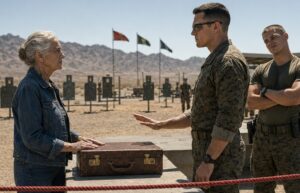
Kathleen Bennett noticed that before she noticed the new sign, before the camera mounted above the chain-link fence, before the young private in sunglasses stepped out of the booth and looked at her truck as if it had arrived from another decade. The gate had always sagged at the right hinge. It used to give a dry metallic groan when it rolled open, and after thirty-two years away from this place, that sound was the first thing her memory supplied.
The private did not roll it open. He pressed a button. The gate moved on a motor, smooth and almost silent.
Kathleen sat behind the wheel with both hands resting at the bottom of it. Her fingers ached from the long drive, but she did not flex them where the private could see. The desert was already bright. Morning light lay hard across the gravel, the berms, the pale ridges beyond the range, and the low roof of the firing line canopy. Heat shimmered over the access road, turning the far target frames into thin black strokes.
“Ma’am,” the private said, leaning toward the window. “You here for the veterans’ walk-through?”
“No,” Kathleen said.
He waited.
She reached to the passenger seat and lifted the folded paper she had printed from the base office email. It gave her name, the date, and one line of authorization for the final open qualification day before Red Mesa Training Range closed for redevelopment. The private took it with two fingers, read it, then read it again as though the words might change.
“You’re scheduled for live fire?”
“That’s what it says.”
His eyes flicked past her shoulder, into the cab. A hard black rifle case lay across the back seat, belted in because Kathleen disliked things sliding around while she drove. Beside it sat a small canvas range bag, faded nearly gray at the seams.
The private looked back at her.
“You’ll need to check in with range command.”
“I remember where it is.”
He gave a small polite smile that meant he did not believe her and was too young to know he did not have to show it. “Road bends left. Park by the blue cones.”
Kathleen nodded once. When the gate opened fully, she drove through.
The tires crunched over gravel. Dust rose behind the truck in a low, familiar curtain. For a moment the place seemed to build itself out of old habits: the rows of target frames, the bleached warning signs, the tower, the long shaded firing line, the benches set under the canopy. But the details had changed. Digital monitors had been bolted where spotter scopes once sat. Orange cable protectors crossed the ground. Tablets rested in charging racks near range command. The old hand-painted lane numbers had been replaced with black vinyl squares.
One number pulled at her eye.
Seven.
It stood halfway down the line, clean and square on the front post, as if a fresh label could make the lane new.
Kathleen parked at the end of the row. She turned off the engine and sat a moment longer, listening. Wind moved over the desert in a thin, sandpaper whisper. Somewhere downrange, a loose piece of target backing tapped against wood. The sound came in three uneven knocks, paused, then came again.
She had heard that rhythm before, not the exact board but the way this range announced small things before large ones. Men used to miss them. Young men mostly. Some older men too, if pride was loud enough in their ears.
Kathleen opened the door.
Her left knee protested first. She waited until the pain cleared into something she could walk through, then stepped down and reached into the back. The rifle case was heavier than she remembered, or she was older than she preferred to admit. Both could be true. She slid it toward her carefully, not jerking, not rushing. The case bumped against the seat frame and stopped.
A voice behind her said, “Need help with that, ma’am?”
Kathleen turned.
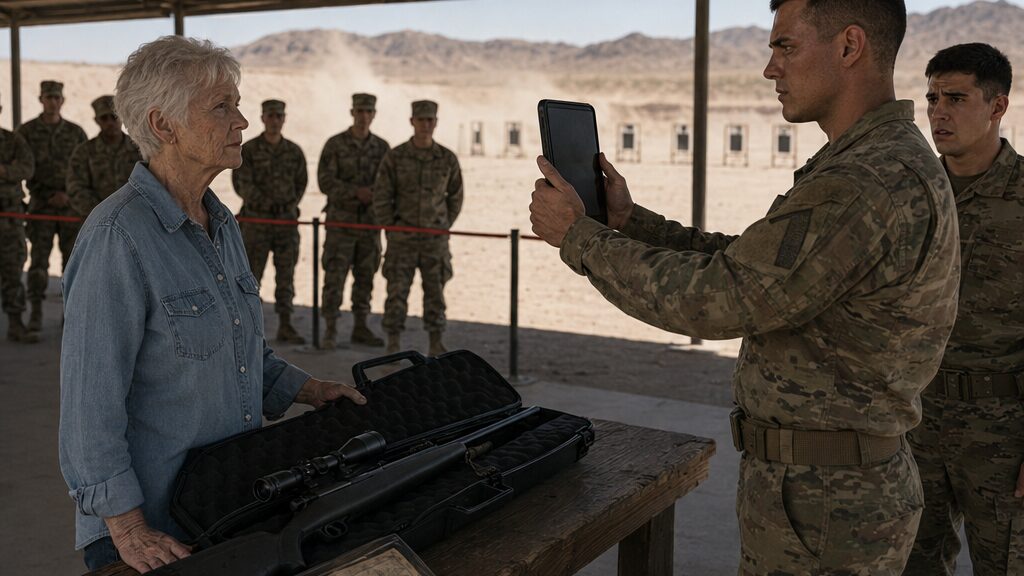
A young soldier in camouflage stood ten feet away with a tablet tucked against one side of his vest. He had the clean, alert posture of someone responsible for other people’s mistakes. Close-cropped hair, sun-browned face, no wasted motion. His name tape read CARTER.
“I have it,” Kathleen said.
“I’m Sergeant Carter. Range safety.” He looked at the case, then at her hands. “Long gun?”
“Yes.”
“You can leave it cased until cleared.”
“That was my plan.”
He heard the edge in it, or thought he did. His expression stayed professional, but the tablet came up between them like a badge. “Name?”
“Kathleen Bennett.”
He tapped the screen. “Bennett…”
She waited.
The shaded firing line drew her eye again. Wooden benches stood under the canopy in a long row. New screws, new paint, same basic design. The seventh bench sat almost exactly where it had before, a few feet from a support post that cast a hard strip of shadow across the surface. She remembered a coffee ring there once. She remembered chalk. She remembered a young man laughing too loudly because he was afraid of failing.
“Are you with the veterans’ group?” Sergeant Carter asked.
“No.”
He tapped again. “I’m showing a Kathleen Bennett under visitor access.”
“I’m cleared for one lane.”
“Do you have your firearms card?”
She reached into the pocket of her light denim shirt and took out the laminated card. He accepted it, scanned the barcode with the tablet, frowned, scanned it again.
Behind him, beyond the command table, an older officer spoke with two reservists. Silver showed at his temples beneath his cap. He turned slightly at the sound of her name, or perhaps Kathleen imagined it. Men who had served long enough learned to look without seeming to look.
Sergeant Carter handed the card back. “This system doesn’t show current qualification.”
“It wouldn’t.”
“Then I can’t clear you for live fire until command verifies.”
“That’s why I came early.”
He looked at her again, not rudely, not openly. His gaze took in the white hair cut short above her collar, the careful way she held herself, the case she had not yet lifted from the truck. His conclusion arrived before his words did.
“Ma’am, this is not a recreational range today. We’ve got active qualification blocks, movement restrictions, hot-line windows. It can get confusing if someone hasn’t been through the current safety brief.”
Kathleen slid the rifle case fully out and set it on the truck bed, not hard enough to make a point. “Then I’ll attend the current safety brief.”
His jaw tightened a fraction. “That’s at the firing line.”
“I remember where that is too.”
A gust came over the berms, light but slanted. Dust crawled across the access road toward the canopy. Kathleen watched it pass over the gravel, break around the support posts, and curl briefly at Lane Seven before settling.
There it was again.
Not wrong enough for a young man with a tablet. Wrong enough for an old woman who had spent too many afternoons watching bullets tell the truth.
She unzipped the canvas range bag and checked what she already knew was inside: ear protection, old shooting glasses, two boxes of ammunition, a small tool roll, and the folded range card wrapped in a plastic sleeve. The pencil marks had faded, but not vanished. She touched the edge of the card with one finger, then tucked it under the rifle sling when she opened the case.
The rifle lay in the foam, dark and oiled, a long scoped bolt-action she had owned longer than some of the men at the range had been alive. It was not military issue now, though it carried the habits of one. The sling was worn smooth where her hand had gripped it over years. The stock had a small nick near the cheek rest from a day she did not like remembering.
Sergeant Carter stepped closer. “Bolt open, please.”
Kathleen lifted the rifle, opened the bolt, and angled the chamber without being asked twice.
His expression shifted, almost imperceptibly. Not respect. Recalculation.
“Thank you,” he said.
She carried the rifle toward the shaded line. The weight settled into her arms with a familiarity that made her throat tighten. It was not youth returning. It was not strength. It was a language she still understood.
At the command table, the older officer looked up. His name tape read REED.
Kathleen knew the surname but not the man. Or perhaps she knew the kind of man: senior enough to let younger soldiers run the line, experienced enough to notice what they missed, tired enough to choose when not to intervene.
“Ma’am,” he said. “Samuel Reed. Range officer in charge.”
“Kathleen Bennett.”
Something moved behind his eyes. Not recognition exactly. A file drawer opening somewhere.
“Sergeant Carter will get you checked in.”
“He’s trying.”
Ryan Carter did not smile.
The safety brief began under the canopy with twelve shooters standing in a loose line and two instructors pointing at diagrams on a monitor. Kathleen stood at the end, rifle grounded, hands resting lightly over the muzzle cap. The sun moved higher. Heat gathered under the roof. A fly worried at the edge of the command table. Voices blurred into procedure: muzzle awareness, ceasefire commands, hydration, medical station, target feedback, electronic scoring.
All useful. All necessary.
Not complete.
When the briefer pointed downrange and described the target lanes, Kathleen found herself looking past his hand. Lane Seven’s frame sat square to a casual eye. But the shadow under the left support was wrong for the hour. The backing board gave that uneven knock again.
Tap. Tap-tap.
Her thumb moved against the edge of the range card.
Ryan noticed. “Ma’am?”
She looked at him.
“If you have a question, ask during the brief.”
“I don’t have a question.”
The briefer continued. “Shooters will not proceed to benches until cleared by range safety.”
Kathleen’s gaze returned to Lane Seven.
Ryan followed it, then looked at his tablet. “You’re assigned pending verification,” he said softly, as if saving her embarrassment. “Please don’t move to a bench until I clear it.”
“I won’t.”
But she knew already which bench they would give her, because empty places had a way of calling the people who remembered them.
When the brief ended, shooters collected their gear. Boots scraped concrete. Cases opened. Magazines clicked. The range came alive with controlled noise.
Kathleen remained still until Ryan stepped in front of her.
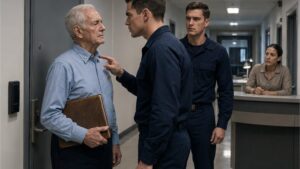
“Mrs. Bennett,” he said, “who authorized you to handle that rifle today?”
Chapter 2: The Tablet Said Visitor, Her Eyes Said Wind
“Not Mrs.,” Kathleen said.
Ryan blinked. “Excuse me?”
“Bennett is fine.”
He held the tablet at chest height. The screen reflected the white glare from beyond the canopy, turning his face pale at the edges. “Ms. Bennett, then. I need to know who authorized live fire. The system shows you as a visitor, inactive status, no current military qualification, no unit assignment.”
“That is accurate.”
“Then you understand the problem.”
“I understand your problem.”
His mouth pressed into a line. Around them, the other shooters were settling at their benches. A young private at Lane Three adjusted his ear protection. Two reservists joked quietly while laying out magazines. An armorer walked behind the line with a chamber flag clipped to his vest. No one stared outright, but attention gathered the way heat gathered under the roof.
Ryan lowered his voice. “Ma’am, this range isn’t for visitors.”
Kathleen rested the rifle on the wooden bench beside her, bolt open, muzzle downrange. “I know.”
He waited, perhaps expecting her to say more. When she did not, he looked again at his screen. “I have to follow what I have here.”
“You should.”
“Then you can’t be on the firing point.”
“I’m not asking you to ignore procedure.”
“With respect, that’s exactly what you’re asking.”
“No,” she said. “I’m asking you to look downrange before you clear Lane Seven.”
Ryan’s eyes moved automatically toward the targets, then back to her. It was quick, almost annoyed, the glance of a man humoring someone who had interrupted a checklist.
“What about Lane Seven?”
“The frame is carrying left after the wind turns.”
“The target system passed calibration this morning.”
“Did someone walk the frame?”
His thumb paused over the tablet. “The system passed calibration.”
“That is not the same thing.”
A reservist at Lane Five looked over. Ryan noticed and straightened. The tablet came closer to his chest, turning from tool to shield. “Ms. Bennett, you are not on the range staff.”
“No.”
“You are not assigned as an instructor.”
“No.”
“And you are not cleared to evaluate target frames.”
Kathleen felt the words land exactly where he meant them to: on her age, her civilian shirt, her white hair, the absence of insignia. She had worn uniforms long enough to recognize the difference between a rule and a man hiding inside one.
She did not reach for her old identification. She did not tell him what she had done here before. She did not say that she had watched better shooters than him miss warnings written in dust.
Instead she pointed downrange with two fingers, low and brief. “See the brush at the left berm?”
Ryan did not turn.
“The wind is quartering different at the target line than it is here. It hits that cut in the berm, drops, and pushes the backing. That knock you hear is the board twisting.”
He exhaled through his nose. “The target sensor compensates.”
“For electronic scoring. Not for a shifted frame.”
“Lane Seven is closed for your use anyway.”
“That is not what I said.”
He leaned slightly toward her. “Ma’am, I need you to step back from the bench.”
The command carried across the nearest lanes. Conversation thinned. The private at Lane Three stopped adjusting his sling. Somewhere behind the command table, Samuel Reed turned.
Kathleen looked at Ryan’s boots first. Good polish. Too clean at the instep for a man who walked berms often. Then his hands. Strong, capable, a little too tight on the tablet. Then his eyes. Not cruel. Not stupid. Young in the particular way that believed urgency and certainty were the same thing.
She stepped back one pace.
The move surprised him. It took some of the force out of his posture.
“Thank you,” he said.
Kathleen reached to the bench, not for the rifle but for the folded range card under the sling. Ryan’s shoulders hardened.
“Hands away from the weapon.”
“My hands are away from the weapon.”
She lifted the plastic sleeve by one corner and placed it flat on the bench between them. The old paper inside had softened at the folds. Pencil lines crossed the printed lane diagram. Wind arrows, yardage notes, small corrections. At the bottom, in handwriting steadier than her hands were now, a note was circled twice.
L7 — low left after noon wind. Walk frame, don’t trust board.
Ryan glanced at it. “What is that?”
“A range card.”
“I can see that.”
“Then read it.”
He did, but too quickly. “This is old.”
“Yes.”
“This doesn’t apply to the current electronic system.”
“The berm didn’t get replaced by the electronic system.”
The nearest reservist made a sound that might have been a laugh covered as a cough. Ryan’s ears reddened.
“Ms. Bennett,” he said carefully, “I’m not going to debate range safety with you.”
“Good. Don’t debate it. Check it.”
“We have a schedule.”
“You have rifles pointed at targets.”
“They’re not loaded yet.”
“Then this is the cheapest time to be careful.”
For the first time, Samuel Reed spoke from behind them. “Problem, Sergeant?”
Ryan turned halfway. “No, sir. I’m handling it.”
Samuel’s gaze went to Kathleen, then to the card, then downrange. He did not step closer. The choice not to move had weight. Kathleen felt it.
“Ms. Bennett is concerned about Lane Seven,” Ryan said, making the word concerned do more work than it should.
Samuel looked toward the target line. “Lane Seven passed morning checks.”
“Yes, sir.”
There. The door closing.
Kathleen folded her hands in front of her. The skin over her knuckles looked thin in the sun. She wondered whether Ryan saw hands that shook and stopped there. He did not know they shook more when she was angry than when she was afraid.
Samuel’s eyes returned to the range card. “Where did you get that?”
“I made it.”
“When?”
“A long time ago.”
“How long?”
“Long enough that the berm was shorter.”
Ryan shifted. “Sir, I can assign her to observation until admin clears her status.”
Samuel looked as if he might ask another question. Instead, one of the instructors called from the command table that the first relay was ready. A timer beeped. The shooters put on ear protection. The range pulled itself back into procedure.
Samuel nodded once. “Keep her off the firing point until verified.”
“Yes, sir.”
Kathleen said nothing.
Ryan reached for the range card. “I’ll hold this until we’re done.”
Kathleen’s hand came down on the plastic sleeve before his fingers touched it. Not fast. Not dramatic. Just final.
“No.”
His eyes snapped to hers.
“It stays with the rifle,” she said.
“It’s loose paper on the bench.”
“It’s been on this bench longer than your tablet has been in its case.”
That one landed before she could soften it. Ryan’s face closed. Samuel heard it too; his chin dipped slightly, not approval, not correction.
Ryan took a breath. “Fine. Put it in your bag. Then step behind the red line.”
Kathleen slid the card back under the sling. She carried the rifle—not as a display, not as defiance, but because no one else had permission to touch it—and moved behind the painted red safety line. Her knee hurt. Her right shoulder did too. She let neither change her pace.
The shooters on the first relay took positions. Lane Seven remained empty for a moment, its bench clean, its target frame tapping downrange. Then a private with narrow shoulders and an anxious set to his mouth approached it, guided by another instructor.
Kathleen watched Ryan check his tablet.
“Lane Seven is open,” he called.
She looked at Samuel Reed. He was looking at the line, not at her.
The private sat at Lane Seven and adjusted his rifle.
Kathleen listened to the wind come over the berm.
Tap. Tap-tap.
Chapter 3: Samuel Reed Watched Without Stepping In
Samuel Reed had learned, over twenty-eight years in uniform, that command was often a choice between two imperfect silences.
There was the silence of restraint, which allowed trained people to do their jobs without a senior officer’s hand on their shoulder. Then there was the silence of convenience, which wore the same uniform but served a different master. Samuel disliked how often he recognized the second one only after it had already done damage.
From the command table, he watched Sergeant Ryan Carter move down the firing line with his tablet, confirming lane assignments and safety checks. Carter was squared away. Too squared away sometimes, but reliable. He knew the current system, knew the safety language, knew how to keep a dozen shooters moving without letting the line turn sloppy.
That mattered today.
Everything mattered today.
Red Mesa Training Range had one final qualification cycle before closure. After that, the land would be turned over in phases: part county emergency services facility, part solar project, part storage, depending on which briefing Samuel believed. The official language called it modernization. The older reservists called it a burial. Samuel had signed the paperwork and stopped arguing with words.
He looked down at the schedule. Three relays before lunch, two after. Inspection at 1600. Archival crew tomorrow. Gates locked by Friday.
A tablet chimed beside him. He ignored it.
Kathleen Bennett stood behind the red line with her rifle case near her boots and her old bolt-action resting open in the rack. She did not fidget. She did not complain. She watched the target line with a stillness Samuel had seen in only a few kinds of people: good hunters, experienced instructors, medics waiting for the second symptom, and soldiers who had learned not to trust quiet.
Her name worked at him.
Bennett.
He had read it somewhere, maybe in one of the old range binders stacked for disposal in the office. Or heard it in a story from a retired master sergeant when Samuel was still young enough to pretend stories were exaggerations. Bennett had been common enough. Kathleen less so.
He almost asked.
Then the line went hot.
“Relay One,” Carter called. “Five rounds slow fire. On command.”
The shooters settled behind their rifles. The private at Lane Seven swallowed visibly before lowering his cheek to the stock. Samuel marked him at once as nervous. Newer shooter, trying to hide it. Not unsafe, just young.
The wind moved lightly from right to left at the firing line. The flags near the canopy showed almost nothing. Downrange, the small brush near the left berm shifted harder.
Samuel noticed because Kathleen had made him look.
That irritated him.
“Load,” Carter called.
Bolts moved. Magazines seated. The ordinary music of a firing line rose under the canopy.
Samuel looked at Lane Seven’s target frame. From here, through heat and distance, it seemed fine. The morning diagnostic had passed. The electronic target board showed green across all lanes. The civilian tech had signed off before sunrise and left with a cup of coffee balanced on the truck console.
Old paper did not overrule signed diagnostics.
Still, Kathleen’s phrase stayed with him.
The berm didn’t get replaced by the electronic system.
“Fire.”
The first shots cracked across the range. Dust kicked behind the berm. The target monitors flickered with scores. Lane Two, center ring. Lane Three, slightly high. Lane Five, clean. Lane Seven, low left.
Samuel glanced at the shooter. The private adjusted, fired again.
Low left.
Carter stepped closer behind him. “Control your breathing. Don’t snatch it.”
The private nodded. Fired a third shot.
Low left.
Samuel picked up the binoculars from the table. The movement was small, but Kathleen saw it. He felt her attention shift to him, not pleading, not triumphant. Waiting.
Through the glass, Lane Seven’s target looked square. Paper backing intact. Frame upright. Sensor panel responding. Nothing dramatic. Nothing that would justify calling a ceasefire in the middle of a qualification relay because an elderly visitor had brought an old note.
He lowered the binoculars.
“Shooter error?” the assistant instructor asked beside him.
“Likely,” Samuel said.
The word tasted lazy.
Down the line, Carter coached the private through another shot. The boy corrected his posture, slowed his breathing, pressed carefully.
Low left.
“Ceasefire,” Carter called at the end of the string, not alarmed, only efficient. “Clear all weapons. Show clear.”
The line obeyed. Carter leaned over Lane Seven’s monitor and tapped through the scoring pattern. Samuel watched his face. The young sergeant did not look worried yet. He looked annoyed on the shooter’s behalf.
“Private, you’re anticipating recoil,” Carter said.
“Yes, Sergeant.”
“You’re pulling low left.”
“Yes, Sergeant.”
Kathleen’s hand moved, barely. Not up, not out. Just her thumb touching the edge of the range card where it rested in the plastic sleeve near her bag.
Samuel looked away first.
He hated that.
At the command table, one of the visiting reservists asked if the old trophies in the range office were being kept or thrown out. Samuel gave the expected answer: archived if marked, disposed if damaged. The reservist shook his head and said something about nobody caring what came before. Samuel had no clean reply.
When the first relay broke, the private from Lane Seven stepped back with his rifle cleared and his face flushed.
“Sir,” he said to Carter, “I was holding center.”
“I know it felt that way.”
“I mean, I really was.”
Carter’s tone stayed controlled. “That’s why we practice.”
The private nodded, ashamed now, and moved away.
Kathleen watched him go.
Samuel saw the look on her face then, and the old file drawer in his mind opened another inch.
Not pity. Recognition.
As if she had seen that particular shame before and knew what it could cost if the wrong lesson attached itself to it.
He crossed to the storage table under the tower, where a stack of old binders waited in a cardboard box labeled ARCHIVE / REVIEW. Most had cracked spines and sun-faded labels. Range maintenance. Incident logs. Qualification standards. He told himself he was looking for closure documents.
His hand stopped on a binder marked RED MESA FIELD NOTES — LEGACY LANES.
The cover stuck when he opened it. Old paper smell rose faintly through dust and dry glue. Pages of diagrams, corrections, handwritten amendments. Names in margins. Initials. Dates. Some pages photocopied so many times the lines had gone gray.
He turned to the section on target frames.
Lane Seven had three pages.
Samuel read the first, then the second. The third held a diagram of the left berm and a note in pencil copied into ink.
After noon wind, check frame cant. Low-left false pattern possible. Do not assign shooter error until frame walked.
Below it, a name.
K. Bennett.
Samuel stood still with the binder open in his hands while the second relay was called to the line.
Behind him, Ryan Carter’s voice rose clear and certain.
“Lane Seven ready.”
Chapter 4: Lisa Wanted Her Mother to Leave Before They Laughed
Lisa Walker found her mother by the truck during the midday break, sitting on the lowered tailgate with her rifle case closed beside her and a paper cup of water untouched in one hand.
For a moment Lisa stayed where she was, half-hidden by the glare off the row of parked vehicles. She had spent most of the morning inside the small administrative trailer near the entrance, signing release forms no one had told them about and answering the same questions twice. Was her mother physically able to participate? Was she aware this was a live-fire range? Did she have assistance if needed? Did she understand the risks?
Each question had been polite. Each one had made Lisa feel as if she were helping strangers build a case against her mother’s judgment.
Now Kathleen sat under no shade except the truck’s open hatch. Heat pressed down on the gravel. The mountains beyond the range looked flat and close, as if painted on the sky. Her mother’s short white hair lifted slightly in the wind. She looked smaller from a distance than Lisa remembered, and that was the thing Lisa hated noticing.
Kathleen saw her before Lisa moved.
“You finished with the paperwork?”
“They said you were already cleared as an observer,” Lisa said.
“I didn’t come to observe.”
“I know.”
Lisa crossed the gravel. Dust coated the sides of her shoes. She had dressed wrong for the range, in a pale blouse and city flats, because when her mother called three days earlier and asked for a ride to Red Mesa, Lisa had imagined an office, a ceremony, maybe a last tour with old photographs in glass cases. She had not imagined rifles, shouting commands, a young sergeant treating her mother like an accident waiting to happen.
Kathleen looked at the flats. “You’ll get dust in those.”
“I’ll survive.”
“That’s what I told you when you bought them.”
Lisa almost smiled. It would have been easier if she had.
Instead she sat beside her mother on the tailgate, leaving enough space for the rifle case between them. The case had always been in Kathleen’s hall closet when Lisa was growing up. Locked, clean, never discussed unless Lisa asked. When she was little, it had seemed like any other adult thing, like tax papers or tools. Only later had she understood that her mother owned a whole life that did not fit into the house where she packed lunches and paid bills and reminded Lisa to put gas in the car before the light came on.
“They’re not going to let you shoot,” Lisa said.
“They might.”
“You heard that sergeant.”
“I heard him.”
“He thinks you’re confused.”
Kathleen turned the paper cup slowly between her fingers. “He thinks he’s responsible.”
“He can think both.”
A command barked from the firing line, followed by the dry rattle of gear being cleared. The sound made Lisa’s shoulders tighten. Kathleen did not react.
Lisa lowered her voice. “Mom, you don’t have to stand there and let them talk to you like that.”
Kathleen’s eyes remained on the range. “How did they talk to me?”
“Like you wandered off from a tour group.”
“That’s one interpretation.”
“That’s what happened.”
Kathleen set the cup down on the truck bed without drinking. “You used to tell stories with more patience.”
“I used to be twelve.”
“You were impatient then too.”
Lisa looked away toward the canopy. Ryan Carter moved along the benches, checking chambers, checking screens, checking people. He was not cruel. That almost made it worse. Cruel could be dismissed. Efficient disregard lodged deeper.
“Why are we here?” Lisa asked.
Kathleen’s fingers went to the latch of the rifle case, not opening it, only resting there. The metal tab clicked once against her nail.
“You know why.”
“No, I know what you said. You said the range was closing and you wanted to see it before it did. That’s not the same as why.”
Kathleen was quiet long enough that Lisa thought she might refuse the question entirely.
Then she said, “A place can keep a promise even after the people leave.”
Lisa waited. Her mother did not continue.
“That sounds nice,” Lisa said carefully. “It doesn’t explain why you’re letting some twenty-five-year-old with a tablet embarrass you.”
“He’s older than twenty-five.”
“Mom.”
Kathleen breathed out through her nose. “He hasn’t embarrassed me.”
“He told you to step behind the line in front of everyone.”
“That line exists for a reason.”
Lisa shut her eyes briefly. It was always like this with her mother. You reached for the wound and came away holding a rule.
“I’m not saying he was wrong about the line. I’m saying he was wrong about you.”
Kathleen’s gaze softened, but not enough to become an answer. “Being wrong about me won’t hurt him.”
“It hurts me.”
That made Kathleen look at her.
Lisa regretted saying it and was glad she had said it. Both feelings sat side by side in her chest, old companions.
“I watched them look at you,” Lisa said. “At your hands. At the way you walk. Like they were already deciding what you couldn’t do. I’ve seen that look at the grocery store, at the clinic, at the bank when you ask them to repeat something. I hate it here more.”
Kathleen picked up the paper cup and finally took a small drink. Her hand shook slightly as she lifted it. Not much. Enough.
Lisa’s throat tightened.
“You see?” she said, softer now. “You’re tired. It’s hot. They’re not listening. We can go home before this turns into something ugly.”
Kathleen held the cup in both hands. “Your father used to say you could make a retreat sound like a rescue.”
“This isn’t about Dad.”
“No.”
“It’s about you.”
Kathleen looked toward Lane Seven.
The old range card lay inside the clear plastic sleeve on top of the closed rifle case. Lisa had noticed it earlier without understanding why her mother kept touching it. Up close it looked like something that should have been thrown away years ago: creases, pencil smudges, tiny arrows, a lane diagram drawn with the kind of careful pressure that left grooves in the paper. One circled note near the bottom had darkened with age.
L7 — low left after noon wind. Walk frame, don’t trust board.
Lisa read it twice.
“What is this?”
“A note.”
“From when?”
“Before you were born.”
Lisa stared at her. “You brought a piece of paper from before I was born to argue with their computers?”
“I didn’t bring it to argue.”
“Then why?”
Kathleen took the sleeve and wiped a bit of dust from the edge with her thumb. She did it tenderly, almost unconsciously, and that worried Lisa more than anything else.
“There was a boy,” Kathleen said.
Lisa went still.
Kathleen did not look at her. “He was nineteen. Maybe twenty. He wanted to qualify clean because his older brother had done it. He was good enough, but he rushed. They all rushed when someone watched. That day, the wind shifted after noon, same as now. The frame carried left just enough to make his corrections wrong. I saw it. I said it needed walking.”
“Did they?”
“No.”
The range behind them cracked with a burst of shots. Lisa flinched. Kathleen did not.
“What happened?”
Kathleen’s fingers flattened the plastic sleeve. “Enough.”
The word closed more than it revealed.
Lisa knew that tone. It meant do not pull. It meant the rest of the memory belonged in a room where Lisa had never been invited.
“Was he hurt?”
Kathleen’s eyes stayed on the far berm. “He learned the wrong lesson first. That was bad enough.”
Lisa frowned. “What does that mean?”
“It means shame can make a person dangerous before a weapon does.”
From the firing line, an instructor called for the second relay to clear. A young private walked away from Lane Seven with his head down, carrying his rifle like it had become heavier than when he arrived. Ryan Carter followed, speaking low and clipped.
Kathleen watched them.
Lisa followed her gaze. “That’s the lane?”
“Yes.”
“You think something’s wrong with it now?”
“I think something should be checked.”
“But you don’t know.”
Kathleen gave a faint, tired smile. “Knowing is a word people use when they want to stop looking.”
Lisa had no answer for that. Wind dragged dust across the lot and rattled the empty cup against the truck bed. Kathleen caught it before it tipped.
“Mom,” Lisa said. “Please don’t make them prove you’re right by letting something go wrong.”
Kathleen turned the cup in her hands again. “I’m trying not to.”
“Then tell the older officer everything.”
“He has the binder now.”
Lisa looked toward the command table. Samuel Reed stood under the canopy with an old binder open, reading as if the pages had become heavier than paper.
“You saw that?”
“I saw him look for it.”
“And if he still doesn’t do anything?”
Kathleen slid off the tailgate. Her left knee stiffened when her weight settled. Lisa reached out, but Kathleen lifted one hand just enough to stop her.
Not unkindly. Not proudly. Just not yet.
“If they fire Lane Seven after noon,” Kathleen said, “someone needs to look twice.”
She closed the tailgate with a firm, controlled push. The sound carried across the gravel.
On the line, Ryan Carter looked over.
Kathleen lifted the rifle case by its handle.
Lisa stood beside her, suddenly aware that leaving would be easier and also impossible.
Chapter 5: The First Miss Was Blamed on the Shooter
Ryan Carter trusted systems because systems did not get embarrassed.
A good checklist did not take offense. A tablet did not get tired or proud or nostalgic. It showed what was entered, flagged what was missing, recorded who cleared what and when. On a range full of rifles and human habits, that mattered. Procedure kept people from turning instincts into accidents.
So when the private on Lane Seven shot low left through two strings, Ryan began where the system told him to begin: with the shooter.
“Reset your position,” he said. “Don’t chase the miss.”
The private nodded too quickly. Sweat had darkened the collar of his uniform. His name tape was dusted pale from lying behind the rifle. He was trying hard not to look toward the other lanes, which meant he knew they were aware of him.
Ryan had seen that spiral before. A shooter threw one round, corrected too aggressively, then started fighting the rifle. By the fifth shot he wasn’t aiming anymore; he was apologizing through the trigger.
“Breathe,” Ryan said. “Natural pause. Press straight back.”
“Yes, Sergeant.”
The private settled behind the rifle. His cheek weld looked better. Shoulders lower. Grip less tense. Sight picture steady through the spotting monitor. Ryan watched the small tremor in the shooter’s hand calm.
“Send it.”
The rifle cracked.
The monitor marked the hit.
Low left.
Behind Ryan, someone shifted.
He did not have to turn to know Kathleen Bennett was watching.
“Again,” Ryan said.
The private swallowed. “Sergeant, I—”
“Again. Same hold.”
The next shot landed low left by nearly the same margin.
Ryan felt irritation rise, not at the private exactly, not even at Bennett. At the shape of the moment. At the way doubt could enter a clean process and make every ordinary problem look like an omen.
He tapped the tablet. Lane Seven’s diagnostics showed green. Sensor active. Calibration current. Morning check complete. No maintenance flags. No open hazard notices. The system had no opinion about old paper.
“Clear,” he ordered.
The private opened the bolt and showed chamber. Ryan leaned in to inspect the rifle, then the ammunition, then the shooter’s position. Nothing obvious. He had the private dry-fire twice. The trigger press was not perfect, but it was not bad enough to explain the pattern.
“Could be optic shift,” the assistant instructor said.
Ryan nodded once. “Swap rifle.”
They moved the private to a spare rifle, same lane, same bench. The private’s face tightened as if the equipment change made his failure more public. Ryan kept his voice even.
“No drama. We’re isolating variables.”
“Yes, Sergeant.”
The phrase sounded like a man grabbing a rope.
Ryan glanced down the line. Other shooters waited behind the red line, some patient, some not. The afternoon block was already slipping. The closure inspection hung over everything. He could feel Samuel Reed’s presence behind him near the command table, not interfering, not absent.
And Bennett stood farther back near the shade post, rifle still cased, range card in hand.
Ryan looked away before she could catch him looking.
The private fired with the spare rifle.
Low left.
A murmur moved lightly behind the line.
Ryan raised his hand. “Quiet on the line.”
The murmur died.
He took the tablet off its strap and opened the diagnostics again. His thumb moved faster than necessary. Lane Seven: green. Target response: green. Frame sync: green. Sensor tolerance: green.
Green meant go. Green meant trust the process. Green meant if he stopped a live range over an old woman’s pencil note and nothing was wrong, every delay would have his name on it.
Bennett’s voice came from behind him, low enough that it did not carry to the whole line.
“It isn’t the boy.”
Ryan turned.
She stood with the plastic sleeve held flat against her chest, not waving it, not presenting it like evidence in court. Her eyes were on the target line, not on him.
“Ms. Bennett,” he said, “please stay behind the red line.”
“I am.”
“This is being handled.”
“Not yet.”
He stepped toward her so the exchange would stay contained. “You need to stop inserting yourself into range operations.”
Her gaze shifted to him. “Then stop assigning blame before you check the lane.”
“The shooter is responsible for shot placement.”
“And the range is responsible for telling him the truth.”
Ryan felt heat climb under his collar. “You think I don’t know that?”
“I think you know the rule. I’m asking whether you see the pattern.”
“The pattern is low-left impact.”
“Same distance. Same rhythm. Same wind turn. Two rifles.”
“Still could be shooter anticipation.”
“It could. Walk the frame and find out.”
He wanted, sharply, to ask what made her think she could stand there in denim and tell him his job. The words formed and stayed behind his teeth because some part of him knew they would sound exactly like what she expected.
Instead he said, “We don’t walk target frames during an active relay unless there’s a safety flag.”
“Then call one.”
“Based on what?”
She lifted the range card. “Based on the same lane doing the same thing when the wind hits that cut.”
“That card is decades old.”
“So is the cut.”
He stared at her.
The answer was too simple. Too irritatingly practical. Too unlike the half-remembered stories people told about themselves when they wanted respect.
A burst of wind came across the range. Not strong. Uneven. It passed Ryan’s face as warm air, stirred dust near his boots, then seemed to gather strength downrange. The brush at the left berm moved. A piece of backing board at Lane Seven knocked against the frame.
Tap. Tap-tap.
Ryan heard it because she had made him hear it.
He looked toward the target.
For one second, the frame seemed to tremble—not enough to move, not enough to alarm, only enough to become visible.
Then the assistant instructor called, “Sergeant? We holding or moving him?”
Ryan looked at the private. The young man stood beside Lane Seven, eyes down, trying to appear ready to take more correction.
Ryan’s grip tightened around the tablet.
If he moved the private, Bennett would think he was listening. If he didn’t, the next shot would either prove the ordinary explanation or make the moment worse. He disliked that those were his thoughts. A safe decision should not care who appeared right.
“Move him to Lane Eight,” Ryan said.
The assistant instructor nodded. “Lane Eight, same rifle?”
“Same rifle.”
The private gathered himself and shifted one lane over. Ryan watched every step, every movement of the muzzle, every clearing action. Procedure first. Always.
At Lane Eight, the private fired three rounds.
Center. Slight right. Center.
This time the silence behind the line was not casual.
The private lifted his head slowly. “Sergeant?”
Ryan looked at the monitor, then at the target line, then at the tablet still glowing green in his hand.
“Again,” he said, though his voice had changed.
The private fired two more.
Both were within qualification standard.
Ryan did not look back at Bennett. Not immediately. He marked the data, cleared the rifle, and gave the private a short nod.
“Good correction,” he said.
The private’s relief was visible enough to shame Ryan. Not because Ryan had corrected him, but because the boy had believed the correction was deserved.
Behind them, Kathleen’s rifle case clicked open.
Ryan turned sharply. “Ms. Bennett.”
She had not lifted the rifle. She had opened the case only enough to reach inside and take out the bolt flag and her old shooting glasses. Then she stopped, looking past him.
The wind moved again. Lane Seven knocked.
She closed the case.
“I won’t fire,” she said.
Ryan stared at her. “What?”
“I won’t put a round through a lane I told you to check.”
“You haven’t been cleared to fire.”
“No,” she said. “But you were about to make that the point.”
The words struck him harder because they were true.
Samuel Reed approached from the command table with the old binder under one arm. His face was unreadable, but his pace was not casual.
Ryan straightened. “Sir, I moved the shooter to Lane Eight. Pattern corrected.”
“I saw.”
“Tablet still shows green.”
“I saw that too.”
Ryan waited for the order. Samuel looked from him to Kathleen, then to Lane Seven. The old binder hung from his hand like something he should have opened sooner.
Kathleen set her shooting glasses on top of the rifle case. The plastic range card lay beside them, its circled note visible in the sun.
“I’m not here to prove I can still shoot,” she said.
For the first time all day, Ryan did not know what to say.
Chapter 6: She Would Not Fire for Proof
Kathleen had learned long ago that the hardest shot was often the one a person did not take.
People liked clean stories. A target. A challenge. A rifle lifted to the shoulder. One impossible round that settled the matter for everyone watching. Those stories made good bar talk and bad training. They taught young shooters to crave the moment when pride and skill looked the same from a distance.
Kathleen had spent years teaching them that the rifle did not care what anyone needed to prove.
Now her own rifle lay inside the open case, bolt removed, chamber empty, black stock catching thin lines of sun through the canopy. Ryan Carter stood a few feet away with his tablet in one hand and uncertainty in the other. Samuel Reed had stopped near the command table, the old binder open against his forearm.
The line had gone quiet enough for Kathleen to hear the desert beyond it. Wind moving through scrub. A loose board downrange. The faint electric hum of the target monitors.
Ryan said, “If you’re refusing to fire, then step off the line.”
“I have stepped off the line.”
“You opened your case.”
“To take out my glasses.”
“You don’t need shooting glasses if you’re not shooting.”
Kathleen looked at him. “I also don’t need permission to wear them.”
His face tightened, then loosened. He knew he had reached for the wrong thing. So did she. The difference was that she had been wrong in front of younger men before and survived it.
Samuel spoke before Ryan could. “Sergeant, hold the relay.”
Ryan turned. “Sir?”
“Hold the relay.”
“Yes, sir.” Ryan lifted his voice. “Range is cold. All shooters remain clear behind the red line.”
The command traveled down the firing line. There were groans, soft questions, the restless scrape of boots. The assistant instructor repeated the order. Rifles were opened, checked, left safe. The private from Lane Seven stood near Lane Eight, watching Kathleen with a confused gratitude that made her look away.
Samuel came closer with the binder. “Ms. Bennett.”
“Kathleen.”
“Kathleen.” He adjusted. “I found your note in the legacy lane file.”
Ryan’s eyes moved from Samuel to her.
Kathleen said nothing.
Samuel turned the binder so she could see the page. Photocopied diagrams. Old signatures. Her own initials, sharp and dark in copied ink. The lane looked flatter on paper than it had ever been in the desert.
“This is yours?” he asked.
“Yes.”
“You were assigned here?”
“For a while.”
“As an instructor?”
“For longer than I meant to be.”
Ryan looked as if he wanted to speak, then decided not to.
Samuel studied the page again. “There’s a reference to an incident review.”
Kathleen felt Lisa watching from near the parking row. She had known this part might come if she stayed. Knowing did not make it easier.
“There were many incident reviews,” Kathleen said.
“This one is attached to Lane Seven.”
She placed one hand on the bench. The wood was new, but it held heat like the old benches had. Her palm found a shallow groove along the edge where a screw sat slightly high.
“A trainee overcorrected,” she said. “He was told his misses were his fault. He believed it. Tried to fix himself instead of the problem.”
Ryan’s gaze dropped.
Kathleen did not look at him. She did not want his guilt yet. Guilt rushed people. Shame made them theatrical.
“Was he injured?” Samuel asked.
“Not by the first mistake.”
The wind moved through the canopy. A strip of shade crossed the open rifle case.
Kathleen continued because stopping there would make the memory larger than the lesson. “He got angry. Embarrassed. Came back the next day determined to prove he could control it. Different drill, same lane, same condition. He rushed a transition he should have slowed. No one died. That’s what the report said first.”
Samuel’s expression changed slightly.
“No one died,” Kathleen repeated. “So the paperwork made it smaller than it was.”
Ryan’s voice came quietly. “What happened to him?”
“He left the program six weeks later. Wouldn’t touch a rifle without apologizing first.” She looked downrange. “People think bad instruction only misses targets. Sometimes it teaches a person not to trust what they actually saw.”
The private on Lane Eight had gone very still.
Kathleen regretted that he had heard. Then she decided perhaps he needed to.
Samuel closed the binder halfway. “Why isn’t this lane flagged in the current system?”
“Because not every old warning becomes new data,” Kathleen said. “Because someone repainted, someone replaced, someone digitized, someone archived, and the cut in the berm stayed where it was.”
Ryan held up the tablet, then lowered it as if suddenly aware of how it looked.
“I followed the current check,” he said.
“I know.”
His eyes lifted. “That’s all?”
“That’s not nothing.”
The answer caught him off guard.
Kathleen touched the plastic range card. “You were right to check status. You were right to keep me behind the line. You were right not to let a stranger handle a rifle because she spoke with confidence.”
He swallowed. “But I was wrong about the lane.”
“You were wrong to stop looking after the screen answered.”
Samuel let out a slow breath. “We can send two downrange to inspect.”
“You can,” Kathleen said.
“Or I can close Lane Seven for the day.”
“You could.”
Ryan looked between them. “If the frame is wrong, we need to know how wrong.”
Kathleen looked at him then. Really looked. Not at his youth, not at his pride, but at the part of him that had begun to choose the problem over the appearance of being right.
“Yes,” she said. “You do.”
Samuel nodded. “Sergeant Carter, take the assistant instructor and walk the frame.”
Ryan said, “Yes, sir,” then hesitated. “Ms. Bennett—Kathleen—what am I looking for?”
The line seemed to lean toward the question.
Kathleen could have answered from where she stood. She could have given the correction, the angle, the way the frame would cant under uneven wind load, the old repair at the left footing if it was still there beneath the replaced brace. She could have made them all hear what they had not heard.
Instead she picked up the range card and held it out to Ryan.
He stared at it before taking it.
“Don’t look at the note first,” she said.
His brows drew together.
“Look at the berm. Then the frame. Then the dust under the left support. Then read the note.”
Ryan held the old card carefully now, by its edges.
Kathleen added, “If you read first, you’ll only look for what I told you to see.”
Something like understanding crossed his face. Not full. Enough.
He nodded once, then headed downrange with the assistant instructor after Samuel gave the formal clearance. The two figures moved along the inspection path, growing smaller against the pale berm. Ryan kept the card in his left hand but did not look down at it.
Lisa came to Kathleen’s side.
“You okay?” she asked.
Kathleen watched Ryan walk toward Lane Seven. “No.”
Lisa’s hand hovered near her elbow, then lowered. “Do you want to sit?”
“Yes.”
But Kathleen stayed standing.
Downrange, Ryan stopped near the target frame. The assistant instructor crouched by the left support. Dust moved in a thin sheet around their boots. Ryan looked at the berm, then the frame, then the ground.
Only then did he look at the card.
Even from the firing line, Kathleen saw his shoulders change.
Samuel lifted the radio. “Carter?”
A pause. Static.
Ryan’s voice came back, smaller through the speaker but clear.
“Sir,” he said, “call a ceasefire extension. We need to pull Lane Seven.”
Chapter 7: Lane Seven Was Never Just a Number
Ryan Carter had expected the problem to be visible once he reached it.
A cracked support. A loose bolt. A target board hanging crooked enough to shame everyone who had missed it. Something plain and accusatory, something that would let him say the fault had been hidden only by distance.
Instead Lane Seven looked almost fine.
That was worse.
The target frame stood in the hard afternoon light with its fresh number plate, fresh sensor panel, fresh backing board, all of it clean enough to pass a morning inspection from twenty yards away. Heat shimmered between Ryan and the firing line. Behind him, the assistant instructor crouched near the left support, brushing dust from the base with two fingers.
Ryan held Kathleen Bennett’s range card in his left hand and forced himself not to read it again.
Look at the berm. Then the frame. Then the dust.
He looked.
The berm behind Lane Seven was cut lower on the left side than the others. Not dramatically. Just enough for wind to slide through a shallow notch and strike the target frame at an angle. A small patch of scrub moved harder there than anywhere else, bending and releasing in irregular pulses.
He looked at the frame.
The top crosspiece appeared square until the wind hit it. Then the backing shifted against the left edge, not swinging freely, not enough to trigger an error, but twisting under tension. A light pop came from the lower brace.
Tap. Tap-tap.
He looked at the dust.
At the left support, the ground had pulled away in a narrow crescent. New gravel had been spread over the old footing, making it look level from above, but the frame leg had a tiny path worn around it where vibration had worked the dust loose. A cable tie held the sensor wire neatly against the upright, clean and tight, as if neatness were the same as stability.
The assistant instructor looked up. “You seeing this?”
Ryan crouched. The tablet strapped against his chest bumped his knee. He pushed it aside.
“Left support’s walking,” he said.
“Barely.”
“Barely enough.”
He finally looked down at the range card. The old pencil note seemed less like a warning now and more like a hand reaching forward across years, not to accuse him but to tap his shoulder.
L7 — low left after noon wind. Walk frame, don’t trust board.
Below it, in smaller letters, Kathleen had written: Dust tells before wood does.
Ryan swallowed.
He radioed Samuel Reed and gave the report. His own voice sounded different through the speaker, stripped of the confidence he had worn all morning.
“Sir, call a ceasefire extension. We need to pull Lane Seven.”
The line remained cold while Ryan and the assistant instructor marked the frame. Samuel authorized a full target walk with the armorer and the civilian range clerk. More boots came down the inspection path. More eyes found what Kathleen had asked him to see. Not a catastrophic failure. Not a dramatic collapse. A small, accumulating wrongness.
The kind that made a good shooter doubt himself.
The kind that did not show up green or red on a tablet.
When Ryan returned to the firing line, the old range card felt heavier than the device on his chest. The shooters had been moved back from the benches. Some were talking quietly. The private who had fired on Lane Seven stood near the water cooler with his hands around a paper cup, looking between Ryan and Kathleen as if the answer to his morning sat somewhere between them.
Kathleen stood beside her rifle case. Lisa Walker was near her, one step back, arms folded, face tight with concern she was trying to hide. Kathleen looked tired now. Not weak, not defeated, simply tired in a way Ryan had not allowed himself to see earlier. The sun had worn at everyone, but it had found old pain in her joints and drawn it closer to the surface.
Ryan walked to her and held out the range card.
She took it by the edges. “You read it after looking?”
“Yes.”
“What did you see?”
He glanced toward the waiting line, then at Samuel. The older officer gave no rescue.
Ryan faced her. “The left support is shifting under crosswind. The sensor panel still reads active because the board isn’t failing. It’s twisting just enough to throw the target face under certain wind.”
Kathleen nodded once. “And the shooter?”
Ryan looked toward the private. The young man straightened when he realized he was being discussed.
“The shooter was correcting for a lie,” Ryan said.
The private’s eyes dropped, then lifted again, relief arriving cautiously.
Kathleen’s expression did not change much, but Ryan saw the smallest easing at the corner of her mouth. Not satisfaction. Something quieter.
Samuel stepped beside them with the legacy binder tucked under one arm. “Lane Seven is closed for the day. We’ll annotate the system and pull the frame after the final safety review.”
Ryan expected Kathleen to say that it should have happened sooner. She did not.
Instead she asked, “Will the private’s score be adjusted?”
Samuel looked toward the command table. “He’ll be allowed to requalify on Lane Eight.”
“Without carrying the first string as failure?”
Samuel paused.
Ryan felt the correction before it came. Not technical this time. Moral.
“That’s fair,” Samuel said. “We’ll void Lane Seven’s string.”
The private heard. His shoulders dropped as though someone had taken a rucksack off him.
Ryan looked at Kathleen. “You weren’t trying to get your lane back.”
“No.”
“You were trying to keep him from learning it wrong.”
She slid the range card into its plastic sleeve. “That was part of it.”
“What was the rest?”
Kathleen looked toward Lane Seven. The closed target frame stood under the heat shimmer, ordinary again now that everyone had seen it. “The first time, I thought being right would be enough.”
Ryan waited.
“It wasn’t.”
Samuel’s face tightened with recognition from the binder, but he let her continue.
“There was a trainee,” Kathleen said. “He believed what the line told him about himself. That he was careless. Weak under pressure. Not cut out for it.” Her thumb pressed the edge of the card flat. “The frame was wrong. The instruction after it was worse.”
Ryan could see the private listening from the water cooler. So could Kathleen. She did not raise her voice, did not turn it into a lesson for the crowd.
“The next day,” she said, “he tried to prove he was not what we made him feel like. He rushed a drill. Nobody died. That was how the report protected itself.”
Samuel lowered his eyes.
Ryan felt the tablet against his chest like an object from someone else’s uniform. “Were you the instructor?”
“I was the one who saw the wind and didn’t make them stop.”
The answer settled over the firing line, though most of the line had not heard it. Ryan heard enough.
“You said something,” he said.
“Not enough.”
He wanted to argue. To tell her she had been outranked, overridden, trapped inside a chain of command he understood better now than he had that morning. But her face warned him not to take the burden away just because it made him uncomfortable to see her carry it.
Samuel opened the binder. “Your note changed the field file afterward.”
Kathleen looked at the page without touching it. “Afterward is a country where people build very good fences.”
Ryan did not fully understand that, but he felt the shape of it.
The assistant instructor called from Lane Seven that the frame had been tagged and taped off. Samuel moved away to update the command log. The range clerk began entering a maintenance flag into the system. Ryan watched the tablet change at last from green to yellow.
It should have comforted him.
It did not.
He looked at Kathleen. “Would you show me the wind call?”
She studied him, weighing whether the question was pride dressed as humility or humility struggling out of pride. He stood still and let her take her time.
Finally she turned toward the berm. “Not from here.”
Ryan nodded. “Where?”
She pointed, not at Lane Seven, but at a patch of shade beneath the canopy where the bench edge lined up with the left berm cut. “There first. You listen before you look.”
“Listen?”
“To the board.”
He almost said the board was tagged out now. He stopped himself.
Kathleen walked slowly toward the firing line. Lisa moved as if to help, then stopped when Kathleen did not ask. Ryan noticed that too. He had spent the day mistaking restraint for refusal.
At the bench, Kathleen placed the range card flat beside Ryan’s tablet. Old paper next to black glass. Pencil beside touchscreen. Neither object looked complete alone.
She pointed downrange. “When the wind comes straight across the line, it lies to you. Feels mild here. Hits harder there. The berm cut turns it. Watch the brush, but don’t trust only that. Brush exaggerates. Dust tells you direction. Sound tells you contact.”
Ryan listened.
For a moment there was nothing but heat, distant voices, the soft shifting of boots behind them.
Then came the board.
Tap. Tap-tap.
Kathleen did not look at him to see if he heard. She kept her eyes downrange and let him arrive on his own.
Ryan saw the dust lift under the left support.
He heard the contact.
He felt, with uncomfortable clarity, how close he had come to teaching the wrong lesson because the right answer had arrived in an old voice.
“I’m sorry,” he said.
Kathleen adjusted the corner of the range card. “For what?”
He knew then that a broad apology would be too easy. “For deciding what you were before I listened to what you saw.”
She accepted that with a small nod.
The private from Lane Seven approached carefully, stopping a respectful distance away. “Ma’am?”
Kathleen turned.
He held his paper cup in both hands. “I was holding center.”
“I know.”
His face changed. Not into pride. Into something steadier.
“Thank you,” he said.
Kathleen’s eyes softened. “Next time, trust your hold long enough to ask better questions.”
“Yes, ma’am.”
Ryan watched him walk back toward Lane Eight, taller than before.
The sun had begun to lower behind the canopy, stretching the bench shadows across the concrete. Samuel Reed returned from the command table.
“Kathleen,” he said, “your clearance came through.”
Ryan looked at her rifle case. “You can take your lane. Not Seven. We’ll assign Eight or Nine.”
Kathleen’s hand rested on the old card.
For the first time that day, uncertainty moved across her face.
Samuel saw it too. “You don’t have to.”
“No,” she said. “I know.”
Ryan waited for her to open the case, to claim the shot everyone had spent the day denying her.
Instead Kathleen looked toward the taped-off frame at Lane Seven.
“I still have one promise to finish,” she said.
Chapter 8: The Last Shot Was Not for Applause
By sunset, the range had emptied of urgency.
The final relay was done. The private from Lane Seven had requalified on Lane Eight with room to spare, then had carried his rifle to the clearing table as if it weighed exactly what it should. The reservists packed their gear into hard cases. The armorer tagged Lane Seven with red tape and a maintenance placard that snapped in the evening wind. The digital board finally showed what Kathleen had known before noon.
Closed.
A small word for something that had taken years to become visible.
Kathleen sat alone for a while at the end of the firing line, under the shade where the roof met the cooling light. Her rifle lay open on the bench at Lane Eight. Not loaded. Not yet. The old range card rested beside it, anchored by her shooting glasses so the wind would not take it.
Lisa stood behind her near the red line, quiet now. Earlier, she would have asked if Kathleen was all right. She had learned, somewhere between the ceasefire and the requalification, that the better question was sometimes none.
Ryan Carter approached carrying his tablet in one hand and a folded photocopy in the other. He had removed his helmet. Without it, he looked younger.
“Ms. Bennett,” he said, then corrected himself. “Kathleen.”
She looked up.
He held out the photocopy. “Range clerk copied your card into the maintenance packet. Sergeant Reed said the original stays with you.”
Kathleen took the copy. Her own pencil marks had come out pale and ghostlike. The circled note at the bottom was still readable.
L7 — low left after noon wind. Walk frame, don’t trust board.
She placed it beside the original. “Copies fade faster.”
“Yes, ma’am.”
“So do originals.”
Ryan stood with that for a moment. “I added a digital note too. Not just maintenance. Training caution. If the system transfers to the new facility, it’ll carry over.”
Kathleen looked at him then. “You wrote it?”
“Yes.”
“What did you write?”
He glanced at the tablet, then put it face down on the bench as if he did not want to read from it. “That target diagnostics don’t replace physical inspection under shifting wind. That repeated shooter error on one lane requires lane verification before correction. That instructors should walk the frame before they teach the shooter to doubt himself.”
Kathleen’s hand stilled on the paper.
“That last part isn’t standard language,” Ryan said.
“No.”
“I can change it.”
“Don’t.”
The evening wind moved over the line, softer now, less sharp with heat. The taped frame at Lane Seven gave one final small knock, muffled by the red tag.
Ryan heard it. Kathleen saw him hear it.
Samuel Reed came from the command table with the legacy binder tucked under one arm. He had signed enough paperwork to look older than he had that morning. He stopped at the bench but did not crowd her.
“Range is yours for the last shot, if you still want it,” he said. “Lane Eight is clear. No audience unless you count us.”
Kathleen looked past him.
There were still people around. The armorer. The range clerk. A few reservists pretending not to linger. The private standing near the water cooler, watching openly now. Lisa by the red line. Ryan beside the bench. Samuel with the binder. Not a crowd, but enough.
Once, that would have bothered her for a different reason. She had been younger then, and pride had worn cleaner boots.
“I don’t want a last shot,” she said.
Samuel’s brow shifted. “No?”
“I wanted one when I drove here.” She touched the rifle stock, tracing the old nick near the cheek rest. “I thought I did.”
Lisa stepped closer. “Mom?”
Kathleen opened the bolt though it was already open, checked the empty chamber though she had checked it before, and let the motion settle her. She had done this ten thousand times. Maybe more. Some habits stayed because they deserved to.
“I thought I owed the place a round,” Kathleen said. “Or he did. Or maybe I wanted to hear it answer.”
No one asked who he was.
Kathleen appreciated that.
She lifted one cartridge from the box and held it in her palm. Brass caught the sunset. Such a small thing to carry so many bad stories when handled badly, so many disciplined ones when handled right.
Ryan stood very still.
Kathleen set the cartridge on the bench beside the range card.
“Not every promise needs noise,” she said.
The wind passed through the canopy. No one moved.
Then Kathleen reached for the rifle, but not to load it. She removed the chamber flag, inspected the bolt, wiped one speck of dust from the stock with her sleeve, and began packing it away.
Lisa came forward. This time, when she reached for the rifle case, Kathleen let her take the far end.
The help was small. It was also not small.
Together they lowered the rifle into the foam. Kathleen placed the bolt beside it, then the old shooting glasses, then the original range card still inside its plastic sleeve. She paused, took the card out again, and looked at Ryan.
“Do you have a pencil?”
Ryan checked his vest and produced one from a small field notebook. Not a pen. A pencil.
Kathleen smiled faintly. “Good.”
She turned the range card over. On the blank back, where the paper had yellowed but held, she wrote slowly. Her hand shook. Lisa saw it. Ryan saw it. No one offered to steady her.
Ryan Carter listened before he looked.
She dated it beneath the sentence.
Then she slid the card back into its sleeve and handed it to Ryan.
His eyes widened. “I thought the original stayed with you.”
“It did long enough.”
“I can’t take this.”
“Yes, you can.”
Samuel opened his mouth, then closed it.
Ryan accepted the card with both hands. “What do you want me to do with it?”
“Use it until it teaches you something better. Then write that down too.”
He looked at the line she had written. His face changed in the last light, not with shame now, and not with victory. With responsibility.
“Yes, ma’am,” he said.
Kathleen closed the rifle case. The latches clicked, one after the other, final and ordinary.
The private from Lane Eight approached before he lost his nerve. “Ma’am, I just wanted to say…” He stopped, embarrassed by whatever sentence he had prepared.
Kathleen spared him by standing. Her knee resisted. Lisa moved near but did not touch.
“You qualified?” Kathleen asked.
“Yes, ma’am.”
“Good.”
“Because you saw it.”
“Because you shot it again.”
He nodded, absorbing the difference.
Samuel held out the legacy binder. “Kathleen, there’s room in the archive box for your note. If you prefer official record.”
She looked at Ryan, who still held the card.
“It’s already where it can do some good.”
Samuel accepted the answer with a slow nod. “I should have stepped in sooner.”
“Yes,” Kathleen said.
The word was not harsh. That made it harder.
Samuel looked down. “I’m sorry.”
Kathleen considered him for a moment. “Then teach your sergeants when to trust their eyes.”
“I will.”
“And when to trust someone else’s.”
Samuel’s mouth tightened. “That too.”
The sun dropped lower, turning the range gold and then copper. The target frames stood in a long quiet row. Lane Seven’s red tag fluttered like a small warning flag, no longer dramatic, no longer ignored.
Lisa helped carry the rifle case to the truck. Halfway there Kathleen stopped, not from pain exactly, but from the sudden feeling of leaving a room where someone’s voice still lingered.
“You okay?” Lisa asked.
Kathleen looked back at the canopy, the benches, the command table, the berm cut that had survived every renovation. Ryan stood at Lane Eight with the card in one hand and the tablet on the bench beside him. He was not looking at either.
He was watching the brush near the left berm.
Then the dust.
Then he tilted his head slightly, listening.
Kathleen breathed out.
“No,” she said. “But I’m ready.”
Lisa took more of the weight of the case. Kathleen let her.
At the truck, the gate beyond the lot began to roll for another departing vehicle. The motor made it smooth and almost silent. Kathleen missed the old groan, then decide