The Price of a Leaf
The Price of a Leaf
Part I — The Gesture
By the time Mara noticed the dog, half the lunch crowd had already flowed past him without really seeing him at all.
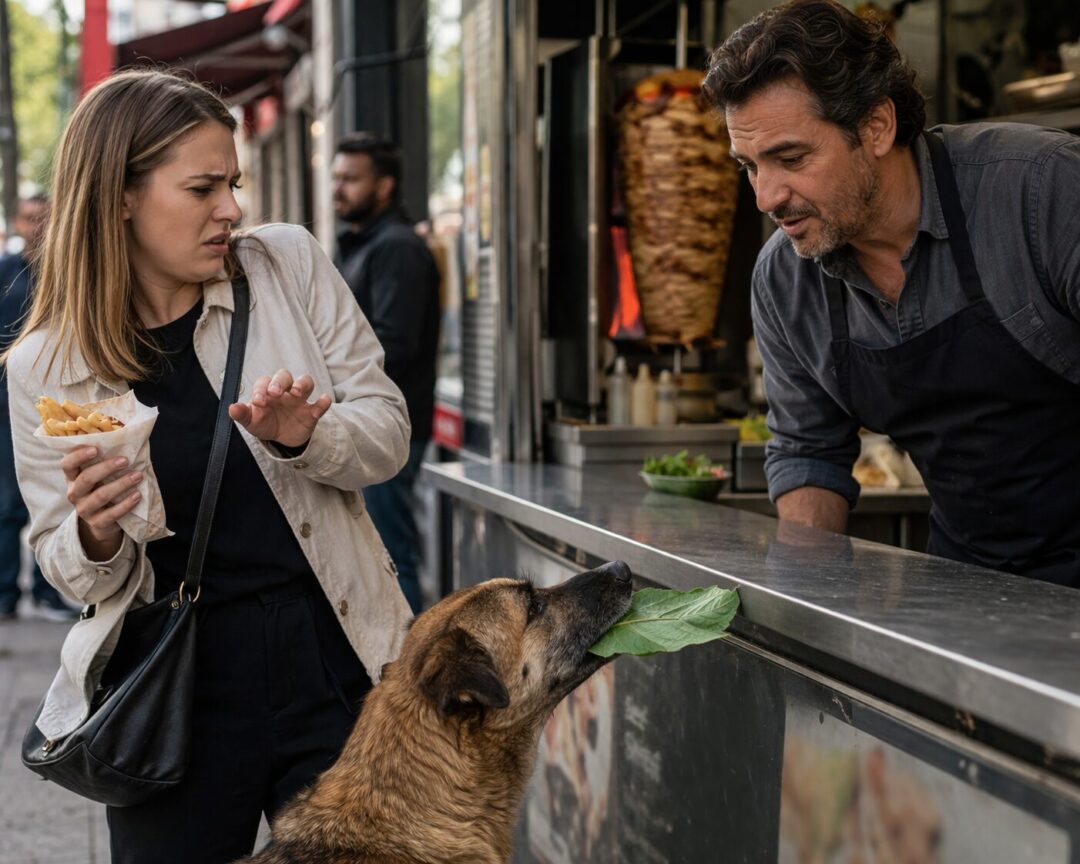
He stood near the curbside food stand as if he belonged there, lean and dusty and so still that he might have been mistaken for part of the street itself if not for the green leaf clamped gently between his teeth. He wasn’t barking. He wasn’t jumping at wrappers or circling the trash bins. He was simply waiting in the strip of sunlight that fell across the sidewalk, his amber eyes fixed on the metal counter where hot food was being passed from hand to hand.
The first strange thing was the leaf.
The second was the way he held it—not like something he’d found, but like something he meant to keep.
Mara stopped short, clutching her paper-wrapped lunch tighter against her chest.
The man behind the counter was handing change to someone else. Oil hissed on the grill. The air smelled of fried chickpeas, warm bread, garlic, cumin, and the sweet edge of onions caramelizing somewhere out of sight. The city moved around all of it in quick impatient currents: shoes striking pavement, scooters whining past, bits of laughter cut off by traffic.
Mara would later tell herself that she had only recoiled because she had been startled.
That was true, but not entirely.
She had grown up in a house where hunger made everyone defensive. The kind of house where every plate was counted, every appetite weighed, every request measured against what it might cost. Even now, years after she had escaped the narrow apartment where her mother rationed groceries with military precision, Mara carried food like something that might be stolen. She ate quickly. She hated being watched while she ate. And dogs—especially stray ones, especially hungry ones—made her tense in a way she couldn’t explain without sounding cruel.
So when the animal stepped a little closer to the stand, the leaf still held in his mouth, she flinched hard enough that a few fries nearly tipped from the paper cone in her hand.
“Move that dog,” she said, her voice sharper than she intended.
A couple of people glanced over and then away again. No one wanted to get involved in the small embarrassments of strangers.
The vendor looked up at last.
He was a broad-shouldered man in a charcoal shirt with the sleeves rolled to his forearms and a dark apron tied firmly at the waist. There was something heavy and grounded about him, as if he had learned long ago to spend his energy only where it mattered. His name tag, if he had one, wasn’t visible. His face was warm, weathered, and tired around the eyes, the kind of face that made you think of someone who had spent many years serving other people and had not yet become hard from it.
He didn’t answer Mara immediately.
His gaze had gone to the dog.
The dog lowered his head. The leaf slipped from his mouth and landed on the pavement.
For a second Mara felt vindicated. There, she thought. Just another street animal nosing around for scraps.
But the dog did not lunge for her food.
He dipped his muzzle, picked the leaf back up with extraordinary care, and lifted it again toward the counter.
The vendor straightened a fraction.
“Wait,” he said quietly.
Mara felt heat prick under her skin. The word wasn’t rude, but it stopped her all the same. She shifted her weight and glanced down the block as though she might still leave with her annoyance intact.
Instead, she stayed.
The dog stood on all fours, still as a child trying to be brave, the leaf trembling only slightly where his breath touched it.
The vendor leaned forward, one hand braced against the counter. He looked from the leaf to the dog and back again. Something in his expression changed—not amusement, not pity, but a kind of attention so complete it made the whole noisy sidewalk seem to step back.
“You brought this?” he murmured.
The dog’s ears twitched.
It was absurd. Mara knew that. The whole scene ought to have been ridiculous. A dog with a leaf. A food vendor talking to him as though he were a customer with exact change.
And yet the dog did not look ridiculous.
He looked earnest.
That was the word that unsettled her most.
Around them, the line stalled by only a few seconds. One man checked his phone. A student with earbuds in frowned and shifted his backpack. Someone behind Mara exhaled in annoyance. But the vendor didn’t seem to notice any of it. His gaze remained on the dog, who had not once looked at Mara’s food again.
Not once.
Mara tightened her fingers around the paper cone.
“It’s just a dog,” she said, softer this time but no less defensive.
The vendor finally turned to look at her.
Not angrily. Not accusingly.
Just with the mild surprise of a man who had heard something small said out loud and wanted to see what shape it took in daylight.
Then he looked back at the animal.
And the dog, as if sensing that this was his one chance to be understood, rose just enough to place the leaf against the lower edge of the metal counter.
An offering.
Not a trick. Not a demand.
An offering.
For reasons Mara could not have explained then, that was the precise moment her certainty began to come apart.
Part II — The Man Behind the Counter
His name was Soren, and on most days he had no time for sentiment.
He had opened the stand before dawn, hauled crates from the back alley by hand, argued with a supplier over chickpea flour, fixed a burner that wouldn’t catch, and sliced through enough onions to make his eyes sting until sunrise. By noon, he usually existed in a hard practical rhythm: wrap, serve, nod, take payment, move the line, keep the heat steady, watch the oil, wipe the counter, do it again.
He had been in this city for twelve years.
Before that, there had been another city, and another, and before those there had been a town with a dry hillside and a stone courtyard where his mother used to leave bread crusts near the gate for the strays. “Not because they are ours,” she would say, brushing her hands clean on her apron, “but because hunger belongs to everyone.”
He had been young enough then to roll his eyes at her. Old enough now to hear her voice in moments he did not expect.
He had noticed the dog before Mara ever spoke.
The animal had lingered near the stand for three afternoons in a row, never too close, never aggressive, always watching the exchange of food and hands and money. Soren had tossed him scraps once, then twice. The dog had eaten quickly and vanished. The third day he hadn’t appeared at all, and Soren had found himself scanning the sidewalk in spite of himself.
Now here he was again.
Only this time, the dog had come with a leaf.
Not just in his mouth—Soren saw that now—but held with purpose. The dog had been watching. Learning the ritual, perhaps in whatever way a hungry creature learns the rules of a world built by others.
Bring something.
Offer something.
Then maybe you will be fed.
Soren knew better than to romanticize animals. Hunger made all creatures inventive. Still, the intelligence in the dog’s gaze was impossible to miss. More than intelligence, perhaps. A fragile dignity. The kind that appeared only when survival and hope had somehow managed to stay alive in the same body.
He reached beneath the warmer for a small tray.
Behind him, the fryer hissed. The line shifted.
“It’s just a dog,” the woman said again, and this time Soren heard more than impatience in her voice. He heard fear stripped of context. Habit hardened into judgment. The brittle edge of someone who thought kindness might be a form of loss.
Without answering her, he crouched and placed the tray on the sidewalk.
The dog did not lunge.
He looked from the tray to Soren’s face, as if waiting for permission.
That, more than anything, broke the last of Soren’s resistance. He smiled despite himself—a slow, tired smile that began somewhere deeper than amusement.
“He paid,” he said.
The words hung in the air.
Not loudly. He did not deliver them for an audience. He said them in the tone one might use for any simple truth that needed no defense.
A few people in line looked over then. The student with the backpack pulled out one earbud. Someone near the back gave a short incredulous laugh, but even that died quickly when the dog lowered his head to the food at last and began to eat with small deliberate bites.
No frenzy. No snapping.
Just hunger meeting relief.
Soren remained crouched beside him. The leaf was still near the counter’s edge, where the dog had set it. Soren picked it up and held it lightly between two fingers.
It was a broad green leaf from some sidewalk shrub or planter box farther down the block. Nothing rare. Nothing valuable.
Unless value depended on what it had cost the one who brought it.
The woman—Mara, though he did not know her name yet—had not moved. She stood with her lunch cooling in her hands, watching the scene with the stunned stillness of someone whose thoughts were rearranging themselves against her will.
Soren had seen that look before. It came when people were confronted not by grand tragedy, but by some tiny unbearable proof that they had been living too narrowly.
The dog ate.
The city rushed around them.
And for ten or twelve strange suspended seconds, the food stand ceased to be a place of transaction and became something else entirely—a place where a creature had approached the world with the only currency he understood, and the world, for once, had answered in kind.
“Respect,” Soren said softly.
He was not speaking to the people in line.
He was not even speaking only to the dog.
He was speaking to the fragile thread that had held the moment together.
The dog kept eating, calm now, trusting. Soren’s hand closed around the leaf.
When he rose again, the line resumed as if a spell had broken. Orders were called. Bags were folded. Money changed hands. But something invisible had shifted all the same.
Mara stepped aside without a word.
She should have walked away then.
Instead, she waited at the corner of the stand until the lunch rush thinned and the dog, belly no longer hollow, curled up in the slice of shade beside the wheel well as though he had finally found somewhere he might be allowed to stay.
Part III — What Hunger Makes of Us
When Soren came around the side of the stand thirty minutes later with a metal bowl of water, Mara was still there.
He looked at her only briefly before setting the bowl down a careful distance from the sleeping dog. The dog lifted his head, sniffed once, and drank.
“I’m not cruel,” Mara said.
The words escaped her with the urgency of a confession offered before accusation had even arrived.
Soren wiped his hands on a towel. “I didn’t say you were.”
She hated that answer immediately, because it gave her nowhere to hide.
The city had softened into the slower drift of early afternoon. The lunch surge was over. Shadows lengthened along the sidewalk. A bus exhaled at the corner. Somewhere nearby, a siren started up and faded again.
Mara looked down at the dog.
Up close, he was rougher than he had seemed at first glance. One ear nicked. Fur worn thin in patches. A scar along the ridge of one shoulder. Not young, though not yet old. The kind of body that had weathered many unkind days and somehow still expected one decent one to arrive.
“I don’t like dogs around food,” she said. “Around people. Around me.”
Soren shrugged lightly. “A lot of people don’t.”
“That’s not what I mean.”
He waited.
Mara almost laughed at the absurdity of finding herself pinned open beside a food stand by a man she had never met. But perhaps that was the nature of embarrassment. It took one small public moment and cracked it wide enough for older things to spill through.
“In my house,” she said slowly, “food was… tense. Always. If something was yours, you ate it fast. If something was on the table, you didn’t assume it would still be there in five minutes. My mother used to say hunger made saints into thieves.”
Soren said nothing.
“I know that sounds dramatic.”
“It sounds remembered.”
Mara looked away.
She had not planned on telling him more, but the stillness of the dog at her feet, the water bowl catching a blade of light, the leaf still tucked absentmindedly into Soren’s apron pocket—none of it allowed for easy retreat.
“My brother used to hide bread in his room,” she said. “Under the mattress. In coat pockets. Once in a shoe box. My mother found it and cried like he’d betrayed her. He was nine.” She swallowed. “I think after that I started seeing hunger as something ugly. Something that made everyone smaller.”
Soren glanced at the dog. “Sometimes it does.”
She followed his gaze.
The dog had finished drinking and lowered himself carefully to the pavement again, but his eyes remained open. Watchful. Not anxious anymore. Just present.
“And sometimes?” she asked.
Soren’s hand touched the apron pocket where the leaf sat.
“Sometimes it tells you what a creature still believes about the world.”
Mara stood very still.
The answer moved through her slowly, like warmth returning to fingers after cold.
She thought of the dog picking the leaf back up. The concentration in that tiny act. The refusal to give up his offering even after being dismissed. She thought of how quickly she had reduced him to a problem. How instinctively. How confidently.
He had come with what he had.
That was all.
And she had met it with suspicion.
The shame of that was sharper than she expected, but cleaner too. Not the kind of shame that corrodes. The kind that opens a door.
“What happens to him now?” she asked.
Soren smiled without humor. “The city happens to him now.”
She looked down the block. Sidewalks, traffic, strangers, weather, hunger. The long machinery of indifference. It had always seemed normal to her, that machinery. Natural. Unavoidable.
Now it looked chosen.
“Does he belong to anyone?”
“No collar. No tag. No leash marks.” Soren folded the towel over one shoulder. “Maybe he used to. Maybe not.”
Mara crouched before she had fully decided to do it. The dog’s head lifted. He watched her with those steady amber eyes.
She did not reach out.
Not yet.
“I’m sorry,” she said, and knew as soon as the words left her mouth that she was not speaking to the man.
The dog blinked once.
Then, with grave consideration, he let his head settle back onto his paws.
It was not forgiveness, exactly.
But it was not rejection.
For some reason, that made her throat tighten.
Part IV — The Smallest Thing Worth Keeping
Mara returned the next day with no clear plan and a bag of grilled chicken she had bought two blocks away because she did not want to arrive empty-handed.
She told herself she was only passing by.
The lie collapsed the moment she saw the dog sleeping near the stand’s side panel in the exact same patch of shade, one ear flicking at the noise of the street.
Soren was working the counter again. He noticed her, then the paper bag in her hand, and one corner of his mouth tilted upward.
“You came back,” he said.
The words were simple, but they landed with the weight of recognition.
Mara looked embarrassed enough for them both. “I was nearby.”
“Of course.”
The dog lifted his head and studied her.
She crouched this time with less fear and more uncertainty, which was somehow harder. Fear protected a person. Uncertainty asked something of them.
“I brought this,” she said softly.
Not for Soren.
For the dog.
The phrase startled her the instant she heard it.
I brought this.
A ridiculous sentence. An ordinary sentence. The truest one she had spoken all week.
The dog rose slowly and came closer. Not all the way. Just enough to sniff the air between them. Mara opened the bag and placed one piece of chicken on the pavement. He took it gently.
No snatching. No desperation.
Just acceptance.
By the third piece, his tail moved.
By the fourth, Mara laughed—a quiet involuntary sound, more surprised than joyful. Soren heard it from the counter and glanced over. He did not interrupt.
Over the next several days, she kept returning.
She learned that Soren closed on Mondays. That he gave away leftover flatbread when he could. That he had once worked construction and ruined his knee, and the stand had started as a side job before it became his whole life. She learned that the dog favored one front paw slightly when tired. That he liked water before food. That he preferred shade to sun and never crossed the street unless someone else moved first.
It became impossible to keep calling him “the dog.”
One evening, while he sat beside her outside the closed stand, watching pigeons with solemn concentration, Mara said, “You need a name.”
Soren was locking the service window. “He came with one.”
“Not one we know.”
The dog blinked at them both.
Mara thought of the leaf. Of the way he had offered it like a promise. Of the absurd sacredness of that small green shape in Soren’s apron pocket, where it had remained all week, drying at the edges.
“Basil,” she said.
Soren laughed then, a real laugh that deepened the lines beside his eyes. “Because of the leaf?”
“Because he seems like he’d object to anything too obvious.”
Soren considered this. So did the dog, if the tilt of his head meant anything.
“Basil,” Soren agreed.
The name stayed.
What surprised Mara most was not how quickly affection grew, but how precise it felt. Basil did not melt her all at once. He altered her by inches. By pauses. By making room where there had only ever been defense.
He taught her that need did not always arrive as threat. That hunger could carry patience. That dignity was not the opposite of dependence. Sometimes it was dependence, offered without surrender.
A week later she took Basil to the veterinarian with Soren’s help and a donation jar on the counter that filled faster than either of them expected. A student from the lunch line dropped in five dollars. A postal worker left ten. A woman with a stroller tucked in folded bills and said only, “For the gentleman who paid.”
Basil had an old infection, a healing rib, and the tired resilience of an animal who had survived by reading people carefully. He needed medicine, rest, and regular food. Nothing impossible. Nothing miraculous.
Mara began rearranging her days around him before she admitted she was doing so.
She bought a bed that he ignored in favor of the rug near her radiator.
She complained about the fur.
She spoke to him in full sentences when no one was around.
At night, when she ate, she no longer turned away protectively from the room. Basil would lie nearby with his head on his paws, not begging, not even watching most of the time. Just there. Present. Proof that hunger did not have to poison everything it touched.
Sometimes, passing the food stand on her way home from work, Mara would catch sight of Soren at the counter, moving through the evening rush with the same grounded rhythm as before. Customers came and went. Money changed hands. Oil hissed. The city kept rushing past.
But in her mind, the true shape of that place had changed forever.
It was where a dog once offered a leaf and was answered as though his dignity mattered.
It was where Mara learned, against her own reflexes, that the smallest offering in the world could still ask something immense of the one who received it.
Months later, on a damp autumn afternoon, she found the leaf pressed flat inside a small square of wax paper on the shelf by Soren’s register.
Dry now. Fragile. Veins visible like the delicate map of a hand.
“You kept it,” she said.
Soren looked up from wrapping a sandwich. “Of course.”
She touched the edge of the wax paper lightly.
Outside, Basil waited by the curb, older now, fuller in the body, patient as ever. When she stepped out from the stand a moment later, he rose and fell into step beside her with the quiet certainty of someone who no longer had to bargain for kindness.
Mara looked down at him and thought of all the things people called worthless until love or hunger proved otherwise.
Then she looked back once through the service window.
Soren lifted a hand.
Basil’s tail tapped once against her leg.
And together they walked into the thinning afternoon, carrying between them the strange and lasting truth that sometimes the world changed not because of what it gave, but because of what, at last, it chose to honor.