The Old Man With The Grease Rag Was The Only One Who Remembered That Aircraft’s Last Crew
Chapter 1: The Hand Against The Old Man’s Chest
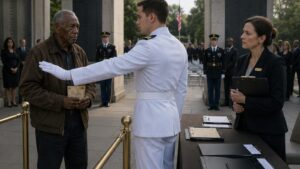
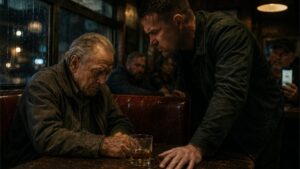
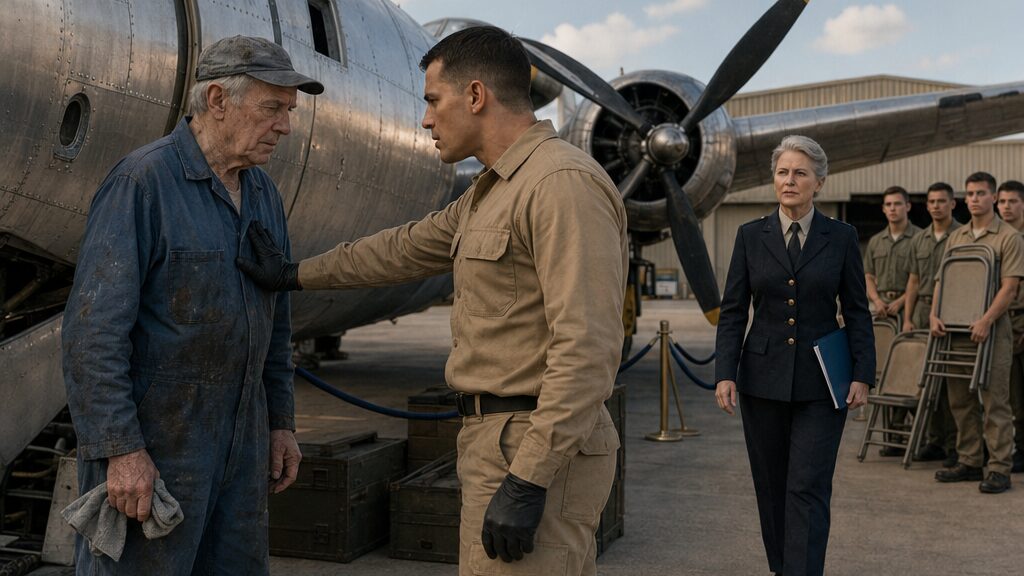
The young man’s hand landed flat against George Martin’s chest before George’s fingers could reach the aircraft.
It was not a shove. Not quite. It was the kind of touch a man used when he thought he had already won the argument, a firm palm against the breast pocket of George’s faded blue coveralls, stopping him three inches from the dull aluminum skin of the old propeller plane.
“Sir, I need you to step back.”
George looked down at the hand.
The glove was clean. Black leather, tight at the knuckles, not a seam loose. A security glove, not a mechanic’s glove. It rested over a patch of old oil that had never fully washed out of George’s coveralls, though the stain was older than the man wearing the glove.
Behind the young man, a row of cadets in pressed uniforms paused with folded chairs stacked in their arms. One of them glanced toward George’s cap, then toward the rag in his left hand, then away as if the whole thing was somebody else’s embarrassment.
The aircraft waited above them, broad-winged and quiet, its propellers tied still, its nose polished for tomorrow’s ceremony. Morning light slid across its rivets. On the far side of the apron, volunteers arranged flags along a rope line. A photographer knelt near a crate, adjusting a lens. The air smelled of cut grass, fuel, hot pavement, and the old hangar dust that never left anything completely.
George had come early because early was the only time a machine told the truth.
He had parked his old pickup by the service gate, signed the visitor sheet where the base gate clerk pointed, and crossed the apron slowly, one hand in his pocket and the other holding the folded grease rag he had carried from home. He had not come to interrupt. He had not come to be seen. He had come for the hour before the chairs, before the speeches, before people in clean shoes told each other what memory was supposed to mean.
The young man shifted closer.
“Maintenance staff are supposed to clear the display area before guests arrive,” he said. “We’ve got a schedule.”
George raised his eyes.
The name strip on the young man’s tan uniform read Torres. Brandon Torres, if George remembered the check-in list on the clipboard. Mid-twenties, maybe early thirties. Back straight enough to prove somebody had corrected it more than once. Jaw smooth. Hair trimmed. Shoes clean. He had one boot up on a low wooden crate, giving himself height he did not need.
George said nothing.
Brandon’s eyes flicked to the rag. “You with restoration?”
George turned the rag once in his fingers. It was gray now, though it had begun life white. He kept it folded into quarters, soft from years of washing, its corners dark where oil had settled permanently into the threads.
“I used to be,” George said.
“Then you know better than to touch the aircraft right before inspection.”
The word touch landed harder than the hand had.
George looked past him to the panel seam below the cockpit, where one fastener sat a fraction proud. Most people would never see it. Even most mechanics would see it only if they were looking for a problem. George had noticed it from thirty feet away, the way a man noticed a limp in an old friend before anyone else knew the friend was hurting.
“I just need to look at that panel,” George said.
Brandon followed his gaze and frowned. “No, sir. You need to step back behind the rope.”
“There’s no rope yet.”
“There will be in ten minutes.”
A cadet gave a small laugh and smothered it by turning toward the chair stack. Brandon heard it. His shoulders stiffened.
George had seen that change in young men before. The moment they realized they had witnesses and began acting not to solve a problem but to protect the version of themselves they hoped everyone else saw.
Brandon lowered his voice, but not enough.
“Sir, I’m not going to argue with you in front of everyone. We have elderly visitors coming later. We can’t have people wandering around the aircraft with shop rags and no clearance.”
George folded the rag once more.
The movement was small. Thumb over cloth, cloth over palm. It gave his hands something useful to do.
“I’m not wandering,” he said.
Brandon’s palm remained against his chest.
For one second, George thought of lifting the hand away. Not hard. Just enough. He could still do it. His fingers were bent at the joints and slower now, but they remembered pressure points, remembered tools, remembered how to make one precise motion count. The thought rose and passed.
He stepped back half a pace instead.
Brandon’s hand fell.
The cadets watched. The photographer lowered his camera, perhaps sensing a picture he should not take. A maintenance volunteer near the wheel chock looked over, then looked away.
George felt the empty air where the young man’s hand had been. It should not have mattered. At eighty-two, he had been pushed by worse things than a security liaison’s glove. Weather. Orders. Time. Silence. A hangar door blown off its track in a storm. A radio call that turned to static and never became a voice again.
Still, his chest burned.
Not from the touch. From the assumption inside it.
Brandon pointed toward the painted safety line. “Behind there, please.”
George looked at the aircraft’s skin. The old bird had been painted and polished until the years were nearly hidden, but not from him. He could see where a replacement panel had taken light differently. He could see old stress around rivets that no museum label would mention. He could see, under the shine, the shape of nights when men worked by flashlight and pretended they were not afraid.
“She’ll bind if you roll her forward like that,” George said.
Brandon exhaled through his nose. “The aircraft isn’t flying anywhere.”
“I didn’t say flying.”
“Then let the assigned crew handle it.”
George nodded once, not in agreement, but because he had learned long ago that some men only heard words after something broke.
A brisk set of footsteps crossed the apron behind Brandon.
“Mr. Martin?”
The young man turned.
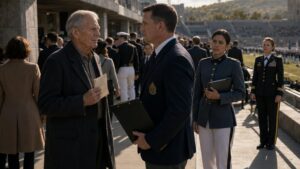
An officer in a dark dress uniform approached from the hangar entrance, a blue folder tucked beneath one arm. Silver hair framed a face that looked composed without being soft. The cadets straightened before she said anything. Brandon snapped his boot off the crate and squared his shoulders.
George did not move.
The officer stopped a few feet away, her eyes going first to George, then to Brandon, then to the space between them where the hand had been.
“Colonel Hall,” Brandon said. “I was just clearing the area before the guest arrival window.”
Virginia Hall held the folder against her side.
“Were you?”
The question was mild enough that it left Brandon no safe answer.
George lowered his gaze to the rag. He did not want this. He had not come for a correction. A correction was only another way to make people look at him.
Virginia stepped closer. “Mr. Martin, I was told you had checked in. I’m sorry no one brought you to the office.”
“No trouble,” George said.
Brandon glanced at him. The look was quick, uncertain now.
Virginia’s voice changed, not louder, but more formal. “We’ve been expecting you.”
A small quiet opened around them. The cadets had stopped pretending not to listen. The photographer held his camera at his chest. Michelle Ramirez, the restoration coordinator, appeared near the hangar door with a clipboard and slowed when she saw the cluster.
George wished the morning would return to how it had been ten minutes earlier, before his name reached anyone else’s mouth.
Virginia opened the blue folder. Inside were printed schedules, seating charts, a ceremony program marked with yellow tabs, and a photograph clipped to the left side. George caught only a flash of it: the aircraft decades younger, its paint darker, men standing under the wing.
He looked away.
“We have you listed with the honored guests for tomorrow,” Virginia said. “Front row, aisle seat, near the aircraft.”
Brandon’s face tightened.
George heard the phrase front row like a wrench dropped on concrete.
“I don’t need a seat,” he said.
Virginia studied him. “Sir, the program has your name.”
The rag lay folded in his hand, clean side in, dirty side out.
George looked past her at the panel seam below the cockpit, at the fastener sitting just wrong, at the old aircraft waiting to be rolled before a crowd that would see shine and not strain.
“My name,” he said quietly, “isn’t the one you should be worried about.”
Virginia’s hand paused on the folder.
A gust moved across the apron and lifted the corner of the top page. For a second the yellow tabs fluttered like signal flags.
Then Virginia lowered her eyes to the program and opened it wider.
Chapter 2: The Name Printed In The Wrong Place
By afternoon, the museum office smelled of toner, stale coffee, and the lemon cleaner someone had used too generously on the conference table.
George sat where Virginia Hall had asked him to sit, though he had chosen the chair farthest from the window. Outside, the aircraft’s nose was visible through the blinds in narrow silver strips. Every time the blinds shifted in the air-conditioning, the plane appeared and disappeared, like a memory refusing to stay buried or be fully seen.
Michelle Ramirez stood at the copier with a stack of fresh ceremony programs. She was careful with everything she touched: paper edges squared, binder clips aligned, pens capped before being set down. Her dark hair was pinned back, and a museum badge hung from her neck. She had the tired, bright expression of someone who had been solving other people’s emergencies since sunrise.
Virginia placed the blue folder on the table in front of George.
“We pulled this from the archive last month,” she said. “Your service record, restoration notes, a newspaper clipping from the aircraft’s return to public display. Some of it is incomplete, but enough to establish your connection.”
George kept his hands in his lap.
The grease rag rested across his knees, folded as neatly as a handkerchief. A dark crescent of oil showed near one corner.
Michelle crossed the room and set three programs on the table. “We’re grateful you’re here, Mr. Martin. Truly. We didn’t know until Colonel Hall’s office confirmed it that anyone from that maintenance crew was still local.”
George looked at the program without touching it.
On the cover was the aircraft in profile, polished and proud, with the museum name printed beneath it. Inside, under Special Recognition, his name sat alone in a line that seemed too clean.
George Martin
Former Crew Chief, 8th Air Mobility Restoration Detachment
Not the exact unit name. Close enough for people who liked close enough.
Virginia sat across from him. “We’d like you in the front row. You won’t have to speak unless you want to.”
“I don’t.”
“That’s fine.”
“I don’t need to be in front.”
Michelle’s smile faltered. “The front row isn’t meant to pressure you. It’s respect.”
George looked at the word on the page. Respect. People used it like a chair they could place someone in.
“There are men missing,” he said.
Virginia’s expression changed. “From the program?”
He turned the page and laid one finger on the list of names scheduled to be read during the memorial portion. Pilots. Command staff. Donors. Restoration board members. A former base commander. Men with titles before their names and abbreviations after them.
His finger stopped at a blank space between two sections where nothing looked missing unless a person already knew what should have been there.
“Three names,” George said.
Michelle leaned over the table. “We used the official public record.”
“I know.”
Virginia’s eyes stayed on George. “Which names?”
George did not answer right away.
Outside, a metal cart rattled past the office window. Someone laughed on the hangar floor. A normal sound. A Friday sound. George felt the years fold inside him with the same quiet pressure as the rag in his hand.
“They weren’t on the public record,” he said.
Virginia reached for a pen. “Were they assigned to the aircraft?”
“Yes.”
“In what capacity?”
George’s mouth tightened.
He could see them as they had been when they were young enough to believe exhaustion was proof of strength. One sitting on an ammo crate with a sandwich gone untouched. One sleeping upright beneath a wing, cap pulled over his eyes. One singing badly into the rain because silence made the incoming calls worse.
Michelle waited, pen lifted.
George pushed the program back.
“If they’re not in your file, you won’t print them because I say so.”
Virginia did not deny it. That was something.
“We can check,” she said.
“By tomorrow?”
She looked down at the folder. “Maybe not.”
“Then don’t put me in their place.”
The room grew still.
Michelle set her pen down. “Mr. Martin, nobody is trying to replace anyone. The ceremony is to honor the aircraft’s service history, the crews, the restoration effort. Your presence helps connect those things.”
George looked toward the window. Through the blinds, he could see only the aircraft’s lower fuselage now, the row of rivets under the cockpit. Even from here, the wrong fastener bothered him.
“You ever polish something so bright people stop seeing what happened to it?” he asked.
Michelle did not answer.
Virginia closed the folder halfway. “You mentioned a panel earlier.”
George’s eyes flicked back to her.
“On the apron,” she said. “You told Brandon it would bind.”
“I said she would.”
Michelle drew a small breath, careful not to sound impatient. “Our restoration volunteers completed the inspection yesterday. The aircraft is cleared for a ceremonial roll only. Slow tow. No engine start.”
George nodded.
“You disagree?” Michelle asked.
“I saw a panel sealed wrong.”
Michelle’s professional calm tightened around the edges. “Which panel?”
“Forward access below the cockpit, port side.”
“That section is cosmetic now.”
“No,” George said.
One word. Low, but it changed the air in the room.
Virginia opened the folder again. “Michelle?”
Michelle hesitated. “There’s preserved linkage behind that section. Not operational in a flight sense, but stabilized. The tow angle shouldn’t affect it.”
“Shouldn’t,” George repeated.
He stood slowly. His knees took longer than his intention. Neither woman moved to help him, and he was grateful for that.
“I need to look at it.”
Michelle clasped the programs against her chest. “Not tonight. We have guests in less than two hours for the donor preview, and the aircraft is already staged.”
George folded the rag once, then twice. “It won’t take long.”
“We can have a volunteer check it.”
“You can.”
The words carried no challenge, only truth.
Virginia watched him. “And if the volunteer says it’s fine?”
“Then you’ll have a volunteer’s answer.”
Michelle looked down, then toward the hangar. “Mr. Martin, I respect your history. But we have preservation rules for a reason. We can’t let anyone, even honored guests, open panels because they have a feeling.”
George almost smiled at that. A feeling. The word people used when they had never learned the difference between fear and recognition.
He walked to the glass display case along the office wall. Inside were photographs, old tools, a faded maintenance checklist, and a typed exhibit label describing the aircraft’s “final operational period.” Dust had gathered on the outside of the case near the lower corner where the cleaning crew had missed it.
George lifted the rag and wiped the dust away.
Beneath it, part of the label became clearer.
The aircraft returned from its final mission cycle with no significant structural incident.
George stopped wiping.
His reflection looked back from the glass: gray cap, lined face, coveralls that made him look like a man who had wandered in through the wrong door.
“No significant incident,” he said.
Virginia stood.
Michelle came closer, reading the label as if seeing it for the first time.
“That was from the archive summary,” she said softly.
George’s hand rested against the glass. Not touching the paper. Not touching the past. Only the barrier between.
“There was an incident,” he said.
Virginia’s voice lowered. “Is that connected to the missing names?”
George folded the rag around his fingers until only the clean edge showed.
Outside, a tow cart beeped twice as it backed near the aircraft.
George turned his head sharply.
Through the slats of the blinds, he saw a volunteer crouch near the forward port side. The volunteer ran a hand along the panel George had noticed, then stood without opening it.
The aircraft waited, polished and wrong.
George looked back at Virginia.
“That panel,” he said, “has been sealed the wrong way.”
Chapter 3: The Aircraft Remembered His Hands
The hangar emptied the way churches emptied after funerals: slowly, with people lowering their voices before they understood why.
By six o’clock, the donor preview had ended, the folding chairs had been stacked along the west wall, and the last museum visitors drifted toward the parking lot carrying programs and small paper cups of lemonade. Michelle walked the floor with a ring of keys, checking rope lines and display stands. Brandon stood near the open hangar door, speaking into a radio, his posture stiff whenever George came into view.
George stayed by the aircraft.
No one had invited him to. No one had asked him to leave either. Virginia had spoken quietly with Michelle after the office meeting, and since then the staff had treated George with the careful politeness people used when they did not know whether they had offended a man or discovered one.
The aircraft’s shadow stretched across the polished concrete. Its wings filled the hangar, too large for the room and yet smaller than George remembered. Time did that. It shrank machines and enlarged ghosts.
A rope line kept visitors at a respectful distance. George stood outside it, his hands at his sides. The grease rag hung from his left hand.
The problem panel sat beyond reach.
He could see it even in the softened evening light. The panel was not flush. One corner held tension. Someone had tightened it to look right instead of seating it correctly. During a slow tow, maybe nothing would happen. Maybe the linkage behind it would shift against the old bracket. Maybe a preserved piece would crack with a sound no one heard under the applause.
Maybe.
That word had killed more men than carelessness. Carelessness was loud. Maybe was quiet. Maybe signed forms. Maybe smiled and said it would probably hold.
George took one step toward the rope.
“Mr. Martin.”
Brandon’s voice came from the hangar door.
George stopped.
The young man lowered the radio from his mouth. He did not come closer this time. That was something.
“The display area is closed,” Brandon said.
George looked at the aircraft, then at him. “I know.”
“I was told you could remain in the hangar until Colonel Hall finishes her call.”
“That so?”
“Yes, sir.”
Sir, now. Clean and late.
George nodded. “Then I’ll remain.”
Brandon shifted. His glove creaked when he flexed his hand. The same hand.
For a moment, George thought the young man might apologize. The shape of it moved behind his eyes, pressed against his teeth, then disappeared under procedure.
“If you need anything,” Brandon said, “I’ll be by the door.”
George looked back at the aircraft. “What I need is behind that rope.”
Brandon did not answer.
Michelle finished checking the far display and approached with the key ring held tight in one hand. “We’ll have the restoration volunteer inspect it again in the morning.”
George glanced at her.
“Open?”
Michelle paused. “Visual inspection first.”
“Then he won’t see it.”
She rubbed her thumb over one key, thinking. “Mr. Martin, I know this is frustrating.”
“No,” he said. “You don’t.”
The words came out harsher than he meant them to. Michelle’s face closed a little, and George regretted it. She had not placed a hand on his chest. She had not laughed. She was protecting what she had been given to protect.
He softened his voice.
“You ever work a machine that old?”
“No.”
“You ever listen to one?”
Michelle looked toward the aircraft. “I’ve spent four years restoring it.”
“That’s not what I asked.”
She did not answer.
George stepped closer to the rope line but did not cross it. “When something’s wrong, old metal talks before it breaks. Not in words. In the way a seam sits. In the way a screw head carries pressure. In the way a panel looks too still.”
Michelle’s eyes moved to the panel despite herself.
George lifted the rag. “You don’t have to believe me. But don’t roll her until somebody opens it.”
Michelle breathed out. “I’ll note your concern.”
A concern. Another word that made truth smaller.
She turned away, then stopped. “Were you really her crew chief?”
George’s fingers tightened around the rag.
“For a while.”
“That aircraft specifically?”
He looked up along the fuselage. The museum had repainted the old identification marks with care, but paint was only a surface language. His memory knew the deeper names: the stiff latch on the starboard equipment bay, the left main gear that needed coaxing in winter, the patch behind the radio compartment where a young mechanic had carved a tiny cross with the tip of a file before anyone could stop him.
“Yes,” George said. “That one.”
Michelle’s expression changed, not into awe, but into something quieter. Belief beginning as a burden.
“Why didn’t you tell anyone when the restoration started?”
“I did.”
She turned back to him.
“Sent a letter,” he said. “Years ago. Said they had the wrong maintenance sequence on the display. Got a thank-you card with a picture of the aircraft on it.”
Michelle lowered her eyes.
“I’m sorry.”
George shrugged once. “People are busy.”
The hangar lights hummed overhead. Outside, the sky had gone orange behind the open doors. A breeze moved in, carrying the smell of grass and cooling asphalt.
When Michelle left to lock the side office, George remained by the rope.
He waited until her footsteps faded, then took the rag in both hands and folded it the way he had folded it before dawn checks: long edge to long edge, corners matched, pressure from thumb to palm. Fold. Wipe. Pause. Remember.
He wiped the top rail of the rope stanchion, though it was already clean. The motion steadied him.
Fold. Wipe. Pause.
In another hangar, in another year, men had moved around this aircraft with red flashlights between their teeth and rainwater running down the backs of their necks. George had been young then, young enough to think his hands could outrun consequence. He had slapped panels into place, safety-wired bolts, checked fuel lines twice, three times, four times if his nerves demanded it. Crews cursed him for delays and thanked him when engines held.
The aircraft remembered all of it.
It remembered Richard Lewis climbing out once with a bleeding eyebrow and a grin that did not fool anybody. It remembered a pilot pressing a folded note into George’s hand before a mission and saying, “If I don’t come back, don’t mail it unless she asks.” It remembered three men whose names had been turned into silence by paperwork that said no significant structural incident.
George had not touched the aircraft since it came into the museum.
Not really. A wipe along a step during restoration. A palm on a tire when no one was looking. But never the skin near that old dent below the cockpit. Never the place where he had stood the morning they rolled her out and he had known, even before the radio call, that not all of them would return.
The hangar door rattled.
George turned.
An elderly man stood just inside the side entrance, one hand on a cane, the other holding his hat against his chest. His shoulders were narrower than they had once been, but his eyes were the same: pale, sharp, and full of things he preferred to make jokes around.
George stared.
Richard Lewis gave him a tired smile.
“Figured I’d find you standing where you weren’t supposed to be.”
George’s throat closed before he could answer.
Richard crossed the concrete slowly. The cane clicked once, then dragged, then clicked again. Brandon looked from the door but did not interfere. Perhaps he had been told enough names for one day.
Richard stopped beside George, both of them facing the aircraft.
For a while, neither man spoke.
The old plane held the last of the evening light along its nose. The wrong panel sat in shadow now, but George still felt it there, like a loose tooth under the tongue.
Richard nodded toward the grease rag. “You still carry that thing?”
“Not the same one.”
“Could’ve fooled me.”
George looked down. “Same habit.”
Richard’s smile faded.
They stood shoulder to shoulder, separated by years neither had managed to explain to anyone who had not been there.
Richard’s voice dropped.
“You still hear them in there, don’t you?”
Chapter 4: The Men Who Were Left Off The Program
George did not answer Richard right away.
The question stayed between them in the hangar, small and old and dangerous. You still hear them in there, don’t you? It seemed to move under the aircraft’s skin, along the rivet lines and panel seams, until the whole machine felt less like aluminum than a closed mouth.
Richard leaned both hands on his cane. He had dressed better than George, in a dark jacket and pressed shirt, but age had done its plain work on him too. His collar sat loose around his neck. One shoe dragged slightly when he moved. The brim of his hat was worn thin where his thumb had worried it over years.
George looked at the rope line. “You shouldn’t be out this late.”
“Neither should you.”
“I’m local.”
“I’m old. That’s almost the same clearance.”
George gave him a faint look. Richard’s mouth twitched, but the joke faded before it became comfort.
Across the hangar, Brandon stood by the open door, trying not to watch them. Michelle had gone into the office. The aircraft’s belly held shadow. Somewhere outside, a truck passed on the access road, its sound rising and falling beyond the hangar walls.
Richard nodded toward the benches near the display case. “Sit down before both of us make the evening news.”
George almost refused. His legs made the decision for him. He walked with Richard to the benches, slower than he wanted, the grease rag still in his left hand. Richard lowered himself first, with care and a small breath he pretended was nothing. George sat beside him.
For a while, they faced the aircraft like two men waiting for orders.
“She looks wrong clean,” Richard said.
George looked at the polished nose. “She was never meant for shine.”
“No. She was meant for noise.”
“And leaks.”
“And bad coffee.”
George’s fingers moved once over the rag.
Richard watched the motion. “You remember that night in Da Nang when the rain came through the roof harder than outside?”
“Which night?”
“That’s fair.”
The old memory nearly smiled in George, then sank. There had been so many nights when water found its way through metal and canvas and men pretended dry socks were a luxury civilians had invented. Rain on wings. Rain in toolboxes. Rain tapping on helmets. Rain hiding tears because grief had no rank and no schedule.
Richard shifted on the bench. “They put your name in the program.”
George said nothing.
“Virginia called me. Wanted to confirm dates. She thought I’d be pleased.”
“Were you?”
“I was pleased you were alive.”
George looked at him then.
Richard shrugged. “At our age, I take the easy victories.”
The hangar lights hummed. The aircraft’s propeller blades made black angles against the high ceiling.
George said, “They left out Halloran, Price, and Webb.”
Richard’s face changed.
Not dramatically. Just enough. His eyes lowered, and the hand on his cane tightened until the knuckles paled.
“I wondered if you’d noticed.”
George gave a dry breath. “Hard to miss what you’ve been carrying for fifty years.”
Richard stared at the floor. “They were never on the public list.”
“They were on the crew list.”
“Not the one anybody can pull.”
“That doesn’t make them less dead.”
“No,” Richard said softly. “It doesn’t.”
A toolbox clanged somewhere beyond the office, and both men looked up by old reflex. George hated that. Hated that a metal sound could still make his body younger than his face.
Richard rubbed his thumb along the cane handle. “I tried once. After the museum got the aircraft back. Sent copies of what I had. Mission notes. My own statement. They thanked me for my interest.”
George’s jaw tightened.
“Did you tell them about the panel?” Richard asked.
“I told them not to roll her.”
“That isn’t the same.”
“They won’t listen.”
“You don’t know that.”
George turned the rag over. Dirty side out. Clean side hidden.
Richard leaned back and looked toward the aircraft’s forward fuselage. “You always did think if you said less, men would hear more.”
“That ever work?”
“Not often.”
George’s mouth moved, almost a smile, then stopped.
Richard lowered his voice. “Tell them tomorrow.”
“No.”
“George.”
“No.”
Richard went quiet, but not in surrender.
George stared at the aircraft. “They have a ceremony. They have chairs, flags, programs, a photographer. They don’t need an old man standing up there telling them their paper is wrong.”
“They need the truth.”
“They need a clean event.”
“That sounds like something they taught us to say before sending boys into weather.”
George looked at him.
Richard held his gaze. The years between them thinned. Behind Richard’s lined face George could see the younger man he had been, the flight engineer who could listen to an engine cough and name the cylinder, who once crawled into a shaking compartment with smoke in it because somebody had to. Men had called Richard fearless. George knew better. Richard had been terrified often. He simply moved anyway.
“That morning,” Richard said, “you stayed on the line after the rest of us were ordered clear.”
George looked down.
The rag lay across his palm. He could feel old rain in it though the cloth was dry.
“We were short two brackets,” Richard said.
“I remember.”
“You made one fit.”
“I made it close.”
“You made it hold.”
“For your crew.”
Richard’s voice softened. “Yes.”
George’s eyes stayed on the rag.
“And then the other call came in,” Richard said.
George closed his hand.
He did not need Richard to say more. The second aircraft. The rushed repairs. The order to prioritize the bird already scheduled out. The three men waiting on a fix George had promised he would get to after he finished Richard’s line. Halloran leaning under the wing with a flashlight. Price sitting on a crate, boots in a puddle. Webb asking if George had any cigarettes, then laughing when George said no.
They had left without the repair George wanted done.
Command called it acceptable risk. Weather window closing. Mission urgent. No significant structural incident recorded in the public summary because the truth had been sealed under other words.
“They didn’t die because of you,” Richard said.
George looked toward the aircraft. “You don’t know what a few minutes are worth until you spend the rest of your life with them.”
Richard swallowed.
Outside, someone pulled the hangar door farther down, and the evening narrowed.
George stood with effort. Richard did not try to stop him. He walked to the aircraft, stopping at the rope line again. The forward port side sat in shadow. He lifted the rag and wiped one small section of the rope stanchion where his hand had rested earlier.
Fold. Wipe. Pause.
Richard came up beside him slowly.
“Halloran had a daughter,” George said.
“I know.”
“Price was nineteen.”
“I know.”
“Webb sang when he was scared.”
Richard’s eyes shone, though his voice stayed steady. “Badly.”
George nodded once.
The dent below the cockpit caught a thin stripe of light. It was not the panel Brandon had blocked him from touching. It was higher, older, nearly hidden by restoration paint. George had put his hand there once after the aircraft came back without the other crew. He had left a smear of grease on the skin and then wiped it away because a man had work to do.
He reached toward it now, but the rope stopped him.
Richard said, “The wrong names will be read tomorrow unless you speak.”
George’s hand hovered in the air.
Across the hangar, Michelle emerged from the office and stopped when she saw both men near the aircraft. Brandon stood straighter by the door, radio in hand.
George let his arm fall.
“I’m tired of speaking to people who only hear records,” he said.
Richard looked at the aircraft. “Then speak to the aircraft. Let them overhear.”
Chapter 5: The Young Man Learned The Wrong Kind Of Respect
By Saturday morning, Brandon Torres had polished his shoes twice and still could not stop looking at the glove.
There was a smear on the right palm, dark and narrow, caught in the crease below his fingers. He had tried wiping it off with a paper towel at the gate checkpoint before sunrise. He had tried rubbing it against the inside of his uniform pocket where no one would see. The mark had lightened but not disappeared.
Grease, probably.
From the old man’s coveralls. From the rag. From the place where Brandon’s hand had pressed against his chest.
He stood beside the temporary security table at the entrance to the airfield, checking names against a printed list while cars rolled in under the morning haze. The ceremony did not begin until afternoon, but donors, veterans’ groups, cadets, staff, photographers, and local officials had started arriving early. Everyone wanted access. Everyone had a badge, a reason, a relative, a problem.
Brandon kept his voice even.
“Please display your pass on the dashboard.”
“Follow the cones to the left.”
“The hangar is not open to general guests until eleven.”
He performed the lines cleanly. Procedure steadied him. It always had.
After last month’s security failure, procedure was all anyone wanted from him. A contractor had wandered into a restricted storage area during a school tour, nothing stolen, no one hurt, but the report had gone upward and come back down heavier than the incident deserved. Brandon’s supervisor had not shouted. Worse, he had spoken quietly about judgment.
Today was Brandon’s chance to prove he had it.
So when he saw an elderly man in stained coveralls walking straight toward the aircraft Friday morning, before ropes were set and before guest control was in place, Brandon had acted.
That was the word he had used in his own head all night.
Acted.
Not overreacted. Not assumed. Acted.
A minivan stopped at the gate. The base gate clerk leaned from the booth and pointed the driver toward Brandon’s table. A woman handed him a printed confirmation. He checked the name, gave directions, and smiled the polite smile that never reached his stomach.
When the van pulled away, he opened his right hand again.
The smear remained.
“Problem with your glove?”
Brandon closed his hand.
Michelle Ramirez stood on the other side of the table with a clipboard tucked under her arm and a radio clipped at her belt. She looked more tired than yesterday, which meant she had probably been at the museum since before dawn.
“No, ma’am,” Brandon said.
She looked at him for one second too long. “Colonel Hall wants the ceremony seating checked by ten. Veterans’ guests front left, restoration donors front right, cadets behind the rope line.”
“Yes, ma’am.”
“And Brandon?”
He straightened.
“Mr. Martin is not to be stopped at the gate.”
Heat rose under his collar. “Of course.”
Michelle’s face softened slightly, but not enough to rescue him. “He may not want assistance. Offer it anyway. Don’t insist.”
“Yes, ma’am.”
She turned to leave, then stopped. “He told us about a panel. I’m having a volunteer do one more visual pass.”
“A visual pass?”
“That’s what we can do without delaying the roll-out.”
Brandon nodded because it was not his place to question restoration procedure. Still, he remembered the old man’s voice: She’ll bind if you roll her forward like that.
Not it.
She.
A black sedan arrived, and Brandon returned to the list.
By midmorning, the apron had transformed. Yesterday’s open work space had become a ceremony ground. Rows of chairs faced the aircraft. Flags stood at measured intervals, snapping gently in the breeze. A podium waited beneath the left wing. The aircraft itself had been polished again until the aluminum carried the pale sky in broken pieces.
George Martin arrived at 10:17.
Brandon saw him before the gate clerk lifted a hand.
The old man came through the pedestrian entrance in the same gray cap and blue coveralls, though the coveralls looked brushed clean in places. He carried no bag. The grease rag was folded in his left hand.
He walked slowly, but not uncertainly. There was a difference Brandon had failed to notice before. Some people moved slowly because they did not know where to go. George Martin moved like a man who knew exactly where he was and had no interest in arriving for anyone else’s comfort.
Brandon stepped from behind the table.
“Mr. Martin.”
George stopped.
For a moment, Brandon forgot the approved sentences. Good morning, sir. Colonel Hall is expecting you. Would you like a cart to the hangar? The lines scattered.
George looked at him without anger.
That was worse.
“Morning,” George said.
Brandon swallowed. “Colonel Hall asked that you be allowed through directly.”
“Did she?”
“Yes, sir.”
George’s eyes dropped briefly to Brandon’s right glove.
Brandon felt the smear as if it had warmed.
“I can walk you in,” he said. “Or arrange a cart.”
“No need.”
“Sir, about yesterday—”
A truck horn sounded behind them. The base gate clerk waved at a delivery vehicle trying to turn too wide near the cones. Brandon glanced back, caught between duty and apology.
George saved him from choosing.
“You’ve got work,” the old man said.
Then he walked past.
Brandon stood still long enough for the delivery driver to lean out and call, “Where do you want me?”
He gave directions automatically, but his eyes followed George across the apron.
The old man paused at the edge of the ceremony area. Several cadets looked at him, then at one another. One seemed to recognize him from yesterday and lowered his gaze. George did not appear to notice. He stood outside the rope line, facing the aircraft.
Not touching.
Just looking.
Brandon flexed his right hand.
At eleven, he rotated from gate duty to apron security. The sun had climbed high enough to sharpen every shadow. Folding chairs filled with early arrivals. The airfield photographer moved around the podium, taking test shots. The ceremony announcer practiced names under his breath, stumbling once, then starting again.
Brandon checked rope lines, guest badges, walkways. He did everything right.
Still, the morning kept bringing him back to George.
He saw Virginia Hall approach the old man with the blue folder. Saw George shake his head before she finished speaking. Saw Michelle point toward the aircraft’s forward side and speak to a maintenance volunteer. Saw the volunteer crouch, look, touch the panel edge with two fingers, then stand and shrug.
Brandon was close enough to hear Michelle say, “We’re clear for the roll-out.”
George said something Brandon could not hear.
Michelle’s shoulders tightened. “Mr. Martin, we noted your concern.”
Concern.
Brandon knew that word. He had used it in reports when he wanted a problem to sound smaller than it was.
George looked at the aircraft for a long moment, then turned away.
He did not argue. That had begun to bother Brandon most of all.
A man who wanted attention argued. A man who wanted to win made witnesses. George Martin simply absorbed decisions and carried them somewhere inside himself, where Brandon could not see the cost.
At noon, Michelle gathered staff near the tow line.
“We’ll move her forward six feet at twelve-thirty,” she said. “Slow tow only. Photographers will be positioned behind the marked line. No one crosses during movement. Brandon, I need you on the port side near the forward rope.”
“Yes, ma’am.”
George stood ten yards away, near the first row of chairs, the rag folded against his palm.
Michelle raised her radio. “Once the aircraft is staged, no one opens panels, no one adjusts ropes, no one changes signage unless I approve it. We are too close to ceremony time.”
Virginia approached from the hangar with the folder under her arm. “Any update on Mr. Martin’s concern?”
“Volunteer checked the panel visually,” Michelle said. “No movement, no gap beyond cosmetic tolerance.”
George’s voice came from behind them. “He didn’t open it.”
Everyone turned.
Brandon felt his stomach tighten before Michelle spoke.
“We can’t open it now,” she said.
George looked at the aircraft, then at the chairs, the podium, the flags, the guests beginning to gather, the program sheets already placed on reserved seats.
“No,” he said quietly. “I suppose you can’t.”
Michelle lifted the radio toward her mouth.
Brandon looked down at his glove.
The grease mark sat in the crease of his palm, dark and stubborn.
Michelle’s voice went out over the channel.
“Prepare to roll the aircraft forward for ceremony staging.”
Chapter 6: The Panel No One Wanted To Open
George heard the tow motor before it moved.
A small electric whine beneath the voices, beneath the flutter of flags, beneath the polite coughs of people taking their seats. It came from the nose gear where the tow bar had been fixed and checked, fixed and checked again by volunteers who trusted bolts because they had tightened them themselves.
The aircraft stood under the noon sun with its polished skin throwing light back at the crowd. Chairs filled in careful rows. A few veterans sat together near the aisle, some wearing caps with embroidered units, some wearing no sign at all of what they had done. Donors gathered on the right side, speaking quietly over programs. The cadets lined the rope, young faces forward, hands clasped behind their backs.
George stood near the port side, not in his assigned seat.
Virginia had tried twice. First gently, then formally. Mr. Martin, we would be honored if you would sit up front. He had told her he could see better from where he was. She had not pressed after that.
Brandon stood near the forward rope line, one hand at his side, the other resting near his radio. He had not come close enough to touch George again.
Michelle moved briskly between the tow crew and the podium, calm on the surface, her eyes moving everywhere. The airfield photographer crouched to frame the aircraft’s nose with the flags behind it.
The tow motor whined louder.
George watched the panel.
Forward port access, below the cockpit. One fastener proud. One corner under tension. A flaw small enough to be dismissed by men who had never watched small things become final.
The aircraft shifted.
Only an inch.
The crowd did not notice.
George did.
Behind the panel, something answered the motion with a faint metal tick.
His body knew before thought arrived. His right hand opened. The rag in his left hand tightened.
The tow motor paused while the volunteer checked alignment. Michelle gave a thumbs-up.
George stepped under the rope.
“Sir,” Brandon said, immediate but not sharp.
George kept walking.
The second tow pull began.
The panel gave another tick, slightly louder, followed by a thin scrape hidden under the motor’s whine.
George raised his voice, not much, but enough for men near machines to hear.
“Stop the tow.”
The volunteer at the motor looked toward Michelle. Michelle looked at George, then at the crowd, then back to the aircraft.
“Stop,” Virginia said.
The word cut cleanly through the apron.
The tow motor went silent.
For a heartbeat, everything else remained too loud: flags, camera shutters, murmurs, the far cry of a bird over the field.
George reached the aircraft before anyone decided whether to stop him.
“Mr. Martin,” Michelle said, hurrying toward him. “You can’t cross the movement line.”
George did not look at her. He was at the panel now, close enough to see the old skin under the restoration paint, close enough to smell warm metal.
“George,” Virginia said, quieter.
He heard the difference. She was not warning him. She was asking him not to make her choose between him and the rules in front of everyone.
He did not want to make anyone choose.
That was the trouble. He had spent a lifetime trying to make his choices small enough that other people could live with them.
The panel ticked again as the aircraft settled against the tow bar.
George lifted the rag.
A maintenance volunteer stepped forward. “Sir, please don’t touch—”
Brandon moved then, not toward George’s chest, but toward the volunteer. He raised one hand, palm out.
“Wait.”
The volunteer stopped.
George glanced at Brandon for half a second. The young man’s face was tense, but he stayed where he was.
Michelle reached them, breath controlled. “We need tools if we’re opening anything.”
“No tools yet,” George said.
He wrapped the grease rag around his right hand, clean side out, covering his fingers so the old skin of the aircraft would not take oil from him. The gesture was slow, careful, almost tender. The same rag Brandon had treated as proof of mess became a barrier against harm.
George pressed gently near the proud fastener.
The panel shifted with a faint click.
The volunteer’s expression changed.
George moved his wrapped fingers along the seam, feeling the pressure. He did not need to see behind it to know the story. The panel had been seated over a bracket instead of beneath its lip. On a static display, it could sit wrong for years. Under tow strain, it would pull against the preserved linkage behind it.
“Flat screwdriver,” he said.
Michelle hesitated.
George finally looked at her. “Not to pry. To release pressure.”
She turned to the volunteer. “Get the kit.”
The volunteer ran.
Around them, the ceremony ground had gone quiet enough that George could hear programs rustling in the front row. He felt eyes on his back. Yesterday, that would have burned. Now there was only the panel, the seam, the old machine asking not to be made into a symbol so carelessly that its truth cracked behind the shine.
The volunteer returned with a small tool roll.
George took the screwdriver, inspected the tip, and rejected it with a shake of his head. “Too sharp.”
The volunteer fumbled. Brandon stepped in, opened the roll wider, and pointed without touching anything. “This one?”
George looked. A shorter blade, worn smooth.
“That one.”
Brandon handed it to him handle first.
Their eyes met briefly.
George accepted it.
He worked the edge under the fastener with the rag still around his fingers. His hands trembled when idle, but not now. Now each motion had work to do. Pressure. Wait. Release. Do not force old metal. Let it tell you where it wants to move.
The fastener eased.
The panel opened a quarter inch.
A sound went through the volunteer, a small sucked breath.
Behind the panel, a control linkage sat too close to the bracket edge. One more tow pull would have scraped it hard. Maybe cracked the stabilizing mount. Maybe only bent something no one noticed until later. Maybe. There it was again, that old coward of a word.
Michelle’s face had gone pale.
“You were right,” she said.
George did not answer.
He opened the panel just enough to slip the rag-wrapped fingers inside and relieve the pressure. “Hold here.”
The volunteer obeyed. George guided his hand to the safe point.
“Not there. There.”
The volunteer adjusted.
George removed the screwdriver and reseated the lower edge. His knees ached. Sweat gathered under his cap. The crowd blurred at the edges, but the machine stayed clear. He could feel it through the rag, not as metal, not as artifact, but as a thing that had once carried living men through fear and back again.
When the panel settled properly, the seam changed.
Not much. Enough.
George tightened the fastener by hand and stepped back.
No one applauded.
He was grateful.
Michelle touched the panel with two fingers, then withdrew her hand as if apology had become physical. “I should have opened it.”
“You had a schedule,” George said.
“That isn’t an excuse.”
“No.”
The word was neither forgiveness nor accusation. Just a place to stand.
Virginia came closer, folder under her arm. “Can we roll her?”
George looked toward the linkage inside the small opening. “Slow. Straight. No turn until she’s clear of the mark.”
The tow volunteer nodded quickly.
George started to step back, but something inside the panel caught his eye.
Not the linkage.
Behind it, on the inner skin, half hidden by shadow and dust, was a chalk mark.
White once. Yellowed now. A short diagonal line crossed by two smaller strokes. Most people would think it was an old inspection mark. George knew his own hand.
He stopped breathing.
The hangar vanished. The crowd. The flags. The blue folder. Brandon and Michelle and Virginia. All of it fell away from the small chalk mark he had left in another year, on another morning, after checking that same section under rain and bad light.
A mark to remind himself: come back after launch.
He had not come back in time.
His rag slipped slightly in his hand.
Virginia saw the change. “George?”
He reached toward the mark, then stopped before touching it.
Halloran had been waiting for that check. Price had been laughing. Webb had been singing through his fear.
The aircraft had carried the mark all these years. Under paint, under restoration, under ceremony polish, beneath everyone’s clean summary.
George closed the panel softly.
“Roll her straight,” he said.
His voice sounded far away to him.
Brandon stood a few feet off, watching not the aircraft now, but George.
George folded the rag once, with difficulty, hiding the clean side inside again.
Then he looked toward the rows of chairs, where programs lay waiting to read the wrong names, and understood that the panel had not been the only thing sealed incorrectly.
Chapter 7: The Names Read Before His Own
By the time the aircraft reached its mark, the crowd had already decided what the interruption meant.
George could feel it in the way people looked at him without trying to look. He had seen that look in hospital corridors, at funerals, in grocery store lines when someone dropped change with shaking hands. Pity mixed with curiosity. Respect trying to arrive before understanding. It made his skin feel too tight.
The aircraft sat six feet farther forward now, straight and unharmed. The tow bar had been removed. The volunteer had checked the panel twice, this time with his hands and not just his eyes. Michelle stood near the port side with her clipboard lowered, no longer pretending the schedule was the most important thing on the apron.
Virginia came toward George with the blue folder held against her chest.
Behind her, the ceremony announcer waited at the podium. He had one finger tucked between pages of the program, ready to begin again once someone told him the morning had returned to order.
George knew better. Once old metal spoke, order did not come back the same.
“George,” Virginia said.
He turned from the aircraft.
She did not use Mr. Martin now. Not because she had forgotten respect, but because something between them had become too plain for ceremony.
“Are you all right?” she asked.
He almost said yes. Men his age said yes the way they breathed, not because it was true, but because other people needed it to be simple.
Instead, he looked at the folder.
“Do you have a pen?”
Virginia opened it at once. “Of course.”
Michelle stepped closer, then stopped herself. Brandon stood several feet away near the rope, his hands ungloved now. George noticed that before anything else. The gloves were tucked under his arm, black leather folded together like something he had decided not to hide behind.
Virginia gave George the pen.
He rested the program against the aircraft’s step because there was no table nearby. His hand shook before the tip touched paper. He waited. The shaking eased when he gave it a job.
Beneath the memorial list, in the blank space no one had known was empty, he wrote three names.
Not quickly.
Halloran.
Price.
Webb.
He did not write ranks. He did not write decorations. He did not write the classifications that had buried them or the mission language that had turned men into an omission. Just the names, each one clear enough to be read by someone who had never heard them before.
Virginia watched without speaking.
When George finished, he held the pen out.
She took it, but not the program.
“These are the men?” she asked.
George nodded.
Richard Lewis stood at the edge of the front row, both hands on his cane. He had refused a chair until George sat, and since George had not sat, Richard had remained standing too. Now he took one careful step closer.
“They were attached to the maintenance and flight support rotation,” Richard said. “The public record won’t show it cleanly. Mine might, if anyone wants to spend another decade asking the right office.”
Virginia looked at him, then at George. “Can you confirm the spellings?”
George tapped the paper once with his finger. “That’s how they wrote them on the board.”
“The board?” Michelle asked softly.
“Crew status board,” Richard said. “Names went up in grease pencil. Came down when men landed.”
George folded the rag in his left hand. He could still see that board. He could see the smears where names had been wiped away too fast because the next launch needed space.
Virginia turned toward the ceremony announcer.
“Give me two minutes,” she said.
The announcer looked uncertainly toward Michelle, then at the guests, then back to Virginia. “Ma’am, the local station is ready to go live.”
Virginia’s expression did not change. “Then they can go live two minutes late.”
Michelle moved then, fast and quiet. She took the program from George only after he released it, then hurried to the podium with Virginia. They spoke in low voices with the announcer. The photographer lowered his camera, sensing again that some moments were not improved by being captured.
George stepped back from the aircraft.
The step where he had written the names showed a faint mark from the rag where his hand had rested. He wiped it clean, then folded the rag carefully, clean side up.
Brandon approached, slow enough for George to see him coming.
“Mr. Martin.”
George turned.
The young man looked different without the gloves. Not less official, exactly. More human. His hands were broad and pale at the palms, a small grease shadow still caught in one crease where he had failed to scrub it out.
Brandon stopped outside arm’s reach.
“I owe you an apology,” he said.
George looked toward the podium. “Not right now.”
Brandon’s face tightened. “Yes, sir.”
George heard the hurt in it, and the obedience. He had not meant to cut the young man down. He had simply spent all morning with things more important than apology.
He looked back at Brandon. “Later, if you still mean it.”
Brandon swallowed. “I will.”
George nodded once.
Virginia stepped to the podium.
The conversations across the seating area thinned. Programs lowered. A child near the back was hushed by someone’s hand on their shoulder. The flags moved in a light wind. The aircraft, straight on its mark, reflected the crowd in faint warped shapes.
Virginia did not begin with George.
That was how he knew she had listened.
“Before we proceed,” she said, “we need to correct the record we brought with us today.”
A ripple moved through the crowd. Michelle stood beside the podium holding the marked program. Richard lowered himself at last into a front-row chair, his cane across his knees, eyes fixed on the aircraft rather than the people.
Virginia continued, her voice even.
“This aircraft is not only metal, engineering, restoration labor, or history displayed under good light. It is also memory carried by people who worked when no one was watching and by men whose names did not always survive the paperwork meant to preserve them.”
George looked down.
The rag lay across his palm, clean side up.
Virginia read the three names.
Halloran.
Price.
Webb.
No music swelled. No one stood. There was no wave of applause to make the moment easier for the living. Only three names in the open air, reaching the aircraft after too many years.
George closed his eyes.
He did not see them dead. Not then. He saw Halloran wiping rain from his eyelashes with the heel of his hand. Price grinning with half a sandwich in his mouth. Webb singing badly enough that men complained just to make him keep going.
When George opened his eyes, the aircraft had not changed.
Everything else had.
Virginia turned one page. “We also recognize George Martin, former crew chief, whose care for this aircraft did not end when his service did.”
The crowd looked toward him.
George did not move.
Virginia did not ask him to stand.
That was another kindness.
She placed the program on the podium and stepped back. The announcer, quieter now, began the ceremony from the revised page. Michelle stood behind him with her hands clasped, looking once toward George and then toward the panel he had insisted on opening.
George stayed beside the aircraft until the memorial portion ended. When the guests bowed their heads, he bowed his too, but not deeply. He had already spent a lifetime bent under the weight of those names. Today, he let them stand on their own.
Afterward, people approached in small numbers. A veteran in a faded cap touched the brim and said nothing. A woman from the museum board thanked him too brightly and then seemed to realize brightness did not fit. One of the cadets, the one who had laughed yesterday and tried to hide it, came near, opened his mouth, closed it, and finally gave George a nod so careful it nearly broke him.
George accepted each with the same small motion of his head.
Richard came last.
“Well,” Richard said, “they finally got top billing.”
George looked at him. “You always did have poor taste in jokes.”
Richard’s eyes were wet. “And yet you missed them.”
George looked toward the aircraft. “Some.”
Richard laughed once, quietly, and the sound carried more grief than humor.
The ceremony moved into its formal closing. Virginia was called back toward the podium. Michelle joined a group near the display signs, already speaking with the maintenance volunteer and pointing toward the exhibit label inside the hangar. George caught the words remembered aircraft, not restored aircraft, and looked away before anyone could see what that did to him.
The sun had shifted west when the crowd began to loosen. Chairs scraped. Programs folded. The photographer packed his camera without approaching George for a posed picture.
George stepped toward the aircraft’s small access step.
His knees resisted. He waited them out.
Brandon appeared beside him, still not too close.
“Sir,” he said, “may I?”
George looked at the young man’s bare hands.
Brandon seemed to understand. He did not reach for George. Instead, he removed the gloves from under his arm and set them on a nearby crate, as if putting down the person he had been yesterday. Then he stood with one hand open, palm up, waiting.
Permission, not control.
George looked at that hand for a long second.
Then he placed his fingers lightly against Brandon’s palm and stepped down from the aircraft’s shadow.
Brandon did not grip too hard. He did not pull. He simply held steady until George’s feet were sure on the ground.
“Thank you,” George said.
The words surprised them both.
Brandon’s jaw worked. “I’m sorry,” he said. “For yesterday. For putting my hand on you. For thinking I knew what I was looking at.”
George looked at the aircraft. The panel sat flush now. The names had been read. The world had not been fixed, but one wrong thing had been made less wrong.
“You were trying to do your job,” George said.
“I did it badly.”
“Yes.”
Brandon accepted it. That mattered.
George reached into his pocket and drew out the folded grease rag. He held it for a moment, thumb moving over the worn edge. Then he turned and placed it on the aircraft step, clean side up.
Michelle, watching from a few yards away, took one step as if to stop him, then did not.
The rag rested there, small and gray against the metal. Not decoration. Not proof. Just a thing that had done its work.
George touched the aircraft once with two fingers, just above the step.
Not the proud nose. Not the polished side where cameras looked. A lower seam, warm from sun, ordinary and almost hidden.
Then he let his hand fall.
Virginia came near but did not interrupt. Richard waited by the front row. Brandon stood beside the crate, his gloves still untouched.
George looked at the three of them, then at the chairs, the flags, the aircraft, the open sky beyond the apron.
For the first time all weekend, he did not feel the need to step out of sight.
The ceremony announcer’s voice faded into the afternoon. Somewhere behind the hangar, a tow motor beeped. A young cadet laughed softly, not cruelly this time, and another shushed him. Life, careless and continuing.
George turned toward Richard.
“You need help to the truck?” Richard asked.
George gave him a look. “I was about to ask you the same thing.”
Richard smiled. “Then we’ll make it look mutual.”
They walked slowly across the apron, two old men side by side, neither leading by much. Brandon followed at a respectful distance until George glanced back and nodded him closer.
Not to carry him.
Just to walk with him.
Behind them, the aircraft held its place in the sun, the folded rag on the step clean side up, and three names, newly spoken, moving at last through the air around it.
The story has ended.