The Old Man at the Rope Barrier Would Not Explain Why He Came Back
Chapter 1: The Hand on the Old Man’s Blazer
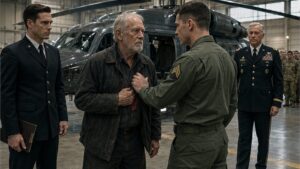
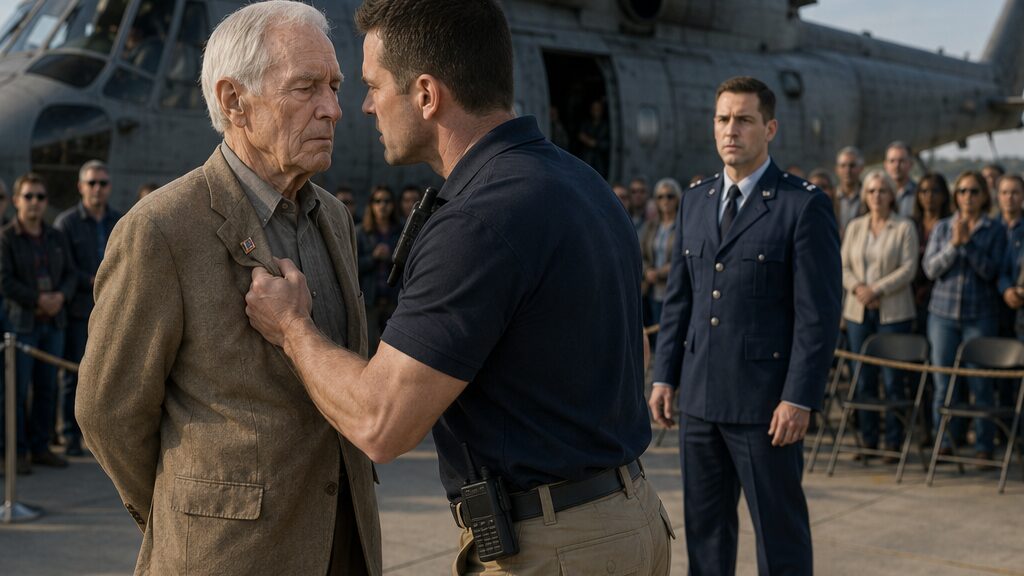
The young man’s hand closed around Richard Carter’s blazer before Richard had finished taking his second step past the rope.
It was not a shove. Not quite. It was worse in its smallness—a fist in tan wool, knuckles pressed near the faded pin on Richard’s left lapel, stopping him like a thing that had rolled where it should not be.
“Sir,” the young man said, too loudly, “you need to step back.”
Richard looked down at the hand.
The blazer was old enough to hold the shape of other rooms. It had a shine at the elbows and a permanent crease below the pocket where Richard’s fingers had rested that morning before he left the house. Inside that pocket, folded twice and wrapped in a square of yellowing paper, was the reason he had come.
He did not reach for it.
He did not reach for the young man’s wrist.
Behind the rope, people turned their heads. A child holding a paper program stopped waving it. Two spectators in folding chairs paused mid-conversation. The aircraft loomed beyond them all, gray and broad-shouldered under the morning sun, its side door open for the ceremony crew, its skin polished in some places and dulled in others where age had settled into rivets and seams.
Richard had known her by touch before most of the people here had learned her name from the banner.
RESCUE AIRCRAFT DEDICATION AND FINAL DISPLAY CEREMONY.
The letters flapped lightly in the wind.
“I said step back,” the young man repeated.
His name badge read JOSHUA NELSON. Private security. Dark polo shirt. Khaki pants. Radio clipped at his shoulder. Arms too tense for the polite words coming out of his mouth.
Richard lifted his eyes from the hand to Joshua’s face.
“I heard you.”
“Then why are you crossing a restricted line?”
Richard said nothing.
Joshua’s jaw tightened. “Sir, this area is for authorized personnel only.”
The rope had been set low, waist-high for most, chest-high to the children. Richard had not ducked under it quickly. He had lifted it with care, first with one hand and then the other, because his right shoulder objected to sudden movement and because the old shoes he wore caught on uneven pavement. He had not tried to sneak. He had simply waited for a gap in the flow of volunteers, then moved toward the aircraft’s side panel as if he had been expected.
He had been expected once.
Not today.
A woman near the program table whispered, “Is he with someone?”
“He looks lost,” another voice answered.
Richard kept his hands behind his back.
He could feel the morning warming the back of his neck. He could smell sun on concrete, aviation fuel too faint to be current, cut grass from beyond the runway fence, coffee from a concession cart. Beneath all of it, something metallic and remembered.
The aircraft’s nose pointed toward the open field, but to Richard it had always seemed as if she were looking back.
Joshua leaned closer, lowering his voice without softening it. “Do you have a pass?”
“No.”
“Are you on the ceremony list?”
“No.”
“Then you can’t be inside the line.”
“I’m not here for the ceremony.”
Joshua gave a short, humorless breath. “Everybody says that.”
Richard’s gaze shifted past him, to the open side of the aircraft. The access ladder stood in place. A restoration volunteer was wiping the handrail. Beyond the stairs, low and nearly invisible from where the crowd stood, was the panel behind which Richard had once taped a label with a pencil stub between his teeth while rain hammered the fuselage hard enough to drown out the engines.
He had been twenty-six.
Now he was seventy-nine, and a younger man’s fist wrinkled his blazer in front of strangers.
“Sir,” Joshua said, “I’m going to ask you one more time.”
The hand on Richard’s blazer tightened.
Richard felt the pressure through fabric, shirt, and bone. It was not much pressure, not enough to hurt, but his body knew what it meant. Moved aside. Managed. Corrected. Reduced to an old man in the wrong lane.
He breathed once through his nose.
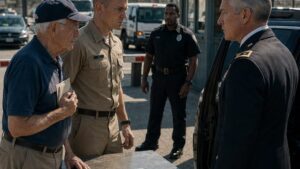
A uniformed officer stood twenty feet away near the ceremony platform, speaking with a public affairs officer. Major Robert Taylor, according to the printed sign near the lectern. He had noticed the disturbance now. His head had turned, his conversation paused. A dark blue service dress uniform, clean shoes, careful posture. The kind of man who knew when an event was slipping out of shape.
Joshua noticed him too and straightened without letting go.
“Everything’s under control, Major,” he called.
Robert did not answer at first.
Richard saw the officer’s eyes move from Joshua’s grip to Richard’s face, then to the lapel pin half-buried beneath Joshua’s fist.
The pin was small, dulled by time, its enamel nearly worn away. A wing. A hook. A shape most people mistook for an old club emblem or something from a reunion jacket. Richard wore it because it weighed almost nothing and because some things did not need to shine to stay true.
Joshua finally released the blazer, but he kept himself close enough to block Richard’s path.
“Back behind the rope,” he said.
Richard smoothed nothing. He did not touch the wrinkled cloth. He did not rescue the lapel from being bent sideways. He simply took one slow step back, then another, until the rope hung between him and the aircraft again.
The spectators resumed movement, but not fully. Their attention stayed on him in fragments: a glance over a shoulder, a whisper, a tightening mouth from someone who had seen too much and chosen not to enter it.
Joshua lifted the rope and snapped it slightly, as if resetting a boundary.
“Stay on this side.”
Richard nodded once.
It was not agreement. It was acknowledgement that he had heard.
The announcer’s voice crackled from the speakers. “Ladies and gentlemen, we’ll begin the dedication program in just a few minutes. Please make your way toward the marked viewing area.”
A small gust moved across the tarmac. The banner lifted. The aircraft’s shadow reached the toe of Richard’s shoe and stopped there.
He looked down.
His shoes had been polished at the kitchen table before dawn. Not well. His fingers stiffened in the mornings, and the left shoe still held a cloudy patch near the lace. He had chosen them because they were the last pair he owned that had ever crossed a flight line on purpose.
Inside his blazer pocket, the folded tag pressed lightly against his ribs.
Joshua turned away to speak into his radio. “Line breach handled. Elderly male, no pass. Keeping him clear.”
Elderly male.
Richard had been called worse, though not always with less understanding.
The child with the paper program edged closer to his mother and looked at Richard with open curiosity. Richard gave the child a faint nod. The child hid half behind the program.
On the platform, Robert Taylor had not resumed his conversation. He was watching Richard now with the look of a man trying to place a sound he had heard years ago and forgotten he knew.
Richard turned his body slightly, enough to face the aircraft without appearing to challenge the rope again. He set his hands behind his back, right hand holding the left wrist, thumb resting on the thin blue vein under the skin.
The posture steadied him. It always had.
There had been mornings when that posture kept him from shaking in front of crews who needed him calm. There had been nights when it kept his hands from reaching for men he could not bring back. There had been a promise made with his hands behind his back because the dying man had already been holding them, and Richard had needed somewhere to put the grief.
Joshua looked over his shoulder.
“You waiting for someone?” he asked, impatient again.
Richard kept his eyes on the aircraft.
“No.”
“Then there’s seating over there.”
“I know.”
“You need assistance?”
A few spectators heard that. Not concern. The word assistance landed like another rope.
Richard turned his head just enough to meet Joshua’s eyes.
“No.”
Joshua seemed annoyed by the simplicity of it. He opened his mouth, but Robert Taylor stepped off the edge of the platform and began walking toward them.
Richard saw the moment Joshua noticed.
The young man’s shoulders adjusted. His hand dropped from his radio. His face arranged itself into professionalism.
“Major,” Joshua said when Robert came near, “he crossed into the restricted area. No credentials.”
Robert did not look at Joshua first. He looked at Richard’s lapel.
The pin had tilted crooked when Joshua grabbed the blazer. For the first time that morning, Richard lifted a hand. Not to salute. Not to explain. Just to set the small piece of metal straight.
Robert watched the movement.
His expression changed so slightly that no one behind the rope would have read it. The air around him seemed to slow.
“Sir,” Robert said, his voice quieter than Joshua’s had been, “may I ask your name?”
Richard’s fingers left the pin.
For a moment he saw another officer, another strip of sun, another aircraft door open in rain. He heard someone laughing from inside the fuselage, calling him Carter, you old crow, bring that tag before this bird forgets us.
But the tarmac was dry. The people were waiting. The rope was still between him and the plane.
“Richard Carter,” he said.
Robert Taylor stood very still.
Joshua shifted his weight. “Major, he’s not on the list.”
Robert did not answer him.
His eyes remained on the faded pin, and then on the wrinkle in Richard’s blazer where Joshua’s hand had been.
Richard put his hands behind his back again.
The announcer welcomed the crowd. The first polite applause rolled over the airfield.
Robert Taylor took one step closer.
Chapter 2: The Officer Who Almost Looked Away
Major Robert Taylor had been trained to notice disruptions without becoming one.
That was what ceremony work required. A fallen banner, a microphone squeal, a misplaced family member, a contractor moving too slowly near the dignitary line—none of it should show on the face. You adjusted, signaled, corrected, smoothed. The public saw order. The people inside the order carried the strain.
But Robert could still see Joshua Nelson’s hand on the old man’s blazer even after it was gone.
He heard the announcer’s voice behind him, bright and practiced. “Today we gather to honor the long service life of this historic rescue aircraft, which will now enter permanent display as part of our community heritage—”
The crowd clapped again.
Richard Carter did not.
He stood behind the rope where Joshua had placed him, hands folded behind his back, shoulders narrow inside the tan blazer. The small pin on his lapel sat straight now. Faded. Nearly colorless. Robert stared at it too long.
He knew that shape.
Not from the ceremony packets. Not from the approved insignia board Sarah Young had set up by the history table. Something older. Something he had seen in a cardboard box in his father’s garage, stamped on a cracked mug and a folded patch that had smelled of dust and engine oil.
Joshua lowered his voice. “Major, I’ve got it. He wandered under the rope. No pass, no wristband, no escort.”
Robert looked at him.
Joshua was not a bad contractor. Overeager, yes. Too physical when nervous. Too aware that the base had hired his company after last year’s crowd-control complaints. But Robert had seen him arrive before dawn, checking barricades, arguing for more water stations, making sure the elderly seating area was shaded. That made what he had done harder, not easier.
“Did he threaten anyone?” Robert asked.
Joshua blinked. “No, sir.”
“Did he refuse to move?”
“He crossed the line.”
“That isn’t what I asked.”
Joshua’s mouth closed.
Robert turned back to Richard. “Mr. Carter, do you need medical assistance?”
“No.”
The answer came flat. Not rude. Closed.
“Are you here with family?”
“No.”
A pause. The kind that left room and also warned against stepping into it.
Robert glanced toward the aircraft. The restoration volunteer had climbed halfway up the access ladder, wiping the rail again though it was already clean. The side panel beneath the rear service marking had been left open for the sealing demonstration. After the speeches, the final archival packet would be placed inside, the panel secured, and the aircraft would become untouchable display. Children would stand beneath the wing for pictures. Veterans would pose near the nose. Local officials would say words like legacy and sacrifice.
Then the maintenance access would close for good.
Robert had signed the order himself.
He looked back at Richard. “You said you’re not here for the ceremony.”
Richard did not move.
“That’s right.”
“Then why are you here?”
The old man’s eyes shifted. Not to Robert, not to Joshua, but to the aircraft’s side panel.
Robert followed the glance.
The open panel was hardly noticeable from the rope. Most guests were looking at the nose art, the flags, the lectern. But Richard had found that panel the way a man found a door in his own house at night.
Joshua exhaled through his nose. “Sir, with respect, we don’t have time to interview every visitor who—”
Robert raised one hand, not sharply, and Joshua stopped.
The announcer continued. “This aircraft participated in rescue support operations across decades of service, carrying crews, equipment, and hope into difficult conditions—”
Hope.
Robert almost winced. Ceremony language had a way of polishing things until no fingerprints remained.
He stepped a little closer to Richard, careful not to crowd him. “Mr. Carter, if there’s something specific you need, I may be able to direct you to the right person.”
Richard’s face did not change. Deep lines around the mouth. White hair combed back neatly. A clean shirt buttoned to the throat despite the heat. Old shoes planted with a mechanic’s sense of balance.
“I know the right place,” Richard said.
“Do you have documentation?”
At that, Richard’s right hand shifted behind his back.
Only an inch.
Robert noticed because he was already watching too closely.
The movement went toward the inside of the blazer and stopped before it became visible. A protective instinct. A guarded pocket.
Joshua noticed too. “Sir, keep your hands visible.”
Richard’s eyes came to Joshua.
Not anger. Something colder because it had been cooled for a long time.
Robert felt heat rise in his own neck. “That’s enough.”
Joshua looked startled.
The crowd applauded again. A speaker had stepped to the lectern. Somewhere, a camera clicked repeatedly. A young airman waved a family away from the access walkway.
Robert turned toward the history table, where Sarah Young stood arranging laminated photographs in a neat row. She was in a volunteer vest over a blue dress, hair pulled back, one hand holding a roll of tape. She had spent months helping the restoration team identify old markings and service records. If anyone at the event might know the pin, it was Sarah.
“Mr. Carter,” Robert said, “would you wait here a moment?”
Richard’s gaze moved to the aircraft.
Robert understood the answer before he heard it.
“I’ve waited long enough.”
It was not dramatic. It was almost too quiet to survive the noise of the speakers. But it made Robert look at him fully for the first time.
There was no demand in Richard’s face. No performance. No wounded pride trying to make itself large enough to be seen. Only time. Too much time, compressed into a man who had dressed carefully, crossed a rope slowly, been grabbed by a stranger, and still refused to say why.
Robert walked to the history table.
Sarah looked up before he spoke. “Problem?”
“Maybe.” He kept his voice low. “That emblem on the old gentleman’s lapel. Do you recognize it?”
Sarah leaned slightly to look past him.
Joshua had positioned himself near Richard again, not touching him now, but close enough to signal control. Richard stood where the rope cast a thin shadow across his shoes.
Sarah’s expression sharpened.
“Can you bring him over?”
“Not yet. Tell me what you see.”
“It’s hard from here.” She squinted. “Winged hook, maybe? The restoration group found traces of a similar mark behind the service panel. But it wasn’t on the approved display list.”
“Why not?”
Sarah lowered the roll of tape. “Because it was removed from official materials years ago.”
Robert felt the sentence settle under his ribs.
“Removed?”
“Not erased,” Sarah said quickly. “Just not included. It belonged to a rescue detachment that got folded into other units. Some records are incomplete. Some names didn’t transfer cleanly.” She looked toward Richard again. “Why?”
Robert glanced back.
Richard had not sat down. He had not approached anyone. He stood behind the rope with his hands behind his back and the aircraft in his eyes. Joshua said something to him; Richard did not answer.
Robert remembered his father’s garage again. A cardboard box labeled OLD AIR FORCE JUNK in black marker. A patch his father had told him not to lose. A mug with a winged hook on the side. A sentence spoken while cleaning out the house after the funeral: The men who kept birds alive never made the programs.
He had been busy that week. Busy with forms, flowers, uniforms, folded condolence cards. He had let the sentence pass.
Now an old man stood twenty yards away, and Robert had nearly let a contractor treat him like an inconvenience.
Sarah stepped around the table. “Major?”
Robert looked at the program board. The official aircraft timeline had dates, locations, mission types, restoration milestones. The final entry read: Permanent Display Sealing, 1600 Hours.
Four o’clock.
He checked his watch.
Not much time.
“Sarah,” he said, “do we have the maintenance logs here?”
“Copies. Not complete.”
“Find anything connected to Carter.”
“First name?”
“Richard.”
Sarah repeated it under her breath as if filing it.
Robert turned back toward the rope. Joshua was talking into his radio again, one hand on his hip. Richard remained motionless except for the slight movement of his chest.
The speaker at the lectern invited guests to honor the aircraft’s crews, maintainers, and families. People clapped politely, already looking toward the refreshments tent.
Maintainers.
Robert heard the word now as something heavier than program language.
He walked back slowly, not because he lacked urgency, but because he did not want to arrive like another man with authority to spend.
Joshua met him halfway. “Major, I can have him escorted to general seating.”
“No.”
“Sir?”
“Not yet.”
Joshua’s face tightened. “He crossed into a controlled zone. If we let one person do it—”
Robert’s gaze moved past him to Richard.
The old man’s right hand had once again drifted toward the inside of his blazer. He did not pull anything out. He only pressed the fabric lightly, as if checking that whatever was there had survived the morning.
Robert’s discomfort deepened into something like shame.
He had seen the hand on the blazer.
He had seen the old man pushed back.
And for one clean, efficient second, he had almost looked away.
Behind him, Sarah’s voice cut through the ceremony noise.
“Major Taylor.”
Robert turned.
Sarah stood beside the history table with a binder open in both hands. Her face had changed.
“That emblem,” she said, not loudly but with enough force that Joshua looked too. “It was removed from official displays years ago.”
Chapter 3: The Tag Folded Against His Heart
Richard found the bench because his left knee had started lying to him.
It claimed it could hold. It had made that claim since the parking lot, through the slow walk past the flags, through the crowd where people drifted with paper cups and programs, through the hand on his blazer. It held until it did not, which was how old joints negotiated with pride.
The bench sat near the parked cars, facing the ceremony tent at an angle. From there, Richard could still see the aircraft between the shoulders of guests and the vertical poles of small flags. He lowered himself carefully, not with the collapse of a tired man but with the control of someone unwilling to let strangers see what effort cost.
His shoe scraped the concrete.
He looked at the cloudy patch near the lace and almost smiled.
“Good enough,” he had told himself at the kitchen table before dawn, rubbing polish in circles with a cloth cut from an old undershirt.
The kitchen had been dark except for the stove light. The blazer hung from the chair back. The folded packet lay beside his keys. He had eaten half a piece of toast he did not want and wrapped the packet twice, first in the old paper, then in a handkerchief Janet Anderson’s husband had once used to clean grease from his cheek and then forgotten in Richard’s toolbox.
Richard had kept it without meaning to.
Then he had kept it because he could not throw it away.
The crowd applauded again. From this distance the sound was thin and polite.
Richard slipped his right hand inside the blazer.
The pocket lining had frayed at the corner. His fingers found the folded paper immediately. He did not remove it at first. He simply held it there, between thumb and forefinger, feeling the stiffness of age, the slight ridge where the tag rested inside.
The maintenance tag was smaller than memory had made it.
A rectangle, once cream-colored, now brown at the edges. Pencil marks faded across the front. A part number. A date. A request written in block letters by a younger hand: CHECK PANEL SEAL BEFORE NEXT LIFT. Under it, in smaller writing, a joke no inspection officer would have approved: CARTER OWES ME COFFEE IF THIS BIRD LEAKS AGAIN.
Richard had not paid for the coffee.
There had been no next easy morning.
A group of visitors passed close to the bench. One of them, a man with sunglasses resting on his cap, glanced at Richard and then at the rope barrier.
“That the guy who tried to get in?”
“Probably just confused,” another said.
Richard kept his hand inside his blazer until they moved on.
Confused.
He had been confused once, but not about ropes.
He had been confused by the way a man could be laughing in the morning and asking for his mother by evening. Confused by the sound of rain on fuselage skin mixing with radio calls and coughing engines. Confused by the unfairness of machines surviving when men did not. Confused by coming home to people who wanted one version of the story and having only pieces too small and too sharp to hand them.
The aircraft beyond the crowd had not been beautiful then. It had been work. It had been leaks, wiring, metal fatigue, fuel stains, frozen fingers, borrowed sleep. It had been men shouting over engines and pretending not to be afraid because someone else needed them steady.
Richard drew the packet from his pocket.
He kept it low, shielded by the curve of his body. The paper trembled slightly, not from fear, he told himself, but from the morning air.
A boy ran past with a small foam airplane, chased by a younger child. Their laughter cut through the speeches, bright and careless. Richard watched them until they disappeared near the refreshment tent.
Then he unfolded the first layer.
He did not open the tag all the way. Not here. Not with the crowd nearby and the security man watching from the corner of his eye. But he let himself see the edge of the old handwriting.
Carter owes me coffee.
His throat tightened.
“John,” he said under his breath, though there was no one named John at the bench, and no one in the story who would answer.
He had not meant to speak.
The name did not belong to the ceremony program. It did not belong to the display board or the official script. It belonged to rain, a half-lit cargo bay, and a young crewman with hands always nicked from tools he handled too quickly.
Richard folded the paper closed.
He had promised badly. That was how he thought of it. Not failed, exactly. A failed promise ended. This one had lived, inconvenient and small, inside drawers and toolboxes and finally inside his blazer pocket for decades.
If the aircraft ever comes home, John had said, put it back where it belongs.
Richard had said, Don’t talk foolish.
Promise me.
So Richard had promised, because men made promises to the dying even when the promise had no map.
For years the aircraft had been transferred, modified, stored, almost scrapped, restored by people who loved history in a cleaner way than Richard could. He had followed news of it in clipped articles and phone calls from old contacts. When he read that it would be permanently sealed after the ceremony, he knew the promise had found its last hour.
And then he had arrived without the right badge, without a family escort, without the willingness to explain himself to a young man with a radio.
Richard looked toward the aircraft.
Joshua Nelson stood near the rope speaking to Major Taylor. The major’s posture had changed. The volunteer woman at the history table had a binder open. The three of them looked, briefly, in Richard’s direction.
He put the packet back inside his blazer.
He could leave.
The thought came cleanly.
He could stand, walk back through the parked cars, drive home with the tag still folded against his heart. No one would know. No one would accuse him of failing a second time. The ceremony would close. The panel would be sealed. The aircraft would sleep in public view, admired by children and photographed by visitors, and somewhere behind its restored skin there would be an empty place no one else could name.
Richard placed both hands on his knees and leaned forward.
The motion hurt. It made his breath catch. He waited for the pain to settle before trusting his legs.
A parked-car attendant nearby noticed. “Sir? You all right?”
Richard looked up. “Yes.”
“You need a golf cart back to the entrance?”
“No.”
The attendant lingered, uncertain.
Richard rose.
The world shifted for half a second, not enough to fall, enough to remind him that pride was not balance. He stood still until the pavement returned to level.
The attendant said, “Hot day.”
“It is.”
“Ceremony’s over that way.”
“I know.”
The attendant nodded and retreated, satisfied or uncomfortable.
Richard turned toward the aircraft again.
He took one step, then another. Not toward the rope this time. Not yet. He moved toward the history table, where photographs lay in rows and strangers had written captions for a life they had not lived. If they would not let him near the panel, he would at least see what they had chosen to remember.
The table was crowded. Laminated pictures. A model aircraft under clear plastic. A sign asking visitors not to touch original documents. A binder open near the edge.
Richard stopped before a black-and-white photograph of six men standing in front of the aircraft in bad weather. One of them had his cap tilted wrong. Another had his hand raised as if objecting to the picture. Richard stood at the far left, younger by half a century, sleeves rolled, eyes narrowed against rain.
His own face surprised him less than the man beside him.
John Anderson had been caught mid-laugh.
Richard reached toward the photograph, then remembered the sign and withdrew his hand.
Someone beside him drew in a breath.
He turned.
A woman stood at the other side of the table, one hand pressed to the strap of her purse, the other holding a folded program. She was in her seventies, with silver hair pinned carefully and eyes that had already recognized him before her mouth allowed it.
For a moment neither of them spoke.
The ceremony noise thinned.
The woman looked from Richard’s face to the photograph, then back again.
“Richard Carter,” she said.
He knew her before memory supplied the older version of the name. Not from age. From the eyes. John’s eyes had been lighter, but they had held the same directness when he was trying not to forgive someone too soon.
“Janet,” Richard said.
Her mouth trembled once and hardened before it could become anything else.
“My husband kept that photograph,” she said. “For forty-eight years.”
Richard lowered his gaze.
“I know.”
“No,” Janet Anderson said, and the softness left her voice. “I don’t think you do.”
Chapter 4: The Widow Who Thought He Forgot
Janet Anderson had rehearsed anger for so many years that it came to her more easily than Richard’s name.
She had not planned to see him. She had come because the base had mailed an invitation addressed to the family of a former crewman, and because the aircraft in the photograph had outlived the man who used to wake from dreams with its engine noise still in his throat. She had told herself she would stand through the ceremony, look at the display, thank whoever needed thanking, and leave before the speeches became too polished.
Then she saw Richard Carter standing beside the history table, older, thinner, wearing a blazer that looked as if it had been brushed carefully by hands that no longer trusted their own strength.
For one second she was twenty-six again, standing in a hallway while two uniformed men tried to tell her what had happened without saying the part she needed first.
John is gone.
Richard’s eyes lowered when she said he did not understand. That made her angrier. She had expected denial, apology, maybe the stiff discomfort of a man caught by a past he had avoided. She had not expected him to accept the accusation as if it belonged to him.
“You never came,” she said.
The words landed between them on the table, among laminated photographs and neat captions.
Richard’s hand moved behind his back. “No.”
“No letter after the first one. No phone call. No visit when they brought his things home.” Janet’s fingers tightened around the program until the paper creased. “You were in every story he wrote me. Carter fixed this. Carter said that. Carter found coffee somewhere no coffee had a right to be. And then after he died, you vanished.”
People shifted around them. A guest reached toward the photo display, sensed the tone, and chose another end of the table. The ceremony speaker’s voice rolled on in the background, naming dates and bases and missions as if a life could become orderly when printed large enough.
Richard looked at the photograph of the six men.
“He talked about you,” he said.
Janet gave a small, sharp laugh. “That’s what you have?”
“He said you hated carnations.”
She stopped.
Richard’s gaze stayed on the photograph. “He said if he died before you, nobody was to bring carnations to the service because you said they smelled like a funeral home trying too hard.”
The air changed in her chest.
It was too specific. Too useless. Too John.
Janet looked down at the old photograph. Her husband’s young face was blurred slightly by rain, but the grin had survived. That tilted cap. That expression as if someone just outside the frame had said something foolish and he was about to answer.
“He told you that?”
“More than once.”
“He told everyone everything.”
“Not everything.”
Richard’s voice had no defense in it. That was what unsettled her most. She wanted the satisfaction of striking a wall. Instead, every word seemed to fall into water.
Janet turned the program over in her hands. On the front was a bright photograph of the restored aircraft. Too clean. Too proud. The real thing stood behind them under the sun, gray and enormous, with children moving beneath its wing and volunteers pointing at safe places to stand.
“I thought you forgot him,” she said.
Richard’s mouth tightened.
“No.”
“Then why?”
He did not answer.
That silence had weight. It was not empty. It was packed with things he had chosen not to say for so long they had hardened into habit.
Janet looked at his blazer. A wrinkle cut across the left side near the lapel, fresh and ugly. The pin there sat straight, but the cloth around it had been pulled. She had seen the end of the confrontation from the parking area, the younger man close to him, the hand on him. She had not known then who Richard was. She had only thought, with the instant irritation of age, that young men with radios sometimes mistook volume for duty.
Now she wished she had walked faster.
“Was that man bothering you?” she asked.
Richard glanced toward the rope. “He was doing his job.”
“That isn’t what I asked.”
For the first time, something almost like tired amusement touched his face. It did not last.
“I crossed where I was told not to cross.”
“Why?”
Again, his hand moved toward the inside of his blazer.
Janet noticed.
“Richard.”
He met her eyes then, fully.
There it was—the thing she remembered from the one photograph John had kept on his dresser after he came home from training. Richard Carter younger, standing with one shoulder angled toward the camera, not smiling, but watchful. Janet had once teased John that his friend looked like he was guarding the photographer from the weather. John had said, That’s Carter. He hears trouble before trouble signs in.
The old man before her still looked like he heard trouble first. Only now, it seemed to be inside him.
“I’m not here for the ceremony,” he said.
“I heard you tell them.”
“I came to put something back.”
Janet waited.
Richard looked down at the table, at the captions printed under photographs. “Not to take anything. Not to speak. Not to be seen.”
“Put what back?”
He reached inside his blazer, then stopped as two visitors passed too close. His hand withdrew empty. “Something John gave me.”
Janet’s body went still.
The name sounded different in Richard’s mouth. Not softened. Not displayed. Carried.
“He gave you something?”
“He asked me to hold it.”
“For forty-eight years?”
Richard did not flinch. “Yes.”
The anger she had rehearsed shifted, but it did not disappear. It looked for another shape. “And you never thought I should know?”
His answer came after a long moment.
“I thought if I came to you, I would have to tell you the rest.”
The rest.
Janet hated him for that phrase because she understood it immediately. Every military widow knew there was an official story and then there was the rest. The official story was folded, typed, stamped, delivered. The rest lived in men who woke at night and did not say why.
“My husband died,” she said. “I was already living with the worst part.”
Richard’s eyes closed briefly.
“No,” he said. “You were living with the clean part.”
She almost stepped back.
The words were not cruel. They were worse because they were careful.
Before she could answer, Sarah Young approached with a binder hugged against her chest. She slowed when she saw Janet’s face.
“I’m sorry to interrupt,” Sarah said. “Major Taylor asked me to check the maintenance records. Mr. Carter?”
Richard turned.
Sarah looked from him to the photograph on the table, then to the open binder. She had the focused expression of someone who had discovered history was not behaving.
“I found three Carter entries,” she said. “Initial only on two. One full signature in a copied log from 1973. Richard Carter, crew chief.”
Janet felt the words pass through her like a delayed sound.
Crew chief.
John had written that phrase often. Crew chief says the bird will hold. Crew chief says I owe him coffee. Crew chief says not to trust a dry panel after sideways rain.
Richard’s jaw tightened at the last entry, though Sarah had not read it aloud.
Sarah hesitated. “There’s also a notation about an aft service panel. The one the restoration team is sealing today. It references a temporary maintenance tag that was never recovered when the aircraft was transferred.”
Richard looked toward the aircraft.
Janet saw his hand press his blazer pocket, very gently.
“You have it,” she said.
It was not a question.
Richard did not deny it.
The noise of the ceremony seemed suddenly far away. The aircraft stood in the sun while officials spoke of heritage, and here, at a folding table under a tent, an old promise lifted its head.
Sarah lowered her voice. “They’re sealing that panel before sunset. The final archival packet goes in after the last speaker.”
Richard looked at the open side access ladder. Joshua Nelson stood near it now, speaking with a volunteer and checking credentials. Major Taylor was beside the platform, but his attention kept cutting toward the history table.
Janet stared at Richard’s blazer pocket. For decades she had imagined him forgetting. It had been easier than imagining he remembered every day and still stayed away.
“Let me see it,” she said.
Richard did not move.
Her voice softened despite herself. “Please.”
He drew out the folded packet slowly, shielding it from wind with both hands. The paper looked too fragile to have survived one year, let alone forty-eight. He unfolded only the outer layer and showed her the edge of the tag.
The handwriting was faded, but she knew it before she could read it.
Not because she recognized the letters. Because she recognized the carelessness of a young man certain he would have time to explain himself later.
Carter owes me coffee if this bird leaks again.
Janet pressed her fingers to her mouth.
Richard folded it closed at once, not hiding it from her, protecting it from the light.
“He wrote that?” Sarah asked quietly.
Richard nodded.
Janet looked at the photograph again. John’s half-laugh. Richard beside him, not smiling, as if he already knew laughter had to be guarded.
“You should have come,” Janet said.
“I know.”
“You should have told me he made you promise.”
“I know.”
The answers should have angered her. Instead they opened a door she had braced shut for years.
“What happened?” she asked.
Richard held the packet flat against his palm.
The announcer introduced another speaker. Polite applause swelled. Joshua’s radio crackled near the rope. Somewhere, a child complained about the heat.
Richard looked at Janet, and for the first time that day, the old control in his face faltered.
“He was worried about the panel,” he said. “Can you believe that? Of all things. Rain coming in sideways, lift schedule a mess, everybody tired. He kept saying the seal would fail. I told him I’d check it after we landed.”
Janet listened without breathing.
“We didn’t land the way we were supposed to.”
Richard’s fingers closed around the folded tag.
“That’s all I can say here.”
Janet wanted to demand the rest, but the words died before they formed. Not because she did not deserve them. Because she saw now what standing here cost him.
Sarah looked toward the aircraft and then down at her binder. “The sealing crew is scheduled at sixteen hundred. But if Major Taylor authorizes a brief access before then, there may be time.”
Richard shook his head once. “I won’t have anyone in trouble.”
“You already are,” Janet said.
He looked at her.
She nodded toward his wrinkled blazer, the rope, the young security man who had treated him like a problem to be moved. “You came all this way to keep a promise, and they put a hand on you.”
Richard slipped the packet back inside his pocket.
“That hand doesn’t matter.”
“It mattered to me.”
He had no answer for that.
Sarah closed the binder, decision forming in her face. “I’ll find Major Taylor.”
She turned quickly and moved through the crowd.
Janet and Richard remained beside the photograph table. For a while neither spoke. The aircraft’s shadow shifted slowly across the tarmac.
At last Janet said, “John kept your letters.”
Richard’s eyes lowered.
“All six of them,” she said. “He tied them with a bootlace. I used to hate that bootlace. I thought it meant he left part of himself with you.”
“He did,” Richard said.
Janet swallowed.
Then Sarah’s voice rose from near the aircraft walkway, sharp with urgency.
“Major Taylor, they’re moving the final panel schedule up. The sealing team wants it done before the heat gets worse.”
Richard turned.
Across the airfield, a restoration volunteer lifted a tool case onto the access ladder.
Sarah looked back at them, binder clutched to her chest.
“The panel may be closed before sunset,” she called.
Chapter 5: The Rule That Erased the Promise
Joshua Nelson had never liked open ropes.
A rope was only useful if people believed it. The moment one person lifted it and stepped through, everyone nearby began measuring whether it applied to them too. Children ducked under. Older men leaned over it to take pictures. Reporters nudged camera bags past the stanchions and said they would only be a second. By the end of any event, a rope became decoration unless someone stood there and made it mean something.
Joshua’s job was to make it mean something.
That was what he told himself as he watched the old man at the history table with the widow and the volunteer.
The old man had a name now. Richard Carter. Major Taylor had repeated it once, quietly, as if testing whether it belonged to a memory instead of a list.
Joshua did not like that either.
Names changed how people looked at rules. Without a name, the old man was a breach. With a name, he became a story, and stories always tried to bend the line.
Joshua checked the credential sheet again, though he had already checked twice. VIPs, veterans’ families, restoration team, active-duty staff, media, base command. No Richard Carter. No Carter at all.
He ran his finger down the page until the paper blurred in the heat.
“No pass,” he said under his breath.
The young airman beside him looked up from the water cooler. “Sir?”
“Nothing.”
Joshua was not a sir, not in the way men in uniform were sir. Contractors were sir only when people wanted them to carry blame politely. If someone crossed the rope and got hurt on the aircraft stairs, it would be Joshua’s incident report. If a guest slipped near the access panel, Joshua would answer why he let unauthorized personnel close. If an old man wandered under the wing during the sealing procedure, everyone would ask why security had not done its job.
His phone buzzed.
A message from the operations tent: Keep access walkway clear. Final sealing may move earlier. Crowd drifting too close.
Joshua put the phone away and looked at the aircraft.
The restoration volunteer had opened a tool case on the ladder platform. Another volunteer stood below with a clipboard. The side panel waited, small and ordinary, though now everyone seemed to be treating it like a chapel door.
Major Taylor approached from the platform. “Joshua.”
Joshua straightened. “Major.”
“I need five minutes of access to the aft service panel before the sealing team closes it.”
Joshua felt the day tighten around him. “For whom?”
“For Mr. Carter.”
“No.”
The word came out before he softened it. The young airman looked down at the water cooler.
Joshua corrected his tone. “Major, respectfully, he’s not credentialed for aircraft access.”
“I’m aware.”
“We have a process.”
“I’m also aware of the process.”
“Then you know I can’t clear a civilian onto the ladder because he says he needs to put something in a panel.”
Major Taylor’s eyes narrowed slightly. “He didn’t say that to you.”
Joshua’s face warmed. “He didn’t need to. Everybody’s suddenly acting like that’s what this is.”
“It may be exactly what this is.”
“Then he can give it to the restoration team.”
“He won’t.”
“Then that’s his choice.”
The words sounded clean to Joshua. Firm. Defensible. He wished they felt better.
Major Taylor studied him for a moment. “Why did you put your hand on him?”
Joshua’s jaw tightened. “He crossed the rope.”
“Why did you put your hand on his blazer?”
The question stripped the rule down to the gesture.
Joshua looked toward the history table. Richard Carter stood half turned toward the aircraft, hands behind his back again, the widow beside him. The wrinkle on the blazer was visible even from here. Joshua had caused it. He remembered the feel of the cloth in his fist: thin, worn, unexpectedly soft.
“He wasn’t responding quickly,” Joshua said.
“He heard you.”
“He wasn’t moving.”
“He was old.”
Joshua looked back sharply. “Being old doesn’t exempt someone from a restricted area.”
“No,” Major Taylor said. “It also doesn’t make him dangerous.”
Joshua had no answer ready.
A radio call cracked from his shoulder. “Operations to security lead, confirm access walkway clear in two minutes.”
Joshua pressed the button. “Security lead. Working it.”
Major Taylor waited.
Joshua lowered the radio. “My father was old when people stopped listening to him.”
The sentence surprised him. It had not been where he thought this conversation was going.
Major Taylor said nothing.
Joshua looked at the aircraft because it was easier than looking at the major. “He was Army. Not Air Force. Never talked about it until he got sick, then he talked too much. To strangers, nurses, anyone stuck in a room with him. Half of it didn’t make sense. He’d get angry if people corrected him.” He breathed out. “I spent two years trying to keep him from wandering into places he couldn’t be. Hospitals. Parking lots. Once behind a restaurant kitchen because he thought he knew the cook from Korea.”
Major Taylor’s expression changed, not soft exactly, but less official.
Joshua folded the credential sheet. “So when I see an old man lifting a rope and walking toward an aircraft with tools out and stairs open, I don’t see history. I see a fall. A lawsuit. A family asking why nobody stopped him.”
“That explains why you stopped him,” Major Taylor said. “Not how.”
Joshua looked down.
The radio hissed again. He ignored it.
From the history table, Sarah Young was walking toward them fast, binder under one arm. “Major, the log entry confirms the panel. Not full context, but enough to connect Carter to the maintenance crew.”
Joshua gave a short laugh without humor. “A copied log entry is not authorization.”
Sarah stopped. Her eyes flicked to him. “No, it’s not. But it means he’s not confused.”
Joshua regretted the laugh immediately. “I didn’t say he was.”
“You reported him as elderly male, no pass.”
“That is what he was.”
Major Taylor’s voice cut in. “That is not all he was.”
Joshua felt the words land where he did not want them.
A contractor in a safety vest waved from the aircraft stairs. “We need this walkway closed now.”
Joshua turned. “Hold position.”
The contractor frowned but stopped.
Major Taylor stepped closer. “I can authorize limited access.”
“Then authorize it in writing.”
“Joshua.”
“No, sir. I’m serious.” Joshua heard his own voice becoming too tight, but he could not stop. “If you want to override the access rules, do it officially. Because if he slips on that ladder, if anyone gets hurt, if the restoration team says security lost control, it won’t be the ceremony program taking the blame.”
Sarah looked between them, frustrated but silent.
Major Taylor’s face hardened. “Fine. I’ll put it on my authority.”
“Then I’ll need him escorted, hands visible, no loose items near the panel unless inspected.”
Sarah drew in a breath. “It’s a paper tag.”
“It is an unverified object entering a sealed display aircraft.”
Major Taylor looked at him with something close to disappointment.
Joshua hated that look. He had seen it from doctors when he asked them not to leave his father unattended. From relatives when he hid the car keys. From strangers who thought caution was cruelty because they arrived late to the story.
He turned away and walked toward Richard before the major could answer.
The old man watched him come.
Joshua slowed as he neared the history table. Janet Anderson stood beside Richard, chin lifted. Sarah followed with Major Taylor.
“Mr. Carter,” Joshua said.
Richard waited.
Joshua looked at the blazer. The wrinkle. The pin. The place where his hand had been.
“I need to inspect whatever you intend to bring near the aircraft.”
Janet’s eyes sharpened. “Need?”
“Yes, ma’am.”
Richard reached into his blazer.
Joshua’s body tensed before he could stop it. Richard noticed. Of course he noticed. His hand paused just inside the pocket, then withdrew slowly with the folded paper packet pinched between two fingers.
He held it out.
Joshua took it carefully.
The paper weighed almost nothing.
That made him feel worse.
He opened the outer fold under Major Taylor’s watch. Inside was a small maintenance tag, browned with age, its edges soft. The pencil writing was faded but legible in parts. Not a threat. Not contraband. Not even important-looking by the standards of the event. A scrap most people would have thrown away in a drawer cleaning.
Joshua read the line about coffee.
For reasons he did not understand, he thought of his father’s wallet, the old appointment cards tucked behind insurance papers long after the doctors were gone.
He folded the packet closed and held it back to Richard.
“Thank you,” Richard said.
Joshua expected anger in the old man’s eyes. He found none. That was harder to meet.
“Mr. Carter,” Joshua said, quieter, “why didn’t you just tell me?”
Richard took the packet and returned it to his blazer.
“Would you have heard me?”
Joshua opened his mouth.
The answer did not come quickly enough.
Behind them, the announcer’s voice rose. “We invite the final preservation team to prepare for the closing of the service access panel.”
Major Taylor stepped beside Joshua.
“Before you touched him,” the major said, not loudly, “did you check his name?”
Joshua looked toward the aircraft, where the volunteer lifted a sealing plate from the tool case.
Then he looked back at Richard Carter.
“No,” Joshua said.
Chapter 6: The Name Missing From the Ceremony Program
Robert Taylor found Richard Carter’s name in a maintenance log, but not in the ceremony program.
That was the part that stayed with him.
The program had room for sponsors, restoration committee members, elected officials, display donors, the aircraft’s manufacturing notes, and three paragraphs about heritage. It had room for a glossy photograph of the plane climbing through blue sky decades after the mission that had made Richard’s hands tremble when he touched the folded tag.
But it did not have room for the crew chief who kept the aircraft flying when the weather broke and the records blurred.
Sarah Young laid the copied log on the archive table and smoothed the page with both hands. “Here,” she said. “R. Carter. Then here again. Initials only. This one has the full signature.”
Robert leaned over the table.
The copy was poor, gray at the edges, the original handwriting slanting through boxes and lines meant to contain more orderly work. In one entry, Richard’s signature appeared beneath a maintenance clearance for a panel inspection. In another, a note referenced water intrusion near the aft service seal. The final entry had a date Robert recognized from the aircraft timeline, though the official display described that period only as rescue support operations under adverse conditions.
Adverse.
The word had done a great deal of hiding.
Joshua stood a few feet away, arms at his sides, no longer pretending not to listen. Janet Anderson sat in a folding chair under the tent, the old photograph in her lap. Richard remained standing. Robert had offered him a chair twice. Richard had refused once and ignored the second offer with such quiet finality that Robert stopped.
The old man’s face had taken on a gray cast in the heat, but his posture held. Hands behind his back. Blazer wrinkled at the lapel. Faded pin catching no light.
Robert looked from the log to the ceremony platform. The announcer was filling time, introducing the restoration volunteer ahead of schedule. Guests had begun moving closer to the marked viewing area. The final sealing team waited near the aircraft stairs.
Time had become visible.
“We can still do this,” Sarah said.
“Do what exactly?” Joshua asked.
Robert looked at him.
Joshua did not retreat, but his voice had changed. Less challenge now. More fear of a mistake already made.
“Major, I’m asking practically. Do we stop a scheduled ceremony? Move contractors? Put him on the ladder? Let him open a preservation panel? I’m not trying to be difficult.”
“No,” Sarah said, a little tired. “For the first time today, you’re not.”
Joshua looked down.
Robert turned to Richard. “Mr. Carter, I can authorize a brief access. The restoration team can open the panel under supervision. You can place the tag inside the archival packet.”
Richard shook his head.
Janet lifted her eyes.
Robert waited.
“Not in the packet,” Richard said.
Sarah frowned. “The archival packet is what will remain with the aircraft. It has preservation notes, donor list, restoration record—”
“That isn’t where it belongs.”
The words were quiet, but the table fell still around them.
Robert looked again at the log. “Where does it belong?”
Richard’s eyes moved toward the aircraft, to a small panel beneath the side marking, just below the ladder platform. “Inside the service lip. Upper left. There was a seam that caught rain if the seal sat wrong. John marked it so I’d check it before next lift.”
Janet’s fingers tightened around the photograph.
Sarah studied the copied diagram in the binder. “There is an inner lip. The restoration team documented old adhesive residue there. They thought it came from a temporary inspection label.”
Richard said nothing.
Robert felt the hair rise slightly along his arms.
Evidence, but not easy evidence. Not a medal in a box. Not a headline. Not a rank that made everyone stand straighter. A scrap of paper, a seam, adhesive residue, a note about rain. Small facts. Mechanic facts. The kind history forgot because they did not photograph well.
The base public affairs officer approached with a headset crooked over one ear. “Major Taylor, we need you near the platform for the closing remarks.”
“In a moment.”
“We’re already adjusting the order.”
“I said in a moment.”
The officer glanced at the faces around the table, sensed a matter above his preference, and stepped back.
Robert looked at Richard. “If I ask them to let you place it there, people will notice.”
Richard’s expression did not change. “I know.”
“They may ask who you are.”
“I won’t answer.”
“Someone else may.”
Richard looked at him then. “Major, I didn’t come for a microphone.”
Janet’s face moved slightly, as if the words had struck her and steadied her at once.
Robert had expected that. Or thought he had. But hearing it made the choice harder. The cleanest path, institutionally, would be to announce him. Recognize him. Bring him forward with polite applause and a sentence about long-overdue honor. The crowd would like that. The event would absorb the morning’s ugliness and turn it into an uplifting moment. Joshua’s mistake would become part of a redemptive story before anyone had to sit with it.
Richard was refusing that.
Not because he did not deserve recognition.
Because recognition was not the promise.
Robert thought of his father’s garage again. The box of old Air Force things he had meant to sort. How quickly he had decided what mattered by what looked official. Medals in one pile. Certificates in another. Greasy scraps discarded. He could not remember now whether he had thrown away the mug with the winged hook or packed it somewhere safe.
The possibility shamed him.
“Sarah,” he said, “show me the full page.”
She turned the binder.
A crew list had been copied onto the next sheet, partial and uneven. Some names were cut off by the scanner. Others were faded nearly blank. Richard Carter’s name appeared in a maintenance section, handwritten in a margin rather than typed with the primary crew.
Robert looked at the ceremony program open beside it.
No Richard Carter.
No John Anderson either, except in a family acknowledgment line Janet had probably had to submit herself.
Robert closed the program.
Joshua spoke quietly. “Major.”
Robert turned.
Joshua’s face had gone pale under the heat. “If you authorize it, I’ll clear the walkway.”
Robert held his gaze.
“And?” Robert asked.
Joshua swallowed. “And I’ll keep people back.”
Janet looked at him with something not yet forgiveness, but no longer contempt.
Richard did not look at him at all. His eyes remained on the aircraft.
Sarah touched the edge of the maintenance log. “There’s one more issue. The restoration team may object to placing anything outside the archival packet. Preservation protocol—”
“I’ll speak to them,” Robert said.
“They’ll want a reason.”
Robert looked at Richard. “May I give them one?”
Richard’s hand moved to the folded packet inside his blazer. “Tell them it’s a maintenance tag that was never cleared.”
“That’s all?”
“That’s all.”
Janet stood. “No.”
Everyone turned.
Her voice shook, but she held herself straight. “No, that is not all. You don’t have to make a speech, Richard, but don’t make him disappear twice.”
Richard’s face tightened.
Janet stepped closer, holding the old photograph. “You kept his tag. You kept his joke. You kept something I didn’t even know existed. If that panel closes with nothing but paperwork, then the ceremony gets him wrong too.”
“I can’t give them what I don’t have,” Richard said.
“What don’t you have?”
He looked at the photograph in her hand.
“The right words.”
For a moment Janet’s anger left her completely, and grief stood there instead, older than both of them.
“You never needed the right ones,” she said. “You needed to come.”
Richard looked away.
Robert gave them the silence he could. Around them the event continued to move: the hum of the speakers, the murmur of crowd control, the clink of a tool on metal near the ladder.
Then the announcer’s voice rose, clear and cheerful.
“Ladies and gentlemen, if you’ll direct your attention toward the aircraft, our preservation team is now preparing for the final sealing of the service access panel.”
Sarah’s head snapped toward the aircraft.
The volunteer on the ladder lifted the panel cover.
Robert picked up the copied log and closed the binder.
“Joshua,” he said.
Joshua straightened.
“Clear the walkway.”
“Yes, Major.”
“Sarah, come with me. Bring the log.”
Sarah gathered the papers.
Robert turned to Richard. “Mr. Carter, I can stop the ceremony long enough to make a public correction.”
“No.”
“It would explain why we’re opening access.”
“No.”
Robert nodded once. He had expected it, but the refusal still carried force.
“What do you want?”
Richard looked past him to the aircraft. The folded packet made a slight shape beneath his blazer.
“Five minutes,” he said. “No microphone.”
Robert looked toward the platform, where the base public affairs officer was already waving at him with alarm. He looked at the crowd, at the rope, at Joshua moving people back with a new care in his gestures. He looked at Janet Anderson, who held a photograph of young men standing in rain, and at Sarah Young with the maintenance log pressed to her chest.
Then he looked at Richard Carter, the name missing from the program.
Robert stepped toward the access walkway.
At the aircraft, the final sealing team raised the panel into position.
Chapter 7: The Rope Opened Without Applause
Richard saw the panel rise into the air and thought, absurdly, that it looked lighter than it had in the rain.
Everything looked lighter in ceremony weather.
The aircraft’s side gleamed where volunteers had polished it for the public. Flags moved gently along the viewing line. Children sat on parents’ shoulders. The announcer’s voice asked for everyone’s attention, and most faces turned toward the access ladder without understanding that anything had changed.
Richard understood.
The panel was small. A rectangle of metal beneath the larger curve of the fuselage, near a service marking that had been repainted so neatly it seemed to deny the years of hands that had opened and closed it under worse skies. The restoration volunteer held the cover with both hands while another worker checked a line on a clipboard.
Major Robert Taylor reached the foot of the ladder first.
Richard did not hear what he said. He saw only the result: the volunteer paused, looked toward the program platform, then toward the old man in the tan blazer. The base public affairs officer hurried forward, face tight with alarm. Sarah Young opened the binder and showed the log. Robert pointed once to the copied page, then to the inner edge of the panel.
The volunteer’s shoulders lowered.
Not surrender. Recognition of another kind of authority.
Richard began walking.
Janet Anderson moved at his right side but did not touch him. That kindness nearly undid him. So many people, when they saw age, reached for the elbow before asking whether help was wanted. Janet walked close enough to catch him if he fell and far enough to let him remain standing on his own.
Joshua Nelson stood by the rope.
Only an hour earlier, his body had blocked the same path, hard with rule and suspicion. Now he held the stanchion in one hand and the rope in the other. He did not lift it quickly. He waited until Richard reached him, then lowered it all the way so Richard would not have to bend.
The gesture was small enough that most of the crowd missed it.
Richard did not.
For a moment he and Joshua faced each other across the opening.
Joshua’s eyes moved to the wrinkle in Richard’s blazer. His mouth tightened. He looked as if he had several sentences ready and trusted none of them.
“Mr. Carter,” he said, “the walkway is clear.”
Richard nodded.
Joshua stepped aside.
Richard passed through the place where he had been stopped.
No one applauded. No one called his name. The announcer continued speaking because Robert had signaled him to keep the program moving, to let the public look where it expected to look while something truer happened slightly to the side.
The concrete changed under Richard’s shoes after the rope. That was impossible, but he felt it anyway. The ground inside the restricted line had the old silence of flight lines, the kind where every unnecessary sound seemed out of place. His soles moved slowly over painted markings and patched cracks in the tarmac.
Halfway to the ladder, his knee failed its promise again.
Not fully. Just a sudden loosening.
Joshua moved before Janet did. One hand came forward, then stopped in the air, asking this time without words.
Richard looked at it.
The same hand.
Not clenched now. Open.
Richard did not take it, but he did not punish the offer. He steadied himself with a breath and gave Joshua the smallest nod that meant, I saw.
Joshua lowered his hand.
At the ladder, Robert waited beside Sarah and the restoration volunteer. The side panel was open, exposing a narrow service space, clean now, almost museum-clean. Richard could see the inner lip from where he stood. Upper left. A faint roughness where old adhesive had once clung.
His throat closed.
For decades he had remembered it larger. A whole corner of the aircraft. A wound in metal. A place where rain had entered and men had cursed and laughed and worked. Now it was a narrow seam, ordinary to anyone who had not once trusted it with lives.
Robert stepped near him. “Take your time.”
Richard almost answered that time was the one thing he had already taken too much of, but he said nothing.
Sarah handed the copied log to the restoration volunteer, who looked from it to Richard with a changed face. Not awe. Something more useful: care.
“We won’t seal it until you’re done,” the volunteer said.
Richard reached inside his blazer.
This time no one told him to keep his hands visible.
His fingers found the folded packet. He drew it out carefully and held it in both hands. The paper had warmed against his chest. He could feel the shape of the tag inside, its edges, its thinness, the ridiculous survival of it.
Janet stood a few steps back with the photograph pressed flat against her body.
Richard looked at her.
She nodded once.
He unfolded the outer paper. The air moved, and Sarah quickly stepped closer to block the wind without touching the tag. Richard opened the handkerchief next. Its fabric was worn soft, stained faintly in one corner from a kind of grease no washing had ever fully removed.
The maintenance tag lay in his palm.
Carter owes me coffee if this bird leaks again.
The joke looked smaller in daylight.
Richard had expected, foolishly, that seeing it here would bring John’s voice back cleanly. It did not. Memory came broken, as it always did. Rain on metal. A boot slipping on the ladder. John laughing through exhaustion. John coughing later. John’s fingers closing around Richard’s sleeve with surprising strength.
If this bird comes home.
It came home, Richard thought.
Late. But it came.
Robert’s voice, low beside him, said, “Mr. Carter, the volunteer can place it if you prefer.”
Richard shook his head.
His hand trembled when he lifted the tag.
The tremor embarrassed him. He could still feel Joshua’s earlier grip in the blazer, the public stillness, the child watching, the phrase elderly male, no pass. He had endured all of that without letting his hand shake where anyone could see.
Now, before a strip of metal and an old joke, his fingers failed him.
Janet moved then.
She did not take his hand. She came close enough that only he could hear.
“He always said you had the steadier hands,” she said.
Richard closed his eyes.
For one breath, he was not on the airfield. He was in the aircraft’s belly with rain drumming so hard it made language useless. John was beside him, younger than anyone had a right to remain in memory, holding out a tag and grinning because fear had not yet decided what face to wear.
Richard opened his eyes.
He slid the tag into the service lip, upper left, where adhesive residue still marked the old place. It did not stick by itself. Of course it did not. Too many years had passed for that small mercy.
The restoration volunteer quietly offered a preservation strip. Not tape from a drawer. Something archival, careful, made for holding old things without pretending they were new.
Richard looked at it, then at the volunteer.
“Thank you.”
His voice scraped.
He fixed the tag in place with slow, deliberate pressure. One corner, then the other. His thumb rested over John’s faded writing for a moment before he withdrew it.
There.
No bugle. No speech. No repair of the world.
Just a tag back where a dying man had asked it to go.
Richard stepped back.
The aircraft did not change. The crowd did not know. The sun moved over the metal exactly as before. And yet the empty place inside him, the one shaped like an unfinished task, shifted.
Not closed.
Shifted.
Janet came forward. She looked into the panel but did not touch it. Her eyes found the tag. Her face broke quietly, without sound.
“That was his writing,” she said.
“Yes.”
“He made a joke.”
“He was scared.”
She nodded, tears running now in a way she did not bother to hide. “He always joked when he was scared.”
Richard looked at the tag. “I told him I’d check the panel after we landed.”
Janet waited.
“We didn’t land where we were meant to. We took damage on the way out. He saw water coming in and kept yelling about the seal.” Richard swallowed. “Not because of the seal. Because if he talked about the seal, he didn’t have to talk about his side hurting.”
Janet’s hand tightened around the photograph.
“I got to him late,” Richard said.
The words were barely louder than the wind.
“No,” Janet said.
He looked at her.
“You got to him,” she said. “That is not the same thing.”
For years he had built his punishment carefully. Not dramatic. Not even visible. A life of not visiting, not explaining, not accepting coffee when someone offered it because one cup remained unpaid. A life of keeping a tag as if carrying it could balance a breath lost in a metal room half a century ago.
Janet touched the edge of the open panel with two fingers.
“He would have hated that you kept blaming yourself,” she said.
Richard almost smiled. It hurt too much to become one.
“He would have charged interest on the coffee.”
That made her laugh once, a small sound that broke into a sob and then steadied.
Behind them, the base public affairs officer whispered urgently to Robert, but Robert shook his head. Sarah stood with the binder closed against her chest, looking at the tag as if history had just become less tidy and more alive.
Joshua remained by the rope, keeping spectators back without barking now. When a man with a camera tried to edge forward, Joshua stepped into his path and said, “Please give them room,” in a voice Richard had not heard from him before.
Them.
Not him. Not elderly male. Them.
The restoration volunteer waited until Richard gave a small nod. Then he raised the panel cover.
Before he placed it, he looked at Janet. “Would you like another moment?”
Janet shook her head and stepped back. “No. He’s waited enough.”
The panel cover settled into place.
The volunteer secured the first fastener, then the second. Each turn of the tool sounded small and final. Richard watched without blinking. When the last fastener seated, the volunteer lowered his hand and stepped away.
The aircraft held the tag now.
Richard’s chest felt both lighter and more hollow, as if setting down a burden had revealed the shape it had left in him.
Robert approached. “Mr. Carter.”
Richard turned.
The major held the ceremony program in one hand. It was folded closed.
“I owe you an apology,” Robert said.
“No.”
Robert stopped.
Richard looked at the program. “You owe the next man more attention.”
Robert accepted that. He did not try to improve the sentence into something ceremonial. “Yes, sir.”
The sir came naturally. Richard heard it and let it pass.
Joshua walked toward them after securing the rope. He stopped several feet away, then seemed to decide that distance could also be cowardice. He came closer.
“Mr. Carter,” he said.
Richard waited.
Joshua looked at the wrinkled blazer. “I shouldn’t have touched you.”
The apology was plain. No excuse attached. Richard respected that more than any polished version.
“No,” Richard said. “You shouldn’t have.”
Joshua took the hit without flinching.
“My father used to wander,” he said. “I saw him today instead of you.”
Richard studied him then, this young man with his radio and rules and fear disguised as control.
“What was his name?”
Joshua blinked.
The question undid him more than accusation would have. “He didn’t talk about the service much until near the end.”
“That isn’t what I asked.”
Joshua looked down, then back up. “Donald Nelson.”
Richard nodded once, as if receiving a name across a desk where it mattered how it was written.
“Then remember him carefully,” Richard said. “Not only at the end.”
Joshua’s mouth tightened. “I’ll try.”
“That’s enough to start.”
For a moment neither moved.
Then Joshua reached out, stopped, and gestured faintly toward Richard’s lapel. “Your jacket…”
The pin had tilted again during the walk and the bending. The wrinkle remained where Joshua had grabbed the cloth. Joshua did not touch without permission this time.
Richard looked down at it.
Then he looked at Joshua.
He gave a slight nod.
Joshua stepped closer and, with two careful fingers, straightened the lapel around the faded pin. He did not smooth away the wrinkle completely; the cloth would not allow it. But he set the pin right and stepped back.
No one applauded.
The absence felt clean.
The announcer, unaware of the private ceremony beside the aircraft, called for attention to the closing of the display panel. The crowd clapped politely as the restoration volunteer raised a hand from the ladder. Their applause belonged to the aircraft, to the program, to the day they thought they had come to witness.
Richard let it be theirs.
Robert leaned toward him. “The public affairs officer will ask if you’d be willing to be recognized.”
“No.”
“I thought so.”
“Janet may speak if she wants.”
Janet shook her head. “Not today.”
Sarah opened the binder and slipped a note into the back pocket. Richard saw her write carefully before closing it: Carter tag returned to aft service panel at request of Richard Carter and Janet Anderson. Original crew maintenance context confirmed by log copy.
A private correction. Small, but placed where someone might find it if they cared enough to look.
Richard approved of useful small things.
The sun had lowered behind the aircraft’s tail, throwing long shadows over the tarmac. The heat softened. The crowd began to loosen as the ceremony neared its end. Families drifted toward the refreshment tent. A child pointed at the aircraft and asked whether it could still fly.
Richard listened for the answer.
A parent said, “No, honey. It stays here now.”
Richard looked at the sealed panel.
Some things stayed. Some things returned. Some things were carried until a man could finally put them down.
Janet walked to the aircraft and placed her palm flat against the metal below the panel. She stood like that for a long moment, not caring who watched. Richard did not interrupt. This was hers now too.
When she lowered her hand, she turned to him.
“I waited years to be angry at you,” she said.
“I know.”
“I may still be, after today.”
“I know.”
“But not the same way.”
He accepted that with a nod. Forgiveness, he had learned, was not a door swinging open. Sometimes it was only a lock no longer being forced.
Janet looked back at the panel. Her voice softened until it nearly disappeared under the wind.
“He finally came home.”
Richard looked at the aircraft, at the sealed place holding an old tag and a joke about coffee, at the rope lying open beside Joshua’s hand, at Major Taylor standing quietly where authority had become attention instead of command.
He placed his hands behind his back, right hand around the left wrist, thumb on the thin blue vein beneath the skin.
For the first time that day, the posture did not feel like holding himself together.
It felt like standing.
The story has ended.