They Laughed At Debra’s Old Denim Jacket Until The Target Came Back Silent
Chapter 1: The Woman In The Denim Jacket
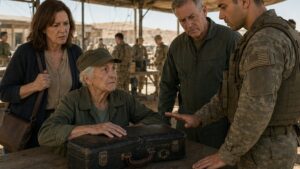
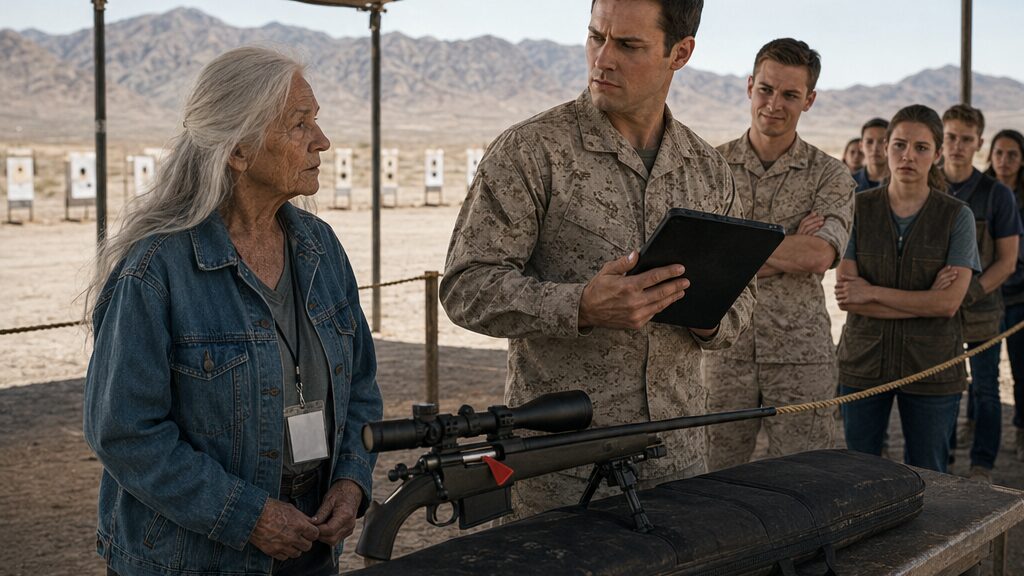
The young soldier took one look at Debra Ramirez’s hands and moved the rifle case farther away from her.
He did it gently enough that he could pretend it was courtesy. The black case had been resting on the check-in table beneath the shade canopy, its latches dulled by years of handling, its corners scraped down to pale metal. Debra had set it there herself with both palms flat, the way she had been taught to place anything serious on a range: deliberately, quietly, without drama.
The soldier slid it six inches back with two fingers.
“Ma’am,” he said, eyes already dropping to the tablet strapped to his left hand, “visitors need to stay behind the yellow rope until orientation starts.”
Debra looked at the rope. It sagged between two orange cones at the back of the canopy, faded by sun and wind. Beyond it, the firing line stretched under canvas shade, benches lined like church pews facing the desert. Paper targets hung downrange in square white rows, trembling in the heat shimmer. Behind them, brown mountains rose under a hard blue sky.
She had not been here in eleven years.
The range had changed. The old wooden sign had been replaced by a digital board. The benches were newer. The target frames had been reinforced. The wind flags were fresh and bright, but one of them had been tied too low on its pole. Debra noticed that before she noticed the soldier’s name tape.
Adams.
Tyler Adams stood straight and polished in his desert camouflage, his sleeves rolled evenly, boots clean despite the dust. He was young enough to still believe that authority lived in posture. His jaw was smooth, his eyes sharp, and his thumb moved across the tablet screen with the impatient rhythm of someone who trusted the machine more than the person in front of him.
“I’m not here for orientation,” Debra said.
Her voice was low. It did not compete with the pop of distant practice rounds or the calls moving down the line.
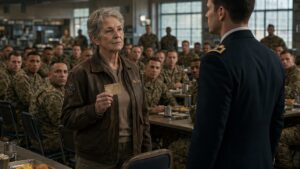
Tyler glanced up. His eyes passed over her white hair, the deep lines at the corners of her mouth, the faded denim jacket buttoned against the morning chill, the old dark shoes planted carefully in the dust. He paused at the jacket the longest. It had once been blue. Years of sun had softened it to the color of washed stone.
“Then who are you here with?”
“Janet Lee.”
That name made him stop moving for half a second. Not long, but Debra saw it. Soldiers always believed stillness hid reaction. It usually revealed it.
“Program director’s busy,” Tyler said. “Charity qualification day. Veterans’ youth scholarship. We’ve got junior shooters, visiting guests, active line personnel, donors, observers. It’s not a casual range day.”
“I know.”
His thumb resumed moving. “Name?”
“Debra Ramirez.”
He entered it, waited, frowned, and tapped again. The tablet flashed pale against the sun. His mouth tightened.
“You’re not on the shooter roster.”
“I should be.”
“Observer list, maybe.” He scrolled. “No, not there either.”
A second soldier, taller and broader across the shoulders, stepped under the canopy with a paper cup of coffee in one hand. His name tape read Green. Matthew Green, if Debra had read the event board correctly when she came in. He looked at Debra, then at the rifle case, then at Tyler’s face, and smiled like the morning had just offered him entertainment.
“Lost donor?” Matthew asked.
Tyler gave him a look that was meant to silence him but did not quite disagree.
Debra kept her hands at her sides. They did shake a little when she left them idle. Age had put its fine tremor into her fingers years ago, a slight flutter most visible when she held a coffee cup or buttoned a cuff. People saw that and believed they knew the rest of the story.
She had learned to let them.
“I was invited,” she said.
“By Janet,” Tyler repeated, not hiding his doubt.
“Yes.”
“For what purpose?”
Debra looked past him toward the benches. A young woman in a shooting vest stood near Lane Four, adjusting the strap on her hearing protection with nervous hands. The girl glanced toward Debra, then away quickly when Tyler shifted his weight. Nearby, a charity volunteer taped new paper to a target board while two older veterans talked under the edge of the canopy.
“Janet asked me to look at the program,” Debra said.
Tyler’s brows lifted. “Look at it.”
“That’s what she said.”
Matthew gave a quiet laugh into his coffee.
Tyler turned the tablet toward himself again. “Ma’am, today is not a good day for walk-in evaluations. We have certified range staff here. We have safety officers. We have electronic scoring and timed rotations. If Ms. Lee invited you to observe, I’m happy to get you a chair in the back.”
Debra let the word certified pass without comment.
On the table, her rifle case sat between a stack of paper waivers and Tyler’s tablet. It was not impressive. No custom decals. No sponsor stickers. No foam-cut logo on the lid. Just black polymer, old brass lock, and a strip of cloth tied around the handle where the grip had split. She touched the cloth once with her thumb, not to claim the case but to settle herself.
“Is the line cold?” she asked.
Tyler blinked. “What?”
“Is the line cold?”
He looked irritated that she had asked before he did. “Yes. Targets are being reset.”
Debra nodded. “Then the case is safe where it is.”
Something in his expression hardened.
Behind him, the desert wind lifted the edge of a target paper. It snapped once, a dry sound like a handclap. Debra turned her head a little, watching how the paper twisted at the bottom left corner. The wind was cutting across the range in layers, not steady. It came down from the mountain gap, brushed the low ground, then slid right. Anyone trusting only the flag nearest the benches would be late by the time the bullet reached paper.
“Are you a family member?” Tyler asked.
“No.”
“Former staff?”
“Not today.”
Matthew laughed again, more openly. The young woman at Lane Four looked over.
Debra did not look at Matthew. She had stood in enough rooms full of men waiting for her to justify herself. Most of them did not want an explanation. They wanted a performance, and she had grown tired of giving them one.
A white range cart rolled past in the dust beyond the canopy. A volunteer called for fresh targets. Someone down the line shouted, “Five minutes to live fire.”
Tyler checked the time on his tablet. “Ma’am, I don’t know what arrangement you made with Ms. Lee, but I can’t let an unregistered civilian handle a firearm on my line.”
Debra’s eyes settled on his. “I haven’t asked to handle one.”
He looked down at her case.
“You brought one.”
“I brought what Janet asked me to bring.”
That reached him. Not enough to change him. Enough to make him curious.
“What’s in the case?”
“A rifle.”
“What kind?”
“The kind that stays closed until the line officer says it may open.”
For the first time, Tyler had no answer ready. Matthew hid a grin behind the rim of his cup.
A woman’s voice came from the far end of the canopy. “Tyler, I need the junior cards loaded before nine.”
Janet Lee strode toward them with a clipboard pressed against her side. She was compact, sun-browned, and moving quickly enough that the dust could not settle on her boots. Her eyes found Debra and softened with relief before she caught the tension around the table.
“Debra,” she said. “You made it.”
“I said I would.”
Janet reached for her hand. Debra gave it, briefly. Janet squeezed too hard, or perhaps Debra’s bones had grown less forgiving. Either way, neither woman mentioned it.
Tyler straightened. “Ma’am, Ms. Ramirez isn’t in the system.”
“She won’t be in the new one,” Janet said. “I told the office to add her manually.”
“It didn’t come through.”
“I’ll fix it.”
Tyler’s gaze flicked from Janet to Debra. “As a shooter?”
Janet hesitated.
That hesitation did what Tyler’s doubt had not. It put weight in Debra’s chest.
The mountains sat beyond the range as they always had, silent and indifferent. Years ago, the morning light had hit them the same way while Debra stood behind nervous recruits and corrected their breathing with two words, sometimes one. Back then, nobody had needed to ask whether she belonged on the line. Back then, her voice could quiet ten benches without rising.
Janet recovered. “As a program guest.”
Tyler seized on the softer title. “Then she should be behind the rope.”
Debra looked at Janet. Janet looked at the case, then at Tyler’s tablet, then at the rows of junior shooters gathering near the benches.
Not yet, Debra thought.
She had not come here to embarrass anyone. She had come because Janet had called twice and left one message that did not sound like Janet: I need someone who remembers what this place was supposed to be.
Tyler picked up a lanyard from a plastic bin. It held a laminated badge with OBSERVER printed in black across the front. He offered it to Debra with the flat politeness of a man closing a door.
“For now,” he said, “you can watch real shooters from behind the line.”
The words settled under the canopy.
Matthew looked down at his coffee. The young woman at Lane Four stopped adjusting her strap. Janet’s jaw tightened, but she did not speak.
Debra took the badge.
Her fingers trembled just enough that the plastic clicked softly against her old denim jacket. She slipped the lanyard over her white hair and let the word OBSERVER rest on her chest.
Then she moved behind the yellow rope without looking back.
Chapter 2: The Tablet Calls Her A Liability
From behind the yellow rope, Debra could see every mistake more clearly.
Distance did that. It stripped away performance. The young instructors moved fast between benches, calling names from tablets, waving shooters forward, checking boxes with their thumbs. The range sounded efficient. Commands snapped through the air. Target numbers were read. Lanes were assigned. Scores were projected onto a screen near the office door.
But efficiency was not the same as discipline.
Debra stood beside a stack of folding chairs nobody had opened. The observer badge lay flat against her jacket, rising and falling with her breath. Her rifle case remained on the check-in table, now pushed against a cooler of bottled water. Tyler had placed it there himself, away from the active benches, as if distance could make it less troublesome.
The morning warmed quickly. Heat lifted from the gravel in clear waves. Paper targets twitched in the wind, some straight, some angled, one on Lane Six pulling hard at its lower staple.
Debra watched that one the longest.
Lane Six had always been difficult. The ground dipped slightly between the two-hundred and three-hundred-yard markers, creating a small channel where wind changed its mind. New shooters blamed themselves. Impatient instructors blamed equipment. Good instructors walked the lane before they blamed anything.
Tyler did not walk the lane.
He stood at the center table with his tablet, calling shooters up in rotation. He was good at command voice. Debra gave him that. He knew how to make young people listen. What he did not yet know was when to let silence teach.
“Ramirez,” Tyler called suddenly.
Several heads turned.
Debra stepped toward the rope but did not cross it. “Yes?”
Tyler looked down at the tablet, then back at her. “Ms. Lee wants you logged for limited participation.”
Janet, standing near the office doorway, did not look up from her clipboard. Debra knew the posture. Janet had decided to let the process expose itself.
“Limited,” Debra repeated.
“Basic safety check only. No qualification score. No live competition string. We’ll see where you are.”
Matthew, leaning against a bench, grinned toward two junior shooters. “Start with which end points downrange.”
A few people laughed. Not many. Enough.
Debra waited until the laughter ended. “Is that the standard check for everyone?”
Tyler’s face held its professional shape. “It’s the standard check for anyone not in our system.”
“I was in the system before there was a tablet.”
Matthew made a low sound, amused. Tyler ignored him.
“Please step forward when instructed.”
The word instructed was not accidental.
The line was cold. Tyler announced it twice, then had the shooters step back. Debra ducked under the rope only after the second confirmation and walked to the equipment table. Her steps were slow, partly because her knees had their own weather now, partly because she refused to hurry on a range for anyone’s pride.
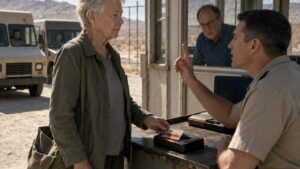
At the table, Tyler pushed a clipboard toward her. “Sign here.”
She read the form before touching the pen.
Matthew shifted. “It’s a waiver, ma’am, not a peace treaty.”
Debra signed.
Tyler slid the tablet toward the scanner pad. “Registration number if you have one.”
Debra recited it.
His thumb paused. He entered the numbers. The tablet blinked, searched, and flashed red.
NO ACTIVE QUALIFICATION FOUND.
Tyler turned it slightly so those nearest could see. “That’s what I’m talking about.”
Debra looked at the red box. The font was new. The judgment was old.
“Try it without the hyphen,” she said.
Tyler’s eyes narrowed. “The system formats automatically.”
“Try it.”
He hesitated long enough for Matthew to smirk again. Then he entered it manually. Another red flash.
ARCHIVED RECORD. MANUAL REVIEW REQUIRED.
The words stayed on the screen.
Tyler frowned as if the tablet had been rude to him personally. “Archived means inactive.”
“It usually does.”
“You understand that without active qualification, I can’t let you fire unsupervised.”
“I haven’t asked to.”
“No, you’ve just made it very clear you think you know my job.”
Debra looked at him then, truly looked. Beneath the sharpness, there was strain. Tyler Adams was not only arrogant. He was defending a thing he was afraid of losing. Authority, maybe. Respect. The belief that if every number matched the tablet, nothing could surprise him.
“I’m not interested in your job,” she said.
That should have softened the moment. It did not.
Tyler lifted an orange chamber flag from a bin and placed it on the table in front of her. “Then let’s keep this simple. Identify the safety device.”
Debra did.
“Purpose.”
She answered.
“When is the line considered cold?”
She answered.
“When may a firearm be uncased?”
She answered.
“When may a shooter touch the trigger?”
She did not answer immediately.
Tyler’s mouth twitched.
Debra looked past him to Lane Six. A paper target twisted again, corner pulling free. “When the shooter has been given permission, the firearm is pointed safely downrange, the shooter is ready to fire, and the shooter has made the decision to fire. Not before. Not because a clock is running. Not because someone is watching.”
The young woman from Lane Four listened with one hand resting on her hearing protection. Amanda Hall, according to the name card on her vest. Seventeen, maybe. Narrow shoulders, serious eyes, nerves held tight in her jaw.
Tyler tapped something on the tablet. “Acceptable.”
“Kind of generous,” Matthew murmured.
Debra picked up the orange chamber flag, turned it once in her fingers, and set it back exactly where Tyler had placed it.
He gestured toward her case. “Open it.”
“Line is still cold?”
“Yes.”
“Permission to open case?”
Tyler exhaled through his nose. “Granted.”
Debra placed both hands on the latches. Her fingers trembled against the metal. She felt Matthew watching them. She felt Amanda watching too, but differently.
The case opened with a tired click.
Inside lay a scoped rifle, plain and cared for, its finish worn in the places hands had known for decades. The foam was not custom-cut. A folded cloth rested beside the stock. There was no flourish, no polished display, no vanity in it.
Tyler’s eyebrows rose slightly despite himself.
Matthew whistled low. “That thing older than me?”
“Almost certainly,” Debra said.
Tyler checked the chamber himself, then paused. It had already been flagged. The action was clear. The magazine well was empty. The rifle lay in the case exactly as a careful person would leave it.
Debra said nothing.
Tyler’s tablet gave a small tone. He glanced down.
LANE SIX SENSOR WARNING.
He frowned and swiped it away.
Debra watched him dismiss it.
“Problem?” she asked.
“Calibration note. Happens when targets reset unevenly.”
“Lane Six?”
His eyes sharpened. “You been reading my screen?”
“It beeped.”
“Lane Six has been fine.”
“Not this morning.”
Tyler looked toward the targets, then back at her. “You haven’t fired a shot.”
“No.”
“Then you don’t know that.”
Debra turned her gaze downrange. The wind flag near Lane Six lifted and dropped. The paper moved half a second later, not with it but after it, tugged from a lower angle.
“The bracket is dragging on the left side,” she said. “The paper’s torquing. If your sensor reads from the lower plane, it’ll call good shots wide or stack them wrong, depending on light.”
Matthew laughed. “She can see all that from here?”
Tyler’s face tightened. He looked at the tablet, then at the target, then at the people listening.
“She can see the three-hundred-yard target?” Matthew said louder, turning the joke into a show. “Ma’am, no offense, but can you even see the three-hundred-yard target?”
This time the laughter came faster.
Debra closed her rifle case.
The click of the latch cut through it, small but clean.
She looked once at the white paper twisting in the desert wind and once at Tyler’s red error screen.
Then she folded her hands over the handle of the case and said nothing at all.
Chapter 3: The Target Will Tell You
By late morning, everyone had an opinion about Debra Ramirez.
She could feel them forming and changing around her like wind against paper. The junior shooters whispered near the water cooler. The visiting veterans watched without committing themselves. Matthew Green had stopped pretending not to enjoy it. Tyler Adams moved through his rotations with his jaw set and his tablet held higher than before, as if it could shield him from the old woman’s quiet.
Debra stayed behind the rope until she was told otherwise.
Her case rested at her feet. The observer badge still hung from her neck, the plastic warm now from the sun. She could have removed it. She did not. There were few things more useful than letting people show you what they thought you were.
Lane Six continued to misbehave.
Two juniors fired good-looking strings and received strange scores. One shot called high left when the target paper barely marked off center. Another registered as a miss, though Debra saw the paper flicker. Tyler blamed inconsistent hold. Matthew blamed nerves. The tablet accepted both explanations without shame.
Amanda Hall came off Lane Four with her lips pressed tight and her score card folded in half. She had passed but not well enough for the scholarship final. Debra watched the girl stand alone under the edge of the canopy, staring at the ground while louder shooters compared numbers.
“Head up,” Debra said quietly as Amanda passed.
The girl stopped, startled. “Ma’am?”
“A bad number is not always a bad shot.”
Amanda glanced toward Tyler. “The tablet says it is.”
“The tablet wasn’t the one breathing.”
Amanda did not smile, but something in her face loosened.
Tyler saw the exchange. That was enough. He walked toward Debra with Matthew half a step behind him.
“All right,” Tyler said, voice carrying. “Ms. Ramirez.”
The firing line grew interested before he said another word. People always knew when a challenge was being dressed up as procedure.
Janet appeared near the office door, clipboard lowered.
Tyler held up the tablet. “We’ve got time before the final block. Since you’ve had a lot of technical observations today, we can settle this properly.”
Debra looked at him. “Settle what?”
“Whether Lane Six is bad, or whether people are just missing and looking for excuses.”
“I didn’t say people were looking for excuses.”
“No, you implied my line was being run wrong.”
“I said the target was dragging.”
Matthew folded his arms. “Then prove it.”
Tyler did not stop him.
The words hung under the canopy.
A few junior shooters shifted closer. One of the visiting veterans put his coffee down. The range medic looked up from a folding chair. Even the paper targets downrange seemed to still for a breath before the wind took them again.
Debra felt the old fork in the road open inside her.
She could step back. She could say Janet had invited her only to observe. She could refuse to become an exhibit for a man half her age defending his screen. It would be the dignified choice. It would also leave Amanda and the others believing the tablet had the final word because no one had made it answer.
Debra touched the observer badge. The plastic edge was sharp against her thumb.
“Line status?” she asked.
Tyler’s eyes flickered.
“Cold,” he said after a second.
“Targets secured?”
“Being checked.”
“Who is my line officer?”
The question made Matthew’s smirk fade.
Tyler looked irritated. “I am.”
“Then I’ll wait for your command.”
The shift was small, but the range felt it. Debra had not accepted Matthew’s dare. She had accepted Tyler’s authority and forced him to use it correctly.
Tyler turned toward the line. “Cold line confirmed. Lane Six will be used for supervised diagnostic fire. All other shooters remain behind the rope.”
Diagnostic. Not challenge. Not proof. The word gave him cover.
Debra lifted her case and carried it to Lane Six.
The walk took longer than it used to. Dust caught at the soles of her shoes. Her right knee complained. Her fingers trembled harder when she set the case on the bench, and she heard Matthew say something under his breath to the trainee beside him.
She did not look over.
The bench smelled of sun-warmed wood, dust, and cleaning oil. Beyond it, the target waited three hundred yards out, white against brown earth. The left lower corner pulled and released, pulled and released.
Tyler stood to her right with the tablet. “Permission to uncase.”
Debra opened the case only after he said it. She lifted the rifle with both hands, muzzle kept downrange, movements slow enough that no one could mistake them. The old weight settled into her palms. Not youth. Not strength. Memory.
She placed the rifle on the rest, then stepped back.
Tyler checked it again. Clear. Safe. Ready to be loaded when commanded.
“Three rounds,” he said. “Center target. This is not a competition string.”
“No,” Debra said. “It’s a question.”
Matthew made a soft sound. “A slow one.”
Debra looked through the scope without touching the trigger. The world narrowed: white paper, black circle, heat shimmer, moving edge. The reticle floated and steadied with her breath, then floated again.
Her hands trembled until they had purpose.
That was another thing young people misunderstood. Stillness was not the absence of motion. It was the management of it.
The wind flag closest to the bench pointed right. The low dust near the two-hundred marker shifted left. The target paper twisted just enough to lie about itself. Debra took her cheek away from the stock.
“Your near flag is late,” she said.
Tyler’s face hardened. “Are you requesting wind adjustment?”
“I’m stating what the range is doing.”
“That’s not an answer.”
Debra looked at him, then at the tablet. “The target will tell you.”
The words moved down the line in whispers.
Tyler’s thumb hovered over the screen. “Load one round on command.”
Debra waited.
“Load.”
She did.
“Ready.”
She settled behind the rifle.
“Fire when ready.”
The range seemed louder in the moment before the shot than after it. Canvas snapped overhead. Someone coughed and then stopped. Debra let the noise pass through her. She did not hold the rifle like an enemy. She held it like a responsibility.
The shot cracked once across the desert.
The target paper flicked.
Tyler glanced at the tablet. His lips pressed together. “Impact registered.”
Debra did not ask where.
“Second round,” Tyler said.
She waited for the command sequence. He noticed. A trace of color rose in his face.
“Load.”
She loaded.
“Fire when ready.”
The second shot cracked.
The paper flicked again, almost the same movement.
The tablet gave a faint tone, not quite the clean chime of a normal score. Tyler looked down, frowning.
Matthew leaned toward him. “What’s it say?”
Tyler did not answer.
Debra already knew enough. The tablet was uncertain.
“Third round,” Tyler said, quieter.
She loaded after command, settled, breathed, and let the rifle speak once more.
The third shot went into the desert morning and came back as silence.
Not literal silence. The range still had wind, canvas, distant boots on gravel. But the human noise under the canopy had stopped. No joke from Matthew. No whisper from the junior shooters. No clipped instruction from Tyler.
The tablet beeped twice.
Tyler stared at it.
“Well?” Matthew asked.
Tyler’s thumb moved. He refreshed the display. A red triangle appeared near the score box.
POSSIBLE SENSOR FAULT.
Matthew looked confused. “So she missed?”
Tyler did not answer.
Debra opened the action and waited. She did not turn. She did not lift her head for approval. She placed the chamber flag where it belonged and kept the muzzle downrange until Tyler confirmed the line.
“Show clear,” Tyler said.
She did.
“Step back.”
She stepped back.
His face had changed. Not humbled. Not yet. More dangerous than humbled. Cornered.
The tablet showed three marks almost on top of one another, then a warning overlay that refused to certify them. Debra saw enough before he angled the screen away.
“Could be stacking error,” Tyler said loudly.
“On three separate impacts?” one of the visiting veterans asked.
Tyler’s eyes snapped toward him. “The system flagged it.”
Debra closed her rifle case partway, leaving it open enough to show she had nothing to hide.
“The paper is still downrange,” she said.
Tyler turned on her. “I know where the paper is.”
“Then bring it in.”
Matthew laughed once, but it died in the middle.
Tyler looked at Janet. Janet gave no rescue. She stood at the edge of the office shade, eyes fixed on Debra with an expression Debra did not want to name.
The young instructor raised his radio.
“Hold all lanes,” he said. “Keep the line cold. Retrieve Lane Six manually.”
The command passed down the range.
No one moved for a breath.
Then a volunteer started toward the target road in the white cart, dust rising behind the tires. The paper target fluttered in the distance, small and bright and suddenly more important than every screen under the canopy.
Debra stepped back behind the bench.
Her hands were shaking again. This time everyone could see them.
No one laughed.
Chapter 4: A Group Too Small For Excuses
The white cart came back slowly, as if the driver understood that speed would make the moment look theatrical.
Dust followed it in a low brown ribbon. The paper target fluttered against the board in the volunteer’s hand, still clipped at the top, one lower corner torn where the wind had worked it loose. From a distance it looked almost blank. The center circle was too far away for most eyes to read.
Tyler kept the tablet tucked against his chest.
Debra stood behind Lane Six with her case closed now, both latches fastened. She had taken her hearing protection off and folded it neatly on the bench. Her hands had not stopped trembling, so she held them together at her waist. That was not pride. That was management.
Matthew had stepped closer to the return table, trying to look amused and unconcerned. Amanda stayed near the rope, her score card still folded in one hand.
The volunteer climbed out of the cart and brought the target under the canopy.
Nobody spoke.
Tyler reached for it first. The volunteer did not know whom to give it to and looked toward Janet. Janet nodded toward the target return table.
“Lay it flat,” she said.
The paper made a dry rasp against the table.
The group tightened around it but did not crowd. Three shots marked the paper just off center, not in the middle of the black circle, but close enough that the correction was obvious to anyone who had watched the target twist. The holes were clustered so tightly their torn edges touched. From more than a few feet away, it looked like one ragged opening.
Matthew leaned over it, his smile weakening. “That’s three?”
The visiting veteran who had spoken earlier bent closer but did not touch the paper. “That’s three.”
Tyler set the tablet down beside the target and swiped away the warning overlay. The screen showed Lane Six, three rounds, possible sensor fault, uncertified grouping. A digital diagram placed the impacts slightly apart, wider than the paper itself showed. The tablet had not invented a failure, but it had misunderstood the proof.
“Target was dragging,” Debra said.
Tyler’s eyes snapped to her. “Which you said before firing.”
“Yes.”
“So you adjusted for a defective target.”
“I adjusted for the wind and the presentation.”
“That’s convenient.”
Debra did not answer.
Tyler looked down at the paper again. His ears had gone red above the collar. “If the bracket was pulling, then the sensor data is unreliable. This cannot be treated as a valid score.”
“It wasn’t a score,” Debra said. “You called it diagnostic.”
A faint shift moved through the people under the canopy. Not laughter. Recognition.
Tyler heard it and stiffened.
Janet stepped to the table. “Tyler, the purpose was to test whether Lane Six was misreading shots.”
“And it is,” he said quickly. “So the lane failed. That doesn’t prove anything else.”
Debra looked at the target paper. The three torn holes sat close together, quiet and physical. No battery. No software. No need to defend itself.
“It proves enough to fix the lane,” she said.
Matthew lifted his hands. “Come on. She got one good group on a bad target. That’s not magic.”
“No,” Debra said. “It’s not.”
That seemed to trouble them more than if she had bragged.
Tyler picked up the paper and held it toward the light. “Wind pushed from the right. Bracket torque pulled left. If she saw it, she could compensate. Experienced hunters do it all the time.”
“Then why didn’t you call it before the juniors fired?” Janet asked.
The question landed flat.
Tyler turned to her. “I was running six lanes.”
“And she was standing behind a rope.”
Debra wished Janet had not said it. Not because it was wrong, but because the moment was beginning to tilt toward personal victory. She did not want that. A range where humiliation became entertainment was no safer than a range where arrogance did.
“May I see the target?” Debra asked.
Tyler hesitated, then handed it over.
She took it by the clean upper corners. Her fingers trembled against the paper. She felt every eye return to her hands. This time no one laughed, but she could feel their attention change shape. Not mockery now. Curiosity. Suspicion. Hunger.
She set the paper down and pointed, not at the holes, but at the left lower tear.
“This staple gave way before the first shot,” she said. “The target was presenting slightly angled. Not enough to ruin the lane, enough to confuse the sensor. If you were teaching today, this was the lesson. Not me.”
Tyler folded his arms. “And what lesson is that?”
Debra looked at him. “When the target and the tool disagree, inspect the target before blaming the shooter.”
The junior shooters along the rope heard that. Amanda most of all.
Tyler’s jaw worked. He wanted a comeback and found only witnesses.
Janet turned the tablet toward herself. “Why is her record showing archived?”
“Because she’s archived,” Tyler said before he could soften it.
The words came out sharper than he intended. He knew it. Everyone did.
Debra lowered her eyes to the table. The observer badge tapped softly against her jacket when the wind crossed the canopy. Archived. It was not the cruelest word anyone had used for age, but it was one of the neatest. Filed away. Not active. Not current. Not expected to return.
Janet reached for the tablet. “Open the manual review screen.”
Tyler kept his hand on it. “Ma’am, with respect, we’re in the middle of rotation.”
“Open it.”
His thumb moved across the glass. A page loaded slowly under the shade. Debra did not step forward. She could read enough from where she stood: D. Ramirez. Historic instructor number. Legacy qualification. Restricted access.
Janet went very still.
Tyler saw her face before he understood the screen. “What?”
“Where did this file come from?” Janet asked.
“The archive pulled it when I entered her number.”
“No. This is not the standard archive.”
He looked down. “It says legacy.”
Janet’s voice lowered. “Tyler, where did you find the old Ramirez file?”
Debra closed her eyes for one breath.
The range seemed to fall away: the canvas shade, the white table, the young faces, the tablet glow. For a moment she saw another target paper on another hot day, a hole too wide, a recruit trying not to cry because a loud instructor had hurried him past fear and into danger. She had stepped in then. Too late to prevent shame. Not too late to prevent worse.
She opened her eyes.
“Janet,” she said.
The program director looked at her.
“Not here.”
Tyler stared between them. “Not here what?”
Debra folded the target paper along its clean edge and handed it back to Janet. “Fix Lane Six before another student fires on it.”
Tyler flushed. “I know how to run my range.”
“No,” Debra said quietly. “You know how to run your tablet.”
The sentence did not rise. It did not need to.
Tyler looked as if she had struck him, though she had not moved.
Then a call came from down the line. “Final block in twenty!”
The ordinary schedule returned like a door slamming open. Shooters shifted. Volunteers moved. The white cart idled. But the air had changed. Every person under the canopy now knew there was a story beneath Debra’s name, and Tyler had been the last to notice it.
Janet folded the target carefully, not along Debra’s crease but around it, protecting the holes.
“Tyler,” she said, still looking at the tablet, “after the next block, we need the classroom.”
“For what?”
Janet looked at the faded safety board by the range office, where old rules sat behind scratched plastic.
“For something we stopped teaching.”
Chapter 5: The Rule They Stopped Teaching
The classroom smelled of dust, dry-erase marker, and old coffee.
It was not much of a room, just a long trailer beside the range office with two narrow windows facing the mountains. Folding chairs sat in crooked rows. A safety board covered one wall, its clear plastic yellowed at the corners. Printed rules were pinned beneath it in block letters, some new, some old enough that the paper had faded from white to cream.
Debra stood at the back while the juniors filed in.
She had not wanted the front of the room. Janet had offered it with her eyes, not her words, and Debra had answered by choosing a chair near the rear window. The target paper from Lane Six was folded in the inside pocket of her denim jacket. She could feel it there when she moved, a small stiff pressure against her ribs.
Tyler stood near the board with the tablet in one hand, trying to return the day to order.
“Before final qualification,” he said, “we’re reviewing fundamentals.”
Matthew sat in the second row, arms crossed, no longer smiling as freely. Amanda sat near the aisle, her folded score card tucked under one knee. Other junior shooters whispered until Janet closed the door.
Tyler tapped the tablet. “Sight picture. Breath control. Trigger press. Follow-through. Those are the four performance fundamentals we evaluate.”
Debra looked at the safety board.
The old rule was still there.
Not at the top. Not in large font. It had been moved to the lower left corner, partly hidden by a newer laminated sheet about electronic scoring procedures. But it remained, printed on a faded card with one corner browned by time.
A shooter’s pride is never part of the firing sequence.
Debra remembered the day she wrote it. Not as a slogan. As a scar turned into instruction.
Tyler followed her gaze and noticed the card. His expression tightened, as if the room itself had betrayed him.
Janet stepped beside the board and lifted the newer laminated sheet so everyone could see what it had covered. “Read that one,” she said.
A junior shooter in the front row leaned forward. “‘A shooter’s pride is never part of the firing sequence.’”
Matthew shifted in his chair.
Tyler gave a short nod. “It means don’t show off.”
Debra felt the sentence fall short.
Amanda raised her hand halfway, then lowered it when Tyler looked at her.
Janet saw. “Amanda?”
The girl’s cheeks colored. “I was just going to ask… if that means don’t rush because people are watching.”
The room went quiet.
Tyler said, “That’s part of it.”
Debra did not intend to speak. She had told herself she would not. But Amanda’s hand had gone to the folded score card under her knee, squeezing it as if the paper had accused her.
“It means,” Debra said from the back, “the shot does not care who is laughing.”
Every head turned.
Tyler’s eyes narrowed. “Ms. Ramirez is correct.”
The words cost him something. Not enough, but something.
Debra stood slowly. Her knee resisted, then yielded. She walked to the safety board, stopping a respectful distance from Tyler and Janet. She did not take the room from him. She took only the rule.
“It also means the shot does not care who is watching, who paid for the equipment, who has the better vest, who has the newer optic, who gave the command, or who wants to be right.” She touched the edge of the faded card, not covering the words. “Pride is noise. A firing sequence has no room for noise.”
No one moved.
Tyler’s face had closed down, but his eyes were listening despite him.
Matthew looked at the floor.
Debra turned to the students. “Safety comes before performance because safety is what lets performance matter.”
A boy in the front row nodded too quickly, eager to show agreement. Debra let him.
Tyler cleared his throat. “Good. Then we’ll review chamber checks before the final.”
He reached for an unloaded training rifle on the front table. He handled it properly, Debra noted. Muzzle safe. Action visible. Finger indexed. For all his pride, Tyler was not careless with firearms. That mattered. It meant he could still learn.
He demonstrated the check, then had each student stand and repeat the sequence with inert equipment. The classroom loosened. Chairs scraped. Nervousness returned to normal shape.
Debra retreated to the side wall.
Amanda came last. Her hands were careful but stiff. When Tyler watched her, she grew stiffer. When Matthew watched, she nearly dropped the training magazine.
“You’re overthinking,” Tyler said.
Amanda swallowed. “Yes, sir.”
“That wasn’t a criticism.”
“It sounded like one,” Matthew muttered, intending it as a joke.
Amanda’s face went red.
Debra saw the girl’s shoulders collapse inward by half an inch. It was a small thing. Many instructors missed small things. Small things became misses. Sometimes they became exits.
After the drill, Amanda stepped back near the wall where Debra stood.
“I almost didn’t come today,” Amanda said, barely above a whisper.
Debra kept her eyes on the front of the room. “Why did you?”
“My dad already paid the registration.”
That was not the real answer. Debra waited.
Amanda folded and unfolded the edge of her score card. “Everyone talks like you’re supposed to know everything already. If you ask, they act like you’re wasting time. If you’re quiet, they act like you’re weak.” She glanced toward the chairs. “I thought maybe this just wasn’t a place for me.”
Debra looked at her then.
Outside, wind rattled the trailer window. Beyond the glass, the targets shivered against their frames.
“It is not the loudest person’s place,” Debra said. “It belongs to the safest person on the line.”
Amanda looked at her as if the sentence had given her a door.
At the front, Tyler called for the final dry drill. The students returned to their rows. Matthew, perhaps eager to recover his easy confidence, picked up one of the unloaded training rifles from the table before Tyler finished speaking.
Debra saw three things at once.
Matthew’s hand closed around the grip.
His finger slipped inside the trigger guard out of habit, not malice.
The muzzle swung across the front row as he turned to say something to the trainee beside him.
“Stop.”
Debra’s voice did not rise. It cut.
The room froze.
Tyler turned.
Matthew blinked, confused by the sudden attention. Then he looked down and saw his own finger. Saw the angle of the muzzle. Saw Amanda in the path it had crossed, even though the rifle was unloaded, even though the classroom drill was controlled, even though nothing had happened.
Nothing had happened because Debra had spoken before it could become a lesson learned the hard way.
“Place it on the table,” Debra said.
Matthew did. Slowly.
“Step back.”
He stepped back.
Tyler’s face had gone pale beneath the desert tan. For the first time all day, he did not reach for the tablet.
Debra looked at the room, then at the faded card on the wall.
“A shooter’s pride,” she said softly, “is never part of the firing sequence.”
No one needed the rest read aloud.
Chapter 6: Wind Does Not Listen To Pride
By afternoon, the desert had stopped being scenery and become an opponent.
The wind came in broken sheets across the long-distance firing point, sliding down from the mountain gap, crossing the low channel near Lane Six, then curling toward the targets as if the range itself breathed unevenly. Dust lifted and vanished. The wind flags disagreed with one another. Paper backs flashed white, then gray, then white again.
Final qualification was supposed to be simple: one controlled string at distance, score verified by tablet and target, top junior eligible for the scholarship slot. It was not simple anymore.
Lane Six had been repaired, but the mistrust had spread. Every strange score drew glances. Every miss made a shooter check the tablet and then the target and then Tyler’s face. The day had grown careful in a way that should have pleased Debra, except caution born from embarrassment could sour quickly.
Tyler stood at the long-distance point with his radio clipped high on his vest. His voice had lost its morning shine.
“Wind call from the board,” he said. “Use posted correction. Do not improvise.”
The posted correction had been right twenty minutes ago.
Debra stood behind the line beside Janet, arms folded loosely, target paper still in her jacket pocket. She watched the far flags and felt an old unease gather in her bones. Not fear. Recognition.
Amanda was in the final group only because another junior shooter had withdrawn. She had not expected the chance. That made her more nervous, not less. She stood at Lane Four, looking at the target as if it might move farther away while she watched.
Matthew had been quiet since the classroom. He performed every check correctly now, almost too correctly, each motion stiff with shame. Debra did not pity him. Shame could be useful if it did not curdle into resentment.
Tyler called the first shooter.
The shot cracked. The target registered low right.
“Hold steady,” Tyler said. “Trust the correction.”
Second shooter. Low right.
Third. Low right, farther.
Murmurs moved behind the rope. The tablet gave clean scores this time, which only made the misses harder to dismiss.
Janet leaned toward Debra. “You see it?”
“Yes.”
“Will you tell him?”
Debra watched Tyler look at the posted board, then downrange, then at the tablet. He knew something was wrong. His pride knew it too, and they were arguing inside him.
“He sees enough,” Debra said.
Tyler called Amanda to ready.
The girl settled behind the rifle. Her movements were careful. She checked the chamber flag, waited for command, loaded only when told. Debra saw her breathe too high in her chest.
“Wind correction as posted,” Tyler said.
Debra closed her eyes briefly.
The posted correction would push Amanda into the same mistake as the others. Not dangerous. Not unsafe in the bodily sense. But wrong, and wrong in front of everyone after the girl had found just enough courage to stay.
Amanda looked once toward Debra.
It was not a request. Requests had words. It was the look of someone asking whether this place would tell the truth.
Debra stepped toward Tyler, stopping outside the firing boundary.
“Your low flag changed,” she said.
He did not turn. “Ms. Ramirez.”
“Two minutes ago.”
“I’m running a live line.”
“I know.”
“Then stay back.”
She did.
The command sequence continued. Amanda placed her cheek against the stock.
Debra looked at the wind flag nearest the far berm. It snapped left, then dropped. Dust near the channel moved right. The posted board still showed a correction from the earlier steady crosswind.
Tyler’s radio crackled. “Ready on targets.”
Amanda’s finger stayed indexed. Good girl, Debra thought.
Tyler lifted his hand. “Fire when—”
“Stop the clock,” he said suddenly.
Amanda lifted her finger away and held still.
Every person behind the rope looked at Tyler.
He did not look at Debra. Not yet. He stared downrange, jaw working. Then he lowered his hand.
“Hold fire. Keep muzzles downrange. Safeties on.”
The line obeyed.
Matthew turned toward him, surprised. Janet’s face did not change, but her shoulders eased.
Tyler walked three steps back to where Debra stood. The distance between them felt longer than the range.
“What do you see?” he asked, quietly enough that only nearby people heard.
Debra could have answered quietly. She could have saved him.
Instead, she looked at his radio.
Tyler followed her gaze. His face tightened. He understood what she was asking him to spend.
Authority could be protected in private. Trust had to be repaired in public.
He lifted the radio.
“Correction update,” he said, voice carrying through the speakers at every lane. “Disregard posted wind board. Current wind is split-layer. Near flag is no longer reliable. Hold for low-channel drift. New correction follows.”
He stopped.
Debra gave him the number.
He repeated it into the radio.
There was no drama in the words, only range work. That made them heavier. Every soldier on the line heard Tyler Adams accept a correction from the old woman in the denim jacket.
Matthew looked down.
Amanda stayed behind her rifle, waiting.
Tyler finished the call and turned back to Debra. His face still held pride, but not the same kind. This pride had been cut open and made to choose what it wanted to become.
“Anything else?” he asked.
Debra looked at Amanda’s shoulders. “Tell her to breathe lower.”
Tyler walked back to Lane Four.
“Amanda,” he said, not loudly, “reset your breath. Lower. Don’t chase the rifle. Let it settle.”
Amanda nodded.
The line resumed.
When Tyler gave the command, Amanda fired.
The target marked just inside the scoring ring.
Not perfect. Not miraculous. True.
Her second shot held closer. Her third was better still. By the end of the string, her score would not stun anyone, but it would keep her in consideration. More than that, she stood from the bench without looking ashamed.
The remaining shooters fired with the updated correction. Scores tightened. The murmurs behind the rope changed from complaint to concentration. The range, bruised by morning pride, began to sound like a place learning again.
Tyler did not look at Debra until the last rifle was cleared and the line went cold.
When he did, the tablet hung at his side.
“No one teaches that wind split in the current course,” he said.
“No,” Debra said.
“Why not?”
She looked toward the safety board visible through the classroom window, then down at the folded target paper inside her jacket.
“Because someone decided simple was faster.”
Tyler swallowed. “Was that someone me?”
“Not first.”
The answer seemed to trouble him more than blame would have.
Janet approached with the final score sheets. “We need ten minutes before awards.”
Tyler nodded, but his eyes remained on Debra.
“Ms. Ramirez,” he said, and the title sounded different now, less like a barrier. “There’s something on the office wall you should probably see.”
Debra already knew what wall he meant.
The old range office had always held photographs. Most would have been replaced by donors, commanders, newer staff, newer stories. But some names had a way of surviving under dust, not because anyone honored them properly, but because no one had bothered to remove them.
She touched the folded paper in her pocket.
“After the line is secured,” she said.
Tyler looked down the firing point, checked each bench, each chamber flag, each student behind the rope.
Then he raised the radio one more time.
“All lanes remain cold,” he said. “Equipment secure. We move only after safety check is complete.”
Debra listened.
The words were ordinary.
That was why they mattered.
Chapter 7: The Quietest Name On The Wall
The range office had kept the old photographs behind glass, but not behind care.
Dust softened their edges. Sun had faded the uniforms until the dark cloth turned gray and the desert behind each group looked almost white. Newer plaques crowded the center wall near the doorway, polished names and donor plates catching the late-afternoon light. The older frames had been pushed toward the side, where the filing cabinet cast a shadow over them.
Debra stood just inside the office and let her eyes adjust.
She had not wanted to come in.
Outside, the firing line was cold and secure. Rifles were cased. Benches were clear. The junior shooters waited near the award table while volunteers sorted score sheets. The desert wind still worried the target papers, but softer now, as if the day had spent most of its argument.
Tyler held the door open for her. He did not rush her. That was new.
Janet moved to the side wall and lifted one frame from its hook. “I found it after you called me back,” she said. “It had been behind the old event posters.”
Debra looked at the photograph without stepping closer.
A younger woman stood in the back row among instructors and range staff, hair dark beneath a cap, face leaner, eyes the same. She was not centered. She was not given the chair in front. She stood with one hand resting on the shoulder of a young instructor seated before her, a man who looked proud enough to burst and terrified enough to need steadying.
Beneath the photograph, on a browned paper strip, someone had typed:
Original Precision Safety Course Staff.
The names were listed in two neat columns. Most were still easy to read. Debra’s sat near the bottom, small and plain.
D. Ramirez.
Tyler leaned closer to the frame. “You were staff here.”
Debra looked past the photo to the safety card Janet had brought in from the classroom. It lay on the desk beside the Lane Six target paper, both flattened under a glass paperweight. The old rule and the new holes. Words and proof. Neither one loud.
“I helped with a course,” Debra said.
Janet gave a soft breath that was almost a laugh. “You wrote half of it.”
“No.”
Janet turned to her. “Debra.”
“I wrote what needed writing. Others built what needed building.”
Tyler stared at the photo as if it might rearrange itself into something easier for him to accept. “The old Ramirez file wasn’t just a qualification.”
“No.”
“You trained instructors.”
“Some.”
“The person who built this program?”
Debra looked at the seated young man in the photograph, the one beneath her hand. Memory rose, not warmly, but clearly. A nervous instructor learning that command voice was not command. A good student when he stopped trying to impress the room.
“He listened,” she said.
Tyler lowered his eyes.
Outside, Janet’s radio crackled with a question about awards. She answered briefly, then turned the volume down.
“We should correct the tablet record,” she said. “Your status should never have been buried like that.”
Debra touched the edge of her denim jacket. “Records bury everyone eventually.”
“That does not make it right.”
“No,” Debra said. “But today is not about my file.”
Tyler looked at her then. Fully. Without the tablet between them.
“I made it about your file,” he said.
Debra did not rescue him from the truth.
He swallowed. “I judged you before I checked anything that mattered.”
“Yes.”
The word was not cruel. It was clean.
Tyler nodded once, as if receiving a command. “I owe you an apology.”
“You owe the line one first.”
His face tightened, but not with anger. With understanding.
Janet picked up the Lane Six target and the faded safety card. “Then let’s finish outside.”
The late-afternoon light had turned gold by the time they returned to the canopy. The mountains stood dark-edged against the sky. Students gathered in a loose half circle near the award table. Volunteers had set out certificates, score cards, and one envelope marked for the youth safety scholarship. Amanda stood near the back, hands clasped, trying not to look as if she hoped for anything.
Matthew stood apart from the trainees, shoulders squared, face serious. When Debra passed, he opened his mouth, then closed it. Not every apology needed to be the first sound after shame.
Janet placed the old safety card on the award table. Beside it, she laid the Lane Six target.
The three-shot group drew eyes before any speech could begin. People leaned in, then stopped themselves from crowding. The paper had become a thing with gravity.
Tyler stepped forward.
He did not bring the tablet.
That, Debra thought, was a beginning.
“I need to correct something from this morning,” he said.
The young shooters went still. The visiting veterans stopped talking. Matthew looked at the ground for a moment, then forced himself to look up.
Tyler kept his hands at his sides. “When Ms. Ramirez arrived, I treated her like she was a problem to manage instead of a person to verify. I made assumptions based on age, appearance, and a missing digital record. I also dismissed a correction about Lane Six that turned out to be right.”
He turned slightly toward Debra.
“I apologize.”
Debra held his gaze. “Accepted.”
No applause followed. She was grateful for that. Applause would have made the moment smaller.
Tyler turned back to the group. “The lesson is not that the tablet was useless. It wasn’t. The lesson is that tools support judgment. They do not replace it. The target matters. The line matters. Safety matters before pride.”
His voice caught almost imperceptibly on the last word.
Janet lifted the faded card. “This rule is being restored to the top of our safety board today.”
She read it aloud.
“A shooter’s pride is never part of the firing sequence.”
The words traveled differently outside. They did not sound like an old slogan now. They sounded like something paid for.
Debra felt the folded years inside her loosen, not disappear, but loosen. She had avoided rooms like this because recognition often demanded a performance. People wanted old stories polished until they became comfortable. They wanted service without grief, skill without cost, age without inconvenience.
But Amanda was watching the rule as if she were memorizing a way to stay.
Janet picked up the scholarship envelope. “This year’s youth safety scholarship was intended for the top qualifying score.”
A few students shifted.
“After today,” Janet continued, “we are adding a safety judgment review to the award criteria. Scores matter. Conduct matters too.”
Tyler looked toward Debra, not asking permission exactly, but making room.
Debra stepped forward. The observer badge still hung on her chest. She had forgotten to remove it. The plastic caught the light, OBSERVER in black letters for everyone to see.
She took it off and placed it on the table beside the target.
Then she picked up the envelope and walked to Amanda.
The girl’s eyes widened. “Ma’am, I didn’t have the highest score.”
“No.”
Amanda’s face fell slightly, confused.
Debra held out the envelope. “You kept your finger indexed when you were unsure. You waited for command when pressure was on you. You asked the question everyone else was too proud to ask. That is worth training.”
Amanda stared at the envelope before taking it. Her hands shook, but she did not hide them.
“Thank you,” she whispered.
Debra nodded. “Use it well.”
Matthew stepped forward then, stopping at a respectful distance. His face had lost its easy grin.
“Ms. Ramirez,” he said, “I was out of line.”
Debra looked at him.
“And unsafe,” he added.
“That matters more.”
“I know.”
“See that it does.”
He nodded, chastened but not destroyed. That was enough for one day.
Tyler moved to the safety board near the office door. The newer laminated scoring sheet had already been taken down. With Janet’s help, he pinned the faded rule at eye level, not low, not hidden, not behind anything. Beside it, Janet placed a copy of the Lane Six target in a clear sleeve. Not as a trophy. As a reminder that paper did not flatter and did not forgive.
Debra watched him step back from the board.
Her name was still not large anywhere. It did not need to be.
Tyler picked up the tablet at last and tapped through the archive screen. He turned it toward Janet. “I corrected the status.”
Janet read it and looked at Debra. “Legacy instructor. Active advisory.”
Debra gave her a look. Janet almost smiled.
“Advisory,” Debra said.
“Only if invited.”
“Good.”
The sun dropped lower. The students began to disperse in quiet clusters, carrying cases, targets, water bottles, and the subdued energy of people who had learned something they had not come to learn. The range was no longer embarrassed. It was tired, humbled, and safer.
Debra returned to Lane Six to collect her rifle case.
Amanda followed at a distance, then gathered courage and came beside her. The girl held the scholarship envelope against her vest.
“Ms. Ramirez?”
Debra closed one latch. “Yes.”
“Do old hands still teach new ones?”
Debra looked down at her fingers on the worn brass latch. They trembled in the cooling air. They had trembled in the morning when people laughed. They trembled now when no one did. The difference had never been the hands.
She closed the second latch.
The sound was soft, final, and clean.
“If the new ones are willing to learn,” Debra said.
Amanda nodded as if she had been given more than an answer.
Debra lifted the case by its cloth-wrapped handle. It felt heavier than it used to, but not too heavy. She walked past the target board, past the tablet on Tyler’s table, past the safety rule now restored where young eyes would have to meet it.
At the edge of the canopy, she stopped once and looked back.
Tyler was showing Matthew how to check the far wind before reading the near flag. Janet was taping the old rule straight. Amanda stood beside Lane Four, not behind the group now, but within it.
The desert wind moved through the targets.
This time, everyone watched what it touched.
The story has ended.