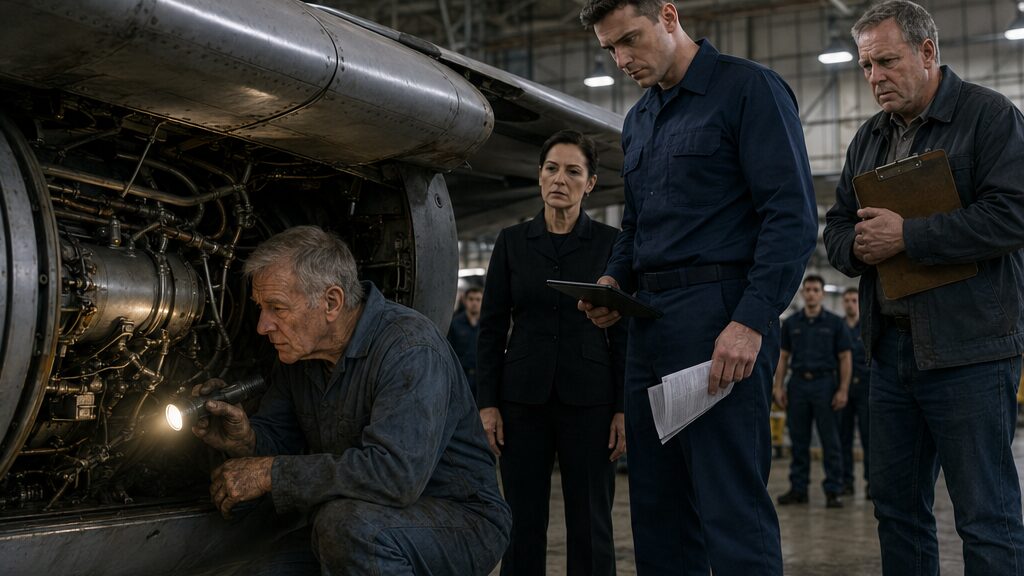
They Laughed At The Old Mechanic Until His Flashlight Found What The Computer Missed
Chapter 1: The Old Man Under The Wing
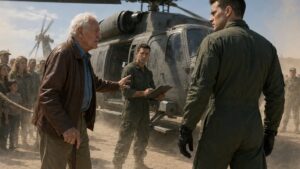
Robert Davis heard the wrong sound before the engine had finished winding down.
It was buried under everything else—the hiss of cooling metal, the dull clank of a tool cart rolling past, the overhead crane whining along its rail, the voices of younger mechanics calling numbers across the hangar. Anyone else would have let it disappear into the ordinary noise of a transport aircraft after maintenance. Robert did not.
He stayed under the wing.
The others stepped back from the aircraft with the relief that came at the end of a long shift. The overhead lights had begun to flatten into a late-afternoon glare across the hangar floor, silvering every oil streak and scuffed boot print. The aircraft sat open and half-dressed, cowling panels removed from one side, hydraulic lines tagged, safety wire clipped neat and bright around fasteners that had been checked twice already.
Robert’s knees were stiff from the low stool. His right hand had cramped around the flashlight. He flexed his fingers once, not enough for anyone to notice, and raised the beam again into the shadowed space beside the actuator housing.
There it was.
Not loud. Not dramatic. Not even steady.
A faint three-beat tremor moved through the metal after the rest of the assembly had settled.
Tap. Tap-tap.
Then nothing.
Robert shifted closer, the worn shoulder of his blue-gray coveralls brushing the edge of the open panel. The fabric had old stains that no laundry could pull out anymore, gray-black smudges along the sleeves and a permanent dark crescent where he wiped his hands without thinking. A junior mechanic had once joked that Robert’s coveralls looked older than half the people on the floor. Robert had not minded. They were not old enough to remember as much as he did.
He angled the flashlight lower.
The beam slid over a hydraulic bleed line, a bundle of wiring, a bracket, then a twist of safety wire catching a needle of light. Nothing jumped out. Nothing broken. No leak blooming wet and obvious. No scorch mark. No cracked fitting wide enough to call the whole shop over.
Still, the sound had been there.
Tap. Tap-tap.
He shut his eyes.
Not to rest. To hear better.
The hangar kept moving around him. A parts clerk pushed a bin past the yellow line. Someone laughed near the tool cage. Farther down, a crew chief barked at a young airman to stop leaning on a tire. The aircraft gave off its own after-work smell: heated oil, old dust, aluminum, hydraulic fluid faint as a memory.
Robert opened his eyes and pointed the flashlight again.
“Mr. Davis?”
The voice came from his left. Young. Careful. Not quite impatient yet.
Robert turned his head and saw the airman assigned to shadow him standing with a tablet held against his chest. The airman had the clean look of someone who had not yet learned where every sharp edge hid. He was trying not to stare at Robert’s hand, which had begun to tremble slightly from holding the light too long.
“You need something?” Robert asked.
“They’re closing the write-up on the actuator response check.” The airman glanced at the aircraft, then at the tablet. “Supervisor Baker said to confirm you’re done in here.”
Robert looked back into the compartment. “Not done.”
The airman hesitated. “Diagnostics came back green.”
Robert said nothing.
The airman shifted his weight. “All parameters within tolerance.”
Robert let the flashlight beam settle where the safety wire disappeared behind the bracket. “Did you hear it?”
“Hear what, sir?”
Robert almost smiled at the sir. It had nothing to do with rank. Young people used it around him when they were not sure whether to treat him like a coworker, a grandfather, or a problem.
“After spool-down,” Robert said. “Three beats.”
The airman listened, though there was nothing to hear now. “I didn’t catch it.”
“No reason you would.”
The boy relaxed, thinking perhaps that meant the matter was finished.
Robert reached for the rag tucked into his back pocket and rubbed a thumb across the side of the housing. Old grease came away. He held the rag under the light, not because it told him anything, but because touch sometimes confirmed what sight did not. The metal had the wrong kind of shine near the edge. Too small to matter if you were looking for damage. Enough to matter if you were listening for motion.
Behind him, the rhythm of the hangar changed.
He did not need to turn to know who had come onto the floor. A group moved differently when command moved with it. Voices dropped half a step. Boots struck the floor with more intention. The airman beside him straightened.
Robert eased himself up from the stool. His left knee resisted, then gave. He did not let the airman see him brace one hand against the aircraft frame. Pride was a foolish thing in a hangar. It made men hide fatigue, and hidden fatigue got people hurt. Still, some reflexes stayed.
Andrew Baker crossed the floor first, broad-shouldered, clipboard in hand, his civilian badge swinging from a lanyard. He had the look of a man who had spent the whole day translating between people who wanted readiness and people who understood machines. Behind him came Tyler Green in a clean dark-blue uniform, tablet tucked under one arm, jaw tight. Two inspection team members followed at a distance.
Robert noticed the paper in Tyler’s hand before he noticed Tyler’s expression.
A clean diagnostic report.
That was usually when trouble started.
Andrew stopped just outside the open panel. “Robert.”
Robert gave him a small nod.
Andrew’s eyes flicked to the flashlight, then the exposed assembly. “We’re trying to close this bird tonight.”
“I know.”
“Anything we need to put on the sheet?”
Robert looked past him to Tyler. The younger man had not spoken yet, but his posture already had. Shoulders squared. Chin level. Boots polished. He looked at the aircraft the way a man looked at a problem he believed had been solved before someone inconvenient reopened it.
Robert lifted the flashlight. “Actuator bracket’s talking after shutdown.”
Tyler’s eyebrows moved, just a fraction. “Talking?”
Robert pointed the beam into the opening. “Three-beat vibration. After the system load drops.”
Tyler stepped closer. “The post-overhaul diagnostic run shows clean. Pressure response, return timing, servo feedback, all within tolerance.”
“I’m not arguing with the printout.”
“It sounds like you are.”
Andrew gave Tyler a brief warning glance, but Robert spared him the effort.
“No,” Robert said. “I’m saying paper doesn’t hear metal after it stops being asked questions.”
The airman beside him looked down quickly. Someone behind Tyler exhaled through their nose.
Tyler did not smile. “Mr. Davis, we have a readiness evaluation tomorrow morning. This aircraft has been down for eleven days. The system passed the required checks.”
Robert looked into the compartment again. The light showed nothing that would convince a room. Not yet.
He felt, for a moment, the old weariness. Not from the knee. Not from the hand. From knowing how small a thing could be before it became large enough for everyone to respect it.
“I heard what I heard,” he said.
Tyler glanced at Andrew. “Has he been on this assembly all afternoon?”
Andrew’s face tightened. “Robert’s been assisting on the actuator bay since thirteen hundred.”
“Assisting,” Tyler repeated.
It was not much of a word. It did not have to be. Robert had heard worse dressed in better manners.
He set the flashlight on the edge of the open panel and wiped his fingers slowly on the rag. His hands were dark with old oil, the lines in them blackened. Tyler’s hands were clean.
Andrew lowered his voice. “Robert, could it be residual movement? Cooling contraction?”
“Could be.”
Tyler seized on it. “Then we document observation and close it.”
Robert shook his head once.
The hangar seemed to pause around that small refusal.
Tyler’s mouth hardened. “You’re holding the line on a sound no one else heard?”
Robert picked up the flashlight again. Its beam trembled only because his fingers had stiffened. He steadied it against the metal rim until the light became still.
“No,” he said. “I’m holding the line because I heard it after the machine said it was finished moving.”
Tyler lifted the diagnostic report.
Chapter 2: The Mark The Computer Did Not See
Tyler Green had learned early that hesitation looked like weakness if the wrong people were watching.
In training, hesitation meant you had not prepared. On inspection days, it meant you had not controlled your shop. In front of Elizabeth Johnson, it meant worse than that. It meant the questions started moving upward.
So when Robert Davis sat under the wing with his old flashlight and his stained coveralls and his warning about a sound nobody else had heard, Tyler felt the shape of the problem before he understood the mechanics of it.
The problem was not only the actuator.
It was the audience.
Elizabeth Johnson had entered the hangar without needing to raise her voice. She wore her black service uniform with a stillness that made other people adjust themselves. Her eyes moved from the aircraft to the open panel, then to Robert on the stool, then to Tyler’s diagnostic report.
“Is there a delay?” she asked.
Tyler stepped in before Andrew could soften the answer. “No confirmed delay, ma’am. Post-overhaul diagnostic run is green. Mr. Davis believes he heard an irregular vibration during spool-down.”
Elizabeth looked at Robert. “Believes?”
Robert did not answer immediately. He was leaning slightly into the open engine bay, flashlight angled low, the beam caught in the machinery. To Tyler, the old man looked as if he had forgotten there were people around him. That irritated him more than it should have.
Tyler had slept four hours the night before. He had walked the inspection team through two systems already, caught a documentation error before it became a briefing problem, and handled three calls about the aircraft’s availability for the morning evaluation. Every schedule board in the building had this transport marked in red. Every hour it stayed open became another question someone would ask Tyler first.
Robert tapped the edge of the actuator housing with two fingers. Lightly. Not enough to test anything.
Elizabeth waited.
Finally Robert said, “It moved after load came off.”
Tyler heard an inspection team member shift behind him.
“With respect,” Tyler said, “we have sensors for that.”
Robert’s eyes came up to him. Not offended. Not defensive. That bothered Tyler too.
“You have sensors for what the test asks,” Robert said.
“And the test is written for this system.”
“Most are.”
Andrew rubbed the back of his neck. “Robert.”
The old mechanic looked back into the panel. The flashlight beam moved, slow and deliberate, across the bleed line, down a clamp, over the bracket foot.
Tyler took one step closer. “Can you show us damage?”
“Not damage.”
“Leakage?”
“No.”
“Loose hardware?”
“Not with your fingers.”
Tyler spread his hands slightly, the diagnostic sheet in one of them. “Then what are we grounding an aircraft for?”
The word grounding changed the air. Tyler knew it as soon as he said it. Robert had not used that word. Andrew had not used it. Elizabeth’s eyes sharpened.
Robert’s face remained still.
“I didn’t say ground it,” Robert said.
“You said you’re holding the line.”
“I said I’m not signing off that bay as clean.”
Tyler felt heat crawl up the back of his neck. There were ways to disagree in a hangar. There were also ways to make a young officer look like he had lost control of his floor.
He crouched beside Robert, taking care not to place a knee in the oil dust. The open compartment smelled of warmed hydraulic fluid and metal shavings. He brought his own small inspection light from his pocket, brighter and whiter than Robert’s old flashlight.
“Show me,” he said.
Robert glanced at the clean light in Tyler’s hand, then at Tyler’s face.
For a moment Tyler thought the old man might refuse just to prove a point. Instead, Robert shifted his flashlight aside and made room.
The space under the cowling tightened around them. Tyler could feel people standing behind him: Andrew, Elizabeth, two inspectors, the airman. The aircraft loomed above, indifferent to rank and embarrassment.
Robert raised one hand. His fingers were thick, scarred, the nails cut short. He did not point directly at the bracket first. He placed his hand near it, palm hovering just below the assembly, as if feeling for heat that was no longer there.
“Here,” he said.
Tyler aimed his light.
He saw the bleed line, bracket, safety wire, fasteners, scuffed paint. Everything looked normal in the hard white beam.
“What am I looking at?” Tyler asked.
Robert said nothing. He reached across and gently nudged Tyler’s wrist downward.
Tyler stiffened at the touch. It was not forceful, not disrespectful. Still, in front of Elizabeth, the correction landed.
“Lower,” Robert said.
Tyler lowered the light.
The white beam flattened across the metal instead of striking it straight on. The surface changed. A faint crescent appeared beside the twist of safety wire near the actuator housing. It was not even a scratch, really. More a dull rub in the finish, thin as a clipped fingernail.
Tyler stared at it.
Robert held his own flashlight underneath now, old yellow beam against new white glare. “There.”
Tyler leaned closer. “That’s surface contact.”
“No.”
“It could be from assembly.”
“No.”
Tyler looked at him. “You can’t know that from a mark.”
Robert’s expression did not move. “It’s moving against the rhythm.”
The words were quiet enough that Tyler almost missed them. Behind him, someone shifted again. Elizabeth stepped closer but did not interrupt.
Tyler forced himself to inspect the mark like any other finding. Its curve was too neat for a dropped tool. Too fresh to be old paint wear. Still, it was tiny. Too tiny to justify blowing up the clearance without data.
“Where’s the deformation?” he asked.
“Behind it.”
“Behind the bracket?”
“Behind the answer you’re looking at.”
Tyler exhaled once. “Mr. Davis, I appreciate your experience, but this airframe has modern feedback systems. If the bracket were flexing outside tolerance—”
“Would the test catch it under uneven bleed-off load?”
Tyler paused.
Robert did not press. He simply held the flashlight steady.
That made it worse. If Robert had been loud, Tyler could have dismissed him as stubborn. If he had told old war stories, Tyler could have categorized him as sentimental. But the old man only waited, as if time belonged to the machine and not to the people rushing around it.
Tyler straightened, partly because his knee had begun to ache and partly because he wanted height back.
Elizabeth looked at him. “Lieutenant?”
Tyler hated the fraction of uncertainty in his own silence.
“The mark is real,” he said. “But there is no confirmed fault. The required checks are clean.”
Robert lowered his flashlight and clicked it off.
The small sound carried.
Andrew looked from one man to the other. “We can annotate it as a watch item.”
“That doesn’t clear the bay,” Robert said.
Tyler turned to him. “You are not the signing authority.”
“No.”
“But you’re refusing to close your portion.”
“Yes.”
Tyler’s jaw tightened. “Based on a sound and a rub mark.”
Robert wiped his thumb across the flashlight barrel. “Based on the way they disagree.”
Elizabeth’s face gave nothing away. She stepped to the edge of the open panel and looked inside without crouching.
“Mr. Davis,” she said, “how long have you been back on this floor?”
“Three months, ma’am. Two days a week.”
“And before that?”
Robert’s eyes shifted briefly to the aircraft. “Long enough to know when metal is lying politely.”
The airman’s mouth twitched before he caught himself. Tyler shot him a look. The airman went still.
Elizabeth did not smile. “We are not grounding an aircraft on poetry.”
“No, ma’am,” Robert said.
“But we are also not ignoring a documented concern in front of an inspection team.” She turned to Andrew. “Enter the observation. Include the location, condition, and Mr. Davis’s note on post-load vibration.”
Tyler felt the decision land with an uncomfortable balance. Not a victory for Robert. Not a victory for him.
“Ma’am,” he said, “if we leave this open, readiness will ask why.”
“Then give them the accurate answer,” Elizabeth said. “An experienced mechanic identified an unverified condition requiring review.”
Tyler heard the careful wording. Unverified. Requiring review. Enough to protect command. Not enough to ground the aircraft.
Robert bent to retrieve his rag from the floor. He moved slowly, and for a second Tyler saw not mastery but age: the stiff knee, the careful breath, the hand braced against metal. Then Robert stood with the same quiet balance as before, and the impression passed.
Tyler folded the diagnostic report once against his tablet. “I’ll prepare a conditional path to closure.”
Robert looked at him. “Don’t prepare it around what you hope is true.”
The words were not loud. They did not need to be.
Tyler met his eyes, then looked away first.
Elizabeth turned toward the maintenance office. “Document it tonight. I want options by morning.”
The group began to break apart, but Tyler remained beside the open panel a moment longer. He crouched again after everyone moved away and shone his light low across the mark.
For one second, at that angle, the crescent seemed to deepen.
Then the glare caught it straight on, and it disappeared.
Chapter 3: A Signature No One Wanted Delayed
By morning, the flashlight lay beside the unsigned paperwork like evidence nobody had admitted into court.
Robert had placed it there without thinking. The flashlight was old, black rubber worn smooth around the grip, the lens clouded at one edge from a drop years back. Beside it sat the conditional clearance note Andrew Baker had printed before sunrise, clipped to a maintenance folder with Robert’s name flagged in yellow.
The maintenance office had no windows to the flight line, only a narrow interior pane looking out onto the hangar floor. Through it, Robert could see the aircraft waiting under white lights, one side still open like an unfinished sentence. People moved around it with the brisk caution of a shop that knew it was being watched.
Andrew stood across the desk, coffee untouched in one hand.
“It doesn’t say you found no fault,” Andrew said.
Robert looked down at the paper.
The wording was clean. Careful. Built to pass through several hands without catching on anyone’s conscience.
Observed minor surface contact near actuator housing. No leak, deformation, or loose hardware confirmed. Recommend monitoring during next scheduled operational cycle.
Below that, a line waited for Robert’s signature.
“You want me to sign a maybe,” Robert said.
“I want you to sign what you observed.”
“That isn’t all I observed.”
Andrew set the coffee down. “Robert.”
There was fatigue in the way he said it. Not irritation. Something closer to pleading.
Robert rubbed one thumb along the edge of the folder. The paper was warm from the printer. He had signed thousands of forms in his life. Red X entries, corrected discrepancies, release notes, inspection sheets. Ink could look small on a line and still weigh more than a wrench.
Andrew lowered his voice. “I know you don’t like the wording.”
“It’s neat.”
“That isn’t a crime.”
“Neat can hide a lot.”
Andrew looked toward the interior window. Tyler Green stood on the hangar floor with two inspection team members, pointing at a tablet. Even from a distance his posture was controlled, his movements exact. A man building certainty because uncertainty had too many witnesses.
“We’re not twenty-five anymore,” Andrew said.
Robert glanced at him.
Andrew gave a tired half smile. “You especially.”
Robert almost answered, but Andrew lifted a hand.
“I’m not saying that to take a shot. I’m saying there’s a process now. More sensors. More documentation. More people above us asking why a part-time civilian mechanic is delaying an evaluation aircraft.”
Robert looked back at the signature line. “That what they asked?”
“Not in those words.”
“But close.”
Andrew did not deny it.
For a moment, the office disappeared from around Robert. He saw a different table, a different form, a different aircraft waiting in heat that made metal burn through gloves. Men younger than Tyler had once stood around him with dust on their faces, waiting for his pen. Some had tried to joke. Some had not been able to stop looking at the ramp.
Back then, nobody called his judgment old-fashioned. They called it final, which had been worse.
A signature could send people into the sky.
He had learned to write his name only after listening for all the things that did not fit.
Robert picked up Andrew’s pen. It was heavier than it looked. He held it above the line but did not touch the paper.
Kathleen used to say he went quiet when he was measuring the cost of a word. At the kitchen table, after he retired, she would slide bills or appointment forms toward him and wait. “Point the light where they stopped looking,” she would say when he frowned too long. She had meant ordinary things: a missed charge, a loose cabinet hinge, the way grief hid under irritation. After she died, the house had gone too still for him to point light at anything. That was why he had come back to the hangar two days a week. Machines did not ask him how he was doing. They only asked him to pay attention.
He set the pen down.
Andrew closed his eyes briefly.
“I won’t sign it like that,” Robert said.
“Then how?”
Robert slid the paper back. “Write what I said. Post-load three-beat vibration. Surface contact near actuator bracket inconsistent with static assembly mark. Recommend access inspection before clearance.”
Andrew stared at him. “Access inspection means delay.”
“It means inspection.”
“It means Tyler has to explain to Elizabeth why a non-required panel is coming off before a readiness evaluation.”
Robert looked through the window again. Tyler had turned slightly, and for a second their eyes met through the glass. Tyler’s face hardened, as if he already knew the answer.
Andrew leaned both hands on the desk. “Robert, help me out. Is this a safety call or an old feeling?”
Robert picked up the flashlight. Its weight settled into his palm the way it always had.
“Both, if you live long enough.”
Andrew looked away.
The silence after that was not angry. It was worse. It was the silence of two men who respected each other and still stood on opposite sides of a line.
The office door opened before either of them spoke again. Tyler stepped in without knocking hard enough to be rude. He carried the tablet under his arm and the diagnostic report in a folder.
“Supervisor Baker,” he said. Then, with a glance at Robert, “Mr. Davis.”
Robert nodded.
Tyler looked at the unsigned paper on the desk. He understood immediately. Robert could see it in the tightening around his eyes.
“We don’t have time for a full access inspection,” Tyler said.
Robert said nothing.
Tyler set his folder down and opened it with precise fingers. “I reviewed the run data again. No out-of-limit values. No pressure decay. No servo lag. No fault codes. The surface mark can be monitored.”
“Can be,” Robert said.
Tyler’s mouth pressed thin. “Everything in aviation is risk management.”
Robert met his eyes. “That’s what people say right before they rename doubt.”
Andrew stepped between them with his voice, if not his body. “Tyler, Robert wants different wording.”
“I heard.” Tyler looked at Robert. “And if we write it your way, we trigger a delay we may not be able to justify.”
“Then justify it after you look.”
“That’s not how this works.”
Robert nodded once, accepting the sentence without accepting the meaning.
Tyler exhaled. Some of the sharpness went out of him, replaced by something more tired and more honest. “Mr. Davis, I’m not trying to insult you.”
“No.”
“But you’re asking me to privilege your ear over the aircraft’s data.”
“I’m asking you not to make them enemies.”
For the first time, Tyler had no quick answer.
Outside the office window, a mechanic laughed too loudly, then stopped when someone reminded him who was inside. The hangar lights hummed overhead. Robert could feel the morning moving toward decisions.
Tyler closed his folder. “Fine. We’ll run it again.”
Andrew looked up sharply. “What kind of run?”
“A limited engine run. Midday. Same load sequence. Additional eyes. If there’s a vibration, we catch it. If there isn’t, we close the observation and move on.”
Robert’s fingers tightened around the flashlight.
Tyler noticed. “Fair?”
Robert looked past him to the aircraft, open under the white lights, waiting.
“No,” he said. “But it’s closer than pretending.”
Tyler gave a short nod, as if that was the nearest thing to agreement either of them could afford.
“I’ll schedule the run,” he said, and walked out before Andrew could object.
Chapter 4: The Three Beats In The Metal
By midday, the aircraft had been pulled to the engine test area just outside the hangar doors, where heat shimmered above the concrete and the open sky made every sound feel larger.
Tyler Green stood near the portable data station with his headset clamped over one ear and the tablet balanced in his hand. The inspection team had arranged itself at a careful distance. Andrew Baker stayed near the safety line, arms folded, eyes moving between Robert and the aircraft. Elizabeth Johnson watched from farther back, still and unreadable beneath the brim of her cap.
Robert stood closer to the left engine than Tyler liked.
Not dangerously close. Not in violation of the line. Just close enough to make Tyler aware of him.
The old mechanic had his flashlight clipped to his belt now, though there was no shadow for it to fight in the open air. His coveralls looked worse in daylight. The stains had layers, old grease under new dust, cuffs darkened where his hands had wiped themselves clean a thousand times. He stood with one boot angled outward, favoring his right knee without admitting to it.
Tyler turned away before the detail could soften him.
“Start sequence in two,” he said into the headset.
The flight crew acknowledged. The engine crew signaled. The air around the aircraft shifted from waiting to warning.
Robert did not put on a show of listening. He did not close his eyes this time. He placed one hand lightly against the portable barrier and watched the open panel area, though from this angle the actuator bracket was hidden behind skin and shadow.
The engine began with a cough, then a rising whine. Air rolled across the concrete. The sound filled Tyler’s chest and pressed against the bones behind his ears. Numbers climbed on the tablet. Temperatures, pressure response, servo feedback, return timing. All of it orderly. All of it inside the safe green bands.
He glanced at Robert.
The old man watched the aircraft, not the tablet.
Tyler told himself that was the difference between habit and data. Robert had spent years judging machines by sound and vibration because that was what his generation had. Tyler had tools that heard more than ears, measured faster than hands, caught problems before instinct could name them. That was not arrogance. That was progress.
Still, he kept looking at the old man.
“Load sequence one,” Tyler said.
The engine note shifted. A low tremor moved through the aircraft and passed into the ground. The tablet recorded a clean response. The actuator cycle returned within tolerance.
“Normal,” one of the inspection team members said.
Tyler did not look at Robert then. He wanted to, which was reason enough not to.
“Sequence two.”
The aircraft answered again. Smooth. Controlled. Nothing flickered except sunlight across the fuselage.
Andrew stepped closer to Tyler’s station. “Looks good.”
Tyler nodded. “It does.”
He heard the relief in his own voice and disliked it.
Elizabeth remained where she was. She had not moved once since the run began.
“Prepare load drop,” Tyler said.
The crew acknowledged.
Robert’s hand tightened on the barrier.
Tyler saw it.
The movement was small, just fingers pressing once into painted metal. But Robert’s whole body changed with it. His shoulders settled. His head tipped a fraction toward the engine, as if a voice had spoken from inside the noise.
Tyler looked down at the tablet.
Still green.
The load came off.
The engine note fell by degrees. Air pressure loosened against Tyler’s chest. The whine softened. Metal began its complicated cooling song.
For a second, there was nothing.
Then Robert flinched.
Not dramatically. Not like a man startled. Like a man who had expected pain and still hated being right.
Tyler heard only the broad mechanical wash of shutdown. He lifted one side of his headset away from his ear.
The sound came again, or maybe he imagined it because Robert had moved.
Tap.
A pause.
Tap-tap.
Tyler’s eyes snapped to the tablet.
The pressure line trembled. Barely. A thin flutter rose and vanished before the graph could make a proper shape of it.
“Did you catch that?” Andrew asked.
Tyler did not answer immediately. He swiped back on the data feed, enlarging the pressure trace. The line had already smoothed itself into something dismissible. A momentary fluctuation. Nothing sustained. Nothing outside tolerance.
“Run artifact,” the inspection team member said.
Tyler wanted to agree. The words were available, clean and useful.
Robert had not moved from the barrier.
Tyler looked at him. “You heard it?”
Robert kept his eyes on the aircraft. “Yes.”
“What exactly?”
“Same three beats.”
Tyler replayed the data. The flutter showed as a slight ripple, then disappeared in the averages. If he printed it, it would not convince anyone who did not already care. If he ignored it, Robert would still be standing there with that stillness in his shoulders.
“Could be shutdown resonance,” Tyler said.
Robert nodded. “Could be.”
That answer irritated him again because it was fair. Robert never pushed past what he could prove. He only refused to pretend the uncertainty was gone.
Tyler signaled for the crew to hold. The heat off the concrete made the aircraft shimmer at the edges.
Andrew came closer, lowering his voice. “Tyler.”
“I saw it.”
“Saw what?”
“A flutter. Brief.”
Andrew’s expression changed. Not relief. Not alarm. Something in between.
“Enough?” he asked.
Tyler looked toward Elizabeth. She had taken one step closer, nothing more.
He imagined the report. Limited engine run conducted due to unverified concern. Momentary fluctuation observed, remained within tolerance. Recommend closure. That version would move. It would satisfy the board. It would get the aircraft back on the schedule.
He imagined another version. Repeat concern. Additional access inspection required. Delay readiness evaluation. Explain to command why a faint sound and a vanishing ripple mattered.
His mouth had gone dry.
He watched Robert take the flashlight from his belt, though the sun was bright enough to make it useless. The old man did not turn it on. He simply held it in one hand, thumb along the barrel, as if the weight helped him think.
Tyler walked over to him.
The closer he came, the older Robert looked. Sweat had gathered at his temple. His face had a gray undertone Tyler had not noticed under the hangar lights. His breathing was controlled, but the run had taken something from him, even standing still.
Tyler lowered his voice. “You all right?”
Robert looked at him then, and Tyler wished he had asked it differently. The old man’s eyes hardened, not in anger but in refusal.
“I’m standing,” Robert said.
“That isn’t what I asked.”
“No,” Robert said. “It’s what you measured.”
Tyler looked away first.
Behind them, the engine ticked as it cooled. Ordinary ticks. Hundreds of them. Only one pattern mattered now, and Tyler was not sure he had truly heard it.
Robert turned the flashlight in his hand. “It’ll hide on you if you ask it the same question.”
“What does that mean?”
“It means the first run loosened it. Second run talks cleaner. Third run might scare you, or it might get shy. Metal doesn’t perform on command.”
Tyler almost said that machines were not people, but the words died before reaching his mouth. He had heard enough old maintainers speak of aircraft that way to know it was not superstition. It was shorthand for attention.
Elizabeth approached them at last. Andrew followed.
“What did the data show?” she asked.
Tyler looked down at the tablet, though he already knew. “Momentary pressure flutter during load drop. Within tolerance. Too brief to flag.”
Elizabeth turned to Robert. “And you heard the same vibration?”
“Yes, ma’am.”
“Can you locate it from here?”
“No, ma’am. Not without opening what’s hiding it.”
Tyler felt the answer land exactly where Robert meant it to.
Elizabeth studied him. “Your recommendation?”
Robert’s fingers tightened once around the flashlight.
“Remove the access panel behind the actuator bracket. Inspect for flex wear.”
One of the inspection team members frowned. “That panel is not part of the required sequence for this check.”
Robert did not look at him. “I know.”
Tyler forced himself to speak. “That’s several hours at minimum, and if we don’t find anything—”
“Then you can write that you looked,” Robert said.
Tyler heard no challenge in it. Only fact.
Elizabeth turned her attention back to him. “Lieutenant?”
There it was again. The place where hesitation looked like weakness.
Tyler looked at the tablet. Green bands. Clean numbers. A small ripple that would not stand up in a room full of people who wanted the aircraft ready.
Then he looked at Robert, who had heard something before the data had bothered to whisper.
“I recommend,” Tyler said slowly, “we review the access requirement before making a final clearance decision.”
It was not agreement. It was not enough. But it was the first sentence he had spoken all day that did not try to bury the doubt.
Robert gave no sign that he appreciated it.
From the tablet in Tyler’s hand, the pressure graph refreshed itself, smoothing the flutter into the past until it was almost impossible to see.
Chapter 5: The Access Panel Behind The Easy Answer
Elizabeth Johnson had spent most of her career distrustful of two things: panic and convenience.
Panic made people loud. Convenience made them neat. Between the two, convenience had caused more trouble in rooms where everyone wore a uniform and understood the cost of admitting delay.
From the maintenance office window, she watched Robert Davis stand beside the open aircraft bay with his old flashlight in one hand and no interest in winning the room. That detail mattered to her. Men protecting their pride usually looked around to see who had noticed. Robert did not. He looked at the aircraft.
Tyler Green stood three feet away with the tablet tucked under his arm, speaking to Andrew Baker in low, clipped phrases. Elizabeth could read enough from posture. Tyler was cornered between data that cleared him and doubt that would not go away. Andrew wanted a path that kept both the machine and the schedule intact. The inspectors wanted documentation. Everyone wanted the answer to be small.
Elizabeth wanted the same thing.
Wanting it did not make it true.
She entered the hangar floor, and the conversation thinned before she reached it. The aircraft’s open side reflected the overhead lights in broken strips. The panel Robert wanted removed sat behind the actuator assembly, half-buried beyond brackets and lines, the kind of thing no one touched unless a manual, a leak, or a failure gave them permission.
“Show me the easy answer,” Elizabeth said.
Tyler looked up. “Ma’am?”
“The answer that lets us close this.”
Tyler hesitated, then opened the tablet. “Replace the suspect surface-contact hardware, re-secure the safety wire, annotate the vibration concern as monitored. Since the pressure flutter remained within tolerance, we proceed with clearance pending post-flight review.”
It was orderly. Elizabeth could see the report already. It had the smoothness of something designed to survive scrutiny.
“And the hard answer?”
Tyler’s eyes moved briefly to Robert.
Robert did not speak.
Tyler said, “Remove the access panel behind the actuator bracket and inspect for hidden flex wear before clearance.”
“How much delay?”
Andrew answered. “If nothing fights us, several hours. If we find damage, longer.”
“If nothing fights us,” Elizabeth repeated.
Andrew gave a humorless smile. “Aircraft have opinions.”
Robert’s mouth almost moved. Elizabeth caught it and looked at him.
“You disagree?” she asked.
“No, ma’am.”
“But?”
Robert lifted the flashlight and aimed it toward the actuator bay without turning it on. “The easy answer fixes what you can see.”
Tyler’s jaw shifted.
Elizabeth stepped closer to the open compartment. “Then show me what I cannot see.”
Robert nodded once. He did not move quickly. His knee made him choose his angle, and Elizabeth noticed Tyler notice it too. Robert crouched beside the bay, bracing one hand against the frame, and clicked on the flashlight.
The yellow beam seemed weak under the hangar lights until Robert angled it sideways. Then the metal changed. The crescent rub mark appeared near the safety wire, just as it had the night before. Small. Nearly polite. Easy to dismiss if one looked straight at it.
“Most people light the thing they want to see,” Robert said. “That gives you glare.”
He lowered the flashlight until the beam ran almost parallel to the metal.
The crescent sharpened.
“You light along the thing,” he said, “and it tells you what touched it.”
Elizabeth leaned in. She knew enough machinery to know the difference between damage and implication. The mark itself proved little. The direction of it troubled her.
“Why that panel?” she asked.
Robert moved the beam behind the bracket, toward the hidden access point. “Because the mark is not the start. It’s the place the movement came out to breathe.”
Tyler let out a quiet breath through his nose. “We don’t know it’s movement.”
Robert nodded. “No.”
Elizabeth turned to him. “You keep saying no when people give you room to exaggerate.”
Robert looked up at her. The flashlight beam stayed fixed. “Exaggeration gets people killed and old men ignored.”
No one spoke.
Elizabeth let the sentence settle where it belonged.
“Have you seen this failure before?” she asked.
Robert’s eyes returned to the bracket. “Not this aircraft.”
“That is not what I asked.”
He was quiet long enough that Andrew shifted beside him.
“Years ago,” Robert said. “Different frame. Different weather. Different men arguing with different paper.”
Tyler’s expression changed, but Robert did not look at him.
“What happened?” Elizabeth asked.
Robert clicked the flashlight off.
The answer did not come.
Elizabeth understood the refusal. She did not know whether it came from pain, discipline, or both. She did not push it in front of the others.
Tyler opened his tablet again, perhaps to recover the conversation with facts. “Ma’am, if we remove the panel without a confirmed fault, readiness may ask why we exceeded the required inspection scope.”
“Then we answer,” Elizabeth said.
“With what?”
She looked at the aircraft, then at Robert’s hand wrapped around the flashlight, the knuckles swollen, the nails dark.
“With the truth. A mechanic identified a physical mark, a repeatable auditory concern, and a momentary pressure anomaly. We inspected because those three things disagree with the easy answer.”
Tyler absorbed that. He did not like it. But he heard it.
Andrew cleared his throat. “I’ll need authorization before I pull people off the other bay.”
“You have it,” Elizabeth said.
One of the inspection team members stepped forward. “Ma’am, for documentation, are we delaying clearance?”
Elizabeth looked at Tyler.
This was his aircraft on paper. His schedule. His evaluation. She could order the delay and spare him the choice, but she knew what that would teach him. It would teach him to wait for senior cover before respecting doubt.
“Lieutenant Green,” she said.
Tyler looked up.
“Your recommendation.”
The hangar seemed to grow wider around him. He stood very still, tablet against his side, eyes flicking once toward the aircraft and once toward Robert.
Robert gave him nothing. No pleading. No challenge. Only the space to choose.
Tyler swallowed. “Delay final clearance pending access inspection.”
The inspection member wrote it down.
The words did not sound like defeat. Not exactly. They sounded like a door opening onto inconvenience.
Andrew nodded once and turned toward the floor crew. “Pull the panel kit. Get me two mechanics who still have patience left.”
The hangar began to move again.
Tyler remained where he was while Robert slowly rose from his crouch. For a moment, Elizabeth thought the younger man might offer a hand. He did not. Perhaps he sensed Robert would not want it in front of everyone. Perhaps he did not yet know how.
Robert steadied himself against the frame and clipped the flashlight back to his belt.
Elizabeth stepped beside him, close enough that her voice did not carry.
“If this panel is clean,” she said, “there will be questions.”
“Yes, ma’am.”
“If it is not clean, there will be different questions.”
Robert looked toward the hidden access panel. “Machines don’t mind questions.”
“And people?”
He took a slow breath.
“People prefer answers that don’t cost them anything.”
Elizabeth watched him return to the bay, not triumphant, not relieved. Just older than the men around him had allowed him to be, and steadier than they expected.
A mechanic arrived with the first tool tray. Andrew signed for the access kit. Tyler put on gloves without being asked.
Robert pointed to the panel nobody had opened, and the flashlight at his belt bumped softly against his hip.
Chapter 6: What Moved When It Should Have Held
The panel did not want to come free.
Robert had expected that. Panels remembered neglect in their own way. Paint sealed edges. Dust settled into seams. Fasteners learned the shape of years. The younger mechanic working the lower screws kept glancing at Tyler, as if afraid that taking too long would become another mark against the shop.
“Don’t rush the stubborn ones,” Robert said.
The mechanic paused.
Robert did not touch the tool. He only pointed with two fingers. “Pressure straight in before you turn. Let the bit sit.”
The mechanic tried again. This time the screw gave with a small crack of old resistance.
Across the bay, Tyler watched without speaking.
The hangar had shifted into evening mode. The bright public movement of the day had narrowed into a circle of work lights around the exposed aircraft. Outside the open doors, the sky had gone dull purple over the flight line. Most of the inspection team had retreated to the office, but Elizabeth remained near the edge of the work area, coat off now, sleeves precise, eyes on the panel.
Andrew signed off each removed fastener on a temporary sheet clipped to a stand. No one joked. No one said the aircraft would be fine. The easy confidence had drained away with the daylight.
Robert stood close enough to see, not close enough to crowd. His knee throbbed down to the shin. He ignored it until ignoring it became work of its own, then shifted his weight. Tyler noticed, of course. The younger man had begun noticing too much.
“Chair?” Tyler asked quietly.
Robert looked at him.
Tyler’s expression stayed neutral. Not pity. Not command. Just an offer placed carefully on the floor between them.
“No,” Robert said. Then, after a beat, “Not yet.”
Tyler nodded and did not ask again.
That mattered more than Robert wanted it to.
The last screw came free. The mechanic eased the panel loose. It resisted, then opened with a dry whisper of disturbed dust.
The hidden space behind it was narrow and ugly. Tubing, bracket backs, shadowed fastener heads, the private side of a system that looked clean from the front. Robert took the flashlight from his belt.
Andrew stepped in with a brighter inspection lamp. Robert lifted one hand slightly.
“Let me start low.”
Andrew stopped.
Robert clicked on the old flashlight.
The beam entered the compartment soft and yellow. At first it showed only dust and the dull backs of fittings. Robert lowered it until the light grazed along the hidden bracket foot.
There it was.
No one said anything because no one needed to.
A crescent-shaped wear mark curved across the hidden side of the bracket, larger than the one outside, bright along one edge where metal had fretted against metal under load. Near it, the paint had powdered away in a fine gray line. Not catastrophic. Not yet. But not nothing. Not assembly scuff. Not imagination.
The same shape. Deeper. Hidden.
Robert held the light steady.
His hand did not tremble now.
Tyler leaned in beside him. The younger man’s shoulder almost brushed Robert’s. He stared at the mark, then at the outer rub line, then back into the compartment as the pattern assembled itself in his mind.
“It was flexing,” Tyler said.
Robert said nothing.
Andrew exhaled slowly. “Behind the bracket.”
Tyler reached in with a gloved finger but stopped before touching. He looked at Robert first.
Robert nodded.
Tyler traced the air just above the wear mark. “Under load drop, it shifted enough to kiss the housing. Then relaxed. That’s why the diagnostic didn’t flag it.”
“One reason,” Robert said.
Tyler looked at him. “What’s the other?”
Robert moved the beam farther back, toward a stiffened line half-hidden behind the bracket. “It only talked when the load came off uneven. Test asked it to behave. It did, mostly.”
Elizabeth stepped closer. “Would this have failed in flight?”
Robert kept the beam on the mark. “I don’t know.”
The answer surprised the room more than certainty would have.
He felt their eyes move to him. He did not look away from the metal.
“I know it was moving when it should have held,” he said. “I know the movement was fresh. I know it was repeating. I know if you keep asking a bracket to forgive motion, eventually it stops forgiving.”
Andrew wrote something down, slower than before.
Tyler lowered his head. “The replacement hardware wouldn’t have touched this.”
“No.”
“We would’ve closed the visible mark.”
“Yes.”
“And flown it.”
Robert clicked the flashlight off. The hidden crescent vanished into shadow.
Nobody spoke for several seconds.
The silence did not feel like victory. Robert had known that it would not. Proof in a hangar was never clean. It meant the aircraft was not ready. It meant the schedule was wrong. It meant someone had missed something. It meant the old memory he had hoped was only memory had reached forward and put its hand on the present.
Years ago, the sound had been similar but not the same. A different aircraft, a different heat, a different young face waiting for him to sign. He had caught that one too late to stop the fear, early enough to stop the loss. Men had come back angry at the delay until they saw the part laid out on a crate, cracked like a dry bone. Afterward they had called him sharp. They had bought him coffee. They had not understood that being right after almost being wrong was not something a man celebrated.
Tyler’s voice brought him back.
“Mr. Davis.”
Robert turned.
The younger man had removed one glove. He looked smaller without his certainty, though not weak. Just younger. Tired. More honest.
“I owe you—”
“Did you hear it?” Robert asked.
Tyler stopped.
Robert held his eyes. “During the run. After load drop. Did you hear the three beats?”
Tyler’s mouth opened, then closed.
The expected apology stayed between them, unfinished.
“I think so,” Tyler said at last.
Robert shook his head. “Don’t think so.”
Tyler looked toward the aircraft, then back. “I heard something after you moved.”
“That’s not the same.”
“No.”
Robert clipped the flashlight back to his belt. “Then learn the difference before you apologize.”
The words were firm, but not cruel. Tyler took them that way. His face tightened, then eased.
Elizabeth had heard. So had Andrew. Neither intervened.
Tyler looked into the compartment again, at the mark he had almost explained away. “Will you show me?”
Robert’s first instinct was to say no. Not because Tyler did not deserve it. Because teaching cost something. It meant opening doors he kept closed. It meant becoming useful again in the way people liked best: on demand, in public, after doubt had made a mess.
He looked at the hidden wear mark, then at the younger mechanic still kneeling with the panel in his hands. The airman from the day before stood behind him, eyes fixed on the flashlight at Robert’s belt.
They were all waiting, though none of them had asked.
Robert felt the ache in his knee, the heaviness in his hand, the old irritation at being needed late. Under it, something quieter moved.
Machines did not mind questions.
People had to be taught how to ask them.
“Not tonight,” Robert said.
Tyler’s face fell before he could hide it.
Robert reached for the work stand and pulled the inspection sheet closer. “Tonight you document it right. Hidden bracket flex wear. External rub mark corresponded with internal movement. Clearance delayed pending repair.”
Tyler nodded.
Robert tapped the paper once. “Use plain words. Plain words save the next man time.”
Andrew’s pen moved immediately.
Elizabeth looked at Robert for a long moment. “And tomorrow?”
Robert picked up his rag and wiped his hands, though the grease only spread darker into the lines.
“Tomorrow,” he said, “we’ll see if anybody still wants to listen.”
Chapter 7: Point The Light Where They Stopped Looking
The next morning, the aircraft did not fly.
It sat in the hangar with its access panel still removed and a red maintenance tag hanging from the open bay. The tag moved slightly each time the ventilation system pushed air across the floor, a small square of color against gray metal. Around it, the shop worked in a quieter rhythm than the day before. No one said much near the left engine. No one had to.
Robert Davis arrived five minutes after his usual time.
He had considered not coming.
At home, before sunrise, he had stood in his kitchen with one hand on the back of a chair and the old flashlight on the table beside his coffee. The house had made its small empty sounds: refrigerator hum, pipe tick, the faint settling creak near the hallway Kathleen had once wanted repainted. His coveralls hung over the chair where he had left them. For a while, he looked at them the way a man looked at a uniform he had no order to wear.
He was tired.
Not only in the knee or the hand. The deeper kind. The kind that came after people finally believed you and somehow made you feel more alone than when they had not.
He had almost called Andrew.
Then he saw the flashlight.
Kathleen had bought it for him after his retirement party, not because he needed one—he owned six—but because she said the old ones he kept were all “half-dead and stubborn, like their owner.” She had taped a small note to the package. Point the light where they stopped looking.
He had kept the flashlight long after the note’s ink faded.
Now, in the hangar, it rested in his side pocket, heavier than it had any right to be.
Andrew saw him first and started across the floor. He stopped halfway, as if deciding whether to hurry would make it worse.
“Morning, Robert.”
“Morning.”
Andrew looked at the aircraft, then back. “Repair team confirmed the bracket assembly is being replaced. Engineering wants the removed part sent over for analysis.”
Robert nodded.
“Elizabeth’s updating the inspection note.”
Another nod.
Andrew shifted the clipboard under his arm. “I should’ve backed you sooner.”
Robert looked at him then.
Andrew did not dress it up. No long speech. No excuse about pressure or process, though both were true.
“I knew enough to slow it down,” Andrew said. “I didn’t.”
Robert glanced toward the open bay. “You slowed it before it flew.”
“That was you.”
“That was the mark.”
Andrew gave him a tired look. “Don’t make it smaller just because it’s uncomfortable.”
Robert almost smiled, but it passed.
Across the hangar, Tyler Green stood with the younger airman and two junior mechanics near the work stand. His uniform was as neat as ever, but something in him had changed. He was not taking up as much space. He was looking more than he was speaking.
Elizabeth Johnson stood nearby, reading from a folder while one of the inspection team members made notes. When she saw Robert, she closed the folder and walked over.
“Mr. Davis.”
“Ma’am.”
“The aircraft is down pending repair and secondary inspection. The readiness board has been notified.”
Robert waited.
Elizabeth’s eyes moved once to the flashlight bulging in his pocket. “I added a procedural recommendation. When an unexplained external mark, repeatable auditory concern, and transient data anomaly appear together, the review authority must consider access inspection before conditional clearance.”
“That’s a long sentence,” Robert said.
“It will survive a meeting.”
“Then it’s probably the right length.”
For the first time since he had known her, Elizabeth almost smiled.
Her face settled again. “I also wrote that your observation prevented an incomplete clearance.”
Robert looked away toward the aircraft.
The words were meant to be respect. He knew that. They still landed with a weight he did not want. Prevented. Observation. His name inside a report that would move through inboxes and briefings until it belonged less to him than to the lesson people wanted from it.
“I don’t need my name in it,” he said.
Elizabeth studied him. “I thought you might say that.”
“Then why put it there?”
“Because unnamed experience is easy to use and easier to forget.”
The sentence stayed between them.
Robert had no quick answer for it.
Tyler approached then, stopping at a respectful distance. He carried no tablet this time. No folder. Just a clean pair of gloves folded in one hand.
“Mr. Davis,” he said.
Robert turned.
Tyler looked toward the open bay. “The airman asked if you would show him how you listened for the vibration.”
The airman, hearing himself mentioned, went rigid near the work stand.
Robert looked at the young face. Hopeful. Nervous. Trying hard not to appear either.
“Did he ask,” Robert said, “or did you tell him to ask?”
Tyler accepted the hit without flinching. “He asked. I told him I’d ask you first.”
That was different.
Robert rubbed the side of his thumb along the flashlight through the fabric of his pocket. “And you?”
Tyler’s jaw moved once. “I’m asking too.”
The hangar noise seemed to withdraw a step.
Robert looked at Tyler for a long moment. Yesterday, the younger man had wanted proof that fit his schedule. This morning, he looked as if proof had cost him something useful: not confidence, exactly, but the part of confidence that refused to kneel down and look from another angle.
Robert turned toward the aircraft. “Bring the airman.”
Tyler gave one short nod and motioned him over.
Robert moved slowly to the open bay. He refused the stool when Andrew nudged it closer, then accepted it a minute later without comment when his knee sent a clean warning up his leg. Nobody made anything of it. That helped.
The younger airman crouched beside him. Tyler stood behind, close enough to hear but not crowd.
Robert took the flashlight from his pocket. He held it out to the airman.
The boy blinked. “Sir?”
“Don’t call me that unless I outrank the aircraft.”
The airman took the flashlight carefully.
Robert pointed to the visible rub mark near the actuator housing. “Most people light the mark straight on. Do that.”
The airman clicked the flashlight on and aimed it directly. The crescent faded under glare.
“What do you see?” Robert asked.
“Not much.”
“Good. Remember that. Bright light can hide things too.”
Tyler’s eyes lowered to the metal.
Robert adjusted the airman’s wrist, gentle and precise. “Now lower. Don’t chase the mark. Let the light cross it.”
The yellow beam flattened. The crescent returned, thin and undeniable.
The airman inhaled softly.
“There,” Robert said. “That’s not the answer. That’s the invitation.”
He guided the beam toward the hidden space where the panel had been removed. The larger internal wear mark waited inside, already tagged and photographed, no longer secret.
“You don’t start by proving you’re right,” Robert said. “You start by noticing what doesn’t match. Sound, mark, pressure, smell, heat. One thing alone might be nothing. Three things disagreeing politely means you slow down.”
The airman nodded too quickly.
Robert looked at him. “Don’t nod for me. Look again.”
The boy looked again.
Tyler stepped closer. “Yesterday, during the run. You asked if I heard the three beats.”
Robert did not turn. “Did you?”
“I heard something after you reacted.”
“That’s still not the same.”
“I know.”
Robert let the flashlight beam rest along the bracket. “Then next time, don’t watch me. Watch the machine.”
Tyler absorbed that. “Yes, Mr. Davis.”
The words were simple. No apology folded into them. No performance. Just acceptance.
Robert found he preferred it.
Elizabeth watched from near the work stand. Andrew stood beside her, arms folded loosely now. None of them clapped. None of them called the room to attention. No one turned Robert into a speech.
Work resumed around them.
A mechanic carried a tool tray past. The parts clerk rolled a cart toward the repair bay. The overhead crane moved somewhere deep in the hangar, its hum vibrating through the rafters. The aircraft waited, grounded not as punishment but as care.
Robert sat under the wing and let the younger airman hold the flashlight. The beam shook at first. Then, under Robert’s quiet direction, it steadied.
“Again,” Robert said.
The airman lowered the angle.
The mark appeared.
Robert nodded once. “Now you’re asking the right question.”
Tyler crouched on the other side, not above them, not behind a report, but level with the open metal.
For a moment, Robert felt Kathleen’s kitchen around him instead of the hangar: the quiet table, the taped note, her voice after he had missed a loose hinge because he was staring too hard at the broken latch.
Point the light where they stopped looking.
He had thought the phrase belonged to machines because machines were easier. But now the light crossed the old metal, touched the young airman’s hands, caught Tyler’s face as he listened, and Robert understood she had meant people too.
He did not say that aloud.
Some things did not need to become lessons to be passed on.
The airman looked back at him. “Like this?”
Robert studied the angle. The boy’s grip was wrong, but not badly. His attention was good.
“Close,” Robert said. “Let the light do less work.”
The airman adjusted.
The crescent sharpened.
Tyler saw it at the same time. Robert could tell by the way he stopped breathing for half a second—not surprise now, but recognition.
“That’s it,” Tyler said quietly.
Robert leaned back on the stool. His knee ached. His hand was stiff. The day would be long, and he would not stay for all of it. He knew that now without shame.
He looked at Tyler. “When the repair team runs it again, you listen after the machine says it’s done.”
Tyler nodded. “I will.”
“And if you don’t hear it?”
“I won’t pretend I did.”
Robert held his gaze.
That was better than an apology.
The airman kept the flashlight trained along the mark, waiting for the next instruction. Robert let the silence stretch, not empty, not awkward. A working silence. The kind a hangar understood.
Then he reached over, not to take the flashlight back, but to guide the beam a little lower.
The story has ended.