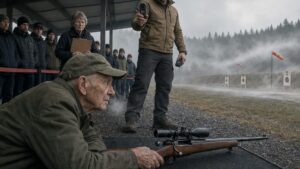
They Thought the Old Man in the Olive Cap Had Wandered Onto the Parade Ground
Chapter 1: The Old Cap at Gate Three
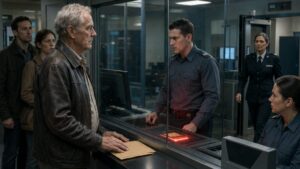
The gate guard looked at Donald Walker’s invitation, then at Donald’s face, then down at the invitation again as if the paper had made a mistake.
Behind the guard station, beyond the chain-link fence and the clipped grass, the parade ground was already waking. A line of white chairs stood under the morning sun. Flags moved in a light wind. Somewhere out of sight, a band tested one brass note and let it hang in the air before cutting it short.
Donald kept both hands on his old olive cap.
He had not worn the cap in years. The brim had gone soft where his thumb had held it too many times. The cloth had faded unevenly, darker around the inside band, paler at the crown. The uniform beneath his light jacket had been brushed, pressed, and brushed again the night before, though no amount of care could make it belong to this decade. Its color was old Army green, plain and quiet among the bright formal uniforms moving beyond the gate.
The guard shifted his weight. “Sir, I’m not seeing you on the access list.”
Donald nodded once, as if this were a weather report.
“I have this,” he said.
The guard had already seen the invitation, but Donald held it out again. The paper trembled only at the corner. He tightened his fingers until it stopped.
The guard accepted it with the careful patience used on children and very old people. “Yes, sir. I understand. This says ceremony guest, but the list here has sections. Family seating, active command, honored veterans, support staff.” He ran a finger down the clipboard. “I don’t see Walker.”
Donald looked past him.
A row of service members crossed the far side of the lawn in measured steps, their shoes dark against the pale walkway. A young officer in a white dress uniform moved with them, head turned toward a public affairs aide who was speaking quickly and pointing toward the reviewing stand. Everything out there had direction. Everything had a place.
Donald lowered his eyes to the clipboard. “Is there a Rivera?”
The guard blinked. “Sir?”
“Paul Rivera.”
The guard scanned the page because Donald had asked him to, not because he understood. “I’m checking access, sir. The ceremony program would be inside.”
“Could you see if there’s a Rivera?”
The guard looked toward the line forming behind Donald. A contractor van idled at the next lane. Two family members waited with flowers wrapped in clear plastic. A medical volunteer carrying a cooler shifted from one foot to the other.
“Sir, I don’t have the name-reading sheet here.”
Donald heard the phrase and felt something in his chest settle hard.
Name-reading sheet.
It sounded so small for what it carried.
He tucked the invitation back into his inside pocket. He had folded and unfolded it so often the crease had grown soft. The letter had arrived three weeks earlier, addressed correctly, printed cleanly, signed by someone from the base he did not know. It invited him to attend the annual remembrance ceremony and recognized his unit’s service. It did not mention Paul. Donald had told himself that did not mean anything. Programs were brief. Letters were brief. Names took up space.
But Paul Rivera’s name had once been left off a wall display during a reunion, then left off a newsletter, then written under the wrong unit in a veterans’ archive. Each time someone had apologized. Each time the correction had come after the room had emptied.
The guard cleared his throat. “Sir, are you here with family?”
Donald looked at him.
“No.”
“Do you have a driver waiting?”
“No.”
The guard’s eyes softened, and that was somehow worse than impatience. “Would you like me to call someone from the guest tent? Maybe they can help figure out where you need to be.”
Donald turned the cap in his hands. Inside the band, written in ink that had browned with time, was his name and the old unit marking. He had almost blacked it out once, years ago, after someone at a county event had asked if the cap was from a thrift store. He had not done it. He could not explain why. Pride had not been the reason. Pride was too loud a word for something so worn.
“I know where I need to be,” Donald said.
The guard did not answer right away. Another band note sounded, longer this time. A drum tapped twice, then stopped.
The family members behind Donald whispered, not unkindly, but the sound brushed the back of his neck. He could step aside. He could let the ceremony begin. He could write another letter next week, or ask someone else to call, or fold the invitation into the kitchen drawer where he kept old envelopes and things that had failed without making noise.
He had done that before.
He looked down at the cap. His thumb found the weak place in the brim.
Paul had once told him that the worst way to lose a man was not all at once. It was piece by piece, whenever someone decided the spelling did not matter, or the date was close enough, or the name could wait until next year.
Donald inhaled slowly.
“Could you call the coordinator?” he asked. “Please.”
The guard reached for the radio clipped to his shoulder. His voice changed when he used it, becoming official and clipped. “Gate Three requesting ceremony staff for guest verification. Elderly male, olive uniform, invitation in hand. Name Walker. Says he’s asking about a Rivera.”
Donald stood still.
The words traveled through the morning air as if he were no longer standing there. Elderly male. Olive uniform. Asking about a Rivera.
He did not blame the guard. The guard was young, and the day had a schedule, and Donald knew what he looked like. He had seen himself in the hallway mirror before leaving home: thin neck, careful hands, old cloth, cap held like a thing that could break. He had looked less like a man invited to a ceremony than a memory that had taken a wrong turn.
A reply crackled through the radio. The guard pressed the earpiece closer.
“Yes, ma’am,” he said. “Understood.”
He looked at Donald with renewed discomfort. “They said you can proceed to the guest check-in tent. Someone will meet you there.”
Donald nodded. “Thank you.”
The guard opened the pedestrian gate.
Donald stepped through, then stopped just past the threshold. For a moment, he had the ridiculous feeling that if he turned around, the gate would still be closed and the whole thing would have been decided without him.
But the path lay open.
He put his cap on.
The old cloth settled against his head with a familiarity that was neither comfort nor pain. It simply belonged there.
The walkway curved toward the parade ground. On the right, white folding chairs faced the reviewing stand in straight blocks. On the left, service members adjusted spacing with small movements of shoulders and boots. The young officer in white crossed in front of the formation, speaking quickly to a public affairs aide. His uniform caught the sun so sharply that Donald had to narrow his eyes.
A table near the guest tent held stacks of programs. Donald slowed when he reached it.
The top sheet listed the order of remarks, the band selection, the presentation of colors, and the reading of remembered names. Donald picked it up with two fingers.
His own unit was printed halfway down.
Donald Walker was printed beneath it.
Paul Rivera was not.
From the parade ground, a command rang out. The formation began to set.
Donald stood with the program in his hand and the old cap shadowing his eyes, watching the ceremony begin to take shape without the name he had come to hear.
Chapter 2: The Officer in White Steps Forward
Andrew Moore saw the old man before he knew the old man was a problem.
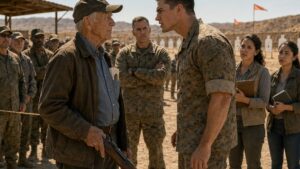
He was standing too close to the formation line, holding one of the programs in a loose hand. His olive uniform looked real enough to be uncomfortable and old enough to be impossible. It did not match any of the assigned participants. It did not match the color guard, the honored guest row, the family seating section, or the veterans who had checked in through the tent with badges and escorts.
Andrew had spent the morning watching details slip loose.
The band had arrived six minutes late. Two reserved chairs had been moved to the wrong side of the aisle. A public affairs aide had lost the printed remarks for the opening welcome and found them under a stack of commemorative folders. A family member had asked if a name could be added to the reading after the list had already been approved. The base commander was due at the reviewing stand in less than ten minutes.
And now an elderly man in an outdated uniform stood near the formation with a program in his hand, looking not lost exactly, but fixed in place.
Andrew crossed the grass with his shoulders squared.
“Sir,” he called.
The old man turned.
Up close, Andrew saw the careful shave, the deep lines around the mouth, the old cap sitting low on his forehead. The man did not startle. He simply waited.
“This area is restricted once formation begins,” Andrew said. “Guest seating is behind the rope.”
The old man looked toward the chairs. “I’m not looking for my seat.”
“Then what are you looking for?”
“A name.”
Andrew kept his voice level. “The ceremony program has been finalized.”
“I saw that.”
“Then I need you to move behind the rope, sir.”
The old man’s eyes went from Andrew’s face to the formation behind him. Not defiant. Not confused. That made him harder to place. If he had been angry, Andrew could have handled anger. If he had been wandering, Andrew could have guided him with kindness and firmness. But the old man stood as if the ground had asked him to stay.
“Paul Rivera,” the old man said. “Is he on the name-reading sheet?”
Andrew exhaled through his nose. He did not mean for it to sound impatient, but it did.
“Sir, I’m not the coordinator for the program.”
“You’re standing between me and the people who are.”
Andrew glanced toward the guest tent. Angela Lopez was at a folding table with three staff members, her headset pressed to one ear, one hand flat on a stack of papers as if holding the whole ceremony down. If Andrew brought every late question to her now, nothing would begin on time.
“I understand you have a concern,” Andrew said. “But this is not the moment.”
The old man folded the program once. The paper made a dry sound.
Andrew lowered his voice. “Sir, I’m going to ask you to step back now.”
Behind him, the formation had gone still enough that the absence of movement became attention. Andrew felt it at his spine. He knew how scenes began: one unclear exchange, one guest too near the line, one phone lifted by someone who did not understand the context. Ceremonies did not tolerate uncertainty.
The old man removed his cap.
That small action stopped Andrew more than a raised voice would have. The man took it off with both hands, not snatching, not flourishing, and held it against his chest. His hair was thin and silver, pressed flat where the cap had rested. Inside the cap, for one brief second, Andrew saw faded ink on the band.
“Please check the sheet,” the old man said.
Andrew’s jaw tightened. “Sir, you need to move.”
The old man did not.
Andrew stepped closer, not touching him, but close enough to make the instruction unmistakable. “This is a formal military ceremony. You can’t stand here in costume and interrupt the formation because of a program concern.”
The word costume landed between them.
Andrew knew it before anyone spoke. He saw it in the old man’s hands.
They tightened around the cap, then relaxed.
The old man looked down, not in surrender but in care, as if the cap had heard the word too.
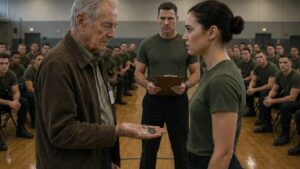
“Officer Moore.”
Andrew turned sharply.
Richard Nelson had crossed from the reviewing stand without Andrew hearing him approach. The senior officer wore a dark formal uniform that carried weight even before one noticed the ribbons and polished buttons. His face was calm in the way that made junior officers stand straighter.
Andrew came to attention. “Sir.”
Richard did not look at him first. He looked at the old man.
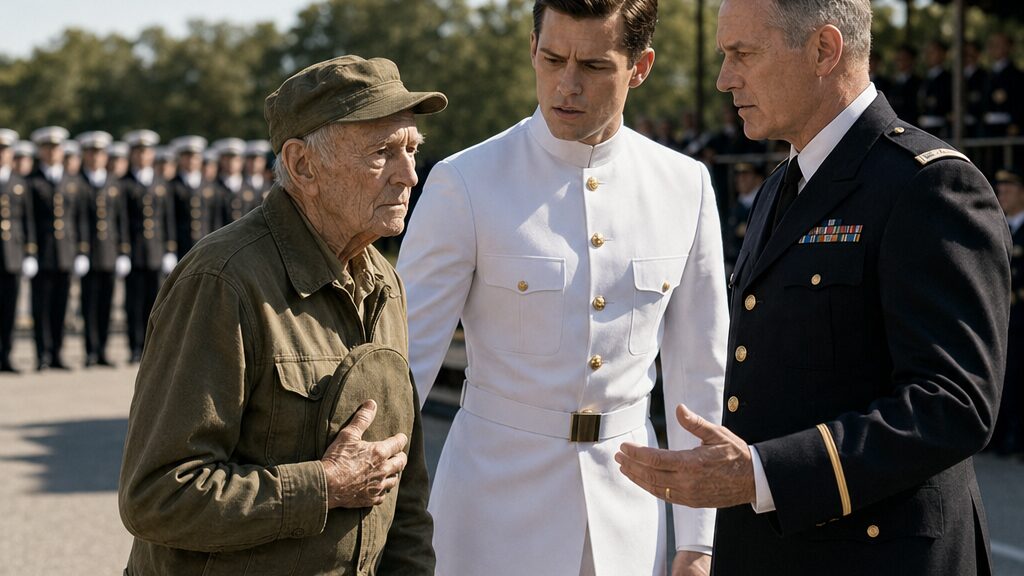
“May I see the cap?” Richard asked.
The old man hesitated only a moment, then held it out.
Richard received it with both hands.
Andrew felt heat rise under his collar.
The base commander tilted the cap just enough to see the inside band. He did not rush. The parade ground seemed to gather around that silence. Andrew saw his eyes pause over the faded letters.
Walker.
Then the unit marking.
Richard’s expression changed without becoming dramatic. His mouth stilled. His shoulders settled. When he looked up, he was no longer looking at an elderly guest who had wandered too close.
“Mr. Walker,” Richard said, his voice lower now, “I apologize.”
Andrew stared at the cap.
The old man gave a small nod, as if apologies were things that needed to be accepted carefully or not at all.
Richard turned toward Andrew.
“Officer Moore,” he said, “this man is not in costume.”
Andrew’s face went cold.
He heard the formation behind him. He heard a flag rope strike the pole once in the wind. He heard his own breathing, too loud.
Richard continued, not loudly enough to embarrass him for sport, but clearly enough that the correction could not be mistaken. “His name is Donald Walker. His unit is listed in today’s remembrance. You will not move him behind a rope as if he is a disruption.”
Andrew swallowed. “Yes, sir.”
The old man looked toward the program still folded in his hand. “I’m not asking about myself.”
Richard turned back to him.
“Paul Rivera,” Donald said. “I need to know if that name is on the sheet.”
The name changed nothing on Andrew’s face because he did not know it. But Richard’s eyes narrowed slightly, not with recognition, but with attention.
Angela had started walking toward them from the tent, headset cord bouncing against her shoulder. The public affairs aide hovered near the rope line, frozen between intervening and disappearing. The band leader looked across the field, waiting for the signal to begin.
Andrew wanted one clean instruction. Move here. Stand there. Apologize now. Resume ceremony.
Instead, Donald Walker stood with his cap in Richard Nelson’s hands, asking about someone else.
Richard offered the cap back.
Donald accepted it, but did not put it on. He held it against his chest the same way as before.
Richard’s voice dropped until Andrew had to lean inward to hear it.
“Who was Paul Rivera to you?”
Chapter 3: The Name That Was Not Printed
The coordination tent smelled of paper, coffee, and hot canvas.
Donald stood just inside the entrance while Angela Lopez worked through three stacks of documents with the speed of someone trying not to show panic. Outside, the parade ground waited in fragments: a band warming and stopping, boots shifting against pavement, a command repeated in a clipped voice. Inside the tent, the air had no ceremony in it. It had corrections, tape, bottled water, spare pens, and a printer with a red light blinking beside the paper tray.
Richard Nelson had brought Donald in himself.
That changed the way people looked at him.
No one called him confused now. No one asked if he needed a chair before asking what he needed. A medical volunteer did glance at him twice, but even that glance had changed. It was not pity exactly. It was caution, as if Donald had become something breakable and official at the same time.
Donald did not want either.
He set his old cap on the nearest folding chair instead of the table. The chair was empty, pushed against the tent wall. The cap looked small there, its olive cloth dull beside a white binder labeled with ceremony tabs. Donald left it alone. He did not like seeing people reach around it.
Angela lifted one packet, then another. “I have Walker, Donald. Honored veteran seating, front section, second row. You were supposed to receive a check-in badge.”
“I didn’t.”
“I’m sorry. It may still be at Gate One. Some of the packets were sorted by arrival lane.” Her eyes flicked toward Richard, then back to the sheet. “That part is fixable.”
Donald waited.
Angela turned a page. “For the name-reading, I have a confirmed list from records, family submissions, and the unit association. The final version was locked yesterday afternoon.”
“Is Paul Rivera on it?”
She did not answer too quickly. Donald respected that. She looked line by line, then checked a second page, then a third. Her finger moved down the columns.
“No,” she said.
The word did not surprise him. It still found its place.
Richard stood near the tent pole, arms at his sides, face unreadable. Andrew remained outside the entrance at first, then stepped in when Richard glanced toward him. The young officer had lost the hard certainty he had carried on the field. In the tent’s shade, his white uniform seemed almost too bright, as if it had no place to hide a mistake.
Angela reached for another folder. “Can you tell me the full name again?”
“Paul Rivera.”
“Middle initial?”
Donald closed his eyes briefly. “A.”
Angela wrote it down. “Service branch?”
“Army.”
“Unit?”
Donald told her.
She stopped writing.
“That may be the issue,” she said carefully. “The ceremony list was built from the current archive categories. Some of the older unit designations were consolidated.”
Donald looked at her.
Angela continued, softer now. “If his record was filed under an older designation, and the submitted list used the current one, it may not have matched.”
“His name matched,” Donald said.
No one spoke.
He had not raised his voice. He almost wished he had. A raised voice would have made the silence easier to understand.
Angela looked down at her papers. “I didn’t mean—”
“I know what you meant.”
Donald reached for the back of a folding chair, not to sit, only to steady the space in front of him. The ground beneath the tent was temporary flooring laid over grass. It gave slightly under his shoes. He disliked that. Parade grounds should be firm.
Richard spoke first. “Angela, do we have access to the archived unit roster?”
“Not cleanly from here. I can call records, but the ceremony begins in minutes.” She checked her watch, though everyone knew the time. “The printed programs are already out. The name-reading sheet is with the band leader and the public affairs aide has the podium copy.”
Andrew shifted by the tent entrance. Donald saw him look once toward the cap on the chair.
Richard said, “We are not discussing printed programs right now. We are discussing whether a name has been wrongly omitted from the reading.”
Angela’s lips pressed together. She was not offended. She was calculating damage.
“I understand, sir. But the reading order was approved by command. If I insert a name without verification and a family asks why their correction was not allowed, we create another problem. If we pause during the ceremony, everyone notices. If we change the podium copy, the band cue may be off.”
Donald listened to the machinery of the day turning around Paul’s name.
He had heard versions of it before. Not cruel. That was the trouble. Cruelty could be answered directly. This was not cruelty. This was a line missing from a form, a category changed in an archive, a timing issue, a cue, a concern about fairness spoken by people who would go home believing they had tried.
Angela turned another page. “Mr. Walker, were you listed with him in the same unit association records?”
“Yes.”
“Did the family submit his name?”
Donald’s grip tightened on the chair back. “There isn’t family coming today.”
“I’m sorry.”
“He had a sister. She used to come when she could. She asked me to make sure.” Donald stopped. The rest of the sentence had no useful place in the tent.
Angela waited, pen still in hand.
Donald looked at the cap. From where he stood, he could see the underside of the brim. The ink inside was hidden now, facing the chair seat. That seemed right. A name did not need to be displayed to be true.
Richard took one step closer. “Make sure of what, Mr. Walker?”
“That he wasn’t skipped again.”
Andrew looked up.
Again.
The word moved through the tent differently than the others. It was small, but it had weight behind it.
Angela lowered the folder. “This has happened before?”
Donald nodded.
“More than once?”
“Yes.”
The printer clicked suddenly, tried to feed paper, failed, and went quiet. Outside, the band began the first full measure of a warm-up hymn, then stopped halfway through.
Angela rubbed one hand over her forehead. “I can try records. I can ask the public affairs aide to hold the podium copy for a correction. But I need authorization, and I need something more than memory.”
Donald looked at her then.
Memory.
He knew she had not meant to make the word small. Still, it stood in front of him like another gate.
Andrew spoke from the entrance. His voice was quieter than it had been on the field. “His cap had the unit marking.”
Angela glanced at him. “That verifies Mr. Walker.”
“It verifies he knows the unit,” Andrew said, then faltered because he heard how thin that sounded.
Donald released the chair.
He could accept his seat. He could sit in the second row, as the paper said, and let his own name be read clearly. He could nod when people looked at him with the new respect Richard had made possible. He could tell himself that Paul would understand. Paul had understood many things he should not have had to understand.
But the cap on the chair seemed to be waiting.
Donald walked to it and rested one hand on the crown. He did not pick it up.
“I didn’t come to correct the program,” he said. “I came so I could hear the name.”
Angela’s face changed, not enough for anyone outside the tent to see, but enough.
Richard turned to her. “What would it take?”
Angela looked toward the parade ground, where the ceremony had started arranging itself into something no one wanted to interrupt. “Sir, changing the program now would disrupt the official order.”
Chapter 4: A Ceremony Clean Enough to Forget
Andrew Moore had learned early that ceremonies were built out of things no one noticed unless they went wrong.
A chair angled poorly. A flag rope tangled before the colors moved. A family member seated in the wrong row. A name mispronounced into a microphone and carried across a field before anyone could pull it back. The work was to make reverence look effortless, to make grief move on schedule, to protect the silence around the important things.
That morning, standing behind the reviewing stand with the sun bright on his white uniform, Andrew felt the whole ceremony tilting toward one missing name.
Angela Lopez had stepped away to make a call to records. Richard Nelson stood near the edge of the tent with Donald Walker, speaking quietly enough that Andrew could not hear every word. The old man’s cap sat on a folding chair inside, untouched. Andrew kept looking at it.
He wished he had never said costume.
The word had come from pressure, not belief. At least that was what he told himself. But pressure had not invented it. It had only opened the door.
A public affairs aide hurried past with the podium folder clutched to their chest. “Officer Moore, band leader has the final order. We’re waiting on the commander’s signal.”
Andrew looked toward Richard. No signal had been given.
“Hold at ready,” Andrew said.
“For how long?”
“Until told otherwise.”
The aide looked relieved to have an instruction, then nervous about what it meant. They left.
Andrew stepped closer to Angela as she lowered her phone. “Can records verify it?”
Angela’s face was tight. “Not before the ceremony. They found a Paul A. Rivera in an older roster index, but the digital file is incomplete. The archived unit designation doesn’t map cleanly to the current ceremony category.”
Andrew almost laughed, not because anything was funny, but because the words sounded exactly like the kind of thing that could bury a man forever.
“So not verified,” he said.
“Not fully.”
Donald stood a few feet away, looking out toward the formation. He had not sat in the honored veteran row. He had not taken the water someone offered. He had become the still point around which the staff kept moving.
Andrew lowered his voice. “Mr. Walker, with respect, we can correct the archival record after the ceremony. We can make sure Mr. Rivera is included in the online posting, the printed follow-up, next year’s program—”
Donald turned.
Andrew stopped. He had meant the words as a solution. Hearing them in the air, he understood how they sounded.
“Next year,” Donald said.
Not bitterly. That was worse.
Andrew held his ground because there were people watching, because Richard was within hearing distance, because the ceremony was late, because duty had trained his body even when his thoughts were no longer aligned.
“I’m trying to prevent an unverified change in front of families who also submitted names,” Andrew said. “If we alter the order without documentation, it can look careless.”
Donald looked past him at the chairs. “And if you leave it out?”
Andrew had no answer that did not sound like procedure protecting itself.
Angela folded her arms around the folder. “Mr. Walker, I believe you. I do. But belief and authorization are not the same.”
Donald nodded once. “I know.”
That small agreement struck Andrew harder than an accusation would have. Donald knew the machine. He knew exactly how polite language worked when it needed to refuse someone without appearing to.
Richard came down the steps from the reviewing stand. “Where are we?”
Angela answered first. “Partial record found. Not enough for full official insertion. The podium copy is already staged. Band cue is ready. Families are seated.”
Richard looked at Donald. “Mr. Walker?”
Donald’s hand moved slightly, as if reaching for the cap that was not there. “I won’t ask you to read what you think you can’t stand behind.”
Andrew felt a release in his shoulders. Then Donald continued.
“But I won’t sit in a chair while his name is missing.”
The release vanished.
Richard studied him. “What are you asking for?”
“I’m asking to hear the name checked before the reading starts.”
Angela shook her head. “In front of everyone?”
“No,” Donald said. “Before you begin.”
Andrew looked toward the formation. Soldiers stood in the sun, still and waiting. The band instruments caught light. A few family members had turned in their chairs to see why the ceremony had not begun. Every delay became its own announcement.
“Sir,” Andrew said to Richard, “if we pause visibly, it becomes the story.”
Richard’s eyes moved to him.
Andrew kept his voice controlled. “The purpose of this ceremony is not to show internal confusion. We can preserve dignity by handling the correction quietly.”
“Whose dignity?” Richard asked.
Andrew’s mouth closed.
The question did not come with anger. It came with patience, which was harder to defend against.
Donald looked at Andrew then, and for the first time Andrew saw not only the old man he had insulted, not only the veteran whose cap carried a unit marking, but someone who was tired of watching others decide what kind of quiet counted as respect.
Andrew glanced again at the cap inside the tent. Its brim was stained where fingers had worried it for years. Nothing about it was decorative. It did not look like something kept for a ceremony. It looked like something that had absorbed kitchens, hospitals, bus seats, folded letters, and mornings when a man almost stayed home.
Andrew had thought order was the shape respect took.
But the cap made order look smaller.
Angela spoke into the silence. “If command authorizes a pause before the reading, I can pull the podium copy and mark a verification note. The name could be acknowledged as pending archival confirmation.”
“That sounds like a footnote,” Donald said.
“It is the language I can defend.”
Donald’s expression did not change, but Andrew saw the exhaustion at the edge of his eyes.
Richard turned to Andrew. “Get the band leader’s sheet.”
Andrew straightened. “Sir?”
“The sheet. Bring it here.”
Andrew hesitated for less than a second, but enough.
Richard’s voice lowered. “Officer Moore, the ceremony can survive a pause. It cannot survive pretending this conversation did not happen.”
Andrew looked at Donald.
The old man did not look victorious. He looked as if each concession cost him something too.
“Yes, sir,” Andrew said.
He crossed behind the reviewing stand toward the band area, moving faster than ceremony pace but slower than panic. The band leader saw him coming and lifted the folder.
“Are we starting?”
“Not yet.”
The band leader frowned but handed him the name-reading sheet.
Andrew took it carefully. Until that morning, it had been just another document in the choreography of honor. Now it felt heavier than paper should.
When he returned, Richard was waiting at the tent entrance. Donald stood beside him, cap now back in his hands.
Richard did not take the sheet.
He looked at Andrew and said, “The ceremony will pause if Mr. Walker asks it to pause.”
Chapter 5: The Man Donald Came to Stand For
Donald carried the cap to the quiet side of the parade ground because he needed a place where the band could not see his face.
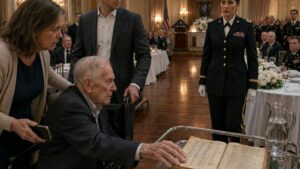
There were memorial chairs arranged near the reviewing stand, each with a small flag placed on the seat. They were not for sitting. Everyone understood that without being told. The flags leaned at the same angle, bright and exact, their wooden sticks tucked against the white folding backs. Beyond them, the formation waited in blocks of stillness. Beyond that, families sat beneath the sun and shaded their eyes with programs.
Donald lowered himself onto a regular folding chair beside the memorial row. His knees complained, but he gave them no attention. He placed the olive cap on his knee and rested one hand over it.
Richard stood nearby, not crowding him. Andrew remained a few steps away with the name-reading sheet in his hand. Angela had returned to the tent to mark what she could mark and call who she could call. The world had not stopped. It had merely learned to hold its breath.
Richard said, “You don’t have to tell us more than you want to.”
Donald looked at the cap. “That’s what people say before needing more.”
Andrew’s eyes dropped to the sheet.
Richard accepted the correction with a small nod. “That may be true.”
Donald rubbed his thumb along the softened brim. The cloth gave under the pressure, then rose again when he let go.
“Paul Rivera did not like being noticed,” Donald said. “That’s one reason it bothers me.”
Neither man interrupted.
“He was not the loudest. He wasn’t the man in the photographs. If there was a camera, he found a place behind someone taller. If there was a job nobody wanted, he acted like he had already been assigned to it.” Donald paused. The parade ground blurred slightly, then steadied. “After we came home, most people remembered the ones who could tell a story cleanly. Paul couldn’t. He would start, then stop. Change the subject. Ask if you wanted coffee.”
A command sounded in the distance. The formation adjusted by inches.
Donald kept his voice low.
“His sister used to come to every unit event with a folder. Birth certificate, discharge paper, old photographs, letters with the unit number written in three different ways. She learned that people are more likely to believe a document than a person. She hated that, but she learned it.”
Andrew’s grip tightened on the name-reading sheet.
“She asked me once, after they left him off a display, if I would check things when she couldn’t. I told her yes.” Donald swallowed. “That was years ago.”
Richard asked, “Is she gone?”
Donald nodded.
He had not meant to say that much. He had only meant to explain enough to get the name read, but the morning had taken the cover off old things. He could see Paul’s sister in a church basement, smoothing papers inside a folder while people balanced paper plates on their knees. He could see her asking politely, always politely, why her brother’s name was missing from the second panel. He could see the man in charge saying they would fix it for the next printing.
Next printing. Next year. Next ceremony.
Paul had become a promise postponed.
Andrew spoke, almost reluctantly. “What did Paul do?”
Donald looked at him.
The question was careful. Not suspicious. Not even official. It had the awkward shape of someone trying to ask as a person while still wearing a uniform that reminded everyone he had first asked as an officer.
Donald considered not answering.
Then he lifted the cap from his knee and turned it in his hands until the inside band faced him. The ink there had outlasted men with louder names.
“He kept people together when things got confused,” Donald said. “That was his gift. Not the kind they put in citations. The kind that means the right person gets water. The right man gets pulled into shade. The new kid gets told when to keep his head down. The scared one gets a joke before he breaks.”
Richard stood very still.
Donald continued. “Once, during a bad hour, Paul moved before anyone ordered him to. He saw what was about to happen. He got two men behind cover and came back for a third. People wrote later that the line held because of command decisions.” His mouth tightened. “Maybe it did. But those three men lived because Paul Rivera noticed them before the paperwork did.”
Andrew looked at the sheet as if the blank space might accuse him.
“Were you one of them?” he asked.
Donald’s hand closed over the cap.
Richard’s head turned slightly toward Andrew, warning without speaking.
Donald answered anyway. “No.”
The lie would have been easy. It might even have helped. But Paul did not need Donald borrowing another man’s wound to make him matter.
“I was the one who told his sister I would remember correctly,” Donald said.
The wind moved across the memorial flags. One of them trembled against the chair back.
Donald stared at it until the tremor stopped. “I almost didn’t come today. Invitation sat on my table for nine days. I thought, they’ll read my name, shake my hand, send a photograph to someone’s office, and Paul will be missing again. I thought maybe I was too tired to hear it.”
Richard said nothing.
“But then I thought of his sister with that folder.” Donald gave a small breath that was almost a laugh. “She carried it like it was a baby. Every paper in a plastic sleeve. Every sleeve labeled. She should not have had to become an archivist to keep her brother from disappearing.”
Andrew’s face changed.
It was not shock now. It was something slower and more useful. Shame, perhaps, but not the kind that looked for quick forgiveness. He looked down at his own bright sleeve, at the spotless cuff near the document in his hand.
Donald saw him do it.
“I don’t want you embarrassed,” Donald said.
Andrew looked up quickly.
Donald’s voice remained even. “Embarrassment ends when people stop looking. That isn’t enough.”
Andrew did not answer.
Richard stepped closer. “Mr. Walker, if we confirm enough to read his name, would you like to read it?”
Donald shook his head before Richard finished. “No.”
“You’re certain?”
“I didn’t come for a microphone.”
The band began to gather again at the far side of the field. Instruments lifted. The first note had not yet sounded, but the posture was there.
Angela came from the tent with a pen tucked behind her ear and a marked folder in her hand. “I reached records again. They can confirm Paul A. Rivera appears in the archived roster index under the old unit designation. They cannot send the full file before the ceremony begins.”
Richard took in the words. “Enough for a spoken correction?”
Angela hesitated. “Enough for a commander’s acknowledgment, if you accept the risk.”
Donald looked at Richard.
Richard looked back at him. “I’ll accept it if you want me to.”
The offer was clean. It was also heavy. Donald had spent years resenting rooms that moved without asking him. Now the room had turned and waited.
He put the cap back on his knee.
“I want his name read before mine,” Donald said. “No story. No explanation that makes him sound like an error. Just his name, where it should have been.”
Angela wrote quickly.
Andrew turned toward the band area. Then he stopped, his face tightening.
“What is it?” Richard asked.
Andrew looked at the marked folder in Angela’s hand, then toward the field.
“The official name-reading sheet,” he said, “is already in the band leader’s hand.”
Chapter 6: Before the First Note Plays
Richard Nelson had commanded rooms where no one dared move without permission, and he had stood in rooms where all the permission in the world could not make a wounded family speak.
The parade ground before him was neither, but it borrowed from both.
The formation was ready. The families were seated. The band leader held the official sheet. The flags at the memorial chairs leaned in a perfect row. The delay had stretched long enough that people had begun to understand something was wrong, though not what. That was the danger point. Uncertainty filled itself quickly.
Richard stood behind the reviewing stand with Donald Walker on his left and Andrew Moore on his right. Angela Lopez waited near the steps, marked folder pressed against her side.
The old man had put his cap back on.
That small change settled the air around him. Without it, Donald had looked exposed, a man asked to produce proof from memory. With it, he looked exactly as he had when Richard first saw him near the formation: worn, out of place to those who did not know better, and steadier than the ceremony around him.
Richard turned to Andrew. “Retrieve the band leader’s sheet and bring him the correction.”
Andrew’s eyes flicked toward the field. “Sir, if I cross now, everyone will see.”
“Yes.”
Angela said, “I can send the public affairs aide.”
“No,” Richard said.
Andrew’s shoulders drew back. He understood the order beneath the order.
This was not punishment. Richard would not dress down an officer for the satisfaction of witnesses. But Andrew had been the first barrier, and if the morning was going to change shape, his conduct had to change with it.
Andrew took the marked folder from Angela. “Yes, sir.”
He stepped out from behind the stand and crossed the open edge of the parade ground.
Heads turned. Not many. Enough.
Richard watched him walk. The white uniform made every movement visible. Earlier, that visibility had sharpened Andrew’s authority. Now it showed the cost of returning to the place where he had been wrong.
Donald said, “He’s young.”
Richard glanced at him. “That doesn’t excuse it.”
“No,” Donald said. “But it may mean he can still learn from it.”
Richard let the words sit. He had seen older men fail to learn from less.
The band leader listened as Andrew spoke, then looked toward Richard, then toward Donald. The sheet changed hands. The correction was marked against the podium copy. No announcement was made. No explanation moved through the families. The work happened visibly enough to be real and quietly enough not to become theater.
Angela released a breath.
Richard looked at Donald. “Mr. Walker, I need to ask plainly. Do you want the ceremony paused before the reading, or do you want the correction placed into the reading itself?”
Donald’s eyes remained on Andrew, who was now conferring with the public affairs aide near the microphone. “What would you do?”
“I would pause,” Richard said. “I would acknowledge that a name had been omitted and correct it.”
Donald nodded faintly. “Because you’re in command.”
“Yes.”
“I’m not.”
“That is not the only reason to speak.”
Donald turned toward him then. The shadow from the cap brim crossed his eyes. “When a commander pauses a ceremony, people hear authority. When an old man pauses it, people wonder what he wants.”
Richard had no immediate answer.
Donald looked back at the field. “I don’t want them wondering about me.”
Angela stepped closer. “If the name is inserted before yours, the families may not know why.”
“That’s all right.”
“But the staff should know why,” she said.
Donald looked at her.
Angela seemed surprised by her own firmness. She held the folder tighter. “Not for display. For the record. If we don’t write why, someone will look at the correction next year and decide it was temporary.”
Richard saw Donald absorb that.
The morning had turned again. At the gate, Donald had been treated as a man whose paper did not match the list. In the tent, Paul Rivera had been treated as a name whose memory did not match the archive. Now Angela was not asking for proof to deny him. She was asking for enough truth to keep the correction alive after the chairs were folded.
Donald touched the cap brim.
“What do you need written?” he asked.
Angela pulled the pen from behind her ear. “Old unit designation. Full name. Your confirmation. Commander acknowledgment. Pending records update.”
Donald’s mouth moved slightly at the last phrase. Not quite a smile.
“Still sounds like a footnote,” he said.
“It is,” Angela answered. “But this one stays attached.”
Andrew returned before Richard could respond. He carried the band leader’s copy and the marked correction. His face was controlled, but not sealed.
“Sir,” he said to Richard. “The band leader can adjust. The public affairs aide will hand the corrected sheet to the reader before the remembrance portion. It won’t affect the opening sequence.”
Richard nodded. “Good.”
Andrew turned to Donald.
He did not speak immediately. He looked at the old cap, then at Donald’s face. His posture changed by degrees: less command, more attention.
“Mr. Walker,” he said, “the name can be read before yours.”
Donald studied him.
Andrew’s jaw tightened, but he did not rush to fill the silence.
“That is what I asked,” Donald said.
“Yes, sir.”
Sir. Not as a habit this time. As a decision.
The first full note from the band sounded across the parade ground.
Everyone turned.
The ceremony had begun to begin. The color guard waited. The families faced forward. The air seemed to draw itself into lines.
Richard moved toward the steps of the reviewing stand, then stopped when Donald did not follow.
“Mr. Walker?”
Donald stood near the memorial chairs with the cap on his head and one hand at his side. He looked smaller against the open field than he had in the tent. The sunlight found the faded seams in his uniform and the age in his fingers. For a moment Richard thought he might still choose to leave.
Instead, Donald removed the cap.
He held it in both hands again, not against his chest this time, but low in front of him.
“Do I need to sit in the second row?” he asked.
Richard followed his gaze to the honored veteran seating.
A place had been kept for Donald there. A clean chair. A printed card. A view of the podium. Everything correct now, or close enough that no one would question it.
“No,” Richard said. “Not if you don’t want to.”
Angela looked up from the folder.
Donald’s thumb pressed once into the brim. “I’ll stand until his name is read.”
Andrew glanced at Richard, then away, as if resisting the instinct to advise against it.
Richard said, “You may stand wherever you’re comfortable.”
Donald looked toward the edge of the formation, the same place Andrew had tried to move him away from. Not in the line. Not in front. Near enough to hear without turning himself into the center.
“There,” Donald said.
Richard nodded.
The opening command rang across the field. The color guard stepped forward.
Donald put the old cap back on and began walking toward the edge of the parade ground. Andrew moved beside him, then slowed, checking himself before matching Donald’s pace. He did not touch Donald’s arm. He did not guide him by the elbow. He walked near enough to make space and far enough not to claim him.
At the edge of the grass, Donald stopped.
The formation stood ahead, bright and still. The reviewing stand waited behind him. The corrected sheet was moving quietly from hand to hand.
Richard watched Donald lift his head beneath the old olive cap.
When the opening music ended and the first words approached the microphone, Donald turned slightly toward Richard.
“One name before mine,” he said.
Chapter 7: Permission to Read One More Name
Donald heard his own name before anyone said it.
Not aloud. Not yet. It sat somewhere ahead of him on the corrected sheet, waiting in its printed place, clean and easy to read. The ceremony had moved through the opening remarks, the presentation of colors, the commander’s welcome, and the first short prayer with the smoothness of a machine repaired just before anyone noticed it had jammed.
Donald stood at the edge of the parade ground.
Andrew Moore stood near him, close enough to make room when staff passed, not close enough to suggest Donald needed holding up. That restraint had weight. Earlier in the morning, Andrew had used the space between them as authority. Now he used it as respect.
The old cap sat on Donald’s head. The sun warmed the crown. Beneath the brim, he watched the reader step toward the microphone with the name-reading sheet.
A hush spread before the first name.
It did not fall all at once. It moved from row to row, from families lowering their programs, to the band letting instruments rest in laps, to the formation stiffening into a deeper stillness. Even the flags seemed quieter.
Donald’s right hand found the seam of his trousers.
The reader began.
Each name entered the air plainly. No music under it. No story around it. Just names, one after another, each given the brief dignity of being heard and then released.
Donald listened.
Some names he knew. Some he did not. A few brought small movements from the family section: a head lowered, a hand closed over another hand, a program folded against a chest. The ceremony did not stop for each grief. It could not. But it gave every grief a place to stand.
Andrew looked toward the corrected sheet as the reader moved down the column.
Donald did not.
He fixed his eyes on the memorial chairs. The small flags leaned in their perfect row. Earlier they had looked arranged. Now, as names crossed the field, they looked occupied.
The reader paused.
Donald felt the pause before he understood it. It was less than a second, only the time needed for someone’s eyes to adjust to a handwritten insertion. But Donald had spent enough years listening for omissions to hear the shape of one forming.
Andrew stepped forward half a pace.
Richard Nelson, standing near the reviewing stand, turned his head slightly.
The reader looked down, then read clearly, “Paul A. Rivera.”
Donald removed his cap.
He did it without thinking, or with the kind of thinking that had lived in his hands so long it no longer needed words. The olive cap came down from his head and rested against his chest. The field blurred at the edges, then steadied.
Paul A. Rivera.
No explanation followed. No apology. No note about archival categories or pending records. The name stood with the others.
Donald did not close his eyes. He had learned not to. Closing them let memory choose its own pictures, and memory was not always kind. Instead he looked at the white chair in the memorial row nearest the aisle. Its flag trembled once in the wind.
The reader moved on.
Donald’s own name came next.
“Donald Walker.”
A few heads turned then. Some had watched the earlier delay. Some had noticed Richard speaking with him. Some had seen Andrew cross the field with the paper. Donald felt attention move toward him and pass over the old cap in his hands, the faded uniform, the narrow shoulders, the face that had been measured at the gate and found uncertain.
He did not put the cap back on.
He held it until his name had fully left the microphone and the next name began.
Andrew did not look at him during that moment. That mattered too. He did not turn Donald into a lesson for the crowd. He stood beside him, eyes forward, jaw set, allowing the old man to be seen without being displayed.
When the reading ended, the band began a low hymn.
The notes moved across the parade ground with no hurry. Donald let the first measure pass through him. Then the second. The cap felt heavier against his chest than it had that morning, though nothing had been added to it.
When the hymn faded, Richard stepped to the microphone.
Donald stiffened.
He had asked for no story.
Richard placed one hand on the podium and looked across the seated families, the formation, the staff, the flags. His voice carried, formal but not grand.
“This morning,” he said, “a correction was made to ensure one of today’s remembered names was spoken where it belonged.”
Donald’s fingers tightened around the cap.
Richard did not look at him.
“That correction will also be made in the record after this ceremony. We are grateful to those who help us remember accurately.”
That was all.
No spotlight. No invitation to stand. No public identification of Donald as the man who had insisted. The ceremony moved on.
Donald breathed again.
After the final remarks, the formation remained still while families were invited to approach the memorial chairs. Chairs scraped softly. People stood in rows, waiting their turn. The ceremony had ended in the official sense, but no one moved quickly. Grief disliked being hurried once permission had been given.
Donald turned to leave the edge of the field.
Andrew moved first, then stopped himself.
“Mr. Walker,” he said.
Donald looked at him.
Andrew’s face had lost the startled look from the confrontation, but not the memory of it. He held the corrected sheet now, folded once lengthwise. The fold was careful, not the careless crease of a document already finished with.
“May I walk with you to the memorial row?”
Donald looked toward the chairs.
There were people there now, family members placing flowers, touching flags, standing silently. Paul’s chair was not marked by family. It was not marked at all, except that the name had been read. Donald had told himself that would be enough.
Andrew waited.
The question was plain. Not an order dressed as kindness. Not a performance in front of Richard. Permission asked before action.
Donald put the cap back on slowly.
“Yes,” he said. “You may.”
They walked together across the grass.
Andrew matched his pace. Donald noticed because it would have been easy not to. Young men in bright uniforms often slowed too much around old people, making a show of patience. Andrew simply walked at the speed Donald walked and kept his eyes on the path ahead.
At the memorial row, Donald stopped before an empty chair near the aisle. He did not know whether it corresponded to Paul in any official arrangement. It did not matter. The chairs were symbols, and symbols could be used honestly or carelessly. Today he chose honestly.
He removed his cap again.
For a moment, he held it in both hands over the chair, not setting it down. The cloth had already carried enough of what belonged to him. Paul did not need Donald’s cap to prove anything.
Instead Donald bowed his head.
Andrew stood beside him.
The formation remained in the distance. The reviewing stand had begun to empty. Angela watched from near the tent, folder still held to her side. Richard stood several yards away, allowing the moment to happen without managing it.
Donald lifted his head.
“That’s all,” he said.
Andrew did not answer too quickly. “No, sir.”
Donald looked at him.
Andrew unfolded the corrected sheet once, then stopped as if thinking better of exposing it to the wind. He folded it again, edges aligned.
“Where should this be filed?” Andrew asked.
Donald looked at the paper.
The question was more important than the sheet. It meant Andrew understood that the name was not finished because it had been spoken once. It meant the morning was asking to become a practice.
Donald reached out, not taking the paper, only touching one corner.
“Somewhere it won’t have to be found by accident next time,” he said.
Chapter 8: The Place They Made Beside Him
By the time the last families left the memorial row, the parade ground looked less like a ceremony and more like a place where one had passed through.
Chairs stood crooked from use. Programs lay forgotten under two seats. A water bottle rolled against the leg of the reviewing stand until a medical volunteer picked it up. The band had packed its instruments into dark cases, and the formation had broken into small groups moving toward shade, their polished shoes leaving faint pressed paths in the grass.
Donald remained near the coordination tent with his cap in his hands.
He had meant to leave sooner. The name had been read. That was what he had come for. Yet departure required its own strength, and the morning had taken more from him than he had expected.
Angela Lopez sat at the folding table with the marked documents spread before her. The printer’s red light had been fixed. It hummed now, producing a fresh sheet one careful page at a time. She did not look relieved. She looked busy in the way people looked when they had chosen to make a problem larger because the smaller version would have been a lie.
Richard Nelson stood near the tent entrance, speaking quietly with a public affairs aide. He glanced once toward Donald, then continued the conversation without summoning him. Donald appreciated that.
Andrew Moore approached from the parade ground carrying the corrected name-reading sheet in a clear folder.
He stopped before Donald. Not too close.
“Mr. Walker,” he said. “May I return something to you first?”
Donald looked at the folder. “That isn’t mine.”
“No, sir. Not this.”
Andrew held out the olive cap.
Donald had not realized he had set it down on the folding chair beside him. For one uneasy second, he disliked himself for letting it out of his hands. Then he saw how Andrew held it.
Both hands. Brim supported. Crown uncrushed.
No one had instructed him to do that.
Donald took it carefully. “Thank you.”
Andrew’s throat moved. “I owe you an apology.”
Donald looked at the cap rather than at Andrew’s face. Apologies often asked for more than they admitted. They asked to be accepted, to be finished, to wash a moment clean because both people were tired of carrying it.
Andrew seemed to understand the silence.
“What I said on the field was wrong,” he continued. “How I said it was wrong. But more than that, I treated the schedule like it mattered more than why everyone was here.”
Donald lifted his eyes.
Andrew did not look noble. He looked uncomfortable. That made the apology easier to believe.
“I can’t undo it,” Andrew said.
“No,” Donald said.
The word was quiet, but it landed.
Andrew nodded. “I know.”
Angela came over with a printed page. “Mr. Walker, I want you to see this before it goes into the ceremony record.”
She placed it on the table, then stepped back so Donald could approach on his own.
The page was not decorative. It had no seal at the top, no patriotic border, no language polished for display. It was a verification note. Paul A. Rivera’s name appeared in plain print, linked to the older unit designation and marked for records follow-up. Donald Walker was listed as witness to service association. Richard Nelson’s command acknowledgment was noted beneath. Angela’s initials sat at the bottom.
Donald read it slowly.
The words were still bureaucratic. They still flattened a man into fields and categories. But Paul’s name was there, and this time the correction had a place to live.
Angela said, “I’m adding a cross-check requirement for next year. Older unit designations, family-submitted names, veteran association records. They’ll have to be checked against each other before the final sheet is locked.”
Donald kept reading though he had reached the bottom.
“That should have existed already,” Angela said.
Donald looked at her.
She did not flinch from her own sentence.
“Yes,” Donald said. “It should have.”
Andrew stepped closer to the table, holding the clear folder. “I volunteered to help with the calls.”
“What calls?” Donald asked.
“To families or association contacts for names that don’t match cleanly. Not just Paul Rivera. Others too.” Andrew paused. “If they’ll let me.”
Angela gave him a brief look. “They will.”
Richard joined them then. The dark formal uniform that had seemed so severe during the confrontation now looked tired at the edges. He removed his cover and held it at his side.
“Mr. Walker,” he said, “I’m sorry the morning required this from you.”
Donald placed his cap on the table, then immediately thought better of it and picked it up again. “The morning didn’t require it. The missing name did.”
Richard accepted the correction with a small nod. “Then I’m sorry the name was missing.”
That was closer.
Donald held the cap against his side. “Thank you.”
A breeze moved through the tent, lifting the corner of the verification note. Angela placed a paperweight over it, an ordinary black stapler pressed into temporary service. Donald almost smiled at that. Important things were often held down by whatever was closest.
Andrew looked at the old cap. “May I ask you something?”
Donald waited.
“When you were standing out there, after the name was read, why didn’t you let them say more about him?”
Donald ran his thumb along the brim. The question was honest, so he gave it an honest answer.
“Because a name can be a full honor if people are listening.”
Andrew absorbed that.
Donald added, “And because men like Paul spent enough of their lives being turned into explanations for other people.”
No one spoke for a while.
Outside the tent, a few soldiers were folding chairs. One of them noticed Donald and paused as if uncertain whether to salute, speak, or pretend not to stare. Donald saw the calculation. He had seen it after the name-reading too. Recognition could make people clumsy.
Andrew saw it as well.
He turned slightly toward the soldier and said, not sharply, “Give him room.”
The soldier nodded and continued folding chairs.
Donald looked at Andrew.
It was a small thing. No speech. No public correction. No ceremony around it. Just behavior adjusted before it became another burden for Donald to carry.
Richard noticed too, but said nothing.
Angela slid the verification note into the folder. “Mr. Walker, would you like a copy mailed to you?”
Donald thought of the kitchen drawer at home, the invitation crease softened by his fingers, the old envelopes and failed corrections. He thought of Paul’s sister with her plastic sleeves, every document labeled because the world had taught her that memory needed witnesses.
“Yes,” he said. “But send one to the unit association too.”
“I will.”
“And keep one here.”
Angela closed the folder. “Here is where it starts.”
The words were simple enough to trust.
Donald put on the olive cap for the last walk across the parade ground.
Andrew did not offer his arm. He walked beside him toward the path that led back to Gate Three. Richard remained near the tent, speaking with Angela about records, calls, and next year’s process. Behind them, the memorial chairs were being gathered, but one small flag had been left on the table beside the corrected folder.
At the edge of the grass, Andrew slowed.
“Mr. Walker,” he said, “would you like me to escort you to the gate?”
Donald looked down the walkway. It seemed longer now than it had in the morning, though the distance had not changed. Beyond the fence, cars moved through ordinary traffic. The world outside the base had not paused for Paul Rivera. It rarely did.
“No,” Donald said. “I can find it.”
Andrew nodded.
Donald took three steps, then stopped.
He turned back.
Andrew stood where Donald had left him, white uniform bright against the dulling grass, hands at his sides, waiting without knowing what for.
“You can walk with me if you’re going that way,” Donald said.
Andrew’s posture changed, almost imperceptibly.
“Yes, sir,” he said. “I am.”
They walked together toward Gate Three.
No one saluted. No one applauded. No one called attention to them from the reviewing stand. Donald preferred it that way. The morning had already given him the sound he came for: Paul A. Rivera, spoken clearly into the open air.
Near the gate, the guard who had first checked Donald’s invitation stood straighter when he saw him.
Donald noticed. He also noticed that the guard looked not at the old uniform first, but at Donald’s face.
“Have a good day, Mr. Walker,” the guard said.
Donald touched the brim of his cap.
“You too.”
He stepped through the gate without being stopped.
The old olive cap sat where it belonged, shaped by years, shaded by his hand, no longer proof for anyone and no longer mistaken for costume. Behind him, on the base, a corrected name entered the record. Beside him, Andrew Moore matched his pace without a word.
Donald walked on, carrying less than he had carried when he arrived.
The story has ended.