They Called the Old Man’s Rusty Water Cart Scrap, Then the Desert Range Went Silent
Chapter 1: The Old Man Beside the Water Cart
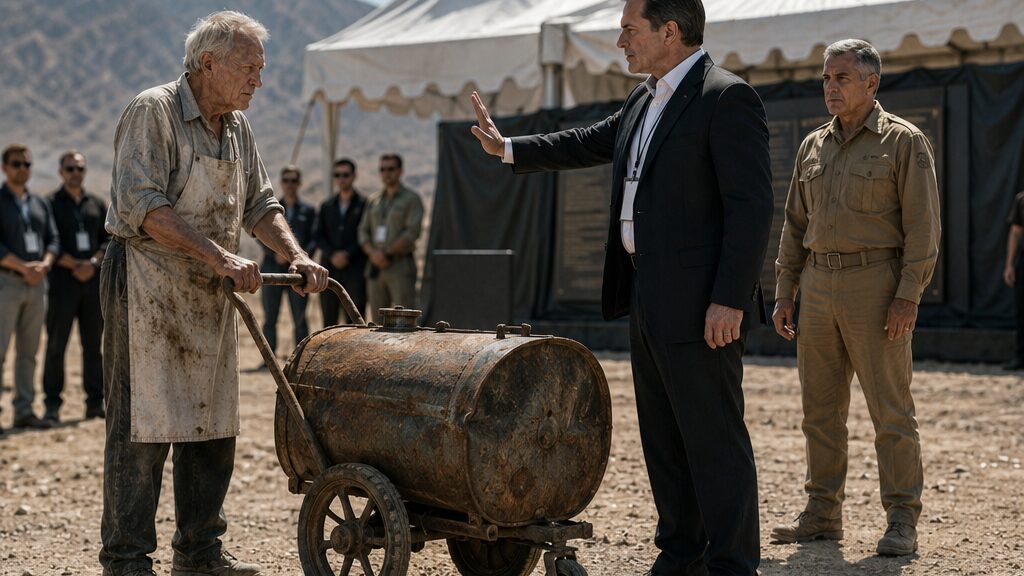
The front wheel of the water cart caught in a rut, and Edward Mitchell nearly went down with it.
For a moment, the whole desert seemed to hold its breath. The rusted tank lurched sideways, its iron handle jerking against his palms. Edward planted one old shoe in the sand, bent his knees, and held on. The cart rocked once, twice, then settled with a dry squeal from the axle.
A young security guard twenty yards ahead stopped under the white event banner and stared.
Edward kept his hands on the handle until the tremor in his fingers passed. The skin across his knuckles had thinned with age, but his grip still remembered weight. Steel. Rope. Canvas. Men leaning into wind. Heat burning through gloves. He did not look back at the road he had crossed. He looked at the cart.
The tank had once been painted dull green. Now most of it had gone brown with rust, sun-scabbed and pitted, with only a few stubborn patches of military paint clinging near the seams. A faded stencil showed through the corrosion on one side, almost invisible unless a person knew where to look.
RED GATE.
The letters had not survived evenly. The R was scarred. The G was split by a dent. The E at the end had faded almost into the color of dust.
Edward brushed his thumb over the stencil, not to clean it, only to make sure it was still there.
Beyond the access road, the range had been dressed for a different kind of memory than the one Edward carried. White tents stood in a neat row against the desert. A small stage had been set near a half-covered memorial wall. Metal folding chairs shone in disciplined lines. Flags hung without movement in the still morning air. At the far end, contractors in clean shirts were arranging coolers and bottled water beneath a shade awning. A few younger soldiers moved equipment with quick, efficient motions, their boots crisp, their uniforms pressed.
The mountains behind them looked the same as they had forty years ago.
That was the part Edward had not expected to hurt.
The range had changed its signs, its roads, its buildings. But the mountains still rose hard and blue beyond the heat. They did not soften for ceremonies. They did not forget what sound carried at noon, or how quickly a man’s mouth could dry when radio chatter turned to static.
Edward shifted the folded invitation in his apron pocket. The paper had softened from being handled too much. One corner had been smudged by grease from the cart hub that morning. He had read it every evening for two weeks without ever deciding whether to come as they expected him to come.
Major General Edward Mitchell, U.S. Army, Retired.
Keynote guest.
Red Gate Veterans Training Center Dedication.
He had folded the line with his title inward.
The guard approached, stopping far enough away to show caution but close enough to block the road.
“Sir?” the guard said. “Deliveries go around back.”
Edward looked at him. The guard was young enough to still be uncomfortable with old people who did not answer quickly. He wore sunglasses and a radio clipped high on his shoulder.
“I’m not delivering,” Edward said.
The guard’s eyes moved from Edward’s stained white apron to the rusty tank, then to the cracked leather of his shoes. Edward knew what he saw. A tired old man, dusty from the road, dragging a ruined piece of equipment toward an event built for polished speeches and cameras.
“You with maintenance?” the guard asked.
“No.”
“Contractor?”
“No.”
The guard waited for more. Edward gave him only the invitation.
The young man took it carefully, as if the paper might crumble. He unfolded it, squinted, then glanced over his shoulder toward the tents.
“This says Mitchell.”
“Yes.”
“Do you have a badge?”
Edward looked past him at the stage. The memorial wall was still covered with tan canvas. Wind lifted one corner, just enough to show a black polished surface beneath. Names, maybe. Or the place where names would be.
“No badge,” Edward said.
The guard’s politeness thinned. “Sir, this is a restricted event until eleven. I can’t let random equipment through.”
“It is not random.”
The words came out quieter than he intended. The guard did not hear the weight in them.
A cart wheel creaked as the tank settled deeper into the sand. Edward glanced down and placed one foot behind the wheel, steadying it. The old movement came without thought. Keep the load from rolling. Protect the water. Watch the slope.
Two contractors had stopped near the tent. One whispered something to the other. A woman at a check-in table looked up, frowned at the cart, then returned to her clipboard. A photographer near the stage raised a camera halfway, decided against it, and lowered it again.
Edward felt the heat gather inside his apron.
He had put the apron on that morning because he had been repairing the left wheel before dawn. He could have changed. He had a dark suit in the closet, sealed in plastic. He had polished shoes, a black tie, and an old ribbon box he had not opened in years. The invitation had expected that man.
But the cart had needed grease, and the road had needed both hands.
He had told himself it did not matter how he arrived.
Now, with the guard trying not to stare at the stains on his shirt, Edward understood that it mattered to everyone else.
The guard handed back the invitation. “I need to call somebody.”
Edward folded it again and tucked it away. “That would be fine.”
“Can you move that off the access road while I check?”
Edward looked at the cart. “No.”
The guard’s jaw tightened. “Sir, it’s blocking the lane.”
“It has waited longer than the lane.”
The guard did not know what to do with that. He touched his radio and turned aside, speaking in a low voice. Edward caught fragments: old guy, tank thing, says he’s invited, no badge.
The desert was quiet beneath the radio crackle. Edward let his gaze travel over the event area. The dedication banner read RED GATE VETERANS TRAINING CENTER in clean blue letters. Under it, smaller words promised resilience, leadership, honor.
Honor had been printed straight. Memory had been arranged under rented shade.
At the far side of the tents, a gray-haired Army officer stepped out from behind the stage with a program in one hand. He wore tan uniform trousers, his sleeves precise, his posture disciplined without stiffness. He paused when he saw the cart. For one second, his face did nothing at all.
Then his eyes narrowed.
Edward looked away first.
He had not come to be recognized at the road.
He had come because the dedication had said the old training ground would be renamed, and because a promise made beside this cart had outlived the men who remembered hearing it.
The guard finished speaking into the radio. “Someone’s coming.”
Edward nodded.
The wind lifted a little. Dust slipped across the road in pale ribbons. The cart’s old axle gave a small metallic tick as the sun warmed it. Edward rested both hands flat on the handle, one thumb near the deep scratch where a young soldier’s ring had cut the paint long ago.
A group of guests arrived in two white vans. Men and women in summer suits stepped out carefully, shielding their eyes from the glare. They looked toward the stage, the flags, the banner, then toward Edward and the cart. Their faces changed in tiny ways. Confusion. Discomfort. The quick decision not to get involved.
Edward lowered his head.
Not in shame, though it might have looked that way. He lowered it because the sun was sharp, because the years were heavy, because anger had always been a waste of water in the desert.
Footsteps came fast over the gravel.
A man in a dark suit cut across the access road with a phone in his hand and a badge clipped to his lapel. He was middle-aged, clean-shaven, and polished in the way men became polished when they spent their days near people with money. His shoes had already collected dust, and he looked personally offended by it.
The guard straightened.
The man stopped in front of Edward, close enough that the cart handle nearly touched his jacket.
His eyes moved over Edward’s apron, the rust, the old wheels, the folded invitation bulging in Edward’s pocket. He did not look long at Edward’s face.
“Who allowed that thing onto the property?” he asked.
Chapter 2: The Suit Called It Scrap Metal
The word thing sat in the hot air between them.
Edward did not answer immediately. He had learned, long before his hair turned white, that silence made careless men reveal the shape of themselves. He kept his palms on the cart handle. The metal was warm now. Rust dust marked the lines of his skin.
The man in the suit turned to the guard. “This access road was supposed to be clear by nine.”
“Yes, sir,” the guard said. “He has an invitation, but—”
“An invitation for what?”
“The dedication.”
The suited man looked back at Edward with a quick, tight smile that was not meant to comfort anyone. “Sir, this is a closed event. We have donors, Army representatives, families of the honored, and press arriving within the hour. You can’t bring scrap equipment through the main entrance.”
Edward looked at the cart. Scrap.
He had heard worse words applied to better men, but this one found an old place in him. Scrap was what remained after usefulness ended. Scrap was what men called metal after they forgot what it had carried.
“It is not scrap,” Edward said.
The suited man gave a small impatient breath. “All right. Vintage equipment. Historical junk. Whatever you want to call it, it can’t sit here.”
A few guests had slowed near the tent ropes. Their conversation thinned as they watched. One contractor leaned on a stack of chairs. A younger soldier stopped beside the stage and pretended to check a cable.
The Army colonel Edward had noticed earlier stood near the edge of the shade, still holding the program. His eyes moved from the cart to Edward’s hands, then to the faded stencil on the tank’s side. He did not step in.
Not yet.
The suited man extended his hand. “I’m Mark Campbell. I’m managing this dedication. And I’m asking you politely to move this equipment behind the service area.”
Edward nodded once. “Edward Mitchell.”
Mark blinked, more from procedure than recognition. “Mr. Mitchell, do you have any connection to the maintenance crew?”
“No.”
“To the contractors?”
“No.”
“Then who told you to bring this?”
Edward drew the folded invitation from his apron pocket and held it out. Mark took it between two fingers. He unfolded it quickly, barely glancing down.
“This is damaged,” he said.
“It was folded.”
“It’s smudged.”
“The wheel hub was dry.”
Mark stared at him. The explanation did not help. It only deepened the story Mark had already chosen: old man, confused, dirty, dragging a hazard toward a ceremony.
“Mr. Mitchell,” Mark said, his voice lower now, careful because people were listening, “we appreciate community interest. But this area is not open to walk-ins.”
“I was invited.”
Mark looked at the paper again. “It says Mitchell. We have several Mitchells on event correspondence.”
“Check the name again.”
“I have checked enough to know this isn’t the way invited guests arrive.”
Edward did not move.
The guard shifted behind Mark. The contractors exchanged a look. The younger soldier by the cable looked toward the colonel, then away.
Mark folded the invitation sharply and handed it back. “Look, I’m not trying to embarrass you. But if every local resident dragged old range debris into the ceremony, we’d have chaos.”
A line moved in Edward’s jaw, then disappeared.
Old range debris.
He tucked the invitation away. His thumb returned to the scratch in the handle.
Mark took that as refusal without understanding why. His patience became performance. He turned slightly so the nearest guests could see his calm.
“Sir, I need you to let go of the cart.”
“No.”
The word was soft, but it traveled.
Mark’s eyes hardened. “No?”
“No.”
“This is government property under event control for the day. You can’t just refuse.”
Edward looked past him to the covered memorial wall. “I can refuse to let it be taken before someone reads what is under that canvas.”
Mark followed his gaze and frowned. “The memorial wall has nothing to do with your cart.”
Edward’s hands tightened.
The old tank gave a faint metallic pop in the heat. Something in the sound pulled the years thin. For half a second, Edward did not see the white tents or the neat rows of chairs. He saw dust blackened by smoke and men using their helmets to scoop water from a leaking valve. He saw a young hand slap this same handle and heard a voice say, Don’t let them forget the ugly parts, sir.
He blinked. The present returned hard and bright.
Mark had turned to the guard. “Get two workers. Move this behind the maintenance shed until the event is over.”
Edward’s body leaned forward before he chose the movement. The cart did not roll. His hands locked down.
The guard hesitated.
Mark noticed. “Now.”
From the shade, the gray-haired colonel finally moved.
“Mr. Campbell,” he said.
Mark looked over, irritated at the interruption. “Colonel Torres, we’re handling a minor access issue.”
Colonel John Torres stepped out into the sun. His face was lined, his eyes narrowed against the glare, but his voice stayed even. “What is the issue?”
“This gentleman has brought an unsafe piece of old equipment into the dedication area.” Mark gestured toward Edward without looking at him. “He claims to be invited.”
John glanced at Edward, then at the tank. He came closer slowly. Not dramatically. Not like a man arriving to rescue anyone. More like a man walking toward a sound he recognized but could not yet name.
Edward kept his head slightly bowed.
John stopped beside the cart and read what remained of the stencil.
RED GATE.
His hand lowered a fraction, program pressed against his thigh.
“Where did this come from?” John asked.
Mark answered before Edward could. “Probably from one of the closed equipment yards. Which raises another problem.”
John did not look at Mark. “Mr. Mitchell?”
Edward heard the shift. Not recognition. Not yet. But the colonel had used his name differently than Mark had. As if it belonged to a person, not an inconvenience.
Edward looked at the mountains.
“North wash,” he said. “Past the old fuel berm. Half buried.”
John’s face changed, but only slightly. “That yard has been locked for decades.”
“The sand did not lock it.”
Mark exhaled. “Colonel, respectfully, we don’t have time for a history lesson. This object is blocking movement and creating a visual issue.”
John looked at him then. “A visual issue?”
“We have families coming. Donors. Reporters. The new facility represents renewal. We can’t have a rusted tank in the arrival lane.”
Edward turned his eyes to Mark. “Renewal that cannot stand beside rust is decoration.”
A few people heard it. The contractor at the chairs stopped pretending not to listen. The younger soldier by the stage went still.
Mark flushed, not enough for shame, only enough for anger.
“Sir, I have been patient,” he said. “You don’t get to lecture me because you dragged garbage into a formal event.”
John’s gaze snapped to Mark.
Edward looked down at his hands. They were marked with rust now, red-brown dust in the creases. There had been a time when rooms went quiet when he entered. There had been doors opened before he reached them, chairs pulled out, phones answered on the first ring.
None of that belonged here.
He had not come to make a man in a suit feel small. He had come to keep a promise to a man who never grew old enough to stand in front of a memorial wall.
So Edward said nothing.
The silence made Mark bolder.
“Move the cart,” Mark said to the guard. “If he won’t release it, call base security.”
John stepped nearer to the tank, his boots crunching softly. He crouched just enough to see beneath the rust. Edward watched him find the dent near the seam, a deep crescent-shaped scar where a piece of flying metal had struck during the incident. John’s expression tightened.
He touched the dent with two fingers.
“Red Gate never ran dry,” Edward said quietly.
The phrase came before he could decide against it.
John went very still.
Mark looked between them. “What does that mean?”
Edward said nothing.
John straightened slowly. He studied Edward’s face now, not the apron, not the dirt, not the old shoes. His eyes searched through age and sun and time.
Edward looked away.
John’s voice dropped so low that only Edward and Mark could hear it clearly.
“Where did you hear that phrase?”
Edward’s grip remained firm on the handle.
Mark’s phone buzzed in his hand. He glanced at it, irritated, then back at John. “Colonel, I need this resolved.”
John ignored him.
“Mr. Mitchell,” he said, more carefully this time, “where did you hear the words ‘Red Gate never ran dry’?”
Chapter 3: The Colonel Remembered a Desert Name
John Torres had heard the phrase only once from a living mouth.
He had been twenty-three then, new enough to the desert to believe maps mattered more than instinct. The old officers had used Red Gate like a warning. They said it quietly in classrooms, lower still in mess halls, and never as a joke. It belonged to a training rotation before John’s time, an incident buried under official language and passed down through fragments.
Heat casualty event.
Comms failure.
Unauthorized route collapse.
Command intervention.
That was how the briefings named it. But older soldiers used other words. They spoke of men lost in glare, water running low, radios snapping into static, and a commander who ignored the safe answer from headquarters because the safe answer would have arrived too late.
Red Gate never ran dry.
John had heard that phrase from his first battalion commander, who said it while pointing at a faded photograph in a hallway nobody visited anymore. The photo showed young soldiers around a dented water tank. At the edge of the image stood an officer with one hand on the same iron handle, head turned away from the camera as if listening for something beyond the frame.
The caption had been too worn to read.
For years, John remembered the phrase but not the face.
Now an old man in a stained apron stood in front of him with rust on his hands and the desert behind him, and John felt memory begin to move.
Mark Campbell did not feel it. Mark saw delay. Delay threatened schedules, donors, speeches, photographs, and the clean arc of a ceremony he had spent months polishing.
“Colonel Torres,” Mark said, “I understand the Army has its internal history, but I need a practical answer. Is this man authorized to be here or not?”
John kept his eyes on Edward. “I’m trying to determine that.”
“You can determine it after we move the cart.”
“No,” Edward said.
The word was as quiet as before, but this time John heard something underneath it. Not stubbornness. Command compressed into restraint. The kind of refusal that had already accepted consequence.
Mark turned on him. “Mr. Mitchell, you are leaving me no choice.”
Edward’s face remained still. “You have choices. You have not liked any of the decent ones.”
A breath moved through the small crowd that had gathered at a distance. No one laughed. The desert did not allow easy laughter in heat like that.
John stepped closer to the cart. “May I?”
Edward looked at his hand near the dent. After a long moment, he nodded.
John touched the tank where the crescent scar cut through the old paint. Heat had warmed the metal, but the dent held shadow.
“This damage,” John said. “Do you know what caused it?”
Edward looked toward the north wash. The land dipped there beyond the modern access road, falling toward scrub and pale stone. New fencing cut across part of the old route. Someone had planted dedication flags along the line, small blue banners snapping now in a breeze that had finally arrived.
“A tow hook snapped,” Edward said.
Mark folded his arms. “That means nothing to us.”
“It meant something to the boy standing beside it.”
John heard the word boy and felt the air change.
“What boy?” he asked.
Edward rubbed his thumb over the handle. “A driver. Nineteen, maybe twenty. He had a ring he kept turning on his finger. Too large for him. Said it had belonged to his father.”
John waited.
Edward did not continue.
Mark gave a hard sigh. “This is exactly what I’m talking about. We’re getting lost in stories.”
John turned to him. “Sometimes stories are records before someone finds the paper.”
Mark’s mouth tightened. He looked at the guests, the tent, the still-covered wall. The event was beginning to slip out of his control in small, visible ways. A few donors had paused near the check-in table. A local reporter stood with her camera lowered but ready. Two soldiers whispered near the stage.
“Fine,” Mark said. “We’ll check the list again. But the cart still moves behind the shed.”
“It stays with me,” Edward said.
“You do not get to decide that.”
Edward looked at him fully then. His eyes were pale from age, but not weak. Mark met them and, for the first time, looked slightly unsure.
John had seen that look in younger officers who realized they had mistaken quiet for permission.
The uncertainty lasted only a second. Mark recovered by turning to procedure.
“Guard,” he called. “Bring the event list.”
The guard hurried off.
John lowered his voice. “Mr. Mitchell, if there’s a reason this tank belongs near the wall, you should tell us.”
Edward looked at the covered memorial. “There are names under that canvas?”
“Yes.”
“All of them?”
John hesitated. “The names approved by the committee.”
“That is not the same answer.”
John felt the remark land with uncomfortable precision. He looked again at Edward’s apron, the dust on his sleeves, the old invitation in his pocket. A man could know fragments. A veteran could know stories. A scavenger could find a tank. But the way Edward asked about names was not curiosity.
It was accountability.
“Were you stationed here?” John asked.
Edward’s mouth moved, almost a smile but not quite. “Many people were stationed here.”
“That isn’t what I asked.”
“No.”
John waited.
Edward looked at him. “I was not stationed here.”
Mark laughed once under his breath. “There we have it.”
Edward continued, calm and low. “I was sent here.”
John’s fingers tightened around the program.
Before he could ask more, the guard returned with a clipboard and a tablet. Mark took them too quickly, glad for paper, glad for lists, glad for anything that could return power to his hands.
“Mitchell,” he muttered, scrolling. “Mitchell, Mitchell…”
Edward watched him without expression.
Mark tapped the screen. “Here. Mitchell. Guest block C. Family seating. That’s probably the confusion.”
John frowned. “First name?”
Mark angled the tablet away. “It only shows last names in this quick view.”
“Then open the full entry.”
“I don’t have time to dig through every administrative field in the road.”
“You had time to call his cart garbage.”
Mark’s face colored again. “Colonel, I respect your service, but this event is under civilian coordination. We have liability protocols.”
John took one controlled breath. He knew his own irritation could become a spectacle if he let it. “Then follow the protocol. Verify before removal.”
Mark looked toward the tent. A woman in a navy blazer had emerged near the archive table, carrying several copies of the ceremony program against her chest. She was scanning the arrivals with the focused distress of someone missing one important piece.
“Patricia,” Mark called.
Patricia Brown turned sharply and came toward them.
“What’s wrong?” she asked before she reached them. Her eyes moved across the group: Mark tense, John grave, Edward silent, the cart immovable in the middle of the access lane.
Mark spoke first. “We have an unidentified guest with damaged paperwork and unauthorized equipment. I need you to confirm he’s not part of the ceremony party so we can clear this.”
Patricia’s attention settled on Edward. She looked at his apron, then his face. Professional concern softened her tone.
“Sir, may I see your invitation?”
Edward gave it to her.
She unfolded it more gently than Mark had. Her eyes moved once across the page, then stopped. The papers against her chest slipped a little.
Mark noticed. “It’s smudged. The last name matched a guest block, but—”
Patricia did not answer him.
She looked at Edward again, closer this time, as if the lines of age were interfering with a picture she had studied in another form.
“Mr. Mitchell,” she said carefully, “were you expected to arrive with an escort?”
“No.”
“Were you contacted by the speaker liaison?”
Edward’s gaze went to the cart. “A woman called. I told her I might come early.”
Patricia swallowed. “She didn’t say how early.”
“No.”
Mark spread his hands. “Patricia, we need clarity.”
She opened the top ceremony program and turned several pages. Her thumb paused near a blank space where an insert should have been. John saw the problem before Mark did. A missing page. A program error. A name separated from its history.
Patricia looked from the program to the invitation, then back to Edward.
“Mark,” she said slowly, “his full entry isn’t in your packet because the keynote bio insert was printed separately. It was supposed to be placed at the podium.”
Mark’s expression flattened. “What are you saying?”
Patricia did not take her eyes off Edward.
“I’m saying the missing honored guest is Edward Mitchell.”
Chapter 4: The Invitation No One Checked Twice
Patricia Brown had spent six months making sure nothing about the dedication looked careless.
She had checked the spelling of every name on the memorial wall three times. She had argued over font size, chair placement, water stations, microphone backup batteries, and the distance between the stage and the first row so older guests would not have to walk too far in the heat. She had built the program from archived orders, family letters, field reports, and old photographs that arrived in envelopes smelling faintly of closets and cedar.
And still, somehow, the most important page had gone missing from the packet in Mark Campbell’s hand.
She stood in the access road with the invitation open, feeling the desert sun burn through the sleeves of her blazer. Edward Mitchell watched her with patient eyes. Patient, not relieved. That unsettled her more than if he had demanded an apology.
“Patricia,” Mark said, his voice tight, “please be precise.”
She looked down at the invitation again, as if the name might rearrange itself into something less disastrous.
Edward Mitchell.
Not Guest Block C. Not a family overflow seat. Not a local veteran who had wandered in early.
The keynote guest.
The man whose biography had arrived in a separate file from Army liaison weeks ago because it needed higher review. The man whose title she had typed carefully, then shortened in the program draft at someone else’s request because he preferred less formality. The man she had imagined arriving in a dark suit, maybe with an aide, maybe in a government sedan, certainly not in a stained apron with rust on his hands.
She hated herself for that last thought.
“The full program insert is at the podium,” she said. “It lists Edward Mitchell as the keynote speaker.”
Mark’s expression did not change at first. It hardened in place, like wet clay left in heat.
“That can’t be him,” he said.
The words came out before he seemed to realize how they sounded.
Edward lowered his gaze to the cart handle.
Colonel John Torres looked at Mark. “Why not?”
Mark adjusted his badge. “Because the keynote guest was to check in through staff reception. There were arrangements. Protocol. We were not told he would arrive dragging—”
He stopped before saying the word again.
Patricia folded the invitation, then unfolded it, only to give her hands something to do. “He told the speaker liaison he might come early.”
“Early does not mean unannounced with equipment.”
Edward spoke then, quietly. “I did not come unannounced. I came ignored.”
Patricia felt the sentence land in the small space between them.
Mark’s mouth tightened. “Nobody ignored you intentionally.”
“No,” Edward said. “That is usually how it happens.”
The guard looked down at the road.
Patricia turned toward the archive tent. “We should move this out of the sun. I can pull the master list and the original bio.”
Mark stepped closer to her, lowering his voice, though not enough. “We cannot move this confusion into the guest area.”
“Then stop treating it as confusion.”
His eyes flashed. “I am trying to protect the event.”
Patricia looked at the cart, then at Edward’s hands. Rust had collected beneath his nails. A pale line crossed one knuckle where the skin had split and dried. He had brought the old tank himself. Whatever else was true, that much mattered.
“The event,” she said, “may be standing in front of you.”
Mark glanced at the watching guests. His face shifted. Patricia saw the calculation there, the fear of visible embarrassment disguised as procedure.
“Fine,” he said. “Archive table. Five minutes. Then we make a decision.”
Edward gave no sign that he accepted Mark’s authority over the matter. He simply leaned his weight into the handle. The cart resisted at first, its wheels half-sunk in the sand. John moved as if to help, then stopped when Edward gave a small shake of his head.
Not pride. Not exactly.
Patricia understood it as ownership.
Edward pulled. The cart groaned forward, one wheel squealing with every turn. The sound followed them to the shade behind the dedication tent, cutting through the soft clink of glasses, the murmur of donors, the flap of canvas in the rising wind.
At the archive table, maps lay pinned beneath clear weights. There were enlarged photographs on easels, old range diagrams, a covered display case holding cracked field compasses and faded unit patches. Patricia had arranged them to tell a clean story: hardship, service, renewal. The rusty cart made the whole display look suddenly too neat.
Edward stopped beside an old map labeled RED GATE TRAINING CORRIDOR, DECOMMISSIONED.
His eyes moved over the map, not searching, remembering.
Patricia opened a storage box beneath the table and pulled out the master binder. Her fingers found the tab marked SPEAKERS. She turned past the base commander, the donors’ representative, the family liaison, then stopped.
The page sleeve was empty.
Her throat tightened.
Mark saw it. “What does that mean?”
“It means the insert was removed.”
“By whom?”
“I don’t know.”
John looked toward the podium. “You said another copy was there.”
Patricia nodded and sent a staff member toward the stage. The wait felt longer than it was. Edward stood with his hand on the cart, looking not at any of them but at the covered memorial wall beyond the tent.
“Mr. Mitchell,” Patricia said, softer now, “did you receive the final program?”
“No.”
“You were supposed to.”
“I received the invitation.”
“And nothing else?”
He shook his head.
Mark seized on it. “That is exactly my concern. This is incomplete documentation.”
John’s voice cooled. “Incomplete because the people running the event failed to complete it.”
Mark looked at him, wounded more by the public nature of the correction than by its truth.
The staff member returned empty-handed. “There’s no insert at the podium.”
Patricia closed her eyes for a second.
Mark spread his hands. “Then we have no proof beyond a damaged invitation.”
Patricia opened the archive box again, this time with less care. She pulled file folders by date, then by incident tag. Red Gate. Water casualty. Rescue review. Command memorandum. Her pulse quickened as she moved through paper that had outlasted everyone’s convenience.
Edward watched her now.
Not anxiously. Sadly.
She found the photo envelope at the bottom of the box, stiff with age. On the front, someone had written in fading ink: RED GATE—AFTER ACTION / WATER POINT.
Patricia slid out the first photograph.
Young soldiers stood in harsh sunlight around a dented water tank. The picture had blurred at one edge, but the tank was unmistakable. Same rounded body. Same iron handle. Same crescent dent near the seam.
At the left edge of the photograph stood a much younger officer, bareheaded, sleeves rolled, one hand resting on the cart as if holding the whole scene in place. His face was turned partly away, but not enough.
Patricia looked from the photograph to Edward.
The years had folded him, thinned him, weathered him. But the line of the brow remained. The set of the mouth. The habit of standing close to the cart without leaning on it.
John stepped in beside her and stared at the image.
Mark said nothing.
Patricia turned the photograph over.
Written on the back, in a clipped archival hand, were the words:
Col. Edward Mitchell at Red Gate water point after emergency recovery.
Patricia felt her professional concern become something heavier.
Moral alarm had weight. It settled in the chest.
She held the photograph carefully, as though it had grown fragile only now that everyone understood what it showed.
Edward looked at it for one breath, then away.
“That was before the final report,” he said.
Patricia’s fingers tightened around the edge of the photo.
“There’s more?” John asked.
Edward’s hand returned to the cart handle.
“There is always more than what gets framed,” he said.
Chapter 5: The Cart That Once Carried Orders
The archive trailer smelled of dust, warm paper, and machine oil.
Edward stood just inside the doorway and let his eyes adjust. The small metal building had been parked behind the dedication tent, its air conditioner rattling in the wall with more sound than relief. Boxes lined one side. Rolled maps rested in a rack. A folding table had been cleared in haste, leaving pale rectangles where binders had protected the surface from years of sun.
The cart waited outside in the narrow shade cast by the trailer. Through the open door Edward could see its rusted side, the faded Red Gate letters broken by corrosion. He had the unreasonable feeling that if he looked away too long, someone would take it.
Patricia set the photograph on the table beside the master binder. John stood near the door, giving Edward space. Mark remained outside for several minutes, speaking sharply into his phone, his silhouette passing back and forth across the doorway.
Edward preferred him there.
Inside the trailer, memory had fewer witnesses.
Patricia opened another folder. “There should be an after-action summary, a route map, maybe a command memo. The digitized catalog said some originals were restricted, but the physical copies were transferred here for the dedication.”
Edward looked at the boxes. “People save strange things when they do not know what they mean.”
Patricia paused. “Did you know these records were here?”
“No.”
“Then why bring the cart?”
Edward rubbed his thumb against the side of his forefinger. Rust still clung there.
“Because records can be misplaced.”
Neither Patricia nor John answered.
The air conditioner rattled. Outside, someone tested the microphone at the stage, a hollow thump followed by a burst of feedback. The dedication was still trying to become a ceremony.
Edward moved to the doorway and looked at the cart.
Forty years earlier, the tank had been dull green, ugly, practical, and blessedly full. No one praised a water tank when all went well. It became important only when everything else failed.
He had been younger than John was now, though already old enough to know that plans died faster in heat. Red Gate had been an advanced desert movement exercise, built to test navigation, endurance, and command under strain. The route was hard by design. Hard, not reckless. At least that was what the paper had said.
Then the wind shifted. A vehicle rolled in the wash. A relay antenna failed. Coordinates blurred through static. A junior officer took a route that looked shorter on the map and crueler on the ground. By noon, the safe answer from headquarters was to hold position and wait for formal recovery.
Edward had stood over a field map spread across the hood of a truck while the sun cooked the metal beneath it. He remembered the pencil slipping in his sweaty fingers. He remembered a captain saying they needed authorization. He remembered looking at the water numbers and knowing authorization would arrive after thirst had already done its work.
The cart had been dragged from a service point and hitched behind a recovery vehicle because it was the only thing with enough water and narrow enough wheels to cross the wash where larger trucks bogged down.
Orders had gone into its side tube because radios could not be trusted.
Names had been written on a grease board and wiped clean when the dust made them unreadable.
One boy with his father’s ring had stood beside the tank and asked if the water would hold.
Edward had said yes.
It had not been a promise to the boy alone. It had been a command to the world.
“Mr. Mitchell?”
Patricia’s voice returned him to the trailer.
She had found a narrow metal cylinder in one of the boxes. It was capped at both ends and tagged as accessory, unidentified. Edward looked at it, then at the cart outside.
“That was mounted under the left brace,” he said.
John stepped toward the door and crouched by the cart. He felt beneath the brace, then looked back. “Bracket’s still there.”
Patricia held out the cylinder. “Do you know what’s inside?”
Edward nodded.
Mark entered then, phone still in hand. “The ceremony starts in twenty-five minutes. I’ve told the workers to stand by until we resolve this, but I need a final answer.”
No one gave him one.
Patricia placed the cylinder on the table. The cap resisted. John offered a hand; she accepted. Together they turned it until old grit broke loose. The smell that came out was faint but distinct: paper sealed too long with metal.
Inside were rolled sheets, stiff and browned at the edges. Patricia eased them open.
Not a medal. Not a portrait. Not anything made for display.
A field route sketch. A water distribution count. A grease-pencil copy of an evacuation order. Several names written in block letters beside vehicle numbers. A time mark. A second route drawn over the first in a darker hand.
Edward did not touch the papers.
John leaned over them, reading silently. His face altered line by line.
Patricia looked up. “This order rerouted the recovery convoy before headquarters clearance.”
“Yes,” Edward said.
Mark frowned. “Was that allowed?”
Edward looked at him. “No.”
The answer dropped flat.
John’s eyes lifted.
Edward kept his voice even. “It was necessary.”
Patricia turned another sheet. “This signature…”
Edward did not look.
John did. He read the line, then looked toward the doorway where the cart waited.
E. Mitchell.
Mark stepped closer, uneasy now but still defensive. “A signature from decades ago does not explain why that tank has to sit in front of a new dedication.”
Edward turned to him. “No. The names explain that.”
Patricia found them on the last page.
There were columns. Men moved. Men recovered. Men hospitalized. Men lost.
The trailer seemed to shrink around the paper.
Edward looked at the floor.
“I told one of them the ugly parts would not be painted over,” he said. “He was not asking for blame. He was asking not to be turned into a clean story.”
No one asked which one. Perhaps they understood that grief sometimes survived by refusing a name in public until it had to.
Outside, the cart’s wheel gave a small creak as wind nudged the tank.
Mark cleared his throat. “Mr. Mitchell… if you are who this suggests—”
Edward looked at him.
Mark stopped.
The old man’s eyes held no triumph. That seemed to trouble Mark more than anger would have.
Patricia carefully gathered the papers. “These need to be shown at the wall. The photograph, too. The program is incomplete without them.”
Mark’s old instinct returned because it was the only ground he knew. “We cannot change the ceremony content minutes before start. Donors have prepared remarks. The wall text has been approved. There are media present.”
John said, “The wall is wrong if the cart is outside by the shed.”
Mark turned on him. “The wall honors the Red Gate dead.”
Edward’s voice came low from the doorway. “Then let it stand beside what carried the living out.”
The trailer went silent.
Mark looked through the doorway at the rusted tank. For the first time, Edward saw not contempt in his face but fear. Not fear of Edward. Fear of being seen clearly by everyone else.
“I need time,” Mark said.
“You had time,” Patricia said.
A worker appeared outside, hesitant. “Mr. Campbell? You wanted the equipment moved?”
Edward stepped out before Mark answered.
The sun struck him full in the face. The worker stood near the cart with a tow strap in one hand. Another waited behind him, eyes lowered, unwilling to meet the old man’s gaze.
Edward walked to the handle and placed both hands where they had been all morning.
Mark came out of the trailer. His face tightened at the sight of the watching staff, the gathering soldiers, the guests drifting nearer in curiosity.
He hesitated, then chose the wrong safety of command.
“Move it behind the shed,” he said. “Carefully.”
Edward did not raise his voice.
“No.”
The worker froze.
Mark’s jaw set. “Sir, please don’t make this harder.”
Edward looked at the cart, at the faded Red Gate letters, at the dent, at the brace where the orders had once been hidden.
“It was harder before,” he said.
Chapter 6: The Wall Behind the Dedication Tent
The ceremony began with the cart moving in the wrong direction.
Edward heard the first microphone crackle as two workers looped a tow strap around the front brace of the tank. The sound carried across the dedication area, thin and official, followed by a welcome from someone on stage thanking families, donors, Army representatives, and honored guests for gathering under the desert sun.
Honored guests.
Edward stood beside the cart with one hand on the handle while the other held the loosened strap before it could tighten. The workers looked from him to Mark, then to John, trapped between instructions and the visible wrongness of obeying them.
Beyond the tent, people were taking seats. Programs opened. Paper fans moved. A local reporter adjusted her camera toward the stage, then glanced toward the disturbance near the archive trailer.
Patricia came out carrying the photograph and the old papers in a flat archival sleeve. Her face had lost the careful smoothness of event management. She looked like someone holding a truth that had become too heavy for one pair of hands.
“Mark,” she said, “stop this.”
Mark kept his voice low. “The ceremony is live.”
“That is why you stop this.”
On stage, the speaker continued. “Today, Red Gate becomes not simply a place of training, but a place of remembrance…”
Edward looked toward the covered memorial wall. The tan canvas had begun to stir in the wind. Under it, the polished stone waited for its official moment. He could still let the day pass. The papers could be added later. The cart could be placed after the guests left. Mark could save face. The program could remain clean.
Clean stories were easier to carry.
But a promise did not age into convenience.
Edward released the tow strap and took hold of the cart handle with both hands.
“Help me turn it,” he said.
The words were not loud. John heard them first.
The colonel stepped forward. Mark moved as if to object, but John had already taken the side rail. Patricia tucked the archival sleeve under one arm and lifted the strap out of the way. One of the workers, after a brief glance at Mark, put his shoulder to the rear brace.
The cart resisted, then groaned. Its wheels carved dark lines in the dust as they turned it back toward the memorial wall.
Mark stared as if authority itself had slipped out of his hands and taken on the shape of rusted metal.
“Colonel Torres,” he said sharply.
John did not stop pushing. “Walk with us or move aside.”
The words were quiet enough that the seated guests did not hear them. Mark did. His face went pale beneath the desert flush.
The cart emerged from behind the tent just as the speaker invited everyone to turn toward the memorial wall.
People turned.
They saw, first, the official scene: the covered wall, the stage, the flags, the neat chairs, the polished donors in the front row. Then they saw the old man in the stained apron guiding a rusted water tank across the edge of the ceremony area while a colonel helped him.
Conversation faded unevenly, like a radio signal dying in the hills.
The speaker faltered.
Edward kept walking.
Each wheel squeal seemed louder in the sudden quiet. The cart did not belong to the clean geometry of the event. It was scarred, crooked, and brown with age. It dragged the desert with it. Dust clung to its hubs. The Red Gate stencil flashed briefly when the sun struck the side.
Mark hurried after them, trapped now between stopping the spectacle and worsening it.
“Please,” he said under his breath, though Edward was not sure whether the plea was for him, John, or the day itself.
Edward stopped before the covered wall.
For a moment, no one moved.
The speaker at the podium looked to Mark. Mark looked to Patricia. Patricia looked at Edward.
Edward nodded once.
Patricia handed the archival sleeve to John and stepped to the side of the wall. Her hands shook when she took the cord. She pulled.
The canvas fell away.
Black stone caught the sun and threw it back in a hard, bright sheen. Names had been etched in measured columns. At the top, silver lettering read RED GATE INCIDENT—SERVICE, LOSS, AND RECOVERY. Beneath the names were three enlarged photographs embedded behind glass.
Edward saw the first two only as shapes: a convoy in dust, a line of soldiers near a wash. His eyes had already found the third.
The water cart.
There it was, younger but unmistakable, paint still dark, dent already cut into the seam. Men stood around it with canteens, sleeves rolled, faces hollow from heat. At the edge of the photo stood a younger Edward with one hand on the handle, head turned slightly from the camera.
The caption beneath was no longer faded.
Colonel Edward Mitchell, Red Gate recovery commander, beside the emergency water point following the reroute order that saved twenty-seven trainees.
Edward felt the ground tilt beneath memory, not enough to make him fall, enough to make him grip the real cart harder.
A murmur moved through the rows.
Mark read the caption. His lips parted, then closed. He looked at Edward’s apron, his rusted hands, his old shoes, then back at the wall. The story he had believed about the man could not survive the photograph.
Patricia stepped to the podium, not waiting for Mark’s permission. She adjusted the microphone with a small burst of feedback.
“There has been an omission in today’s printed program,” she said. Her voice shook once, then steadied. “The keynote biography insert for our honored guest was not placed where it should have been. That error is mine to help correct now.”
She looked toward Edward.
“Edward Mitchell was invited here today not only as a witness to Red Gate, but as the commander whose decisions shaped the recovery and the future of this range.”
The audience turned fully toward him.
Edward did not move to the podium.
John held the archival sleeve against his chest, his eyes on the caption. Something had settled in him, too: the old phrase, the half-remembered photograph, the commander without a readable face. He looked at Edward now with the stunned recognition of a man discovering that a legend had arrived without asking anyone to make room.
Mark stepped back once.
The movement was small. Edward saw it anyway.
A younger soldier in the side aisle whispered something to another. A family member in the front row pressed a hand over her mouth. The reporter lifted her camera but did not take a picture yet.
For several seconds, no one seemed to know what respect should sound like.
That was better than applause.
Silence had room for shame.
John walked to Edward’s side. He did not make a show of it. He did not snap his heels or raise his voice. He simply stood beside the old man and faced him as a soldier faces someone whose name has weight.
“General Mitchell,” John said.
The title moved across the dedication area like wind over dry grass.
Edward closed his eyes for the length of one breath.
When he opened them, Mark Campbell was staring at him as if the desert itself had changed shape.
John’s voice remained low, but everyone near the wall heard it.
“Sir,” he said, “where would you like the cart?”
Chapter 7: The Name the Range Had Forgotten
Edward did not answer John’s question at once.
The old cart stood between him and the memorial wall, rusted body facing the rows of guests, faded Red Gate stencil turned toward the sun. Behind it, the photograph showed the same tank when its paint had still been mostly whole and the men around it had been young enough to believe survival should have made them loud.
Edward looked at the names.
Some he had known by voice before face. Some by handwriting on reports. Some by the way they moved under a pack, favoring one knee or rolling one shoulder against the weight of a rifle. The stone had made them equal, neat, permanent. It had also made them smaller than memory.
John waited beside him.
Patricia stood near the podium with the archival sleeve pressed flat against her body. Mark Campbell had stepped out of the center of things, though not far enough to disappear. He held his phone at his side now, screen dark, his badge crooked from the morning’s heat and haste.
The audience watched Edward as if a curtain had lifted and no one knew whether to clap.
He hoped they would not.
“Not there,” Edward said finally.
John glanced toward the open space beside the wall. “Sir?”
Edward touched the cart handle. “Not in front of the names.”
A murmur moved through the chairs. John nodded once, listening.
Edward guided the cart a few feet to the side, where the wall’s shadow reached the dust. John helped without taking over. One of the workers came forward, and Edward let him steady the back wheel. The man handled the tank differently now, carefully, almost apologetically. Edward noticed and felt no satisfaction from it.
When the cart was placed at an angle beside the wall, its dent lined up with the photograph behind glass. The real scar and the framed scar faced each other across time.
Edward rested his hand on the handle instead of walking to the podium.
Patricia leaned toward the microphone. “General Mitchell, would you like—”
“No podium,” Edward said.
His voice was not forceful, but the microphone caught enough of it from Patricia’s side that the first rows heard. She stepped back and let the silence widen.
Edward looked at the guests. He saw donors in pale suits, soldiers standing straighter now, families holding programs, contractors half-hidden at the tent edge, the guard from the access road with his hands folded in front of him. He saw Mark, whose face had lost the clean certainty it had worn when he called the cart scrap.
Edward did not look away from him.
“When I came through the access road this morning,” Edward said, “I was asked to move this cart out of sight.”
Mark’s throat moved.
Edward’s hand remained on the metal. “That was not the first time someone wanted the ugly part of Red Gate moved out of sight.”
No one shifted.
“The range was built to test men,” Edward continued. “Sometimes a test shows courage. Sometimes it shows a failure in the plan. Red Gate showed both.”
The desert wind pushed lightly against the flags. One snapped once, then fell still again.
Edward looked at the old papers in Patricia’s arms. “A route failed. Communications failed. The heat did not wait for permission. Neither did thirst. Men who had followed orders found themselves paying for decisions made above them.”
His thumb moved over the scratch in the handle, the old groove made by a young soldier’s ring.
“I gave an order that day before I had the authorization to give it. Not because I was brave. Because I was responsible. Responsibility is not the same as permission.”
John lowered his eyes.
Edward saw, in the crowd, the families listening differently now. Not to rank. To cost.
“This cart carried water,” Edward said. “It carried route sketches. It carried written orders when radios could not be trusted. It carried the weight of men who were trying to get other men home.”
He stopped.
For one moment, he was back in the wash with the sun cutting every shadow to a blade. A young driver stood beside the tank, turning a ring too big for his finger. Sir, if this thing makes it out, don’t let them forget the ugly parts.
Edward breathed through it.
“Some men came home because this cart moved,” he said. “Some did not. If we remember only the clean language, we fail both.”
The audience remained silent. That silence had changed. Earlier, it had been shock. Now it was attention.
Edward turned slightly toward Mark.
Mark looked as if he wished to stand somewhere else, inside some earlier minute before his words had become public objects.
Edward said, “Mr. Campbell.”
Mark straightened automatically. “General Mitchell, I—”
“Edward is enough.”
Mark swallowed. “Edward. I owe you an apology.”
Edward waited.
Mark looked around. The watching faces seemed to pull the easy version out of him before it could form.
“I made assumptions,” Mark said. “I was focused on the event and the donors and how things appeared. I thought you were…” He stopped, ashamed of the sentence before finishing it.
“Disposable,” Edward said.
Mark flinched.
The word was not cruel. That made it worse.
“Yes,” Mark said. “I treated you that way.”
Edward looked at the cart. “Do not apologize because someone called me General.”
Mark’s eyes lifted.
“Apologize because you believed an old man without a badge could be moved aside without being heard.”
The guard at the road lowered his head. A few guests looked down at their programs. Patricia’s eyes shone, but she did not interrupt.
Edward continued, still quiet. “Rank was never the reason I should have been treated decently. It was only the reason you became embarrassed.”
Mark took the words standing still. To his credit, he did not defend himself.
“You’re right,” he said.
Edward studied him. He had known men who apologized only to recover control. Mark was fighting that instinct now, visibly. His pride had not vanished. It had simply found itself cornered by truth.
“The dedication is yours to manage,” Edward said.
Mark shook his head slightly. “I don’t think I should—”
“You should,” Edward said. “That is how you learn. Not by being removed before the lesson costs you anything.”
John looked at Edward, and something like respect deepened in his face.
Edward turned to the wall again. “The cart belongs near the names, but not as a decoration. Not as my story. Not as proof that a general was here.”
He looked back at Mark.
“You decide where it belongs,” Edward said. “And you decide what the label says.”
Mark stared at him.
The request was simple enough for everyone to understand and heavy enough that no one could help him carry it. Edward had handed him neither humiliation nor forgiveness. He had handed him responsibility.
Mark looked at the cart, then at the memorial wall, then at the worker who had nearly hauled it away. His voice came low.
“Beside the wall,” he said. “In the shadow, where people have to step closer to read it.”
Edward said nothing.
“And the label…” Mark stopped, searching. For once, he did not seem to be searching for the polished phrase. “The label should say it carried water and orders at Red Gate. It should say men lived because ordinary equipment was not treated as ordinary that day.”
Edward watched him.
Mark looked at him fully. “And it should not call it General Mitchell’s cart.”
The desert wind moved again. This time the flags lifted together.
Edward gave a small nod.
Patricia lowered her head over the archival sleeve, as if steadying herself. John turned toward the wall, his jaw tight. In the front row, someone let out a breath that might have been a sob but did not become one.
Mark faced Edward.
“I’m sorry,” he said. “Not for being caught. For what I thought I was allowed to do.”
Edward’s hand remained on the cart handle.
“That is the first honest thing said from this stage,” he replied.
It was not absolution. It was not punishment.
It was enough to move the day forward.
Chapter 8: The General Left With the Same Cart
By late afternoon, the desert had turned gold around the edges.
The guests had gone first, slowly and without the bright chatter with which they had arrived. Some stopped beside the cart before leaving. They did not touch it. They leaned close to read the temporary label Patricia had written by hand on archival card stock and placed beneath a sheet of clear plastic weighted with two stones.
Emergency water cart used during the Red Gate recovery. It carried water, route sketches, and written evacuation orders when communications failed. Preserved as a witness to shared service, loss, and responsibility.
No one had added Edward’s title.
He had asked for that once, and no one had argued.
The memorial wall stood uncovered now. Its black surface reflected the lowering sun, the chairs being folded, the flags being taken down, and the rusted tank resting in its narrow band of shade. The cart no longer looked as if it had been dragged accidentally into the ceremony. It looked difficult. Necessary. Uncomfortable enough to be honest.
Edward sat on a folding chair near the access road while a worker tightened the cart’s brake with a wrench from the maintenance shed. The worker had asked permission before touching it. Edward had nodded and watched his hands.
“You’ll want this wheel blocked if it stays here,” the worker said.
“It has rolled away before,” Edward said.
The worker looked up, unsure whether to smile. Edward spared him the decision by looking toward the mountains.
John Torres approached with his uniform jacket folded over one arm. Without the jacket, he looked older and less official, which Edward preferred.
“The base commander wants to call you tomorrow,” John said.
“Tomorrow is a better day for calls.”
John accepted that. He stood beside him for a moment, both men watching the wall.
“I should have recognized you sooner,” John said.
“No.”
“I knew the phrase.”
“You knew a phrase. That is not the same as knowing a face.”
John’s mouth tightened. “Still.”
Edward looked at him. “You stopped long enough to wonder. That is more than many men do.”
John seemed to take that as both comfort and instruction.
Across the tent area, Mark Campbell stood with Patricia near the display table. His suit jacket was off now, sleeves rolled, tie loosened. He was helping her sort the program inserts that had never reached the podium. The missing biography had been found in a sealed envelope beneath a stack of donor acknowledgments. No one had said sabotage. No one had needed to. The mistake had been smaller and more ordinary than that: haste, assumptions, divided responsibility, a preference for clean surfaces.
Patricia crossed the ground toward Edward with the biography page in hand.
“I thought you might want this,” she said.
Edward took it.
The paper described him in language that belonged to files and ceremonies. Major General. Command authority. Desert recovery. Institutional advocacy. Foundational role in preserving the range. Distinguished career.
It was all true.
It was also thin.
He folded the page once and placed it in his apron pocket beside the smudged invitation.
Patricia watched the movement. “I’m sorry it wasn’t where it should have been.”
“So am I.”
The answer was gentle, which made her eyes lower.
“I’ll correct the permanent exhibit,” she said. “Not just the label. The full record. The route. The order. The names attached to the recovery, not only the names on the wall.”
Edward looked at her then. “All of them?”
Patricia nodded. “All that can be found.”
He let out a breath he had been holding for longer than the afternoon.
“That will do,” he said.
Mark came over last.
He stopped several feet away, as if the morning had taught him distance. For a moment, he seemed uncertain whether to speak to Edward, to John, or to the cart.
Edward waited.
“We’ll build a low rail,” Mark said. “Not around it like a trophy. Just enough to protect the wheels. People can still stand close.”
Edward nodded.
“And the label Patricia wrote will stay until the permanent one is approved.”
“Good.”
Mark’s hands moved once at his sides, then stilled. “I spoke to the guard.”
Edward looked toward the access road. The young guard was helping load folded chairs into a truck, face red from work and heat.
“I told him the mistake began with me,” Mark said. “Not with him.”
Edward studied him.
“That matters,” Edward said.
Mark looked down. “Not enough.”
“No. Not enough. But it matters.”
The words seemed to ease something in Mark without freeing him from it. That was right. Some lessons had to remain heavy or they became decoration too.
The worker finished blocking the cart wheel and stepped away. The tank rested beside the wall, angled toward the photograph of its younger self. The crescent dent caught the sunset in a dark line.
Edward stood slowly.
John moved as if to help, then stopped himself. Edward noticed and gave him the smallest nod.
His knees complained. His back had stiffened from the day. Rust marked his apron; dust clung to his trousers. He looked, he knew, very much like the man Mark had misjudged that morning. That was not something to correct.
He walked to the cart and placed his palm on the handle one last time.
The metal had cooled.
For years, he had imagined bringing it here and feeling some door close inside him. Instead, the feeling was quieter. Not closure. Permission, perhaps, to stop holding the promise alone.
The names on the wall did not speak. The cart did not forgive him. The desert did not soften.
But the ugly part had not been hidden.
That was something.
Edward stepped back.
“Will you come for the formal exhibit opening?” Patricia asked.
He looked at the wall, then at the access road stretching pale toward the highway.
“If the cart stays,” he said.
“It stays,” Mark answered.
Edward turned toward him. Mark did not look polished now. He looked tired, dusty, and more human than he had in the morning.
“Then I may,” Edward said.
John walked with him toward the road. Not escorting. Just walking.
At the edge of the access lane, Edward paused and looked back. The event tents were coming down. The flags had been folded. The stage was half dismantled. Without the ceremony around it, the memorial seemed smaller and truer.
The rusty cart rested beside the wall like an old witness finally allowed to sit in the room.
Edward touched the folded invitation in his pocket, felt the biography page beside it, then let both remain there.
He had arrived with no badge, no escort, no polished shoes. He left the same way, in the same stained apron, with rust still under his nails.
Behind him, Mark’s voice carried faintly across the cooling desert.
“Careful with that side,” he told a worker near the wall. “That dent stays visible.”
Edward did not turn around again.
He walked toward the road with the mountains ahead turning blue in the evening light, his hands empty for the first time all day.
The story has ended.