The Officer Saluted The Old Man At Booth Seven Before Anyone Knew Why His Coffee Went Cold
Chapter 1: The Old Man Would Not Leave Booth Seven
The young assistant manager placed a laminated Reserved sign on Mark Thompson’s table before Mark had lifted his coffee.
It landed beside the second cup with a soft plastic tap, too small a sound for anyone else to notice over the rush of plates and voices, but Mark noticed. He had learned to hear small sounds. A spoon slipping against china. A boot shifting on wet gravel. A breath held too long before bad news.
He looked at the sign, then at Joshua Hall’s hand still resting on the edge of Booth Seven.
“Mr. Thompson,” Joshua said, keeping his voice low in the way people did when they wanted nearby customers to hear that they were being polite. “I’m going to need this booth.”
Mark kept both hands around his own white mug. The coffee inside it steamed against the lines of his face. Across from him, the second mug sat untouched, its surface already beginning to dull.
The diner was full enough to make every empty chair look like an accusation. Two families waited near the front glass. A delivery driver stood by the pie case. Behind the counter, the cook snapped an order bell three times, and the young server moved through the narrow aisle with plates balanced up her arm. Rain clung to the windows in fine threads, blurring the red sign outside until it looked older than it was.
Booth Seven was in the back corner, under the veterans wall.
It had not always been called that. To most people it was just the booth under the old photographs, the one by the outlet that didn’t work and the patched seat cushion Katherine had been meaning to replace. But Mark knew where the afternoon light used to fall. He knew which frame had slipped crooked after the winter the furnace failed. He knew the nail above his shoulder had been bent for eighteen years and still held.
Joshua looked up at the wall as if remembering why he had come. “Katherine’s got the contractor coming after breakfast. We have to clear this whole side. Photos, trim, everything.”
Mark said nothing.
“I can move your coffee to the counter.” Joshua tried a smile. He was young enough for impatience to show even when he covered it. “Or I can set you at Table Three. It’s quieter over there.”
“It’s not quieter,” Mark said.
Joshua blinked. “Sir?”
“The vent rattles.”
Joshua glanced toward Table Three as if the vent had betrayed him.
Mark took a slow sip from his mug. He wore a blue-and-gray plaid shirt buttoned to the throat, dark trousers pressed by habit more than vanity, and a jacket folded beside him on the seat. His hair was white at the temples and thin on top. His hands were broad but unsteady in small ways he disliked, so he moved them carefully. He had arrived at seven, as he did every Saturday, before the rush, before the families, before Joshua started counting chairs as if chairs were the only thing a room could hold.
The young server had set down two coffees without asking.
She knew.
Joshua did not.
“Mr. Thompson, I’m sorry, but we’ve got people waiting.”
Mark looked past him toward the front. A child pressed a hand to the glass of the pastry case. A man in a ball cap checked his phone with open irritation. Katherine Wright stood by the register with a pencil tucked behind her ear, her eyes moving from the waiting customers to Booth Seven and back again. She had owned the diner for six years, long enough to learn where the pipes froze and which suppliers lied, not long enough to understand everything that had belonged to the room before she did.
Joshua lowered his voice further. “It’s just one morning.”
The second coffee sat across from Mark, pale steam disappearing into the noise.
“One morning,” Mark repeated.
The words did not sound sharp. That made them worse.
Joshua straightened, tugging lightly at the hem of his muted green shirt. He had been promoted to assistant manager two months ago and still looked surprised each time the title required him to disappoint someone. “We’re not throwing the pictures away. Katherine’s making it nicer. New frames, better lighting, maybe little printed labels. People like that kind of thing.”
Mark’s eyes lifted to the wall.
The photographs had faded to the color of weak tea. Men stood in rows in uniforms from different years, different branches, different wars and bases and training fields. Some images had curled at the corners. Some names had blurred until the ink seemed less like writing than shadow. Near the center, above Booth Seven, one frame held two young men shoulder to shoulder, both unsmiling because young men often mistook seriousness for strength. The label beneath it had been typed long ago, then sun-struck, then stained by a coffee splash no one living seemed to remember.
Mark remembered.
Joshua followed his gaze. “That one’s coming down first. The contractor said we should sort them in the storage hall so nothing gets damaged.”
Mark’s thumb moved once against the handle of his mug.
“After the coffee cools,” he said.
Joshua stared at him. “What?”
“I’ll move after the coffee cools.”
“It’s hot coffee, Mr. Thompson.”
“Yes.”
A woman at a nearby table turned slightly. One of the two regulars at the counter stopped stirring sugar into his cup. Joshua felt the attention and shifted his weight.
“I’m trying to be respectful,” he said.
Mark looked at the Reserved sign.
Joshua flushed. “That came out wrong.”
Katherine crossed from the register, her steps brisk but not hard. “Mark,” she said, with the careful warmth of someone speaking to a longtime customer in front of people waiting to spend money. “We can hold your booth next week. I promise. Today is just tight.”
Mark looked at her then. He had liked Katherine from the start because she did not pretend the diner had been born when she bought it. She had kept the old clock even though it lost seven minutes a day. She had learned how the cook liked the grill scraped. She had not changed the coffee mugs when a sales rep offered tall black ones with the diner’s name printed in red.
But she had taken the veterans wall for granted because it had always been there.
“That frame,” Mark said, not raising his voice. “Don’t stack it with the others.”
Katherine glanced up. “Which frame?”
Mark looked again toward the two young men.
Joshua exhaled softly. “We’ll be careful with all of them.”
“That one,” Mark said.
Katherine’s face showed the first small crease of real attention. “Is it family?”
The second coffee cooled across from him.
“No,” Mark said.
The answer was true enough to hurt.
The cook’s bell rang again. The waiting man in the ball cap muttered something about empty seats. Joshua looked toward him, then back at Mark. The room had begun to tighten around the booth. Mark could feel it: not anger exactly, but the pressure of people who did not know they were stepping on something because they could not see it underfoot.
Katherine softened her voice. “Mark, I need you to help me today.”
He looked at the mug across from him. Its steam was nearly gone.
He had been asked for help in worse places, by men with dirt in their teeth and blood on their sleeves and radios that would not stop cracking with names. He had learned then that help did not always mean saving someone. Sometimes it meant remembering what had been asked when nothing could be changed.
“After the coffee cools,” he said again.
Joshua’s jaw tightened. “It already is.”
Mark did not answer.
Joshua reached for the untouched cup.
Mark’s hand moved before the young man’s fingers touched porcelain. Not fast, not violent. Just a quiet covering of the mug, palm curved over its rim as if shielding a small flame from wind.
The whole booth seemed to fall silent around that gesture.
Joshua froze.
Katherine said, “Joshua.”
But the front door opened before anything else could happen.
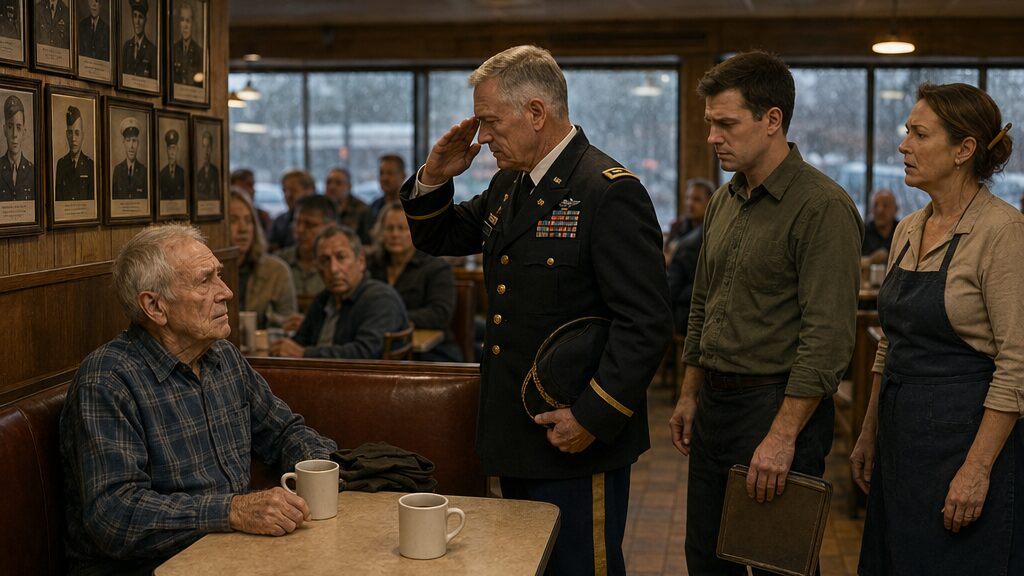
The little bell above it gave a thin metallic shake. Rain smell entered first, then a man in a dark dress uniform stepped inside and paused on the mat. His cap was tucked beneath one arm. His jacket held ribbons and polished brass that caught the diner lights in brief, disciplined flashes. He was older, square-shouldered, with a face made stern by years of having to keep it that way.
Mark did not turn at first. He was still looking at Joshua’s hand, suspended inches from the second cup.
Then the diner changed.
It was not silence. Not yet. Plates still moved, the grill still hissed, the rain still ticked against the glass. But something in the uniform drew eyes the way a flag draws wind. Katherine straightened. Joshua pulled back his hand.
The officer took two steps into the diner, scanning the room with the calm of a man accustomed to entering unfamiliar places and understanding them quickly.
His eyes passed over the counter, the waiting customers, the booths.
Then he saw the wall above Mark.
His movement stopped.
Mark heard the pause more than saw it. A break in rhythm. A held breath where a stranger’s footsteps should have been.
Slowly, the officer’s gaze lowered from the faded photograph to the old man seated beneath it, one hand still guarding the white mug across the table.
The officer’s expression changed by almost nothing.
But Mark knew small sounds, small shifts, small silences.
And in that silence, he knew he had been recognized.
Chapter 2: The Salute That Silenced The Diner
Joshua Hall had never seen a room go still because of one man’s face.
He had seen the diner quiet for spilled coffee, for a dropped plate, for arguments at the register, for the old radio above the grill cutting out during a storm. But this was different. The customers did not stop all at once. They slowed, as if each person sensed the change through someone else and then passed it along.
The officer stood halfway between the door and Booth Seven, rain darkening the shoulders of his uniform coat. His cap remained under his arm. He looked first at the photograph above the booth, then at Mark Thompson, then back to the photograph.
Joshua turned and looked too, though he had seen that wall a hundred times without really seeing it.
The frame above Mark held two young soldiers, shoulder to shoulder in washed-out sunlight. One had a narrow face and serious eyes. The other was broader through the jaw, his mouth held in a line that could have become a smile if someone had asked at the right moment. Beneath the glass, the label had faded unevenly. Joshua could make out only pieces.
Thompson. King.
Or maybe he imagined the first name because the old man below the frame was named Thompson.
“Sir,” Joshua said to the officer, unsure whether he was greeting him or asking what was wrong.
The officer did not answer immediately.
He stepped closer to the booth. His shoes made no squeak on the damp floor. At the table, Mark’s hand moved away from the second mug and returned to his own. He did not rise. He did not smile. He looked, to Joshua, almost tired of what was about to happen.
The officer stopped at the end of the booth.
“Mr. Thompson,” he said.
Mark’s eyelids lowered once. “Morning.”
Joshua glanced between them. Katherine stood near the aisle, one hand resting against the back of a chair. Customers at the front had stopped pretending not to watch.
The officer’s eyes moved to the second cup.
Then to the wall.
Then to Mark again.
“It’s been a long time since I heard anyone say it the way you did,” the officer said quietly.
Mark looked down into his coffee. “Say what?”
The officer’s mouth tightened, not with displeasure but with memory. “‘After the coffee cools.’”
Joshua felt heat rise behind his collar. It had sounded stubborn when Mark said it to him. Like a delay. Like an old man building a wall out of a sentence.
The officer heard something else.
Mark’s fingers tightened around the mug handle. “People say all kinds of things.”
“Not that way.”
The officer shifted his cap to his left hand. His right hand came up, not quickly and not for effect. He brought it to the brim line that was not there, holding the salute with the precision of long practice and the restraint of someone who understood it was not a performance.
The diner silenced completely then.
Joshua felt it in his chest.
The grill hissed behind the counter. Rain threaded down the windows. Somewhere, a child whispered and was hushed.
Mark sat beneath the salute in his plaid shirt, his shoulders slightly stooped, his face turned partly toward the table. For one uneasy second, Joshua thought Mark might ignore it, and that frightened him more than anger would have. Then Mark placed his own mug down carefully, aligning it with the edge of the table as if that small order mattered.
He looked up.
His eyes were not wet. They were steady, but the steadiness cost him something.
The officer held the salute.
Mark gave the faintest nod.
Only then did the officer lower his hand.
Katherine drew a breath she must have been holding. Joshua looked at Mark’s coffee, then the untouched cup, then the Reserved sign he had placed between them. The sign looked loud now. Absurd. A little plastic command in a place where something older had been sitting quietly for years.
“I didn’t know,” Joshua said.
The words came out before he knew who he was saying them to.
Mark did not look at him. “Most people don’t.”
The officer turned toward Joshua then, not harshly. That was worse. Harshness Joshua could have defended against.
“Is there a reason this gentleman is being moved?”
Joshua swallowed. “We’re clearing the wall. The booth. We’ve got customers waiting, and the contractor—”
Katherine stepped forward. “It’s my renovation. Not his decision alone.”
The officer looked up at the wall. “These photographs belong to the diner?”
“They’ve always been here,” Katherine said. “I was going to restore them. New frames. Proper labels.”
At the word labels, Mark’s eyes lowered.
Joshua noticed it this time.
The officer noticed too.
He turned back to the photograph above Booth Seven. “May I?”
Katherine nodded.
He moved close enough to read the fading label. Joshua watched his face as he studied it.
“What is it?” Joshua asked.
The officer did not answer at first. He looked at Mark.
Mark’s voice was low. “Leave it.”
“Mr. Thompson—”
“Charles,” Mark said.
Joshua looked at the officer, startled by the use of his first name. The officer seemed no less startled, but he accepted it. Something passed between the two men, not friendship exactly, but recognition traveling both directions.
Charles Anderson lowered his voice. “This isn’t right.”
Mark gave a small shrug. “It’s old.”
“That doesn’t make it right.”
The words settled over the booth.
Joshua stepped closer despite himself. “What isn’t right?”
Mark finally turned to him. His face held no triumph, no satisfaction at having made the younger man feel small. If anything, he looked sorry that Joshua had become part of it.
“The coffee’s cold,” Mark said.
Joshua stared, confused.
Mark touched the second mug with two fingers and pushed it an inch toward the empty side of the booth. “That was all I asked for.”
Katherine’s eyes moved from the cup to the photograph. “Mark, who is in that picture with you?”
Mark’s expression closed gently.
Charles answered, but not with the full story. “A man whose name should not be forgotten.”
The simple sentence made Joshua feel the shape of what he had almost done: not moved an old customer, not cleared a booth, but interrupted something he had not cared enough to understand.
“I’m sorry,” Joshua said.
Mark looked at the Reserved sign again.
Joshua snatched it off the table too quickly, almost bending it. “I’m sorry,” he said again, quieter.
A regular at the counter cleared his throat and turned back to his coffee. The customers near the door began to look at anything except the booth. Katherine stepped aside, creating space without announcing that she was doing it.
Charles remained standing by the table.
Mark picked up his own mug. His hand trembled once, then steadied.
“You came for coffee,” Mark said.
“I did.”
“Then sit somewhere.”
Charles looked at the empty side of Booth Seven, where the second cup waited.
Mark did not invite him.
Charles understood and chose the next booth instead.
Joshua moved as if waking. “I’ll bring you a fresh cup.”
Mark shook his head. “Not that one.”
Joshua stopped.
“Leave that one,” Mark said.
The assistant manager nodded, though he did not yet understand.
Charles sat in the next booth, still facing Mark and the wall. He accepted a menu from the young server without reading it. The diner resumed itself unevenly. Forks lifted. Chairs scraped. The cook rang the bell once and then, perhaps sensing the room, did not ring it again.
Joshua went behind the counter and took one of the white mugs from the stack. His fingers hesitated over the handle. For the first time, he noticed the small chips along some rims, the faint scratches from years of spoons, the way the mugs were not identical even though he had always thought they were.
He poured coffee for Charles and carried it carefully.
When he set it down, Charles said, “Thank you.”
Joshua nodded. His mouth felt dry. “Sir, how did you know him?”
Charles looked past him to Mark.
Mark was watching the rain now, not the room. One hand rested beside the untouched cup as if keeping company with it.
Charles said, “Not from fame, if that’s what you’re asking.”
Joshua flushed.
“I wasn’t—”
“You were,” Charles said, not unkindly. “Most people do.”
Joshua looked toward the photograph again. “Then from where?”
Charles waited until Mark turned his head slightly. Not enough to join the conversation. Enough to warn him.
The officer lowered his voice. “From a record. From a phrase. From a face I was told to look for if I ever passed this town.”
Mark’s jaw moved once.
“Charles,” he said.
The officer stopped.
Mark looked at him fully now.
“Don’t tell it like that.”
Chapter 3: The Photograph They Almost Took Down
Katherine Wright had bought the diner with a leaking roof, a loyal breakfast crowd, and a wall of men she could not name.
The old owner had called it history. The realtor had called it character. The contractor, who arrived late that Saturday with a tool belt and rain on his boots, called it “a lot of dust.” Katherine had smiled each time because smiling was easier than admitting that she had never known what responsibility came with owning walls.
Now she stood in the narrow storage hallway with a stack of empty frames waiting on a folding table, and Mark Thompson’s words followed her there though he had spoken only a few of them.
Don’t stack it with the others.
The hallway smelled of cardboard, bleach, and old fryer oil that had worked itself into the building long before she owned it. Joshua had taped paper labels to three plastic bins: KEEP, COPY, REPLACE. He had done it before breakfast, proud of the clean system. Katherine had approved it. At the time, it had seemed respectful.
Now the bins looked like a mistake made in block letters.
The contractor waited near the wall with a flat pry bar. “You want these down or not?”
Katherine looked through the doorway toward the dining room. Mark was still at Booth Seven. Charles Anderson sat one booth over, coffee untouched now, uniform jacket neat, hands folded. Joshua moved around them with unnatural care, as if the floor had become thin ice.
“Give me a minute,” Katherine said.
The contractor sighed but stepped back.
Katherine climbed onto the short step stool herself.
The frame above Booth Seven was fastened tighter than the others. Dust feathered along the top edge. When she touched the wood, a faint brown line marked her fingers. The glass was clouded from the inside, or maybe from years of being wiped with the wrong cloth. She lifted it from the bent nail and felt the weight of it.
Not heavy.
Not light either.
Mark watched from below.
“I’m not throwing it away,” she said.
“I know.”
His calm made it worse. If he had accused her, she could have defended herself. If he had been angry, she could have apologized in the broad, practical way business owners apologize when a customer is upset. But Mark only looked at the frame as if it were being moved from a place it had earned.
Katherine carried it into the storage hall.
Under the fluorescent light, the photograph looked more fragile. The two young men in it seemed both impossibly young and already gone. One had Mark’s eyes. Not exactly the face, not after all the years between them, but the eyes were there. Controlled. Watchful. Holding back something the camera had not asked to see.
Beneath the photograph, the label was worse than Katherine had realized.
The typed names had faded, but they were still partly readable. The first line seemed to say Mark Thompson. The second had been smeared by an old brown stain, leaving only pieces of another name. The last name looked like King, or maybe it had become King because some later hand had filled in what it expected to find.
Katherine rubbed the glass with her sleeve.
Behind her, Joshua said, “Careful.”
She turned. He had followed her into the hall, carrying two other frames. His face still held the stunned look from the salute.
“I am being careful,” she said.
“I know. I just—” He stopped. “I don’t know.”
Katherine set the frame flat on the folding table. “Neither do I.”
That admission sat between them.
In the dining room, a burst of laughter rose from a table and died quickly, as if the customers remembered the morning had changed shape. The contractor’s drill whined once, then stopped when Katherine looked out sharply.
“Not yet,” she called.
The contractor raised both hands.
Joshua placed the other frames on the table. “I thought he was just being difficult.”
Katherine studied the label. “So did I.”
“You didn’t ask him to move.”
“I sent you.”
He looked at her then.
She did not look away.
It would have been easy to tell him she had been busy, that managers delegated, that the breakfast rush did not pause for memory. All of that was true. None of it mattered.
Katherine touched the lower edge of the frame. A coffee stain had seeped under the label years ago, leaving a ring-shaped shadow near the corner. She thought of the white mug across from Mark, untouched and cooling, while people waited for pancakes and booth space.
“Has he always ordered two?” she asked.
Joshua nodded. “The server said every Saturday.”
“Did you know?”
“I mean, I noticed. I didn’t think it was…” He glanced toward the dining room. “I didn’t think it was anything.”
Katherine closed her eyes briefly.
Running the diner had trained her to notice shortages, complaints, waste, overtime, the cost of eggs, the number of napkins used on Sundays. She knew which regular tipped in quarters and which booth needed the screw tightened. She knew Mark liked his coffee black and never wanted the check brought early.
But she had not known the second cup mattered.
That ignorance felt less like a lack of information than a failure of attention.
Charles appeared at the hallway entrance. He did not enter until Katherine saw him.
“May I?” he asked.
The question itself changed something in her. He did not reach for the frame. He did not lean over it as if authority gave him ownership. He asked.
Katherine nodded. “Please.”
Charles stepped close and looked down at the photograph. His uniform seemed too formal for the storage hallway, for the bleach smell and stacked paper towels and spare ketchup boxes. Yet he handled the moment with less ceremony than Katherine would have expected. He simply stood still.
“That’s him,” Joshua said softly.
Charles glanced at him. “Yes.”
“And the other man?”
Charles’s eyes returned to the label. “That is the question.”
Katherine felt a chill move through her arms. “You don’t know?”
“I know what I was told. I don’t know what this wall says.”
Joshua leaned over the label. “It says Mark Thompson and—” He squinted. “Something King.”
Charles’s face tightened. “Does it?”
Katherine looked again. The old stain had made the letters uncertain. The more she stared, the less sure she became. The label might have been wrong for years. It might have been right once and damaged later. It might have been corrected by someone with good intentions and bad memory.
“Mark said one name was missing,” Katherine said.
Charles looked toward the dining room.
At Booth Seven, Mark sat alone now. The second mug remained across from him. His shoulders were slightly curved, not collapsed, as if he had learned long ago how to carry weight without letting it spill.
Katherine turned back to the table. Around the frame, other photographs waited in their stacks. Men in dress uniforms, work uniforms, flight jackets, fatigues. A few women too, tucked near the bottom row where later owners had added frames wherever space allowed. Some labels were typed. Some handwritten. Some had no labels at all.
She had planned to take them all down, scan them, print clean copies, and hang them beneath a new sign. HONORING OUR LOCAL HEROES. The phrase had seemed harmless when the sign company suggested it.
Now it sounded like something that could cover a wound without cleaning it.
“Maybe we should pause the wall,” Joshua said.
Katherine nodded slowly. “Maybe we should.”
The contractor poked his head into the hall. “Lady, I’ve got another job after this.”
Katherine looked at the frame, then at the bins labeled KEEP, COPY, REPLACE.
“No wall work today,” she said.
He frowned. “You still owe the call-out.”
“I know.”
When he left muttering, Joshua let out a breath.
Katherine picked up the frame again, intending to carry it somewhere safer than the folding table. As she lifted it, the backing shifted loose. Something inside slipped half an inch: not the photograph, but a second piece of paper tucked behind it.
Joshua saw it too.
“Wait,” he said.
They set the frame back down. Charles did not move to interfere.
Katherine turned the small metal tabs one by one, careful now in a way she had not been when the morning began. The backing came free with a dry whisper. Behind the photograph lay another label, older than the one on the front, browned at the edges and folded once.
Joshua unfolded it.
Katherine watched his face change.
“What?” she asked.
He held the paper under the light.
There, in faded type, was Mark’s younger face matched with a name that was not his.
And beneath it, partly hidden by the crease, another name had been crossed out so lightly it was almost still there.
Chapter 4: The Name Beneath The Wrong Face
By Sunday afternoon, the diner looked less like a place that fed people and more like a room waiting to confess something.
The chairs were upside down on the tables. The blinds were half closed against a pale, wet light. Without the breakfast crowd, every old sound had room to show itself: the refrigerator’s low hum, the tick of the wall clock losing its seven minutes, the drip from the coffee machine no one had remembered to empty. Joshua Hall stood at the sink behind the counter with his sleeves pushed to his elbows, washing the white mugs one by one.
He had volunteered to come in.
Katherine had asked if he was sure, because Sundays were his only full day off, and he had said yes too fast. He did not know how to explain that staying home would have been worse. At home, he would have seen Mark’s hand covering the second cup every time he closed his eyes. He would have heard his own voice asking an old man to move as if all grief had to do was make room for paying customers.
So he washed mugs.
The one from Booth Seven was easy to recognize now. It had two small chips near the rim, one shaped like a half moon, the other no bigger than a grain of rice. He had probably carried it dozens of times without noticing. That bothered him more than it should have. A mug could be chipped for years in a man’s hand, and Joshua could still call himself observant because he knew how many pancakes a family of four usually ordered.
He dried it with a towel and set it apart from the others.
In the dining room, Katherine had spread the old photographs across three tables, no longer using the bins labeled KEEP, COPY, REPLACE. Those bins were stacked by the back door now, empty and somehow ashamed. The frame from above Booth Seven lay open on the table closest to the wall. The old label rested beside it under a glass salt shaker so the ceiling fan would not disturb it.
Joshua had read it five times.
The more he read it, the less simple it became.
The typed label on the front had put Mark Thompson under the wrong face. Or maybe, years ago, someone had mounted the photograph crooked behind the mat and lined the names up badly. The older paper hidden behind the backing showed two names, but one had been lightly crossed out, as if the correction itself had been made by someone afraid to press too hard.
Katherine stood with her arms folded, staring down at it.
“We can fix this today,” Joshua said.
She looked up. “Can we?”
“I mean physically. New label, new backing. We know this one is Mark.” He touched the air above the broader young face in the photograph, careful not to touch the print. “And the other one is King. Or at least the last name.”
Katherine’s mouth tightened. “A last name is not a person.”
Joshua looked away.
The back door opened before he could answer. Mark Thompson came in slowly, not because he had been invited formally, but because Katherine had called and said they found something he should see. He wore the same plaid shirt under a dark jacket and carried his cap in one hand. Rain had silvered the shoulders of his coat.
Charles Anderson followed behind him. Out of uniform today, he looked less like a figure from another world and more like an older man who had slept badly. His posture remained exact.
Joshua straightened. “Mr. Thompson.”
Mark looked at the mug set apart near the sink.
Joshua almost apologized again, but the word had begun to feel too easy. He dried his hands instead.
Katherine turned the frame toward Mark. “We didn’t want to change anything without you.”
Mark walked to the table. He stood over the photograph for a long moment. His face did not move much. That was what Joshua had learned to watch for now—the small places where emotion did not go because Mark would not let it.
Charles stayed near the end of the counter.
Katherine said, “The label on the front is wrong.”
Mark nodded.
“You knew?”
“Yes.”
Joshua’s chest tightened. “For how long?”
Mark looked at him. “Long enough.”
The answer was not unkind, but it closed a door.
Joshua tried another one. “Then we’ll fix it. We’ll make a proper label. I can print it now. We’ll put your name under your photo and King’s under his. We’ll—”
“No,” Mark said.
The word was quiet, but it stopped Joshua as cleanly as a hand raised in traffic.
Katherine frowned. “Mark, if it’s wrong, we should correct it.”
“You should know what you’re correcting.”
“We can ask the county office,” Joshua said. “Or records. Charles said there are records.”
Charles did not move.
Mark looked at him. “He said too much.”
Joshua felt the sting of that, though it was not aimed at him.
“I’m not trying to make this worse,” Joshua said. “I just don’t want it sitting there wrong.”
Mark’s eyes shifted to him then. For the first time since Saturday, Joshua felt truly looked at.
“Why?” Mark asked.
Joshua opened his mouth.
Because it was embarrassing. Because customers had seen the salute. Because Katherine’s diner could not have a wrong veterans wall during a renovation. Because he wanted to undo the moment when he had reached for the cup. Because if he fixed the label, maybe he could become the kind of person who had not needed Charles Anderson to make him notice an old man.
None of those answers were good enough.
“It shouldn’t be wrong,” he said at last.
Mark studied him. “That’s closer.”
Katherine pulled out a chair. “Mark, please sit.”
He did, but not at Booth Seven. He sat at the table with the open frame, leaving one chair between himself and the photograph. Joshua carried the chipped white mug over without filling it and set it near his hand.
Mark glanced at it.
Joshua said, “I didn’t know whether you wanted coffee.”
Mark touched the mug handle once. “Not yet.”
Katherine sat across from him. “Tell us what we need to know.”
Mark looked at the photograph as if it were a window into a room he had chosen not to enter for a long time.
“That picture was taken before we shipped out,” he said. “They asked us to stand still. He couldn’t. He kept shifting his weight because he had a blister from new boots and wouldn’t admit it.”
Joshua looked at the narrow-faced young man in the photograph. The one whose last name might have been King.
“He was your friend,” Katherine said.
Mark nodded.
“And someone put his name under your face?”
“After the fire.”
Joshua looked up. “What fire?”
“The diner had a kitchen fire years back,” Katherine said softly. “Before I bought it. Some of the records were damaged.”
Mark kept his eyes on the frame. “Old owner tried to put the wall back together from memory. He meant no harm.”
“And you never corrected him?” Joshua asked.
“I did.”
The room seemed to narrow.
Mark lifted one finger and placed it lightly near the crossed-out name on the older paper. “He changed it once. Then changed it back when someone told him another version. Then the label got stained. Then he got sick. Then his daughter ran the place for a while and didn’t want to touch anything. After that, people stopped asking.”
Joshua felt something inside him shift from shame to a heavier thing. Shame was about himself. This was about the years during which Mark had sat beneath the wrong label, saying the truth softly enough that the world could ignore it.
“Why keep sitting there?” Joshua asked.
Mark leaned back slightly. “Because leaving doesn’t correct a thing.”
Katherine looked down.
Joshua picked up the towel from the counter, though his hands were dry. “Then let us correct it now.”
Mark’s gaze returned to him. “Not with a big sign. Not with a breakfast special. Not with someone putting my name in front because a man in uniform saluted me.”
Katherine’s face colored. “I wasn’t going to use you like that.”
Mark’s silence was not agreement.
She lowered her eyes. “I didn’t mean to.”
Charles spoke from the counter. “Meaning to isn’t always the line.”
Joshua looked at him. The older man was watching Mark, not Katherine.
Mark stood slowly. “If you want the wall right, start with his name. Not mine.”
Katherine nodded. “We need the full name.”
Mark’s hand closed around the back of the chair.
Joshua thought he might give it then, the missing part, the simple piece that would allow them to print the label and feel useful. But Mark only took his cap from the table.
“I’ll come Saturday,” he said.
Katherine stood. “Mark—”
“Booth Seven,” he said. “Before opening.”
Then he walked toward the door.
Joshua stepped aside to let him pass. As Mark reached the back entrance, Charles followed him out into the thin rain. Joshua waited until the door closed before he breathed.
Katherine stayed by the table, looking older than she had that morning.
Joshua lifted the chipped mug and carried it back to the sink. He washed it again though it was already clean. He ran his thumb carefully around the half-moon chip and imagined Mark’s hand finding that same place every Saturday.
Behind him, the front door opened once more.
Charles had returned alone.
Rain darkened his collar. He looked at the open frame, then at Joshua, as if deciding how much the younger man had earned.
“He’s been correcting that name quietly for years,” Charles said.
Joshua’s hand tightened around the mug.
Charles added, “And most people just kept serving the coffee.”
Chapter 5: The Coffee Was Never For Him Alone
Mark arrived before Katherine unlocked the front door.
He stood under the diner awning in the gray-blue hour before sunrise, cap pulled low, shoulders angled against a wind that carried the smell of wet pavement and old leaves. Inside, one light glowed above the counter. Through the glass, he could see chairs still upside down on tables and the veterans wall half bare, pale rectangles marking where frames had hung for years.
It looked wrong.
Not ruined. Not yet. Just exposed.
Katherine opened the door with keys still in her hand. She did not greet him too brightly. He appreciated that.
“Morning, Mark.”
“Morning.”
She stepped aside. “Joshua’s here.”
“I saw his car.”
“And Charles.”
Mark paused.
“He said he’d stay in the back unless you wanted him.”
That, too, Mark appreciated.
He entered the diner. Without customers, Booth Seven seemed less like a booth and more like a question waiting in the corner. The table had been wiped clean. No Reserved sign. No tools. No stack of frames on the seat. The empty wall above it held one nail, bent slightly upward, still in place.
Mark removed his cap and sat.
His knees complained. His left hand trembled when he placed the cap beside him, so he covered it with his right until both were still. Age had made small betrayals of his body, but he had learned not to quarrel with all of them in public.
Joshua came from behind the counter carrying two white mugs.
Not one.
He walked more slowly than usual. The pot steamed in his other hand. At the booth, he hesitated.
“May I?”
Mark looked at him.
The question had not cost Joshua much, maybe only a second. But the second mattered.
Mark nodded.
Joshua set one mug in front of him and one across from him. He poured the first, then looked at Mark before filling the second.
Mark nodded again.
Coffee rose dark and fragrant in both cups.
Joshua set the pot on the table, then seemed to realize he should not leave it there and picked it up again. He was nervous, and Mark found that he did not dislike the boy for it. Nervous meant he understood the ground had changed.
Katherine stood by the end of the booth with the open frame held against her chest. Charles remained near the kitchen doorway, far enough back to keep his promise.
Mark wrapped both hands around his mug.
For a while, no one spoke.
The second coffee steamed across from him. In that early light, it looked almost like every other Saturday. Almost.
Katherine said, “We don’t need everything today.”
Mark gave a faint breath that might have been amusement. “People always say that when they need the hardest part.”
She accepted it without defense.
Joshua took a small folded paper from his apron pocket. “I found three possible records for the last name King. County clippings, old donation lists, one photo from a Memorial Day event. But none of them matched exactly. I didn’t want to guess.”
Mark looked at the folded paper but did not reach for it.
“Good,” he said.
Joshua’s shoulders lowered a little.
Katherine slid into the booth beside no one, not across from Mark, not in the empty seat, but on the aisle side. “What should the label say?”
Mark looked at the second cup.
The surface had not yet cooled. A thin ring of steam lifted and vanished.
“He hated cold coffee,” Mark said.
No one moved.
“He would drink anything else cold. Soup. Beans. Rainwater from a canteen if he had to. But not coffee. Said cold coffee made a man feel abandoned.”
Joshua looked down.
Mark’s mouth pressed into a line, not quite a smile. “He said a lot of things.”
“What was his name?” Katherine asked softly.
Mark’s fingers tightened on the mug.
He could have said only the name. That was what they needed. A word to put under glass. A correction. A clean line on a new label. He had come prepared to say it and leave.
Instead, he heard the old voice in the back of his mind, complaining about boots, laughing too loud when everyone else was trying to sleep, saying after the coffee cools as if time itself could be bargained with.
“His last name was King,” Mark said. “You have that part.”
Katherine waited.
Mark looked toward the bare wall. “We were young enough to think being remembered meant someone would tell the story right. Later I learned most people don’t have the whole story. They carry what pieces they can.”
Charles stepped no closer, but Mark could feel his attention from the kitchen doorway.
“We were told to hold a road until a convoy cleared,” Mark said. “That’s all I’ll say about that part.”
Joshua did not write. Katherine did not interrupt.
“He made coffee in a little dented pot that had no business surviving anything. Burned it every time. Swore it was perfect every time. The morning he didn’t come back, I kept his cup hot until I couldn’t.”
The diner seemed to take the words into its walls.
Mark looked at the second mug.
“When I came home, people wanted to ask bigger things. What happened. What was it like. Did I know this man or that man. They wanted dates, places, pieces they could put in the paper. I didn’t have clean pieces.”
He rubbed his thumb along the handle of his mug.
“Years later, I came in here and saw the photograph. His name was wrong. Mine was wrong. I told the owner. He tried to fix it. Then time did what time does. People moved frames. Labels faded. Coffee spilled. Everyone got busy.”
Katherine’s eyes were wet, but she did not wipe them.
Mark appreciated that too.
“I kept coming because at least his face was still on a wall where people ate breakfast and talked about ordinary things. He would’ve liked that. He liked noise. He liked places where nobody marched.”
Joshua looked toward the empty seat across from Mark.
“The second coffee is for him,” he said.
Mark looked at him.
Joshua’s voice dropped. “That’s why you said after it cools.”
Mark did not answer at once.
Outside, a truck passed on the wet street, tires whispering.
“I wait until it cools,” Mark said. “Then I know I stayed long enough.”
The words were plain. That was the only way he could say them.
Katherine turned the frame in her hands and looked down at the photograph. “We can put both names correctly. Yours and his. No headline. No special display.”
Joshua unfolded his paper. “And we can leave the booth alone.”
Mark looked at him.
“I mean, not untouched forever,” Joshua said quickly. “We still have to repair the seat eventually. But we can ask first. We can do it on a day you’re not—” He stopped himself. “We can ask.”
Mark let that stand.
Katherine said, “I was planning a Veterans Breakfast for next week. Before all this. That’s what the wall was for. New frames, a small program, local veterans invited. I thought it would help the diner and honor the wall.”
Mark’s hand stilled.
“I still want to do it,” she continued, carefully. “But not the way I planned.”
Joshua looked at her, surprised.
Katherine met Mark’s eyes. “Only if you agree.”
Mark’s first instinct was no. It came so quickly it felt older than thought. He saw strangers turning toward him. He saw someone asking him to stand. He saw applause rising like weather he could not stop. He saw his friend’s name used as decoration for a morning special and a newspaper photo.
“No,” he said.
Katherine nodded once, accepting the blow.
Mark looked at the second coffee. It had cooled enough now that no steam rose from it.
“I won’t be displayed,” he said.
Joshua folded the paper slowly.
Katherine said, “Then you won’t be.”
But Mark heard uncertainty beneath her promise, not because she meant to break it, but because people often did not understand how easily honor could become a stage.
He lifted his mug.
Across from him, the second cup sat untouched.
For the first time in years, three people knew why.
Chapter 6: Not A Speech, Not A Trophy
On the morning of the Veterans Breakfast, Katherine left Booth Seven empty.
It cost her three complaints before eight o’clock.
A regular tried to sit there with his newspaper and stopped when Joshua stepped into the aisle. A family of four asked why the best booth was closed when the diner was clearly full. A man near the window muttered that saving seats was bad business. Each time, Joshua answered in the same quiet voice.
“That booth is taken.”
He did not explain. He did not point to the wall. He did not say veteran. He did not say salute. He did not spend Mark’s story to purchase patience from strangers.
Katherine noticed.
She stood behind the counter with a stack of small printed cards she no longer trusted. The first version had said Honoring Mark Thompson and Our Local Heroes. She had thrown those away before sunrise. The new cards simply listed the names beneath the restored photographs, with blank space where a story could have been forced but had not been earned.
Still, the room had a dangerous brightness to it.
The old photographs were rehung in cleaned frames, but not polished into sameness. The chips and stains remained where they did not hide the faces. The label beneath the photograph above Booth Seven had been replaced with two separate names, plain and even. No adjectives. No ranks printed bigger than names. No banner above them.
Charles Anderson sat at the counter in uniform again, at Katherine’s request and Mark’s permission, though Mark had said, “Don’t make the uniform do the talking.”
Local veterans occupied three tables near the wall. Some wore caps. Some wore jackets with patches. Some wore nothing that announced anything at all. Their voices were low, ordinary, threaded with talk about weather, knees, grandchildren, and bad coffee from other places.
Joshua carried plates with unusual care. Every time he passed Booth Seven, empty beneath the corrected photograph, his eyes checked the two mugs waiting there.
Katherine had set them herself, then worried that even that was too much.
“Stop touching them,” Joshua murmured when she adjusted the handle for the third time.
“I’m not touching them.”
“You are.”
She pulled her hand back.
At eight fifteen, Mark entered.
He wore the same dark jacket and plaid shirt, his cap in his hand. The bell over the door sounded thin and bright. For a moment, people looked up with the reflexive curiosity of any diner crowd watching someone arrive late to a full room.
Joshua moved first.
He did not rush. He did not announce him. He simply walked to the end of the aisle and gave Mark space to pass.
“Morning, Mr. Thompson,” he said.
Mark looked at him, then at the empty booth.
“Morning.”
Charles stood at the counter.
A few heads turned toward the movement. Katherine felt her whole body tighten, fearing a salute, fearing the room rising, fearing the story turning into exactly what Mark had refused. But Charles only stood straighter and gave Mark a small nod, the kind one man could give another without asking the room to witness it.
Mark returned it.
Then he walked to Booth Seven and sat down.
The diner resumed breathing.
Joshua came with the coffee pot. He poured Mark’s cup first. Then he paused before the second.
Mark looked at him.
Joshua asked, “May I?”
Mark nodded.
The second cup filled.
Katherine held the printed cards against her apron and waited until the plates had gone out, until no one was standing, until the room’s attention had loosened. She had planned to say a few words. Not a speech, she had promised herself. Just enough to explain why the wall looked different.
Now, with Mark seated beneath the photograph, every sentence she had prepared felt too large.
She stepped into the dining room.
“Thank you all for coming,” she began.
Mark’s eyes lowered to his mug.
Joshua stopped near the counter.
Katherine looked at the cards in her hand and saw suddenly how easily paper could become a stage. She saw Mark’s hand covering the second cup. She saw the wrong label under the right face. She saw herself telling Joshua to move him because customers were waiting.
She set the cards on the nearest table.
“We corrected some names on the wall,” she said. “Some were faded. Some were wrong. If anyone here knows of another correction, please tell us. We’ll listen before we print anything.”
That was all.
The room waited for more.
Katherine almost gave it to them. The silence invited her to fill it with noble words. She had always been good at filling uncomfortable silence; owning a diner required that. But this silence did not belong to her.
She stepped back.
A veteran near the wall nodded once and returned to cutting his eggs.
Joshua exhaled so softly only she heard it.
Then a man at Table Three turned in his chair and looked toward Booth Seven. “Is that the gentleman from the photograph?”
The room shifted.
Mark’s hand moved around his mug.
Joshua stepped forward before Katherine could decide what to do. “The wall has names,” he said evenly. “If you want to read them, you’re welcome to. Mr. Thompson is having breakfast.”
It was not rude. It was not dramatic. It was a door quietly closed before anyone could walk through it without permission.
Mark looked at Joshua.
The younger man did not look back for praise.
Katherine felt something in her chest loosen and ache at once.
The man at Table Three gave an embarrassed nod. “Of course.”
For several minutes, breakfast continued. Forks clicked. Coffee poured. The cook muttered about toast. The wall held its names without requiring anyone to perform reverence beneath it.
Then Mark stood.
Not quickly. His hand pressed the table once before he rose. Joshua took a step as if to help, then stopped himself. Mark noticed. That mattered.
The room quieted anyway.
Mark did not move toward the center of the diner. He did not face the people. He turned toward the wall above Booth Seven.
Katherine saw the problem at once.
The frame was level. The glass was clean. The label was correct.
But the photograph was not in the place it had occupied before. During rehanging, the contractor had placed it one nail to the left, aligning it with the new row. It looked better that way. More balanced.
It was not where Mark had looked all those years.
Mark reached for the frame.
Joshua moved beside him. “Do you want me to—”
“No.”
Joshua stopped.
Mark lifted the frame down himself. His hands trembled, and Katherine had to force herself not to help. The room watched, but he did not look at the room. Charles remained still at the counter, jaw set, eyes fixed on the floor in front of him as if guarding Mark’s privacy by refusing to stare.
Mark moved the frame back to the bent nail above Booth Seven.
The old nail sat slightly apart from the new arrangement. Using it broke the clean line Katherine had paid the contractor to measure. The photograph now hung a fraction lower than the others.
It looked right.
Mark adjusted it with two careful fingertips. Then he stepped back.
Katherine waited for him to speak. So did everyone else. She could feel the waiting gather, eager and dangerous.
Mark turned, not toward the room but toward Katherine.
“Leave it there,” he said.
“I will,” she answered.
He looked at Joshua.
The young man nodded. “We will.”
Mark returned to the booth and sat down. The effort had tired him; Katherine could see it in the way he hid one hand beneath the table.
The room did not applaud.
Perhaps Charles’s stillness prevented it. Perhaps Joshua’s warning had. Perhaps, for once, people understood that not every meaningful thing needed noise around it.
Mark lifted his coffee.
Across from him, the second cup waited in its old place beneath the photograph.
Katherine picked up the printed cards and carried them behind the counter. She dropped them into the trash without ceremony.
Joshua saw her do it.
Later, he would ask what should replace them.
For now, he took the coffee pot, walked to Booth Seven, and stood beside Mark with a question in his posture rather than an announcement in his mouth.
Mark looked up.
Joshua said, “Warm yours?”
Mark glanced at the second cup, then back at Joshua.
“Mine,” he said.
Joshua filled only Mark’s mug. Then he stepped back without touching the other.
For the first time that morning, Mark’s face softened.
Not much.
Enough.
Chapter 7: The Cup Placed Back With Care
After the frame was returned to the bent nail, the diner learned how to be quiet without becoming stiff.
It did not happen all at once. A fork clicked too loudly against a plate. Someone coughed and looked embarrassed for having a throat. The cook, unable to bear the hush for long, slid an order into the window and muttered that eggs still turned cold whether people were being respectful or not. That helped. A few people smiled into their coffee. Chairs shifted. The room resumed itself, not the way it had been before, but close enough to breathe.
Mark sat at Booth Seven with his mug in both hands.
The photograph above him hung slightly lower than the others. The new label beneath it was plain, black letters on cream paper. Two names, each under the correct face. No flourish. No title larger than the men. No word like hero trying to carry what it could not possibly hold.
Mark Thompson.
King.
The missing first name had been added that morning, but Mark did not look at it long. He had looked at it enough when Katherine showed him before the doors opened, her fingers holding the label by the edges as if it were something breakable. He had read it once. Then he had asked her to put it where it belonged.
Now he looked at the coffee.
Joshua came by with the pot again after the breakfast plates were cleared. He stopped at the edge of the booth, not stepping into the space between Mark and the wall.
“Warm yours?” he asked.
Mark nodded.
Joshua filled the cup carefully. Steam rose again, thin and white.
Then the young man looked at the second mug across the table. Its coffee had gone still and dark. A faint ring had formed near the porcelain edge.
Joshua did not reach for it.
He did not ask too quickly.
Mark watched him learn the shape of the silence.
After a moment, Joshua said, “Would you like me to leave that one?”
Mark’s thumb rested near the half-moon chip on his own mug. The question was simple, and because it was simple, it found the place in him that speeches missed.
“For now,” he said.
Joshua nodded. “For now.”
He stepped back.
Across the room, Katherine was taking down the printed menu insert for the Veterans Breakfast. She had crossed out the heading before anyone saw it, then replaced it with the regular breakfast page. Pancakes. Eggs. Toast. Coffee. Ordinary things. Mark liked that. A man could be grateful for ordinary things after learning how easily the world could lose them.
Charles sat at the counter, his uniform jacket buttoned, cap beside his plate. He had not saluted again. Mark was grateful for that too.
When their eyes met, Charles lifted his coffee slightly. Mark returned the gesture, barely.
No one else needed to understand it.
The morning thinned. The local veterans paid their checks one at a time, some stopping at the wall, some not. One older man removed his cap near the photographs, then put it back on and left without a word. A woman in a faded jacket traced the air near a name but did not touch the glass. The man from Table Three walked past Booth Seven on his way out and slowed as if he wanted to say something. Joshua appeared beside the register just then and asked whether he needed a receipt. The man took the offered distraction and left quietly.
Mark noticed.
So did Katherine.
Near ten, she came to the booth with her apron folded over one arm. She did not sit. “I kept the old label,” she said.
Mark looked up.
“It’s in an envelope in the office. The wrong one and the older one behind it. I didn’t know whether to throw them away.”
“Don’t.”
“I won’t.”
He took a sip of coffee.
She glanced at the second mug. “Do you want the wall left exactly as it is?”
“No.”
The answer surprised her.
Mark looked toward the row of photographs. “Fix what needs fixing. Clean the glass. Ask about the names. Don’t make them all match just so the wall looks new.”
Katherine nodded slowly. “All right.”
“And the booth seat needs work.”
Her mouth softened. “It does.”
“Do it on a Tuesday.”
“Tuesday?”
“I don’t come Tuesdays.”
She looked down for a moment, not hiding a smile but keeping it small enough for him. “I’ll do it on a Tuesday.”
Joshua returned with a towel, wiping a clean patch of counter that did not need wiping. He had been doing that often, Mark had noticed. Work gave the young man somewhere to put discomfort until it became something better.
Katherine turned to him. “Joshua, make a note. Booth Seven repair on a Tuesday. Ask Mark before scheduling.”
Joshua nodded. “I will.”
Mark set his mug down. “You don’t have to ask me everything.”
Joshua met his eyes. “No, sir. Just the things that are yours.”
The words were not perfect. They were careful, and that mattered more.
Katherine left them then, carrying dishes toward the kitchen.
Joshua stayed a second longer. “Mr. Thompson?”
Mark waited.
“I wanted to say—” Joshua stopped, looked at the wall, then started again. “I’ve been thinking about the difference between making something right and making myself feel better.”
Mark did not help him.
Joshua accepted that too. “I think I mixed those up.”
The diner sounds moved around them: water running, plates stacking, the bell over the door opening for a late customer.
Mark looked at the second cup. “Most people do.”
Joshua breathed out through his nose, almost a laugh but not quite. “Do you want me to know anything else? About him?”
Mark’s first answer rose from habit.
No.
It had protected him a long time, that answer. It had kept strangers from turning memory into a performance. It had kept grief from being handled by people with loud voices and careless hands.
But Joshua’s hands were still now. Waiting.
Mark looked at the name beneath the photograph. Not the whole wall, not the room. Just the corrected name.
“He cheated at cards,” Mark said.
Joshua blinked.
Mark continued, eyes on the mug. “Badly. Everybody knew. He thought we didn’t. Took three weeks before someone told him we were letting him win because he sulked when he lost.”
A small smile broke across Joshua’s face before he could stop it.
Mark looked at him, warning and permission both.
Joshua softened the smile into something quieter. “He sounds like trouble.”
“He was.”
The word carried warmth this time.
Joshua nodded once, as if that single detail had been entrusted to him and not collected.
He did not ask for more.
That was the moment Mark felt something in the morning settle.
Not heal. He distrusted that word when people used it for old things. Some absences did not close. Some promises did not end because a name had been corrected and a cup had been handled with care. But the weight shifted. It moved from one hand to two, from one corner booth to a wall that might finally remember without asking him to bleed for it in public.
Charles came to the booth before leaving. He stood where Joshua had stood, leaving the empty side untouched.
“Mark,” he said.
Mark looked up.
Charles held his cap in both hands. “Thank you for allowing me to be here.”
Mark studied him. “You drove out for coffee.”
“I did.”
“Then next time, sit at the counter. Coffee’s faster there.”
Charles’s expression eased. “Yes, sir.”
He did not salute. He put on his cap, gave the photograph one brief look, and walked out into the late morning.
Katherine turned the sign in the door from breakfast service toward closing prep, though a few customers remained. Sun had finally broken through the rain, touching the windows and making the tabletops shine in uneven squares.
Joshua came once more to Booth Seven.
The second cup had gone cold.
This time Mark lifted his eyes before Joshua asked.
“You can take it now,” he said.
Joshua reached for the mug, then stopped. “May I?”
Mark nodded.
Joshua picked it up with both fingers around the handle, steady and unhurried. He did not stack it inside another cup. He did not pour it out at the table. He carried it behind the counter as if ordinary care could become a kind of answer.
Mark watched him rinse it, wash it, dry it, and set it on the shelf apart from the others.
Not displayed.
Ready.
When Joshua returned, he brought no fresh coffee. Only the check, folded face down, and even that he did not place too close.
Katherine saw and came over from the register. “That one’s taken care of.”
Mark looked at her.
She raised one hand before he could object. “Not because of the wall. Not because of today. Because you’ve been buying two coffees every Saturday for years, and one of them was never mine to charge for.”
Mark’s mouth tightened.
For a moment she thought he would refuse the kindness on principle.
Then he slid the check back toward her with two fingers. “Just today.”
“Just today,” she agreed.
He put on his cap slowly. His knees resisted when he stood, but he did not rush them. Joshua did not step forward this time. He only cleared the aisle.
At the door, Mark paused and looked back.
Booth Seven was empty now except for his own mug, which Joshua had not yet removed. Above it, the photograph hung from the bent nail. Two young men stood shoulder to shoulder in faded light, not cleaned of age, not made into symbols, not lost under the wrong names.
Mark lifted the mug slightly from the table before leaving, a small motion toward the wall rather than the room.
No one applauded.
No one needed to.
The bell over the door rang softly as he stepped outside, and this time, when the diner returned to its ordinary noise, it did not feel like forgetting.
The story has ended.