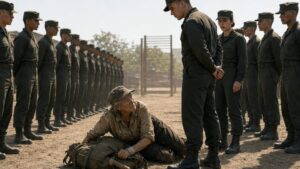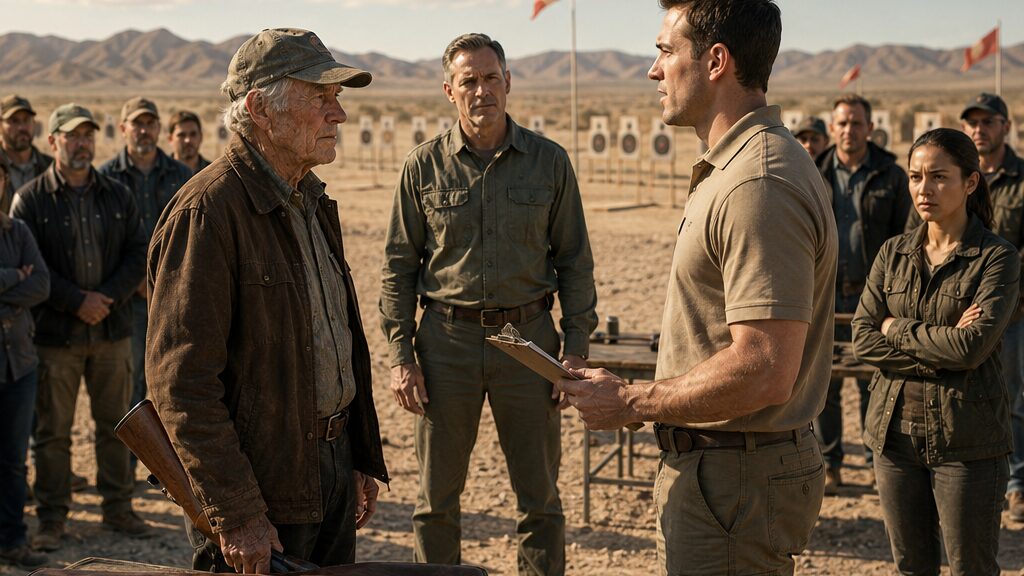
The Young Soldier Mocked The Old Rifleman Until The Desert Target Came Back Silent
Chapter 1: The Old Man At The Desert Firing Line
The first thing Eric Carter noticed was not the rifle case in the old man’s hand, but the way the old man walked into the desert range as if he had already measured every yard of it.
Jack Miller came through the open gate just after sunrise, moving slowly over the hard-packed sand, his boots leaving shallow marks between tire tracks and spent brass. The morning light lay flat across the firing line, turning the metal benches silver and the distant target berms the color of old bone. Beyond them, the desert rolled away in scrub, heat, and pale stone.
He carried a worn brown rifle case in his right hand. The leather had cracked along the corners, and one latch had been repaired with a strip of dull brass that did not match the other. It looked too old for the young shooters already unpacking sleek black bags and padded cases along the benches. It looked like something that should have been hanging behind a garage door, not arriving at a charity qualification day run with clipboards, wristbands, and numbered lanes.
Jack did not hurry. He stopped before the red safety line and looked downrange. His eyes moved from the flags to the berm, then to the patch of dust near the left side of the far target frames where the wind dragged loose grit in thin strokes. He stood there long enough that a volunteer by the registration table glanced up twice.
“Sir?” the volunteer called. “Check-in is over here.”
Jack turned his head, nodded once, and carried the case to the table.
Susan Green stood behind a stack of forms and sponsor cards, trying to keep the morning from becoming disorder. The event was supposed to be simple: veterans, trainees, instructors, donors, and a public qualification relay to raise money for a local rehabilitation program. But the desert wind was already starting early, two target carriers had jammed during setup, and half the young trainees were treating the day like a competition before the first safety brief had even begun.
“Name?” she asked, pen hovering.
“Jack Miller.”
She searched the list. “Miller… Miller…” Her finger stopped near the bottom. “Guest participant?”
“That’s what they told me.”
Susan looked up then, really seeing him: late seventies, maybe more, face lined deep by sun and weather, gray hair under an old cap, faded shirt under a brown jacket too warm for the desert morning. His hands rested lightly on the rifle case. They were large hands, but the skin had thinned, and the fingers did not lie perfectly still.
“You’ll need to attend the safety brief before you handle any firearm,” Susan said carefully.
“Yes, ma’am.”
The answer came without offense. That made her hesitate.
“You’ve shot here before?”
Jack looked past her toward the range tower. For a moment, something in his face tightened, not pain exactly, but recognition held behind the eyes.
“A while back.”
Before Susan could ask more, a sharp voice cut across the firing line.
“Who put him on the relay list?”
Eric Carter came walking from lane four with a clipboard tucked under one arm and sunglasses hooked at the front of his tan range shirt. He was tall, square-shouldered, clean-shaven, and moved with the quick confidence of a man who expected people to make space for him. The younger trainees watched him the way uncertain people watch anyone who sounds certain.
Susan lowered her voice. “Eric, he’s registered.”
Eric stopped in front of the table, looked at Jack’s worn jacket, then at the old case. His eyes lingered on Jack’s hands.
“For observation?” Eric asked.
“For participation,” Susan said.
Eric gave a short laugh that was not meant to be private. A few trainees nearby looked over.
Jack set the rifle case gently on the table instead of the ground. The movement was careful, almost formal. He did not open it.
“Sir,” Eric said, turning toward Jack with a smile that sharpened at the edges, “this is a live-fire qualification event. It’s not a museum demonstration.”
The volunteer at the table stopped sorting wristbands.
Jack looked at Eric. “I understand.”
“Do you?” Eric tapped the clipboard against his thigh. “We’ve got new shooters here. Donors. Veterans. Press at noon. I can’t have somebody wandering in with antique gear and shaky hands because they think the rules are flexible.”
The word shaky traveled farther than the rest.
Two young men at the next bench glanced at Jack’s hands. A trainee zipped her rifle bag slower, listening. Someone coughed into the dry morning air.
Jack did not hide his hands. He let them rest where they were, one across the top of the old case, the other near the brass latch.
“The rules should never be flexible,” he said.
Eric blinked, as if the answer had not gone where he expected. Then he leaned slightly closer.
“You current on range procedure?”
Jack’s eyes moved briefly to the red line, the chamber flags laid out near the safety table, the empty barrels angled downrange. “Enough to know nobody crosses that line until the tower says cold.”
Eric’s smile thinned. “That’s cute. But we’re running a timed relay later. This isn’t a place to find out your eyes aren’t what they used to be.”
Susan’s pen tightened in her hand. “Eric.”
“I’m responsible for safety,” he said without looking at her. “If someone gets hurt, it’s not going to be because I was too polite to say what everyone else is thinking.”
Jack looked toward the far berm again. The wind flag nearest the three-hundred-yard marker lifted, settled, then lifted from the opposite edge.
He could have said many things. He could have named places, years, ranges, men who once stood straighter when he entered a firing line. He could have said that his eyes had watched mirage over sand before Eric had learned to read road signs. He could have said that his hands shook more when they were empty than when they had a purpose.
Instead he opened the left latch of the rifle case, just enough to check that it was secure, then closed it again.
“I’m here for the relay,” he said.
Eric gave him a long look.
“With that?”
“With what I brought.”
“You even know what class you’re registered under?”
“Open rifle.”
Another small laugh came from Eric, but this one carried irritation. “Open rifle has the longest lanes.”
“I know.”
Susan glanced between them. “Jack, we can place you in a shorter demonstration lane if you prefer.”
“No, ma’am.”
Eric turned to the trainees as if the scene had become useful. “This is exactly why we brief fundamentals. Confidence is not competence. Wanting to shoot is not the same as being ready to shoot.”
Jack picked up his case.
One of the older veterans sitting beneath the shade canopy watched him over the rim of a paper cup. The man’s expression changed for a second, like a memory had brushed past, then disappeared before it became certainty.
Eric stepped aside but did not clear the path kindly. “Fine. You can attend the safety brief. But I’m not putting you near the main lanes until I see you handle basic procedure without making my blood pressure jump.”
Jack nodded.
He walked toward the benches. The case swung lightly at his side, its old leather dark against his trousers. As he passed the row of modern gear, a trainee whispered something, and another laughed under his breath.
Jack heard it. He had spent too many years on ranges not to hear small sounds inside larger ones.
He stopped at an empty bench near the end, set the case down, and placed both palms flat on top of it. His fingers trembled once, then settled.
Inside the case, beneath the rifle, folded into the corner where no one could see it, was a yellowed range card softened from years of being opened and closed. Jack did not need to look at it. He knew every crease.
The loudspeaker crackled.
“All participants to the safety table. Safety brief in five.”
Jack remained at the bench one extra moment, watching the nearest wind flag lift again.
Behind him, Eric’s voice carried to Susan. “Put him far right if he insists. Lane twelve. Out of everyone’s way.”
Susan hesitated. “That’s the farthest lane.”
“Exactly.”
Jack picked up the rifle case and walked toward the safety table without turning around.
Chapter 2: The Young Instructor Raises His Voice
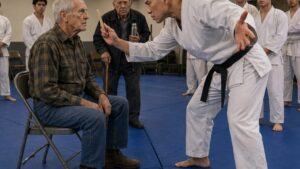
Sarah Nelson noticed the old man because he was the only person at the safety table who did not seem eager to prove he belonged there.
Everyone else gave off some signal. The younger trainees adjusted slings, checked optics, compared ammunition, or stood with their shoulders just a little too wide. Eric Carter moved in front of them like the range belonged to his voice. Even Susan Green, arranging forms at the end of the table, kept looking toward the sponsor tent and the parking lot, measuring the event against everything that might go wrong.
But Jack Miller stood still with his old rifle case at his feet, hands folded over the top of a walking pace that did not ask for sympathy. His cap shaded most of his eyes. Dust had gathered along the cuffs of his trousers. He looked, Sarah thought, like someone’s grandfather who had taken a wrong turn at the memorial luncheon.
Then she felt ashamed of thinking it.
“Eyes forward,” Eric called.
The group quieted.
Sarah stood in the second row with six other trainees. She had been trying not to look nervous all morning. The charity qualification was not military, not academy, not anything that should have made her stomach knot, but she wanted her certificate. She wanted proof that her hands could follow rules under pressure. Eric had told them confidence mattered. He said hesitation made people dangerous.
Now he paced in front of the safety table, holding up a chamber flag.
“Today is not about ego,” he said, in a tone full of it. “It is not about stories. It is not about who used to shoot, who thinks they can shoot, or who brought something old and sentimental in a case.”
Several heads shifted toward Jack.
Jack looked at the table.
“This range runs on procedure,” Eric continued. “Muzzles downrange. Actions open until instructed. Fingers off triggers until sights are on target and command is given. Nobody touches equipment during a cold range. Nobody argues with staff. Nobody freelances.”
Sarah repeated the rules silently, the way she had since the first class. Muzzle. Action. Finger. Command. Cold range. Staff.
Eric turned suddenly toward Jack. “Sir.”
Jack looked up.
“Since you’re joining us, why don’t you tell the group what the first thing you do is when you open a rifle case on a live range?”
A small pause opened around the question.
Jack answered evenly. “Ask whether the range is hot or cold.”
Eric’s jaw flexed. “Before that.”
“Nothing comes before knowing the condition of the range.”
A few trainees looked down quickly, hiding smiles.
Eric did not smile. “You check that the firearm is clear.”
“Not if touching it breaks range condition.”
The quiet answer did something strange to the air. Sarah felt it more than understood it. Eric had asked the question to expose him, but Jack’s reply had landed with the weight of habit, not cleverness.
Eric turned back to the group. “Technically, yes, nobody handles firearms while the range is cold unless instructed. Thank you for that clarification.”
The word clarification sounded like an accusation.
When the briefing moved to the benches, Sarah ended up near lane six, close enough to see Jack sent all the way to lane twelve. It sat near the far end of the covered line, where the shade thinned and the wind crossed at a tricky angle from the open wash. His bench had a scarred top, an old sandbag, and a target monitor that flickered twice before settling.
Eric watched him place the rifle case down.
“Slowly,” Eric called. “No surprises.”
Jack waited until the line was declared hot for equipment handling. Then he opened the case.
Sarah expected something dramatic after the way Eric had mocked it. But the rifle inside was plain, old, and carefully maintained. Wood stock, worn smooth where hands had known it for years. No oversized attachments. No expensive modern shine. Beside it lay a folded yellowed card, its edges darkened with age.
Jack touched the card first.
Not for long. Just two fingers resting on it, almost like a greeting.
Then he lifted the rifle, pointed safely downrange, opened the action, checked the chamber with his eyes and then by feel, and inserted the chamber flag. Every movement was slow, but nothing wandered. Nothing pointed where it should not. Nothing seemed uncertain.
Sarah found herself watching his hands.
They had trembled at the table. They did not tremble now.
“Need help with that antique?” Eric called.
Jack did not answer.
“Some of these older safeties can be confusing,” Eric added, louder. “No shame in asking.”
One of the young men at lane four laughed. Sarah did not.
Jack laid the rifle down with the muzzle aligned downrange and stepped back behind the line.
Eric walked toward him, clipboard under his arm. “You’re going to have to move faster than that once the relay starts.”
Jack looked at the far flags. “Fast is not the same as ready.”
“That one from a poster?”
“No.”
“Then let me give you one from today.” Eric leaned his hip against the neighboring bench. “If I see anything unsafe, you’re done. I don’t care how many donation dollars somebody attached to your name.”
Sarah saw Jack’s cheek move slightly, not quite a smile.
“That’s fair,” he said.
For the first time, Eric seemed bothered by how little resistance he was getting.
The line moved through dry-fire checks. Sarah focused on her own equipment, but her attention kept drifting. When Eric barked corrections, people jumped. When Jack moved, he seemed to move inside a silence that belonged only to him.
A trainee two lanes down fumbled while adjusting his sling. He turned sideways to ask a question, and the muzzle of his rifle drifted off the safe direction by a few inches. It was not much. It happened in the tiny space before anyone’s voice caught up.
Jack saw it.
He did not shout. He did not embarrass the trainee. He took one step, placed two fingers lightly on the barrel, and guided it downrange.
“Keep your world in front of you,” Jack said quietly.
The trainee froze, then flushed. “Sorry.”
“Good catch,” Jack said.
Eric turned only after the rifle was already safe. “What’s going on?”
“Nothing now,” Jack said.
Eric strode over. “Did you touch another participant’s firearm?”
“I corrected direction.”
“That’s staff responsibility.”
“It was moving before staff saw it.”
The trainee swallowed. “He stopped me, sir. I turned without thinking.”
Eric looked at the trainee, then at Jack. A public rebuke formed in his face, searching for a clean place to land. But there was no way to make the correction look wrong without making safety look secondary.
Sarah felt her earlier certainty about Eric loosen.
Jack had not raised his voice. He had not made the trainee small. He had prevented something before it became an incident and then let the young man keep his dignity.
Eric clipped his pen hard against the board. “Everyone reset. And keep your muzzles where they belong.”
The command snapped across the line.
People moved. Sarah did too, but her eyes found the old rifle case again. The yellowed card had slipped partly open inside it. She could see faint ruled lines, old numbers, wind marks written in careful pencil, and a phrase across the bottom in faded block letters.
She could not read all of it.
Only the first words.
First rule—
Jack saw her looking and folded the card closed with two fingers.
The loudspeaker crackled again. “Preparation relay in ten.”
Eric’s face was tight now. He turned toward Jack.
“Lane twelve,” he said. “You stay there until I tell you otherwise.”
Jack nodded as if lane twelve had always been the place he intended to stand.
Sarah looked from Eric to Jack and felt, for the first time that morning, that the loudest man on the range might not be the one who understood it best.
Then, as the line settled, the same trainee Jack had corrected reached for his rifle too early while the tower still called the range cold.
Jack’s head turned before anyone else moved.
Chapter 3: The Officer Who Remembered The Breath
Raymond Hall heard the old cadence before he recognized the man.
He was standing in the range command post with one hand on the radio and the other on a stack of relay sheets when the sound reached him through the open window. Not a voice exactly. Not a command. Just a quiet count beneath the metallic clatter of preparation.
Inhale.
Hold.
Settle.
Release.
Raymond had not heard it spoken aloud. He had seen it in the timing of a man at lane twelve, in the way the old shooter looked through wind instead of at it, in the way he waited through movement until the moment stilled by itself.
Some habits were signatures.
He stepped closer to the window.
The far-right lane sat partly beyond the clean view of the post, where the roofline cut across the bench and the desert light washed everything pale. An elderly man stood there beside an old rifle case, cap low, shoulders slightly bowed. Eric Carter hovered near him with the stiff posture of someone trying to control a situation that refused to become simple.
Raymond’s first thought was impossible.
His second was that the desert had a cruel sense of timing.
“Problem on twelve?” the scorekeeper asked from behind him.
“Not yet,” Raymond said.
He lifted the binoculars from the hook beside the window and focused on the old man’s hands. Age had changed them. Of course it had. Time thinned every proud thing eventually. But when the old man checked the chamber and rested the rifle on the bag, Raymond saw the motion again: two fingers, eyes, touch, pause, muzzle, breath.
A memory came back so sharply that the command post seemed to shrink around it.
A younger Raymond, barely twenty, standing at this same desert range under a sun that felt like punishment. A retired Marine instructor walking the line without raising his voice. Men twice as loud falling quiet when he stood behind them. A sentence repeated until it became part of the dust.
Slow is smooth. Smooth is accurate.
Raymond lowered the binoculars.
“Get me the guest list,” he said.
The scorekeeper handed him a clipboard. Raymond scanned the names until he found it near the bottom.
Jack Miller.
For a moment, the range outside went silent in his mind.
He had never trained directly under Jack for long. Few had. Jack Miller had already been half legend by then, though not the kind printed on posters. He was the instructor instructors talked about after hours, the one who could diagnose a shooter by the pause before the trigger broke, the one who cared less about trophies than whether a nineteen-year-old learned not to let fear move the muzzle. Raymond had seen him correct a roomful of senior men without humiliating one of them.
Then Jack had disappeared from the range years ago. People said retirement. People said health. People said grief, in lowered voices, because one of his former students had died and Jack had packed away more than rifles after that.
Raymond looked again toward lane twelve.
Eric did not know.
That much was obvious from the way he stood too close, speaking with his chin lifted. Eric was not a bad instructor, Raymond reminded himself. He was disciplined on paper, accurate enough to impress donors, and useful with new shooters who mistook volume for certainty. But he had a hunger in him that had not yet learned the difference between command and respect.
Raymond left the command post.
The heat struck him as soon as he stepped onto the line. By noon the desert had lost all softness. Dust clung to boots. Wind flags flicked and fell in uneven rhythms. Trainees stood behind the benches in clumps, waiting for the next relay order. Susan Green was near the safety table, speaking with a volunteer, her smile careful and tired.
Raymond walked toward lane twelve.
He heard Eric before he reached them.
“I’m telling you, sir, this isn’t the lane for someone who needs extra time. Crosswind runs ugly here. You’d be more comfortable on the demonstration side.”
Jack was looking downrange. “Comfort is not the point of a range.”
Eric gave a short exhale. “You’ve got an answer for everything except why you’re here.”
Raymond stopped a few feet away. “Is there a safety issue?”
Eric turned quickly. “Not yet.”
“Then lower your voice.”
The instruction was calm, but it carried enough rank in the room of the range that nearby trainees looked over.
Eric straightened. “Yes, sir. I was just explaining lane assignment.”
Raymond looked at the old man. Up close, there was no doubt left. The years had narrowed Jack Miller’s face and deepened the lines around his mouth, but the eyes were the same: pale, steady, almost tired from seeing more than people wanted seen.
“Mr. Miller,” Raymond said.
Jack’s gaze shifted to him. There was a pause, small enough that only someone watching for it would notice.
“Officer Hall.”
Raymond felt the title land between them. Not Raymond. Not son. Not any of the old range names. Jack had recognized him and chosen distance.
“You’ve been away a long time,” Raymond said.
“Ranges change.”
“Some things don’t.”
Jack looked back toward the berm. “Most things do.”
Eric’s eyes moved between them, suspicious now. “You two know each other?”
Raymond kept his answer measured. “Mr. Miller has been on this range before.”
Eric waited for more. Raymond did not give it.
Jack’s hand rested lightly on the case. The old leather looked even more worn in the sharp light. One corner had been darkened by years of being carried in the same grip.
Susan approached from behind, drawn by the shift in attention. “Everything all right?”
“Yes,” Raymond said.
Eric’s mouth tightened. He did not like being corrected in front of trainees. He liked it even less when he did not understand why.
“With respect,” Eric said, though the words carried very little of it, “we have standards. I don’t care who’s been here before. If he’s shooting open rifle with the others, he needs to demonstrate current competence.”
Jack turned toward him then.
Not sharply. Not angrily. But fully.
“Current competence,” he repeated.
Eric held his ground. “Yes, sir.”
A light gust crossed the line. Dust lifted near the far berm and slid sideways. Jack watched it pass.
Raymond could have ended it there. He could have told Eric exactly who stood in front of him. He could have pulled the old records from the office, pointed to the faded names on the wall, said enough to make every trainee look at Jack differently.
But Jack’s silence held him back.
Recognition given too soon could become another kind of theft. It could turn a man into a story before he had chosen to speak. Raymond had seen veterans reduced to plaques, photos, applause they had not asked for. Jack had never cared for display. If he had come here quietly, there was a reason.
So Raymond only said, “Then follow procedure.”
Eric nodded, but his pride had been touched. “Fine.”
He turned toward the gathering trainees and raised his voice enough for them all to hear.
“Since everyone seems confident this is appropriate, we’ll make it simple. After lunch, open rifle demonstration. Lane twelve. Mr. Miller can show the group what current competence looks like.”
Susan’s expression changed. “Eric—”
“No pressure,” Eric said, smiling now. “Just fundamentals. We can all learn something.”
A few spectators shifted closer. Sarah Nelson stood near lane six, watching Jack with open concern.
Jack did not look at the crowd. He did not look at Eric. He looked at Raymond.
For a second, Raymond saw the old instructor from years ago, standing in heat and dust, refusing to rescue a student from the lesson he had earned.
Jack closed the rifle case.
“All right,” he said.
Eric’s smile returned, bright and careless. “Good. Then after lunch, sir, the line is yours.”
Raymond watched Jack’s fingers rest once on the case latch before letting go.
The wind flag at three hundred yards snapped hard to the left, then died flat.
Eric walked away as if he had won something.
Raymond stayed where he was, looking at the old man who had taught better men than all of them how to breathe before a shot.
“Jack,” he said quietly, “you don’t have to do this.”
Jack lifted the worn case from the bench.
“No,” he said. “But he asked in front of students.”
And with that, he walked toward the shade, leaving Raymond with the uneasy certainty that Eric Carter had just challenged the wrong old man in the wrong desert.
Chapter 4: The Lane Nobody Wanted
By the time Jack returned to lane twelve after lunch, the wind had changed its mind three times.
It came first from the left, low and steady, pressing dust along the ground. Then it lifted, swung across the wash, and ran unevenly over the open stretch between the firing line and the far berm. The flags told only part of it. The nearest one snapped with confidence. The middle one sagged. The farthest twitched, hesitated, then pointed in a direction that did not agree with either of the others.
Jack stood behind the bench and watched them all.
The desert did not lie, but it did not explain itself either.
Behind him, people gathered because Eric had made sure they would. Trainees drifted from their lanes. A few veterans stepped out from under the shade canopy. Volunteers pretended to reorganize equipment while keeping their faces turned toward the far right end of the line. Susan Green stood near the safety table with her arms folded tightly, her event smile gone.
Eric arrived with the confidence of a man stepping onto a stage he had built.
“Open rifle demonstration,” he announced. “Lane twelve. We’ll keep this safe and educational.”
Jack set the rifle case on the bench.
The old leather looked smaller under the watching eyes. He could feel them on his back: curious, doubtful, amused, uncomfortable. He had stood under heavier attention. He had watched young men try to breathe through fear. He had watched pride collapse under pressure. He had watched silence do more work than shouting.
Still, his left hand trembled when he touched the latch.
Eric saw it.
“Take your time,” he said, loud enough for the nearest trainees. “We don’t want that case getting away from you.”
A few laughs broke loose, short and uncertain.
Jack opened the case.
Inside, the rifle lay in its fitted hollow, plain and clean. The folded yellowed range card rested in the corner. Jack moved it aside with two fingers, not hiding it, not showing it. He lifted the rifle, muzzle downrange, action open. He checked chamber, magazine, bore, safety, and bench position in the same sequence he had followed before lunch. Each movement took its own time.
Eric shifted his weight. “For the group, notice the pace. Careful is good. Too slow can become a problem under match conditions.”
Jack set the rifle on the sandbag and stepped back.
Raymond Hall stood several yards behind the line, expression unreadable. His hands were clasped loosely in front of him, but Jack saw the tension in the knuckles. Raymond had always had that habit, even as a young man in the old days, when he thought hiding worry made it disappear.
The tower gave the range condition. Hot for preparation. No live fire until command.
Jack looked through the empty sights toward the target frame. Three hundred yards. Paper bull, white backing, black center. Nothing heroic. Nothing impossible. Just distance, wind, breath, and the small failure inside every person who thought the world would obey them because they demanded it.
Eric stepped closer. “You sure you can see it?”
Jack did not answer.
“Mr. Miller?”
“I see enough.”
“That’s not exactly confidence-inspiring.”
Jack took one cartridge from the box he had brought and laid it beside the rifle. Then another. Then three more. Five in a neat line. He did not load.
“Only five?” Eric asked. “Most people like a little insurance.”
“The target will tell you.”
The words settled strangely. Not loud. Not dramatic. But the trainees nearest the line stopped whispering.
Eric smiled. “All right. Five shots. Standard position from the bench?”
Jack looked at the stool, then at the sand in front of the bench, then at the wind flags again.
“Kneeling.”
Eric’s smile widened with disbelief. “You want to shoot three hundred kneeling in this wind?”
“I do.”
“That’s not required.”
“No.”
“Then why make it harder?”
Jack finally turned his head. “Because you put me in lane twelve.”
For the first time all day, Eric had no quick answer.
A low murmur moved through the spectators. Sarah Nelson stood near the back, her eyes fixed on Jack’s hands. Jack noticed her only because she was not watching for failure. She was watching to understand.
He took the yellowed range card from the case and unfolded it once. Pencil marks, wind notes, old elevation holds, and the faded phrase at the bottom looked back at him. He did not need the numbers. They belonged to another year, another shooter, another promise. But he had carried the card too long to leave it closed now.
Eric leaned to see. “Need notes?”
Jack folded the card and tucked it under the edge of the case lid where the wind would not take it.
“Always.”
The tower crackled. “Relay ready. Load on command only.”
Jack knelt slowly beside the bench.
The movement cost him more than he let show. His right knee found the mat. His left boot planted in the dust. The old joint gave its familiar complaint, sharp then dull. He let it pass through him. Pain was just another noise. You did not obey every noise.
Someone behind him whispered, “He can barely get down.”
Jack settled his elbow, checked the rifle, waited.
Eric stood to the side, arms crossed. “Remember, finger off trigger until you’re on target and the command is given.”
Jack’s finger lay straight along the receiver.
“I remember.”
Raymond took one step closer, then stopped.
The wind came again, not from one direction but in layers. Jack watched the far dust. The near flag lied high. The middle flag told the truth late. The far one twitched at the edge, revealing the push sliding along the berm.
He adjusted nothing yet.
The tower gave the command.
“Load.”
Jack loaded one round.
“Ready on the right. Ready on the left. Line is hot. Fire when ready.”
Every sound sharpened. A cough behind him. A paper target clicking faintly in its frame. The small scrape of Eric’s boot in grit. His own breath, entering slow.
He did not fire.
Five seconds passed.
Ten.
Eric shifted. “Any time, Mr. Miller.”
Jack waited.
The wind dropped.
Not stopped. Dropped.
He felt the small opening in it the way another man might feel a hand leave his shoulder.
The rifle came fully into him. Not forced. Not gripped. Held.
Inhale.
Hold.
Settle.
Release.
The shot cracked across the desert.
No flourish. No recoil drama. No movement from Jack except the old rifle’s honest jump and return.
The target did not reveal anything from where they stood. The paper remained distant and blank to the naked eye.
Jack opened the action, checked, loaded the second round.
Eric stared downrange, then at him. “You’re going to take a minute between each?”
“If the wind takes a minute.”
Someone laughed once, but it died quickly.
The second shot came after the middle flag twitched and before the near flag caught up. The third came when a thin curl of dust shifted at the base of the berm. The fourth took longer. The sun pressed against the side of Jack’s face. Sweat ran behind his ear. His knee burned. His left hand wanted to tremble again, but the rifle gave it work, and work gave it memory.
Before the fifth shot, a stronger gust crossed the line. Several flags snapped hard. A trainee muttered that the group was ruined.
Jack lowered the rifle slightly.
Eric seized on it. “Problem?”
Jack looked at the far berm. “Waiting for the argument to end.”
Eric frowned. “What argument?”
“The wind with itself.”
The line went quiet.
Jack lifted the rifle again.
He did not think of Eric. He did not think of Raymond. He did not think of old records or young eyes or the case waiting open beside him. He thought of the first rule, and the second, and the breath between them. He thought of a former student’s handwriting on a card. He thought of all the noise that had ever tried to make a shooter hurry.
Then the desert gave him half a second.
The fifth shot broke.
Jack opened the action, cleared the rifle, inserted the chamber flag, and laid it safely on the bench before moving his finger anywhere near the case.
“Cease fire,” the tower called. “Cease fire. Actions open. Make safe.”
Jack stayed kneeling until the command finished. Only then did he place one hand on the bench and rise.
His knee resisted. For a moment his body betrayed him more openly than his aim had. Sarah took a small step forward, but Raymond gently lifted a hand without looking at her.
Jack stood on his own.
Eric glanced toward the target monitor, but lane twelve’s screen flickered and showed nothing but pale static.
The scorekeeper called from the tower, “Carrier jammed on twelve. We’ll retrieve manually.”
A murmur passed down the line.
Eric’s mouth curved. “Well. Dramatic.”
Jack closed the rifle case halfway, leaving the card tucked under the lid.
Downrange, a range volunteer climbed into the small utility cart used for target checks. The engine coughed, then started. Dust rose behind its tires as it moved toward the far berm.
Everyone watched it go.
Jack rested his hand on the old case.
For the first time that day, Eric did not speak.
The cart reached the target line. The volunteer stepped out, walked to lane twelve’s frame, and stopped.
Even from three hundred yards away, Jack could see the pause.
The volunteer removed the paper carefully, as if sudden movement might change what was on it. Then the scorekeeper leaned from the tower window and called for it to be brought back.
The cart turned around.
The target rode in the passenger seat, face turned away from the firing line.
No one laughed now.
Chapter 5: When The Target Came Back Silent
Sarah heard the utility cart before she could see the target clearly.
Its little engine buzzed over the desert hardpan, too ordinary for the silence waiting at the firing line. People who had been pretending not to care had stopped pretending. The trainees stood in uneven clusters. The veterans under the shade canopy had risen from their folding chairs. Susan Green held a stack of sponsor envelopes against her chest and did not move.
Jack Miller stood beside lane twelve with his chamber-flagged rifle on the bench and the old case open beside it.
He looked less like a man waiting for praise than a man waiting for weather.
Eric Carter stood a few feet away, arms crossed. His face wore the same confidence as before, but it seemed held in place now, not natural. Sarah could see the tightness around his mouth.
“Probably off paper,” one of the young men near her whispered.
Sarah did not answer.
The cart rolled behind the line and stopped near the tower. The volunteer climbed out with the target held flat against a piece of cardboard backing. The paper faced inward, hidden from the crowd.
The scorekeeper took it first.
He looked down.
Then he looked again.
That second look moved through the group like a physical thing.
Eric stepped forward. “Let’s see it.”
The scorekeeper hesitated, glancing at Raymond Hall. Raymond nodded once.
The target turned.
At first Sarah could not understand what she was seeing. There was the black center, clean against the white paper. There were expected marks from the target frame, a crease from handling, a smudge of desert dust near the lower corner. But where the five shots should have scattered across the paper, there was only one ragged hole slightly widened at the edge of the center mark.
Not five obvious holes.
One.
A small dark wound in the paper, no larger than the first joint of her thumb.
Nobody cheered.
That was what Sarah would remember later. Not applause. Not shouting. Just a silence so complete that the wind itself seemed suddenly disrespectful for making sound.
Eric reached for the paper. “That’s not right.”
The scorekeeper held it out.
Eric took it and tilted it toward the light. “Could be a target issue.”
Raymond’s voice came calm from behind him. “What kind?”
Eric did not look back. “Carrier vibration. Paper overlap. Prior hits.”
“That was a fresh face,” the volunteer said.
“Then maybe we need to check the backing.”
Raymond nodded. “Check it.”
The volunteer had already brought the cardboard backer. He turned it around. Five clean impacts sat so close together that their edges touched and tore into a single clustered mark. Sarah heard someone exhale sharply.
Eric’s ears reddened.
“That rifle was zeroed for this lane,” he said.
Jack closed the old case lid slightly, not enough to latch it. “No.”
Eric turned. “No?”
“It was zeroed for a different range, a different year, and a different man.”
Sarah saw Raymond’s eyes lower briefly toward the case.
Eric looked from Jack to the target. He searched for something to challenge: the distance, the ammunition, the wind, the timing, the equipment. But the target did not care what he needed. It hung between his hands, plain as a receipt.
“You expect us to believe you guessed that wind?” Eric asked.
Jack shook his head once. “Guessing is for people in a hurry.”
A few of the older veterans shifted under the shade, not laughing, but recognizing something. Sarah felt it too. The lesson was not only that Jack could shoot. It was that he had waited while everyone else measured him by the wrong thing.
Eric’s grip tightened on the paper. “Do it again.”
Susan finally spoke. “Eric.”
“No, if we’re making a point, let’s make it clean.” He looked at the group, then back at Jack. “Five more. Same lane.”
Jack studied him. There was no anger in his face, only a kind of disappointment that made Sarah look down.
“The point is already clean,” Jack said.
“You afraid the second group won’t match?”
Raymond took a step forward. “Carter.”
Jack lifted one hand slightly, and Raymond stopped.
That small gesture startled Sarah more than the target had.
Jack looked at Eric. “The rifle is clear. The line is safe. The target is marked. Nobody needs another hole in paper to learn what this one says.”
Eric’s jaw worked. “And what does it say?”
Jack reached for the target, not pulling it from him, only touching the lower edge where the paper fluttered in the wind.
“That you were watching my hands when you should have been watching my muzzle.” He let the words rest. “That you were listening for weakness when you should have been listening for the range. That you wanted me to rush because your pride was in a hurry.”
The line stayed quiet.
Jack did not raise his voice. Somehow that made every word harder to avoid.
Eric looked as if he wanted to throw the target down, but there were too many eyes on him now. Sarah saw his confidence trying to rebuild itself and failing because the paper remained between them.
“You made your point,” he said.
“No,” Jack said. “The target did.”
He took his hand away.
The scorekeeper carefully accepted the paper from Eric before it could wrinkle. He held it at the top corners, staring at the hole again.
One of the young trainees from lane four, the one who had laughed earlier, whispered, “How is that even possible?”
An older veteran answered from under the canopy, “Fundamentals.”
Raymond’s mouth moved almost like a smile, but his eyes stayed on Jack.
Sarah stepped closer before she realized she had moved. She stopped at the edge of the group, embarrassed, but Jack noticed her. His expression softened slightly.
“Did you see the flags?” he asked.
Sarah glanced downrange. “Some of them.”
“Not enough,” Eric muttered.
Jack ignored him. “No one sees enough at first.”
The answer landed differently than anything Eric had said all morning. It did not make her feel smaller. It made the distance between not knowing and learning seem crossable.
Susan walked to the scorekeeper. “Can we preserve that?”
The scorekeeper nodded. “We can mount it after the event.”
Eric turned sharply. “Mount it?”
Susan looked at him. “It’s a charity demonstration. That target just became the best donation pitch we’ve had all day.”
A few people smiled, but gently. The pressure around Eric shifted from fear of his voice to awareness of his embarrassment. Sarah almost felt sorry for him. Almost.
Eric handed the cardboard backing away and wiped his palm on his trousers. “I’m going to check the relay schedule.”
He started to leave.
“Eric,” Jack said.
The young instructor stopped.
Jack took the folded range card from inside the case. For one second Sarah saw the bottom line clearly.
First rule: respect the line.
Jack held the card, not offering it, just looking at it.
“When you teach,” he said, “they learn what you practice before they learn what you say.”
Eric did not turn around. But his shoulders changed, dropping a fraction from their rigid height.
Then he walked toward the command post.
The crowd slowly loosened. People began speaking again, but softly. The target passed from the scorekeeper to Susan, then to Raymond, each person treating it less like a trophy than evidence from a trial no one had known they were attending.
Sarah remained near lane twelve.
Jack was packing the rifle. He wiped the stock with a cloth, checked the chamber again though everyone had seen it clear, and placed it back in the case with the same care he had shown before anyone believed he deserved watching.
“You weren’t trying to beat him,” Sarah said.
Jack’s hands paused over the case.
“No.”
“What were you trying to do?”
He folded the cloth once. “Keep him from teaching the wrong lesson.”
Sarah looked toward Eric, who stood alone near the command post with the clipboard lowered at his side.
Raymond came to lane twelve then. He held the target in both hands. The silence around him was different from the crowd’s silence. Older. He looked at the hole in the paper, then at the rifle case.
“You still count the breath the same way,” Raymond said quietly.
Jack closed one latch.
“Some habits are worth keeping.”
Raymond glanced toward the range office, then back at him. “Why did you really come today, Jack?”
Jack’s fingers rested on the second latch.
For the first time all day, he did not answer right away.
Chapter 6: The Promise Inside The Rifle Case
The old range office smelled of dust, paper, and sun-warmed wood.
Jack had forgotten that smell, or thought he had. The room sat behind the command post, half storage and half memory, with metal filing cabinets along one wall and faded safety posters pinned beside a corkboard. Through the small window, the firing line looked distant and flat, stripped of all the noise that had filled it an hour earlier.
The charity event was winding down outside. Voices came and went. A vehicle door closed. Someone laughed near the parking lot, then caught themselves and lowered their voice. The desert evening had begun to pull heat out of the metal roof.
Jack set the rifle case on the old desk.
Raymond stood near the door, giving him space without leaving him alone. Susan had taken the target to be placed in a protective sleeve. Sarah had gone to help clear equipment, though Jack had noticed her glance back twice. Eric had disappeared after the relay schedule was finished, his voice absent from the range for the first time that day.
Jack opened the case.
The rifle rested where it belonged. The range card sat in the corner.
Raymond looked at it, then looked away, as if staring too long would be trespass.
“You don’t have to explain,” he said.
Jack gave a faint breath that might once have been a laugh. “You asked.”
“I did.”
“Then you wanted me to.”
Raymond accepted that with a small nod.
Jack lifted the card.
The paper had been folded so many times that it no longer lay flat. The pencil marks had faded, but he could still read them: wind calls, elevation notes, five-shot groups, corrections made in a young hand that had pressed too hard on the downstrokes. At the bottom, the words remained darker because they had been written over twice.
First rule: respect the line.
Below that, smaller.
Second rule: respect the person beside you.
Jack touched the edge of the card with his thumb.
“He wrote that?” Raymond asked.
“Yes.”
“A student?”
Jack looked through the office window toward the far lanes. “One of the best I ever had. Not because he shot better than everyone. He didn’t. Not at first.”
Raymond waited.
“He listened better.”
Outside, a volunteer dragged an empty target frame past the window, its metal legs scraping lightly over the dirt. The sound thinned and disappeared.
Jack sat in the chair behind the desk. It made a tired creak beneath him. He had stood all day on old joints and older memories, and now that the range had quieted, the cost arrived honestly.
“His hands shook worse than mine,” Jack said. “First week, he tried to hide it. Thought the others would smell fear on him if they saw. I told him a rifle doesn’t punish fear. It punishes pretending.”
Raymond leaned against the filing cabinet.
“He kept the card in his case?” Raymond asked.
“No. I kept it after he left.”
“Left the range?”
Jack’s thumb stilled.
The room did not need the full story. Some things became smaller when spoken too plainly. A young man. A later year. A phone call. A funeral where people said brave so often that the word lost shape. A mother placing a folded card into Jack’s hand because she did not know what else to do with it.
“He made me promise something,” Jack said. “Last time I saw him here.”
Raymond’s eyes lowered.
“What promise?”
“That I wouldn’t let the range become a place where loud men taught young ones to confuse pressure with discipline.” Jack looked at the card. “I told him I wasn’t in charge of the world.”
“What did he say?”
“He said, ‘No, sir. Just your end of the line.’”
Raymond looked away then.
Jack folded the card along its oldest crease. His hands trembled again now that the rifle was packed and the shooting was over. He did not try to stop it. There was no audience in the office that needed convincing.
“I stayed away too long,” he said.
“You had reasons.”
“I had excuses too.”
Raymond did not answer.
Jack slid the card back into the case, but not fully into the corner. He left it visible.
“When Susan called about the charity event, she didn’t know who she was calling,” Jack said. “She had an old donor list. My number should have been dead by now.”
“But you came.”
“I thought I’d drop the case off. The rifle too, maybe. Let the range auction it or hang it somewhere. I thought that would count.”
Raymond studied him. “As keeping the promise?”
“As ending it.”
The words sat between them.
Outside, the wind tapped sand against the window. Jack could hear young voices near the benches. Sarah’s among them, asking someone to check that all chamber flags were accounted for. Not loud. Not timid. Careful.
Raymond heard it too.
“She watched you today,” he said.
Jack nodded.
“So did Eric.”
At that name, Jack’s eyes moved back to the desk.
“He’s not lost,” Raymond said.
“No.”
“You made him look foolish.”
“He did most of that.”
This time Raymond did smile faintly.
Jack closed one latch of the case. The sound was small, final, and not final enough.
“I didn’t come to shame him.”
“I know.”
“I saw him with those students.” Jack’s voice remained even, but the weariness beneath it deepened. “He knows procedure. He knows commands. He can shoot. But he talks like the range is his mirror. Everything comes back to how he looks standing in front of them.”
Raymond nodded slowly. “He wants to matter.”
“So teach him to matter correctly.”
Raymond’s gaze sharpened. “Me?”
Jack looked at him. “You run the range.”
“And you still teach from ten feet away without meaning to.”
Jack looked down at his hands. “Meaning to is the part I’m not sure about.”
The door remained half open. Evening light stretched across the floor in a long gold strip. Dust moved inside it, turning slowly.
For years, Jack had imagined the promise as something behind him, a voice stored with the old case, a burden that could be carried privately until his body finished carrying anything at all. Today had changed that. Not because he had shot well. Shooting well was not new. Being needed in the old way was.
That frightened him more than Eric’s mockery had.
A soft knock touched the doorframe.
Jack did not turn immediately. Raymond did.
Eric Carter stood outside the office.
His clipboard was gone. His sunglasses were no longer hooked at his shirt. Without them, his face looked younger, and the embarrassment he had tried to outrun had caught him at last.
He looked first at Raymond, then at Jack, then at the open rifle case on the desk.
“Sir,” Eric said.
The word did not sound like performance now.
Jack rested his hand on the worn leather lid.
Eric swallowed once. “May
Chapter 7: The First Rule On The Wall
Jack did not answer Eric right away.
The young instructor stood at the office threshold with one hand resting against the doorframe and the other hanging open at his side, as if he had forgotten what to do with it without a clipboard. The evening light behind him made his shoulders look less broad than they had on the firing line. Dust clung to the front of his boots. His face had lost the bright, hard shine of command.
Raymond looked from Eric to Jack.
Jack closed the rifle case halfway, leaving the yellowed range card visible.
“Come in,” he said.
Eric stepped into the old office, but only just. He stopped near the wall of faded safety posters and looked at the desk, the case, the card, then at the floor.
For several seconds, no one spoke.
Outside, volunteers finished breaking down the charity tents. Metal poles clicked against each other. A cooler lid slammed. Farther away, someone called for a missing staple gun. The ordinary sounds made the office feel smaller.
Eric drew a breath. “I owe you an apology.”
Jack waited.
Eric swallowed. “Not because of the target.”
Raymond’s gaze shifted slightly, but he said nothing.
Eric looked up. “Because I decided what you were before you did anything wrong. Then I kept trying to make the range prove me right.”
The words came stiffly, like they had been carried there with difficulty. Jack could hear pride still inside them, bruised but not gone. That was all right. Pride did not leave a man in one evening. Sometimes it only learned where to stand.
Jack rested his hand on the case lid. “You said it in front of students.”
“I know.”
“Then say the rest there.”
Eric’s face tightened.
Jack watched the struggle move through him. The instinct to resist. The fear of losing authority. The memory of the paper target in other men’s hands.
Raymond made no move to rescue him.
Finally Eric nodded. “Tomorrow morning.”
Jack studied him. “Not for me.”
“No, sir.”
“For them.”
Eric looked toward the window, where the last of the day lay over the empty lanes. “For them.”
Jack closed the case and latched it.
The next morning, the range looked different, though nothing important had moved.
The same berms sat beneath the pale sky. The same flags waited for wind. The same benches carried scratches from years of use. But the air along the firing line had changed. It no longer buzzed with the eager challenge that had filled it the day before. People spoke more quietly. The trainees arrived in smaller groups, glancing toward lane twelve as if the empty bench had kept a secret overnight.
Susan Green had placed the target in a clear sleeve and set it on the front table of the range classroom. She did not hang it yet. Beside it lay a fresh white card and a black marker.
Sarah Nelson stood near the first row, hands folded behind her back. When Jack entered carrying the old rifle case, she straightened without seeming to realize it.
Eric was already there.
He wore the same tan range shirt, but the sunglasses were absent. His clipboard sat on a chair behind him. He stood in front of the trainees with nothing in his hands.
Raymond waited near the side wall. Susan stood by the table.
Jack took a seat near the back.
Eric saw him do it. A flicker of surprise crossed his face, then something like understanding. Jack had no interest in being displayed at the front of the room like the target. If Eric had something to repair, Eric would have to stand in the open himself.
The room settled.
Eric looked at the trainees first, then at the veterans and volunteers who had drifted in. His eyes paused on Sarah, then moved to the sleeved target on the table.
“Yesterday,” he said, “I failed the first rule of this range.”
No one moved.
“I did not cause a safety incident,” he continued. “I did not break a written command. But I failed before any of that. I judged a participant by age, equipment, and appearance. I spoke disrespectfully. I used my position to make someone prove they belonged here.”
His voice tightened, but he kept going.
“That was wrong.”
Jack watched the backs of the trainees’ heads. Some were still. Some lowered slightly. Sarah did not look away from Eric.
Eric turned toward Jack.
“Mr. Miller, I apologize.”
Jack gave one small nod.
Eric faced the room again. “Yesterday’s target should not teach you that old men can surprise you. That’s too small a lesson. It should teach you that your assumptions can make you unsafe before your finger ever gets near a trigger.”
The room remained silent, but it was no longer the silence of embarrassment. It was listening.
Jack rose.
Every head turned.
He walked to the front, not quickly. The old rifle case hung at his side. When he reached the table, he set it down beside the sleeved target.
“Open it,” he said to Sarah.
Sarah looked startled. “Me?”
“Yes.”
She stepped forward carefully. Jack shifted the case so the muzzle end faced safely away from the group before she touched the latches. He saw her notice the direction. That mattered.
Sarah opened the case.
The rifle lay inside, chamber open, flag inserted. The yellowed range card sat beside it.
Jack lifted the card and placed it on the table.
“This belonged to a student,” he said.
He did not give the room the student’s name. The promise did not need an audience that large.
“He wrote two rules at the bottom after a bad day on this range.”
Sarah leaned closer. Eric did too.
Jack read them aloud.
“First rule: respect the line. Second rule: respect the person beside you.”
The words did not echo. They simply entered the room and stayed there.
Susan picked up the fresh white card. “May I?”
Jack nodded.
She wrote the two rules in large, clean letters. Her handwriting was not as careful as the pencil marks on the old card, but it was steady. When she finished, she placed the card beside the target.
Raymond took a strip of tape from the supply box and fastened both to the classroom wall, not among the sponsor posters, but beside the safety board where every participant would have to see them.
The target looked almost plain there. A white paper with one ragged hole. A lesson small enough to fit in a hand and large enough to quiet a room.
Jack looked at Eric. “You still want to teach?”
Eric answered carefully. “Yes, sir.”
“Then start with Sarah.”
Sarah’s eyes widened.
Jack gestured toward the door. “Firing line. Dry work only.”
They moved outside into the morning light. The range remained cold. No ammunition came to the line. Jack made that clear before anyone touched a rifle. Eric repeated the command, and this time his voice carried without sharpness.
Sarah stood at lane six with an unloaded training rifle, chamber open and flagged. Eric positioned himself beside her, then stopped and looked back at Jack.
Jack stood several feet away, arms relaxed, old case on the bench beside him.
“Don’t perform,” Jack said.
Eric turned back to Sarah.
He adjusted nothing at first. He watched.
Sarah settled behind the rifle, then shifted too quickly, trying to correct herself before anyone could speak.
Eric opened his mouth. The old version of him might have snapped a correction across the lane. Instead he paused.
“What did you feel?” he asked.
Sarah blinked. “I rushed.”
“Yes.” Eric glanced once at Jack, then back at her. “Don’t fight the rifle. Build the position again.”
Sarah reset.
Jack watched Eric’s shoulders lower as he taught. Not perfect. Not transformed into another man by one afternoon of embarrassment. But trying. Honest effort had a look to it. It did not need polish.
When Sarah settled the second time, Jack stepped closer.
“Breath,” he said.
She inhaled, held too high in her chest, and wavered.
Jack tapped two fingers lightly against the bench, once, twice, then waited.
“Let it fall,” he said.
She breathed out. The rifle steadied.
Eric saw it. So did Sarah.
A small smile touched her face, not prideful, just surprised by her own stillness.
Jack nodded. “That’s where learning starts.”
By midmorning, the charity signs were gone, but a few people remained to help clean. Susan came out of the classroom with the old range card now copied and protected in a sleeve. She handed the original back to Jack.
“I put the copy on the wall,” she said. “The original stays with you.”
Jack looked at the card.
For years he had thought keeping it meant carrying the promise alone. Now the words had moved from the case to the wall, from memory to practice. They belonged to the range again.
He slid the card into the case, but not as deeply as before.
Raymond walked with him toward the parking area when the sun had climbed high enough to bleach the color from the berms.
“You leaving the rifle?” Raymond asked.
Jack looked down at the case.
“Not today.”
Raymond smiled faintly. “Good.”
“Maybe the case someday.”
“But not yet.”
Jack looked back at the firing line. Eric was helping Sarah clear the training rifle. He watched her check the chamber herself, then nod before he spoke. The order was right. The student saw first. The instructor confirmed second.
“Not yet,” Jack said.
Raymond extended his hand.
Jack took it.
Neither man made the handshake into ceremony.
At the classroom door, the target and the copied rules caught the light. A young trainee paused before them, read the card, then looked toward the line with a different face than the one he had worn the day before.
Jack carried the worn rifle case through the gate, his steps slow over the hard-packed sand. The case was the same weight in his hand, but it did not feel as heavy.
Behind him, Eric’s voice reached across the range, calmer now.
“Respect the line,” he called.
A beat later, Sarah answered with the others.
“Respect the person beside you.”
Jack did not turn around.
He walked toward the parking lot with the desert wind at his back, the old case at his side, and a promise no longer locked inside it.
The story has ended.