They Called His Porch Repair A Violation Until He Raised One Blank White Paddle
Chapter 1: The White Paddle In The Ballroom
The photograph of Mark Adams’s front porch appeared on the ballroom screen sixteen feet wide, bright enough that every warped board looked like a crime.
A soft sound moved through the room—not quite a gasp, not quite a laugh. The kind of sound people made when they were relieved the embarrassing thing belonged to someone else.
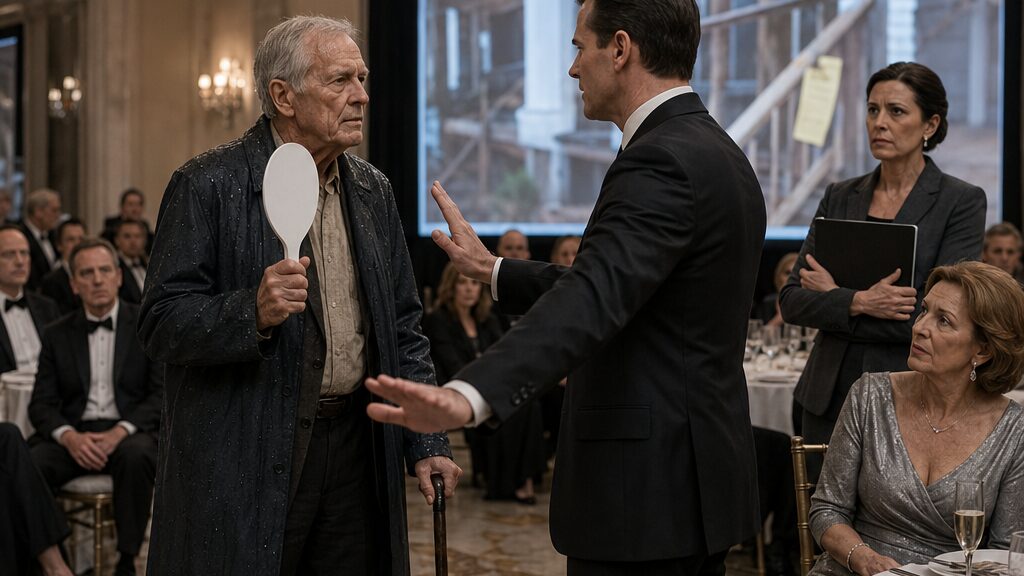
Mark stood near the last row of chairs with rain darkening the shoulders of his overcoat. Water gathered at the hem and dropped quietly onto the polished marble floor. His cane was planted beside his right shoe. In his left hand, he held the blank white paddle they had given him at the check-in table, the number printed small on the back where no one in the room could see it.
On the screen, a yellow violation tag hung from a new strip of raw wood beside his front steps.
Brian Harris, president of the Willow Creek Homeowners Association, stood at the podium in a black suit that fit like it had been measured twice. He had one hand resting near the microphone and the other around a remote. Behind him, the photograph changed to a closer view: two replacement boards, a temporary rail, a strip of contractor tape lifting in the wet.
“Violation forty-seven,” Brian said. “Unapproved exterior modification, unfinished visible construction, and nonconforming material placed on a primary-facing elevation.”
The words rolled smoothly across the room. They sounded official enough to make the porch disappear and leave only the violation.
At the front tables, residents in evening dresses and dark jackets turned their heads toward one another. Champagne glasses caught the chandelier light. Someone near the aisle whispered, “Is that on Briar Lane?”
Mark felt the question pass over him. Briar Lane had been his street for thirty-two years. He had delivered mail there before half the maple trees were tall enough to shade a sidewalk. He knew which houses flooded at the curb, which garage doors stuck in January, which neighbors used to leave porch lights on for his late route.
Now his house was a photograph.
He raised the white paddle.
Brian saw it and kept speaking.
“This is why the board is proposing a temporary fast-track enforcement measure before the insurance review. We all understand maintenance challenges. But visible unfinished work affects everyone’s property value.”
Mark lifted the paddle higher.
The motion pulled at his shoulder. He had dressed in a clean shirt, combed his hair carefully, and told himself not to look like a man who had argued with a porch for five days. He had not planned on the rain soaking through his coat between the parking lot and the clubhouse doors. He had not planned on arriving just as his own front steps filled the screen.
Brian’s gaze sharpened.
“Mr. Adams,” he said, smiling without warmth, “we’ll have open comment after the presentation.”
Mark kept the paddle up.
The room shifted again. People began looking back now, not just at the screen. Rachel White, seated at a round table near the aisle, turned with a champagne flute in her hand. Her expression was careful, but not kind. Mark could almost hear the calculation behind it: wet coat, cane, old man alone, holding up the meeting.
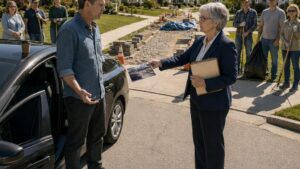
Nicole Scott, the property manager, stood along the side wall with a tablet tucked against a black folder. Her face tightened when she recognized him. Beside her, an inspection assistant held a clipboard and looked as if he wished to be anywhere else.
Brian clicked off the screen. The photograph vanished, leaving a blank blue glow.
“Mark,” he said, moving from behind the podium, “please lower the paddle.”
Mark’s fingers tightened around the thin handle. It was lighter than he expected, a cheap piece of white plastic meant to look elegant for one evening. At the check-in table, the volunteer had said, “Resident voting paddle,” and handed it to him as if it meant nothing.
To Mark, it meant he had not been erased yet.
He took one step into the aisle. His cane struck the marble, the sound small but hard.
“I have a right to object,” he said.
Brian came toward him with the calm speed of a man used to being obeyed in public. A security guard near the velvet rope straightened. The room quieted. Mark saw people lean back in their chairs to make a lane, not for him, but away from him.
“This is not the comment period,” Brian said. His voice stayed low enough to seem reasonable and clear enough for nearby tables to hear. “You are out of order.”
Mark looked past him at the blank screen where his porch had been. The image remained in his eyes: the new board pale against old paint, the tag bright as a warning flag.
“That board is not decoration,” Mark said. “It is the way I get through my own front door.”
A few faces changed. Not many. Enough.
Brian’s jaw moved once. “No one is preventing you from using your home.”
“You ordered the man fixing it to stop.”
“The work was unauthorized.”
“The old rail came loose in the storm.”
“You still have to follow the approval process, Mark.”
Mark heard his first name land in the room like a hand placed on the back of his neck. Familiarity used as control. His cane hand ached. He lowered the paddle an inch, then raised it back to the same height.
Brian stepped closer. “I’m asking you respectfully to sit down.”
“No,” Mark said.
The word surprised him by how little force it needed.
The guard moved from the rope. Nicole took two steps forward, folder pressed against her ribs. The inspection assistant glanced at Brian, then at the floor.
Rachel White’s champagne glass hovered in midair. Someone at her table whispered, “This is awful.” Mark could not tell whether they meant the porch or him.
Brian reached for the paddle, not quite touching it. His fingers stopped in the air near Mark’s knuckles.
“This is a community event,” Brian said. “We are not going to turn it into a personal dispute.”
“It became personal when you put my steps on that screen.”
“You made them visible from the street.”
“I made them safe enough to stand on.”
Brian’s smile disappeared. For one second, Mark saw the impatience under the polish. Not hatred. Something colder and more common: a man who had decided that another person’s complication was a threat to order.
“Security,” Brian said, turning his head slightly, “please help Mr. Adams outside.”
The guard approached with both hands open. “Sir.”
Mark did not move. He looked at Nicole instead. The tablet in her arms held the file. The dates. The photos. The thing Brian had not said aloud.
“You photographed the danger after you created it,” Mark said.
Brian’s face went still.
The room heard that. Mark could feel it. Not agreement, not yet, but attention.
The guard stopped close enough that Mark could see rain beads on his own sleeve reflected in the man’s polished name badge. Brian leaned in, voice lowered now.
“Mark, don’t make this worse.”
Mark brought the paddle down slowly until it rested against his coat. He turned toward the exit, cane first, one careful step and then another. No one clapped. No one spoke for him. The chandelier light made the marble look slick as water.
At the velvet rope, he paused.
Behind him, Nicole opened the black folder. The inspection assistant bent toward her tablet. Brian had returned to the podium, but he was no longer looking at the room.
Mark looked back once.
“My porch was safe before your office touched the file,” he said.
Then he walked out into the rain before anyone could decide whether to believe him.
Chapter 2: The Porch That Could Not Wait
Five days earlier, Mark’s cane slipped between the porch boards before he had both feet outside.
It happened in the ordinary gray light before breakfast, with the house still smelling of coffee grounds and old wood. He had opened the front door to bring in the newspaper, just as he did every morning, and placed the cane where his body remembered the porch should hold him.
The tip went down wrong.
Not far. Not enough to fall through. Just enough for the rubber end to catch in the swollen seam between two warped boards. His shoulder jerked. His left hand shot toward the rail.
The rail moved.
Mark froze.
The newspaper lay at the bottom of the steps in a plastic sleeve, shining with rain. Somewhere down the block, a garage door rumbled open. A dog barked twice and stopped. Ordinary sounds, all of them. Nothing in the world seemed to understand that he was standing half in his house and half out of it, one hand gripping a rail that had just shifted beneath his weight.
He pulled the cane free slowly.
The porch had always complained in weather. It creaked in August heat and groaned under snowmelt. Deborah used to call it “the old man before the old man,” and Mark would say, “Careful, the porch can hear you.” She would laugh and tap the rail twice with her knuckles before stepping down to water the geraniums.
The geranium pots were gone now. Sarah had taken them after the funeral because Mark forgot to water them and hated watching them brown.
But the rail remained. Deborah’s hand had polished one place near the top without meaning to, years of leaving for church, bringing in groceries, waving to neighbors, pausing on the second step to remind him to lock the door. Mark knew the smooth place by touch. He found it now with his thumb and felt the rail shift again, faint but real.
“Not today,” he said.
The house answered with silence.
He backed inside, shut the door, and stood in the front hall until his breathing settled. The framed photograph on the console table caught his eye: Deborah in a blue sweater, standing on the porch with both hands wrapped around a mug. Behind her, the railing was freshly painted white. Mark had done that paint job in one Saturday, before his knees became weather reports.
He did not look long.
In the kitchen, he set the kettle on, then forgot to turn on the burner. He opened the drawer where he kept household papers, closed it, opened it again. The HOA folder was under appliance manuals and an envelope of old warranty cards. Willow Creek’s logo sat on the cover, a clean green tree inside a circle.
He had lived under that tree for decades without much complaint. He had trimmed hedges to the required height, used approved mailbox paint, replaced his roof shingles in the correct shade of weathered gray. Rules were not the enemy. Mark had carried mail through neighborhoods without rules and knew what neglect looked like.
But the rail had moved.
He called the HOA office first.
The recorded voice told him office hours, website instructions, and emergency maintenance procedures for common areas only. For private exterior repairs, residents should submit an architectural modification request through the portal.
“I don’t need architecture,” he muttered. “I need not to fall.”
The portal took twelve minutes to load because he typed his password wrong twice. When the form finally opened, it asked for project category. He selected “other.” It asked for paint color, contractor license, elevation drawing, estimated completion date, neighbor visibility, and whether the project altered the original exterior appearance.
He wrote: Storm damage. Loose front rail. Warped porch boards. Cane catches. Temporary safety repair needed immediately. Permanent repair to match existing porch.
The form would not submit without a color sample.
Mark stared at the screen.
He could hear Deborah’s voice as clearly as if she were standing behind him. Don’t argue with a machine, Mark. It doesn’t know it’s being stupid.
He found an old can of white exterior paint in the garage, pried off the lid with a screwdriver, and took a picture of the dried rim with his phone. The picture came out blurry. He submitted it anyway.
A confirmation appeared.
Estimated review time: thirty days.
Mark read it twice.
Then he looked toward the front hall, where the cane leaned against the wall beside Deborah’s photograph. Thirty days was a season when a man trusted his feet. It was a threat when he did not.
By noon, the rain had eased to a mist. He put on his old jacket and stepped out through the garage instead, taking the longer route around the side path to inspect the porch from below. The side path was uneven, and he hated it. Deborah had always preferred the front. The front door was for neighbors, company, mail, morning light. The garage door was for hiding from weather and carrying trash.
The bottom step had pulled slightly away from the stringer. Two porch boards near the threshold cupped upward where water had gotten beneath them. The rail post nearest the stairs had loosened at the base.
Mark touched the post.
It gave.
He pulled his hand back as if the wood had accused him.
A truck slowed in front of the house. Rachel White was driving, her hair neat, her sunglasses too large for the cloudy day. She glanced toward the porch, then toward Mark standing beside it with his cane sunk slightly into the wet grass. She lifted two fingers from the steering wheel. He returned the gesture.
Her eyes went back to the porch before she drove on.
By two o’clock, Mark had the phone number for Charles Ramirez, a contractor who had replaced a neighbor’s back steps the year before. Charles answered over the sound of a saw.
“Ramirez Repairs.”
“This is Mark Adams on Briar Lane. I’ve got a porch rail trying to retire before I do.”
Charles laughed once, then listened. When Mark explained the rail, the warped boards, the cane catching, the thirty-day approval window, the line went quiet.
“I can come by tomorrow morning and brace it,” Charles said. “Temporary, safe, clean. I’ll take photos before and after. If we can match what’s there, it shouldn’t be a problem.”
“Everything is a problem if you put it in the wrong box,” Mark said.
“Then we’ll put it in the right one.”
Mark looked through the kitchen doorway at the front hall. The cane stood where he had left it. Beside it, Deborah smiled from the photograph, forever younger than he was now, forever standing on the porch as if the boards beneath her would always hold.
“I don’t want anything fancy,” Mark said.
“I didn’t figure you did.”
“I want to use my front door.”
There was another pause, gentler than the first.
“I’ll be there at nine,” Charles said.
Mark hung up and finally turned on the burner under the kettle. When steam began to rise, he stood beside the stove and let the sound fill the kitchen.
Outside, the porch waited under the dripping eaves.
Chapter 3: The Yellow Tag On Fresh Wood
Charles Ramirez arrived with two sawhorses, a stack of clean boards, and the habit of looking at a problem before talking about it.
Mark appreciated that immediately.
The contractor crouched at the base of the porch steps in a faded work jacket, one hand on the loosened rail post, the other pressing along the wet edge of the bottom tread. He did not whistle through his teeth or shake his head for effect. He tested, measured, stood, and looked at the front door.
“You’ve been coming out this way?” Charles asked.
“Since 1991.”
“I mean this week.”
“So do I.”
Charles glanced at him, then nodded once. “We brace the rail today. Replace the two worst boards. Temporary fasteners visible until the wood dries, then I come back, finish, sand, paint. It’ll look like it did before, only it won’t try to kill you.”
Mark looked toward Rachel White’s house across the curve of the street. Her porch planters were symmetrical, red flowers on both sides of the door, mulch smooth as cake frosting. His own front steps had tools beside them now. A strip of contractor tape fluttered in the damp air.
“How temporary is temporary?” Mark asked.
“Depends on who asks.”
Mark almost smiled.
For two hours, the porch sounded alive with work. Hammer taps, drill bursts, Charles’s boots shifting on the boards. Mark stayed nearby despite being told twice he could sit inside. He handed over screws when Charles asked and held the rail steady while a brace went in. The new board near the threshold was pale, almost raw-looking against the old painted porch, but it lay flat. When Mark tested his cane on it, the rubber tip held.
A simple thing.
A board that held.
He did not realize how tightly he had been breathing until his chest loosened.
Charles noticed but did not comment. He packed old splintered wood into the back of his truck and took photographs from three angles. “For the file,” he said. “Before, during, temporary safe condition. I’ll email them to you.”
“I submitted the request.”
“Good.”
“It said thirty days.”
Charles looked toward the rail, then at the wet sky. “Then it’s a good thing wood doesn’t read portals.”
Mark was on the second step, testing the repaired rail with his left hand, when a white HOA golf cart stopped at the curb.
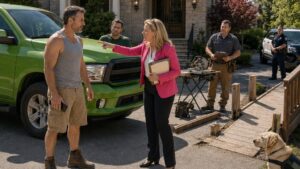
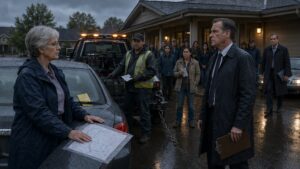
Nicole Scott stepped out first, black folder in one hand, tablet in the other. She wore a gray coat belted tight and shoes too polished for wet pavement. An inspection assistant followed with a clipboard and a plastic sleeve of papers. Nicole looked at the porch, at Charles’s tools, at the new board, and then at Mark.
“Mr. Adams,” she said. “We received a report of unapproved exterior work.”
Charles straightened slowly.
Mark kept his hand on the rail. “You received my emergency request two days ago.”
Nicole’s expression did not change. “You submitted an architectural modification request under exterior alteration. It has not been reviewed.”
“I submitted it because the rail was loose.”
“And the board has not approved work to begin.”
“The porch didn’t wait for the board.”
The inspection assistant looked down at his clipboard.
Nicole stepped closer and raised the tablet. Mark heard the faint click of a photograph. Then another. The camera lens pointed at the new board, the brace, the tape, the tools.
Charles wiped his hands on his work pants. “Ma’am, this is a temporary safety stabilization. Same footprint. Same rail line. No expansion, no new structure.”
“Are you the licensed contractor on record for the approved project?” Nicole asked.
“There is no approved project yet,” Charles said. “That’s the problem.”
Nicole turned to Mark. “Mr. Adams, I need all work stopped immediately until the architectural committee reviews the application.”
Mark’s hand tightened around the rail. He felt the new brace solid beneath his palm, and beneath that, the memory of the rail shifting while his weight leaned into it.
“No,” he said.
Nicole blinked once. “Excuse me?”
“No. He’s not taking the safe part off so the unsafe part can look familiar.”
“I’m not asking him to remove anything at this moment. I am ordering work to stop.”
Charles folded his arms but said nothing.
Nicole took a yellow notice from the plastic sleeve. It was larger than Mark expected, bright enough to be seen from the sidewalk. She peeled a backing strip from the top.
“Don’t put that on my rail,” Mark said.
“This notice must be visibly posted.”
“That rail is what I hold.”
Nicole paused, then attached the notice to the temporary post just below the top, where no hand needed to grip. She pressed the adhesive flat with two fingers. The black letters stood against the yellow.
VIOLATION NOTICE.
The word seemed louder than the drill had been.
Across the street, Rachel White had opened her front door. She stood half-hidden behind the storm door, watching. Farther down, a neighbor walking a small dog slowed at the curb.
Nicole took another photograph, this time of the yellow tag on the fresh wood.
Mark felt heat rise behind his eyes. Not tears. Anger, dry and old. The kind that had nowhere useful to go.
“I told your office this was an emergency,” he said.
Nicole glanced at her tablet. “The system shows an exterior cosmetic alteration request.”
“Then the system is wrong.”
“The system reflects the category selected and assigned.”
“I selected what it allowed me to select.”
“Mr. Adams, I understand this is frustrating.”
“No,” he said, and this time his voice cut sharper than he meant it to. Charles looked at him. Nicole held still. “You understand the form. You don’t understand the step.”
For a moment, the only sound was rainwater dripping from the gutter into the shrubs.
Nicole’s mouth tightened. “The association has liability concerns. Unapproved work creates exposure. If someone is injured—”
“I’m the someone.”
“Visitors, delivery personnel, neighbors—”
“I carried mail for forty years,” Mark said. “I know who uses a front step.”
Nicole’s eyes flicked to the cane, then away too quickly.
Charles moved half a step forward. “I can make it safe and clean by this afternoon. If you stop me now, it stays braced but unfinished.”
“Then it remains a visible violation,” Nicole said.
Mark looked at the yellow tag again. The fresh board beneath it had no paint, no history, no smooth place where Deborah’s hand had worn the rail. It did not look beautiful. It looked honest. It looked like a thing interrupted while trying to help.
“What fine?” he asked.
Nicole opened the folder. “Initial notice is a warning. If unapproved exterior work remains visible through the benefit weekend, fines begin Monday. If work continues after this notice, the board may assess accelerated penalties.”
“Benefit weekend,” Charles repeated. “That’s what this is about?”
Nicole did not answer him. She addressed Mark. “There will also be an insurance walkthrough tied to the annual community standards presentation. The board is asking residents to correct visible issues before then.”
“My porch is not a centerpiece.”
“It faces the street.”
“It faces my life.”
The words came out quiet. Too quiet for Rachel across the street to hear, maybe. Nicole heard them. Charles did too.
For the first time, Nicole looked less certain. Then the expression closed again, folded back into procedure.
“I strongly recommend,” she said, “that you remove or cover the unfinished materials until approval is granted.”
“And use what? The loose rail?”
“You may use another entrance temporarily.”
Mark looked toward the driveway, the narrow side path, the garage door with its raised lip of concrete. Another entrance. Another way around. Another small surrender described as practical.
“This is my front door,” he said.
Nicole slid the folder shut. “If the boards remain through the weekend, the fine doubles.”
She stepped back, signaled to the inspection assistant, and returned to the golf cart. The assistant avoided Mark’s eyes as he climbed in.
Charles waited until they drove away before speaking.
“I can finish the stabilization. Not the cosmetic work. Not if they’re watching.”
Mark stared at the yellow tag.
On the porch rail, bright against new wood, the notice trembled slightly in the damp air.
“Do what keeps it from moving,” Mark said.
Charles nodded.
Across the street, Rachel closed her door. Mark heard the soft click even from where he stood.
He placed his cane on the new board. It held.
For now, that had to be enough.
Chapter 4: Sarah Calls It A Warning Sign
Sarah Johnson arrived two days before the benefit with a grocery bag in each hand and concern already arranged on her face.
Mark watched her through the front window before she saw him. She stood in the driveway, looking first at the yellow tag on the porch rail, then at the raw board beneath it, then at the contractor tape Charles had wrapped around the unfinished section. Her car door hung open behind her. The rain had stopped, but the air still held the damp chill that made old joints speak up.
Sarah did not use the front steps.
She came through the garage.
Mark heard the side door open, then the careful shuffle of paper bags on the kitchen counter. She called, “Dad?” in a tone that already knew where he was and what she planned to say.
“In here.”
He was in the front hall, standing beside the console table with his cane in one hand and the HOA folder in the other. He had been sorting papers into piles: the emergency request confirmation, Charles’s invoice estimate, printed photographs of the loose rail, a copy of the violation notice Nicole had left. The folder looked thicker than the repair itself.
Sarah came in carrying the smell of cold air and grocery-store rotisserie chicken. She was dressed for work even though it was Saturday morning, dark slacks, blue sweater, hair pulled back. Her eyes moved from his face to the cane, then to the front door.
“I saw the notice.”
“So did everyone else.”
“Dad.”
“It’s posted where they wanted it.”
She set her purse on the bench by the wall. “Why didn’t you tell me it had gotten this bad?”
“I told you the rail was loose.”
“You said you were having someone look at it. That is not the same as an HOA violation tag on your front porch.”
“The tag didn’t make the rail loose.”
“No, but it tells me things are getting out of hand.”
Mark looked at the papers in his folder. He had expected this. He had also hoped, childishly, that she might arrive and simply say the new board looked safe. That she might touch the rail and understand the difference between unfinished and dangerous.
Instead she stood between the kitchen and the hall like someone guarding two exits.
“I brought soup,” she said, as if gentleness could be placed on top of the argument. “And chicken. Some bananas. You were out last week.”
“I can buy bananas.”
“I know.”
“Do you?”
Sarah pressed her lips together. Deborah used to do that when trying not to laugh at him. On Sarah it looked like trying not to cry.
Mark hated that more.
She glanced toward the front door. “I’m not saying you can’t handle groceries.”
“You are saying this porch means something bigger.”
“It does.”
“It means the porch needs fixing.”
“It means you nearly fell and didn’t tell me.”
Mark put the folder on the console table. “I did not fall.”
“Nearly matters.”
“Nearly is not an event.”
“Nearly is a warning sign.”
The words settled between them. Warning sign. Violation notice. Approval delay. Fine. All week, other people had found tidy labels for things that had weight and splinters and rainwater in them.
Sarah walked to the console table and picked up the photograph of Deborah. Her thumb brushed the edge of the frame but not the glass.
“Mom would have called me,” she said.
“No,” Mark said. “Your mother would have handed me a screwdriver and told me to stop pretending the rail would heal itself.”
Sarah gave a small laugh despite herself. It faded quickly. “She also would have told you when pride was doing the talking.”
Mark looked away.
The front hall had not changed much since Deborah died. Same narrow rug, same brass umbrella stand, same hook where her green gardening hat still hung because neither he nor Sarah had been able to move it. The house kept offering proof of her absence in ordinary places.
“I promised her I’d keep the house,” Mark said.
Sarah placed the photograph back carefully. “That’s not what she meant.”
“You don’t know what she meant.”
“She meant live, Dad. She meant keep living. She didn’t mean fight a homeowners association over a dangerous porch until you break a hip trying to prove you’re fine.”
He felt the words hit because they were not entirely wrong. That was the trouble with Sarah. She did not talk like Brian. She did not say community standards or visible compliance. She said dangerous porch and break a hip and meant love, even when it sounded like a verdict.
“I am not trying to prove I’m fine,” he said.
“Then what are you proving?”
“That this is still my door.”
Sarah closed her eyes for a moment.
The furnace clicked on. Warm air moved through the vent near the stairs. Mark could hear the faint tap of something loose outside, probably the contractor tape at the rail.
Sarah opened her eyes. “There’s a place fifteen minutes from me. Not assisted living exactly. Independent apartments. They have ground-floor units, maintenance on site—”
“No.”
“You haven’t even heard me.”
“I heard enough.”
“It would be safer.”
“So would never crossing a street.”
“That’s not fair.”
“Neither is deciding a loose rail means I’m finished.”
Her face changed then, hurt breaking through the carefulness. “I am not trying to take your life away.”
Mark’s grip tightened on the cane handle. He wanted to answer softly. He wanted to say he knew. But the week had rubbed him raw, and all he could see was another person standing in front of an entrance, explaining why he should use a different one.
“Then stop moving the door,” he said.
Sarah looked at him for a long moment. Then she nodded once, more to herself than to him, and went back into the kitchen.
He followed slower, regretting the words by the time he reached the doorway.
She was unpacking groceries with unnecessary precision. Soup cans aligned. Bananas placed in the bowl. Chicken in the refrigerator. She wiped a spot on the counter that was already clean.
“I’m sorry,” Mark said.
She did not turn. “I know.”
“I mean it.”
“I know that too.”
He stood there, useless with his cane.
After a while, Sarah said, “The benefit is tomorrow night?”
“Yes.”
“You’re not going.”
“I am.”
She turned then. “Dad.”
“They’re voting on accelerated enforcement before the insurance review. Brian is using my porch as an example.”
“Let them. Pay the fine for now. Appeal it later.”
“With whose permission?”
“That’s not what I meant.”
“It’s what happens.”
Sarah’s shoulders fell. “I don’t want you standing in a room full of people who already think they know what they’re looking at.”
“Neither do I.”
“But you’re going anyway.”
Mark nodded.
She looked past him toward the hallway, and her gaze caught on the console drawer, still open from when he had searched for old HOA papers. A stack of envelopes sat inside, along with spare keys, rubber bands, expired coupons, and the white resident paddle from the last annual meeting three years earlier. Willow Creek had used the same cheap paddles for votes then too, before switching to tablets and back again when the tablets failed.
Sarah pulled it out.
The paddle was blank on the front, white plastic dulled at the edges. Mark remembered Deborah holding one at a budget meeting, fanning herself with it because the air conditioning had gone out. She had whispered, “At least this place gives you something to wave before ignoring you.”
Sarah turned the paddle in her hand. “You kept this?”
“Your mother did.”
“Of course she did.”
“She said a vote you don’t use becomes someone else’s permission.”
Sarah’s expression softened. For a moment she looked younger, standing in the kitchen with Deborah’s old paddle and a grocery bag folded under one arm.
Then she set the paddle on the table between them.
“If you go,” she said, “let me drive you.”
“No.”
“Dad.”
“I need to walk in myself.”
“That is exactly the kind of sentence that worries me.”
“It is exactly the kind of thing I still get to decide.”
They held each other’s gaze. The argument did not end. It changed shape.
Finally Sarah picked up her purse. “Storm’s coming tomorrow night.”
“I know.”
“You’ll take your coat.”
“I have been dressing myself successfully for some time.”
She almost smiled. Almost.
At the garage door, she paused. “Call me after.”
Mark nodded.
“I mean it.”
“I know.”
After she left, he stood in the quiet kitchen. The groceries made the room look tended. The white paddle lay on the table, plain and absurd and waiting.
Mark picked it up.
It weighed almost nothing.
Chapter 5: The Neighbor With The Champagne Glass
By the time Mark reached the clubhouse doors, rain had soaked through the shoulders of his overcoat and turned the wool heavy.
The parking lot was full. Cars with polished hoods reflected the entrance lights in long trembling lines. Through the tall glass, he could see chandeliers, black jackets, silver trays, women turning carefully in narrow heels. The Willow Creek Annual Benefit and Community Standards Vote had always been dressier than it needed to be, but this year the place looked less like a neighborhood meeting and more like a hotel trying to impress someone.
Mark stood under the portico long enough to catch his breath.
His cane clicked once against the stone. The sound vanished under rain hitting the awning.
He had left the old white paddle from Deborah’s drawer at home. It had felt too much like carrying a ghost into a fight. At the check-in table, they would give him a current one. That mattered. Not nostalgia. Standing.
Inside, warmth hit his face. A volunteer behind the table looked past him first, perhaps expecting someone younger to step around him and claim a reservation. When no one did, she smiled too brightly.
“Good evening. Name?”
“Mark Adams.”
She scrolled on a printed list, found him, and hesitated just long enough for him to see it. Not because he was absent. Because his name had a mark beside it.
“Mr. Adams,” she said. “Resident member. One voting paddle.”
She handed him a blank white paddle with a small number printed on the back. Clean, flimsy, identical to dozens stacked beside the programs.
Mark took it carefully. Rain from his sleeve darkened the paper tablecloth.
A man near the velvet rope offered to take his coat. Mark shook his head.
“I’ll keep it.”
“It’s wet, sir.”
“So am I.”
The man did not know what to do with that, so he stepped aside.
Beyond the entry, the ballroom opened wide and bright. Round tables filled the floor. A string quartet played near the far wall, mostly ignored. Champagne glasses moved through the crowd on trays held by staff in black. At the front stood a screen, still dark, and a podium with the Willow Creek logo fixed to it.
Mark recognized people in pieces: the back of a neighbor’s head, a familiar laugh, a man who never waved from his driveway but always waved in meetings. He recognized Rachel White by the champagne glass before he registered her face. She was speaking with two neighbors near the ballroom edge, her dress a pale silver that caught the chandelier light.
Her eyes found him.
For a second, she seemed uncertain whether to greet him. Then she came over.
“Mark,” she said. “I didn’t know you were coming.”
“I live here.”
Color touched her cheeks. “I only meant—with the weather.”
“I’ve delivered mail in worse.”
“Yes. Of course.”
The two neighbors behind her glanced toward his cane and then toward his coat. One of them looked down at the wet spots forming around his shoes. Mark shifted the paddle under his arm, freeing his hand for the cane.
Rachel lowered her voice. “I saw the tag on your porch. I’m sorry that’s happening.”
“It did not happen by itself.”
“No. I know.” She paused. “But you have to admit, from the street, it looks… unfinished.”
“It is unfinished.”
Her relief at his agreement was visible. “Exactly. That’s all people are reacting to. With the benefit and the insurance review, everyone is a little sensitive about appearances.”
“Fresh wood offends insurance now?”
“That’s not what I meant.”
Mark looked at her champagne glass. The bubbles rose in perfect lines.
“What did you mean?”
Rachel glanced back at the neighbors, then stepped slightly aside, as if giving him privacy inside a crowded room. “Some people are worried Brian will use this to push through stricter enforcement. And some people are worried if we don’t tighten things up, premiums go up for everyone. It’s complicated.”
“My rail was loose. That was not complicated.”
“But starting without approval—”
“The approval form asked me for a paint sample while the rail moved in my hand.”
Rachel’s expression shifted, but before she could answer, Brian Harris crossed the entry from the direction of the podium.
He saw Mark and smiled with his teeth.
“Mark. You made it.”
The words sounded welcoming. His body did not. Brian stopped just close enough to block the natural path into the ballroom.
“Brian,” Mark said.
“I wish you had called ahead. Nicole mentioned there was some confusion earlier this week.”
“She made it clear.”
Brian’s eyes flicked to the paddle. “We’re going to keep tonight’s meeting orderly. There’s a lot on the agenda.”
“I read the agenda.”
“Good. Then you saw open comment is limited.”
“I saw the proposed enforcement measure.”
Brian lowered his voice. “That measure is not about you personally.”
“My porch is in your packet.”
“It is an example of a category of concern.”
“It is my front door.”
Rachel stood silent beside them, glass held at her waist now.
Brian’s smile thinned. “No one wants to embarrass you.”
Mark looked past him into the ballroom. At the front, Nicole stood near a side table arranging folders with an inspection assistant. The screen behind the podium flickered as someone tested the projector. For half a second, a desktop appeared, then vanished.
In that blink, Mark saw a folder name: Standards Presentation Final.
Brian touched his arm lightly, not a grip, not yet. “Why don’t we find you a seat in the back? When the appropriate time comes, you can make a brief comment.”
Mark looked at the hand until Brian removed it.
“I can find a chair.”
“Of course.”
But Brian did not move.
A staff member passed with champagne. The tray tilted slightly around Mark’s cane. A woman behind him made a soft sound of annoyance, then covered it with a cough.
Mark stepped around Brian.
The ballroom seemed to lengthen as he entered. Every table had white linen, folded cards, small centerpieces of winter greenery. A pianist had joined the quartet. The music was polite enough to make discomfort more visible.
Mark chose a chair near the back aisle. Not because Brian had suggested it. Because from there he could see the screen, the podium, Nicole’s table, and the exit.
Rachel passed him on her way back to her table. She stopped again, briefly.
“I hope this gets sorted,” she said.
“Sorted how?”
She looked tired then, or maybe only human. “Without making things worse.”
Mark rested the paddle across his knees. “That depends on what people think worse means.”
She did not answer.
The meeting began with thank-yous, donor acknowledgments, a reminder about silent auction baskets, and a short speech from Brian about shared investment. Mark listened. He had attended enough meetings to know language could trim a problem into a shape that fit the room.
Nicole spoke next about compliance timelines. Her voice was clear, professional, and nearly kind. She mentioned storm season, exterior consistency, insurance expectations, and the importance of not beginning work before review. The screen showed sample images: a fence too tall, a mailbox in the wrong color, trash bins visible from the street.
Then Brian returned to the podium.
“As we all know,” he said, “one visible issue can become a broader liability question when left unaddressed.”
He clicked the remote.
Mark’s porch appeared behind him.
Larger than life. Brighter than memory. The raw board, the brace, the yellow tag, the strip of tape. His own front door just visible at the edge of the photograph, painted the same dark green Deborah had chosen twenty years earlier.
A murmur rolled through the room.
Mark looked down at the white paddle against his wet sleeve.
The room had already decided what his porch meant.
He closed his fingers around the handle.
Chapter 6: Out Of Order Does Not Mean Wrong
Brian did not touch Mark’s arm until the room began listening.
That was what Mark noticed first. Not the pressure of the fingers near his sleeve, not the security guard stepping closer, not the way Rachel White’s champagne glass had lowered to the table and stayed there. He noticed that Brian had allowed the room to murmur at the photograph, had allowed the phrase “visible unfinished work” to settle, had allowed people to see Mark wet and old and standing alone before he moved to stop him.
Order, Mark thought, had timing.
“Mr. Adams,” Brian said, his voice smooth enough for the front tables and firm enough for the back, “you are out of order.”
Mark kept the paddle raised.
The photograph of his porch still filled the screen. Yellow tag. Fresh wood. Temporary brace. It looked bad from that angle. He would not pretend otherwise. Charles had not painted it. The tape had wrinkled in rain. The new board stood out against the old porch like a bandage on a face.
But a bandage was not an injury.
“That board is not decoration,” Mark said. “It is the way I get through my own front door.”
The room held the sentence for a moment.
Brian’s fingers hovered near Mark’s forearm, not quite gripping, but close enough that Mark felt the heat of another person’s decision. The security guard stopped beside the aisle.
“No one is questioning your need to access your home,” Brian said.
“You are questioning the repair that lets me do it.”
“We are questioning an unapproved modification.”
“You stopped the man making it safe.”
“The contractor was advised to pause until the architectural committee reviews the matter.”
“Pause,” Mark said. “That is a fine word for leaving a thing half-fixed.”
A few people shifted. Someone at a rear table whispered, “Let him talk.”
Brian heard it. His expression did not change, but his hand came closer to Mark’s arm. This time the fingertips touched wet wool.
Mark looked down at them.
Brian withdrew almost immediately.
“Let’s step into the hall,” Brian said quietly.
“No.”
“Mark.”
“No.”
The second no was softer. It carried farther.
Nicole had come away from the side wall with the black folder pressed flat against her tablet. She looked between Brian and Mark, then toward the screen. Her face had that same closed expression from the porch, but something behind it had tightened.
“Nicole,” Mark said without taking his eyes off Brian, “what time did my emergency request arrive?”
Brian turned. “That isn’t relevant to tonight’s presentation.”
“It is relevant to the photograph.”
Nicole hesitated.
The inspection assistant beside her looked at the folder in her arms. Rachel White leaned slightly forward in her chair.
Brian’s voice sharpened by half an inch. “We are not litigating an individual compliance file in the middle of a community vote.”
“You put my individual compliance file on the wall.”
“It was anonymized.”
“My front door is in it.”
A sound passed through the room. Not laughter now.
Nicole opened the folder. The motion was small, but Mark saw Brian see it.
“Nicole,” Brian said.
She stopped.
Mark lowered the paddle just enough to ease the strain in his shoulder, but he did not let it fall. “You have the timestamp.”
“This is not the proper forum,” Brian said.
Mark looked at the residents in their formal clothes, at the centerpieces and glasses and folded programs. “Then why did you bring my porch here?”
Rachel’s lips parted, but she said nothing.
Nicole opened the folder the rest of the way. Papers shifted. Her tablet screen lit her face from below. “The request was submitted Tuesday at 8:42 a.m.”
Mark nodded once. “Emergency note attached?”
Nicole scrolled. “The resident wrote that the storm loosened the rail, boards were warped, and cane use was affected.”
Brian moved toward her. “Nicole.”
She looked up, and this time her voice was lower. “It was routed as exterior cosmetic alteration.”
“By the system,” Brian said.
“By review assignment,” Nicole said.
The difference was small. The room did not understand it yet. Mark did.
Brian’s face changed only around the eyes.
“Thank you,” Mark said.
Nicole closed the folder halfway, as if she had already said more than she intended.
Brian turned back to the room. “This is exactly why we cannot handle individual construction disputes emotionally. We have processes for resident safety, and we have processes for exterior standards. When residents begin work before approval, it puts the association in a difficult position.”
Mark felt the old anger stir again, but beneath it was something colder. Not surprise. Confirmation.
“You had my note,” he said.
“We had an incomplete application.”
“The form would not submit without a paint sample.”
“Then you should have contacted the office.”
“I did.”
Brian looked briefly toward Nicole.
Mark saw the glance. So did Rachel. Maybe others.
“Voice mail is not approval,” Brian said.
“No,” Mark said. “But neither is silence a handrail.”
That reached them. He saw it move across faces in the back rows first, where people were not performing concern for the front tables. A man crossed his arms. A woman lowered her program. Rachel stared at the screen now, not at Mark, as if seeing the porch differently required looking longer.
Brian stepped closer again. This time his voice dropped so only Mark and the nearest tables could hear clearly. “You are making this harder than it needs to be.”
Mark almost laughed. It would have sounded wrong, so he swallowed it.
“Harder than getting through my door?”
“You know what I mean.”
“I know what you want me to mean.”
The security guard shifted his weight.
Brian straightened. “Sir, please escort Mr. Adams to the lobby until open comment.”
“Sir?” the guard said, not quite sure which sir he meant.
Mark lowered the paddle fully. His shoulder throbbed. For one wild second, he wanted to fling the white plastic at the screen and split the picture of his porch down the middle. He imagined it clattering on the marble, imagined everyone seeing he could still make a room jump.
Then he thought of Deborah tapping the porch rail twice before stepping down.
A vote you don’t use becomes someone else’s permission.
He tucked the paddle against his coat instead.
“I’ll walk,” he said.
Brian gave a small nod, as if he had won something.
Mark turned. The aisle seemed longer than before. People moved their chairs inward by inches to clear his way, and the scrape of chair legs sounded like judgment pretending to be courtesy. His cane clicked on the marble. His wet coat brushed the back of one chair. No one touched him.
At Rachel’s table, he felt her watching. He did not look at her.
In the lobby, the music from the ballroom became muffled and strange. The security guard stopped by the velvet rope.
“You okay, sir?” he asked, quietly enough that it did not sound official.
Mark looked at him. The man seemed younger than Sarah, broad-shouldered, uncomfortable.
“I’m standing,” Mark said.
The guard nodded as if that answered more than it did.
Behind them, Brian resumed speaking. His voice rose through the open ballroom doors.
“—the proposed measure allows the board to address visible unfinished work quickly, before it affects insurance classification or community value.”
Mark stood beside a marble column and watched rain slide down the glass doors. His reflection looked older than he felt and exactly as old as everyone else seemed to think he was.
Nicole came into the lobby three minutes later.
She did not approach at first. She stood just beyond the velvet rope with the folder held against her side.
“Mr. Adams,” she said.
Mark turned. “Did Brian send you to tell me the comment period is closed?”
“No.”
“Then?”
She looked toward the ballroom. “I should not have read from the file in open session.”
“You did not read the important part.”
Her fingers tightened around the folder.
“The request was reassigned,” Mark said.
Nicole was silent.
“Who reassigned it?”
“I can’t discuss internal workflow in the lobby.”
“You discussed my porch on a screen.”
“That was not my decision.”
“No,” he said. “But the tag was.”
She absorbed that. Not easily. Not defensively either. He could see the office in her—the deadlines, the forms, the fear of admitting one file had a person inside it.
“Mr. Adams,” she said, “even if the emergency note had been categorized differently, the work still needed documentation.”
“Charles took photographs.”
“Those should be submitted.”
“They were.”
She looked down at the folder.
Mark waited.
When she spoke again, her voice had changed. “I saw the contractor’s email.”
“And?”
“And it was forwarded to the architectural committee.”
“When?”
Nicole’s eyes lifted to his.
There it was. The answer she had not wanted to carry.
“Yesterday afternoon.”
Mark nodded. The repair had been stopped before the photographs could be reviewed. The violation had been prepared before the safety evidence reached the people supposedly responsible for safety. The process had not merely been slow. It had been steered.
From inside the ballroom came a low swell of voices. Brian must have moved to the vote.
Mark looked down at the paddle in his hand. The blank white face had a smear of rainwater across it. No number on this side. No name. Just a small, silent surface waiting to be counted by someone else.
He held it out toward Nicole.
She flinched slightly, misunderstanding.
“Not yours,” Mark said. “Mine.”
“I know.”
“No,” he said. “You know the file number. You don’t know mine.”
She did not answer.
Mark pulled the paddle back and rested it against his coat.
“I want the complete file,” he said. “The request, the reassignment, the contractor photographs, the inspection notes, and who changed the category.”
“I can request—”
“Before morning.”
Nicole looked toward the ballroom again. “That may not be possible.”
“It became possible when you put my front door in front of two hundred people.”
The guard had stepped farther away, pretending not to hear.
Nicole’s face flushed faintly. “I can send what I have access to.”
“And tomorrow,” Mark said, “the board can walk from my curb to my door before they vote on whether I’m allowed to make it safe.”
“That is not how emergency review usually works.”
“Then it can learn.”
For the first time all night, Nicole almost smiled. Not with amusement. With the tired recognition of a person watching a rule meet the thing it failed to imagine.
“I’ll email what I can,” she said.
Mark nodded.
He turned toward the glass doors. Outside, rain moved across the parking lot in silver sheets. In the ballroom behind him, Brian’s voice rose and fell, guiding the room toward a decision Mark no longer needed to witness.
He stepped through the doors into the wet night.
At the edge of the portico, he paused and looked back through the glass. Brian stood under the chandelier light, one hand lifted toward the screen. Nicole remained in the lobby with the folder against her chest.
Mark raised the paddle once, not for them to count.
For himself to remember.
Then he lowered it, tightened his grip on the cane, and walked into
Chapter 7: The Walk From Curb To Door
By morning, the rain had stopped, but the porch still held it.
Water gathered in the cupped places of the old boards, dull and gray beneath the cloudy sky. The yellow violation tag had softened at one corner and curled outward, as if even the notice wanted to come loose. Mark stood at the curb with his cane in one hand and Nicole’s printed file in the other, watching three HOA board members step carefully from their cars as though the wet street itself might stain them.
Nicole had sent the file at 6:17 a.m.
Mark had been awake since four.
He had printed what mattered: his original request, timestamped Tuesday at 8:42 a.m.; the contractor photographs Charles had submitted; the inspection notice; and the routing history Nicole had not mentioned in the lobby. The line was plain, almost boring.
Emergency safety note reviewed. Reassigned to exterior cosmetic alteration pending standards presentation.
Below it sat Brian Harris’s initials.
Mark had stared at those initials at the kitchen table until they no longer looked like letters. They looked like two fingers pressing something down.
Now Brian stood near the curb in a navy overcoat, his hair neat despite the wet air. Nicole stood beside him with her tablet. Rachel White had come too, wrapped in a cream-colored coat, her face bare of the polished expression she had worn in the ballroom. She stayed near the sidewalk, not with the board and not with Mark.
Charles Ramirez’s truck was parked at the edge of the driveway. He leaned against the front fender, arms folded, saying nothing.
Brian looked at the porch from a distance. “Mark, we agreed to an emergency review, not a demonstration.”
Mark held out the printed file. “You agreed to walk from the curb to my door.”
“That was your language.”
“Yes.”
Nicole looked up from her tablet. “The board can observe the access route and then discuss temporary stabilization options.”
“Good,” Mark said. “Observe.”
Brian exhaled through his nose. “Before we begin, I want to be clear. No one here wants you unsafe.”
Mark looked at the yellow tag on the rail. “Then you should all want to know what unsafe looks like.”
He turned toward the driveway.
The first steps were easy. The driveway had a slight slope, but he knew where the shallow cracks ran and where the water settled after a storm. His cane tapped once, twice, then clicked on a pebble near the walkway. He moved slower than he liked. Not because he wanted sympathy. Because rushing made the route lie.
Behind him, shoes whispered over wet pavement.
Sarah had called twice that morning. He had not answered the first time. The second time he had picked up and said, “I’m not alone,” which was both true and not the answer she wanted. She had gone quiet, then said, “Do not perform bravery for people who don’t deserve it.”
“I’m performing accuracy,” he had told her.
Now accuracy required crossing the narrow walkway where the lawn edged too close and the concrete tilted toward the flower bed. His cane tip found the seam. He lifted it free and continued.
Rachel’s voice came from behind him, low. “I didn’t know the path sloped that much.”
“It always has,” Mark said. “It only started mattering when my left knee stopped pretending.”
No one laughed. He was glad.
At the bottom step, he paused.
The porch looked different with people watching. Smaller, somehow. Less like a public issue than a few boards and a rail and the stubborn fact of a human body needing support. The temporary brace Charles had installed held firm, but the unfinished section still showed where work had stopped. One old board beside the new one had swollen overnight. The seam had opened enough to catch the edge of a rubber cane tip.
Mark placed his cane there deliberately.
It caught.
He heard Rachel inhale.
Brian stepped forward. “Careful.”
Mark did not look back. “That is the point.”
He freed the cane and set it on the new board Charles had installed. Solid. Then on the older board beside it. Soft give. Then near the threshold where the rail had shifted before the repair.
“This,” Mark said, touching the braced rail, “is what your notice calls a violation.”
Charles came closer. “That brace is temporary. I told them that in the photos.”
Nicole nodded. “The file includes that.”
Brian’s expression tightened. “The issue is not whether the brace has function. The issue is that visible unapproved work creates precedent.”
“Precedent for what?” Mark asked. “Not falling?”
“For residents starting projects and claiming emergency after the fact.”
Mark turned on the second step. He did it slowly because turning on wet wood was no longer casual. The board members watched the movement despite themselves.
“I claimed emergency before the work,” he said. “Your initials moved it out of emergency.”
Brian looked at Nicole.
Nicole did not rescue him. She held the tablet in both hands. “The routing history shows the request was reassigned after initial review.”
“It was incomplete,” Brian said.
“The form would not submit without a paint sample,” Mark said. “I sent a picture of old paint because the computer wanted color while my rail moved.”
A board member murmured something to another. Charles stared at Brian with the expression of a man watching a nail bend because someone refused to hit it straight.
Brian’s voice stayed controlled. “I was trying to prevent an exception from becoming a loophole before the insurance walkthrough.”
Rachel stepped closer to the bottom step. “So you delayed it because the benefit was coming.”
“I reclassified it because the visible condition affected broader association concerns.”
“You photographed it as neglect,” Mark said. “After you stopped the repair that would have made it disappear.”
Brian looked at him then, not at the file, not at Nicole, not at the porch. “You could have used the garage for a few weeks.”
Mark felt the sentence enter his chest and settle in the place Sarah’s had the day before. Another entrance. Another way around. A small practical thing that was not small to the person asked to do it.
He looked toward the garage, then back at the front door. The dark green paint was damp. Deborah had chosen it after standing with six color cards in the sunlight and declaring all of them wrong except that one.
“My wife came through this door the last time she came home from the hospital,” Mark said.
The words surprised the group into stillness. He had not planned to say them. He had planned to talk about timestamps, boards, forms. Things that could be held without shaking.
He swallowed once and continued more carefully.
“She stopped right here.” He touched the rail where the smooth place used to be before the new brace interrupted it. “She said, ‘Don’t let them talk you into living through the garage.’ She meant Sarah, mostly. Maybe me. I don’t know. She was tired.”
Rachel lowered her eyes.
Mark looked at Brian. “I am not asking this association to keep my memories. I am asking it not to make the safe door unusable because the safe repair was ugly for a week.”
Nicole’s face had gone pale in the cool morning light.
Brian said nothing.
A delivery truck turned onto the street, slowed at the cluster of people, then passed. The driver glanced once and kept going. Ordinary life sliding around a small public reckoning.
One board member cleared his throat. “What would be required to finish it properly?”
Charles answered, not too quickly. “Two more boards replaced, rail post reset, sand, prime, paint to match existing. One day of work if weather holds. I can leave temporary safety in place until final coat cures.”
“And code?” Nicole asked.
“Within code. Same footprint. Safer than what was there.”
Brian looked toward the porch photo in his folder, then at the actual porch. The photograph had made the repair look like a stain. The walk had made it look like a route.
“We can approve a temporary stabilization,” he said. “Pending normal review.”
“No,” Mark said.
Everyone looked at him.
Brian’s mouth flattened. “Mark, that is the reasonable compromise.”
“No. Temporary removal and normal review puts me back where I started. You can approve emergency safety completion with a matching finish, or you can say in writing that appearance matters more than the rail holding.”
“That’s not fair.”
Mark rested both hands on the cane. “Neither was putting my door on a ballroom screen.”
Rachel looked up. “He’s right.”
Brian turned toward her.
She seemed almost startled by her own voice, but she did not take it back. “I complained about the porch. I did. I thought it looked abandoned. But I didn’t know the request was already in. I didn’t know he was using that rail like this.”
Brian’s face showed irritation now, open and human. “We cannot run an association on feelings.”
“No,” Mark said. “But you cannot run one on photographs alone either.”
Nicole looked down at the tablet. “There is an emergency accommodation provision for temporary safety work after storm damage. It requires board acknowledgment within seventy-two hours, not full architectural approval.”
Brian turned sharply. “That provision is for common hazard exposure.”
“It says resident access hazard,” Nicole said. Her voice was careful, but it did not bend. “The language is broader than we usually apply.”
Mark watched Brian read the screen she held out. He did not feel victory. He felt tired. He felt the porch beneath his feet and the cold damp in his knees. He felt Deborah’s absence, Sarah’s fear, Charles waiting to do a simple job made complicated by people who preferred clean categories to wet wood.
Brian handed the tablet back.
“We’ll call an emergency board vote,” he said. “For completion under matching finish requirements.”
“And the fine?” Mark asked.
“Suspended pending review.”
“No.”
Brian’s eyes narrowed.
“Withdrawn,” Mark said. “The notice was based on a category your office changed.”
Nicole looked at the board members. One nodded slightly. Another looked away, then nodded too.
Brian saw it.
“Withdrawn,” he said.
The word came out like a door being closed too hard.
Mark looked at the yellow tag. “Then take that off my rail.”
Nicole stepped forward before Brian could move. She peeled the damp notice carefully from the temporary post. Some adhesive remained, a pale rectangle on the wood.
She held the tag in her hand, folded once by the rain.
Mark placed his cane on the new board and climbed the last step. At the threshold, he paused and looked back.
Charles was watching him. Rachel too. Brian stood at the bottom of the steps with his hands in his coat pockets, already looking like a man preparing the version of the story he could live with.
“Charles,” Mark said, “can you finish it without making it fancy?”
Charles nodded. “I can finish it right.”
Mark opened his front door.
Inside, the hall waited: the narrow rug, the console table, Deborah’s photograph. He did not step in yet.
He turned back to Brian.
“And the rule,” he said. “Fix that too. I won’t be the last person who needs a board to hold before a committee meets.”
Brian did not answer.
Mark went inside, but he left the door open behind him.
Chapter 8: The Vote Without Applause
One week later, the white paddle felt heavier in Mark’s hand.
It was not the same paddle from the ballroom. That one had been returned at the door in the confusion after the benefit, dropped into a bin with the others like a used napkin. This one came from the stack at the emergency HOA meeting, clean and blank and waiting on a folding table beside a coffee urn.
Mark picked it up without ceremony.
The meeting room was smaller than the ballroom. No chandeliers. No champagne. No string quartet softening the air. Just rows of chairs, fluorescent lights, a table for the board, and raincoats hung on the backs of seats because the week had decided not to dry out. Mark preferred it. A room like this did not pretend a neighborhood was a gala.
His porch repair was not on a screen this time.
It sat in a packet, three pages long, titled Emergency Resident Access Repair Procedure. Nicole had written most of it. Mark knew because she had sent him the draft with tracked changes still visible, small blue lines showing where “may consider” became “must review” and where “cosmetic alteration” became “safety access concern when supported by photographs or contractor statement.”
Brian sat at the board table, shoulders squared, face composed. He had not apologized. Mark had not expected him to. Apologies were not the only measure of whether something had changed.
Rachel sat two rows behind Mark. Sarah sat beside him.
That had been a negotiation.
She had arrived at his house that evening determined to drive him. He had let her, after making clear she was not to answer questions for him, carry his papers, or help him stand unless he asked. She had agreed to all of it with a strained patience that told him agreement cost her something too.
On the drive, she had said, “I’m trying to learn the difference between helping and taking over.”
Mark had watched the wet streets slide by. “So am I.”
Now she sat with her hands folded around her purse strap, saying nothing.
Nicole called the meeting to order because Brian’s voice had become the wrong instrument for this particular song. She summarized the proposed rule correction. Emergency repairs tied to safe entry, storm damage, handrails, steps, ramps, or other access hazards would receive seventy-two-hour review. Temporary stabilization could proceed if documented by photographs and a licensed contractor. Cosmetic matching could be required, but safety work could not be stopped solely because it was visible before finish work.
Brian watched the room as she spoke. Not humbled. Alert.
When she finished, a board member asked about abuse of the provision.
Charles, seated near the side wall in a clean work shirt, lifted one hand. “Require before photos, contractor notes, and matching finish. That stops abuse without stopping the repair.”
A few residents nodded.
Another board member asked about liability if temporary work failed.
Nicole answered that documented stabilization by a licensed contractor reduced liability more than ordering residents back onto known hazards.
Mark watched Brian’s jaw shift.
Then Rachel stood.
She did not look at Mark first. She looked at the board.
“I was one of the residents who complained about Mr. Adams’s porch,” she said. Her voice carried because the room was small and because she did not decorate it. “I saw raw wood and tape and thought someone was letting standards slide. I was wrong to assume neglect from the sidewalk.”
Mark looked down at the paddle in his lap.
Rachel continued, “The rule should make room for context before it makes an example out of someone.”
She sat before the room could turn her statement into anything larger.
No applause followed. Mark was grateful.
Brian opened public comment. Two residents worried about loopholes. One asked whether emergency repairs would allow mismatched paint for months. Nicole answered. Charles answered once. Mark listened. Not every concern was cruel. Some were ordinary fears in pressed clothes: one person’s exception becoming everyone’s excuse, one visible mess becoming decline, one loose standard becoming another bill.
Then Brian looked at him.
“Mr. Adams,” he said, “would you like to speak?”
Mark placed one hand on Sarah’s armrest, not on her arm, and stood. She did not reach for him. He noticed. He appreciated it enough that he almost lost his first sentence.
He steadied himself with the cane.
“I don’t want a special rule named after me,” he said.
Some eyes dropped to the packets. A few people smiled faintly. Mark did not.
“I don’t want anyone in this room to think this is about winning an argument. My porch needed a repair. The first repair was ugly. It was also the first safe thing that had happened to that rail all week.”
He looked at Brian then, briefly.
“When I submitted the request, the system asked me for a paint sample. I sent one. It asked me for things a man can provide from a chair. But the danger was at the door, not in the form.”
Sarah’s fingers tightened around her purse strap.
Mark held the paddle by its handle. He did not raise it yet.
“I have lived in Willow Creek a long time. I know rules matter. I followed plenty of them when they were inconvenient and even when they were silly. But a rule that cannot tell the difference between a vanity project and a board that keeps a person upright is not protecting the neighborhood. It is protecting itself from having to look closer.”
The room stayed quiet.
He took one breath.
“I am not asking to be treated like I cannot manage my home. I am asking not to be forced to prove I deserve to enter it safely.”
He sat.
Sarah touched his sleeve once, then withdrew her hand. It was exactly enough.
The vote came after short discussion. Brian called for paddles.
Mark watched white rectangles rise around the room. Not all at once. Not dramatically. Some quick. Some reluctant. A few remained down. Rachel’s went up. Nicole’s role did not allow a vote, but she looked at the count without expression.
Mark raised his paddle last.
For a moment, the blank white face hovered in front of him, the same shape as the one in the ballroom, the same simple surface that had looked foolish in his wet hand under chandelier light. Now it looked like what it was: not power, not victory, but a way to be counted before someone else summarized him.
The motion passed.
Brian announced it in a level voice. “Emergency Resident Access Repair Procedure is adopted. The Adams violation notice is withdrawn as miscategorized. Completion approved under matching finish requirements.”
No one cheered.
Mark lowered the paddle.
Outside the meeting room, Sarah offered to take him home. He let her. At the house, Charles’s work was already finished. The rail was reset and painted to match the old white as closely as fresh paint could. The replacement boards lay smooth under the porch light. The adhesive mark from the yellow tag had been sanded away.
Sarah parked at the curb.
Mark opened his door before she could come around. He heard her stop herself. That small restraint mattered more than if she had run to help.
He walked from the curb to the steps. The cane struck the driveway, then the path, then the first porch board. Solid. The rail met his palm without shifting.
At the top, he paused.
Deborah’s smooth place on the rail was gone under new paint and repair. For a moment, grief rose sharp and unreasonable. He had fought to keep the house from changing, and the repair had changed it anyway.
Sarah stood at the bottom step. “Dad?”
“I’m all right.”
This time, he meant it differently.
He opened the front door. Warm light crossed the threshold and touched the porch boards. Inside, the console table waited with Deborah’s photograph, and beside it, the old white paddle from the drawer lay where Sarah had placed it before they left.
Mark turned back. “Saturday morning,” he said.
Sarah blinked. “What?”
“You can come Saturday. We’ll talk about the side path. Maybe a better light by the garage. Not tonight.”
Her face softened. She nodded. “Saturday.”
“And I choose the fixture.”
“Of course you do.”
He almost smiled.
Sarah returned to her car. Mark stepped inside and set his cane against the wall. Then he picked up Deborah’s old paddle and laid it flat beside her photograph.
Not raised. Not surrendered.
Kept.
He closed the door and turned the lock from the inside, not because he was trapped, but because he was home.
The story has ended.