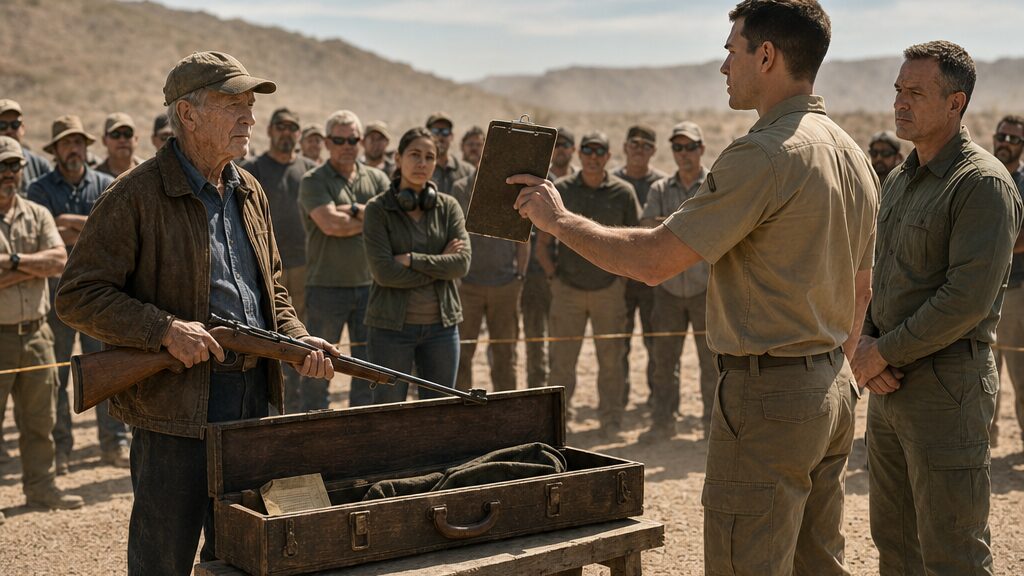
The Young Instructor Mocked An Old Veteran’s Rifle Until The Desert Target Came Back Silent
Chapter 1: The Old Rifle Case At Lane Seven
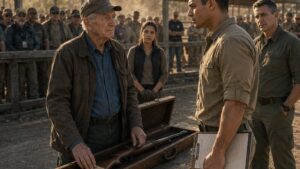
The first thing people noticed was the rifle case.
Not Paul Harris.
Not the careful way he stepped out of his pickup and closed the door without a sound.
The case.
It was long, scratched, and made of wood darkened by decades of use. Among rows of black polymer cases and modern equipment bags, it looked like something that belonged in a museum.
A few shooters glanced at it and smiled.
One laughed.
Paul heard them. He heard everything.
The desert range stretched beneath a cloudless morning sky. Dust drifted across the packed earth whenever the wind stirred. Rows of targets waited far downrange, white against the tan landscape.
The veterans’ charity qualification event had already drawn a crowd.
Paul rested one hand on the case.
Inside his jacket pocket was a folded yellowed range card.
He touched it briefly.
Then he walked toward registration.
The clerk looked up from a folding table.
“Name?”
“Paul Harris.”
The clerk searched the list.
“Registered participant?”
“Yes.”
A pause.
The clerk found the entry.
“Lane assignment will be announced shortly.”
“Thank you.”
Paul stepped aside.
Nearby, groups of shooters compared optics, discussed rifles, and traded stories. Most were younger. Some wore competition jerseys covered in sponsor logos.
Paul remained alone.
He preferred it that way.
A whistle sounded.
A young man in a tan range uniform strode toward the firing line.
Confident.
Fast.
Loud enough to command attention.
Mark Allen.
The range instructor.
Paul recognized the type immediately.
Not a bad man.
Just a man who had learned confidence before humility.
“Everybody gather up,” Mark called.
The crowd formed a loose semicircle.
Mark began explaining the event schedule.
Safety procedures.
Qualification requirements.
Scoring standards.
Most of it was correct.
A few details were rushed.
Paul listened quietly.
When the briefing ended, participants moved toward their assigned positions.
Mark noticed him for the first time.
His eyes dropped to the wooden rifle case.
Then to Paul’s face.
Then back to the case.
The look lasted less than a second.
But Paul had seen that look many times.
The quick calculation.
The assumption.
Old man.
Old rifle.
Problem.
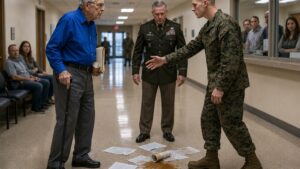
“You participating today?” Mark asked.
Paul nodded.
“Yes.”
Mark blinked.
“With that?”
A few nearby shooters chuckled.
Paul answered calmly.
“With my rifle.”
Mark smiled.
The smile was not friendly.
“You sure you’re in the right event?”
More laughter.
Paul looked at the firing line.
“I believe so.”
“This qualification isn’t exactly casual shooting.”
“I understand.”
Mark crossed his arms.
“How long since you’ve competed?”
“Quite a while.”
“Thought so.”
The surrounding shooters listened openly now.
Public attention was shifting.
Paul felt it.
Pressure gathering.
Judgment forming.
He kept his expression neutral.
Mark pointed toward the case.
“That thing even safe?”
Paul met his eyes.
“Yes.”
“You have paperwork?”
Paul removed the folded range card.
Its edges were worn soft.
Mark barely glanced at it.
“That’s old.”
“It is.”
“Very old.”
“Yes.”
A few people laughed again.
Mark handed it back.
“We use updated standards here.”
Paul folded the card carefully.
“I understand.”
Something about the response seemed to irritate Mark.
Perhaps because it gave him nothing to fight.
Perhaps because Paul refused embarrassment.
“Look,” Mark said, louder now, “we’ve got a lot of people here today. We can’t spend half the morning babysitting outdated equipment.”
The words carried across nearby lanes.
Conversations slowed.
Eyes turned.
Paul felt dozens of strangers deciding who he was.
He had experienced worse.
Not on ranges.
Not in competitions.
In classrooms.
In training fields.
Young men eager to prove themselves before learning patience.
The years had taught him something useful.
Being underestimated was often quieter than being respected.
Mark waited.
Perhaps expecting an argument.
An apology.
A retreat.
Instead Paul asked, “May I inspect my lane assignment?”
The instructor stared at him.
“That’s it?”
“Yes.”
“You’re not upset?”
“No.”
Mark shook his head.
“Fine.”
He grabbed a clipboard.
His finger moved down the sheet.
Then a small smile appeared.
Lane Seven.
The worst lane on the range.
The far edge.
Uneven ground.
Harsh crosswind exposure.
A lane experienced shooters avoided whenever possible.
Mark tapped the paper.
“Lane Seven.”
Someone nearby whistled.
Another shooter muttered, “Good luck.”
Mark’s smile widened slightly.
“Hope your museum piece likes the wind.”
Paul accepted the assignment slip.
“Thank you.”
The lack of reaction seemed almost disappointing.
Mark turned away.
The crowd dispersed.
Paul walked toward Lane Seven.
The desert wind brushed against his jacket.
Dust moved across the firing line.
He reached the lane and set down the rifle case.
For a moment he simply stood there.
Watching.
Listening.
Feeling the wind.
The same way he always had.
Nothing about the lane bothered him.
Wind was wind.
Distance was distance.
Targets were honest.
People were complicated.
He knelt beside the case and rested a hand on the worn wood.
Memories stirred.
Not of competitions.
Not of awards.
Of students.
Young faces.
Long days.
Lessons repeated until they became instinct.
One student in particular.
The reason he had come.
The reason the folded card remained in his pocket.
Paul closed his eyes briefly.
Then opened them again.
Across the range, Mark was already speaking animatedly to another group of shooters.
Confident.
Certain.
Unaware.
Paul looked downrange.
The targets waited silently in the distance.
And Lane Seven waited with them.
Chapter 2: The Young Instructor Raised His Voice
The firing line grew louder as the morning progressed.
Bolts clicked.
Cases opened.
Shooters checked equipment.
The smell of dust and oil drifted through the dry air.
Paul sat quietly on a folding stool beside Lane Seven.
His rifle case remained closed.
He preferred preparation without performance.
Others preferred the opposite.
Mark Allen moved up and down the line like a man determined to be seen.
He corrected grips.
Adjusted positions.
Offered advice whether it was requested or not.
Most participants respected him.
Paul could understand why.
Confidence looked convincing from a distance.
Unfortunately, confidence and judgment were not always the same thing.
“Lane Seven.”
Mark’s voice carried across the line.
Paul looked up.
The instructor approached with two younger shooters following behind.
“There he is.”
One of the younger men glanced at the wooden case.
“That’s the rifle?”
Mark nodded.
“Apparently.”
The group laughed.
Paul said nothing.
Mark stopped directly in front of him.
“You planning to shoot today or display antiques?”
The younger shooters grinned.
Paul looked at the firing line.
“I’m planning to shoot.”
“With iron sights?”
“Yes.”
“No optic?”
“No.”
Mark shook his head dramatically.
“You’re making this difficult.”
“For whom?”
A few nearby shooters laughed unexpectedly.
Mark’s smile tightened.
“For everyone trying to keep this event moving.”
Paul nodded once.
“I’ll do my best.”
The answer landed softly.
Yet somehow it made Mark sound louder than before.
The instructor looked around.
People were watching.
He raised his voice.
“Listen, folks. Qualification standards don’t care how things were done forty years ago.”
More heads turned.
“Speed matters. Consistency matters. Modern equipment matters.”
His gaze returned to Paul.
“Adapt or get left behind.”
The statement clearly wasn’t meant for everyone.
Paul let the silence sit.
Sometimes silence did more work than words.
Mark waited.
Again expecting resistance.
Again receiving none.
Eventually he scoffed and walked away.
The younger shooters followed.
One glanced back.
Not mockingly.
Curiously.
Paul noticed.
Not everyone in the crowd had made up their mind.
He opened the rifle case.
The old rifle rested inside.
Wood worn smooth by years of handling.
Metal carefully maintained.
Nothing flashy.
Nothing modern.
Simply cared for.
He checked the chamber.
Checked the action.
Checked it again.
The motions flowed without thought.
Across the line, a voice suddenly called out.
“Range cold in two minutes!”
Participants began preparing.
Equipment shifted.
Rifles moved.
People talked over one another.
Paul watched quietly.
Then his eyes stopped.
A shooter three lanes away had placed a rifle on the bench.
The muzzle pointed at an angle that crossed part of the staging area behind the line.
The shooter wasn’t careless.
Only distracted.
Talking.
Laughing.
Not noticing.
Mark walked past without seeing it.
Several others missed it too.
Paul stood.
His voice was calm.
“Sir.”
The shooter looked up.
“Yes?”
“Could you rotate your rifle slightly?”
The man frowned.
“Why?”
“The muzzle.”
The shooter glanced down.
Understanding arrived instantly.
“Oh.”
His face reddened.
He corrected it immediately.
“Thank you.”
“No problem.”
The exchange lasted only seconds.
But nearby people had seen it.
Including Mark.
The instructor stopped walking.
“What’s the issue?”
The shooter answered first.
“Nothing. He caught something I missed.”
Mark looked toward the bench.
Then toward Paul.
Then back toward the bench.
His expression changed slightly.
Not much.
Just enough.
A hairline crack in certainty.
“Right,” Mark said.
“Good catch.”
He moved on.
But several participants continued looking toward Lane Seven.
Emma Rivera was among them.
The young shooter had been listening all morning.
She had heard the jokes.
Seen the old rifle case.
Watched Paul accept every insult without retaliation.
Now she watched him sit down again as though nothing had happened.
That interested her more than the correction itself.
Most skilled people wanted recognition.
This man seemed determined to avoid it.
The range eventually went cold.
Then hot again.
The morning advanced.
The desert sun climbed higher.
Paul removed the yellowed range card from his pocket.
For a brief moment it caught the light.
Emma saw it.
A faded card covered with handwritten notes.
Not a score sheet.
Not event paperwork.
Something older.
Something personal.
Before she could study it further, Paul folded it and returned it to his pocket.
At the far end of the range, a vehicle pulled into the parking area.
Several staff members straightened immediately.
A tall man stepped out.
Close-cropped hair touched with gray.
Measured posture.
The kind of presence that never needed volume.
Thomas Green.
Senior range officer.
He walked toward the firing line carrying a folder beneath one arm.
Mark noticed him and hurried over.
The two exchanged a few words.
Then Thomas scanned the range.
His gaze moved from lane to lane.
Shooter to shooter.
Until it reached Lane Seven.
Paul was adjusting a sling.
Nothing remarkable.
Nothing dramatic.
Yet Thomas stopped walking.
Completely.
His eyes fixed on Paul’s hands.
Not his face.
Not the rifle.
The hands.
The precise movements.
The order.
The routine.
Something familiar.
Something old.
Something he had seen before in training manuals and archived footage.
Thomas stared.
And for the first time that morning, someone looked at Paul Harris and felt recognition instead of doubt.
Chapter 3: The Senior Officer Remembered The Hands
Thomas Green remained still for several seconds.
The desert wind tugged at his uniform sleeve.
Around him, the range continued its normal rhythm.
Conversations.
Equipment checks.
Distant laughter.
Yet all of it seemed strangely muted.
His attention stayed fixed on Lane Seven.
On the old man.
On the hands.
Mark noticed.
“Everything okay?”
Thomas did not answer immediately.
He watched Paul close the rifle’s action.
Check it.
Open it again.
Then close it once more.
The sequence was exact.
Not merely practiced.
Institutional.
A routine built from thousands of repetitions.
“Who’s that?” Thomas asked.
Mark glanced toward Lane Seven.
“Him?”
“Yes.”
“Paul Harris.”
The name stirred something.
Not a memory.
An echo of one.
Thomas frowned.
“What’s his background?”
Mark shrugged.
“Retired, I guess.”
“You guess?”
“He signed up for the charity qualification.”
Thomas continued watching.
The old rifle case sat beside the lane.
Weathered.
Familiar somehow.
“What happened this morning?”
Mark hesitated.
“Nothing important.”
That answer alone told Thomas plenty.
“Mark.”
The younger instructor sighed.
“He showed up with an old rifle. People had concerns.”
“Safety concerns?”
“No.”
Thomas looked at him.
“Then what kind?”
Mark shifted uncomfortably.
Thomas already knew.
Age concerns.
Appearance concerns.
The kind people disguised as practical judgment.
Across the range, Paul carefully adjusted his position on the bench.
Nothing hurried.
Nothing wasted.
Thomas had spent years observing shooters.
The best ones always looked slower than everyone expected.
Not because they were slow.
Because they never rushed.
“Has he caused any problems?” Thomas asked.
“No.”
“Broken any rules?”
“No.”
“Missed any procedures?”
“No.”
Mark folded his arms.
“But he’s clearly out of his depth.”
Thomas did not respond.
Instead he looked downrange.
Then back at Paul.
Something continued bothering him.
Not in a negative way.
Like a memory standing behind frosted glass.
Almost visible.
Not quite.
A range employee approached with paperwork.
Thomas accepted it absentmindedly.
His eyes never left Lane Seven.
An image surfaced unexpectedly.
An old Army training document.
Black-and-white photographs.
A section describing safety discipline.
There had been pictures of hand placement.
Bolt checks.
Inspection sequences.
A name attached to the material.
He could not remember it.
Yet.
“Excuse me,” Thomas said.
He walked toward the range office.
Inside, the small building offered shade and cooler air.
Folders lined the shelves.
Old event records occupied several cabinets.
Thomas set down the paperwork and opened a drawer.
Years of archived training materials.
Range certification guides.
Historical safety references.
He flipped through them quickly.
Nothing.
Another folder.
Then another.
Minutes passed.
Outside, the qualification event continued.
Thomas finally stopped at a worn binder.
Army marksmanship transition materials.
Older than most documents on the shelf.
He opened it.
Pages crackled softly.
Photographs.
Training diagrams.
Safety routines.
Then he found it.
A name.
Paul Harris.
Not a celebrity.
Not a decorated headline figure.
Something far more influential.
An instructor.
One whose safety methods had been adopted and expanded across multiple training programs decades earlier.
Thomas stared.
A slow realization settled over him.
He closed the binder.
Then reopened it.
Just to make sure.
The name remained.
Paul Harris.
Outside, the firing line waited.
Thomas returned immediately.
The desert sunlight felt brighter now.
Mark met him halfway.
“Ready for the qualification round?”
Thomas glanced toward Lane Seven.
“Yes.”
His voice sounded thoughtful.
“Very ready.”
Participants began gathering near their assigned positions.
Excitement increased.
This was the stage where scores began to matter.
Where reputations were tested.
Where confidence often outran ability.
Emma Rivera took her place nearby.
She noticed Thomas looking toward Paul.
Not suspiciously.
Respectfully.
That alone caught her attention.
The senior officer walked directly to Lane Seven.
Paul looked up.
Their eyes met.
For a moment neither spoke.
Then Thomas nodded.
A small gesture.
Professional.
Measured.
But meaningful.
“Good morning,” Thomas said.
“Good morning.”
“You’ve been here before.”
Paul smiled faintly.
“A few times.”
“I thought so.”
Neither man elaborated.
Neither needed to.
Thomas looked at the old rifle case.
Then at the rifle.
Then at Paul’s hands.
The memory behind the glass had finally become clear.
“Good luck today,” Thomas said.
Paul’s expression remained calm.
“Thank you.”
Thomas stepped away.
Mark watched the interaction from a distance.
Confusion crossed his face.
Why would the senior officer pay special attention to Lane Seven?
Why to him?
The answer remained hidden.
For now.
The qualification briefing began.
Shooters assembled.
Targets waited far downrange beneath the desert sun.
Mark stepped forward to address the crowd.
His voice carried across the range.
“This next stage is the official qualification round.”
The crowd quieted.
“Normally participants receive a short preparation period.”
Mark paused.
His eyes found Lane Seven.
A decision forming.
Part challenge.
Part performance.
Part wounded pride.
“However,” he continued, “for anyone confident enough to rely on old methods, we can always make things interesting.”
The crowd stirred.
Paul remained still.
Mark pointed toward him.
“Paul Harris.”
Dozens of heads turned.
“If you’re willing, let’s skip preparation entirely.”
Silence spread across the firing line.
“A cold qualification.”
The challenge hung in the desert air.
Public.
Unexpected.
Impossible to misunderstand.
Thomas narrowed his eyes.
Emma looked from Mark to Paul.
The entire range waited.
And Paul Harris quietly considered whether to accept.
Chapter 4: One Knee In The Desert Dust
The challenge did not surprise Paul.
Pride had a pattern.
It pushed until someone pushed back, then mistook silence for permission to push harder.
He looked at Mark Allen across the firing line.
The young instructor stood with the clipboard angled against his hip, shoulders squared toward the crowd. His expression was controlled, but his eyes gave him away. He was not only challenging Paul now. He was defending the version of the morning he had built in front of everyone.
Old man.
Old rifle.
Wrong place.
Paul felt the weight of the yellowed range card in his pocket.
For a moment, he thought of leaving.
Not because he was afraid of the target.
Because proving a thing in public changed its meaning.
He had come for the charity match. For a name on a memorial sign near the registration table. For a promise made years ago in a quieter room, when a former student had squeezed his hand and said, “Don’t let them turn safety into decoration.”
Paul had not come to become the story.
Thomas Green stepped forward.
“Mark,” he said evenly, “cold qualification is not standard for this event.”
Mark did not take his eyes off Paul.
“Only if he agrees.”
The range became still.
Wind moved dust across the concrete pad.
Emma Rivera stood two lanes away, watching with one hand resting on the edge of her shooting mat. Her face held no amusement now.
Paul rose slowly.
His knees protested, but not loudly enough to matter.
“I’ll shoot the standard course,” he said.
Mark’s mouth curved.
“Cold?”
Paul looked downrange.
Targets shimmered faintly in the heat.
“Yes.”
A murmur passed through the spectators.
Mark clapped once, sharp and satisfied.
“Lane Seven going cold qualification.”
Thomas’s eyes moved to Paul.
There was a question there.
Paul answered with the smallest nod.
Not for show.
Not for pride.
For the line.
For the lesson.
He turned to the old wooden rifle case and lowered himself beside it. The hinges gave a soft sound as he opened the lid. Inside, the rifle lay in worn cloth, plain and cared for.
No one laughed now.
Paul checked the rifle with patient hands.
Nothing hurried.
Nothing decorative.
The chamber check. The line check. The muzzle awareness. The old rhythm returned like a song remembered by bone rather than mind.
He could feel the crowd looking.
He did not look back.
Mark called instructions.
Paul listened for the range command, not the tone.
When the line was declared hot, the world narrowed.
Dust.
Wind.
Breath.
Target.
His body was no longer seventy-eight for that moment. It was not young either. It was simply trained. A body shaped by repetition, caution, failure, correction, and thousands of quiet mornings when nobody had been watching.
Paul stepped into Lane Seven’s uneven patch of earth.
The bench was available.
He ignored it.
A ripple moved through the crowd when he lowered to one knee in the desert dust.
Someone whispered.
Mark’s face tightened.
Paul settled into the kneeling position carefully, never pretending his joints were better than they were. He adjusted only what needed adjusting. His left knee found firmness. His right foot braced. The rifle came into place.
The old wooden stock met his shoulder.
Familiar.
Not comforting.
Honest.
He breathed once.
The first shot cracked across the range.
The sound rolled into the desert and disappeared.
Paul worked the action with smooth economy.
No flourish.
No wasted motion.
The second shot followed.
Then the third.
The wind shifted.
He waited.
A long pause opened.
Somewhere behind him, someone exhaled too loudly.
Mark said nothing.
Paul did not chase time. He let the range become quiet again. He let the dust settle just enough to see the angle of movement near the target frames. He let his breathing return to the place it belonged.
Fourth shot.
Fifth.
Sixth.
The rifle’s recoil pressed into his shoulder with old familiarity.
Not a battle.
Not a performance.
A conversation with distance.
He heard nothing but what mattered.
The flag line.
The wind’s edge.
The faint scrape of dust near his boot.
A younger version of himself might have wanted the crowd to understand what they were watching.
This version did not.
Understanding earned slowly lasted longer.
He paused before the final string.
His knee ached.
His back tightened.
Sweat moved under his collar.
For one breath, the front sight swam.
He lowered the rifle slightly.
A mistake would be honest.
Age was honest.
Pain was honest.
But rushing because people watched would not be.
He reset.
Behind him, Mark shifted impatiently.
Paul waited him out without turning.
Then the sight settled.
Seventh shot.
Eighth.
Ninth.
The last cartridge waited.
Paul felt the card in his pocket again, as though the old paper had weight far beyond itself.
He remembered a young man grinning after missing badly, then listening better than any student in the line.
He remembered saying, Slow is smooth.
He remembered the student finishing the phrase.
Smooth is safe.
Paul breathed.
The final shot broke cleanly.
Silence came after it.
Not immediately.
First there was the echo.
Then the faint mechanical settling of the rifle.
Then the desert.
Then the people.
Paul held position a moment longer, as he had taught generations of students to do. A shot did not end when the sound ended.
Only when control remained.
He opened the action.
Checked the chamber.
Set the rifle safe.
Then he rose, slower than he had knelt.
No one joked about that either.
Mark cleared his throat.
“Target retrieval.”
The target runner walked downrange.
The distance seemed longer now.
Everyone watched the white paper at the far end.
Paul returned to the rifle case and laid the rifle inside without closing the lid.
The old wood of the case looked darker in the noon light.
Thomas came to stand near him.
He did not speak.
Paul appreciated that.
Mark watched the target runner with forced casualness.
“Could be anywhere,” he muttered, but his voice did not carry the certainty it had before.
The runner reached Lane Seven’s board.
He pulled the target free.
Then he stopped.
Just stopped.
The paper held in both hands.
From the firing line, no one could see the score.
But everyone could see the runner’s face.
He looked once at the target.
Then toward Paul.
Then back at the target.
And for the first time all morning, the desert range seemed to be holding its breath.
Chapter 5: The Target Came Back Silent
Emma Rivera knew what a good target looked like.
She had studied them in videos, on training walls, in the hands of shooters who tried not to smile when pretending not to care about scores.
A good target usually came back with noise around it.
Cheers.
Groans.
Someone calling numbers.
Someone explaining conditions.
But when Paul Harris’s target came back, nobody said anything.
That was how Emma knew.
The target runner walked slowly now, as if the paper had become heavier on the return trip. Dust clung to his boots. His eyes kept dropping to the sheet, then lifting toward Lane Seven.
Emma’s fingers tightened around the edge of her mat.
Mark Allen stepped forward first.
He held out his hand.
The runner passed him the paper.
Mark looked.
His jaw moved once.
No words came out.
The crowd pressed closer without being asked.
Emma stood on her toes to see.
At the center of the paper was a small, tight cluster.
Not perfect in the impossible way of stories.
Real.
Human.
Better for being real.
A few holes touched. Others grouped close enough that the emptiness around them seemed embarrassing.
The scoring rings looked almost unused except at the center.
Someone whispered, “No way.”
Another person said, “From Lane Seven?”
Mark turned the paper slightly, as if a different angle might change it.
Thomas Green came to his side.
He did not take the target immediately.
He simply looked at it.
His expression did not change much, but Emma saw something move through his eyes.
Recognition deepening into certainty.
Mark cleared his throat.
“Wind dropped,” he said.
No one answered.
The wind had not dropped.
Everyone had felt it.
“It’s an old target frame,” Mark added. “Could be scoring overlap from earlier.”
The runner shook his head before he seemed to remember Mark outranked him on the line.
“Fresh sheet,” he said quietly.
The words landed harder because they were not dramatic.
Mark’s face reddened.
“I’m not saying he didn’t shoot well.”
Paul stood beside the open rifle case, hands relaxed at his sides. He did not reach for the target. He did not ask the score.
Emma found that impossible to stop watching.
Every good shooter she knew leaned toward proof.
Paul stood apart from it.
As if the paper belonged to the range, not to him.
Thomas finally took the target.
He inspected the staple marks, the lane number, the shot placement.
Then he looked at Mark.
“It scores.”
Mark said nothing.
“It qualifies,” Thomas added.
The crowd shifted.
The sound that followed was not applause.
Not exactly.
It was a low release of breath, murmurs, disbelief softening into respect.
Emma looked toward Paul, expecting satisfaction.
She saw only quiet.
Maybe tiredness.
Maybe sadness.
He bent and touched the edge of the rifle case, not closing it, simply resting his fingers there.
Mark walked toward him with the target.
His steps were stiff.
“Good group,” he said.
It sounded like gravel in his mouth.
Paul nodded.
“Thank you.”
Mark waited.
Perhaps for Paul to return the morning’s humiliation.
Perhaps for a clever line.
Perhaps for a victory he could resent.
Paul gave him nothing.
Emma felt something inside her loosen.
She had spent months trying to look confident at the range. Trying to stand like she belonged. Trying not to flinch when louder shooters corrected her before she asked.
She had thought confidence meant taking space.
Paul showed her another kind.
The kind that did not move until necessary.
The kind that did not beg to be witnessed.
Thomas carried the target to the scoring table.
Several shooters followed him.
Emma stayed near Lane Seven.
Paul had begun placing the rifle back into the case.
“You knew,” she said before she could stop herself.
Paul looked up.
His eyes were pale, calm, and more tired than she expected.
“Knew what?”
“That you could do that.”
He folded the cloth gently over the rifle.
“I knew I could follow my process.”
“That’s not the same.”
“No.”
He closed one latch on the case.
“But it is the part I control.”
Emma looked toward the scoring table.
Mark was speaking with Thomas, his gestures tighter now, smaller.
“He was wrong about you,” she said.
Paul closed the second latch.
“He was wrong about the rifle first.”
Emma almost smiled.
Paul’s face softened slightly.
“People are often wrong about what they don’t take time to understand.”
She looked at the old case.
“Does that bother you?”
He took a moment before answering.
“Yes.”
The honesty surprised her.
Then he added, “But being bothered is not a reason to become careless.”
At the scoring table, Thomas was no longer looking at the target.
He was looking at Paul.
Then at the range office.
Then back at Paul.
Something had changed in him too.
The senior officer handed the target to the clerk and spoke quietly. The clerk nodded, wrote the score, and glanced toward Lane Seven with sudden attention.
Mark remained beside the table, arms crossed.
He looked less triumphant now.
Less certain.
But not yet humbled.
Emma knew the difference.
A man could be proven wrong and still defend the part of himself that had needed to be right.
Thomas left the table and approached Lane Seven.
He carried Paul’s target in one hand.
The bullet holes in the center seemed smaller up close.
More devastating somehow.
“Mr. Harris,” Thomas said.
Paul stood.
“Sir.”
Thomas studied him for a long second.
Then his eyes dropped briefly to the folded edge of the yellowed card visible in Paul’s jacket pocket.
His voice lowered.
“Did you train at Fort Benning?”
The question changed the air.
Paul’s hand went still on the rifle case.
For the first time all day, Emma saw something break through his calm.
Not fear.
Not pride.
Memory.
Paul looked at Thomas Green.
The desert wind moved between them.
Then Paul answered softly, “A long time ago.”
Chapter 6: The Name On The Old Range Card
Paul had hoped no one would ask.
That was foolish, he knew.
A man could carry an old rifle case into a public range, shoot a cold qualification from the worst lane, and still pretend he would remain invisible only if he had spent too many years trusting silence.
Thomas Green did not press him in front of the crowd.
That was the first mercy.
“Could we step into the office?” Thomas asked.
Paul looked toward the firing line.
Mark stood near the scoring table, watching them.
Emma too.
Others pretended not to.
“The event should continue,” Paul said.
“It will.”
Thomas turned to the safety marshal.
“Run the next relay.”
Then he looked back at Paul.
“Just a few minutes.”
Paul lifted the wooden case.
The weight felt different now.
Not heavier.
Less hidden.
He followed Thomas across the dusty yard toward the small range office.
Inside, the air smelled of paper, sun-warmed wood, and old coffee. A fan turned in the corner with a faint clicking sound. Through the window, Paul could see the firing line continuing without him.
That comforted him.
The day was not supposed to stop because of one old man.
Thomas placed a worn binder on the desk.
Paul recognized it before it opened.
Not the exact binder.
The type.
Government-issue seriousness. Training material reproduced until the copies looked older than the rules themselves.
Thomas opened it to a page marked with a paper slip.
There it was.
A faded photograph.
A younger Paul Harris stood beside a line of trainees, demonstrating a chamber check. His hair was dark. His posture straighter. His face less carved by time.
The man in the photograph looked like a stranger who had borrowed his bones.
Thomas tapped the caption.
“Staff Sergeant Paul Harris.”
Paul looked away from the page.
“Former.”
“Former instructor,” Thomas said. “Not former Paul Harris.”
The kindness in it made Paul uncomfortable.
He set the rifle case beside the desk.
“You found an old document.”
“I found the document this range still uses as the foundation for its safety procedures.”
Paul’s jaw tightened slightly.
“Procedures belong to everyone who follows them.”
Thomas watched him carefully.
“You trained people who trained people who built places like this.”
Paul did not answer.
Through the window came the muted crack of another relay firing downrange.
It helped.
The sound placed him back in the present.
Thomas closed the binder halfway.
“There’s another reason I asked you in here.”
Paul already knew.
The memorial sign near registration had told him enough when he arrived.
A name carved cleanly into painted wood.
A former student.
A man whose family had turned grief into funding for young shooters and veterans who needed a reason to gather somewhere safe.
Thomas opened a folder from the desk.
“Were you his instructor?”
Paul looked at the name.
For a moment the room grew smaller.
“Yes.”
The word barely moved.
Thomas’s voice softened.
“He spoke of you?”
Paul almost smiled.
“He argued with me first.”
Thomas waited.
Paul touched his jacket pocket.
Then removed the yellowed range card.
The paper had been folded and unfolded so many times the creases were white.
He laid it on the desk.
Thomas did not touch it.
Paul appreciated that too.
On the card were old notes.
Wind calls.
Position reminders.
A line written in younger handwriting near the bottom.
Slow is smooth. Smooth is safe.
Thomas read it.
His expression changed.
“He wrote that?”
Paul nodded.
“After failing his first qualification.”
The memory came gently.
A hot range.
A frustrated young man.
Too eager.
Too embarrassed.
Paul had taken him aside, not to shame him, but to slow him down. They had worked until sunset. Not on shooting first. On safety. On breath. On listening before reacting.
“He wanted to be fast,” Paul said.
“Most young shooters do.”
“He became careful.”
Thomas looked toward the window, toward the event outside.
“And this charity match was built in his name.”
Paul folded the card again, but his fingers lingered over the handwriting.
“He asked me to come someday.”
“When?”
Paul slipped the card back into his pocket.
“Before there was a charity match.”
Thomas understood.
The room went quiet.
Outside, another relay ended. Voices rose faintly.
Paul looked at the binder.
“At first I thought coming would be selfish.”
“Why?”
“Because grief already makes people generous with legends.”
Thomas leaned back against the desk.
“You didn’t want to become part of one.”
“No.”
Paul glanced toward the old rifle case.
“I wanted to stand on the line he helped build. That was all.”
Thomas let the words settle.
Then he said, “Mark doesn’t know any of this.”
“He doesn’t need all of it.”
“He needs some.”
Paul turned back.
“Does he?”
Thomas held his gaze.
“He challenged a participant publicly because he mistook age for incompetence. He questioned equipment before inspection. He missed a safety issue you caught.”
Paul’s expression stayed restrained, but his voice sharpened by one quiet degree.
“Then correct the behavior. Don’t make a shrine out of me.”
Thomas accepted the rebuke.
A small nod.
Fair hit.
“I’m not trying to.”
“Good.”
Paul picked up the rifle case.
His hand rested on the worn handle.
“These events matter because young shooters learn what the line means. If today becomes about an old man’s score, it fails him.”
Thomas did not ask which him.
He knew.
The former student.
The name on the sign.
The one who had written on the card.
The one whose absence had brought Paul back to the desert.
A knock sounded on the office door.
Mark stood outside the glass.
His posture was formal now, but tension remained in his shoulders.
Thomas opened the door.
“Next stage scores are posted,” Mark said.
His eyes flicked toward Paul, then the binder, then away.
“Mr. Harris’s score qualifies for the final round.”
The words were correct.
The tone was not.
Something in Mark still resisted the truth even while speaking it.
Thomas looked at Paul.
Paul said nothing.
Mark swallowed.
“The announcement needs to be made.”
Through the open door, the desert range waited.
Shooters gathered near the score table.
Emma stood among them.
The old rifle case hung at Paul’s side.
The yellowed card rested against his heart.
And Mark Allen, still caught between pride and duty, had to decide how mu
Chapter 7: Slow Is Smooth, Smooth Is Respect
By sunset, the desert had turned gold at the edges.
The firing line looked different in that light.
Softer.
Quieter.
Even the steel frames downrange seemed less harsh, their shadows stretching long across the dust.
Paul stood beside Lane Seven with the old rifle case closed at his feet.
The final round had been called.
His name was on the board.
So was Emma Rivera’s, several places below the cutoff.
She had missed the final by one point.
Paul had seen her standing near the score table, trying to look composed while disappointment worked at her mouth. She did not complain. She did not blame the wind. She only folded her arms and watched the final shooters prepare.
That mattered to him.
Mark Allen walked toward the line with the clipboard.
He had announced Paul’s qualification properly.
Not warmly.
Not easily.
But properly.
“Finalists to the line,” Mark called.
Shooters began moving.
Paul did not.
Thomas Green glanced at him.
Paul bent, picked up the rifle case, and carried it toward the scoring table instead.
Mark frowned.
“Mr. Harris?”
Paul stopped.
“Yes.”
“You’re in the final.”
“I know.”
Mark waited.
Paul looked toward Emma.
“Give my position to her.”
Emma’s head snapped up.
“What?”
Mark stared at Paul.
“That isn’t how finals work.”
Thomas stepped closer, quiet but attentive.
Paul rested the rifle case upright against his leg.
“I qualified. I’m withdrawing. Next eligible shooter advances.”
The clerk checked the sheet.
“That would be Emma Rivera.”
Emma shook her head.
“No, I didn’t earn that.”
Paul looked at her.
“You earned next.”
“That’s not the same.”
“No,” he said. “It’s better.”
She did not understand.
Not yet.
Mark looked irritated again, but the anger had less strength than before.
“You shot the best cold score of the day,” he said. “You’re just walking away from the final?”
Paul’s hand settled on the case handle.
“I didn’t come to win a final.”
Several spectators had gathered, but no one spoke over him.
The whole range seemed to know by then that Paul Harris did not waste words.
Mark lowered the clipboard.
“Then why did you come?”
Paul looked beyond him, toward the memorial sign near registration.
The painted wood caught the last light.
The name on it was clear from where he stood.
“To keep a promise.”
Thomas bowed his head slightly.
Mark followed Paul’s gaze.
Something passed over his face.
Not full understanding.
Enough to begin.
Emma stepped forward.
“I can’t take your place.”
Paul turned to her.
“You can if you treat it as responsibility, not a gift.”
Her eyes searched his.
“What if I miss?”
“Then miss safely.”
The answer startled a small laugh out of someone nearby, but it died gently, without mockery.
Emma looked down at her hands.
Paul said, “Every shooter misses. Not every shooter learns.”
She swallowed.
Then nodded.
Mark checked with Thomas.
Thomas said, “Advance Rivera.”
The clerk changed the board.
Emma took her place on the final line.
Paul remained behind the rope with the rifle case beside him.
The final round began.
Emma was not perfect.
Her first shot landed wide.
Her shoulders tightened.
Paul saw the exact moment frustration tried to take control.
Mark opened his mouth, perhaps to correct her.
Paul spoke first, calmly.
“Breathe before you fix anything.”
Emma heard him.
She lowered the rifle, kept the muzzle safe, breathed, and reset.
Her next shot tightened.
Then the next.
Not enough to win.
Enough to learn.
When the final ended, another shooter took first place. Emma finished in the middle of the group, neither embarrassed nor celebrated.
But when she stepped back from the line, her face had changed.
She looked steadier.
Mark approached her.
“Good recovery,” he said.
The words sounded difficult for him.
Emma nodded.
“Thank you.”
Then Mark turned toward Paul.
For a moment, the young instructor seemed trapped between pride and apology, unsure which one would let him stand straighter.
Paul spared him the performance.
“Mr. Allen.”
Mark looked up.
Paul pointed gently toward the rifle resting on the bench beside the final lane.
“Muzzle before conversation.”
Mark turned.
The rifle was not in danger, not exactly.
But its angle was careless enough to matter.
His face tightened.
Then changed.
He corrected it himself.
No excuse.
No speech.
Just action.
When he turned back, his voice was lower.
“Yes, sir.”
Paul nodded once.
That was enough.
The sun slipped lower.
People began packing equipment.
No applause followed Paul across the range. No crowd surrounded him demanding stories. Thomas made sure of that with his presence alone.
Near the office, he handed Paul the yellowed range card.
Paul had not realized he had left it on the desk.
Thomas held it carefully by the edges.
“I made a copy,” Thomas said. “With your permission, we’d like to place the line on the safety wall.”
Paul looked at the card.
Slow is smooth. Smooth is safe.
The handwriting was young forever.
He ran his thumb near the crease, not over the words.
“Not my name,” Paul said.
Thomas nodded.
“Not your name.”
Paul looked toward Emma, who was packing her gear slowly and checking each step twice.
Then toward Mark, who was walking the line with less swagger and more attention.
“Put the rule where they’ll see it before they touch a rifle.”
Thomas smiled faintly.
“We will.”
Paul slid the card back into his jacket pocket.
He returned to Lane Seven one last time.
The dust had settled where his knee had pressed into the earth.
He looked at the shallow mark, then at the target frames downrange, now dimming in the evening light.
The day had not gone as he wanted.
It had gone as it needed.
He knelt beside the wooden case and checked each latch.
One.
Then the other.
The sound was soft.
Final.
Emma approached before he lifted it.
“Mr. Harris?”
Paul looked up.
She held herself carefully, as if approaching a lesson rather than a person.
“Was it really smooth is safe?”
Paul’s eyes softened.
“That was how he remembered it.”
“What did you say?”
Paul stood with the case in hand.
“Slow is smooth,” he said. “Smooth is respect.”
Emma considered that.
Then she nodded.
Not fully understanding.
But beginning.
That was enough too.
Paul walked toward his pickup as the desert cooled around him.
Behind him, the range lights came on one by one.
At the safety wall near the office, Thomas had already cleared a space.
Not for a score.
Not for a photograph.
For a rule.
Paul placed the rifle case on the truck seat and rested his hand on the worn wood before closing the door.
For the first time that day, he allowed himself to feel tired.
Then he looked once more toward the firing line.
Mark was speaking to Emma near Lane Seven.
His hands were lower now.
His voice too.
Paul could not hear the words.
He did not need to.
The line was safe.
The lesson had moved.
He started the engine and drove slowly out of the range, leaving only dust behind him, and the quiet weight of respect where laughter had been.
The story has ended.