They Called the Old Veteran Dead Weight Until the Cave Started Telling Him the Truth
Chapter 1: The Dust Moved The Wrong Way
The dust should have been drifting out of the tunnel.
Thomas Wilson knew that before he knew how badly his shoulder hurt, before he noticed the blood darkening the sleeve beneath his torn field jacket, before he heard Sergeant Matthew Rivera behind him saying his name like a warning instead of a question.
The dust should have moved toward the open chamber, toward the broken mouth of the cave somewhere behind them, toward air and late-afternoon light.
Instead, it crawled inward.
A thin gray sheet of it slid along the rock beside Thomas’s face, pulled toward the black throat of the tunnel ahead. It slipped over the wall in delicate ribbons, as if something deeper inside were breathing in.
Thomas pressed his back harder against the stone.
“No,” he said.
The word scraped out of him dry and sharp.
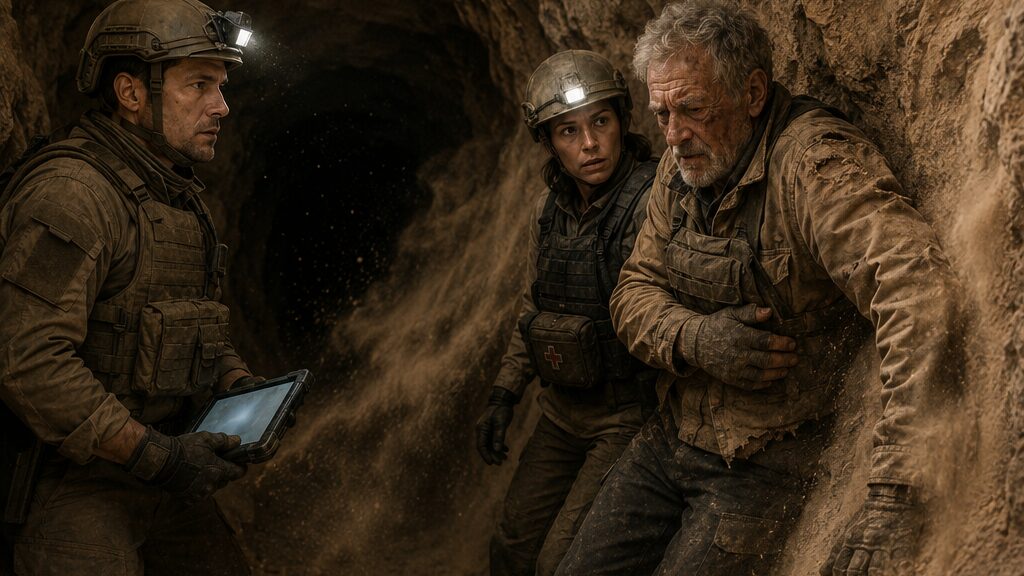
Angela Baker turned toward him. Her helmet lamp cut across his face, catching the grit on his cheek, the white stubble along his jaw, the tremor in his left hand. She was close enough that Thomas could see the pulse working at her throat. She had one gloved hand lifted as if she meant to steady him, and the other near the medical pouch strapped to her vest.
“Mr. Wilson,” she said, keeping her voice low, “you need to sit down.”
“I said no.”
Matthew stepped around a fallen slab behind her, his scanner tablet clutched against his chest. His face was streaked with dust, but his eyes were clear and impatient in the hard beam of his headlamp.
“We don’t have time for this,” Matthew said. “The route is marked open. The trainee’s beacon is beyond that choke point.”
Thomas did not look at the tablet. He looked at the dust.
It moved in the wrong direction in the light, faint as breath on cold glass. The younger ones saw dirty air. Thomas saw pressure. He saw a sealed pocket pulling from somewhere it had no business pulling from. He saw stone holding itself together by habit and pride.
Old stone could lie better than men.
He pushed himself off the wall and nearly went down.
Angela caught his arm. Pain flashed through his shoulder and down his ribs, hot enough to bring water to his eyes. He swallowed it. There was no room in the cave for pain. Pain took up air. Panic took up air. Speeches took up air.
Thomas had learned that young.
Matthew saw the stagger, not the swallow. Thomas watched the sergeant’s face change: concern first, then calculation, then the careful patience people used on the elderly when they had already decided not to listen.
“Sir,” Matthew said, softer now, worse now, “you’re hurt. You hit the wall hard when the shelf dropped. Let Baker check you.”
“That tunnel is drawing,” Thomas said.
Matthew glanced at the passage. “Air movement doesn’t mean collapse.”
“It does when it wasn’t moving five minutes ago.”
“The scanner says the void is stable.”
Thomas laughed once, without humor. Dust caught in his throat and turned it into a cough. Angela tightened her grip on his arm.
“The scanner sees what’s open,” Thomas said when he could breathe again. “It doesn’t hear what’s waiting.”
Matthew’s jaw tightened.
Behind him, deeper in the chamber, one of the rescue crew shifted their weight. Pebbles clicked down a slanted stone face. Everyone froze until the sound stopped.
That was the worst thing about caves. They taught even brave people to listen only after something had already moved.
Thomas lifted his right hand from his side. His knuckles were split. The skin across the back of his hand was thin and spotted and powdered with pale dust. He placed three fingers against the wall beside him.
Tap.
The sound was short.
Tap.
The second one came back thinner.
Tap.
The third vanished.
Thomas closed his eyes.
Not vanished, he corrected himself. Swallowed.
Angela stared at his hand. “What are you doing?”
“Listening.”
Matthew exhaled through his nose. “With respect, we have equipment for that.”
Thomas opened his eyes. “Then use it better.”
The words came out harder than he intended. They struck the chamber and stayed there. Angela’s hand fell from his arm. Matthew’s expression went flat.
Thomas hated the look immediately. He knew it. He had worn versions of it himself at twenty-five, at thirty, at forty, standing in front of older men whose warnings seemed like superstition until the world proved otherwise. A young leader under pressure could mistake correction for insult. An old man under pressure could forget how little time youth had been given to learn.
He softened his voice. “Sergeant, I’m not trying to take your command.”
“Then don’t.”
A silence opened.
The cave filled it with the slow hiss of dust.
Angela stepped closer, putting herself between Thomas and the tunnel without quite meaning to. “What exactly are you saying?”
He looked past her shoulder to the passage. The darkness beyond it seemed smooth. Safe. The kind of safe that got people killed because it looked like a decision had already been made.
“I’m saying that wall to the east is sealed with loose fill, not bedrock. Something behind it is taking air. If you put six bodies through that choke point, your lights and your motion may be enough to wake it.”
Matthew lifted the tablet. “The lidar map shows continuous stone. No secondary cavity.”
“Because the cavity is behind old fill.”
“There’s no old fill on the map.”
Thomas turned his head slowly and looked at him.
That was the whole problem. They had walked into a place that remembered more than the map did.
The radio on Matthew’s shoulder snapped alive before Thomas could answer.
Static burst into the chamber, loud enough to make Angela flinch.
“Rivera, this is Adams. Status.”
Matthew pressed the radio. “We’re at the interior split. Minor shelf drop. One civilian observer injured, ambulatory. Beacon still active beyond marked route.”
Thomas shut his eyes at civilian observer.
He had worn heavier words once. He had signed reports that made younger men stand straighter. He had trained soldiers to read tunnels with their fingertips, boots, breath, and fear. But inside this cave, he was an old man whose shoulder did not work and whose warning came without a screen behind it.
The radio crackled again. “Repeat, beacon still active?”
“Affirmative.”
“Proceed through the marked route. You have twenty minutes before sunset affects extraction support.”
Thomas opened his eyes.
The dust was still moving inward.
Matthew looked at the tunnel. Angela looked at Thomas. The rest of the chamber waited, held between command and stone.
Thomas lowered his hand from the wall.
“No,” he said again, but this time the word was quiet.
Matthew stared at him. “Mr. Wilson—”
Thomas looked down at the dust on his glove, at the pale powder caught in the creases of old scars, and understood that they still heard an old man refusing. They did not yet hear the cave.
The radio hissed on Matthew’s shoulder.
Adams’s voice cut through the static, clipped and certain.
“Rivera, proceed through the marked route.”
Chapter 2: The Observer Nobody Wanted Inside
Three hours earlier, Angela Baker had watched Thomas Wilson climb out of a county emergency van and wondered who had decided to bring somebody’s grandfather to a collapse site.
He did not move like a man who wanted help. That was the first thing she noticed. He stepped down carefully, one hand on the doorframe, boots finding the ground before he released his grip. Not weak exactly. Measured. As if every movement had been inspected before being allowed.
The desert staging area shimmered around him.
Vehicles stood in a ragged half circle outside the cave boundary: National Guard trucks, county emergency units, a mobile command trailer, two rescue rigs with ropes and tripods stacked beside them. The sun hung white above the low ridge. Heat trembled over the gravel. Beyond the tape and floodlight stands, the cave mouth opened in a dark notch at the base of the rock, smaller than Angela expected and more unpleasant for that.
A training exercise had turned into a rescue after an old shelf inside the cave gave way. One trainee was trapped beyond a partial collapse. His beacon still pulsed. His radio did not.
Angela had been checking oxygen bottles when the old man arrived.
He wore faded field pants, a tan work shirt, and a jacket too heavy for the heat. A folded packet of papers was tucked beneath his arm. Not a folder from command. Not printed maps in plastic sleeves. Just worn paper, creased and re-creased until the corners had softened.
Matthew Rivera saw him too. He was speaking with Eric Adams beside the command trailer, tablet in hand, helmet already clipped under one arm. Matthew’s posture changed when he noticed Thomas: shoulders still square, expression still respectful, but with a tightening at the mouth Angela recognized.
The schedule was already broken. Nobody wanted another variable.
Thomas crossed the gravel slowly. Halfway there, he paused, bent with effort, and touched two fingers to the ground. Angela thought at first he had stumbled. Then she saw him rub dust between his thumb and forefinger.
Eric Adams stopped talking.
“Mr. Wilson,” Adams called. “Over here.”
Thomas straightened. He did not hurry.
Angela drifted closer under the excuse of checking the trauma kit in the entry team’s pack.
Adams was a solid man with a voice built for radios. He kept his sleeves clean even at sites where everyone else looked slept-in and sandblasted. He extended his hand to Thomas, but his eyes went to the papers first.
“Appreciate you coming out,” Adams said.
“You said north training caves,” Thomas replied.
“That’s right.”
“Which entrance?”
Adams pointed with his chin. “County calls it Entrance C.”
Thomas looked toward the black cut in the ridge. Something in his face went very still.
Angela noticed. Matthew did too.
“You know it?” Matthew asked.
Thomas did not answer right away. He lifted the folded papers and opened them along old seams. The pages were covered in thin pencil lines, faded notes, numbered angles, and small marks that meant nothing to Angela. They were not clean like a digital map. They looked handled, argued with, survived.
“I helped survey portions of this system in the late seventies,” Thomas said. “Before the Guard stopped using the rear service tunnels.”
Matthew glanced toward Adams. “Rear service tunnels?”
Adams’s brows drew together. “Not in the current county file.”
“They wouldn’t be,” Thomas said.
There was no challenge in his voice. That somehow made it more irritating. He said it like weather. Like the file’s ignorance was not Adams’s fault but still dangerous.
Adams held out his hand for the papers. Thomas let him see them but did not let go.
Angela caught that too.
“These aren’t certified site documents,” Adams said after a brief look.
“No.”
“Are these originals?”
“Copies of copies. Some of the originals were damaged.”
Matthew’s tablet chimed. He glanced down. “Lidar team has a route. Main passage is obstructed at Chamber Two, but there’s a narrow bypass west. Beacon is past the split.”
Thomas looked at the tablet only long enough to understand its shape. “West bypass is not the problem.”
Matthew waited.
Thomas folded the papers once, slowly. “The problem is what was sealed east of it.”
Adams gave a tight smile. “We’re not entering sealed areas.”
“You might be standing next to one without knowing.”
A radio operator called from the trailer, and Adams turned for half a second. When he faced Thomas again, his patience had become official.
“Mr. Wilson, let me be clear. We asked you here because the county coordinator said you had historical familiarity with this system. That’s useful. But this is an active rescue. Sergeant Rivera commands the entry team. You are here as an observer only.”
Thomas nodded.
No protest. No wounded pride. No list of credentials.
Just a nod.
Angela expected that to end it. Instead, the quiet made Adams fill the air.
“If your condition changes, if you slow movement, if Sergeant Rivera tells you to stop, you stop. Understood?”
Thomas looked toward the cave mouth again. “Understood.”
Matthew softened a little. “Sir, I respect your service. But inside, we go by current safety procedure.”
“Good,” Thomas said. “Current safety procedure should include listening when the ground disagrees with your map.”
Matthew’s face closed.
Angela turned away before anyone saw her almost smile. Not because it was funny. Because the old man had said it without heat, and still it landed harder than if he had barked.
She stepped toward him with a blood pressure cuff and pulse oximeter. “I need to clear you before you enter.”
Thomas looked at the cuff as if it were an inconvenience he had earned. “You always ask permission like that?”
“When I can.”
He offered his wrist.
His skin was dry and warm. There were old scars along his knuckles and one pale line disappearing under his sleeve. His pulse was slower than Angela expected. Not calm. Controlled.
“You done cave rescue recently?” she asked.
“No.”
“That worries me.”
“It should.”
She looked up.
He was watching the entrance, not her.
“Does it worry you?” she asked.
“Yes.”
That answer stopped her for a moment. Most men trying to prove they belonged did not admit fear before the first step.
Matthew called the team to form up.
Rescue crew members checked ropes and lamps. Someone tested the stretcher rig. Adams spoke into his radio, giving time markers and extraction windows. The desert wind moved grit across the staging mats, and Thomas bent again, rubbing it between gloved fingers.
Angela finished securing her kit. “You do that a lot?”
“What?”
“Check dust.”
Thomas looked at the powder on his glove. “Dust tells you where air has been.”
“And where it’s going?”
“If you’re lucky.”
“If you’re not?”
He closed his hand. “Then it tells somebody else afterward.”
The answer sat between them, too heavy for a staging area full of equipment and clipped commands.
Angela studied him again. The stoop was real. The careful breathing was real. The age was real. But so was the way his eyes measured the ridge, the cave mouth, the men checking ropes too close to loose stone, the tiny shifts of wind at the entrance.
Fragile, she thought, but not foolish.
Matthew waved them forward. “Entry team moving.”
Thomas tucked the folded survey sheets inside his jacket.
At the cave threshold, everyone switched on lamps. Light struck the first twenty feet of stone and died beyond it. The temperature dropped in a breath.
One by one, they stepped inside.
Thomas stopped before crossing fully into darkness.
Angela nearly bumped him. “You okay?”
He lifted his right hand, placed two fingers and a knuckle against the stone lip of the entrance, and tapped.
Once.
Twice.
Three times.
Then he listened.
No one else did.
Chapter 3: The First Warning They Stepped Over
Matthew Rivera trusted the map because the map had no ego.
It did not remember wars. It did not flinch at shadows. It did not speak from guilt or pride or old habits polished into superstition. It measured, rendered, updated. It showed voids, density, slope, probable fracture lines, and navigable gaps in clean layered color.
Inside a cave where a trainee’s beacon still pulsed somewhere ahead, Matthew needed clean.
The first passage narrowed quickly. The entry team moved in single file, shoulder brushing stone, boots grinding over loose grit. The air cooled as they descended. Helmet lights crawled across mineral veins and old drill marks half-swallowed by time. Every sound came back wrong: a buckle tap became a distant knock; a breath became someone whispering behind you.
Thomas Wilson walked third, behind Matthew and a rescue crew member carrying the first rope bag. Angela stayed close behind him, close enough to catch him if he stumbled. Matthew noticed that and did not object. If Adams had asked his private opinion, he would have said the old man should have remained outside.
But Adams had not asked for private opinions. He had given a controlled risk and a public clock.
“Beacon strength improving,” the radio operator said through Matthew’s earpiece. “You’re approximately eighty yards from last signal cluster.”
“Copy,” Matthew said.
The passage dropped into the first split ten minutes later.
Matthew raised a fist, and the line stopped.
Ahead, the cave forked around a blunt stone column. The west passage sloped downward, narrow but open, its floor packed with old silt. The east side looked like an uneven wall at first glance, a bulge of rubble and mineral crust sealed into darkness. Matthew’s tablet painted the west bypass in green.
Clear route.
He felt some of the pressure in his chest loosen.
“West bypass,” he said. “One at a time. Keep contact points low.”
Thomas did not move.
Matthew turned.
The old man stood with his lamp angled not at the path but at the sealed east wall. Dust drifted through the beam in thin pale flecks.
Angela touched his elbow. “Mr. Wilson?”
Thomas lifted one hand for silence.
Matthew waited two seconds. Three. The beacon pulsed on his screen, steady and accusing.
“Mr. Wilson,” Matthew said, “we need to keep moving.”
Thomas crouched slowly, and for an uneasy instant Matthew thought his knees had given out. But the old man only lowered himself beside the stone column and touched the ground.
He rubbed dust between his fingers.
Then he looked at the west passage.
“No,” Thomas said.
Matthew kept his voice even. “No what?”
“Not that way.”
“The map shows it open.”
“It is open.”
“Then what’s the issue?”
Thomas stood with effort. Angela’s hand hovered near his back, but he did not take help.
“It’s too clean,” he said.
The rescue crew member with the rope bag looked down at the passage floor. “Clean?”
“No recent fall from the ceiling. No side scrape. Dust laid flat but pulling at the edges.” Thomas pointed to the beam of Matthew’s light. “Watch there.”
Matthew looked.
Dust shifted in the air. That was all. Dust always shifted when six people stood breathing in a cave.
“I see suspended dust,” Matthew said.
“You see it moving toward the west?”
Matthew did not answer immediately. He hated that he had to look again.
The particles did seem to angle faintly into the west passage, as if drawn by a slow current. It was subtle. Too subtle to justify stopping a rescue.
“Airflow,” he said. “Could be from an opening ahead.”
Thomas shook his head. “Could be from a pressure pocket behind old fill.”
“There is no pocket on the scan.”
“The scan is reading the face of the fill as stone.”
Matthew looked toward Angela. She was watching Thomas, not the tablet.
That irritated him more than he wanted to admit.
“Sir,” Matthew said, “with respect, you’re basing that on dust?”
“And sound.”
“What sound?”
Thomas stepped to the stone column. He placed his fingers against it and tapped three times.
Tap.
Tap.
Tap.
The small sounds returned strangely. Matthew heard stone. Maybe a hollow tail after the last tap, maybe not. The cave made liars of echoes.
Thomas turned toward the east wall. “That was a service pack.”
“A what?”
“Loose fill. Rock shoved into an old access cut and sealed over. It ages like stone from the outside. Inside, it keeps settling.”
Matthew checked the tablet again. The scan overlay stayed green west, red east. Obstruction. No passage.
“Current records don’t show an access cut here.”
Thomas looked at him. Not angry. Almost tired.
“Current records don’t have to breathe in here.”
The line behind them shifted. Someone coughed. The radio clicked with static.
Matthew pressed his mic. “Command, we’re at the first split. Confirm west bypass remains best route?”
A pause. Then the radio operator’s voice: “Affirmative. Lidar model confirms west bypass. East face reads solid obstruction.”
Matthew looked at Thomas. “There it is.”
Thomas held his gaze. “The model is wrong.”
No one spoke.
Matthew felt the weight of the team waiting. He felt Adams outside, sunset coming, the trapped trainee somewhere beyond the green route. He felt the old man standing in everyone’s way with dust on his glove and no proof that could be uploaded, logged, or defended in an after-action report.
He stepped closer, lowering his voice. “I understand you know this system. I do. But I can’t halt movement every time something feels wrong.”
“It doesn’t feel wrong,” Thomas said. “It is wrong.”
“That distinction matters to you. It doesn’t help me move a team.”
Thomas’s face changed then, just slightly. Some small door closed behind his eyes.
Matthew regretted the words, but not enough to reverse the order.
“We proceed west,” he said. “Slow and spaced. Baker, keep Mr. Wilson in the center. If he needs to stop, you stop with him and notify me.”
Thomas did not move.
Matthew exhaled. “Sir.”
The old veteran looked down at the dust near his boots. His hand flexed once, like he wanted to reach again for the stone and stopped himself.
“I’m not trying to embarrass you,” Thomas said quietly.
Matthew’s ears warmed.
“I didn’t say you were.”
“No. But that’s what you hear.”
Angela looked between them.
Matthew wanted to tell him he heard a man turning uncertainty into delay. He heard an observer forgetting he was not command. He heard the trapped beacon ticking away while everyone gave old stories room to breathe.
Instead, he said, “I hear a warning. I’ve evaluated it.”
Thomas nodded once.
That nod bothered Matthew more than an argument would have. It held no agreement. Only acknowledgment that the warning had been placed in his hands and he had chosen what to do with it.
“Moving,” Matthew said.
The team entered the west bypass one at a time.
The passage forced them low. Matthew went first, one palm against the left wall, boots testing each placement. The rock narrowed around his shoulders. His tablet display jumped, corrected, and painted a stable corridor ten yards ahead.
Behind him, the rope bag scraped stone. Angela murmured for Thomas to duck lower. Thomas’s breathing roughened but stayed controlled.
Matthew told himself to focus on what was in front of him.
Still, after six yards, he glanced back.
Thomas had stopped at the mouth of the bypass. His lamp was angled not toward them but toward the east wall, the sealed face the scan had dismissed. Dust slid across the beam. The old man watched it the way a medic watched a pulse.
For one second, Matthew almost called the team back.
Then the beacon signal strengthened.
A faint digital chirp sounded from the tablet.
Closer.
The decision hardened again.
“Keep moving,” Matthew said.
They had gone less than ten feet farther when the cave trembled.
Not a collapse. Not yet.
A low shudder moved through the stone under Matthew’s palm. Fine dust fell from above in a soft gray veil, coating his glove, his screen, his eyelashes. Someone behind him swore under their breath. Angela told everyone to freeze.
Matthew held still, heart hammering, and watched the tablet glitch beneath the dust.
Behind him, from the first split, Thomas Wilson said nothing.
When Matthew turned his headlamp back, the old man was standing under a falling curtain of pale grit.
The dust was dropping hardest over the exact tunnel he had marked.
Chapter 4: The Wall Remembered His Old Mistake
Thomas did not hear the tremor end.
He felt it leave.
That was different. The young listened for sound, for the obvious complaint of stone. Thomas listened for the pressure that stayed after the sound was gone. The cave had shivered once, shed dust over the west bypass, then held itself too still. Stillness in a cave was not peace. It was a held breath.
Matthew’s voice carried from inside the narrow passage. “Everyone hold position.”
Good, Thomas thought.
Then, because the thought came too easily, he corrected himself. Not good. Not enough.
He leaned one shoulder against the stone column and breathed through his nose. The pain in his ribs had settled into a tight belt around his chest. Each breath had to be asked for and accepted carefully. His right hand had started shaking. He closed it into a fist until the tremor disappeared inside the glove.
Angela crouched beside him. “You need to let me look at your shoulder.”
“Later.”
“That’s what people say when they’re about to become my problem.”
He almost smiled. It would have hurt.
“Already your problem,” he said.
She studied him for a second, then looked down the bypass where Matthew’s light moved in brief, controlled sweeps. “Was that what you warned about?”
“No.”
Her face tightened. “No?”
“That was the cave correcting weight. Small correction.”
“Small?”
He nodded toward the west passage. “The big mistake comes when people think small correction means permission.”
Angela’s mouth opened, then closed. She wanted something cleaner. He could see it. A rule. A percentage. A measurement. A sentence she could carry to Matthew and make useful.
Thomas wished he had one to give.
Instead, he turned back to the east wall.
The sealed face looked like rough natural stone under the dust. But the angles were wrong. Not to the eye at first. To the body. The rock bulged where it should have recessed. Pebble fill had settled in a shallow diagonal. A line of pale mineral crust ran too evenly along one side, like a scar someone had tried to sand smooth.
He had seen work like this before.
Not here exactly. Not with these young soldiers. Not with Angela’s lamp and Matthew’s tablet and Adams outside turning the rescue into minutes.
He had seen it with hotter air in his throat, a different helmet, and a younger man crawling ahead of him through a service cut that smelled of damp canvas and old explosive dust.
Thomas placed his fingertips on the wall.
Not yet, he told the memory.
But the memory had always been poor at obeying.
The old tunnel came back in pieces, never as a full scene. He remembered a boot sole disappearing around a bend. He remembered the scrape of a pack on stone. He remembered dust floating still when it should have fallen. He remembered being annoyed because the younger soldier had laughed at something just before the air changed, and Thomas had let the laugh cover the warning.
One second. That was the part that had never left him.
Not a grand failure. Not cowardice. Not ignorance. One second of not trusting the small wrong thing fast enough.
By the time he tapped the stone, the answer had already changed.
By the time he shouted, the tunnel had breathed in.
“Mr. Wilson.”
Angela’s voice cut the memory cleanly.
Thomas found himself with his forehead close to the wall. His fingers were still touching stone. Dust had gathered in the creases across his glove.
“I’m here,” he said.
“You left for a second.”
He looked at her.
She did not say it accusingly. That made it harder.
“Old habit,” he said.
“Leaving?”
“Coming back.”
A faint call came from deeper in the bypass. Matthew ordered one of the rescue crew members to advance five feet and check the floor. The response was controlled, professional. Nobody was panicking. That was good. That was dangerous too. Professional people could walk steadily into a wrong answer.
Thomas lowered himself to one knee, ignoring Angela’s protest, and pulled the folded survey sheets from inside his jacket. The paper resisted him where sweat and dust had stiffened the seams. He opened it across his thigh, careful not to tear the old pencil lines.
Angela angled her lamp down.
“What are those marks?” she asked.
“Air cuts. Drainage guesses. Some emergency routes. Some of them were never finished.”
“Guesses?”
“Everything underground is a guess until it kills you or lets you pass.”
She gave him a look.
“I know,” he said. “Not comforting.”
His finger moved across the faded paper. Entrance C. First decline. Split column. West bypass marked in old shorthand, but beside the east wall was a small symbol nearly worn away by the fold: three short diagonal marks beneath a half circle.
He stopped.
Angela saw the change in him. “What?”
Thomas did not answer. He shifted the paper closer to the wall, comparing old memory to present stone.
Three diagonal marks. Half circle. Packed service closure with an upper pocket.
He had not drawn that notation. Someone else on the survey crew had. He remembered arguing about it in a trailer afterward, late coffee turning sour in paper cups, a lieutenant wanting the route removed from training maps because unfinished passages created liability. Seal it, label it obsolete, move on.
The cave had not moved on.
“Hold that,” he said.
Angela took the paper.
Thomas stood too fast and pain cut the edge of his sight white. He braced against the wall, waited for the cave to settle inside his head, then tapped the sealed face.
Tap.
A dull answer.
Tap.
A thinner one.
Tap.
The third trembled somewhere beyond the wall and did not return properly.
Not hollow. Not solid.
Hungry.
His hand shook this time before he could hide it.
Angela noticed.
“You know this place.”
“Part of it.”
“That wall?”
“Not enough.”
She turned the paper toward the rock. Her lamp followed the old notation, then rose to the sealed face. “There’s something marked here.”
“Yes.”
“Does Matthew know?”
“He knows I think the map is wrong.”
“That’s not the same.”
No, it was not.
Thomas folded the paper, too sharply, and the crease nearly split. Angela caught one corner before it bent.
For a moment they both held it.
Her glove was clean where his was powdered gray. Young hands, steady hands. He remembered having hands like that. He remembered believing steadiness was proof of readiness.
“Tell me what this means,” Angela said.
The demand was quiet. Not like Matthew’s command voice. Not like Adams through the radio. It had less authority and more weight.
Thomas looked toward the bypass.
The team had resumed movement, slower now. Matthew was doing what a good young leader did when he did not yet know he had chosen wrong: reducing risk inside the chosen path instead of questioning the path itself.
“I missed it once,” Thomas said.
Angela did not interrupt.
“Different tunnel. Different country. Long time ago.” He swallowed against the dust in his throat. “There was air pulling where it shouldn’t. I had a reason for it. Good reason. Sensible. Everybody had a reason to keep moving.”
His thumb pressed against the survey paper until the edge bit through the glove.
“A young man was ahead of me. I told myself I’d check at the next brace.”
The cave clicked softly above them.
Angela’s eyes flicked upward, then back.
“There wasn’t a next brace,” Thomas said.
The words did not break. He had said them too many times inside his own skull for that. They came out flat, almost useful.
Angela looked at the wall again, and Thomas saw understanding begin without pity. He was grateful for that. Pity filled space. There was not enough space.
“So your fear is information,” she said.
Thomas gave a small breath that might have been a laugh if he were not so tired.
“Took me forty years to phrase it that well.”
The radio snapped alive on Matthew’s shoulder inside the bypass, loud enough to echo back.
“Rivera, report progress.”
Matthew answered, voice faint but firm. “Advancing through west bypass. Minor tremor, no visible collapse. Proceeding with caution.”
Thomas looked at Angela.
She looked down at the paper still between their hands.
Her lamp shifted. On the actual wall, just above knee height and half-hidden under mineral crust, something cut through the dust: three shallow diagonal scratches beneath a worn half circle.
Angela stepped closer and wiped them with her thumb.
The old marking appeared, pale and deliberate.
She held the survey sheet beside it.
The two matched.
Chapter 5: The Sergeant Chooses The Clean Map
Matthew saw the old scratches on the wall and still chose the route in front of him.
That would be the part he would remember later, though not because it made him careless. He was not careless. He checked the tablet twice, had the rope line spaced, slowed the team, redistributed weight through the bypass, and made every person call their footing before advancing.
He did nearly everything right inside the wrong decision.
The west bypass pinched lower after the first ten yards. The ceiling pressed down in rough shelves. Matthew moved half-crouched, left shoulder scraping stone, tablet tucked close to protect the screen from falling grit. The beacon strengthened with every yard.
A soft pulse on the display.
Closer.
Alive, maybe.
That was the word that kept him moving.
Behind him, the rescue crew member breathed hard but steady. Farther back, Angela’s voice drifted low as she spoke to Thomas. Matthew could not hear the words, only the rhythm: question, pause, answer. It bothered him that she was still asking the old man things while the mission moved.
Then he hated himself for being bothered.
Thomas Wilson had not been wrong about the tremor. The dust had fallen where he said the cave was unsettled. But unsettled was not the same as impassable. A rescue scene did not give perfect choices. It gave bad ones and asked which could be defended.
Matthew could defend the map.
He could defend the beacon.
He could defend the order.
He pressed his radio. “Command, movement is slow but controlled. Beacon signal increasing. No secondary collapse.”
Adams answered quickly. “Copy. Maintain pace. Sunset window narrowing. County coordinator wants extraction before full dark.”
Matthew looked at the low passage ahead. “Understood.”
The scanner refreshed. The west bypass remained green, but the edges flickered where the tablet had gathered dust. Matthew wiped the screen with his sleeve. The image sharpened.
Green.
He moved.
A faint sound came from behind him.
Tap.
Tap.
Tap.
Matthew froze despite himself.
The sound was not loud. It came from back near the split, where Thomas must have put his hand to stone again. Three small knocks, patient and maddening.
The rescue crew member whispered, “Sergeant?”
“Hold.”
Matthew listened.
The cave returned nothing he could name. A faint murmur, maybe. A pressure in the ears. The kind of silence that made imagination useful and dangerous.
Then Thomas’s voice carried, thin but clear.
“Matthew.”
Not Sergeant. Matthew.
That made him turn.
Through the slant of helmets and shoulders, he saw Thomas standing near the east wall with Angela beside him. She held his old survey sheet in one hand and had her other palm on the rock, over a pale marking. Her face had changed.
Matthew did not like that either.
“What is it?” he called.
Angela answered before Thomas could. “There’s an old mark here. It matches his sheet.”
“Meaning?”
Thomas’s voice came steady. “This west bypass runs beside a sealed service pocket. The pocket is pulling air. If we continue, we may be loading the wrong side of the closure.”
Matthew looked at his tablet again.
No cavity.
No pocket.
No warning.
“Command,” he said into the radio, “do you show any secondary void east of first split?”
A pause. The radio operator answered. “Negative. East face reads obstruction. No navigable cavity. West bypass remains recommended route.”
Thomas stepped closer to the bypass entrance. Angela moved as if to stop him, but he lifted one hand and she let him.
Matthew watched the old man’s face appear under a haze of dust and lamplight. He looked worse than before. Paler. One shoulder lower. The lines beside his mouth had deepened, not from fear exactly, but from holding something in place.
“Your equipment is reading the packed face,” Thomas said. “Not what’s behind it.”
Matthew’s voice tightened. “And if I pull everyone back on that, and the trainee loses his window?”
Thomas looked at him for a long moment.
That look had no accusation in it. Somehow that made it harder to stand.
“If you keep going and the pocket lets go,” Thomas said, “you won’t have a window.”
The rescue crew member shifted behind Matthew. Pebbles crackled under a boot.
Matthew heard uncertainty ripple through the line. That was the danger of open disagreement underground. Fear moved faster than command. Once it got into the team, every sound became a vote against movement.
“Enough,” Matthew said, not loudly.
Thomas stopped.
“I have a live beacon,” Matthew said. “I have a mapped route. I have command confirmation. I also have your warning, and I am adjusting movement accordingly. But we are not turning this team around on a historical marking and dust behavior.”
Angela said, “Sergeant—”
“Baker, keep him stable.”
Her face hardened.
Matthew turned away before the argument could grow teeth.
“Forward,” he said. “Slow. Maintain spacing. No unnecessary contact with the east wall.”
The words sounded competent. They were competent.
He wished they felt true.
They advanced.
The bypass widened slightly after another six yards, enough for Matthew to straighten one knee. The beacon pulsed stronger now. Somewhere ahead, beyond a tight bend, something metallic clicked at regular intervals. A locator clipped to a harness, maybe. Or loose gear swinging in a draft.
Draft.
Matthew stopped and lifted one hand.
Dust hung in his headlamp beam.
At first it seemed motionless. Then, slowly, the particles angled past him, not forward toward the trapped trainee, not backward toward the entrance, but sideways.
Toward the right-hand wall.
East.
The wall beside him looked solid: rough stone pressed close, seams filled with old mineral crust, no gap wider than a fingernail. But the dust touched it and vanished along a hairline crack.
Matthew’s throat dried.
He pressed his palm flat against the stone.
Cold.
Then not cold.
A faint pulse moved under it, or through it, or inside his own hand. He could not tell.
He lifted the tablet.
Green.
The screen insisted on green.
Behind him, Thomas coughed once. Not loud. Not theatrical. The sound of an old body losing an argument with dust.
Matthew almost laughed then, a hard little burst trapped behind his teeth. Not because anything was funny. Because he suddenly understood the terrible weakness of clean information. It did not have to be false to be incomplete.
“Command,” he said, “I have lateral dust movement into the east wall approximately sixteen yards into bypass.”
Static.
Then Adams: “Repeat?”
Matthew repeated it.
The pause this time was longer.
“Lidar still shows continuous stone,” the radio operator said.
Thomas’s voice came from behind, low and close enough now that Matthew knew he had moved into the bypass despite Angela.
“Tap it.”
Matthew looked back.
Thomas stood braced with one hand on the wall, Angela beside him, ready to catch him. His face was gray under the dust. He nodded once toward the stone beside Matthew.
“Tap it,” he said again.
Matthew did.
Once.
The first answer was hard.
Twice.
The second came back thin.
Three times.
The third did not come back.
Matthew heard it disappear.
Not fade. Disappear.
The wall beside his palm seemed to take the sound and keep it.
He looked at Thomas.
The old man’s expression did not change. There was no triumph in it. No I told you. Only a quiet grief Matthew did not understand yet.
Then the beacon ahead gave one sharp pulse.
The tablet flickered.
The right-hand wall exhaled dust.
A seam opened in the mineral crust like a dry mouth. Air pulled sideways hard enough to tug grit across Matthew’s cheek. Someone behind him shouted to hold. Another boot slipped. The rope line snapped tight against Matthew’s hip.
“Back,” Thomas said.
Matthew found his voice half a second late. “Back! Everyone back!”
The cave answered with a low crack.
Not loud. Worse than loud. Deep.
The floor kicked under Matthew’s boots. He slammed one hand against the ceiling, dropping the tablet. Angela grabbed Thomas, but the old man twisted away from her, reaching toward the right wall as if he meant to hold the whole cave in place by force of recognition.
“Move!” Matthew shouted.
The packed service wall shifted.
Dust exploded into the bypass. Light vanished. Bodies collided in the narrow space. Matthew hit his shoulder against stone and tasted grit. He heard Angela call Thomas’s name.
Then the ceiling shelf near the split gave a violent lurch.
Thomas was thrown backward out of the bypass, across the chamber, and into the rock wall with a sound that cut through everything.
For one suspended second, Matthew saw him exactly as he would see him later: old, dusty, injured, pressed against stone, eyes still open and fixed not on his own pain but on the dust moving the wrong way.
Chapter 6: The Cave Answers The Quiet Man
Angela had seen men try to make themselves useful while bleeding.
She had seen it in training sites, roadside accidents, flood rescues, and once in a collapsed parking structure where a man with a broken ankle kept apologizing for slowing everyone down. Pain made some people loud. It made others polite. In Thomas Wilson, it made something worse.
It made him ready to be left behind.
He was against the rock wall when she reached him, one knee bent wrong beneath him, right hand pressed to his ribs, eyes still locked on the tunnel. Dust coated the lines of his face until he looked carved from the same stone that had struck him.
“Thomas,” Angela said.
He blinked at the name, as if she had called him from far away.
“Don’t let them go through,” he said.
“Nobody’s going through.”
Matthew was behind her, coughing, ordering the team to fall back from the bypass mouth. His voice had lost its sharp edge. Not broken. Stripped. The rescue crew members moved in short, careful bursts, dragging rope clear, checking helmets, calling that they were up, up, shaken but up.
Angela cut Thomas’s jacket open at the shoulder seam. “Can you breathe?”
“Enough.”
“That wasn’t the question.”
His mouth twitched, but his eyes went past her again.
The tunnel ahead had changed. It was still there, still dark, still shaped like a route if someone wanted badly enough to believe in it. But dust now poured into it from the side seam in slow, steady streams. The cave was drawing breath.
Matthew crouched beside them. “The bypass is compromised.”
Thomas closed his eyes briefly. “Not compromised. Revealed.”
Angela pressed gauze against a torn place near his upper arm. “You can explain poetry later.”
“It’s not poetry.”
“Then explain it plainly.”
Thomas opened his eyes.
The look he gave her was weary and direct. For the first time since they entered the cave, Angela felt the full force of his attention. Not the scattered attention of an injured man. Not confusion. He was measuring what she could carry.
“The sealed wall is settling,” he said. “The pocket behind it is equalizing through the bypass seam. That means the west route is now tied to the unstable space. Too much vibration, too much movement, and it drops.”
Matthew wiped dust from his mouth with the back of his glove. “Can we retreat to the entrance?”
Thomas listened before answering.
Angela hated that pause.
He tapped the wall behind him weakly, not the clean three-tap pattern but a searching touch. His fingers dragged over grit.
“Maybe,” he said.
Matthew stared. “Maybe?”
“The shelf that threw me shifted behind us too. Entrance path may still pass one at a time. But the trainee is not behind us.”
The radio crackled with Adams’s voice, distorted by stone and dust. “Rivera, report. Rivera, do you copy?”
Matthew pressed his mic. “Bypass instability confirmed. Minor injuries. Team intact. Holding at first split.”
“Can you proceed to beacon?”
Matthew looked at Thomas.
The old man looked down.
Angela saw it happen. The fold inward. The retreat behind the eyes. Not fear of the cave. Something older. A decision forming in the wrong direction.
Thomas pushed Angela’s hand away and tried to sit straighter. “There may be a service passage east.”
Matthew’s head snapped up. “Behind the sealed wall?”
“Not through the wall that’s pulling. Near it. Emergency ventilation cut, if it wasn’t collapsed.”
“If?”
Thomas breathed in shallowly. “I need to find the sound.”
Angela pressed him back. “You are not crawling anywhere.”
“I don’t need to crawl.”
“You can barely sit.”
He looked at her hand on his chest. Not offended. Not grateful. Simply noticing the obstacle.
“Then help me stand.”
“No.”
Matthew said, “Baker—”
She turned on him. “No.”
The word cracked through the chamber louder than she intended. Several helmets turned.
Thomas watched her.
Angela lowered her voice, but not the force in it. “You don’t get to do that.”
“Do what?”
“Turn yourself into a brace. A marker. A sacrifice. Whatever word you use so you don’t have to admit you’re giving up.”
His face went still.
Matthew looked away.
Angela knew she had struck something deep, but the cave gave no space for apology. She leaned closer, blocking Thomas’s view of the tunnel until he had to look at her.
“You said the cave is breathing wrong. Fine. Teach me how to hear it.”
Thomas’s jaw tightened. “This isn’t a class.”
“It is now.”
“You don’t learn this in two minutes.”
“Then give me one minute’s worth that keeps us alive.”
Dust slid down the wall beside his shoulder.
He followed it with his eyes.
“I can hold here,” he said quietly. “If the closure shifts, I can call it. You and Rivera take the team back to the split and—”
Angela put her hand over his on the rock.
His fingers were cold through the glove.
“No,” she said. “You are not the warning device. You are the person who knows how to read it.”
For a moment, Thomas looked older than seventy-two. Not weaker. Farther away. As if some part of him stood in another tunnel with another young soldier ahead of him and no way to call the second back.
Angela softened her grip but did not remove it.
“Whoever you couldn’t get out before,” she said, “that isn’t happening by you staying silent now.”
The chamber seemed to hold the words.
Thomas looked at her for a long time.
When he spoke, his voice had lost its edge. “Put your fingers here.”
Angela shifted her hand.
“No. Not your fingertips. Knuckle and two fingers. Bone carries it better.”
She obeyed.
Thomas adjusted her hand with small movements. His own hand trembled, but the corrections were exact.
“First tap asks what the surface is,” he said. “Second asks what’s behind it. Third asks if the answer changed.”
Matthew moved closer on Thomas’s other side.
Thomas noticed but did not look at him. “Don’t hit hard. If you hit hard, you only hear yourself.”
Angela swallowed. “Like this?”
Tap.
The sound came back short.
Thomas nodded. “Surface.”
Tap.
The second answer thinned, slipping away along the wall.
“Behind,” Thomas said.
Angela waited, then tapped a third time.
The sound did not return straight. It seemed to bend, traveling somewhere to her right, through stone she had thought was solid.
Her skin prickled beneath the glove.
Thomas watched her face. “You heard it.”
She nodded once.
Matthew said, barely above a whisper, “What does that mean?”
Thomas lifted his eyes toward the east wall, then to the dark seam near the floor where dust continued to pull inward.
“It means the opening we can see is lying,” he said. “And the opening we need is probably not an opening at all.”
Adams’s voice broke through again. “Rivera, command requires route decision.”
Matthew reached for his radio, then hesitated.
Angela looked at him.
The hesitation mattered. It was small, but in the cave small things were the only honest things.
Matthew pressed the mic. “Stand by.”
Thomas closed his eyes for one breath, then opened them and placed Angela’s hand back on the stone.
“Again,” he said.
She tapped.
He listened with her.
The third answer bent lower this time, not toward the bypass but beneath the sealed face, where a cracked skirt of rock met the floor.
Thomas turned his head slowly.
“There,” he said.
Angela angled her lamp. The wall looked sealed. Rough. Useless.
Matthew stared at it. “That’s solid.”
Thomas’s mouth tightened, almost a smile and almost grief.
“Don’t look for the opening,” he said. “Listen for it.”
Chapter 7: The Passage That Was Never On The Map
The wall did not look like a door.
Thomas had known men die because they expected danger to announce itself properly. A cracked beam, a widening seam, a rock groaning loud enough for every fool in the room to agree on it. But the earth did not care whether anyone agreed. It kept its old routes in plain sight and let people walk past them.
The place he pointed to was a shallow skirt of rock at the base of the east wall, half-choked with dust and fallen chips. No gap showed. No shadow promised passage. It looked like the end of all choices.
Matthew stared at it, helmet lamp shaking slightly with his breath. “How do we open that without dropping the pocket?”
“We don’t open it,” Thomas said. “We find where it already failed.”
Angela stayed beside him, one hand near his back but not touching unless he swayed. He was grateful for that. Help offered too quickly could feel like a wall.
The radio hissed again. Adams’s voice came broken but forceful. “Rivera, I need a route decision.”
Matthew lifted the radio. His eyes stayed on Thomas. “We’re investigating a possible old ventilation cut east of the split.”
“Negative. East is obstruction.”
Matthew’s mouth tightened.
Thomas waited.
“Command,” Matthew said, slower, “east obstruction may include an old emergency passage not captured on current scan.”
A pause came through the static. Then Adams: “Source?”
Matthew looked at Thomas, and for the first time since entering the cave, he did not look embarrassed to say it.
“Wilson.”
The radio gave only static for three beats.
Thomas did not smile. The word had not solved anything. Trust was not escape. It was only permission to lose time in a different direction.
Adams came back clipped. “Proceed only if Rivera confirms safe. No uncontrolled breach.”
Matthew lowered the radio. “You heard him.”
Thomas nodded. “Then stop looking for the breach.”
Angela crouched near the rock skirt. “Listen for it.”
“Lower,” Thomas said.
She placed her knuckle and two fingers near the floor.
Tap.
The answer was dull.
Tap.
Still dull.
Tap.
The third went sideways.
Angela turned her head. “It bends left.”
Thomas eased himself down beside her. Pain climbed his ribs in sharp rungs, but he kept his breath even. He put his own hand on the stone, not to take over, only to confirm what she had heard.
Tap.
Tap.
Tap.
There it was. A thin answer running under the stone, not into the sealed pocket but beneath it. A separate line. Old work. Not natural, not clean, not safe, but real.
“Two feet left,” he said.
Matthew dropped to one knee, brushing dust away with a gloved hand. A rescue crew member angled a pry tool, but Thomas stopped him with a look.
“No prying.”
The crew member froze.
Thomas pointed. “Clear with your hand. From the top down. If the dust pulls hard, stop.”
They worked slowly.
The cave punished hurry. Every movement had to be small enough that fear could not ride it. Angela swept dust with the side of her glove. Matthew moved loose pebbles one at a time. Thomas listened to what fell and what did not.
A narrow line appeared beneath the packed grit.
Not a gap. A seam.
Matthew leaned closer. “That’s it?”
“That’s the lip.”
“Of what?”
Thomas closed his eyes and let the old map settle over the present stone. Entrance C. Split column. Failed service closure. Ventilation cut sloping under the east pocket, too low for regular movement, maybe large enough for a crawl, if the years had been kind.
“Emergency air cut,” he said. “They drove it under the pocket before sealing the training side. It was never meant for regular use.”
Angela looked at him. “Can it get us to the trainee?”
“Maybe not directly.”
Matthew’s face hardened.
Thomas lifted one finger before he could speak. “But it can get us around the pressure pocket. If the beacon is past the old closure, this may bring us behind it.”
“May.”
“Yes.”
Matthew absorbed that. The old version of him would have reached for the tablet again and made the clean answer win by force. Thomas saw the impulse move through his face. Then Matthew placed the tablet face down on the floor beside him.
“What do you see?” he asked.
The question struck Thomas more sharply than pain.
Not what do you think. Not can you prove it. What do you see?
Thomas looked at the young sergeant, dust on his eyelashes, command pressing down on him harder than any stone. He saw not arrogance now, but fear disciplined into attention. A young man trying to learn fast enough not to bury anyone.
Thomas turned back to the seam.
“I see dust lifting away from the lower edge,” he said. “Not pulling in. That means air on the far side is moving out toward us. Gentler pressure. Different space.”
Angela lowered her lamp.
Fine dust trembled at the seam, then lifted outward in a pale breath.
She saw it before Matthew did.
“It’s exhaling,” she said.
Thomas nodded once.
The words seemed to change the chamber. Not safer. Truer.
Matthew gave the order quietly. “Clear it.”
They widened the seam by hand until the packed dust broke inward with a soft sigh. A dark slit appeared, barely shoulder wide, sloping down behind the stone skirt. Cooler air touched Thomas’s face. It smelled old, metallic, and dry.
Not clean air.
Possible air.
A rescue crew member sent a small light through on a cord. It slid down the narrow passage, bounced once, then steadied. The camera feed on Matthew’s tablet showed rough-cut walls and a low crawl space angling away from the unstable bypass.
Matthew looked at Thomas. “Can you fit?”
Angela answered first. “No.”
Thomas almost objected, then felt his ribs refuse the lie.
“No,” he said.
The word cost him less than he expected.
Matthew looked to the crew member. “Smallest gear load. One rope. Medical kit passed after. Baker, you go second.”
Angela shook her head. “Thomas stays with me.”
“I need you through the passage.”
“You need him alive to tell us what the passage is saying.”
Matthew held her stare, then nodded.
That nod was not surrender. It was command changing shape.
They moved in sequence. The first crew member crawled through, then another. Matthew went next to scout the bend. Angela stayed with Thomas at the mouth of the cut, one hand ready but not holding him.
When Matthew’s voice came back through the slit, it carried less echo. “Passage opens after twelve feet. There’s a drop, maybe three feet. I can hear something beyond.”
Thomas leaned closer.
At first he heard only the cave’s deep body: small ticks of cooling stone, the whisper of disturbed dust, the breathing of people trying not to sound afraid.
Then, faintly, a cough.
Not from the team.
A thin, human cough from deeper in the passage.
Angela’s eyes widened.
Matthew’s voice came again. “Beacon confirmed. We’re behind the closure.”
Thomas pressed his palm to the floor beside the seam. Dust lifted away from his glove, outward this time, as if the cave had finally chosen to tell the truth in a language everyone could see.
“Go,” he told Angela.
She did not move.
“You taught me,” she said.
“Not enough.”
“Enough to come back for you.”
He wanted to say something hard, something useful. Instead he nodded.
Angela crawled into the slit.
Thomas waited alone at the mouth of the passage, back against the wall, lamp dimmed to save battery. Voices moved beyond the stone. Matthew giving orders. Angela telling the injured trainee not to fight the sling. A crew member calling for the rope to feed slow.
The cave shifted once above Thomas.
He lifted his hand.
Tap.
Tap.
Tap.
The third answer held.
For now.
Minutes stretched. He did not count them. Counting invited fear to make arithmetic. He listened instead.
The rope tightened, slackened, tightened again. A boot scraped in the cut. Matthew emerged first, backing out on his elbows, pulling the stretcher harness. Angela followed with the injured trainee secured low, face pale under dust, eyes half-open but alive.
Alive.
The word passed through Thomas without triumph. It simply sat there, enormous and quiet.
Matthew helped guide the trainee clear, then turned back to Thomas. “We have to move. This passage gives us another route out, but it’s low and slow.”
Thomas looked toward the bypass, where dust still poured inward through the cracked wall. The marked route was no longer pretending.
“Then low and slow is what the cave allows.”
Matthew gave the faintest breath that might have become a laugh outside.
They moved through the hidden passage in reverse order, the trainee first, the team feeding rope, Angela checking his breathing as she crawled. Thomas went near the rear. Every few yards Matthew stopped issuing immediate commands and looked back.
Not for permission.
For reading.
Thomas answered with small gestures. Wait. Shift left. One at a time. No gear against that seam. Lights down. Listen.
At one bend, dust suddenly reversed in Angela’s lamp beam, curling toward a crack above them.
She stopped before Thomas spoke.
“Sergeant,” she called softly. “Wrong way.”
Matthew froze the line.
Thomas closed his eyes. Pride would have been useless there, and still something inside him loosened.
“Good,” he said.
They waited until the pull settled, then continued through a lower cut that scraped Thomas’s shoulder and made his vision blur at the edges. Angela heard the change in his breathing and looked back, but he shook his head once. Not denial. Timing. Not yet.
The passage rose after what felt like a hundred feet and opened into a broader service chamber. Ahead, a thin blade of evening light cut through a collapsed grate half-buried in sand.
Outside light.
For a moment nobody moved.
Then Matthew turned to Thomas.
No speech. No apology shaped for witnesses. Just the young sergeant, dusty and shaken, asking with his eyes if the light could be trusted.
Thomas listened.
The dust moved outward toward the glow.
He nodded.
The team began to climb.
The injured trainee coughed again as they lifted him toward the opening. The sound echoed past Thomas into the service chamber, and then a second cough answered it from deeper in the dark.
Thomas turned his head.
Angela saw him stop. “What is it?”
He held up one hand.
There it came again: weak, distant, human.
Not the trainee in the sling.
Someone else, deeper in the passage.
Outside light lay ahead, close enough to touch.
Thomas faced the dark and listened.
Chapter 8: What He Refused To Take Home
By the time Thomas Wilson reached the medical tent, night had taken the desert.
Floodlights washed the staging area in hard white glare. Dust moved through the beams in restless sheets, turning every person into a shadow first and a face second. The rescued trainee was already on a cot, oxygen mask fogging lightly, a base doctor bent over him with practiced calm. Another rescue crew had gone back through the service opening for the second trapped trainee, guided by Angela’s voice over the radio and Matthew’s slower, changed commands.
They brought that trainee out alive too.
Not easily. Not cleanly. Not because the cave suddenly became merciful. They brought him out because Angela heard dust pull toward a crack and stopped the line before the ceiling shed loose stone. Because Matthew waited long enough for the air to settle instead of making courage look like speed. Because Thomas, seated on a folded tarp with a blanket around his shoulders, marked the old service route on his faded sheet with a pencil borrowed from the radio operator, his hand shaking only when no one was looking directly at it.
Afterward, people wanted to stand near him.
That was the part he liked least.
A county emergency coordinator came with thanks in her face and a phone in her hand until Eric Adams quietly redirected her toward the command trailer. A rescue crew member touched Thomas’s shoulder, remembered the injury, and withdrew the hand awkwardly. The radio operator brought him water and called him “sir” in a way that had more care than protocol in it.
Thomas drank half the bottle and set it down.
His whole body hurt now that the cave no longer required him to sort pain by usefulness. His shoulder throbbed. His ribs pinched with each breath. His knees had become distant, disloyal things. The base doctor told him he needed transport for imaging. Thomas said he would sit a minute.
The doctor looked at Angela.
Angela looked at Thomas.
Thomas sighed. “Five minutes.”
“Two,” Angela said.
He nodded because two was a number and numbers comforted medics.
Across the staging area, Matthew stood with Adams beside the command board. Their voices were low. The clean digital map glowed on the screen between them, still showing the west bypass in green. Beside it lay Thomas’s old survey sheet, weighted at the corners with a flashlight and a roll of tape.
The old paper looked out of place under the floodlights.
So did Thomas.
He watched Adams lean closer to the sheet. Matthew pointed, not to defend himself, but to show sequence: split, marked closure, wrong-way dust, service cut, hidden passage, second cough. Adams listened without interruption. That was something. Not everything. But something.
Angela stepped into Thomas’s line of sight and held out a cup of coffee.
He took it with both hands. The cup warmed his fingers.
“You look angry,” she said.
“I look seventy-two.”
“That too.”
He looked down at the coffee. “They’ll try to make it simple.”
“Who?”
“Everyone.”
Angela sat on an overturned gear case beside him. Her uniform was smeared with dust from shoulder to boot. A thin scrape marked one cheek. She looked tired enough to be honest.
“Simple how?”
“Old veteran saves team. Modern equipment fails. Young sergeant learns lesson.” He shook his head slightly. “Bad story.”
Angela’s mouth curved. “Is it?”
“Yes.”
“Why?”
“Because the scanner didn’t fail. It told part of the truth. Matthew didn’t fail. He carried the clock they gave him. Adams didn’t want casualties. You weren’t wrong to think I was hurt.”
“You were hurt.”
“Still am.”
“I noticed.”
Thomas took a careful sip of coffee. It tasted burned and wonderful.
“The cave was complicated,” he said. “People don’t like complicated after fear. They want a clean hero so they can stop listening.”
Angela was quiet.
Beyond the tent opening, Matthew left Adams and crossed the floodlit gravel. He stopped a few feet away, helmet under one arm, tablet under the other. For a second, he looked like the young men Thomas had trained long ago, trying to decide whether respect required a speech.
Thankfully, he chose against it.
“The second trainee is stable,” Matthew said. “Doctor says both should make it.”
Thomas nodded. “Good.”
Matthew looked toward the medical cot, then back. “I wrote the route sequence into the incident log. Your survey sheet goes into the debrief as source material, if you allow it.”
“If it helps.”
“It will.”
Thomas waited.
Matthew shifted the helmet against his side. “I should have stopped at the first split.”
Thomas looked at him then.
The young sergeant’s face was open, but not asking to be rescued from guilt. That mattered.
“You should have had better records,” Thomas said.
Matthew blinked.
“You should have had more time, less pressure, and a map that admitted what it didn’t know. You should have listened sooner. All of those can be true.”
Matthew absorbed that, jaw working once.
Thomas added, “A command mistake is still a mistake. Just don’t decorate it until you can’t learn from it.”
Matthew nodded slowly.
Angela looked away, but Thomas saw her smile into the rim of her coffee.
Adams approached next, slower than Matthew had. He carried Thomas’s folded survey sheet with care that was almost enough to make Thomas forgive him for the word observer.
“Mr. Wilson,” Adams said.
Thomas set the coffee down.
“I owe you an apology.”
Thomas studied him. Adams looked uncomfortable, but not performative. Good. Performances were for ceremonies, and Thomas had no patience left for those.
“You owe your records an update,” Thomas said.
Adams accepted that with a short nod. “That too.”
He held out the survey sheet. “The county wants to digitize this. With your permission. I’d also like your notes included in the formal report.”
Thomas took the paper.
For years he had kept it in a drawer, then a box, then the inside pocket of a jacket he wore only when old places called. He had told himself he kept it because records mattered. That was not the whole truth.
He had kept it because letting it go felt too much like letting go of the young man in the other tunnel, the one who had laughed just before the air changed.
But paper did not carry the dead back.
Sometimes it only kept the living from learning.
Thomas smoothed the sheet across his knees. Dust still clung to the creases, pale and stubborn.
Angela stood. “Transport’s ready.”
He almost said he could walk.
Then his ribs tightened, and his shoulder answered, and the lie felt smaller than the dignity he would lose by telling it.
“All right,” he said.
Angela offered her arm.
This time he took it.
Not because he could not stand without it. Maybe he could. Maybe not. Because help, when accepted plainly, did not erase what a person knew.
At the tent pole, Angela paused before lifting the flap.
Tap.
Tap.
Tap.
Thomas looked at her hand against the metal pole.
The sound was wrong for stone. Too bright, too thin, harmless. But she listened anyway.
He felt something in him settle that had not settled in forty years.
“Surface,” she said.
Thomas nodded.
“Behind,” she added.
He waited.
She tapped once more, softer.
“Changed,” she said.
Outside, Matthew was instructing a crew member to mark dust behavior in the route notes before moving any equipment. Adams had a radio to his ear, telling someone that the old service system needed a full survey before anyone called the site safe again. No one applauded. No one lined up to shake Thomas’s hand. The night stayed busy, imperfect, alive.
Thomas folded the survey sheet along its oldest crease.
Then he held it out to Angela.
She stared at it. “I can’t take that.”
“You already did.”
Her fingers closed around the paper carefully.
“What do you want me to do with it?”
“Use it until it’s wrong,” Thomas said. “Then write down why.”
Angela looked at him for a long moment, then tucked the sheet into her vest as if it weighed more than paper.
Thomas stepped out of the tent with her arm steady under his hand. The desert air was cool now. Dust moved low across the staging lights, no longer pulled the wrong way, only passing through.
Behind him, the cave mouth sat dark in the ridge.
It had not forgiven anyone. It had not thanked anyone. It simply waited, as old places did, for the next person willing to listen before entering.
Thomas let Angela guide him toward the waiting vehicle.
At the edge of the light, he looked back once.
Not to carry the cave home.
To leave enough of himself there that others might come out.
The story has ended.