The Young Officer Tried To Remove The Old Man From The Podium, Then Saw His Face In The Memorial Photo
Chapter 1: The Old Man With The Folded White Map
The security aide at the hangar door looked at Edward Clark’s invitation, then at Edward’s coat, then back at the invitation as if one of them had to be lying.
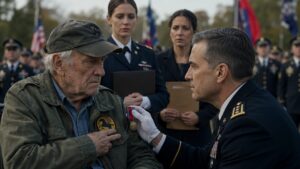
Behind the aide, the military hangar had been polished into ceremony. Rows of folding chairs faced a wooden podium. American flags stood in careful formation beneath the high steel beams. A large banner near the stage read RIDGE 17 MEMORIAL OBSERVANCE, its blue letters sharp enough to be seen from the parking lot. Uniformed soldiers moved between the rows with clipboards, straightening programs and checking name cards. Their shoes clicked against the concrete with the neat impatience of people who had been told the schedule mattered.
Edward stood just outside the threshold, one hand resting on the head of his cane, the other holding a folded white paper against his chest.
It was not really paper. Not anymore.
The creases had softened with age. The corners had yellowed despite the careful way he kept it wrapped. To anyone passing quickly, it looked like a wrinkled handout or an old man’s misplaced note. Edward knew what it had once been before time, sweat, rain, and ash had reduced it to something fragile enough to tear if handled badly.
A field map.
A piece of ground.
A decision that had never stopped returning to him.
“Sir,” the security aide said, not unkindly, “this section is for invited ceremony participants and family seating.”
Edward’s eyes moved past him to the rows near the front. Several older veterans had already been seated there, most in dark suits, some with ribbons pinned to their lapels. Edward wore a plain navy blazer that had shined at the elbows, a light shirt buttoned to the collar, and black shoes polished more from habit than success. His hair, white at the sides, had been combed back with water. His hands were steady only when he remembered to make them steady.
“I was invited,” Edward said.
The aide glanced again at the envelope. “It says E. Clark.”
“That’s right.”
“No rank listed.”
Edward looked down at the folded map. “No.”
The aide hesitated, then lifted two fingers toward a younger officer crossing near the registration table. The officer turned before the aide called his name, as if he had trained himself to notice disorder from across a room.
He was tall, clean-shaven, and dressed in a dark formal uniform with medals aligned over his chest. Everything about him had been arranged: cap under his arm, program binder in hand, jaw tight with schedule pressure. His nameplate read DAVIS.
“Problem?” he asked.
The aide handed him the invitation. Mark Davis took it, scanned the front, then looked at Edward with the fast, professional smile of a man already moving to the next problem.
“Mr. Clark,” he said. “Welcome. General seating is to the left. One of our volunteers can help you.”
Edward did not move. “I was asked to speak.”
Mark’s smile paused, not fully disappearing. “At today’s ceremony?”
“Yes.”
“That can’t be right.” Mark opened his binder, flipped through the pages, and ran a finger down the printed schedule. “Our speakers are the base commander, the memorial committee chair, two family representatives, and a closing reflection from E. Clark.”
Edward waited.
Mark looked up. “Are you family?”
“In a way.”
“That section is coordinated through the committee. Did someone bring you the wrong card?”
“No.”
The word was quiet enough that the aide shifted awkwardly beside them.
Mark lowered his voice. “Sir, I’m trying to keep this morning respectful. We have Gold Star families here. Senior guests. Press from the local station. If you’re looking for someone, I can have you escorted to the veterans’ seating.”
Edward heard the words beneath the words. Old man. Confused. In the wrong place. A soft disruption best moved before anyone important noticed.
He had heard sharper tones in younger mouths. He had once stood in rooms where men shouted because the world outside was burning and no answer left everyone clean. This was not that. This was a polished hangar, a printed program, a young officer afraid of embarrassment.
“You can check the name again,” Edward said.
Mark’s eyes flicked to the folded white map under Edward’s hand. “Is that your speech?”
Edward looked at it for a moment too long. “No.”
“Then what is it?”
“A reminder.”
Mark’s expression tightened. He turned one page in the binder, then another. “Mr. Clark, I don’t have time to solve this right now. Please take a seat in general seating. If the committee confirms your role, we’ll find you.”
Edward looked toward the podium.
It stood beneath the flags, small from here, but it had the same shape as every military podium he had ever hated: polished wood, brass seal, microphone waiting for voices that could make loss sound orderly. On top of it lay a white cloth for the ceremonial wreath. From this distance it looked too much like the folded map in his hand.
He had promised he would not let that happen again. Not the smoothing. Not the clean version.
The Ridge 17 banner stirred slightly in the hangar draft.
A woman at the display wall adjusted framed photographs showing aircraft, young faces, and a grainy mountain ridge. She wore a visitor badge and white gloves. Edward recognized none of the captions from where he stood, but he knew what would be missing before he saw it. Ceremonies always found a way to remember courage without remembering the hour when courage failed to save everyone.
“Sir?” Mark said.
Edward turned back.
“You’ll need to move along,” Mark added.
The aide looked embarrassed now, but he stepped slightly closer, making a gentle barrier with his body.
Edward slid the invitation back into his inside pocket. He folded the white map once more along its oldest crease, careful not to press too hard. The paper made no sound, but in his mind it cracked like frozen mud under boots.
“I’ll sit,” Edward said.
“Thank you,” Mark replied, relief disguised as authority.
Edward walked slowly toward the left side of the hangar. The chairs there were farther from the stage. The print on the programs was too small for him to read without his glasses. A volunteer offered him a seat near the aisle, and he lowered himself into it with care, placing the folded map across his knees.
Around him, people murmured in low ceremony voices. A boy tugged at his collar. A woman dabbed her eyes before anything had begun. Two veterans in front of Edward compared service dates and then fell silent when the lights over the stage brightened.
Mark moved across the room like a man closing open doors. He spoke to a camera operator, then to the junior enlisted assistants, then to someone near the podium. Twice, Edward caught him glancing back.
Edward did not look away. He had learned long ago that being dismissed was sometimes easier for the person doing it if the dismissed man acted grateful.
The folded map warmed under his palm.
On the program resting on the empty chair beside him, the printed words RIDGE 17 were surrounded by clean lines and official seals. No names were listed on the front. No small hilltop coordinates. No weather note. No mention of the four men who had waited for the second helicopter that never reached the slope.
Edward closed his eyes.
His late wife had told him, the last winter before she died, that memory became cruel only when he carried it alone.
“Go once,” she had whispered. “Say their names where someone can hear them.”
Now the room was full of people, but the ceremony had already begun to feel like another place where no one would hear.
At the front, Mark Davis took position near the stage steps and spoke into his headset.
“Keep Mr. Clark away from the podium unless I confirm him,” he said, not realizing Edward could see the words forming from across the room.
Edward opened his eyes.
The microphone waited beneath the flags.
And for the first time that morning, he wondered whether silence would be the greater disrespect.
Chapter 2: The Microphone Was Not Meant For Him
Mark Davis had built the ceremony to survive every predictable mistake.
He had extra programs in a box behind the flag stands. He had a backup microphone taped beneath the podium shelf. He had two junior enlisted assistants assigned to move the wreath if the family representative became too emotional to carry it. He had even written phonetic spellings in the margin of the schedule because mispronouncing a name at a memorial was the kind of mistake people remembered forever.
What he had not planned for was the old man in the plain blazer.
From the stage steps, Mark watched Edward Clark sit in general seating with the folded white paper across his lap. The old man did not fidget. He did not ask nearby guests for help. He did not wave his invitation or complain to the volunteers. He simply watched the podium as if he were waiting for something that belonged to him to be returned.
That bothered Mark more than it should have.
The hangar lights dimmed over the seating area and brightened on the stage. Conversation thinned into a respectful hush. A bugle recording played softly through the speakers, not loud enough to overwhelm the room but enough to set people straight in their chairs.
The memorial committee chair opened with prepared remarks. She spoke of sacrifice, aviation crews, rescue coordination, and the thirty-year anniversary of Ridge 17. She said the operation had become “a defining example of courage under impossible conditions.” Mark relaxed slightly. The words were polished. The tone was right.
Then came the family representative, a gray-haired woman who carried a photograph against her chest and spoke for less than two minutes before emotion swallowed the rest. The room held her silence gently.
Mark glanced at the schedule.
After the base commander’s welcome, there would be a closing reflection from E. Clark.
He had still not confirmed who E. Clark was supposed to be.
The committee chair had told him that name had been supplied by “legacy records.” The base commander, Michael Green, had been called away that morning for an urgent meeting at headquarters and was due back before the closing segment. Mark had decided to keep the slot flexible. If the old man was the wrong person, they would move to the wreath. If the right person appeared, Mark would adapt.
That was leadership, he told himself. Not disrespect. Control.
A junior enlisted assistant stepped close. “Sir, the commander’s vehicle hasn’t returned.”
Mark checked the clock. “Proceed to the reflection.”
“With Mr. Clark?”
Mark looked across the room.
Edward had already stood.
He had not risen quickly; there was nothing dramatic about it. He planted his cane, pushed himself upright, tucked the folded white map under one arm, and began walking down the aisle. Heads turned, first because movement during a ceremony drew attention, then because no one seemed to know whether he was supposed to be moving.
Mark’s pulse sharpened.
He stepped toward the aisle before Edward reached the front. “Sir,” he whispered, keeping his smile in place for the room. “Please return to your seat.”
Edward stopped near the first row. “My name was called.”
“It was not called. The reflection was announced.”
“That is why I came.”
Mark felt several eyes on them now. The front-row veterans watched without expression. The committee chair looked uncertain. The microphone stood only a few feet away.
“Mr. Clark,” Mark said, lower, “this is not the moment.”
Edward’s face changed slightly. Not anger. Not fear. Something older than both.
“No,” he said. “It is exactly the moment.”
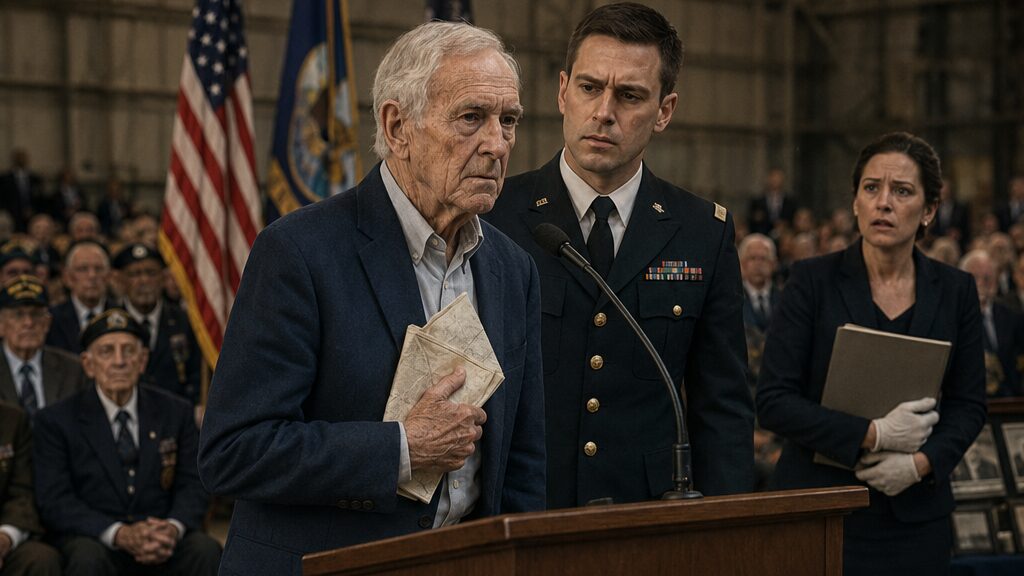
Before Mark could stop him without making the disruption larger, Edward stepped past him and reached the podium.
The room rustled. A camera operator adjusted focus. The old man placed the folded white map on the podium beside the microphone. His hand rested on it, fingers spread over the worn creases.
Mark climbed the stage steps behind him, close enough to intervene if he had to. He kept his shoulders squared, expression controlled. If the old man rambled, Mark would gently turn off the microphone and guide him away. He had seen confused guests before. Grief made people certain of things.
Edward leaned toward the microphone.
For one terrible second, nothing came out.
Mark saw the tremor in his hand then. Small, contained, but real. The room waited. The silence stretched until Mark’s own embarrassment began to rise on Edward’s behalf.
Then Edward spoke.
“On the seventeenth ridge,” he said, his voice rough but steady, “we were told the wind would be our enemy. It was not. The wind told the truth before the radios did.”
Mark froze.
The line was not in the program.
It was not in the public history notes. Mark knew those notes because he had shortened them himself. He had removed technical detail, changed operational language into clean phrases, and cut anything that might confuse guests who had not come for a briefing.
Edward looked down at the map beneath his hand.
“There were six lights on the slope when the first bird turned,” he continued. “By morning, only two were still burning.”
A murmur moved through the room.
Mark stepped closer to the microphone. “Sir,” he said, smiling tightly, “we appreciate your reflection, but we need to keep today’s remarks brief.”
Edward did not turn. “Brief is what we made the report.”
The words landed softly, but they struck harder than a raised voice.
Mark heard someone in the first row inhale. The committee chair’s program lowered into her lap. At the archive display, Nicole Adams turned sharply from the wall of photographs.
Edward’s eyes lifted over the audience.
“I was asked to speak about courage,” he said. “Courage was there. So was fear. So was confusion. So was the kind of order a man gives when he knows someone will spend the rest of his life hearing it.”
Mark’s mouth went dry.
This was not rambling.
This was too precise, too controlled, and too dangerous for a ceremony full of families. He imagined the local station clipping the moment, the headline becoming Old Man Interrupts Memorial With Accusations. He imagined Michael Green returning to a stage already lost.
“Mr. Clark,” Mark said, this time close enough that the microphone caught part of it. “Please step back.”
Edward finally turned his head.
From that close, Mark saw the age in him differently. Not weakness. Wear. The kind of wear polished uniforms were designed to hide from ceremonies.
“You can check the name again,” Edward said.
The same line from the door.
A few people heard it. Mark knew because their attention shifted from Edward to him.
“I did,” Mark said.
“No,” Edward replied. “You checked whether I looked like the name.”
Mark felt heat climb beneath his collar.
He reached toward the podium, intending to move the folded white map aside, to create some small physical break in the moment. Edward’s hand closed over it first. Not fast. Not dramatic. Just final.
Nicole Adams took one step away from the archive wall.
Edward looked back at the room and spoke again, quieter.
“The phrase was ‘hold the low line.’ That was never put in the public report.”
Nicole’s face went pale.
Mark saw it from the corner of his eye. She had gone completely still, one white-gloved hand pressed against the edge of a display table.
Edward breathed once through his nose, as if steadying something inside his chest.
“I did not come to correct your program,” he said. “I came to say four names.”
The hangar had changed. Mark could feel it. The audience no longer looked irritated. They looked uncertain, pulled toward the old man by the terrible possibility that he knew something the ceremony had failed to know.
Mark leaned in, voice low. “Sir, if you continue, I’ll have to pause the ceremony.”
Edward nodded once. “Then pause it.”
The words were not defiant. They were tired.
That made them worse.
Mark signaled to the audio table. The microphone went dead with a small click that sounded much louder than it was.
For a moment, Edward remained at the podium, his hand on the folded white map, speaking into silence.
Then he understood.
He closed his mouth, lifted the map carefully, and stepped back.
No one applauded. No one protested. The room held itself in a strange suspension while Mark took the microphone and announced a brief intermission for “program adjustment.”
As the lights came up, guests began to murmur. Mark walked Edward down the steps with a hand hovering near his elbow but not touching him.
“You should have waited,” Mark said.
Edward looked at him. “So should you.”
Across the hangar, Nicole Adams was already moving toward the records table, her face fixed with the expression of someone who had just heard a ghost use the correct password.
Chapter 3: The Photograph Missing From The Wall
Nicole Adams had spent three weeks building the Ridge 17 display, and until that morning she had believed the missing pieces were ordinary.
Every archive had gaps. Labels fell off. Photographs were misfiled. Old operational records came with clearance markings that made committees nervous. Her job was to give the public what it could safely hold: faces, dates, aircraft numbers, a map reproduction cleaned of tactical markings, and enough context for families to feel the institution had not forgotten.
But when the old man said “hold the low line,” Nicole felt the past open under her feet.
She had seen those words once.
Not in the public packet. Not in the approved ceremony script. They had been penciled along the margin of a restricted note attached to a damaged operations folder. The handwriting had been cramped, almost impatient, and the phrase had been circled twice as if someone had known it would matter later.
Hold the low line.
Nicole crossed to the records table while the hangar shifted into intermission. Guests stood in small clusters, speaking in low, unsettled voices. Near the back, Edward Clark sat alone again, folded white map across his knees, face lowered. No one had escorted him out. Mark Davis had not gone that far, though he had positioned a security aide near the aisle as if politeness could disguise a guard post.
Nicole pulled open the first storage case beneath the display.
Inside were duplicate programs, foam wedges, a roll of clear tape, cotton gloves, and the printed captions she had rejected. She moved past them quickly. Her hands were steady because she had worked in archives long enough to know panic damaged paper faster than time.
The public wall behind her showed Ridge 17 as the committee wanted it remembered.
There was a photograph of a rescue aircraft lifting through bad weather. Another of young service members beside a transport truck, their smiles too large for the cold around them. Another showed the ridge itself, distant and grainy, a white slash against dark rock. The central frame held a group image: twelve men and two women in field gear, identified as “Joint Evacuation Coordination Team, Ridge 17.”
Nicole stared at that frame.
She had always disliked its balance.
The left edge had too much empty space. The bodies angled toward someone who was not there. A caption could hide many things, but not composition. People in a photograph did not lean toward absence unless someone had been removed.
She lifted the frame from the easel and turned it over.
The backing was newer than the photo. Too new. She found the small metal tabs and bent them back with her thumbnail. The print slid free inside its mat.
Trim marks.
Someone had cropped it.
Nicole’s throat tightened.
She laid the photo on the table and pulled the archive manifest from her folder. The public display set had been transferred from a larger Ridge 17 collection stored on-site decades earlier, then digitized, then reduced for ceremony use. She had complained twice that the file names were inconsistent. Mark had told her not to overcomplicate a memorial with “museum problems.”
She searched the manifest with her finger.
R17-JECT-GROUP-A.
Public print.
R17-JECT-GROUP-B.
Restricted review.
No display without command authorization.
Nicole looked toward Edward.
He was not watching her. He had unfolded one corner of the white map and was smoothing it with the side of his hand. The gesture was so careful it hurt to see. Not possessive. Protective.
Mark approached her before she could open the second case.
“Tell me you know what that was,” he said.
Nicole kept her voice low. “I’m trying to find out.”
“You’re the archive coordinator.”
“That doesn’t mean every restricted file came with a clean explanation.”
Mark glanced back at the audience. “He hijacked a memorial.”
“He knew a nonpublic operational phrase.”
“He could have heard it somewhere.”
“From where?”
Mark’s jaw tightened. “Old veterans talk.”
Nicole looked at him then. He was trying to hold the ceremony together with both hands and had mistaken denial for discipline.
“Mark,” she said, “I saw that phrase in a restricted note.”
His expression shifted, just enough.
“Are you sure?”
“No. That’s why I’m looking.”
“Look fast.”
He started to leave, then stopped as Edward rose from his seat near the back. The security aide moved half a step, uncertain. Edward did not head for the stage. He walked toward the display wall.
Every few steps cost him. Nicole saw it now that she was watching closely. His cane touched the concrete lightly, but his body prepared before each movement, as if pain had to be negotiated with rather than obeyed. He stopped in front of the wall and looked at the cropped group photograph.
Not at all of it.
At the empty left edge.
Nicole stepped beside him.
“Mr. Clark,” she said.
He did not correct the name.
“Do you recognize this photograph?”
Edward’s eyes remained on the frame. “Most of it.”
“Most?”
“The part you have left.”
Mark exhaled sharply behind them. “Sir, this is exactly why we need to verify before you keep making statements.”
Edward turned from the wall. His face held no triumph, no satisfaction at having unsettled them. Only fatigue.
“You should verify,” he said.
Nicole looked at the folded white map under his arm. “May I ask what you’re carrying?”
Edward’s hand tightened almost imperceptibly.
“No,” he said.
The refusal was quiet, but it closed the conversation.
Nicole nodded. “Then I’ll ask something else. Did the phrase ‘hold the low line’ come from a radio order?”
Edward looked at her for the first time fully.
Around them, the hangar noise seemed to thin.
“It came before the radios failed,” he said.
Nicole felt the air leave her lungs.
Mark stepped closer. “That doesn’t answer the question.”
“It answers enough for her,” Edward said.
It did.
Nicole returned to the storage case and pulled out the lower tray. Beneath a stack of foam board, she found a flat archival envelope with an old transfer label half peeled from the corner. The label had been typed, but a handwritten notation ran across the bottom in faded black ink.
R17 command image — review before display.
She slit the envelope carefully and drew out a larger print.
The group photograph was the same scene as the cropped one on the wall, but wider. On the left stood a younger man in field gear, one hand braced on a folded white map spread across the hood of a vehicle. He was not smiling. Everyone else in the photograph angled toward him, waiting.
The image was grainy, but the face was clear enough to trouble the present.
Nicole looked from the photograph to Edward.
Not proof. Not yet. Age changed a face. Grief changed it more. But the line of the brow, the set of the mouth, the slight turn away from attention—it was there.
Mark saw her looking.
“What?” he demanded.
Nicole did not answer. Something else had slipped from the envelope with the photograph: a narrow storage tag, brittle at the edges, tied once with cotton string.
She turned it over.
Clark command map — do not display without clearance.
The hangar’s public noise faded behind her.
Edward Clark stood very still, the folded white map pressed against his side, while the missing photograph lay between them like a door someone had not meant to open.
Chapter 4: The Officer Who Chose The Polished Version
Mark Davis did not like the way people had begun looking at him.
No one accused him. No one spoke loudly. That would have been easier. Instead, the hangar had filled with the softer damage of uncertainty. Guests stood near their seats with programs folded in their hands. The veterans in the front row watched the stage as if they had seen ceremonies go wrong before and were waiting to learn whether this one would correct itself or pretend.
Mark preferred direct problems. A missing speaker could be replaced. A microphone could be swapped. A wreath could be carried by someone with steadier hands.
An old man with the right wrong words was harder.
He guided Nicole away from the display table before the photograph drew too much attention. “Not here,” he said.
Nicole held the archival print against a folder, shielding it with her body. “Then where?”
“Back office.”
Edward Clark stood beside the display wall, his folded white map tucked beneath his arm. He had not asked to follow. He had not asked what Nicole had found. He simply looked at the cropped photograph still hanging in its frame, as though the missing edge had been missing for years and only now had the room become honest enough to notice.
Mark turned to the security aide. “Keep the guests away from this area.”
The aide nodded.
Edward’s eyes moved to Mark.
“Not like that,” Edward said.
Mark stopped. “Excuse me?”
“They are not a threat to the photograph.”
“I’m trying to protect the integrity of the ceremony.”
Edward looked toward the stage. “You already tried that.”
The words were calm, which made Mark want to answer sharply. He did not. Too many people were watching. Instead he said, “Sir, I need you to come with us until we can verify what’s happening.”
Edward’s hand rested over the white map. “I’ll come for the map.”
“You have the map.”
“No,” Edward said. “I have the copy I could carry.”
Nicole looked down at the storage tag in her hand.
Clark command map — do not display without clearance.
Mark saw it again and felt the day tilt further from him.
The backstage corridor smelled of floor polish, coffee, and the warm electrical dust from old lighting panels. Voices from the hangar followed them in waves, then faded as the door shut. Mark led the way because leading was what kept panic from showing. Nicole walked beside him, careful with the photograph. Edward followed more slowly. Each tap of his cane sounded too loud in the narrow corridor.
The office they had been given for ceremony coordination was barely larger than a supply room. Boxes of programs leaned against the wall. A laptop sat open on a folding table beside the final running order. A garment bag hung from a hook. On the desk lay the extra copy of the ceremony script Mark had revised until nearly midnight.
He had thought the final version was respectful.
He had removed technical clutter. He had smoothed conflict. He had cut the names from a long operational appendix because the family representative already had a photograph and because reading every name, every role, every unit would slow the hour and risk confusing the audience. He had changed “command failure window” to “severe communication disruption.” He had changed “delayed extraction” to “hazardous weather conditions.” He had changed “hold the low line” to nothing at all because he had not known what it meant and did not want the base commander asking why it was there.
That was not dishonesty, he told himself.
That was ceremony.
Nicole laid the wider photograph on the table. Mark bent over it despite himself.
The younger man at the left edge was hard to ignore once restored. Everyone in the image seemed oriented toward him. His hand pinned a white field map against a vehicle hood. The wind had caught one corner of it. His face was leaner, darker-haired, decades younger, but there was something in the mouth that made Mark glance at Edward before he could stop himself.
Edward did not look at the photograph.
He looked at the programs stacked in boxes.
“You printed many,” he said.
Mark straightened. “We expected a full audience.”
“Do any have the names?”
Mark did not answer quickly enough.
Edward nodded once, as if the silence had confirmed something he had expected.
Nicole touched the edge of the archival print. “Mr. Clark, I need to ask directly. Is this you?”
Mark was grateful she asked it. He would have sounded accusatory.
Edward’s eyes lowered to the photograph at last. For a moment, the office seemed too small for the years between his face and the face in the print.
“It was cold that morning,” he said.
Nicole waited.
“The map kept lifting. I remember being irritated by that. Men were waiting on a ridge, and I was angry at a piece of paper.”
Mark stared at him. “That doesn’t answer her question.”
Edward looked at Mark with the same tired steadiness he had shown at the podium. “It answers the part that matters.”
“It doesn’t matter if we can’t verify it.”
“Then verify it.”
The simplicity of the reply irritated Mark because it was the very thing Edward had asked at the entrance. Check the name again. Mark had checked the wrong things: clothing, schedule order, visible rank, whether the old man looked like someone who belonged at a microphone.
He turned to the table and picked up the folded white map Edward had set down for a moment while adjusting his cane.
Edward’s hand moved.
Not fast enough to grab it. Just enough for Mark to see the fear before it was hidden.
For the first time all morning, Mark saw something in the old man that was not stubbornness. It was grief so disciplined it looked like manners.
Mark held the folded paper awkwardly. “I only need to compare it to the tag.”
“Put it down,” Edward said.
The room went quiet.
Mark could have pulled rank. He could have said the object might be part of an official collection, that the ceremony was under his control, that no guest could bring restricted material into a public event without review. The sentences formed and died in his throat.
He placed the folded map back on the table.
Edward stepped forward, picked it up with both hands, and held it close to his chest.
“I’m not trying to take anything from you,” Mark said.
Edward’s eyes flicked to the boxes of programs, then to the script on the desk. “You already did, without knowing.”
The words should have angered him. Instead, they landed somewhere lower.
Mark opened his laptop and pulled up the digital event file. “The speaker entry came from legacy records. It listed E. Clark, no title, no bio, no contact number. The committee couldn’t confirm. Colonel Green said we’d handle it on site if necessary.”
“Michael Green,” Nicole corrected softly. “He’s a colonel, but he commands the base.”
Mark shot her a look. “I know who commands the base.”
Nicole did not flinch. “Then call him.”
“He’s in transit.”
“Call him again.”
Mark looked at Edward. The old man had lowered himself into the only chair without being invited, as if his legs had finally negotiated all they could. His cane rested against his knee. His hand still covered the folded white map.
For one uncomfortable second, Mark imagined his own grandfather in that chair. Then he pushed the thought away because sentiment had no use in a room where records needed verifying.
He dialed Michael Green’s office. No answer. He called the driver. No answer. He sent a message marked urgent, then opened the restricted file index Nicole indicated.
Access denied.
“Of course,” Mark muttered.
Nicole reached into her folder. “I requested temporary archive clearance for today. Mine may still work on the local terminal.”
“This is why displays should be finalized before the event,” Mark said.
Nicole looked at him. “This is why history should not be finalized for convenience.”
He almost answered, but Edward shifted in the chair.
“Miss Adams,” Edward said, “is there a list in that file?”
Nicole softened. “A list?”
“Four names.”
Mark heard it then: not anger, not pride, not even fear. A plea hidden inside restraint.
Nicole’s expression changed. “I’ll look.”
Mark’s phone buzzed in his hand before she could move. A message from Michael Green’s aide said the commander was ten minutes from the gate.
Mark read it twice.
Ten minutes. Ten minutes to decide whether the ceremony could be repaired or whether he had allowed an unidentified old man to crack open a classified memory in front of families, donors, press, and veterans.
Nicole had moved to the local archive terminal in the corner. She entered her credentials. The screen loaded slowly.
Edward watched nothing but the folded map.
A file name appeared. Ridge 17 command transfer. Nicole opened it, then covered her mouth with the back of her hand.
Mark stepped closer. “What?”
She pointed to a scanned signature at the bottom of an old authorization form. The image was faded, but the name was clear enough.
E. Clark.
Below it, in smaller typed text, was a title Mark did not read aloud.
Nicole looked from the screen to Edward, then to the folded white map.
“Mark,” she said carefully, “the old man’s signature may match the restricted Ridge 17 command file.”
Chapter 5: The Name Beneath The Dust
The records room beneath the hangar offices had no ceremony in it.
No flags. No polished brass. No printed programs with careful margins. Only gray cabinets, humming lights, and the dry smell of paper stored long after the people who wrote it had grown old or gone silent. Nicole Adams had always liked rooms like this. They did not flatter memory. They kept it, imperfectly, in boxes.
Edward Clark paused at the bottom of the stairs.
“You don’t have to come down,” Nicole said.
He looked at the rows of cabinets. “Yes, I do.”
Mark had stayed upstairs to keep the intermission from becoming rumor. He had wanted the file brought to him. Nicole had refused. Some records should not be carried through a hallway full of curious guests and camera equipment, especially not after being ignored for thirty years.
A junior enlisted assistant had unlocked the room and then retreated, leaving Nicole with Edward and the old local terminal connected to the archive index. The fluorescent light made Edward look paler than he had in the hangar. His shoulders had settled lower, but his eyes were clear.
Nicole pulled on fresh gloves. “The restricted folder is in cabinet C-six.”
Edward waited while she turned the wheel handle and opened the drawer. The metal gave a tired groan. Inside were flat boxes labeled by operation number. Ridge 17 occupied three inches of space.
It seemed too little.
Nicole lifted the top folder and carried it to the table. A fine line of dust clung to the lid. She wiped it with the side of her glove before opening it.
The first documents were ordinary in the way official documents could make extraordinary things look lifeless: weather tables, aircraft logs, communications summaries, casualty addendums, route diagrams. Nicole moved carefully, reading only what she needed. Edward stood across from her, both hands resting on his cane.
Then she found the map sleeve.
It was translucent, brittle at one edge, and marked COMMAND COPY — WHITE FIELD OVERLAY. Her breath slowed as she opened it.
The original map inside had once been white, or close to it. Time had stained it cream. Red and blue grease-pencil lines crossed the ridges and ravines. A low route had been circled twice. Beside it, in small block letters, someone had written HOLD LOW LINE UNTIL SECOND BIRD CLEARS.
Nicole looked up.
Edward had unfolded his own copy.
For a moment, the two maps lay across from each other like two versions of the same wound. His had been carried, refolded, touched too many times. The archive map had been preserved flat and hidden. But the markings matched. The low route. The circled ridge. The pressure point where the evacuation had split into two choices and neither had been merciful.
Nicole’s voice came out lower than she intended. “You carried a copy all this time.”
Edward nodded.
“Why?”
He looked at the map, not her. “Because the original belonged to the Army.”
“And the copy?”
“That belonged to the men I left on the ridge.”
Nicole did not know what to say to that, so she did what archivists did when emotion could damage the work. She turned to the next document.
The order was there.
Signed at 0320 hours.
Evacuation route adjustment authorized under command discretion due to weather collapse and enemy movement risk. Priority extraction redirected to southern slope. Remaining team ordered to hold low line until second aircraft window.
Below the order was the signature.
Edward Clark.
And below the signature, the title Mark had avoided reading aloud upstairs.
Commanding General, Joint Evacuation Task Force.
Nicole felt the words settle into the room without needing to be spoken.
Edward had not moved.
She had expected, perhaps unfairly, some small sign when the proof appeared. Relief. Fear. A desire to be recognized at last. Instead he looked older, as if the document had taken years from him by surviving.
“This confirms it,” Nicole said.
Edward’s mouth tightened.
“Mr. Clark—”
“General,” she almost said, but stopped because something in his posture warned her that the title would not comfort him.
He noticed.
“You can say Edward,” he said.
“I don’t think I should.”
“You think a title changes the paper?”
“No,” Nicole said. “But it changes what happened upstairs.”
He looked toward the ceiling. Above them, the ceremony guests still waited in the hangar. Footsteps passed overhead. A muffled announcement asked everyone to remain near their seats.
“What happened upstairs,” Edward said, “was a young officer protecting a ceremony from an old man he did not understand.”
“He humiliated you.”
Edward’s eyes returned to the map. “He interrupted me. Humiliation requires consent.”
Nicole studied him, unsure if she believed that or if he needed to believe it.
“You should have told him,” she said.
“What?”
“Who you were.”
The question lingered under the lights.
Edward folded one corner of his copy back along its crease. “Thirty years ago, I told men to wait where the wind had turned. I told them help would come. I told them to hold the low line because it was the only route the second aircraft could still reach.”
Nicole glanced down at the order.
“The second aircraft didn’t reach it,” she said softly.
“No.”
The room seemed to shrink.
Edward’s hand rested on the map, covering a cluster of old marks. “Four men heard my voice and did what I asked. They stayed. That decision moved the main group out before the weather closed. It saved people. That is the sentence they like.” His fingers pressed once, lightly. “It does not include the four.”
Nicole turned the pages until she found the casualty addendum. Four names were listed in a separate block, clipped from the operational summary as if even the paperwork had been unable to decide where to place them.
Edward looked at the list but did not touch it.
“My wife kept the first letter,” he said. “From one of the families. Not angry. That was worse. They thanked me for bringing most of their son’s team home.” He swallowed once. “I spent years learning how to accept gratitude that had teeth in it.”
Nicole stood still.
This was not the story the display told. The display told of courage, impossible weather, and successful extraction. It did not tell of a commander who had saved many by ordering a few to wait. It did not tell of a man who had hidden from honor because honor had never known what to do with the missing.
“Why come today?” she asked.
Edward’s eyes closed briefly.
“My wife made me promise before she died.” His voice did not break. It only thinned. “She said the dead do not ask us to suffer forever. They ask not to be edited out.”
Nicole looked at the public program she had brought downstairs. The closing reflection was printed as E. Clark. No title. No biography. No names.
She hated the smallness of that line.
“I can fix the display,” she said.
Edward shook his head. “Displays are for later.”
“Then the ceremony.”
“I did not come to reclaim the ceremony.”
“You came to speak.”
“I came to say four names.”
Nicole turned back to the file and carefully removed the archival photograph from its sleeve. The same wide image from upstairs, but clearer here. Young Edward stood beside the vehicle hood, white map under his hand, surrounded by faces turned toward him. On the back, a caption had been typed and then corrected by hand.
General Edward Clark reviewing final low-line adjustment before Ridge 17 extraction.
Nicole placed the photograph beside Edward’s folded copy.
“You understand what this means,” she said.
Edward looked at the younger man in the image for a long time.
“I understand what people will think it means.”
“What should they think?”
“That rank did not make the order hurt less.”
Footsteps sounded on the stairs.
Mark appeared in the doorway, cap tucked under his arm, his face drawn tight. “Colonel Green just entered the gate.”
Nicole gathered the file, the photograph, and the casualty list. “He needs to see this.”
Mark’s eyes went to the table. To the original map. To Edward’s copy. To the signature.
His expression changed in increments, each one small enough to be denied if anyone had asked. First irritation. Then recognition of trouble. Then something closer to fear.
Edward folded his white map carefully and stood.
Mark did not tell him to hurry.
They climbed back toward the hangar in silence. At the top of the stairs, the corridor door opened before they reached it, and Michael Green stepped in wearing his service cap and the worried look of a commander returning to a ceremony already in motion.
“What happened?” Michael asked.
Nicole held out the archival photograph.
Michael took it with one hand, already preparing for an explanation. Then his eyes dropped to the image.
The corridor went still.
In the photograph, young Edward Clark stood with one hand on the same white map Edward now carried folded against his chest.
Michael looked up slowly.
Not at Nicole. Not at Mark.
At the old man in the plain blazer.
Chapter 6: General Clark Was Already In The Room
Michael Green had spent enough years in command to recognize the instant when a room required more truth than schedule.
He stood in the corridor outside the hangar with the archival photograph in his hand while the ceremony murmured on the other side of the wall. Mark Davis waited stiffly near the office door. Nicole Adams held the Ridge 17 file against her chest. Edward Clark stood slightly apart from all of them, not hiding, not presenting himself, simply holding the folded white map as if it were heavier than rank.
Michael looked again at the photograph.
There was no doubt in the posture. Age had changed the body, but not the way the man withheld himself from attention. The younger Edward in the image stood at the edge of command, surrounded by people waiting for him to decide. The old Edward stood the same way now, only the decision had changed.
Michael lowered the photograph.
“Sir,” he said.
Edward’s face tightened almost imperceptibly at the address. “Colonel.”
Mark looked from one man to the other. “You know him?”
Michael did not answer immediately. His eyes stayed on Edward. “I know the name. Every officer who studies Ridge 17 knows the decision. We were told General Clark declined public observances.”
“I did,” Edward said.
“Then why today?”
Edward touched the folded map. “Because the program did not include the four names.”
Michael’s gaze shifted to Nicole.
She opened the file and handed him the casualty addendum. No drama. No speech. Just a page with four names set apart by bureaucratic spacing.
Michael read them.
The corridor seemed to pull tighter around the silence.
“Were these omitted from today’s reading?” he asked.
Mark answered before Nicole could. “The ceremony committee shortened the operational section. I approved the final script.”
Michael looked at him.
Mark stood straighter, as if posture could become explanation. “Sir, the source material was incomplete. The speaker entry only said E. Clark. No title, no verified contact. Mr. Clark approached the podium without confirmation during the reflection slot.”
“General Clark,” Michael said quietly.
The correction did not come sharp, but it struck Mark harder than a reprimand.
His eyes moved to Edward. “Sir, I—”
Edward lifted a hand, stopping him before the apology could begin.
“Not yet,” Edward said.
Michael understood more from those two words than from the file. “What do you want done?”
Edward looked toward the hangar doors. Beyond them, the audience waited beneath flags and lights, holding programs that had made the day cleaner than it should have been.
“I want the names restored,” he said.
“That can be done.”
“Before I speak.”
Michael nodded. “Yes.”
“And no introduction that makes the room feel absolved because it recognizes a title.”
Mark stared at the floor.
Michael closed the file slowly. “Understood.”
Ten minutes later, the hangar lights dimmed again.
The guests returned to their seats with the uncertain quiet of people who knew the ceremony had shifted but not why. The local camera operator adjusted his tripod. Veterans in the front row watched the side door. The memorial committee chair sat with her hands clasped tightly over her program.
Mark stood behind the podium, but not as he had before. Earlier, he had occupied the stage as if keeping it intact depended on him. Now he stood slightly back, binder held at his side, face pale beneath the controlled stillness of uniform discipline.
Michael Green stepped to the microphone.
“Ladies and gentlemen,” he said, “thank you for your patience.”
The room settled.
Michael did not rush. He placed the Ridge 17 file on the podium and rested one hand beside it. “This morning, our ceremony followed a program that was incomplete. That responsibility belongs to this command.”
Mark’s throat moved.
Michael continued. “Ridge 17 has often been remembered through the language of success. Many lives were saved. That is true. But truth becomes smaller when it leaves out the cost carried by those who were asked to wait, and by those who gave the order.”
Edward stood at the side of the stage near the steps. He had agreed to return only after Nicole placed the casualty list beneath the microphone. The folded white map was in his hand. No one had taken it from him.
Michael looked toward the archive table. Nicole nodded.
The screen behind the podium changed.
At first, the image was only light. Then the archival photograph appeared above the stage: young faces in field gear, a vehicle hood, a white map caught under one man’s hand. The restored left side of the image filled the space that had been missing from the public display.
A stir passed through the room.
Michael turned slightly toward the screen. “This photograph was part of the restricted Ridge 17 collection. It should have been reviewed before today. It was not.”
He let the words stand.
“The man at the left of this image is General Edward Clark, commanding officer of the Ridge 17 evacuation.”
The silence came so quickly it seemed to remove the air.
Mark did not look at the screen at first. He looked at Edward.
The old man in the plain blazer. The man he had moved from the entrance. The man he had told to sit in general seating. The man whose microphone he had cut.
Then Mark looked at the photograph.
The young commander’s hand pressed a white map against the hood of the vehicle. Edward’s old hand held its folded copy at the stage steps. The distance between them was thirty years and a few feet.
Michael’s voice softened, but stayed clear. “General Clark was invited to deliver today’s closing reflection. Through incomplete records and our own failure to verify them properly, he was not received with the respect any guest deserves, much less the respect owed to a man whose decisions shaped the operation we are gathered to remember.”
Edward’s jaw tightened.
Michael saw it and adjusted course.
“But let me be clear,” he said. “Respect should not require recognition.”
That changed the silence.
Several people lowered their eyes.
Michael lifted the casualty list. “Before General Clark speaks, four names omitted from the printed program will be read.”
He read them one at a time.
Not quickly. Not ceremonially polished. Simply enough for the room to hear each name as belonging to a person rather than an appendix.
When the fourth name faded into silence, Michael stepped back from the microphone.
Edward climbed the stage steps slowly.
No one moved to help him until he paused. Mark took half a step forward, instinct and shame colliding in him. Edward saw the movement but did not accept it. He reached the podium on his own, placed the folded white map beside the casualty list, and rested his hand over it.
The microphone stood where it had stood before.
This time, it remained on.
Edward looked at the audience. He did not look at the photograph behind him.
“I asked that those names be read before mine was explained,” he said. “Because they have waited longer.”
No one breathed loudly.
Mark stood behind him, no longer the figure controlling the stage but the younger officer forced to listen. From where he stood, he could see Edward’s hand on the map. He remembered reaching for it in the office and seeing the old man’s fear. He remembered calling it a speech. A reminder. Trash to be moved. Evidence to be handled.
Edward spoke for less than two minutes.
He did not describe himself as a general. He did not defend the order. He did not ask the room to admire what had happened on the ridge. He spoke of wind, broken radios, men who obeyed when obedience cost them, and the danger of turning memory into something comfortable.
When he finished, he did not step back to receive applause.
For a moment, none came.
That silence was better.
It held the room in the shape of what it had learned.
Then people began to stand—not all at once, not with theatrical force, but quietly, unevenly. A veteran near the front rose first. A family member followed. Others stood because standing was the only language left, though Edward looked as if he wished they would sit and remember instead.
Mark remained still.
His apology had been growing in him since the screen lit up. It pressed against his ribs now, urgent and insufficient. When Edward stepped away from the podium, Mark moved toward him.
“General Clark,” he began, voice low.
Edward stopped him with one lifted hand, the same gentle command as before.
Mark fell silent.
Edward looked at him, not cruelly, not warmly.
“Do not start there,” Edward said.
Chapter 7: Do Not Apologize Because I Was A General
“Do not start there,” Edward said.
Mark Davis stopped with his mouth still shaped around the title. Behind him, the hangar remained standing, quiet and uneasy, hundreds of people held in the strange stillness that follows a truth no one knows how to arrange itself around.
Edward stood beside the podium steps with the folded white map under one arm. The archival photograph still glowed on the screen behind him: the younger commander, the field vehicle, the white map held against the wind. The old man did not look back at it. He had spent enough of his life being followed by that younger face.
Mark swallowed. “Sir, I owe you an apology.”
Edward studied him for a moment. The young officer’s uniform remained perfect. His medals were straight. His shoulders were squared. Only his eyes had changed. They no longer looked past Edward toward schedule, donors, cameras, and polished order. They stayed on him.
“For what?” Edward asked.
Mark’s answer came too quickly. “For not recognizing you.”
Edward shook his head once.
Mark fell silent again.
“That is the easy apology,” Edward said. “It would make this morning about my name.”
Michael Green stood near the side of the stage, the Ridge 17 file held closed against his chest. Nicole Adams remained by the archive table, one gloved hand resting beside the restored photograph. Neither interrupted.
Edward looked toward the audience. People were still standing. Some out of respect, some out of uncertainty, some because they had risen with others and no longer knew when sitting would be right. He wished they would sit. Standing made a monument of the wrong thing.
He stepped back to the microphone.
The room responded before he spoke. Chairs creaked as people prepared themselves. Mark moved aside, this time leaving space instead of guarding it.
Edward set the folded map on the podium. His hand rested on the top crease, the one that had nearly worn through. Beside it lay the casualty list Michael had read aloud. Four names. Ink on paper. Lives compressed into a block of text and then, for years, into absence.
“When I came here this morning,” Edward said, “I did not come to be found.”
His voice carried through the hangar with the roughness of age, but the microphone held it faithfully now.
“I came because my wife asked me, before she died, to stop treating memory as a room I had to sit in alone. She told me that if the Army was going to say Ridge 17 out loud again, then I owed the dead the courage to stand where I had not wanted to stand.”
No one moved.
Edward looked down at the list.
“The program you received today was incomplete,” he said. “That is being corrected. But I want to be careful about what lesson you take from the correction. The wrong done this morning was not that a retired general was asked to sit in the wrong section.”
His eyes moved briefly to Mark, then away.
“The wrong was that an old man was treated as if his confusion had been proven by his age, his clothes, and his silence.”
Mark lowered his eyes.
Edward continued, quieter. “If I had been nobody, the treatment would still have mattered.”
The sentence settled more deeply than the announcement of his rank had. It reached the rows of guests who had watched him be moved aside and had said nothing. It reached the committee members who had trusted a clean program more than an incomplete record. It reached the young assistants who had looked at Edward as a seating problem. It reached Edward himself, because some part of him had allowed people to erase him so long as they did not erase the dead.
He unfolded the map.
Not all the way. Only enough to reveal the old markings, the low route, the ridge circled twice, the pressure point where a decision had split the night in two. The paper trembled once under his fingers, then stilled.
“These marks are not decoration,” he said. “They are not proof that I was important. They are the shape of a choice I have lived with for thirty years.”
He touched the casualty list.
“The four names read before mine are the reason I came.”
Then he read them again.
This time, he did not read them as part of an official correction. He read each name as if returning it to a place at the table. After each one, he paused long enough for the hangar to hold it. Somewhere in the middle rows, a woman began to cry quietly. An older veteran bowed his head. Nicole removed her gloves and folded them together as if she could no longer stand between skin and history.
When Edward finished the fourth name, he did not add explanation.
He folded the map slowly, along the same old creases. The motion was careful, almost tender, and the room watched a commander put away not evidence but burden.
Mark stepped forward again, but this time he did not reach for Edward. He stopped at the edge of the podium, cap held in both hands.
“Mr. Clark,” he said.
Edward looked at him.
The title was gone.
Mark’s face tightened with the effort of saying the harder thing. “I am sorry for how I treated you before I knew anything about you.”
Edward waited.
“I thought I was protecting the ceremony,” Mark said. “I was protecting how it looked.”
Edward’s expression softened, not into forgiveness exactly, but into recognition of a man finally naming the correct failure.
“Then protect it differently next time,” Edward said.
Mark nodded once. “Yes, sir.”
Edward almost corrected him, then let it pass. Some habits would take longer than a morning.
Michael returned to the microphone after Edward stepped away. He did not ask for applause. He did not close with a grand statement. He announced that the Ridge 17 display would remain open after the ceremony, that the restored photograph and corrected names would become part of the permanent archive, and that the printed program would be amended before it was sent to families.
The room listened differently now.
After the final notes of the bugle recording faded, people did not rush the stage. A few approached Edward, but most seemed to understand that gratitude could crowd a man as surely as disrespect. An older veteran stopped a few feet away, placed his hand over his heart, and nodded. Edward returned the nod.
Nicole came to him with the archival photograph in a protective sleeve.
“I’ll make sure the record is corrected,” she said.
Edward looked at the young face in the image. “Correct the record for them first.”
“I will.”
“And leave the uncomfortable parts in.”
Nicole nodded. “Especially those.”
Michael offered to have a driver bring Edward to the front entrance. Edward declined. The walk across the hangar was not far, and he wanted to take it at his own pace.
He passed the rows of chairs, the flags, the display wall now altered by the larger photograph. Guests made room without making a spectacle of it. The folded white map rested under his arm, returned to the private place it had occupied for three decades.
Near the front row, Mark had stopped beside another elderly veteran who stood uncertainly with a program in one hand and a cane in the other. The man seemed to be searching for his seat while the aisle emptied around him.
Mark bent slightly, not impatient, not performing for anyone.
“Let me help you find the front,” he said.
Edward paused long enough to see the veteran accept the offer.
Outside the hangar doors, evening light had softened the parking lot. The air smelled faintly of rain on concrete. Edward stood beneath the overhang and drew one breath, then another.
For years, he had thought carrying the map was the price of remembering. Now, for the first time, it felt less like a sentence and more like something entrusted.
He tucked it carefully inside his blazer.
Then Edward Clark walked away from the ceremony in the same old coat he had worn when no one knew his name.
The story has ended.