The Old Veteran Everyone Ignored at Airport Security Saw What the K-9 Was Really Warning About
Chapter 1: The Dog Sat Before Anyone Asked Why
The German shepherd sat before the officer gave the command.
Richard Harris noticed that first.
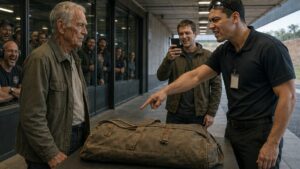
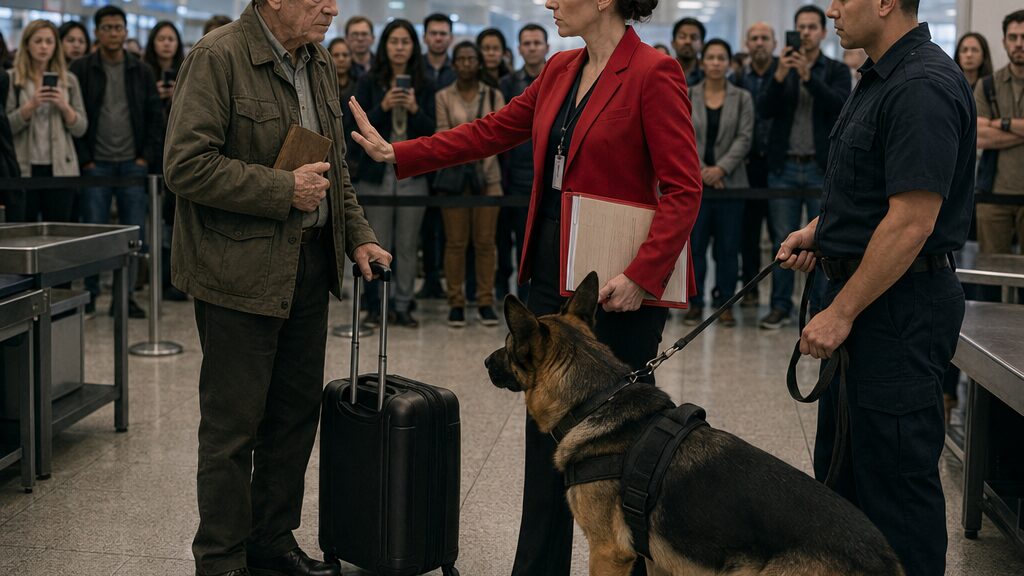
The dog’s rear touched the airport tile in a quick, uncertain drop, not the hard, squared-off sit of a clean find. Its ears stayed forward, but its nose was not locked on Richard’s black rolling suitcase. The dog’s head shifted once toward the bag, then away, then toward the woman in the red blazer stepping into the lane with one palm raised.
“Sir, stop right there.”
Richard stopped.
The suitcase bumped the heel of his old shoe and rocked once on its wheels. A boarding pass stuck halfway from the pocket of his field jacket. The jacket had gone soft at the cuffs after too many winters and too many washings, and this morning it made him look poorer than he was and older than he liked. He had dressed for a flight, not for judgment.
Behind him, the line tightened. The murmur changed shape. People stopped complaining about belts, bins, laptops, and shoes. Phones rose just enough to pretend they were not recording.
Richard kept his right hand on the suitcase handle and his left hand around the small brown notebook he had carried through three states, two airports, and more quiet rooms than he cared to count. The elastic band around it had lost its stretch. One corner had been darkened by rain years ago. He had almost left it at home, then slipped it into his pocket before dawn.
The young K-9 officer held the leash short. Too short, Richard thought. The dog’s shoulders had no room to answer its own nose.
“Step away from the bag,” the officer said.
Richard looked from the leash to the dog’s paws. The front right paw had lifted half an inch and settled again. A dog that knew would plant. A dog being pulled toward certainty by a handler’s expectation would hover.
“Officer,” Richard said, “your dog didn’t finish.”
The young man’s eyes snapped to him. “Sir, step away from the bag.”
The woman in red moved closer, placing herself between Richard and the stream of passengers. Her blazer was sharp, a little too bright beneath the white ceiling lights. A badge hung from a clip near her lapel. She had the tight posture of a person whose morning had already gone wrong and who refused to let it spread.
“I’m Rebecca Nelson, airport security operations,” she said. “We need you to comply.”
“I am complying.”
“Then take two steps back.”
Richard released the suitcase handle. His fingers resisted for half a second before opening. He stepped back once, then again. The black suitcase stood alone in the lane, its handle still extended, as if it had been abandoned by someone guilty.
The dog leaned forward and sniffed near the bottom seam. Its nose skimmed left, crossed the wheel, then lifted. Not a deep pull. Not a source hold. A question.
Richard watched the dog’s head turn toward the red blazer again.
The officer gave the leash a small correction. “Check.”
The shepherd’s nose returned to the suitcase because the leash returned it there.
Richard felt an old weight settle under his ribs. Not fear, exactly. Something colder. The feeling of seeing a mistake in motion while everyone with authority mistook motion for truth.
A second uniformed officer came through carrying papers in a plastic tray. He moved fast, cutting between Richard and the passengers, and the papers fluttered in the air from the speed of his stride. Rebecca took them without looking away from Richard.
“What’s your destination?” she asked.
“Denver.”
“Purpose of travel?”
Richard’s thumb rubbed the notebook’s worn edge. “Family.”
“Are you carrying anything that does not belong to you?”
“No.”
“Did anyone ask you to transport anything?”
“No.”
“Have you been in possession of this suitcase at all times?”
“Yes.”
The questions came clean and practiced. Richard knew the value of clean questions. He also knew how easily they turned dirty when nobody looked at the animal between them.
The dog gave a soft breath, almost a huff. Its head lowered again, but not to the suitcase. The nose drifted toward the papers in Rebecca’s hand. Rebecca shifted them to her other side.
Richard’s eyes followed.
The young officer noticed. “Sir, look at me.”
Richard did. The officer was not careless. That made it worse. His boots were polished, his uniform squared, his jaw tense. He wanted to be good at his work. He wanted the dog to be right because the dog was his responsibility, and responsibility made young people defensive when fear got near it.
“Is there a reason you keep watching my K-9?” the officer asked.
“Yes.”
Rebecca’s expression hardened. “This is not the time to interfere with a trained detection team.”
Richard’s mouth went still.
Behind him a child whispered, “What did he do?” An adult hushed the child too late. The words traveled anyway.
Richard had been called slow in grocery lines. Sir in the voice that meant obstacle. Sweetheart by clerks too young to know how insulting kindness could become when it stopped seeing the person beneath age. He had learned to let most of it pass. Pride was expensive when you lived long enough. But the dog stood in front of him with its body split between obedience and uncertainty, and Richard could not make himself look away.
The loudspeaker announced a boarding group at another gate. Someone in line groaned. Another phone came higher.
Rebecca stepped toward Richard, lowering her voice. “Mr. Harris, we are going to move this bag to secondary inspection. You will come with us. Do not touch the suitcase unless instructed.”
Richard nodded once.
The dog’s gaze flickered up at him. For a heartbeat, Richard saw not accusation but confusion in the animal’s face. That, more than the crowd, more than the raised phones, made his chest tighten.
He had seen dogs blamed for handlers’ certainty before.
Rebecca gestured to the second officer. The officer reached for the suitcase.
“Wait,” Richard said.
The word was quiet, but something in it made the officer pause.
Rebecca turned. “Excuse me?”
Richard looked at the dog, then the leash, then the papers in her hand.
“That dog is not alerting on my suitcase.”
Chapter 2: The Old Handler No One Recognized
They took Richard to a secondary inspection area formed by glass partitions and gray metal tables. It was near enough to the checkpoint that he could still hear bins sliding, shoes dropping, zippers opening, voices rising and falling in irritated bursts. Far enough that the crowd became a blurred audience.
The black suitcase stood on the table.
Richard stood beside a plastic chair nobody had invited him to sit in.
Rebecca Nelson placed the papers on a clipboard and spoke to the second officer without looking at Richard. “Document the time of stop, lane number, K-9 indication, passenger statement.”
“Passenger statement?” Richard asked.
Her pen paused.
“You said I made a statement. I made an observation.”
The young K-9 officer’s shoulders stiffened. “Sir, the dog changed behavior on your bag.”
“He changed behavior near my bag.”
“That is enough for us to inspect.”
“For inspection, yes.” Richard looked down at the shepherd. The dog stood now, panting lightly, leash still tight enough to shorten its neck. “For conclusion, no.”
The officer’s face tightened at the word conclusion. “I know my dog.”
Richard gave a small nod. “I expect you do.”
The answer seemed to bother him more than argument would have. He had prepared for resistance, maybe anger, maybe excuses. Richard offered none of it. He only watched the dog the way a mechanic watched a shaking engine, listening for the one sound no one else had heard.
Rebecca drew herself taller. “Mr. Harris, we’re not debating training standards in a passenger screening area.”
“Then don’t write down that he alerted on the suitcase.”
The second officer glanced up from the form.
Rebecca looked at Richard fully now. Her eyes were sharp, not cruel. There was strain at the corners. “Are you refusing inspection?”
“No.”
“Are you challenging the authority of the K-9 team?”
“No.”
“Then what exactly are you doing?”
Richard lowered his notebook onto the edge of the table. The cover made a soft tap against the metal. His hands looked older beneath the lights than they had at home that morning. Veins raised. Knuckles bent. A faint tremor in the left thumb that he disliked and could not command away.
“I’m telling you the dog’s nose left the bag twice,” he said. “His sit was not complete. His right paw stayed loose. The handler brought him back before he chose source.”
Timothy Rivera stared at him.
For the first time, Richard saw something besides irritation pass over the younger man’s face. Not belief. Recognition of language.
Rebecca recovered faster. “You cannot know what the dog chose from where you were standing.”
“I was standing where the dog told me to stand.”
A passenger outside the glass turned a phone toward them. Rebecca moved one step, blocking the angle with her red blazer.
“Mr. Harris,” she said, voice lower, “I understand that travel can be stressful. But using technical-sounding language does not change the procedure.”
There it was. Richard felt it land. Not an insult loud enough to answer. Something smoother. Technical-sounding. Old man words dressed up to delay the inevitable.
He opened the notebook.
The pages had no long explanations. No sentimental record. Just tight lines of old shorthand, dates, sketches of scent cones, paw marks, wind arrows, leash positions, abbreviations most people would mistake for nonsense. Some pages had been written in rain. Some in dust. Some beside kennels at night when a dog’s mistake would not let him sleep.
Timothy’s gaze dropped to the page despite himself.
“Is that supposed to be a certification?” Rebecca asked.
“No.”
“Then put it away.”
Richard did not. He turned one page with care. There was a drawing there: a dog at a ninety-degree angle to a target, leash pressure marked by three short lines. Under it, in cramped handwriting: Handler belief can become dog path if pressure arrives before source.
He did not show it to her like proof. He was not on trial to prove he had once been someone. He only looked at the dog again.
“What’s his rest command?” Richard asked.
Timothy’s jaw flexed. “You don’t give commands to my dog.”
“I didn’t ask to.”
“Then don’t ask me handler questions.”
“Officer Rivera,” Rebecca warned.
Timothy looked at her, then back at Richard. “Down.”
Richard nodded. “And his release?”
Timothy said nothing.
The dog’s ears shifted at the spoken word, though no command had been given directly. He knew the rhythm of work. He wanted clarity. Dogs almost always did.
Richard closed the notebook halfway. “He’s a good dog.”
Timothy’s anger changed shape again. “You don’t know that.”
“I know he tried to leave the suitcase and wasn’t allowed to finish.”
A silence opened.
It was not peaceful. It was the kind of silence in which everyone heard the line that had just been crossed.
Rebecca stepped close enough that Richard could smell coffee on her breath and the faint paper-dry scent of a long shift. “You are suggesting my officer mishandled an active K-9 indication.”
“I’m suggesting the dog had more to say.”
Timothy’s hand tightened around the leash. The shepherd looked up at him, then away. The dog’s head turned again toward the clipboard, toward Rebecca’s hand, toward the red blazer and the papers pressed against it.
Richard saw it. Timothy saw Richard see it.
Rebecca snapped the folder shut. “Open the suitcase.”
The second officer laid the suitcase flat and released the zipper. Its teeth made a long, ugly sound in the small space.
Inside were folded shirts, a pair of worn dress shoes wrapped in a grocery bag, a shaving kit, two books, and a small box tied with plain string. Richard’s belongings looked suddenly intimate under official light. Rebecca’s gloved hands hovered before touching anything, but the second officer moved faster.
“Careful with the box,” Richard said.
Rebecca’s eyes lifted. “What’s in it?”
“A photograph frame.”
“For whom?”
“My daughter.”
The answer made the room smaller.
Rebecca nodded once to the officer. He opened the box enough to verify it and set it aside. Richard did not thank him. Gratitude for basic care could become another kind of surrender.
Timothy brought the dog nearer again. This time the shepherd sniffed along the open suitcase, paused at the grocery bag, moved over the shaving kit, then lifted his head.
No sit.
Timothy swallowed.
Rebecca’s face remained controlled. “Run it again.”
The dog circled. Richard watched the leash. A little slack now. Better. The shepherd returned to the suitcase, sniffed the side seam, then turned, nose rising toward Rebecca’s document folder where she had tucked it under her arm.
Timothy gave the leash a short check without meaning to.
Richard closed the notebook.
“Don’t help him lie,” Richard said softly.
Timothy’s eyes flashed. “What did you say?”
“I said don’t help him lie. Dogs don’t lie unless we teach them to.”
Rebecca’s expression hardened completely. “That is enough. The suitcase will be fully inspected, and your interference will be noted.”
Richard looked at the open suitcase, the old shoes, the gift box, the notebook under his palm, the dog whose nose was still trying to leave the story they had written for him.
Outside the glass, someone whispered, “He’s in trouble now.”
Rebecca pointed to the table. “Continue.”
The officer reached deeper into the suitcase.
The shepherd lowered his nose, not to Richard’s clothes, but toward the red folder pressed against Rebecca Nelson’s side.
Chapter 3: A Clean Report With One Dirty Detail
They found nothing in the suitcase except the private evidence of an old man trying to arrive decently.
Two shirts folded with military corners though the fabric had softened. Dark socks tucked inside polished shoes. A razor with tape around the cracked handle. A paperback with a receipt marking the middle. The framed photograph, still wrapped, showing Laura Davis at eighteen in a navy graduation gown, smiling like she had not yet learned how silence could grow inside a family.
The officers did not damage anything. Richard gave them that. They opened, checked, lifted, and replaced. But inspection had a way of making harmless things look guilty simply because gloved hands touched them.
Rebecca stood over the table with her clipboard.
Timothy kept the dog at his side. He had given the shepherd more leash, and that small mercy kept Richard from saying anything for a while.
“Mr. Harris,” Rebecca said, “we are not finding prohibited material in your suitcase at this time.”
“At this time,” Richard repeated.
“It is standard language.”
“Standard language can still leave a stain.”
Rebecca’s eyes flicked toward him. “Your bag was subject to inspection after a K-9 indication. That is what the report will reflect.”
“No.”
The second officer stopped moving.
Rebecca lowered the clipboard slightly. “No?”
Richard pressed his notebook flat on the metal table with his palm. It was a small motion. He did it because his hand had started to shake, and he wanted stillness before words.
“The report can say the dog showed interest near my bag,” he said. “It cannot say he indicated on my bag.”
Timothy looked down at the shepherd.
Rebecca exhaled through her nose. “Mr. Harris, you are not the reporting officer.”
“No. I’m the person you’re reporting about.”
The words surprised even him. He had not meant to sharpen them. His voice had stayed low, but the edge was there. Age did that sometimes. It sanded away patience in some places and left bone exposed in others.
Rebecca placed the clipboard before him. “Read the passenger acknowledgment.”
Richard adjusted the reading glasses he kept in his jacket pocket. They pinched one ear and blurred at the edges. The form was neat, impersonal, full of lines that made the morning look more certain than it had been.
Passenger questioned after K-9 alert on checked personal property.
He read the sentence twice.
Then he looked at the dog.
The shepherd’s tongue rested just past its teeth. Its breathing had slowed. When Timothy shifted his weight, the dog leaned with him. A team. Still young, still learning each other. Richard felt an unexpected ache for both of them.
He took the pen Rebecca offered.
For one quiet moment, he saw the simplest path. Sign. Zip the suitcase. Find the customer service desk. Beg for a later flight. Call Laura and explain as little as possible. Let the airport keep its clean sentence. Let the dog carry the mistake. Let the young officer remember an old man as difficult and nothing more.
His phone buzzed in his jacket.
Rebecca’s gaze went to the pocket. “You can answer after we finish.”
Richard set down the pen without writing. “It’s my daughter.”
“After we finish.”
He did not reach for the phone. The buzzing stopped. A few seconds later, it started again.
Laura called twice when something mattered.
Richard closed his eyes briefly. He had promised he would be there by dinner. Not a big promise, not to anyone listening. But Laura had said, “Just come, Dad. We don’t have to fix everything.” It had taken him three days to answer that message. It had taken him seven years to earn it.
He opened his eyes.
“I’m not signing that sentence.”
Rebecca’s patience thinned. “Refusal to acknowledge does not invalidate the record.”
“Then correct the record before asking me to acknowledge it.”
“The record reflects operational judgment.”
“The dog’s body reflected doubt.”
Timothy’s head lifted.
Rebecca turned on him. “Officer Rivera?”
He straightened. “Ma’am.”
“Do you stand by the indication?”
The question was simple. Too simple. Richard watched it hit the young man in the chest.
Timothy looked at the dog, then at the open suitcase, then at the folder beneath Rebecca’s arm. “The dog changed behavior at the bag.”
Rebecca’s voice cooled. “That is not what I asked.”
Timothy’s grip shifted on the leash. “I initiated the inspection based on a change of behavior.”
“Do you stand by the indication?”
Richard said nothing. He would not rescue the young man from the truth. Not with Rebecca watching, not with the report waiting, not with the dog standing innocent between them.
Timothy swallowed. “I need to review the sequence.”
Rebecca stared at him as if he had changed languages.
A sharp sound came from the checkpoint outside the room: a bin dropping, someone apologizing, a baby crying. Life continuing around one small sentence that refused to be clean.
Rebecca picked up the clipboard. “Fine. We will mark passenger declined to sign pending review.”
“Write that I disputed the word alert.”
“We are not taking dictation from you.”
Richard slid the pen back toward her. “No. You’re taking responsibility.”
Her lips pressed into a line.
A different officer came to the doorway with another set of papers. “Supervisor Nelson, they need your review on the lane evaluation forms.”
Rebecca turned, annoyed. “Now?”
“They said now.”
Richard saw the folder before he understood why it mattered.
It was the same red-edged document sleeve Rebecca had been carrying against her blazer. The officer held it out. Rebecca took it, tucked the clipboard under her arm, and stacked the sleeve with the inspection report.
The German shepherd’s head lifted.
Not sharply. Not dramatically. No bark. No lunge. Just a quiet rise of the nose toward paper that had passed through too many hands.
Richard’s palm tightened over the notebook.
The dog stepped once toward Rebecca.
Timothy did not correct him this time.
Rebecca looked down, finally following the movement instead of managing it. The shepherd’s nose hovered near the red-edged sleeve, then dipped toward the lower corner where the paper bowed slightly outward.
The same looseness came into the dog’s front paw.
The same unfinished question.
Richard looked at Timothy. Timothy looked back, and this time there was no anger in his face.
Only fear that the old man had seen it twice.
Chapter 4: The Video Made Him Smaller Than He Was
By the time Richard reached the customer service counter, he had already become a stranger in other people’s phones.
He saw himself first in the reflection of a tablet screen held by a young traveler two chairs away. The angle made him look smaller than he had felt in the inspection room. Bent shoulders. Brown field jacket. Mouth set in a hard old line. The black suitcase standing on the table like evidence. Rebecca’s red blazer bright enough to be the center of the frame. Timothy and the German shepherd beside her, all authority and attention.
The traveler noticed Richard looking and turned the tablet flat against their chest.
Richard looked away.
His flight had closed its doors eight minutes earlier.
The airline gate agent spoke gently, which Richard almost disliked more than impatience. “I can put you on the evening connection, sir, but there’s no guarantee your checked timing will match. Since you didn’t board, we have to reissue the seat.”
“I didn’t check a bag,” Richard said. His voice came rougher than he meant. “It’s carry-on.”
“I understand.”
She did not understand. Not because she was unkind, but because the morning had reduced everything to boxes on her screen. Passenger delayed. Security hold. Missed boarding. Reissue.
Richard set the notebook on the counter so he could free both hands to search for his ID again, though she already had it. He was doing what people did when they had no control: repeating small motions until the world gave them back one familiar shape.
Behind him, two men in business jackets murmured.
“That’s the guy from the K-9 thing.”
“Did they find anything?”
“I don’t know. Someone said he argued with them.”
Richard kept his eyes on the gate agent’s keyboard.
The notebook lay under his palm, warm from his hand. For years it had been a tool. A place for details no memory should be trusted to hold alone. Wind direction, leash tension, false positives, handler bias. Lately, it had become something else. A weight in his pocket. Proof to himself that there had been a time when his observations mattered before he had to defend why he was making them.
His phone buzzed again.
Laura Davis.
He let it buzz twice, then answered. “I’m here.”
“You’re at the gate?”
“No.”
A pause came through the line. Not anger yet. Preparing for anger. “Dad.”
“I missed the flight.”
“What happened?”
He watched the gate agent glance up, then politely look away. “Security delay.”
“Are you okay?”
“Yes.”
“What kind of security delay?”
He could have told her the useful version. Dog checked my suitcase. Nothing found. Getting another flight. He could have made himself sound sensible and the morning sound small. That had always been his habit with Laura: cut the story down until it could not accuse anyone, including him.
But on the seats behind him, the traveler’s tablet still glowed.
“I was stopped by a K-9 team,” he said.
Laura was quiet. “Why?”
“The dog changed behavior near my suitcase.”
“Near it?”
Richard almost smiled despite himself. She had heard the word he had chosen. As a child, Laura had been able to find a missing screw from a bicycle chain faster than he could ask where she’d put the wrench. She had not lacked attention. She had only stopped offering it to him after years of receiving too little back.
“They’re reviewing it,” he said.
“That’s not an answer.”
“No.”
“Dad, did you argue with security?”
Richard closed his eyes.
Not, Did they treat you right? Not, Did they make a mistake? The question carried old history under it. Did you get stiff? Did you go silent? Did you make it harder because saying what you felt was harder than standing alone?
“I made an observation.”
Laura let out a tired breath. “That sounds like you.”
The words were not cruel. They hurt because they were accurate in a way that missed the point.
The gate agent slid a boarding pass across the counter. “Evening departure. You’ll need to stay near the gate in case there are additional security notes on your record.”
Richard covered the phone. “Thank you.”
“Dad?” Laura said.
“I’m still here.”
“Are you coming or not?”
“I’m coming.”
“You said dinner.”
“I know.”
“It wasn’t about dinner.”
“I know that too.”
But he had known many things too late. He had known his wife was lonely after she stopped asking him to talk. He had known Laura stopped inviting him to school events because he always stood at the back, watchful and proud and silent, as if love could be communicated by attendance alone. He had known K-9s better than rooms full of people who needed him to say something plain.
On the line, Laura’s voice softened by one degree. “I saw a clip.”
Richard’s fingers stopped on the notebook.
“It’s online already?” he asked.
“I don’t know if it’s online. Someone in the family sent it. It’s just a short video. You’re standing there and that woman is holding up her hand, and the dog is by your suitcase.”
He looked out toward the checkpoint. People were still moving through it, shoes in bins, laptops in gray trays, lives resumed.
“What did it look like?” he asked.
“Like you were in trouble.”
He nodded once, though she could not see. “That’s what it was made to look like.”
“Were you?”
“No.”
“Then why didn’t you say that?”
Richard looked down at the notebook. His thumb had found the rain-darkened corner again. “I did.”
“No. I mean in a way people understand.”
The old irritation rose, then faded. He was too tired to defend the language of a lifetime.
A uniformed officer came to the edge of the customer service area. “Mr. Harris?”
Richard turned. The officer was role-only to him, a face attached to procedure. “Yes.”
“Please remain available. Officer Rivera may need to speak with you.”
Laura heard enough to tense through the line. “Are they still holding you?”
“No,” Richard said. “Not exactly.”
“That’s another answer that isn’t an answer.”
“I’ll call you when I know the flight is certain.”
“Dad.”
He waited.
“Don’t just disappear into your own head and call it handling things.”
The words held him still.
For a moment, he was back in his kitchen before dawn, the framed photograph wrapped in paper, his hand on the light switch, practicing a sentence he had not yet said to her: I should have come sooner.
“I won’t,” he said.
He ended the call only after she did.
The customer service area hummed around him. Wheels rolled over carpet. A gate announcement dissolved in static. Someone laughed too loudly near a vending machine.
Richard sat in the plastic chair closest to the wall. He placed the notebook across his knee, not open, just there. His hand rested on it until the tremor passed.
Minutes later, Timothy Rivera appeared without the dog.
He looked younger without the leash.
“Mr. Harris,” he said.
Richard looked up.
Timothy glanced toward the checkpoint, then back. His voice was low enough that nobody nearby would hear. “What did you mean when you said he wasn’t committing?”
Chapter 5: The Younger Handler Finally Looked Twice
Timothy led Richard away from the customer service area and into a service corridor where the airport noise thinned behind a heavy door.
The corridor smelled of floor cleaner, machine heat, and damp concrete. It ran behind the public face of the terminal, past stacked bins, locked storage cages, and a wall clock that made each minute look official. At the far end, behind a half-open door, the German shepherd lay on a mat with his head up.
The dog’s ears moved when Richard entered.
Richard stopped at the threshold.
“I’m not asking to handle him,” he said.
“I know.”
Timothy said it too quickly, then looked embarrassed by the speed of his answer. He had brought Richard here, but pride still stood between them like a second leash.
The shepherd watched Richard without alarm. Dark eyes. Open mouth. No blame. Dogs had little use for blame when people had already made such a feast of it.
“What’s his name?” Richard asked.
Timothy hesitated.
Richard nodded once. “Never mind.”
“It’s not that.” Timothy rubbed the back of his neck. “We’re not supposed to give operational details.”
“Good rule.”
That disarmed him again.
Richard took the chair Timothy offered near a metal worktable. His knees thanked him for sitting, though he kept his face still. Timothy remained standing, as if sitting would admit the conversation had become something other than a challenge.
“You said his paw stayed loose,” Timothy said.
“It did.”
“And that means what?”
“By itself? Nothing.”
Timothy frowned. “Then why mention it?”
“Because it wasn’t by itself.”
Richard opened the notebook. He did not turn to old pages this time. He found a blank space near the back, took a pencil from the elastic loop, and drew a rough rectangle for the suitcase. Beside it, a line for the checkpoint lane. Another line for the path Rebecca had taken with the folder. His pencil moved slowly, not from uncertainty but from care.
Timothy leaned despite himself.
“Your dog approached here,” Richard said, tapping near the suitcase. “Head dropped. Good. Nose worked the lower seam. Also good. Then his head came up before he fixed source.”
“He can air-scent.”
“Yes.”
“Then that doesn’t mean—”
“I didn’t say it did.” Richard looked up. “Let me finish one thought at a time.”
Timothy’s mouth shut.
Not from obedience. From hearing something in Richard’s tone that had once belonged in training yards where mistakes could be corrected without humiliating the student. Richard had not intended to use that voice. It came out of him like muscle memory.
He drew a small arrow away from the suitcase.
“He drifted here. Toward Supervisor Nelson. Toward the papers. You brought him back.”
“I redirected him to the target area.”
“You redirected him to your expectation.”
Timothy looked toward the dog. “You don’t know what I expected.”
“I know what your wrist did.”
The young man’s hand dropped from where it had been holding an invisible leash.
Richard softened his voice. “That’s not an insult. Every handler does it. The leash tells on us before our mouth does.”
Timothy was quiet.
Richard turned the notebook so the younger man could see. He sketched the dog’s front paws, one planted, one light. “A committed indication has weight in it. Not always pretty. Not always textbook. But weight. Your dog had questions. Nose asking one thing, leash asking another.”
Timothy stared at the drawing. “You were a handler.”
Richard did not answer immediately. He drew a curved cone from the direction of the document folder to the suitcase. “I trained handlers for a while.”
“Military?”
Richard set the pencil down. “Army.”
The word sat there, plain and undecorated.
Timothy’s expression changed, but not into awe. Richard was grateful for that. Awe was just another way to stop listening. Instead the younger man looked back at the notebook, then at the dog, then at his own hands.
“Why didn’t you say that up front?” Timothy asked.
“Would it have changed the way Supervisor Nelson heard me?”
Timothy had no answer.
Richard closed the notebook halfway. “Sometimes credentials make people defend harder. Especially in public.”
The dog stood and came to the end of its resting lead, not pulling, only curious. Timothy turned. “Down.”
The shepherd lay down, but its eyes stayed on Richard.
“He respects you,” Richard said.
Timothy gave a humorless breath. “Not how it felt this morning.”
“This morning you needed him to be certain.”
The words landed. Timothy looked toward the door, toward the unseen checkpoint and Rebecca and the report that still waited to become permanent.
“I didn’t force an alert,” he said.
“No.”
“I wouldn’t.”
“I didn’t say you would.”
“But you think I influenced it.”
“I think you were in a crowded lane, with a supervisor waiting, passengers watching, a suitcase in front of you, and a dog giving you something unclear.” Richard slipped the pencil back into the loop. “Most mistakes don’t start with bad intent. They start when pressure makes us prefer the simple answer.”
Timothy sat finally.
The chair creaked under him. He covered his face with one hand for a second, then dropped it. “His first week on this rotation, he missed a planted training aid in a trash receptacle. Not operational, just evaluation. Rebecca was there. Since then, every time he changes behavior, I feel everyone watching to see if I’m going to miss it again.”
Richard let the confession pass without grabbing it.
“That’s a hard thing to carry down a leash,” he said.
Timothy looked at him. “You ever make a bad call?”
Richard’s fingers rested on the notebook. “Yes.”
The young man waited for more, but Richard did not open that door wider. Not here. Not with an airport clock pressing them forward. The story of a bad call never belonged to the person who told it alone. There had always been a dog, a handler, a civilian, a consequence.
He stood carefully. “May I see him walk past the same route again?”
Timothy rose too. “Rebecca won’t authorize a retest based on a passenger theory.”
“Then don’t call it a retest. Walk him to water. Walk him to rest. Let him pass her if she’s carrying the same folder.”
“That sounds like a retest.”
“It sounds like a walk.”
For the first time, Timothy almost smiled.
They moved back toward the public side through the service corridor. Richard walked slower than Timothy wanted, and Timothy slowed without comment. That small courtesy did not go unnoticed.
Near the checkpoint return path, Rebecca stood with the red-edged document sleeve tucked beneath one arm, speaking to a contract screening evaluator. Her posture was controlled but tighter than before. The morning had not left her clean either.
Timothy kept the leash loose as he guided the shepherd along the corridor edge.
Richard stood back. Hands visible. Notebook closed.
The dog passed the first stack of bins without interest. Passed the metal table. Passed Richard’s black suitcase, now zipped and upright near the wall.
Its nose dipped briefly, then moved on.
Timothy’s breathing changed.
Rebecca turned at the sound of the dog’s tags.
The shepherd’s head lowered.
Not to the suitcase.
To the red-edged sleeve under Rebecca Nelson’s arm.
Its paw went light again, hovering above the floor as if the question had returned to the exact place no one wanted to look.
Chapter 6: The Red Blazer Held the Missing Trail
Rebecca Nelson did not move for three seconds.
Richard counted them because old habits counted what mattered.
One: the dog’s nose held near the lower corner of the red-edged sleeve.
Two: Timothy did not correct the leash.
Three: Rebecca looked at Richard as if he had reached across the corridor and placed the dog there with his own hand.
Then she stepped back.
The dog followed the scent half a pace before Timothy quietly halted him. Not a command that crushed the question. A hold. Better. Richard saw the difference and kept his face neutral.
“What is this?” Rebecca asked.
Timothy’s voice was careful. “He’s showing interest in the document sleeve.”
“I can see that.”
The contract screening evaluator looked from Rebecca to the dog, then down the corridor, as if hoping someone with a higher badge might appear and take ownership of the moment.
Rebecca pulled the sleeve away from her blazer and held it at arm’s length. “This has been with me all morning.”
“Yes,” Richard said.
She turned on him. “Do not start.”
“I hadn’t.”
“You arranged this?”
Timothy stiffened. “Ma’am, he didn’t touch the dog. He didn’t touch the folder. He stood back.”
Rebecca’s eyes flashed at Timothy now. Betrayal was too large a word for it, but not by much. “You brought a passenger into a restricted service corridor to challenge an active screening report?”
“I asked him what he saw.”
“You asked him.”
Timothy swallowed. “Yes.”
The corridor seemed narrower with the admission in it.
Rebecca lowered the sleeve onto a metal worktable near the operations office door. “Inside.”
The office was small, windowed on one side, with monitors showing checkpoint lanes from above. From that angle, people became moving pieces: bins, bags, shoes, jackets, bodies flowing through rules. Richard saw himself on one paused screen without expecting it. Brown jacket. Black suitcase. Rebecca’s red blazer. Timothy’s dog at the edge of the bag.
The video made everyone look certain.
Rebecca shut the door. The sound sealed out the checkpoint noise but not the pressure.
“I have a line backed up, a missed flight, a passenger refusing to sign, a K-9 officer revising his language, and now a dog showing interest in my administrative folder,” she said. “Someone explain this in a way that doesn’t turn my checkpoint into a circus.”
Richard did not answer first. It was Timothy’s dog. Timothy’s report. Timothy’s moment to choose whether truth needed an old man to carry it.
Timothy looked at the sleeve on the table. “Where was that before the stop?”
Rebecca folded her arms. “With me.”
“Before that.”
“At the supervisor station.”
“Before that?”
Her jaw tightened. “I reviewed lane evaluation materials this morning.”
The contract screening evaluator shifted near the wall. Rebecca saw the movement. “What?”
The evaluator cleared their throat. “There was a training-scent kit on the evaluation cart.”
Rebecca’s head turned slowly. “The kit was sealed.”
“It was supposed to be.”
The room changed.
Not dramatically. No one gasped. But Richard felt the air tighten around the small gap between supposed to be and was.
Rebecca looked at the red-edged sleeve. “Those materials were on the same cart?”
“For a few minutes,” the evaluator said. “During the shift change.”
Timothy rubbed his thumb along the leash handle, though the dog was outside with another officer now. “If the sleeve picked up trace odor—”
“Trace odor from a sealed kit should not be enough to create an operational problem,” Rebecca said.
Richard spoke then. “Should not is not did not.”
She looked at him with exhaustion now instead of anger. It made her seem older than she had in the checkpoint lane. “Mr. Harris, you realize what you’re implying.”
“I’m not implying anything. I’m following the dog.”
“You’re following a theory.”
“No.” Richard tapped the notebook once. “A theory begins before observation. This began after.”
Rebecca’s gaze dropped to the notebook. “And that book has an answer for everything?”
“No.”
The sharpness in his own response surprised him. He eased his hand away from the cover.
“No,” he repeated. “It has mistakes. Mostly.”
Timothy looked at him.
Richard did not want to tell the old story. The office did not deserve it, and neither did the morning. But Rebecca’s face still held the look of someone bracing for an attack, and Timothy’s held the look of someone afraid he had already failed beyond repair. Richard knew both looks. Pride and shame wore uniforms well.
“When I trained handlers,” he said, “I told them to write down the errors that embarrassed them. Not the successes. Success makes people lazy in memory. Errors keep details alive.”
Rebecca glanced toward the monitors. On the paused screen, her own red blazer cut through the crowd like a warning flag.
Richard opened the notebook, not to prove, but to remind himself to be fair. He turned to a page with an old entry in small writing, then closed it before anyone could read the date. “A dog follows source, not suspicion. If we decide the person is the problem before the dog finishes, we can make the dog support our decision.”
The contract evaluator said, “We’d have to shut down the lane record and file contamination review.”
Rebecca’s eyes closed briefly.
There it was. Not evil. Consequence. Reports, supervisors, questions, perhaps discipline. A morning that could no longer be cleaned by a sentence on Richard’s form.
“My team is already under review,” she said quietly.
Timothy’s expression changed. He had not known.
Rebecca saw that too and looked away. “The evaluation this morning was supposed to demonstrate improvement after last month’s miss. We cannot afford another procedural failure.”
Richard thought of Laura’s words: Don’t just disappear into your own head and call it handling things.
He could sign the report, accept a later flight, leave them to their fear. It would be easy to mistake that for dignity. He had done that before in other rooms, with people he loved, letting silence protect him from the messy obligation of saying what had to be said.
He placed his palm on the notebook until his hand steadied.
“Supervisor Nelson,” he said, “you can write whatever protects the morning, or you can let the dog work the area clean.”
Rebecca laughed once, without humor. “Clean? There is nothing clean about this now.”
“Then fair.”
She studied him. “Why do you care? The suitcase is cleared. You’ll be rebooked. You can walk away.”
Richard looked through the office window toward the corridor where the shepherd waited, alert and innocent beneath fluorescent light.
“Because if the record says he alerted on my bag, your officer learns the wrong lesson,” he said. “Your dog carries confusion into the next search. And the next old man who says something you don’t expect gets smaller before he even opens his mouth.”
Rebecca’s face shifted, not softened exactly, but struck.
Timothy looked down.
Richard closed the notebook. “Let him work without being aimed at me. No tight leash. No suitcase as the answer. No one feeding him the story first.”
Rebecca’s fingers rested on the red-edged sleeve. She did not pick it up.
Beyond the door, the shepherd gave one low sound, not a bark. A breath waiting to become work.
Rebecca looked at the monitor, at the frozen image of the checkpoint, then at Timothy.
“What conditions?” she asked.
Richard met Timothy’s eyes before answering.
“The dog decides where the trail ends,” Richard said. “Not us.”
Chapter 7: The Dog Found What Pride Would Not
They cleared one checkpoint lane without announcing why.
That was Rebecca Nelson’s first condition. No spectacle. No passengers gathered behind the rope. No phones. No whispering line of strangers waiting to turn another angle of Richard Harris into a story he could not answer.
Her second condition was that an airport review official observe from the side.
Richard’s condition was simpler.
“No one points him at my suitcase,” he said.
Rebecca stood with the red-edged sleeve on the inspection table, her hands resting flat on either side of it. The red blazer was still sharp, but the woman inside it had begun to show the weight of the morning. “And you do not address the dog.”
“I won’t.”
“You do not instruct Officer Rivera.”
Richard looked at Timothy, then back at her. “I’ll state conditions. He handles his dog.”
Timothy’s face tightened, but not with anger this time. He accepted the burden of that distinction with a small nod.
The cleared lane looked strange without the flow of travelers. Gray bins sat stacked at one end. The conveyor belt was still. A few officers watched from a distance, pretending not to watch. Richard’s black suitcase stood upright near the wall, zipped, handle lowered now. Without the handle extended, it looked less accused. Just a bag waiting to be allowed to continue.
Richard placed his notebook on the metal table beside him, closed.
He had carried it like a shield all morning. Now he left his hand off it.
Rebecca noticed. Her eyes moved from the notebook to his face, then away.
The review official spoke quietly. “We’re documenting this as a controlled environmental check after potential cross-contact concern. No operational conclusion until after the sequence.”
Rebecca gave a clipped nod. “Proceed.”
Timothy brought the shepherd in from the service corridor.
The dog knew the lane had changed.
Richard saw it at once. The shepherd’s energy sharpened but did not spike. No crowd pressed near him. No suitcase had been pushed into his path as the answer. Timothy’s shoulders sat lower. The leash hung with a soft curve instead of a straight line.
Good, Richard thought.
Not perfect. Nothing involving people ever was. But fairer.
Timothy stopped at the lane entrance. He did not look at Richard for approval. Richard was grateful for that. The young man looked at the dog instead, the way he should have been allowed to look from the beginning.
Rebecca stood near the inspection table with the red-edged sleeve set at its far end. Her clipboard rested beside it. The folder had been separated from the report, the evaluation materials, and the other papers. Each item lay several feet apart. The training-scent kit, sealed now in a clear container, had been placed on a different table under the review official’s supervision.
The evaluator stood near the back wall, pale and silent.
Richard kept himself still.
Age made stillness harder than people understood. Young officers mistook stillness for ease, perhaps because they had not yet lived inside joints that complained, lungs that measured stress, hands that betrayed private tremors under bright lights. Richard’s left knee ached from standing. His neck felt tight. His morning medication sat in his shaving kit, repacked inside the suitcase he had not been allowed to touch for too long.
But he stayed still because movement could become suggestion.
“Work,” Timothy said.
The word was low. Not pushed.
The shepherd moved.
He checked the lane entrance first, nose down near the tile seam. Then the base of the metal table. Then the air below the conveyor belt. His tail held level. Timothy moved with him, giving slack, following instead of steering.
Richard watched the leash more than the dog for the first ten seconds. The leash told the truth about the human. Timothy’s wrist twitched once near the suitcase, the old expectation trying to wake. He caught himself. Loosened.
The dog passed Richard’s suitcase.
A brief sniff at the wheel.
A breath at the side seam.
Then onward.
No sit.
No hold.
Richard felt the room understand the absence before anyone dared name it.
Rebecca’s eyes went to the suitcase, then to the dog. Her face remained controlled, but the first clean line of the morning had cracked.
The shepherd turned toward the inspection table.
Timothy followed.
The dog passed the clipboard first. Sniffed. Moved on.
The loose report pages. Sniffed. Moved on.
The evaluation packet. Longer interest, but no final behavior.
Then the red-edged sleeve.
The shepherd’s head lowered and stayed.
No one breathed loudly.
Its nose worked the lower right corner, where the paper laminate had bowed outward. It traced the edge, lifted, circled once, and returned. This time the body changed in a way even an untrained person could read. Shoulders squared. Front paws planted. Rear lowered with weight and decision, not hesitation. The sit completed itself.
Timothy did not tighten the leash.
The dog sat beside the document sleeve and held.
Richard closed his eyes for one second.
Not victory. Relief. For the dog first.
The review official stepped closer. “Mark location.”
The evaluator whispered, “That was on the cart.”
Rebecca did not answer.
Timothy swallowed. “Final response on the sleeve.”
His voice held steady until the last word. There it shook.
The dog remained sitting, eyes forward, waiting to be told it had done right.
“Reward him,” Richard said softly.
Rebecca’s head turned.
Timothy hesitated.
Richard did not look at Rebecca. “The dog worked clean. Don’t make him carry our silence.”
Timothy reached to his belt and rewarded the shepherd with quiet praise and a small tug toy. The dog’s tail moved, not wildly, just enough to bring life back into the sterile lane. The sound of the toy between its teeth softened something in the room.
Rebecca looked down at the red-edged sleeve as if it had betrayed her.
The review official asked for the sequence to be repeated with controls. It was repeated. The suitcase stayed clear. The sleeve drew the dog again, though slightly less strongly after being moved. The evaluation packet drew mild interest. The sealed kit, from a distance, drew obvious recognition only when presented as a controlled source.
Piece by piece, the morning rearranged itself.
No one said Richard had been right in a grand way. It would have embarrassed everyone, including Richard. Instead the language changed in small official increments.
Change of behavior near passenger property.
Potential scent transfer.
Premature operational interpretation.
Passenger disputed terminology.
Further review required.
Richard listened to each phrase and measured how much truth it could hold without breaking.
Rebecca stood apart while the review official spoke with the evaluator. Her red blazer no longer looked like authority. It looked like something she had been wearing too long.
Timothy came to Richard with the dog at his side.
“I should have let him finish,” Timothy said.
Richard looked at the shepherd. The dog leaned lightly against Timothy’s leg, toy hanging from his mouth.
“Yes,” Richard said.
Timothy accepted it like a needed bruise. “I’m sorry.”
Richard nodded. “Remember the feeling. Not to punish yourself. To catch it sooner next time.”
Timothy looked at him for a long moment. “Is that what you did?”
Richard’s hand moved toward the notebook, then stopped before touching it. “I tried.”
It was the closest he came to an old confession.
Rebecca approached with the clipboard.
The review official had given her space, but not escape. The form on top was no longer the one Richard had refused to sign. This one had lines crossed out, initials beside corrections, an attached continuation page.
“Mr. Harris,” she said.
He turned.
Her voice was quieter than it had been all morning. “The original report will be amended. The wording will not state that the K-9 alerted on your suitcase.”
Richard waited.
“It will state that the initial stop was based on change of behavior near your property, later determined to require review due to possible environmental cross-contact with evaluation materials.”
He took that in. It was not poetry. It was not apology. But it had moved from false certainty toward difficult truth.
“And Officer Rivera?” he asked.
Timothy looked surprised.
Rebecca followed Richard’s glance. “Officer Rivera’s handling will be reviewed in context.”
“In context,” Richard repeated.
Rebecca’s mouth pressed slightly. “Yes.”
Richard nodded once. “Good.”
She studied him. “Good?”
“A mistake without context becomes a weapon. Context makes it training.”
Something passed across Timothy’s face that he quickly looked away to hide.
Rebecca lowered the clipboard. “You could have made this much worse for us.”
“I still can.”
Her eyes sharpened, but Richard’s voice held no threat.
“I mean the truth can always make things worse before it makes them useful,” he said.
Rebecca looked toward the cleared lane, the sleeve, the suitcase, the dog now sitting calmly at Timothy’s side. “What do you want, Mr. Harris?”
The question came without the old impatience. That made it harder to answer carelessly.
He could ask for names. Supervisors. A written apology on letterhead. Compensation. A public statement. He could ask them to find whoever had filmed him and tell the world the old man had not been what they thought.
But he could hear Laura in the pause: in a way people understand.
Richard picked up his notebook and slipped it into his jacket pocket.
“I want the report to say the dog was not wrong,” he said. “I want it to say the first interpretation was.”
Rebecca blinked.
“And I want my daughter told, if she calls, that I was delayed because I disputed an inaccurate report, not because I caused trouble.”
Rebecca’s hand tightened around the clipboard.
“That’s all?”
Richard looked at the dog, at Timothy’s young face, at the red-edged sleeve that had held the missing trail in plain sight.
“No,” he said. “I want the next person who says the dog isn’t finished to be heard before he has to prove why he knows.”
Rebecca Nelson stood very still.
Then she lifted the pen over the amended report.
“What exact wording do you want written?” she asked.
Chapter 8: A Quiet Apology Beside the Gate
Richard reached the evening gate with his suitcase in one hand and his notebook in the other.
The terminal had changed light. Morning’s hard white glare had softened into the amber wash of delayed departures and tired travelers. People sat with shoes loosened, jackets folded into pillows, children asleep against backpacks. The day had worn everyone down to something more honest.
His new boarding pass was tucked inside his jacket pocket.
The black suitcase rolled beside him without accusation now. One wheel clicked faintly every few turns. It had always clicked. He had not noticed before the checkpoint made every sound seem like evidence.
Near the windows, planes moved under floodlights, slow and massive. Richard chose a seat with its back to the wall. Habit. Then he caught himself, almost smiled, and sat one seat over, angled toward the open gate instead.
His phone buzzed.
Laura.
He answered before the second ring.
“I’m at the gate,” he said.
“Are you really?”
“Yes.”
“Evening flight?”
“Yes.”
A pause. Then, “Someone from the airport called me.”
Richard looked down at the boarding pass edge. “Did they?”
“A supervisor. Rebecca Nelson.”
He could see Rebecca in his mind, standing in the operations office with the corrected report, choosing each word like it cost her. Perhaps it had.
“What did she say?” he asked.
“She said your delay was caused by a disputed K-9 screening interpretation and a procedural review. She said you were cooperative.” Laura gave a small breath that was almost a laugh. “She said you were specific.”
Richard’s mouth moved before he could stop it. “That sounds like me.”
This time, the old phrase did not land as an accusation between them.
Laura was quiet for a moment. “She also said you helped them correct something without making it worse.”
Richard watched a baggage cart cross the tarmac. “I don’t know about helped.”
“Dad.”
He waited.
“Take the word.”
The gate announcement crackled overhead, naming another city. A child cried, then quieted against someone’s shoulder.
Richard rubbed his thumb along the notebook’s elastic band. “All right.”
Laura’s voice softened. “Were you scared?”
He almost answered no. It rose in him by reflex, polished by decades. Men of his age had been trained by fathers, uniforms, grief, and habit to deny fear so completely that even honesty felt like poor posture.
He looked at his hand. The tremor was back, faint but real.
“Yes,” he said.
The word opened no wound. It simply stood there.
Laura inhaled on the other end. “I wish you’d said that earlier.”
“So do I.”
Another silence came, but it was not empty like the old ones. It held work being done.
“I saw the video again,” she said. “The first one. Before the airport called. I hated it.”
Richard looked toward the gate counter. “I didn’t enjoy it myself.”
“No, I mean I hated that everyone was watching you like that.” Her voice tightened. “And I hated that my first thought was, Please don’t make this harder, Dad.”
He closed his eyes.
There were apologies that asked the injured person to do the work of forgiving too quickly. Laura did not offer one of those. She placed the truth between them and let it be ugly.
“I taught you that,” Richard said.
“What?”
“To expect silence to become trouble.”
“Dad—”
“No. I did.”
He opened his eyes. Across the gate area, Rebecca Nelson approached slowly, no longer carrying the red-edged sleeve. Her blazer was still red, but she held it over one arm now. Without it, in a plain blouse and airport badge, she looked less like the moment that had stopped him and more like a person reaching the end of a hard day.
Richard spoke into the phone. “I’m going to have to call you back before boarding.”
“Are they bothering you again?”
“No,” he said. “I don’t think so.”
Rebecca stopped a few feet away, waiting until he lowered the phone. That courtesy mattered.
“I’ll call before takeoff,” he told Laura.
“You better.”
He almost said yes, ma’am, the way he had when she was little and bossy and holding a toy stethoscope to his chest. Instead he said, “I will.”
He ended the call.
Rebecca remained standing. “May I sit?”
Richard gestured to the chair beside him.
She sat, leaving one empty seat between them. For a while, both looked out the window at a plane nosing away from the gate.
“The corrected report has been filed,” she said.
“Thank you.”
“Officer Rivera requested additional training review for himself and the team. Voluntarily.”
Richard nodded. “That’s good.”
“The dog is fine.”
“That’s better.”
A faint expression crossed her face, almost a smile and not quite. “You care more about that than the report.”
“No. I care about both. But the report won’t go into the next lane trying to please a handler.”
Rebecca absorbed that.
She held out a folded copy of the amended passenger note. “For your records. It also confirms the airline rebooking was due to security delay.”
Richard took it but did not unfold it. “I appreciate it.”
Her hands rested in her lap. Without the clipboard, they seemed uncertain what to do. “I owe you an apology.”
He did not rescue her from saying it.
“I dismissed what you saw,” Rebecca said. “Not only because of procedure. Because of how you looked to me in that moment. Older passenger. Worn jacket. Nervous line behind you. I treated your calm like confusion and your precision like interference.”
Richard looked at the folded paper.
Rebecca continued, “That was wrong.”
The gate area moved around them. No one clapped. No one turned. A boarding group lined up at the next gate with the ordinary impatience of travelers who knew nothing of red folders, scent transfer, or the cost of one corrected word.
Richard preferred it that way.
“I was angry,” he said.
“You had reason.”
“I know. I’m saying it because I didn’t show it.”
Rebecca looked at him then.
“My daughter tells me that can be a problem,” he said.
This time Rebecca’s almost-smile arrived. “She sounds observant.”
“She had to be.”
The words came out heavier than he intended. Rebecca did not press.
At the far end of the concourse, Timothy appeared with the shepherd. They were not coming toward the gate, only passing through a service opening beyond the public rope. The dog walked at Timothy’s side with an easy, clean gait. The leash had a curve in it.
Richard watched them.
Timothy saw him and stopped. He did not salute. He did not wave broadly. He simply placed one hand lightly against his chest, then let it fall. A private acknowledgment from one handler to another, though only one of them still wore the job.
Richard nodded back.
The dog sat calmly beside Timothy, not because tension had forced him there, but because the handler had stopped and the moment allowed stillness.
Rebecca followed Richard’s gaze. “He asked what you wrote in that notebook.”
“He should start his own.”
“I think he will.”
Richard unfolded the amended note at last. The language was stiff, but it held. Change of behavior near passenger property. Subsequent controlled check indicated environmental cross-contact. Passenger disputed initial terminology accurately. No prohibited item associated with passenger property.
Accurately.
That one word was small enough to hide inside the sentence and large enough for Richard to feel in his throat.
He folded the paper and opened his suitcase. For the first time all day, no one watched his hands as if they might reveal guilt. He placed the amended note inside the framed photograph box, then took the old notebook from his jacket.
His fingers paused on the cover.
For years he had carried it where he could reach it quickly. As if the past might be called to testify at any moment. As if he might vanish without written proof that he had once known how to read what others missed.
Then he set the notebook inside the suitcase, between the folded shirts and the wrapped frame.
Not buried. Not discarded.
Packed.
Rebecca stood when the gate agent announced preboarding.
“Mr. Harris,” she said, “I hope you make it to your daughter.”
“So do I.”
She offered her hand.
He looked at it for a moment, then took it. Her grip was firm, but not performative. His was weaker than it had once been. Neither of them pretended otherwise.
When Richard joined the boarding line, no one knew what had happened. A man ahead of him struggled with an overpacked carry-on. A woman searched for her earbuds. The gate agent scanned passes with practiced cheer.
Richard handed over his boarding pass.
“Have a good flight, Mr. Harris,” the gate agent said.
He stepped onto the jet bridge. The windows along it showed a slice of the concourse behind him.
Timothy and the shepherd were still visible in the distance. The dog sat beside him, relaxed, ears forward, waiting without confusion.
Richard lifted his hand once.
Then he turned toward the plane, the suitcase rolling at his side, the old notebook quiet inside it, and the phone in his pocket ready for the call he had promised to make.
The story has ended.