They Ignored the Old Veteran’s Helmet Until Her White Marker Found the Missing Road
Chapter 1: The Helmet in the Red-Lit Room
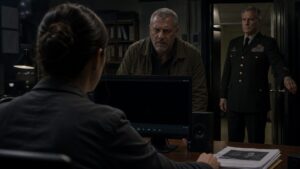
The room went quiet when Virginia White set the battered helmet on the security table.
Not all at once. The radios still hissed. Rain kept striking the tall windows hard enough to sound like gravel thrown by hand. A printer near the wall coughed out another weather notice no one had time to read. But the people nearest the entrance stopped moving first, and then the stillness passed through the county emergency operations center like a cold draft.
Virginia kept one hand on the helmet’s rim.
The man at the security desk stared at it before he looked at her.
“Ma’am,” he said, soft but hurried, “this area’s restricted tonight.”
“I know,” Virginia said.
Her voice did not rise above the radios. It had not needed to rise much in years. People either listened or they did not.
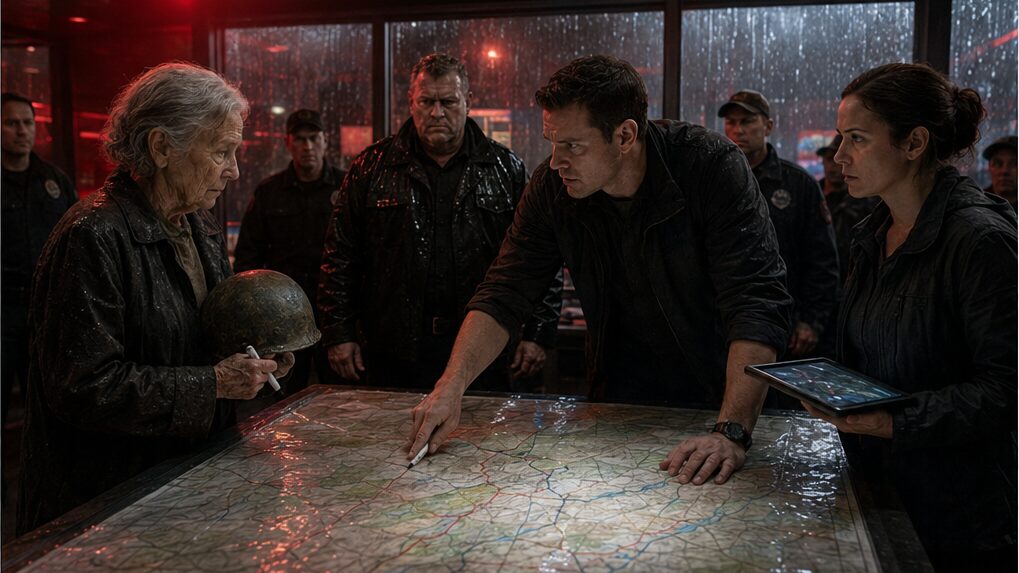
Beyond the security desk, the operations floor glowed red from storm alerts running across the wall monitors. A county map covered the central table under clear plastic, its roads marked in grease pencil and colored tabs. Blue pins showed flooded bridges. Yellow squares showed blocked roads. A red string of dots climbed toward the northern ridge, where the storm had folded itself over the hills and stayed there.
Virginia saw the red dots and felt the old pressure beneath her ribs.
Not fear. Not exactly.
Recognition.
A young deputy stepped closer, blocking part of her view. “Are you family of someone missing?”
“No.”
“Then we need you to wait in the public area.”
Virginia looked past him. At the map. At the ridge. At the route they had chosen.
“No,” she said.
The deputy blinked as if the word had arrived from the wrong person.
Virginia knew what he saw. A seventy-eight-year-old woman with rain on her gray hair and one shoulder lower than the other from an old injury that announced itself in weather like this. A woman in a dark coat too worn at the cuffs, holding an old steel helmet as if she had wandered in from another decade. A woman who should have been home with tea, the television low, and somebody else making decisions.
A voice cut across the room. “What’s the hold-up?”
Ryan Moore stood at the map table, sleeves rolled to the forearms, marker in one hand, radio clipped high on his vest. He was younger than Virginia had expected for the person in charge, maybe late thirties, with eyes that moved fast and a jaw held too tight. He looked at the deputy, then at Virginia, then at the helmet.
The helmet changed his face before she did. Not respect. Recognition of inconvenience.
“Ma’am,” Ryan said, already turning away, “unless you have official business, I can’t have civilians on the operations floor.”
“I’m not here as a civilian.”
That got a few glances.
The woman with the tablet near the far side of the map looked up. Rebecca Hall, according to the badge clipped to her jacket. Her fingers paused over the screen.
Ryan’s attention returned fully this time. “Are you with a response unit?”
“Not anymore.”
“Then we’re back where we started.”
Virginia did not answer. She stepped around the deputy.
He half-lifted a hand to stop her, then hesitated. Maybe it was the helmet. Maybe it was her expression. Or maybe, Virginia thought, he had a grandmother somewhere and did not want to be the kind of man who grabbed one on a night when reporters were already pressed against the glass outside.
The operations room had the overheated smell of wet coats, burnt coffee, and electrical equipment. Volunteers moved along the back wall, repeating road closures into headsets. Someone had taped a handwritten sign to the coffee station: KEEP THIS AREA CLEAR. The sign had already been ignored by three half-empty cups and a flashlight.
Virginia reached the edge of the map table.
The plastic surface reflected red light across her knuckles. The county had changed, but the ridges had not. Not where it mattered. Roads had been renamed. A subdivision sat where training woods used to begin. The old access markers were gone from public maps. But the land under the names was the same land, and water still took the same arguments downhill.
Ryan planted the marker cap against the table. “We don’t have time for this.”
“You’re sending them over Thompson Ridge.”
The room’s movement thinned again.
Ryan’s eyes narrowed. “Who told you that?”
Virginia nodded toward the map. “You did.”
Rebecca’s gaze dropped to the route line on her tablet.
Ryan looked at the map as if checking whether she could have guessed. The red-dotted route climbed north from the fairgrounds staging area, crossed the lower ridge road, and angled toward a group of houses above the old quarry basin. A rescue convoy was already out there, if the timestamps on the radio board were right. Maybe ten minutes from the first fork. Maybe less, in this rain.
“We have three stranded families above the quarry,” Ryan said. “One child with an asthma issue. We’ve got a window before the west culvert tops. This is the fastest route still open.”
“It is not open all the way through.”
Ryan exhaled through his nose. Not quite a laugh. Worse than a laugh.
A radio crackled near the dispatch station. “Field Team Two proceeding northbound. Visibility low. Standing water at mile marker four.”
Virginia’s grip tightened on the helmet.
Field Team Two.
She knew what wet gravel sounded like under overloaded tires. She knew how drivers talked when they were trying not to worry the people listening. She knew how command rooms became louder when no one wanted to admit the map was lying.
Ryan turned toward the radio operator. “Tell Mark Johnson to maintain route until we confirm the crossing.”
Virginia said, “He should not go to that crossing.”
This time, everyone near the table heard her.
The county sheriff, broad-shouldered and damp from outside, turned from a wall monitor. “Who is she?”
Ryan did not take his eyes off Virginia. “That’s what I’m trying to find out.”
Virginia set the helmet more firmly against her hip. The rim was cold through her coat. A dent over the left side caught the red light.
“I served with the state Guard,” she said. “Survey and field mapping. Before your system had all those colors.”
Ryan’s look did not soften. “I respect your service, ma’am, but this isn’t a veterans’ event. We’re running live rescue coordination.”
The words landed cleanly. Not cruel. Not shouted. That was almost harder.
Virginia heard what was under them: Thank you for what you were. Please stop interfering with what we are doing now.
She had been hearing versions of that sentence for years. At the pharmacy when the clerk spoke louder than necessary. At the auto shop when the mechanic explained tire tread as if she had not driven supply roads in black ice. At the county office when a girl with perfect nails told her old paper records were not useful anymore.
Usually, Virginia let people have their assumptions. They were lighter to carry than corrections.
Tonight, the red route on the map ran through a place she had not allowed herself to picture in years.
“Your crossing was cut after the second slide,” she said.
Rebecca looked up sharply. “Second slide?”
Ryan held up one hand without looking at her. “Our county road layer was updated last spring.”
“From overhead.”
“From survey data.”
“From above,” Virginia said.
Thunder moved over the building. The lights flickered once, dimmed, then steadied.
For a moment, she saw another room that was not a room. Canvas overhead. Mud under boots. Rain dripping from the edge of a helmet onto a paper map someone had tried to keep dry with a clear ration bag. A young voice saying they could make it if they stayed on the main track. Her own hand pointing to a ridge line no one wanted to take seriously.
She blinked, and the red-lit command room returned.
Ryan tapped the map with the marker. “This is the approved route.”
“It was approved by people who haven’t stood in that wash.”
The sheriff made a low impatient sound. “Ryan.”
“I know,” Ryan said.
He leaned over the table. The movement put him between Virginia and the route, as if his body could close the matter. “Mrs. White, we have active units in the field, a flood watch turning into a warning, and families calling every two minutes asking why we haven’t reached them. If you have something specific, say it. If not, I need you to step back.”
Virginia looked at his marker, then at the red dots, then at the faint contour line under the plastic.
Specific.
All her life, specific had mattered. Not bravery. Not noise. A snapped branch. A missing culvert shadow. The wrong sound under a tire. A patch of grass flattened against the direction of rain. Men could die inside the distance between “close enough” and specific.
She lifted the helmet with both hands and took one slow breath.
Ryan’s mouth tightened. “What does an old helmet have to do with a live rescue?”
Chapter 2: The White Line Nobody Wanted
Virginia did not answer Ryan’s question right away.
She looked at the map table and waited for her hands to stop feeling like they belonged to the past. The helmet was heavier than it should have been. It had spent years in a closet wrapped in a towel, then in the bottom drawer of the old cedar chest after she could no longer stand finding it by accident. She had not brought it to be dramatic. She had brought it because, on the local news, when the first reporter said Thompson Ridge and quarry basin, Virginia had gone to the chest before she had gone to the phone.
Some objects remembered shapes the mind tried to blur.
Ryan stared at her. Around him, the room pressed in, full of people trying not to appear as if they were watching. Rebecca held her tablet against her chest. The sheriff shifted his weight from one boot to the other.
Virginia stepped to the open edge of the map table.
“May I have the marker?”
Ryan looked down at the white marker in his hand.
“No.”
A volunteer at the radio desk glanced over his shoulder.
Virginia nodded once, as if the refusal had been expected and accepted. She reached into her coat pocket and took out a stub of white china marker wrapped with tape near the middle. It was old enough that the paper label had worn off. Her fingers remembered its thickness before her mind did.
Ryan’s face changed slightly. “You brought your own.”
“Yes.”
“Mrs. White—”
“Virginia.”
The word was not loud. It made Ryan pause anyway.
She moved the helmet over the map.
The sheriff took a step forward. “Don’t put that on the table.”
Virginia lowered the helmet before anyone could stop her.
It came to rest just below the north ridge line, rim touching the clear plastic, dent facing east. The small sound it made was dull and final. Not a slam. Not a challenge. A placement.
The room quieted in a different way.
Even Ryan looked down.
Virginia set two fingers on the helmet’s rim to hold it steady. With her other hand, she peeled the paper from the china marker tip and looked for the old crossing beneath the printed road labels. The county map had been simplified for emergencies: roads thickened, streams colored bright blue, high-risk zones washed in transparent red. Useful, in most rooms. Dangerous, in certain weather.
“There,” she said.
Ryan followed the direction of her marker. “That’s Lower Ridge Road.”
“That is what the map calls it now.”
“That is what the road department calls it.”
Virginia shook her head. “Road departments name surfaces. Water uses ground.”
A few people looked at one another. The sheriff’s mouth pulled thin, but Rebecca moved closer.
Virginia placed the marker point on the map just west of the official route. Her hand trembled for one second. She pressed her ring finger against the table until it steadied.
Then she drew.
The white line did not follow the red dots.
It began at the lower service track near the fairgrounds, cut away before the first bend, climbed through what the map showed as a patch of state woodland, then curved along a narrow contour just below the old quarry ridge. It avoided the printed crossing entirely.
“That isn’t a road,” Ryan said.
“No.”
“You just drew through tree cover.”
“I drew where the old maintenance road is.”
Ryan leaned closer, irritation sharpening into professional attention despite himself. “There’s no listed maintenance road in that section.”
“There wouldn’t be.”
“Why?”
“It was never county-maintained.”
Rebecca turned her tablet around, pinching and zooming. “I don’t have a road there. I’ve got canopy, slope, and a drainage cut.”
“You have the tops of trees,” Virginia said.
Ryan looked at Rebecca. “Check the historic layer.”
“I am.”
The sheriff came closer now, enough that Virginia could smell wet leather and coffee. “Ma’am, are you saying you know a secret road?”
“No.”
“Then what are you saying?”
Virginia kept her eyes on the line. “I am saying your fastest route crosses ground that was never a road after the second slide. And I am saying there is an older approach above it that holds longer in flood.”
“Longer?” Ryan repeated. “That is not the same as safe.”
“No. It is not.”
The answer seemed to catch him wrong. He had expected certainty. Maybe arrogance. Maybe a speech about how everything was better in the old days.
Virginia gave him none of that.
Rain scraped the windows. On the wall monitor, a radar band crawled across the county in angry yellow and red. A new alert blinked on the screen behind the dispatch station.
Rebecca spoke without looking up. “I’ve got a 1979 state training overlay, but it’s incomplete.”
Ryan kept his eyes on Virginia. “How old were you when you saw this road?”
“Old enough to learn not to trust a straight line in rain.”
“That’s not an answer.”
“It’s the one I have right now.”
Ryan’s jaw moved. He uncapped his own marker and pointed to the red route. “My answer is this: we have units here, here, and here. Mark Johnson is ten minutes from this crossing. If I reroute him based on your memory and that road is impassable, I lose the window to reach those families before the quarry road floods behind them.”
“If you keep him on this route,” Virginia said, touching the printed crossing, “you may lose more than the window.”
The sheriff said, “Enough.”
Ryan did not echo him. That mattered, though he may not have known it.
He bent lower over the map, studying the white line. His sleeve brushed the table’s edge. “What is the second slide?”
Virginia felt the room lean with him.
There it was. The question behind the question. The door she had kept closed so long that the hinges had become part of the wall.
She tapped the helmet once with her thumb. “After the first flood, they rebuilt the crossing in the same place because it was cheaper and faster. After the second slide, the ground under it changed. It looked passable from above. From below, it was hollowed out along the edge.”
Ryan’s eyes lifted. “When?”
“Years ago.”
“How many?”
“Enough.”
“That’s not good enough for a command decision.”
“No,” Virginia said. “It isn’t.”
Her honesty seemed to frustrate him more than a lie would have.
Rebecca said quietly, “Ryan.”
He turned. “What?”
She carried the tablet around to his side of the table. “The historic overlay doesn’t show a road, but there’s a linear break here. It matches part of her line.”
“How much?”
“Maybe a quarter mile. It disappears under canopy.”
“That could be anything.”
Rebecca looked at Virginia’s marker line again. “Could be.”
Virginia saw the young woman’s eyes move from the tablet to the helmet, then to Virginia’s hand. Not belief yet. Something narrower. A crack in dismissal.
The radio popped.
“Command, Field Team Two approaching north fork. Water increasing. Confirm we stay on Ridge.”
Ryan reached for the radio clipped to his vest.
Virginia’s body remembered a different voice saying, Confirm we stay on main. Static under rain. Men waiting for permission from a map that could not feel mud.
Ryan pressed the button. “Field Team Two, hold at north fork for thirty seconds.”
The sheriff’s head snapped toward him. “Ryan.”
Ryan ignored him. “Repeat, hold at north fork.”
The radio hissed. Then Mark Johnson’s voice came back, strained but steady. “Holding at north fork. Be advised, water moving fast across the low side.”
Ryan released the button slowly.
The room had stopped pretending it was not watching.
Virginia kept her fingers on the helmet. The white line cut across the map like a memory no one had invited but everyone now had to see.
Rebecca leaned close over her tablet, then frowned.
“What?” Ryan asked.
She did not answer at once. Her thumb moved, pulled up another layer, then another. The glow from the screen lit her face pale.
“Rebecca.”
She looked from the tablet to Virginia’s line.
“There’s a mismatch,” she said. “Between the official road layer and the drainage model.”
Ryan’s expression hardened into focus. “How bad?”
Rebecca swallowed. “Bad enough that I need another minute.”
Chapter 3: The Tablet Could Not Find the Road
Rebecca Hall had trusted maps because maps were supposed to be the place where panic became shape.
On a normal night, the tablet in her hands could make sense of almost anything the county threw at them. Wildfire perimeters. Ambulance staging points. Downed power lines. Shelter capacity. It could stack satellite imagery over road layers over flood predictions until chaos became colored bands and numbered routes. When people yelled from six directions, Rebecca looked down and found the cleanest line through the noise.
Tonight, Virginia White had drawn a line the tablet did not want to admit existed.
Rebecca stood beside the map table with the device balanced against her palm, rain flickering against the windows behind her. The old woman’s white mark cut through a green area labeled as state woodland and crossed a slope model that showed moderate risk, then reappeared near a maintenance boundary from an archived state file. It did not behave like a road layer. It behaved like a scar.
Ryan stood close enough that she could feel him waiting.
“Talk to me,” he said.
Rebecca zoomed in until the screen became pixelated. “The current county layer shows Lower Ridge as continuous through the crossing. Last lidar update tags it elevated enough for pass-through under moderate flooding.”
“And?”
“The drainage model doesn’t agree.” She tapped the screen, pulling up pale blue flow lines. “If the west culvert backs up, water sheets across the road here. Not just over it. Along it.”
The sheriff made an impatient sound. “Meaning?”
“Meaning the road could look open right before it isn’t.”
Virginia’s eyes closed for half a breath.
Rebecca noticed.
That was the thing bothering her most. Not the old helmet. Not the hand-drawn route. The reaction. Virginia did not look like someone pleased to be right. She looked like someone hearing an old machine start again in another room.
Ryan pointed at the tablet. “What about her maintenance road?”
Rebecca hated that he said her as if the line belonged to Virginia more than to the land. But he was not wrong. In the system, the road was nowhere.
“I don’t have it as passable,” Rebecca said. “I don’t have it as anything current.”
Ryan’s face tightened with the answer he had expected.
“But,” Rebecca added, before he could speak, “there’s a canopy break in the older aerials. Narrow. Intermittent. It follows her line for roughly eight hundred yards, then disappears.”
“Disappears,” the sheriff said. “That sounds real useful.”
Rebecca kept her eyes on the tablet. “Tree cover after regrowth could hide it. Or it could be washed out.”
Ryan turned to Virginia. “Can a truck get through?”
Virginia looked at the white line, not at him. “Depends on the truck. Depends on the driver. Depends whether the old rock bed is still where it was.”
“That’s not enough.”
“No.”
Again, that plain refusal to exaggerate. Rebecca saw Ryan struggle with it. Virginia would not make the answer easier for him. She would not sell certainty she did not have.
At the radio desk, the dispatcher lifted a hand. “Command, Field Team Two asking for status. They’re holding at north fork. Mark says water is rising behind them.”
Ryan pinched the bridge of his nose. For the first time all night, he looked less like a commander and more like a man standing between several bad doors.
“How many in Field Team Two?” Virginia asked.
Ryan glanced at her. “Six.”
“High-water vehicle?”
“One. Plus a county utility truck and a medical unit staged behind.”
“Drivers?”
Ryan’s eyes narrowed. “Good ones.”
“I asked because it matters.”
“Everything matters right now.”
Virginia accepted that with a small nod. Her fingers rested beside the helmet on the map table, not touching it now but close enough that Rebecca kept seeing the distance between her hand and the dented rim.
The sheriff walked toward the wall monitor. “Families above the quarry just called again. They can hear the creek under the back deck. We need movement.”
“We need the right movement,” Rebecca said.
The sheriff looked at her as if she had changed sides without permission.
Rebecca felt heat rise in her face. She had not changed sides. She did not even know what side there was. There was the route in the system, clean and current and approved. There was Virginia’s line, ugly and incomplete and troubling. And there was Mark Johnson sitting at a fork in the rain while water decided faster than any of them.
Ryan leaned over the radio. “Field Team Two, report conditions at north fork.”
Static answered first.
Then Mark’s voice came through, broken by weather. “North fork holding, but lower ditch is running hard. We’ve got mud movement on the right shoulder. Visibility poor. I can see water across the main grade ahead.”
Ryan grabbed the edge of the table. “Depth?”
“Unknown. Looks shallow from here, but it’s moving sideways.”
Rebecca looked down at the drainage model.
Sideways.
Virginia’s marker rested exactly above the section where the blue lines bent across the road instead of under it.
Rebecca felt the first clean chill of belief.
Not full belief. Not enough to bet six lives and three stranded families. But enough that the room no longer felt divided between data and an old woman’s memory. The data had begun whispering in the same direction.
She pulled up the archived 1979 layer again and adjusted the opacity. The image was grainy, the ridge a smear of gray and black. She overlaid Virginia’s line.
A faint pale trace appeared under the tree pattern.
Rebecca stopped breathing for a second.
Ryan saw her face. “What?”
“I need the county road archive.”
“It’s not in our emergency stack.”
“I know.”
“Can you get it?”
“Maybe.”
The sheriff threw up one hand. “We do not have time for a research project.”
Virginia spoke before Ryan could answer. “The old road will not show in county maintenance.”
Rebecca turned to her. “Where would it show?”
“Training access logs. State Guard. Maybe forestry after that.”
Ryan said, “We don’t have those here.”
Virginia looked toward the map, then toward the rain-dark windows. “No. You don’t.”
Something passed through her face then, quick and painful. Rebecca saw it and understood that the missing record was not the only thing Virginia had carried in from the rain.
The radio erupted again, louder this time.
“Command, Field Team Two. We’ve got water coming over the road at the crossing approach. Repeat, water over the road. Mark is stepping out to check the grade.”
Ryan snatched the handset. “Negative. Tell Mark to stay in the vehicle.”
The dispatcher relayed it fast.
Static broke over the response. A male voice came back, thinner now under the storm. “Command, this is Mark. I’m looking at pavement drop on the far edge. Can’t see bottom. Water’s cutting under the shoulder.”
Rebecca looked at Virginia.
Virginia did not move. Her eyes were fixed on the place where her white line left the printed route before the crossing.
Ryan keyed the radio. “Mark, can you reverse to the fork?”
A burst of static. Then: “Maybe. Water rising near the rear tires.”
The room shifted, all at once, from debate to consequence.
Rebecca’s tablet suddenly felt too smooth, too light, too clean for the thing it was trying to represent.
Virginia’s helmet sat beside the map line, old and dented and treated minutes ago like a relic that did not belong near the work. Now no one reached to move it.
Ryan turned slowly from the radio to the map.
The white line waited under the red light.
Then Mark’s voice cracked through again.
“Command,” he said, “that crossing is failing.”
Chapter 4: The Route That Looked Faster
Ryan Moore had learned early that hesitation had a sound.
It was not silence. It was the scrape of boots around a command table, the soft tap of a tablet screen, the breath everyone took before deciding not to say the thing they were thinking. It was a radio channel full of rain and a field captain waiting for orders while water chewed at the road under his tires.
“Say again,” Ryan said into the handset.
Static broke hard enough that he had to press the receiver closer to his ear.
Mark Johnson’s voice came back thinner. “Crossing is failing. Shoulder is undercut. We are stopped short of it, but rear approach is getting water. I need a decision.”
Ryan looked at the map.
The red route still looked reasonable. That was the worst part. On paper, it made sense. Shortest distance from staging to the quarry houses. Highest listed road still marked passable. Culvert replaced eleven years ago. Confirmed usable in two previous storms. Every official layer pointed there.
Virginia White’s white line cut away from it like an accusation.
The sheriff stepped close, lowering his voice without lowering the pressure in it. “Ryan, those families are calling every three minutes. If we sit here arguing over an old logging track and that child stops breathing—”
“I know.”
“Then move your team.”
Ryan turned on him. “They are my team. That means I don’t drive them into a washout because the map looks cleaner than the road.”
The sheriff’s eyes hardened, but he did not answer.
Ryan hated that he had said it aloud. It made the doubt real. Command was easier when uncertainty stayed internal, when the voice on the radio asked for a decision and you gave one as if the world had narrowed to the line you chose.
Rebecca stood at the table with her tablet, pale in the red light. “The drainage model supports her warning at the crossing.”
“Supports,” Ryan said. “Not confirms.”
“No. But Mark’s field report confirms water cutting the shoulder.”
Ryan looked at Virginia.
She had not moved toward him, had not demanded the handset, had not taken advantage of the room’s shift. She stood with one hand near the helmet and the other resting against the table’s edge, her fingers slightly bent with age or cold. Her face was controlled, but not empty. He could see strain in the corners of her eyes.
It made him more uneasy, not less.
If she had been dramatic, he could have dismissed her. If she had insisted she was certain of everything, he could have treated her like every other civilian who walked into a crisis with fear dressed up as advice.
But she had admitted what she did not know.
And then the road had started failing exactly where she had pointed.
Ryan keyed the radio. “Mark, can you back out to the fork?”
A pause.
“Trying now. Rear wheels slipping some. We can reverse one at a time, but the medical unit behind us is close to the soft shoulder.”
“Do not cross.”
“Copy, not crossing.”
The sheriff threw both hands down at his sides. “Then what’s your route?”
Ryan’s eyes went to the white line again.
He could feel the whole room waiting for him to either trust the old woman or prove that he would not. It angered him that those seemed like the only two options. This was not about pride. Not really. It was about six responders in vehicles, three stranded families, one sick child, and a storm system that did not care whose instincts were right.
“What condition is this old road in?” he asked Virginia.
Virginia looked down at the map. “The lower entrance will be narrow. If the county put barriers there, they may have to move them. The first climb will be rough but rock under mud. The risk is here.” She tapped a bend along the line. “If the runoff has taken this shoulder, they cannot pass two vehicles side by side.”
Ryan followed her finger. “One at a time?”
“If they keep left along the rise.”
“Left toward the drop?”
“Left toward the rock.”
That answer came too quickly to be invented.
Ryan rubbed rain-damp grit from the side of his face. “And after the bend?”
“A marker.”
“What marker?”
Virginia’s mouth tightened. “Old concrete post. Waist high. It used to have a number plate. If it’s still there, they turn above it, not below.”
“And if it isn’t there?”
“Then they stop.”
The sheriff laughed once, sharp and humorless. “That’s your rescue plan? Drive into the woods and hope for an old post?”
Virginia looked at him then.
Not with anger. Ryan might have preferred anger.
“No,” she said. “The plan is to stop trusting the part of the road that is already telling you it is failing.”
No one spoke.
Ryan stared at the red route, the white line, the flood overlays, the time stamps. He had built his career around procedure because procedure kept fear from steering. But procedure had limits. He knew that. Every commander knew that, even if they only admitted it after the incident review.
The radio broke in again. “Command, Field Team Two. Rear vehicle is sliding toward ditch. We’re correcting. Need route or recall.”
Recall meant sending them back while the families waited above the quarry. If the quarry road went under, they might not get another chance before morning. If he sent them forward on Virginia’s route and she was wrong, they could end up stuck in the woods instead.
Ryan pressed the handset so hard his thumb ached.
“Mark,” he said, “hold at the north fork once you’re clear. Do not advance to the crossing.”
“Copy.”
Ryan turned to Rebecca. “Can you send him an adjusted route?”
“Not as a recognized road.”
“I didn’t ask if the system likes it. Can you mark it?”
Rebecca’s eyes flicked to Virginia’s line. “Yes.”
The sheriff stepped in. “Ryan.”
Ryan held up a hand. “I’m not committing yet. I want every closure update within two miles of that white line. I want forestry access notes, utility easements, hunting club gates, anything. And someone get the road crew supervisor on the phone.”
The room started moving.
Not fast enough for the sheriff, too fast for Ryan’s comfort. Rebecca bent over her tablet, building a temporary route layer from Virginia’s hand-drawn line. The dispatcher called for road crew contacts. A volunteer reached for archived paper binders stacked near a file cabinet no one had opened in months.
Virginia remained still.
Ryan noticed it and resented how much it steadied the room.
He uncapped his marker and drew a small circle around the failing crossing. The tip squeaked against plastic. It was the same spot Virginia had touched before any radio report confirmed it.
He did not look at her when he asked, “Why did you say second culvert earlier?”
“I didn’t.”
He glanced up.
Virginia’s face had gone quieter.
“You said second slide,” Ryan said.
“Yes.”
“But the danger point is the west culvert.”
“The culvert is what you can name,” she said. “The slide is what made the name less useful.”
Ryan looked back to the map. “Explain.”
“Not here.”
“We don’t have time for not here.”
Her eyes moved toward the crowded room, the sheriff, the volunteers, the reporter shadows beyond the glass doors. For the first time, Ryan understood there was a difference between what she knew and what it cost her to say it.
The dispatcher called out, “Field Team Two reversing final vehicle now. Water still rising.”
Ryan lifted the radio. “Mark, once clear, hold at fork. We may have an alternate.”
“Copy. Would love one.”
A burst of static swallowed the last word.
Then Mark came back, voice suddenly urgent. “Command, wait—road edge is dropping under the rear axle. We’re moving, but signal may cut in the hollow.”
“Mark, repeat.”
Static.
Ryan leaned toward the radio as if proximity could pull sound from the storm.
“Mark?”
A hard crackle. Then Mark’s voice, broken and low.
“Road’s dropping under the water—”
The channel snapped into empty hiss.
Chapter 5: What the Old Helmet Remembered
Virginia heard the radio go empty and felt the years fold inward.
For one breath, the emergency operations room dissolved. The wall monitors became gray rain. The plastic-covered map became paper under a sheet of clear ration wrap. The fluorescent lights became a dim lantern swinging from a tent pole while mud sucked at boots outside.
Then a young man’s voice crossed the years.
Road’s dropping.
Virginia closed her hand over the rim of the helmet.
The room around her surged into motion. Ryan called Mark again. The dispatcher adjusted channels. Rebecca spoke to someone on a phone, her tablet tucked against her shoulder. The sheriff demanded an update that no one had yet received.
Virginia did not move.
The dent beneath her thumb was shallow, but she knew its shape. She had cleaned mud from that dent with the corner of a towel in a supply tent, her fingers so cold she had barely felt the metal. She had carried the helmet home later because no one else had known what to do with it, and because leaving it behind had seemed like another failure of attention.
“Mrs. White.”
Ryan’s voice reached her through the room.
Virginia looked up.
He stood across the map table, no longer blocking the route with his body. His face had lost the polished certainty she had disliked. It had not become humble. Not yet. It had become awake.
“I need to know what happened there,” he said.
The sheriff began, “Ryan, we need—”
Ryan did not turn. “I need to know.”
Virginia looked at the room. Too many faces. Too much red light. Too much waiting.
“Not in front of everyone.”
Ryan searched her face, then nodded once. “Rebecca, keep trying Mark. Build the alternate route. Sheriff, give me two minutes.”
“We don’t have two minutes.”
“Then use them well.”
Ryan stepped away from the table toward the side hallway. Virginia lifted the helmet. Its weight pulled at her shoulder. She hated that Ryan noticed.
He did not offer to carry it.
For that, she followed him.
The hallway outside the operations floor was narrow and colder, lit by a single emergency strip along the baseboard. Rain ran down a small window at the end, blurring the parking lot lights into long yellow wounds. The noise from the command room became muffled but not gone.
Virginia leaned one hand against the wall before she meant to.
Ryan saw it. “Do you need a chair?”
“No.”
“Virginia.”
The use of her name made her look at him.
“I’m not asking because I think you’re fragile,” he said. “I’m asking because I need you steady.”
It was not an apology. It was better than the wrong apology would have been.
She lowered herself onto the bench beneath the window. The helmet rested in her lap. Her hand returned to the dent.
“I was twenty-six,” she said. “State Guard survey unit. Flood season. Not like this one, but close enough.”
Ryan stood with his marker still in one hand, cap missing, tip drying. He seemed to realize it and closed his fist around it.
Virginia looked down at the helmet. “We were sent to update access routes after the first slide. Not heroic work. Mud, measuring tape, paper maps, men who thought the young woman with the contour sheets was there to write numbers they had already decided.”
Ryan said nothing.
“We found the main crossing damaged. I marked the alternate ridge approach. The old maintenance road. Rock bed under clay. Slow, but it held. My note was added to the field sheet.”
“What happened?”
“They rebuilt the crossing before the next storm because it was cheaper than cutting the ridge approach open again. On the updated map, the main road looked usable. The alternate stayed unofficial.” Her thumb moved once over the dent. “Then the second slide came.”
The hallway light hummed.
“A supply truck went to check the crossing. I told them the shoulder below it had hollowed out. I had seen the runoff pattern. Small thing. Grass bent wrong. Water not falling where it should.” She paused. “The officer in charge said I was tired.”
Ryan’s eyes dropped briefly.
Virginia almost smiled. “He wasn’t entirely wrong. I was tired. That does not make the ground solid.”
The command room noise swelled as someone opened a door, then dimmed again.
“The truck didn’t make it back?”
“One man didn’t.”
The words came out plain because she had spent fifty-two years sanding the edges from them. Plain was what remained when grief was too old to perform.
Ryan’s shoulders shifted. “The helmet was his?”
Virginia looked at the dent. “No. Mine.”
His face tightened with confusion.
“The truck clipped a slide barrier and threw rock. I was close enough to be stupid.” She tapped the dent once. “This is not a symbol. It is a reminder that being right late is not enough.”
Ryan looked toward the operations room.
Virginia knew what he was hearing. The radio. The missing signal. The water rising near the rear tires.
“You should have told us sooner,” he said.
It was not cruel, but it was young.
Virginia looked up at him. “I tried.”
He took the sentence without defending himself. That mattered.
She continued, “The old road is not abandoned in the way people think. It was never meant for daily traffic. But it was cut where the ridge stays above floodwater. The first bend is bad. The second is worse. After that, it runs high until the quarry spur.”
“How do we get Mark onto it from the fork?”
“Back him up fifty yards from the north fork. There will be a break in the trees on his left. Not wide. It may look like runoff, not road.”
“If he can’t see it?”
“Tell him not to look for road surface. Tell him to look for two stones set like gateposts, one lower than the other. The right one may be buried in brush.”
Ryan’s eyes sharpened. “You didn’t mention stones before.”
“I was hoping the concrete post would be enough.”
“Hoping?”
Virginia’s hand tightened on the helmet. “Yes.”
For the first time, irritation flashed through his fear. “I need everything, not pieces.”
“You think I don’t know that?”
The hallway went still.
Virginia had not raised her voice much, but something in it stripped the air clean. Ryan did not interrupt.
She looked back toward the window. “Every detail I give you is attached to something I have spent most of my life not walking through unless I had to. You need the road. I understand that. But do not stand there and speak to me like I have been keeping it from you for sport.”
Ryan’s expression changed.
Not softened. Changed.
“I’m sorry,” he said.
Virginia nodded once. She did not absolve him. She did not need to.
The operations room door opened. Rebecca leaned out, tablet in hand. “Ryan. We got Mark for a second. He’s clear of the drop but stuck at the fork. Water is still rising. I have the temporary route ready, but I need confirmation before I send it.”
Ryan looked at Virginia.
Virginia stood. Her knees protested, and for one bitter second she wished she could rise like she used to, quick and clean and without anyone wondering whether she would manage. She did manage. That was all.
She carried the helmet back into the red-lit room.
The map waited. The white line waited. The radio hissed.
Virginia set the helmet down beside the ridge, dent facing the failing crossing.
Ryan came to her side, not across from her this time.
“Tell me the route,” he said.
Virginia looked at him until she was certain he was listening.
“The old road is not abandoned,” she said. “It is the only one up there that still rises above the floodline.”
Chapter 6: The Commander Finally Listened
Ryan had never felt the command room turn so quietly.
There was no formal transfer of authority. No one announced that Virginia White now mattered. The sheriff did not step back with sudden respect. The volunteers did not stop being afraid. The radar did not soften its colors on the wall.
But when Virginia placed her finger on the white line again, every person near the table watched the exact spot she touched.
Ryan noticed because he was watching too.
“Rebecca,” he said, “send Mark the temporary route. Label it alternate ridge access. Not confirmed road.”
“Sending.”
“Dispatcher, open a clean channel with Field Team Two. I don’t want cross-talk.”
The dispatcher nodded. “Working.”
The sheriff came up beside him. “Ryan, if this goes wrong—”
“It’s already wrong,” Ryan said. “I’m trying to keep it from getting worse.”
The sheriff looked ready to answer, then glanced at the map. The failing crossing had been circled twice now. Virginia’s white line ran above it, thin and stubborn.
Ryan lifted the handset. “Field Team Two, this is Command. Do you copy?”
Static.
Then Mark’s voice, faint. “Command, go.”
Ryan exhaled once, controlled. “We are sending an alternate route to your unit. Do not proceed to the main crossing. Repeat, do not proceed to main crossing.”
“Already convinced on that part.”
A few people in the room released nervous breaths, almost laughs, but not quite.
Ryan looked to Virginia.
She did not take the radio. She stood close enough to see the map, far enough that he had to turn toward her. That distance felt deliberate. She would guide, but she would not perform command for him.
“Tell him to reverse from the fork,” she said. “Not turn.”
Ryan keyed the radio. “Mark, reverse from the fork approximately fifty yards. Do not attempt a turn until instructed.”
“Reverse fifty. Copy.”
“Slow,” Virginia said.
“Proceed slowly. Watch rear ditch.”
Mark answered, “Rear ditch is full. We’ll crawl it.”
Rebecca’s tablet flashed as the temporary route transmitted. “He has it.”
Ryan kept his eyes on Virginia’s hand. Her index finger hovered above the map without touching, following something older than the plastic.
“Ask what he sees on his left,” she said.
Ryan relayed it.
Static chewed part of Mark’s answer. “Trees. Mud. Water running down from the slope. No road.”
The sheriff’s jaw worked.
Ryan did not look at him.
Virginia’s face remained still. “Tell him he is looking too wide. He should see two stones, not a road.”
Ryan pressed the handset. “Look for two stones set like gateposts. Low, possibly brush-covered. Do not look for road surface.”
A pause.
Long enough for the storm to fill the whole room.
Then Mark said, “Stand by.”
Ryan could feel the old version of himself waiting to reject the instruction. Stones in the dark. An unofficial road. A memory held by a woman he had nearly had escorted out. It was not how a command decision was supposed to feel.
But the official crossing was failing behind water.
The radio clicked. “Command, I’ve got one stone. Left side. Maybe two. Right one’s half buried.”
Virginia closed her eyes for less than a second.
Ryan saw it. So did Rebecca.
“Tell him not to enter straight,” Virginia said. “The front will slide. He angles right first, then left up onto the rock.”
Ryan repeated it carefully. “Mark, approach right first, then left onto the rise. Do not enter straight. Expect mud over rock.”
“Copy. That is a tight cut.”
“Yes,” Virginia said, though the radio could not hear her.
Ryan added, “One vehicle at a time. High-water vehicle first. Medical unit waits until the first clears the bend.”
Mark’s answer came back steady. “Understood. Moving now.”
The room seemed to hold its breath around the sound of rain.
Ryan lowered the handset but did not release it. His eyes stayed on the map, on Virginia’s white line, on the place where the route bent through state woodland and climbed toward the old quarry spur.
“How far to the first bend?” he asked her.
“Three hundred yards, maybe less if the lower track has washed in.”
“Landmark?”
“Dead pine if it is still standing.”
Rebecca looked up from the tablet. “Dead pine won’t show in current imagery.”
“It was struck years ago,” Virginia said. “White trunk. Split top.”
The sheriff muttered something under his breath, but this time Ryan heard worry in it rather than contempt.
The radio crackled. “Command, this is Mark. We’re in. Mud heavy. I can feel rock under it. Visibility about twenty feet.”
Ryan looked at Virginia.
“Now he stays left?” he asked.
“Not yet. If he stays left too soon, the rear will pull down. Tell him to ride center until the ground tilts.”
Ryan repeated the instruction.
Mark responded, “Copy. Riding center.”
Rebecca stepped closer to Virginia, holding out the tablet. “Does this match where you think he is?”
Virginia leaned in. The glow lit the lines on her face and the raindrops still caught in her hair. For the first time, Ryan saw how tired she was. Not confused. Not fragile in the way he had first assumed. Tired from carrying concentration through a body that made everything cost more.
She studied the screen, then shook her head. “Your route is too smooth.”
Rebecca blinked. “Too smooth?”
“The bend hooks sharper before the rise. The map is rounding it.”
Ryan felt his stomach tighten. “How much sharper?”
Virginia picked up the white marker. Her hand trembled again, and she waited without shame until it steadied. Then she darkened the bend with one precise correction.
“Here.”
Rebecca adjusted the route immediately. “Updating.”
The sheriff looked between them. “Are we really correcting live rescue navigation by hand?”
Ryan said, “Yes.”
The word surprised even him.
The radio cut through again. Mark’s voice was strained now. “Command, ground tilting. Vehicle sliding right.”
Virginia’s finger pressed the map. “Now left. Slow. No brake if he can help it.”
Ryan transmitted, “Ease left now. Slow. Avoid hard braking.”
“Copy—left now.”
Static.
A long grinding sound came through the radio, maybe tires, maybe interference. Someone at the dispatch desk whispered a word and then stopped.
Ryan gripped the handset until his knuckles whitened.
“Field Team Two, status.”
Nothing.
“Mark, status.”
Rain. Static. The low electric hum of the building.
Virginia’s hand moved to the helmet. She did not clutch it. She steadied it with her palm, as if holding down the past while the present decided whether to repeat it.
Ryan looked at that hand and felt something in himself give way.
Not surrender. Not blind faith.
A decision.
He turned to the room. “All units hold nonessential traffic. Rebecca, keep the adjusted layer live. Dispatcher, if we lose Mark again, we relay through the medical unit. Sheriff, I need the road crew ready to clear the lower gate if the second vehicle can’t make the angle.”
The sheriff stared at him, then nodded once and moved toward the phones.
Ryan leaned toward Virginia. “After the first bend?”
She looked at him, and this time she did not have to ask whether he was listening.
“After the first bend,” she said, “he looks for the concrete post. If he reaches it, he does not turn below it. He turns above.”
Ryan raised the handset.
Before he could speak, Mark’s voice burst through.
“Command, we cleared the bend. Repeat, first vehicle cleared the bend.”
The room exhaled in pieces.
Ryan did not let himself smile. Not yet.
“Mark, continue to concrete post. Turn above it, not below.”
“Copy. Above the post.”
Ryan looked at Virginia. “What if he can’t see it?”
Virginia’s eyes stayed on the map. “Then he stops and listens.”
Chapter 7: The Turn Beyond the Floodlights
Virginia had learned, long ago, that some sounds arrived before disaster and some arrived before safety.
The difference was rarely loud.
In the command room, everyone kept waiting for Mark Johnson to see the concrete post, but Virginia knew sight was a poor instrument in rain like this. Headlights flattened distance. Floodlights turned every wet leaf silver. Mud erased edges. A man could stare straight at a road and miss it if the water wanted him to look somewhere else.
She kept her palm on the helmet.
The metal was cool beneath her fingers, a steadiness borrowed from another life. The white route lay beside it now, no longer a strange mark from an old woman’s hand but a working line Rebecca had entered into the temporary system. Still, on the large wall display, the line looked uncertain, thin, unofficial. It did not have the confidence of county data. It had the shape of memory.
“Field Team Two,” Ryan said into the handset. “Report visual on concrete post.”
Static broke apart, rejoined, then opened into Mark’s voice.
“Negative. We’ve got trees tight on both sides. Rain is blowing sideways. I’ve got a pale trunk ahead, maybe the dead pine you mentioned, but no post.”
Virginia leaned closer to the map. The dead pine. If it still stood, he had passed the first rise and was nearing the shallow saddle before the quarry spur. The concrete post should have been on his right, just before the road pretended to continue downward.
Unless it had fallen.
Unless brush had swallowed it.
Unless fifty years had done what fifty years did.
Ryan looked at Virginia.
She did not look back yet. She was listening to the radio under the radio.
“What do you hear?” she asked.
Ryan lifted the handset. “Mark, cut engine for ten seconds.”
The sheriff turned. “Cut engine? In that mud?”
Virginia said, “If he is stopped, he needs his ears.”
Ryan held her gaze for one second, then pressed the button. “Mark, stop where you are if safe. Engine off for ten seconds. Listen for water.”
A pause.
“Command, confirm engine off?”
“Confirmed. Ten seconds only.”
The room’s own noise seemed suddenly rude. Ryan turned and sliced one hand through the air. The dispatcher stopped speaking mid-sentence. Rebecca lowered her tablet. Even the sheriff held still.
Through the radio came a faint mechanical shudder, then quiet.
Not silence. Rain hissed. Wind dragged itself through leaves. Somewhere beyond the microphone, water spoke in more than one voice.
Virginia closed her eyes.
There was the broad rush of runoff from the slope. There was the sharper slap of water against exposed stone. And beneath it, almost hidden, a hollow pulsing sound: water dropping through a cut where the old road bed crossed buried rock and spilled down toward the quarry basin.
She was in the tent again. Mud on the map. A lantern swinging. A young driver waiting for orders. Her own hand pointing above the lower sound, not below it.
Her eyes opened.
“He is too low.”
Ryan did not question her. “Mark, you are too low. Do not follow the apparent track downhill.”
Mark’s voice returned over the engine starting again. “Copy. I have what looks like a track dropping right. You’re saying no?”
“No,” Virginia said sharply, then caught herself.
Ryan repeated, “Negative on the downhill track.”
Virginia touched the map above the marked bend. “There should be water crossing buried stone above him. Not loud. A broken sound. Tell him to move toward that, not away.”
Ryan relayed it carefully. “Listen for water over stone above your position. Move toward that sound. Slow.”
The radio crackled. “Command, I can’t navigate by sound in a high-water truck.”
Virginia took one breath.
Ryan looked at her, and she saw the fear he was trying to keep disciplined. Not fear for himself. Fear of choosing wrong while others paid.
She held out her hand for the handset.
He hesitated.
Not out of dismissal this time. Out of command habit. Then he handed it to her.
The room shifted again, but Virginia did not look at anyone. She held the handset with both hands because one was not steady enough.
“Captain Johnson,” she said.
A short burst of static. “Go ahead.”
“This is Virginia White. You do not know me.”
“No, ma’am.”
“You cleared the first bend because your tires found rock under mud. You are now where the old track splits. The lower track looks easier. It is not. It drops toward the wash. If you take it, you may not climb back out.”
No one in the room moved.
Mark answered, “Understood. I still don’t see the upper turn.”
“You won’t see it from your seat. Have your right-side spotter look above the headlight line. Not at the ground. There should be a broken water line crossing stone, and beyond it, a dark gap between two laurel stands.”
Ryan watched her as if each word were something being placed on the map.
Mark’s voice came again, faint but intent. “Stand by.”
Virginia lowered the handset slightly but did not give it back.
The waiting was worse now because she had stepped inside it. Before, she had been warning, correcting, bracing for disbelief. Now her voice had gone out into the storm and sat in the cab beside people whose faces she could not see.
The helmet under her other hand seemed colder.
A memory moved beneath her ribs: a young man with mud across one cheek grinning because someone had found coffee; the same young man later absent from the roll call; her own report folded in a file that named road conditions but could not name the weight of being unheard.
She had promised herself never to speak of that night unless speaking could change something.
The radio clicked.
“Command, this is Mark. Spotter sees the water line. We’ve got a gap above it. It is tight.”
Virginia pressed the button. “Do not swing wide. Nose toward the water sound, then climb left when the ground firms.”
“Copy. Nose toward sound, climb left.”
“Do not rush when the truck lurches.”
A pause. “When?”
“It will.”
Ryan’s eyes flickered to the map.
A second later, through the radio, came a heavy metallic groan and someone in the field shouting away from the microphone.
The dispatcher flinched. Rebecca’s hand went to her mouth.
Virginia tightened her grip on the handset. “Captain Johnson.”
Static.
“Captain Johnson, answer.”
The radio spat rain and engine noise.
Then Mark came back, breath harder. “We lurched.”
A tremor went through the room, half relief, half dread.
Virginia kept her voice level. “Good. That means you found the shelf. Turn left now. Not hard. Let the rear follow.”
“Turning.”
The seconds stretched.
Virginia heard tires grind. Heard water slap. Heard an engine strain against mud and weight and weather. She imagined the headlights lifting, the front wheels finding stone, the rear of the truck sliding just enough to test the driver’s hands. She imagined the lower wash pulling dark beside them.
“Come on,” someone whispered near the radio desk.
Virginia did not whisper. She listened.
The engine note changed.
It rose, caught, then evened.
Mark’s voice burst through, louder. “We’re up. We’re on higher ground.”
Rebecca closed her eyes. Ryan leaned one hand on the table and bowed his head for only an instant.
Virginia returned the handset to him before anyone could turn relief into spectacle.
Ryan took it. “Good work. Continue to quarry spur. Medical unit follows only after you confirm the turn is passable.”
“Copy. Sending second vehicle one at a time.”
The room began moving again, but differently now. No one pushed the helmet aside. No one spoke over Virginia when she corrected the next bend by half an inch. Rebecca adjusted the temporary route without being asked. Ryan repeated Virginia’s instructions with exact wording, not polished versions.
At the map table, Virginia stood inside a strange quiet. She was needed. That was not the same as being seen, but it was closer than she had expected when she walked in from the rain.
The second vehicle cleared the turn.
Then the medical unit.
Each report loosened something in the room, but Virginia did not allow herself relief until Mark’s voice returned nearly twenty minutes later, worn thin and alive.
“Command, Field Team Two at quarry spur. We have visual on the first house.”
Ryan’s shoulders dropped by a fraction. “Status of residents?”
“Stand by.”
Rain tapped against the windows. The red alerts continued crawling. The helmet sat on the map, dent toward the failed crossing, beside the completed white route.
Virginia looked at it and, for the first time in years, did not see only what had not come back.
The radio clicked again.
“Command,” Mark said, voice rough with exertion, “we have the stranded group. All alive.”
Chapter 8: The Map They Left Unfolded
By morning, the rain had weakened to a gray mist, but the emergency center still smelled of the storm.
Wet coats hung over chair backs. Coffee had gone cold in paper cups along the wall. The red light had faded from the monitors, replaced by pale county maps and lists of road closures waiting for daylight crews. Volunteers spoke more softly now, as if the building itself had grown tired.
Virginia stood at the map table with her coat buttoned and the helmet tucked under one arm.
The white line remained.
Rebecca had traced it into the temporary system before dawn, then printed a paper copy and laid it beneath the clear plastic. It looked different in daylight. Less dramatic. A narrow correction across green woodland, a bend sharpened by hand, a note in Rebecca’s neat block letters: FIELD-VERIFIED RIDGE ACCESS — REVIEW REQUIRED.
Review required. Virginia liked that. It did not pretend the old road was safe because it had worked once. It did not pretend the map had become perfect because one old woman remembered it. It simply admitted the map had more to learn.
Across the room, Mark Johnson’s team had reported from the hospital staging area. The child with asthma was stable. The families from above the quarry were wet, shaken, and alive. One rescue vehicle had damaged a side panel on the tight turn, and the medical unit would need a tow once the ground dried. No one complained about that.
Reporters still waited beyond the front doors.
The county sheriff stood with Ryan near the hallway, speaking in a low voice. Every so often the sheriff looked toward Virginia, then toward the glass doors. Virginia had seen that look before. People deciding what part of an old person’s life might be useful in public.
She lifted the helmet slightly and started toward the exit.
“Virginia.”
Ryan’s voice stopped her before the security desk.
He crossed the room, slower than he had moved during the night. He had a paper map in one hand and no marker in the other. Without the radio pressed to his shoulder, he looked younger again, but not as certain.
“Reporters want a statement,” he said.
“I’m sure they do.”
“They’re asking about you.”
Virginia glanced toward the doors. A camera lens shifted beyond the glass. “Then tell them the rescue team found the families.”
“I will.”
“And tell them the road failed before your people crossed it.”
“I will.”
“That is enough.”
Ryan looked down at the map in his hand. “The sheriff thinks the public should understand why we changed routes.”
“The public should understand you changed routes because conditions changed.”
“That isn’t the whole truth.”
“No,” Virginia said. “It is the part that belongs to them.”
He absorbed that without argument.
Behind him, Rebecca approached with her tablet hugged to her side. “I saved the temporary route layer separately. I also flagged the drainage mismatch. Once road crews verify the old access, we can add a conditional note for flood events.”
Virginia nodded. “Conditional is good. Roads behave differently depending on water.”
Rebecca almost smiled. “I’m starting to understand that.”
The words were small. They warmed Virginia more than praise would have.
Ryan unfolded the paper map and placed it on the security desk between them. It was a printout of the northern ridge, marked with the white line, the failed crossing, and the sharp upper turn beyond the dead pine.
“I want to review the old terrain files,” he said. “Not just this road. All the ridge approaches, old training access, forestry cuts, anything that may not be in the county layer.”
Virginia waited.
“With you,” he added.
Rebecca looked at Virginia, then quickly down at her tablet, as if she had not meant to hope too visibly.
Virginia shifted the helmet under her arm. Its rim pressed into her side through the coat. All night, it had been weight. Now it felt like weight with a place to rest.
“I am not joining a committee,” Virginia said.
Ryan’s mouth moved, not quite a smile. “I wasn’t going to call it that.”
“I do not do ceremonies.”
“I believe that.”
“I will not sit in a room so someone can say they listened to a veteran.”
Ryan’s face sobered. “That’s not what I’m asking.”
“What are you asking?”
He folded the map once, carefully, along the edge of the marked route. “I’m asking if you’ll help us find what our maps are missing.”
Virginia looked toward the operations floor.
The big map table was still cluttered with radios, paper notes, and a cooling cup of coffee. The helmet had sat there through the hardest part of the night and no one had pushed it aside. That did not erase the first look Ryan had given her. It did not erase the sheriff’s impatience, or the deputy blocking her path, or the years of being spoken to as if age had taken the sharpness from her mind before it had taken strength from her hands.
But respect, she had learned, was not always a grand reversal. Sometimes it arrived as changed procedure. A corrected map. A younger person asking the question properly the second time.
She set the helmet on the security desk.
The deputy who had tried to stop her at the door was there again. He glanced at the helmet, then at Virginia. This time he did not move it. He made space for it.
Virginia placed one finger on the folded map. “The quarry ridge first.”
Ryan nodded. “The quarry ridge first.”
“And the old forestry cuts above Thompson Creek.”
Rebecca tapped quickly on her tablet. “I’ll make a list.”
“No,” Virginia said.
Rebecca paused.
Virginia looked at the young woman’s screen, then toward the map table. “Bring paper too.”
Rebecca’s smile came then, tired and real. “Paper too.”
The sheriff approached from the hallway, his expression arranged for public use. “Mrs. White, before you go, I wanted to say the county appreciates—”
Virginia lifted one hand. Not sharply. Enough.
The sheriff stopped.
She looked at him with the same steady attention she had given the map.
“Captain Johnson brought those families out,” she said. “His drivers held the road. Your dispatchers kept the channel open. Your data officer found the mismatch. Your commander made the decision.”
The sheriff’s prepared expression faltered.
Virginia picked up the helmet again. “Do not make the story smaller so it fits on camera.”
For a moment, no one answered.
Then Ryan said quietly, “Understood.”
That was the only public statement Virginia needed.
The reporters were still waiting when she walked toward the side hallway instead of the main doors. Ryan did not stop her. Rebecca walked with her as far as the corner, carrying the tablet in one hand and the printed map in the other.
“Will you come back tomorrow?” Rebecca asked.
Virginia looked through the narrow window at the mist lifting over the parking lot. Morning had turned the puddles silver. Somewhere beyond the town, water was still moving downhill, finding every old mistake and every patient stone.
“Not tomorrow,” Virginia said. “My knees will have an opinion about tonight.”
Rebecca nodded, serious. “The day after?”
Virginia adjusted the helmet under her arm. “Call first.”
“I will.”
Virginia started down the hall, then stopped.
“Rebecca.”
“Yes?”
“When you mark that road, don’t mark it safe.”
Rebecca held the paper map closer. “What should I mark it?”
Virginia thought of Mark’s engine finding rock under mud. Of Ryan handing her the radio. Of a dent in old metal that had finally become more than a wound.
“Mark it known,” she said. “Then make people earn the rest.”
She left through the side door into the thin morning mist.
Inside, Ryan returned to the operations table. The room was quieter now, but not empty. He stood for a long moment over the county map, looking at the white line beside the space where the helmet had been.
Then he took a fresh marker and wrote one small note near the ridge route, not large enough for cameras, but clear enough for the next person who would need it.
Ask who remembers the ground.
He left the map unfolded.
The story has ended.