They Called Her Porch Repair an Eyesore Until She Opened the Battered Suitcase
Chapter 1: The Suitcase Stopped at the Clubhouse Door
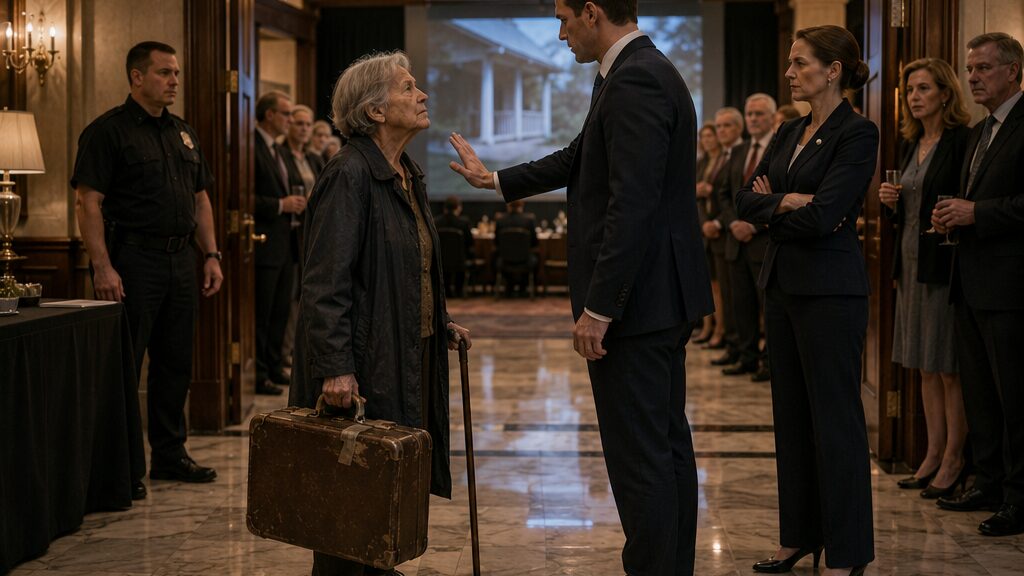
Nicholas Harris put his palm out before Barbara Hall could cross the marble threshold.
Not high, not rough enough to look like a shove, but close enough that the heel of his hand brushed the front of her rain-dark coat and made her stop. Behind him, the clubhouse glowed with chandeliers, white tablecloths, polished silver coffee urns, and the soft clatter of people pretending not to stare.
Barbara’s fingers tightened around the handle of the brown suitcase.
It was too old for that room. Its corners were scuffed pale. One brass clasp sat crooked from years of being forced shut around more papers than it was meant to hold. The leather handle had been wrapped twice with black tape where it had split. She had carried it from her front hall, down the back steps, across the driveway, into a hired car she did not tell anyone she had ordered, and now into the lobby of the Cedar Glen clubhouse, where the annual reception was already underway.
Nicholas looked at the suitcase first, then at her.
“Mrs. Hall,” he said, keeping his voice low because the room behind him had gone quiet enough to hear anyway. “You can’t bring that inside.”
Barbara breathed through the small burn in her hip. She had taken the back door again before leaving home, and the extra steps had made her leg stiff by the time the car reached the clubhouse. She shifted the suitcase half an inch so it rested against her shin.
“I’m on the agenda,” she said.
“You’re on the compliance list,” Nicholas corrected. “That doesn’t mean you can bring personal storage into a formal meeting.”
“It isn’t storage.”
A woman near the check-in table turned her head. A man holding a plate of appetizers paused with one small fork in the air. Someone’s phone lifted, not quite pointed at Barbara, not quite hidden either.
Nicholas saw it too. His jaw tightened. He was young enough to still believe a pressed suit could make impatience look like authority. His badge read Compliance Manager in neat black letters under the Cedar Glen crest.
“We’ve already received your written objection,” he said. “The board has the photographs. Tonight is not for theatrics.”
Barbara looked beyond him.
Through the open double doors, at the front of the reception hall, a large screen had been lowered beside the board table. On it was a photograph of her porch. Her porch, enlarged until every rough edge looked worse than it did in real life: the pale temporary board, the strip of contractor tape, the new handrail that did not match the approved bronze finish, the damp stain from the last rain.
Under the photograph, in clean white letters, were the words: URGENT EXTERIOR VIOLATIONS.
Her mouth went dry.
She had known they would discuss her house. The notice had said so. But she had imagined a folder, a line item, a few tired board members glancing at papers before asking questions. She had not imagined her front porch glowing over a room full of neighbors in cocktail jackets and dark dresses, as if her home were a warning poster.
Nicholas moved slightly, blocking her view.
“Mrs. Hall,” he said, softer now, which was worse. “Let me have someone help you sit in the lobby. When your item comes up, we’ll let you speak briefly.”
“Without my papers?”
“The board has what it needs.”
“No,” Barbara said. “The board has what it chose to photograph.”
The woman in the black suit near the hall entrance uncrossed her arms. Emma Wright, board president, wore a simple pearl pin on her lapel and the expression of someone already tired of an interruption she had planned for.
“Nicholas,” Emma said, “is there a problem?”
Barbara kept her eyes on Nicholas, but she felt the room leaning closer. She could hear shoes on marble, the faint hiss of whispered names. Hall. Porch. The old board. The one with the orange tag.
Nicholas lowered his voice. “Mrs. Hall is refusing to check the suitcase.”
“I am refusing to be discussed without the record,” Barbara said.
Emma walked toward them with smooth, careful steps. “Barbara, this is not a court proceeding.”
“No,” Barbara said. “If it were, you would have to keep dates.”
A few people shifted. Someone made a small sound that might have been a laugh, then swallowed it.
Emma’s face did not change, but the pearl pin rose and fell once with her breath. “We are happy to hear from you when the item is called. But large personal items can’t be brought into the meeting room. It’s a safety issue.”
Barbara almost smiled at that. Safety. They had used the word on the violation notice. They had used it when they ordered the contractor to stop. They had used it when they told her a temporary board was a liability, though they had not answered when she asked what her foot was supposed to land on in the meantime.
“This suitcase has been in my house longer than your rules about porch color,” Barbara said.
Nicholas glanced toward the security officer by the check-in table. “Ma’am, please don’t make this difficult.”
The word ma’am slid over her like a paper sheet. Polite, thin, disposable.
She remembered David standing on their porch the first spring after they bought the house, tapping the step with the heel of his boot and saying, “This one will need watching.” He had written everything down. Every repair. Every receipt. Every little sketch in pencil on the back of envelopes because he trusted paper more than memory.
Barbara had trusted memory. Then she had trusted patience. Then she had trusted the HOA office to stamp what it received and return what it owed.
Now her porch was on a screen.
She lifted the suitcase with both hands and set it down between her and Nicholas. The brass clasp gave a dull click against the marble.
Nicholas flinched as if the sound were louder than it was.
“I brought every answer you said was missing,” she said.
The room behind him quieted fully.
For the first time, Nicholas seemed unsure whether to look at her or at the suitcase. Emma did not look unsure. She looked annoyed, which Barbara found easier to bear.
“Barbara,” Emma said, “this is exactly why the board asked for a simple written statement.”
“You got six.”
“And the board reviewed them.”
“No,” Barbara said. “Someone stamped them.”
The security officer stepped away from the wall. He was not threatening. Not yet. But the movement changed the air. Barbara felt the old familiar embarrassment rise in her throat: the shame of taking too long at a door, of dropping a credit card, of having to ask a stranger to repeat himself, of being watched while her body made ordinary things complicated.
She placed one hand on the suitcase handle and the other on the head of her cane.
“I am not here to spill papers across your party,” she said. “I am here because my front step is on that screen, and none of you have asked why I stopped using it.”
Nicholas’s lips pressed together. “The issue is not your mobility. The issue is unauthorized exterior work.”
“The issue,” Barbara said, “is that the work was temporary because the approval wasn’t.”
A murmur went through the room.
Emma’s eyes sharpened. “That will be addressed when your item is called.”
“Then let me in.”
“Without the suitcase.”
Barbara looked past her again at the enlarged porch, at the bright white words beneath it. Urgent exterior violations. Her house reduced to an example. Her careful taped board made to look like neglect. Her handrail made to look like defiance.
She had spent the afternoon deciding whether to come. She had stood in the front hall beside the suitcase, one hand on David’s old work gloves, telling herself that a woman her age should not have to drag her private papers through a room full of people who thought uniform paint mattered more than a safe step.
Then she had looked through the narrow front window at the porch she could no longer trust.
She raised her chin.
“I will not leave the record outside.”
Emma turned slightly toward the security officer.
“If she came to dispute the violation,” Emma said, “she can do it without that suitcase.”
Chapter 2: The Step That Changed Her Morning Route
Two weeks earlier, Barbara had stood inside her own front door with a grocery bag in one arm and watched the porch step shift under a squirrel.
It was a small shift, barely more than a dip and a knock, but the sound traveled through the doorframe and into her bones. The squirrel froze, tail high, then sprang away across the walkway as if offended by the unreliability of the house.
Barbara stayed where she was.
The milk in the grocery bag pressed cold against her forearm. A loaf of bread leaned sideways against a can of soup. Outside, the porch looked almost normal in the morning light: white railing, brick planters, the low green shrubs David had once trimmed with more patience than skill. The step itself had only a faint tilt at the left corner, the kind a person could miss if that person had never put seventy-eight years of weight on one hip and then tried to lower a foot with confidence.
She had not used the front step in four days.
At first she told herself she was being sensible. The back door led through the laundry room, down two narrower steps, across a patch of uneven concrete, and around the side of the house. It took longer, but longer was not the same as impossible. She could still carry one bag at a time. She could still hold the railing, if she wore gloves so the rusted edge near the bottom did not scrape her palm. She could still manage.
The word manage had become a room she lived in.
She set the grocery bag down on the small table by the door and leaned her cane against the wall. Beneath that table sat David’s battered brown suitcase. It had lived there since the year after he died, too heavy to move upstairs, too useful to throw away, too full of old house papers for anyone else to understand.
Barbara nudged it with the toe of her shoe.
“Don’t look at me like that,” she said.
The suitcase, being David’s, said nothing.
It had been his habit to save everything. Paint chips in envelopes. Appliance receipts. Window measurements. A hand-drawn sketch of the porch from twenty years earlier, when one board had softened at the edge and he had replaced it before anyone else noticed. Back then, Cedar Glen had been new enough that neighbors borrowed ladders without asking the board. David had known every hinge and pipe in the house. Barbara had known which windows held afternoon sun and where to stand in the kitchen when the radio played low.
After he died, people began offering advice in gentler voices.
“You should think about something smaller.”
“Stairs get harder.”
“It’s a lot of house for one person.”
They meant well, mostly. That was the trouble with it. Concern could sound so much like a door closing.
The front step knocked again in the wind.
Barbara opened the drawer of the hall table and removed the folder marked PORCH—CURRENT. The label was hers, not David’s. Printed in block letters after the city clinic discharge nurse had circled “fall risk” on a page and told her, kindly, that home access mattered as much as medication.
The nurse had not told her anything Barbara did not know. Barbara already knew which foot to lead with, which shoes had grip, which mornings her hip would lie to her. But the nurse’s paper had made the problem official. Official things, Barbara had learned, were harder for boards to ignore.
Or so she had thought.
At the kitchen table, she laid out the copies again.
First request: front step repair and handrail stabilization, submitted with contractor estimate.
Second request: added clinic note.
Third request: follow-up after no response.
Fourth request: revised finish color because Nicholas Harris had said the board preferred bronze hardware.
Every sheet had a date. Every sheet had either an email printout or a stamped receipt from the HOA office. Barbara had driven there herself for the last two, because email disappeared too easily into polite silence.
The phone rang while she was measuring coffee into the old drip machine.
“Mrs. Hall?” Nicholas’s voice came through bright and professional. “I’m following up about your architectural modification request.”
“It’s a repair,” Barbara said.
“Yes. Well. Because it involves exterior appearance, it falls under architectural review.”
“The step moves.”
“We understand your concern. The board needs the complete materials list before it can make a determination.”
“I gave you the estimate.”
“The estimate describes pressure-treated lumber and a temporary support bracket. It doesn’t specify finish color or final railing style.”
“Because the contractor said he needed to open the step to see what was underneath.”
There was a pause, the kind made by someone reading from a screen and not liking where the conversation had gone.
“I’m sure that’s true,” Nicholas said. “But the board can’t approve open-ended exterior work.”
Barbara watched coffee drip into the pot, slow and dark.
“So I wait.”
“Only until the next review session.”
“When?”
“Currently scheduled for the week after next.”
She turned toward the front hall. From where she stood, she could see the top of the suitcase beneath the table.
“And until then,” she asked, “which door do you suggest I use?”
Another pause.
“For safety reasons, if you believe the front step is unstable, you should avoid using it.”
Barbara closed her eyes.
She did not tell him that avoiding it meant carrying laundry through the kitchen because the back door opened by the washer. She did not tell him that the back path puddled after rain. She did not tell him that she had stopped picking up the newspaper because the front walk felt farther away when she had to reach it from the side yard. She did not tell him that every changed route in her house felt like being slowly edited out of it.
“I understand,” she said, because she wanted the call to end before her voice changed.
That afternoon, the contractor came by between jobs. He was role-only to Barbara at first, just a man with a pencil behind one ear and mud on his boots, but he listened without hurry. He stepped on the porch once, twice, then crouched and pressed his fingers under the lip of the shifting board.
“This can’t wait two weeks,” he said.
“The HOA says it can.”
“The HOA isn’t standing on it.”
He installed the temporary board before dusk. Plain lumber, cleanly cut, secured so the weight would spread instead of dip. He wrapped a strip of contractor tape along the side edge because the color did not match and he wanted no one pretending they had not seen it. The new support made the step look unfinished, Barbara admitted that. But when she set one foot on it, the board held.
For the first time in days, her body trusted the front door.
She stood there longer than necessary, one hand on the railing, looking out at the street David had chosen because the maple trees met overhead in summer.
“You see?” she whispered.
The next morning, rain silvered the porch boards. Barbara opened the front door to test the step before taking out the trash.
An orange notice hung from the railing in a plastic sleeve.
The paper inside was already damp around the edges, but the words in the center were clear.
UNAUTHORIZED EXTERIOR MODIFICATION. CORRECTIVE ACTION REQUIRED.
Barbara stood barefoot inside the doorway, one hand on the frame, and stared at the notice until the chill from the wet morning reached her toes.
Chapter 3: The Violation Notice on Wet Porch Boards
Nicholas was photographing the porch when Barbara opened the door.
He stood two steps back on the walkway in a charcoal raincoat, phone held horizontally, careful not to step on the damp grass. The orange violation notice swung from the railing between them. Rain tapped the plastic sleeve, blurring the ink at the corners but not enough to soften the accusation.
Barbara had not yet put on her shoes. She had come to the door because she heard the small artificial click of a camera again and again, too close to the house.
Nicholas lowered the phone.
“Good morning, Mrs. Hall.”
“Is it?”
He looked briefly at her bare feet and then away, as if embarrassed on her behalf. That irritated her more than if he had stared.
“I didn’t mean to disturb you,” he said. “I’m documenting the exterior condition.”
“You already tagged it.”
“The tag is a notice. Documentation is separate.”
Barbara reached for the cane she kept just inside the door. The suitcase sat under the hall table behind her, its scuffed side half visible in the dimness, as if waiting to see whether she would need it.
She stepped carefully onto the temporary board.
It held.
Nicholas’s eyes moved to her foot. “I’d prefer you not stand on that while I’m here.”
“Why?”
“For liability.”
“For whose?”
He slipped the phone into his coat pocket. “Mrs. Hall, the board has a process. I understand you feel this repair is urgent, but unauthorized work creates a problem for everyone.”
“The step moved.”
“That’s why you were advised not to use it until approval.”
“You advised me to stop using my own front door.”
“I advised you to avoid a hazard.”
Barbara looked down at the board. Pale, wet, square-edged, honest. It did not match the porch. It did not pretend to. That was why the contractor had taped it. A temporary thing should look temporary; David had said that about everything from patched gutters to grief casseroles left in dishes people wanted back.
“This board is the reason I can stand here talking to you,” she said.
Nicholas drew a measured breath. “And the board’s concern is that it was installed without approval, in a visible frontage area, with nonconforming material.”
“Because the conforming material is waiting for your approval.”
“That is not accurate.”
Barbara’s hand tightened on the cane. “Which part?”
“The association is not preventing repair. The association is asking you to follow the same standards as everyone else.”
A car slowed on the street. Barbara did not turn to see who was inside. She could feel the neighborhood noticing. Cedar Glen had a talent for curtains shifting without faces appearing.
“I submitted the request,” she said.
“And we requested additional information.”
“I gave it.”
“The finish selection remained incomplete.”
“The contractor couldn’t finish what you wouldn’t approve.”
Nicholas’s expression hardened, but only slightly. He was too practiced to show anger fully. “The contractor installed a temporary structure anyway.”
“A temporary support.”
“An unauthorized temporary structure.”
Barbara let the rain fill the pause.
Behind Nicholas, the street looked polished and empty. Lawn edges clipped. Mailboxes matching. Mulch dark under ornamental shrubs. Every house presenting its face, whether anyone inside slept well or not.
“When David and I moved here,” she said, “no one needed a committee to replace a rotten board.”
Nicholas looked at the porch instead of at her. “The community standards have matured.”
“Matured,” Barbara repeated.
He missed the sharpness in it, or chose not to answer. “I need to advise you that the temporary board and taped edge need to be removed within five days unless an emergency exception is granted.”
“Then grant it.”
“I can’t do that standing on your walkway.”
“But you can accuse me standing there.”
“I’m not accusing you.”
“You hung orange paper on my railing before breakfast.”
Nicholas glanced toward the notice. “The color is standard for visibility.”
Barbara almost laughed. It came out as a breath.
A neighbor across the street opened a garage door. The sound rolled over the wet pavement. Nicholas turned slightly, aware of being seen, and his voice grew smoother.
“I’m trying to help you keep this from escalating,” he said.
“No. You’re trying to make me remove the only safe thing on this porch before the board admits it left me waiting.”
“You’re making this personal.”
“It is my front door.”
His face changed then. Not much. Enough. A flicker of frustration, maybe, or impatience with the way old people insisted the world was made of rooms and steps and handles instead of forms.
“Mrs. Hall,” he said, “there are concerns about whether the property is being maintained safely.”
There it was.
Not the board. Not the tape. Not even the color. The word safely had turned around and pointed at her.
Barbara felt the porch tilt in memory beneath her foot. She felt the clinic nurse’s hand hovering near her elbow without touching. She felt David’s absence behind her, where he would have stood in the hall with his jaw set, already asking Nicholas for a copy of the rule and a pencil to mark the foolish parts.
She did not have David’s voice.
She had her own, smaller now, but still hers.
“If you are concerned about safety,” she said, “stop photographing the board and answer the request that fixes the step under it.”
Nicholas removed a folded paper from inside his coat. “This is the compliance timeline. If the temporary work remains after five days, the matter can be escalated.”
“To what?”
“A formal unsafe condition review.”
Barbara looked at him then. Really looked. Not at his badge, not at his raincoat, not at the phone that held pieces of her porch cropped to look as bad as possible. At him. He seemed uncomfortable, but not ashamed. That frightened her more than open cruelty would have.
“Unsafe condition,” she said.
“It’s procedural language.”
“It’s language you can use to say I’m not keeping up the house.”
“It means the board has to assess risk.”
“It means you can make my front step sound like evidence against me.”
Nicholas did not answer.
Rain gathered on the edge of the temporary board and fell in a steady line to the bricks below. Barbara followed it with her eyes, buying time until the heat in her chest cooled enough to speak without trembling.
“I want copies of every photograph you take.”
“You can request them through the office.”
“I want the date on that request to be today.”
“You’re welcome to email.”
“I’ll bring it in.”
His gaze moved past her into the hallway, to the suitcase under the table. “That won’t be necessary.”
“Necessary and welcome are different things.”
For the first time, Nicholas looked tired. “Mrs. Hall, I know this is upsetting. But if the board sees a temporary board, a taped edge, incomplete paperwork, and continued use of a disputed entrance, they have to consider whether the home is being maintained in a safe condition.”
Barbara stepped back over the threshold. Not because he had won. Because her foot had begun to ache, and she refused to give him that too.
She took the orange notice from the railing. The plastic sleeve was slick in her hand.
“The original step shifted before this board was installed,” she said. “Write that down.”
“I’ll include your statement.”
“No,” Barbara said. “Write down that the temporary board is the reason the step can be used at all.”
Nicholas’s hand moved toward his phone, then stopped.
“I’ll note your objection.”
Of course he would. Objection sounded smaller than truth. It sounded like an old woman making noise at the edge of a process.
Barbara folded the wet notice once and held it against her side.
Inside the hall, the suitcase waited beneath the table, full of David’s old certainty that dates mattered, measurements mattered, receipts mattered, the order of things mattered.
Nicholas stepped back from the porch and looked once more at the taped board.
“I should also warn you,” he said, “if the board determines the temporary work itself creates an unsafe condition, they may require immediate removal before approval of any permanent repair.”
Barbara’s hand closed around the notice until rainwater squeezed between her fingers.
The board beneath her foot had held.
Now the people judging it might take it away.
Chapter 4: The Approval Form Nobody Wanted Dated
Three days after Nicholas photographed the porch, Barbara carried the suitcase into the Cedar Glen HOA office and placed it on the counter between a vase of silk lilies and a bowl of wrapped peppermints.
The board secretary looked at the suitcase, then at Barbara, then down at the computer screen as if a name might appear there explaining what kind of trouble had just walked in.
“I need a stamped copy of this,” Barbara said.
She laid one page flat on the counter. Not a packet. Not yet. One page was all she trusted them to look at without pretending to drown in paper.
The board secretary read the top line. “Request for emergency repair exception.”
“Yes.”
“We have an architectural modification form for that.”
“This is not a modification.”
“The porch board—”
“The porch board is temporary,” Barbara said. “The repair underneath it is the matter.”
The secretary’s fingers hovered over the paper without touching it. “Let me get Nicholas.”
Barbara had expected that. She had worn her gray coat because the office air conditioning always ran too cold, and she had tied the suitcase shut with David’s old canvas strap because the broken clasp opened when she lifted it wrong. She waited with both hands on the handle and watched a printer spit pages into a tray behind the counter.
Cedar Glen’s office smelled like lemon cleaner and new carpet. On the wall hung framed photographs of the development from its opening year: clean roofs, bare young trees, cheerful couples standing beside SOLD signs. Barbara and David were not in any of the photographs, though they had moved in before the second pool gate was installed. People like them became original owners only when the board wanted to talk about community legacy. Otherwise, they were residents with unresolved violations.
Nicholas came through the side door holding a folder.
“Mrs. Hall,” he said. “I wish you had called first.”
“So you could tell me not to come?”
“So we could prepare the right documents.”
“I brought the right document.”
He glanced at the page on the counter. “This isn’t the current form.”
“It has the date of my first request on it.”
“That’s exactly the problem.”
Barbara slid her glasses lower on her nose and looked at him over the frames. “A date is a problem?”
“The board can only review what’s properly submitted. If you want emergency consideration, you’ll need to complete the current request packet. It includes a waiver acknowledging that temporary work was started before approval.”
“A waiver saying I started it wrong.”
“A waiver saying work began before the board authorized it.”
“Because the step moved before the board answered.”
Nicholas put his folder on the counter and opened it to a crisp stack of pages. The top sheet was bright white, not like the softer paper Barbara had at home, the kind that had yellowed slightly inside the suitcase. He turned it toward her and uncapped a pen.
“If you sign here, we can process it cleanly.”
Barbara did not take the pen.
The board secretary had become deeply interested in the printer.
“What happens to the first request?” Barbara asked.
“It remains in the file.”
“With its original date?”
“Of course.”
“Then why does this one say today?”
Nicholas gave a small practiced smile. “Because today is when you’re requesting the exception.”
“I requested the repair before the temporary board.”
“This is a separate request.”
“No. It’s the same porch.”
The smile faded. “Mrs. Hall, I’m trying to keep this manageable.”
There was the word again, wearing a different coat. Manageable. As if the trouble were not the step, or the delay, or the wet notice hanging from her railing, but the fact that she kept insisting the order of events mattered.
Barbara opened the suitcase.
Not wide. Just enough to reach inside. The broken clasp clicked, and the board secretary finally looked up.
Barbara removed a manila folder with a blue rubber band around it. David had used blue bands for warranties, red bands for taxes, green for receipts. Barbara had kept his system because it was easier than inventing a life without him in it.
She laid out three pages.
“First request,” she said. “Stamped received.”
Nicholas looked toward the secretary.
“Second request,” Barbara continued. “With the clinic note attached.”
“Mrs. Hall—”
“Third request. Revised estimate. Your office asked for railing finish.”
Nicholas lowered his voice. “I’m not disputing that we received correspondence.”
“Then stamp today’s page and attach it to those.”
He took a breath through his nose. “The board may not accept homemade timelines as official.”
“Good. I brought theirs.”
She removed copies of the office receipts. Each one bore the Cedar Glen date stamp, slanted slightly because the secretary always pressed harder on the left side. Barbara placed them in a row across the counter.
For a moment, the only sound was the hum of the office lights.
Nicholas glanced at the papers but did not touch them. “You keep a lot of records.”
“My husband did.”
His expression softened automatically, the way people’s faces did when a dead spouse entered the room. Barbara disliked that softness most when it arrived too late to matter.
“I understand this is emotional,” he said.
“No,” Barbara said. “You understand it is dated.”
The board secretary coughed once into her hand.
Nicholas recapped the pen. “The issue is that emergency exceptions have to be considered under current policy.”
“Then consider it.”
“We can’t do that at the counter.”
“Then stamp it at the counter.”
He looked at the suitcase, at the folders inside it, then at Barbara. Something in his face closed, not anger exactly, but a decision to stop negotiating in a language she could answer.
“The board will review the matter at the annual meeting,” he said. “You’ll receive notice.”
“My porch is already on the annual meeting agenda?”
“Exterior compliance trends are being discussed. Your property is part of a broader concern.”
“Trends,” Barbara repeated.
Nicholas slid the new form toward her. “I strongly recommend you sign this. It shows cooperation.”
“It erases sequence.”
“It simplifies review.”
“It protects you.”
“It protects the board,” she said.
He did not deny it quickly enough.
Barbara gathered her stamped copies one by one. Her hands moved carefully, smoothing corners, aligning edges, returning the blue rubber band to the folder. She had come prepared to be patient. She had not come prepared to be foolish.
The secretary finally reached for Barbara’s emergency request. “I can stamp this as received.”
Nicholas turned his head. “Hold on.”
The secretary froze.
Barbara kept her eyes on Nicholas.
He said, “We need to make sure it’s categorized correctly.”
“So stamp it first,” Barbara said. “Categorize it after.”
“That is not how intake works.”
“That is exactly how intake worked every time I brought you a paper you wanted to ignore later.”
The secretary’s face flushed.
Nicholas picked up Barbara’s page and held it as if it were fragile for the wrong reason. “I’ll take this for review.”
“With a stamped copy.”
“Once it’s accepted.”
“Received,” Barbara said. “Not accepted. Received.”
The two words sat between them.
Nicholas placed the page back on the counter. He nodded once to the secretary, who stamped it so lightly the date almost failed to print. Barbara looked at the pale mark.
“Again,” she said.
The secretary blinked.
“Please,” Barbara added.
The stamp came down harder the second time. The date stood clear.
Barbara folded the copy into the blue-banded folder and returned it to the suitcase. When she lifted the suitcase from the counter, the old handle creaked. Nicholas looked as if he wanted to offer help and knew better than to try.
At the door, Barbara paused.
“Will the board be showing photographs of my porch at the meeting?”
Nicholas’s mouth tightened. “The presentation hasn’t been finalized.”
“That means yes.”
“It means the board president determines presentation content.”
Barbara nodded, though nothing inside her agreed. “Then tell Emma Wright I will be there.”
Nicholas looked down at the new unsigned form still on the counter. “You may be limiting your options.”
“No,” Barbara said. “I am keeping them in order.”
She left before her leg could betray her in front of them.
That evening, at her dining table, Barbara placed the newly stamped page into the suitcase. She did not close it right away. The folders leaned against each other like tired witnesses. David’s old pencil sketch of the porch lay on top, the measurements written in his square hand.
The phone rang after dinner.
It was a recorded message from Cedar Glen, reminding residents of the annual reception and board presentation on community standards. Barbara listened until Emma Wright’s voice reached the line about “examples of noncompliance spreading when early action is delayed.”
Barbara did not move until the message ended.
Then she wrote the date on a blank sheet of paper and added it to the suitcase.
Chapter 5: The Neighbor Who Mistook Safety for Shame
The contractor returned on Saturday with a measuring tape, a level, and the uneasy expression of a man who had already been warned by someone with a clipboard.
Barbara watched him from the doorway as he crouched beside the porch step. The temporary board had dried after two days of sun, but the contractor tape still marked its edge in a bright stripe that seemed louder than paint. He pressed the level to the old frame underneath and frowned.
“Worse on this side,” he said.
“I know.”
“You shouldn’t be using it much.”
“I’m using it because you made it usable.”
He gave her a look over his shoulder. “Usable and finished aren’t the same thing.”
“That sounds like something the board would say.”
“Difference is I know which part is holding weight.”
He measured the gap between the old step and the porch frame, then wrote on a notepad balanced against his knee. Barbara liked that he wrote by hand. It made him seem less likely to revise history without leaving marks.
Across the street, a garage door opened.
Barbara did not look up at first. She had learned that acknowledging watchers encouraged them. But the footsteps came closer, firm and quick, and soon Brian Gonzalez stood at the edge of her walkway wearing a golf shirt tucked too neatly into khaki pants.
“Barbara,” he called. “Do you have a minute?”
The contractor stopped writing.
Barbara stayed on the porch. “Not if it’s about the board.”
Brian gave a short laugh, the kind meant to show he was reasonable and she was making that difficult. “Well, that’s exactly what it’s about.”
“Then no.”
He came halfway up the walk anyway. “People are concerned.”
“People have my phone number.”
“People don’t want to upset you.”
“They sent photographs to the HOA.”
His eyebrows lifted. “If a property issue is visible from the street, residents have a right to report it.”
The contractor stood slowly, measuring tape in one hand.
Barbara noticed Brian glance at him, then at the taped board. His eyes held on the tape as if it offended him personally.
“That right there,” Brian said. “That’s the problem. It looks like an abandoned job.”
“It is an unfinished repair.”
“It looks like neglect.”
Barbara felt the word land where Nicholas had been aiming for days.
She rested both hands on the top of her cane. “The step was unsafe.”
“And no one wants you hurt,” Brian said quickly. “That’s not what this is about.”
“What is it about?”
“It’s about standards. We all bought into Cedar Glen because it’s maintained. If everyone starts patching with whatever lumber they have lying around—”
“I did not pull it out of a ditch.”
“I’m not saying you did.”
“You just said whatever lumber.”
“I’m saying there’s a process.”
The contractor looked down at his notes.
Barbara saw the problem then with a clarity that cooled her. Brian was not there to understand the porch. He was there to be seen trying. He wanted the contractor to hear him. He wanted the street to see him standing in front of the untidy board, defending the clean lines of Cedar Glen from a widow’s temporary brace.
“I followed the process,” Barbara said.
Brian sighed. “Barbara, with respect, if you had followed the process, there wouldn’t be an orange notice on your railing.”
The contractor shifted.
Barbara did not.
The suitcase sat inside the open door behind her, visible from where Brian stood. She had left it there after adding the office paper. Its lid was closed, but the canvas strap lay across it like a belt.
Brian pointed, not at the suitcase but toward the porch. “The board can’t make exceptions based on personal circumstances every time. That’s how communities decline.”
“Is that what you think this is?” Barbara asked.
“I think buyers notice. I think appraisers notice. I think when one front elevation looks like this, it affects everyone.”
The contractor spoke before Barbara could. “The old step moves under weight.”
Brian looked annoyed by the interruption. “I’m sure you’re doing your job.”
“I’m telling you the repair is necessary.”
“And I’m telling you necessary work still needs approval.”
Barbara looked from one man to the other. The contractor’s boots were dusty. Brian’s shoes were spotless. One had tested the step with his hands. The other had judged it from the street.
“How many photographs did you send?” she asked.
Brian blinked. “Excuse me?”
“To the HOA. How many?”
“That’s not really—”
“How many of my porch?”
He glanced toward the house across the street, then lowered his voice. “Enough to make sure the board understood the situation.”
“The situation being my tape?”
“The situation being visible noncompliance.”
“My house is not a disease, Brian.”
His face changed, and for a second she thought she had embarrassed him. Then he straightened.
“No one said that.”
“You said decline. You said spreading.”
“That was Emma’s wording in the notice.”
“You repeated it.”
The contractor rolled the measuring tape back into its case with a metallic rasp. “Mrs. Hall, I can come back another time.”
“No,” Barbara said.
Brian turned to him. “Actually, that might be best until the board clarifies whether you’re authorized to proceed.”
The contractor went still.
Barbara’s hand tightened on her cane. “He is here to measure.”
“If he’s working on an unapproved modification, he could be exposing himself.”
“To what?” Barbara asked.
Brian held up both hands. “I’m not threatening anyone. I’m saying there are liability issues.”
“You all learned that word together.”
The contractor looked at Barbara, then away. She saw the calculation in his face. Not fear exactly. Business. License. Insurance. The cost of becoming part of an argument where the people with rules could make simple work expensive.
Brian softened his voice. “Barbara, maybe this is the time to consider whether the house is becoming too much.”
There it was, dressed as concern.
The maple leaves shifted overhead, throwing small pieces of light across the walkway. Barbara heard, absurdly, the refrigerator humming inside the kitchen. She thought of the back door with its narrow steps, the laundry basket she had stopped carrying full, the way she now planned every exit from the house like a small expedition.
“My house,” she said, “is not too much because you dislike a board.”
“I’m trying to be practical.”
“No. You’re trying to make my front door look like a neighborhood problem.”
Brian’s mouth thinned. “You know people are only trying to protect property values.”
“Mine is property too.”
“That’s not what I meant.”
“It rarely is.”
He looked past her into the hallway again. This time his eyes found the suitcase. “Are you planning to bring all this to the meeting?”
Barbara did not answer.
Brian gave a small shake of his head. “I hope you don’t make it harder on yourself.”
The words were quiet enough that a passerby might have mistaken them for kindness.
Barbara lifted the violation notice from the little table by the door. She had kept it there because leaving it outside felt like letting the HOA name the house from the street.
“Harder than what?” she asked.
Brian had no answer that he wanted to say aloud.
After he left, the contractor stayed by the porch a moment longer. He did not resume measuring.
“I can draw up the permanent plan,” he said. “I can give you the numbers and the safety notes. But if they’re going to come after my access or say I knowingly worked on a prohibited job, I have to be careful.”
Barbara nodded. She could not blame him. That irritated her too.
“How careful?” she asked.
He looked at the temporary board, then at the orange notice folded beside the door.
“I can’t keep working if the HOA threatens my license access.”
Barbara watched him put the level back in his truck.
When he drove away, the temporary board remained behind, doing the job everyone else had made dangerous.
Chapter 6: The Photos They Put on the Big Screen
By the time Barbara was allowed into the meeting hall, her porch had already been made larger than life.
The photograph filled the screen at the front of the room, bright and cruel under the projector light. The temporary board looked raw and pale. The contractor tape shone like a warning stripe. The orange violation notice, caught in one of Nicholas’s images, hung from the railing like proof that her house had been caught doing something shameful.
Barbara stopped just inside the doorway.
A few neighbors turned. Some looked quickly away. Others stared with the relief of people whose own houses were not on the screen.
Nicholas stood beside her, one arm angled subtly toward the suitcase as if he could still prevent it from entering by pretending not to touch it. The security officer remained near the wall. Emma sat at the board table beneath the Cedar Glen crest, her microphone angled neatly toward her mouth.
“Mrs. Hall,” Nicholas murmured. “You can sit in the reserved row. The suitcase needs to remain at the side.”
Barbara kept walking.
The suitcase bumped once against her knee. Every step across the polished floor carried farther than it should have. She could feel the weight of the room on the back of her neck: the reception guests, the board members, the neighbors who had eaten small pastries under chandeliers before turning toward the screen to study her porch.
At the front, the board secretary shuffled papers. Emma looked up.
“Barbara,” she said into the microphone, though Barbara had not yet reached the table. “We’re about to discuss your item. Please take a seat.”
“I can hear standing.”
A murmur moved through the hall.
Emma’s smile was small and controlled. “For order, all resident comments should be made from the microphone.”
Barbara looked at the microphone placed at the side aisle, several feet from the board table, far enough that anyone speaking there would have to look up at the projected photograph of her own violation while addressing the people judging it.
She walked to it.
Nicholas followed with visible restraint.
“Before resident comment,” Emma said, “I want to clarify that the board’s concern is not personal. Cedar Glen has always tried to balance individual needs with exterior consistency. When temporary fixes remain visible, they can create safety concerns, confusion about standards, and potential effects on community appearance.”
The slide changed.
Another photograph appeared. Same porch, closer angle. The edge of the temporary board. The tape. A water stain. Nicholas had taken it from low enough to make the board look warped.
Barbara heard someone whisper, “That’s worse than I thought.”
She did not turn.
Emma continued. “This is not about denying anyone necessary maintenance. This is about ensuring maintenance is done correctly, with approval, by licensed workers, and in compliance with the association’s architectural guidelines.”
Barbara glanced at the contractor, who stood at the back of the room with his cap in his hands. She had not known he would come. He did not look at her long, but his presence steadied something in her.
Brian Gonzalez rose from the second row.
“As someone on the neighbor committee,” he said, “I want to say this is exactly why early enforcement matters. Nobody wants to embarrass anyone. But if a visible frontage is left like this, even temporarily, it sends the wrong message. We all have to live with what people see from the street.”
Barbara’s hands rested on the suitcase handle.
Emma nodded. “Thank you, Brian.”
Barbara waited for Emma to invite her to speak. Emma looked instead at her notes.
Nicholas stepped closer. “Mrs. Hall, when you speak, please keep it to the current condition and proposed correction.”
Barbara turned her head slightly. “The current condition began before your photograph.”
“That’s not the issue being discussed.”
“It is the only issue being discussed.”
Emma’s microphone clicked softly as she adjusted it. “Barbara, you’ll have three minutes.”
“Three minutes for four requests, two office visits, one clinic note, and five days before escalation?”
The room changed again. It was not sympathy yet. It was attention.
Emma’s expression cooled. “This is not a debate.”
Barbara lifted the suitcase just enough to set it on the small table beside the side microphone. The old brass clasp struck the wood with a flat sound. In the quiet hall, it might as well have been a gavel.
Nicholas moved at once. “Mrs. Hall, we discussed this.”
“No,” Barbara said. “You discussed removing it.”
“For safety and order—”
“It contains papers.”
“It contains materials not submitted as part of tonight’s packet.”
Barbara looked at Emma. “That is because your office would not keep them in order.”
Emma leaned toward her microphone. “Barbara, be careful.”
The words were not loud. They did not need to be. The entire room heard the warning wrapped inside them.
Barbara felt the old heat of humiliation rise, but it did not scatter her this time. She had passed through it already at the doorway. She had seen her porch enlarged and labeled. She had listened to Brian explain the message her home sent to the street. There was little left to take from her except the record, and the record had a handle wrapped in black tape.
On the screen behind Emma, Barbara’s porch waited in projected judgment.
Barbara turned so the room could see both her and the photograph.
“That board,” she said, “was installed because the original step shifted under my weight.”
Nicholas said, “The board has not received confirmation that—”
Barbara raised one hand. Not sharply. Just enough.
“I am not finished.”
The gesture startled him into silence.
She opened the suitcase.
Only the top layer showed: blue-banded folder, red-banded folder, green-banded receipts, David’s old pencil sketch inside a clear sleeve, the orange violation notice flattened beneath a paperweight she had brought from home because the suitcase lid did not stay open by itself.
No one spoke.
Barbara took out the orange notice first.
“This was placed on my railing before the emergency repair request was stamped,” she said.
Emma sat very still. “The notice followed visible installation of unauthorized materials.”
Barbara placed the notice on the table.
Then she removed the first stamped request.
“This was received before that board was installed.”
Nicholas stepped toward Emma, then stopped when several people in the front row leaned to see the paper.
Barbara did not look at them. She looked at the date.
“My husband used to say a house will tell you what is wrong before it fails, if you listen soon enough,” she said. “I listened. I wrote. I waited. Then I stopped using my own front door because waiting became the unsafe part.”
Her voice did not break. She would not allow it to. Not under the projector. Not beneath the photograph they had chosen.
Emma’s fingers folded around her pen. “Barbara, the board is willing to review any previously submitted documents through the proper channel.”
“The proper channel is stamped on them.”
A low murmur ran through the room.
Nicholas spoke quietly but firmly. “You’re presenting this as if the association ignored you. That is not accurate. We requested additional information.”
Barbara reached into the suitcase again and removed the folder with the revised railing finish.
“Then I will start with the first letter you stamped received,” she said, “and we can see where the missing information went.”
Chapter 7: The Papers That Refused to Stay Quiet
Barbara began with the paper that had a coffee ring on the corner.
Not because it was the most official, but because it was the first.
The room waited while she adjusted her glasses and smoothed the page on the little table beside the microphone. Behind her, the projected photograph of her porch still filled the screen. The enlarged tape, the pale board, the orange notice—all of it hung over her shoulder like an accusation that had not yet learned to be embarrassed.
“March third,” Barbara said. “Request for front step repair and handrail stabilization. Submitted to the Cedar Glen office. Stamped received.”
Emma’s microphone clicked. “Barbara, the board has acknowledged prior communication. The current question is whether the visible temporary structure—”
“The current question began on March third.”
Emma folded her hands. “Please keep your comment concise.”
Barbara looked down at the suitcase. The lid sagged against the paperweight she had brought from home, a small brass duck David had once used on the kitchen bills because he said serious papers needed something foolish nearby to keep them honest.
She moved the duck to the next folder.
“March tenth,” she said. “Follow-up request. Added clinic discharge note.”
Nicholas stepped forward. “Medical details are not necessary for exterior review.”
Barbara did not look at him. “The note says safe entry and exit should be maintained at the primary door where possible.”
A low movement passed through the room. Chairs creaked. Someone near the back whispered, then stopped.
Emma’s voice sharpened. “The board does not need private medical information read aloud.”
“I agree,” Barbara said. “That is why I sent it privately before my porch was placed on a screen.”
The words landed cleanly.
Emma glanced at the projected photograph, and for the first time that evening, the photograph looked less like evidence and more like a choice someone had made.
Barbara set the clinic note down without reading further. She had not come to make strangers measure her pain. She had come to put dates back where they belonged.
“March seventeenth,” she said. “Your office requested finish color, rail style, and material list. March nineteenth, I submitted a revised estimate with bronze rail finish noted.”
Nicholas said, “The estimate still included pressure-treated lumber.”
“For the structural board under the step.”
“For visible frontage.”
“The visible part was temporary because the structural part had to be opened.”
The contractor at the back of the room cleared his throat. Every face turned. He looked startled by the attention, then lifted one hand slightly.
“That’s accurate,” he said. “You can’t tell how much rot or shifting is under a step until you open it.”
Emma looked at him. “You are not on the speaker list.”
“No, ma’am.”
“Then please allow the resident to complete her comment.”
The contractor lowered his hand, but his words had already entered the room. Barbara tucked them away, not as rescue, but as a board placed under her own.
She removed the next sheet.
“March twenty-fourth,” she said. “I called the office and asked which door I should use while waiting. Nicholas told me to avoid the front step if I believed it was unstable.”
Nicholas’s face flushed. “That was safety guidance.”
“Yes.”
He blinked.
Barbara looked up at him. “It was good advice. I took it. I used the back door until rain made the side path slick. Then the contractor installed the temporary support so I would not have to choose between the bad step and the worse route.”
Emma leaned toward the microphone. “The board was not notified before the temporary work began.”
Barbara slid another paper forward. “March twenty-sixth. Emergency call to contractor. March twenty-seventh. Temporary support installed. March twenty-eighth. Violation notice placed on railing before my emergency exception request was stamped.”
“The violation followed visible work,” Nicholas said.
“The request followed your delay.”
“Mrs. Hall—”
Barbara turned to him then.
It was not a large turn. Her shoes stayed planted. Her hand remained on the folder. But Nicholas stopped talking as if she had stepped directly in front of him.
“You photographed the board,” she said, “but not the gap beneath it. You photographed the tape, but not the shift in the old frame. You photographed the orange notice after you hung it, but not the stamped requests before it.”
Nicholas’s mouth tightened. “Documentation focuses on observable violations.”
“That is the problem.”
No one murmured this time.
Barbara returned to the suitcase. Her fingers found the clear sleeve with David’s old pencil sketch. She had not meant to use it. It was not necessary, not in the way the stamped papers were necessary. But the corner of it had slid free, and the square, familiar handwriting caught her before she could close the folder again.
She lifted it out.
The sketch showed the porch from above, each board measured, each support marked. David had drawn it years ago when one corner softened. He had written replace before give in his blunt pencil hand, as if wood could be reasoned with if one acted early enough.
Barbara held it a moment too long.
Emma noticed. “Is that part of the current request?”
“No,” Barbara said.
She almost put it back.
Then she turned it toward the board.
“This is my husband’s drawing from the last time that step needed work. He replaced it before it failed because he believed maintenance meant listening early.”
Her voice thinned at the end. She paused until it steadied.
“I listened early too.”
The words did not ask for pity. They did not need to. The room had grown still around them.
Brian shifted in the second row. He did not look at the screen now. He looked at the papers.
Emma lowered her eyes to the documents spread across the table. “Barbara, the board understands that the repair matters to you.”
“No,” Barbara said. “The board understands it is visible.”
Emma’s face hardened.
Barbara placed David’s sketch beside the stamped requests, not on top of them. Memory beside record. Neither replacing the other.
Nicholas tried again, quieter. “The association still has to consider whether allowing unapproved temporary work creates liability.”
Barbara nodded. “Then consider the liability of delaying a repair until the unsafe route becomes the only approved one.”
A woman near the side aisle drew in a breath.
Linda Baker stood slowly from her chair.
Barbara saw her from the corner of her eye. Linda had been sitting halfway back, hands folded in her lap, face pale under the bright meeting lights. Barbara knew her as a neighbor who waved from a distance, a retired nurse who brought soup to people after surgery and avoided board fights the way some people avoided icy sidewalks.
Emma looked relieved to address someone else. “Linda, if you have a comment, please wait until—”
“I’ve seen her use the back route,” Linda said.
The room turned.
Barbara’s fingers closed around David’s sketch.
Linda did not move toward the microphone. Her voice carried anyway, plain and steady. “From my kitchen window. She carries things one bag at a time. The side concrete puddles near the laundry door after rain. There’s no proper rail on the lower part. If you told her not to use the front, then the alternative is not safer.”
Nicholas stared at the floor.
Emma’s lips parted, then closed.
Barbara felt no triumph. Only a strange ache, like someone had pressed a hand gently against a bruise she had been hiding even from herself.
Linda looked at Barbara then, not long, not dramatically. “I should have said something sooner.”
Barbara gave the smallest nod she could manage.
Emma spoke after a careful pause. “The board can review whether an emergency accommodation should have been considered sooner. However, this does not change the fact that the temporary structure requires formal approval or removal.”
Barbara looked at the papers on the table. For a moment, she saw how easy it would be for them to make this small. An exception. A correction to a file. A way to let everyone go home believing the system had worked once enough pressure was applied.
She picked up the unsigned waiver Nicholas had pushed at the office. She had brought it too.
“This form says I acknowledge the work began before approval,” she said.
Nicholas looked up.
Barbara placed it beside the stamped March third request.
“I will not sign that unless the board also acknowledges approval was requested before the temporary work became necessary.”
Emma’s eyes narrowed. “That is not standard language.”
“Then revise it.”
The board secretary stopped writing.
Barbara’s heart knocked hard once, but she kept going.
“I will not remove the temporary board until the permanent repair is scheduled. I will not agree that I created the unsafe condition by trying to keep my footing. And I will not let the association use a photograph of my porch to say I failed to maintain a house you delayed me from repairing.”
The room seemed to hold its breath.
Emma looked at Nicholas. Nicholas looked at the papers, the photo, the suitcase, then at Barbara.
For once, he did not speak first.
Barbara gathered the documents into a straight line across the polished table.
“Now,” she said, “you can decide whether this is about the board on my porch or the dates you don’t want beside it.”
Linda remained standing.
“The back route is the dangerous one,” she said.
Chapter 8: The Board They Finally Let Stay
One week later, the old temporary board came up with a groan.
Barbara stood in the open doorway with one hand on the frame and watched the contractor work the pry bar under the pale edge. The board resisted, then loosened all at once, lifting from the porch like a stubborn truth finally allowed to move.
“Careful,” Barbara said.
The contractor looked up, half smiling. “I am.”
“I wasn’t talking to you.”
He glanced at the board in his hands. “I’ll give it a dignified retirement.”
Barbara allowed herself the smallest smile.
The morning was cool and bright. The kind of June morning Cedar Glen liked to print in newsletters: trimmed lawns, clean sidewalks, maple leaves moving gently above the street. But there was no photographer from the HOA office now, no orange notice swinging from the railing, no projected image waiting to make the house look careless.
There was only the porch, opened properly at last.
A new board lay on sawhorses beside the steps, already cut, sanded, and primed in the approved color. The replacement rail leaned against the brick planter. It was bronze, because Barbara had chosen not to fight about bronze when bronze would hold as well as anything else. She had fought about dates. She had fought about removal before repair. She had fought about the right to stand at her own front door without being treated as a problem to manage.
Some things were worth spending strength on. Some things were only paint.
The suitcase sat inside the hall, just where she could see it. Closed now. The canvas strap wrapped around it, brass clasp crooked as ever. On top of it lay the letter Emma Wright had sent after the special board review.
Barbara had read the letter six times, not because it was kind, but because it was exact.
The fine had been withdrawn.
The emergency repair exception had been granted.
The board would revise its intake procedure so emergency safety repairs could be stamped as received before being routed for architectural review.
The temporary support could remain until permanent work began.
The association did not admit fault.
Barbara had laughed once at that line, alone in the kitchen. David would have circled it in pencil and written, They rarely do.
Nicholas had delivered the final approval packet himself the day before. He had stood on the walkway, not the porch, holding a folder against his side.
“Mrs. Hall,” he had said, “the board has authorized the repair under the emergency safety provision.”
Barbara had waited.
Nicholas had looked down at the step. The orange notice was gone by then; Barbara had removed it after the meeting and placed it inside the suitcase, flattened beneath the brass duck.
“I also wanted to say,” he continued, “the photographs should have included the structural concern.”
“That would have helped.”
“Yes.”
He had seemed younger without the meeting room around him. Not harmless. Not forgiven. Just younger.
“I was following procedure,” he said.
“I know.”
His shoulders eased slightly, as if he had expected argument and found the truth more uncomfortable.
Barbara had taken the folder. “Next time, follow the whole porch.”
Now, as the contractor lifted the old temporary board away, a car slowed near the curb. Brian Gonzalez sat behind the wheel. For a moment Barbara thought he might drive on.
He did not.
He parked across the street and crossed over with his hands in his pockets. He stopped at the walkway, a respectful distance from the work.
“Morning, Barbara.”
“Morning.”
The contractor kept working. Barbara appreciated that.
Brian looked at the open step, the exposed frame, the dark places where the old support had shifted. The damage was plain now, uglier and more honest than the photograph had been.
“I didn’t realize it was that bad underneath,” he said.
“No.”
The single word held more than she intended, but less than he deserved.
Brian nodded. “I should have asked before sending pictures.”
“Yes.”
He glanced up at her. “I thought I was helping the neighborhood.”
“You were helping the board misunderstand my house.”
The contractor paused, then wisely reached for another tool.
Brian accepted it without protest. “Fair enough.”
Barbara studied him. She did not want his apology to become another thing she had to take care of.
“The new rail will match,” she said.
“I see that.”
“The board will get its color.”
“And you’ll get your step.”
Barbara looked down at the open porch. “I will get my front door back.”
Brian lowered his eyes. “That’s different.”
“Yes,” she said. “It is.”
He did not ask to come closer. He did not offer to help. After a moment, he said he was glad the repair was moving forward, and Barbara let that be enough. When he returned to his car, he looked once more at the porch before driving away. Not tenderly. Not transformed. But accurately.
By noon, Linda Baker came over with two paper cups of coffee and left one on the porch rail after asking where it would not be in the way.
“I heard the rule revision passed,” Linda said.
“With three edits and no admission of common sense.”
Linda laughed softly. “That sounds like a board.”
Barbara wrapped both hands around the warm cup. “Thank you for standing up.”
Linda looked toward the side path between the houses. “I should have done it before the meeting.”
Barbara followed her gaze. The back route was visible from here: the narrow concrete, the low place where water collected, the awkward turn by the laundry door. She had hated that Linda had seen her there. She was grateful too. Both feelings could live in the same place, she supposed, if the place was large enough.
“You did it when it mattered,” Barbara said.
Linda shook her head. “You made it matter.”
After she left, Barbara sat in the hall chair and rested while the contractor worked. She did not pretend she was not tired. That was new. Or maybe not new, only newly permitted. The house rang with measured sounds: drill, hammer, scrape, silence, then the careful placement of something meant to last.
The suitcase waited beside her.
She touched the taped handle. For days it had felt like a burden she was dragging through rooms where people did not want her papers, her history, or her order of events. Now it looked smaller. Still heavy, still battered, but only a suitcase again.
Near the top of the pile inside were the stamped requests, the clinic note, the contractor’s warning, the orange violation notice, Emma’s letter, and David’s porch sketch. Barbara opened the lid and took out the sketch.
The pencil lines had faded slightly where David’s hand used to rest. She carried it to the doorway.
The contractor had fitted the new board. It lay flush with the porch, not proud, not hidden. Solid. The rail would come next.
Barbara held the sketch against her chest and watched him test the step with his full weight.
It did not move.
When the work was finished, the contractor swept the porch clean. The old temporary board rested off to the side, scarred by rain and tape, no longer needed but not shameful. Barbara asked him to leave a short piece of it by the planter until trash day.
“I want to remember which board held first,” she said.
He did not question her.
Late afternoon light fell across the front hall when Barbara finally closed the suitcase. She buckled the canvas strap, pressed the crooked clasp until it caught, and slid the brass duck back onto the hall table where it belonged.
Then she picked up David’s old work gloves.
They were stiff at the fingers, worn pale across the palms. She had found them in the suitcase under the repair folders, though she did not remember putting them there. For a moment she stood with them in both hands, feeling the shape of work that had outlasted the worker.
She stepped onto the repaired porch.
No dip. No knock. No warning underfoot.
The movement was ordinary, and because it was ordinary, her eyes stung.
Barbara crossed the new board slowly, not because she had to, but because she could. At the railing, she laid David’s gloves over the bronze rail where the sun could reach them.
Behind her, the suitcase sat closed by the front door.
In front of her, the step held.
The story has ended.