They Laughed When the Old Navy Man Checked the Rope Before the Veterans Fundraiser
Chapter 1: The Banner Went Up Before Anyone Checked the Edge
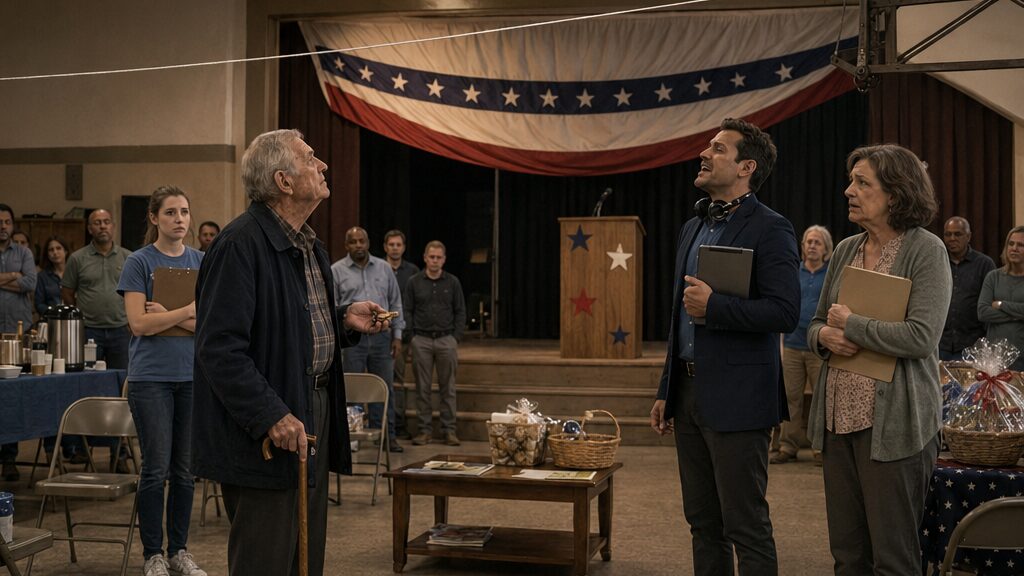
The banner jerked once above the stage, sharp enough that the wooden rod along its bottom edge tapped the wall like a knuckle on a coffin lid.
Frank Whitaker stopped in the middle of the aisle.
Around him, the community center auditorium kept moving. Volunteers carried folding chairs two at a time. Someone at the front table shook red-white-and-blue confetti into glass bowls. A teenager stood on tiptoe taping paper stars to the podium. The smell of burnt coffee, dust, and floor polish hung in the warm afternoon air.
But Frank had heard the sound.
Not the tap. Not the flutter of vinyl.
The thin, tight complaint of a line taking strain in the wrong place.
He shifted his cane to his left hand and looked up.
The forty-foot welcome banner stretched across the stage beneath the old rafters, its letters wide and cheerful: HONORING THOSE WHO SERVED. It had been raised higher than usual this year, probably so the mayor could stand beneath it for photographs. Two white ropes ran up from each end, crossed through old hardware above the stage curtains, and disappeared toward the side wall.
One rope was clean. One wasn’t.
The right-hand line angled over the corner of an old metal lighting bracket, the kind the center had stopped using years ago but never removed. The bracket edge bit into the rope just below the knot. It did not look dangerous from the floor. Nothing about it sagged. The banner hung straight. The knot was neat enough to satisfy a person who had learned rigging from a chart and never had to trust it in weather.
Frank took three slow steps toward the stage.
His right knee objected first, then his left. He ignored them both. His thumb found the brass whistle on his keychain and rubbed the worn side until the metal warmed under his skin.
“Mr. Whitaker?”
A girl with a clipboard hurried over, ponytail swinging, her volunteer badge crooked on her shirt. Stephanie Mitchell. Frank knew her from Saturday food drives, though she always looked surprised when he remembered her name.
“You okay?” she asked. “Do you need a chair?”
Frank kept looking up. “No.”
She followed his gaze. “Is something wrong with the banner?”
The air-conditioning kicked again. A rectangular vent above the stage coughed cold air across the vinyl. The banner lifted, not much, but enough for the rope to drag once over the bracket. Frank heard the faint rasp.
His thumb stopped moving.
“Who hung it?” he asked.
Stephanie glanced toward the stage steps, where Jason Rivera stood with a headset around his neck and a tablet in his hand. Jason wore a navy blazer too new for the room and shoes that clicked like he had chosen them for confidence. He was pointing two volunteers toward a stack of raffle baskets.
“Jason’s crew,” Stephanie said. “They came in this morning. He said they’ve done bigger events than this.”
“Mm.”
Frank moved down the aisle until he could see the line from a different angle. There it was. The rope did not run over the bracket. It crossed the bracket. That was worse. Every time the banner lifted, the line sawed against the same narrow point.
Stephanie hugged the clipboard closer. “Should I get Jason?”
Frank’s first instinct was yes.
His second was the one that had been growing stronger these last two years: not yet.
He could already see how it would go. Jason would look up, see a banner that appeared steady, then look down at Frank’s cane. Someone would say they were behind schedule. Nancy Hill would come over with that soft director’s voice she used now, the one that made every sentence sound like a pillow around a hard thing.
Frank, why don’t you sit and enjoy tonight?
He used to have the keys to this building. Not official ones at first, just a spare set because he was the one who showed up before sunrise when the furnace failed or the chairs needed hauling or the food pantry truck backed in early. For years, the center had called him when something leaked, jammed, sagged, cracked, stuck, sparked, or smelled wrong.
Then his wife died.
After that, people began asking him less what needed doing and more whether he needed help getting up.
Nancy had meant kindly when she met him at the door that afternoon.
“Frank, I’m so glad you came,” she had said, both hands around his. “But no working tonight. You’ve done more than enough for this place. Jason has everything handled. You just enjoy the evening, all right?”
She had even placed a reserved seat card for him in the second row, beside men from the veterans’ post and their wives. A good seat. A respectful seat.
A useless seat.
“Mr. Whitaker?” Stephanie asked again.
Frank blinked and looked at her. “When is the safety meeting?”
“Jason said five. Before doors open.”
“What time is it?”
“Four forty.”
He nodded.
She hesitated, then lowered her voice. “Is it really bad?”
Frank stared at the rope until the air-conditioning stopped and the banner settled back against the wall.
“The knot is holding,” he said. “The line isn’t the problem.”
Stephanie waited.
“It’s what the line is touching.”
Her eyes lifted again, but from the floor it was just rope, banner, ceiling junk, and shadow.
Across the room, Jason clapped twice.
“Everybody, five-minute warning,” he called. “Safety briefing at the front. Then we go into final setup. Mayor’s office confirmed six-thirty arrival, children’s choir at six-forty-five, pledge at six-fifty. We cannot drift.”
A volunteer by the coffee table asked where to put the extension cords. Jason answered without looking away from his tablet. Two older women laughed over a tangled ribbon. Someone dragged a chair leg across the floor with a shriek that made Frank’s jaw tighten.
He had heard too many warnings buried inside ordinary noise.
He turned slowly and started toward the front.
At the supply table, Pamela Green was counting children’s choir folders. The folders were bright blue, each with a small white label. Eight of them. She glanced up as Frank passed.
“Evening, Mr. Whitaker. You ready for a big crowd?”
“Where are the children standing?”
“Stage front. Just for one song before the pledge.” She smiled, distracted, already counting again. “Jason marked their spots with tape.”
Frank looked.
Eight small pieces of blue painter’s tape made a row across the stage floor directly beneath the banner.
He felt the whistle press into the crease of his palm.
The old habit rose in him so suddenly he almost laughed. On a ship, he would have had the line cleared before the second complaint. No debate. No meeting. No smile from a young man with a tablet. Men learned fast when weather was coming and weight was overhead.
But this was not a ship.
This was a community center with a leaking hallway roof, a donor banner, a nervous new manager, and people who thought kindness meant keeping old men comfortable.
Frank stopped at the front row and looked for Nancy. She stood near the side door with a folder under one arm, nodding while a board member spoke too close to her face. She saw Frank watching and lifted her brows in a silent question.
He pointed up.
Nancy’s expression softened before she even followed his finger. That softness told him she had already decided what kind of problem he was.
She mouthed, In a minute.
Jason clapped again, louder this time.
“All right, team. Safety briefing. Quick and clean.”
Volunteers gathered in a loose half circle before the stage. Stephanie took a place near the coffee table. Pamela stood with her choir folders against her chest. Nancy joined Jason at the front, still scanning her paperwork.
Jason smiled at the room.
“First, thank you. This fundraiser matters. We’ve got veterans’ families, local businesses, press, and the mayor coming through those doors in less than an hour. So I need everybody sharp, positive, and on schedule.”
Frank stood near the aisle, both hands on his cane.
Jason tapped his tablet. “Exits are marked. Food service stays behind the left line. Choir enters from stage right, exits down the center steps. No loose cords, no open flames, no blocking the donor table. Rigging is already approved, so nobody touches anything above shoulder height without checking with me.”
Frank looked up once more.
The banner shifted.
Just enough.
“Any questions?” Jason asked. He answered his own question by glancing at the tablet again. “Good. Any real safety concerns before we move?”
Frank’s fingers tightened around the cane handle.
For one breath, he thought of letting it pass. Of watching. Of hoping the line held through the pledge and one song and a few photographs. Of being the old man who had noticed but not bothered anyone.
Then the air-conditioning breathed again, and the rope gave that thin, tired sound.
Frank raised one trembling hand.
Chapter 2: When Jason Laughed at the Old Man’s Warning
Jason laughed before Frank had finished speaking.
It was not a small laugh. It rose bright and careless across the auditorium, loud enough that the volunteers at the coffee table turned around with cups in their hands.
Frank’s words hung under the banner.
“The rigging is wrong.”
Jason’s smile stayed in place, but his eyes tightened. “Mr. Whitaker.”
He said the name with warmth polished over impatience, the way people spoke when they wanted the room to see how kind they were being.
Frank lowered his hand to the rubber tip of his cane.
Jason glanced at Nancy, then at the volunteers. “We appreciate your service, sir. Truly. But this isn’t the Navy. It’s a veterans’ fundraiser. The rope is fine.”
A few people smiled. Not cruelly, not all of them. Some looked down at their cups as if embarrassment were something they could avoid by staring into coffee. Someone near the back muttered, “Here we go,” and Frank heard it as clearly as he had heard the rope.
He had always heard the small things.
The faint tick before a pulley jammed. The different slap of wet line against steel. The change in a young sailor’s breathing when fear got ahead of training. Twenty-two years aboard Navy ships had trained his ears before age had thinned them. He had trusted sound before sight because storms often took sight away first.
He looked at Jason. “It’s not the rope.”
Jason gave the room another patient smile. “Then what exactly is the concern?”
“The knot against that metal edge.”
Jason tipped his head up toward the rafters, barely looking. “The knot is standard.”
“The knot may be.” Frank pointed with two fingers, not his whole hand. His shoulder did not lift easily anymore. “But the line crosses that old lighting bracket. When the vent comes on, the banner lifts. The line moves. The edge is cutting into it.”
Jason lowered his head slowly.
For a moment, the room shifted. Not enough to become belief, but enough for attention. Stephanie’s pencil stopped moving over her clipboard. Pamela Green looked from Frank to the row of blue tape marks on the stage. Patrick Allen, standing near the podium in a dark suit with a flag pin, turned his shoulders slightly toward the banner.
Jason felt that change and stepped into it.
“These are outdoor-rated lines,” he said. “We use them for all events.”
“This isn’t outdoors.”
The sentence landed too plainly. It made a few people smile again, this time sharper. Jason’s cheeks colored.
“Mr. Whitaker,” he said, “I don’t want you worrying about technical setup. My crew hung that banner this morning. We’ve done festivals, runs, outdoor stages, all kinds of things.”
Frank rubbed the brass whistle on his keychain with his thumb. “Wind doesn’t only happen outdoors.”
“We’re indoors.”
“The side doors don’t seal.”
Jason’s smile went still.
Nancy shifted beside him. Frank saw the choice pass across her face. She knew the side doors rattled in bad weather. She knew the bracket was old. She knew Frank had fixed more things in this room than Jason had yet learned the names for.
But she also knew donors were coming. She knew the mayor’s office wanted a smooth event. She knew Jason was her new hire, her proof to the board that the center was modernizing instead of limping along with favors from retired men and handwritten lists.
“Frank,” she said gently, “we did have the setup reviewed.”
“By who?”
Jason answered before Nancy could. “By me.”
Frank looked at him.
The room had gone too quiet.
Jason lifted his tablet. “The checklist is complete. The load is minimal. The rope is rated. The banner is vinyl. The rod is lightweight. We are behind schedule.”
“The weight is not the only issue.”
“Sir, with respect—”
“That’s not respect,” Frank said.
The words came out softer than he intended, but they carried.
Jason’s expression changed. For the first time, the smile disappeared completely. Frank regretted the sentence almost as soon as he heard it, not because it was false, but because it had stepped past the line he usually kept for himself.
Jason looked around the room and found his audience again.
“Okay,” he said, clapping once. “Here’s what we’re not going to do. We’re not stopping a community fundraiser with guests arriving in forty minutes because Mr. Whitaker doesn’t like a knot.”
Frank felt something old and hot move under his ribs. He pressed his thumb hard into the brass whistle.
“I didn’t say I didn’t like it.”
“You said the rigging was wrong.”
“It is.”
“And I’m telling you it has been handled.”
Patrick Allen cleared his throat near the podium. “Maybe someone can take a quick look from the ladder.”
Jason turned toward him, and for one second Frank saw the fear beneath the irritation. Jason was not only annoyed. He was cornered. A ladder would mean delay. Delay would mean questions. Questions would mean the new manager had missed something in front of Nancy, the board, and the volunteers.
Jason smiled at Patrick now. “Colonel, I appreciate that. But if we start second-guessing every finished item, we won’t open the doors on time.”
Patrick’s face settled back into ceremony. He nodded once, not quite agreement, not quite refusal.
Frank swallowed.
There it was. Rank recognized rank, suit recognized suit, and the room relaxed because the awkward moment seemed to have found its proper place. The old man had been heard. The young manager had answered. The schedule had survived.
Only the rope had not changed.
Jason turned back to the volunteers. “Nobody touches the rigging. Nobody climbs anything. If you see an issue, you bring it to me. Otherwise, we keep moving. Understood?”
A scattered murmur answered him.
Frank looked at Nancy.
She would not meet his eyes.
Jason tapped his tablet. “Stephanie, help Pamela with the choir entrance path. Food table, make sure the warmers are behind the tape. Raffle baskets stay right side. Let’s go.”
The half circle broke apart.
Chairs scraped. Paper rustled. Coffee cups lifted. People were grateful for movement. Movement let them pretend no one had been humiliated.
Frank stood still until the aisle cleared.
Stephanie passed him, then slowed. Her cheeks were pink. “Mr. Whitaker, I—”
“Do your job,” Frank said.
She flinched slightly.
He closed his eyes for half a second. He had not meant it as a rebuke. He had meant: do not get in trouble on my account. He had meant: watch the children’s path. He had meant too many things for three words to carry.
When he opened his eyes, she was still there.
He softened his voice. “Stay clear of the stage front when you can.”
She nodded, uncertain, and hurried away.
Frank started toward the stage.
His knee caught on the first step down from the aisle. He paused, breath held, until the joint agreed to bear him. He hated that pause more than pain. Pain was private. The pause was visible.
At the side of the stage, he tilted his head and studied the line again.
The banner lifted when the vent blew. The rope moved less than an inch. Most people would not count an inch. Frank had learned that inches were often where trouble began.
He could not reach the bracket without a ladder. He could not climb the ladder without making himself the spectacle Jason expected. He could not pull the banner down without being removed.
He could still reduce the bite if he could get canvas over the lower edge. He could still tie a telltale below the main line where movement would show. Not a fix. A warning. A poor substitute for authority.
But better than wishing.
He turned toward the supply table.
Stephanie was there with Pamela, arranging choir folders by height. Jason stood a few feet away, speaking into his headset though there was no one on the other end yet.
Frank took one step.
Jason saw him.
“Stephanie,” Jason called sharply. “Don’t let him touch the rigging.”
The words crossed the room and pinned her in place.
Frank looked at the girl. She looked at the banner, then at Jason, then at Frank’s cane.
For a moment, nobody moved.
Then Frank turned, slow but steady, and walked toward the stage anyway.
Chapter 3: The Little Cord Nobody Thought Mattered
The children were singing under the banner when Frank reached the stage.
Not the full song yet, only a warm-up line Pamela Green tapped out with two fingers against a music stand. Their voices rose thin and uneven in the half-empty auditorium, eight children standing on eight pieces of blue painter’s tape. Above them, the welcome banner stirred in the air-conditioning draft and settled back against the wall.
Frank stopped at the edge of the stage and looked at the space between the wooden rod and the children’s heads.
Too close.
Pamela noticed him and lowered one hand. The children fell quiet in a ragged line.
“Mr. Whitaker?” she said. “We’re just running placement.”
“Move them back two feet.”
Pamela glanced at the tape marks. “Jason marked these.”
“Move them anyway.”
Her mouth tightened, not in anger but in the strain of a woman already balancing parents, music, timing, and a room full of adults who all believed their own concern came first.
“I can ask him,” she said.
“No time for asking every time common sense speaks.”
The sharpness in his own voice surprised him.
A boy in the front row stared. Pamela’s eyes flicked toward Frank’s cane, then toward the banner, then back to the children.
“All right,” she said, careful now. “Everyone, heels behind the second tape line. Just for rehearsal.”
There was no second tape line, so the children shuffled backward until Pamela held up both hands. Frank let out a breath he had not known he was holding.
Behind him, Jason’s shoes clicked across the floor.
“Mr. Whitaker.”
Frank did not turn.
The vent came on again. Vinyl lifted. Rope rasped.
Jason reached the stage steps. “I thought I was clear.”
“You were.”
“Then why are you giving instructions to my performers?”
Frank looked at him. “They’re children.”
Pamela pressed her folders against her chest. “It’s all right, Jason. We can sing from a little farther back.”
Jason’s jaw worked once. He could not scold her in front of the children, so he saved the look for Frank.
“Please step away from the stage.”
Frank stepped sideways, not away, and continued studying the line.
Jason leaned closer, lowering his voice. “You are making people nervous.”
“They should be.”
“That’s exactly the problem.”
“No,” Frank said. “The problem is overhead.”
Jason looked toward Nancy, who was across the room greeting a donor. He took one breath through his nose.
“Do not touch anything connected to that banner.”
Frank finally turned to him. “I heard you.”
“And?”
“And I’m going to stand where I can see it.”
Jason stared as if deciding whether to make the confrontation larger. Then his headset crackled with a test tone, and someone called his name from the lobby.
He pointed two fingers at Frank. “No touching.”
Frank did not answer.
Jason left, speaking too loudly into his headset.
Pamela resumed rehearsal, but she kept the children back. That much, at least, had changed.
Frank moved to the supply table when no one was looking directly at him. The table held scissors, tape, zip ties, extension cord covers, spare place cards, a first aid kit, and three coils of cord in a plastic bin. He lifted one coil and felt it between thumb and forefinger. Too slick. Decorative. He put it back.
At the bottom of the bin, under a roll of duct tape, he found a short length of cotton cord. Not strong enough to hold anything heavy. Strong enough to tell the truth before the main line did.
Stephanie appeared at the other side of the table.
“Jason said—”
“I know what Jason said.”
Her fingers tightened around the clipboard. “He’ll blame me if I help.”
“He might.”
That honesty made her blink.
Frank picked up the canvas tape roll. Empty cardboard showed through the middle. There was just enough left.
“I need three strips,” he said.
“I thought you weren’t touching the rigging.”
“I’m not.”
She looked at the tape, then at the stage. “Then what are you doing?”
“Giving myself a way to be wrong.”
Stephanie frowned.
Frank tore one strip of canvas tape with his teeth. His dentures slipped slightly, and he felt heat rise in his face. He turned away until he had them set again. When he looked back, Stephanie was pretending not to have noticed.
That small mercy almost undid him.
He tore two more strips and tucked them over his left wrist. Then he took the cotton cord.
“My hands aren’t what they were,” he said. “Hold this end still.”
Stephanie stared at him. “Mr. Whitaker…”
“Either help me do a small thing carefully, or watch me do it badly.”
For a moment, her fear of Jason fought with something else. Curiosity, maybe. Or the look of the children standing under the banner. She set down the clipboard and held the cord.
Frank bent over the table, his knees burning. He tied a small loop, slow and precise. His fingers trembled, but they remembered. Over, under, snug, not strangled. Leave room for movement. Let strain show before failure.
Stephanie watched the knot form.
“You learned that in the Navy?”
“I learned that before the Navy,” Frank said. “The Navy taught me what happens when you don’t check it.”
He took the loop and moved toward the stage wall where the rope descended near an old mounting hook. He could not reach the bracket itself. He could reach the lower angle where the line shifted when the banner lifted. He wrapped the canvas tape around the accessible edge below the bracket, not a true fix, only a buffer where secondary movement might scrape. Then he tied the cotton loop beneath the main line, positioned so that if the rope sawed too much, the smaller cord would pull loose first.
Stephanie stood close enough to block part of him from the room.
“What’s that for?” she whispered.
“To tell me if I was wrong.”
She looked at the little loop. “And if you’re not?”
Frank leaned on his cane, breath tight. “Then it falls before the banner does.”
He saw understanding reach her face and frighten her.
“Should we tell Jason again?”
Frank almost said yes.
The word rose and stopped behind his teeth.
He looked toward Jason, who was laughing with two donors near the lobby doors, tablet tucked under his arm, every inch the man in charge. Then toward Nancy, who was smoothing the front of the donor table. Then toward Pamela, who had the children singing softly from two feet farther back than the tape.
Frank imagined walking into the center of the room and demanding a ladder. He imagined Jason’s smile thinning. He imagined Nancy saying, Frank, please. He imagined Amanda hearing about it later and asking why he kept pushing when people were only trying to help.
His thumb found the brass whistle again.
“Watch the loop,” he told Stephanie.
“That’s all?”
“For now.”
The disappointment in her face was worse than Jason’s laughter.
Before she could answer, Jason’s voice cut across the stage.
“What is that?”
Frank turned.
Jason was already striding toward them. His gaze fixed on the small cord beneath the line, then on the tape, then on Stephanie.
“I told you not to touch the rigging.”
“She didn’t,” Frank said.
Jason stopped close enough that Frank could smell mint on his breath. “Did you?”
“I did not alter the main line.”
“That is not what I asked.”
“I gave myself a warning.”
“You gave yourself permission.”
Pamela stopped rehearsal again. The children went quiet. Across the room, a few volunteers looked over, then quickly looked away. Nancy noticed the cluster and started toward them.
Jason lowered his voice, but the anger stayed in it. “Mr. Whitaker, if you interfere one more time, I will have to remove you from the volunteer list for tonight.”
Frank heard Stephanie inhale.
For a second, the room narrowed to the rubber tip of his cane on the floor, the whistle under his thumb, the small cord tied where nobody thought to look.
The volunteer list.
As if the work had been a favor granted to him. As if the center had not called him for fifteen years before Jason knew where the breaker box was.
Frank felt the old heat again. He could have told Jason about lines in winter storms, about sailors young enough to be his sons waiting for him to say whether a deck was safe, about the night he tied three men to a rail because he did not like the way the sky had gone green.
Instead, he said, “Then remove me after the children sing.”
Jason stared at him.
Nancy reached them, breathless from hurrying in dress shoes. “What’s going on?”
Before Jason could answer, a woman’s voice came from the side aisle.
“Dad?”
Frank closed his eyes.
Amanda stood near the front row, raincoat over one arm, her expression already pulled tight with worry. She looked from Jason to Nancy to the little cord under the banner, then back to her father.
“What happened?” she asked. “Have you been causing trouble again?”
Chapter 4: The Daughter Who Took the Keys for Love
“Dad, please don’t make them regret inviting you,” Amanda said, and above her the banner creaked as if the room itself had heard.
Frank turned his head just enough to see the rope move. The little cotton loop beneath it trembled once, then settled.
Amanda stepped closer, raincoat folded over her arm, her hair damp at the edges from the first hard drops outside. She had her mother’s way of pressing her lips together when worry became anger. Frank had watched that expression cross her face in hospitals, parking lots, grocery aisles, and once in his own kitchen when she found the truck keys still hanging beside the door after she had asked him not to drive at night.
Jason took the opening like a man offered a rope of his own.
“Ms. Whitaker,” he said, smoothing his voice. “I’m glad you’re here. We’re trying to keep the event on schedule, and your father is concerned about the banner.”
Amanda looked up, then back to Frank. “The banner?”
“The line is rubbing against the bracket,” Frank said.
Jason exhaled through his nose. “The rigging has been checked.”
“By you,” Frank said.
Amanda’s eyes moved between them. Behind her, guests were beginning to enter the lobby, shaking umbrellas, brushing rain from jackets, greeting each other in voices that bounced off the cinderblock walls. The fundraiser was no longer preparation. It was becoming public.
Nancy joined them, hands clasped around her folder. “Amanda, everything’s all right. Frank noticed something he wanted us to be aware of.”
That was the sort of sentence Nancy used when she needed a problem to shrink.
Frank felt it. Aware of. Not fix. Not inspect. Not stop.
Amanda touched his sleeve. “Dad, maybe come sit with me for a minute.”
“I’m watching the loop.”
“What loop?”
Stephanie, standing half behind the supply table, looked as if she wished the floor would open. Frank did not point toward her. He pointed toward the cord.
“That one.”
Amanda squinted. “You tied something up there?”
“Below the main line.”
Jason gave a small, humorless laugh. “After being asked not to touch the rigging.”
“It isn’t holding weight,” Frank said. “It’s a telltale.”
“A what?” Amanda asked.
“A warning.”
Her face softened in the worst way. “Dad.”
He knew that tone. It was the tone she used when she found a pan left on the stove, when he forgot to charge his phone, when he mixed up the date of a doctor’s appointment. Not anger first. Fear wearing anger’s coat.
“Don’t,” he said.
She withdrew her hand as if he had slapped it.
Jason’s headset chirped. He pressed one finger to it and turned away. “Yes, open the left doors. Keep the donor table clear. No, the mayor is not here yet.” He looked back at Nancy. “We need to move.”
Nancy gave Frank a pleading look. “Frank, please. Let Jason run the event.”
Frank looked past her to the stage. Pamela had moved the children away for the moment. They clustered beside the piano, restless and whispering, while parents began filling the chairs. The blue tape marks still waited beneath the banner like little invitations to stand in the wrong place.
“I’m not stopping him running it,” Frank said. “I’m asking him to check it.”
Jason lowered the headset. “And I’m telling you we are past that point.”
Frank looked at him for a long second. “That’s not a point you pass.”
The words had weight. Even Jason felt it. But a board member called Nancy from the lobby, and the spell broke.
Amanda slid her arm through Frank’s. “Come on. Walk with me.”
He almost refused. Then his knee sent a hot strip of pain up his thigh, and he hated himself for being grateful she had offered her arm.
They moved into the side hallway, away from the stage lights and the eyes. The hallway smelled of damp coats and old bulletin boards. From the auditorium came the rising sound of guests arriving: laughter, chair legs, microphone feedback, Jason’s voice trying to be everywhere at once.
Amanda stopped beside the framed photographs of past fundraisers. Frank was in several of them. Younger, straighter, holding a ladder in one, carrying a tray in another, standing behind a table of donated canned goods with his wife beside him. In that photograph, she was laughing at something outside the frame.
Amanda saw where he was looking and looked away first.
“I’m not trying to embarrass you,” she said.
“I know.”
“Then why does everything feel like a fight lately?”
Frank gave a dry little breath. “Because you keep taking things and calling it help.”
Her eyes flashed. “Your truck keys?”
“For one.”
“You backed into the mailbox.”
“I scraped it.”
“You didn’t see it.”
“It was dark.”
“That’s my point.”
“No,” he said, sharper than before. “Your point is you got scared.”
She stared at him.
The auditorium doors opened, and a gust of damp air rushed down the hallway. The banner inside gave a low flap. Frank’s head turned toward the sound automatically.
Amanda noticed.
“You do that all the time,” she said quietly.
“What?”
“Leave in the middle of a sentence. Not with your feet. Just… gone.”
Frank looked back at the photograph. His wife’s smile stood in the frame, untouched by the two years since she had died.
Amanda folded her raincoat tighter. “After Mom, you stopped telling me things. You stopped calling when something hurt. Stopped asking for help until I had to guess. I’d come over and the porch light would be out, or the fridge would be empty, or you’d say you were fine when you hadn’t slept.”
Frank’s fingers found the whistle again, but this time he did not rub it. He just held it.
“So I took the keys,” Amanda said. “Maybe I shouldn’t have. But I didn’t know what else to take hold of.”
From inside the auditorium, the microphone popped.
“Good evening, everyone,” Jason’s amplified voice said. “We’ll begin shortly. Thank you for supporting our veterans’ community fund.”
Amanda’s mouth tightened. “I’m scared, Dad.”
Frank’s reply came too fast. “So am I.”
She blinked.
He had not meant to say it.
The hallway seemed to narrow around them.
“I’m scared,” he said again, quieter now, “that one day I’ll agree with everybody. Sit down, Frank. Don’t lift that, Frank. Don’t drive, Frank. Don’t worry about the rope, Frank. And then I’ll look up and won’t know when I stopped being a man and became somebody’s chore.”
Amanda’s face changed, but before she could answer, Patrick Allen came through the hallway from the lobby, adjusting his flag pin. He gave Frank a polite nod.
“Whitaker,” he said. “Good to see you. They’ve asked me to lead the pledge tonight. Hope you don’t mind.”
Frank’s hand closed around the whistle.
For years, he had led it when the center held veterans’ events. Not because his voice was strongest. Because Nancy had once said he made the room quiet without asking.
“Not at all,” Frank said.
Patrick paused, hearing something beneath the answer. “They like a formal touch for the mayor, I suppose.”
Amanda looked at Frank.
Frank looked toward the auditorium doors.
Jason’s voice continued through the speakers, polished and quick. “We’re monitoring the weather, and everything remains on schedule.”
A phone buzzed in Nancy’s hand as she hurried past the hallway entrance. She glanced at it and stopped.
Frank saw her face tighten.
“What is it?” he asked.
Nancy looked up, startled he had noticed. “Weather alert. Severe thunderstorm warning now. High winds.”
Jason appeared behind her, headset on, tablet tucked under one arm. “We’re indoors.”
Frank felt Amanda’s arm stiffen against his.
Nancy lowered her voice. “Jason, maybe we delay the choir until the first gust line passes.”
“The mayor’s office is six-thirty. The choir has to be done before the pledge. Donors are here. We cannot start changing the run of show in the hallway.”
“Side doors don’t seal,” Frank said.
Jason turned on him. “Please don’t start again.”
A gust struck the building hard enough to rattle the metal push bar on the side exit. Several guests in the auditorium laughed nervously. The old community center lights flickered once and steadied.
From the stage came a faint snap.
Not breaking. Not yet.
Frank stepped away from Amanda and moved toward the auditorium doors.
“Dad,” she said.
He did not stop.
Inside, the banner lifted like a sail.
The white rope tightened across the bracket.
And the little loop of cotton cord Frank had tied beneath it twitched hard, then hung crooked, one strand stretched thin as a hair.
Chapter 5: Not While Children Were Standing Under It
The mayor stepped to the podium just as Pamela Green guided the children into place beneath the banner.
Frank stood at the back of the center aisle with one hand on his cane and one hand closed around the brass whistle. The auditorium was full now. Wet coats steamed faintly over chair backs. Paper programs fluttered in people’s hands each time the old air-conditioning kicked on. Outside, thunder pressed against the building, not loud yet, but close enough to make the windows tremble in their frames.
The children lined up on the blue tape marks.
Frank’s jaw tightened.
Pamela had moved them back during rehearsal, but the stage had been reset for the program. Jason was at the side with his headset, pointing quickly, silently correcting positions. The first row of children shuffled forward until their toes met the tape.
Stephanie stood near the right stage steps with her clipboard against her chest. She was not watching the mayor. She was watching the little cord.
That mattered.
It was not enough.
“Good evening,” the mayor said into the microphone, and the speakers gave a warm hum. “What an honor to be here with so many families, neighbors, and men and women who have served…”
Frank looked up.
The banner hung steady for three seconds. Four. Then the vent breathed cold air across it. The vinyl lifted away from the wall. The wooden rod rolled slightly in its hem. The rope drew tight across the bracket and gave that same thin complaint.
Frank’s thumb slid over the whistle.
Blow it, some old part of him ordered.
But this was not a drill deck. This was a room full of civilians, children, donors, a mayor, old soldiers with hearing aids, and a young manager who had already painted him as a disruption. A whistle blast would panic people. A shout might freeze them. A wrong command could cause the very crush he wanted to prevent.
So he watched the loop.
Amanda stood beside him now, her arms folded tight. She had followed him in from the hallway but had not spoken. Every few seconds she looked at his face, then at the banner, as if trying to read what he read.
“Dad,” she whispered, “how bad?”
He did not answer at once.
Patrick Allen waited beside the podium for his turn, upright and composed, his suit jacket buttoned. Jason moved to Pamela and whispered something. Pamela nodded, distracted, then lifted one hand to quiet the children.
The mayor continued. “Tonight’s fundraiser will help maintain this historic center and support programs for veterans and their families…”
Historic, Frank thought. That was what people called a building when they did not want to say old.
Another gust hit.
The side doors rattled hard enough that several heads turned. The banner rose. The line jerked. The little cord snapped loose and dropped from beneath the rope.
Stephanie saw it fall.
Her mouth opened.
Frank was already moving.
“Clear the stage,” he said.
His voice did not boom. It cut.
Amanda startled beside him. Two people in the row ahead turned around. The mayor paused, one hand on the edge of the podium.
Jason looked toward the back. “Sir, please sit down.”
Frank kept walking down the aisle. His cane struck the floor once, twice, three times. The whistle bit into his palm.
“Clear the stage now.”
The children looked at Pamela. Pamela looked at Jason. Jason lifted both hands, a public smile fighting with private anger.
“Everything is fine,” he said, loud enough for the room. “We’re just having a minor interruption.”
Stephanie ran up the stage steps.
That broke the room’s script.
“Ms. Green,” she said, breathless, grabbing Pamela’s sleeve. “The little cord he tied. It snapped.”
Pamela’s face drained.
Jason stepped toward Stephanie. “Get off the stage.”
Frank reached the front row. His knees were burning now, but pain had become distant, a signal from another room.
“Children off the marks,” he said.
Pamela moved.
Not fully. Not with confidence. But enough. She put both arms out and backed the children away from the blue tape. “Step back. Everyone step back with me.”
A murmur traveled through the audience.
Jason’s face flushed. “Pamela, stop. You’re frightening them.”
“The line is cutting,” Frank said.
“You don’t know that.”
“I know enough.”
“You cannot stop the whole fundraiser over a rope.”
“I’m not worried about the rope.”
Jason stared at him, breathing hard. “Then what exactly are you worried about?”
Frank pointed upward. “The edge it’s been rubbing against all afternoon.”
The room looked up as one body.
For a second, nothing happened.
That second almost ruined him.
He felt it: the doubt, the embarrassment, the possibility that the cord had fallen from his own poor knot, that Jason would be confirmed, that Amanda would drive him home in silence and never return the keys, that Nancy would stop calling altogether, that everyone would remember this as the night Frank Whitaker finally became too old to trust.
Then Patrick Allen turned his head and looked at Frank.
Not at the cane. Not at the trembling hand. At Frank’s face.
Something passed between them that had nothing to do with rank or ceremony. Recognition, perhaps. Or memory. The old colonel knew what command sounded like when it came from somewhere deeper than volume.
Patrick stepped away from the microphone.
“Move,” he said to the mayor quietly.
The mayor obeyed before understanding why.
Jason saw Patrick step back and lost the last bit of polish from his face. “This is unnecessary.”
Frank lifted the brass whistle halfway to his mouth.
Amanda saw it and whispered, “Dad…”
He lowered it again. Not yet.
“Jason,” Nancy said from the side aisle, voice shaking now, “maybe we should—”
A gust slammed the building.
The right-side exit doors banged against their frame. The lights flickered. The banner snapped outward like a sail catching wind. The rope screamed.
Not a metaphor. Not a creak. A high, tearing sound that made every conversation die.
“Off the stage!” Frank barked.
This time he did not care who thought him rude.
Pamela grabbed the nearest child and pulled. Stephanie pushed two more toward the steps. Patrick reached the podium and guided the mayor down and away. The children stumbled, confused, one of them crying now. A parent stood up so fast her chair tipped backward.
Jason froze.
Frank saw his eyes go to the bracket.
At last, the young man saw it too.
The rope had frayed white and gray where it crossed the metal edge. Fibers sprang out like hair. The knot remained neat. The rope remained rated. The bracket did not care.
“Move!” Frank shouted again.
Jason snapped out of it and grabbed the music stand, yanking it aside as Pamela got the last child past the tape marks.
For one breath, the front of the stage was empty.
Then the line parted.
The right side of the banner dropped first. The wooden rod swung down in a hard diagonal arc, striking the podium with a crack that split through the speakers. The microphone shrieked. The rod bounced, whipped across the front of the stage, and slammed onto the floor exactly where the children had been standing moments earlier.
One end knocked over the music stand. The other struck the first blue tape mark and skidded to a stop against the stage step.
Silence fell so completely that Frank could hear the banner vinyl sliding down the wall.
The mayor stood pale beside Patrick. Pamela had both arms around two children. Stephanie was crying without sound, her clipboard on the floor. Amanda’s hand covered her mouth.
Jason’s headset hung crooked against his cheek.
Frank remained in the aisle, cane planted, whistle in his fist, breathing hard through his nose. His knees were shaking now. He did not trust them to move.
No one laughed.
No one told him to sit down.
The broken rope dangled from above the stage, twisting slowly against the old metal bracket.
Then the wooden rod rolled once, hollow and final, across the floor where eight children had been standing ten seconds earlier.
Chapter 6: It Was What the Rope Was Rubbing Against
The fallen rod rolled against the podium and stopped with a soft wooden knock.
Nobody moved.
The auditorium held its breath around the wreckage: the torn banner sagging from one side, the microphone hanging over the podium edge, the blue tape marks exposed beneath the fallen rod like small, bright accusations. A child sniffled. Somewhere near the back, a program slipped from someone’s lap and whispered to the floor.
Frank took one step toward the stage.
His right knee nearly gave.
Amanda was beside him at once. “Dad.”
“I’m all right.”
“You’re not.”
He did not argue. He let her hand steady his elbow for three steps, then gently pulled free before they reached the stage. Not because he did not need help. Because there were things a man had to pick up himself.
He bent slowly, breath held, and lifted the broken end of the rope.
The fibers were frayed where they had parted, not clean, not sudden. Strand after strand had been worn through by the bracket until only a few had carried the load. He held it between thumb and forefinger. His hand trembled, but the rope told a steady story.
Jason stood at the side of the stage, staring up at the bracket.
“It wasn’t the rope,” Frank said.
His voice sounded smaller now in the dead room.
Jason turned.
Frank held the frayed section out. “It was what it was rubbing against.”
The words did not accuse. That made them worse.
Pamela sank into a chair with two children pressed against her sides. Stephanie wiped her face with the heel of her hand and looked at the little cotton loop lying near the stage step. Patrick Allen picked up the toppled chair in the front row and set it upright with careful hands.
Nancy came forward, pale beneath her makeup. “Everyone, please remain calm. We’re going to take a short break and make sure everyone is safe.”
Safe. The word wavered.
Parents moved toward the children. Chairs scraped. People began speaking in low bursts, the room returning to sound by pieces. The mayor’s aide hurried with a phone. A volunteer unplugged the microphone. Jason still had not moved.
Nancy touched Frank’s sleeve. “Frank, thank God you saw it.”
He looked at her hand until she removed it.
“I saw it before,” he said.
Her eyes filled, not with tears exactly, but with the sudden knowledge that gratitude could not erase timing.
“I know,” she whispered.
Jason swallowed. “Mr. Whitaker…”
Frank turned toward him.
The young man’s mouth opened, closed, opened again. His headset wire twisted under his jaw. Without the confident voice, without the tablet raised like a shield, he looked very young.
“I checked the weight rating,” Jason said.
Frank nodded. “I believe you.”
“I checked the knots.”
“I believe that too.”
Jason looked at the rope in Frank’s hand. “I didn’t check the path.”
“No.”
The answer landed between them, plain and heavy.
Nancy straightened as two board members approached, alarmed and already calculating consequences. “Frank,” she said quickly, louder now, “what you did tonight was heroic. Everyone here needs to know that. We should recognize you properly before people leave.”
Frank looked past her to the children.
One little girl was crying into Pamela’s blouse. Stephanie stood beside them, still shaking, trying to be useful by gathering the fallen choir folders with hands that would not obey.
“No,” Frank said.
Nancy blinked. “No?”
“No microphone.”
“But people should understand—”
“They understand enough.”
A board member murmured, “The donors are upset.”
Frank looked at him. “They should be.”
Nancy took that like a slap, though Frank had not meant it for her alone.
Jason removed the headset and held it in both hands. “The event can’t continue like this.”
“No,” Frank said.
Nancy pressed her folder against her stomach. “We’ll refund tickets if we have to. We’ll reschedule the program. I need to document what happened.” Her eyes moved to Jason. “We had the outdoor event checklist, correct?”
Jason’s face tightened. “Yes.”
“For indoor rigging?”
“It covers lines and load.”
Frank looked up at the bracket. “Does it cover edges?”
Jason did not answer.
Nancy’s silence answered first.
Frank lowered the rope.
A different kind of quiet moved through the small group now. Not shock. Recognition. The center had not been saved by a checklist. It had been endangered by one that let people stop looking.
Nancy rubbed her forehead. “We don’t have a written indoor rigging checklist.”
Jason looked at her. “Nancy—”
“We don’t,” she said, voice breaking at the edge. “We have setup notes. We have vendor forms. We have fire exits and food permits. We don’t have what he was asking for.”
Frank wanted to feel satisfaction. It would have been easy. Clean, even. A young man wrong. An old man right. The room waiting.
But all he felt was tired.
Not just in his knees, though they were throbbing now. Tired of needing danger to translate him. Tired of being believed only after wood struck the floor. Tired of seeing Amanda’s frightened face and knowing she had almost been right to fear the world around him, just not in the way she thought.
Jason stepped closer.
“I should’ve listened,” he said.
The words were too quiet for the room, meant only for Frank.
Frank studied him. He saw shame there, and fear, and the instinct to explain himself before blame found him. He remembered that instinct from men half Jason’s age on storm decks and in engine rooms, men who learned only after something small became large.
Frank could have made him smaller.
He could have asked whether the rope was still fine. He could have repeated this isn’t the Navy. He could have held up the frayed line for the donors and the board and let Jason stand there while every face turned.
Instead, Frank placed the broken rope in Jason’s hands.
“Next time,” he said, “don’t listen because I’m old. Listen because I checked.”
Jason’s fingers closed around the rope.
His face worked once, and he looked down.
Frank turned before the young man could apologize again. He had no use for more words inside that room. The air was too warm, the lights too bright, the whispers too full of him.
He walked toward the side exit.
Amanda followed but did not touch him this time. That restraint cost her; he could feel it pacing beside him.
Outside, rain struck the pavement in silver sheets. The flag above the pole snapped and twisted against the darkening sky. Frank made it as far as the concrete base before he had to stop. He put one hand against the pole, lowered his head, and let the pain in his knees show because there was no one in front of him now except his daughter.
Amanda stood behind him for several seconds.
Then she stepped around so he could see her.
Her eyes were wet, though whether from rain or something else, he could not tell. She reached into her coat pocket and took out a small ring with two keys on it. His truck keys. The old brass tag from the dealership still hung beside them, worn almost smooth.
Frank stared at them.
Amanda did not smile. She did not make a speech. She simply placed the keys in his open hand and closed his fingers over them.
Inside the community center, voices rose around the fallen banner, around Jason, around Nancy and the board and the question of what would happen next.
Frank stood in the rain with the keys in one hand and the silent brass whistle in the other, unsure which weight he was supposed to trust first.
Chapter 7: The First Knot He Taught Without Anger
The volunteers came expecting a thank-you ceremony and found ropes laid across the folding tables.
Canvas tape sat beside exit maps. Three old brackets had been clamped to a practice board. A strip of vinyl banner hung from the edge of the stage, not high enough to hurt anyone, just high enough to move when the air-conditioning breathed across it. Beside the coffee urn, where raffle baskets had stood a month earlier, Frank Whitaker had placed a notebook full of careful drawings.
At the center of the front table lay his brass whistle.
Nobody touched it.
Nancy Hill stood near the doorway with a stack of printed agendas she had not yet handed out. She watched the first volunteers slow as they entered, their smiles faltering when they realized there was no podium, no framed certificate, no patriotic centerpiece, no microphone waiting for Frank.
Only work.
“This is different,” one of the board members said under his breath.
Frank heard him.
He sat at the front table, cane against his knee, both hands folded loosely around a short length of rope. His truck keys were in his coat pocket. Amanda had driven behind him in her own car instead of insisting on bringing him, and the space between their vehicles on the road had felt strange and wide and almost kind.
Stephanie Mitchell came in carrying her clipboard again, though this time she had tucked a pencil behind her ear. She stopped when she saw the practice board with the brackets.
“You brought the edge,” she said.
Frank nodded. “Couldn’t bring the whole ceiling.”
She smiled, then looked at the brass whistle. “Is that part of it?”
“It is today.”
More people entered, quieter than usual. Pamela Green arrived with two parents from the choir committee. Patrick Allen came in without a suit jacket, wearing a plain sweater under his coat. He nodded to Frank and took a seat halfway back, not in the front as an honored guest, not in the rear as an observer. Just among the others.
Jason Rivera arrived last.
The room noticed.
He paused at the doorway, one hand on a folder thick with papers. For a moment, Frank saw him as he had stood after the banner fell, holding the frayed rope like it had burned him. Jason’s face was thinner now, or maybe only less arranged. He had no headset. No tablet raised at chest height. No new shoes clicking authority into the floor.
He walked to the front row and sat down.
Nancy looked relieved enough to sag. “All right,” she began, lifting the agendas. “Before we start, I want to say again how grateful we are to Frank for—”
“No,” Frank said.
The single word stopped her.
Nancy lowered the papers. A few volunteers turned toward Frank.
He did not look at all of them. He looked at the table, at the ropes, at the bracket edge, at the whistle. “If this is gratitude, we can all go home.”
Nancy’s face reddened. “Frank, I only meant—”
“I know what you meant.” He softened it as much as he could. “But thanks won’t keep a thing from falling.”
The room settled under that.
Amanda stood near the back wall. Frank had not asked her to come. She had come anyway, quietly, without hovering. When he glanced toward her, she did not move forward. She only nodded once.
Nancy placed the agendas on the table.
Frank picked up the brass whistle and held it between two fingers.
“This isn’t for noise,” he said. “Not first. It’s for stopping.”
He set it down again.
“Most trouble gives you something before it gives way. A sound. A rub mark. A smell. A loose screw. A person who keeps saying something doesn’t look right.” He lifted the rope. “You don’t have to know everything. You do have to stop long enough to check.”
No one wrote that down at first.
Then Stephanie did.
The scratch of her pencil seemed to give the others permission. Papers shifted. Pens clicked.
Frank turned to the practice board. “This is a line over a smooth curve. This is a line over an edge. Same rope. Same pull. Different result.”
His fingers moved slowly. The tremor was worse in front of people. It always was. The rope twitched against his thumb, and he had to start the first knot again.
The old embarrassment rose at once.
He felt the room see it.
A month ago, that would have made him hide his hands in his lap. Now he kept them where they were.
“My hands shake,” he said.
The sentence was plain. It had no apology in it.
Nobody looked away.
He drew the rope over itself, under, then back through. The knot formed slowly, not prettily at first, but correctly. He pulled it snug and passed it to Stephanie.
“Tell me what you see.”
She blinked. “Me?”
“You watched the loop last time.”
Color came into her face, but she took the rope. She studied it the way he had hoped she would—not for the answer he wanted, but for the thing itself.
“The knot’s not the only question,” she said.
Frank waited.
She looked at the practice board. “It matters what it touches after the knot.”
Frank nodded once.
A small breath moved through the room. Not applause. Better.
Pamela leaned forward. One of the parents beside her whispered, “That’s what happened?” and Pamela said, “Yes,” so quietly that it carried.
Jason opened the folder in his lap.
Frank saw the pages inside: diagrams, checkboxes, blank spaces, notes in a precise hand. The title at the top read Indoor Event Safety Checklist. Several lines were filled in. Several were empty.
Jason raised his hand.
The movement drew nearly every eye in the room, including Frank’s.
“I rewrote what we had,” Jason said. His voice was steady, though not easy. “Some of it. Fire exits, cable covers, load ratings, weather alerts, stage placement.” He looked down at the folder. “I left blanks where I didn’t know what I didn’t know.”
Frank studied him.
Jason held up the folder slightly. “Would you check it?”
There were many answers Frank could have given. He could have made the room remember Jason’s laugh. He could have asked whether the checklist had been approved by him. He could have enjoyed, just for a moment, the clean reversal of being asked by the man who had ordered him to sit down.
He reached for the folder instead.
“After we tie,” he said.
Jason nodded and lowered his hand.
Patrick Allen’s mouth moved almost into a smile.
Frank handed another rope to Pamela, then one to a board member, then one to Jason in the front row. “Tie what you think is right.”
That caused a rustle of discomfort.
“We’re not testing pride,” Frank said. “We’re finding what needs practice.”
The first attempts were what he expected. Too loose. Too tight. Pretty and useless. Strong in one direction, weak in another. Jason’s knot was neat, but he had dressed it wrong, the load line crossing where it would bind and slip under movement.
Jason stared at it as if insulted by his own hands.
Frank came around the table slowly. His knees still hurt. They always did. Amanda straightened at the back wall, then forced herself to stay where she was.
Frank stopped beside Jason.
“May I?” he asked.
Jason looked up, startled by the question. “Yes.”
Frank untied the knot and placed Jason’s hands back on the rope.
“Again. Slower.”
Jason obeyed.
The room watched the younger man struggle through the second attempt. Frank did not rescue him. He corrected one turn with two fingers.
“There,” Frank said. “Now look past the knot.”
Jason followed the line to the practice bracket.
“It’s touching the edge,” Jason said.
“Where?”
Jason leaned closer. He pointed.
Frank said nothing.
Jason moved the rope a half inch and placed a strip of canvas tape over the contact point. “It needs a guard there. Or a different path.”
“Good.”
The word was small, but Jason took it like something he had not expected to receive.
Across the table, Stephanie had been working with another practice line. She pulled it tight, frowned, then lifted her hand.
“Mr. Whitaker?”
Frank looked over.
She pointed to the underside of a second bracket. “This one looks smooth from here, but if the line moves when the vent hits it, it rubs there.” She touched a dark scrape on the metal. “Not at the top. Underneath.”
Frank walked over and bent close.
She was right.
Not because he had shown her that one. Because she had learned where to look.
He straightened slowly. “Mark it.”
Stephanie took a strip of tape and flagged the spot. Her hands shook a little, too.
Frank saw that and felt something loosen in him. Not relief exactly. Something quieter. The knowledge that judgment could move from one pair of hands to another without making either pair less necessary.
Nancy finally handed out the agendas. This time nobody treated them as ceremony. The volunteers wrote on them, crossed things out, added lines. Pamela asked whether children should ever stand under temporary rigging. Jason answered before Frank could.
“No,” he said. Then he glanced at Frank. “Not unless it’s been inspected from the line path down, and even then we ask whether they need to stand there at all.”
Frank nodded.
Amanda looked down at the floor.
When the first hour ended, no one left.
The coffee had gone cold. The rain outside had become a soft tapping instead of a warning. The room smelled of rope fiber, paper, and old dust stirred from the practice board. Frank’s back ached. His fingers were stiff. Twice he had dropped a cord and had to pick it up with effort.
No one rushed to do it for him.
That may have been the hardest kindness to receive.
Near the end, Nancy stood with the new checklist in her hand. “Frank, we’d like you to chair the safety committee.”
The room waited.
Frank looked at the title printed at the top of the page. Committee sounded like meetings, minutes, and a name on paper. It could be real. It could also be another reserved seat.
“No chair,” he said.
Nancy’s shoulders fell slightly.
“Training,” he continued. “Every event. Different people. Nobody signs a checklist alone. Nobody says checked unless they can say what they checked.”
Jason wrote that down.
Frank saw him do it.
Amanda came forward then, not to help him stand, not to collect him, only to place a fresh cup of coffee at his elbow. She set it down and stepped back.
“Black,” she said.
“Too late in the day.”
“I know.”
He looked at her.
She almost smiled. “You drove yourself here. I figured I could stop managing the coffee.”
He picked up the cup and took a careful sip. It was bitter and too hot. Perfect.
At the front table, the brass whistle lay where everyone could see it. Frank set his coffee down and lifted the whistle by its chain.
“One more thing,” he said.
The room quieted.
“This sound means stop. Not panic. Not run. Stop. Look up. Check the line. Check the exit. Check the person next to you. Then move.”
He put the whistle to his lips.
For a heartbeat, he saw the room from a month ago: Jason laughing, Nancy looking away, children under the banner, the rope sawing itself thin. He saw himself too, silent too long, waiting for permission from people who did not know what he knew.
Then he blew once.
The note was clear, bright, and brief.
Every person in the room stopped.
Jason looked up first. Stephanie followed the practice line with her eyes. Pamela turned toward the stage. Patrick checked the side exit. Nancy lowered her agenda and scanned the ceiling instead of Frank’s face.
Amanda looked at her father.
Frank lowered the whistle.
His hands still trembled. His knees still hurt. The room still had old brackets, old doors, old habits, and more blind spots than one workshop could fix.
But nobody smiled into a coffee cup.
Nobody told him to sit down.
They looked up, checked the line, and waited for what he would teach them next.
The story has ended.