She Paid Him Twenty-Two Thousand Dollars, Then He Came Back To Her Ruined Kitchen Asking For More
Chapter 1: The New Invoice In The Kitchen With No Walls
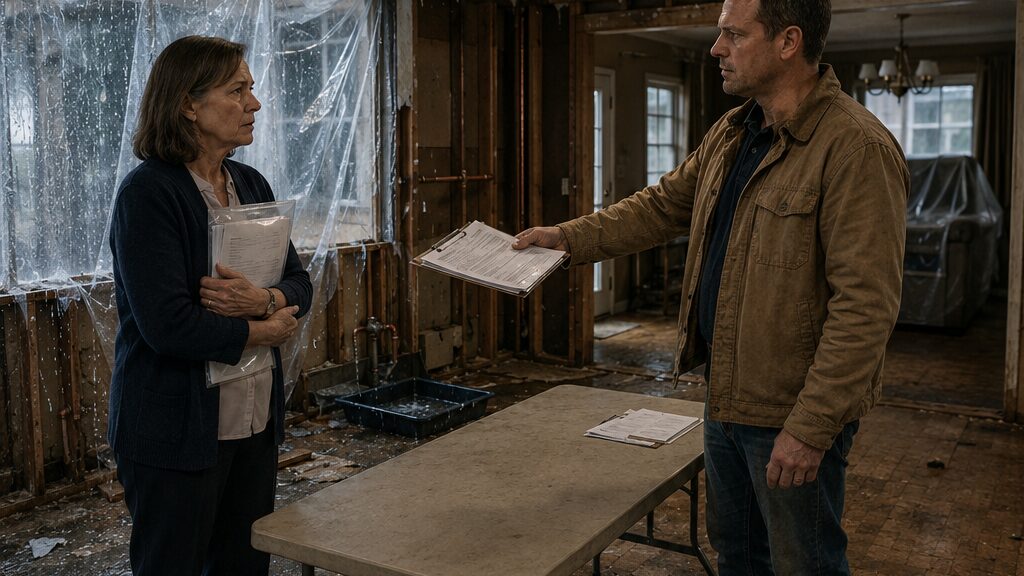
Robert Miller stood in Margaret Taylor’s gutted kitchen with sawdust on his boots and a new invoice in his hand, asking for another $8,400 while rainwater dripped through the plastic where her back wall used to be.
The water landed in a paint tray someone from his crew had left behind. Tap. Tap. Tap. The sound was steady enough to feel deliberate.
Margaret did not take the paper.
She stood beside the bare subfloor, one hand pressed against the folding table that had become her kitchen counter, the other holding the original contract in a clear plastic sleeve. Behind her, copper pipes stuck out of an open wall like broken ribs. A strip of insulation sagged from the ceiling. Her cabinets were gone. The sink was gone. Her stove sat in the dining room under a moving blanket, unplugged and useless, like an old animal put aside.
“You already have twenty-two thousand dollars from me,” she said.
Robert glanced around as if she had mentioned a small inconvenience. He was a sturdy man in his forties, clean work jacket zipped halfway, hair combed even though the room around him looked torn open. He had a way of standing with his shoulders loose, not defensive, not ashamed. That was part of what had made her trust him.
“That covered demo, rough plumbing, disposal, and labor,” he said. “Materials went up.”
Margaret looked toward the empty corner where, two weeks earlier, his crew had stacked three cardboard boxes marked cabinet hardware before loading them back into the truck. She had watched from the laundry room doorway and told herself not to hover.
“What materials?” she asked.
Robert tapped the invoice with one finger. “Margaret, I can’t keep my guys on this unless you stay current.”
Stay current. He said it the way the electric company might say it, like she had fallen behind on an obligation everyone else understood.
Rain pushed against the plastic. The sheet bellied inward, then snapped back with a wet slap. Margaret flinched before she could stop herself.
Robert saw it. His voice softened.
“I know this is stressful,” he said. “But this is construction. Once walls open up, things change.”
“They looked exactly like this three weeks ago.”
“That’s not accurate.”
Margaret felt heat rise in her face, and with it came the old instinct to smooth the air before it hardened. She almost said, Maybe I misunderstood. She almost said, I’m sorry, I just need to understand. She had said those words too many times since Robert first parked his truck in her driveway with Miller Home Renewal printed on the side.
Instead, she unlocked her phone.
Her thumb shook once, so she steadied it against the edge of the plastic sleeve. She opened the photo album named Kitchen Repair, a name that now felt foolish, and found the picture she had taken twenty-one days earlier because Jennifer had asked to see the progress.
Same open wall. Same copper pipes. Same bare floor. Same folding table pushed against the remaining half-wall.
Margaret held the phone beside the room itself.
“Tell me what changed.”
Robert’s jaw tightened.
“You taking pictures of my job site now?”
“My kitchen,” Margaret said. Her voice came out smaller than she wanted, so she said it again. “My job site. My money.”
For a second, he looked less patient. Not angry yet. Just interrupted.
Then he smiled without warmth and stepped closer to the folding table. “I’m trying to help you. You had a pipe burst. Your kitchen was a mess when we got here. I moved you up because you told me your family was coming for Thanksgiving.”
“You said four weeks.”
“Based on normal conditions.”
Margaret lifted the contract. “Fixed price. Materials included. Work to be completed in four weeks. Licensed electrical and plumbing subcontractors.”
Robert gave a short laugh through his nose. “You’ve been reading.”
“Yes.”
“Then read the part about change orders.”
“I did.”
The contract in her hand had been read so many times the sleeve was creased along the edge. She had sat with it at the laundry room counter under the buzzing light, following each line with a pen as if the meaning might change if she looked at it carefully enough. There were change orders for hidden damage, yes, but the form required written notice, itemized costs, and homeowner approval before work continued.
This invoice was not itemized beyond broad words: materials adjustment, labor extension, project continuation.
Robert set the invoice on the folding table and slid a second packet from behind it.
“Then this is simple,” he said. “Updated work authorization. Sign it, we move forward. Don’t sign it, I can’t be responsible for the delay.”
Margaret looked at the packet.
She did not want to touch it. The pages felt like a trap even before she read them. But she thought of the missing wall behind her, the wet plastic, the stove wrapped in the dining room. She thought of Jennifer saying, Mom, maybe it’s time to think about a place closer to us, and the careful way her daughter said it, as though Margaret were a lamp that might break if moved too quickly.
Margaret picked up the packet.
Robert watched her, waiting for the part where she would skim, sigh, and sign because the alternative was another night with soup from a microwave and rain in the house Jack had spent twenty-seven years improving.
Jack had built the breakfast nook himself, back when Jennifer was small enough to sit under the table and tie shoelaces around the chair legs. He had added the back wall after saving for three summers. He had installed the old maple cabinets when Margaret said the kitchen never had enough light. When the pipe burst behind the dishwasher in September, Margaret had stood ankle-deep in water and called Robert because his flyer had arrived the week before with the words Storm and Water Damage Specialists printed in blue.
He had called her ma’am. He had noticed Jack’s handmade trim. He had said, “You can tell someone loved this house.”
That was the sentence that had cost her the first check.
She turned the first page of the authorization. Then the second.
Robert folded his arms. “It’s standard.”
Near the bottom of the second page, in smaller print than the rest, she found the sentence.
Homeowner releases contractor from claims relating to prior work, delays, damages, and conditions arising before execution of this authorization.
The words seemed to tilt on the page.
Margaret read them once. Then again.
Robert said, “Like I said, standard.”
She set the packet down carefully. “This waives my right to complain about what already happened.”
“It keeps the project clean going forward.”
“The project isn’t clean.”
His eyes moved to the exposed pipes, then back to her. “You don’t want a fight over wording.”
“I don’t want to sign away my right to damages.”
For the first time, Robert’s expression changed completely. The patience emptied out of his face.
His voice dropped. “You don’t want a lien on your house over this.”
The word landed harder than the dripping water.
Lien.
Margaret had heard it before, but only vaguely, in conversations where other people understood what it meant. Something filed. Something legal. Something attached to the house. The house Jack had left her. The house she had promised herself she would keep standing, keep safe, keep welcoming enough that Jennifer would bring the children and not look around with that worried softness in her eyes.
Robert saw her hand tighten on the contract sleeve.
He lowered his voice further, almost kindly. “I don’t want to go that route. But if I’m carrying costs and you’re refusing to authorize work, I have to protect my business.”
Margaret looked at the kitchen.
The folding table held a toaster, a roll of paper towels, her contract, Robert’s invoice, and the packet asking her to surrender rights she had not known she needed to defend. The old kitchen window was covered in dust. The floor dipped slightly where the subfloor had been cut and patched but not secured. One of Robert’s workers had told her not to step near the open edge, then never came back.
She looked at Robert.
He had not raised his voice. He had not threatened her in the way people on television threatened each other. He had simply placed a legal word in the middle of her ruined kitchen and waited for her fear to do the rest.
Margaret slid the authorization back across the table.
“I’m not signing this today.”
“You’re making a mistake.”
“Then I’ll need that in writing too.”
A flicker crossed his face. Annoyance, maybe. Or surprise.
“You want everything in writing now?”
“Yes.”
Robert picked up the invoice but left the authorization on the table. “Fine. But delay is on you from here.”
Margaret lifted the packet and held it out to him. “Take this with you.”
“You’ll need it.”
“Not today.”
He stared at her for a moment, then took it. The paper bent slightly in his grip.
At the doorway to the dining room, he paused beside the covered stove. Rainwater tapped behind Margaret. The house smelled of wet wood and dust.
Robert looked back at the plastic sleeve in her hand.
“Who told you to read that part?”
Chapter 2: The Signature She Thought Would Protect Her
Margaret ate tomato soup from a coffee mug in the laundry room because there was no bowl she could wash, no sink she could use, and no counter left in the kitchen except a folding table balanced over plywood.
The microwave sat on top of the dryer. Each time the drum shifted beneath it, the mug trembled. She kept one hand near the handle as if the soup might leap out and ruin one more thing.
Through the open doorway, she could see the plastic over the kitchen wall puff inward with the rain. The old house made unfamiliar sounds now. Water striking a tray. Tape peeling and catching. Air moving through places air had never been invited.
Robert’s last question stayed in the room with her.
Who told you to read that part?
No one. That was the shame of it and the start of something else.
Margaret set the mug down and carried the contract to the laundry counter. The clear plastic sleeve was smudged from her fingers. She wiped it with the cuff of her cardigan, then felt foolish for treating the paper more gently than Robert had treated the house.
She opened a notebook she usually used for grocery lists and wrote the date at the top.
Then she stopped.
What was she making? A complaint? A diary? Proof? She did not know what proof was supposed to look like. Robert knew. That was the difference. He knew which words frightened people and which words hid other words. He knew how to say change order, authorization, carry costs, lien.
Margaret knew how to label leftovers and stretch one roast chicken into three meals. She knew which floorboard squeaked outside Jennifer’s old bedroom. She knew that Jack always tightened screws too much and hummed under his breath when he measured. She knew the house.
But she did not know how to fight a contractor.
The notebook page stayed blank except for the date until she forced herself to begin.
September 18: pipe burst behind dishwasher.
September 20: Robert Miller estimate.
September 22: signed contract. Paid $12,000 deposit.
September 25: demo began.
October 3: Robert requested second payment for cabinet order/materials. Paid $10,000.
October 6: fewer workers.
October 10: no workers.
October 13: called Robert. No answer.
October 15: text from Robert: waiting on materials.
October 19: text: need final installment before proceeding.
October 21: Robert came with new invoice for $8,400.
She looked at the list and felt sick.
The second payment sat there like an accusation.
She had written the check in the dining room, apologizing because the table was covered with dust and she had only one working pen. Robert had said, “No worries, Margaret. We’ll get you taken care of.” He had stood near Jack’s covered stove and told her the cabinets could be delayed if he did not secure the order that week.
She had asked, “Is that normal?”
He had smiled. “These days? Unfortunately.”
She had believed him because the alternative was to believe she was alone in a torn-open house with a man who knew more than she did.
Her phone rang.
Jennifer’s name appeared on the screen with a photo of the grandchildren holding pumpkins from last year. Margaret looked toward the kitchen, then back at the phone. For one wild second, she considered not answering.
She answered.
“Hi, honey.”
“Mom, are you okay? You sound funny.”
Margaret straightened as if Jennifer could see her. “I’m fine. Just eating late.”
“In the kitchen?”
Margaret’s eyes moved to the laundry room microwave. “Close enough.”
There was a pause. Jennifer had learned pauses from her father. Jack used to go quiet when something did not fit.
“How’s the work going?” Jennifer asked.
Margaret pressed two fingers to the notebook page. “Behind schedule.”
“How far behind?”
“Oh, you know contractors. Rain and deliveries and all that.”
“Mom.”
The word carried too much. Worry, warning, love, impatience. Margaret could already hear the next part: This is exactly why I don’t like you being there alone. Maybe after Thanksgiving we should look at condos. Maybe you don’t need all that house.
She gripped the phone harder.
“It’s not ideal,” she said. “But I have it handled.”
“You always say that.”
“I do usually handle things.”
“I know. I just—” Jennifer exhaled. “The kids keep asking if we’re still making pies at your house.”
Margaret looked at the dust-coated doorway where the old kitchen had once smelled of cinnamon and butter. She saw Jennifer at nine years old pressing fork marks into pie crust too hard. She saw Jack pretending every burned edge was his favorite part.
“Tell them yes,” she said before she could stop herself.
“Mom, don’t promise that if—”
“Tell them Grandma is working on it.”
After they hung up, Margaret stood very still.
Then she wrote in the notebook: Told Jennifer kitchen behind schedule. Did not tell her wall open.
The sentence embarrassed her more than the missing cabinets.
She opened Robert’s text thread and scrolled to the beginning. At first his messages were warm and quick.
Glad we could help.
Crew will arrive around 8.
You’ll have a kitchen before you know it.
After the second payment, the tone changed.
Checking on materials.
Will update.
Crew pulled to another job today.
Need final installment before proceeding.
Costs changing. Must stay current.
Margaret read the payment schedule in the contract again. Deposit on signing. Second payment after materials delivered and rough inspection completed. Final payment upon substantial completion.
She had paid the second amount before materials were delivered.
Before inspection.
Before she knew whether inspection had even been requested.
Her face burned. “Oh, Margaret,” she whispered.
For a moment she wanted to close the notebook and put the contract away. She wanted to decide it was too late, too complicated, too embarrassing. She wanted someone else to tell her what mattered.
Instead, she walked to the small printer in the spare bedroom and turned it on.
The printer coughed and clicked. One by one, Robert’s texts slid into the tray. She printed the contract. She printed photos of the kitchen from each week. She printed the picture of the three cabinet boxes in the corner, blurry because she had taken it from the laundry room doorway while pretending not to watch.
When the ink began to fade, she replaced the cartridge with one Jack had labeled BLACK – OFFICE in block letters on masking tape. He had labeled everything. Screws. Paint cans. Extension cords. Keys no one remembered.
Margaret held the cartridge for a second before snapping it into place.
Back in the laundry room, she made three piles on top of the dryer: Contract. Payments. Communications.
She heard Robert’s voice again.
You don’t want a lien on your house over this.
She opened her laptop and searched the phrase with her town name, then contractor dispute, then lien threat. The results were too many, too dense, too full of terms that made her chest tighten. She shut the laptop once, opened it again, and wrote down questions instead of answers.
Was a permit required for plumbing?
Was a permit required for electrical?
Can contractor file lien if work incomplete?
How to verify contractor license?
How to check cabinet order?
She did not know which question mattered most.
Then she saw the line in the contract again.
Licensed electrical and plumbing subcontractors responsible for all permitted rough-in work.
Permitted.
She circled the sentence so hard the pen tore the paper beneath the plastic sleeve.
The kitchen popped as wind pressed against the plastic wall. The paint tray overflowed and sent water across the subfloor in a thin, shining sheet.
Margaret got a towel, stepped carefully around the open seam in the floor, and knelt with one hand braced against the folding table. Her knees ached. The towel darkened quickly.
She looked at the exposed pipes, the loose wires, the place where the sink should have been.
In the morning, she decided, she would call the city and ask whether anyone had ever been allowed to leave her kitchen like this.
Chapter 3: No Permit, No Cabinets, No Real Answer
“I don’t see any permit for that address,” the city clerk said.
Margaret held the phone so tightly her fingers pressed dents into the case. She was standing in the kitchen doorway because that was where the signal was strongest, looking directly at the open wall Robert had called rough plumbing.
“No permit at all?” she asked.
“I checked plumbing and electrical under your address. Nothing current. There was a water heater permit in 2016, but nothing for kitchen work this year.”
Margaret closed her eyes.
The clerk’s voice became gentler. “Who told you one was pulled?”
“The contractor.”
“Did he give you a permit number?”
“No.”
“Then you may want to ask him for it in writing.”
Margaret almost laughed. Not because it was funny, but because the phrase in writing had begun to feel like a door she should have known existed.
“Is a permit required?” she asked.
“For plumbing relocation, electrical changes, opening walls? Yes, ma’am. Generally, yes. I can’t speak to your exact scope without seeing it, but if pipes and wiring were changed, someone should have contacted us.”
Margaret looked at the copper pipes jutting out from the wall. “They were changed.”
“Then ask for the permit number,” the clerk said. “And don’t let anyone close the walls before inspection.”
After the call ended, Margaret stood listening to the drip into the paint tray.
Don’t let anyone close the walls.
Robert had told her the next step was closing walls as soon as she signed the authorization.
Her phone buzzed.
Robert: Checking in. Need signed authorization and payment today if you want crew this week.
Margaret stared at the message until the screen dimmed.
She typed: Please send the plumbing and electrical permit numbers for my address.
She erased Please.
She typed again: Send the plumbing and electrical permit numbers for my address.
Then, because her stomach tightened at how sharp it sounded, she added: Thank you.
She deleted that too.
Send the plumbing and electrical permit numbers for my address.
She pressed send before she could soften it.
Three dots appeared. Disappeared. Appeared again.
Robert: We handle permits as needed. Don’t delay job over internet research.
Margaret wrote the response in the notebook exactly as he sent it. Then she took a photo of the open wall, making sure the date stamp was visible in the image details. She did not know whether that mattered, but it felt like something solid.
The next search took her longer.
Robert’s business card lay beside the laptop. Miller Home Renewal. Licensed and Insured. Residential Restoration. A license number printed in small blue text at the bottom. She had never checked it because the card itself had seemed like checking. Men did not print license numbers on cards if they were not real, she had thought.
The state licensing website did not make itself easy. She typed the number with dashes, then without dashes. She tried Miller. She tried Robert Miller. She tried the business name.
At first nothing came up.
Then she found an old listing under Miller Home Renewal Services, LLC.
Expired.
Margaret leaned closer.
The expiration date was eight months earlier.
There was an address listed too, but it did not match the one on Robert’s contract. The contract address was a suite number on Westbridge Road. The license record showed an old industrial park near the highway.
Her mouth had gone dry.
She clicked through the record, expecting some explanation, some renewal pending, some notice that would make it less bad. There was none. Just expired.
Her phone buzzed again.
Robert: Margaret, I’m not going to have my process second-guessed. If you keep interfering, delay costs will be added.
The word interfering stung more than she expected. She was standing in her own damaged house, holding his expired license record, and still some trained part of her wanted to apologize for being difficult.
She set the phone facedown.
“No,” she said aloud.
The empty kitchen did not answer.
She printed the license page. The printer ran slowly, leaving faint lines across the text, but the word Expired came through clearly enough.
Then she took out the printed photo of the cabinet boxes.
She had almost not printed that one because it felt petty. Three boxes in a corner did not prove anything. But now she studied the image. One box had a label from a lumberyard on the north side of town. The name was partly obscured by plastic wrap, but she could read enough.
She called.
The first person transferred her to kitchen orders. The second asked for an order number. Margaret did not have one.
“I only have my name and the contractor’s name,” she said. “The cabinets were supposed to be for my address.”
“I’m not sure I can release order information.”
“I understand,” Margaret said, though she did not. “I paid for them. Or I paid him for them. I’m trying to find out whether anything was delivered.”
The person on the line went quiet. Keyboard clicks followed.
“Can you give me the delivery address?”
Margaret did.
More clicking.
“There was an order associated with that address,” the employee said carefully.
Margaret gripped the edge of the folding table.
“Was?”
“It was entered, then canceled.”
“When?”
A pause. “October fourth.”
The day after Margaret wrote the second check.
“Was it refunded?” she asked.
“I can’t give you payment details.”
“Please,” Margaret said, and hated the old pleading note in her voice. She forced herself to stop. “I’m not asking for private information. I’m asking whether the cabinets I paid my contractor for are coming to my house.”
Another pause.
“No, ma’am. There is no active cabinet order for that address.”
Margaret looked at the corner where the boxes had sat. She remembered asking one of Robert’s workers if those were hers, and the man had shrugged and said, “Ask Robert.”
“Can you tell me how it was refunded?” she asked.
“I can say it was refunded to the original payment method.”
“His card?”
“I can’t give names.”
But the answer was in the silence.
Margaret thanked the employee, wrote down the time, the name of the lumberyard, and the exact words: no active cabinet order for that address.
Her phone buzzed again.
Robert: Last warning. If you want to play inspector, I’ll need to bill for downtime.
For a moment, the kitchen seemed to tilt around her. The missing cabinets were no longer missing because of delay. The permit was no longer a misplaced number. The authorization was no longer paperwork.
It was a path. He had built it carefully. First the warm estimate. Then the fast demolition. Then the second payment before delivery. Then silence. Then fear. Then the new invoice. Then the release. Then the lien.
Margaret sat at the folding table, surrounded by printed pages, and pulled the original contract toward her. The clear plastic sleeve caught the gray light from the open wall. His signature was still there at the bottom, confident and dark.
For the first time, she did not look at the signature as protection.
She looked at it as evidence.
The phone rang before she could write another note. The caller ID showed the lumberyard number again.
Margaret answered quickly.
The employee’s voice was lower this time. “Mrs. Taylor? I need to be careful what I say. But I checked with my manager. The order for your cabinets was canceled by the contractor, and the refund went back to the card used by Robert Miller.”
Chapter 4: The Woman Two Streets Over Had The Same Contract
The woman on Margaret’s porch held a contract in both hands as if it might blow away, though the morning was still.
“Are you Margaret Taylor?” she asked.
Margaret looked past her to the sidewalk, then to the street. No truck. No Robert. Just a woman in a raincoat, hair pinned messily at the back of her head, with worry sitting openly on her face.
“Yes.”
“I’m Betty Gonzalez. I live on Briar Lane. Two streets over.” She lifted the papers slightly. “Did you hire Robert Miller?”
Margaret did not answer right away.
The day before, she might have said yes and then apologized for the state of the house, for standing in the doorway too long, for not inviting a neighbor inside. Now she looked at the contract in Betty’s hands. The top margin. The line spacing. The same bold promise across the first page.
Miller Home Renewal.
Margaret’s stomach pulled tight.
“Come in,” she said.
Betty stepped into the entry and stopped when she saw the kitchen.
The plastic over the back wall had come loose at one corner despite Margaret’s extra tape. Gray light filtered through it, turning the room the color of wet newspaper. The folding table stood in the middle with Margaret’s printed texts, permit notes, license record, and cabinet order notes arranged in piles. A towel lay near the subfloor seam, dark from last night’s leak.
Betty stared.
“Oh,” she said softly. “He did this to you too.”
The too was worse than any question.
Margaret took her contract from the clear plastic sleeve and laid it beside Betty’s on the folding table. The pages were not identical, but they were close enough to make her hands go cold. Same payment terms. Same language about licensed subcontractors. Same promise that materials were included unless written changes were approved. Same signature at the bottom, bold and careful, with the R looped wide enough to look practiced.
“What did he do at your house?” Margaret asked.
Betty pressed her lips together. “Bathroom.”
“Finished?”
Betty laughed once, but there was no humor in it. “There’s no floor.”
Margaret looked up.
Betty unlocked her phone and held out a photo. Margaret saw open joists where tile should have been, a toilet removed and sitting in a hallway, a vanity leaning against a wall, blue painter’s tape around a doorway. The photo had the same exposed look as Margaret’s kitchen, the same sense that a private room had been turned inside out.
“He said the subfloor had rot,” Betty said. “Maybe it did, I don’t know. My husband used to handle all that. Robert said he needed another payment to order replacement materials. I gave it to him six weeks ago.”
Margaret touched the edge of Betty’s contract. “Did he pull a permit?”
Betty looked embarrassed. “He said permits slow everything down.”
Margaret closed her eyes briefly.
“What?”
Margaret pointed toward the papers on the folding table. “I called the city yesterday. Nothing for my address. Then I checked his license number. It expired eight months ago.”
Betty’s face changed slowly. First confusion. Then refusal. Then the terrible relief of not being the only fool in the room.
“He told me his crew was tied up because of your kitchen,” Betty said.
“He told me his crew was waiting on cabinets.”
“He told me materials went up.”
“He asked me for eighty-four hundred dollars.”
Betty looked at the kitchen again. “In this?”
Margaret nodded.
The rain had stopped, but water still clung to the plastic sheet. A drop gathered along the taped edge, fattened, and fell onto the paint tray. Betty flinched at the sound. Margaret almost said, You get used to it, but she stopped herself. No one should get used to that.
Betty sat at the folding table without being asked. Her knees seemed to give out more than bend. She placed her contract beside Margaret’s and smoothed it with both palms.
“I didn’t tell anybody,” Betty said. “My sister kept asking why I was showering at her house. I told her I was having plumbing upgraded.”
“I told my daughter the kitchen was behind schedule.”
Betty looked at her, and for the first time that morning, neither woman looked away.
Margaret brought out the notebook. “When did he start?”
Betty hesitated. “Are you making a complaint?”
“I’m making a timeline.”
“That sounds like a complaint.”
“It might become one.”
Betty’s shoulders rose and fell. “I don’t want to be dragged into something. I just wanted to ask if he was working here. I thought maybe he really was busy.”
Margaret heard the fear under it. Not fear of Robert exactly. Fear of being seen. Fear of someone saying, Why did you pay him? Why didn’t you check? Why didn’t you know better?
She knew that fear well enough to speak carefully.
“I paid him a second time before materials were delivered,” Margaret said. “Because he told me he needed to secure the order. I didn’t check either.”
Betty’s eyes filled, but she blinked it back sharply. “He makes you feel like asking is rude.”
“Yes.”
“And then when you don’t ask, he uses that too.”
Margaret wrote Betty’s start date, payments, and promises. Betty had copies of checks, three texts, and a voicemail she had not played for anyone. When she played it now, Robert’s voice came through the speaker, smooth and tired.
“Betty, I’m doing my best here, but I can’t keep absorbing delays on your project. If you want the bathroom usable, you need to stay current.”
Betty stopped the recording with her thumb.
Margaret wrote down the phrase.
Stay current.
It had sounded official in Robert’s mouth. On paper, beside two ruined rooms, it sounded rehearsed.
By noon, Betty had called a neighbor she knew from church, a man whose porch repair had stalled after demolition. He did not come in, but he stood at Margaret’s doorway and looked past her into the gutted kitchen. His eyes caught on Robert’s business card lying beside the laptop.
“I know that card,” he said. “But the website’s gone.”
Margaret turned. “Gone?”
“I tried to pull it up last week. Nothing. Said page not found.”
Betty’s fingers tightened around her folder.
Margaret sat down and searched the address printed below Miller Home Renewal. The website did not load. The social media page linked from an old search result showed only a blank business profile with no reviews, no photos, no phone number except the one Robert had been using.
The neighbor rubbed the back of his neck. “Maybe he changed companies.”
“Did he give you the same license number?” Margaret asked.
He looked uncomfortable. “I didn’t look.”
“Neither did I,” Betty said.
That made him glance toward her. Something in the room softened, not enough to feel safe, but enough for him to pull a folded estimate from his coat pocket. It had a slightly different company name at the top.
Miller Residential Renewal.
The same license number sat at the bottom.
Margaret copied it into her notebook.
By the time the neighbor left, Betty remained seated at the folding table, both contracts in front of her. The ruined kitchen no longer felt like only Margaret’s humiliation. It had become something else, something uglier but stronger. A place where the lies lined up.
Betty looked at the exposed pipes. “What do we do now?”
Margaret wanted to say she knew. She wanted to be the kind of woman who had a next step ready, who did not need to search every term, who did not feel her heart jump every time her phone buzzed.
Instead, she said the truth.
“We keep copies.”
That afternoon, Margaret made two new folders from old tax files. One for Betty. One for the neighbor. She labeled each with a black marker, the way Jack would have, pressing firmly enough that the letters showed through the tab.
When Betty left, she paused on the porch.
“I almost didn’t knock,” she said.
“So did I,” Margaret answered, though she had not been the one knocking.
Betty gave her a tired smile and walked down the steps.
Margaret shut the door and stood with her back against it. The house was quiet except for the plastic shifting in the kitchen. She had just reached for the tape to fix the loose corner when her phone lit up.
Unknown number.
She let it ring once, twice, three times, then answered.
No one spoke at first. Then Robert’s voice came through, lower than before.
“You’ve been calling people, Margaret.”
Chapter 5: The Envelope At The Door Was Not A Repair Plan
Robert knocked while Margaret was standing on a chair, stretching a fresh strip of tape across the plastic where her back wall should have been.
The knock was not loud. That made it worse. Three measured taps, as if he had an appointment.
Margaret froze with the tape pulled tight between both hands. One end stuck to the plastic. The other curled around her wrist. Behind her, the folding table was no longer a counter. It was covered in folders, contracts, printed text messages, permit notes, and photographs of rooms Robert had opened and abandoned.
The knock came again.
“Margaret,” Robert called through the door. “We need to talk.”
She stepped down from the chair carefully. Her knees felt unsteady, but her hands did not. She peeled the tape from her wrist, pressed the loose end against the plastic, and walked through the dining room.
At the front door, she looked through the glass panel.
Robert stood on the porch holding a manila envelope.
No tool belt. No crew. No materials. No apology. Just the envelope and the same jacket, zipped against the cold.
Margaret opened the door but left the storm door latched.
“What do you need?”
His eyes moved past her shoulder toward the kitchen. From where he stood, he could see the plastic wall, the open subfloor, the folding table stacked with evidence where a family should have been able to eat.
“I need you to stop escalating this,” he said.
“You mean stop talking to your customers?”
“I mean stop making statements you don’t understand.”
Margaret’s fingers rested on the storm door latch but did not lift it. “Did you bring permit numbers?”
Robert’s mouth tightened. “You don’t want to do this on the porch.”
“I don’t want you in my house.”
The words surprised them both.
For a second, Robert stared at her as if recalculating. He had been inside the house so many times without asking, walking through dust and torn walls as though access came with the check she had written. Now the thin barrier of the latched storm door seemed to offend him.
He lifted the envelope.
“I brought you a formal notice.”
“What kind of notice?”
“Costs incurred due to homeowner delay. Storage fees. Labor rescheduling. Materials escalation.” He paused. “And lien rights.”
There it was again.
Lien.
Margaret felt the word strike the same place in her chest, but this time it did not spread as quickly. Behind her, on the folding table, was the expired license record. The no-permit note. The cabinet refund. Betty’s contract. The neighbor’s estimate with the same license number.
“What materials are you storing?” she asked.
Robert blinked.
“The cabinets were canceled.”
His gaze sharpened. “Who told you that?”
“The lumberyard.”
“You had no right calling my suppliers.”
“I had every right to ask where the cabinets I paid for were.”
Robert leaned closer to the storm door. “You paid for a project. Not individual line items.”
“The contract says materials included.”
“Materials were ordered.”
“And canceled.”
His voice dropped. “You are making this bigger than it needs to be.”
Margaret opened the storm door then, but only halfway. She took the envelope from his hand without stepping aside.
The first page was a letter on Miller Residential Renewal letterhead, not Miller Home Renewal. She noticed that before she read anything else.
Robert saw her eyes stop at the name.
“It’s the same company,” he said.
“Then why is the name different?”
“Administrative.”
She read the letter standing in the doorway. The language was careful, firmer than his texts, and full of words meant to make her feel late, unreasonable, exposed. Homeowner interference. Failure to authorize continuation. Project suspension. Contractor reserves all rights. Additional costs accruing daily.
Near the bottom, a figure had been circled by hand.
$11,260.
Margaret looked up. “It was eighty-four hundred two days ago.”
“That was before you started interfering with scheduling.”
“There has been no crew here to schedule.”
“I pulled them because you refused to sign.”
“You had already pulled them.”
Robert exhaled through his nose. “Margaret, you’re emotional. I understand that. Your husband is gone, you’re trying to manage a house—”
“Do not mention my husband.”
The porch went still.
The old Margaret would have regretted the sharpness immediately. She would have softened it, given him a way back into politeness. But Robert had used Jack’s absence the first day too. He had admired the trim, praised the house, let her feel seen before he made her feel small.
Robert’s face cooled.
“I’m saying you’re in over your head.”
Margaret held up the letter. “No. You’re saying what you think will work.”
A floorboard creaked behind her.
Robert’s eyes shifted past Margaret, and the confidence on his face thinned.
Betty Gonzalez stepped into view from the dining room, her own folder held against her chest.
She said nothing.
She did not need to.
Robert straightened. “This is private business.”
Betty’s voice shook, but she kept it level. “Mine too, apparently.”
Margaret saw his eyes flick from Betty to the folding table. The folders were visible behind both women, labels facing outward. Taylor. Gonzalez. Porch estimate. Photos. Permits. License.
For the first time since he had appeared with the invoice, Robert looked less like a man guiding a confused homeowner through paperwork and more like a man who had walked into a room where the paperwork had learned to answer back.
“You two don’t understand how construction works,” he said.
“Then explain it,” Margaret said. “Start with why my cabinets were refunded to your card.”
His jaw moved once.
“That was a vendor issue.”
“Then explain why no permit was pulled.”
“That stage hadn’t been reached.”
“The pipes are moved.”
“Rough-in isn’t complete.”
“Then explain why the update waived damages for prior work.”
Robert’s eyes hardened. “Because people twist things.”
“People?”
“Homeowners. They panic when a job gets messy. They call everybody. They threaten complaints. They don’t understand that crews cost money whether they’re on-site or waiting for decisions.”
Betty made a small sound. “My bathroom has no floor.”
Robert turned on her. “Because we found rot.”
“And left.”
“Because payment wasn’t current.”
“I paid you.”
Margaret stepped slightly forward, not enough to push the door open, but enough to bring Robert’s attention back to her.
“You made it this big,” she said. “I just started keeping copies.”
For a moment, no one spoke.
A car passed slowly on the street. Margaret wondered if the driver could see into the house, see the plastic wall, the two women, the contractor with his empty hands.
Robert looked from Margaret to Betty and back again.
“You think complaints are fast?” he asked. “You think some board is going to get you a kitchen by Thanksgiving?”
Margaret’s throat tightened at the word Thanksgiving.
Robert caught it. Of course he did.
“You can spend months making calls,” he said. “Meanwhile that wall stays open. Or we can settle this like adults and move forward.”
“With what money?” Betty asked quietly.
Robert ignored her.
Margaret looked down at the letter again. The number circled at the bottom seemed absurd now, almost childish in its boldness. $11,260, as if adding ink could create debt.
“What does moving forward mean?” she asked.
Robert’s face changed a fraction. He thought she was bending.
“Sign the authorization. Pay half of the updated amount now. I’ll get a crew back by Monday.”
“Will you put the permit numbers in writing?”
“We’ll handle permits.”
“Will you provide proof the cabinets are reordered?”
“You don’t need to micromanage vendors.”
“Will you remove the release of prior damages?”
His silence answered too quickly.
Margaret folded the letter and slid it back into the envelope.
“No.”
Robert stared at her.
“No?”
“No.”
“You’re choosing a long road.”
“I didn’t choose it. I just stopped pretending I wasn’t on it.”
His mouth flattened. He took the envelope when she held it out, but this time he did not pull away immediately.
“People who file complaints wait years,” he said. “People who settle get kitchens.”
Then he turned and walked down the porch steps without looking back.
Margaret watched him reach his truck. It was parked at the curb, clean and empty, no lumber in the bed, no cabinets strapped down, no sign that it had come to fix anything.
Betty released a breath behind her.
Margaret closed the door and locked it.
On the folding table, her phone buzzed with a new email. The subject line showed a copy of Robert’s notice, sent formally now, with a demand deadline in bold.
Margaret opened it. At the bottom, below the threat of lien rights, Robert had written one final sentence.
Failure to resolve this privately may result in further delay for which homeowner accepts full responsibility.
Chapter 6: The Inspection Found What The Walls Had Hidden
Michael Davis shined a work light into the open wall and said, “Nobody inspected this because nobody was asked to.”
Margaret stood three feet behind him, arms crossed tightly over her sweater, watching the beam move across copper pipes, cut studs, loose wiring, and a place where Robert’s crew had left a joint angled in a way that looked wrong even to her.
Michael did not touch anything at first.
That unsettled her more than if he had started working.
He was a broad-shouldered man with a gray tool bag, scuffed boots, and a manner that had arrived cautious and stayed cautious. When Margaret called, he had asked twice whether she wanted an estimate for completion or an inspection of prior work. She had not known the difference.
Now she did.
He took out his phone and photographed the wall before moving closer.
“Did he tell you this was ready to close?”
“He said he could move forward once I signed.”
“With this?”
Margaret did not answer.
Michael crouched near the cut section of floor. The subfloor patch flexed under his gloved hand. He looked up at her with an expression that was not pity, exactly, but was worse than doubt.
“Don’t step here.”
“One of his workers said that.”
“Good. Shame he didn’t fix it.”
The light moved again.
Margaret tried to read Michael’s face the way she had learned to read Robert’s. But Michael did not perform patience. He made notes, took photos, asked short questions, and frowned only when the house gave him a reason.
“Was there an electrical subcontractor?”
“The contract says there would be.”
“Name?”
“I don’t know.”
“Plumber?”
“I don’t know.”
“Permit number?”
“No permit.”
Michael looked back into the wall. “Then nobody should be closing this.”
Margaret felt the words settle into the room. Robert’s threat had been delay. Delay if she did not sign. Delay if she complained. Delay if she asked questions. But the delay had been hiding something more practical and more frightening: if she had signed, he might have covered the wall before anyone saw what had been done.
“What is wrong?” she asked.
Michael pointed with the end of his flashlight, not touching. “That connection is not supported properly. This line shouldn’t be run like that. I don’t like how they notched this stud. Electrical is too close here, and I don’t see protection plates where I’d expect them. I’m not an inspector, but I can tell you this isn’t something I’d put my name on.”
Margaret gripped her elbows harder.
“Is it dangerous?”
“I don’t like that word unless I’m sure.” He paused. “But I wouldn’t use the kitchen like this, and I wouldn’t let anyone close that wall until the city looks at it.”
A small sound came from Margaret before she could stop it.
Michael glanced at her. His expression softened, but his voice stayed firm.
“I know that’s not what you wanted to hear.”
“I wanted to hear the truth.”
“Then the truth is, some of this may need to come out before it can be finished.”
The kitchen seemed to lose another layer then. Margaret had thought the damage was what she could see: no cabinets, no sink, bare floor, plastic wall. Now the visible mess had become only the surface. Behind it were hidden mistakes, hidden shortcuts, hidden costs.
Michael photographed the pipes from three angles. He photographed the cut floor, the open wall, the exposed wiring, the sagging plastic. Every click sounded like proof and expense at once.
When he finished, he stood at the folding table and looked over her documents. He did not read every page, but he paused at the expired license printout and the cabinet refund note.
“He’s still working under this number?”
“That’s what was on my contract.”
Michael tapped the paper. “That’s a problem.”
“Enough of a problem?”
“Enough that you should file with the board. Maybe small claims too. I’m not a lawyer, but I’ve seen this pattern.”
“What pattern?”
“Fast demo. Big deposit. Second payment before materials land. Then change orders. Then homeowner gets blamed for delay.” He pushed the license paper back toward her. “Most people run out of money before they run out of patience.”
Margaret looked toward the open wall. “He told me people who settle get kitchens.”
Michael’s mouth tightened. “People who settle quietly help him get to the next kitchen.”
The words struck harder because Michael did not say them dramatically. He said them like a man who had seen too many walls opened after someone else had been paid to close them.
He wrote an estimate at the folding table. Margaret watched his pen move from line to line: removal of improper work, stabilization of subfloor, plumbing correction, electrical subcontractor inspection, permit coordination, temporary weather protection, cabinet reorder, installation.
The total made her sit down.
Michael did not apologize for it.
“I can break it into stages,” he said. “Make the house safe first. Then make it pretty.”
“How much of Robert’s work can be used?”
He looked toward the wall.
“Less than you paid for.”
Margaret pressed her fingertips against the folder labeled Taylor. For a moment, she wanted to shove every paper into the trash. The contract, the photos, the notes, the expired license, the cabinet refund. Evidence did not put cabinets on walls. Evidence did not make the floor level. Evidence did not give her money back quickly enough.
But Michael was still standing there, waiting.
“What do I need from you?” she asked.
“For a complaint?”
“Yes.”
“A written assessment. Photos. Estimate to correct. I’ll state what I observed and what should not be covered before inspection.” He held her gaze. “But Margaret, understand this. It won’t make you whole tomorrow.”
“I know.”
“Do you?”
The question was blunt enough to sting.
She almost said, Of course I do. Instead she looked around the kitchen where Jack’s cabinets had once caught morning light, where Jennifer had sat on the counter as a teenager and eaten apples straight from the grocery bag, where grandchildren were supposed to roll dough next month.
“No,” she said. “Probably not.”
Michael nodded, as if that was the first fully useful answer she had given.
He left her with a temporary brace over the weakest part of the floor and a warning written on painter’s tape across the open wall: DO NOT CLOSE BEFORE INSPECTION.
Margaret stood looking at the tape after he drove away.
Robert would hate it.
That gave her no pleasure, only direction.
The licensing board office was in a beige building beside a tax service and a dentist. Margaret carried her folder in both arms, worried the papers would slide out in the parking lot. The waiting room smelled faintly of toner and old coffee. A television mounted in the corner played silently with captions no one watched.
Rebecca Moore called Margaret’s name from a glass window.
She was not warm in the way Margaret had hoped, but she was not dismissive either. Her hair was pulled back, her reading glasses hung from a chain, and she listened without interrupting as Margaret explained the kitchen, the payments, the expired license, the missing permit, the canceled cabinets, and the other homeowners.
When Margaret finished, Rebecca slid a complaint packet through the opening.
“You’ll need to be specific,” she said.
“I brought everything.”
“Everything is not the same as specific.”
Margaret felt herself shrink a little.
Rebecca must have seen it, because her voice softened by a degree. “I’m not saying you don’t have a complaint. I’m saying the board needs dates, amounts, contract names, license numbers, and what work was performed or not performed. If there are other homeowners, they should file their own complaints. You can reference each other, but we need individual records.”
Margaret pulled out the expired license page. “This matters?”
“It matters.”
“The no permit?”
“It matters.”
“The cabinets?”
“It matters if you can document it.”
Margaret looked at the packet. It was thicker than she expected.
“How long does this take?”
Rebecca did not pretend. “Months, sometimes longer.”
Margaret thought of the plastic wall, the towel, the folding table, the taped warning Michael had left. She thought of Robert’s line: People who file complaints wait years. People who settle get kitchens.
Rebecca leaned forward slightly.
“Mrs. Taylor, the expired license record is important. But if you want this taken seriously, don’t just say he treated you badly. Show the pattern. Name the pattern. Dates. Payments. No permit. Canceled materials. Release language. Other complaints if they exist.” She tapped the packet once. “File it correctly, or he’ll call it a misunderstanding.”
Chapter 7: Four Folders On A Folding Kitchen Table
Four folders sat where Margaret’s stove should have been.
Taylor. Gonzalez. Porch estimate. Unknown third.
She had written the last tab that way because the neighbor had not wanted his name on anything yet. He had let her copy his estimate, nodded when Betty said Robert had used the same license number, then folded himself back into silence as soon as the word complaint came up. Margaret understood. Silence had felt safer to her too, until it started costing money.
Now the folding table held what the kitchen could not: order, dates, names, amounts, photos, and the careful evidence of how Robert Miller had moved through their homes.
The plastic wall snapped behind her. Michael’s warning tape still stretched across the open studs: DO NOT CLOSE BEFORE INSPECTION.
Betty stood beside the table with her arms folded, staring at the folders as if one might accuse her.
“He called me last night,” she said.
Margaret looked up.
“What did he say?”
“That if I wasn’t comfortable with the complaint process, he could refund fifteen hundred dollars and walk away clean.” Betty’s face tightened. “Clean. That was the word he used.”
Margaret set down her pen. “Did he say it in a voicemail?”
“No. He called from blocked number.”
“Did you write down the time?”
Betty gave a tired laugh. “You sound like Rebecca.”
“I’m starting to think that’s not a bad thing.”
Betty pulled a receipt from her purse and turned it over. On the back, in hurried blue ink, she had written the time, the amount, and the phrase walk away clean.
Margaret felt a small, hard warmth in her chest.
“Good,” she said.
Betty looked embarrassed by the praise. “I almost said yes.”
Margaret did not answer too quickly.
The room made its usual wounded sounds around them: tape tugging loose, a faint drip from somewhere hidden, the old refrigerator humming in the dining room where it had been moved and plugged into an extension cord Michael said should not stay that way much longer.
“Why didn’t you?” Margaret asked.
Betty touched the edge of her folder. “Because he wanted me to agree not to talk to anyone else.”
There it was again. Not the refund. The silence.
Margaret opened the Gonzalez folder and placed the note inside.
“He offered you less than you paid and wanted back more than money,” she said.
Betty sat slowly. “When you say it like that, it sounds obvious.”
“It didn’t feel obvious when I almost signed his authorization.”
Across the table, the neighbor shifted in the chair closest to the dining room. He had arrived ten minutes earlier with another copy of his estimate, this one showing the same license number but a different company name again: Miller Restoration Group. He had not taken off his coat.
“I don’t want my name in some public thing,” he said.
Margaret turned to him. “You don’t have to decide today.”
“If he files liens—”
“He hasn’t filed one yet,” Betty said.
“He keeps saying he can.”
Margaret opened her own folder and took out Rebecca’s complaint packet. The pages were covered now with sticky notes. Dates. Payments. Contract names. License numbers. Permit status. She had hated the packet at first. It had felt like a test written by people who already understood the answers. But the more she filled in, the more Robert’s fog thinned.
“Rebecca said threats are different from filings,” Margaret said. “If he files anything, we respond to what he actually filed, not what he says at the door.”
The neighbor looked at the kitchen wall. “Easy to say when it’s not your house.”
Betty’s head snapped up. “Look around.”
He flushed. “I didn’t mean—”
“I know what you meant,” Margaret said quietly.
That stopped both of them.
She looked at the missing wall, at the place where cabinets should have been, at the taped warning from Michael, at Jack’s stove still sleeping under a blanket in the dining room. The house had become a kind of public exhibit before she had agreed to show anyone.
“I know exactly what you meant,” she said. “That’s why he uses the house. He knows we’ll pay to stop feeling exposed.”
No one spoke for a moment.
Then Betty opened her folder and pulled out her check copy. “He told me the bathroom would be done before my sister visited. I paid because I didn’t want her thinking I couldn’t keep up since my husband died.”
The neighbor looked down at his hands. “He told me the porch wasn’t safe for deliveries. My wife uses a walker. I paid because I wanted the front steps fixed before winter.”
Margaret felt the words move around the gutted kitchen and attach themselves to the walls Robert had left open. Not excuses. Not stupidity. Reasons. Human, ordinary, humiliating reasons that Robert had known how to press.
She took out her own second payment copy.
“I paid the ten thousand because he said the cabinets needed to be secured that week,” she said. “But that wasn’t the only reason.”
Betty looked at her.
Margaret’s mouth went dry. She could have stopped. She could have kept her mistake in the clean language of paperwork: payment issued prior to material delivery. Rebecca would have accepted that.
But Betty had written down walk away clean. The neighbor had admitted the porch. The least Margaret could do was name her own weakness where it had entered the room.
“I paid because I wanted him to keep liking me,” she said.
The sentence sounded terrible once spoken. Childish. Small. True.
She folded her hands over the check copy.
“I wanted him to think I was reasonable. I wanted the crew to come back. I wanted not to be the kind of woman contractors complain about after they leave.” She looked toward the open wall. “And he knew that before I did.”
Betty’s eyes softened.
The neighbor let out a slow breath. “He does that thing,” he said, “where he makes you feel like the job is a favor.”
Margaret nodded. “Yes.”
The word made the room steadier.
They spent the next hour building the pattern Rebecca had asked for. Not emotions first. Dates first. Names first. Company names across contracts. Miller Home Renewal. Miller Residential Renewal. Miller Restoration Group. Same phone number. Same license number. Same payment schedule. Same phrase: stay current. Same shift after second payment. Same suggestion that delays belonged to the homeowner.
Margaret took photos of the documents lined up side by side. She made copies for each person. She wrote a short page for the complaint packet that did not call Robert names. It listed actions.
Demolition began before permit verification.
Second payments requested before documented material delivery.
No active permits found.
License number expired.
Release language introduced after delays.
Threats of lien or added costs after homeowner questions.
At least three homeowners with similar facts.
The neighbor read the page twice.
“That sounds serious,” he said.
“It is serious,” Betty answered.
He did not agree to file that day. But he left his copied estimate on Margaret’s table and said he would think about it. That was more than he had offered when he arrived.
After he left, Betty stayed to help Margaret collate the complaint. They clipped photos behind contracts. They numbered pages. They wrote the lumberyard statement exactly as Margaret remembered it. They added Michael’s preliminary note that nothing should be closed before inspection.
At three-thirty, Margaret’s email chimed.
She almost ignored it. Her eyes were burning, and her hand ached from writing.
Betty leaned over. “Is it him?”
Margaret opened the email.
It was not from Robert.
It was from a mediation office, with the licensing board copied. The subject line read: Notice of Contractor Dispute Mediation Availability.
Margaret read it once. Then again.
Robert had submitted a response through a representative, denying abandonment and claiming homeowner interference prevented completion. He alleged that Margaret had refused reasonable change authorizations, contacted suppliers improperly, and caused additional costs. He requested mediation before further board action.
Attached was a letter.
Margaret opened it.
Robert’s language was cleaner now. Someone had helped him. It described her as emotional, disruptive, and unwilling to follow normal construction procedures. It said she had created a hostile work environment by contacting other customers. It said she owed him money.
Betty read over her shoulder and whispered, “Can he say that?”
Margaret looked at the folders on the table, then at the kitchen around them.
He could say anything. That was what she was learning. Paper did not have to be true to be dangerous. It only had to arrive before the truth was organized.
The front door opened.
Margaret turned sharply.
“Mom?” Jennifer’s voice called from the entry. “Your car was here, and you weren’t answering your phone.”
Margaret stood too quickly, knocking one folder crooked. Papers slid across the folding table and onto the bare subfloor.
Jennifer stepped into the dining room and stopped.
Her eyes moved from the stove wrapped in a blanket, to the extension cord, to the folding table, to Betty, to the open kitchen wall covered in plastic and warning tape.
The color drained from her face.
“Mom,” Jennifer said, barely above a whisper. “What happened to your house?”
Chapter 8: Fixed Is Not The Same As Over
Robert sat across from Margaret in the mediation room with the same tired expression he had worn in her ruined kitchen.
Not angry. Not frightened. Tired. As if everyone else had made paperwork necessary. As if the open walls, the canceled cabinets, the expired license, and the missing permits were weather he had been forced to stand in.
Margaret noticed his hands first. Clean nails. No cuts. No dust. He had brought a folder too, black and thin, with papers clipped neatly inside. A representative sat beside him, whispering once before the mediator entered.
Jennifer sat on Margaret’s left. Betty sat on her right. The neighbor had filed separately after all, though he had chosen to wait in the hall until called. Michael’s written assessment lay in Margaret’s folder, along with photos of the open wall, the unsafe connections, the subfloor patch, the plastic sheeting, the expired license printout, the no-permit record, the canceled cabinet note, the release form, and Robert’s demand letter.
Margaret had brought the original contract in its clear plastic sleeve.
She had almost replaced the sleeve because it was bent and cloudy now. In the end, she kept it. It had been through the whole thing with her.
The mediator, a woman with a calm voice and sharp eyes, began with ground rules. No interrupting. No threats. No promises that were not written. Mediation was not court. Mediation was not a board ruling. Mediation was a chance to resolve money and completion issues before further action.
Robert looked at Margaret when the mediator said resolve, as if offering her one more chance to be sensible.
Margaret looked down at her first page.
She had written three sentences at the top in large letters.
Do not apologize for asking.
Answer with dates.
Do not sign away other complaints.
Jennifer’s hand brushed her sleeve under the table. Not a child’s grip. Not a rescue. Just contact.
The mediator turned to Robert. “Mr. Miller, your response states work was delayed due to homeowner interference.”
Robert nodded. “That’s correct. Mrs. Taylor became uncomfortable with normal construction conditions and began second-guessing vendors, crew scheduling, and necessary adjustments. We were prepared to continue.”
Margaret felt Jennifer shift beside her.
The mediator turned to Margaret. “Mrs. Taylor?”
Margaret’s voice did not come right away.
Robert’s eyes waited across the table. He knew that silence. He had used it before.
Margaret slid the photo from three weeks before the invoice across the table, then the photo from the day he demanded $8,400.
“This is the kitchen three weeks before his additional invoice,” she said. “This is the kitchen the day of his invoice. The condition is the same.”
The mediator looked at both photos.
Margaret placed the contract beside them.
“The contract says fixed price, materials included, second payment after material delivery and rough inspection. I paid the second installment before those conditions because Mr. Miller told me cabinets had to be secured.”
Robert leaned back. “Materials were ordered.”
Margaret took out the lumberyard note. “They were ordered, canceled, and refunded to your card.”
For the first time, the representative beside Robert stopped writing.
Robert’s face barely moved. “Vendor issue.”
The mediator looked at him. “Do you have documentation showing the cabinets were reordered or delivered?”
Robert opened his folder. He looked through the top pages once, then again. “Not with me.”
Margaret heard Betty breathe out quietly.
The mediator wrote something down.
Margaret continued before she could lose nerve. “No plumbing or electrical permit was pulled for my address. The license number on my contract was expired. The updated authorization he asked me to sign included a release of claims for prior work, delays, and damages.”
Robert’s representative lifted a hand. “Standard release language for project resets.”
Margaret turned one page.
“Then why was I told it was only about material increases?”
The room stilled.
Robert’s eyes hardened, but he did not answer.
The mediator looked at the document. “Mr. Miller?”
Robert’s mouth pressed into a line. “Homeowners don’t always understand the purpose of those forms.”
Margaret felt a strange calm come over her then. It was not victory. It was recognition. He had not changed. Only the room had. In her kitchen, his tone had made her feel slow. Here, written beside dates, his tone sounded like what it was.
“The form was not explained,” Margaret said. “It was presented with an $8,400 demand and a threat of lien.”
“I never threatened you,” Robert said.
Margaret took out his email notice and placed it on the table.
The mediator read the highlighted lines without expression.
Beside Margaret, Jennifer’s jaw tightened. The day Jennifer had arrived and seen the kitchen, she had cried in the dining room—not loudly, but angrily, one hand over her mouth. Then she had asked why Margaret had not told her.
Margaret had answered, “Because I knew you would tell me to leave.”
Jennifer had not denied it.
For three days after that, they had moved around each other carefully. Jennifer wanted to call someone, hire someone, move Margaret into the guest room, take control of whatever could still be controlled. Margaret wanted help but not replacement. They had argued beside the unplugged stove until Betty quietly gathered the fallen papers and left them alone.
Then Jennifer had seen the contract sleeve, the folders, the complaint packet, the warning tape Michael left on the open wall.
“You did all this?” she had asked.
Margaret had said, “I’m trying.”
That was when Jennifer stopped telling her what to do and started asking what page she should copy next.
Now, in the mediation room, Jennifer said nothing. She let Margaret speak.
The mediator reviewed Michael’s assessment next. Improper support. Unsafe proximity. No closure before inspection. Correction work required before completion. Robert objected to the word unsafe, then to Michael’s qualifications, then to the idea that an unfinished rough-in could be judged at all.
The mediator listened.
“Do you have a permit record?” she asked him.
“We would have handled permits at the appropriate stage.”
“Was a permit pulled?”
“It was premature.”
“Was a permit pulled?”
Robert’s representative touched his sleeve.
“No,” Robert said.
The word was small, but it changed the air.
Margaret did not smile. Betty stared at the table. Jennifer closed her eyes for a second.
The discussion turned to money. It was uglier than Margaret expected, not because Robert shouted, but because numbers made pain look negotiable. Deposits. Labor. Demolition value. Refunds. Corrective cost. Materials. Mediation compromise. Possible board action. Possible small claims. No guarantee. No full recovery today.
At one point, Robert offered an amount that would not cover even Michael’s safety corrections.
Margaret nearly accepted anyway.
She was tired. The kitchen had been open for weeks. The holidays had passed without pies, without grandchildren at the flour-dusted table, without Jack’s old carving knife laid out beside the sink. Jennifer had hosted Thanksgiving in her own kitchen while Margaret stood at the counter drying dishes and pretending not to feel homeless in someone else’s house.
A partial check, even an insulting one, had weight.
Then the mediator read the settlement terms Robert’s side proposed. The payment would be made in exchange for full release of claims, confidentiality, and agreement not to participate in or support further complaints relating to Robert Miller, Miller Home Renewal, Miller Residential Renewal, or related entities.
Margaret looked at the words.
The room became her kitchen again. Robert at the folding table. The update packet. The small print. His voice asking who told her to read that part.
“No,” she said.
Robert’s head lifted.
The mediator looked at her. “Mrs. Taylor?”
“I won’t agree not to cooperate with other complaints.”
Robert’s representative began, “That provision is common—”
“I’m not signing it.”
The words came easier this time.
Robert stared at her across the table. “You want a kitchen or a crusade?”
Margaret looked at him for a long moment.
“I wanted a kitchen when I hired you.”
He looked away first.
The final agreement took another hour. It was not everything. It did not repair trust, reimburse every night of takeout, or return the savings Margaret had moved from one account to another while pretending she was only rearranging money. It did not give Jennifer back the Thanksgiving she had hoped to bring her children to. It did not erase Betty’s bathroom or the neighbor’s porch.
But Robert agreed to pay enough for Margaret to begin Michael’s correction work, and the agreement did not silence her. The licensing complaint stayed active. Betty’s complaint stayed active. The neighbor’s complaint moved forward. The board would have Robert’s contracts, the expired license record, the no-permit confirmation, Michael’s assessment, and the repeated release language.
When Robert signed, his hand moved quickly. The signature looked just like the one on Margaret’s contract.
For a second, she saw what had fooled her: the confidence of a line practiced many times.
By February, the kitchen had walls again.
Michael’s crew came when they said they would. They pulled permits. They left copies on the folding table until Margaret pinned them to the dining room wall because seeing them helped her breathe. The inspector came twice. The first time, Margaret stood close enough to hear every word. The second time, she made coffee in the laundry room and did not apologize for asking the inspector to explain what he approved.
The new cabinets were simple white. Not the maple she and Jack had chosen years before. Not what she would have picked if money had not been thinned by Robert’s damage. But they were level. The doors closed cleanly. The sink no longer leaked. The floor did not dip near the wall. The stove returned to its place and warmed the room the first time she turned it on.
On the first night she cooked there again, Margaret made soup.
Not from a microwave. Not from a mug balanced on a dryer. She chopped onions on a real counter and listened to them soften in a pan. Steam rose against the new wall where plastic had flapped for weeks.
Jennifer came over after work and stood in the doorway longer than necessary.
“It looks good,” she said.
“It’s safe,” Margaret answered.
Jennifer’s eyes moved to the drawer beside the stove. “Did you put everything away?”
Margaret opened it.
Inside lay the old contract in its cloudy plastic sleeve, the mediation papers, Michael’s final invoice, permit copies, and the board complaint confirmation. Not hidden. Not displayed. Kept.
Jennifer touched the edge of the sleeve. “You don’t have to keep looking at it.”
“I’m not looking at it.” Margaret closed the drawer gently. “I’m keeping it where I know it is.”
They ate at the small kitchen table Jack had once sanded smooth after Jennifer spilled nail polish on it as a teenager. The room smelled of onions, broth, and new paint. Outside, the February dark pressed against the windows, but no air came through the walls.
Jennifer carried her bowl to the sink and rinsed it, then turned back with a careful smile.
“At least it’s over.”
Margaret looked at the new wall.
For a moment, she saw it as it had been: plastic breathing in the rain, copper pipes exposed, Robert’s invoice on the folding table, his voice lowering around the word lien. She saw Betty on the porch with her contract. Michael’s tape. Rebecca’s packet. Jennifer’s face when she first walked in.
Then she looked at the wall as it was now. Smooth. Painted. Solid.
“No,” Margaret said. “It’s fixed. That’s not the same thing.”
The story has ended.