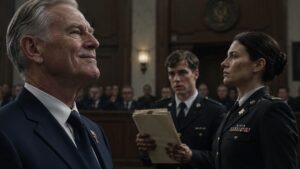
They Laughed When the Old Veteran Warned Them About the Arm Lock
Chapter 1: The Warning Everyone Heard and Nobody Respected
“We stopped teaching it your way for a reason.”
Kevin Rivera said it loudly enough for all twenty-four service members on the mats to hear.
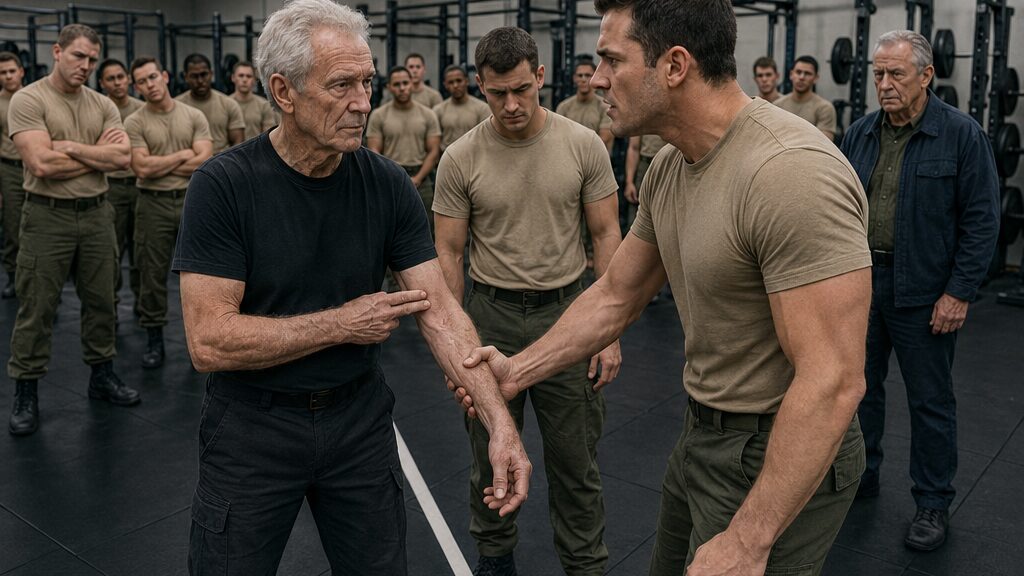
A few heads turned toward Frank Baker. One of the junior instructors looked down, but not before a smile pulled at the corner of his mouth. Across the black training floor, pairs of soldiers remained frozen halfway through the restraint sequence, waiting to see whether the old man in the plain black shirt would answer.
Frank did not.
He stood beside the weight racks with a cardboard box at his feet and two fingers pressed against the pale seam of scar tissue inside his left elbow. At seventy-three, he had learned how quickly a room could become interested in the wrong thing. If he defended his name, they would hear wounded pride. If he mentioned the years he had spent teaching combatives, they would hear an old man reciting credentials.
So he watched the trainee nearest the white tape line.
The young man’s partner had trapped his right wrist against the ribs and stepped wide to secure the arm. His heel landed beyond the tape. His hips turned before the trainee’s shoulder did. The trapped elbow rotated inward until the joint had nowhere left to travel.
Frank felt the old warning in his own arm before the trainee’s face changed.
“Release the wrist first,” Frank said.
Kevin folded his arms. He was broad through the shoulders, his tan training shirt darkened at the collar from the morning session. “They’re following the approved sequence.”
“The foot is too far outside.”
“The line marks the control lane.”
“It also invites the instructor to chase width.”
Kevin glanced at the class. “That’s not how the current standard reads.”
Frank looked at the trainee’s hand. The little finger had begun to curl.
“No,” Frank said. “It isn’t.”
The answer seemed to irritate Kevin more than an argument would have. He stepped closer, putting himself between Frank and the nearest pair.
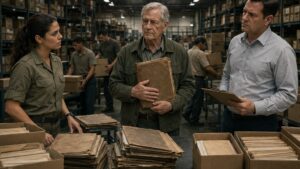
Robert King had invited Frank to the base to return a box of old lesson plans, photographs, and marked-up training cards that had occupied a closet in Frank’s house for nearly thirty years. Robert had promised coffee, a quiet tour, and no ceremony.
Then an administrative call had pulled Robert out of the gym.
Frank had intended to leave the box and go.
Kevin pointed toward the pair on the mat. “This version was reviewed after the old programs were retired. It uses leverage, not pain compliance. We don’t wrench joints and call it toughness anymore.”
A silence moved through the class.
Frank understood the accusation beneath the words. He had heard versions of it before, often fairly. Some instructors from his generation had treated injury as weakness and caution as hesitation. Frank had spent years trying to separate discipline from punishment.
He had not always succeeded.
“This isn’t about pain compliance,” he said. “It’s about where the elbow loses rotation.”
Kevin gave a short laugh. “You’ve been standing here ten minutes.”
“Long enough.”
The same junior instructor who had smiled now looked openly amused. The trainee at the white line released his partner and shook his own hand once, sharply, as though flicking off water.
Frank saw the movement.
The trainee saw Frank seeing it.
He tucked the hand behind his thigh.
Kevin followed Frank’s gaze but caught only the end of the gesture. “Problem?”
“No, Sergeant,” the trainee said.
Frank lowered his fingers from his scar.
“Have him spread his hand,” he said.
Kevin’s face tightened. “He said he’s fine.”
“Have him spread it.”
A few soldiers looked at one another instead of at Frank. The old man had crossed some invisible boundary. He was no longer an invited visitor offering an observation. He was challenging the instructor in front of the class.
Kevin walked to the trainee. “Show him.”
The trainee opened his hand. All five fingers extended.
Kevin turned back. “Satisfied?”
Frank was not. The ring finger had lagged half a second behind the others.
But proof offered too early could look like accusation, and accusation without authority could close the room completely.
“Ask him whether the last two fingers have tingled before today.”
The trainee swallowed.
Kevin noticed.
“Have they?”
“Only after grip work.”
“How many times?”
The trainee hesitated. “A couple.”
Kevin’s voice hardened. “And did medical restrict you?”
“No, Sergeant.”
“Then we continue.”
Frank looked down at the white tape. It ran in a clean line across the mats, newly replaced, bright against the black surface. In the old rooms there had been no lane markers. Instructors had drifted too close to walls, benches, one another. The lines were an improvement. They created order.
But this one had been placed to reward a wider step, and the timed standard rewarded speed. Good changes could combine into a bad result.
“Your line is teaching the wrong distance,” Frank said.
That brought the laughter.
Not from everyone. Only one short breath from the junior instructor and a low sound somewhere in the back row. But it was enough.
Kevin turned slowly. “The line?”
“Yes.”
“The tape is the problem now?”
“The tape, the time, and the locked wrist together.”
Kevin put his hands on his hips. “You think a piece of tape is injuring soldiers?”
“I think people follow what you measure.”
The room grew still again.
Kevin’s expression changed. The irritation remained, but something more personal entered it, something Frank could not place.
“You don’t know what we measure.”
“Then show me.”
Frank regretted the words as soon as they left him. Not because they were wrong. Because they gave Kevin a way to turn the safety question into a contest.
Kevin took it.
He stepped onto the center mat and motioned the nearest pair aside. “All right. Since we have a concern about limited rotation, we’ll demonstrate the sequence on someone who has it.”
Robert’s empty chair sat against the wall. Frank looked at it once.
Kevin extended a hand toward the mat. “You said the position is unsafe.”
“I said the transition removes space.”
“Then let the class see it.”
“This doesn’t need a performance.”
“It needs clarity.”
Frank heard the career pressure behind Kevin’s tone. Certification was three days away. The class needed confidence in its instructors, and Frank had cracked that confidence in less than fifteen minutes. Kevin was not only defending pride. He was trying to restore order.
But he was doing it by making an old man the lesson.
Frank bent to lift the box.
Behind Kevin, the trainee rubbed his ring finger against his thumb.
Frank straightened without the box.
A current of attention passed through the formation. Some faces held concern now, not amusement. Others carried the bright, uncomfortable focus people gave a confrontation they had not paid to see but did not want to miss.
Frank stepped onto the mat.
His left knee resisted the first stride. His elbow would not fully straighten. He stopped with both feet inside the white line.
Kevin came close enough that Frank could smell detergent and stale coffee on his shirt.
“Normal training speed,” Frank said.
Kevin’s eyebrows rose. “You sure?”
“No faster. No slower.”
Kevin reached for Frank’s left wrist.
For an instant, Frank saw another room, another set of black mats, another young hand disappearing against a rib cage.
He pressed two fingers to the scar inside his elbow.
Then Kevin closed his grip around Frank’s wrist and turned to the class.
“Watch how the approved hold handles limited mobility.”
Chapter 2: One Small Step Put Kevin on His Knee
Kevin tightened the restraint, and Frank knew at once that the younger man had removed his own safe exit.
The grip itself was controlled. Kevin did not jerk the wrist or drive the elbow high. His left hand pinned Frank’s forearm against his side while his right hand guided the wrist inward. By the current manual, the position was clean.
Then Kevin stepped across the white line.
His stance widened. His hips settled. His weight came forward before Frank’s shoulder had turned.
The class watched Kevin’s hands.
Frank watched Kevin’s feet.
“You feel the control point?” Kevin asked.
“I feel where you lost it.”
A few faces changed.
Kevin drew Frank’s wrist tighter against the ribs. “The subject can’t rotate out.”
“Neither can you.”
Frank moved before Kevin could answer.
It was not a throw. There was no sweep, no wrenching twist, no burst of strength. Frank slid his right foot on a short diagonal and stopped his heel one inch before the white tape. At the same time, he turned his captured hand just enough to place Kevin’s locked wrist between them.
Kevin’s own stance did the rest.
His hips tried to follow the pressure, but his wide foot had nowhere safe to go. His center shifted past his knee. To keep his wrist from folding under the trapped angle, he dropped down.
One knee struck the mat.
The sound was small.
The silence after it was not.
Frank released immediately.
He stepped back, leaving Kevin free before the younger man had to pull away. Kevin remained on one knee for half a breath, staring at his own hand as if it belonged to somebody else.
Frank did not look at the class.
“That is the space you keep taking away from your trainees,” he said.
Kevin rose quickly. Color had climbed from his collar into his face.
“You changed the position.”
“I changed where I stood.”
“You redirected the wrist.”
“Because you locked yours.”
Kevin flexed his fingers. “You resisted before the restraint was complete.”
“That is when people resist.”
A murmur moved through the back row and stopped when Kevin faced them.
Frank had wanted the room to see the danger. Instead, he could feel the story becoming simpler in their minds: the young instructor had challenged the old man, and the old man had put him down.
It was the wrong lesson.
Kevin demonstrated the starting grip in the air. “The subject in this drill is compliant until the control point.”
“Then you’re not training the moment that causes the injury.”
“We’re training the standard.”
Frank looked toward the trainee who had shaken his hand earlier. “Standards are supposed to control risk. Not hide it.”
Kevin’s jaw tightened. “You walk into my class, contradict the manual, put an instructor on his knee, and now you’re suggesting we hide injuries?”
“I’m suggesting you check one.”
The trainee lowered his eyes.
That was enough to make the room notice him.
Kevin noticed too. “Come here.”
The trainee stepped onto the mat. He was young, perhaps twenty-three, with a damp line of hair at his forehead and the careful posture of someone trying not to favor one side.
“Which hand?” Kevin asked.
“Right.”
“Any pain?”
“No pain.”
Frank moved closer but kept his hands down. “Tingling?”
The trainee glanced at Kevin. “Sometimes.”
“Which fingers?”
The ring finger and little finger separated slightly from the others.
“These two.”
Kevin exhaled through his nose. “Grip fatigue can do that.”
“Yes,” Frank said. “So can pressure at the elbow.”
Kevin turned on him. “You’re not medical.”
“No.”
“You haven’t examined him.”
“No.”
“You saw him shake his hand.”
“I saw when he shook it.”
That stopped Kevin for a moment.
Frank pointed toward the white line. “After the third repetition. When his partner planted outside the lane and pulled the wrist tight before turning the shoulder.”
The trainee looked at his partner. The partner looked back, uncertain.
Kevin said, “You counted his repetitions?”
Frank did not answer.
He had counted without deciding to. Decades of instruction had left him unable to watch a training floor casually. He tracked foot placement, breathing, hesitation, whose grip tightened under stress, who nodded despite not understanding. Long after retirement, rooms still divided themselves into patterns.
The junior instructor stepped forward. The smile was gone. “Sergeant, I saw him shake it during warm-ups too.”
Kevin looked at him. “Today?”
“Last week.”
The trainee’s face tightened.
Kevin’s authority did not disappear, but it changed shape. It became something he had to hold in place.
“Why wasn’t that reported?”
The trainee answered carefully. “I mentioned it after Tuesday’s block.”
“To whom?”
No one spoke.
Kevin’s eyes moved toward the junior instructors.
Frank saw the answer before anyone gave it.
Kevin had heard.
Maybe not as a formal complaint. Maybe not with the words numbness or injury. But enough to remember.
Kevin looked back at Frank. “We are not diagnosing anyone on the mat.”
“Then stop the drill and send him to someone who can.”
The installation of authority returned to Kevin’s voice. “Class, take ten. Hydrate. No partner work until I call you back.”
The formation broke with unusual quiet. Nobody hurried toward the water coolers. Several soldiers glanced at Frank as they passed, but the looks did not feel like respect. They felt like expectation.
Frank disliked them more than the laughter.
Kevin motioned the trainee toward the edge of the mat. “Sit down.”
The trainee obeyed.
Frank turned toward the box by the weight racks. He had done enough. More than enough. The proper people would take over now.
Robert entered through the side door wearing a dark blue civilian jacket over an olive shirt. He carried a folder under one arm and raised his free hand when he saw the scattered class.
“What happened?”
Kevin answered before Frank could. “Your guest interrupted instruction.”
Robert looked from Kevin’s flushed face to Frank’s scarred arm, then to the trainee seated against the wall.
His expression lost all color.
“Frank,” he said quietly. “What did you see?”
The question carried recognition, but not relief. Robert sounded afraid.
Frank felt the old room gather around him again.
“Same alignment,” he said.
Robert’s hand tightened around the folder.
Kevin caught the exchange. “Same as what?”
Robert did not answer.
The trainee tried to push himself up with his right hand. His arm buckled, and he folded it against his chest.
Kevin reached him first. “Don’t move it.”
The trainee stared at his open palm.
“I can’t feel them,” he said.
Kevin crouched beside him. “Which ones?”
The trainee lifted his hand with the other.
The ring finger and little finger hung slightly apart.
“These two.”
Chapter 3: The Numb Fingers Changed the Argument
The trainee could not keep his little finger pressed against Rachel Martinez’s hand.
“Again,” she said.
He tried. The finger trembled outward almost at once.
Rachel released the pressure and wrote a note on the examination sheet. The base clinic room was too small for the number of people Kevin had allowed inside. He stood near the sink with his arms folded. Frank occupied the only chair against the wall, his left hand resting over his right wrist. Robert waited in the corridor beyond the open door, visible through the narrow gap.
The trainee watched Rachel’s pen.
“Is that bad?”
“It means we keep checking,” she said. “Turn your palm up.”
He did.
“Any numbness now?”
“Still the same two.”
“Pain at the elbow?”
“Not really.”
“Shoulder?”
“No, ma’am.”
Rachel placed one finger against the inside of his elbow, gentle enough not to provoke a reaction. “Tell me if the sensation changes.”
The trainee’s face tightened.
“There.”
“More tingling?”
“Yes.”
Kevin shifted near the sink. “That doesn’t establish the drill caused it.”
Rachel looked at him. “I haven’t said it did.”
“He’s had grip fatigue before.”
“How do you know?”
Kevin’s folded arms loosened.
Rachel waited.
The trainee stared at the floor.
Frank pressed two fingers against the pale scar inside his own elbow, not rubbing it but locating something. Rachel had noticed him do the same thing in the gym. At first she had taken it for an old man’s unconscious response to pain.
Now she watched the exact placement of his fingertips.
“Sergeant Rivera,” she said, “when was the first symptom reported?”
Kevin’s gaze moved to the trainee. “He mentioned tingling after grip work.”
“When?”
“Last week.”
The trainee looked up.
Rachel lowered her pen. “Was it entered into the injury log?”
“It wasn’t presented as an injury.”
“That wasn’t my question.”
Kevin’s face hardened. “No formal report was made.”
“Did you direct him to medical?”
“He said it resolved.”
The trainee shifted on the examination table. “It did. Mostly.”
Rachel turned to him. “How many times has this happened?”
“Twice before today.”
Kevin looked at him sharply. “You told me once.”
“I told the junior instructor the first time.”
“And the second?”
The trainee’s silence answered.
Kevin turned toward the doorway, where the junior instructors had remained outside with the rest of the class. No one met his eyes.
Rachel wrote again. She had seen training rooms create their own definitions of pain. A complaint became soreness. Soreness became fatigue. Fatigue became something expected. By the time a symptom received the proper name, everyone could claim they had never heard it before.
She faced Frank. “Show me the position you believe increases it.”
Kevin objected at once. “He hasn’t examined the trainee.”
“I’m asking for the motion, not a diagnosis.”
Frank stood slowly. His left elbow remained slightly bent even when he straightened. He approached the examination table but stopped beyond arm’s reach.
“May I?” he asked the trainee.
The young man nodded.
Frank did not touch him. “Hold your right arm in front of you. Palm inward.”
The trainee followed.
“Now bend the elbow.”
No change showed on his face.
“Keep the shoulder still and turn the wrist toward your ribs.”
The trainee began the movement.
“Stop,” Frank said.
The word came before the trainee flinched.
Rachel saw the ring finger tighten.
“Where?” she asked.
“Inside the elbow,” the trainee said. “Then down.”
Frank lowered his own arm. “That is the path.”
Rachel repeated the motion more carefully, supporting the trainee’s wrist so the shoulder could not compensate. The tingling increased at nearly the same angle Frank had predicted.
She stepped back.
“You’ve seen this pattern before,” she said.
Frank returned to the chair. “Yes.”
“In restraint training?”
He looked at the floor.
Kevin moved away from the sink. “That old sequence isn’t the same as ours.”
“No,” Frank said. “Yours changes the entry.”
“And the grip.”
“Yes.”
“And the release standard.”
“Yes.”
Kevin spread his hands. “Then stop talking as if one caused the other.”
Frank’s expression did not change. “I said the failure point is familiar. Not that the systems are identical.”
Rachel studied both men. Kevin was defensive, but not entirely wrong. Similar symptoms did not prove identical causes. Frank’s precision was useful, perhaps important, but experience could create its own tunnel vision. People often recognized the shape of an old mistake and forced new facts to fit it.
She addressed Frank. “Your explanation is plausible. That is all I can say from this examination.”
Kevin seized on the words. “Plausible.”
Rachel turned to him. “And the symptom was known before today.”
His mouth closed.
“I’m placing the trainee on restriction pending further evaluation,” she continued. “No restraint drills. No loaded carries. No grip testing.”
“The certification block is Thursday.”
“He will not participate.”
Kevin looked toward the trainee, and for the first time his concern seemed to outweigh his irritation. “Will this recover?”
Rachel kept her answer measured. “We caught a functional change. That matters. I need imaging and a full nerve assessment before I tell you more.”
The trainee nodded once, but his breathing had become shallow.
Frank noticed. “Can he call someone?”
Rachel looked at him.
“Before you take him for testing,” Frank said. “Let him tell whoever is waiting for him that he’ll be late.”
The trainee’s shoulders dropped slightly.
It was the first thing anyone had said that treated him as more than a problem in the training schedule.
Rachel handed him his phone.
Kevin watched Frank with a different kind of suspicion now. Less certain, more searching.
Robert appeared in the doorway. “The training chief wants a preliminary account.”
“From whom?” Kevin asked.
“All of us.”
Kevin gave a humorless laugh. “Good. Then we can explain that a retired visitor disrupted a certification rehearsal and performed an unauthorized counter.”
Frank did not look at him.
Rachel capped her pen. “You can also explain the prior symptoms and the absence of a report.”
Kevin’s face tightened again. “There was no diagnosed injury to report.”
“There was a symptom to document.”
The room held still.
Rachel had expected Frank to press his advantage. He did not. That restraint might have been dignity. It might also have been avoidance.
She stepped closer to him.
“You knew which movement would increase the numbness,” she said. “You knew before he completed it.”
Frank’s fingers returned to the scar inside his elbow.
“Where did you learn that pattern?”
Robert lowered his eyes in the doorway.
Kevin looked from him to Frank.
For several seconds, Frank said nothing. His silence no longer felt calm. It felt occupied.
Finally, he lifted his hand from the scar.
“From the first man we failed.”
Chapter 4: Kevin Knew the Name Frank Would Not Say
“Did you fail him too?”
Kevin placed the photograph on the desk between them.
Its corners had gone soft from years in a wallet. Andrew Rivera stood in the center wearing an older version of the training uniform, one hand resting on the shoulder of a younger Kevin. Behind them, a row of mats filled a gym Kevin remembered only in fragments: the smell of canvas, his father’s whistle, men laughing too loudly after drills.
At the edge of the photograph stood Frank Baker.
His left arm was wrapped in a rigid brace from wrist to upper bicep.
Frank looked at the picture but did not reach for it.
The gym office was empty except for them. Through the open door, the equipment room gave off the faint odors of rubber and disinfectant. The morning class had been suspended until the training chief reviewed Rachel’s report. The silence that replaced it felt wrong.
Kevin tapped the photograph. “You recognized my name yesterday.”
Frank’s gaze remained on Andrew. “I recognized your face.”
“You knew him.”
“Yes.”
“And you said nothing.”
Frank lifted his eyes. “It wasn’t the place.”
“You had no trouble correcting me in front of my class.”
“I corrected a position.”
“You put me on my knee.”
“You put yourself there.”
Kevin’s hand flattened over the desk. He had repeated that moment all night, each time finding a different way Frank could have warned him, stopped him, refused him. None changed the fact that Kevin had stepped too wide after being told the step was wrong.
That did not make Frank innocent.
“My father spent years saying your program hurt a man and buried it,” Kevin said. “He said instructors cared more about passing evaluations than what happened to the people under them.”
Frank’s face gave nothing back.
“He said one man tried to fight it,” Kevin continued. “Then stopped when command pushed back. Was that you?”
Frank looked toward the open doorway. “Andrew had a sharp eye.”
“That isn’t an answer.”
“He saw the transition problem early.”
Kevin stared at him. “Before you?”
“Yes.”
The admission landed harder than denial would have.
“My father warned you?”
“He warned all of us.”
“And you ignored him.”
“We disagreed with him.”
“Is that what you called it?”
Frank’s right hand moved to his left elbow. Two fingers found the scar through the fabric of his sleeve.
Kevin had seen that gesture in the clinic. He had watched Rachel notice it too. Yesterday it had looked like habit. Now it looked like a door Frank kept touching without opening.
“What happened to the first man?” Kevin asked.
Frank’s jaw tightened.
“Did the hold damage his arm?”
“Yes.”
“Permanently?”
Frank said nothing.
Kevin shoved the photograph closer. “Look at him.”
“I am.”
“No. Look at what he became because nobody listened.”
Frank’s expression changed then—not much, but enough. His eyes moved from Andrew’s face to the old gym behind him.
Kevin had grown up with pieces of his father’s anger. Andrew had never told the story in a straight line. He would speak about instructors who mistook obedience for safety, then stop when Kevin asked names. He would complain about paperwork that vanished, about appeals that became delays, about a man who knew better and chose the building over the soldier.
The name Frank Baker had surfaced only twice.
Both times Andrew had gone quiet afterward.
Kevin pulled open the top desk drawer and removed a second item: a folded photocopy of an old training roster. Frank’s name appeared at the top beneath Lead Instructor. Andrew’s was lower on the page.
“The records clerk found this after I asked about the old program,” Kevin said. “My father was your junior instructor.”
“He was.”
“He reported the problem.”
“Yes.”
“And you were in charge.”
“Yes.”
Kevin waited for more.
Nothing came.
The old anger he had inherited found a fresh place to stand. “You walk in here and act like silence is discipline. Maybe it’s just how you avoid answering.”
Frank looked at him steadily. “Sometimes it is.”
Kevin had expected resistance. The agreement unsettled him.
From the equipment room came the click of a metal latch. A junior instructor had left a storage cabinet partly open. Inside, old foam pads leaned against newer training shields, edges cracking with age.
Kevin pointed at Frank’s arm. “Was that injury from the same hold?”
Frank followed the gesture but did not uncover the scar.
“Related.”
“Related how?”
“I tested the position.”
“On yourself?”
Frank’s mouth tightened. “Afterward.”
“After the trainee was hurt.”
“Yes.”
Kevin stepped away from the desk. His anger now had too many directions. Frank had seen the danger. Frank had been injured testing it. Frank had still allowed the system to continue.
“Did my father help write the report?”
“He pushed for one.”
“Did you?”
Frank’s silence returned.
Kevin gave a short, bitter laugh. “There it is.”
He picked up the photograph and held it upright. “He told me men like you always had a reason. There was always a commander, a deadline, a regulation. But the person who got hurt was expected to live with the result.”
“Andrew was not wrong about that.”
“Was he wrong about you?”
Frank’s hand fell from his elbow.
Before he could answer, footsteps approached from the corridor.
Robert King appeared in the doorway carrying a gray records box sealed with yellowed tape. He wore the same dark blue jacket from the gym, though now it hung open. Dust marked one sleeve.
His gaze went first to the photograph in Kevin’s hand, then to Frank.
“You found Andrew,” Robert said.
“I grew up with Andrew.”
Robert stopped.
Kevin watched recognition move across his face. The older man seemed to understand at once why Kevin’s anger had been sharper than professional embarrassment.
“You knew him too,” Kevin said.
Robert set the box on the desk. “We all did.”
Kevin pointed toward Frank. “He won’t tell me whether my father was right.”
Robert looked at Frank for permission.
Frank gave none.
That, Kevin realized, was how these men had protected one another for years—not always with lies, but with pauses, glances, decisions about what another man should be allowed to say.
Kevin tore the old tape from one corner of the box.
Robert caught his wrist. “Wait.”
Kevin looked down at the hand, then up at him.
Robert released him.
“The document you want is in there,” he said. “At least part of it.”
“So it proves the problem was reported.”
“Yes.”
“And that Frank tried to correct it.”
Robert glanced at Frank again.
Kevin pulled the box toward himself. “Then maybe he can stop pretending he has nothing to say.”
Robert’s face hardened with something close to grief.
“The paper will show that Frank saw the danger,” he said. “But it will not clear him.”
Chapter 5: The Missing Addendum Proved Less Than They Hoped
The approval page was missing.
Robert emptied the records box onto the conference table twice, as though a second search might produce a different past. Training rosters, handwritten evaluations, faded photographs, and brittle memoranda spread beneath the fluorescent lights. At the center lay Frank’s corrective addendum, twelve pages held together by a rusted clip.
The final page ended with a signature line.
It was blank.
“The routing copy should be here,” Robert said. “I kept it with the packet.”
The installation training chief sat at the far end of the table, a current manual closed beneath one hand. Rachel occupied the chair beside Frank. Kevin remained standing, arms folded, as if sitting would imply trust.
Frank read the first page without touching it.
The title was typed in block letters: MODIFICATION OF CLOSE-CONTROL ARM RESTRAINT FOLLOWING TRAINING INJURY.
Below it, in his own handwriting, a note slanted into the margin.
Preserve rotational space before weight transfer.
The words looked younger than he felt.
Robert searched the empty box again. “Someone removed the endorsement.”
“Or it was never endorsed,” Kevin said.
“It went forward.”
“According to whom?”
“According to me.”
Kevin’s expression barely shifted. “You’ve remembered a lot since yesterday.”
Robert looked away.
Rachel drew the addendum toward her. Several pages contained hand-drawn figures—shoulders, wrists, arrows indicating lines of pressure. One diagram showed two fingertips placed inside the elbow above the scar path.
She looked at Frank’s arm.
“This is your check.”
“It was part of it.”
“You wrote this?”
“With Andrew and two others.”
Kevin leaned over the table. “My father’s name isn’t on it.”
“He was transferred before the final draft,” Frank said.
“Convenient.”
“No,” Frank said. “It wasn’t.”
The training chief tapped the current manual. “I need to understand whether this old document applies to the present sequence.”
Frank looked at the white ceiling for a moment before answering. “Not directly.”
Kevin unfolded his arms. “Yesterday you acted like it did.”
“I said the failure point was familiar.”
“You stopped the class.”
“A trainee had numb fingers.”
“That symptom has not been tied to the drill.”
Rachel spoke without looking up. “It also hasn’t been separated from it.”
The training chief raised one hand. “Keep this precise.”
Rachel turned the old diagram sideways. “The addendum identifies compression and traction risk when the elbow is fixed before the shoulder rotates. That principle remains relevant.”
Kevin pointed to the manual. “The current sequence changes the entry and mandates a controlled release.”
“Yes,” Rachel said. “But the timed evaluation encourages the instructor to establish the wrist before the partner has completed the turn.”
The training chief looked at Frank. “Is that your claim?”
“It’s what I saw.”
“Once?”
“Across six pairs.”
Kevin’s eyes narrowed. He had not known Frank had counted that too.
Rachel flipped to the seventh page and stopped. “This section is wrong.”
Robert leaned closer. “Which part?”
“The recommended wrist angle. It assumes the nerve risk decreases when the hand is turned farther inward.”
Frank looked at the paragraph.
Rachel traced a sentence with her pen. “Current guidance says that can increase tension in the position you’re describing.”
No one spoke.
For one brief hour, the addendum had seemed capable of doing what Frank had never done for himself. It might prove he had acted, that he had not simply watched a trainee leave with a damaged arm and gone back to work.
Now the paper lay open between them, both warning and error.
Kevin pulled out a chair and sat.
“So the old correction could have hurt someone too.”
“Yes,” Frank said.
Robert looked at him. “We didn’t know that then.”
“We knew enough to be uncertain.”
The words came out before Frank could soften them.
Rachel studied him. “Did you recommend testing before adoption?”
Frank turned to the next page. A paragraph described a controlled pilot program with medical observation.
“Yes.”
“Was it performed?”
“No.”
The training chief pushed back slightly from the table. “Why not?”
Robert answered. “Command rejected the suspension request. The program was preparing for an installation-wide evaluation. They didn’t want the entire restraint block frozen over one injury.”
“One permanent injury,” Frank said.
Kevin watched him.
The training chief’s hand remained on the current manual. “There is no record here of a permanent finding.”
“The man did not regain full function.”
“How do you know?”
“Because I visited him.”
Robert closed his eyes.
That detail had not been in the official report. The official language had described prolonged weakness, uncertain prognosis, reassignment pending evaluation. The institution had preferred phrases that remained unfinished.
Rachel turned to the final unsigned page. “This document proves the mechanism was questioned. It does not prove the current drill caused the trainee’s symptoms. It also does not establish that this proposed correction was safe.”
Frank nodded.
Kevin looked almost disappointed by his agreement.
The training chief opened the current manual. “Then certification proceeds unless medical identifies an immediate restriction affecting the class as a whole.”
Rachel’s chair scraped the floor. “One trainee is already restricted.”
“One trainee with symptoms that may have multiple causes.”
“The pattern appeared during the drill.”
“According to observation, not testing.”
Frank felt the argument moving into familiar channels. Each statement could be defended. Together they created permission to continue.
“When is the certification review?” he asked.
“Thursday morning.”
“Delay it.”
The training chief shook his head. “Not without current evidence.”
“You have a recurring symptom, an alignment concern, and an old report describing the same failure point.”
“I have an incomplete historical record and a disputed interpretation.”
Kevin spoke for the first time in several minutes. “If certification is delayed, the unit loses the training window.”
The training chief looked at him. “Correct.”
“And my instructor status?”
“Would be reviewed.”
Kevin’s gaze dropped to the table.
Frank saw the pressure clearly now. It did not excuse what Kevin had ignored, but it explained the speed with which he had turned uncertainty into confidence.
Robert gathered the loose papers into a stack. His hands shook enough to rattle the clip.
“There was another route,” he said.
Frank looked at him.
Robert kept his eyes on the papers. “After command declined the initial suspension, there was an appeals hearing. Safety review, medical, training command. All in one room.”
Kevin sat straighter. “Did the hearing happen?”
“Yes.”
“Was the addendum presented?”
Robert did not answer.
Frank knew what came next. He had known since the box appeared.
The scar inside his elbow tightened without movement.
Kevin looked between them. “Who was supposed to present it?”
Robert finally raised his head.
“Frank.”
The training chief’s expression changed.
Rachel lowered her pen.
Kevin stared at Frank. “You had a final appeal?”
Frank said nothing.
Robert’s voice was quiet now. “He had one last chance to put the injury, Andrew’s warning, and the correction into the official record.”
“And?”
Robert looked at the blank signature line.
“He did not attend the hearing.”
Chapter 6: Frank Finally Told Them Why He Stayed Silent
Kevin found Frank alone in the darkened gym, stepping toward the white line and backing away from it.
The overhead lights were off. Only the emergency fixtures burned above the exits, leaving the mats in long gray rectangles. Frank’s cardboard box sat near the wall, still unopened. His shoes made almost no sound.
Forward.
Stop.
Back.
Again.
“You missed a hearing,” Kevin said.
Frank halted with one foot behind the tape.
Kevin closed the door. “That is what Robert meant.”
“Yes.”
“Why?”
Frank looked down at the line. “I knew you would ask.”
“You knew yesterday.”
“Yes.”
“And you let me keep asking questions you had already answered for yourself.”
Frank stepped over the tape, then back behind it.
Kevin’s voice sharpened. “Stop doing that.”
Frank did.
For a moment the only sound came from the ventilation system.
Kevin walked closer. “My father spent the rest of his career believing you abandoned the case.”
“He was right.”
The directness struck harder than an excuse.
“Why?” Kevin asked again.
Frank pulled up the left sleeve of his black shirt.
The visible scar near his elbow was only part of it. A pale, uneven seam ran farther along the inside of his forearm, crossed by smaller marks where pins had once entered. The joint itself sat slightly wrong, thickened on one side. Frank extended the arm as far as he could. It stopped well short of straight.
“After the injury,” he said, “command wanted to know whether the trainee had resisted improperly.”
Kevin’s jaw tightened.
“I said the position could fail even under normal resistance. They asked me to demonstrate.”
“With your own arm.”
“With Robert controlling it.”
Kevin looked toward the empty doorway, as if Robert might still be standing there.
“We went slowly,” Frank continued. “Too slowly to reproduce the training speed. Nothing happened. So I told him to close the angle.”
“And it damaged you.”
“The first time, no. The second time, the joint locked. I told him to continue because I wanted the exact point.”
Kevin stared at the scar. “That was not discipline.”
“No.”
“What was it?”
“Pride.”
The word settled between them.
Frank lowered his sleeve only halfway. “I believed that if I could map the failure on my own body, they would have to listen. Instead, they saw an instructor who had ordered an unsafe test after an injury.”
“They weren’t wrong.”
“No.”
Kevin looked away first.
Frank pressed two fingers inside his elbow, showing the exact location rather than hiding the gesture. “The addendum came after surgery. Andrew helped gather the earlier observations. He wanted the program suspended until the review.”
“And you?”
“I wanted a modification. I still believed the system could continue if we corrected the mechanics.”
“So he thought you were protecting it.”
“I was.”
The admission seemed to take weight from Frank’s shoulders and place it in the room.
Kevin moved to the edge of the mat. “Why miss the hearing?”
Frank’s fingers remained on the scar.
“The injured trainee’s family was attending.”
Kevin waited.
“I had visited him in rehabilitation. His hand had improved, but not enough. He asked whether I had known the hold could fail.”
“What did you tell him?”
“That I knew it could become unsafe if taught badly.”
“That was not his question.”
“No.”
Frank’s voice had changed. It had lost the firm economy Kevin had heard in the gym. Each sentence now seemed to cost him something.
“He asked if I knew before his injury that instructors were rushing the transition. I did. Andrew had warned me. I had corrected individuals, but I had not stopped the block.”
“Because of the evaluation.”
“Yes.”
Kevin’s mouth tightened.
“The family wanted me to say that at the hearing,” Frank continued. “Not just that the technique had a flaw. That I had seen the behavior around it and allowed training to continue.”
“And you could not.”
“I told myself the hearing had already decided what it wanted. I told myself my presence would turn it into blame instead of correction.”
“But really?”
Frank looked at him.
“I was ashamed.”
The ventilation clicked off. The silence deepened.
Kevin had imagined this confrontation since recognizing Frank’s name. In those versions, Frank denied everything until Kevin forced the truth from him. Or Frank produced proof that Andrew had misunderstood. Either answer would have preserved a simple shape: guilty man, wronged father, son who finally named the harm.
Instead, Frank stood under an emergency light with a damaged arm and no defense.
“My father said silence protected the program,” Kevin said.
“It did.”
“He said you let them call the injury an individual failure.”
“I did not write those words.”
“You let them stand.”
“Yes.”
Kevin’s anger remained, but it no longer felt clean. “Guilt does not make that better.”
“No.”
“Hurting your own arm does not make it equal.”
“No.”
“Then why show me?”
“Because you asked why I knew the pattern.”
Kevin gave a bitter breath. “You always answer one question late.”
Frank lowered his sleeve.
“I thought not defending myself was restraint,” he said. “Most times it was fear with better posture.”
Kevin turned toward the rows of silent mats.
The current trainee’s hand came back to him: the ring finger lagging, the little finger failing against Rachel’s pressure. Kevin had seen the shaking the week before. He had asked whether the young man could continue. He had not asked whether he should.
Frank’s voice came from behind him.
“You knew about the symptoms.”
Kevin remained facing the mats.
“Once,” he said.
“Twice.”
“The first report went to a junior instructor.”
“The second came to you.”
Kevin closed his eyes.
The trainee had approached after Tuesday’s session, flexing his hand. He had called it tingling. Kevin had asked whether it disappeared after rest. When the answer was mostly, Kevin had told him to hydrate, reduce extra grip work, and report if it worsened.
No medical referral. No entry in the log.
Certification had been ten days away.
“I thought he was protecting himself from the timed block,” Kevin said.
“Did you?”
Kevin turned.
Frank did not accuse him. That made the question worse.
“I thought if I stopped training over every complaint, we would never certify,” Kevin said. “I thought the new sequence had already been reviewed by people more qualified than me.”
Frank nodded once. “Those thoughts can all be true.”
“And still not be enough.”
“Yes.”
Kevin looked down at the white tape. “If I report it now, they will say I concealed a symptom.”
“You did.”
“My instructor assignment could be over.”
“Yes.”
“You say that easily.”
“No.” Frank’s voice stayed level. “I say it clearly.”
Kevin’s hands curled, then opened.
For the first time since Frank entered the gym, neither man held the higher ground. The old failure had not disappeared beneath the new one. It had found its repetition.
“What happens if we say nothing?” Kevin asked.
“Certification proceeds.”
“And maybe nobody else gets hurt.”
“Maybe.”
Kevin looked at Frank’s stiff elbow.
The old man had built a life around that word.
Frank stepped forward until his shoe touched the white line, but he did not cross it.
“We stop the certification in the morning,” he said.
Kevin’s face hardened. “You do not command this program.”
“No.”
“You do not carry the consequences.”
“I carry mine.”
“And I carry mine.”
Frank met his eyes.
“That is why you have to be the one who stops it.”
Chapter 7: This Time Kevin Stopped the Drill First
The certification inspector started the timer before Rachel’s objection had been entered into the record.
A sharp electronic tone cut through the gym.
“Begin.”
The first pair moved.
Kevin stood at the edge of the mat with the official sequence card in his hand. The card felt thin enough to tear. Across the room, Rachel was still speaking to the installation training chief, pointing at the medical restriction she had submitted that morning. The injured trainee was absent, but the rest of the class had been ordered to proceed.
Frank stood beside Robert near the weight racks.
He had not stepped onto the mat.
Kevin had expected him to intervene the moment the inspector lifted the timer. Instead, Frank watched with his hands loose at his sides, leaving the decision where he had said it belonged.
With Kevin.
“Establish wrist control,” the inspector called.
The service member acting as instructor trapped his partner’s right wrist and guided the forearm toward the ribs.
“Step to the control lane.”
His boot landed behind the white line.
Safe.
Kevin exhaled.
The pair completed the turn and released cleanly. The inspector marked the score sheet.
A second pair took their place. Then a third.
Nothing happened.
With each successful repetition, the argument from the previous three days seemed to weaken. The current sequence worked when performed correctly. The medical finding remained limited to one trainee. The old addendum remained unsigned and partly wrong.
Kevin could still stop the block.
He could also wait for evidence that might never appear.
The fourth pair entered the lane. One of the service members was smaller than his partner and compensated by moving faster. Kevin had corrected him twice during rehearsal for chasing the timed standard instead of maintaining position.
The timer sounded.
The instructor seized the wrist.
His partner turned late.
The instructor widened his step.
His heel touched the tape.
Kevin felt every person in the room disappear except the two on the mat.
“Continue,” the inspector said.
The heel crossed the line.
The instructor’s hip settled before the partner’s shoulder rotated. The trapped wrist drew tight against the ribs. For an instant, the position looked controlled.
Then the partner’s little finger stiffened.
Kevin saw it.
The ring finger followed half a beat later.
The same delay Frank had noticed on Monday.
“Stop.”
Kevin’s voice struck the room harder than the timer.
The pair froze.
The inspector looked up. “The sequence is active.”
“Release the wrist,” Kevin ordered.
The instructor hesitated.
“Release it now.”
He obeyed. The restrained service member stepped away and shook his hand.
Kevin was already moving.
He crossed the mat, dropped to one knee beside the white line, and took the man’s forearm without closing his grip.
“Spread your fingers.”
The hand opened.
The ring finger lagged.
Kevin placed two fingers inside the elbow, exactly where Frank had placed his own so many times. He did not press hard.
“Any change?”
“Tingling.”
“Down which side?”
The service member traced the inside of his forearm toward the last two fingers.
The inspector approached. “Is there pain?”
“No.”
“Then reset the pair.”
Kevin rose.
“No.”
The word came more quietly than his first command, but nobody mistook it.
The training chief stepped forward. “Sergeant Rivera, the medical objection has not established a class-wide hazard.”
Kevin looked at the service member’s hand. “It has now established a repeatable warning sign.”
Rachel reached them and examined the arm. “How many repetitions today?”
“Two warm-ups,” the service member said. “This was the first timed one.”
She guided the wrist through a smaller range. The fingers tightened again.
The inspector closed the timer in his fist. “An isolated symptom does not authorize an instructor to terminate certification.”
Kevin looked toward Frank.
The old man did not nod. He did not give permission. He simply stood beside the weights with his left elbow bent and his eyes on the mat.
Kevin turned back.
“I had a report last week from another trainee,” he said.
The training chief’s face changed. “A formal report?”
“No.”
“Why not?”
“Because I did not enter it.”
The class remained in formation, but attention shifted from the trainee to Kevin.
He continued before he could retreat into explanation.
“The trainee described tingling after the same block. I treated it as grip fatigue and allowed training to continue.”
The inspector lowered the score sheet. “You concealed a possible injury?”
“I failed to document a symptom.”
“That answer will be part of the investigation.”
“Yes.”
“You understand stopping this event produces an automatic certification failure.”
“Yes.”
“And your instructor status will be reviewed.”
Kevin looked down at the line crossing beneath his boot.
On Monday, the tape had seemed like order. A boundary. A visible standard that removed interpretation. Now he could see how easily a clean line could become an excuse not to look beyond it.
“Yes,” he said again.
The inspector faced the training chief. “Certification is terminated pending safety review.”
A murmur ran through the class.
Kevin turned toward the pair. The instructor who had applied the hold looked pale.
“You followed the sequence as it was taught,” Kevin told him. “This is not yours to carry.”
The young man nodded, though uncertainty remained in his face.
Rachel escorted his partner toward the clinic. The inspector began collecting the score sheets. The training chief spoke quietly into his phone, already opening the administrative machinery that would decide Kevin’s assignment.
Robert moved toward Frank, but Frank stayed where he was.
The inspector noticed him.
“You identified the issue,” she said.
Frank’s gaze remained on Kevin. “I recognized it.”
“That distinction may matter later. For now, this class requires an interim instructor.”
Kevin felt the words before she finished.
She looked directly at Frank. “You will take over the corrective block.”
Several members of the class turned toward the old veteran.
The invitation carried everything Frank had once wanted: authority restored, expertise recognized, a room finally willing to listen.
Frank shook his head.
The inspector’s expression hardened. “Mr. Baker, this is not ceremonial. We need someone who understands the failure.”
“He does.”
Frank pointed to Kevin.
The training chief stared at him. “Sergeant Rivera’s status is under review.”
“He stopped the drill.”
“After failing to report an earlier symptom.”
“Yes.”
Kevin could not tell whether Frank was defending him or refusing responsibility.
The inspector said, “You expect him to teach the correction before one has been approved?”
“No. I expect him to show the class what must be examined before the next drill is attempted.”
Frank stepped onto the mat at last, but he did not move to the front. He stopped behind the white line.
“Do not replace one unquestioned method with another,” he said. “The old addendum contains errors. The current sequence contains a condition you have not controlled. Rachel can define the medical limits. Kevin can identify where the timed movement breaks them.”
The room waited.
Frank looked at Kevin.
On Monday, Kevin had stood over him and used the class to prove the old man irrelevant. Now Frank had the room’s attention and could have taken everything back.
Instead, he left Kevin space.
The inspector closed her folder. “One demonstration. No applied pressure. Then this floor shuts down.”
Kevin walked to the center of the mat.
He called the class closer, not into formation but into a semicircle where everyone could see the feet and the trapped arm together.
Then he knelt beside the white line.
“The problem begins before the hold looks wrong,” he said. “Watch the heel. Then watch the fingers.”
Frank remained behind him.
The inspector looked from one man to the other. “Proceed.”
Kevin placed two fingers beside the service member’s elbow and raised his eyes to the class.
“This time,” he said, “we stop before pain tells us we were late.”
Chapter 8: The New Lesson Began Before Anyone Touched an Arm
Three weeks later, Frank entered the gym and found no chair waiting for him at the front.
He stopped inside the door.
Robert had promised there would be no ceremony. Even so, Frank had expected some awkward arrangement—a folding chair beside the instructor’s table, perhaps, or a printed sign naming him as a special adviser. The kind of honor that placed an old man where everyone could see him while keeping him safely out of the way.
Instead, the chairs remained stacked against the wall.
The class stood in pairs on the black mats. The white tape had been moved six inches inward, narrowing the control lane. Beside every pair lay a laminated card containing three checks: shoulder free, elbow aligned, fingers responsive.
Kevin stood at the front with Rachel.
He wore no instructor whistle.
Frank noticed that first.
Kevin’s formal instructor status remained suspended. The investigation had found that he had failed to document the trainee’s earlier complaint, but it had also recorded that he had stopped certification, disclosed his own omission, and assisted in identifying the repeatable risk. He had been retained under supervision while the corrective block was tested.
Robert came up beside Frank. “You can still leave.”
“I know.”
“Thought you might want the option stated.”
Frank glanced at him. “You have been stating options late for thirty years.”
Robert accepted that without protest.
At the front, Kevin called the room to attention without raising his voice.
“We are not beginning with the hold,” he said. “We are beginning with the warning we ignored.”
No one looked toward Frank.
He was grateful for that.
Kevin held up the old unsigned addendum in one hand and the current sequence card in the other.
“One document noticed a risk but proposed a correction that included its own errors. The other improved several parts of the technique but failed to account for what happens when speed, foot placement, and a fixed elbow combine.”
He set both documents down.
“This is not a lesson about old methods defeating new ones.”
Rachel stepped forward. “And it is not a lesson about waiting for pain. Nerve irritation may appear first as weakness, delayed finger movement, tingling, or loss of coordination.”
She demonstrated the two-finger check on Kevin’s arm.
“Before pressure,” she said, “the instructor confirms space here.”
Each pair copied the gesture.
Two fingers inside the elbow.
No gripping.
No force.
Frank watched the movement travel across the room. What had once been a private habit born from injury now existed as a question asked before anyone touched the joint.
Kevin moved between the pairs.
“Do not press,” he corrected. “You are checking position, not testing pain.”
A service member shifted his heel toward the old tape mark that had been removed. Kevin stopped beside him.
“What changed?”
“The lane is narrower.”
“Why?”
“So I can’t settle my weight before the shoulder turns.”
“What if the partner resists early?”
“I release the wrist and reset.”
Kevin nodded and moved on.
There was no apology to Frank. No introduction of him as a legendary instructor. No account of Andrew, the damaged trainee from years ago, or the hearing Frank had failed to attend.
The absence did not feel like erasure.
It felt like discipline.
Rachel approached Frank. “I want you to demonstrate the transition without load.”
Frank looked at his arm. “Kevin can do it.”
“He will. I want the class to see the difference between recognizing a position and forcing a body to reproduce it.”
That was not praise. It was a boundary.
Frank stepped onto the mat.
Kevin took the partner position but did not close his hand around Frank’s wrist.
“Normal pace?” he asked.
Frank almost smiled. “No.”
Kevin nodded. “Your pace.”
They began.
Frank guided Kevin’s hand toward his forearm, then indicated the direction of the shoulder turn. He moved his right foot diagonally and stopped behind the corrected line.
“Here,” he said. “The instructor still has an exit. The partner still has rotation.”
He attempted to raise his left arm enough to show the next angle.
The elbow locked.
Pain arrived as a bright, narrow line from the old scar into his wrist. His breath caught. The hand would not turn.
The class saw it.
Frank’s first instinct was to pull the arm close and continue explaining with the other hand. He had done that for years—hidden limitation inside instruction, turned pain into a pause nobody was allowed to name.
Rachel was already beside him.
“Do not force it.”
“I know.”
“Then stop.”
The words were quiet, but they reached the place in him that had once told Robert to continue closing the angle.
Frank let his arm lower.
Rachel fitted a light brace around the elbow from the medical kit at the edge of the mat. Her hands were efficient, neither delicate nor dramatic.
Kevin remained in place.
Frank looked at the class. No one appeared disappointed. No one seemed to think the lesson had failed because the old instructor’s body could no longer complete it.
Kevin raised his own arm. “I’ll finish the movement.”
Frank stepped aside.
The action cost him more than the pain had.
Kevin demonstrated the transition slowly. At the control point, he stopped and asked the partner to spread his fingers. Then he showed the class how a rushed step removed the safe rotation Frank had described.
He did not drop anyone to a knee.
He did not need to.
After the demonstration, the pairs began at half speed. Rachel moved along one row, Kevin along the other. Frank remained near the center where he could see the feet and hands together.
Robert stood by the wall, silent.
One pair reset before Kevin reached them. The instructor had noticed his partner’s shoulder lagging behind the wrist.
Another pair stopped when the restrained service member said the word “space.”
No one rolled their eyes.
No one treated the stop as failure.
During the break, Kevin approached Frank with the revised lesson card.
“The training chief approved a limited advisory position,” he said. “Two sessions a month. Observation and curriculum review. No physical demonstration requirement.”
Frank examined the card but did not take it.
Kevin waited.
“You wrote ‘no physical demonstration,’” Frank said.
“Rachel wrote it.”
“Good.”
“You can refuse.”
Frank looked across the room. The injured trainee from the first week stood near the door in clinic clothes, his right arm unrestricted but not yet cleared for partner work. His fingers opened evenly now, though slowly. He was watching the class, not Frank.
“I will review the curriculum,” Frank said. “For six months.”
Kevin nodded. “Six.”
“After that, somebody else should know enough to disagree with me.”
A trace of discomfort crossed Kevin’s face.
Frank handed the card back. “That is part of the job.”
The break ended.
Kevin called the class together. The service members formed a semicircle around the corrected lane.
He did not stand over them. He lowered himself to one knee beside the tape and placed two fingers near his partner’s elbow.
“What do we check before force?” he asked.
The class answered together.
“Space.”
Frank looked down at his shoes.
One toe rested on the white line.
He moved it quietly behind the boundary.
The story has ended.