They Took the Old Veteran’s Three Cartridges, Then Asked Him to Read the Wind
Chapter 1: The Three Cartridges Moved Across the Bench
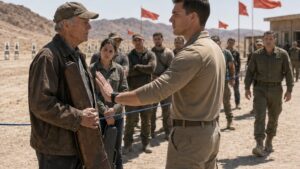
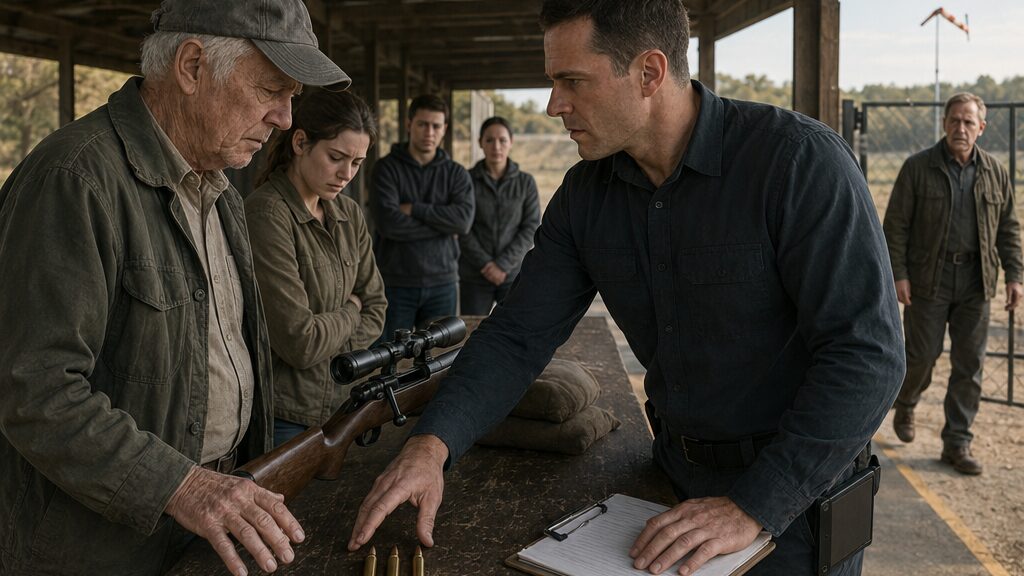
Ryan Johnson’s hand crossed into Lane Four before Stephen Baker had loaded a single round.
His fingers flattened over the three brass cartridges Stephen had placed in a straight line beside the old laminated range card. Without asking, Ryan slid them across the scratched wooden bench until they stopped beside his clipboard.
“You’ll observe today,” he said.
The words carried farther than they needed to beneath the covered firing line.
Two scholarship applicants looked over from the neighboring lanes. A uniformed liaison stopped writing. Beyond the benches, several veteran spectators stood behind the yellow boundary line, close enough to hear but too disciplined to interfere.
Stephen left his scoped bolt-action rifle resting on the sandbags. Its action was open. The chamber was empty. The muzzle pointed downrange.
He looked at the cartridges, then at Ryan.
Ryan was thirty-six, broad through the shoulders, clean-cut, and dressed in the range’s dark safety shirt with ACTING SUPERVISOR stitched over one pocket. A slim electronic tablet hung from his belt. His manner was controlled, but his voice had the deliberate firmness of a man who knew other people were listening.
“I saw your hand,” Ryan said.
Stephen’s right hand rested near the rifle stock. The tremor had returned in the fingers, a fine irregular movement that became more visible whenever he tried to hold them still.
“I expect you did,” Stephen said.
Ryan’s eyes narrowed, perhaps because the answer did not sound ashamed.
“Public event,” he said. “New shooters on the line. I can’t authorize you to fire without a competency assessment.”
“You haven’t performed one.”
“I’ve seen enough to pause you.”
The distinction was almost correct. That was what made it difficult.
Stephen had taught range officers to stop any action they could not verify as safe. He had written those words more than once. He could not fault Ryan for interrupting uncertainty.
He could fault the announcement.
Behind him, Jessica Baker shifted her rifle case from one hand to the other.
“Grandpa,” she said quietly.
She was twenty, wearing a plain canvas shooting jacket and the tight expression she used when she wanted to disappear without moving. This scholarship qualification mattered to her. The award would cover the final portion of her community college tuition and certify her for the youth safety program she hoped to assist with next summer.
Stephen had promised not to interfere.
He had also promised Daniel Green he would watch the candidates.
Ryan picked up one of the cartridges, examined its casing, and set it down again.
“You brought only three?”
“That was all I intended to need.”
A short laugh escaped one of the adult family guests behind the line. It stopped when no one joined it.
Ryan did not laugh. He looked instead at the old faded gray cap Stephen had placed beneath the bench, then at the worn rifle case leaning against the divider.
“This isn’t an exhibition,” he said.
“No.”
“And nobody needs to prove anything.”
Stephen glanced at the cartridges on Ryan’s side of the bench.
“That remains to be seen.”
Jessica closed her eyes briefly.
Ryan took the answer as defiance. His thumb moved across the tablet clipped at his side.
“Temporary disqualification,” he said. “Pending review.”
The liaison stepped closer and laid his clipboard on the bench to confirm the entry. The bottom edge covered most of Stephen’s laminated range card, leaving only one cracked corner exposed.
Stephen felt the tremor travel farther into his hand.
He lowered it beneath the bench and closed his fingers around the faded cap. The cloth had softened over thirty years. He held it until the movement eased.
No one watching could see what he was doing.
That, Stephen thought, had once seemed like discipline.
The range loudspeaker announced the next target cycle. Motors engaged beyond the firing line, and the paper targets began traveling toward the berm.
Stephen looked past Ryan’s shoulder.
Above the roofline, the digital wind indicator showed a mild, steady reading. The small direction arrow barely moved. Ryan glanced at it, satisfied.
Stephen watched something lower.
The shadow beneath the covered lane narrowed where the ground dropped toward the target trench. Dust near the concrete lip moved in a thin ribbon from right to left. A loose thread on the nearest target frame fluttered once, then hung still.
“Before you send the next target,” Stephen said, “watch the bottom edge.”
Ryan turned.
“The bottom edge of what?”
“The carrier.”
The motor drew the target farther downrange.
Ryan looked at the digital display. “Wind is under two.”
“Up there.”
The implication sharpened Ryan’s face.
“Mr. Baker, you’ve already been asked to stand down.”
“I am standing down.”
“Then don’t coach the line.”
Stephen released the cap but kept his hand beneath the bench.
The carrier crossed the midpoint.
For one brief second, the lower edge of the target kicked sideways. The paper snapped toward the left and straightened again. It was small enough that someone looking only at the bullseye might miss it.
The liaison saw it.
So did one of the trainees.
Ryan’s gaze followed the target until it stopped.
“Track vibration,” he said.
“Could be,” Stephen answered.
Ryan studied him, waiting for more. Stephen offered none.
Jessica moved close enough that only he could hear her.
“Please let it go.”
He looked at her.
Her cheeks had reddened. She kept her eyes on the numbered lane markers, not on him.
“I need today to be about the qualification,” she said. “Not about everybody finding out what you used to do.”
Stephen felt the sentence settle harder than Ryan’s hand on the cartridges.
“What do you think I used to do?”
She finally met his eyes.
“I don’t know. You never tell me.”
The loudspeaker called shooters to their assigned positions. Jessica stepped toward Lane Six, then stopped.
“I can’t get removed because you’re arguing with the supervisor.”
“I haven’t argued.”
“That makes it worse sometimes.”
She walked away before he could answer.
Ryan motioned to the liaison, who wrote TEMPORARILY DISQUALIFIED on the form. The clipboard still covered the range card.
The first qualification relay began its preparation sequence. Bolts remained open while shooters checked equipment. Range officers moved behind the line.
Stephen stood beside his old rifle without touching it.
The gate at the far end of the spectator area opened with a metallic scrape.
Daniel Green entered carrying a canvas folder under one arm. At fifty-nine, he had the compact build of a man who had spent most of his life walking firing lines. His hair had thinned, but his eyes still moved from chamber flags to muzzle direction before they moved to faces.
He saw Ryan first.
Then he saw Stephen.
His stride shortened.
For an instant, something passed over Daniel’s face—recognition followed by anger, or relief followed by the memory of why relief was not enough.
He came to Lane Four without speaking.
Ryan straightened. “Director Green. I was about to brief you.”
Daniel did not answer him.
His attention had dropped to the scratched bench. The liaison shifted his clipboard, exposing more of the old laminated card beneath it.
Daniel’s face changed again.
He touched the cracked corner with one thumb but did not pick it up.
“Where did you get that?” he asked.
Chapter 2: The Name Daniel Would Not Say Aloud
Daniel’s question hung over the bench while the first relay waited for the command to begin.
Stephen looked at the range card.
“From this range,” he said.
Ryan glanced between them. “You know him?”
Daniel’s thumb remained on the cracked corner of the laminate.
He knew the handwriting visible beneath the cloudy plastic. He knew the faded grid lines, the small red mark near the lower trench, and the strip of yellow tape sealing one edge. Stephen could see all of that recognition.
Daniel still addressed him as if they had never met.
“Mr. Baker,” he said, “step back from the firing line, please.”
Not Stephen.
Not Sergeant Baker, which would have been worse.
Just Mr. Baker.
Stephen lifted the rifle from the sandbags, verified the open action in full view of Ryan, and carried it muzzle-up only after turning away from the line. He placed it inside the old case without closing the lid.
Daniel looked toward Jessica’s lane.
“Pause the relay,” he told Ryan.
Ryan’s jaw tightened. “For the disqualification?”
“For a review.”
The loudspeaker sounded a hold. Shooters stepped back. Several looked toward Lane Four, where the morning’s private discomfort had become the center of the entire event.
Daniel picked up the range card.
The clipboard had left a clean rectangle across its dusty surface.
“Office,” Daniel said.
The range office stood behind the observation porch, separated from the firing line by glass. Inside, framed safety rules covered one wall. A bank of monitors displayed target cameras and wind readings. On another wall hung photographs from old scholarship events, but none went back far enough to include Stephen.
Ryan entered first with the liaison. Daniel followed. Stephen came last.
Jessica appeared in the doorway before Daniel could close it.
“I’m part of this,” she said.
Ryan looked ready to object, but Daniel nodded.
“You’re the applicant affected by the delay.”
Jessica stepped inside and remained near the door.
Daniel placed the card on the desk. He turned it over, revealing faded pencil notes pressed beneath the laminate. His thumb paused at a split in the corner.
“You kept this,” he said.
“You gave it back.”
“I thought you threw it away.”
“You thought several things.”
The irritation in Daniel’s eyes sharpened. “And you corrected none of them.”
Ryan set his tablet on the desk.
“With respect, whatever history exists here doesn’t change what happened. I observed an uncontrolled tremor in Mr. Baker’s shooting hand. I stopped him before loading. That’s my responsibility.”
“It is,” Stephen said.
Ryan blinked.
Jessica looked at her grandfather as though he had betrayed his own case.
Stephen continued. “A range officer should stop what he cannot verify.”
“Then we agree,” Ryan said.
“We agree on the stop.”
Ryan waited.
Stephen did not give him the rest.
Daniel folded his arms. “Did you assess whether the tremor changed under supported position?”
“No.”
“Did you ask about adaptive technique?”
“No, but—”
“Did you inspect the rifle?”
“The action was open. Muzzle was safe.”
“Did Mr. Baker violate a command?”
“No.”
Daniel turned to Stephen. “And did you explain anything?”
“No.”
A humorless breath left Daniel’s nose.
“That part hasn’t changed.”
Jessica looked from one man to the other.
“What exactly did he do here?”
Daniel’s eyes went to Stephen, giving him the chance.
Stephen remained silent.
Daniel’s mouth hardened.
“He helped write the manual wind-check procedure for the old range,” he said. “Before the electronic system.”
Ryan glanced at the monitors. “That system was replaced twelve years ago.”
“Procedures outlast equipment when they’re worth keeping.”
“Then why isn’t his name in the current manual?”
Daniel did not answer immediately.
Stephen knew why. When the range updated its documents, he had refused attribution. He had asked for his name to be removed from training materials and records. At the time, he had called it simplification.
Daniel had called it disappearing.
Jessica took a step farther into the room.
“You told me you were just coming to watch.”
“I was.”
Daniel looked at Stephen. “Tell her the rest.”
Stephen’s gaze moved to the glass. Outside, Benjamin Scott stood at Lane Two with his equipment arranged in exact, expensive rows. He was the event favorite—fast, confident, already known to the committee. Jessica stood to lose more than a morning if the relay collapsed into argument.
“Daniel asked me to observe the candidates,” Stephen said.
Jessica stared at him.
“Observe for what?”
“The scholarship committee wanted an outside assessment of judgment under pressure.”
“You were evaluating me?”
“All of them.”
“But you didn’t tell me.”
“You wanted to earn it without help.”
“Watching me in secret isn’t help?”
Stephen had no answer that would not sound like an excuse.
Ryan picked up his tablet.
“This is exactly why I need the decision to stand. We have an insurance observer arriving before noon. We have applicants handling firearms, family guests behind the line, and now an undisclosed evaluator trying to coach operations after being stopped.”
“I did not coach operations,” Stephen said.
“You contradicted the wind display in front of trainees.”
“I mentioned the carrier.”
“And you were wrong. The track vibrated.”
Daniel looked toward the monitor showing the target lane. “Did it?”
Ryan’s voice cooled. “The system is certified.”
“That wasn’t my question.”
The room grew quiet.
Stephen could have explained the difference between the elevated reading and the low channel beneath the roof. He could have pointed to the faint mark on the card Daniel still held.
Instead, he said, “Ryan acted within his authority.”
Ryan seized the sentence.
“Thank you. Then the disqualification remains until a formal assessment can be scheduled after today’s event.”
“After today?” Jessica asked. “He isn’t even competing.”
“He brought ammunition to the line.”
“Three rounds,” Daniel said.
“Three are enough for an incident.”
Ryan’s words came too quickly. Something personal lived beneath them, but Stephen could not yet see its shape.
Daniel closed the card without unfolding it.
“No one is overriding you,” he said. “Not without a present assessment.”
Ryan’s shoulders lowered a fraction.
Stephen noticed Jessica notice it too.
She looked at her grandfather. “So you came to judge whether I stayed calm under pressure.”
“To observe.”
“What’s the difference?”
Stephen glanced at the range card.
“A judgment should follow observation.”
The irony reached her before it reached Ryan.
Jessica gave a small, incredulous shake of her head.
“Maybe you should have told him that before he took your cartridges.”
She left the office.
Through the glass, she returned to Lane Six and began resetting her equipment with movements too sharp to be calm.
Daniel lowered his voice.
“You could have avoided this.”
“Yes.”
“You could still explain yourself.”
“Yes.”
“But you won’t.”
Stephen looked past him at the wind monitor.
The arrow held nearly still.
The qualification relay resumed under Ryan’s authority. Benjamin settled behind his rifle at Lane Two. His movements were polished and quick. He completed each preparation step before the range officer had finished observing the neighboring shooter.
The first shot appeared on the monitor.
Left of center.
The second landed close to it. Then the third.
A respectable group, tight enough to draw approving murmurs from the porch—but every shot sat several inches left.
Ryan leaned toward the screen.
“Trigger pressure,” he said.
Stephen watched Benjamin prepare for the next string without adjusting for wind.
Above the roofline, the digital arrow remained calm.
On the bench outside, the uncovered corner of a paper score sheet lifted toward the left.
Chapter 3: The Sensor Said Calm While the Paper Drifted
The second trainee’s group landed left in almost the same place as Benjamin’s.
Ryan called it imitation.
“First shooter sets a visual expectation,” he told the scholarship committee member. “Second shooter copies the error without realizing it.”
Stephen stood behind the yellow line with his old rifle case closed at his feet. The explanation was possible. Shooters did borrow mistakes from one another, especially when they were young and watching scores.
But paper did not copy.
A loose corner of the score sheet on Lane Four rose from the bench, leaned left, and settled. It did the same thing again a few seconds later.
Above the roof, the digital wind arrow barely moved.
Daniel came to stand beside Stephen.
“You saw the groups.”
“Yes.”
“Same offset.”
“Nearly.”
Daniel kept his voice low. “Say something.”
“I already did.”
“You said six words about the bottom of a target.”
“Seven.”
Daniel looked at him.
Stephen watched the firing line.
Benjamin had begun his second string. He was rushing now, trying to correct the leftward group through speed rather than patience. The first shot moved closer to center. The second went farther left.
Ryan stepped behind him and gave a brief instruction about trigger control.
Stephen saw Benjamin’s shoulders tighten.
“Not trigger,” Stephen said.
Ryan turned immediately.
“Mr. Baker.”
Stephen remained behind the line. “His pressure is consistent.”
“You can determine that from here?”
“I can see the rifle settle.”
“You’re not part of the coaching staff.”
“No.”
“Then stop coaching.”
Daniel said, “He answered the question your correction created.”
“I didn’t ask one.”
“That may be the problem.”
Ryan’s face hardened, but the loudspeaker interrupted before he could respond. The empty target carrier on Lane Five began its return cycle.
Stephen looked downrange.
The carrier crossed the first support without trouble. At the second, its lower frame moved left. At the narrow section above the trench, it began a shallow oscillation.
“Now,” Stephen said.
The frame kicked twice.
The paper target snapped against its clips.
The electronic-target technician stopped the carrier before it reached the firing line.
Ryan stared downrange.
Stephen pointed—not toward the target, but toward the strip of shadow along the ground.
“It starts where the roof current meets the berm return.”
The technician looked up at the wind display. “Sensor says one-point-eight, steady.”
“Sensor is above the roof,” Stephen said.
Ryan folded his arms. “And calibrated for the entire range.”
“No instrument is calibrated for a place it cannot feel.”
The technician glanced at Daniel.
Daniel said, “Run an empty carrier twice.”
Ryan shook his head. “We’re delaying a qualification based on a guess.”
“A repeated mechanical movement isn’t a guess,” Daniel said.
“The carrier could be misaligned.”
“Then we need to know that too.”
Ryan looked toward the spectators. The event had already stopped once. The scholarship committee member was checking the time. Near the gate, a man in a gray suit had arrived carrying a document folder.
The insurance observer, Stephen assumed.
Ryan saw him and made his decision.
“One diagnostic cycle,” he said. “Then we continue.”
The technician sent the empty frame downrange.
It traveled cleanly through the first section. Near the same point above the trench, the bottom edge moved left and returned. On the second pass, the movement was smaller.
“Track,” Ryan said.
Stephen watched the paper corner rise again.
Daniel retrieved the range card from the office and brought it to the bench. He did not unfold it. He set it beside the loose score sheet, away from the liaison’s clipboard.
The old card’s corners had curled despite the laminate. A hand-drawn line marked the roof edge. Another marked the trench. Numbers ran down one side in Stephen’s own compressed handwriting.
Ryan looked at it without touching it.
“This is what you’re relying on?”
“It records conditions,” Stephen said.
“From when?”
“Different years.”
“That berm has been rebuilt twice.”
“The low ground hasn’t moved.”
“The sensor passed inspection last month.”
Stephen looked at him. “Then test the sensor.”
Ryan turned to the technician.
The technician opened the control shelter and began a diagnostic through the range software. While it ran, Stephen walked only as far as the yellow line allowed. He studied the roof supports, the flags beyond the berm, and the ground-level dust.
Jessica approached from Lane Six.
“Are they stopping the relay because of you?”
“Because the carrier moved.”
“It’s a machine. Machines move.”
“So does air.”
She looked toward Ryan and lowered her voice.
“The committee member asked if my family situation was becoming a distraction.”
Stephen felt the old reflex rise—the belief that the kindest thing he could do was make himself smaller.
“I’ll stay out of it.”
“That’s not what I said.”
“It’s what you need.”
“You don’t know what I need because you never ask.”
The technician called from the shelter. “Diagnostic complete.”
Ryan stepped to the monitor. The display showed green status bars across every category.
“Sensor operating within tolerance,” the technician said. “No fault recorded.”
Ryan turned so the insurance observer and committee member could hear.
“There. The equipment is functioning correctly.”
The words did not prove what Ryan believed they proved. A working sensor could report the air around the sensor perfectly and still miss the current beneath it.
Stephen opened his mouth.
Jessica touched his sleeve.
“Please,” she said. “I can’t afford to lose this because they think you’re trying to take over.”
Her fingers remained there only a second.
Stephen closed his mouth.
Ryan addressed the line. “The carrier movement is mechanical. Qualification resumes in five minutes.”
Daniel stared at Stephen.
“You know that isn’t settled.”
Stephen watched Jessica return to her lane.
“No,” he said.
“Then why are you letting him call it settled?”
Because he had once mistaken public correction for humiliation.
Because one gifted trainee had smiled when warned and because Stephen, unwilling to shame him in front of a class, had allowed the next sequence to proceed.
Because silence could wear the uniform of restraint long after it had become fear.
But Stephen said only, “It’s his range today.”
Daniel’s expression went flat.
“It was yours once.”
“No. It was never anyone’s. That was the point.”
The uniformed liaison began clearing the bench for the next relay. He lifted the range card, intending to return it to Stephen.
The cracked laminate caught on the clipboard clip.
The card unfolded.
A narrow inner panel, hidden beneath the outer crease, opened across the bench.
The liaison froze.
There, in faded red pencil beside a hand-drawn mark at the target trench, was a sentence Stephen had written years ago.
The liaison read it aloud before anyone could stop him.
“Stop the relay before the third pass.”
Ryan looked at Stephen.
Daniel did not.
He was staring at the old warning as if the rest of the room had vanished.
“What happened on the third pass?” the liaison asked.
Chapter 4: The Warning Stephen Once Failed to Repeat
Daniel closed the classroom door and turned the lock.
The click was quiet, but Stephen felt it with the force of a range command.
The old classroom stood beside the equipment corridor, its whiteboard stained by years of erased diagrams. Plastic chairs had been stacked along one wall. Through the narrow window in the door, range staff moved past carrying target frames and cables.
Daniel laid the unfolded range card on the instructor’s table.
“Why did you keep the one card everyone thought was destroyed?”
Stephen remained standing.
“Everyone didn’t think that.”
“I did.”
“You weren’t everyone.”
Daniel’s hand flattened beside the faded warning. “You left it in the review file. Then the file was cleared out, and this disappeared with it.”
“I asked for it back.”
“You asked the clerk. You didn’t ask me.”
“You would have said no.”
“I would have asked why.”
“That was the part I didn’t want.”
Daniel stared at him for a long moment.
Outside, Ryan’s voice came over the loudspeaker, instructing applicants to remain off the firing line until the technical review was complete. His tone was measured, but the words carried impatience.
Stephen looked at the crease running through the red sentence on the card.
Stop the relay before the third pass.
Daniel followed his gaze.
“You wrote that after the accident.”
“Yes.”
“Not before.”
“No.”
The answer changed the air between them. Daniel had known most of the facts. He had never heard Stephen say them in that order.
The trainee had been twenty-four, quick with numbers and quicker with a rifle. Gifted enough that ordinary correction felt to him like interference. He had noticed the carrier shudder that morning and dismissed it as old equipment. Stephen had stopped beside his lane and told him to wait for maintenance.
The trainee had smiled.
Not mocked him. Not openly.
Just smiled as though patience were a superstition older men used to slow younger ones down.
Stephen had repeated the warning once.
The trainee had argued that the first two passes were clean enough.
Stephen had looked at the other students watching. He had seen the embarrassment rising in the young man’s face and mistaken his own reluctance to cause more of it for professional restraint.
He had allowed the relay to continue.
On the third pass, the lower carrier wheel seized. The frame twisted against the rail and threw a broken bracket backward into the covered trench. The trainee had been standing where procedure said he should not stand, reaching toward equipment that procedure said he should not touch.
The bracket struck his shoulder and tore through muscle before stopping against bone.
No firearm had discharged. No one had been in danger from a bullet.
It was still a range accident.
And Stephen had seen enough to prevent it.
Daniel pulled out a chair but did not sit.
“You gave him a direct warning.”
“I gave him a quiet one.”
“You told him to stop.”
“I did not stop him.”
“You were not the range officer that day.”
“I was the instructor.”
“The range officer restarted the carrier.”
“I did not challenge him.”
Daniel’s palm struck the table once, not hard enough to move the card.
“You think the injured man spent thirty years blaming you?”
Stephen said nothing.
“He didn’t.”
The sentence landed without comfort.
Daniel continued. “He blamed the equipment. Then himself. Then nobody. He went through rehabilitation and taught classroom safety for six years.”
“I know.”
“Do you?”
Stephen looked up.
Daniel’s face had reddened around the eyes.
“He asked about you every year,” Daniel said. “At first he thought you were busy. Then he thought you were angry. Eventually he understood you weren’t coming back.”
Stephen’s right hand began to tremble. He placed it against the edge of the table, but the laminate clicked softly beneath his other fingers.
Daniel looked at the movement.
“That didn’t start then.”
“No.”
“When?”
“Years later.”
“Then why did you let everyone think the accident ended your shooting?”
“Because it ended something.”
Daniel sat at last.
“What?”
Stephen looked through the door window toward the strip of daylight at the end of the corridor.
“My confidence in the part of me that knew when to speak.”
Daniel’s anger shifted, not disappearing but finding a different place to stand.
“You always knew when.”
“No. I knew what was wrong. That is not the same thing.”
“You were trying not to humiliate him.”
“I was trying not to appear cruel.”
“And he got hurt.”
“Yes.”
The word came cleanly this time.
Stephen lifted the range card. The old laminate had yellowed around the edges. He remembered writing the warning in red pencil because no permanent marker had been available. He had intended to transfer it later into a proper maintenance log.
Instead, he had sealed it into the card as though preserving the sentence could change when he had learned it.
“The card wasn’t a record of the wind,” he said. “Not only that. It was a record of what happens when you notice something and let another person’s pride decide whether you say it twice.”
Daniel’s gaze dropped to the warning.
Outside, a door opened. Ryan’s voice entered the corridor without the loudspeaker.
“Director Green?”
Daniel did not answer.
Ryan spoke louder.
“We need a decision. The committee is asking whether the afternoon relay can be completed. If this delay continues, Jessica Baker’s qualification may have to be canceled.”
Stephen’s hand tightened on the card.
Daniel looked toward the door. “That was fast.”
“He needs the event moving,” Stephen said.
“He needs this conversation ended in his favor.”
“Both can be true.”
Daniel stood and unlocked the door.
Ryan waited in the corridor with the clipboard under one arm. The insurance observer stood several steps behind him, studying the posted evacuation map as if he were not listening.
“The system diagnostic is clean,” Ryan said. “The carrier passed a mechanical reset. We can resume, but the committee wants assurance that there won’t be further interference.”
“Interference,” Daniel repeated.
Ryan’s eyes moved to Stephen. “Unassigned instruction. Challenges to certified equipment. Anything that disrupts candidates.”
Stephen saw the calculation beneath the professional language. Ryan was not inventing the pressure. The event could lose time, money, and credibility. But he was choosing a definition of interference that removed the need to examine his own conclusion.
“What happens to Jessica’s relay?” Stephen asked.
“If we restart now, she shoots. If we spend another hour on this, the schedule becomes uncertain.”
Daniel said, “You’re making her qualification contingent on Stephen’s silence?”
“I’m explaining time.”
“No,” Stephen said. “He’s explaining consequence.”
Ryan met his eyes.
For the first time that morning, Stephen saw something behind the younger man’s certainty that was not arrogance. It was fear—contained, practiced, and already translated into procedure.
Stephen knew the shape of it because he had lived inside another version for years.
Jessica stood at the far end of the corridor. She had heard enough to understand that her place in the event was being balanced against him.
She said nothing.
That silence was not restraint. It was trust waiting to see what he would do.
Stephen looked down at the red warning.
He had already made this choice once.
Quiet correction. One chance. Then retreat.
He folded the card along its old crease and walked past Ryan toward the firing line.
“Mr. Baker,” Ryan called.
Stephen did not stop until he reached Lane Four.
The applicants, spectators, committee member, liaison, and technician turned toward him. His rifle case remained beside the scratched bench. The three cartridges still sat near Ryan’s clipboard, exactly where Ryan had moved them.
Stephen faced the acting supervisor.
“You had reason to stop me,” he said.
Ryan’s expression changed slightly, as though he had expected an accusation.
Stephen continued. “You did not have enough reason to finish the judgment.”
The firing line went still.
“I’m requesting a formal competency assessment,” Stephen said. “Three rounds. Your commands. Your inspection. Your authority to stop the test at any point.”
Ryan glanced toward the insurance observer, then Daniel.
Stephen placed the range card on the bench.
“And I want the low-channel wind included in the assessment.”
Ryan’s jaw tightened.
“You expect to prove the equipment wrong and your ability at the same time?”
“No.”
Stephen looked at the three cartridges.
“I expect the target to tell us what we failed to ask.”
Chapter 5: The First Shot Landed Where Nobody Expected
Stephen refused the bench rest before Ryan finished unfolding it.
The padded support landed on the scratched bench with a muted thump.
Ryan kept one hand on it. “It reduces movement.”
“That is why I don’t want it.”
A murmur passed behind the yellow line.
Stephen’s faded cap lay beside the folded range card. His rifle rested open on the sandbags, chamber visible, muzzle downrange. The three cartridges remained under Ryan’s control.
Ryan studied him.
“You’re disputing whether the tremor affects your firing. A rest gives us a safer baseline.”
“It gives you a result for a condition you did not question.”
“I questioned control.”
“You questioned my hand.”
Stephen’s voice stayed low. Ryan’s had begun to carry.
Daniel stood several feet back with the insurance observer. He made no move to intervene.
Ryan looked at the clock above the range office. Noon had passed. Every minute placed more attention on his decision.
“Supported position,” he said. “No standing, no unsupported shooting.”
“Agreed.”
“Rear bag permitted.”
“Agreed.”
“Bench rest available.”
“Declined.”
Ryan exhaled through his nose.
“Fine.”
He inspected the rifle himself. He checked the open action, the chamber, the optic mounting, and the stock. Nothing in his face changed when he found the equipment plain but carefully maintained.
“Three rounds,” he said. “Issued individually. Any failure to follow command ends the assessment. Any uncontrolled muzzle movement ends it. Any unsafe action ends it.”
Stephen nodded.
Ryan held up the first cartridge.
“Do you understand?”
“Yes.”
Jessica stood behind the line with her arms folded across her shooting jacket. She had not spoken since Stephen left the classroom. Benjamin stood near her, no longer smiling. His own leftward group remained displayed on the monitor.
The technician brought up a fresh paper target.
Stephen looked at it and said, “Not that one.”
Ryan’s hand stopped.
“What’s wrong with it?”
“Nothing. I need a blank reference edge.”
“You need the center.”
“Not for the first shot.”
Several spectators shifted.
Ryan’s expression hardened. “This is an accuracy assessment.”
“It is also a judgment assessment.”
“You don’t set the test.”
“You asked whether I could read the condition I described. A bullseye alone will not answer that.”
Ryan looked toward Daniel.
Daniel said, “He requested your assessment. You can refuse.”
That left the decision where it belonged.
Ryan considered the waiting committee, the observer, the candidates, and the old man everyone now watched. Refusing might appear cautious. It might also appear afraid of the result.
“Put up a reference target,” he told the technician.
The technician clipped a sheet with a narrow printed line near its right edge and sent it downrange.
Stephen watched the carrier travel.
At the trench, the bottom frame shifted left.
Small. Repeatable.
He lowered himself into the chair at Lane Four. The movement took longer than it once had. His left knee resisted the bend, and his right hand trembled against the bench when he steadied himself.
No one looked away.
Stephen adjusted the sandbags without touching the rifle’s trigger. He settled the stock, then lifted his right hand and let the tremor show.
Ryan watched closely.
The movement did not disappear when Stephen took the rifle. It traveled through his fingers into the stock. The muzzle made a small, visible pattern against the distant paper.
Jessica’s mouth tightened.
Stephen did not fight it.
That was the lesson age had forced on him. A tremor grew stronger when treated as an enemy. His had a rhythm—not perfect, not always identical, but knowable. It widened, narrowed, paused, and returned.
He had not lost steadiness.
He had lost the right to demand it continuously.
Ryan held out the first cartridge.
Stephen did not take it.
“Command first,” he said.
A brief color rose in Ryan’s face. He had nearly issued ammunition before formally opening the assessment.
“Shooter may receive one round.”
Stephen accepted the cartridge. He kept it visible between thumb and forefinger, then loaded only after Ryan’s command. The bolt closed with a soft mechanical sound.
Every step was deliberate.
The liaison marked the sequence on the clipboard.
Stephen placed his cheek against the stock and looked through the scope.
The target moved slightly—not in the carrier, but in the image created by his hand. He breathed without holding too long. The sight drifted across the reference line, away, then back.
Ryan waited.
So did everyone else.
Stephen lifted his face from the stock.
“Not yet,” he said.
He opened the action and removed the live cartridge.
A murmur moved through the spectators.
Ryan stepped closer. “Problem?”
“Pulse changed.”
“Your pulse?”
“The wind.”
Ryan looked at the digital display. “Still under two.”
Stephen placed the cartridge on the bench, keeping it under Ryan’s observation.
The loose score sheet corner rose.
A moment later it settled.
Stephen reloaded only after receiving the command again.
This time he stayed behind the scope.
The tremor widened.
Narrowed.
Paused.
The shot broke.
The report rolled beneath the roof and faded toward the berm.
Stephen opened the action at once. The empty casing came free and dropped onto the bench. He verified the chamber, then moved his hands away from the rifle.
“Clear,” he said.
The technician brought the camera image onto the monitor.
The hole sat several inches from the scoring center.
It was not wild. It was not close enough to be mistaken for success.
Silence held for half a second.
Then someone behind the line breathed out.
Jessica lowered her eyes.
Ryan stared at the monitor, and the tension in his shoulders loosened. He did not smile. That made the relief more visible.
“The round is outside the scoring area,” he said.
Stephen nodded.
Ryan picked up the clipboard.
“Assessment may be concluded on demonstrated—”
“No,” Daniel said.
Ryan looked at him. “The result is clear.”
Stephen touched neither rifle nor cartridge.
“What was the point of aim?” he asked.
Ryan frowned. “The target.”
“What point?”
“The reference edge you requested.”
“Which mark?”
Ryan looked at the monitor again.
The paper contained the narrow printed line, several small measurement ticks, and the shot hole. Without knowing Stephen’s intended mark, the image proved little beyond the fact that the bullet had struck paper.
Ryan set the clipboard down.
“You’re saying you meant to place it there.”
“I’m saying you have not measured it.”
“This is becoming performance.”
Stephen looked toward Jessica. Her disappointment remained, but uncertainty had entered it.
He turned back to Ryan.
“The first round was not for the center.”
“Then what was it for?”
“To find where the air moved it.”
Ryan gave a short, disbelieving shake of his head. “You cannot establish that from one shot.”
“No.”
Stephen glanced at the two remaining cartridges on Ryan’s side of the bench.
“That is why there are three.”
The technician magnified the target image.
Stephen unfolded the laminated card. Along one side were old reference marks corresponding to the low trench and roof return. The faded numbers meant nothing to the spectators.
They meant something to Daniel.
Ryan watched Stephen place one finger beside a small horizontal line without covering it.
“Bring the target back,” Stephen said.
“For what?”
“Measurement.”
Ryan’s pen remained poised over the disqualification form.
Stephen pointed to the old card.
“Measure the hole from this reference line,” he said. “Not from the bullseye.”
Chapter 6: Three Shots Proved More Than a Perfect Center
The technician measured twice before speaking.
He used the target camera grid first, then brought the paper back and checked it by hand at the return station. Ryan stood beside him with the clipboard. Daniel watched from the other side.
Stephen stayed behind the yellow line.
At last, the technician looked up.
“The lateral difference matches the card within a quarter inch.”
No one reacted immediately.
The result was too technical for applause and too precise for dismissal.
Ryan took the target from the technician and held it beside the laminated card. The shot hole sat almost exactly where Stephen’s faded conversion line predicted it would land if the lower wind moved opposite the calm reading above the roof.
“An old note can match by coincidence,” Ryan said.
“Yes,” Stephen answered.
Ryan looked at him, thrown by the agreement.
Stephen continued. “One shot proves little.”
“Then we should stop before you turn coincidence into theater.”
The line behind them tightened.
Stephen looked at the clipboard in Ryan’s hand. The disqualification form remained half completed.
“If you stop now,” he said, “write that the first round matched the predicted drift.”
Ryan’s grip shifted.
“This is my assessment.”
“Yes.”
“And I determine when it ends.”
“Yes.”
“Then I’m ending it.”
Stephen felt the tremor begin in his right hand. He did not hide it. He held the hand in front of him until Ryan looked at it.
“You stopped me because you saw this,” Stephen said. “That was reasonable. You declared what it meant before you tested it. That was not.”
Ryan’s face hardened.
Stephen did not raise his voice.
“I am requesting the remaining two rounds on the record.”
The insurance observer stepped closer to Daniel and spoke quietly. Daniel listened, then addressed Ryan.
“He says the assessment conditions allow completion if no safety violation occurred.”
Ryan looked toward the liaison.
The liaison checked the form. “No violation recorded.”
The power shifted without anyone taking authority from Ryan. He still had the decision, but now refusal required explanation.
He placed the target on the bench.
“One more round,” he said.
“Two remain.”
“One. If it does not confirm your correction, the assessment ends.”
Stephen considered arguing.
Then he saw Jessica.
She stood beside Benjamin with her hands lowered now, watching not for a miracle but for what Stephen would do when the terms were imperfect.
“One,” Stephen agreed.
Ryan handed him the second cartridge.
Stephen waited for the formal command.
The rifle remained open until then.
He loaded, settled behind the stock, and placed his cheek against the worn comb. The corrected scoring point sat inside the center ring, offset by the amount written on the old card.
His hand trembled against the grip.
The sight moved.
He let it.
The range was so quiet he could hear the paper edge lifting on the bench.
It rose.
Held.
Dropped.
The tremor narrowed at the same moment.
Stephen pressed through the pause.
The second shot struck the target.
He opened the action, cleared the rifle, and withdrew his hands.
The camera image appeared.
The new hole sat inside the scoring ring at the corrected point.
Benjamin leaned forward.
Jessica did not move at all.
Ryan stared at the monitor. The first round had established the drift. The second had applied the correction. Together they showed judgment and control, but two shots could still be explained as preparation and luck.
Ryan knew it.
Stephen knew he knew it.
The technician said, “That confirms the offset.”
“It suggests it,” Ryan replied.
Stephen looked at the third cartridge still lying beside the clipboard.
Ryan covered it with his hand.
“The assessment is complete.”
“You authorized three.”
“I reduced it to two.”
“You reduced it to one after the first.”
“And you agreed.”
“I agreed to prove the correction. I did.”
Ryan’s voice sharpened. “Then you have what you wanted.”
Stephen looked at the target.
“No.”
“What else is there?”
“Repeatability.”
A veteran spectator behind the line whispered the word to the man beside him.
Ryan glanced toward the insurance observer. The observer’s face gave nothing away.
Daniel said, “If you deny the third round now, the written conclusion will remain open.”
Ryan turned on him. “You said you wouldn’t overrule me.”
“I’m not.”
“Then stop helping him corner me.”
Daniel’s expression tightened. “No one had to help.”
The words struck harder than an accusation.
Ryan looked down at the cartridge beneath his palm.
When he spoke again, his voice was controlled.
“One final round.”
Stephen nodded.
Ryan lifted the cartridge, but before he could extend it, the loose paper corner snapped sharply left.
Stephen raised one hand.
“Wait.”
The digital wind arrow above the roof still showed only a mild change.
At ground level, dust slid along the concrete lip in a thin stream. The target frame shifted once.
Ryan looked at the display.
“The reading is within tolerance.”
“The condition is changing.”
“You just asked for the round.”
“I asked to fire it under observable conditions.”
A few spectators shifted impatiently. The scholarship committee member checked the clock again. Benjamin folded his arms. Even Jessica glanced toward the target as though willing the movement to stop.
Ryan held the cartridge out.
Stephen did not take it.
“You said your hand had a resting phase,” Ryan said. “Use it.”
“My hand does.”
Stephen looked downrange.
“The wind doesn’t yet.”
The cartridge remained suspended between them.
Then Ryan drew it back.
Minutes passed.
Stephen lowered himself from the shooting position and rested both hands on his knees. The tremor remained visible. He breathed slowly until it lessened, then returned.
No one mistook the waiting for weakness now.
It had become the most disciplined action on the range.
Ryan watched the ground-level dust. For the first time, he looked below the digital display without being prompted.
The stream thinned.
The paper corner lifted once and settled.
Ryan checked the target frame.
Still.
He extended the cartridge again.
“Shooter may receive one round.”
Stephen accepted it.
He loaded under command, settled behind the rifle, and waited through two tremor cycles. On the third, the movement narrowed. His breathing slowed. The sight crossed the corrected point and returned.
The shot broke.
Stephen opened the action and cleared the chamber.
The third hole appeared near the second—not touching it, not impossibly perfect, but close enough to confirm that the correction had not been luck.
The technician enlarged the image.
No one spoke.
Ryan walked to the return station when the target arrived. He examined the paper at arm’s length, then closer. He checked the back as though the holes might change there.
They did not.
Stephen stood from the chair.
His knee resisted. Jessica took one involuntary step toward him, then stopped when he steadied himself against the bench.
Ryan brought the target back.
He placed it beside the laminated card and the clipboard.
“The first round was not a scoring attempt,” he said.
“No.”
“You used it to measure drift.”
“Yes.”
“And the next two applied the same correction.”
“Yes.”
Ryan’s eyes moved to Stephen’s hand.
The tremor had returned.
“You could have explained that before any of this.”
Stephen looked at the red warning beneath the laminate.
“I could have explained several things.”
The room waited for him to claim victory.
Instead, Stephen faced the witnesses.
“Ryan was right to stop a shooter he could not assess,” he said. “A firing line cannot run on courtesy.”
Ryan looked up.
Stephen continued. “He was wrong to treat a visible condition as a finished judgment. Those are different mistakes.”
The silence shifted. It no longer belonged to surprise alone.
Ryan set the target down.
“My father had a tremor,” he said.
The admission came so quietly that only those nearest heard it at first.
Ryan looked toward the range instead of at Stephen.
“He kept shooting after he could no longer control it. My mother asked me to take his firearms out of the house. I waited because I didn’t want to humiliate him.”
Stephen said nothing.
Ryan swallowed.
“One went off into the floor while he was cleaning it. Nobody was hurt.”
His thumb pressed against the clipboard edge.
“I promised I would never hesitate again.”
“That promise was not wrong,” Stephen said.
Ryan looked at him.
“What you did with it was.”
Ryan accepted the sentence without flinching.
“I saw your hand and decided I already knew the rest.”
“Yes.”
“And when the evidence changed, I kept defending the first decision.”
“Yes.”
Ryan’s mouth tightened. “Because everyone was watching.”
Stephen looked at the target.
“That is when correction costs the most.”
Daniel’s gaze moved between them. Something in his face eased, though not enough to become forgiveness.
Stephen touched the range card.
“I made the opposite mistake once,” he said. “I saw a danger. I warned a trainee quietly. He ignored me. I let the relay continue because I did not want to shame him in front of others.”
Jessica’s eyes fixed on him.
“An equipment failure injured him,” Stephen said. “I spent years calling my silence restraint. It was fear wearing better clothes.”
He looked at Ryan.
“Neither of us gets to hide behind intention.”
Ryan lowered his eyes.
The target, the card, and the clipboard lay together on the scratched bench. Past warning, present proof, and official judgment occupied the same square of worn wood.
Stephen picked up the card.
For a moment, Jessica seemed to expect him to put it away.
Instead, he carried it to her.
She did not reach for it.
Stephen placed it flat on the bench before her and turned it so the faded numbers faced the firing line.
“Explain the correction,” he said.
Jessica stared at him.
“To who?”
Stephen looked toward the applicants, spectators, committee member, technician, Daniel, and Ryan.
“To everyone.”
Chapter 7: The Blank Line Beneath the Old Warning
Jessica did not touch the range card at first.
She stared at the faded numbers, the red warning split by the old crease, and the narrow conversion marks Stephen had used to place three shots where the wind—not the bullseye—required them.
Behind her, the firing line waited.
Stephen could see the moment she considered refusing. Not because she did not understand the correction, but because accepting the card in front of everyone might look like accepting his authority after spending the morning insisting she wanted none of his help.
Then she turned toward the witnesses.
“The first shot was the most disciplined one,” she said.
Her voice came out thinner than she intended. She cleared her throat.
“It wasn’t aimed at the center because the center couldn’t answer the first question.”
Benjamin shifted closer to the bench.
Jessica pointed to the reference line on the target.
“He used this mark to see how far the lower wind moved the shot. The sensor was reading above the roof. The paper and carrier were reacting below it.”
She looked at Stephen once, checking neither for permission nor rescue.
“The next two shots used the correction from the first. They weren’t proof that he never shakes. They were proof that he knows when the movement is predictable and when the conditions are stable enough to fire.”
Stephen felt something loosen in his chest.
Not pride exactly.
Relief, perhaps, stripped of the need to claim it.
Jessica turned the card so Benjamin could see the markings.
“The first shot gave information,” she said. “Without that, aiming at the center would have been guessing.”
The scholarship committee member stepped nearer.
“So the miss was intentional?”
Jessica considered the word.
“It wasn’t a miss. It just wasn’t a score.”
Stephen lowered his eyes to hide the brief smile that came despite him.
No one applauded.
The silence was better.
It held attention without turning him into a spectacle.
Ryan stood at the end of the bench with the clipboard tucked against his ribs. The stiffness had gone from his posture, leaving him looking younger and more tired.
He opened the incident form.
The original entry remained visible:
Visible tremor. Shooter deemed unfit pending review.
Ryan uncapped his pen.
He drew one line through the final phrase—not enough to erase it, only enough to show it had been corrected. Beneath it he wrote slowly.
Assessment completed. Adaptive technique verified. No safety violation observed.
He paused over the earlier note that claimed Stephen had interfered with operations.
Then he crossed that out too.
The liaison watched him.
“You want me to initial the change?”
Ryan handed him the clipboard.
“Yes.”
The liaison signed beside the amendment. The same clipboard that had covered Stephen’s range card now lay open beside it, official paper and old handwritten warning occupying the bench without one hiding the other.
Daniel picked up the microphone.
“The qualification will restart after a low-channel wind check,” he announced. “All previous scores from the affected relay may stand, or shooters may elect to repeat under corrected conditions.”
Benjamin looked toward his target monitor.
His earlier group was tight enough to remain competitive. Repeating it meant surrendering certainty for fairness.
“How long for the reset?” he asked.
“Ten minutes,” Ryan said.
Benjamin studied the leftward cluster one final time.
“I’ll reshoot.”
The committee member looked surprised. “You’re not required to.”
“I know.”
Benjamin glanced at Jessica.
“I’d rather know which score is mine and which one belongs to bad information.”
He began clearing his lane for a fresh target.
The second trainee followed after a moment.
The choice moved through the firing line more quietly than any command. Applicants checked their notes. The technician lowered a temporary indicator beneath the roofline. Ryan walked with him to the trench access and watched the ground-level current rather than the elevated display.
Stephen remained at Lane Four.
Jessica picked up the range card.
“You really wrote all this?”
“Most of it.”
“Some of these notes are older than Mom.”
“Several are older than your mother’s good judgment.”
Jessica looked at him.
Stephen let the joke sit there, awkward and small.
It was the first thing between them all morning that did not require defense.
Daniel approached carrying a folder.
“I have a proposal,” he said.
Stephen’s expression must have warned him, because Daniel raised one hand.
“Listen before refusing.”
“That has never improved your proposals.”
“Honorary senior adviser. No scheduled hours. Name on the training committee. You review procedures when asked.”
Stephen looked toward the spectators, some of whom were still watching him instead of the technicians.
“No.”
Daniel’s mouth tightened. “You haven’t heard the terms.”
“I heard the title.”
“It gives you authority.”
“It gives people a reason to listen before I speak.”
“That sounds useful.”
“It is the wrong lesson.”
Daniel glanced at the target with its three holes.
“You think anyone here is going to forget what happened?”
“No. That is why the next thing matters.”
Stephen touched the range card in Jessica’s hands.
“If you put a title on me today, they will remember that I was important. I want them to remember that Ryan had a reasonable question and asked it badly. That I had an answer and waited too long to give it. That the equipment worked and still failed to describe the whole condition.”
Daniel’s face resisted, then softened.
“You always did make a simple offer difficult.”
“You offered the wrong thing.”
“What would be the right thing?”
Stephen looked toward the small classroom beside the equipment corridor.
“One safety class.”
Daniel waited.
“Next month,” Stephen said. “No ceremony. No introduction longer than my name.”
A slow breath left Daniel.
“And after that?”
“If the class is useful, another.”
Daniel held out his hand.
Stephen looked at it before taking it.
Their grip lasted only a second, but it crossed more years than either man named.
Jessica ran one thumb over the red warning on the card.
“Why did you stay away from here?” she asked.
The question was quiet enough that Daniel stepped back.
Stephen could have given her the version that sounded disciplined. He could have said the accident changed his priorities, or age changed his schedule, or the range no longer needed him.
Instead, he watched his right hand tremble beside the bench.
“I was afraid you would see what I couldn’t do anymore.”
Jessica looked at the hand too.
“I already saw it.”
“I know.”
“And you thought hiding everything else would make it smaller?”
“No.”
He placed his faded cap on the bench.
“I did not think that far.”
She folded the card closed, then opened it again.
“The silence hid more than the tremor ever could.”
Stephen accepted the sentence.
There was no defense worth offering.
Ryan returned from the trench with dust on one knee. He stopped beside them.
“The lower indicator confirms the cross-current,” he said. “We’re adding a ground-level check before each relay.”
He looked at Stephen.
“I’d like your help revising the assessment procedure. Not today.”
Stephen nodded once.
“Start with private questions.”
Ryan glanced toward the place where he had moved the three cartridges.
“I will.”
The loudspeaker called candidates back to their lanes.
Jessica looked down at the open card. Beneath the red warning, a section of laminate protected several blank lines.
She found a pencil in her jacket pocket.
“What should I write?”
Stephen considered telling her.
Then he moved aside.
“What did you observe?”
Jessica bent over the scratched bench and wrote beneath the old warning:
Check where the air moves, not only where the instrument stands.
She left the next line blank.
Benjamin called from Lane Two.
“Jessica, what correction are you using?”
She looked at Stephen, but only for a moment.
Then she carried the card toward Benjamin and began explaining it in her own words.
Stephen remained beside Lane Four.
On the bench lay the three spent casings from the assessment. He picked up two and placed them in the ammunition box for disposal.
The third he set beside the blank line Jessica had left.
Not as proof that he had won.
As a reminder that every shot began before the trigger and continued after the target returned.
He closed the old rifle case, placed the faded cap on his head, and watched Ryan call the line safe with greater care than before.
Daniel stood near the classroom door.
“Next month?” he asked.
Stephen lifted the case.
“Send me the lesson plan first.”
Daniel smiled. “So you can rewrite it?”
“So I can read it.”
Stephen walked toward the gate while Jessica’s voice carried from the firing line, calm and clear, explaining why the first shot had mattered more than the perfect center.
The story has ended.