They Made the Old Veteran Kneel Until the Military Dog Remembered His Hands
Chapter 1: The Visitor They Ordered Behind the Fence
“Family visits happen after the professionals finish.”
The man in the cowboy hat said it loudly enough for the people behind the wooden rail to hear.
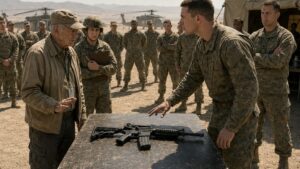
Jerry Adams stopped with one boot inside the red-dirt lane and the other still on the packed gravel by the gate. Heat pressed against the back of his dark work jacket. Beyond the rail, two junior handlers stood beside a Belgian Malinois whose ribs moved too quickly beneath its tan coat.
Jerry had never said he was family.
The gate clerk had asked why he was there. He had answered, “I need to speak to whoever signed the transfer assessment.”
That should have been enough.
The man in the hat extended one arm toward the visitor area as if directing a slow vehicle. “Behind the fence, sir.”
Jerry looked past him.
The dog stood twenty yards away with its weight tipped forward. Its black mask had grayed around the muzzle. One ear held upright; the other leaned slightly outward. The animal’s rear left leg rested lightly on the dirt.
A junior handler shortened the leash.
Jerry felt the old leather lead beneath his coat press against his ribs.
“When does the vehicle come?” he asked.
The man’s expression tightened. He was younger than Jerry had expected, perhaps thirty-eight, broad through the shoulders, sunburned above the collar. His badge read BRANDON WRIGHT, OPERATIONS.
“That’s not visitor information.”
“It leaves within forty-eight hours.”
Brandon’s eyes sharpened. “Who told you that?”
Jerry did not answer. The notice had been brief, forwarded by a former kennel mechanic who had remembered one name and one dog. UNSUITABLE FOR STANDARD RETIREMENT PLACEMENT. TRANSFER AUTHORIZED.
Behind Brandon, the junior handler stepped toward the Malinois from its left side.
Jerry saw the dog’s mouth close.
That was the first warning. Not the growl people waited for. Not the teeth. The sudden stillness.
“Don’t come in on that side,” Jerry said.
The handler glanced at him.
Brandon turned. “Keep moving.”
“The left hip bothers him.”
“Sir.”
The handler reached toward the collar.
The Malinois froze from nose to tail. The leash tightened. Dust lifted beneath one front paw.
Jerry’s voice dropped. “Give him room.”
Brandon stepped between Jerry and the field. “These are trained personnel.”
The dog’s breathing stopped for one beat.
Jerry had seen that silence before—an animal gathering itself because every choice had been removed.
“Tell him to angle away,” Jerry said.
Brandon’s jaw flexed. “Behind the barrier. Now.”
One of the observers shifted uncomfortably. No one spoke.
The junior handler tugged the lead and repeated a command. The dog twisted its head toward the pressure, eyes whitening at the corners.
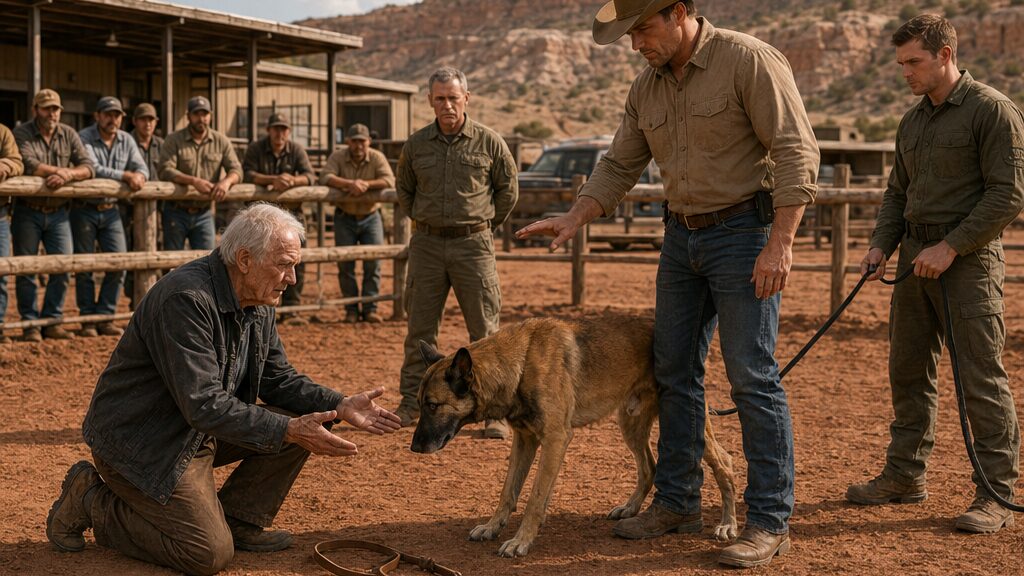
Jerry moved before he decided to. Not toward the dog. Sideways, into the lane, putting himself where the animal could see a shape that was not advancing.
The Malinois snapped its head toward him.
Brandon seized Jerry’s sleeve. “Stop.”
Jerry went still.
The dog surged one step. The handler stumbled, recovering with both hands on the leash.
“Get low,” Brandon ordered. “Do not move.”
The words struck the field hard enough to silence the observers.
Jerry looked at the dog, not at Brandon.
He could have said that he had spent twenty-six years reading animals before men with clipboards decided what their movements meant. He could have given his service dates. He could have named the bases, the handlers, the dogs carried home and the dogs that had not come home.
Instead, he bent one knee.
Pain shot through his right hip as he lowered himself into the dirt. He placed both hands where the dog could see them, palms open, fingers loose.
Something slipped from inside his coat.
The old leather lead landed beside his knee and uncoiled in the red dust. Three thick knots interrupted its scarred length.
The dog stared at it.
Brandon released Jerry’s sleeve and backed away. “Secure your animal.”
The junior handler pulled tighter.
The Malinois made a low sound—not quite a growl, more breath than threat.
Jerry turned his shoulder slightly, reducing the shape of his body.
“Let him decide the distance,” he said.
Brandon looked at him as if the sentence itself were insubordination.
The dog lowered its nose.
The leash remained taut between the handler’s hands and the collar. The animal took one step, then another. Its head moved from Jerry’s face to the lead in the dirt.
Jerry smelled dust, sun-warmed leather, and the mineral tang of the dog’s breath.
The Malinois touched the first knot with its nose.
Jerry’s hand trembled once. He pressed his thumb lightly against his forefinger until it stopped.
The dog sniffed the second knot, then the third.
A utility truck rolled behind the kennel line, raising a veil of dirt. No one behind the rail moved.
The junior handler started to pull the dog back.
“Wait,” said a new voice.
A gray-haired man in uniform had appeared near the equipment shed. His gaze was fixed on the lead.
The dog lifted its head toward Jerry’s hands.
Jerry did not reach.
For a long moment, the animal stood over him, ears forward, body tense with memory or uncertainty. Then its mouth opened. The hard line of its spine softened. It stepped close enough for its shoulder to touch Jerry’s chest.
Jerry’s breath caught.
The Malinois lowered itself into the dirt beside his knees and pressed its muzzle beneath his open palm.
The field changed.
Not loudly. No one gasped. No one applauded. But the junior handler let the leash go slack. One observer removed his sunglasses. Brandon’s hand fell from the radio at his belt.
Jerry laid two fingers against the gray fur above the dog’s nose.
“You got old,” he whispered.
The dog closed its eyes.
The gray-haired man came forward slowly. He stopped several feet away, looked at Jerry’s face, then at the three knots in the lead.
His posture straightened.
Jerry recognized him only after the years settled into place: a younger man once standing at the edge of a training yard, taking notes and pretending not to be nervous.
“Dennis,” Jerry said.
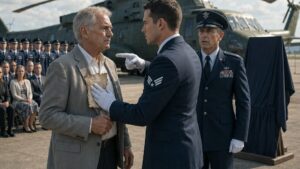
Dennis Hall raised his right hand in a restrained salute.
“Sergeant Adams,” he said, his voice rough. “I thought you were dead.”
Chapter 2: Three Knots Nobody at the Ranch Could Explain
Brandon closed the kennel-office door and remained in front of it.
“Did you enter that lane deliberately to provoke a reaction?”
Jerry sat in a metal chair beside the observation window. Through the glass, the Malinois paced once inside a shaded run and then lay facing the office.
Dennis stood at the sink, washing red dirt from the leather lead with a damp cloth. He handled it more carefully than he had handled his own cap.
Jerry looked at Brandon. “No.”
“You crossed a marked boundary after being told to remain outside.”
“The dog was being crowded.”
“That isn’t an answer.”
“It’s the one I have.”
Brandon removed his hat and placed it on a filing cabinet. A pale line crossed his forehead where the brim had blocked the sun. Without the hat, he looked less like the authority figure from the field and more like a tired man trying to prevent a day from splitting further open.
“You created a liability incident in front of staff and visitors.”
“The tight leash created it.”
“One of my handlers could have been injured.”
Jerry glanced through the window. “So could the dog.”
Brandon planted both hands on the desk. “You don’t get to walk in here, refuse to identify yourself, ignore instructions, and then act as if everyone else failed some test.”
Dennis shut off the water.
“He did identify himself,” Dennis said.
“He gave the gate clerk a name.”
“That name should have been in the program archive.”
Brandon turned. “Then why wasn’t it flagged?”
Dennis did not answer at once.
Jerry knew that silence. It was the kind institutions produced when too many people had touched a record and no one wanted to own the blank space.
The office door opened before Brandon could press him. A woman in khaki field pants entered carrying a tablet and a paper folder. Her dark hair was tied low at the back of her neck.
“Brenda Rodriguez,” she said. “Veterinary behavior.”
Jerry nodded.
She looked through the observation glass. “What happened outside was affiliative behavior. The dog approached voluntarily, reduced posture, sought contact, and remained regulated after physical proximity.”
Brandon folded his arms. “Meaning?”
“Meaning it was not an attack sequence.”
Jerry watched the dog’s ear turn toward the sound of Brenda’s voice.
“It also doesn’t mean he is safe for civilian placement,” she added.
Brandon’s shoulders eased by a fraction.
Jerry said, “I didn’t claim it did.”
Brenda studied him. “Everyone else seems to think you came here to take him home.”
“I came because the report is wrong.”
“Which part?”
“The conclusion.”
“That isn’t a small part.”
Dennis crossed the room carrying the lead. He had cleaned most of the red dust from it, though the leather remained dark around the knots. He stopped in front of Jerry and offered it with both hands.
Jerry hesitated before taking it.
Dennis touched the first knot. “You used to repair them this way.”
“Leather stretches.”
“Most people replaced a damaged lead.”
“Most supply rooms had more money than ours.”
Dennis gave a brief breath that almost became a laugh. It died quickly.
Brandon looked from one man to the other. “You knew him.”
“I knew of him first.” Dennis leaned against the desk. “Then I worked under the same transition program for six months. Adams was already civilian by then.”
“Consultant,” Jerry corrected.
Dennis nodded. “Consultant.”
Brenda turned her tablet toward herself. “Was he assigned to this dog?”
“No,” Jerry said.
Dennis said, “Not officially.”
Jerry’s fingers closed around the lead.
Brandon caught the distinction. “What does that mean?”
“It means the paperwork lagged behind the work,” Dennis said. “It happened then.”
“It happens now,” Jerry said.
Brenda ignored that. “Do you have documentation?”
Dennis moved to an equipment cabinet at the back of the office. He unlocked it, pulled out a flat archival box, and set it on the desk. Inside were old training photographs, laminated inventories, and faded equipment logs.
He searched without speaking.
Jerry watched his hands. Dennis had become slower, but not careless. He still squared the corners of each page before moving it aside.
At last he drew out a photograph.
The colors had gone yellow. A younger Jerry stood beside a training barrier, one hand holding the same scarred lead. At his knee sat a lean Malinois with a black face and an undamaged left hip. A second handler stood partly outside the frame.
Only one shoulder and a name strip were visible.
JONES.
Brenda leaned closer. “That’s this dog?”
Jerry looked through the observation glass rather than at the photograph.
“Yes.”
“The lead is the same?”
Dennis placed the photograph beside Jerry’s hand. The second knot was visible below his fist.
“The third wasn’t there yet,” Dennis said.
Jerry’s thumb moved over the newest knot.
Brenda noticed but asked nothing.
Brandon pulled the photograph toward him. His expression had changed since the field. The impatience remained, but now it competed with calculation.
“So he recognizes Mr. Adams.”
“Sergeant Adams,” Dennis said.
Jerry’s head came up. “Jerry is fine.”
Dennis looked at him. “Not in that lane, it wasn’t.”
The room fell quiet.
The salute had followed them indoors, but nothing else had changed. The dog remained behind glass. The transfer remained signed. The clock above the filing cabinet continued toward noon.
Jerry placed the lead across his lap. “When does the order stop?”
Brandon picked up his hat but did not put it on. “It doesn’t.”
Dennis frowned. “Brandon.”
“A prior relationship does not cancel a behavioral classification. Recognition is not placement clearance.”
Brenda nodded reluctantly. “He’s right about that.”
Jerry felt the dog’s gaze through the glass.
“Then review the classification.”
“We have reviewed it,” Brandon said. “The contractor was selected last week. Transport is scheduled within forty-eight hours.”
“For what kind of placement?”
“That information goes through legal.”
“What kind?”
Brandon’s voice cooled. “You are not the owner.”
The words landed more cleanly than the public order to kneel.
Jerry had no answer because Brandon was correct.
Brenda opened the paper folder. “There may be grounds to add historical context. But before I recommend anything, I need to understand your role in the original assessment.”
She placed the folder on the desk and turned it toward Jerry.
The first pages were recent: bite-risk scales, trigger charts, red boxes around the words UNPREDICTABLE RESPONSE TO HANDLER HESITATION.
Then she opened the oldest section.
The paper was a photocopy of a handwritten field form. The ink had faded to blue-gray. Along the left margin were descriptions of freezing, lunging, leash biting, and refusal after separation from the primary handler.
At the bottom, beside the date, were two initials.
J.A.
Jerry’s grip tightened around the three knots.
Brenda watched his face.
“Those are yours,” she said.
Chapter 3: The Report Written in Jerry’s Own Hand
“Do not place where hesitation will be punished.”
Brenda read the sentence exactly as Jerry had written it years before.
The veterinary assessment room had no windows. White light flattened the table, the report, and every expression around it. Somewhere beyond the wall, a metal kennel door slammed and a dog barked twice.
Jerry looked at his handwriting.
The letters leaned forward as if written in a hurry. They had been. He remembered the cheap pen catching on the form, the dog striking the end of a leash outside, and someone asking when the kennel could be cleared for another intake.
Brenda tapped the line beneath it.
“This statement appears in every later summary.”
“It shouldn’t.”
“You wrote it.”
“I wrote more than that.”
“Where?”
Jerry said nothing.
Brandon stood near the door with his hat against his thigh. Dennis had taken a chair in the corner, though he sat on its edge as if he expected to be called away.
Brenda turned a page. “You recorded a lunge toward a temporary handler.”
“Yes.”
“A freeze response during a leash transfer.”
“Yes.”
“Biting at the lead.”
“Yes.”
“Failure to release on command.”
Jerry lifted his eyes. “After Paul died.”
No one spoke for several seconds.
Brenda’s voice softened, but only slightly. “Paul Jones was the primary handler?”
Jerry nodded.
“What happened?”
“He didn’t come back.”
Brandon shifted his weight. Dennis lowered his gaze.
Brenda waited, perhaps expecting more. Jerry gave her none.
She returned to the report. “Your observations were made over eleven days.”
“Eight working days. Three were medical rest.”
“That distinction isn’t in the file.”
“It was supposed to be in the follow-up.”
“Was there a follow-up?”
Jerry looked again at the initials.
“No.”
The word made the room smaller.
Brenda sat back. “Then this is the last clinical-style assessment attached to that phase of the dog’s history.”
“It wasn’t clinical.”
“It was treated as clinical.”
“I was writing handling cautions.”
“You used behavior terms.”
“Because people listen to terms.”
“And then you left them without context.”
Jerry’s jaw tightened. “I didn’t tell anyone to call him permanently unstable.”
“No. You only wrote the material that allowed them to.”
Dennis said, “That’s not fair.”
Jerry stopped him with a glance.
Brenda saw it. “You agree with me?”
“I agree the paper stayed when I didn’t.”
For the first time since the field, Brandon looked at Jerry without defensiveness. It was not sympathy. It was recognition of a different kind—the recognition that blame had found more than one address.
Brenda slid another page across the table. A recent evaluator had quoted Jerry’s warning beneath a conclusion:
DOG DISPLAYS ESCALATION WHEN HANDLER CONFIDENCE IS INCONSISTENT. REQUIRES FIRM, IMMEDIATE CORRECTION AND CONTINUOUS CONTROL.
Jerry read it twice.
“They reversed it,” he said.
Brenda leaned forward. “Explain.”
“I wrote that hesitation shouldn’t be punished. They turned hesitation into something the dog should be punished for.”
Brandon frowned. “That conclusion doesn’t say punishment.”
“Firm correction and continuous control.” Jerry touched the page. “To a dog already expecting pressure when people get uncertain, that means the same thing.”
Brenda considered the wording.
“He doesn’t react to weak people,” Jerry continued. “He reacts when a person gets afraid, shortens the line, and then demands obedience to cover the fear. The tighter they get, the less room he has to choose anything that isn’t resistance.”
“You’re saying the trigger is contextual.”
“I’m saying the handler is part of the behavior.”
Brandon’s expression closed again. “That can become an excuse for any dangerous animal.”
“It can.”
The answer disarmed him.
Jerry folded his hands. “Some dogs are unsafe. Some handlers are unsafe. Most cases aren’t clean enough to protect anyone’s pride.”
Brenda looked down at the pages. “The recent videos show frontal approaches, shortened leads, repeated commands.”
“Because the report taught them to expect defiance.”
“And the dog gave them what they expected,” Dennis said.
Jerry looked toward him. “The dog tried every smaller answer first.”
The metal door sounded again outside. This time there was no barking afterward.
Brenda gathered the reports into one stack, but she did not close the folder.
“If the original notes lacked context, I can document that,” she said. “It may support a review.”
Brandon spoke immediately. “A review does not stop an executed transfer order.”
“It can delay one.”
“Not without a formal basis.”
“You have a newly identified prior handler-consultant and a recognition event suggesting undisclosed history.”
“Affiliation,” Brenda corrected. “Not proof of safe placement.”
Jerry said, “No one is asking you to write safe.”
They both looked at him.
“Write incomplete,” he said.
Brenda’s fingers stilled on the folder.
That word carried more weight than the others because it did not ask anyone to trust Jerry. It asked them to admit what they did not know.
She nodded once. “The record is incomplete.”
Brandon exhaled through his nose. “Even if I accept that, the ranch has a reduction deadline. We have an inspection coming. Kennel capacity is above contract.”
“So that’s what this is,” Jerry said.
“It is one part of what this is.”
“One part written in ink. The dog’s part written in pencil.”
Brandon’s face reddened. “You think I enjoy signing these transfers?”
“I don’t know what you enjoy.”
“You don’t know anything about what I’m carrying here.”
Jerry met his eyes. “Then tell the truth before you ask me to.”
Silence pressed between them.
Brenda broke it. “Jerry, why didn’t you complete the follow-up?”
Dennis looked up sharply.
Jerry had known the question was coming. He had spent the drive across New Mexico arranging answers that sounded responsible: funding ended, records were moved, the program changed contractors, his own health failed.
All were partly true.
None were the reason.
His thumb found the second knot in the lead.
He had tied it during the week those observations were written, after the leather split against a kennel latch. Paul had still been alive when the first knot was made. By the second, Paul’s boots had already been returned without him.
Jerry’s voice came out low. “I left.”
Brenda waited.
“I told them someone else should finish.”
“Why?”
Jerry looked at the closed room, the white table, the old words that had outlived his courage.
“I couldn’t.”
Brandon gave a humorless shake of his head. “That isn’t an explanation.”
“No,” Jerry said. “It’s what happened.”
A phone vibrated against Brandon’s belt.
He checked the screen, and something in his expression hardened into decision.
“What?” Dennis asked.
Brandon slid the phone away. “The receiving contractor confirmed dispatch.”
“When?”
“The transport vehicle is already on the road.”
Jerry’s fingers closed around the second knot until the old leather pressed into his palm.
Chapter 4: The Promise He Mistook for a Command
Dennis found Jerry in the empty training barn after sunset and offered him exactly what Jerry had once wanted most.
“You can have the evening exercise period,” he said. “No observers. No reports. Just you and the dog.”
Jerry stood beside a row of retired bite sleeves hanging from wooden pegs. The barn doors were open to the vehicle lot, where the last light lay in thin copper strips across the dust. In the kennels beyond, feeding pans struck concrete and dogs answered one another in short, impatient bursts.
“And the transfer?” Jerry asked.
Dennis glanced toward the open doors. “Still proceeds.”
“Then you’re offering me a goodbye.”
“I’m offering you time.”
“In exchange for silence.”
Dennis’s jaw tightened. “In exchange for not turning one incomplete report into an investigation that takes this entire program apart.”
Jerry slid the three-knotted lead through his hands. The leather had dried darker where Dennis cleaned it.
“You worried about the program,” Jerry said, “or your name on it?”
“Both.”
The honesty stopped Jerry from answering quickly.
Dennis stepped farther into the barn. His uniform shirt was unbuttoned at the throat now, his sleeves rolled once. Without the field posture, he looked closer to retirement than he had that morning.
“We have an inspection in three weeks,” he said. “The kennels are over capacity. The contract requires movement. If legal freezes one transfer, they review all of them. That may be necessary, but don’t pretend there’s no cost.”
“I’m not pretending.”
“Brandon thinks you are.”
“Brandon thinks every question is a hand reaching for his keys.”
Dennis looked at the lead. “He isn’t wrong about every risk.”
Jerry waited.
“A visitor crossed a line here eighteen months ago,” Dennis said. “Wanted to see a dog her husband had handled. The supervisor on duty made an exception. The dog redirected on a junior handler. Three surgeries.”
“Brandon was the supervisor?”
Dennis nodded.
That explained the hard edges without smoothing them. Brandon had once trusted emotion over procedure and watched someone else pay for it. Now he treated procedure as if it could remove every human choice.
Jerry rubbed the second knot beneath his thumb.
Dennis noticed. “What happened after Paul?”
The name entered the barn softly and filled it.
Jerry looked through the open doors toward the vehicle lot. A transport manifest lay clipped to a board in the office across the way. He had watched Brandon carry it there.
“He came to me before deployment,” Jerry said. “Asked what would happen when the dog got old.”
Dennis remained silent.
“I told him there were programs. Retirement placements. Medical evaluation. All the usual answers.”
“What did Paul ask?”
Jerry could still see the younger man leaning against a kennel gate, trying to make the question sound casual.
“He said, ‘Don’t let them make him useful forever.’”
Dennis lowered his eyes.
“At the time, I thought he meant don’t send him back to work after he’d earned rest.” Jerry drew the lead taut between his hands, then loosened it. “After Paul died, I turned it into an order. I thought I had to repair the dog. Make him steady again. Make him ready for somebody to approve.”
“That was your job.”
“No. My job was to help him recover. I made recovery look like performance.”
A dog barked once outside, closer than the others.
Jerry remembered the old rehabilitation lane: rain instead of dust, the dog younger and leaner, circling whenever a man stood directly in front of him. Jerry had known to wait. For weeks, he had waited.
Then one afternoon a review team arrived early.
The dog froze. Jerry saw the hesitation and felt every unfinished thing in himself rise against it. He shortened the lead. Repeated the command. Insisted.
The dog bit down on the leather and twisted until the strap tore against the buckle.
“I pushed him through a trigger,” Jerry said. “Not because he needed it. Because I needed proof we were both still useful.”
Dennis’s face did not move, but his shoulders settled lower.
“The third knot,” he said.
Jerry held it up. “I nearly cut the lead apart afterward. Couldn’t stand looking at what I’d done. Then I repaired it instead.”
“And left.”
“The next morning.”
Dennis walked to the open doors. “Why didn’t you tell anyone?”
“I told them someone else should finish.”
“That isn’t the same.”
“No.”
It was the word Jerry had been carrying all day. Not confusion. Not injustice. No.
He had not filed the follow-up. He had not explained the trigger. He had allowed shame to dress itself as restraint, then called the silence dignity.
Dennis pointed toward the office across the lot. “The manifest is there.”
Jerry followed him.
The records room smelled of paper, dust, and the faint ammonia drift from the kennels. Dennis unlocked a cabinet and removed a thin packet labeled TRANSITION RECEIVING AGREEMENT.
Jerry expected a retirement partner, perhaps a secure sanctuary with low traffic and permanent veterinary care.
The destination page named a private contractor two states away.
He read the program description twice.
MOBILE DEMONSTRATION SUPPORT. HANDLER-STRESS SCENARIOS. CONTROLLED HIGH-STIMULATION EXPOSURE.
Jerry placed one finger on the final phrase.
“They’re using older dogs for training demonstrations.”
Dennis did not answer.
“Crowds?”
“Sometimes.”
“Rotating handlers?”
“Yes.”
“Transport crates, public noise, repeated restraint?”
“It meets the contract standard.”
Jerry turned the page. The medical notes listed hip degeneration and reduced recovery after exertion. The behavior summary recommended firm handling during hesitation.
The same broken meaning, repeated until it looked official.
Dennis said, “It isn’t a combat role.”
“No. It’s being made useful forever with softer words.”
A kennel light came on outside. Through the room’s narrow window, Jerry saw the Malinois standing at the front of its run, ears angled toward the building.
For one sharp moment, Jerry wanted Dennis’s offer. One private hour. The lead in his hand. The dog beside him. No hearing, no questions, no need to name what he had done.
It would have been easier to call that mercy.
Jerry closed the manifest.
“I don’t want the evening period.”
Dennis stared at him. “You may not get another chance.”
“Then the last thing I give him won’t be a quiet goodbye that helps everyone else keep moving.”
“What are you going to do?”
Jerry looked at the initials on the copied report clipped beneath the manifest.
For years he had believed silence prevented him from turning Paul’s service into a claim. Now the silence had become part of the machinery moving the dog toward another role.
“Tomorrow,” Jerry said, “I am putting my name back on that report.”
Chapter 5: Respect Was Offered Without a Changed Decision
A photographer was waiting in the conference room when Jerry arrived the next morning.
The man stood beside a folded flag display and a portable backdrop printed with the ranch emblem. A chair had been positioned in front of it. On the table rested a narrow wooden presentation box.
Jerry stopped in the doorway.
Brandon rose from the head of the table. His hat was absent, his shirt freshly pressed. Brenda sat near a stack of assessment forms, her expression unreadable. Dennis remained standing by the window.
“What is this?” Jerry asked.
Brandon motioned toward the photographer. “A recognition record. Internal and public affairs, if you consent.”
“I don’t.”
The photographer lowered the camera.
Brandon’s mouth tightened. “We can keep it internal.”
“I said I don’t.”
Jerry crossed to the table. Brandon opened the presentation box.
Inside lay the three-knotted lead, cleaned and coiled on blue felt.
Someone had fastened a small engraved plate beneath it.
SERGEANT JERRY ADAMS
MILITARY WORKING-DOG SERVICE
Jerry lifted the lead out of the box. He set the empty case aside and coiled the leather plainly on the conference table.
“No felt required,” he said.
The photographer looked toward Brandon for instruction.
“You can go,” Brandon told him.
When the door closed, Jerry took the chair farthest from the backdrop.
Brandon remained standing. “We amended the visitor incident record. It now identifies your prior service and consulting role. Dennis prepared a memorandum confirming the dog’s historical association with you.”
“And the transfer?”
“Remains scheduled.”
Jerry looked at Dennis.
Dennis did not hold his gaze.
Brandon placed both hands on the table. “Yesterday was mishandled. You should not have been spoken to the way you were spoken to. That does not mean the placement decision was made without cause.”
“You arranged a photograph before asking what I came to say.”
“I arranged recognition.”
“You arranged an ending.”
Brenda closed the folder in front of her. “Jerry asked for a formal review.”
“And I’m explaining why that cannot become an improvised field exercise,” Brandon said.
Jerry leaned back. “No one asked for improvisation.”
“You entered an active lane.”
“To stop a handling error.”
“By becoming another uncontrolled variable.”
The words came faster now, but Brandon’s voice did not rise. It had the compressed force of something rehearsed privately many times.
“A woman came here eighteen months ago,” he said. “Widow of a handler. She had photographs, letters, proof of connection. The dog knew her scent from stored clothing. I let her stand inside the secondary boundary because I thought history mattered more than the line painted on the ground.”
Dennis looked toward the window.
Brandon continued. “The dog hit the end of the leash. The junior handler stepped between them. Tendons in his forearm were severed. He still cannot close three fingers.”
Jerry’s hand stopped on the lead.
“I signed the exception,” Brandon said. “I watched them load that handler into an ambulance. So when an unverified visitor crosses my lane, I do not pause to wonder whether he once knew more than I do.”
The room held his confession without forgiving what followed from it.
Jerry said, “You were right to build a rule after that.”
Brandon blinked.
“You were wrong to use it as permission not to look.”
A faint muscle moved in Brandon’s cheek.
Jerry continued, “Safety is not the same as control. But people confuse them when control feels cleaner.”
“And people romanticize experience when they want exceptions.”
“That’s true too.”
Brenda looked from one man to the other. “Then we have something useful.”
Brandon turned to her. “Which is?”
“Neither of them gets to decide alone.”
She opened a blank assessment packet.
“A live re-evaluation could be justified,” she said. “Not because Jerry is a veteran. Not because the dog recognized him. Because the existing record is incomplete and the receiving environment may repeat the documented triggers.”
Brandon sat slowly. “The transport arrives this afternoon.”
“Then we assess before it arrives.”
“And if the dog escalates?”
“We stop.”
Jerry said, “At the first overload sign.”
Brenda’s gaze settled on him. “Not the first bite. Not the first lunge. The first overload sign.”
“Yes.”
“You do not override me because you think you know him.”
“I won’t.”
“You do not demand a second attempt if the first one fails.”
Jerry’s fingers pressed into the leather.
“No.”
Brenda slid the consent form across the table. “And success does not mean you receive the dog.”
The sentence left an open space in him.
For one dangerous second, he saw his apartment as he had imagined it during the drive: the narrow balcony cleared of old boxes, a padded bed beside the kitchen, early walks before traffic. He had imagined the dog sleeping near his chair as if proximity could return the years both of them had lost.
Brandon watched him carefully. “Is that what this has been about?”
Jerry did not answer at once.
Brenda placed a pen beside the form. “Your apartment is on the third floor. No yard. The medical file indicates the dog may need mobility support within a year.”
“I know.”
“Do you?”
The question was not cruel.
Jerry thought of Paul asking that the dog not be made useful forever. He had nearly turned the promise into a different demand: stay with me, remember with me, prove I did not leave for good.
He picked up the pen.
Brandon said, “You are asking other people to risk consequences.”
Jerry looked at him. “Yes.”
“And if this goes wrong?”
“My name stays on the report.”
“That doesn’t treat an injury.”
“No. But I won’t hide behind yours either.”
He signed.
Brenda rotated the page and added her name. Dennis signed as witness.
Brandon stared at the three signatures. Then he reached for the final line.
His pen hovered.
“What exactly do you propose?” he asked Jerry.
“Controlled approach. Neutral handler. No frontal pressure. Slack line. One command only if needed.”
“And you?”
“I stay outside the dog’s first choice.”
Brenda nodded. “I control termination.”
Brandon signed.
The conference room no longer held a ceremony. The backdrop looked foolish against the wall. The empty presentation box remained open, its blue felt waiting for an object Jerry had refused to surrender.
Brenda collected the forms.
“One more condition,” she said. “If he turns toward you, you do not take the lead unless I instruct you.”
Jerry looked down at the three knots.
“Agreed.”
“And if I stop the test, it is over.”
Jerry placed the lead in the center of the table.
“Then stop it before we ask him to pay for our need to be right.”
Chapter 6: Let the Dog Decide the Distance
The transport vehicle arrived before the re-evaluation began.
It rolled through the ranch gate in a curtain of red dust, white box body, contractor logo on the door, steel travel crates visible through the rear ventilation grilles. The driver parked beside the kennel office and left the engine running.
The Malinois heard it.
From the shaded holding run, the dog lifted its head and began pacing along the fence.
Jerry stood outside the evaluation lane with his hands empty.
The three-knotted lead lay on a small table beside Brenda’s clipboard. Brandon had objected to using it at all, then agreed after Brenda inspected the leather and added a secondary safety line. Dennis waited behind the spectator rail with the junior handlers.
No photographer. No backdrop. No folded flag.
Only the dog, the dust, and a decision already idling nearby.
Brenda approached Jerry. “What do you see?”
“Pacing is even. Mouth open. Tail neutral.”
“And?”
“He keeps checking the vehicle.”
“Overload?”
“Not yet.”
She studied him, then nodded to Brandon.
Brandon entered the lane as the primary handler. He wore gloves but no hat. The choice surprised Jerry until he understood it: Brandon had placed himself where the risk lived instead of assigning it to a junior handler.
The dog was brought from the run on a standard nylon lead. Brandon walked a shallow curve rather than approaching head-on.
“Good,” Jerry said quietly.
Brandon heard him and did not react.
At Brenda’s signal, a junior handler crossed the far end of the lane, stopped, then turned sideways. The dog watched without advancing.
Brenda marked the response.
A metal pan dropped deliberately behind the barrier. The dog flinched, looked toward the sound, then returned its attention to Brandon.
No lunge.
No bite at the leash.
The contractor driver stepped from the vehicle and leaned against the door. The dog’s pacing had stopped, but its breathing remained quick.
Brenda introduced the three-knotted lead.
She clipped it to the secondary point on the harness while the nylon safety line remained attached. Brandon took the leather in his left hand.
“Slack,” Jerry said.
“I know.”
Brandon left a shallow curve between his fist and the dog.
The first knot hung near his wrist.
They repeated the crossing exercise. The dog tracked the moving handler and then looked away.
Brenda made another note.
A small release moved through the observers. Jerry felt it too and distrusted it. Early success could make people hurry toward proof.
Brenda changed the exercise. “Frontal approach. Slow. Stop at twenty feet.”
The junior handler entered directly ahead.
The Malinois closed its mouth.
Jerry saw Brandon see it.
“Pause,” Jerry said.
Brenda raised one hand, allowing the exercise to hold.
The dog’s ears angled outward. Its weight shifted back toward the injured hip, then forward again. Brandon glanced at Brenda. The uncertainty lasted less than a second.
His fist tightened.
The curve in the leather disappeared.
The dog froze.
Every muscle along its back hardened. Its eyes moved toward the pressure at the collar. Brandon gave a low command.
The dog did not respond.
He repeated it.
The Malinois snapped its head around and caught the lead between its teeth.
Behind the rail, someone inhaled sharply.
Brandon pulled back.
The dog twisted, exactly as the old report described.
“Stop,” Brenda said.
Brandon held firm, perhaps hearing the word as an instruction to control the animal rather than himself.
“Loosen the lead,” Jerry said.
“It has the leather.”
“Loosen it.”
The dog shook once. The second knot struck against its muzzle.
Brandon’s face had gone pale. Eighteen months collapsed into his grip: a widow inside a boundary, a junior handler reaching, blood on dust. Jerry could see the memory taking command.
“Brandon,” Jerry said. “He isn’t pulling you into danger. You’re pulling him out of choices.”
Brandon looked at him.
“Open your hand.”
Brenda moved closer but did not enter the leash radius. “Do it.”
Brandon released two fingers.
The lead sagged half an inch.
The dog stopped shaking.
“More,” Jerry said.
Brandon opened his hand until the leather rested across his palm.
The dog let go.
No one moved.
The Malinois stood with its head low, breathing hard. Its gaze traveled across the lane and found Jerry outside the boundary.
Jerry felt the pull of old habit stronger than any leash. Step in. Take control. Show them. Show Paul. Show himself.
The dog took one uncertain step toward him.
Brenda said, “Jerry, remain where you are.”
He did.
The dog looked from Jerry to Brandon.
Jerry lowered one hand beside his leg, palm open, but did not call.
“Let him decide the distance,” he said.
This time the words were not a correction aimed at anyone. They were the structure of the choice.
Brandon stood with the lead loose.
The dog moved away from the frontal handler. It circled once, shook from nose to tail, then approached Jerry only as far as the lane marker. There it stopped.
Jerry’s chest tightened.
The dog did not come to him.
Not yet.
That was not failure.
Jerry lowered himself slowly outside the painted boundary, one knee touching the red dirt. He kept his open hand on his own side of the line.
The Malinois watched him.
Then it turned back toward Brandon.
Brandon’s shoulders shifted, but he did not shorten the lead.
The dog stepped close enough to smell his glove.
Brandon did not reach down.
After several breaths, the Malinois sat.
Brenda’s pen moved across the clipboard.
“Recovery under reduced restraint,” she said. “Voluntary re-engagement with handler.”
The contractor driver straightened beside the vehicle.
Brenda introduced one final variable: the rear door opened, exposing the steel crates and the dark interior.
The dog rose immediately. Its breathing accelerated. It looked toward the vehicle, then at the three-knotted lead.
Jerry saw the threshold approaching.
“That’s enough,” he said.
Brenda looked at him. “We have not completed transport exposure.”
“He’s telling us.”
Brandon glanced at the dog’s rear leg. A faint tremor ran through it.
The old Jerry would have asked for one more minute. One clean response. One undeniable proof.
Jerry stood.
“End the test.”
Brenda raised her hand. “Assessment terminated.”
The vehicle door closed.
Brandon led the dog away in a wide curve, the leather slack. At the holding-run gate, he stopped and looked toward Jerry.
“Do you want the lead?” he asked.
Jerry shook his head. “Finish the return.”
Brandon did.
Only after the dog entered voluntarily and the gate latched did he bring the lead back. He did not put it in the presentation box. He laid it across Jerry’s open hands.
The review group gathered under the narrow shade beside the field. Brenda read her preliminary findings aloud.
“The observed escalation was context-linked. Frontal pressure, tightened restraint, repeated command during hesitation. Recovery occurred when pressure was reduced. This does not establish unrestricted placement suitability.”
The contractor driver frowned. “Our paperwork is signed.”
Brenda continued. “It does establish that the current classification is incomplete and that the receiving program’s routine conditions may reproduce the identified triggers.”
Dennis said, “Transfer should be suspended.”
Brandon looked toward the vehicle, then at the holding run.
The driver asked, “Who has authority to do that?”
Brandon removed the radio from his belt.
“I do until legal reviews the new assessment.”
He transmitted the hold.
The driver returned to the cab and shut off the engine.
Silence settled over the ranch, deeper now that the vehicle no longer vibrated against it.
Dennis turned to Jerry. “With the transfer suspended, we can begin a direct retirement-placement review.”
Brenda closed her clipboard. “Including an assessment of Jerry’s home.”
Everyone looked at him.
The expectation was visible even without words. The dog had remembered him. Jerry had come across the state. He had challenged the report. The story seemed to point toward one obvious ending.
Jerry looked through the fence.
The Malinois lay in the shade, tired but no longer pacing. An old dog with a damaged hip, a history of forced roles, and no obligation to complete anyone else’s promise.
Jerry ran his thumb over the third knot.
“I’m not asking to take him home,” he said.
Chapter 7: The Respect That Continued After the Salute
Brandon pulled out the chair at the head of the review table.
“This one is yours,” he said.
Jerry looked at the chair, then at the people already seated around it. Brenda had spread the revised assessment across two folders. Dennis held a typed memorandum with handwritten corrections in the margins. The base legal representative sat beside the foster-program coordinator, both waiting with pens ready.
Jerry walked past the head chair and took the empty seat beside Brenda’s working notes.
“I’d rather see what’s being written,” he said.
Brandon let the chair slide back beneath the table.
No one saluted.
That helped.
Through the office window, the red-dirt lane lay empty. The contractor vehicle had departed the previous evening without the dog. Its tire tracks still cut across the yard, though wind had begun softening their edges.
Brenda turned the first page toward Jerry.
“The transfer hold is now formal,” she said. “The contractor placement has been withdrawn pending a new retirement recommendation.”
“Withdrawn or delayed?”
“Withdrawn.”
Jerry nodded once.
The legal representative adjusted a pair of reading glasses. “That does not establish where the dog goes next. We have three realistic options. Continued residence here during review, an approved retirement foster, or direct placement with a qualified individual.”
Dennis looked at Jerry.
Jerry kept his eyes on the paper.
The legal representative continued. “Given yesterday’s response, a direct placement assessment could be conducted for Mr. Adams.”
“Jerry,” he said.
The representative corrected without hesitation. “For Jerry.”
Brenda tapped the medical summary. “Third-floor apartment. No private yard. Narrow stairwell. The dog’s left hip will likely worsen.”
“I know.”
“You also live alone.”
“Yes.”
“Emergency support?”
“Not reliable enough.”
The words cost less than Jerry had expected. Perhaps because no one was trying to take his dignity from him now. They were asking what he could carry.
He looked around the table.
“I can help him transition,” he said. “I can’t promise I’m the right place for him to finish.”
Dennis’s gaze dropped to the memorandum.
Brandon folded his hands. “Yesterday you crossed the state to stop us from sending him away.”
“I crossed the state to stop you from sending him somewhere wrong.”
“That isn’t the same as wanting him?”
“No.”
Jerry rested one finger on the margin of Brenda’s report.
“It’s knowing wanting isn’t enough.”
The foster-program coordinator opened a map. A small circle had been marked west of the ranch.
“There is a property thirty-eight miles from here,” she said. “Single-story house. Fenced acreage. Retired veterinary technician on site. No children, no boarding operation, no rotating handlers.”
Jerry studied the map.
“How many dogs?”
“One older Labrador. Calm, separated introduction plan.”
“Road traffic?”
“Minimal.”
“Gun range?”
“None within hearing distance.”
Brenda added, “The foster can manage medication and mobility support. We would schedule gradual visits. Same people. Same route. No demonstration work.”
Jerry looked at the small circle again. Thirty-eight miles was close enough to be present and far enough that presence would not become possession.
“What do you need from me?”
“Transition sessions,” Brenda said. “Not command demonstrations. Familiarity. Decompression. Help teaching the foster what the report failed to explain.”
Jerry nodded.
Dennis unfolded his memorandum.
“There is another matter.”
His voice carried the careful stiffness of official language, but his hands betrayed him. The top page trembled faintly.
“I corrected the historical record,” he said. “Not removed. Corrected.”
He passed the document to Jerry.
The original observations remained: freezing, lunging, biting at the lead, failed release. Beside them Dennis had added the circumstances—recent loss of primary handler, unresolved medical pain, repeated frontal pressure, incomplete follow-up.
At the bottom, he had written:
THE ABSENCE OF CONTEXT WAS AN INSTITUTIONAL FAILURE. THE ORIGINAL OBSERVER’S LATER SILENCE CONTRIBUTED TO THAT FAILURE BUT DID NOT CREATE IT ALONE.
Jerry read the sentence twice.
“You didn’t have to include the part about my silence,” he said.
“Yes,” Dennis replied. “I did.”
Jerry looked at him.
Dennis did not offer an excuse. That was the first useful respect he had given since the salute.
Brenda placed a pen beside the revised report. “Do you agree with the correction?”
Jerry found the old warning in the middle of the page.
Do not place where hesitation will be punished.
This time, beneath it, Brenda had added:
HESITATION SHOULD BE TREATED AS INFORMATION, NOT DEFIANCE.
Jerry signed.
Brandon signed after him.
The placement plan was approved before noon.
Three weeks later, a foster vehicle waited beside the red-dirt lane with its rear door open.
It was not a steel contractor box. The interior held a low padded platform, nonslip matting, water, and a ramp shallow enough for the dog’s hip. The foster coordinator stood several yards away, speaking quietly with Brenda.
Jerry held the three-knotted lead.
The Malinois stood beside him, looking into the vehicle.
The dog had completed four short visits to the property. It had walked the fence line, slept beneath a cottonwood, and ignored the old Labrador from opposite sides of a gate. Each time, Jerry had returned to the ranch alone.
Today the kennel had been cleared of the dog’s name.
Dennis stood behind the wooden rail. Brandon waited near the ramp without touching it.
“Ready?” Brenda asked.
Jerry looked at the dog.
“No.”
Brenda gave the smallest nod. “Neither is he.”
The Malinois approached the ramp, smelled the edge, and stopped.
Its mouth closed.
Jerry felt every person around him become still.
The dog took one step backward.
A younger version of Jerry would have shortened the lead before the hesitation spread. He would have given a command in the voice that left no space for uncertainty. He would have called the response discipline and ignored what it cost.
Jerry let the leather sag.
The first knot rested near his wrist. The second hung between them. The third touched the dust.
The dog looked up at him.
Jerry lowered himself beside the open vehicle.
This time no one had ordered him down.
His knee found the red earth slowly. Pain moved through his hip, but there was no shame in the posture. He placed his open hand beside his leg and turned his shoulder away from the ramp.
“You don’t owe me a clean goodbye,” he said.
The dog’s ears shifted.
Jerry did not point toward the vehicle. He did not call the dog by command. He sat in the space beside the choice.
After several breaths, the Malinois moved forward and smelled the ramp again.
One paw touched the rubber surface.
Then the other.
The dog climbed halfway, stopped, and looked back.
Jerry kept the lead loose.
The Malinois entered the vehicle.
Brenda closed neither the gate nor the door. She waited.
The dog turned in the padded space, came back to the threshold, and lowered its gray muzzle into Jerry’s palm.
Jerry’s hand trembled against the familiar weight.
For years, he had imagined keeping Paul’s promise would feel like holding on.
It did not.
It felt like leaving his hand open.
The dog withdrew and settled on the mat.
Only then did Brenda secure the interior gate.
Dennis approached Jerry after he stood. There was no salute. He simply offered his arm when Jerry’s stiff knee resisted the first step. Jerry accepted it for two strides and released it.
The foster coordinator entered the driver’s side.
Brandon remained beside the ramp, looking at the leather lead in Jerry’s hand.
“May I?” he asked.
Jerry studied him.
The first day, Brandon had seized his sleeve without permission and ordered him into the dirt. Now he waited with his hand open.
Jerry held out the lead but did not release it immediately.
“Here,” he said, touching the leather just below the third knot. “This section looks stronger than it is.”
Brandon bent closer.
“The repair carries tension,” Jerry continued, “but the old leather beside it can still fail. Don’t watch only the knot.”
Brandon nodded. “Watch what the repair is pulling against.”
Jerry let the lead pass into his hands.
“Exactly.”
Brandon carried it to the foster coordinator and explained where to hold it, where not to tighten, and when to leave slack. He spoke without performance. He asked Brenda a question before making the final attachment.
The vehicle door closed.
As it rolled toward the gate, the Malinois remained visible through the side window, head raised but body resting.
Jerry stood beside the lane until the vehicle disappeared beyond the wooden fence.
The dust rose, drifted, and settled over the old tire tracks.
Dennis came to stand beside him.
“You’ll see him Tuesday,” he said.
“I know.”
“You all right?”
Jerry looked at the empty road.
“No,” he said.
Then, after a moment, “But I will be there Tuesday.”
Behind them, Brandon was speaking with the gate clerk. A new visitor form lay on the counter. The first question no longer asked only for authorization or relationship to the animal.
It asked what the visitor knew that the staff might need to hear.
Jerry turned away from the road and walked back toward the kennels.
The story has ended.