The Old Veteran Returned a Broken Tag Before the Army Honored the Wrong Man
Chapter 1: The Hand Closed Around the Red Jacket
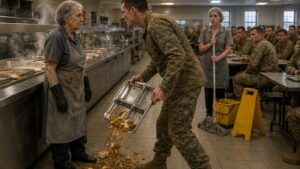
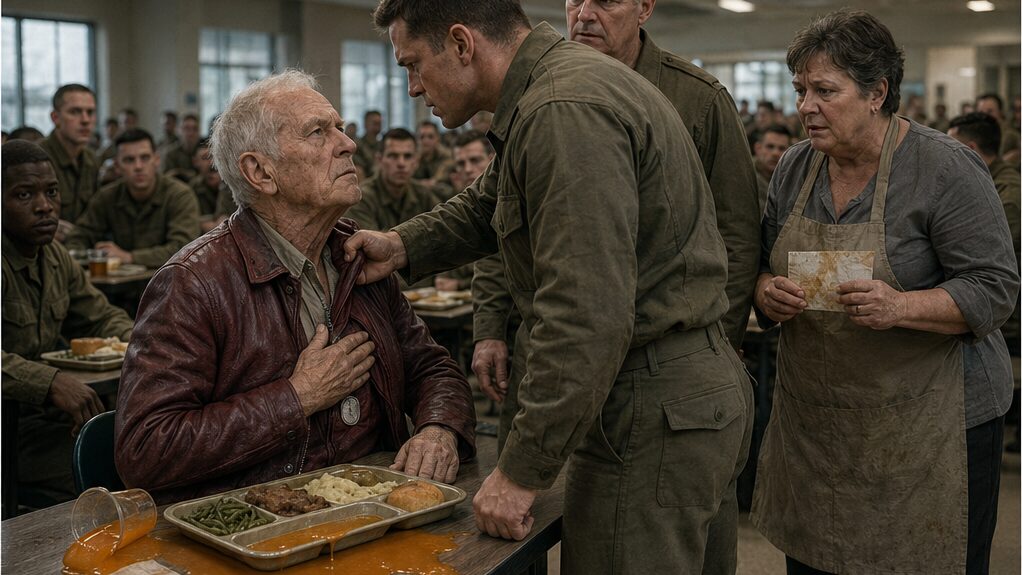
Staff Sergeant Jeffrey Clark’s fist was already twisted into the collar of Raymond Thomas’s red leather jacket when the orange drink reached the edge of the table.
It fell in a bright sheet, splashing Raymond’s trouser leg before striking the floor. A plastic cup rolled beneath the next table. The sound was small, but the dining hall quieted around it in widening rings.
Raymond stayed seated.
Jeffrey leaned closer, his forearm rigid between them. At twenty-nine, he had the hard, contained posture of a man determined not to appear uncertain in front of anyone. His uniform was pressed. His jaw was not.
“I asked you where you got the pass.”
Raymond could smell pepper from the gravy on his tray and the sharp citrus powder from the spilled drink. The combination carried him somewhere he had not intended to go yet.
He kept his eyes on Jeffrey.
“You asked after you took it out of my hand.”
“The pass expired last month.”
“The date was written by the office that mailed it.”
“That doesn’t authorize you to enter a controlled facility.”
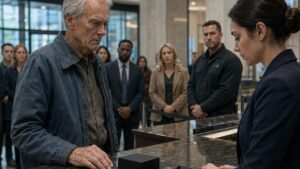
Raymond glanced toward the entrance. He had come through the door Brenda Williams had named in her letter, though the young clerk there had stared at the paper pass as if it were a grocery receipt. Brenda had not been at the desk. A soldier had waved Raymond toward the dining line while the clerk searched for someone to call.
He had taken the tray because standing idle drew attention.
He had chosen the table for another reason.
Beyond the rows of uniformed service members, a temporary partition sealed off the dining hall’s oldest section. The wall behind it had once held field-kitchen photographs, unit rosters, and a blackened steel ladle recovered from a fire. Raymond had wanted to sit near it before anyone arrived to escort him.
Just once, he had wanted the room without a ceremony inside it.
Jeffrey’s grip tightened.
“Look at me when I’m speaking.”
“I am looking at you.”
The answer made several nearby soldiers lower their eyes toward their trays.
Jeffrey’s expression shifted. Not anger exactly. Something closer to the panic of a man whose authority had failed to produce the expected shape of obedience.
Raymond felt the jacket pull against the back of his neck. The leather was old enough to show pale cracks along the shoulders. His wife had bought it used when he retired. She had called the color foolish and then insisted it suited him.
Jeffrey reached toward Raymond’s chest.
Raymond’s right hand moved first.
His palm covered the metal tag beneath his gray shirt.
Jeffrey stopped. “What are you hiding?”
“Nothing.”
“Then take your hand away.”
“No.”
The word was quiet. It landed harder than Raymond intended.
Jeffrey’s gaze dropped to the thin chain visible above Raymond’s fingers. He hooked one finger beneath it and pulled. The metal tag slid halfway into view, scraping across a shirt button.
Raymond caught Jeffrey’s wrist—not squeezing, only stopping it.
The room changed.
Chairs did not move, but bodies turned. Conversations died. At the end of the nearest table, a young soldier set down his fork without taking his eyes from Jeffrey’s hand.
Raymond released the wrist immediately.
“I won’t interfere with you,” he said. “You will not pull that chain.”
Jeffrey straightened enough to look around. He saw the watching soldiers and mistook their silence for support.
“That is military identification.”
“It was.”
“Whose?”
Raymond’s thumb pressed against the dent in the tag. Its broken edge had worn smooth against his skin over the years, but one corner still caught fabric if he moved too quickly.
Jeffrey drew the tag farther into the light.
Stamped letters showed beneath Raymond’s fingers.
CAMPB—
Jeffrey’s eyes narrowed.
“That isn’t your name.”
“No.”
A murmur moved somewhere behind him.
Jeffrey looked almost relieved. He had found the clean answer he wanted.
“So you admit you’re carrying military property issued to somebody else.”
Raymond looked at the orange liquid spreading around the base of his tray. It reached the folded paper invitation beside his plate, soaking one corner before he could lift it.
Robert Campbell had mixed orange drink too strong.
Three scoops when the field manual called for two. Said weak drink lowered morale faster than bad news. Raymond could still see him stirring a dented steel container with a wooden paddle, grinning while dust collected in the sweat at his temples.
The memory passed before it could fully open.
Raymond placed the wet invitation on his lap.
“It isn’t mine to wear,” he said. “That is why I brought it back.”
Jeffrey’s grip on the jacket faltered but did not release.
“Back to whom?”
Raymond looked past him.
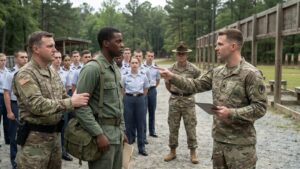
A senior officer stood several paces behind Jeffrey, centered in the aisle. Dark formal uniform. Close-cut gray hair. Rows of decorations Raymond did not count. The man’s face had changed since the photograph attached to his last letter, but not enough.
Daniel Harris had been watching long enough to understand what was happening.
He had also been silent long enough for Raymond to understand something else.
Jeffrey followed Raymond’s gaze only halfway, too focused on the tag.
“You’re going to place that on the table,” Jeffrey said. “Then you’re going to stand slowly and come with me.”
“I will place it on the table when you release my jacket.”
“You don’t set conditions.”
“I just did.”
Jeffrey bent lower. His voice lost volume, but not force.
“You think being old means I have to let you ignore procedure?”
Raymond felt heat rise beneath his collar. Not shame. Not fear. The old reflex was simpler: identify the threat, control the hands, leave room to move.
He could have broken Jeffrey’s grip. Age had taken speed but not knowledge. A thumb against the knuckle, a turn of the shoulder, the young man’s balance overextended—
Raymond let his own hands remain open.
A physical victory would answer the wrong question.
“I think,” he said, “you should know what procedure requires before you put your hands on someone.”
Jeffrey’s face hardened.
From near the serving line came the squeak of rubber soles. Brenda Williams was hurrying toward them, one hand raised. Her dining-hall badge swung against her blouse.
“Staff Sergeant, wait. He’s—”
Jeffrey raised his free hand without looking at her.
“Ma’am, stay back. We have an unauthorized individual with another soldier’s identification.”
Brenda stopped.
Only for a second.
But Raymond saw it. The calculation behind her eyes: Jeffrey’s uniform, the room full of witnesses, her civilian position, the inspection scheduled that week.
That second was enough.
Jeffrey pulled Raymond forward by the jacket.
The chair legs scraped.
Raymond’s wounded knee struck the underside of the table. The tray jumped, and a fork clattered onto the floor.
He drew one breath through his nose.
“Release the jacket.”
“You are being detained.”
“Then state the authority and call the military police.”
Jeffrey hesitated.
The hesitation was the first honest thing in his face.
Raymond saw Daniel step closer behind him.
Jeffrey noticed the movement at last and began to turn.
Daniel’s voice carried without being raised.
“Sergeant Clark, take your hand off the man whose name is on today’s dedication.”
Chapter 2: The Ceremony Raymond Never Agreed to Accept
Jeffrey released him so quickly that the leather snapped back against Raymond’s chest.
The sound seemed louder than the spilled cup had been.
Every face in the dining hall turned toward Raymond now. Not with the blunt suspicion Jeffrey had shown, but with something Raymond found almost as unwelcome: immediate curiosity sharpened by Daniel’s authority.
Jeffrey took one step back. His hand remained half raised, fingers curled as if they still held the jacket.
“Sir, I didn’t know—”
“That is evident,” Daniel said.
Raymond pushed his chair away from the wet table and stood without accepting the arm Brenda offered. His knee complained. He waited until the pain settled before smoothing the front of his jacket.
The collar had folded inward beneath Jeffrey’s fist. Raymond pulled it straight.
Daniel’s eyes moved to the red mark near Raymond’s throat.
“Mr. Thomas, I apologize.”
“Not here.”
Daniel glanced at the watching soldiers.
“I think this needs to be addressed here.”
“No.” Raymond picked up the soaked invitation from his lap. “What happened here needs facts before it gets a performance.”
Jeffrey lowered his hand.
The shame in his face was real. So was the anger beneath it—anger at himself, at Raymond, at the room for having witnessed the collapse of his certainty.
Daniel turned to a medical aide who had appeared near the serving line.
“Have him checked.”
Raymond looked directly at Daniel. “No.”
“Your neck—”
“Is attached.”
“Your knee struck the table.”
“It has struck worse.”
A few soldiers shifted, almost smiling. Raymond saw it and wished he had chosen different words. He did not want charm to turn the room in his favor. That was another kind of simplification.
He lifted the chain over his head.
The broken tag settled in his palm.
Outside his shirt, it looked smaller than it felt. The metal had darkened with age. One edge was sheared diagonally through the lower corner, cutting away part of the stamped surname. The remaining letters and numbers were shallow from decades of contact.
Jeffrey stared at it.
Raymond closed his fingers.
“You wanted to see it,” he said. “You’ve seen it.”
He replaced the chain beneath his shirt.
Daniel gestured toward a side corridor. “We should speak privately.”
Raymond looked at the partition around the old dining section. “That was the plan before lunch.”
Daniel’s mouth tightened almost invisibly.
Brenda retrieved Raymond’s cane from beside the table. He had not used it during the confrontation. Taking it now felt like agreeing to the room’s judgment, but leaving it would have been foolish.
He accepted it from her.
“I’m sorry,” she said.
“You knew I was coming.”
“Yes.”
“You should have said so sooner.”
Her eyes dropped toward the puddle around the chair. “I thought he would let me explain.”
“So did he.”
Jeffrey heard. His face reddened.
Daniel led them into the dining-hall office: Raymond, Brenda, Jeffrey, and a public-affairs specialist who appeared without being invited and began closing the blinds.
The office smelled of coffee and industrial cleaner. On one wall hung an enlarged rendering of the renovation: new serving counters, polished floors, framed historical panels. A gold rectangle marked the dedication area.
Raymond remained standing until Daniel indicated a chair.
“I prefer to stand,” he said.
Daniel did not press him.
Jeffrey stood near the door.
“Staff Sergeant,” Daniel said, “you are relieved from access supervision pending review.”
Raymond turned. “Not yet.”
Daniel’s brows lifted.
“You said facts first,” Raymond continued. “Ask him what he believed. Ask who gave him the information. Ask why nobody at the entrance had a current guest list.”
Jeffrey looked at Raymond with open confusion.
Daniel said, “His conduct is not your responsibility.”
“No. But removing him before you understand the failure gives everybody else somewhere convenient to put it.”
The public-affairs specialist stopped taking notes.
Raymond pointed to the wet invitation in his hand. “Start with this.”
Brenda took it carefully and laid it on the desk. The orange liquid had blurred part of the printed heading, but Raymond’s name remained visible above a base seal. Beneath it were arrival instructions, an access code, and an entrance designation.
Brenda read the code twice.
“That series was retired after the security update.”
“When?” Daniel asked.
“Five weeks ago.”
The public-affairs specialist said, “The invitations were mailed six weeks ago.”
Jeffrey’s gaze flicked toward the paper.
Brenda touched the entrance designation. “And this door is no longer used for ceremonial guests. They moved check-in to the visitor center.”
“Nobody informed me,” Raymond said.
Daniel looked at the specialist.
“We sent an update by email.”
“I don’t use email.”
“It was also posted on the event page.”
“I don’t visit event pages.”
Daniel exhaled slowly. “You should have been contacted directly.”
“Yes.”
The word sat between them without drama.
Brenda folded a paper towel beneath the invitation to absorb the liquid. “His access was legitimate.”
Jeffrey stared at the floor. “The pass was expired.”
“The instructions were wrong,” Raymond said. “Your hand was still yours.”
Jeffrey’s jaw worked. “Yes, sir.”
“Don’t call me sir because Colonel Harris knows my name.”
Jeffrey looked up.
Raymond saw the effort it cost him not to defend himself.
“Yes,” Jeffrey said.
Daniel stepped beside the rendering on the wall.
“Mr. Thomas, the ceremony begins at fifteen hundred. The dining section is being dedicated in recognition of your actions during the field-kitchen fire. Guests are already arriving on base. Veterans from your former unit have traveled considerable distances.”
“I did not agree to accept a dedication.”
“You accepted the invitation.”
“I accepted an invitation to review the display and meet with you.”
Daniel’s expression became guarded. “The letter described the dedication.”
“The letter described honoring the men who served in that kitchen.”
“It also included your citation.”
“Which is why I came.”
A silence opened.
The public-affairs specialist looked from Daniel to Raymond as if a sentence had gone missing from the conversation.
Daniel lowered his voice. “We discussed your concerns in correspondence.”
“I wrote once. You answered around them four times.”
“The historical review is still open.”
“The plaque is already made.”
Brenda looked toward the rendering. Jeffrey stopped staring at the floor.
Daniel moved closer, careful to keep space between himself and Raymond.
“There are hundreds of people expected. The command has committed resources, families have traveled, and the renovation opens tomorrow. If there is wording you want reconsidered, we can attach an amendment to the historical record.”
“Wording.”
“I am not dismissing your concern.”
“You reduced it to a noun small enough to schedule later.”
Daniel’s face held.
Raymond could see the pressure behind it now: the prepared chairs, the printed programs, the visiting officials, the desire to preserve an afternoon already arranged.
Recognition had not brought truth into the room. It had brought logistics.
Daniel said, “At least allow me to show you the display before you decide.”
“I decided before I left home.”
“Then why come?”
Raymond’s hand moved toward the tag but stopped before touching it.
“To return something.”
Daniel’s gaze followed the movement.
Before he could answer, a dining employee knocked and opened the office door.
“Ma’am,” he said to Brenda, “they need the rolling partition moved. The memorial panel is blocking the storeroom route.”
Brenda looked to Daniel.
“I’ll handle it.”
Raymond followed her into the corridor despite Daniel calling his name.
At the far end, two workers had opened a storeroom door behind the closed dining section. A tall memorial panel stood inside beneath a dark blue cloth. One corner of the covering had caught on the frame and pulled back several inches.
Gold lettering showed against black stone.
Raymond stepped closer.
Daniel reached him a moment later. “Mr. Thomas.”
Raymond lifted the loose edge of cloth.
He saw his own name first, cut larger than the rest.
Beneath it, one sentence remained exposed.
During the fire, Raymond Thomas acted alone.
Chapter 3: A Name Missing Beneath the Covered Plaque
Raymond pulled the cloth farther aside before Daniel could stop him.
The plaque was taller than Raymond’s chest and polished enough to return a blurred reflection of the corridor. His red jacket floated across its dark surface like a stain.
There were twenty-three lines beneath his name.
Robert Campbell did not appear in any of them.
Raymond read the text once, then again, because part of him still expected the missing name to emerge between sentences if he slowed down.
It did not.
The plaque described an enemy attack on a temporary field kitchen, a ruptured fuel line, trapped personnel, and Raymond making “repeated solitary entries” into the burning structure. It credited him with locating the injured, organizing evacuation, and carrying a mortally wounded soldier clear moments before the final explosion.
The wounded soldier had no name.
Daniel reached for the cloth.
Raymond held it away from him. “Leave it.”
“The panel is not ready for public viewing.”
“It’s ready enough to carve.”
Brenda stood several feet behind them. Jeffrey had followed from the office but remained near the doorway, as though crossing farther into the corridor required permission no one had given.
Daniel said, “The text is based on the approved citation.”
“The approved citation was wrong.”
“It is the official source.”
“So was the invitation that sent me to the wrong door.”
Daniel’s expression tightened. “Those are not comparable.”
“No. One embarrassed your office. The other erased a man.”
A worker quietly pushed the empty transport cart away.
The public-affairs specialist approached with a folder held against her chest. She looked at Daniel before speaking.
“Sir, the installation historian is in the records room. We can ask for the supporting file.”
Daniel checked his watch.
Raymond saw the movement.
“Postpone it.”
“We are not making that decision in a corridor.”
“You made the first decision without me.”
Daniel lowered his voice. “And if the records support the citation?”
“They won’t.”
“How certain are you?”
Raymond looked down at the place beneath his shirt where the tag rested.
“Certain enough to have carried the correction longer than you’ve carried that rank.”
The words struck harder than he intended. Daniel’s eyes sharpened, but he did not answer with authority.
“Records room,” he said.
They crossed the loading corridor behind the kitchen. The sounds of lunch service faded into refrigeration hum and the metallic rattle of carts. Raymond’s knee had stiffened. He leaned more heavily on the cane and hated that Jeffrey noticed.
The records room occupied a narrow office near the rear entrance. Shelves held gray archival boxes, renovation plans, and binders labeled by building number. The installation historian, a civilian man with thick glasses, cleared a chair for Raymond.
Raymond remained standing until the historian pulled a file from a locked cabinet.
“Field kitchen incident, nineteen seventy-one,” the historian said. “The dedication request includes the final award citation, casualty summary, and two after-action extracts.”
“Two?” Daniel asked.
The historian nodded. “One was attached during the initial nomination. It was not included in the approval packet.”
He laid both documents side by side beneath the fluorescent light.
The later document was familiar. Raymond had received a copy after the ceremony he never attended. The language had been polished until the fire seemed to have obeyed a sequence. Attack. Rupture. Rescue. Explosion. One living hero. One unnamed death.
The earlier report was typed unevenly on yellowing paper.
Daniel read aloud from the first paragraph.
“‘Sergeant Thomas and Specialist Campbell entered the preparation structure after the first ignition to remove injured personnel—’”
He stopped.
Raymond stared at Robert’s name.
There it was. Ordinary black letters. No gold. No title beyond the rank he had held. No declaration of courage.
Alive again for one line.
The historian turned the page. “The report mentions Campbell three times. It says he located the first casualty and assisted in clearing the south exit.”
Brenda leaned over the desk. “Then the plaque is wrong.”
“It establishes presence,” Daniel said. “Not the sequence of the final rescue.”
Raymond looked at him.
Daniel did not look away.
The historian tapped the bottom of the earlier report. “There is a problem. No signature. The last page is missing, and the author isn’t identified.”
“Who submitted it?” Raymond asked.
“No routing cover survived.”
Jeffrey spoke from near the door. “Could it have been a draft?”
“It could,” the historian said. “Or a field statement copied before signatures. We can’t certify which.”
Raymond placed both hands on the desk.
The room seemed suddenly too bright.
“It says he was there.”
“Yes,” Daniel said.
“It says he entered.”
“Yes.”
“It says he found the first man.”
Daniel’s voice remained controlled. “It does not prove who ordered the later entry, who made the final recovery, or why the citation changed.”
Raymond looked at the polished phrasing on the official page.
He knew why it changed.
Not every hand that changed it. Not every office. But he knew how stories narrowed. A recommendation needed one name. An action needed a clean line. The living man could be interviewed. The dead man could be summarized.
And the living man had said too little.
The historian opened a casualty inventory. “There is one more relevant entry.”
He turned the binder toward Raymond.
CAMPBELL, ROBERT—personal effects incomplete. Identification set damaged; one half recovered with remains, second half unaccounted for.
Raymond lifted the chain over his head.
This time no one asked him to.
He placed the tag beside the inventory. The broken edge aligned with the black-and-white photocopy attached to the page. The stamped surname, serial number, and blood type matched.
Brenda drew in a breath.
Jeffrey took one involuntary step closer, then stopped himself.
The historian bent over the tag without touching it. “This confirms identity and provenance.”
Daniel said, “It still doesn’t establish the full account.”
“No,” Raymond said. “Metal doesn’t remember enough for you.”
The historian looked uncomfortable. Daniel’s face changed—not offended, but tired.
“I am trying to protect the integrity of the record.”
“You are trying to protect today.”
Daniel’s eyes went to the clock on the wall.
Raymond saw the answer before Daniel spoke.
“We have less than two hours. I can suspend the unveiling pending review, but canceling the ceremony entirely on an unsigned report would create questions we cannot yet answer.”
“Questions are what the ceremony should have had before the stone was cut.”
“And where were your questions when the citation was approved?”
The room stilled.
Daniel did not raise his voice. That made the question worse.
Raymond’s fingers closed around the edge of the desk.
Brenda glanced at Daniel as if he had crossed a line.
But Raymond knew the line belonged to him.
Daniel continued, more quietly. “You received the citation. You were contacted for oral history twice. You declined both times. You wrote this command only after the dedication was announced.”
Raymond looked at Robert’s name in the unsigned report.
“I wrote before.”
“To Robert Campbell’s family?”
Raymond did not answer.
The tag lay between the official inventory and the incomplete report, proof of ownership but not truth. It could show that Robert existed. It could not say what Raymond had told him. It could not name the order given near the fuel line. It could not explain why Raymond had kept half the tag against his chest for fifty-five years.
A knock sounded at the records-room door.
The clerk opened it before Daniel responded.
A woman stood in the corridor carrying a bundle of envelopes tied with a faded kitchen string. She was in her early fifties, with Robert’s dark, level eyes and none of his easy smile.
Raymond knew Cynthia Campbell before anyone said her name.
She entered without greeting Daniel.
Her gaze moved to the broken tag on the desk, then to the chain still looped through Raymond’s fingers.
She placed the bundle of envelopes beside it.
Raymond recognized his own handwriting on every envelope.
Some had been returned unopened. Others had never been stamped.
Cynthia looked at him.
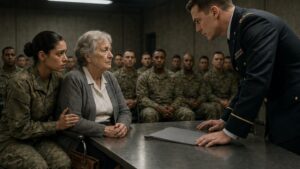
“Are you finally going to tell me why my father’s name disappeared?”
Chapter 4: The Daughter Who Would Not Thank Him
Cynthia placed the bundle of letters beside Raymond’s tray in the empty dining-hall annex.
The string around them had once been white. Age and handling had darkened it to the color of old flour sacks. Raymond recognized the knot because he had tied it himself—a square knot, pulled tight enough to hold and loose enough to undo without a knife.
“You sent some of these,” Cynthia said. “You started the others.”
Raymond looked at the envelopes.
Three bore postal marks. Two had RETURN TO SENDER stamped across the front. The rest were sealed but unstamped, their corners softened from being moved through drawers and boxes.
Daniel stood near the annex door. Brenda had brought water and a fresh tray, though Raymond had not touched either. Jeffrey remained outside in the corridor under instructions Raymond had not heard.
Cynthia pulled out the chair opposite him but did not sit.
“Which one tells me what happened?”
“None of them.”
“I know.”
Her voice was level. That made it more difficult to meet her eyes.
Raymond slipped the broken tag beneath his shirt. Cynthia watched the movement.
“Don’t hide it now.”
He let his hand fall.
The tag remained against his chest.
“It belonged to your father,” he said.
“I knew that when I was twelve.”
Raymond looked up.
Cynthia touched the bundle. “My mother had the other half. She showed it to me after I found the casualty notice in her dresser. She said the Army never recovered the second piece.”
“They didn’t.”
“You did.”
“Yes.”
“And you kept it.”
“Yes.”
Daniel shifted near the door. Cynthia turned toward him.
“Is he here because you invited him?”
Daniel said, “He was invited for the dedication.”
“Did he know what it said?”
“He raised concerns.”
“That wasn’t my question.”
Daniel paused. “He had received the proposed citation language.”
Cynthia looked back at Raymond. “So you knew.”
“I knew enough.”
“Enough to come here. Not enough to call me.”
Raymond rested both hands on the table. The right one trembled slightly. He pressed the fingertips against the metal edge until they steadied.
“I did call once.”
“After my mother died.”
“Yes.”
“You hung up when I answered.”
Raymond remembered her voice: younger then, but already carrying Robert’s refusal to fill silence for someone else. He had heard his friend in the first word and put the receiver down.
“I wasn’t ready,” he said.
Cynthia pulled out the chair and sat.
“My mother waited forty-three years for you to be ready.”
Brenda lowered her gaze. Daniel said nothing.
Raymond glanced toward the annex wall. It had been stripped for renovation, leaving pale rectangles where photographs once hung. Near the floor, a dark stain marked the place where an old steam table had stood.
Robert had once complained that every Army dining facility smelled the same after closing—bleach, wet steel, and yesterday’s onions.
Cynthia pushed the letters toward Raymond.
“She believed the official citation was a mistake. Not a lie. A mistake someone would correct when the right person spoke.”
Raymond touched the top envelope.
It was addressed to Robert’s widow. His own handwriting leaned harder on the downstrokes than it did now.
“What did she think of me?” he asked.
“She thought you saved my father.”
“I carried him out.”
“That wasn’t what I asked.”
Raymond withdrew his hand.
Cynthia’s eyes moved to the front of his shirt. “She knew you had the tag.”
“How?”
“You sent a photograph in nineteen eighty-three.”
He remembered that too. The tag on his kitchen table beside a typed page he had never mailed. He had thought the picture might prove he had not forgotten Robert. Instead, it had proved he possessed something the family had been told was lost.
“My mother wrote back,” Cynthia said. “She asked whether my father went inside willingly the last time.”
Raymond’s throat tightened.
“I received the letter.”
“You never answered.”
“No.”
“Did you think silence was kinder?”
“At the time.”
“And later?”
“Later, I had practiced it too long.”
Cynthia leaned back. Her anger did not leave, but something in it shifted from accusation toward exhaustion.
Daniel stepped forward. “Ms. Campbell, the installation has found an earlier report naming your father. We intend to conduct—”
“Please don’t offer me an investigation before I know what he knows.”
Daniel stopped.
Cynthia turned to Raymond again.
“Start with what the plaque gets wrong.”
Raymond looked down at the tabletop.
The surface was new laminate, made to resemble wood. Beneath his palm, it had no grain.
“The first blast came from outside the preparation tent,” he said. “A mortar round struck near the fuel bladders. The main kitchen was a framed structure with canvas extensions. One fuel line split. Fire ran along the ground faster than anyone expected.”
Cynthia waited.
“Your father was at the drink station.”
A brief, unwilling smile touched her mouth. “Orange?”
“He mixed it too strong.”
“My mother said that.”
“He claimed the Army watered down everything except orders.”
The smile disappeared, but the memory remained between them.
Raymond continued. “Robert heard someone in the south section before I did. He went in before I gave him permission. Came out with a private over his shoulder and half his sleeve burned through.”
Cynthia’s fingers closed around the old string.
“The first rescue was his?”
“Yes.”
The word seemed to move through the room.
Daniel looked toward the door, perhaps thinking of the plaque beyond it.
Raymond said, “He went back with me. We cleared another man near the serving line. After that, the roof supports began to fail. We pulled everyone away.”
“Then why does the citation say you made repeated entries alone?”
“Because I was the one they interviewed in the hospital. Because Robert was dead. Because the recommendation needed a single account.”
“You could have corrected it.”
“Yes.”
Cynthia flinched, not from the answer but from how readily he gave it.
Raymond looked at her.
“I corrected parts. I said Robert found the first man. I said he was beside me. The officer taking the statement told me the award board needed actions that could be independently confirmed. Men remembered seeing me carry Robert out. They remembered me directing evacuation. Nobody who saw Robert find the first casualty was in condition to give a statement then.”
“So they removed him.”
“They reduced him.”
“And you let them.”
Raymond’s hands tightened.
“Yes.”
Cynthia stood so abruptly that the chair legs struck the floor.
Brenda moved, then stopped herself.
“My mother defended you,” Cynthia said. “When people said you accepted credit, she defended you. She said you must have tried.”
“I did try.”
“No. You tried enough to keep believing you had tried.”
The sentence found the exact place he had protected.
Raymond looked at the bundle of letters.
He had written Robert’s name hundreds of times over the years. On envelopes. In margins. At the top of statements he never signed. He had mistaken repetition for testimony.
Cynthia turned away and walked toward the stripped wall. Her shoulders rose and fell once.
“When she was dying,” she said, “she asked whether you ever answered the question.”
Raymond could hear the refrigeration units through the wall.
“What did you tell her?”
“That the mail got lost.”
He closed his eyes.
Cynthia faced him again. “I lied to protect you from a dying woman’s disappointment.”
“I’m sorry.”
“That doesn’t tell me anything.”
“No.”
“Then tell me why he went back.”
Raymond’s fingers found the tag beneath his shirt.
The metal was warm now.
“The fire had reached the fuel line,” he said. “We thought two men were still inside.”
“You thought?”
“The count was confused. One had already been moved to the aid station. The other was trapped near the rear preparation area.”
“And my father?”
Raymond saw Robert as he had been in the last clear moment: one sleeve blackened, blood at his hairline, still arguing that the south wall offered the fastest route.
“I told him to stay at the casualty point.”
Cynthia’s gaze sharpened. “Did he?”
“No.”
“Did he go back on his own?”
Raymond looked toward Daniel, then Brenda, as if either of them might interrupt.
Neither did.
Cynthia stepped closer to the table.
“You had rank over him.”
“Yes.”
“Did you order him back inside?”
Raymond’s mouth opened, but no sound came.
He had spent fifty-five years arranging the answer around that single word. He had called it necessity. Confusion. Duty. A decision made in seconds. He had written every surrounding fact and left the center blank.
Cynthia did not ask again.
She watched his silence take shape.
Then she nodded once, as if he had finally answered.
Chapter 5: What the Broken Tag Could Not Prove
The casualty inventory listed Robert Campbell’s watch, wallet, wedding ring, and one half of an identification set.
It contained no statement from Raymond.
The records technician turned the final page twice before looking up. “That is the complete surviving file.”
They had moved to the base archive room as the dining hall emptied for ceremony preparations. Outside the narrow window, workers carried folded chairs toward the renovated section. Each time the door opened, Raymond heard the muted scrape of furniture being arranged for an honor he no longer understood how to stop.
Cynthia stood beside the archive table. She had not spoken to him since the annex.
Daniel read the inventory while the installation historian examined the tag under a magnifying lamp.
“The fracture pattern is consistent with the photographed half,” the historian said. “The number matches. There is no doubt this belonged to Specialist Campbell.”
Daniel removed his glasses. “That establishes ownership.”
“It establishes more than your plaque does,” Cynthia said.
“It does not establish the sequence of events.”
Raymond watched the broken edge beneath the lamp. Daniel was right, and Raymond hated him for being right in a way that mattered.
The tag could prove Robert had lived, served, and died. It could prove Raymond had carried part of his identification away from the fire.
It could not prove who spoke first.
It could not prove what tone Raymond used.
It could not prove whether Robert obeyed an order or chose the danger before the order was complete.
The archive door opened.
Jeffrey entered with a thin security bulletin in his hand. He stopped several paces from Raymond.
“Colonel Harris asked me to review the access warning.”
Daniel held out his hand. “And?”
Jeffrey gave him the paper.
“The reported theft involved current electronic visitor cards from the processing center. Not legacy identification tags. The bulletin says no recovered items were connected to military personnel records.”
Daniel read it. “You were briefed on this yesterday.”
“Yes, sir.”
“Then why did you treat the tag as evidence of the same issue?”
Jeffrey’s face remained forward. “I saw an expired pass and an identification item with another name. I connected them.”
“Without checking the bulletin.”
“Yes, sir.”
“Without calling security.”
“Yes, sir.”
Raymond looked at Jeffrey’s hands. Both hung open at his sides.
Jeffrey swallowed. “I thought if I let him move before I knew what he had, I’d lose control of the situation.”
“You never had control,” Cynthia said.
Jeffrey’s eyes shifted toward her, then back to Daniel.
“No, ma’am.”
The answer carried no defense. Raymond had expected an explanation built from policy and pressure. Instead, Jeffrey stood inside the plain shape of what he had done.
Daniel dismissed him to wait outside.
“Let him stay,” Raymond said.
Cynthia looked at him.
Raymond gestured toward the bulletin. “He found something we needed.”
“He found that he was wrong,” she said.
“That too.”
Jeffrey remained near the wall.
The historian closed the casualty inventory. “There may be a field-log reference in storage. Building maintenance retained several boxes from the old kitchen exhibits.”
The old field-kitchen storage bay lay beyond the loading area, behind a steel door that resisted the first key. When it opened, stale dust and machine oil drifted into the corridor.
Inside were serving pans, ration crates, framed photographs, and a rusted mixer mounted on a wheeled base. Raymond recognized the shape of equipment before he recognized individual pieces. His body remembered the width of aisles and the reach between stations.
Brenda found a metal clipboard inside a wooden crate marked HISTORICAL MATERIAL—UNSORTED.
The pages had water damage along one edge. Most entries concerned fuel, meal counts, and equipment repairs. Near the back, a casualty notation named Robert and two injured soldiers.
The line beneath it was harder to read.
Campbell returned south side on Thomas instruction. Two believed unaccounted.
Cynthia read it over Raymond’s shoulder.
“Your instruction.”
“Yes.”
The words did not change anything he knew. Seeing them written made them heavier.
Daniel leaned closer. “Who wrote this?”
“No initials,” the historian said. “Likely the shift clerk. It confirms an instruction but not its wording or context.”
Cynthia looked at Raymond. “What was the wording?”
Raymond placed the clipboard on a steel table.
The bay disappeared around him.
He heard the pop of burning canvas and the metallic howl of a fuel can rupturing. Robert’s left sleeve had been wrapped in a wet towel. His face was gray beneath the soot.
“Two men are still in the rear,” Raymond had told him.
Robert had looked toward the south opening.
“I can reach them.”
Raymond had said, “Take the wall. Stay low. Bring them to my voice.”
Not Go.
Not exactly.
But an order did not require the word.
“I told him where we believed they were,” Raymond said. “I told him to take the south wall and bring them out.”
“Did he object?” Cynthia asked.
“No.”
“Did you give him a choice?”
Raymond remembered Robert tightening the towel around his arm with his teeth.
“I did not say he could refuse.”
Cynthia turned away.
Raymond continued because stopping now would be another form of selection.
“Your father found the trapped soldier. The second man had already been moved. Robert pushed the injured man toward the opening. I reached them before the fuel ignited.”
“And my father?”
“He was behind him.”
The smell returned—not as flame, but as wet canvas, burned sugar, and powdered drink cooked onto steel.
“I pulled the injured man clear. Then I went back for Robert.”
Cynthia pressed both hands against the edge of the table.
“You carried him out.”
“Yes.”
“Alive?”
“For a few minutes.”
No one moved.
The historian lowered his eyes to the clipboard.
Daniel spoke carefully. “The record supports shared action. We can revise the dedication to name both men.”
Raymond looked at him.
Daniel continued. “We do not need to settle every question today. The inscription can state that Specialist Campbell initiated the rescue and that both men acted to evacuate personnel.”
Cynthia’s laugh held no humor. “And the order?”
“That belongs in the complete historical review.”
“Where nobody at the ceremony has to hear it.”
Daniel’s patience thinned. “What would you have me do? Present an unresolved command decision as established fact? Accuse Mr. Thomas publicly based on an unsigned log and his memory under trauma?”
“I’m not asking you to accuse him.”
“What are you asking?”
“For you to stop manufacturing certainty.”
The words struck Daniel into silence.
He turned to Raymond.
“We can halt the unveiling and announce a joint dedication. Both names. Equal placement. The review can continue without reducing this afternoon to speculation.”
Raymond pictured Robert’s name cut beside his own.
Not beneath. Not absent.
For one weak moment, relief moved through him.
The family would have the name. The institution would acknowledge the first rescue. The tag could go home. Raymond could say the record had been corrected without standing before strangers and naming the decision that had lived under his ribs for fifty-five years.
Daniel saw the hesitation.
“This is not concealment,” he said. “It is accuracy within what we can support.”
Raymond almost nodded.
Cynthia reached for the broken tag. Her fingers stopped before touching it.
“My father does not need to be added to your version of Raymond,” she said. “And Raymond does not need to be cleaned until nobody can see what silence cost.”
Daniel’s voice hardened. “A memorial cannot hold every moral complication.”
“Then don’t pretend it holds the truth.”
She looked at Raymond.
“If you let them put my father’s name beside yours without telling why it disappeared, they will make him a convenient addition and you a harmless legend.”
The chairs outside scraped into neat rows.
Cynthia stepped away from the table.
“I will reject that memorial publicly if I have to.”
Raymond watched the relief he had nearly accepted close like a door.
Chapter 6: The Easy Correction That Preserved the Lie
Robert Campbell’s name had been added in smaller letters.
Raymond stood in Daniel’s command office the next morning, holding the revised mock-up beneath the light. His own name still filled the top line in gold capitals. Robert’s appeared below it, centered inside a new paragraph as if the stone had remembered him late.
Daniel waited behind his desk.
“It is temporary artwork,” he said. “The final plaque would place both names appropriately.”
“Appropriately.”
“Equally.”
Raymond set the mock-up down. “They are not equal here.”
“The design team had less than twelve hours.”
“They had fifty-five years.”
Daniel removed his glasses and folded them.
The ceremony had been delayed from the previous afternoon to late morning under the explanation of a historical review. Guests had been moved to another base event, fed, and asked to return. The postponement had bought time, but not much truth.
A revised statement lay beside the mock-up. It called Robert’s omission “an archival discrepancy recently brought to the command’s attention.”
Raymond tapped the phrase.
“When did my letter arrive?”
Daniel did not answer immediately.
“February.”
“It is June.”
“Yes.”
“You wrote that the matter was under review.”
“It was.”
“Who reviewed it?”
Daniel looked toward the window. Beyond the glass, a flag moved above the headquarters lawn, too distant to make a sound.
“I referred it to public affairs and the installation historian.”
“When?”
“After the dedication materials had entered production.”
“That was not my question.”
Daniel’s jaw tightened.
“In May.”
Raymond let the silence remain.
Daniel put his glasses back on. “I believed we could honor your service and address the discrepancy through an addendum. The renovation had funding deadlines. Guests had committed travel. Canceling on the basis of one disputed letter would have affected more than this command.”
“You waited because the ceremony was useful.”
“I waited because institutions require evidence.”
“You had enough evidence to ask me here.”
Daniel stood.
“Yes. The ceremony was useful. Morale matters. History matters. A dining facility full of young soldiers should know that men before them risked their lives for one another.”
“Then tell them about the men.”
“I am trying to.”
“You are trying to keep the chairs facing the same direction.”
The office door opened after a knock.
A clerk carried in a clear evidence envelope. Inside lay the broken tag and its chain.
Daniel accepted it and placed it beside the revised statement.
“The historian logged the item. Ms. Campbell has agreed that the command may retain it until the review concludes.”
Raymond looked toward Cynthia.
She stood near the wall, arms folded. “I agreed it could be photographed. Not retained.”
Daniel glanced at the clerk. “There may have been a misunderstanding.”
Raymond took the envelope.
The adhesive flap had not been sealed. He removed the tag and let the plastic fall onto Daniel’s desk.
“This is not evidence the Army discovered,” he said. “It is something I brought to return.”
“Chain-of-custody procedures—”
“Do not put another label around it and call that care.”
He lifted the chain over his head. The tag settled once more against his chest.
Daniel’s face went still. “You cannot dictate the historical process.”
“No. I can decide whether you use what I carried to support a story I have not told.”
A second knock came.
Jeffrey entered without his uniform jacket. The absence made him look younger, though not less tired. He stopped several feet from Raymond.
Daniel said, “Staff Sergeant Clark has been removed from ceremonial duties. His conduct review will proceed independently. The command statement will acknowledge the access failure and the physical contact.”
Raymond looked at the revised statement.
One paragraph addressed Jeffrey. Two addressed Robert. Five praised the command’s commitment to honoring service.
“This is your solution,” Raymond said. “Add Robert. Remove Jeffrey. Keep the ceremony.”
Daniel’s expression sharpened. “Would you prefer no accountability?”
“I prefer the right accountability.”
Jeffrey spoke before Daniel could.
“I saw Ms. Williams coming.”
Raymond turned toward him.
Jeffrey kept his eyes level, though his hands flexed once.
“In the dining hall,” he said. “Before I pulled you forward. I heard her say to wait.”
Brenda, standing near Cynthia, looked at him.
Jeffrey continued. “I knew she might have information. But everyone was watching, and I had already said you were unauthorized.”
Daniel’s voice was cold. “Sergeant.”
“You asked for a full statement, sir.”
“Continue.”
Jeffrey looked at Raymond.
“I thought if I let go before she explained, it would look like I had lost control. So I tightened my grip.”
There was no policy in the admission. No stolen-card warning. No confusion about the pass.
Only pride under observation.
Raymond felt the collar of his jacket against the bruise on his neck.
“Why tell me now?” he asked.
“Because yesterday I kept saying I made a connection between the pass and the tag.” Jeffrey swallowed. “That explains why I approached you. It does not explain why I held on.”
Cynthia watched him with an expression Raymond could not read.
Daniel said, “You will wait outside.”
Raymond raised a hand.
“No. Stay.”
Jeffrey looked surprised.
“You were willing to use a room full of witnesses when you thought they made you stronger,” Raymond said. “You can remain when they do not.”
Jeffrey nodded once.
A public-affairs specialist appeared at the door and whispered to Daniel.
Daniel checked the clock. “Guests are entering the dining hall. We have forty-seven minutes.”
He turned to Raymond.
“The revised plaque will remain covered. I will announce that the dedication has been amended to honor both men. No unveiling. No permanent installation until the review concludes. Staff Sergeant Clark will not participate.”
Raymond looked at the mock-up again.
Robert’s smaller name.
The archival discrepancy.
The delayed letter made recent by careful language.
It was better than yesterday’s plaque.
That was the danger.
A better version of a lie could survive longer than the first.
Daniel slid a prepared page across the desk. “You may read this statement or speak briefly in your own words. It acknowledges Specialist Campbell’s first entry and your joint rescue actions. It makes no finding about disputed command decisions.”
Raymond picked up the page.
The language was respectful. Balanced. Clean.
It gave Robert credit.
It gave Raymond protection.
It gave Daniel a ceremony.
Cynthia said nothing.
Raymond read the page twice, then tore it once down the center.
The sound was soft.
Daniel stared at the halves.
“I will not accept the original dedication,” Raymond said. “I will not accept this one either.”
“Then what will you accept?”
“I don’t know yet.”
The public-affairs specialist looked at the clock.
Daniel’s restraint broke at the edges. “You have had decades to decide what you want to say.”
“Yes.”
“And now hundreds of people are waiting.”
“They waited one night. Robert waited fifty-five years.”
Raymond removed the tag from beneath his shirt but kept the chain around his neck. The metal rested in his palm.
He had no speech. No notes. Only fragments he had spent a lifetime refusing to arrange in public.
He looked at Jeffrey.
“Where were you assigned to stand during the ceremony?”
“Near the rear doors.”
“No.”
Daniel said, “Mr. Thomas, he has been removed from duty.”
“I heard you.”
Raymond pointed toward the dedication area beyond the office wall.
“Leave the original plaque covered.”
Daniel studied him.
“And Sergeant Clark?”
“Put him where I can see him.”
Jeffrey’s face changed.
Cynthia unfolded her arms.
Daniel asked, “Why?”
Raymond closed his hand around the tag.
“Because if I tell only the part that makes him ashamed, I will be doing what all of you planned to do with me.”