They Moved the Old Sailor From the Reserved Table Until the Admiral Recognized His Scorched Tray
Chapter 1: The Man Seated Before His Name Was Checked
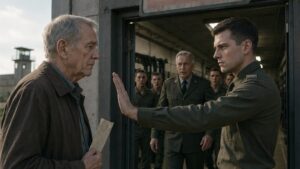
“Sir, did you remove that tray from government property?”
Edward Allen looked down at the warped sheet of stainless steel balanced across his knees. One corner had curled inward under heat decades ago, and smoke had darkened the shallow rim beyond anything soap could fix. It was wrapped in an old dish towel, though the top remained exposed.
“No,” he said. “I brought it back.”
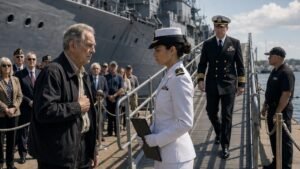
The security sailor glanced from the tray to Edward’s olive jacket, then toward the line forming behind him at the installation entrance. Edward could feel the impatience gathering in small movements: shoes shifting, invitation cards tapping against palms, a cough aimed more at him than at any sickness.
“Brought it back from where?”
“The Resolute.”
The sailor’s expression did not change. The ship’s name meant less to him than the bar code refusing to scan on Edward’s invitation.
The card identified him only as E. Allen—Artifact Consultation. No rank. No title. No explanation for why an eighty-one-year-old man had arrived carrying what looked like discarded cafeteria equipment.
“Your escort is supposed to be with you.”
“My daughter is parking.”
“We have wheelchairs available.”
“I walked in.”
“That isn’t what I asked.”
Edward raised his eyes. The sailor was young enough to be his grandson and disciplined enough to hide most of his embarrassment at having to argue with an old man while the line lengthened.
Edward understood the embarrassment. He simply did not feel obliged to rescue him from it.
A ceremonial aide came through the gate, glanced at the invitation, and pointed down a service corridor. “Historical office guests are staging near the mess hall. Straight through, then left at the rededication banner.”
Edward tucked the invitation into his jacket and stood before anyone could offer a hand. His right knee objected at once. He waited for the sharpness to settle, then carried the tray against his ribs and walked.
The corridor smelled of floor wax, hot metal, and coffee strong enough to strip paint. Carts rattled beyond swinging doors. Somewhere ahead, someone called for another rack of cups. The sounds reached Edward before the mess hall itself did, each one clipped and familiar: the slap of rubber soles, the hollow collision of trays, the metallic cough of ventilation ducts.
He had expected the building to feel new.
Instead, his body recognized it before his mind could refuse.
At the end of the corridor hung a blue-and-gold banner:
USS RESOLUTE MESS-DECK HERITAGE REDEDICATION
Beneath the words was the ship number stamped under Edward’s tray.
He stopped so abruptly that a cook pushing a cart had to steer around him.
“Coming through, sir.”
Edward moved aside. His thumb found the scorched corner under the cloth. He had carried the tray out of a storage locker after the ship was decommissioned, with permission from a supply chief who had told him nobody wanted it. For fifty-three years it had sat in the bottom drawer of Edward’s workbench beneath rags, spare hinges, and a box of screws he never used.
Now its number hung above a polished entrance.
Inside, the mess hall was bright enough to erase shadows. Stainless-steel tables stood in strict rows beneath exposed ducts. White-uniformed personnel crossed between dark-uniformed sailors setting out place cards and water pitchers. At the front, a broad object stood beneath a navy-blue cloth. A brass strip along its base had already been uncovered.
Edward saw his surname.
ALLEN
He turned away before reading the rest.
A mess-hall chief approached with a clipboard. “Guest seating is on the far side, sir.”
“I’m here for the historical office.”
“They’re not set up yet.”
“I was told to wait near the mess.”
“That’ll be guest seating.”
The far side had folding chairs arranged behind a cordon. Edward looked instead at the plain table nearest the covered display. No flowers. No raised platform. One place setting had been laid there, though the card faced away from him.
“That chair will do.”
“It’s reserved.”
“So am I.”
The chief did not hear him or chose not to. A call from the galley pulled her away before she could answer.
Edward sat.
His knee welcomed the decision. His pride did not.
He set the scorched tray on the tabletop beside the clean place setting. The contrast made it look worse: blackened rim against white napkin, warped metal beside a polished fork. A paper cup waited near his right hand. Its handle pointed into the aisle.
Edward turned it inward.
On the Resolute, loose handles caught sleeves when the deck pitched. Cups became projectiles. Scalding coffee found wrists, laps, faces. A man who set a table properly did not leave handles where hurried bodies could snag them.
A junior cook passing with bread plates noticed him adjusting the cup.
“Everything all right, sir?”
“It is now.”
The cook smiled uncertainly and moved on.
Edward checked the entrance. Catherine had his phone number, his medication, and a habit of assuming any delay meant he had fallen. He should have waited at security. He knew that. But the wheelchair beside the gate had felt like a verdict, and when Catherine had said she would be five minutes, he had heard permission rather than instruction.
A lieutenant in service dress entered with a tablet in one hand and irritation already arranged across his face. He was lean, precise, and moving too quickly to see anything not listed on his screen.
“Why is there a civilian at the command table?”
The mess-hall chief looked over from the galley doors. “Historical office guest, Lieutenant.”
“This table is for principal participants.”
Edward watched the lieutenant approach.
“Sir, I’m Lieutenant Anthony Baker. May I see your credentials?”
Edward handed him the invitation.
Anthony read it twice. “This says artifact consultation.”
“Yes.”
“It doesn’t authorize seating in the ceremonial section.”
“No one authorized the pain in my knee either.”
Anthony’s mouth tightened, though not cruelly. He glanced toward the entrance, where personnel were beginning to assemble. “We’re inside the final movement window. The admiral’s party will be here shortly.”
“Then you should keep moving.”
“Sir, I need you in the visitor section until your escort arrives.”
“My escort has a name.”
“Fine. What is your daughter’s name?”
Edward took back the invitation. “Catherine.”
Anthony tapped the tablet. “Catherine Allen isn’t on the principal access list.”
“She isn’t the artifact.”
Anthony inhaled through his nose. Edward recognized the effort. The lieutenant was trying to remain courteous while calculating how many seconds courtesy was costing him.
His gaze landed on the tray.
“What is that?”
“What I was asked to bring.”
“It can’t remain on a food-service table.”
“It served food before you did.”
A nearby sailor lowered his eyes to hide a reaction.
Anthony noticed. Color rose along his neck.
“Sir, personal items entering the meal area have to be inspected and cleared. That tray is visibly fire-damaged.”
Edward’s fingers closed over the cloth. “You can inspect it where it sits.”
“Not during staging.”
Anthony turned to the security sailor beside him. “Move the chair to visitor holding. We’ll verify the invitation there.”
The sailor hesitated. “With him in it, sir?”
Edward looked up sharply.
Anthony corrected himself. “Assist the gentleman to the visitor section.”
“I am sitting where they told me to come.”
“No, sir. You selected a restricted table.”
The room had not gone silent, but attention had begun collecting around them. Edward saw it in quick glances from the serving line, in hands slowing over place settings, in the way two junior sailors suddenly found reasons to stand within earshot.
Anthony leaned closer and lowered his voice, which made the words more insulting rather than less.
“This area is reserved for actual participants in the ceremony. I need you to cooperate.”
Edward studied him. The lieutenant believed he was being patient. That was the worst of it. He believed patience was something he was giving downward.
Edward looked toward the covered display. His surname waited beneath the cloth like a charge he had not yet heard.
He could stand, carry the tray out, and meet Catherine at the gate. He had done harder things than leave a room.
He pushed one hand against the table.
His knee failed to straighten on the first attempt.
Anthony reached for his elbow.
Edward pulled away. “Don’t.”
The word came out louder than he intended.
Heads turned.
Anthony withdrew his hand. For a moment, something almost apologetic crossed his face. Then he saw the gathering personnel, the unfinished seating, the clock above the galley doors.
Procedure closed over him again.
“Move the chair,” he told the sailor.
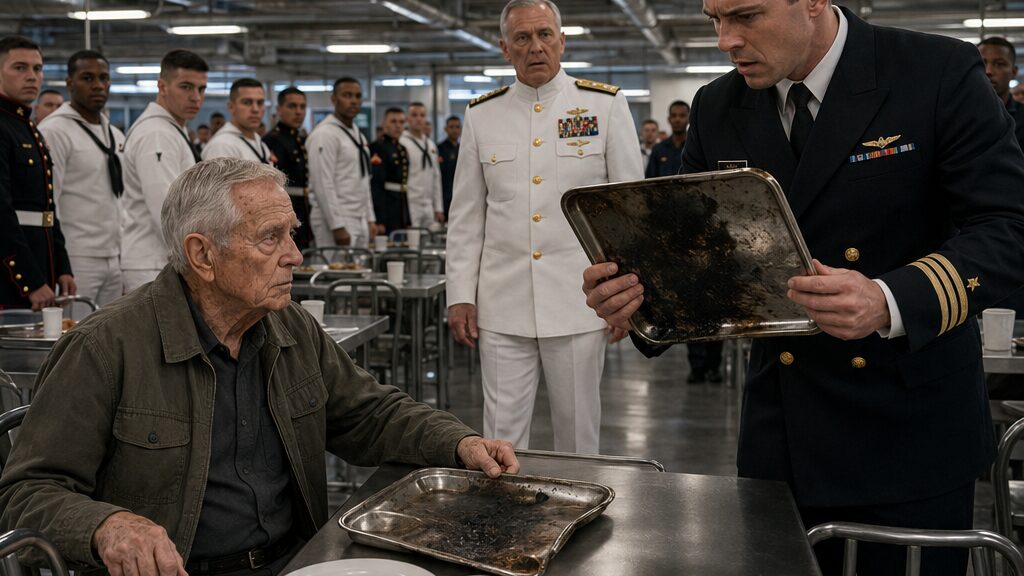
Then he reached past Edward for the scorched tray.
Chapter 2: The Admiral Stopped When the Tray Turned Over
Anthony lifted the tray by its cleanest edge.
“Set it down,” Edward said.
The lieutenant kept moving.
The old cloth slipped free and landed beside the untouched place setting. Under the industrial lights, the tray looked worse than it had at the gate. Heat had buckled its center. One corner shone where years of handling had polished the soot away, but the rest bore a permanent brown-black stain.
Anthony held it away from his uniform.
“I’ll have it placed with the historical materials after it’s cleared.”
“You’ll put it back now.”
“We are not doing this in front of the admiral’s party.”
Edward tightened his grip on the chair. He wanted to stand. He wanted to take the tray with both hands and make Anthony understand that some objects had already survived all the handling they should ever have to endure.
His knee had other ideas.
The security sailor positioned himself behind the chair but did not touch it.
From the main entrance came the crisp call, “Attention on deck.”
Bodies straightened throughout the mess hall. Conversations died. Shoes aligned beneath white and dark uniforms as Rear Admiral Raymond Lewis entered with a ceremonial aide and two senior officers.
Anthony turned toward him while still holding the tray.
That movement tilted the metal almost vertically.
Its underside faced the room.
The ship stamp appeared first: a faded set of letters and numbers pressed into the steel. Below it ran three narrow notches cut by hand beneath the rim. One was deeper than the others.
Raymond took two more steps.
Then stopped.
The officers behind him nearly closed the distance before catching themselves.
Raymond’s eyes did not go to Edward’s olive jacket or the unreadable patch at his chest. They stayed on the scorched underside of the tray.
“Where did you get that?” he asked.
Anthony glanced at it. “An unverified guest brought it into the meal area, Admiral. I was having it secured.”
Raymond looked past him.
Edward sat with one hand flat on the table and the other clamped around the chair edge.
The admiral’s expression changed in increments. First concentration. Then disbelief. Then something Edward did not want to see because it resembled gratitude before any facts had been exchanged.
Raymond stepped around Anthony.
“Chief Allen?”
The title moved through the mess hall more quickly than an order.
Anthony’s arm lowered by an inch.
Edward could have corrected the admiral. Retired Chief Allen. Mister Allen. Just Edward. Instead he said, “That belongs on the table.”
Raymond’s gaze shifted to Anthony. “Return it.”
“Yes, sir.”
“With both hands, Lieutenant.”
Anthony’s face went still.
He adjusted his grip, one palm under either side, and carried the tray the two steps back to Edward. The warped metal trembled slightly. Edward could not tell whether the movement came from Anthony’s hands or his own when he received it.
He set it beside the clean place setting.
The three notches disappeared against the tabletop.
Raymond remained in front of him. The admiral wore dress whites so precise they seemed cut from the light itself. Gold glinted at his shoulders and over his chest. Behind him, rows of sailors and Marines stood silent among steel tables and half-filled water glasses.
Edward felt suddenly aware of his frayed cuff, his stubborn knee, the faint tremor in his fingers.
Raymond came to attention.
His right hand rose in a formal salute.
No one had ordered the room to remain still. It did anyway.
Edward looked up at him.
The gesture should have been simple. Recognition offered. Recognition received. He had seen thousands of salutes in his life, most of them so ordinary that no one remembered them after the hand came down.
This one held.
Raymond’s face carried no theatrical solemnity. Only certainty.
Anthony stood half a pace behind him, the tablet lowered at his side. The certainty was not on his face. He looked as though the floor plan had changed beneath his feet and no one had issued him a revision.
Edward’s first feeling was not pride.
It was exposure.
He glanced toward the covered display and saw again the brass strip with his surname. The blue cloth seemed larger now, less like concealment than a held breath.
At last, Raymond lowered his hand.
“Chief,” he said, “this facility’s mess deck exists in its present form because of the standard you set aboard the Resolute.”
Edward said nothing.
Raymond continued, his voice carrying through the room without needing volume. “When that ship was burning, you kept another mess deck functioning under fire. You turned it into a casualty station and kept men alive when—”
“Don’t.”
The word cut more cleanly than Edward expected.
Raymond stopped.
A few faces in the background shifted. The younger personnel had understood the salute. They did not understand the refusal.
Edward touched the tray’s rim.
“Don’t call me the man who saved the mess deck.”
Raymond’s posture did not loosen, but his eyes narrowed with attention. “That is how the action is recorded.”
“Then it’s recorded wrong.”
The silence changed. Before, it had been respect. Now it was uncertainty.
Anthony took a small breath.
Raymond looked at the tray, then at the covered display. “We should speak privately.”
“That would have been my preference.”
The admiral accepted the rebuke without flinching. “It should have been arranged.”
Anthony stepped forward. “Admiral, the invitation was listed only under artifact consultation. There was no rank or principal-participant designation. I followed the access—”
Raymond turned his head.
Anthony stopped.
Edward watched the lieutenant’s jaw tighten. The man wanted to explain because explanation was how competent people separated mistakes from negligence. Edward knew the impulse. He had used it himself.
Raymond spoke quietly. “Lieutenant, the issue is not whether the form was incomplete.”
“No, sir.”
“It is what you did when a person did not fit the form.”
Anthony’s eyes flicked toward Edward. Shame had entered them, but so had resistance. He was not ready to surrender the belief that his decision had been reasonable.
Edward found that almost reassuring. Instant repentance would have been another kind of ceremony.
A woman in a navy-blue civilian suit hurried from the exhibit alcove. She carried a folder thick with flagged documents and wore an identification badge from the historical office.
“Admiral Lewis.” She stopped when she saw Edward. “Mr. Allen?”
“Chief Allen,” Raymond said, though his tone had softened into a question.
“Edward will do.”
The woman looked from him to the tray. “I’m Sarah Scott. We’ve spoken by telephone.”
“You spoke. I listened.”
A nervous smile appeared and vanished. “I’m sorry the escort arrangements failed.”
“My daughter is still looking for parking.”
Sarah glanced at Anthony, then at the chair that had been angled away from the table. Understanding moved across her face.
“I asked that Mr. Allen be brought directly to the exhibit alcove.”
Anthony answered before Raymond could. “His invitation did not say that.”
Sarah opened the folder. “The principal invitation was sent to his daughter. His own card was generated from the artifact intake list.”
Edward looked at her. “Principal invitation?”
Sarah hesitated.
That was answer enough.
From the galley came a burst of steam and the clang of a dropped lid. No one in the room turned toward it.
Raymond gestured to the place setting. “Please remain seated.”
“I had planned to.”
The admiral almost smiled, then thought better of it.
He looked toward the assembled personnel. “Resume preparations.”
The room moved again, but not normally. Voices remained low. Every person who passed Edward’s table looked at him differently. Some with curiosity. Some with respect. A few with the open hunger people showed when they sensed a story and wanted the part that would make it easy to repeat.
Anthony stepped closer.
“Mr. Allen.”
Edward looked at him.
“I should not have touched the tray without your permission.”
It was not a full apology. It was specific, which made it worth more.
“No,” Edward said. “You shouldn’t have.”
Anthony absorbed that without defense. Then his tablet chimed, and duty pulled his attention toward three new problems at once.
Raymond asked Sarah to uncover the display.
She did not move.
“Admiral,” she said, “perhaps we should review the final language first.”
Edward heard the caution in her voice.
Raymond heard it too. “Has something changed?”
Sarah glanced at Edward. “I received the last scanned file this morning.”
“What file?”
“Chief Allen’s after-action statement.”
Edward’s fingertips went cold against the tray.
Sarah looked toward the side dining room. “There are inconsistencies I hoped he could clarify before the ceremony.”
Raymond’s attention sharpened. “What kind of inconsistencies?”
Edward pushed the paper cup away. Its handle, still turned inward, struck the place card. The card rotated.
His name appeared on the front in raised blue letters.
CHIEF EDWARD ALLEN — PRINCIPAL HONOREE
Before he could turn it back, Sarah lifted the cloth from the display.
A polished plaque stood beneath it, mounted beside a photograph of a much younger Edward.
The inscription named him as the sole organizer of the Resolute’s emergency evacuation and casualty response.
Chapter 3: The Plaque Told a Cleaner Story Than He Remembered
Sarah placed a black archival pen in Edward’s hand and turned the plaque over.
A white certification label had been fixed to the back.
I HAVE REVIEWED THE ABOVE ACCOUNT AND AFFIRM THAT IT ACCURATELY REPRESENTS THE EVENTS DESCRIBED.
Beneath it waited a blank signature line.
Edward set the pen down.
Sarah kept her hand near the plaque but did not push it closer. “We need the certification before it goes into the permanent display.”
“No.”
Raymond stood at the end of the side-room table, his dress-white cap tucked beneath one arm. Anthony had remained near the doorway, officially to control access, though Edward suspected the lieutenant had been told to stay.
The tray lay between them.
Catherine had still not arrived.
Sarah opened her folder. “The wording is based on the ship’s official damage report, your citation, medical logs, and statements taken from surviving crew.”
“My citation was written by people who weren’t in the mess.”
“The commanding officer approved it.”
“He wasn’t in the mess either.”
Raymond studied the photograph mounted beside the plaque. Edward was thirty years old in it, broad-shouldered, unsmiling, wearing an apron over coveralls. Someone had cropped away the sailors standing on both sides of him.
“We can delay the installation,” Raymond said.
Sarah looked at him. “The public program begins in four hours.”
“Then the installation can be delayed for four hours.”
“The display is the center of the rededication.”
“That does not make it accurate.”
Edward glanced at Raymond. The admiral had moved quickly from certainty to caution, but caution was not yet understanding. He still believed there was an account waiting to be corrected into a cleaner account.
There wasn’t.
Sarah slid a draft of the ceremonial remarks across the table. One paragraph had been marked in yellow.
Edward read the first line.
Acting independently after the command passage became inaccessible, Chief Allen directed the evacuation of injured personnel and established emergency medical operations in the mess deck.
He pushed it away.
“Who wrote ‘acting independently’?”
“It appears in the historical summary.”
“Who wrote it first?”
Sarah turned several pages. “The earliest phrasing I found is in a witness statement submitted six days after the fire.”
“Name.”
“The signature is difficult to read.”
“Then don’t use the sentence.”
Sarah’s professional calm thinned. “Mr. Allen, I am trying not to. That is why you were invited.”
“I was invited to deliver a tray.”
“You were invited as the principal honoree.”
“No one told me that.”
Raymond looked at Sarah.
She closed the folder halfway. “We contacted his daughter after he declined the first invitation.”
Edward stared at her. “You contacted Catherine?”
“She believed you had misunderstood the event.”
“I understood it.”
“You said you would not attend a ceremony built around your name.”
“And she thought that meant I wanted a better chair?”
The door opened before Sarah could answer.
Catherine entered carrying Edward’s cane, his medication bag, and enough anger for everyone in the room.
“There you are.”
Edward looked at the cane. “I didn’t need that.”
“You left it in the car.”
“I walked here.”
“Yes. I’ve heard. Half the security desk has heard.”
She crossed to him, checked his color with one glance, then noticed Raymond. Her pace faltered.
“Admiral.”
“Ms. Allen.”
Catherine looked from the admiral to the plaque, then to the photograph of her father. Pride rose across her face so quickly that Edward almost looked away.
“They uncovered it already.”
Edward turned toward her. “You knew.”
She set the cane against his chair. “I knew they were honoring you.”
“You knew I was the principal honoree.”
“You wouldn’t have come if I told you.”
“That should have answered the question.”
“It answered the wrong question.”
Her voice had softened, but the room was too small for privacy.
“You’ve spent my entire life refusing to speak about the Resolute,” she continued. “Then they finally ask you to come back, and you act like they’ve accused you of something.”
Edward looked at the unsigned label.
“Maybe they have.”
Catherine’s pride changed shape. “What does that mean?”
No one answered for him.
She picked up the draft remarks and read the highlighted paragraph. “This says you directed the evacuation.”
“It says I did it independently.”
“Didn’t you?”
Edward looked at the photograph again. The crop ended at his shoulders. On the original print, Matthew Flores had stood to his left with one hand raised against the camera, laughing because he had not wanted his picture taken in a filthy undershirt.
“Matthew did.”
The name landed without context.
Catherine lowered the paper. “Who is Matthew?”
“Petty Officer Matthew Flores.”
Sarah opened the folder again. “Damage control, second class. Listed among the fatalities in passage compartment three.”
Edward’s jaw tightened at the flatness of the description.
“The plaque belongs to him more than it belongs to me,” he said.
Raymond moved closer to the table. “What did Flores do?”
Edward’s eyes went to the tray.
“Enough.”
“That is not sufficient for the record,” Sarah said.
“It was sufficient to die.”
Her face tightened. “I am not minimizing his death. I’m telling you his surviving documentation does not assign him a command role in the mess-deck response.”
“Then your documentation is missing the truth.”
Sarah turned to a casualty file. “There is no statement from him.”
“He was dead.”
“There are no witness statements attributing the evacuation order to him.”
Edward pushed back from the table. The chair legs scraped hard against the floor.
Catherine reached toward him, then stopped before touching his shoulder.
Sarah continued, more carefully now. “Your own after-action statement says you assumed control at 1410 and ordered all accessible casualties transferred to the mess deck.”
Edward stood with the help of his cane. Anger steadied his knee better than caution had.
“My statement was seven lines long.”
“Eight.”
He looked at her.
Sarah swallowed. “Eight lines.”
“You counted them. Did you count what wasn’t there?”
“That is what I am trying to do.”
“No. You are trying to make what is there fit on brass.”
Raymond removed the plaque from its stand and laid it flat. “No one is asking you to approve language you believe is false.”
Catherine looked at him. “Then let him tell you what happened.”
Edward turned on her. “You don’t know what you’re asking.”
“No,” she said. “I don’t. Because you never told me.”
The rebuke was quiet enough to hurt.
For years Catherine had asked about the fire in indirect ways. Why he never sat with his back to a closed door. Why smoke from a backyard grill could empty all the color from his face. Why he kept an ugly tray wrapped beneath his workbench and became furious when she once suggested donating it.
He had answered every question with some variation of It was a long time ago.
Now she looked at the plaque and understood that time had not been the reason.
Sarah lifted the tray carefully, waiting until Edward gave the smallest nod before touching it.
“The museum photographer needs images of the underside,” she said. “May I?”
Edward wanted to say no.
Instead he sat again.
Sarah turned the tray over on a clean cloth. The ship stamp faced upward. The three notches showed beneath the rim.
She angled a portable lamp across the scorched surface.
Faint yellow lines emerged near the center.
Not scratches.
Numbers.
Sarah bent closer. “Were these written in grease pencil?”
Edward did not answer.
She adjusted the light. More marks appeared: grouped strokes, partial figures, a circle split by a diagonal line.
Raymond came around the table.
Sarah pulled a casualty summary from the folder and placed it beside the tray. Her finger moved from one faded number to the official total, then back again.
“These don’t match.”
Anthony left the doorway despite himself. “What don’t?”
“The count beneath the third mark,” Sarah said. “The official record says forty-one personnel were received in the mess before the secondary fire.”
She looked up at Edward.
“This tray records forty-eight.”
Chapter 4: Three Notches Beneath the Rim Changed the Timeline
Sarah did not touch the tray again until she had placed the casualty summary beside it and turned the portable lamp low across the metal.
“This mark was made before 1410,” she said.
Edward kept his eyes on the table.
“That is not possible according to your statement.”
“It is possible according to the tray.”
Sarah slid a photocopy from the folder. “The medical log records you unconscious at 1356. Smoke inhalation. You were revived in the mess at 1408.”
Anthony stood near the historical office door with his tablet pressed against his thigh. “Then someone else wrote the number.”
“Yes,” Sarah said. “That is the point.”
The office had been built from a converted storeroom behind the galley. Shelves held boxed menus, ship photographs, tarnished utensils, and ledgers that smelled of paper dust and old grease. Through the wall came the muted machinery of lunch service continuing without them.
Raymond had removed his white dress jacket and draped it over a chair. In shirtsleeves, he looked less ceremonial but no less careful.
“Show me the sequence,” he said.
Sarah arranged the documents in a line.
“The first fire alarm was logged at 1327. The main passage was declared impassable at 1352. Chief Allen’s report says he assumed control of the mess at 1410 and ordered all accessible casualties transferred there.”
Her finger moved to the tray.
“But the first grease-pencil group reads twelve. The second brings the total to twenty-nine. The third brings it to forty-eight. At least one of those counts had to be written before Chief Allen regained consciousness.”
Catherine stood behind Edward’s chair. She had stopped trying to catch his eye.
Raymond examined the three notches beneath the rim. “What do these represent?”
Edward’s thumb rested against the deepest one. He had carved it later, after the ship reached port, with the point of a galley knife he should not have used.
“Passages,” he said.
Sarah leaned forward. “Which passages?”
“Groups that came through them.”
“Directed by whom?”
Edward said nothing.
Anthony shifted near the door. “Could the numbers be meal counts?”
Edward looked up. “Forty-eight men didn’t stop for lunch while the ship burned.”
Anthony’s face tightened. “I was asking.”
“And I answered.”
The lieutenant accepted the correction, though his shoulders stayed rigid. He had not recovered from the mess hall. Every time someone looked at him, he seemed to hear the words actual participants again.
Sarah opened a thick ledger recovered from the Resolute’s supply files. Its pages were browned at the edges.
“This is the galley issue log. Somebody used the margins to track bandages, water, morphine, and blankets.”
Edward recognized the cramped figures before he recognized the handwriting.
Matthew had written numbers as though each one were leaning into heavy wind.
Sarah pointed to an entry. “At 1344, seven blankets were sent to passage two. At 1349, another ten went to passage three. Both requests were signed with the initials M.F.”
Catherine’s hand settled on the back of Edward’s chair without touching him.
“Matthew Flores,” she said.
Edward nodded once.
The room seemed to narrow around the ledger.
He remembered Matthew at the galley hatch, face streaked with soot, shouting for wet cloth and anything that could serve as a splint. He remembered passing supplies through smoke too thick to see the hand that received them. He remembered Matthew laughing once, absurdly, because Edward had sent him tablecloths embroidered for officers’ dinners.
They’ll bleed respectfully, Matthew had shouted.
The memory came with his voice intact. That was the cruelty of it.
Sarah turned another page. “These entries establish that Flores was coordinating movement before 1350.”
Raymond looked toward Edward. “Why is none of this in the damage report?”
“Ask the man who wrote it.”
“You wrote the after-action statement.”
“Eight lines.”
“Those eight lines became the basis for everything that followed.”
Edward pushed his chair back.
Raymond did not raise his voice. “Chief, I am not accusing you.”
“It sounds familiar enough.”
“I am trying to understand how a dead sailor disappeared from an account that placed you at its center.”
The words found their mark.
Edward rose with the cane. The office floor tilted for a moment, though the ship had been gone for half a century.
Sarah closed the ledger. “We can stop.”
“No,” Raymond said. “We can slow down. We cannot pretend this has not surfaced.”
Edward looked at him. “You think the documents will tell you what happened because they have dates in the margins.”
“I think they tell us the existing account is incomplete.”
“Incomplete is a comfortable word.”
Raymond held his gaze.
Then he went to a cabinet near the back wall and removed a thin brown folder. He handled it differently from the others.
“My father was assigned to the Resolute’s galley,” he said.
Anthony looked at him sharply.
Raymond set the folder beside the tray. On its cover was a typed surname Edward knew before he read it.
Lewis.
“He was nineteen,” Raymond continued. “A junior cook. His witness statement was among the records my office supplied to Sarah.”
Edward stared at the folder.
A narrow boy with burned eyebrows came back to him, carrying water cans until his hands blistered. Edward had forgotten the boy’s first name, but not the way he had kept asking whether the captain knew where they were.
“Your father wrote the sentence,” Edward said.
Raymond opened the statement.
His voice was quieter when he read. “‘Chief Allen took charge when no one else could and directed every movement into the mess.’”
Sarah glanced toward the tray. “That wording appears almost unchanged in the historical summary.”
Raymond closed the folder. “My father told that story all his life.”
“Then he told what he saw.”
“He described you as the reason he survived.”
“He was nineteen.”
“That does not make him dishonest.”
“No.”
Edward lowered himself into the chair again. The anger had gone from his knee, leaving only pain.
“It made him grateful,” he said. “Grateful men simplify.”
Raymond’s face changed. The salute in the mess hall had come from more than records. It had come from a son carrying his father’s version into a room built for memory.
Sarah placed the medical log beside the witness statement. “The evidence does not show that either man lied. It shows that the action began before Chief Allen could have directed it.”
“And if we change the exhibit now?” Anthony asked.
Raymond looked at him.
Anthony continued carefully. “Without a complete account, it may appear that the Navy is accusing Chief Allen of claiming credit, or accusing your father of falsifying testimony.”
The word accusing settled heavily.
Sarah nodded. “He is right. Documents can establish contradiction. They cannot establish motive.”
Edward looked toward the open doorway. Beyond it, the mess hall had emptied between services. Chairs stood tucked beneath tables. Cups waited upside down on racks.
For decades, he had believed refusing invitations kept Matthew from being used. He had believed silence was the opposite of taking credit.
Yet his name had grown larger in the space he left empty.
Raymond rested one hand on his father’s folder. “I will not unveil the plaque as written.”
Sarah exhaled.
“But I cannot replace one unsupported account with another,” he said. “Not because I doubt you. Because the correction must survive people who will.”
Edward rubbed his thumb over the deepest notch.
Catherine came around the chair. “Dad, tell them.”
He looked at her.
She did not say tell me. That was worse.
Sarah waited with her pen still capped.
Raymond waited without his jacket, without his salute, without the certainty he had carried into the mess hall.
Edward could give them Matthew’s name. He could give them the numbers. He could let them conclude Matthew had directed the first groups and leave the rest untouched.
But the rest was the reason the account had been cut down to eight lines.
“Matthew gave the order I left out,” he said.
Sarah uncapped her pen.
Edward rose before she could write.
“That is all you get.”
“What order?” Raymond asked.
Edward picked up the tray.
His fingers covered the three notches.
“The one I obeyed.”
Chapter 5: The Door He Closed Never Left His Hands
The cloth would not fold around the tray because Edward’s hands would not stop shaking.
He tried once, drawing the corners together over the scorched steel. One slipped free. He tried again and caught only air.
Behind him, the loading-platform door stood open to the service lane. A supply truck idled beyond the concrete, its engine sending a low vibration through the railing.
Catherine did not offer help.
Edward hated her for that for almost three seconds.
Then he understood.
“You’re going to let me drop it,” he said.
“No.”
“It appears that way.”
“I’m going to let you decide whether you’re leaving.”
He pressed the tray against the wall to steady it. “I have decided.”
“You decided fifty-three years ago.”
He turned.
Catherine stood between him and the door back into the mess hall. She had his medication bag over one shoulder and his cane in one hand, but she was no longer holding either out to him.
The loading platform smelled of diesel, wet cardboard, and onions from the galley bins. It was an undignified place for a family confrontation. Edward preferred it to the historical office.
“The plaque is stopped,” he said. “That was the problem.”
“No. The plaque is the newest problem.”
“You came here wanting them to honor me.”
“I came here wanting someone to tell me why my father has spent half his life afraid of a kitchen fire.”
His mouth tightened.
She continued before he could leave. “Sarah showed me a letter.”
The truck engine seemed to grow louder.
“What letter?”
“From Matthew’s sister.”
Edward looked toward the service lane.
Catherine took a folded photocopy from her bag. The original paper had been lined and thin. He knew the handwriting before she opened it.
“She wrote you eleven years after the fire,” Catherine said. “She asked what Matthew’s last hours were like. She said the Navy sent her a citation that made him sound like he died closing a valve alone.”
Edward’s fingers flattened against the tray.
“You had no right to read that.”
“I asked Sarah whether Matthew had family. She found the correspondence file.”
“That letter was addressed to me.”
“And you never answered it.”
He had written six replies. One had begun Your brother was brave. He burned it because bravery was too clean. Another began Your brother ordered me to close the door. He tore that one in half before reaching the second sentence.
“I didn’t know what to say.”
Catherine’s voice softened. “You knew. You didn’t want to say it.”
The platform blurred at its edges.
Edward set the tray on a steel cart before his hands betrayed him further. His thumb moved to the first notch.
“Twelve came through passage one,” he said.
Catherine stayed still.
“Burns. Broken bones. One man had half the overhead come down across his legs. Matthew sent them with two damage-control sailors.”
His thumb moved to the second notch.
“Seventeen through passage two. Smoke was lower by then. They came crawling. Matthew stayed at the junction and sent them toward the mess because the medical bay had lost power.”
“And the third?”
Edward’s thumb stopped at the deepest cut.
“Nineteen.”
The number had lived in his body longer than it had remained visible on the tray.
“Matthew brought them as far as the smoke door. The fire had jumped behind him. He could hear the mess on the sound-powered phone, but we couldn’t see him through the smoke.”
Catherine lowered the cane.
“What happened?”
Edward’s breath caught high in his chest. For an instant he smelled insulation burning, hot paint, coffee spilled across steel. He heard men coughing under tables while corpsmen tore linens into strips.
“The door was designed to contain smoke between sections,” he said. “It had to be dogged shut by hand.”
“From which side?”
“Both.”
She understood before he said more.
“He was on the other side.”
Edward nodded.
“The seal had warped. We got it nearly closed, but pressure kept pushing it back. Matthew leaned into it from his side.”
Catherine’s face lost color.
“He told me the fire was in the passage behind him. If the door stayed open, smoke would fill the mess. Forty-eight wounded men. Cooks. Corpsmen. Everyone who had made it that far.”
“What did he tell you?”
Edward looked at the tray.
“Close it, Chief.”
The words came in Matthew’s voice, not his own.
“He said it once. Then he called me slow.”
A sound escaped Catherine—not laughter, though it remembered the shape.
Edward gripped the cart.
“I told him to come through. He said the hinge was jammed and there wasn’t time. I told him we could hold it until a team reached him.”
“Did they?”
“No.”
He saw Matthew’s gloved hand through the narrowing gap. Not waving. Pushing.
“He ordered me to dog it shut. So I did.”
The latch had resisted. Edward had used both hands and one knee. When it caught, the smoke stopped entering almost at once.
So did Matthew’s voice.
Catherine stepped closer but did not touch him.
“The mess survived because the door held,” Edward said. “My work came after. We boiled water. Counted morphine. Turned tables into litters. Kept the injured low when the ventilation failed. But we had a room left to work in because Matthew bought it.”
“Why did you leave that out?”
“Because the captain asked who gave the order to seal the passage.”
“And you said?”
“That I did.”
Catherine stared at him.
“I was the chief. The decision belonged to me.”
“But Matthew ordered you.”
“A dead petty officer could not defend the decision. I could.”
“Then why not say both?”
Edward looked away. “Because his sister would read it.”
“She asked you to tell her.”
“She would know I closed the door on him.”
“She deserved to know he chose to save them.”
“He should not have had to choose.”
The answer came too hard. Catherine recoiled, then steadied herself.
Edward felt the old anger rise—not at her, not even at the Navy, but at every person who wanted sacrifice arranged into a shape that could be engraved.
“Matthew was stubborn,” he said. “He stayed at that junction too long. He ignored two orders to fall back. If he had retreated earlier, maybe he lived. If I had sent someone sooner, maybe he lived. If the door had not warped—”
“If,” Catherine said.
He stopped.
She placed the photocopied letter on the cart beside the tray.
“You think telling the whole truth will make him less brave.”
“It might.”
“You think it will make you less brave.”
Edward looked at her sharply.
“That matters too,” she said. “Even if you hate that it matters.”
He wanted to deny it. The denial would have been another lie.
For fifty-three years, he had feared two judgments. That he had abandoned Matthew. That people would call him a hero for obeying him.
He had avoided both by saying almost nothing.
The plaque in the mess hall proved silence had chosen for him.
Catherine picked up the cloth and held one corner. “I won’t wrap it.”
He looked at her.
“I won’t carry the story in there for you either. Sarah can show the numbers. The admiral can stop the plaque. None of them can say what you did.”
“The ceremony will be canceled.”
“No. Right now it is delayed. If you leave, they will eventually use the safest version they can defend.”
The safest version.
Edward saw his cropped photograph, Matthew cut out at the shoulder. He saw Raymond’s father, nineteen and grateful, building one man large enough to explain why he had survived.
Catherine placed the cane against the cart.
“Do you want me beside you?”
He looked through the open door toward the mess hall.
“Yes,” he said.
It was one of the harder words.
Together they returned through the service corridor. No one announced them. A galley worker flattened against the wall to let Edward pass, eyes dropping to the scorched tray in his hands.
Raymond and Sarah stood near the covered display. Anthony was speaking into a radio, reorganizing the delayed program in clipped phrases.
Edward stopped before the admiral.
Raymond dismissed the aide with a glance.
Edward set the tray on the nearest table.
“Do the microphones in that room record?”
Raymond looked at Sarah, then back at him. “They can.”
“Not the ceremony feed. Testimony.”
Sarah understood first. She closed the exhibit folder.
Raymond asked, “What do you need?”
Edward rested both hands on the tray until the shaking eased.
“Chairs,” he said. “And enough time to get it wrong before I get it right.”
Chapter 6: He Asked the Admiral to Lower His Hand
Raymond’s hand had barely reached the edge of his brow when Edward said, “Lower it, Admiral.”
The salute stopped in place.
The mess hall was full again. Sailors and Marines stood behind rows of steel tables, their unfinished meals cleared away. Veterans occupied the front seats. The blue cloth had been drawn over the plaque once more, though its polished stand remained visible beneath it.
At the center table, Edward sat with the scorched tray before him.
Raymond lowered his hand.
No one else moved.
The public-affairs officer had begun the program with the original introduction, trimmed of the disputed claims. Then Raymond had stepped forward, faced Edward, and offered the salute again—not as performance, Edward believed, but because he did not know what else belonged in the space.
Edward did.
“Have them sit,” he said.
Raymond turned to the room. “Seats.”
Chairs scraped across the floor in a long metallic wave. White uniforms, dark uniforms, veterans’ jackets, and civilian clothes settled to the same height.
The sound eased something in Edward.
Witnesses standing in formation could become a crowd. People sitting at tables might still become listeners.
Sarah occupied a chair to his left with a recorder and a legal pad. Catherine sat to his right. She had asked where he wanted her. He had pointed beside him.
Anthony stood near the service doors, not hidden but not central.
Raymond took the chair opposite Edward.
No lectern separated them.
Edward placed his palms on the tray.
“This was not a command board,” he said.
His voice reached the speakers an instant later, older and thinner than it sounded inside his head.
“It was a serving tray. We used it for eggs until the fire.”
A few sailors glanced at one another.
Edward continued. “When the medical bay lost power, we turned the mess into a casualty station. We used what we had. Tablecloths became bandages. Salt shakers held broken fingers straight. Trays carried instruments, water, and names.”
He turned the metal over.
Under the lamps, the grease-pencil marks were barely visible. Sarah had enlarged photographs ready, but he had asked her not to display them yet.
He touched the first notch.
“Twelve men came through passage one.”
The second.
“Seventeen through passage two.”
The third.
“Nineteen through passage three.”
He named the junior cooks who carried water until their hands blistered. He named the corpsmen who worked without enough light. He named two injured sailors who dragged men heavier than themselves. Some names came slowly. One escaped him until Sarah whispered the surname from the ledger, and Edward repeated it without pretending the memory was his alone.
Then he said, “Petty Officer Matthew Flores directed those groups toward us.”
The room remained still.
“He was damage control. He knew the ventilation routes. He knew which passages would hold longest. The first men reached the mess before I was conscious. So any account saying I independently organized the evacuation is false.”
Raymond’s father’s statement lay in a folder near his hand. Raymond did not open it.
Edward looked toward the younger faces.
“The person who wrote that account was not a liar. He was nineteen. He saw me after I woke up. He saw me giving orders because that was my job. He did not see what Matthew had done before.”
Raymond lowered his eyes briefly.
Edward could have stopped there. Matthew’s name would enter the record. The plaque would change. The worst distortion would be corrected.
But the deepest notch waited beneath his finger.
“The official report is incomplete for another reason,” he said. “Mine.”
Sarah’s pen paused.
“I wrote the after-action statement used in that file. Eight lines. I was asked to describe how the mess was secured and who gave the order to seal passage three.”
The ventilation system hummed overhead.
“I wrote that I gave the order.”
Catherine’s hand rested on the table, close enough for him to reach but not reaching first.
“That was not the whole truth. Matthew ordered me to close the smoke door while he was still beyond it.”
A sound moved somewhere in the rear of the room—a breath, a chair, nothing more.
Edward kept his eyes on the tray.
“The seal had warped. He held it from his side while I dogged it from mine. If it stayed open, smoke and fire would enter the mess. Forty-eight injured men were inside. So I closed it.”
His mouth had gone dry. Catherine turned the paper cup so the handle faced inward and nudged it toward him.
Edward drank.
“When the door locked, we could no longer hear him.”
He placed the cup down carefully.
“I left that out because I was ashamed. Not of following the order. Not only that. I was ashamed that he had to give it. I was ashamed I survived to explain it. I was afraid his family would read that I closed a door with him on the other side.”
He looked at Sarah’s recorder.
“His sister asked me for the truth. I did not answer.”
No document could soften that sentence.
“I told myself silence kept me from taking his credit. But silence did the opposite. It let the easiest story survive. It put my name where his should have been, and where other names should have been too.”
At the service doors, Anthony had stopped looking like an officer managing a room. He was simply listening.
Edward turned the tray so the three notches faced outward.
“Matthew was brave. He was also stubborn. He stayed too long at the junction. I should have ordered him back sooner. He should have obeyed sooner. Those things can be true beside the fact that he saved everyone in that mess.”
Sarah’s pen moved again.
“He was not perfect,” Edward said. “Neither was I. Do not clean either of us up for display.”
The public-affairs officer approached Raymond from the side and bent near his shoulder.
“Sir,” she whispered, not quietly enough, “the internal broadcast is still live.”
Raymond looked at Edward. “We can stop the feed.”
Every instinct Edward had carried into the building urged him to accept. The room was enough. The record could be corrected privately. Matthew’s sister’s family did not need to hear his confession through a base network.
Then he remembered the unanswered letter.
“No,” he said. “Leave it.”
The officer waited for Raymond.
Raymond nodded once. “Continue the feed.”
Edward released a breath.
He spoke for another twenty minutes.
Not beautifully. Twice he lost the sequence. Once he contradicted the medical log and allowed Sarah to mark the conflict. He corrected the pronunciation of a sailor’s name, then admitted he could not remember whether another had arrived in the second group or the third.
He did not call Matthew a martyr.
He did not call himself a hero.
When he finished, no one applauded.
For one dangerous moment, Edward feared they were waiting for permission.
Then a young cook in the second row raised a hand.
Raymond glanced at Edward.
Edward nodded.
“Chief,” the cook said, “when you woke up, how did you know what to do?”
Edward considered giving the answer people expected: training, discipline, duty.
Instead he looked around the mess hall.
“I didn’t know all of it,” he said. “I knew the next useful thing.”
The cook lowered his hand.
Another sailor asked who had written the numbers on the tray. Edward said he did not know which hands wrote which marks. That uncertainty, he told them, belonged in the record too.
Raymond finally stood.
The room began to rise with him.
“Remain seated,” he said.
They did.
He walked to the covered display and pulled away the cloth. The polished plaque caught the light, Edward’s name centered above the false account.
Raymond lifted it from the stand.
He did not break it, turn it dramatically toward the floor, or make a speech condemning those who had approved it.
He carried it to Sarah’s table and laid it face down.
“Open a formal correction file,” he said. “Include the testimony, the contradictory times, the Lewis statement, the galley ledger, and every available name.”
Sarah closed her legal pad. “Yes, Admiral.”
“No single-author summary until the review is complete.”
“Yes, Admiral.”
Raymond looked at Edward. “Your testimony will be identified as testimony, not treated as final proof where the documents remain uncertain.”
“That is how it should be.”
Anthony stepped away from the service doors. His face was pale but controlled.
“Admiral, the revised guest-handling report is due with my event assessment.”
Raymond regarded him. “This is not the time.”
Anthony glanced at Edward. “No, sir. But it should be in the same record.”
Edward did not absolve him. Anthony did not ask him to.
Raymond placed one hand on the back of the empty chair across from Edward.
“The dedication is canceled,” he said to the room. “The historical review begins tonight.”
Then he looked at Sarah.
“Put every name we have on the file.”
Sarah opened a fresh folder.
Across its blank tab, she wrote not Edward’s name, not Matthew’s, and not the admiral’s.
She wrote:
USS RESOLUTE MESS-DECK RESPONSE — COLLECTIVE ACTION REVIEW
Chapter 7: Respect Remained After the Dress Whites Were Gone
Edward could not find his own face on the new wall panel.
From the mess-hall entrance, he saw photographs, names, a diagram of the Resolute’s damaged compartments, and a reproduction of the old galley ledger. But there was no enlarged portrait of him in the center. No polished sentence declaring that one man had saved everyone else.
He stood beneath the rededication banner with his cane planted beside his right shoe and wondered whether relief could feel so much like fear.
“You’re blocking traffic,” Catherine said.
Edward glanced behind him. Two junior cooks waited with a cart of clean cups, neither willing to ask the old man to move.
He stepped aside. “They have voices.”
“They also recognize you.”
“That is not always an improvement.”
Three months had passed since the canceled ceremony. The mess hall had returned to ordinary work: serving lines steaming, chairs scraping, utensils clattering against stainless steel. No dress whites filled the room. No formation waited for an admiral’s hand to rise.
Edward preferred it that way.
At the front, Sarah arranged recording equipment for the day’s historical workshop. The scorched tray rested on a plain worktable rather than inside the glass case positioned against the wall. Replacement trays had been stacked beside it so the young cooks could compare weight, shape, and construction.
The tray looked smaller than Edward remembered.
Anthony approached from the galley side carrying a folder. His uniform was neat, but not ceremonial. The sight of him still brought back the pressure of a hand reaching across Edward without permission.
Anthony stopped before the table.
“Mr. Allen.”
“Lieutenant.”
Anthony looked at the tray, then at Edward.
“We need to move it six inches for the camera angle.” He held one hand open beside the metal without touching it. “May I?”
Edward studied him long enough that Anthony’s fingers began to stiffen.
“Yes.”
Anthony lifted the tray with both hands and shifted it carefully. He did not handle it as though it were sacred. He handled it as though it belonged to someone else.
That was better.
“The revised guest procedure was approved,” Anthony said.
Edward raised an eyebrow.
“Credentials are verified after seating when age or mobility makes standing impractical. Personal objects remain with the owner unless there is an immediate safety concern. Staff must ask before assisting physically.”
“You wrote all that because you grabbed one tray?”
“I wrote it because I moved a person before I understood why he was there.”
Edward looked toward the nearest table. Two elderly veterans were already seated while a clerk checked their invitations beside them.
“Does it slow the line?”
“Yes.”
Anthony’s mouth tightened in what might have become a smile.
“We adjusted the schedule.”
Edward nodded once.
Anthony seemed to wait for something else—approval, perhaps, or forgiveness. Edward offered neither in words. He rested his hand briefly on the edge of the table Anthony had prepared, then moved toward the wall panel.
That was enough.
The panel had no central hero. Its sections were organized by action.
EVACUATION ROUTES
MESS-DECK CONVERSION
MEDICAL RESPONSE
GALLEY AND SUPPLY SUPPORT
UNRESOLVED TIMELINE QUESTIONS
Matthew Flores’s name appeared beneath the passage diagram, beside the statement that available evidence supported his role in directing three groups toward the mess before 1356. The wording did not claim more than the documents and Edward’s testimony could hold together.
Raymond Lewis’s father appeared under galley support, credited for carrying water and recording what he witnessed after Edward regained consciousness. His later statement was described as sincere but incomplete.
Edward’s own section named his decisions after 1408, including the organization of supplies, casualty placement, ventilation watches, and the sealing of passage three.
It did not excuse him.
It did not condemn him.
A line beneath the account read:
Chief Allen later testified that Petty Officer Flores ordered the passage sealed from the opposite side. No surviving document independently confirms the exchange. The physical and casualty evidence is consistent with the door having prevented smoke from entering the mess deck.
Edward read the paragraph twice.
Sarah joined him. “There are still people who want a simpler conclusion.”
“There always are.”
“Matthew’s sister’s family approved the wording.”
Edward looked at her.
Sarah lowered her voice. “They heard the recording. His niece said the imperfect version sounded more like the man her mother described.”
Edward touched the pocket where he carried a letter he had finally written. It was not eight lines. It did not ask forgiveness.
He had begun with the truth.
“I should have answered sooner.”
Sarah did not reassure him. She had learned.
“Yes,” she said.
The workshop began around the worktable. Young cooks, corpsmen, logistics sailors, and damage-control personnel gathered in an uneven semicircle. Raymond attended without dress whites and sat at the side rather than opening the session.
Sarah introduced the records, then asked Edward whether he wanted to describe the tray.
Before he could answer, a young cook raised her hand.
“Chief, can I ask something else?”
Sarah glanced at her prepared question list. “Go ahead.”
The cook looked directly at Edward. “Were you afraid?”
The room grew quiet.
It was not the question officials had asked in the months since the testimony. They asked how training had prepared him, how leadership operated under pressure, how modern crews could preserve institutional memory.
Fear made poor exhibit language.
Edward looked at the faces around the table. Some were younger than Raymond’s father had been aboard the Resolute. They had been taught to identify risks, report failures, follow damage-control routes, and maintain readiness. They had also been taught, in ways no manual admitted, that competence meant controlling fear well enough that no one could see it.
“Yes,” Edward said.
The cook waited.
Edward resisted the old instinct to close the answer before it became dangerous.
“I was afraid before I knew how bad the fire was. I was afraid when I woke up. I was afraid I would give the wrong order. Afterward, I was afraid people would blame me for Matthew. Then I was afraid they would praise me instead.”
No one wrote for several seconds.
“What did you do with it?” another sailor asked.
“Usually?” Edward said. “The next useful thing.”
A few people smiled, remembering his answer from the broadcast.
Edward shook his head. “That is not a slogan. Sometimes the next useful thing is admitting you do not know. Sometimes it is obeying someone junior to you because he sees what you cannot. Sometimes it is answering a letter before eleven years become fifty.”
Sarah looked down at her notes.
The workshop continued without becoming a tribute. The sailors examined the ledger and argued over the possible sequence of the three groups. A corpsman pointed out that one grease-pencil mark might indicate dosage rather than casualty count. Edward disagreed, then admitted the corpsman might be right.
No one seemed disappointed when he could not provide certainty.
At lunch, the worktable was cleared except for the original tray. Edward sat among the younger personnel rather than at a reserved place. Catherine brought him coffee and set it near his hand.
The handle faced outward.
He looked at her.
She smiled. “I wanted to see whether you were paying attention.”
Edward turned it inward.
Across the table, the young cook who had asked about fear reached for her own cup. Before lifting it, she noticed the handle of the cup beside her extending into the aisle.
Without looking around, she rotated it inward for the sailor sitting there.
The sailor never noticed.
There was no salute. No order. No one stopped eating.
Edward watched her return to her meal, carrying forward a piece of care whose origin she might never fully know.
Then he lifted his coffee and joined the table.
The story has ended.