She Carried His Last Letter for Sixty Years, But His Son Closed the Door
Chapter 1: The Door Opened Only Halfway
Virginia Rivera touched the yellowed envelope through the pocket of her coat before she opened the café door, the same way she had touched it before boarding buses, entering records offices, and standing outside houses where no one knew the name Daniel Young anymore.
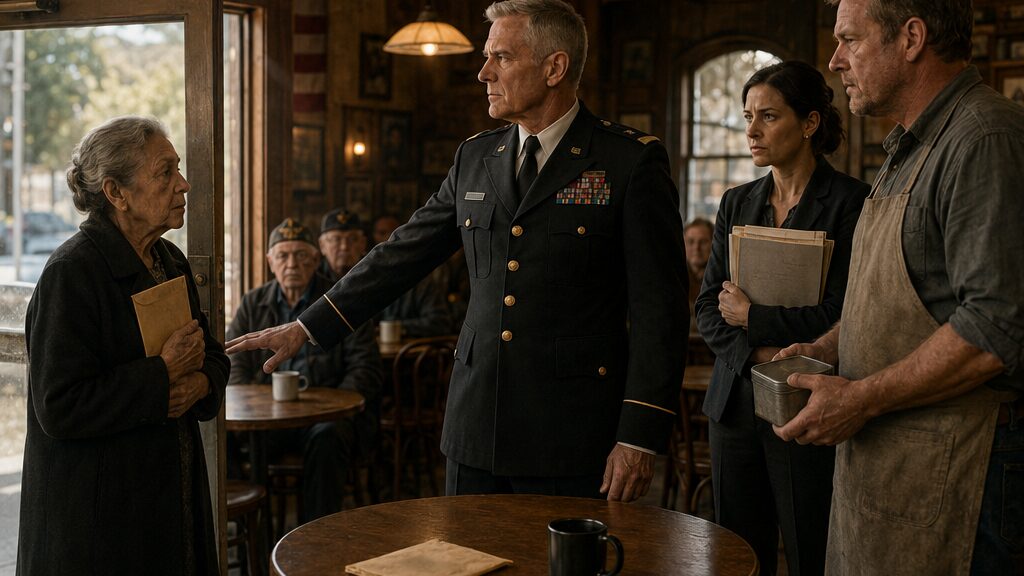
The glass door reflected her first: a small old woman in a dark coat, gray hair pinned back, one hand steadying herself against the brass handle. Behind her reflection, inside the café, men in pressed jackets and old service caps sat under framed photographs of ships, aircraft, and units that had long since changed their names. A blackboard near the counter read Veterans’ Breakfast, 8 A.M., in chalk that had been rubbed and rewritten too many times.
Virginia did not look at the blackboard for long. She looked at the man in uniform seated near the window.
Frank Wilson had his back half turned to her, but she knew him before he stood. The shape of the jaw was older, heavier, carried with command. The hair was silver at the sides. The uniform was formal enough to make every other man in the room sit a little straighter. But there was something in the tilt of his head when he listened, something in the way his right hand rested against the table before he answered, that made Virginia’s fingers tighten around the envelope.
Daniel had done that with his hand, once. On a crate. On a card table. On the edge of a cot. Always as if holding the world still long enough to hear the next thing properly.
The envelope seemed to warm beneath her coat.
She pulled the door open.
A small bell above it rang once, too brightly. Several faces turned. The café smelled of coffee, toast, old wood, and the faint metal scent that came from winter coats hung too close to a heater. Virginia stepped in carefully, not because she was frail enough to fall, but because she had learned not to waste a movement when her legs had already carried her farther than sense recommended.
Behind the counter, Thomas Baker looked up from stacking mugs. He was broad through the shoulders, his gray work shirt rolled to the elbows, an apron tied over it. His expression changed when he saw her searching the room instead of the menu.
“You meeting someone, ma’am?” he asked.
Virginia’s mouth had dried during the walk from the bus stop. She swallowed once.
“Frank Wilson.”
At the window table, the man in uniform stopped speaking.
The café quieted in layers. First the nearest table, then the counter, then the far wall where two veterans had been arguing softly over baseball. Frank turned. His eyes passed over Virginia the way strangers’ eyes passed over old women every day: quickly, politely, without finding a reason to stay.
Then he saw that she was looking directly at him.
Thomas wiped his hand on his apron. “Colonel Wilson?”
Frank stood. The chair legs moved against the floor with a low scrape.
“I’m Frank Wilson,” he said.
Virginia took two steps toward him, then stopped beside an empty round table near the window. A black mug sat there, turned upside down on a saucer, waiting for whoever usually sat in that seat. She did not sit.
“My name is Virginia Rivera,” she said. “I served with Daniel Young.”
Frank’s face did not move at first. Then the stillness hardened into something practiced.
“My father has been dead a long time.”
“Yes.”
“If this is about some memorial group, you can leave your information at the counter.”
“It isn’t.”
“If it’s about money—”
“No.”
The word came out sharper than she intended. A few people looked at the pocket of her coat as if a person could hear an object through wool.
Virginia softened her hand. “I didn’t come for myself.”
Frank studied her then. Not with recognition. With assessment. She knew that look too. Men had given it to strangers at checkpoints, to claims that arrived without paperwork, to grief that asked for entrance after the gate had closed.
“You said you served with him,” Frank said.
“I did.”
“In what capacity?”
“Medic.”
“What unit?”
She gave it. Quietly. Clearly.
One of the older men at the counter shifted, as if the number had stirred something he did not want to examine before breakfast. Frank noticed the reaction and disliked it. His gaze narrowed.
“You have identification?”
Virginia almost smiled, not from humor but from the old shape of it. “Not the kind you’re asking for.”
“Then I don’t know you.”
“No.”
“And you don’t know me.”
“I know who your father asked me to find.”
The sentence landed wrong. She knew it as soon as Frank’s eyes changed.
“My father didn’t ask you anything,” he said. “He died before I was old enough to remember his voice.”
Virginia’s hand went to her coat again. She could feel the softened corners of the envelope beneath the cloth, the slight ridge where the flap had been sealed. She had replaced the outer wrapping twice in sixty years, but never the envelope itself. Never the seal. Never Daniel’s name, written with a hand that had been shaking less from fear than from blood loss he would not admit until it was too late.
She did not take it out yet.
Frank stepped toward her. “Who sent you?”
“No one.”
“Then how did you find me?”
“It took time.”
“Time?” He gave a short, humorless breath. “My father died more than sixty years ago.”
“Yes.”
“And you walked in here today because you suddenly remembered?”
The accusation was not loud. That made it worse. It let everyone hear every word.
Thomas came out from behind the counter. “Colonel, maybe we ought to sit down and—”
Frank raised one hand without looking at him. Not angry. Commanding. Thomas stopped.
Virginia felt the old instinct to retreat behind silence, to preserve the thing in her pocket from the room, from suspicion, from anyone who might treat it like evidence instead of a last request. She had done that before. She had stepped away from doors and desks and women with tired eyes because she told herself she was protecting the letter.
She had protected it so well that Daniel’s son was an old man now.
“I have something that belongs to your family,” she said.
Frank’s jaw tightened. “No, you don’t.”
Virginia drew the envelope out.
The room seemed to take one breath.
It was not impressive. That had always been part of its danger. It looked too small for what it had done to her life. Yellowed paper, softened edges, the old fold line protected by a faded cloth sleeve. No ribbon. No official seal. No medal. Just a name written across the front in ink that had browned with time.
Frank looked at it and then back at her.
“You carry an old envelope into a veterans’ breakfast and expect me to believe it means something?”
“I expect nothing.”
“Then what do you want?”
“To finish what I promised.”
His face flickered, but only for an instant. Then the door opened behind Virginia and another couple entered, bringing in a gust of cold air and ordinary voices. The bell rang, the sound too cheerful again. Frank glanced toward them, then toward the watching tables. Public embarrassment settled over his shoulders like another uniform.
He lowered his voice. “Whatever story you’ve brought, I’m not interested.”
Virginia held the envelope with both hands. They did not shake, though the effort of that steadiness had begun to hurt her wrists.
“He asked me to bring it,” she said.
Frank stared at her. For one second, something almost opened in him.
Then he looked away.
“My mother lived the rest of her life without whatever that is,” he said. “I won’t let a stranger walk in after she’s gone and make a performance out of my father.”
“I’m not here to perform.”
“You’re here in a room full of veterans with a prop in your hand.”
The word struck harder than she let him see.
Thomas took a step forward. “Colonel—”
“No.” Frank reached past Virginia toward the glass door. He pulled it open just enough for the bell to tremble but not ring. “Mrs. Rivera, I’m sure you’ve had a long trip. But my father is dead. My mother is dead. Whatever you brought, I don’t want it.”
Cold air moved over the envelope.
Virginia stood on the threshold between the café warmth and the morning outside. Frank’s hand stayed on the door, ready to close it. Behind him, the black mug waited upside down on the empty table as if someone had saved a place for the truth and no one had decided whether to sit.
Chapter 2: The Black Mug Beside the Envelope
Frank did not close the door because Virginia did not move.
That was the first thing the café noticed. Not a plea, not tears, not an argument. Just the old woman standing with the yellowed envelope in both hands while the decorated man held the door open for her to leave.
The bell above the glass trembled in the cold draft.
Thomas Baker came around them and put his palm gently against the doorframe, not touching Frank, not challenging him outright. “Colonel, let her sit a minute. If it’s nothing, it’ll still be nothing after coffee.”
“I didn’t ask for coffee,” Virginia said.
Thomas looked at her. “No, ma’am. But you look like you forgot to eat.”
Something in that simple sentence almost undid her. Not because it was kind, but because kindness was dangerous when a person had been holding herself together with purpose alone. She lowered the envelope a few inches.
Frank saw the movement and misread it. “See? She knows this isn’t the place.”
Virginia looked at him. “I know exactly what place this is.”
Frank’s hand tightened on the door.
Amanda Mitchell appeared from the hallway beside the counter, carrying a folder against her chest and a stack of photocopied pages under one arm. She had the same dark eyes as Frank, but hers did not shut as quickly.
“Dad,” she said, “who is she?”
“No one we know.”
Virginia turned toward her. “You’re Amanda.”
Amanda stiffened. “How do you know that?”
“Because I found his son first. Then his granddaughter.”
Frank let the door fall shut. The bell rang once, hard.
The café went silent again.
Thomas moved to the empty round table and turned the black mug upright. “Sit,” he said, not quite an order and not quite a request. “All of you. Before someone says something he can’t take back.”
Frank did not sit. Virginia did, slowly, because her knees had begun to warn her. She placed the envelope on the table, near the mug, but kept two fingers resting on its edge. The paper looked older against the polished wood. More fragile. More stubborn.
Amanda remained standing behind her father. Her folder was pressed so tightly to her chest that the papers bowed.
Frank stood over Virginia. In his uniform, with the morning light cutting across his shoulders, he looked like a man built from rules. Virginia understood rules. Rules held chaos back. Rules saved lives. Rules also made it possible not to hear a dying man if the dying man asked for something no regulation could carry.
“How much?” Frank asked.
Amanda turned sharply. “Dad.”
Virginia looked up at him. “He didn’t ask me to sell it.”
“That isn’t what I meant.”
“It’s what you said.”
Frank’s face flushed, faintly but visibly. Around the café, men looked down at their plates. One old veteran at the counter put his coffee cup down without drinking.
Thomas set a fresh black mug in front of Virginia and filled it. The smell rose between her and Frank, bitter and hot.
“You said Daniel Young gave you that,” Frank said.
“Yes.”
“When?”
Virginia looked at the envelope. “Near the end.”
“That’s convenient.”
“No.”
“No? You walk in here with a sealed letter nobody can check without doing exactly what you want, and I’m supposed to call that what? Fate?”
Virginia’s fingers lifted from the envelope. “Call it late.”
Amanda shifted.
Frank heard it too. His eyes moved to the envelope again. “Late by sixty years.”
“Yes.”
“Why?”
Virginia did not answer.
There it was—the silence she had carried like a second object. It rose up before she could stop it, old and familiar. If she explained too much, she would drag Daniel into the room in pieces. If she explained too little, they would think she had come with a story shaped for sympathy. She had spent years believing that the promise itself should be enough. But promises did not speak for themselves. Not after sixty years.
Frank took her silence as permission to harden.
“You don’t get to come in here, say my father’s name, and then decide what I’m allowed to know.”
“No,” Virginia said quietly. “I don’t.”
“Then open it.”
Virginia looked up.
The command pushed through the room. Amanda took one step forward. Thomas’s hand froze on the coffee pot.
Frank pointed at the envelope. “Open it. If it’s from him, prove it.”
“I can’t.”
“Because there’s nothing inside?”
“Because it isn’t addressed to me.”
Frank laughed once, without amusement. “That’s your answer?”
Virginia reached into the inner pocket of her coat.
Frank’s posture changed as if expecting some new trick. Amanda’s fingers tightened around her papers. Thomas set the coffee pot down with care.
Virginia removed a small metal tin, dull with age. Its lid had a shallow dent near one corner. She placed it beside the envelope, close enough that the two objects seemed to belong to each other but not touching. The sound it made against the table was small, but every face in the café turned toward it.
Frank looked at the tin.
“What is that?”
“Something else he gave me.”
Thomas leaned closer despite himself. “May I?”
Virginia’s hand hovered over the tin. For a moment she was no longer in the café. She was holding it under a light that swung from canvas. Daniel was trying to make a joke with lips gone pale. “Don’t let them throw it in a box with the rest,” he had said. “She’ll know it. She’ll know I kept it.”
Virginia pulled her hand back. “Not yet.”
Frank stared at her. “You’re enjoying this.”
The accusation drew a sound from Amanda, half protest, half disbelief.
Virginia turned her face slowly toward him. “No.”
“Then stop stretching it out.”
“I have spent more years trying to end this than you have spent asking what happened.”
Frank’s expression went blank. Not calm. Protected.
Amanda’s voice came softer. “What happened?”
Virginia looked at her, and for the first time since entering the café, she nearly answered fully. The younger woman’s face held suspicion, yes, but also hunger. Not for drama. For a missing shape in the family.
“Daniel was alive when he gave me this,” Virginia said. “He knew he would not remain so. He asked me to find Melissa Johnson.”
Frank’s head lifted sharply.
Amanda whispered, “Grandma.”
Virginia nodded once. “He asked me to give her the letter. And the tin.”
Frank stepped back half an inch, though no one touched him.
“Don’t say her name,” he said.
Virginia folded her hands in her lap. “He said it first.”
The café stayed silent. Outside, a truck passed, its engine low and ordinary, moving through a morning that had no idea a dead man’s name had just entered the room.
Frank looked at the envelope again. This time not as if it were fake. As if it might be worse than fake.
Amanda set her folder down on the edge of the table. “Dad, let me look at the outside.”
“No.”
“Just the outside.”
Frank’s answer came through his teeth. “No.”
Virginia did not touch the envelope now. She let it sit in the open, vulnerable to their judgment. The black mug steamed beside it. The tin waited closed.
“You recognize the name,” she said.
Frank’s eyes snapped back to hers.
“Daniel Young was my father,” he said. “That doesn’t make you part of him.”
“No,” Virginia said. “It makes me the person he left holding what he couldn’t carry.”
Frank stared at her for a long time. The anger did not leave him. It changed its clothing. Became fear. Became the old discipline of a son who had trained himself not to ask for what no one could give.
Then he reached toward the envelope.
Amanda held her breath.
His fingers stopped just above Daniel’s handwriting. He did not pick it up.
“I know that name,” Frank said. His voice had lowered to something almost private. “I know my mother’s name. I know what grief did to her. And I am not opening a stranger’s old wound in the middle of a diner.”
Virginia bowed her head once, accepting the blow without agreeing to it.
Frank straightened.
“You can leave it,” he said. “Or you can take it with you. But I won’t open it.”
Chapter 3: The Name Missing From the Records
Amanda found Daniel Young’s name on the third photocopied page, typed so faintly that the letters looked as if they were trying to disappear.
She had gone behind the counter with Thomas because her father refused to let the envelope be opened and refused, with equal force, to let Virginia leave with it. That contradiction sat at the table like another person. The old woman remained by the window, the black mug untouched in front of her, the yellowed envelope and tin placed between her and Frank. Frank stood near the coat rack with his arms folded, not leaving, not yielding.
Amanda spread the pages across Thomas’s scarred office desk.
“This one,” she said.
Thomas bent over the paper. The back office was barely large enough for both of them, crowded with receipt boxes, a wall calendar, a humming refrigerator, and a framed photograph of the café from decades earlier. “That him?”
“Daniel Young. Same service branch. Same year.” Amanda pressed the page flat. “But this address doesn’t exist anymore.”
Thomas squinted. “Road got renamed?”
“More than renamed. Half that block was cleared for a municipal building before I was born.”
“You work with records?”
“Military records office. Civilian side.” She glanced toward the door, where her father’s voice could be heard, low and clipped. “Mostly requests. Corrections. Family searches.”
Thomas gave her a look. “So you know this could be real.”
Amanda did not answer at once.
Real was not simple. Real could be a mistake. Real could be a partial file, a name matched to the wrong family, an old grief dressed in someone else’s facts. Real could also be the thing her father had spent his life not asking about because every question made her grandmother disappear behind a closed bedroom door.
“I know enough not to dismiss it in five minutes,” she said.
Thomas nodded, then opened a drawer and pulled out a small magnifying glass he used for old receipts and faded supplier invoices. “Your father doesn’t look like a man who likes being wrong in public.”
“He doesn’t like my grandfather being used.”
“Is that what you think she’s doing?”
Amanda looked through the doorway. Virginia sat straight-backed, hands still, as if she had been ordered to wait and had decided waiting would not defeat her. Her coat collar was worn at one edge. Her shoes were clean but old. The envelope in front of her did not look like bait. It looked guarded.
“I don’t know,” Amanda said.
Thomas tapped one of the photocopies. “Then keep looking.”
Amanda returned to the folder she had brought with her. She had not come to the café because of Virginia. She had come to meet her father after dropping off requested documents for a veterans’ archive project. The folder held old death notices, service confirmations, and fragments of family paperwork she had been sorting for weeks because Frank had agreed, reluctantly, to donate copies of Daniel’s official records to the café’s memorial wall.
Official records were clean. That was why Frank liked them. Name. Date. Branch. Status. No unanswered final words. No sealed envelope on a table.
Amanda turned another page and stopped.
A small slip of paper had been tucked between two photocopies. It was not part of her folder. The paper was brittle, lined, folded twice. Across the top was a date written in a careful old hand.
She knew it was not her father’s.
“Thomas,” she said.
He leaned in.
The note contained only three lines: Daniel Young. Melissa Johnson. Address confirmed? Beneath that was another address, crossed out so hard the paper had nearly torn. In the corner, the same date appeared again.
Amanda carried the note back into the café.
Conversation stopped when she emerged. Frank looked first at her face, then at the paper in her hand.
“What is that?”
Amanda did not give it to him. She went to the table and laid it beside the yellowed envelope, careful not to touch either object with the other.
Virginia looked at the note.
For the first time that morning, her composure failed in a visible way. Not dramatically. Her lips parted. Her right hand moved toward the paper, then stopped before reaching it.
Amanda saw the movement. “This is yours.”
Virginia nodded.
“You wrote this date?”
“Yes.”
Frank came closer. “What date?”
Amanda looked at him. “Long before today.”
He took the note despite her still hand and read it. His expression changed, but not toward belief. Toward calculation.
“This proves nothing,” he said.
“It proves she was looking,” Amanda said.
“It proves she had names.”
Virginia’s gaze remained on the crossed-out address. “I had old names. Not the right ones.”
Frank turned on her. “Where did you get that address?”
“From a county office after three returned letters and two wrong houses.”
“You expect us to believe you traced my family through county records?”
“No. I expect you to believe I tried.”
“Why didn’t you find us?”
Virginia looked from him to Amanda. The answer had many doors, and behind each was another mistake. Melissa had remarried. Frank had taken a stepfather’s surname for part of his childhood, then later reclaimed Daniel’s through service papers. Records had been sealed, moved, misfiled, digitized badly, corrected by people who did not know which dead man mattered to which living child. But beneath all that lay the harder truth: Virginia had stopped when the search hurt too many people.
She chose the smaller answer. The safer one.
“Your mother’s name changed in the records.”
Frank’s eyes narrowed. “Changed how?”
“After she remarried.”
A muscle worked in his cheek. “You don’t get to talk about my mother’s life like you studied it from a file.”
“I didn’t study it. I followed it.”
“That’s worse.”
Amanda looked at the old note again. “Dad, the address is real. Or was real. And this date—” She hesitated. “This date is from when Grandma was still alive.”
Frank heard it. Virginia saw when he did. His anger did not sharpen this time. It went still.
He turned the note over, as if another answer might be hidden on the back.
“If you found an address when my mother was alive,” he said, “then why am I hearing about this now?”
Virginia did not speak.
Frank’s voice dropped. “Did you go to her?”
The café held its breath around the question.
Virginia looked at the envelope, then at the metal tin, then at Frank Wilson, who had his father’s hand and his mother’s wound and no patience left for silence.
Frank stepped closer to the table.
“If you found us before,” he asked, “why didn’t my mother ever get it?”
Chapter 4: The Ring That Proved Too Little
Thomas opened the tin only after Virginia nodded, and even then he did it as if the lid might make a sound the room would remember.
The small metal box resisted at first. Its hinges had stiffened with age, and Thomas had to press his thumb against the dented corner before the lid gave way. Inside, on a square of darkened cloth, lay a ring. It was plain at a glance, dulled by years in a place without skin, but a faint line of engraving still circled its outer edge.
Frank looked at it once and turned away.
“No,” he said.
Amanda leaned closer. “Dad—”
“No.” His voice cut through the café. “That could be anyone’s.”
Virginia sat very still. Her hands had folded themselves on her lap, one thumb pressed hard into the other palm. She had imagined this moment many times and never once had the ring looked so small. In memory, Daniel had pressed it into her hand with the envelope, and it had seemed heavy enough to hold back the end of the world.
Thomas did not touch it. He only angled the tin so the morning light caught the worn engraving.
Amanda reached into her folder with quick, careful fingers. “Wait.”
Frank watched her, not the ring. “Don’t do this.”
“I’m not doing anything. I’m looking.”
“That’s doing something.”
Amanda ignored him and pulled out a photocopy sealed in a clear sleeve. The image had been enlarged from an old family photograph, the grain thick enough to blur the edges of faces. Virginia saw Daniel before the paper reached the table. Younger than the man in her memory, smiling beside Melissa Johnson on the steps of a small house, one sleeve rolled, one hand lifted as if he had been caught mid-wave.
Amanda placed the photograph beside the tin.
The café seemed to lean in.
In the photograph, Daniel’s lifted hand wore a ring.
Frank stared at it.
Amanda did not speak. She took the magnifying glass Thomas had left near the papers and held it over the photocopy. The ring in the image showed little more than a pale band, but the shape was right. Not proof enough for a court. Not proof enough for a man determined to keep a door shut. But enough to make denial costly.
Virginia looked down at the tin. “He wore it on a cord later. The ring was too loose by then.”
Frank’s eyes flashed. “Don’t.”
She stopped.
He picked up the photograph and held it too tightly by the edges. “You don’t get to narrate him.”
“I was not trying to.”
“You keep saying little things. Details. Just enough to make us react.”
Amanda looked at him. “Dad, the ring matches.”
“It resembles a ring in a bad copy of an old picture.”
“It has the same edge.”
“You can’t know that.”
“No. But I can know it’s not nothing.”
Frank lowered the photo. His face had lost some of its color. For the first time, Virginia saw not the officer but the boy who had been raised beneath a framed absence. He had built his father out of silence, ceremony, and his mother’s refusal to answer too much. Every object Virginia had placed on the table threatened to make that father more real and less controllable.
She understood that. Understanding did not make it less cruel.
Frank turned to her. “Where did you keep it?”
Virginia looked at the tin.
“With the letter.”
“For sixty years.”
“Yes.”
“Why not send it to the Army? To records? To whatever office handles recovered personal effects?”
“Because he did not ask me to send it to an office.”
“He asked you to send it to my mother, apparently. And you didn’t.”
The sentence struck the table like a dropped plate.
Thomas moved slightly. “Colonel, that’s enough.”
“No, it isn’t.” Frank’s voice rose for the first time, and several café regulars looked toward the door as if measuring how close the scene had come to something they should leave. “She has my father’s ring. She has a letter addressed to my mother. She says she found records. She says she tried. But my mother died without this.”
Amanda’s eyes moved to Virginia. “Is that true?”
Virginia could have defended herself with the roads that no longer existed, the returned envelopes, the clerks who had shrugged at misspellings, the hospital years when she had worked nights and searched on days when sleep should have saved her. She could have said that phone numbers changed, names changed, counties merged records, houses became parking lots, grief remarried and hid itself.
Instead she said, “Yes.”
Frank looked almost satisfied, and that hurt more than his accusation.
“You admit it.”
“I admit she did not receive it.”
“Because of you.”
Virginia met his eyes then. “Because of me in part.”
Amanda drew in a breath. Thomas lowered his head.
Frank’s hand trembled once around the old photograph. He noticed and set it down quickly. “In part,” he repeated.
Virginia reached for the black mug, not to drink but to have something warm to hold. Her fingers curled around it carefully. “Your mother was not easy to find.”
“That’s your explanation?”
“No.”
“Then give me the real one.”
Virginia stared at the steam rising from the coffee. The truth pressed against her teeth. She had promised Daniel she would find Melissa. She had promised with his blood drying under her nails and the ring cold in her fist. But she had not promised to break Melissa open. She had not known then that one promise could stand against another person’s survival and leave no clean choice.
Frank misunderstood her silence again. She saw him do it.
“You don’t have one,” he said.
Amanda touched his sleeve. “Dad.”
He pulled away. “No. I want to know how an old woman walks in here with my father’s things and expects us to be grateful.”
Virginia lifted her face. “I don’t expect gratitude.”
“What do you expect?”
She opened her mouth. No sound came. Thomas had gone still. Amanda watched her with a grief-hungry patience that frightened Virginia more than Frank’s anger.
Virginia set the mug down.
“I came once before,” she said.
Frank’s expression changed. “When?”
Virginia looked at the envelope. The seal remained unbroken, innocent as if paper could be innocent after so many years.
“I came,” she said again, but the rest would not come with it.
Frank stepped closer, and his shadow crossed the tin, the ring, the photograph of the hand that matched his own.
“When?” he demanded.
Virginia’s fingers went to the edge of the table, holding there as if it were the only solid thing left in the room.
“I came once before,” she said, and this time her voice broke before the sentence could finish.
Chapter 5: The Returned Letter Nobody Mentioned
Amanda found the note about the battlefield nurse inside her grandmother’s recipe box, tucked behind a card for lemon cake nobody in the family had baked in twenty years.
She had not meant to search that box. She had brought Frank home because he would not stay in the café and would not let her bring the ring back there either. He carried the photocopy of Daniel’s photograph folded in his jacket pocket, though he denied knowing he had put it there. Amanda carried the questions.
The old storage boxes were stacked in the hall closet of her father’s house, the place where family things went when no one could decide whether keeping them was love or laziness. Frank stood behind her while she lifted lids. He did not help. He watched as if the boxes belonged to an investigation, not to him.
“What are you hoping to find?” he asked.
“The thing you’re afraid is here.”
He gave her a hard look. “Don’t be clever.”
“I’m not.”
The first box held tax files, ribboned greeting cards, a cracked picture frame, and an old address book with half the names crossed out. The second held Melissa Johnson’s kitchen things: handwritten recipes, church bulletins, a folded apron, brittle newspaper clippings, and the small metal measuring spoon Amanda remembered being allowed to hold when she was little.
Frank’s face tightened at the apron.
Amanda saw it and almost stopped. Then she thought of Virginia in the café, trying and failing to finish a sentence while her father stood over her with Daniel’s photograph in his hand.
She opened the recipe box.
Most of the cards smelled faintly of vanilla and dust. Melissa’s handwriting leaned forward, firm and pretty. Amanda flipped past pot roast, biscuits, funeral potatoes, pie crust. Near the back, behind the lemon cake card, a folded scrap of stationery had been slid so far down it might have been hidden or simply abandoned.
Amanda unfolded it.
The first line made her sit back on her heels.
Frank noticed. “What?”
Amanda did not answer.
“What is it?”
She read it once, then again, slower.
A woman came today. Army nurse, maybe medic. Said she had something from Daniel. I sent it back. God forgive me, I could not open another grave in this house.
Frank reached for the paper. Amanda let him take it.
He read it standing. His mouth tightened on the first line. By the last, the paper had begun to shake in his hand.
“She never told me,” he said.
Amanda stayed on the floor beside the open boxes. “Maybe she couldn’t.”
“She told me everything that mattered.”
The words sounded practiced. Amanda wondered how many years he had lived inside them.
Frank read the note again. “This doesn’t say it was Rivera.”
“No. But how many women came with something from Daniel?”
He folded the note along its old crease and unfolded it immediately, as if hiding it again would make him complicit. “She sent it back.”
“That’s what it says.”
“Then Virginia lied.”
Amanda frowned. “How?”
“She said my mother never got it.”
“She didn’t. She sent it back unopened.”
“That means she had the chance.”
“That means she was in pain.”
Frank turned away from the closet. “Don’t explain my mother to me.”
“I’m not. I’m reading what she wrote.”
“She raised me alone.”
“I know.”
“She worked double shifts. She patched my school pants by hand. She went to ceremonies she hated because I wanted to stand near flags and pretend I could remember him.” His voice grew rougher, but not louder. “She didn’t refuse him because she didn’t care.”
Amanda rose slowly. “I didn’t say that.”
“That woman in the café doesn’t get to make my mother look cruel.”
“She hasn’t.”
“She came with his ring.”
“Yes.”
“She kept it after my mother sent the letter back.”
Amanda held his gaze. “Would you have wanted Grandma forced to take it?”
The question entered the room and changed its size.
Frank looked at the boxes, at the recipe cards, at the apron with its faded pocket. His anger had been easier in the café. It had a target there. An old woman with a sealed envelope. A tin. A story delivered too late. Here, among Melissa’s handwriting and household things, the target would not stay still.
Amanda reached for the note again. “Dad, Grandma wrote ‘God forgive me.’ That isn’t indifference.”
Frank did not give it back. “It’s guilt.”
“Yes.”
His eyes lifted. “And now you want me to inherit it?”
Amanda said nothing.
He moved to the kitchen and set the note on the table. The kitchen was too bright, the counters too clean. Amanda had always found her father’s house orderly in a way that made grief seem like something he filed between utility bills. He opened a cabinet, took down a glass, filled it from the sink, and did not drink.
“She was sick after he died,” he said.
Amanda waited.
“Not like a hospital sickness. Not at first.” He stared into the glass. “She’d wake up hearing footsteps. She’d set a plate for him and then throw it in the sink. If someone knocked after dark, she made me hide in the hallway, even when I was too young to understand why.”
Amanda had never heard this.
Frank’s hand closed around the glass. “When I was twelve, I asked her if he died afraid. She slapped me. First and last time she ever did. Then she locked herself in her room until morning.”
Amanda’s throat tightened. “Dad.”
“So if a woman came to the door with a battlefield story and my father’s last words, yes, maybe my mother sent her away. Maybe she had to.”
Amanda looked at the note, then toward the hallway where the boxes sat open. “And maybe she regretted it.”
Frank’s face hardened again, but the hardness was tired now. “Regret doesn’t mean we owe that woman an audience.”
“She carried the envelope for decades.”
“After being told not to bring it back.”
Amanda stepped closer to the table. “That’s not what the note says.”
Frank tapped the paper. “It says Melissa sent it back.”
“It says she couldn’t open it.”
“That’s the same thing.”
“No, it isn’t.”
He looked at her then, and for a moment Amanda saw the boy he had been: trained by grief not to ask, trained by love to defend the person who had survived. She understood him. She also understood that his defense had become another closed door.
“What do you want me to do?” he asked.
“Let the truth be bigger than what Grandma could bear.”
Frank’s eyes glistened, but he blinked it back before it could become visible mercy.
“The letter belongs buried,” he said. “If my mother chose not to read it, maybe we should honor that.”
Amanda stared at him. “You mean bury it unopened?”
“I mean stop letting strangers decide what our family needs.”
He picked up Melissa’s note and folded it carefully, too carefully.
Amanda knew then that he would go back to the café and take control of the envelope if he could. Not read it. Not return it to Virginia. Put it somewhere safe, which in her father’s language meant somewhere no one would have to feel it.
She waited until he went upstairs to put the note in his desk.
Then she took her phone from her pocket and stepped into the hall beside the open boxes. Her hands were unsteady as she found the number Virginia had written on the back of the old search note.
The call rang four times.
When Virginia answered, she sounded awake, as if she had been sitting beside the phone for years.
Amanda looked toward the stairs and lowered her voice.
“What did my grandmother send back?”
Chapter 6: The Promise She Almost Abandoned
Virginia arrived before sunrise to retrieve the envelope, and Thomas Baker already had it waiting beside a black mug he had not filled.
The café was dark except for the lights over the counter and the blue glow from the front windows. Chairs still rested upside down on most of the tables. Outside, the street was quiet, the veterans’ breakfast sign turned inward so no one passing by would read it too early and come in hungry for company.
Thomas stood behind the counter with the metal tin in front of him, unopened.
“You didn’t have to come this early,” he said.
“Yes, I did.”
He looked at her coat, buttoned wrong at the top. “You sleep?”
Virginia did not answer.
Thomas nodded as if that was an answer too. “Coffee?”
“No.”
“You sure?”
“If I sit with coffee, I may stay.”
“That was my intention.”
She gave him a tired look, and he almost smiled, but not quite. He came around the counter and placed the envelope on the round table near the window. The same table. The same black mug. The tin beside it. Everything arranged carefully, almost ceremonially, though Thomas did not seem like a ceremonial man.
Virginia remained standing.
“I came for those,” she said.
“I figured.”
“You had no right to keep them.”
“No, ma’am.”
But he did not hand them over.
Virginia looked at him.
Thomas wiped both hands on his apron, though they were clean. “Colonel Wilson called last night.”
Her chest tightened. “Did he ask you to give them to him?”
“He asked whether they were still here.”
“And what did you say?”
“I said yes.”
Virginia reached for the envelope. Thomas put one hand on the table, not touching the paper, only blocking the easy path to it.
“I almost called him back,” he said.
Virginia’s eyes lifted.
“I almost told him to come take the whole thing before opening. Because I don’t like trouble in my place. I’ve seen families tear each other apart over less than an old letter.” He swallowed. “And because yesterday, for about ten minutes, I thought maybe you’d brought too much pain into a room that didn’t ask for it.”
Virginia’s hand lowered.
Thomas moved his hand away from the envelope. “Then Amanda called me.”
Virginia closed her eyes once.
“She called you too, didn’t she?” he asked.
“Yes.”
“What did you tell her?”
“Not enough.”
Thomas pulled out the chair across from the black mug. This time he did not tell her to sit. He only waited. After a long moment, Virginia sat.
Her body felt older in the early hour, before duty had fully tightened around the weak places. She folded her hands in her lap so Thomas would not see how stiff they had become overnight.
“What did Melissa send back?” Thomas asked.
Virginia looked at the sealed envelope. “Nothing.”
He frowned. “Amanda said there was a note.”
“There was a note to herself, perhaps. Not to me.” She touched the edge of the table. “What came back to me was the package. Unopened. No explanation. No handwriting except my own.”
Thomas sat slowly across from her. “You mailed it?”
“The second time.”
“The second?”
Virginia’s lips pressed together. There it was again: the old habit of closing the door from her side before anyone else could. She had told herself for decades that the details belonged to Daniel and Melissa, not to strangers. But silence had not honored them. Silence had turned into delay. Delay had turned into Frank’s accusation.
She drew a careful breath.
“The first time I found her, I went to the house. Frank was a child. I saw him in the yard before I knocked.”
Thomas did not move.
“He had a wooden airplane in his hand. One wing was broken. He was trying to fix it with tape. I remember that more clearly than I remember the door.” Virginia looked toward the window, where morning had begun to pale the glass. “Melissa opened it only as far as the chain allowed. I said Daniel’s name. She went white.”
“What did you tell her?”
“Too much and not enough. I said I had served with him. I said he had asked me to bring something. I said he had not died alone.”
Thomas’s eyes lowered.
“She looked past me at Frank. Then she said, ‘Not in front of my son.’ I told her I could come back. She told me not to.” Virginia’s voice stayed quiet, but the quiet had rough edges now. “I should have handed it to her anyway. I should have placed it on the porch and walked away. I should have done anything except decide I understood her better than Daniel did.”
Thomas let the silence remain.
Virginia reached for the black mug and turned it slowly by its handle. Empty. Cold. “I mailed it months later. I thought distance might be kinder. It came back unopened.”
“And you stopped.”
“For a while.”
“How long?”
She almost lied by making it smaller. “Years.”
Thomas looked at her then. Not accusing. That made it harder.
Virginia’s fingers tightened around the mug. “Daniel did not ask me to make his wife suffer. He did not ask me to break into her grief. He said, ‘Tell her I kept it close. Tell her I tried to come home clean.’ He said, ‘If there’s a boy, tell him I was thinking of his hands.’”
Thomas’s breath caught softly.
Virginia looked down at her own hands. “I did not know what that meant. Not then. Daniel was fevered. He had lost blood. But he was clear about the letter. Clear about the ring. Clear that the child should know he was loved before he was known.” She swallowed. “When Melissa sent it back, I told myself I had done what I could. That was the lie that let me sleep.”
The front bell rang.
Virginia turned.
Frank Wilson stood just inside the café door, still in civilian clothes this time, a dark jacket over a pale shirt. Amanda was behind him, one hand still on the door as if she had tried to stop him from entering too fast. Frank’s face made clear he had heard enough to misunderstand and enough to be wounded by it.
“You knew my mother refused it,” he said.
Virginia stood too quickly, and pain shot through her knee. She kept her hand on the table until it passed. “Yes.”
“And you still came back.”
“Yes.”
“After she told you not to.”
Virginia looked at Amanda, then back to him. “After your granddaughter asked what had been sent back.”
Frank’s eyes moved to the envelope. “So now it’s her decision?”
“No.”
“Mine?”
“No.”
“Then whose?” His voice sharpened. “Yours? Still yours after all this time?”
Virginia did not answer at once. The old defense rose again: It was Daniel’s. It was Melissa’s. It was not yours to demand. But those answers would not be enough, because the question under Frank’s anger was not about ownership. It was about why everyone who knew something about his father had decided for him.
Virginia placed her hand on the envelope.
“I made the promise,” she said. “That made the burden mine. It did not make the letter mine.”
Frank stepped closer. “Then give it to me.”
Amanda spoke quickly. “Dad—”
“No. If it belongs to the family, give it to me.”
Virginia felt Thomas watching her. Amanda too. The envelope waited under her palm, still sealed, still patient in the terrible way old things could be patient.
“You may take it,” Virginia said.
Frank’s expression shifted with surprise.
“But I will not ask forgiveness for bringing it.”
“I didn’t offer any.”
“I know.”
His jaw tightened. “And I won’t open it here.”
Virginia’s fingers lifted from the envelope.
Frank reached for it, then stopped before touching it. “Not with you watching me.”
Amanda looked at him. “Dad, don’t do it like this.”
“This is the only way I’m doing it.” He looked at Virginia, his eyes bright with anger and something closer to fear. “I’ll take the envelope. I’ll take the tin. But I will not read my father’s last words at a table with strangers, and I will not perform grief for the woman who decided when my family was ready to receive it.”
Virginia folded her hands in front of her, empty already in every way that mattered.
“Then take them,” she said.
Frank picked up the envelope and the tin as if they were evidence, not inheritance. But when his fingers closed around the yellowed paper, his thumb rested for one brief second on Daniel Young’s handwriting, and his face changed before he could stop it.
He turned toward the door.
Amanda did not move with him.
Frank looked back. “Amanda.”
She glanced at Virginia, then at the black mug waiting untouched on the table.
“I’m coming,” she said, but her voice did not belong to his certainty anymore.
Chapter 7: The Son Who Finally Chose To Read
Frank broke the seal with a butter knife from Thomas Baker’s counter, then stopped before the blade had gone all the way through.
The café was closed. The chairs had been lowered from the tables again, but no one had turned on the front sign. Outside, cars passed without slowing. Inside, the yellowed envelope lay beneath Frank’s hand on the round table near the window, the ring resting beside it in the open tin.
Amanda sat across from him. Thomas stood behind the counter with his arms folded. Virginia sat at the far end of the table, not close enough to read, not far enough to pretend she had surrendered the room.
Frank stared at the broken edge of the envelope.
Amanda’s voice was low. “You can still wait.”
He did not look at her. “I’ve waited my whole life without meaning to.”
The paper made a dry sound when he slid the knife the rest of the way along the flap. Virginia closed her eyes, but only for a moment. She had imagined many hands opening that envelope. Melissa’s hands. A younger Frank’s hands. A clerk’s indifferent hands after Virginia died and someone found it in her things. She had not imagined this: Daniel’s son, old enough to have his own gray hair, opening it under café lights while his daughter watched him become less certain.
Frank slipped two folded sheets from inside. The paper had browned at the edges. A smaller scrap fell against the table, no larger than a receipt, and Amanda caught it before it slid near the coffee stain in the wood.
Frank unfolded the first sheet.
His face changed before he read a word aloud.
Amanda leaned forward. “What?”
He shook his head once.
“Dad.”
“It’s his handwriting.”
The room seemed to loosen around that sentence. Thomas looked down. Virginia pressed her hands together in her lap until the knuckles whitened.
Frank kept staring at the page. “I’ve seen it on two things. A card to my mother. A signature on an enlistment copy. I thought I remembered wrong.”
Amanda’s fingers tightened around the small scrap. “You didn’t.”
Frank began to read silently.
Virginia kept her eyes on the black mug in front of him. Thomas had poured coffee for Frank when he came back, but Frank had not touched it. Steam had risen, faded, and vanished. The mug now held a dark circle that reflected the overhead light.
Frank’s eyes moved line by line. Twice he stopped. Once his mouth tightened as if a word had struck too close. Amanda watched him with the patience of someone afraid that if she breathed too loudly, he would fold the pages and retreat back into command.
He reached the middle of the second page and sat back.
“No,” he said.
Amanda’s face tightened. “No what?”
Frank lowered the letter. “He mentions the porch.”
Virginia looked up.
Amanda unfolded the small scrap she was holding. It was not a note from Daniel. It was a pressed piece of paper, brittle and faded, with the faint outline of a house drawn in pencil. A porch with two steps. A window box. A narrow walk. In one corner, almost lost to time, someone had written: Tell her I remembered the blue paint.
Amanda looked from the scrap to Frank. “What porch?”
Frank’s grip on the letter changed. “My mother painted the porch blue while he was gone.”
Thomas said quietly, “How would he know that?”
Frank did not answer.
Amanda’s voice softened. “Grandma kept a photograph of it.”
Frank shook his head. “No.”
“She did. In the recipe box. You saw it.”
“That was a house. It could have been any house.”
“Dad.”
He stood abruptly, the chair scraping behind him. The letter remained in his hand. For a moment, Virginia thought he might put it back in the envelope, return the tin, and choose the old refusal again because grief had trained him better than truth ever could.
Instead he walked to the window.
His reflection looked layered over the street outside: the old officer, the father, the son of a man he had never known. Virginia saw Daniel in the angle of his shoulders and hated herself a little for it, because Frank had never asked to be compared to a ghost.
Frank read again by the window.
Amanda turned the small scrap toward Virginia. “Did you know about the blue paint?”
Virginia shook her head. “No.”
“Did he tell you?”
“He said something about blue. I thought he meant sky.” Her throat worked. “He was not always making sense by then.”
Frank turned from the window. “Don’t.”
Virginia stopped.
His voice was rawer now. “Don’t tell me what he was like at the end.”
“I won’t.”
But the letter in his hand had already begun doing it.
Frank looked at the page again. “He wrote my mother’s nickname.”
Amanda’s eyes filled, though she did not cry. “What nickname?”
Frank did not say it. He pressed his mouth shut, and that was answer enough. Whatever Daniel had written belonged to the family before it belonged to the room.
Virginia lowered her gaze.
For a while there was only the hum of the refrigerator behind the counter and the faint tick of the old wall clock. Frank read the final lines without moving except for his eyes. When he reached the bottom, he did not fold the pages. He stood with them open, as if closing them too soon would be another kind of refusal.
Amanda spoke first. “Does he mention you?”
Frank looked at Virginia.
Virginia felt every year between them.
“Yes,” Frank said.
Amanda turned to her.
Virginia did not ask what Daniel had written. She had no right to demand a place in a letter she had carried but never owned.
Frank came back to the table. He set the pages down beside the ring. The motion was careful now. Not gentle exactly, but no longer suspicious.
“He said you promised,” Frank said.
Virginia nodded.
“He said if you made it, then he knew someone had heard him.”
Her hands moved once in her lap and then stilled.
Frank looked at her for a long moment. “He trusted you.”
Virginia’s first instinct was to refuse the mercy inside that sentence. Trusted did not mean she had done it well. Trusted did not erase Melissa’s closed door, the returned package, the years when Virginia had put the tin in a drawer and pretended a drawer could be a grave. But Frank was not offering absolution. He was stating what the letter had said.
“Yes,” she said.
Frank sat down slowly.
Amanda touched the edge of the letter but did not lift it. “Can I?”
Frank hesitated. Then he slid the pages toward her.
Amanda read with one hand near her mouth. The first tears came without sound. She wiped them away impatiently and kept reading. When she reached the line about the blue porch, she looked up at her father.
“He knew,” she said.
Frank nodded once.
Amanda finished and placed the letter back on the table. “He didn’t disappear.”
Frank flinched at the phrase.
She reached for his hand, but he moved before she touched him. Not away. Toward the tin. He picked up the ring and held it in his palm. The metal looked even smaller there than it had in Virginia’s memory.
“My mother had a box,” he said. “With his pictures. A handkerchief. Some ribbons. Things she wouldn’t let me touch.” His thumb moved over the ring’s worn edge. “She never told me there was a letter.”
“She may have wanted to,” Amanda said.
Frank closed his fingers around the ring. “Maybe wanting wasn’t enough.”
Virginia looked at him then because the sentence had crossed the table and reached her too.
“No,” she said. “It isn’t.”
Frank met her eyes. The old anger had not vanished. It remained, but it had lost its certainty. That made it heavier, not lighter.
“Why didn’t you force her to take it?” he asked.
Amanda drew in a breath, but Virginia answered before she could intervene.
“Because I was afraid of being cruel.”
Frank waited.
“And because when she sent it back, part of me was relieved.”
The confession settled between them.
Thomas looked at her, sorrowful and quiet.
Virginia kept going because stopping now would be another evasion. “I told myself I had respected her grief. But I also put the envelope away where it could not ask anything of me for a while. I was tired. I was angry that Daniel had died and left me with words for people who did not want them. I was ashamed of that anger, so I called it patience.”
Frank’s face tightened, but he did not interrupt.
Virginia looked at the opened envelope. “When I started looking again, I was no longer young. That is not an excuse. It is only the truth.”
Amanda folded her hands over the edge of the table. “Why now?”
Virginia almost gave the smaller answer: a record correction, a veterans’ archive list, Frank’s name found at last. Instead she gave the one that had made her board the bus.
“Because last month I forgot where I had put the tin.”
Frank looked at the ring in his hand.
“I found it in the linen drawer after three hours. But for those three hours, I thought I might die having lost the only thing Daniel asked me to protect.” Virginia’s voice thinned. “I could not let that be the end of him.”
Frank lowered his head.
For the first time, no one asked another question.
Amanda reached across the table and touched the envelope with two fingers. “It’s here now.”
Virginia nodded, but she did not trust herself to speak.
Frank stood again. He placed the ring back in the tin, then changed his mind and held it. “There’s somewhere this needs to go.”
Amanda looked at him. “The house?”
“No.”
Virginia knew before he said it. Her hand went to the edge of the table.
Frank looked at her. Not as an officer. Not even as Daniel’s son, exactly. As a man holding a father’s last words too late and trying not to drop them.
“Will you come with us to his grave?”
Chapter 8: Walking Away Without the Envelope
Virginia stood at Daniel Young’s grave without the envelope for the first time, and her empty hands did not know what to do.
The cemetery caretaker had led them to the marker and then withdrawn without ceremony. Morning light lay pale across the rows of stones. Frank stood on one side of the grave with the opened letter folded inside a protective sleeve. Amanda stood beside him holding the tin. Virginia remained a step back, as if the distance could correct the years.
Daniel’s name was carved cleanly into the stone.
She had seen it in records, on forms, on the envelope, in her own handwriting beside addresses that failed. She had whispered it in rooms where no one answered. But here, in the place where his family had come without her for decades, the name seemed to belong to the earth in a way it never had belonged to her.
Frank noticed her empty hands.
“You can stand closer,” he said.
Virginia did not move. “This is your place.”
He looked at the grave. “It should have been yours too, in some way.”
“No.”
The word came gently, but firmly enough that Amanda turned toward her.
Virginia clasped her hands in front of her coat. “I was with him at the end. That is not the same as belonging to what came after.”
Frank absorbed that without answering. He had been quieter since reading the letter. Not softened in any simple way. Rearranged. His anger had not disappeared; it had found older rooms inside him and was opening doors there.
Amanda knelt and set the tin on the grass in front of the marker. The ring was inside, resting on the dark cloth.
Frank held the letter but did not open it. “I thought I’d want to read it here.”
Virginia looked at the paper sleeve. “You do not have to.”
“I know.”
That was new. Yesterday, every choice had seemed to him like something someone else was stealing.
He looked at the stone. “He wrote that he hoped my hands would be useful.”
Amanda pressed her lips together.
Frank gave a small, strained breath. “I spent my life making them useful. I thought that was mine. Turns out I was answering a man I didn’t remember.”
Virginia watched his hand close slightly around the letter. Daniel’s hand had closed around hers once, trying to give away a future he would not enter. Frank’s hand was larger, older, alive.
“He also wrote that if Melissa couldn’t read it, I shouldn’t hate her for that.” Frank’s voice changed on the last words. “He knew her better than I did in some ways. Or he guessed better.”
Amanda touched his arm.
Frank did not pull away.
Virginia looked down. “She loved him.”
“You don’t know that.”
“No,” Virginia said. “But she opened the door when I said his name. If there had been nothing left, she would have shut it before I finished.”
Frank closed his eyes briefly.
The apology, when it came, did not look like the apologies Virginia had imagined. There was no reaching speech, no public moment, no neat exchange of blame and forgiveness. Frank simply turned toward her with his father’s letter in his hand and the weariness of a son who had defended a locked room for so long he had forgotten he was inside it.
“I was wrong to call it a prop,” he said.
Virginia’s throat tightened.
Frank looked at the cemetery rows instead of directly at her. “I was wrong to say you enjoyed it.”
“Yes,” she said.
Amanda’s eyes flicked toward her, startled by the plainness of the answer. Frank accepted it with a small nod.
“I don’t know how to forgive the years,” he said.
Virginia looked at Daniel’s name. “Neither do I.”
“But I believe you brought it because he asked.”
Her eyes closed for a moment.
There it was. Not pardon. Not relief. Not repair of what could not be repaired. But belief, arriving late and still arriving.
Amanda opened the tin and took out the ring. “Do you want to hold it?”
Virginia stepped back before the offer could become habit. “No.”
Amanda paused.
“It belongs with you,” Virginia said.
“You kept it safe.”
“I kept it too long.”
Frank looked at her then, and something like pain passed through his face because he could no longer make her either innocent or guilty enough to be simple.
Amanda closed her hand around the ring. “Then we’ll keep it now.”
Virginia nodded.
Frank reached into his jacket and took out an envelope of his own. For one brief second, Virginia’s body went cold at the sight of it. Another letter. Another burden. Then he extended it and she saw cash folded inside.
“For your travel,” he said. “And whatever you spent looking.”
Virginia did not touch it.
“Please,” Amanda said softly.
Virginia shook her head. “Daniel did not ask me to bill his family.”
Frank’s mouth tightened. “It isn’t payment.”
“I know.”
“Then take it as help.”
“I came here to leave something. Not carry something else away.”
Frank lowered the envelope slowly.
Thomas Baker had not come to the cemetery. Virginia was glad. The moment did not need more witnesses. The dead had enough.
Frank put the money away. “What do you need, then?”
Virginia looked at Daniel’s grave for a long time. The answer surprised her by being small.
“Say his name.”
Frank’s eyes moved to the stone.
Amanda stood.
Together, awkwardly at first, the three of them faced the marker. Frank held the letter. Amanda held the ring. Virginia held nothing.
Frank spoke first. “Daniel Young.”
Amanda followed, her voice breaking slightly. “Daniel Young.”
Virginia waited until the air had room for him.
“Daniel Young,” she said.
Not Sergeant. Not hero. Not casualty. Not a file number, not a story, not a promise. His name, plain and whole, returned by the people he had tried to reach.
Afterward, Frank did open the letter, but he did not read it aloud. He stood with Amanda near the grave and read a few lines to themselves, heads bent close together, while Virginia turned away enough to give the family privacy and stayed near enough that Daniel was not alone in her memory.
When they returned to the café, the breakfast crowd had come and gone. Thomas had left the round table near the window empty. On it sat the black mug Virginia had not drunk from, washed and turned upright.
Frank noticed it. So did Amanda.
Virginia walked to the table. For a moment she saw the envelope there as it had been: sealed, yellowed, impossible. She saw Frank standing over her. Thomas placing the tin down. Amanda holding papers as if facts could protect anyone from grief. Then she saw the table as it was now.
Empty, except for the mug.
Thomas came out from the kitchen and stopped when he saw their faces. He did not ask.
Frank held up the protective sleeve with the letter inside. “It’s with us now.”
Thomas nodded once. “Good.”
Amanda placed the tin in her bag with both hands.
Virginia looked toward the door. Her body felt hollowed out, but not weak. More like a house after heavy furniture had been removed, every mark on the floor visible at last.
Thomas stepped closer. “You sure you won’t sit?”
Virginia rested one hand on the back of the chair. Her fingers did not search for the envelope. That absence frightened her for one breath, then settled.
“No,” she said. “Not today.”
Frank came to her side. “Will we see you again?”
Virginia looked at him. It would have been easy to promise. Easier still to disappear and leave the completed thing untouched. But promises had weight. She knew that now better than anyone in the room.
“If you ask,” she said, “and if I can.”
Frank accepted that.
Amanda reached for Virginia’s hand. Virginia let her take it. The younger woman’s grip was warm, careful, uncertain.
“Thank you,” Amanda said.
Virginia shook her head once. “Remember him.”
“We will.”
“And remember her kindly too.”
Amanda glanced at her father.
Frank looked down, then nodded. “We’ll try.”
That was enough. More than Virginia had expected. Less than any of them had lost.
She walked to the glass door. For sixty years she had left places checking her pocket, checking her bag, checking the inner fold of her coat. At the threshold she stopped, and by habit her hand moved toward the place where the envelope had always rested.
There was nothing there.
The old panic rose halfway and then failed.
Behind her, Frank stood with the letter. Amanda stood with the ring. Thomas stood beside the empty table and the black mug. Daniel’s name had been spoken at his grave by his family.
Virginia opened the café door.
The bell rang once above her, bright and ordinary. She stepped outside into the morning, and this time she did not look back to make sure she had not forgotten anything.
Behind her, the door remained open.
The story has ended.