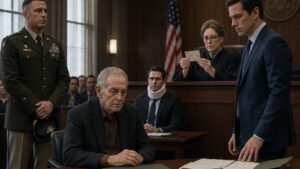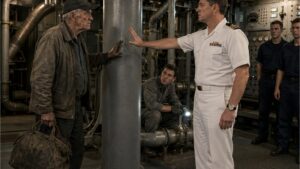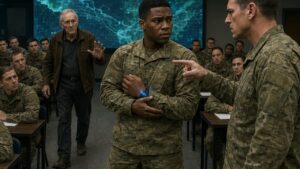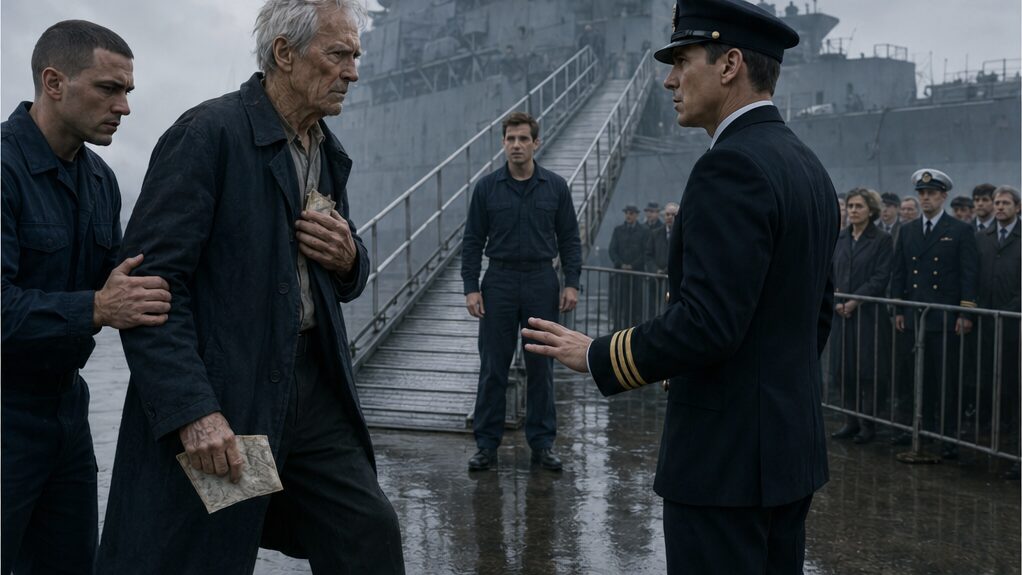
They Restrained the Old Man at the Pier Until the Warship Remembered His Name
Chapter 1: The Old Man Beneath the Gangway
The security sailor’s hand closed around Frank Miller’s left arm just as his shoe touched the first steel step of the gangway.
“Sir, you need to stop.”
Frank stopped.
Rain had softened to a mist, but the pier still shone black beneath the gray bulk of USS Resolute. Water ran in narrow lines along the ship’s hull. Above him, sailors crossed the quarterdeck in dress uniforms, carrying cables, folding chairs, and boxes of printed programs for the decommissioning ceremony.
The sailor’s grip tightened when Frank turned.
Frank looked down at the hand, then up at the young man’s face.
“You can ask me to wait,” he said. “You don’t need to hold me.”
The sailor released him, though not immediately. “I asked you twice, sir.”
“The wind took the first one.”
The second had been lost beneath a burst from the ship’s announcement system. Frank did not say so. He stepped back from the gangway and rested his weight on his good leg.
His coat had once been navy blue. Years of weather had thinned it to an uncertain charcoal, with pale seams at the cuffs. Beneath it he wore a plain shirt and dark trousers polished by use, not ceremony. The invitation in his right hand had gone soft in the rain. Black ink feathered across the paper.
The sailor held out his palm. “May I see that?”
Frank gave him the invitation.
The man read the blurred name twice. “Frank Miller.”
“That is correct.”
“No rank. No organization. No guest code I can read.”
“The code was there this morning.”
“Do you have identification?”
Frank produced an old leather wallet. His driver’s license was valid. It proved that a seventy-nine-year-old man named Frank Miller lived in a modest house two counties inland. It did not explain why he had arrived alone at a restricted pier before dawn, asking to board a ship under security lockdown.
The sailor compared the photograph to Frank’s face. “Are you a veteran, sir?”
Frank looked past him.
The Resolute’s superstructure disappeared into low fog. Her antennas and mast seemed detached from the rest of the ship, floating above the pier. Forty-two years had altered her silhouette. New arrays stood where older equipment had once been. Portions of her deck had been enclosed. The gangway had been shifted forward.
But the hull still carried the same slight inward scar beneath the second frame.
“Yes,” Frank said.
“What branch?”
Frank’s gaze remained on the scar. “Navy.”
The sailor’s expression softened by a fraction. “All right. We have a veterans’ reception tent by the east gate. They can check the general list there.”
“I was told to report to this gangway.”
“By whom?”
“The historical office.”
“Do you have a contact name?”
Frank did. He also knew that the contact was likely inside, working through a morning crowded with admirals, families, former crew, reporters, and ceremonial staff. He had no intention of using a frightened junior clerk as leverage.
“The office sent the invitation,” he said.
A black sedan turned onto the pier. The security sailor glanced toward it. Two more vehicles followed, headlights diffused by fog.
“Please stand behind the barrier,” he said.
Frank did not move.
“I need to board before the ceremony.”
“Sir—”
“I will not interfere with your guests.”
“You are one of the guests if your invitation checks out.”
Frank folded the damp paper once, carefully aligning edges that were beginning to tear. “Then check it.”
The sailor touched the radio at his shoulder.
Before he could speak, a man in a dark dress uniform came down the pier with quick, controlled steps. Four gold stripes marked each sleeve. His cap sat perfectly level despite the wind. He glanced first at the arriving sedans, then at Frank, then at the stalled movement around the gangway.
“Problem?” he asked.
The sailor straightened. “Captain, this gentleman has an unreadable invitation. Says he was told to board here.”
The officer extended a hand. “Commander Scott Ramirez. I command the Resolute.”
Frank passed him the invitation.
Scott examined it without offering his other hand. “Mr. Miller, the ship is closed except to verified guests and crew until the ceremony begins.”
“I understand.”
“You’re not on this access sheet.”
“Then the sheet is incomplete.”
Scott looked up.
For an instant, Frank saw the reaction he had seen in hundreds of young officers confronted by an answer that did not fit the available boxes. Scott was not cruel. He was calculating. Behind him, the sedan doors opened. A ceremonial coordinator hurried across the pier under an umbrella, already speaking into a headset.
Scott lowered his voice. “Were you assigned to this ship?”
“Yes.”
“When?”
“A long time ago.”
“In what capacity?”
Frank’s fingers moved toward the inside of his coat, then stopped. The folded paper there seemed to press against his ribs.
“I came to visit Compartment C-12.”
Scott’s posture changed. “That space is restricted.”
“I know.”
“It isn’t part of today’s visitor route.”
“I know that too.”
Scott studied him. “Then whoever invited you should have explained that access below the marked tour decks is prohibited.”
“The pier-side passage will take me there without crossing the public route.”
“There is no pier-side passage to C-12.”
Frank looked at the gangway, then at the hull.
“There was,” he said. “Before the 1989 yard period. Entry from second frame, red line, manual dog. The forward section was plated over when they moved the auxiliary trunk.”
The security sailor glanced at Scott.
Scott’s eyes narrowed. “That information can be found in old plans.”
“Some of it.”
“And some veterans memorize ship details.”
“Some do.”
The ceremonial coordinator appeared at Scott’s shoulder. “Captain, the regional commander is three minutes out. Public affairs wants the gangway clear.”
Scott gave a short nod.
“Mr. Miller,” he said, “we’ll have someone escort you to the reception tent while your credentials are reviewed.”
“No.”
Scott’s tone cooled. “This is an active security area.”
“And I was invited to this gangway.”
“Your paper cannot be authenticated.”
“Then find the person who issued it.”
“We are not delaying arrivals over a damaged printout.”
Frank felt the old ache beneath his left shoulder, sharpened by the sailor’s earlier grip. He kept his voice level.
“You can refuse the paper. You do not need to handle me like I have forgotten where I am.”
The security sailor flushed. “Sir, I released you.”
“You did.”
Scott looked from one man to the other. Guests were beginning to gather behind the barriers. A woman lifted her phone, not quite pointing it at them. The black sedans idled in the fog.
Scott made his decision.
“Move him to the checkpoint room,” he said. “Out of the traffic lane.”
“I can wait here.”
“You can wait where you are not obstructing the ceremony.”
Frank looked up at the Resolute. The gangway rose before him, wet and narrow, guarded by sailors who had no reason to know what he knew.
Inside his coat, his fingers found the edge of the folded carbon copy.
He had crossed worse distances.
He stepped away from the gangway.
Halfway down it, a young sailor carrying a box of archival display cards heard Frank say quietly, almost to himself, “Second frame, red line, manual dog.”
The sailor stopped so abruptly that one of the cards slid from the box and skittered across the wet metal.
He stared at Frank.
Then he turned around and ran back toward the ship.
Chapter 2: The Sailor Who Heard an Old Command
“Sir, where was the yellow boundary after the first flooding alarm?”
The question came from behind Scott before Frank had reached the checkpoint room.
The young sailor from the gangway stood at the bottom step, breathing hard. He had left the archival box aboard. Rain darkened the shoulders of his working uniform, and one trouser leg was wet to the knee.
Scott turned. “Petty Officer?”
“David Wilson, Captain. Damage control. I also maintain the historical display.”
“I know who you are. Why are you interrupting?”
David looked at Frank. “The phrase he used. It’s in the old training notes.”
Scott’s expression gave nothing away. “Many phrases are.”
“Not that one, sir.”
Frank watched David’s eyes. They were not the eyes of someone who had recognized a face. They held something more tentative and, in its own way, more dangerous: belief searching for proof.
David stepped closer. “Sir, during the first flooding alarm, where was the yellow boundary?”
Frank said nothing.
The ceremonial coordinator checked the pier, then her watch. “Captain, we need the lane open now.”
Scott kept his attention on Frank. “Answer him.”
“You told me to leave.”
“I am giving you a chance to clarify your connection to the ship.”
“A chance,” Frank repeated.
David shifted uncomfortably. “Mr. Miller, the current diagram says the boundary was at Frame Twenty-Eight.”
“It would.”
“But the handwritten training note says that was wrong.”
Frank looked toward the ship. Through the fog, the forward section seemed farther away than it was.
“It was wrong,” he said.
“Then where?”
Frank lowered his gaze to the pier.
With the toe of his old shoe, he drew a short line through the film of rainwater. Then another, angled toward the gangway.
“Initial report put the breach here,” he said. “So Twenty-Eight made sense.”
David crouched to see the crude map.
Frank added a second line. “But water was traveling behind the cableway. The visible flow was not the leading edge. This passage had already begun to take water.”
He marked a point closer to the hull.
“The yellow boundary moved aft to Thirty-Two.”
David looked up. “Before the second report?”
“Before the messenger reached control.”
“How would they know?”
“They didn’t. Not yet.”
Scott folded Frank’s damaged invitation. “How did you?”
Frank erased part of the map with his shoe. “The deck had changed pitch.”
David stared at him.
A gust pushed mist under the gangway. Somewhere aboard, metal struck metal with a hollow clang.
David said, “That’s the lesson in the note. It says not to trust the first visible boundary if trim has changed.”
Scott’s jaw tightened. “Who signed the note?”
“Just an initial and surname. F. Miller.”
The name sat between them.
Frank gave no sign that it mattered.
Scott looked at him more carefully now. The worn coat. The slightly stooped shoulders. The hands, broad across the knuckles but marked by age. Nothing about him announced command. Nothing denied it either.
“Were you part of the damage-control party?” Scott asked.
“I was aboard.”
“That is not what I asked.”
“It is what I answered.”
The first official vehicle reached the base of the pier. A rear admiral stepped out beneath an aide’s umbrella. Cameras followed.
The coordinator moved close to Scott. “Captain, public affairs is already asking about the delay. We have family groups arriving behind the press buses.”
Scott looked toward the guests, then back to Frank.
David rose. “Sir, we can check the archive. The original note should be indexed under the flooding incident.”
“How long?”
“Five minutes if the local server is up.”
“And if it isn’t?”
David hesitated. “Longer.”
Scott’s radio crackled. The executive officer reported that the regional commander was approaching the quarterdeck.
Scott pressed two fingers briefly against the bridge of his nose. The gesture was small, but Frank recognized the pressure behind it. A ship’s final day still belonged to schedules, inspections, weather calls, and the possibility that one unnoticed error would become the only part anyone remembered.
Scott lowered his hand. “Run the name.”
David started toward the gangway.
“Not yet,” Scott said. “First, I want to know what he is carrying.”
Frank’s hand moved instinctively to his coat.
Scott noticed.
“Mr. Miller, you reached inside your coat earlier. What is it?”
“Paper.”
“More identification?”
“No.”
“Take it out.”
Frank’s face became still.
The pier security sailor shifted his stance. The movement was not aggressive, but it placed him half a step nearer.
Frank reached inside his coat and removed a folded carbon copy wrapped in a thin square of waxed cloth. The cloth was old enough to have yellowed. He unfolded it only enough to show that something lay within.
David glanced at the exposed edge. “That looks like a watch bill.”
“It is.”
“From when?”
Frank covered it again. “From the night you are asking about.”
David’s attention sharpened. “May I see it?”
“No.”
Scott held out his hand. “If it supports your identity, it needs to be examined.”
“It does not support my identity.”
“Then what does it support?”
Frank looked at the ship.
“Names.”
The answer seemed to irritate Scott more than refusal would have.
“Mr. Miller, we have an old document in a restricted area, an invitation that cannot be authenticated, and claims about a compartment excluded from today’s access plan. I cannot simply accept that because you speak with confidence.”
“I have not asked you to.”
“You have asked to board my ship.”
Frank’s eyes returned to him. “Yes.”
The words were quiet. Scott heard the difference anyway.
Not your ship, they might have meant.
Or perhaps they meant nothing more than what was said.
The regional commander’s party was now twenty yards away. The coordinator whispered, “Captain.”
Scott’s uncertainty hardened into procedure.
“Petty Officer Wilson, take the document to the archive and compare it with the incident records.”
David looked from Scott to Frank. “Sir, he hasn’t agreed to release it.”
Scott kept his hand out. “We will return it.”
Frank did not move.
“Mr. Miller, refusing verification leaves me no basis to admit you.”
“There are other ways to verify me.”
“You have declined to provide them.”
“Yes.”
“Why?”
Frank’s thumb pressed against the waxed cloth.
Because the eight names had been passed from office to office until they became a number in a report.
Because one version of the story had survived aboard the Resolute, polished and framed.
Because the paper had lain on his desk, then in a safe, then beside his bed through two hospitals and three houses.
Because every person who had asked to borrow it had wanted proof of the ship’s survival, not proof of what survival had cost.
He said only, “This is not a credential.”
Scott’s voice dropped. “Then stop using it like one.”
Frank unfolded the cloth.
The carbon paper inside had faded to brown-purple. Typed lines crossed the page. Eight names remained legible, some clearer than others. Pencil marks ran beside them like a route drawn by a shaking hand.
David leaned nearer but did not touch.
Scott read the first line.
Frank refolded the page.
“Give it to Petty Officer Wilson,” Scott said.
“No.”
“That is a lawful security request.”
“It is a memorial.”
“It is an unverified document.”
“It is not leaving my hand.”
The change in Frank’s voice silenced the small group around him. It was not loud. It carried no threat. Yet even the coordinator stopped checking her watch.
For the first time that morning, Scott looked less like a man managing an interruption and more like an officer who had heard an order without understanding why he wanted to obey it.
Chapter 3: Eight Names on Salt-Stained Paper
“Gary White,” Scott read, as if the dead man’s name might unlock Frank like a code.
They had moved into a temporary security room built against the pier warehouse. Its broad window overlooked the Resolute’s gangway. Rain crawled down the glass, bending the figures outside into dark vertical shapes.
Frank sat at a metal table. The watch bill lay open before him under his left hand.
Scott stood across from him. David remained near the door, allowed inside because of his archive duties. The pier security sailor waited in the corridor.
Scott tapped the first name with the capped end of a pen. He had not touched the paper itself.
“Gary White,” he repeated. “What can you tell me about him?”
Frank looked at the typed line.
“Machinist’s mate second class.”
“That’s on the page.”
“Twenty-three years old.”
“Not on the page.”
“Raised outside Spokane. Mother worked nights at a hospital laundry. He sent half his pay home and lied about it whenever the division officer asked why he never had money before payday.”
David glanced at Scott.
Scott’s face remained guarded. “That information could have come from a reunion group.”
“Gary never attended one.”
“Why not?”
Frank looked at him.
Scott’s pen stopped moving.
Frank said, “Because he died aboard the ship.”
The room seemed smaller after that.
Scott moved to the second line. “Donald Martin.”
“Electrician’s mate first class. Repaired the port ventilation controller two days before the flooding. He wrote that the replacement relay would fail under vibration.”
“Was that report connected to the casualty?”
“No.”
“You’re certain?”
“I read it after.”
David stepped closer to the table. “After what?”
Frank did not answer.
Scott continued down the page. Frank gave each man enough shape to resist being treated as a password.
A hometown. A habit. A maintenance discrepancy. The brand of tobacco one sailor kept in an empty toolbox although smoking below decks had been forbidden. The left-handed signature another used on training forms. None of it appeared in the public summary David pulled up on a secure tablet.
By the fourth name, Scott stopped pretending Frank’s connection might be invented.
“Mr. Miller,” he said, “I believe you served aboard the Resolute.”
Frank folded the waxed cloth beside the paper. “That was never in dispute.”
“It was in dispute here.”
“Because you made it so.”
Scott absorbed the rebuke. “You could have prevented much of this by giving us your service record.”
“I could have.”
“Or your final rank.”
“I could have done that too.”
David studied Frank’s face. “Why didn’t you?”
Frank looked through the wet window at the gangway.
A line of guests now moved steadily aboard. Some wore uniforms. Others carried canes, flowers, or framed photographs beneath plastic covers. Sailors helped them over the slick threshold one by one.
“Because that is not why I came.”
Scott pulled the ceremonial guest list closer. “Then let’s establish why you did come. You asked for C-12.”
“Yes.”
“The compartment has been sealed from public access for decades.”
“Not physically sealed.”
“Restricted.”
“Words matter on a ship.”
Scott placed both palms on the table. “So does cooperation.”
David’s tablet chimed. He opened a search result.
“Captain, I found the incident index.”
Scott moved beside him.
David scrolled through scanned records. Most were later summaries: damage assessments, commendation language, yard repairs, revised procedures. The same sentence appeared in several versions.
Rapid action by the command team and damage-control parties prevented loss of the ship and preserved all recoverable personnel.
David frowned. “All recoverable personnel.”
Frank’s gaze remained on the watch bill.
Scott said, “Search Miller.”
David entered the name.
Dozens of results appeared. Some belonged to other sailors. Others were references without first names. One training memorandum carried the signature F. Miller. A command roster listed only officers by billet, but the scan was blurred where the names began.
“No direct match yet,” David said.
Scott turned to Frank. “You requested historical access?”
“Yes.”
“Under what designation?”
“Consultant.”
“There is no consultant named Frank Miller on today’s access sheet.”
“Then check the planning correspondence.”
Scott called the ceremonial office from the room phone. He identified himself, asked for every message associated with Frank Miller, then waited.
Frank watched the gangway.
From this angle, it looked steeper than he remembered. Age had changed the mathematics of ordinary things.
Scott’s expression shifted as he listened.
“When was that change requested?” he asked.
A pause.
“By whom?”
Another pause.
He looked at Frank.
“All right. Send it.”
Scott ended the call.
“You were on the original planning list,” he said.
Frank said nothing.
“Your name was entered with full retired rank and a proposed introduction. Six weeks ago, the historical office received a request to remove all titles, ceremonial billing, and special seating.”
David looked at Frank. “You requested that?”
“Yes.”
Scott’s restraint cracked at the edges. “You stripped away the information that would have verified you.”
“I removed information that would have turned the visit into something else.”
“And then you arrived alone with a damaged invitation.”
“The damage occurred after I arrived.”
“You declined a car, escort, aide, assigned liaison, and reserved entrance.”
“Yes.”
“Why?”
Frank refolded the watch bill along its oldest crease.
Scott waited.
When Frank did not answer, he said, “You created the precise conditions that made verification difficult.”
“I did not instruct anyone to put a hand on me.”
The words landed without force and therefore with more weight.
Scott straightened. “No. You did not.”
David looked down at the eight lines.
“Were they assigned to C-12?” he asked.
Frank’s fingers stopped.
David pointed to the pencil marks. “These route notes lead toward the compartment. All eight names are grouped under the same watch section.”
Frank folded the page before David could study it further.
“Yes,” he said.
“What happened there?”
“The public record is available.”
“The public record doesn’t list them.”
“No.”
David’s voice softened. “Why not?”
Frank slipped the watch bill back into its waxed cloth. “That is a question for people who believed a number was easier to carry than names.”
A knock sounded at the door.
The pier security sailor opened it halfway. A woman stood behind him in a raincoat, her gray-streaked hair damp around her face. She held an umbrella in one hand and anger in the other.
Frank closed his eyes for a moment.
“Deborah,” he said.
His daughter entered, saw the security room, the officers, and the folded paper beneath Frank’s hand.
“What happened?”
Scott began, “Ma’am, we are verifying—”
“You put him in a security room?”
“His invitation was unreadable, and he declined to identify his status.”
Deborah looked at Frank. “Of course he did.”
Scott’s expression tightened. “You knew he removed his rank from the arrangements?”
“I argued with him about it for a month.”
“Then perhaps you can explain why.”
Deborah pulled out the chair beside her father but did not sit.
Frank said quietly, “Deborah.”
“No. You got here before me because you changed the pickup time, you refused the liaison, and now you’re protecting everyone from information they need.”
“I was handling it.”
She looked around the room. “Clearly.”
Scott glanced toward the watch bill. “Why does he need access to C-12?”
Deborah’s anger thinned. Beneath it was something older and more tired.
She placed one hand on the back of Frank’s chair.
“He did not come here to be honored,” she said. “He came because today is his last chance to keep a promise.”
Chapter 4: The Heroic Record Left Something Out
Scott recognized the old man’s face before he reached the nameplate beneath the photograph.
It hung in the ship-history room between a faded commissioning pennant and a brass model of USS Resolute. The man in the picture was forty years younger, broad-shouldered, dark-haired, and standing at the center of a damaged bridge with one sleeve rolled above a bandaged wrist.
The expression had not changed.
Scott stopped so abruptly that David nearly walked into him.
Beneath the frame, a small engraved plate read:
CAPTAIN FRANK MILLER
COMMANDING OFFICER, USS RESOLUTE
FLOODING EMERGENCY AND RECOVERY OPERATIONS
David looked from the photograph to the rain-streaked porthole. Frank remained outside in the checkpoint room with Deborah and the security sailor. Even at that distance, his worn coat was visible through the glass.
“That’s him,” David said.
Scott did not answer.
A second display case held later photographs: Frank receiving command of a carrier group, Frank at a Pentagon briefing, Frank in a formal portrait wearing four stars. The captions traced a career that had ended near the top of the Navy’s command structure.
Scott felt heat rise beneath his collar.
He had ordered that man moved out of sight because cameras were arriving.
“Why wasn’t he on the list?” he asked.
“He was,” David said. “Until he removed the title.”
Scott turned toward him. “That does not explain why the historical office failed to flag the name.”
“No, sir.”
“Or why no liaison met him.”
“No, sir.”
The answers were respectful. They were not comforting.
David crossed to a computer built into the archive desk and inserted his access card. “The local scans are here. If the watch bill is authentic, there should be a matching personnel assignment.”
Scott looked again at the command photograph.
He had studied the Resolute’s flooding emergency before assuming command. Every captain had. The incident appeared in damage-control courses as an example of rapid containment under catastrophic conditions. Captain Miller had supposedly recognized a false boundary, shifted personnel before the second report, and saved the ship from progressive flooding.
Scott remembered the lesson. He did not remember eight names.
David opened the incident folder.
The first files were familiar: repair photographs, deck plans, commendation summaries, and a report praising command judgment under conditions of severe uncertainty. David enlarged a scan of the original training memorandum.
At the bottom, beside several handwritten corrections, was the signature:
F. Miller, CAPT, USN.
David let out a breath. “He wrote the note.”
Scott stared at the same phrase Frank had spoken on the pier.
Second frame. Red line. Manual dog.
The words had traveled through four decades of training and returned in the voice of the man security had mistaken for an inconvenience.
“Find the watch bill,” Scott said.
David searched by date, compartment, and watch section. A scan appeared, poorly aligned and dark along one edge.
The eight names matched.
Even the penciled route marks matched the ones Frank had guarded beneath his hand.
Scott leaned closer. “Open the incident summary.”
David did.
The report described ruptured seawater lines, electrical failures, a spreading fire threat, and a dangerous change in trim. It praised the crew’s response and listed the ship as saved with “all recoverable personnel accounted for.”
Below the summary, a museum caption had been prepared for the decommissioning display:
Through extraordinary leadership and disciplined damage control, Captain Frank Miller and the crew of USS Resolute preserved the ship and every life that could be reached.
David read it twice.
Then he looked at the watch bill scan.
“Where are they?” he asked.
Scott knew what he meant.
The eight names appeared nowhere in the display text.
He scrolled deeper into the file. The casualty appendix listed totals but no individual assignment to C-12. A note referred to a command review annex.
Scott clicked it.
ACCESS RESTRICTED. SEALED HISTORICAL MATERIAL. AUTHORIZATION REQUIRED.
David shifted beside him. “Can you open that?”
“Not at my level.”
“You command the ship.”
“I command the ship. I do not control sealed historical review files.”
David’s mouth tightened. “The display says every life that could be reached.”
“That may be accurate.”
“It may also be doing a lot of work.”
Scott glanced at him.
David straightened. “Respectfully, sir.”
Scott closed the warning window and opened Frank’s personnel record. The service summary was undeniable. Destroyer commands. Carrier strike group. Fleet staff. Four-star retirement.
Yet the man outside had allowed them to question whether he had served at all.
Scott should have felt relief that the mistake could now be corrected. Instead, a worse unease spread through him.
Frank had not been trying to prove he was important.
He had been trying to reach a compartment the official history barely acknowledged.
The ceremonial coordinator called through Scott’s radio. “Captain, we need you on the platform in twelve minutes. Regional commander is asking where you are.”
Scott lifted the radio. “Delay my arrival.”
“Sir, the opening sequence—”
“Delay it.”
He ended the transmission.
David looked surprised.
“Print the command record and the watch bill scan,” Scott said.
“What about Mr. Miller?”
Scott looked through the porthole again.
Frank stood now. Deborah was speaking to him with one hand lifted in frustration. He listened without defending himself. Beyond them, guests crossed the gangway beneath white-gloved salutes.
“He stays where he is until we know what C-12 means,” Scott said.
David frowned. “Sir, we know who he is.”
“That answers the access question. It does not answer the compartment question.”
“We could bring him aboard.”
“Not through a ceremony full of press while we are holding a sealed incident annex we do not understand.”
David studied him. “You’re worried about the ceremony.”
“I am worried about the ship.”
The distinction sounded weaker aloud.
A shadow moved past the porthole. An older woman in a raincoat had reached the checkpoint room. She stopped when she saw Frank.
For one moment, neither of them moved.
Then she entered.
Scott and David returned to the security room with the printed records. The older woman stood near the table, her wet umbrella closed beside her. Frank had not risen to greet her.
“Sharon Thompson,” she said before Scott could ask. “Retired chief. I served aboard Resolute during the flooding.”
Her gaze fell on the command photograph in Scott’s hand.
“You found the wall,” she said.
Scott set the printout on the table. “Chief Thompson, perhaps you can help clarify why Admiral Miller requested access to C-12.”
The title changed the room.
The security sailor in the corridor stiffened. Deborah looked at her father. David watched Frank as though waiting for some physical transformation.
None came.
Frank remained an old man in a worn coat, one hand resting over eight names.
Sharon did not salute.
She looked through the open doorway toward the ship-history room and the polished display beyond it.
“Admiral Miller,” she said, “has spent forty-two years letting that wall lie for him.”
Chapter 5: The Order That Saved the Ship
“Do you still remember the exact minute?” Sharon asked.
They had moved into the officers’ wardroom, away from the guests and cameras. The table had been cleared of ceremonial folders, but the scent of coffee remained in the wood. Outside, wind struck the gangway in irregular metallic knocks.
Frank placed the watch bill between them.
“Fourteen twenty-three,” he said.
Sharon did not blink. “You answered quickly.”
“I have never needed time to remember.”
Scott stood near the closed door with David. Deborah sat apart, arms folded tightly. No one had asked Frank to take the head of the table. He had chosen the chair nearest the bulkhead.
Sharon remained standing.
“At fourteen twenty-three,” she said, “what did you order?”
Frank’s thumb moved over the folded edge of the paper.
Scott said, “Chief Thompson, the command review annex remains sealed. Until we receive authorization—”
“You have the man who gave the order sitting in front of you.”
Scott’s expression hardened. “And I am responsible for what happens aboard this ship now.”
Sharon finally looked at him. “Then listen like a commanding officer.”
The words struck close enough that Scott said nothing.
Frank opened the watch bill.
Eight names lay beneath the wardroom lights.
“The initial breach was forward of C-12,” he said. “The first boundary failed. Water entered the cableway and crossed behind the reported line. We lost power to two pumps. The ship took a port list that kept increasing.”
David knew the public version. Frank could see it in the young man’s face: disciplined teams, corrected boundaries, a saved ship.
“The manual bulkhead at C-12 could stop the spread,” Frank continued. “But the remote mechanism had failed.”
Sharon’s voice was flat. “And eight sailors were inside the section.”
“Yes.”
“Say the rest.”
Frank looked at her.
She had been twenty-six when the ship flooded, a first-class petty officer with a voice that could carry over alarms. Now the skin around her eyes had thinned, but the anger behind them had not.
“An internal party was attempting to reach them,” Frank said.
“They were forty feet away.”
“The passage had already begun to flood.”
“Forty feet.”
“Chief—”
“Do not give me the title now.”
Frank’s hand tightened on the paper.
Scott shifted his weight. “Was a rescue attempt possible?”
“Possible is not the same as survivable,” Frank said.
“Was it possible?”
“For a few more minutes.”
The wardroom went silent except for the gangway striking its fittings outside.
Scott understood first. “But the ship did not have a few more minutes.”
“No.”
Frank looked down at the route marks beside the names. He had drawn them during the casualty, when reports arrived faster than they could be written cleanly.
“The water was approaching the main electrical distribution space. If it reached that boundary, we would lose the remaining pumps and emergency power. Fire suppression would fail. Steering was already compromised.”
“How many aboard?” David asked.
“Three hundred fourteen.”
Scott’s gaze settled on the eight names. “You ordered the compartment sealed.”
“Yes.”
“With them inside.”
“Yes.”
Deborah’s arms loosened. She had heard fragments over the years, never the order stated so plainly.
Sharon pulled out the chair opposite Frank but did not sit. “And the history says you saved everyone who could be reached.”
Frank did not defend the language.
Scott asked, “Did the eight know?”
Frank’s eyes lifted.
“Two did.”
Sharon closed her eyes briefly.
David said, “Two?”
“Gary White and Donald Martin reached the manual control,” Sharon said. “The remote dog would not engage. They volunteered to stay and secure it from their side.”
Scott looked at Frank. “That is not in the public record.”
“No.”
“Why?”
Frank’s answer came slowly. “Because the review board believed the distinction would invite arguments about whether they had been ordered, abandoned, or sacrificed.”
“Which were they?” David asked.
Frank looked at the young sailor.
“All three descriptions are incomplete.”
He remembered the voice over the circuit, broken by static. Gary reporting water at his knees. Donald asking for thirty seconds more. The damage-control assistant shouting that the next boundary was vibrating.
Frank had given them eighteen seconds.
Then he had ordered the wheel turned.
Sharon sat at last.
“You let them call it a clean rescue,” she said.
“I never called it clean.”
“You also never corrected them where anyone could hear.”
“The classified review contained the facts.”
“The facts were sealed.”
“I testified.”
“To admirals behind a closed door.”
Scott watched Frank absorb each accusation without resistance. It would have been easier to see him as either a decorated commander or a guilty old man. The truth refused both shapes.
Sharon pushed the watch bill toward him.
“You promised me their names would stay with the ship.”
“They did.”
“On a paper in your coat.”
Frank’s face changed.
It was slight—a tightening around the mouth, a loss of focus in the eyes—but Deborah saw it.
Sharon saw it too and did not soften.
“You carried them,” she said. “You did not share them.”
“I was responsible.”
“Yes. And you made responsibility into a locked room where no one else was allowed.”
Frank looked toward the closed wardroom door.
The gangway rattled again. Guests continued boarding above them. Somewhere on the pier, music began as the ceremonial band tested its instruments.
Deborah leaned forward. “Is that why you removed your title?”
Frank did not answer.
“You thought if they knew who you were, they would put you on a stage.”
“They intended to.”
“And if you stood on that stage?”
“The ship would be praised. I would be praised.”
“And the eight?”
He touched the watch bill.
Sharon’s anger bent toward grief. “You keep saying you stayed quiet for them. Some of us think you stayed quiet because the families might ask whether you would do it again.”
Frank met her gaze.
“Would you?” Scott asked.
The question remained between them.
Frank did not answer it.
A knock sounded at the wardroom door. The executive officer entered carrying a secure tablet.
“Captain, historical command responded. The annex can be reviewed only if the decommissioning sequence is formally delayed and the ship remains under active custody. Once transfer proceedings begin, access authority moves outside our chain.”
Scott took the tablet. “How long a delay?”
“Unknown. At least an hour. Possibly more.”
“The regional commander?”
“Wants the ceremony on schedule.”
Scott’s jaw tightened.
The executive officer continued carefully. “Sir, today’s performance report is already under review. A delay tied to an unverified historical dispute will require written justification.”
Scott looked at the clock.
The ceremony was due to begin in nine minutes.
He turned to Frank. “If I delay this, I risk the final transfer, the public schedule, and my command record.”
Frank folded the watch bill.
Scott waited for him to ask.
Frank had spent decades refusing to ask for anything that might be mistaken for special treatment. The habit rose inside him now, dressed as restraint.
Sharon saw it.
“Do not make him choose for you,” she said.
Frank looked at Scott.
For the first time that day, he understood that silence would not protect the dead. It would only protect him from having to name the cost in front of those who had paid it.
“Delay the ceremony,” he said.
Chapter 6: The Honor He Refused to Accept
Scott stepped to the microphone while the man his sailors had restrained stood below the platform in a worn coat.
Rows of guests faced him beneath the white ceremonial canopy. Senior officers occupied the front seats. Veterans and families filled the sections behind them. Cameras rested on shoulders along the barrier. The Resolute towered over all of them, her gangway temporarily cleared.
The empty chair at Scott’s right had been intended for the regional commander’s honored guest.
Scott had asked Frank to sit there.
Frank had refused.
“Before we begin,” Scott said, “I need to correct a failure that occurred on this pier this morning.”
The band lowered its instruments.
A gust lifted the corner of the prepared ceremony program on the lectern. Scott placed one hand over it.
“An invited historical consultant arrived with damaged credentials. He was denied entry, moved away from the gangway, and physically handled while attempting to explain his connection to this ship.”
Whispers moved through the seats.
Scott looked down at Frank.
“This visitor was Admiral Frank Miller, United States Navy, retired. He commanded USS Resolute during the flooding emergency that nearly destroyed her forty-two years ago. He later served in fleet command and retired at four-star rank.”
Silence reached the edges of the pier.
The security sailor stood near the barrier, his face drained of color. David remained beside the gangway. Deborah and Sharon stood several feet behind Frank.
Members of the current crew began to straighten.
Frank did not.
Scott continued. “His identity has now been verified through the ship’s command archive and historical records.”
A senior officer in the front row rose, but Frank lifted one hand.
The movement was small. The officer stopped.
Scott felt the ceremony trying to become what Frank had feared: rank recognized, mistake exposed, hierarchy corrected by a larger hierarchy.
He looked at the old invitation beside his notes.
“I also need to say this clearly,” Scott said. “Our treatment of Mr. Miller was wrong before we knew he was an admiral.”
The pier remained still.
“We were responsible for security. We were also responsible for listening. We did one and neglected the other.”
The words cost him something. That was why they mattered.
Scott stepped back from the microphone and gestured toward the empty chair.
“Admiral Miller, the platform is yours.”
Frank looked at the chair.
Its polished arms shone beneath the canopy. Someone had placed a bottle of water beside it. The ceremony program now carried a handwritten addition beneath the opening remarks.
ADMIRAL FRANK MILLER—FORMER COMMANDING OFFICER.
Frank climbed none of the steps.
Instead, he removed the watch bill from his coat.
“Captain Ramirez,” he said.
Scott leaned toward the microphone. “Yes, sir?”
“Why are these names not in the program?”
Scott’s eyes dropped to the paper.
The audience could not read it, but the cameras found it immediately: old carbon copy, salt-stained edges, eight lines guarded by an old man’s hand.
“The program was based on the official public history,” Scott said.
“That was not my question.”
Scott looked toward the ceremonial coordinator. She had gone motionless beside the platform.
“They are not in the program because the public history does not identify them individually.”
Frank unfolded the page.
“Gary White. Donald Martin.”
He did not raise his voice. The microphones carried the names across the pier.
“Six others were assigned with them to Compartment C-12 on the day this ship was saved. Their names are not on your display wall. They are not in the ceremony booklet. They are not in the version of the story being retired with this ship.”
A murmur moved through the families’ section.
Scott glanced toward the regional commander. The older officer’s expression revealed nothing.
Frank looked at the empty chair again.
“I was invited to speak about leadership,” he said. “I declined.”
Scott said, “The planning office listed you as a historical consultant at your request.”
“Yes.”
“You also requested removal of your rank.”
“Yes.”
“Why?”
Frank’s gaze went to the Resolute.
“Because rank makes people stand before they understand what they are standing for.”
No one moved.
Scott felt the truth of the morning turn toward him. He had listened only after the photograph supplied four stars.
Frank held up the watch bill.
“I did not come for that chair. I came to take these names below decks before this ship leaves Navy custody.”
The regional commander rose. “Admiral Miller, the compartment is under restricted historical seal.”
Frank turned toward him. “Then open it.”
“That process cannot be completed during a public ceremony.”
“Then this should not be a public ceremony yet.”
The answer produced no applause. It created something harder: discomfort.
Scott stepped toward Frank. “The annex authorization requires a delay.”
“How long?”
“Long enough to disrupt transfer proceedings.”
“And your evaluation,” Sharon said from behind Frank.
The regional commander looked at Scott. “Captain Ramirez, we can conduct a private review after today’s event. There is no need to suspend the entire schedule.”
Scott understood the offer.
Complete the ceremony. Preserve order. Admit Frank privately afterward. Keep the sealed history away from cameras and families. The Navy would still correct the mistake, but on terms that protected everyone currently holding authority.
He looked at the empty chair.
Then at the security sailor.
Then at Frank, who had every right to use his former rank and had refused it until other names could be heard.
Scott returned to the microphone.
“Admiral Miller, if the compartment is opened, what are you asking to do?”
“Bring the families aboard. Bring surviving members of the watch. Read the eight names where they served.”
“And after that?”
Frank looked at Sharon.
“Tell the part of the story we left out.”
The ceremonial coordinator approached the platform steps. “Captain, press feeds are live. If we stop now, we cannot control how this is reported.”
Scott met her eyes. “We have controlled it for forty-two years.”
He lifted the shipboard radio from the lectern.
“All stations, this is the captain. Suspend decommissioning sequence. Maintain active custody status. Secure the ceremonial platform and hold all transfer actions.”
The executive officer’s voice answered after a stunned pause. “Aye, Captain.”
Scott turned toward the gathered officers.
“Close the gangway to ceremonial traffic,” he ordered. “Use the guest registry and historical office records to locate the families of the eight sailors assigned to C-12. No one proceeds until they have been offered entry.”
The regional commander’s face hardened. Cameras shifted toward him, waiting.
Scott did not look away.
Below the platform, Frank refolded the watch bill.
For the first time that morning, the gangway belonged to neither rank nor schedule.
It waited for the dead.
Chapter 7: Behind the Door Marked C-12
Frank’s hand closed around the wheel, but he could not make it turn.
The steel was colder than he expected. New paint covered the old scratches, yet the shape beneath his palm had not changed. Four spokes. A thick center hub. A red inspection stripe crossing one edge of the locking plate.
Behind him, the passage was crowded but silent.
The eight families had come aboard in ones and twos after hurried calls from the historical office. Some had already been attending the ceremony without knowing why their relatives’ names were missing from it. Others had driven from nearby hotels or been escorted through the gate by sailors sent to find them.
Sharon stood nearest the door. Deborah waited beside her. David held a portable work light, its beam falling across the white stencil:
C-12.
Scott remained farther back with the executive officer and the pier security sailor. He had removed his ceremonial cap before coming below decks.
Frank tightened his grip.
Nothing happened.
The wheel had been opened for inspection that morning. Scott had shown him the maintenance note. There was no mechanical reason it should resist.
“Dad,” Deborah said quietly.
Frank shook his head.
The passage narrowed around him. For one disorienting second, the clean deck beneath his shoes seemed to tilt left. He heard water rushing behind steel, alarms striking one another, voices coming through a circuit broken by static.
Fourteen twenty-three.
He released the wheel.
A murmur passed through the families, then stopped. No one urged him forward.
The pier security sailor stepped closer. He kept both hands visible.
“Sir,” he said, “may I steady you?”
Frank looked at him.
That morning, the same young man had closed a hand around his arm without asking. Now embarrassment and concern sat together on his face.
Frank could have refused. The old instinct rose immediately: stand alone, carry alone, require nothing.
Then Sharon’s accusation returned to him.
You made responsibility into a locked room where no one else was allowed.
Frank nodded.
The sailor placed one hand beneath his elbow, careful and light. Frank took the wheel again.
This time it turned.
Metal released with a deep internal clunk. Scott helped pull the heavy door outward, and stale air moved into the passage.
C-12 was smaller than memory had made it.
Most of the equipment had been removed. Cable brackets lined one bulkhead. A capped pipe crossed the ceiling. On the far side, a newer steel panel marked the section repaired after the flooding. The compartment held no ceremonial flags, photographs, or brass plaques.
Only eight folding chairs had been placed in a row.
Frank entered first.
Each family stood behind one chair. Sharon and the two surviving former crewmembers remained near the door. Current sailors lined the passage outside, leaving the compartment to those who had waited longest to enter it.
David set the light on a bracket.
Frank removed the watch bill from his coat.
The waxed cloth had protected it from rain, but not from time. When he unfolded the carbon copy, the paper trembled in his hands.
He read the first name.
“Gary White.”
A woman behind the first chair lowered her head. She held an old photograph against her coat.
“Donald Martin.”
An elderly man closed his eyes.
Frank continued.
Each name entered the compartment without rank or explanation. He did not list commendations. He did not describe their final actions. For the moment, it was enough that they had been spoken where the official story had left only a number.
When the eighth name was read, Frank placed the watch bill across the back of the nearest chair.
No one applauded.
Sharon broke the silence.
“You promised me they would not disappear into the report.”
Frank faced her. “I remember.”
“You told me the ship would carry them.”
“It did.”
“No. You carried them. The ship carried the version everyone could live with.”
Frank looked around C-12.
The families watched him without hostility, which was harder than anger would have been.
“I gave the order to seal this compartment,” he said.
Deborah drew a breath but did not move.
Frank continued before silence could rescue him again.
“The first flooding boundary failed. Water was moving toward the main distribution space. If we lost that space, the remaining pumps would stop. Fire suppression would fail. The ship’s list would increase until recovery became impossible.”
His voice sounded too steady in the small room.
“Eight sailors were assigned inside or immediately forward of this section. A rescue party was moving toward them. I recalled that party.”
The woman holding Gary’s photograph looked up.
“Two sailors reached the manual control,” Frank said. “Gary White and Donald Martin. They reported they could secure the bulkhead from their side.”
The elderly man behind Donald’s chair gripped its metal frame.
“They volunteered?” someone asked.
“Yes.”
“Did they know they could not get back?”
Frank looked at the red stripe on the door mechanism.
“They knew the passage was flooding. I do not know what each man believed about his chances.”
“But you knew,” the woman said.
“I knew the probability.”
“That is not what I asked.”
Frank met her eyes. “Yes. I knew.”
The work light hummed.
She held the photograph tighter. “Would you give the same order again?”
Scott shifted in the passage. Deborah’s face tightened. Sharon remained still.
Frank had answered the question privately for forty-two years. Sometimes he had told himself there had been no choice. Other nights, choice was the only word that remained.
“Yes,” he said.
Pain crossed the woman’s face, but he did not look away.
“I would issue the order again because three hundred fourteen people were aboard, and the ship had minutes before the next boundary failed.”
The compartment seemed to contract around the answer.
Frank placed one hand on the watch bill.
“But I would not again permit the Navy to call the decision uncomplicated. I would not let a report say every reachable life was preserved without naming who stood on the other side of that sentence. And I would not mistake carrying the guilt alone for honoring your families.”
Sharon’s eyes filled, though her voice remained firm. “Why did you?”
Frank looked at her, then at Deborah.
“Because if I allowed anyone to share it, I thought I was asking them to forgive me.”
The woman with Gary’s photograph stepped forward.
“I did not come to forgive you,” she said.
“I know.”
“I came because my brother’s name was not in the program.”
Frank nodded.
“That can be corrected,” Scott said from the doorway.
She turned toward him. “Not just the program.”
Scott accepted the rebuke. “No, ma’am.”
The elderly man behind Donald’s chair reached into his pocket and placed a small metal object on the seat. It was a worn key tag stamped with a number.
“He mailed this home the week before,” he said. “My mother kept it in her kitchen drawer until she died.”
One by one, the families placed what they had brought on the chairs: photographs, letters, a folded handkerchief, a maintenance badge, an envelope never opened because the handwriting on it had been enough.
Frank stood among the objects and names.
He did not feel absolved.
He felt accompanied.
Afterward, as the families remained inside C-12, David found Frank in the passage. The young sailor held a tablet against his chest.
“The archive transfer begins tonight,” he said. “The current history entry still uses the public summary.”
Frank looked back through the open door.
David continued, “Captain Ramirez authorized a corrected entry. The families want the eight names included. Chief Thompson wants the command decision included.”
“And you?”
David hesitated. “I want it to be honest without pretending I understand what it was like.”
“That is a better beginning than most.”
David activated the tablet.
“Will you dictate the first sentence?”
Chapter 8: The Warship Remembered Every Name
“No,” Frank said when David read the third version aloud.
They stood in the ship-history room as evening pressed blue-gray against the portholes. The ceremony platform outside had been dismantled without ever completing its prepared program. Chairs were stacked beneath the canopy. Guests had gone home or gathered quietly on the pier.
David deleted the sentence.
He had tried three beginnings.
Admiral Frank Miller commanded USS Resolute during—
Under the leadership of Admiral Frank Miller—
The distinguished career of Admiral Frank Miller—
Each time, Frank stopped him before the sentence reached its second line.
David rested his hands above the keyboard. “Then where should it begin?”
Frank unfolded the watch bill beside the computer.
“With them.”
David opened a blank entry.
Frank read the eight names again. David typed each one in full, checking the spelling against the original carbon copy.
When the last name appeared on the screen, Frank said, “Now write the date.”
David did.
“Write that flooding crossed the first reported boundary and threatened the ship’s remaining electrical and pumping systems.”
The keys clicked.
“Write that two sailors secured the manual bulkhead from inside the compartment.”
David paused. “Should I say they volunteered?”
“Yes. And say that six others remained trapped beyond the closing boundary.”
“What about the rescue party?”
“Recalled by order of the commanding officer.”
David looked up. “Do you want your name there?”
Frank considered the question.
“Yes.”
David typed:
Captain Frank Miller ordered the rescue party withdrawn and Compartment C-12 sealed, preventing further flooding while ending the remaining possibility of escape for the eight sailors assigned there.
The sentence was neither heroic nor condemning.
It was heavy enough.
Scott entered without his cap. He carried a thin folder and stopped at the display case when he saw Frank’s old command photograph.
“Historical command approved the correction pending family review,” he said. “The sealed annex will be transferred with an expanded access recommendation.”
David saved the draft.
Scott placed the folder on the desk. “I also submitted a change to base access procedure.”
Frank glanced at it.
“Elderly veterans and civilian guests with damaged or incomplete credentials will be offered seating while verification is conducted,” Scott said. “No one is to be physically directed unless there is an immediate security concern. A historical liaison will be present at all major veteran events.”
“That will slow your checkpoint,” Frank said.
“Yes, sir.”
“Some people will abuse it.”
“Yes.”
“And you still submitted it.”
Scott looked through the porthole toward the gangway. “Security without judgment is only a locked door.”
Frank did not praise him. Scott did not appear to expect it.
After a moment, Scott said, “I owe you an apology.”
“You owe one to the man you believed I was.”
Scott’s eyes returned to him.
Frank buttoned the worn coat over the empty inside pocket. “Do not apologize because you discovered my rank. Apologize because you decided an old man without one could be moved out of sight.”
Scott accepted the words without lowering his gaze.
“You’re right.”
Frank nodded toward the folder. “Then make the procedure last after today.”
“I intend to.”
The security sailor appeared in the doorway carrying the framed command photograph.
“Captain said this was being removed before archive transfer,” he told Frank. “The staff thought you might want it.”
Frank studied the younger man in the image.
That captain had not yet learned how long one order could remain present. He stood amid damaged equipment with his bandaged wrist visible, already being shaped into the version history preferred.
“It belongs with the ship’s record,” Frank said.
The sailor looked uncertain. “Sir, it’s your photograph.”
“It is a photograph of a commanding officer. The command did not belong to him alone.”
David took the frame and returned it to the wall. Beneath it, he removed the polished caption celebrating the rescue. He left the brass clips empty for the corrected text.
Frank placed the watch bill in a clear archival sleeve beside the keyboard.
Deborah, waiting near the doorway, noticed.
“You’re leaving it?” she asked.
“For the family review.”
“You carried it for forty-two years.”
“That was long enough.”
Sharon stood behind her. Some of the anger had gone from her face, though not all of it.
“The original stays with the archive?” she asked.
“If the families agree.”
“And if they do not?”
“Then it goes where they choose.”
Sharon nodded. “That sounds more like a promise.”
Frank accepted that without defense.
They left the history room together.
At the quarterdeck, the security sailor moved toward Frank as the ship rolled slightly against its lines. He stopped before touching him.
“Would you like an arm for the gangway, sir?”
Frank looked down its wet length.
That morning it had been a barrier guarded by men who saw only an old coat and damaged paper. Now sailors stood along it, not in ceremonial formation, but because work had paused as the families departed.
Frank could have crossed alone.
He placed his hand lightly on the sailor’s offered forearm.
“Yes,” he said. “Thank you.”
They descended slowly.
Scott remained at the top of the gangway. David stood beside him. Deborah and Sharon followed several steps behind Frank.
No one saluted.
The absence felt right.
At the bottom, Frank stepped onto the same patch of wet pier where he had traced the flooding route with his shoe. Rain had washed the lines away.
He turned once toward the Resolute.
The ship’s announcement system clicked alive.
A voice sounded across the pier, clear and unhurried.
It did not announce Admiral Frank Miller.
It read the first of eight names.
Then the second.
The names traveled through the fog, over the empty ceremonial chairs, down the gangway, and into the steel of the ship that had carried them as silence for forty-two years.
Frank stood in his worn coat until the final name was spoken.
Then he walked away with his daughter, while behind him USS Resolute remembered them all.
The story has ended.