They Put a Price on the Trumpet She Had Used to Play Her Friend Home
Chapter 1: The Price Tag Was Already on the Handle
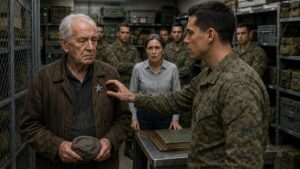
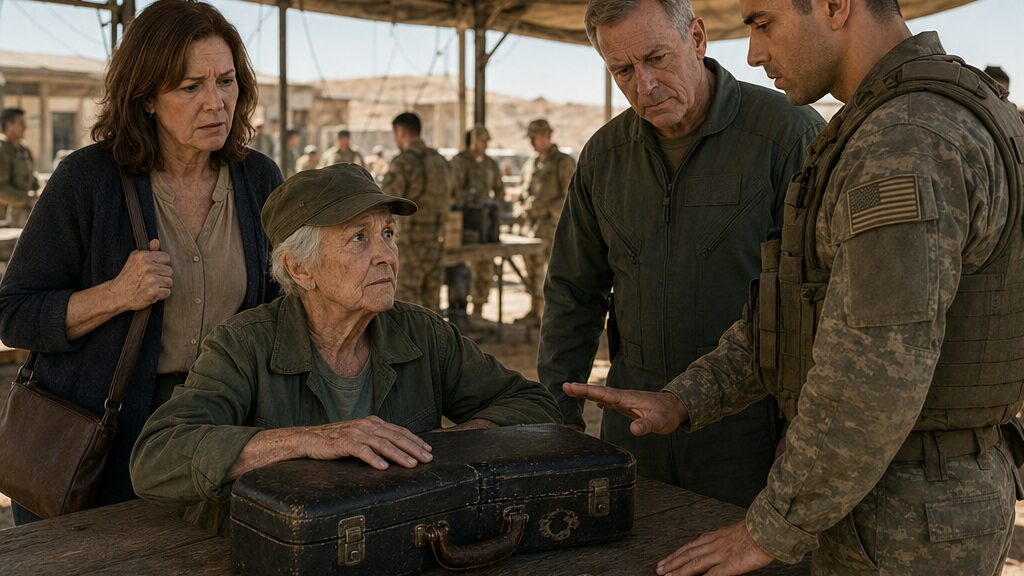
Joshua Rivera had already pushed the paper tag through the cracked leather handle when Betty Martin caught his wrist with two fingers.
She did not grab hard. At seventy-six, she no longer trusted sudden movements, especially around men wearing body armor and radios. But the touch stopped him.
The tag hung between them.
ITEM 17-B, it read. FIELD TRUMPET AND CASE.
Below that, in Joshua’s square handwriting, was the acquisition price.
Two hundred seventy-five dollars.
On the rough wooden table beside the case lay fourteen twenties, counted into a neat stack, and a clipboard turned toward Betty with a yellow arrow marking the signature line.
Dust drifted through the open side of the shelter. Beyond it, trucks rolled between canvas tents, and young soldiers crossed the sun-bleached staging yard with water cans and equipment cases. A radio crackled somewhere behind Joshua. No one else at the table seemed to hear how loud the paper tag was in Betty’s head.
“Ma’am?” Joshua said.
Betty lifted his wrist away from the handle and released it.
“You put the price on the wrong part.”
He glanced at the tag, then at the case. “The instrument and case are being inventoried together.”
“I heard you.”
Rachel stood at Betty’s right shoulder, one hand pressed against the strap of her purse. “Mom, they have to label it. That’s how this works.”
Betty looked down at the black case. Its corners had gone gray with wear. One brass clasp had been replaced by a bent steel hook. Three uneven black stitches pulled a split seam together near the hinge.
Her thumb rested over those stitches.
Joshua remained standing. He was young enough that the patch on his shoulder looked brighter than his face. “The price isn’t meant to disrespect you,” he said. “That’s the highest figure the curator authorized without documentation.”
“The trumpet has documentation.”
“The serial number confirms age and issue type. It doesn’t establish collector value.”
“I didn’t say collector value.”
Rachel exhaled through her nose. “Mom.”
Betty turned her eyes toward the cash. The roofing contractor had asked for three hundred before he would put her name back on the schedule. She had seventy-two dollars in an envelope at home, minus whatever the pharmacy demanded on Friday. The money on the table was enough to stop the rain from reaching the wiring, if the contractor did not find more rot.
It was not enough to make the case feel lighter.
Joshua slid the clipboard an inch closer. “The trumpet itself has corrosion along the lead pipe. Two valves stick. The bell has been reshaped at least once. The case is not original to the manufacturer.”
“No,” Betty said. “It isn’t.”
“That lowers the market value.”
“It raised mine.”
Rachel looked toward the shelter entrance, where an older man in a flight-style uniform had paused near a folding display board. Robert Hill had introduced himself earlier as the volunteer curator for the new history room. Since then he had mostly watched, his hands behind his back.
Rachel lowered her voice. “You asked for an appraisal. They gave you one.”
“I asked whether the unit would take it.”
“And they will.”
Joshua tapped the cash with one finger. “This is already above the resale estimate. The center is paying for local service relevance.”
Betty looked up at him. “Local.”
He hesitated. “Your records show you were assigned through this training command before your overseas rotation.”
“My records show what somebody typed.”
“Mom, please sign it.”
The word please had an edge sharpened by four nights of arguments. Betty could hear the leak behind it. She could see Rachel standing on the kitchen chair with a flashlight, staring at the brown line spreading toward the outlet. She could also see the photographs Rachel had taken of the trumpet without asking, the case laid open on Betty’s bed like evidence.
Joshua reached for the tag again.
Betty lifted it free of the handle before he could touch it. She did not tear it. She placed it beside the cash and turned the blank side up.
“This case is not storage,” she said.
Joshua’s expression tightened, not in anger but in the careful patience people used when they thought age had made a conversation fragile. “I understand it has sentimental value.”
“No. You understand the phrase sentimental value.”
Rachel closed her eyes briefly.
Betty pressed the case toward herself and opened the hook clasp. The other clasp resisted until she struck it once with the heel of her hand. The lid rose only three inches.
Joshua leaned forward.
She did not show him the trumpet.
Instead, she turned the case so the split seam faced him. The three stitches were thick, ugly, and pulled at different angles. Beneath them, half hidden by grime, was a faded maintenance stamp shaped like a narrow wing around a number.
“Those aren’t factory stitches,” Joshua said.
“I know.”
“Who repaired it?”
Betty kept her palm on the lid. “A medic who used thread cut from her field pouch because we had no light worth wasting and no time to find a proper kit.”
The noise beyond the shelter seemed to recede.
Joshua looked again at the stitches. His face changed, though only slightly. “During a deployment?”
“During an evacuation.”
Rachel’s shoulders dropped. Betty had never told her that much.
Joshua’s hand moved toward the case, slower now.
Betty lowered the lid before he reached it.
“She didn’t come home,” Betty said.
The young sergeant’s hand stopped above the black surface. For one moment, Betty could not tell whether he meant to take the case or keep her from pushing it away.
Then his palm settled gently on the lid beside hers.
Not gripping. Not claiming.
Just stopping the movement.
“Ma’am,” he said, quieter than before, “are you sure you want to complete this today?”
Rachel stepped closer. “She has to. The roof—”
“I asked her.”
Betty withdrew her hand from beneath his. The sudden absence of contact felt colder than it should have.
“I brought it here,” she said.
“That isn’t the same answer.”
Joshua glanced at the acquisition form. “The training rotation closes in forty-eight hours. After that, the temporary purchase authority expires. We can hold the offer until then, but I need a clear statement of intent before I process the transfer.”
Rachel stared at him. “You already counted the money.”
“That was before I understood there might be a provenance issue.”
“A what?”
“A history we haven’t documented.”
Betty shut the case fully and fastened the bent hook.
Robert Hill stepped away from the display board. He approached without looking at the money. His attention remained fixed on the repaired seam.
“May I see that mark again?” he asked.
“No.”
Robert stopped at the opposite side of the table. Gray hair showed beneath his cap, and the lines around his eyes deepened as he studied the portion still visible below Betty’s hand.
“That wing-and-number stamp belonged to the old evacuation detachment,” he said. “They stopped using it before Sergeant Rivera was born.”
Joshua looked from Robert to Betty.
Robert’s voice stayed measured. “Where did you serve, Mrs. Martin?”
Betty pulled the case against her ribs and rose from the folding chair.
The cash remained on the table. The price tag lay blank side up.
“That,” she said, “is not part of the sale.”
Chapter 2: The Leak She Had Hidden Behind a Bucket
Rachel had lifted the bucket only to empty it. The scorched plaster beneath it changed the argument before either woman spoke.
A thin brown track ran down the wall toward the electrical outlet. Above it, the paint had blistered into pale bubbles. One corner of the outlet plate was dark.
Rachel set the bucket down too hard. Water slapped over the rim and spread across the kitchen floor.
“How long has that been there?”
Betty kept wiping the counter.
“Mom.”
“Three days.”
Rachel crouched near the wall, then stood immediately. “It smells burned.”
“The breaker is off.”
“For the whole kitchen?”
“For that wall.”
“You told me it was a ceiling stain.”
“It was.”
“And then?”
“It became something else.”
Rain ticked against the window over the sink. Another drop landed inside the metal bowl near the refrigerator. The house had developed its own uneven rhythm: bucket, bowl, bucket, silence.
Rachel pulled out her phone.
“Don’t call anybody yet.”
“I’m calling the roofer.”
“He’s already been.”
Rachel froze. “When?”
“Tuesday.”
“And?”
Betty folded the damp cloth into quarters. “He gave me an estimate.”
“How much?”
“The roof needs work.”
“How much?”
Betty looked past her toward the hallway. The black trumpet case lay beneath her bed, raised on two old magazines to keep it off the floor. She had moved it there after water reached the bedroom baseboard. She had not mentioned that either.
Rachel followed her gaze.
“What did he say, Mom?”
“He said he could secure the dangerous section if I paid a deposit.”
“How much?”
“Three hundred.”
“And the rest?”
Betty did not answer.
Rachel’s phone was already at her ear. The roofing contractor answered on the fourth ring. Rachel turned away, but the kitchen was too small to make the conversation private.
“Yes, this is her daughter. I’m standing in the kitchen. There’s discoloration near an outlet.”
A pause.
“No, she didn’t tell me that.”
Betty set the cloth down.
Rachel listened, her face becoming still. “So you won’t patch it?”
Another pause.
“I understand liability. I’m asking whether you can at least cover the opening.”
She closed her eyes.
“When is the next available appointment?”
By the time she ended the call, the rain had thickened against the window.
“He won’t do a temporary patch without the deposit,” Rachel said. “He says the decking may be soft and he won’t send anyone onto it unless the job is authorized.”
“He told me the same.”
“He also said you asked him not to send the estimate to me.”
“It is my house.”
“That wall could catch fire.”
“The breaker is off.”
“That is not the point.”
Betty picked up the bucket and carried it to the sink. Her arms trembled slightly from the weight. Rachel took it from her before she could pour.
Betty let go because spilling water out of pride would have been foolish. She hated that Rachel would interpret the decision as proof of weakness.
“What else haven’t you told me?” Rachel asked.
“Nothing useful.”
“Your prescriptions?”
Betty reached for the bucket.
Rachel held it away. “You skipped the pharmacy last week.”
“They were out.”
“I called.”
The room narrowed.
Rachel’s voice softened, which made Betty dislike it more. “They said both prescriptions were ready and returned to stock.”
“I still have tablets.”
“How many?”
“Enough.”
“That means not enough.”
Betty walked out of the kitchen.
Rachel followed her into the bedroom. The wallpaper near the window had begun to peel. Betty bent, pulled the black case from beneath the bed, and wiped one drop of water from its lid with her sleeve.
Rachel stared at it.
“No,” she said.
“You asked what I could sell.”
“I asked whether there was anything we could do.”
“This is something.”
“That trumpet?”
“It has a value.”
“You haven’t opened it in years.”
“That does not mean I forgot how.”
“I didn’t say that.”
“You photographed it.”
Rachel went quiet.
Betty straightened slowly. Pain pulled along her lower back, but she refused to brace herself against the bedpost.
“You moved it,” she said. “The buckle was facing the wall. You put it back facing the door.”
“I wanted someone to look at it.”
“Who?”
“A man at the training center. Robert Hill. He volunteers with their history room.”
“You sent him pictures before asking me.”
“I needed to know whether it was worth enough to matter.”
“Everything has to matter in dollars before you ask permission?”
Rachel’s face reddened. “Permission? I found you dizzy in this room with water running down the wall. You told me you had stood up too fast. Then I found out you were cutting pills in half.”
Betty gripped the case handle.
Rachel looked at the three stitches. “I’m trying to keep you here.”
“By selling what is here with me.”
“By fixing the house.”
The rain tapped the case lid, one drop at a time from a seam in the ceiling. Betty moved it against her leg.
Rachel’s anger faltered. “Why the training center?”
Betty wiped the lid again. “Because if it leaves this house, it should not sit behind glass in an antique store with somebody guessing what kind of music it played.”
“So Robert was right to look.”
“I did not say that.”
“But you’ll take it there?”
Betty looked at the worn hook clasp. “Soldiers should keep it, if anyone does.”
Rachel nodded too quickly, relieved by an agreement Betty had not quite made.
That evening, after they returned from the training site without completing the sale, Rachel sat at the kitchen table while Betty changed the bowl beneath the newest leak.
Neither mentioned Joshua’s hand on the case.
Rachel opened her phone and placed it on the table.
“There’s something you should see.”
Betty did not sit.
On the screen was Robert Hill’s preliminary email, sent three days earlier. Most of it concerned corrosion, serial numbers, and the center’s limited acquisition budget.
Rachel scrolled to the final paragraph.
Betty read the line once.
Then again.
The instrument may be ordinary, Robert had written, but the repairs may matter more than the instrument.
Betty reached for the phone.
Rachel pulled it back. “What did he recognize?”
Betty looked toward the hallway, where the case waited in the dark bedroom.
“What did he see in those stitches?” Rachel asked.
Betty’s hand remained extended between them.
She had spent thirty years believing no one would notice.
Now someone had, and the roof was still leaking.
Chapter 3: Three Stitches from a Night Without Lights
Robert Hill did not touch the case when he said, “That thread came from a field dressing pouch.”
The archive room was hardly a room at all. Two temporary walls divided it from a supply warehouse, and the ceiling lights hummed above metal shelves stacked with labeled cartons. A decommissioned radio sat beneath a framed map. Dust gathered along the edges of everything except Robert’s worktable.
Betty stood on one side of it with the case closed.
Joshua stood near the door, no body armor this morning, only fatigues and a notebook tucked under his arm. Rachel had remained outside after Betty told her the inspection would take ten minutes. Betty had no intention of letting it take eleven.
Robert adjusted his glasses. “Waxed surgical thread. Older type. The medics carried it for repairs as often as they used it on people.”
“They used what they had.”
“The stitch angles are wrong for a formal repair.”
“They were made in the dark.”
Robert nodded once. “You said during an evacuation.”
“I said enough yesterday.”
“You did.”
“Then why am I here?”
“Because if the center buys the trumpet as a generic artifact, the record will be false.”
Betty’s fingers tightened around the handle. “False records never stopped the Army before.”
Joshua looked down.
Robert did not smile. “No. But I’m trying not to add another.”
He opened a thin folder and removed a photocopied sheet. At the top was a faded version of the same winged stamp visible near the case seam.
“This mark belonged to the 214th Forward Evacuation Detachment,” he said. “Maintenance section marked shared equipment with it during the desert rotation.”
Betty said nothing.
Robert placed the photocopy beside the case but did not push it toward her.
“I served later,” he continued. “Different unit. Same staging corridor. We inherited a cabinet of their logs, most of them incomplete.”
“Incomplete is a generous word.”
“There are names missing.”
“There always are.”
Joshua shifted his notebook under his arm. “Mrs. Martin, if you can establish direct service use, the history room may be able to revise the valuation.”
Betty turned toward him. “That is what you heard?”
His face flushed. “No, ma’am.”
“It sounded like it.”
Robert pulled out a chair. Betty remained standing.
“May I examine the seam?” he asked.
“You may look.”
“I would need to lift the edge.”
“No.”
He folded his hands. “Then tell me what caused the damage.”
Betty looked at the three stitches.
The archive room vanished at the edges.
There had been no ceiling lights that night. Only red-filtered lamps under canvas, vehicle beams cut low, and a horizon that flashed without warning. The case had fallen from the back of a transport when the convoy halted too fast. One latch tore free. The leather split open, and the trumpet struck the ground hard enough to flatten part of the bell.
Deborah Green had picked it up before Betty could.
Not because the trumpet mattered more than the wounded. Because the wounded had not arrived yet, and everyone needed something to do with their hands while they waited.
“You’re not carrying this open,” Deborah had said.
“It won’t close.”
“It will when I’m finished.”
She had cut thread from a field pouch and pushed it through the leather with a curved needle. Her stitches had always leaned left, even when she closed skin.
Betty blinked, and the metal shelves returned.
“A transport stop,” she said. “The case was thrown from the rear of a vehicle. The latch tore loose.”
Robert waited.
“A medic repaired it.”
“The medic who didn’t come home?”
Betty’s jaw tightened. “You have enough for your label.”
“I don’t write labels until I know whose life I’m reducing.”
The words angered her because they were careful.
Robert crossed to a filing cabinet and removed a large archival envelope. From it he drew a photocopy of a unit photograph.
The image showed twelve people standing in front of a medical transport aircraft. Sunlight had bleached their faces, but Betty recognized every posture before she recognized the names.
A younger Betty stood near the end of the row, a trumpet tucked under one arm. Beside her, Deborah held the battered black case upright by its unbroken handle.
Robert laid the photograph beside Betty’s case.
The three stitches in the photograph were visible even through the grain.
Joshua stepped closer, then stopped himself.
“That’s you,” he said.
Betty looked at the young woman she had been. The uniform hung differently on her shoulders then. Her face was leaner, impatient with the photographer. Deborah was half smiling, as though someone had spoken just before the shutter closed.
“You told me the case had field history,” Joshua said. “I thought you meant it traveled with the unit.”
“It did.”
“No. I mean—I thought you were making the connection broader than it was.”
“You thought I was an old woman making an old thing important.”
Joshua did not defend himself. “Yes, ma’am.”
The honesty unsettled her more than an excuse would have.
Robert returned to the form. “With this photograph and the maintenance mark, the center can document the case as a unit artifact. That changes the institutional value.”
Rachel appeared in the doorway. “By how much?”
Betty closed her eyes briefly.
Robert answered without looking at Rachel. “Possibly enough to meet the repair deposit.”
Rachel entered. “Then this solves it.”
“No,” Betty said.
Rachel stopped. “Why not?”
Robert turned the acquisition form around. “Documented artifacts purchased under this authority become permanent federal property. No return provision. No private withdrawal later.”
Rachel looked at Betty. “But that was always the idea.”
“No,” Betty said. “The idea was to put it where it belonged.”
“That is where it would belong.”
“You don’t get to decide that because the number improved.”
Joshua opened the case only after Betty nodded once.
The trumpet lay in faded blue lining, its bell dented and its brass dulled almost brown. Robert studied it without reaching inside.
A loose section of lining had lifted near the hinge.
Joshua pointed. “There’s something under there.”
Betty leaned forward too late.
He slipped two fingers beneath the cloth and drew out a folded piece of paper, yellowed along the edges and flattened by years of pressure.
The sight of it drove the air from Betty’s lungs.
Joshua unfolded the first crease.
Betty took the note from his hand before he could open the second.
The paper trembled between her fingers.
Rachel stared at it. “What is that?”
Betty folded it along the old lines and pushed it into the inside pocket of her field jacket.
Robert’s gaze moved from the pocket to the case.
“Was that written by the medic?” he asked.
Betty closed the lid over the trumpet.
No one tried to stop her.
She fastened the bent hook, lifted the case, and held it against her side.
The first sentence of the note had been harmless enough.
The second was the promise she had failed to keep.
Chapter 4: Her Daughter Called It Choosing the Dead
Rachel locked the trumpet case in the trunk before Betty reached the car.
The click of the latch carried across the parking area.
Betty stopped beside the rear bumper. Heat rose from the asphalt around her boots. She held Deborah’s folded note inside her jacket pocket, two fingers pressed over it as if the paper might work its way free.
“Open it,” she said.
Rachel kept the keys in her fist. “Not until we talk.”
“That case belongs to me.”
“I know.”
“Then open the trunk.”
“You were about to walk off with it.”
“I was walking to the car.”
“You wouldn’t answer anybody.”
“I answered Robert. I told him no.”
Rachel looked toward the acquisition shelter. Through the open side, Joshua was removing the counted cash from the table. Robert stood beside him with the old photograph still in his hand.
“You told them no after you brought the trumpet here to sell.”
“I brought it here to decide.”
“We don’t have time for you to turn every decision into a test.”
Betty moved closer. Rachel did not step away, but the keys disappeared into her purse.
“Do you hear yourself?” Betty asked.
“Yes. I hear somebody trying to keep the roof from falling in.”
“The roof is not falling in.”
“The wall is burned.”
“The outlet is dead.”
“You were under that leak when I found you on the floor.”
“I was not on the floor.”
“You were sitting against the bed because you couldn’t stand.”
“I stood too fast.”
“You always have a smaller name for the thing that scares me.”
The words struck more accurately than Betty wanted to admit.
A military truck passed at the edge of the lot, scattering dust. Rachel turned her face until it settled, then looked back at Betty.
“I can pay some,” she said. “Not all. I already checked my savings.”
“You should not have.”
“I have eight hundred dollars.”
“Put it back.”
“The roofer said the damage could spread past the kitchen.”
“And your car needs brakes.”
“My car is not leaking onto electrical wiring.”
“You have your own bills.”
“You are my mother.”
“That does not make my house your debt.”
Rachel opened her purse and took out the keys, but she did not unlock the trunk. “Then let the trumpet pay for it.”
Betty stared at her.
Rachel’s voice hardened in response to the silence. “That is what you decided, isn’t it? You said soldiers should keep it. Robert can prove where it came from. The center will pay more now. This is the best possible outcome.”
“The best for whom?”
“For you.”
“No. The best for the roof.”
“They are connected.”
“Only because you made them connected before I had agreed.”
“I sent photographs. I did not forge your signature.”
“You brought strangers into my bedroom with a camera.”
“I brought the case into the only conversation you would have.”
Betty reached for the keys. Rachel closed her hand around them.
“You do not get to lock away my property because you dislike my answer.”
“And you do not get to pretend this is only about property.”
The note under Betty’s fingers made a dry sound against the lining of her pocket.
Rachel heard it. Her eyes dropped to the jacket.
“What did she write?”
“That is mine too.”
“Was it for you?”
“Yes.”
“Then why hide it for thirty years?”
Betty stepped past her toward the passenger side.
Rachel caught the car door before Betty opened it. “I’m not taking you home until we finish this.”
“Then I’ll walk back to the shelter.”
“In this heat?”
“I have walked farther in worse.”
“That sentence is exactly the problem.”
Betty turned.
Rachel’s eyes were wet, but she did not look fragile. She looked furious.
“You think surviving hard things means nobody gets to stop you from doing something dangerous now,” Rachel said. “You think because you carried people, equipment, grief, whatever else you won’t name, you have to carry every problem alone until it puts you on the floor.”
“I was not on the floor.”
“You were close enough.”
Betty looked away.
Rachel drew a breath. “I called the assisted-living place.”
The parking lot seemed to tilt beneath Betty.
“You did what?”
“I asked about waiting lists. I did not apply.”
“You told strangers I cannot live alone.”
“I asked what options existed.”
“So that is it.”
“No.”
“The photographs. The appraisal. The roof estimate. You needed proof.”
“Proof of what?”
“That I have begun failing.”
Rachel flinched. “I needed a plan in case you keep hiding things until there is an emergency.”
“You had the plan before you asked me.”
“Because asking you gets me nothing.”
The accusation landed between them, too close to truth for Betty to dismiss.
She pulled the note from her pocket. The old folds had softened until the paper wanted to open by itself. She kept it closed.
Rachel watched her. “Is that why you won’t sell it?”
“I have not said I won’t.”
“You won’t say anything. That is how you keep control. You make everyone guess, then punish them for guessing wrong.”
Betty’s hand tightened around the paper.
Rachel wiped beneath one eye with the heel of her palm. “I don’t want you moved somewhere. I want your house safe enough that nobody can use one bad inspection to tell you it isn’t your choice anymore.”
Betty looked at her then.
Rachel continued, quieter. “I want you at home. In that stubborn little house with the crooked porch and the kitchen drawers that stick. I want to complain about the thermostat and find expired cans in your pantry. I am not trying to remove you from your life.”
“Then stop deciding what parts of it are disposable.”
“I am trying to understand why one trumpet matters more than the room it is stored in.”
“It is not one trumpet.”
“Then tell me what it is.”
Betty folded the note smaller, though the creases were already fixed.
“I cannot.”
“You mean you will not.”
“Yes.”
Rachel’s face closed.
For several seconds, neither moved. The staging area continued around them. A forklift beeped in reverse. Someone called for a manifest. From the shelter came the metallic clap of a folding table being moved.
Rachel looked toward the sound. “That offer ends tomorrow.”
“I know.”
“You have seventy-two dollars.”
Betty said nothing.
“I found the envelope.”
“You went through my desk?”
“I was looking for the estimate.”
“You find a reason for every boundary you cross.”
“And you find a reason to build another boundary.”
Rachel opened her purse and drew out the keys. This time she unlocked the trunk. The lid lifted, revealing the black case lying between a spare blanket and a bag of emergency groceries.
Betty reached for it.
Rachel put one hand on the lid. “Answer one thing first.”
“Move your hand.”
“Have you kept this because you loved her, or because you think suffering is the only honest way to remember her?”
Betty felt the question in the place beneath her ribs where she kept all the answers that could not survive daylight.
Rachel’s voice shook. “You have spent my whole life choosing the dead over the living.”
Betty’s anger rose clean and fast. Then it struck something harder inside her and broke.
She looked at the case.
The chapel returned in fragments: polished floor, rows of uniforms, an empty chair near the front, the trumpet case on her knees. Her thumb over the clasp. The order of service folded beside it. Everyone waiting for a note that never came.
Rachel’s hand left the lid.
Betty did not lift the case.
“I did not play for her,” she said.
Rachel went still.
Betty pushed the folded note deep into her pocket and turned toward the shelter.
“Mom.”
She kept walking.
The black case remained locked in Rachel’s trunk, and for the first time since bringing it to the training center, Betty walked away without it.
Chapter 5: The Promise She Broke in Front of an Empty Chair
Joshua brought the case back from Rachel’s car and placed it six feet from Betty.
He did not slide it toward her. He did not rest his hand on the lid. He set it on the packed earth beside a folding chair, then stepped back far enough that she would have to choose whether to cross the distance.
Evening had cooled the edge of the training ground. The last vehicles stood in long rows beyond the shelter, their metal surfaces holding the day’s heat. Robert sat at the end of a rough table with the acquisition form before him.
Rachel remained near the parking area.
Betty stood facing the case.
“You asked her for the key?” she said.
Joshua nodded. “I told her I would return the case to you.”
“And she agreed?”
“Not immediately.”
Betty almost smiled, but the feeling disappeared before it reached her face.
Joshua glanced toward the case. “I did not open it.”
“You already did that once.”
“Yes, ma’am.”
He accepted the correction without defending himself.
Robert tapped the form. “We can stop here.”
“We stopped yesterday.”
“I mean completely. No sale. No record. You take the trumpet home.”
“And the roof continues leaking.”
Robert lowered his hand.
Betty crossed the six feet and sat beside the case. The hook clasp faced her. She placed her thumb on it but did not lift.
Joshua remained standing. “Mrs. Martin, what you said in the parking lot—”
“You were listening?”
“Your daughter’s voice carried.”
“Mine did not.”
“No.”
Robert looked at the darkening training field rather than at Betty. “You do not owe us the rest.”
“That has not stopped either of you from trying to find it.”
Neither man answered.
Betty opened the hook. The clasp on the other side stuck. She pressed it once, twice, then stopped.
At the funeral, the clasp had worked.
That was the worst part. Nothing mechanical had prevented her.
“Deborah knew before I did,” Betty said.
Joshua shifted his weight but stayed silent.
“She knew she would not be coming home?”
“No. She knew I would try to stop playing.”
Betty drew the note from her jacket. The paper had warmed against her body. She unfolded only the first section.
“She wrote this after the night she repaired the case. We had been awake nearly twenty hours. The evacuation flights kept changing, and every time the radios went quiet, somebody started imagining why.”
Robert’s eyes moved to the stitches.
“She told me to play something,” Betty continued. “I told her no one wanted music in that place. She said wanting had nothing to do with needing.”
A dry laugh escaped Betty, without humor. “Deborah had opinions about every job except her own.”
“What did you play?” Joshua asked.
“Eight bars. Quietly. Enough that the people nearest us stopped talking.”
She saw them again: medics sitting on supply crates, drivers leaning against tires, one wounded soldier awake beneath a blanket. Deborah threading the last stitch through the case while Betty played toward the dark canvas wall.
“Afterward, she wrote the note. The first line said I sounded better when I was angry.”
Joshua’s mouth moved slightly.
“The second line?” Robert asked.
Betty looked down at the folded section she had not opened.
“She said if she ever went first, I was to play her home.”
The words entered the cooling air and did not disappear.
Robert folded his hands.
Joshua looked toward the case, then away.
“She died eight months after we returned,” Betty said. “A collision on an icy road. Nothing heroic. No desert. No evacuation. A truck crossed the center line while she was driving to work.”
The simplicity of it had always felt like another insult.
“Her family asked for military honors. They asked me to play because she had told her sister about the promise.”
Betty pressed the resistant clasp.
“The chapel was full. There was an empty chair near the front for her mother, who had been taken to the hospital that morning. Her photograph stood beside the folded flag. I sat behind the honor guard with this case on my knees.”
The clasp released with a sharp metallic snap.
Joshua’s head lifted.
Betty opened the lid.
The trumpet lay inside, its brass dark in the evening light.
“When my time came, I put my hand here.” She touched the inner latch. “I could hear everyone waiting. I could hear the chairs moving. I could hear one of the soldiers breathing behind me.”
Her fingers rested on the trumpet but did not lift it.
“I could not open the case.”
“You froze,” Joshua said.
Betty looked at him.
He corrected himself. “That is not an excuse. I only meant—”
“I know what you meant.”
She closed her eyes.
“I told them the clasp had jammed. Later I told Deborah’s sister the valve had locked. I let people believe the instrument failed because I could not admit that I had.”
Robert’s voice was low. “What happened after?”
“I left before the family meal. Drove until I reached the old range outside the training corridor. It was empty by then. Wind, sand, abandoned target frames.”
Betty lifted the trumpet. Its weight settled into her hands with terrible familiarity.
“I stood where nobody could hear me and played everything I had been supposed to play in the chapel.”
The first notes had cracked. The middle had steadied. By the end she had no breath left and had played anyway, forcing sound through a throat closed by grief.
“I played until my mouth bled,” she said. “Then I put the trumpet away and decided the promise was finished.”
“But you kept it,” Joshua said.
“I kept the proof that it wasn’t.”
The words silenced even the small noises around them.
Robert studied the acquisition form. “The history room can document this. The photograph, the unit mark, the field repair, the oral history. With those, I can justify the higher payment.”
Rachel had come closer without Betty hearing. She stood at the shelter’s edge, arms folded tightly across herself.
“How much higher?” she asked.
Robert named a figure that would cover the deposit and most of the first repair phase.
Rachel inhaled sharply.
Betty held the trumpet across her lap. For one brief moment, relief moved through her. The roof could be secured. The burned wall could be opened. She could refill both prescriptions.
Then Robert pushed the form toward her.
“The difficulty is the authority we are using,” he said. “A documented artifact acquired with those funds becomes permanent property. The center cannot pay the revised amount and leave you a right of return.”
Rachel stepped to the table. “But it would stay here. She could visit it.”
Betty looked at her daughter.
Rachel’s face tightened. “I am not saying that makes it easy.”
“No,” Betty said. “You are saying it makes it practical.”
“I am saying the roof is still damaged.”
Robert turned the form so Betty could read the ownership clause.
Transfer is complete, permanent, and without condition.
The language was clean. That made it worse.
Joshua spoke carefully. “If you sign, the case and instrument become part of the collection. They could be loaned to another facility. Display decisions would belong to the center.”
“And the note?” Betty asked.
Robert looked at the paper in her hand. “Only if you include it.”
“If I do not?”
“It remains yours.”
“So you would own the case repaired around it, the trumpet tied to it, and a version of the story with the center missing.”
Robert did not answer quickly enough.
Rachel put both hands on the table. “Mom, maybe it doesn’t have to be perfect.”
Betty looked at the trumpet’s dented bell. “No. It only has to be true.”
She placed the instrument back inside the case. The lining received it in the same worn shape it had held for decades.
Then she drew the form toward herself.
Joshua reached for a pen and stopped before touching it. He set it on the table within her reach.
Betty picked it up.
Rachel let out a breath.
Betty found the sentence granting permanent ownership. She drew one deliberate line through it.
Robert leaned forward. “Mrs. Martin—”
She wrote beneath the clause in block letters.
FIVE YEARS. OWNERSHIP RETAINED.
She capped the pen and pushed the altered form across the table.
“You want the history,” she said. “Those are the terms.”
Chapter 6: The Offer That Helped by Taking Too Much
Someone had begun passing a collection envelope before Betty entered the administrative trailer.
It moved from hand to hand along the wall, pale and overfilled, with UNIT FAMILY written across the front in blue marker. A volunteer was pressing folded bills through the opening when the room noticed Betty at the door.
The envelope stopped moving.
On the table beside it lay her altered acquisition form. Robert’s paper clip marked the line she had crossed out.
Betty looked at Joshua.
He straightened. “I did not start that.”
“Did you stop it?”
His silence answered.
The unit commander rose from behind the table. She was younger than Betty expected, with sleeves rolled precisely and reading glasses resting on a stack of regulations.
“Mrs. Martin, we were trying to find an immediate solution.”
“You found an envelope.”
“A few people heard about the roof.”
“How?”
The commander glanced toward Robert.
He removed his glasses. “I asked the family readiness coordinator whether emergency assistance existed. The details traveled farther than I intended.”
“The trumpet too?”
“No photographs were shared.”
“That was not my question.”
Robert’s expression tightened. “They know a veteran came to sell an artifact because she needed a repair deposit.”
Betty walked to the table and lifted the envelope. It was heavier than the price Joshua had first offered.
The volunteer smiled uncertainly. “It isn’t charity, ma’am. People wanted to help.”
Betty opened the envelope and began removing the bills.
A twenty. Two fifties. Several tens. A check with the payee line blank.
She placed each contribution on the table.
“Whose is this?” she asked, holding up the check.
The volunteer raised a hand.
Betty returned it.
“Ma’am, you don’t have to—”
“Yes, I do.”
The commander stepped forward. “No one is purchasing the trumpet with this money.”
“That makes it worse.”
Rachel entered behind Betty. She took in the scattered bills and closed the door.
“Mom, listen first.”
“I have listened to people explain what their money means since yesterday.”
“This could cover the deposit without the sale.”
“And what would they have bought?”
“Nothing.”
“Then why did they not pass the envelope last week? Or for the veteran whose furnace failed last month? Or for the mechanic outside town deciding between insulin and rent?”
The volunteer looked down.
Betty gathered the last bills and held them out. “They are giving because Deborah’s story made them feel something. I will not turn her into a reason strangers can feel generous for an afternoon.”
Rachel came closer. “You need the roof fixed.”
“I needed it fixed before they knew about the trumpet.”
The commander touched the altered form. “Your proposed arrangement cannot be approved under the acquisition authority. We do not have a custodial-loan line attached to this project.”
“Then reject it.”
“I am rejecting it.”
The words were not cruel. Their finality still struck hard.
The commander slid the form toward Betty. “A permanent purchase remains available until the rotation closes this evening. Otherwise the funds revert.”
Rachel pressed her lips together.
Betty looked at the crossed-out clause. The ink she had used seemed darker than everything printed around it.
The commander continued, “The collection envelope was an informal effort. I can order it stopped.”
“You should.”
“I will.”
Betty returned the empty envelope to the volunteer.
A phone rang in Rachel’s purse.
She checked the screen and stepped into the corner. Her side of the conversation was mostly silence.
“Yes,” she said finally. “I understand.”
When she ended the call, her face had changed.
“The roofer moved the schedule,” she said.
Betty remained still.
“He can send the crew tomorrow morning. Another job was delayed. But he needs the deposit by five today, or he gives the slot to the next customer.”
The clock above the commander’s desk read eleven forty-three.
Rachel turned toward the cash still spread across the table. “This is enough.”
Betty’s voice stayed level. “Put it back.”
“Mom.”
“Every dollar.”
Rachel looked as though she might argue, but then she began helping the volunteer sort the money by donor.
The commander returned to her regulations.
Joshua moved beside Betty. “There is something I should tell you.”
She waited.
“Yesterday, when I put my hand on the case, I was not trying to take it.”
“I know that now.”
“I delayed the processing afterward.”
Robert looked up.
Joshua continued. “The ownership declaration asks whether the seller understands the transfer is permanent and intends to surrender all rights. You never answered yes. You said you brought it here. That was not the same thing.”
“So you marked the form incomplete.”
“Yes.”
“Why did you not say so?”
“I thought I was giving you time without interfering.”
“You were still deciding for me.”
“Yes, ma’am.”
There was no defense in the answer.
Betty studied him. “You counted the money before you asked why my hand was on the stitches.”
His eyes dropped. “Yes.”
“You believed the transaction mattered more than the hesitation.”
“Yes.”
“And then you believed protecting me required another silence.”
Joshua met her gaze. “Yes.”
Betty nodded once. “You are learning the wrong lessons in the correct order.”
Robert made a small sound that might have been a laugh, but he covered it with a cough.
The commander turned the rejected form facedown. “I am sorry we cannot make your terms work.”
Betty looked around the trailer.
There were travel vouchers clipped to one board, training schedules on another, and a printed
Chapter 7: She Named the Terms Before Anyone Touched the Case
The rough table had been cleared of cash.
No envelope, no counted bills, no temporary tag. Only Betty’s handwritten terms lay beneath a metal clipboard, weighted at one corner by Joshua’s unopened pen.
The black case rested in front of her.
Across the open shelter, the final afternoon of the training rotation was being dismantled around them. Soldiers folded canvas walls, stacked water cans, and called numbers from equipment sheets. Dust moved through the sunlight in thin sheets. By sundown, the temporary acquisition authority would be gone.
Betty placed Deborah’s note beside the clipboard.
Robert read the first page of the proposed agreement again. The unit commander stood at his shoulder, checking each paragraph against a printed regulation. Rachel sat to Betty’s right, close enough to speak quietly but not close enough to reach the case without asking.
Joshua stood opposite them.
His open hand hovered above the lid.
Betty looked at it.
He drew it back.
“Thank you,” she said.
The words made him straighten more than an order would have.
The commander tapped the agreement. “Five-year custodial loan. Legal ownership remains with Mrs. Martin. The center receives temporary possession for exhibition and preservation.”
“With restrictions,” Betty said.
“Yes. No transfer to another installation without written permission. No restoration beyond stabilization. No removal of the field repairs.”
Robert nodded. “The stitches remain exactly as they are.”
“The trumpet may not be polished until it looks new.”
“It won’t be.”
“The dent stays.”
Rachel looked at the darkened brass through the narrow opening of the case. “Even if it affects the sound?”
Betty did not look at her. “It has sounded through worse.”
The commander continued. “The oral-history payment is for recorded testimony and supporting research. The exhibit-loan payment is separate. Family readiness has confirmed that Mrs. Martin qualifies for the same emergency home-repair grant available to other veterans in the county.”
“No special designation,” Betty said.
“No special designation.”
“And the collection money?”
“Returned.”
Betty looked toward the volunteers packing the neighboring table. “All of it?”
Joshua answered. “Every contribution was returned or voided.”
Robert slid a payment sheet forward. The total was modest. It covered the roofer’s deposit, the first phase of the electrical repair, and little beyond that.
It was enough.
Rachel studied the amount. “I can add the rest for the damaged wall.”
Betty turned to her.
“As a loan,” Rachel said quickly. “Written down. Payment schedule if you insist.”
“I insist.”
“I know.”
There was no anger in Rachel’s answer, but there was weariness.
Betty looked back at the agreement.
Robert pointed to a paragraph near the bottom. “There is one issue left.”
“There always is.”
“The oral history becomes part of the exhibit record. Visitors may hear portions of it.”
“Portions I approve.”
“Yes. But if the history is to explain why the trumpet matters, we cannot imply that you played at Deborah’s funeral.”
Rachel’s hand closed around the edge of her chair.
Robert continued, “We can say the trumpet was carried during service. We can describe the repair. We can identify Deborah. But if we include the promise, the account must also include what happened.”
Joshua looked at the packed earth.
The commander said, “You can omit that part entirely.”
Betty touched the folded note.
Omitting had been her best skill. She had omitted the second prescription from conversations about money. She had omitted the burned outlet from conversations about the roof. She had omitted the chapel whenever Rachel asked why the trumpet had not been played at family events.
Each omission had preserved something until it began to rot around the edges.
Rachel spoke carefully. “You do not have to put your worst moment behind glass.”
“It would not be behind glass.”
“You know what I mean.”
“No. Tell me.”
Rachel looked toward the case. “You spent years carrying that failure privately. Sharing it does not automatically make it lighter. It could make strangers feel entitled to judge something they did not live through.”
“That is true.”
“Then why give it to them?”
Betty unfolded the note.
The paper opened along its old creases. The first sentence appeared in Deborah’s slanted handwriting.
You sound better when you’re mad, Martin.
A few people nearby had stopped packing, though they pretended otherwise. Betty lowered her voice rather than raise it.
“The note has four lines,” she said. “I have spent thirty years remembering only one.”
Rachel’s eyes moved to the paper.
Betty read the final line aloud.
“Whatever happens, don’t stop playing just because I’m not there to bother you.”
The sounds of the staging area continued, but the table became still.
Rachel looked at the trumpet. “She didn’t ask you to keep it forever.”
“No.”
“She didn’t ask you to hide it.”
“No.”
Betty folded the note once, not along the old crease but beside it.
For years she had treated Deborah’s request as an order tied to a funeral. Play her home. One duty, one moment, one failure. She had never allowed the final line to change the meaning of the first.
Joshua glanced at the case. “When was the last time you played?”
Betty knew the date. She did not give it.
“Long enough ago that the valves may object.”
Robert pushed the recording-release page toward her. “We can make the funeral portion accessible only in the guided history program. Not on the public loop.”
“Does that make it less true?”
“No.”
“Then why hide it there?”
“To give it context.”
Betty considered that.
The unit commander checked the time. “We have ninety minutes before the finance office closes. If we are doing this, the agreement must be signed and transmitted soon.”
Rachel leaned toward Betty. “There is another option. Keep the trumpet. Take my savings. We will work out the roof later.”
“You said your car needs brakes.”
“I can wait.”
“No.”
“You are allowed to let me help.”
“And you are required to let me decide the form of it.”
Rachel sat back.
Betty softened her voice. “Your loan for the wall. Written terms. No photographs of my property without asking.”
Rachel’s mouth tightened. “Agreed.”
“No calling facilities unless I ask you to.”
“What if there is an emergency?”
“Then we name what counts as one now, before either of us is frightened.”
Rachel looked down at her hands.
“Agreed,” she said.
Betty took Joshua’s pen.
She signed the exhibit-loan agreement, then the oral-history form. On the line describing the authorized narrative, she added a sentence in her own hand:
The record will include the promise, the failure, and what happened afterward.
Robert read it and nodded.
The commander signed beneath her.
Joshua placed the temporary price tag on the table. He had kept it flat inside his notebook. The figure he had written two days earlier was still visible.
“Do you want this destroyed?” he asked.
Betty picked it up.
The string was bent where it had looped through the cracked handle. The paper itself was clean, almost innocent. It had not misunderstood anything. People had done that for it.
“No,” she said. “Keep it with the record.”
Rachel frowned. “Why?”
“Because that is where the story began for them.”
She turned the tag blank side up and wrote one line:
PRICE OFFERED BEFORE HISTORY WAS ASKED.
Robert read it without comment.
The finance paperwork went into a folder. The commander carried it toward the administrative trailer. Rachel followed to call the roofer and confirm the deposit process.
Betty remained at the table with Joshua and Robert.
The case sat between them.
Joshua raised his hand, palm open, and held it several inches above the lid.
He waited.
Betty watched the restraint in his fingers. On the first day, the gesture had stopped a transaction he did not understand. Now it asked a question.
Robert said, “The case must be moved to the archive trailer before the convoy departs.”
Betty opened the lid.
The trumpet rested beneath the faded lining, its dented bell turned toward her. She placed Deborah’s note in a protective sleeve Robert had prepared, but she did not tuck it beneath the lining again.
It would travel where it could be read.
Robert pointed to the recording outline. “The full account will include the funeral.”
“Yes.”
“And the empty range afterward.”
“Yes.”
“And Deborah’s last line.”
“Every word.”
Joshua kept his hand suspended.
Betty closed the case and fastened the bent hook.
Rachel returned to the shelter. “The contractor accepted the deposit authorization. The crew will be there at seven.”
Relief crossed her face before caution replaced it.
Betty rested both hands on the black lid.
Five years was a long time. It was also not forever.
She pushed the case across the rough table toward Joshua.
His hand descended, but he stopped before touching it.
Betty looked at him.
“Carry all of it,” she said, “or carry none of it.”
Chapter 8: The Trumpet Remembered More Than One Goodbye
Betty heard her own recorded voice before she entered the history room.
“I failed to play when she needed me remembered.”
The sentence came through a speaker beyond the half-open door, clear and unhurried. Betty stopped in the hallway.
Rachel nearly walked into her.
“You approved that section,” Rachel said.
“Approval sounds different through a wall.”
“Do you want them to turn it off?”
Betty looked at the new ceiling tile above them. Six weeks earlier, rain had been entering her kitchen through two layers of rotten decking. Now the dangerous section of roof was covered, the burned wiring had been replaced, and the wall stood open to bare studs until she could afford the finish work.
The repairs were incomplete.
So was everything worth keeping.
“No,” she said. “Leave it.”
They entered.
The history room occupied what had once been a supply classroom. Display cases lined one wall. Maps, field radios, faded photographs, and equipment tags were arranged without ceremony. No flags draped the doorway. No one had gathered a crowd.
Robert stood near the central exhibit with a military history technician. Joshua waited beside a closed glass case.
Inside it rested the battered black trumpet case.
The cracked handle faced forward. The three uneven stitches had not been cleaned or hidden. Beside the case stood the unit photograph of Betty and Deborah, enlarged only enough for their faces to be seen.
The old price tag lay beneath the exhibit label.
Two hundred seventy-five dollars.
Below the figure, in Betty’s handwriting:
PRICE OFFERED BEFORE HISTORY WAS ASKED.
Rachel read the label silently.
“The roofer called,” she said after a moment. “He found one more soft section above the hallway.”
Betty kept her eyes on the display. “How much?”
“He is sending the estimate tomorrow.”
“You already know the number.”
Rachel hesitated. “Probably nine hundred.”
“I have some left from the honorarium.”
“Not nine hundred.”
“We will look at the estimate.”
“We?”
Betty turned to her.
Rachel’s expression was cautious, as though one careless movement might collapse the agreement they had built.
“We,” Betty repeated. “Then I decide what I can cover and what I need to ask.”
Rachel’s shoulders loosened.
“I am still afraid you will hide the next thing,” she said.
“I probably will want to.”
“That is not comforting.”
“It is honest.”
Rachel looked at the open hallway behind them, checking that no one was close enough to hear. “I am afraid I will see one problem and start making plans around you again.”
“You probably will want to.”
“That is also not comforting.”
“No.”
Betty extended her hand.
Rachel took it once, briefly, then let go before either of them could turn the gesture into more than it was.
Robert approached with a folder. “The loan record is complete. Five years, renewable only with your written approval. The trumpet can be reclaimed with thirty days’ notice.”
“And if I die before then?”
Rachel stiffened.
Betty ignored it.
Robert opened the folder. “Your designation names Rachel as the person authorized to choose the next custodian.”
Rachel looked at her. “You did that?”
“Do not make me regret it.”
“I will try not to.”
“That is the correct answer.”
Joshua stepped beside the glass case. He wore no body armor today, only a pressed uniform with the same American flag patch on his shoulder. His hands remained at his sides.
“The guided program begins next week,” he said. “Robert wanted your decision about the display.”
“What decision?”
“The case can remain closed, with the trumpet represented by the photograph. Or we can display the instrument separately.”
Betty looked through the glass.
For most of her life, the case had been a barrier she controlled. Open meant sound, obligation, exposure. Closed meant safety, delay, silence.
“What do you recommend?” she asked.
Joshua appeared surprised.
“I think the case should stay closed during ordinary hours,” he said. “People see the repairs first. They have to ask what it carried.”
“And during the guided program?”
“We open it after Deborah’s name is spoken.”
Robert nodded. “That was his suggestion.”
Betty studied Joshua. “Why?”
“Because the trumpet is not the beginning of the story.”
Six weeks earlier, he had counted money before asking about her hand on the stitches.
Now he had learned to ask where a story began.
“Do it that way,” Betty said.
Robert handed her a small key. “Would you like to open it today?”
The military history technician unlocked the glass panel and stepped away. Joshua reached inside, then stopped.
His open palm hovered over the black lid.
The same hand. The same case. No cash between them now.
He waited.
Betty placed the key in his palm.
“You may lift it out,” she said.
Joshua took the case by its cracked handle with one hand beneath the base. He carried it to the narrow table prepared for guided sessions and set it down gently.
Betty approached.
The room had grown quiet, though only Rachel, Robert, Joshua, and the technician were present. No audience waited to reward her. No one held a phone.
That helped.
She opened the bent hook.
The second clasp resisted as it always had.
Her thumb rested against it.
For one instant, polished chapel floors appeared beneath her feet. She heard chairs shifting behind her and felt the weight of the order of service beside a case she could not open.
Then the clasp released.
The trumpet lay in the faded blue lining.
Joshua did not reach for it.
“Would you like me to leave it there?” he asked.
Betty considered saying yes.
The recorded voice in the adjoining room continued with the account of the empty range—the wind, the abandoned target frames, the music played too late for everyone except the woman who needed to survive it.
Betty slipped her fingers around the trumpet.
The brass was cool. The valves resisted when she tested them. Robert had stabilized the corrosion but honored her order not to polish away the years. The dent in the bell remained.
Rachel watched her lift it.
“You do not have to play,” she said.
Betty adjusted the mouthpiece.
“I know.”
That was the difference.
She raised the trumpet and took a breath.
The first attempt produced only air and a rough metallic edge.
No one moved.
Betty lowered the instrument. Her mouth had forgotten the exact pressure. Her lungs objected to being asked. For several seconds, the old shame searched for its familiar place inside her.
Joshua looked at the floor, giving her privacy without leaving.
Betty raised the trumpet again.
This time she did not aim for the funeral call she had failed to play. She did not try to reproduce the music from the empty range. Those belonged to their moments, and forcing them now would have been another kind of concealment.
She chose the eight plain bars she had played beneath canvas while Deborah stitched the case in darkness.
The first note came thin.
The second steadied.
By the fourth, the room held the sound rather than judging it. The dent changed the tone slightly. Age shortened Betty’s breath. The final phrase trembled but did not break.
When she finished, there was no applause.
Rachel wiped one cheek and pretended to examine the photograph.
Robert closed the recording folder.
Joshua stood beside the table, his hands open and empty.
Betty lowered the trumpet and looked at Deborah’s half smile in the old unit picture.
For thirty years, she had thought the instrument remembered one goodbye she had failed to give and another she had given too late.
Now it remembered this too: a note played because she had chosen to play it, while the people around her understood enough not to claim the choice.
She returned the trumpet to its lining.
Before closing the lid, she touched the three uneven stitches from the inside.
Then she left the case open for the first guided session.
The story has ended.