They Called Daniel Torres’s Legal Forge A Fire And Turned His Locked Gate Into A War Zone
Chapter 1: Smoke Behind The Locked Chain Barrier
“That is not a barbecue,” Karen Hill said, lowering her garden shears as orange light pulsed between the trunks at the end of the cul-de-sac.
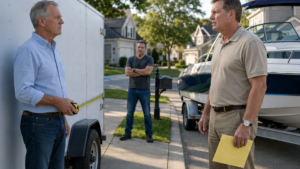
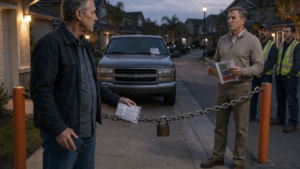
The glow came from Daniel Torres’s property, past the strip of pine and scrub oak that made his house feel farther away than it was. His roofline barely showed above the trees. His driveway disappeared behind a heavy motorized chain barrier and a black steel gate with vertical bars. Most houses on the street had open lawns, porch flags, decorative stones around mailboxes. Daniel’s had a keypad, cameras, a steel sign that read PRIVATE PROPERTY, and a chain thick enough to look borrowed from a shipyard.
Karen stood beside her hydrangeas and watched smoke curl through the branches.
Not black smoke. Not roaring smoke. A steady gray plume, thin at the top, rising and flattening in the late-afternoon air. But below it, through the leaves, she saw flashes: orange, white, then a darker red. Metal clanged once, sharp enough to cross the trees.
The neighbor beside her, a woman with a grocery bag still hanging from one wrist, leaned toward the sound. “Maybe he’s burning brush.”
“At four in the afternoon?” Karen said. “Behind a locked gate?”
The woman gave an uncomfortable laugh. Everyone on the cul-de-sac had a Daniel story. He did not wave unless waved to first. He accepted deliveries at the barrier. He kept his trash cans inside the gate until pickup morning and rolled them out before sunrise. When children rode bicycles too close to his driveway, the cameras tracked them with small black movements.
Karen did not hate him. She told herself that often. She just did not like not knowing.
Another clang rang out, followed by a clean hiss of quenching metal.
Behind the trees, Daniel lifted a pair of tongs from a steel basin and watched vapor fold around the piece he had just cooled. The forge sat beneath a covered outdoor bay behind his workshop, sheltered by fireproof panels and an overhead hood that pulled heat away in a disciplined column. The floor was poured concrete. Extinguishers stood mounted at either end. A red permit folder hung in a weather-sealed box by the rear door, exactly where the county inspector had told him to keep it.
Nothing was loose. Nothing was improvised.
The blade blank in his tongs glowed dull red at the edge, then faded. He laid it on the rack and turned down the fuel feed with two fingers, listening until the flame lowered to a contained blue.
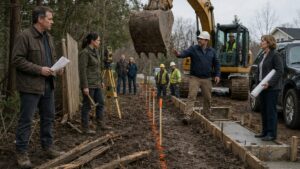
On the tablet mounted beside the forge controls, a green diagram of the storage array pulsed in blocks. PHEV MUNICIPAL RESILIENCE PILOT — NODE 3. The label had been shortened by the city engineers, but Daniel still thought of the system by its full awkward name. Six sealed battery cabinets, one inverter stack, two transfer switches, and enough compliance paperwork to fill a file drawer. The city wanted quiet backup capacity for emergency loads during summer grid stress. Daniel had the land, the technical background, and the temperament to monitor something no one wanted advertised.
At least, that was what the project manager had said.
Daniel tapped the screen and checked the afternoon readings. Temperature normal. Containment normal. Cell balance acceptable. The storage bay sat farther back under the trees, screened by cedar fencing and marked with hazard labels that could be read only from inside the property. To the neighbors, if they saw anything through a gap, it would look like gray cabinets, conduit, warning signs, and maybe something to fear.
That was why he kept the gate locked.
The chain barrier gave a low electric hum as Daniel tested it from the remote clipped to his belt. It tightened across the driveway, rising half an inch and settling into place. He watched the line of it until he was satisfied.
No one needed to cross. No one needed to know more than the law required.
His tablet chimed.
He looked down. A yellow alert flashed across the grid diagram.
EVENING LOAD TEST ADVANCED. MANUAL STABILITY CHECK REQUIRED BEFORE 18:30.
Daniel’s jaw tightened. “Of course.”
He wiped his hands on a dark shop towel, killed the forge flame, and walked toward the storage bay. His boots passed over the painted line he had put across the driveway just inside the gate, a narrow stripe of industrial yellow. It was not decorative. It reminded delivery drivers where to stop if he opened the barrier. It reminded Daniel where the outside world ended.
Past the workshop, the battery cabinets hummed softly, a low even sound like a sleeping machine. He unlocked the cabinet interface and began the check. Voltage spread first. Thermal status second. Communications third.
The forge gave off its last thread of smoke behind him.
At the street, Karen had moved closer to the edge of her lawn. She raised her phone and zoomed toward the trees. The image jumped, blurred, sharpened. Smoke. Orange reflection. A dark rectangular shape with warning stickers. Another shape beside it. Maybe tanks. Maybe a generator. Maybe something worse.
The neighbor said, “Should we call someone?”
Karen hesitated. She imagined later, on the news, someone saying all the neighbors had seen smoke and done nothing. She imagined the trees catching, propane exploding, her house at the curve of the cul-de-sac taking embers on the roof. She imagined Daniel looking at them through his cameras while whatever he was hiding burned.
“He never tells anyone anything,” Karen said.
“That doesn’t mean—”
A deeper hum rolled through Daniel’s property as the storage system shifted into test mode. It was not loud, but it was unfamiliar. The sort of sound that made ordinary machines feel too large.
Karen’s thumb was already on the emergency call button.
Daniel crouched beside Cabinet Two and watched the thermal numbers settle. The system was behaving. The forge was cooling. The chain was locked. The evening was still recoverable if he finished in twenty minutes.
On Karen’s phone, the dispatcher’s voice came through thin and official.
“What is the nature of your emergency?”
Karen swallowed. For a second, all she had was uncertainty.
Then the forge gave one last orange flicker through the smoke, reflected off the inner wall of the bay.
“There’s a massive fire,” Karen said, louder than she expected. “A structural fire, I think. At the end of our cul-de-sac. The property is locked up, and the owner has equipment back there. Big equipment. We don’t know what it is.”
The neighbor glanced at her sharply.
Karen turned away, covering her other ear. “Yes, there’s smoke. Yes, flames. Behind a barrier. You need to send someone now.”
Inside the gate, Daniel finished the voltage check and opened the communications panel. One value lagged, then corrected. He frowned and tapped the diagnostic again.
From far down the road, a siren rose, thin at first, then harder as it turned toward the trees.
Daniel stopped with his hand above the tablet.
The siren grew into two. Then three.
He looked toward the driveway, where the chain barrier held across the entrance in a straight, dark line. Red light began to flash through the leaves before he could finish locking down the grid.
Chapter 2: The Rookie With His Weapon Drawn
Jack Hernandez came out of the first cruiser with his weapon already in his hand.
Daniel saw it from halfway down the driveway and stopped walking.
The rookie officer planted himself behind the open driver’s door, shoulders high, jaw clenched, dark uniform still too crisp in the places older officers wore soft. He aimed low, not directly at Daniel’s chest, but close enough that the message crossed the gate before any words did. Behind him, a fire engine braked at the curve. Another cruiser slid in behind it. Neighbors appeared in driveways as if pulled by string.
Daniel lifted both hands slowly to shoulder height. Not surrender. Visibility.
“The forge is shut down,” he called. “There is no structural fire.”
“Stay where you are!” Jack shouted.
Daniel looked at the space between them: the street, the chain barrier, the black steel gate, the yellow line on his side of the drive. His own house sat behind him with the workshop to the left and the storage bay deeper under the trees. The last smoke from the forge hood thinned into nothing.
“I am on my property,” Daniel said.
Jack moved closer to the gate. His weapon remained out. “Open it.”
“Do you have a warrant?”
The question changed the air. Daniel saw it in the small tightening around Jack’s eyes. He had expected panic, apology, maybe excuses. Not that.
A second officer, older and broader, stepped from the passenger side of the cruiser. His name plate read Baker. James Baker kept one hand near his belt but did not draw. He looked past Daniel toward the forge bay, then up at the smoke.
“I don’t see active flame,” James said, half to Jack, half into the scene.
Jack did not look back. “Dispatch said structural fire with unknown equipment.”
“Then the fire department can assess from here,” Daniel said. “I’ll provide permit documentation at the gate.”
Jack’s face reddened. “You don’t get to decide how we respond to an emergency.”
“No,” Daniel said. “The law decides how you enter private property.”
On the right side of the street, Karen Hill stood with her phone raised. Daniel recognized her posture before her face. Forward lean, one elbow tucked, recording like she was gathering proof for a meeting that had not yet been called. Two neighbors hovered behind her. One of them whispered something, and Karen shook her head without lowering the phone.
Jack saw the phones too. Daniel could see the moment he noticed them.
The rookie straightened.
“Sir,” Jack said, voice louder now, “we have a credible report of a fire and possible hazardous equipment. Open the gate for a safety check.”
“No warrant. No consent.”
The fire crew had begun to unload near the engine, but no one was rushing hoses forward. One firefighter stood near the curb, scanning the property with professional calm. The absence of urgency should have helped. Instead, the quiet seemed to irritate Jack more.
He holstered his weapon slowly, as if granting Daniel a favor, but kept his hand close to it.
Daniel lowered his hands. He walked to the gate, not close enough for anyone to reach him, and opened the weatherproof box mounted inside the bars. He removed a folder and held it up.
“Forge permit. Inspection record. Fire suppression layout. I can pass copies through the document slot.”
Jack stared at the folder. “You can pass yourself through by opening the gate.”
James shifted. “Hernandez, let’s verify the visible hazard first.”
Jack’s head snapped toward him. “We got called to a locked property with smoke and unknown power equipment. He’s refusing access.”
“That’s not the same as active flame.”
“It’s enough for exigent circumstances if there’s a threat to life or property.”
Daniel heard the phrase land. Not as law, but as a tool Jack had just found in his own mouth.
“No one is inside except me,” Daniel said. “No visible flame. No injured person. No request for aid. If you believe otherwise, state the specific facts.”
Jack stepped closer until only the gate separated them. “The specific fact is you’re hiding behind a locked barrier while half the street reports smoke.”
“Half the street is wrong.”
Karen’s voice cut in from the curb. “We saw flames.”
Daniel turned his head just enough to see her. “You saw a forge.”
“A forge?” she repeated, as if the word proved something worse. “In a neighborhood?”
“A legal forge.”
“You never told anyone.”
“I’m not required to.”
The phones stayed up. The red lights flashed across Daniel’s face, across the gate bars, across the chain.
Jack took that silence and filled it. “What else are you not required to tell people, Mr. Torres?”
Daniel felt the old familiar pressure under his ribs. The assumption that privacy itself was a confession. He had lived with it in smaller forms for years: delivery drivers staring over the fence, neighbors pausing their walks near his driveway, online comments after someone posted a blurry photo of his security cameras. He had answered none of it because answering one question invited ten more.
Now there was a gun belt ten feet from him and a crowd behind it.
“My answer remains the same,” Daniel said. “Bring a warrant.”
Jack laughed once, short and humorless. “You think this is court?”
“I think this is my gate.”
James moved closer to Jack but kept his voice low. “We should get the chief on the line before this becomes something.”
Jack’s eyes did not leave Daniel. “It already is something.”
Behind the fire engine, a neighbor murmured, “What if it’s not just a forge?” Another answered, “I heard batteries can explode.” Karen’s phone tilted toward them, catching the whispers.
Daniel’s tablet buzzed against his hip.
He did not look down, but the vibration pattern told him enough: the grid check was not complete. The evening load test was still waiting. The system was stable, but only if left alone. Unknown radio interference, electronic devices near the inverter stack, physical entry by people who did not understand the layout—any of it could create the problem they were pretending to prevent.
“Mr. Torres,” James said, more carefully, “can you confirm whether there are any hazardous materials on-site?”
Daniel looked at him. James’s expression held something Jack’s did not: concern, but also a warning. Help me keep this from getting stupid.
Daniel could have said more. He could have said city project. He could have said PHEV storage. He could have said the mayor’s office had signed off on the installation. But the nondisclosure language sat in his mind like a locked cabinet. He had promised controlled disclosure only through approved channels. He had built his life around not opening doors just because someone outside became loud.
“There are permitted systems on-site,” Daniel said. “They are secured. They are not a threat if you remain outside the property.”
Jack seized on it. “Permitted systems. That’s cute. What systems?”
“Produce a warrant.”
Jack turned toward the watching neighbors, then back. His voice rose.
“Refusal to cooperate during a reported emergency gives us reason to believe you’re concealing an active hazard.”
“No,” Daniel said. “It gives you reason to call a judge.”
The line hit harder than Daniel intended. A few neighbors shifted. James looked down briefly. Jack’s face went flat.
Karen stepped closer to the curb, phone lifted higher. Her livestream showed Daniel behind bars of his own gate, smoke fading behind him, an officer squared in front of him.
Jack pointed at the chain.
“Open the gate,” he shouted, each word carrying down the cul-de-sac, “or we’re coming in.”
Chapter 3: No Warrant, No Consent, More Cruisers
The second wave of cruisers turned the wooded road into a tunnel of flashing red and blue.
Daniel watched them arrive one after another until his property no longer looked like a home at the end of a cul-de-sac. It looked surrounded. Cruiser bumpers angled toward his driveway. Radios barked from shoulders. Firefighters stood aside, no hoses charged, no axes in hand, their stillness ignored by everyone who wanted the scene to be more dramatic than it was.
Daniel remained just inside the gate, one boot behind the yellow line.
He had not moved back toward the house. That would look like retreat. He had not stepped into the street. That would give Jack what he wanted: Daniel outside his boundary, easier to crowd, easier to cuff, easier to turn into a problem that could be handled away from the lock and chain.
Karen Hill’s phone was still up. More phones had joined hers.
“Mr. Torres,” Jack said, no longer shouting but louder than necessary, “this is your last chance to cooperate voluntarily.”
Daniel held his own phone at chest height now, recording. “State whether you have a signed search warrant.”
Jack’s mouth tightened. “We are investigating an emergency.”
“That is not an answer.”
A murmur traveled through the neighbors. Daniel saw Karen glance at her screen, reading comments or messages. Her face sharpened with the attention. She turned slightly so the cruisers filled the background of her video.
James Baker came around the front of the cruiser with his radio low in one hand. “Chief wants an update.”
Jack stepped away from the gate, keeping Daniel in the corner of his eye. “Tell him we have a noncompliant resident, locked access, smoke observed, unknown equipment, possible hazardous materials.”
“Possible,” James said.
Jack looked at him.
James did not flinch, but he lowered his voice. “The fire crew hasn’t confirmed active fire.”
“And if we stand here until something blows, that’s on us.”
Daniel heard the word through the bars.
Blows.
He turned toward Karen. “Who said anything about an explosion?”
Karen’s phone dipped half an inch. “People are worried.”
“People are repeating things.”
“You won’t tell us what’s back there.”
“I don’t owe my neighbors an inventory.”
“That attitude is why everyone’s scared,” Karen said.
Daniel almost answered. He almost told her that fear was not a warrant, that curiosity was not danger, that the city itself had inspected what she was filming like a campfire ghost story. But he saw the tiny red LIVE icon on her screen and stopped himself.
Silence had always been his shield. Now it was being edited into guilt in real time.
His tablet vibrated again at his hip. He turned the screen slightly inward and glanced down.
MANUAL STABILITY CHECK INCOMPLETE. LOAD TEST WINDOW: 00:22:14.
Twenty-two minutes.
The system could wait, but not indefinitely. He needed ten quiet minutes at the cabinet. Ten minutes without officers pushing electronics through his fence, without cruiser radios flooding the property, without someone opening a panel because warning labels looked suspicious.
Jack’s phone rang.
He answered with his shoulders squared, as if John Smith could see him. “Chief.”
The whole front line seemed to pause.
Jack listened, eyes on Daniel. “Yes, sir. Fire crew is staged. Resident refuses entry. Claims legal forge, won’t open the gate. Unknown equipment on-site. Neighbors are filming.”
A pause.
“No, sir. We haven’t put hands on the gate.”
Another pause. Jack’s jaw flexed.
“I understand.”
He turned slightly away, but Daniel still heard the next part.
“I’m not losing control of the scene.”
When Jack hung up, his face had changed. Not calmed. Hardened. Daniel had seen men do that in workshops when a mistake became public; they stopped trying to correct it and started trying to survive being seen.
James noticed too. “What did he say?”
“He said maintain scene safety and establish facts.”
“That sounds like wait.”
“That sounds like don’t let a locked gate make us look useless.”
James breathed out through his nose. “Hernandez.”
Jack ignored him and walked back to the gate.
“Mr. Torres,” he said, “we’ve received additional concern from residents about possible explosive storage.”
Daniel’s hand tightened around his phone. “From residents.”
“Are there large battery units on this property?”
Daniel said nothing.
There it was. Not knowledge. A guess with a badge standing behind it.
Jack leaned closer. “That silence is going to be part of my report.”
“Then include this,” Daniel said, raising his phone so his voice recorded cleanly. “I am Daniel Torres. I am the owner and lawful resident of this property. I have offered permit documentation for the forge. I have stated there is no active fire, no injured person, and no consent to enter. I will cooperate with any lawful warrant. I do not consent to a warrantless search, electronic surveillance, or physical entry.”
Karen’s phone held steady. The neighbors went quiet enough that the hum of Daniel’s chain barrier could be heard under the cruiser engines.
For one small second, the sentence did what Daniel needed it to do. It made the scene plain. It stripped away smoke, rumor, tone, fear, and left the gate standing between two choices.
James Baker looked at Jack. “That’s clear enough to slow this down.”
Jack’s eyes flicked toward Karen’s phone, then toward the other officers. A young officer near the second cruiser watched him with open expectation. Firefighters waited. Neighbors waited. The whole street had become a room where hesitation could be mistaken for failure.
Jack said, “Get the surveillance kit.”
James turned sharply. “For what?”
“To establish whether there’s an immediate hazard inside the workshop.”
“You don’t have authorization for that.”
“I have exigent circumstances.”
“You have a guy saying no and a bunch of neighbors guessing.”
Jack stepped into James’s space. “And I have a chief who doesn’t want this department on the news tomorrow because we stood outside a gate while a neighborhood burned.”
Daniel saw James’s face close. Not agreement. Calculation. The tired look of a man deciding how much he was willing to resist in front of younger officers, cameras, and a command structure that would remember his tone later.
James looked toward Daniel once, and in that look Daniel saw the warning again.
This is going further.
Daniel’s tablet pulsed against his side. The load window ticked down.
A cruiser trunk opened with a hollow metallic pop. An officer lifted out a compact black case, the kind that did not belong to fire response. Jack waved him forward.
Karen whispered to her livestream, “They’re bringing something out now.”
Daniel took one step closer to the gate, still behind the yellow line.
“What is in that case?” he called.
Jack did not answer.
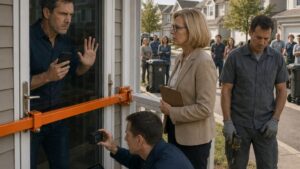
The officer knelt on the pavement and flipped the latches open. Foam padding showed inside, cut around small dark devices, coiled cable, adhesive pads, a handheld receiver. Under the cruiser lights, one object caught a hard white glint: a flat electronic bug with a glossy back, designed to stick and stay.
James Baker looked down at it, then at Daniel’s gate.
Daniel felt the heat that had left the forge return behind his ribs, controlled no longer by valves or switches.
The officer lifted the adhesive listening device from the case and turned toward Daniel’s workshop window.
Chapter 4: The Listening Bug On The Glass
The adhesive bug glinted under the flashlight like a wet black coin.
Daniel watched the officer carry it toward the side path that led along the fence line, not through the gate, not yet, but close enough to make the intention plain. The workshop window faced the driveway at an angle, behind the bars and beyond the chain, still on Daniel’s side of the property line. The glass reflected cruisers, neighbors, and the thin white beam sweeping over it.
“Stop,” Daniel said.
The officer slowed, looking back at Jack Hernandez.
Jack kept his eyes on Daniel. “Proceed.”
Daniel stepped closer to the gate until the bars divided his face into narrow strips. “That device does not cross my property line.”
Jack gave a small, sharp laugh. “Now you’re telling us what equipment we can use?”
“I’m telling you what you cannot attach to my building without a warrant.”
“It’s an emergency safety assessment.”
“It’s electronic surveillance.”
James Baker stood near the open equipment case, his bodycam light blinking on his chest. He looked at the bug in the officer’s hand, then toward Daniel’s window. The hesitation was brief, but Daniel saw it. Jack saw it too.
“You have something to say?” Jack asked him.
James lowered his voice. “That glass is past the gate.”
“The window is visible from here.”
“Seeing is not attaching.”
The words did not travel far, but they traveled far enough. One of the neighbors behind Karen Hill whispered, “Are they allowed to do that?” Karen’s phone lifted higher as if the answer might become useful later.
Jack turned toward the crowd just slightly, then back to Daniel. His whole body seemed to tighten around the need not to be corrected.
“Mr. Torres,” he called, louder now, “you have admitted there are systems on this property. You refuse to identify them. You refuse access. We have a report of fire and possible explosive hazard. If you are so confident there’s no danger, you can open the gate.”
Daniel’s tablet buzzed against his hip again.
He did not look down. He knew the message without seeing it. The grid was waiting. The city’s storage node sat under the trees, quiet, expensive, and legally wrapped in language that had seemed excessive until this moment: unauthorized access, electronic interference, physical tampering, disclosure limits, public safety continuity.
The project manager’s voice came back to him, not as memory but as pressure.
You’re not guarding a battery, Daniel. You’re guarding trust. People panic around things they don’t understand.
He had disliked the sentence then. It sounded like something designed for a brochure. Now it stood behind his teeth, asking to be spoken, and he refused it.
“Nothing crosses this line without lawful authority,” Daniel said.
Jack’s eyes narrowed. “You rehearsed that?”
“I meant it.”
The officer with the bug shifted his weight. He was young too, though not as rigid as Jack. He held the device awkwardly, as if it had become heavier while they argued.
James said, “Hernandez, we should wait for written authorization.”
Jack snapped, “From who? The fire gets permission before spreading?”
“There is no active fire.”
“That’s your guess.”
“That’s my observation.”
Jack took two steps toward him. “Your observation is noted.”
The old anger in Daniel moved, but it did not get loose. It had learned discipline in shops, in inspection rooms, in neighborhood association meetings he had stopped attending after three months because every question aimed at him had sounded like accusation. Why do you need that much power? Why so many cameras? Why the gate? What are you building? Why won’t you just explain?
Because explanation, once demanded as tribute, never ended.
He lifted his phone again and angled it toward Jack, the officer with the bug, and the window behind him.
“For the record,” Daniel said, “I do not consent to electronic monitoring, physical attachment of any device, entry onto the property, or interference with the permitted systems inside.”
Jack stepped close enough that his belt nearly touched the gate. “For the record, your lack of cooperation is creating the urgency.”
Daniel looked at him through the bars. “No. Your impatience is.”
The silence after that was not quiet. Radios hissed. Engines idled. The chain barrier gave its low, steady hum. Somewhere behind Daniel, the storage system’s cooling unit cycled on with a soft mechanical breath.
The sound turned Jack’s head.
“What was that?”
“A secured system stabilizing itself.”
“What system?”
Daniel said nothing.
Jack smiled without warmth. “There it is.”
He turned toward Karen Hill. “Ma’am, did you or did you not report unknown equipment on this property?”
Karen’s eyes flicked from Jack to Daniel. For the first time since the sirens arrived, she seemed unsure of the size of what she had helped create. But her phone was live, neighbors were watching, and fear was easier to stand in than doubt.
“Yes,” she said. “We saw equipment. And smoke. And lights.”
“Did anyone mention batteries?” Jack asked.
A neighbor behind her muttered, “Someone said big battery boxes can go up like bombs.”
Daniel’s grip tightened on his phone.
Jack pointed toward the workshop. “That’s enough for me. Place the device.”
James moved before the officer did, not blocking him, but stepping into the space near the open case. “Jack.”
The first name landed badly.
Jack stared at him. “Move.”
James did not move at once. His bodycam light blinked between them, a small blue eye. “We are being recorded from every angle. He gave a clear legal warning. There is no flame. Fire is not advancing. If this is wrong, it is going to be very wrong.”
For a second, Daniel saw the other story that could still happen. Jack could curse, back down, call for a warrant, blame procedure. Karen’s video would become a neighborhood argument, not a public record of something worse. Daniel could finish the grid check, send a tight report to the city, and add another lock to a life already full of them.
Then Jack looked toward the younger officers watching him and made his choice.
“Interference with an emergency investigation,” Jack said. “That’s where we are now.”
He waved the officer forward again.
Daniel turned his body slightly, enough to see the storage bay down the driveway through the trees. The cabinets were invisible from the street, hidden by design. But the workshop window, if bugged, sat close enough to the control network cabinet that Daniel could not dismiss the risk. He did not know what frequency the device used. He did not know whether it transmitted continuously, whether it paired to the receiver in the case, whether it was even approved for this use.
He did know the city’s agreement had one sentence in bold.
Prevent unauthorized electronic access or attachment within the secured zone.
His silence had protected the project until now. Now it had become another opening for them.
“Officer Baker,” Daniel said.
James looked at him.
“Your camera is recording?”
“Yes.”
“Then record this. If that device touches my glass, it is an unauthorized electronic attachment inside a secured municipal project zone.”
Jack’s head snapped back. “Municipal what?”
Daniel’s mouth closed.
He had said too much, but not enough.
Jack saw the gap and drove straight into it. “So now it’s municipal? A minute ago it was just a forge.”
Daniel said, “Bring a warrant and the authorized contacts will verify what needs to be verified.”
“Or you open the gate.”
“No.”
Jack’s voice dropped. “You’re done setting terms.”
He turned sharply toward the cruisers. “Forget the bug. Bring up the cutters.”
James’s face changed. “Hernandez, don’t.”
Jack pointed at the motorized chain barrier stretched across the driveway.
“We are not standing here all night while he hides behind hardware. Bolt cutters. Now.”
Daniel looked at the chain, dark and taut in the flashing lights, and felt the boundary stop being a symbol. It became a thing someone was about to touch.
Chapter 5: The Bolt Cutters Crossed First
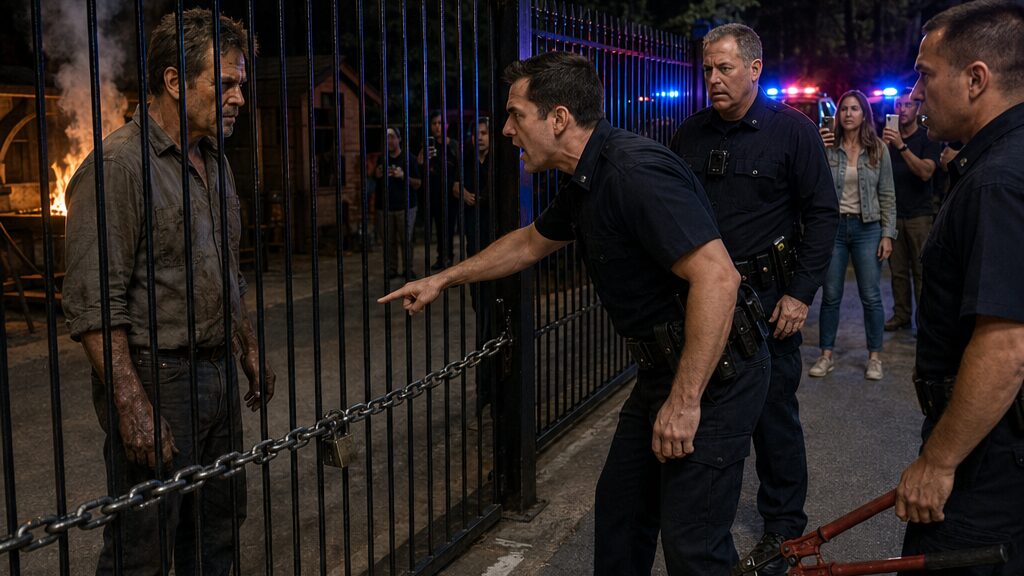
The bolt-cutter jaws slid through the gate bars toward Daniel’s chain before anyone outside had the courage to look him in the eye.
They came in sideways, black steel beaks opening and closing once as the officer carrying them adjusted his grip. The tool was large, handled in both hands, its red rubber grips bright under the cruiser lights. Behind it stood Jack Hernandez with his chin lifted and his hand near his belt, not touching his weapon now but wanting everyone to remember it was there.
Daniel stood six feet back from the gate.
The chain barrier hummed across the driveway between two steel posts. Behind it, the yellow line on Daniel’s concrete looked pale beneath the rotating lights. The cutter jaws hovered just above that line, not touching the chain yet.
“Last warning,” Daniel said. “That tool is crossing onto private property without lawful authority.”
Jack gave the smallest shake of his head, as if disappointed in him. “You don’t get to tell us where the line is.”
Daniel looked down at the painted stripe, the chain, the gate posts set in concrete he had poured himself. “I know exactly where the line is.”
The officer with the cutters hesitated.
Jack’s voice sharpened. “Cut it.”
From the street, Karen Hill whispered, “Oh my God,” and her phone rose another inch.
Daniel heard the whisper. He heard the cruiser engines, the radios, the fire truck idling uselessly at the curve, the neighbors breathing like an audience. He heard, beneath all of it, the unfinished grid check ticking away in the tablet against his hip.
He also heard himself, from years before, telling the city’s project team that he preferred written procedures because spoken promises vanished under pressure. They had laughed politely. Then they had handed him a binder full of procedures and called him the right man for the node.
He had believed that meant they understood him.
Now a rookie with a badge was about to cut through a barrier because people outside it disliked not knowing what was inside.
“Officer Baker,” Daniel said, voice carrying. “Confirm on camera that I have not threatened any person.”
James Baker’s eyes moved to Jack, then back to Daniel. The delay was painful. “You have not threatened any person.”
Jack snapped, “Baker.”
Daniel continued, “Confirm I offered documentation for the forge.”
James swallowed. “You offered documentation.”
“Confirm there is no active flame visible from the street.”
James stared at him. In that second, Daniel did not see an ally. He saw a man weighing his pension, his rank, his place in the department, the anger of a young officer who had turned a mistake into a test.
James said, “No active flame visible.”
Jack stepped toward him. “That is enough.”
“No,” Daniel said. “It is not.”
The cutter jaws opened around the chain.
Daniel moved.
He did not rush the officer. He did not grab a wrist. He did not reach for a person at all. He stepped to the gate, slid his left arm through the bars, and seized the far handle of the bolt cutters where it had crossed past the gate plane. His right hand shot through after it, catching the other handle just above the rubber grip.
The officer jerked back in surprise.
Daniel held.
For a second, all of them froze around the absurd intimacy of it: two men separated by a gate, both gripping the same tool, the chain between them untouched.
“Let go!” Jack shouted.
Daniel’s boots stayed behind the yellow line. His forearms pressed against the cold bars. The cutter handles strained in his hands, metal flexing, the jaws opening wide and useless around the chain.
“This side is mine,” Daniel said.
The officer pulled again. Daniel forced the handles outward, using the bars as leverage. The tool twisted. One jaw scraped against the chain with a shriek but did not bite.
Jack lunged a half step forward. James caught his arm.
“Don’t,” James said.
Jack ripped free. “He’s assaulting—”
“No person,” James said, louder now. “He’s got the tool.”
Daniel heard them, but the world had narrowed to steel. Gate bar against forearm. Cutter handle against palm. Chain vibrating where the jaw had scraped it. He could feel the flaw in the tool’s position, the overextension, the hinge loaded wrong because the officer had pushed it through at an angle.
He had spent half his life listening to metal complain before it failed.
With one hard twist, Daniel wrenched the handles wide. The officer lost his grip and stumbled back. The bolt cutters clanged against the inside of the gate, caught for half a second between two bars.
Daniel pulled them fully to his side.
The street erupted.
Jack shouted. Karen gasped. An officer swore. The fire crew stepped forward and then stopped. Daniel turned away from the gate with the bolt cutters in both hands, carried them three steps back, and dropped them on the concrete beside the yellow line.
Then he picked up the steel wrench from the small maintenance shelf by the gate control box.
It was not theatrical. It was not wild. It was the same wrench he used to adjust the chain tensioner, heavy and plain, its handle darkened from years of use.
“Daniel!” James shouted through the gate. “Don’t make it worse.”
Daniel looked at him.
For a moment the anger almost found a human target. Jack’s face. Karen’s phone. The whole bright cowardly crowd of people waiting to see what kind of villain he would become for them.
He lowered his eyes to the cutters instead.
The first strike landed on the hinge pin with a crack that cut through the sirens.
The second strike bent one jaw out of alignment.
Jack yelled, “Stop!”
The third strike shattered the cutting edge. A bright piece of hardened steel snapped free and skittered across Daniel’s concrete, stopping just inside the yellow line.
Then silence.
Not complete silence. No street full of engines ever went truly quiet. But the human noise vanished, as if every person there had forgotten the next line.
Daniel stood over the broken cutters, wrench in hand, breathing hard through his nose. He had not crossed the gate. He had not touched an officer. He had not swung at a person. The tool lay ruined on his side, its jaws split, its purpose ended.
Jack found his voice first.
“You just destroyed police property.”
Daniel looked through the bars. “Your tool crossed the line.”
“I am placing you under arrest.”
“For what?”
“For obstruction, interference, destruction of police equipment—”
“On my property,” Daniel said.
Jack’s face had gone pale beneath the cruiser lights, which made the red flashes look painted on him. He turned to the officers behind him, searching their faces for the reflection he needed: outrage, support, permission. The younger officer nodded too quickly. James did not.
Karen’s phone trembled in her hand. Her live audience had become invisible weight. Daniel could tell from her expression that the scene no longer fit the shape she had given it. She had called in a fire. She was filming a man destroy a tool pushed through his locked gate.
Jack pointed toward the gate.
“Prepare to breach.”
James stepped in front of him. “No.”
Jack stared. “Move.”
“You need the chief on this now.”
“The chief told me to maintain scene safety.”
“This isn’t safety anymore.”
Jack’s voice cracked through the street. “He took our equipment and destroyed it.”
Daniel set the wrench on the concrete at his feet, visible, away from his hands. Then his tablet buzzed again.
This time he looked.
LOAD TEST WINDOW: 00:07:38.
Below it, a second alert pulsed yellow.
EXTERNAL RF ACTIVITY DETECTED NEAR NODE CONTROL RANGE.
The radios. The surveillance kit. The receiver. The swarm of official panic pressing against the system he had promised to protect.
Jack was still shouting orders. Officers were moving, not yet as one, but enough. One went to a cruiser. Another reached for a heavier case. James was talking into his radio, voice clipped and urgent.
Daniel bent, picked up his tablet, and unlocked the secure folder he had avoided opening all evening.
The city seal filled the screen.
At the gate, Jack shouted, “Breach team forward.”
Chapter 6: The City’s Hidden Battery Under The Trees
Officers moved toward the gate as Daniel’s hands shook over the tablet screen.
The tremor infuriated him more than the shouting. He could steady a glowing piece of steel under a hammer. He could splice a control lead inside a cabinet with sweat running down his back in August heat. But now, with cruiser lights dragging red and blue across the glass, his thumb missed the secure folder twice before the city authentication prompt accepted him.
Behind the gate, Jack Hernandez was turning the ruined cutters into a battle cry.
“He seized equipment. He destroyed it. We are past verbal compliance.”
James Baker’s voice cut in. “We are past clean procedure too.”
Daniel opened the emergency project file.
The first screen showed the city seal, the project number, and three lines that had been written by lawyers who never imagined a rookie officer yelling beside a chain barrier.
MUNICIPAL PHEV STORAGE RESILIENCE PILOT.
AUTHORIZED PRIVATE HOST SITE: TORRES PROPERTY.
UNAUTHORIZED PHYSICAL OR ELECTRONIC ACCESS PROHIBITED.
Daniel carried the tablet to the gate and turned it outward.
“Officer Baker,” he said, because Jack was no longer listening for facts, “record this.”
James looked over.
Jack did too, but with the expression of a man seeing only another trick. “What is that supposed to be?”
“City authorization,” Daniel said. “The equipment behind this gate is a municipal energy storage node. It is funded by the city. It is secured under written agreement. You are attempting unauthorized entry into protected infrastructure.”
For a heartbeat, the words hung there without shape.
Then Karen Hill said from the curb, “Energy storage?”
One of the neighbors whispered, “Like batteries?”
Jack seized on that. “So you admit there are batteries.”
Daniel’s anger sharpened into disbelief. “I am showing you the authorization.”
“You’re showing me a tablet.”
James came closer, stopping beside Jack but angling his body toward the screen. His bodycam light blinked steadily. “Let me see it.”
Jack blocked him with an arm. “Do not validate this.”
“I’m reading a city seal.”
“You’re reading pixels.”
Daniel swiped to the next document: installation approval, inspection certificate, emergency contact tree. Deborah Johnson’s office appeared in the header on the fourth page. Not her personal signature, but the mayoral office authorization line, stamped and dated.
He had not wanted to show any of it to the street. He had not wanted Karen’s phone to capture even a blurred glimpse. The whole point had been discretion. No attention. No curious visits. No one trying to prove the strange boxes under the trees were dangerous.
His silence had built the wall. His silence had also brought them to it with tools.
“Call the city emergency contact,” Daniel said. “The number is on the screen.”
Jack laughed. “You want us to call a number you provide while you stall a lawful emergency response?”
“There is nothing lawful about cutting my chain.”
“You don’t get to launder a hazard through paperwork.”
James leaned toward the tablet. “Hernandez, if this is real—”
“If,” Jack snapped. “If. And if it’s fake and we back off, and something happens back there, whose name is on the scene log?”
The question struck harder than his shouting. For the first time, Daniel heard the fear under Jack’s aggression cleanly. Not just ego. Not just performance. Jack was imagining the headline that would end him: Rookie Waited Outside Locked Gate Before Explosion. He was wrong, reckless, dangerous—but in his own mind, he was already standing trial for hesitating.
Daniel tried to use that.
“Then verify,” he said. “Do not breach. Verify.”
Jack’s radio crackled. A dispatcher’s voice asked for status. Another officer near the cruiser said something about additional supervisors en route. The fire captain spoke quietly with James, gesturing toward the lack of heat shimmer, the empty hose line, the silent house.
Daniel tapped the emergency contact icon.
The call spun.
For three seconds, he heard ringing through the tablet speaker. Then radio noise swallowed it. The screen flickered, the call dropped, and the yellow RF alert pulsed again from the top corner.
CALL FAILED.
Daniel stared at it.
Jack saw his face and smiled. “Problem?”
Daniel called again.
This time the tablet rang once and dropped straight to a connection error.
The storage node hummed under the trees behind him. It was still stable. But the load test window had narrowed to minutes, and every minute spent at the gate meant the check remained incomplete. The equipment was designed to isolate if something went wrong, but forced entry, unknown devices, cut power lines, panicked officers opening cabinets—those were not engineering conditions. Those were human failures.
Daniel looked past Jack to James. “Your radios are interfering with the control channel. Have them step back from the gate.”
Jack barked, “Absolutely not.”
James said, “Could that happen?”
Daniel’s laugh came out once, without humor. “You brought a surveillance receiver to the edge of a battery control site you refused to identify properly.”
Jack pointed at him. “There. He just said control site. He knows exactly what’s back there and hid it during an emergency.”
“I told you it was secured.”
“You hid it.”
“I protected it.”
“You protected it from the police?”
Daniel’s voice dropped. “From unauthorized access.”
Jack turned to the officers behind him. “Heavy pry kit. Now.”
James grabbed his radio. “Chief, we need you direct on this. Now. Possible city infrastructure claim, no active fire, attempted forced entry pending.”
Jack rounded on him. “I gave an order.”
James held the radio like a shield he hated needing. “And I am making sure command owns it.”
The words hit the street. Command owns it.
Jack’s face hardened with humiliation. The younger officers heard it. Karen’s livestream heard it. Daniel heard it and understood that James had not become brave all at once; he had simply found a way to make caution sound procedural.
Daniel seized the moment. He backed two steps from the gate and opened a different file, one he had never planned to show anyone outside city channels. The site schematic appeared: property outline, secured zone, battery cabinets, inverter, manual disconnects, emergency setback distances.
He turned the tablet toward the gate again.
“If anyone breaches without knowing this layout,” he said, “they risk damaging the municipal node and creating the hazard you invented.”
Karen lowered her phone just enough to look with her own eyes.
“The city put that back there?” she asked.
Daniel did not answer her. It cost him. A small part of him wanted to turn on her, to hand her the truth like a blade and ask whether it was enough now, whether his years of quiet had earned a mob at his gate. But the larger part, the part trained by machines and procedures, stayed with the immediate danger.
Jack dismissed the schematic with a chop of his hand. “Fake until verified.”
“Then verify.”
“We will verify inside.”
“No.”
Jack stepped to the gate, close enough that his breath touched the bars. “You lost the right to say no when you destroyed our cutters.”
Daniel held his gaze. “You lost the right to pretend this is safety when you ignored every safe option.”
The heavy pry kit arrived from the cruiser in a long black case.
James spoke fast into his radio, moving away from Jack now. “Chief Smith, this is Baker. I need a direct order. We have documentation visible with mayoral office headers. Repeat, mayoral office headers. Resident claims city-funded storage infrastructure. No active flame visible. Hernandez is preparing breach.”
For the first time, Jack looked uncertain.
Not because of Daniel. Not because of the documents. Because James had put his name, the chief’s name, and the mayor’s office into the same recorded breath.
Daniel’s tablet vibrated again.
The city emergency contact returned his failed call.
He stabbed the answer icon. “This is Torres, Node Three. Unauthorized police breach in progress. I need Mayor Johnson’s office now.”
A voice on the other end changed from sleepy irritation to alarm in two words. “Say again?”
Daniel raised the volume and turned the screen partly toward James’s bodycam.
Before he could repeat it, John Smith’s phone rang from Jack’s hand.
Jack looked down.
The screen lit his face white.
MAYOR CALLING.
Chapter 7: The Mayor Called Before The Gate Fell
Deborah Johnson’s voice came through John Smith’s phone before he could say hello.
“That is city-funded infrastructure. Call off the raid now.”
The words carried because the street had gone quiet enough to hear them. Jack Hernandez stood with the phone in his hand as if it had become another device he did not know whether to trust. John Smith was not there in person yet, but his phone had been patched through Jack’s line, and the mayor’s anger filled the gap between all of them.
Jack looked down at the screen. “Mayor Johnson, this is Officer Hernandez on scene. We have a noncompliant resident, destroyed equipment, possible hazardous—”
“Where is Chief Smith?”
Jack’s mouth tightened. He tapped the phone with stiff fingers and pushed it toward speaker as another cruiser turned into the cul-de-sac. “Chief is en route.”
John Smith’s voice broke in from the call, breathless, as if he had answered from inside a moving car. “Mayor, I’m aware of the situation.”
“No, Chief,” Deborah said. “You are aware of whatever your rookie told you. I am telling you the property you are preparing to breach contains a municipal energy resilience node authorized through my office. Your officers are standing at a secured host site.”
The words municipal energy resilience node moved through the neighbors in whispers. Karen Hill had both hands wrapped around her phone now, the live video catching Jack’s face, the closed gate, Daniel’s tablet, the broken bolt cutters at his feet.
Jack said, “Ma’am, he never identified that until after obstructing—”
“Do not talk over me,” Deborah said.
It was not a shout. It did not need to be.
Daniel stood on his side of the gate with the tablet still lit in his hand. The city seal glowed against his palm. Behind him, the storage node hummed beneath the trees, steady despite the chaos pressed up against its boundary. He had imagined this project failing through heat, equipment fault, software error. He had not imagined saving it from men with badges who believed volume could substitute for verification.
James Baker stepped toward the gate, radio lowered, bodycam still blinking. “All units hold position.”
Jack snapped his head toward him. “I did not give that order.”
John Smith’s voice came through the phone, clipped and hard. “I am giving it. All units step back from the gate.”
No one moved at first. The order had to travel through pride, confusion, adrenaline. Then James took two deliberate steps backward from the bars. The younger officer holding the pry kit lowered it. The fire captain made a subtle gesture, and his crew retreated toward the engine. One by one, the line outside Daniel’s property loosened.
The chain barrier stayed exactly where it was.
Jack did not step back.
Daniel watched him the way he watched metal near fracture. Jack’s face had gone pale, but his eyes were still working, looking for a place to put the humiliation. On Daniel. On James. On the mayor. On the broken cutters. Anywhere but on the choices that had brought him here.
“Chief,” Jack said, voice tight, “he destroyed department equipment. We can’t just—”
“We can,” John said. “And you will stop talking until I arrive.”
Karen’s phone caught that too. Daniel saw her glance at the comments streaming up her screen. Whatever audience she had gathered was no longer watching the suspicious man behind the gate. They were watching officers get pulled backward by a voice from city hall.
Deborah spoke again, each word clean enough to be quoted. “Mr. Torres is the authorized caretaker of that node. He had no obligation to open a private secured site to a warrantless search because neighbors misunderstood forge smoke.”
Karen flinched as if the sentence had crossed the street and touched her.
Daniel looked at her then. Not long. Not with triumph. Just enough for her to know he had heard.
She lowered her phone a few inches, but not all the way.
John Smith’s cruiser arrived with no siren, just lights, and stopped behind the first line of vehicles. The chief got out wearing a jacket over his uniform shirt, hair flattened on one side, face arranged into command before his door closed. He took in the gate, the chain, the officers, the neighbors, the shattered bolt-cutter jaws shining near Daniel’s yellow line.
He saw Karen filming.
His expression changed by almost nothing, which told Daniel he had understood the worst part first. The scene was already public.
John took the phone from Jack. “Mayor, I’m on scene.”
“Then be useful,” Deborah said. “Confirm the site is secure. Confirm your people are outside the property. Confirm no one breaches that gate.”
John turned slowly. “All officers, back from the barrier. Now.”
This time they moved at once.
Jack remained half a beat longer, then stepped back like the pavement had forced him.
James’s bodycam captured it all: John’s order, the retreat, the broken cutters, Daniel still behind the bars holding the tablet. Daniel knew it was being captured because James angled himself without making it obvious, the small blue light turning toward the chief as he approached the gate.
John stopped several feet from it. He looked at Daniel for the first time not as a problem reported up the chain, but as the man on the other side of a mistake.
“Mr. Torres,” he said, “we need to verify the documentation.”
Daniel did not move. “Through the authorized city contact.”
John’s jaw worked. He was not used to being refused after taking charge. “That can be arranged.”
“It should have been arranged before your officers tried to cut my chain.”
Jack shifted behind him. “Chief—”
John did not look back. “Do not.”
The single command struck harder than any shout Jack had given all night.
Daniel felt no pleasure from it. That surprised him. He had expected relief, maybe satisfaction. Instead he felt the dry exhaustion that comes after holding a heavy object too long. His arms ached. His forearms had red marks from the gate bars. The wrench lay on the concrete where he had put it down, safely away from his hands, and the broken cutters looked almost ridiculous now. A ruined tool under official lights.
His tablet buzzed.
The city contact, still on the line, spoke through the speaker. “Mr. Torres, Mayor Johnson’s office is connected. Can you confirm Node Three has not been physically accessed?”
Daniel turned away from the gate for the first time. He looked down the driveway toward the dark shape of the storage bay. “Not accessed. External interference detected. Load check incomplete.”
John heard enough to stiffen. “Is there danger?”
Daniel looked back at him. “There is risk when unauthorized people bring radios, surveillance devices, and pry tools to a secured control site.”
John absorbed the sentence because he had to. Karen’s phone was still up. James’s camera was still blinking. The mayor was still on the line.
“Move the cruisers back from the gate,” John said. “Kill nonessential radios within twenty yards. Fire stays staged but inactive unless Mr. Torres reports a fire condition.”
Jack stared at him as if betrayed. “We’re taking instructions from him now?”
John turned.
The chief’s voice lowered, which made every word clearer. “We are taking instructions from reality.”
Jack’s mouth opened, but nothing came out.
Daniel used the pause. He spoke into his tablet. “Beginning manual stability check now.”
He stepped backward, not retreating, not giving them his back fully until he reached the point where the driveway curved toward the storage bay. Even then, he kept the gate in view. He crossed his own yellow line deeper into his property and moved under the trees with the tablet in both hands.
For the next few minutes, the cul-de-sac watched him work.
That was the strangest humiliation of all. Not the guns, not the shouting, not the false report. The watching. The fact that the work he had kept private out of discipline was now a public performance under emergency lights. He opened the cabinet interface, entered the manual stability sequence, confirmed temperature, voltage, isolation, inverter response. The system accepted each step with small green acknowledgments.
At the gate, John spoke quietly with Deborah. James stood nearby, answering questions in short factual sentences. Jack remained at the edge of the scene, arms stiff, face turned partly away from Karen’s phone.
Karen whispered to someone beside her, “I didn’t know.”
Daniel heard it because the street had stayed too quiet.
He did not answer. He tapped the final confirmation.
NODE 3 STABLE. EVENING LOAD TEST READY.
Only then did his breathing deepen.
When he returned to the gate, John had ended the call with the mayor, but he held the phone like it was still hot. He looked at Daniel with the strained expression of a man trying to build a bridge out of the same materials he had just used as a barricade.
“Mr. Torres,” John said, “we will be opening an internal review.”
Daniel looked at the shattered cutters. “That is not the same as admitting what happened.”
John’s eyes flicked toward Karen’s phone.
That was answer enough.
A neighbor’s voice rose from behind Karen. “Wait, so he was powering the city? And they tried to break in?”
Another neighbor said, “She’s still live.”
Karen looked at her screen. Her face drained.
The video had not just captured the mayor’s call. It had captured John Smith ordering his people back after the attempted breach, James Baker’s warnings, Jack’s refusal to slow down, Daniel’s legal statements, the broken bolt cutters, the chain still locked and uncut. It was already moving beyond the cul-de-sac faster than any official statement could follow.
John seemed to understand at the same moment.
He turned slightly toward Jack, voice low enough to be private only if cameras had not existed.
“Do not say another word on camera.”
Chapter 8: The Apology Beside The Broken Cutters
John Smith approached the podium with a paper that did not contain the word warrant.
Daniel knew because he had read it ten minutes earlier, standing beside the city hall side entrance while two officials argued in whispers and a camera crew tested the lights inside the press room. The statement called the siege “an unfortunate communication failure.” It called Jack Hernandez’s attempted breach “an effort to assess perceived danger.” It called Daniel’s property “the site in question,” as if the gate, chain, forge, and broken bolt cutters had belonged to no one.
Now John placed that paper on the podium and looked out at the cameras.
Daniel stood to the side, not behind him, not close enough to look like support. Deborah Johnson stood on the other side with her hands clasped tightly in front of her jacket. Her face had the controlled fury of someone who had spent the morning learning how many departments had failed to send one another the right notice, and how quickly that failure had become a weapon in the wrong hands.
Jack was not at the podium. Daniel had seen him once through a side hallway window, standing near the back wall in plain clothes, eyes fixed on the floor while a senior officer spoke into his ear. He looked younger without the command voice. Not innocent. Just smaller.
John adjusted the microphone.
“Yesterday evening,” he began, “officers responded to a report of a possible structural fire and hazardous equipment at a private residence on—”
Daniel listened to the first sentence and felt the old pattern closing around him. Possible. Hazardous. Responded. Passive words. Words that spread responsibility until no hand could be seen holding the tool.
John continued. “Due to a lack of complete information regarding a municipal energy project at the property, the situation escalated into a communication failure between agencies, residents, and responding personnel.”
Daniel looked down at his own hands. The marks from the gate bars had darkened overnight. Thin red bands across his forearms. He had refused a doctor, refused a private meeting with the department’s attorney, refused three different suggestions that he stand silently while the city handled the optics.
He had been silent for years.
Silence had brought him to a podium where they were preparing to apologize to the air around him.
John looked ready to move to the next paragraph.
Daniel stepped forward.
The room changed before he spoke. Cameras shifted. Deborah’s eyes moved to him, and after one tense second, she did not stop him.
John turned his head. “Mr. Torres—”
Daniel looked at the paper on the podium. “Say what was violated.”
The sentence was not loud. It did not need to be. Every microphone caught it.
John’s fingers flattened on the paper. “This is not the format for—”
“Then make it the format.”
A reporter near the front lifted her pen. Another camera zoomed closer. Somewhere behind Daniel, a phone buzzed again and again with notifications he had stopped checking before sunrise.
John lowered his voice. “Mr. Torres, we discussed—”
“No,” Daniel said. “Your office discussed. Your officers came to my locked gate without a warrant. Your officer ordered an electronic device toward my window. Your officer ordered bolt cutters onto my chain. Your officer ordered a breach after I stopped the tool on my side of the property line. If you are apologizing, name it.”
For one second, John’s face hardened into the same command mask Daniel had seen the night before. Then his eyes flicked to Deborah.
She did not rescue him.
“Chief,” she said, calm and cold, “the city would also benefit from precision.”
John looked back at the cameras. The paper beneath his hands had become useless.
Daniel stepped back to his place.
He had not wanted this either. That was the private truth no one in the room would understand. He did not enjoy cameras. He did not want strangers repeating his name with little flags of outrage attached to it. He did not want the municipal grid photographed, mapped, debated, or turned into another thing people pretended to understand after thirty seconds online.
But he wanted the boundary named.
John took a breath. When he spoke again, the words came slower.
“Mr. Daniel Torres’s rights were violated.”
The room stilled.
John forced himself to continue. “Responding officers did not possess a signed warrant. Mr. Torres clearly stated that he did not consent to entry, electronic surveillance, or physical interference with his property. Despite those statements, officers escalated toward unauthorized surveillance and attempted forced entry at his gate. That was wrong.”
Daniel did not look away.
John’s voice roughened, not with emotion Daniel trusted, but with the strain of public admission. “The department accepts responsibility for that escalation. We apologize to Mr. Torres for treating a lawful resident and authorized municipal infrastructure host as a threat without proper verification.”
A flash went off.
Then another.
Deborah stepped to her microphone and did what politicians did: contained the blast radius. She acknowledged the municipal project, the communication gap, the need for review, the importance of public safety and constitutional limits existing together. Daniel listened only enough to know she was not undoing what he had forced John to say.
When the questions started, they came sharp.
“Chief Smith, has Officer Hernandez been suspended?”
“Were officers authorized to use the electronic device?”
“Why did the department ignore the absence of visible fire?”
“Mayor Johnson, why were neighbors and local emergency responders not informed of the secured energy site?”
Deborah answered some. John answered fewer. Daniel answered only one.
A reporter asked, “Mr. Torres, do you regret not telling neighbors what was on your property earlier?”
The room turned toward him.
There it was, the softer version of the accusation that had chased him for years. If only you had explained yourself sooner. If only you had been easier to know. If only your privacy had been less inconvenient to other people’s fear.
Daniel leaned toward the microphone.
“I regret that my silence made it easier for people to imagine danger,” he said. “I do not regret refusing a warrantless entry.”
The answer did not satisfy everyone. He saw that immediately. Some wanted anger. Some wanted forgiveness. Some wanted a cleaner victim, a cleaner villain, a story without the discomfort of shared mistakes and unequal consequences.
Daniel had no interest in giving them one.
When the press conference ended, he did not shake John Smith’s hand. John did not offer it. That, at least, was honest.
Deborah walked with Daniel to the side exit. “We should have briefed the department better,” she said.
“Yes.”
“I’m sorry.”
Daniel stopped at the door. Through the glass, beyond the steps, he could see the wooded edge of the city hall parking lot. Not his trees. Not his gate. But enough shadow and branch to make him want home.
“Apologize in writing,” he said. “To the record.”
Deborah nodded once. “You’ll have it.”
By late afternoon, the cruisers were gone from his cul-de-sac, but tire marks remained near the curb. Neighbors watched from windows when Daniel’s truck turned into the driveway. Karen Hill stood on her porch with her arms wrapped around herself, phone nowhere visible.
Daniel stopped at the gate and got out.
The chain barrier waited across the entrance, uncut. The gate stood closed. On the inside of the yellow line, exactly where he had left them for the city investigator to photograph that morning, lay the broken bolt cutters. Their jaws were split open, useless, almost delicate in failure.
Daniel picked them up by one handle and carried them to the workbench near the forge.
The forge was cold. The storage node hummed steadily under the trees. On the small television mounted inside the workshop, the evening news replayed John Smith’s apology with captions beneath his face.
Mr. Torres’s rights were violated.
Daniel watched the line once. Only once.
Then he turned off the television, walked back to the gate, and pressed the remote on his belt.
The motor engaged with a low familiar hum. The heavy chain tightened, rose, and settled into place across the driveway. Daniel stood behind it until the lock clicked.
The sound was small, metallic, final.
Then he turned toward the trees and went back inside his own property.
The story has ended.