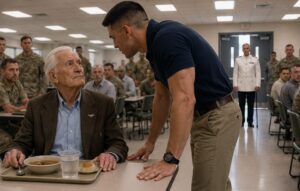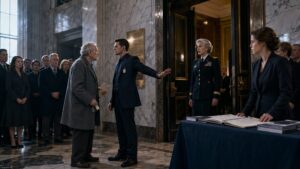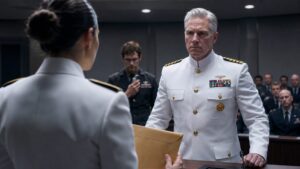
The Security Chief Slammed an Old Woman Down Before Learning Who Controlled the South Gate
Chapter 1: The Woman Brandon Chose to Remove
“Restraints.”
The order came before Deborah White had taken her second step across the polished black line marking the South Gate entrance.
She stopped beneath the revolving door’s brass frame. Behind her, a valet eased a silver sedan toward the curb. Ahead, the lobby opened in marble, glass, and pale light, every surface designed to reflect wealth without showing the people who cleaned it.
The man blocking her path wore a dark security uniform with a silver nameplate: Brandon Baker. He was broad through the shoulders, his hair cut close enough to display the red pressure line from his cap. One hand rested on his belt. The other pointed at Deborah as if he had already finished deciding what she was.
A younger guard emerged from beside the reception counter.
“Sir?” he asked.
“I said restraints, Rivera.”
The young man slowed. His badge read Andrew Rivera. His eyes moved from Deborah’s gray coat to her face, then to the worn leather bag hanging from her shoulder.
Deborah looked at Brandon. “You haven’t asked my name.”
“I don’t need your name.”
“That usually comes before restraints.”
A few guests near the elevators turned. Brandon noticed them noticing. His chin lifted.
“We received an alert about a wanted individual entering the property.”
Deborah glanced past him. Behind the marble counter, a woman in a navy reception jacket stood with one hand resting on a sheet of paper. Linda Lee, according to the small plaque beside her terminal. The paper showed a grainy photograph of an older woman caught beneath harsh exterior lighting.
Linda folded it once.
Too quickly.
Deborah’s appointment was on the forty-second floor. Amy Flores expected her at four-thirty, though not by the South Gate. Paul Anderson’s driver had been instructed to collect her from home, escort her through the executive garage, and deliver her directly to the private elevator.
Deborah had canceled the car without telling Paul.
A controlled entrance showed a visitor what an organization wanted seen. A public entrance showed what it believed no one important would notice.
Brandon took one step closer. “You need to come with us.”
“I am expected upstairs.”
“That’s what they all say.”
“They?”
His mouth tightened. “People who don’t belong here.”
The answer was too polished to be spontaneous.
Deborah shifted her gaze toward the ceiling. Two black camera domes covered the entrance and the elevator corridor. A third, positioned above the reception counter, sat at a slightly wrong angle. Its status light was dark.
“Your camera is disabled,” she said.
Brandon glanced up despite himself.
Linda’s fingers tightened around the folded bulletin.
That was the first thing Deborah had seen that interested her more than the insult.
She reached slowly into the inside pocket of her gray coat.
Andrew’s hand moved toward his belt.
“Identification,” Deborah said.
She produced a leather card holder and offered it to Brandon. He took it without looking down.
The coat had belonged to no institution. It was not tailored, armored, or expensive. Its sleeves had softened at the cuffs, and one pocket had been repaired twice with thread slightly darker than the wool. Deborah wore it because it was warm, because it did not invite conversation, and because no one studied a woman in an old gray coat unless they wanted her moved.
Brandon held the card holder between two fingers.
Linda cleared her throat. “Chief, the person in the notice—”
“I know what the notice says.”
“The age range is younger.”
Brandon turned his head slowly. “Did I ask for an assessment?”
Linda lowered her eyes.
Deborah watched the movement. Fear, not uncertainty.
“Open the identification,” Deborah said.
Brandon smiled without humor. “You don’t give instructions here.”
“No. Your written procedure does.”
His eyes sharpened.
“The alert photograph shows a woman with a scar above her right eyebrow,” Deborah continued. “I have no such scar. The subject is listed as approximately fifty-five. I am sixty-eight. She is wearing a green field jacket. Mine is gray.”
A man standing near the concierge desk raised his phone.
Another employee did the same.
Brandon saw the screens. His authority had become a performance, and Deborah could almost mark the instant retreat ceased to be available to him.
He lifted the folded bulletin from behind the desk and opened it just enough to inspect the photograph. The look lasted less than a second.
Then he turned the page facedown.
“You’ve memorized the notice,” he said. “That makes me more suspicious, not less.”
“I read what was visible from the door.”
“You expect me to believe that?”
“I don’t require your belief. I require verification.”
The valet doors opened behind her. A family entered with wheeled luggage. Brandon moved sideways, placing his body between Deborah and the rest of the lobby, but not before the father caught sight of Andrew’s half-raised restraint pouch.
Deborah looked toward the side corridor leading to the hotel service elevators. The access panel carried an older model card reader, one scheduled for replacement under the acquisition’s risk plan. Beyond it lay a loading passage connected to the emergency control room. She had reviewed the diagrams the night before.
Brandon followed her gaze.
“Checking exits?” he asked.
“Checking whether your building matches its reports.”
For the first time, uncertainty touched his face.
It disappeared almost at once.
He stepped closer until she could smell coffee beneath the sharp scent of his uniform starch. “Last month, a trespasser got past this desk and reached the guest floors. Management blamed my department. Three people almost lost their jobs. So I don’t care how calm you sound or what story you brought with you. I keep this entrance clean.”
There it was: a reason he could repeat to himself until cruelty resembled duty.
Deborah looked at the employees filming from a distance, the dark camera above the counter, Linda’s hidden paper, Andrew’s rigid shoulders.
“This entrance is not clean,” she said. “It is frightened.”
A flush rose along Brandon’s neck.
He thrust her unopened card holder at Andrew. “Run it.”
Andrew accepted it. His thumb touched the edge, but Brandon blocked his path toward the terminal.
“Actually, no. We’ll let the police confirm everything.”
A cruiser was already visible through the tinted glass, parked beyond the valet lane as if it had been waiting before Deborah arrived.
She felt something inside her settle.
Not fear. Recognition.
Years earlier, another uncertain image had been treated as certainty because men under pressure wanted movement more than truth. Deborah had told herself there would be time to correct the record after the operation began.
There had not been.
“Chief,” Andrew said quietly, “my camera is running.”
Brandon looked toward the small lens clipped to Andrew’s chest.
He took Deborah’s card holder back, snapped it shut without opening it, and slipped it into his own pocket.
Then he pointed at the body camera.
“Turn that off.”
Chapter 2: The Marble Counter and the Missing Camera
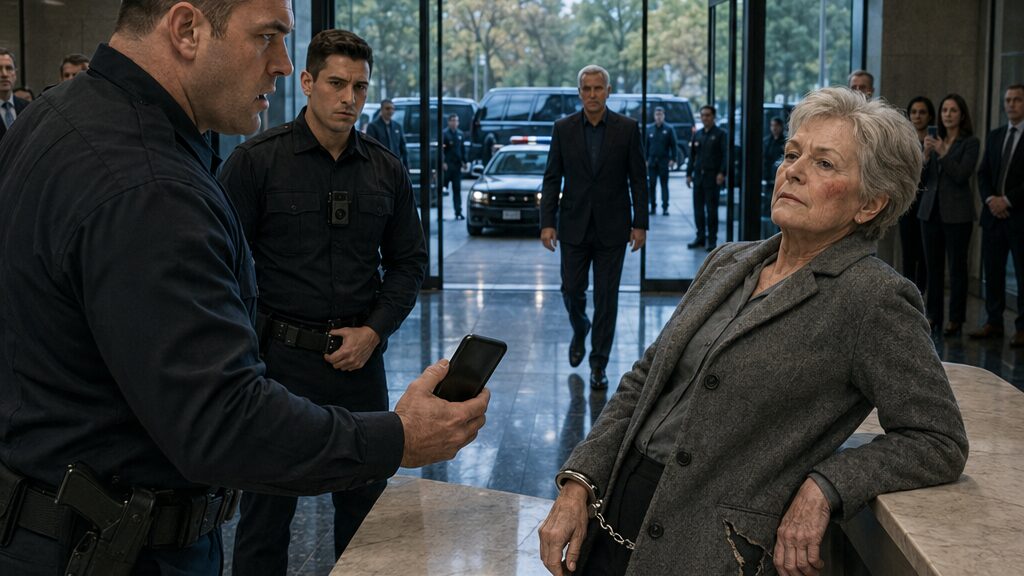
Brandon emptied Deborah’s bag onto the marble counter as if he were displaying evidence after a raid.
Her reading glasses struck the stone first. Then a plain wallet, a packet of tissues, two peppermints, a narrow notebook, a capped pen, and the secured black phone Paul had insisted she carry.
A hotel key envelope belonging to someone else slid beneath the notebook. Linda reached for it, then stopped when Brandon looked at her.
Guests had formed a loose semicircle at a safe distance. No one came closer. Several phones remained raised.
“Nothing dangerous,” Andrew said.
Brandon opened the wallet. “That remains to be seen.”
Deborah stood with her hands visible. “You have not established lawful grounds for a search.”
“This is private property.”
“That does not convert suspicion into consent.”
“You entered after being told to stop.”
“You ordered restraints before speaking to me.”
He pulled the inner lining of the bag outward. “And now I know why.”
“For carrying peppermints?”
A few people shifted. Someone near the elevators gave a brief, nervous laugh.
Brandon’s head turned toward the sound. The laugh died.
He picked up Deborah’s notebook. Its cover was dark blue, softened at the corners. He flipped through pages of short, orderly entries: times, door positions, camera locations, staff responses.
“What is this?”
“Observations.”
“You’re casing the building.”
“I wrote that your east camera is obstructed by decorative lighting.”
Linda’s eyes flicked toward the ceiling.
Brandon turned several pages. “Four-twelve. Valet left keys unattended. Four-fourteen. Delivery entrance held open fourteen seconds.” He looked at Deborah. “Who sent you?”
“You still haven’t opened my identification.”
The police cruiser’s lights were not flashing. Through the glass, an officer sat behind the wheel speaking into a radio. Brandon seemed reassured by the sight.
He reached for Deborah’s coat pocket.
She moved back half a step.
Andrew immediately raised both hands. “Ma’am, please don’t move.”
Deborah looked at him. “Did he authorize a clothing search in writing?”
Andrew’s lips parted.
Brandon seized the pocket and pulled.
The old stitching tore with a dry rip.
The notebook’s duplicate pencil, hidden in the lining, dropped to the floor. A narrow plastic credential sleeve remained caught inside the torn wool, but only its blank backing showed.
Brandon held the flap of damaged fabric. “Concealed compartment.”
“A repaired pocket.”
“Same difference.”
“No,” Deborah said. “That distinction is the entire problem.”
He released the cloth. The pocket sagged open against her hip.
Linda moved a hand toward the folded bulletin again.
Deborah saw it and spoke directly to her. “Read the description aloud.”
Linda froze.
“Don’t involve my staff,” Brandon said.
“She was involved when you used the notice she received.”
Linda’s face had lost color. “The subject is approximately five foot six.”
Deborah was barely five foot three.
Brandon slapped the notebook down. “People lie about height.”
“The report says fifty to fifty-eight,” Linda continued, words coming faster now. “Dark green jacket. Facial scar above the right eye. Last seen near the transit station.”
“Enough.”
“And it says she may be seeking shelter,” Linda finished.
The lobby went still.
Not armed. Not violent. Not accused of theft.
Seeking shelter.
Brandon leaned across the counter. “The police sent a request to locate her.”
“No,” Linda said, quieter. “They sent a welfare bulletin.”
His stare landed on her with such force that she stepped back.
Deborah watched the employees watching Linda. This was how a procedure became a culture: not through one order, but through the price attached to correcting it.
Brandon turned to Andrew. “Give me her identification.”
Andrew glanced down. At some point during the search, he had opened the card holder. Deborah saw recognition pass across his face—not of her former title, which was absent, but of the valid state seal and address.
He closed it and held it out.
Brandon took a step toward him.
Andrew shifted instead toward Deborah.
His hand brushed hers as he returned the card holder.
“Leave,” he whispered. “Before the officer comes in.”
Brandon was speaking to Linda and did not see.
Deborah slipped the identification into the torn pocket, where it hung precariously against the lining.
Andrew’s fear was visible now. So was his calculation. Probationary stripe. Inexpensive watch. A health-plan enrollment card tucked behind his badge when he turned. He had something to lose and had been taught that obedience placed responsibility elsewhere.
Deborah bent, picked up her pencil, and wrote his name in the notebook.
Andrew saw.
His face tightened. “Are you reporting me?”
“I’m recording who was here.”
“That’s the same thing.”
“No. It depends what you do next.”
The officer climbed out of the cruiser.
Brandon straightened his uniform. “Last chance. Walk outside quietly, admit you entered under false pretenses, and this stays simple.”
It was an offer now. Not mercy—erasure.
Deborah looked at the dark camera above the marble. She imagined the bulletin disappearing after midnight, the search report describing her as confused, aggressive, unable to provide identification. The next woman would not have a secured phone. She might not know how to read a room faster than the men controlling it.
Deborah began placing her belongings back into the bag.
Brandon smiled. “Good decision.”
She put away the glasses, tissues, wallet, and peppermints. She left the notebook on the counter.
“I’m not leaving.”
His smile vanished.
“The original notice must be preserved,” she said. “So must the disabled-camera record, the body-camera command, and every incident report produced under the same removal procedure.”
“You think you’re conducting an investigation?”
“I think someone should.”
The officer entered through the glass doors. He looked first at Brandon, not Deborah.
That answered another question.
Brandon moved around the counter. “She refused multiple lawful directions, attempted to access restricted elevators, and became confrontational during a safety search.”
“I did none of those things.”
The officer reached for his handcuffs.
Andrew stared at the floor.
Linda pushed the original bulletin beneath a folder, protecting it or hiding it—Deborah could not yet tell which.
Brandon picked up the blue notebook and tore out the page containing Andrew’s name.
Deborah’s restraint cracked.
She reached for the page.
Brandon caught her wrist.
Pain shot through her thumb and up the arm. He twisted until her shoulder drew forward.
“Let go,” she said.
“You don’t command anyone here.”
“You are exceeding the restraint threshold stated in your own manual.”
His eyes flicked toward the watching employees.
Deborah saw the decision arrive.
Not confusion. Not fear.
Choice.
He drove her forward.
Her cheek struck the marble counter with a blunt white flash. Her teeth cut the inside of her lip. The edge pressed beneath her ribs as Brandon forced her arm high behind her back.
Someone gasped.
Deborah tasted blood.
Above her, reflected in the polished stone, Brandon’s face looked calm again.
Chapter 3: Five Minutes Before the South Gate Closed
The handcuff closed around Deborah’s wrist one metal tooth at a time.
“She became violent,” Brandon told the officer.
Deborah’s cheek remained pressed against the marble. Blood warmed the corner of her mouth and touched the collar of her gray coat. Brandon held her right arm behind her while the officer reached for the left.
“She reached for me,” Brandon continued. “My team used minimum necessary force.”
The officer looked at Andrew. “That accurate?”
Andrew’s body camera faced the floor. Its status light had gone dark when Brandon ordered it off.
Andrew swallowed.
“No,” he said.
Brandon’s grip changed.
Not much. Enough for Deborah to feel it.
The officer paused. “No what?”
“She didn’t reach for him. She reached for a page he tore out of her notebook.”
Brandon laughed once. “Rivera’s been on the job six weeks. He lost his view during the struggle.”
“My camera kept recording audio.”
The sentence altered the lobby.
Deborah felt the change before anyone moved. Linda lifted her head. The officer’s hand stopped near the second cuff. Brandon’s palm went damp against Deborah’s sleeve.
“You turned it off,” he said.
“I turned off the lens,” Andrew replied. “The audio buffer continues unless the unit is docked.”
“You told me it shut down completely.”
“You never asked.”
There was no triumph in Andrew’s voice. Only terror shaped into words.
Brandon released Deborah’s arm and stepped toward him.
“Stay where you are,” the officer said.
Brandon looked offended. “He works for me.”
“Not at this moment.”
Deborah slowly lowered her arm. The cuff remained locked around her right wrist, its short chain hanging loose. She did not straighten yet. The marble supported more of her weight than she wanted anyone to know.
Her old instinct urged silence.
Observe. Accumulate. Wait until the position was certain.
That instinct had once kept her alive. It had also helped bury a mistake beneath sealed reviews and carefully limited language. There was always a reason to delay exposure until the evidence was perfect. Perfection usually arrived after the injured had stopped waiting.
She pushed herself upright.
The room tilted briefly. She steadied one hand on the counter.
Linda moved toward her. “You’re bleeding.”
“I know.”
Brandon pointed at Deborah. “She entered under false pretenses. She has surveillance notes. She could be involved in corporate espionage.”
The officer looked at the scattered contents of her bag. “Ma’am, can you explain why you were documenting security systems?”
“Yes.”
She said nothing more.
Brandon seized the pause. “See? Evasive.”
Deborah looked toward the glass doors. The cruiser occupied the central curb lane. Beyond it, hotel traffic continued to move, though valets had begun steering vehicles away from the entrance.
“How long since the first physical contact?” she asked Linda.
Linda checked the terminal clock. “Two minutes. Maybe a little more.”
Brandon gave a disbelieving shake of his head. “What does that matter?”
Deborah turned to Andrew. “My phone.”
He glanced at Brandon.
That hesitation was the remaining chain between them.
Then Andrew picked up the secured black phone and placed it on the marble within Deborah’s reach.
Brandon snatched it first.
“You don’t get to call anyone until the officer clears it.”
The officer frowned. “Chief—”
Brandon pressed the side button. The screen illuminated but remained locked.
“Who are you going to call?” he asked Deborah. “A shelter lawyer? Someone upstairs who’ll claim you had an appointment?”
“Paul Anderson.”
The name erased some of the color from Linda’s face.
Brandon’s expression held, but only because he had not yet placed it. “And who is that supposed to be?”
“Give me the phone.”
He studied her bruised cheek, the torn coat, the open cuff hanging from her wrist.
Then he smiled.
“Let’s hear it.”
He held the screen toward her face. The device unlocked.
A single emergency contact appeared beneath the secure interface.
GENERAL PAUL ANDERSON.
Brandon’s thumb stopped.
He knew the name now.
Paul’s company did not own the hotel security contract directly. It owned the emergency network behind it—the armored response teams, crisis communications, continuity systems, and acquisition security review capable of terminating every local subcontract with one finding.
Brandon glanced toward Linda, hoping for contradiction.
She gave none.
He could still have handed Deborah the phone privately. He could have released the cuff, stepped back, and claimed confusion.
Instead, because the officer was watching and the employees had their cameras raised, he tapped the call button and placed the phone on speaker.
The line connected before the first full ring.
“Deborah?”
Paul’s voice contained none of the softened patience people often used with older women. It was alert, immediate, and already moving.
Deborah looked at the clock behind the reception desk.
“General,” she said, “your boys at the South Gate just put hands on me. You have five minutes before I end their careers.”
Silence held for half a second.
Then Paul asked, “Are you restrained?”
“One cuff.”
“Injured?”
“Documentable.”
“Threat active?”
Deborah looked at Brandon.
He stepped back.
“Contained for the moment.”
Paul’s voice hardened. “Secure the building. Nobody leaves.”
Movement sounded on his end—doors, clipped orders, an engine starting.
Brandon reached toward the phone. “This is a misunderstanding.”
Deborah covered it with her left hand.
“No,” she said. “A misunderstanding ends when evidence corrects it.”
She turned to the officer. “Do not remove this cuff until it has been photographed in place. Do not allow anyone to access the security terminal. The bulletin beneath Linda’s folder is original evidence.”
Linda pulled the paper free and placed both hands over it.
Brandon looked toward the control-room corridor.
Andrew moved into his path.
The younger guard’s knees were nearly trembling, but he stayed there.
“You step aside,” Brandon said, “or you’re finished in this industry.”
Andrew’s mouth worked before sound came. “Maybe.”
The officer touched his radio. “Requesting a supervisor and evidence unit at the South Gate.”
Brandon stared at him. “We have handled hundreds of removals together.”
The officer’s expression tightened at the word hundreds.
Deborah heard it too.
There would be time later to determine whether Brandon had exaggerated. For now, the sentence belonged in the record.
“Linda,” Deborah said, “note the exact time of his statement.”
Linda pulled a receipt roll from the printer and wrote with shaking fingers.
The clock advanced.
One minute since the call.
Paul returned to the speaker. “External team is ninety seconds out. Internal data freeze has started.”
Brandon’s eyes snapped toward the dark camera. “You can’t access our system without authorization.”
“The emergency continuity agreement grants access when record destruction is reasonably suspected,” Deborah said. “You disabled a camera during an active detention.”
“That camera malfunctioned this morning.”
“Then the maintenance record will support you.”
His jaw flexed.
Two minutes.
A low engine sound rose beyond the glass—not one vehicle, but several moving together.
Guests near the elevators turned toward the entrance.
Brandon looked at Deborah’s coat as if seeing it for the first time. Its torn pocket hung open. Blood marked the collar. Nothing about it had changed, except that he now understood his mistake could reach farther than the lobby.
“You came here deliberately,” he said.
Deborah did not answer.
That truth belonged to a later room.
Tires screamed outside.
A black SUV cut across the valet lane and stopped nose-to-nose with the police cruiser. A second sealed the exit. Two more arrived from opposite directions, enclosing the curb in a precise square.
Doors opened almost simultaneously.
Men and women in dark civilian response gear stepped out. Their weapons remained holstered, but their formation made the hotel guards look suddenly ornamental.
The lobby doors slid apart.
Paul’s voice came through the phone one final time.
“South Gate secured.”
Deborah looked at Brandon.
The confidence had left his face. What remained was not remorse. It was calculation discovering that every exit had closed.
She checked the clock.
“Three minutes,” she said.
Chapter 4: The Order Deborah Refused to Give
Paul Anderson entered the lobby, saw the cuff hanging from Deborah’s wrist, and reached for Brandon Baker.
“Stop.”
Deborah did not raise her voice.
Paul froze with one hand inches from Brandon’s collar.
The response team had spread through the South Gate with mechanical precision. Two members guarded the glass doors. Another stood beside the security corridor. A technician had already opened a hardened laptop on the concierge desk. Hotel guests had been directed away from the entrance, though several remained visible behind the elevator partition, holding their phones above one another’s shoulders.
Paul looked at the blood on Deborah’s coat.
“He assaulted you.”
“Yes.”
“He restrained you without cause.”
“Yes.”
“And you want me to stop?”
“I want you to think.”
His jaw worked. He was in his early sixties now, silver at the temples, but anger returned something of the officer Deborah had once commanded—the man who believed speed could make uncertainty irrelevant.
Brandon edged backward.
Paul noticed.
“Move again,” he said, “and I will put you on the floor.”
“No,” Deborah said.
The word was sharper this time.
Paul turned toward her.
“No one touches him,” she continued. “No weapons drawn. No private interrogation. No removal from camera coverage.”
“The camera is dead.”
“Then put him where the others work.”
Paul’s gaze lifted to the black dome above the counter. “Who disabled it?”
Brandon straightened. “It malfunctioned.”
Deborah nodded toward the security corridor. “Preserve the maintenance records. Do not search beyond the continuity authority in your contract. We are not replacing one unlawful detention with another.”
The officer stepped closer. His earlier confidence had thinned. “Ma’am, I should remove that cuff.”
“Not yet.”
“You may have a wrist injury.”
“Photograph it first. In place. Both sides.”
Paul looked as though he wanted to argue. Deborah held out the restrained hand.
“This is evidence, General.”
The title affected the room differently now. Brandon flinched. Andrew lowered his eyes. Linda stared at Deborah’s torn coat as if trying to reconcile it with the word.
Paul signaled to a response-team member carrying a camera. The cuff was photographed against Deborah’s bruised wrist, then measured for tightness. Only after the officer recorded the serial number did Deborah allow him to unlock it.
Pain returned with circulation. She flexed her fingers once and stopped when they trembled.
Paul removed his jacket.
“Put this on.”
Deborah looked at the dark, tailored fabric.
“No.”
“Your coat is torn.”
“That is why I’m keeping it.”
He glanced at the blood drying near its collar. Understanding came slowly and displeased him.
The technician at the concierge desk raised a hand. “Continuity freeze confirmed. External backups are locked. Local deletion permissions suspended.”
Brandon stepped forward. “You cannot seize private corporate data because someone made a phone call.”
Amy Flores’s voice came from the revolving door.
“He can if someone triggered the emergency evidence clause three minutes before a scheduled acquisition review.”
She entered carrying a slim case and wearing the expression of an attorney who had arrived at the worst possible fact before being told what it was. Her eyes moved from Deborah’s face to Paul’s response team, then to the surrounded police cruiser outside.
“Tell me nobody has drawn a weapon.”
“No one has,” Deborah said.
Amy exhaled. “Tell me nobody has been detained by a contractor.”
“No one has.”
“Then why are the exits blocked?”
“To prevent destruction of records.”
Amy looked at Paul. “Your agreement permits a data freeze. It does not permit turning a hotel into a military installation.”
“It isn’t military,” Paul said.
“That distinction will comfort the board.”
Deborah picked up her blue notebook. The torn page containing Andrew’s name lay on the counter, wrinkled but intact.
“Amy,” she said, “establish civilian evidence control. Independent vendor, chain of custody, written limits. Paul’s people secure equipment until they arrive.”
Amy studied her. “You were supposed to be upstairs twenty-seven minutes ago.”
“I know.”
“You came through this entrance deliberately.”
Paul’s head turned.
There it was—the truth she had withheld even from him.
Deborah slipped the notebook into the damaged pocket of her coat. “I wanted to see the South Gate without an escort.”
Paul’s anger changed direction. “You canceled the driver.”
“Yes.”
“You knew there were concerns.”
“I knew the reports were too clean.”
“So you tested the building alone.”
“I entered through the public door.”
“That is not an answer.”
“It is the relevant fact.”
For a moment they faced one another across the marble counter: Paul furious because she had risked herself, Deborah unwilling to admit how much of that risk had come from believing she could control every room without being known.
Linda approached with a tablet held against her chest.
“I have the incident log,” she said.
Brandon’s head snapped toward her. “You do not release internal records.”
Linda nearly stopped.
Deborah said nothing.
Linda looked at Brandon, then at the disabled camera above them. She placed the tablet on the counter.
“The visible log only goes back six months,” she said. “There should be two years.”
The technician connected a sealed drive. Lines of recovered directory entries appeared across the laptop screen.
“Deletion events,” he said. “Multiple.”
Amy moved closer. “Dates?”
“Some entries were removed last week. Others immediately after individual incidents.”
Brandon folded his arms. “Old files are purged under retention policy.”
Linda shook her head. “Not incident files.”
He turned on her. “Your department missed the trespasser last month. I protected your staff when management wanted terminations.”
“You told us to stop writing descriptions in the public log.”
“For privacy.”
“You told us to use classifications instead.”
Brandon laughed dismissively. “Because receptionists are not investigators.”
The technician opened a recovered index.
A list filled the screen.
Unauthorized presence. Confused individual. Welfare removal. Identity discrepancy.
Deborah counted the entries carrying Brandon’s approval code.
Eleven.
Each had a short notation beside it.
Subject claimed mistaken identity.
Subject unable to verify invitation.
Subject became noncompliant.
The words were familiar in the way old injuries were familiar—not because they matched a memory exactly, but because they had been designed for the same purpose. They converted uncertainty into guilt and resistance into proof.
Andrew stepped beside Linda.
“That one,” he said, pointing at the fifth entry. “She had a room key.”
Brandon stared at him. “You were not present.”
“I heard you discussing it afterward.”
“You heard a security review.”
“I heard you say the hotel would rather refund one night than let someone like her cross the lobby again.”
The room went quiet.
Amy closed her eyes briefly. When she opened them, the calculation in her expression had become more severe.
“If these records connect to the acquisition,” she said, “the board will attempt to isolate tonight as an employee-conduct matter.”
“It isn’t isolated,” Deborah said.
“We don’t know that yet.”
Deborah touched the torn edge of her pocket.
“We know eleven people said they were misidentified.”
Paul looked at the recovered list, then at Brandon.
“Give me five minutes alone with him.”
“No,” Deborah said.
“He knows where the missing files are.”
“And if you frighten him into speaking, every answer becomes unusable.”
Paul’s restraint looked painful.
Deborah understood it. Violence had always tempted institutions because it created the appearance of speed. Five minutes could produce obedience. It could not produce truth.
Amy pointed toward the private elevators. “We need to move this discussion upstairs before the press arrives.”
Deborah looked through the glass. Beyond the SUVs, a news van had stopped at the far curb.
“Too late,” Linda said.
The technician scrolled farther through the restored index. A column marked PERFORMANCE appeared beside the incident codes. Several entries carried green indicators.
Amy leaned in.
“What are those?”
Linda’s voice was barely audible. “Security success credits.”
Brandon’s face hardened.
The technician opened the linked report.
Eleven mistaken removals had not merely been approved under Brandon’s credentials.
They had been counted toward his performance rating.
Chapter 5: The Old File Behind Her Silence
Amy placed two folders on the conference table.
“One ends Brandon Baker’s career by morning,” she said. “The other may reopen yours.”
The executive conference room overlooked the South Gate forty floors below. From that height, the four black SUVs appeared small and orderly around the police cruiser. The lobby’s marble floor reflected the temporary evidence lights in pale squares.
Deborah’s torn gray coat hung over the back of her chair. She had refused a replacement, but Paul had persuaded her to let a medic clean the cut inside her mouth and wrap her wrist. Without the coat, she felt more exposed than she had while cuffed.
Amy touched the first folder.
“Termination for cause. Unauthorized force, interference with evidence, falsification of an incident report. We suspend the local security contract, compensate you privately, and notify law enforcement.”
“Compensate me?”
“It is standard language.”
“I am advising the buyer.”
“You are also the injured party.”
“Those facts are not interchangeable.”
Amy moved her hand to the second folder. It was older, sealed in dull gray material with no corporate marking.
Paul had brought it from the secure case in his vehicle.
Deborah recognized the corner abrasion before she read the code.
Her final operational review.
“We can open the South Gate investigation without releasing this,” Amy said. “There is no legal requirement to connect a twenty-year-old government matter to a private security incident.”
“There may be a moral one.”
“Moral connections are unlimited. Legal scope is not.”
Paul stood near the windows, arms folded. He had not removed his anger; he had only disciplined it.
Deborah looked at the first folder. “What did management reward?”
Amy slid a page toward her.
The figures were clean enough to hide what they measured. Reduced unauthorized presence. Improved guest-comfort index. Faster resolution time. Lower police referral rate.
Beside Brandon’s name were quarterly bonuses.
Linda’s reception logs supplied the missing human detail. People sleeping near the transit station. Visitors with old clothing. Guests who spoke slowly. Delivery workers using the wrong door. Eleven people who insisted they had been mistaken for someone else.
Brandon’s worst conduct had not occurred despite the system.
It had improved his numbers.
“Who approved the metric?” Deborah asked.
“The hotel operations committee.”
“Names.”
Amy hesitated. “The review should determine that.”
“You already know.”
“I know who signed the compensation plan. That is not the same as knowing who intended abuse.”
“No,” Deborah said. “It rarely is.”
Paul turned from the glass. “Fire Brandon. Freeze the bonuses. Expand the audit. You do not need to sacrifice yourself to make the point.”
Deborah rested her wrapped wrist beside the gray file.
“Sacrifice is not the question.”
“It becomes the question when you place this into public review.”
Amy opened her case and removed a single authorization sheet. “Your former office released the file to you under restricted conditions. The injured civilian’s identity remains protected. If you waive your own confidentiality carelessly, reporters may reconstruct theirs.”
That stopped Deborah.
The conference room seemed to narrow around the gray folder.
Years earlier, an image taken from a distance had been matched to a target under a deadline. The analyst had marked confidence as moderate. Field pressure transformed moderate into sufficient. Deborah had approved movement before a second identifier arrived.
The wrong person had left the building.
An innocent civilian had been injured in the capture.
Deborah had spent the following months correcting reports, arranging compensation through sealed channels, and insisting upon procedural changes that remained classified. When senior officials offered retirement without public findings, she had accepted.
She had called it protection.
Protection of methods. Protection of personnel. Protection of the injured person’s privacy.
Some of it had even been true.
Paul moved closer to the table.
“I arranged the retirement terms,” he said.
Amy looked at him.
Deborah did not.
“You advised the review board,” she said.
“I persuaded them not to make you the sole public failure for a command-wide problem.”
“You persuaded them to make no one the public failure.”
“I protected the institution during an active operation.”
“And me.”
“Yes.”
The answer came without apology.
Paul pulled out a chair but did not sit. “You had spent thirty years carrying decisions other people avoided. One bad authorization did not erase that.”
“No,” Deborah said. “It only injured someone.”
His face tightened. “You corrected the procedure.”
“In secret.”
“You honored the civilian’s privacy.”
“I also preserved my reputation.”
Silence settled between them.
Amy opened the gray folder just enough to show the first page. Most names were redacted, but the authorization line remained visible.
D. WHITE.
Deborah touched it with one finger.
Her own signature looked smaller than she remembered.
“We cannot use confession as another extraction,” she said.
Amy waited.
“If the injured person does not consent, their identity remains protected. No hints, no dates that narrow it, no details that allow reconstruction.”
“That limits what you can disclose.”
“It should.”
“And if they refuse contact?”
“Then I release only my decision and the institutional findings.”
Paul shook his head. “You’re prepared to damage yourself without giving the public enough context to understand why.”
“Understanding is not always owed to the person confessing.”
The words cost her more than she expected.
Amy sat down. “There is another problem.”
She opened a digital report on the table display. A photograph appeared—the same blurred image from the South Gate bulletin.
Deborah leaned forward.
“The woman Brandon accused you of being was not listed in any active warrant database,” Amy said. “The police welfare bulletin was issued after a transit worker reported concern. The hotel copied the image into an internal watch system.”
“Who classified her as wanted?”
“No one officially.”
Paul looked at the screen. “Brandon told the officer she was wanted.”
“He also changed the title on the internal version,” Amy said. “From welfare contact to repeat unauthorized person.”
Deborah studied the image. The woman’s face was turned partly away, but the exhaustion in her posture was unmistakable.
“Was she ever here?”
Amy brought up an incident entry.
Eight months earlier. South Gate public restroom. No room reservation located. Removed after complaint. No arrest. No citation. No formal trespass order.
Linda’s handwritten note had been attached to the recovered record.
Subject stated she entered to wash before a job interview. Claimed purse and documents remained inside restroom during removal.
“What happened to her belongings?” Deborah asked.
“No property record.”
Paul’s voice hardened. “Then they stole them.”
“We do not know that,” Amy said.
“We know they removed a woman and failed to document her property.”
Deborah kept reading.
The incident was marked resolved in four minutes and twelve seconds.
A green performance credit sat beside Brandon’s approval.
Four minutes.
Less time than she had given Paul.
The countdown that had sounded like power in the lobby now felt obscene. Deborah had possessed a number that could mobilize vehicles, freeze systems, and stop men from touching her.
The woman in the photograph had possessed no number anyone feared.
“Find her,” Deborah said.
Amy’s expression remained careful. “For the South Gate investigation?”
“No. To ask permission.”
“Permission for what?”
“To make her absence visible without making her life public.”
Paul looked at the sealed file. “And your old case?”
Deborah closed the folder.
“We ask there too.”
Amy began gathering the papers, but Deborah stopped her.
“Leave both.”
After Amy and Paul stepped toward the door, Deborah looked again at the old authorization page, then at the photograph on the screen.
Two women reduced to uncertain images.
One harmed by an order Deborah had approved.
One harmed by a system she had come to inspect without announcing herself.
At the bottom of the recovered South Gate record, a final line appeared beneath the woman’s image.
No charges filed. Subject identity unconfirmed.
Brandon had used her photograph for eight months anyway.
Chapter 6: The Witness Who Would Not Sign
Andrew Rivera was handed a prepared statement and told that signing it would save every guard’s job.
Brandon sat across from him in the temporary interview room, no longer wearing his security jacket. The removal of the uniform had not reduced his authority over Andrew. It had only made the pressure feel more personal.
“This says what happened,” Brandon said.
Andrew read the first paragraph again.
Subject entered after verbal warning. Subject displayed surveillance behavior. Subject resisted a lawful safety intervention.
His name waited beneath the final line.
“You told me her identification was fake,” Andrew said.
“It may still be.”
“It scanned.”
“You never completed the scan.”
“Because you stopped me.”
Brandon leaned back. “You think Paul Anderson’s people are going to protect you? They need someone below management to confirm their theory. That will be you.”
Outside the interview room, footsteps moved through the service corridor. Independent investigators had arrived before dawn. The building remained open through the north entrance, but South Gate was sealed behind temporary partitions.
Brandon tapped the statement.
“Sign, and the department presents a unified account. The company cannot fire everyone during an acquisition. Refuse, and you become the probationary guard who mishandled the detention.”
Andrew looked at the door.
“You ordered the camera off.”
“And you complied.”
That was the part Brandon knew would hold him.
Andrew had complied.
He had watched the bulletin disappear under Linda’s folder. He had accepted Deborah’s identification and nearly returned it to Brandon unopened. He had stood close enough to stop the search before the coat tore.
Instead, he had whispered that Deborah should leave.
As if escape were the same as protection.
Brandon pushed a pen across the table. “You need the health plan, Rivera.”
Andrew’s hand closed around the pen.
The door opened.
An investigator entered and told Brandon his interview would continue separately.
Brandon stood. At the threshold, he looked back.
“Every man in that lobby made a choice,” he said. “Don’t pretend yours was different from mine.”
The door shut behind him.
Andrew stared at the signature line.
He was still staring when Deborah entered several minutes later.
Her gray coat had been temporarily stitched at the pocket with black thread. The repair was uneven. She wore it anyway.
“I’m not supposed to discuss your evidence with you,” she said.
Andrew set the pen down. “Then why are you here?”
“To tell you what I cannot offer.”
He waited.
“I cannot promise you immunity. I cannot guarantee your employment. I cannot direct the investigators to treat your later honesty as cancellation of your earlier conduct.”
His face hardened. “Paul’s people can lock a building in three minutes, but you can’t protect one witness?”
“I can. That is why I must not decide what protection costs.”
“That sounds convenient.”
“It does.”
Deborah sat across from him. Her wrist remained bandaged.
Andrew looked at it, then away.
“You wrote my name down,” he said.
“Yes.”
“I thought you were marking me.”
“I was.”
“For what?”
“For hesitation.”
He gave a bitter laugh. “That saved you?”
“No. It almost did.”
The distinction struck him harder than accusation.
Deborah rose. “Your decision has to remain yours.”
At the door, Andrew said, “Would you sign?”
She stopped.
“Years ago,” she said, “I signed the wrong thing because everyone around me agreed speed mattered more than doubt.”
“That isn’t an answer.”
“No. It is why I will not make yours for you.”
She left him with the statement.
In the South Gate security office, investigators reconstructed the five-minute timeline across three screens. Door sensors, phone records, body-camera audio, and vehicle entries advanced second by second.
Four sixteen and twelve seconds: Brandon ordered restraints.
Four eighteen and forty seconds: camera lens disabled.
Four twenty-one and nine seconds: Deborah struck the counter.
Four twenty-three and thirty-one seconds: call placed to Paul.
Four twenty-six and fourteen seconds: first SUV entered the valet lane.
The precision made the violence look almost orderly.
Linda stood beside the reception desk while an investigator searched the recovered digital files.
“There are gaps,” the investigator said.
“I know.”
“Do you have another source?”
Linda looked toward Deborah.
Then she crouched behind the marble counter and removed a drawer.
The wood panel beneath it had been secured with two strips of tape. Linda peeled them back and withdrew a narrow paper ledger.
“I started it after the woman from the restroom,” she said.
Deborah took no step closer. “Why hide it?”
“Because Brandon deleted the public notes. I thought if I kept copies, I could prove it later.”
“Why didn’t you report him?”
Linda held the ledger against her chest. “My husband lost his job. My daughter had just started college. Brandon told management reception had caused the trespass incident. He said one more complaint would eliminate our whole desk.”
“You believed him.”
“I believed he could make it true.”
The ledger contained dates, descriptions, missing property, staff present, and the phrases Brandon ordered removed from official reports.
No reservation found.
Appeared confused.
Clothing inconsistent with property standards.
Claimed invitation could not be verified.
Linda’s private record did not absolve her. It proved she had known.
She understood that before Deborah said anything.
“I watched him put your face on the counter,” Linda whispered. “I kept thinking I had been careful. That I was preserving things. But all I preserved was paper.”
An investigator took the ledger into custody.
Across the corridor, the interview-room door opened.
Andrew emerged carrying Brandon’s prepared statement.
For an instant, Deborah thought he had signed.
He handed it to the investigator.
The signature line was blank.
“I need to add two incidents,” he said.
Brandon, visible through the glass wall of the adjacent room, stood abruptly.
Andrew did not look at him.
“I helped remove a delivery driver who had the correct paperwork,” he continued. “And a guest’s brother who was waiting near the elevators. I knew both identifications were probably valid.”
The investigator asked, “Are you requesting an immunity agreement before continuing?”
Andrew’s face went pale.
“No.”
He reached beneath his uniform shirt and removed the body camera.
“There are audio files in the local buffer from earlier incidents. I copied them because Chief Baker told me to erase them. I was afraid to report him. I was also afraid to delete them.”
Brandon struck the glass with his palm.
Everyone turned.
His voice came muffled through the partition. “You think confession makes you innocent?”
Andrew finally looked at him.
“No.”
It was the strongest answer he had given.
Later that morning, Amy found Deborah in the service corridor beside the now-dark marble counter. She held a phone but did not offer it.
“We located the woman from the bulletin,” Amy said.
Deborah’s hand tightened inside the torn pocket.
“Is she safe?”
“She has housing through a temporary employment program. She does not want her name entered into the corporate record.”
“It won’t be.”
“She may speak to you.”
Deborah waited.
“Her conditions are specific,” Amy continued. “No lawyers. No recording. No guards. Paul does not come, and neither does his convoy.”
Through the glass doors, one black SUV remained at the curb.
Deborah looked at it, then at her reflection in the darkened marble.
For years, she had believed difficult meetings required preparation, leverage, and control of the room.
This woman had asked her to arrive with none of them.
“When?” Deborah asked.
“Tonight.”
Amy held out an address written on plain paper.
At the bottom, beneath the meeting time, was one final condition.
Deborah must come alone.
Chapter 7: No One Should Need Her Number
Deborah opened the hearing by placing her sealed operational file on the table before anyone asked for it.
The gray folder landed softly beside the South Gate incident records. Even so, every person in the closed conference room looked toward it.
Two weeks had passed since Brandon Baker forced her face against the marble counter. The bruise along her cheek had faded to yellow. Her wrist no longer required a bandage, though it still resisted when she turned her palm upward.
She wore the repaired gray coat.
The torn pocket had been restitched properly, but the new seam remained visible. Deborah had asked the tailor not to disguise it.
Amy Flores sat at the far end of the table with counsel for the hotel’s owners and the acquisition committee. Paul Anderson occupied a chair against the wall rather than beside Deborah. His response force had been excluded from the hearing under the safeguards he had agreed to accept.
Andrew Rivera and Linda Lee waited outside for separate testimony.
Brandon sat across from Deborah without a uniform.
A recording device showed a steady red light between them.
The independent reviewer touched the sealed folder. “This file concerns a government operation unrelated to the South Gate.”
“It concerns an identification decision made under pressure,” Deborah said. “That makes it relevant.”
Amy leaned toward her. “You are not required to submit it.”
“I know.”
The woman from the bulletin had met Deborah alone in a borrowed office above a job-training center. She had refused money. She had refused an apology written by attorneys. She had asked only one question.
Would Deborah have cared if the guards had attacked the correct woman?
Deborah had not answered quickly enough.
That delay had been the most truthful thing she brought to the meeting.
The woman eventually allowed the South Gate facts to be used without her name, current location, employment details, or image. Deborah’s old operational file carried the same protections for the civilian injured years earlier.
No one would be exposed to make Deborah’s remorse easier to understand.
The reviewer broke the seal.
“The authorizing official is identified as D. White.”
“Yes.”
“You approved action before completion of a second identity check.”
“Yes.”
“An innocent person was injured.”
“Yes.”
Brandon stared at her.
Until that moment, he had treated Deborah’s authority as proof that she belonged to a world without consequences. Now he watched her place her own failure into the same record that might end his career.
Amy spoke carefully. “The disclosure is limited. The affected civilian has not consented to broader release.”
“That limit remains absolute,” Deborah said.
One of the acquisition representatives shifted in his chair. “This could destroy the transaction.”
Deborah looked at him. “Then the transaction is not strong enough to survive the truth.”
Amy’s eyes narrowed in warning. “The board has already accepted an external review of local security.”
“Not enough.”
“You have seen the proposed reforms.”
“I have seen recommendations.”
Deborah opened the document before her.
“Verification before restraint. Preservation of original bulletins. Independent review of watch-list additions. Prohibition against performance incentives based on removals. A complaint process outside hotel management. Mandatory camera-failure escalation. None of these provisions are binding after acquisition.”
“The final language is still under negotiation,” Amy said.
“Then my approval is withheld.”
The sentence tightened the room.
Deborah’s advisory authority did not allow her to purchase the tower. It allowed her to declare whether its security risk was acceptable. Without that declaration, financing would pause, insurers would reconsider, and the board would have to explain why it resisted safeguards created by its own evidence.
Amy glanced at the committee.
“You would stop the acquisition over implementation language?”
“I would stop it over the belief that protection is optional.”
The hearing resumed.
Linda testified first.
She brought the handwritten ledger she had hidden beneath the reception drawer. Her voice shook when she described removing phrases from public logs, failing to challenge Brandon’s classifications, and watching people leave without their complaints being recorded.
She did not call herself a whistleblower.
“I wrote things down because I wanted to feel less responsible,” she said. “Writing them down did not help the people being removed.”
Andrew followed.
He admitted participating in two unlawful removals. He described the body-camera audio, the prepared statement, and Brandon’s warning that the department would collapse unless every guard supported one account.
The independent reviewer asked why he had refused to sign.
Andrew looked at Deborah’s repaired pocket.
“Because she told me hesitation almost helped her. I didn’t want to spend the rest of my life calling ‘almost’ the same thing as doing right.”
His employment would not continue unchanged. He had accepted suspension and retraining while cooperating under formal witness protection. No one in the room called that vindication.
Paul’s testimony came next.
He acknowledged that his response team had surrounded a police cruiser and sealed exits before civilian control was established. The contract permitted emergency evidence protection, but the speed and formation had created an appearance of military detention.
“Would you do it again?” the reviewer asked.
Paul looked toward Deborah.
“I would respond again,” he said. “I would not allow loyalty to determine the limits of that response.”
He accepted new restrictions requiring civilian authorization, visible identification, and automatic review whenever his force entered a public facility.
Then Brandon was called.
He denied ordering anyone to target homeless visitors.
The reviewer displayed the performance records.
Brandon changed his answer.
He admitted rewriting the welfare bulletin, but said management demanded cleaner entrances. He admitted classifying uncertain incidents as successful removals, but said the bonus system rewarded speed and reduced referrals. He admitted telling guards to use broad descriptions, but insisted hotel executives had praised the results.
“They taught me what success looked like,” he said.
The acquisition representatives grew still.
For the first time, Deborah saw fear move beyond Brandon’s side of the table.
He continued, voice gaining force as responsibility spread outward.
“Guests complained about people sleeping near the station. Executives wanted them kept away from the property. Reception wanted someone else making the hard calls. Police wanted fewer minor reports. Everyone liked the numbers until the wrong person had connections.”
His eyes settled on Deborah.
“You would not be sitting here if I had done that to the woman in the photograph.”
“No,” Deborah said.
The room waited for anger.
She gave them none.
“That is the most important fact you have stated.”
Brandon’s expression faltered.
Deborah closed her file.
“The system moved when I made one call. It did not move when she complained. It did not move when Linda recorded missing property. It did not move when Andrew doubted an order. It did not move when eleven people said they had been misidentified.”
She looked toward the committee, not Brandon.
“He chose to use force. He chose to falsify records. Those choices belong to him. The incentives, silence, and convenient definitions belong to more people.”
No one applauded.
There was nowhere inside that room for applause to hide what accountability would cost.
The final findings removed Brandon from security work at the property and referred the assault, false reporting, and earlier detentions for legal review. The operations committee lost authority over security metrics pending investigation. Linda remained as reception manager under independent supervision and helped reconstruct every missing complaint. Andrew’s discipline stayed on record beside his cooperation.
The acquisition proceeded only after the safeguards became contractual.
Two days later, Deborah returned to the South Gate.
The temporary partitions were gone. The camera above the marble counter showed a steady green light. A printed verification checklist stood where Brandon had scattered her belongings. Beside it was an independent complaint terminal with instructions in several languages and a phone available without hotel approval.
The marble still held a faint mark where a metal cuff had struck it.
Deborah did not ask for the mark to be polished away.
Outside, no convoy waited.
The woman from the bulletin stood near the curb, watching traffic pass through the valet lane. She had agreed to see the changes but not the hearing.
Deborah joined her and removed the gray coat.
The woman looked at it. “You kept wearing that?”
“Yes.”
“Why?”
“Because people behaved differently after they knew who was inside it.”
Deborah held the coat out.
The woman did not take it immediately. “Is this supposed to mean something?”
“It used to help me disappear.”
“And now?”
“Now I would rather it keep someone warm.”
The woman examined the repaired pocket, running one finger along the darker seam.
“You think giving me this fixes anything?”
“No.”
That answer seemed to satisfy her more than another apology would have.
She put on the coat. It was slightly large through the shoulders, but the sleeves reached her wrists.
Behind them, a guard at the South Gate stopped a delivery worker, checked the paperwork, found a discrepancy, and called reception rather than reaching for restraints.
The process took longer than five minutes.
No one complained.
Deborah watched until the delivery worker was admitted.
Then she turned away from the tower with her phone still inside her bag.
The number remained there.
The difference was that no one at the South Gate needed it.
The story has ended.